FSB’s Third Annual Short-Eared Owl Lousy Photo Shoot!

You knew it was coming. You heard the rumours. You’ve waited patiently, and guess what? Today is the day! Right this second, Braden and I are proud to reveal FSB’s Third Annual Short-Eared Owl Lousy Photo Shoot!

Like many birders, Braden and I try to “bird in” the new year with one or more big days of birding somewhere near our home in Missoula. The past couple of years, we’ve headed to Ninepipe National Wildlife Refuge about an hour north of us, mainly because it’s a reliable place for a variety of birds and is especially good for hawks, falcons, and other raptors. This year, our day was shaped by a couple of fun additional circumstances. One is that our long-time friends Susan Snetsinger and her son (Braden’s pal) Eli Frederickson happily agreed to join us for our birding excursion. The other is that a putative sighting of an Arctic Loon on the north end of Flathead Lake  sent all of us Montana birders into a tizzy. Why? Because an Arctic Loon has never been reported in the state!

For the third year in a row, we decided to head north through the spectacular Mission Valley for our first major birding expedition of the year.

(To view our past two “lousy owl” photo blogs, see our posts Lost in Owls and Plenty of Partridges.)

Unfortunately, on December 30th, yours truly woke up with his first cold in two years and was in no shape to venture out on January 1st. No problem. Everyone agreed to push back our outing to January 3rd and, more important, the Arctic Loon was still being reported! As we set out before dawn, fog and ice covered our route, making driving sketchy, especially with the pre-dawn danger of deer wandering out onto the highway. Braden, though, fearlessly drove us north and as we passed the National Bison Range, a bit of light began seeping in through the fog.

We decided to head to the loon first and that afforded Susan and Eli a once-in-a-lifetime opportunity to join Braden and me at our favorite French breakfast spot, McDaniels, in Ronan. I even convinced the two of them to order my favorite morning birding beverage, a large iced tea, to help power us all through the day.

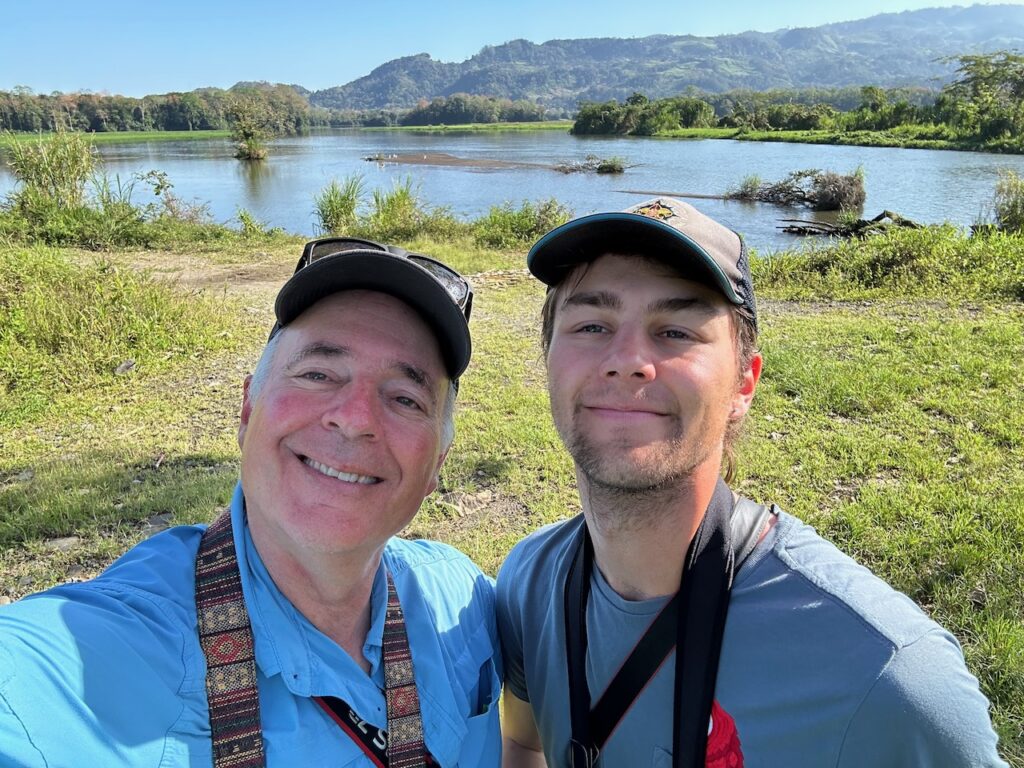
From left to right, Braden, Sneed, Eli, and Susan as we pursued our spirited quest to locate the “Arctic Loon.”

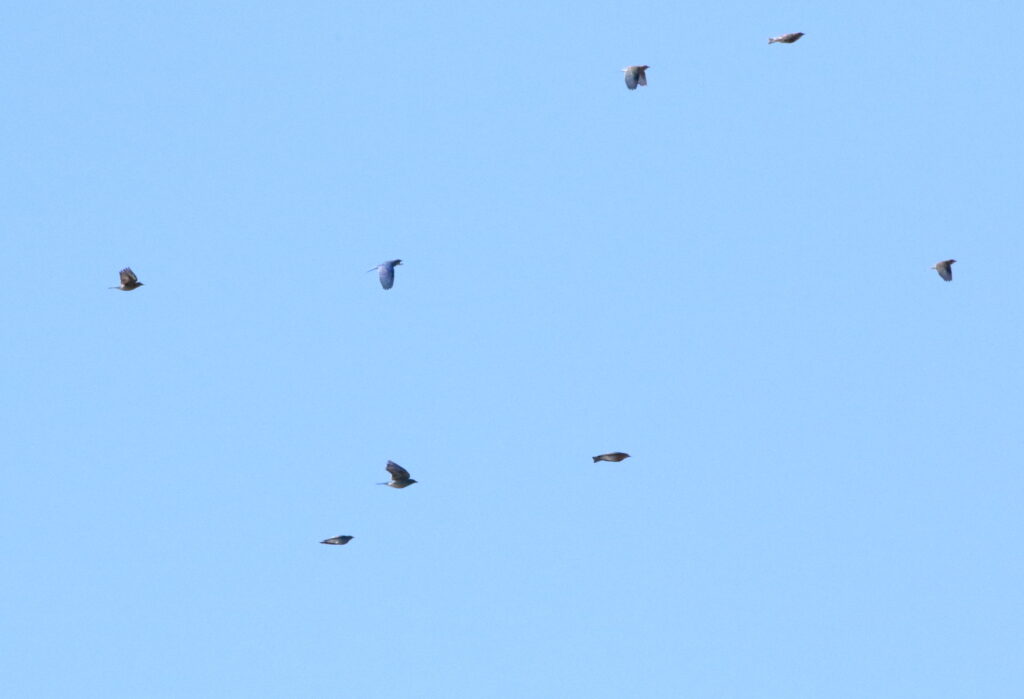
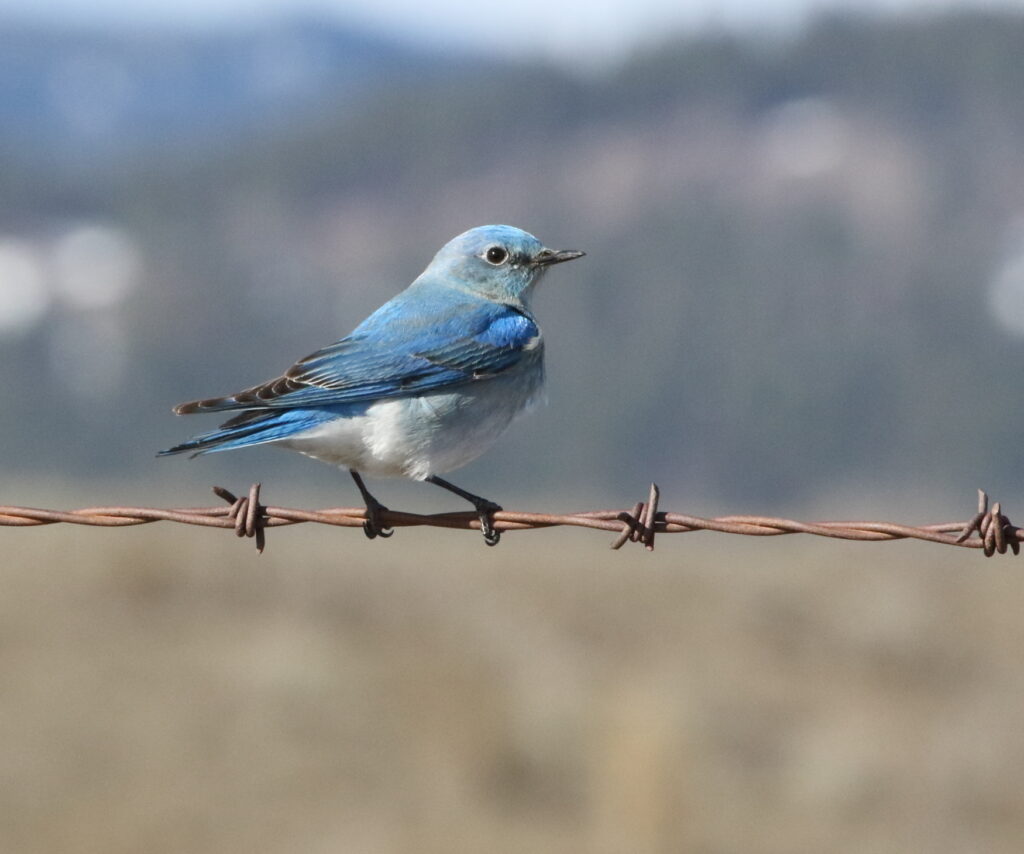
After a fruitless stop to look for Long-eared Owls near Polson, we arrived at our destination of Somers on Flathead Lake just after 11 a.m. Dan Casey, who first reported the Arctic Loon, had kindly noted several viewing possibilities from the lakeshore, and we began visiting these. Right off the bat, we saw some interesting birds. These included Red-necked Grebes, a species we had never found in Montana at this time of year, and a couple of Blue Jays, a species Braden and I totally missed in our home state last year.

We saw no sign of a loon of any kind, so continued to explore the lakeshore. More fun birds popped up, including a variety of ducks, Trumpeter Swans, and one of our favorite winter birds, Northern Shrikes. We also toured the neighborhood where we’d seen our lifer Snowy Owl eight years ago (see our very first post, A Quest for Snowy Owls). None of the owls have been reported this winter, but we thought, “Might as well give it a try.” We eventually left the Kalispell area both owl-less and loon-less, but none of us really minded. We were still seeing birds and even better, enjoying each other’s company.

Any day you find a Northern Shrike is a good birding day—and we saw three or four of them during our expedition.

90 minutes later, we were turning down Duck Road at Ninepipe. It was only 3 p.m., but this time of year it felt a lot later. Much of the fog at cleared, but mist still hung off of the spectacular mountains in the distance, giving everything an other-worldly feel. We drove slowly and picked up some expected raptors: Rough-legged and Red-tailed Hawks, Northern Harrier, Bald Eagle, and American Kestrel.  

“Should we go drive by the Short-eared Owl place?” I asked Braden.

“Sure,” he answered and began searching for the location on his phone.

We didn’t get that far.

Heading south on Ninepipe Road, he suddenly shouted, “There’s one!”

I am especially proud of this lousy Short-eared Owl Shot. See how I tilted the camera to make it appear that the owl is flying downhill? Well, guess what? It wasn’t! I just used my advanced photo skills to make you think that. This is a highly complex and dangerous technique, however, so don’t try it at home!

I immediately pulled over so we could all look and, sure enough, there was one of our favorite creatures flying low over a marsh area in the distance.

We had barely begun to look at it, however, when Eli shouted, “There’s another one!”

“Oh my god,” Braden added, scanning with his binos, “There’s three more way out beyond that!”

If I’d been trying harder, I would have been able to capture up to five SEOWs in one shot–but that might have made the photo TOO good for this blog!

We clambered out of our minivan, and the more we looked, the more Short-eared Owls we saw. These weren’t quick glances, either. Some of the owls appeared to be hunting, dropping quickly into the marsh for a go at a vole. Others looked to be courting, sparring and jousting “good-naturedly” and briefly locking talons before circling around again. A couple of owls spent a few minutes chasing away a Northern Harrier who apparently lacked the firepower to defend her space.

This SEOW did not want its identity revealed, so as you can see I used sophisticated AI processing to blur out its face.

While these weren’t the closest SEOWs we’d ever seen, this was far and away the best Short-eared Owl experience any of us had ever had. Not only were the owls engaging in all kinds of interesting behaviors, we had this winter spectacular all to ourselves.

We encountered nary another birder during our half hour enjoying this “most owl” spectacle!

Oh, and did I mention that I got to take more than a dozen lousy Short-eared Owl photos? That felt particularly gratifying since, after three years, I’ve got a reputation to uphold! We hope you enjoy the gallery and keep tuning in to FatherSonBirding. Even more, we hope you keep having your own magical birding moments.

Happy New Year!

P.S. Oh, it turns out that the Arctic Loon got “downgraded” to a Pacific Loon. C’est la loon!

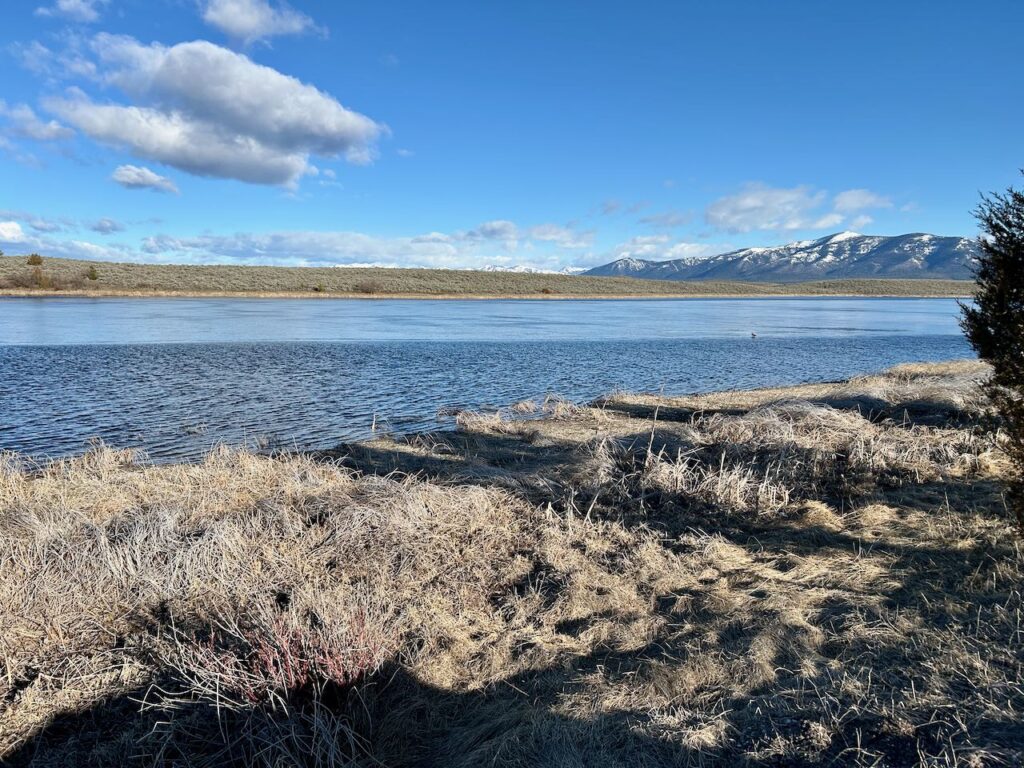
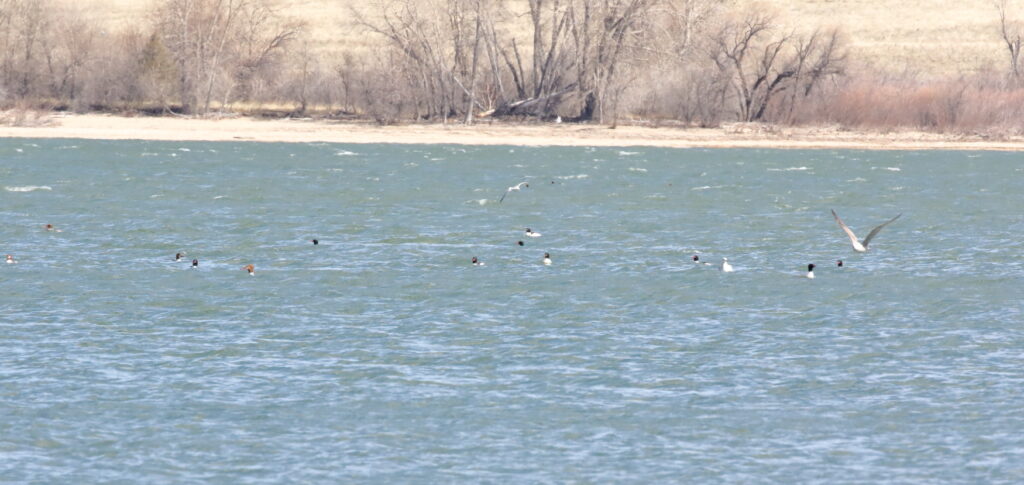
Even without the owls, a winter visit to the Mission Valley is a soulful, satisfying experience. Oh, and can you find Trumpeter Swans in this picture?

Birding 2025: It’s a Wrap

As always, we encourage you to share and link to this post. We absolutely do not give permission to use it to train AI models or for other purposes without permission. Happy New Year, Everyone!

As 2025 rapidly winds up, Braden and I want to thank you for your continuing interest in FatherSonBirding and all that you do for birds. We can’t believe that it’s been almost EIGHT YEARS since we published our very first post, A Quest for Snowy Owls! We certainly wouldn’t have kept at it without your interest and support.

We’re thrilled to report that 2025 has been FSB’s biggest year yet. We published a record 49 posts this year, including our 250th post, “Binoculars and Scopes for the Happy Holiday Birder”. Speaking of that, we also launched FSB equipment reviews—articles we do NOT get paid for, but which have attracted a ton of viewer interest.

FSB received a record 20,000 views in 2025, greatly helped by our equipment and travel reviews!

And speaking of viewers, our site attracted 20,000 views this year, shattering last year’s record of 14,000—with the caveat that about a thousand of those views were likely from AI bots stealing our content without permission (Grrrr…). Still, the vast majority of those extra visitors were legitimate—and from an astounding variety of places. More than 15,000 viewers from 104 countries visited our site this year! Huge gracias, arigatos, mercis, and many more thank yous to our international visitors!

By now, we can hear you pleading, “But please, Sneed and Braden, tell us your Top 5 most popular posts!” Astoundingly, four of our five top posts were equipment review posts:

1) Vortex Triumph 10X42 Binoculars: Entry Level Excellence with 1,425 views. (View post here!)

2) Nikon Monarch HG Binoculars: FSB’s First Equipment Review with 950 views (View post here!)

3) Vortex Razor HD 13-39X56 spotting scope with Mountain Pass tripod: A Perfect Travel Combo? With 580 views (View post here!)

4) Birding Barcelona, Part 1: The Urban Core with 510 views (View post here!)

5) Vortex Viper HD Binoculars (Equipment Review, and/or Texas 2025 Part 2-½) with 480 views (View post here!)

Our 2024 blog about birding downtown Barcelona snuck into the Top 5 for 2025—with several of our Japan and Costa Rica posts close behind!

The numbers reveal some clear trends: with rare exceptions, our most popular posts have been our equipment reviews and reports from travel destinations. Our posts from Japan, Spain, Colombia, Mexico, and Costa Rica have been especially popular—as have posts about very birdy domestic locales such as Texas and San Diego. Our book reviews also have done well, but a decline in America’s literacy rate is clearly evident, as our statistics reveal that many more viewers are interested in buying gear than in reading books.

On a personal level, Braden and I are grateful for the many wonderful birding experiences we got to share, both together and separately. Braden was fortunate to visit both Mexico and Costa Rica in 2025 as well as take an epic cross-continent trip from Maine to Montana following his graduation from the University of Maine. He also birded the heck out of Arizona while on his way to his current job in California, where he’s racking up all kinds of new birding experiences.

As for Sneed, I kicked off the year with a trip to Victoria, Canada, thanks to my wife, Amy—and, honestly, the year never seemed to slow down. As soon as we returned, my buddy Roger Kohn invited me on an epic last-minute trip to Colombia. There followed journeys to Texas, Maine, eastern Montana, California (twice!), and most recently, Georgia and Oregon. Most of the latter were not planned as birding trips, but you won’t be surprised to learn that we saw a ton ‘o birds along the way.

You also won’t be surprised to learn that, quite unintentionally, Braden and I shattered most of our own birding records. Braden finished out his birding year with a remarkable 867 species while I smashed my own previous record with 551 species!

One of the low points for the year was having to say goodbye to our wonderful “birding dog” Lola. She left us far too soon and we still miss her terribly. (See this post.)

Besides finding birds, Lola proved adept at finding marine mammals such as this whale. We miss you Lola!

Moving forward, we hope to continue to publish a wide variety of posts for your reading pleasure, including those about everyday birding experiences that are at the heart of a birder’s joy and wonder. Just a few adventures that we have lined up for 2026 include trips to Costa Rica and Germany, along with visits to birding festivals in Colorado, Arizona, and Montana. Meanwhile, it is our sincerest wish that the next year brings you all good things, including many incredible birding experiences and a brighter outlook for birders, birds, and the planet we all share.

For some ideas about how to help birds this coming year, please visit our last post, Giving Back to Birds—with Great Breaking News! As always, if you would like to help support FatherSonBirding, consider buying new copies of some of Sneed’s books by clicking on the book jackets to the right.

Giving Back to Birds—with Great Breaking News! (FSB Holiday Shopping Guide, Part 3)

Holiday Joy! Back in August, we alerted FSB readers to Houston Audubon’s effort to buy a critical piece of land for their globally-important Bolivar Flats refuge. (See this post!) This is a refuge Braden and I have visited and is a vital habitat and staging area for hundreds of thousands of birds annually. When a developer planned to build a housing development smack in the middle of it, Houston Audubon negotiated an option to buy and protect the property. The problem? A $3 million price tag! We were skeptical that it could be done, but guess what? GUESS WHAT??? Thanks to donations by 1,127 donors from 47 states and 8 different countries, Houston Audubon achieved its goal! Donations included a huge check from Roku CEO/Founder Anthony Wood and his wife Susan. (I knew I loved Roku for a reason!) Everyone who donated—and those who didn’t—should be immensely pleased, because this is not only a crucial win for birds, it is a win for all of us. It also is the perfect lead into today’s blog topic—End-of-the-Year giving for birds!

Especially near the end of the year, when tax deadlines are looming, we know that a lot of you are asking yourselves, “What can I do to help birds?” We all know that birds are in big trouble, but it can feel overwhelming to figure out just how to spend our donation dollars most effectively. Today, in order to make your lives a bit easier, we are pleased to present a short list of Braden’s and my favorite groups that are helping birds, and yes, we have donated to every one of them. To find out more, just click on the underlined names below. Then, please, please break out that credit or debit card! We truly are at a global crossroads in the fight to save birds, and we guarantee that every dollar you spend will make you feel just a little bit better. While you’re at it, you might want to join your local Audubon chapter and/or the American Birding Association to help connect you to other birds, share information, and expand the love of birds!

Groups Working Internationally

Cornell Lab of Ornithology—the maker of eBird and Merlin makes huge investments in science and education to raise awareness of birds and promote conservation.

Bird Life International—Braden’s favorite group works on the entire international spectrum of bird threats, and also works with local communities to help protect birds and habitats. (Andean Cock-of-the-rock photo courtesy of Roger Kohn!)

Union of Concerned Scientists—one of Sneed’s favorite groups, we make monthly contributions to this group working to fight rampant disinformation and promote rational, scientific solutions to a host of environmental problems facing us.

Groups Focused Mainly on North America

Audubon—still the biggest name in birding, Audubon promotes bird conservation and education, and works on legislation to protect birds. (Note: the national, state, and local chapters are all independent entities. Donations to national do not trickle down, so consider donating to all three.)

Owl Research Institute—one of the few groups focused on one of the world’s most charismatic groups of birds, ORI has been collecting data on owls for more than thirty years, sharing it with many different entities to shape science and conservation priorities. They especially work to decipher the causes behind the decline of many owl populations—including those of this Short-eared Owl.

American Bird Conservancy—also works on a wide range of bird-related issues including the urgent problem of outdoor cats.

State and Local Groups

Montana Audubon—besides putting on the wonderful Wings Across the Big Sky birding festival every year (and yes, Braden and I plan to be there in 2026!), Montana Audubon works to educate birders, identify the Treasure State’s bird conservation priorities, conduct research on endangered species, and carry out many, many other activities that benefit birds and birders.

Houston Audubon Society—a regional bird powerhouse, promoting bird education and conservation, and protection of vital habitats, especially for migrating birds. Think High Island from the movie The Big Year! (Roseate Spoonbill shown.)

Bird Conservancy of the Rockies—another regional powerhouse with widespread activities including vital research into wintering grounds of grassland birds in the Southwest and Mexico.

University of Montana Bird Ecology Lab (UMBEL)—conducts important research, monitoring, and outreach activities around the region!

Montana Bird Advocacy—a grassroots research organization started by well-known Montana birding legends Jeff Marks and Paul Hendricks, MBA conducts research on little-known Montana birds such as the Gray Flycatcher. (See our post Gray Flycatcher Science.)

An unbanded adult Gray Flycatcher implores: “Donate Now!”

Books for the Happy Holiday Birder (FSB Shopping Guide, Part 2)

If you’re like me, you never read quite as many books as you’d like. This year, though, I was very fortunate to read and review some outstanding bird-related titles that you’re going to want to consider for your holiday buying. Most—but not all—of these were published in 2025 or late 2024. I’ve also included a few books that aren’t solely about birds—but give great insights into how to protect them. Of course, you will want to begin your shopping with eight or ten copies of my book Birding for Boomers—And Everyone Else Brave Enough to Embrace the World’s Most Rewarding and Frustrating Activity. This popular gift book has received half a dozen awards and even made a couple of bestseller’s lists. Once you’ve placed that order, however, you’ll want to check out the titles below. Please note: we receive no compensation for any of these recommendations (other than a free review copy or two), so the thoughts are all our own. Enjoy!

Purely Enjoyable Bird Storytelling

Let’s start with the “most fun” category of reading—great storytelling that just happens to be about birds. In the past, I’ve recommended such titles as Christopher Skaife’s The Ravenmaster, Joshua Hammer’s The Falcon Thief, and Tim Gallagher’s classic, Imperial Dreams. My favorite title from this year’s reading is Tim Birkhead’s The Great Auk: Its Extraordinary Life, Hideous Death and Mysterious Afterlife. This wonderful, often whimsical tale focuses on an extinct species most of us have heard of, but know little about. Birkhead gets totally into Bird Nerd mode by both explaining the biology and history of the Great Auk, and tracing some of the antics of egg collectors who were totally obsessed with obtaining Great Auk eggs. You’ll love this! See our full review here.

The Great Auk by Tim Birkhead (Bloomsbury, 2025)

Also on the short list for this category is Bruce M. Beehler’s Flight of the Godwit, a must-read for anyone interested in the remarkable lives of shorebirds—and who isn’t? Through the tales of his own peregrinations, Beehler follows the migrations of many of North America’s most charismatic shorebirds, telling us all kinds of cool things that I certainly never knew before. See our full review here.

Birding Memoirs

My top pick for this category is Christian Cooper’s 2023 book, Better Living Through Birding: Notes from a Black Man in the Natural World. I admit that I put off reading this book for a couple of years after it came out. It’s sheer popularity made me insanely jealous as an author, but once I picked it up, I was captivated. Cooper’s down-to-earth honesty about his life and passion for birds sucked me right in, both with its engaging storytelling and how it broadened my perspective on birding in our culture.

My second pick for this category is Richard L. Hutto’s new book, A Beautifully Burned Forest: Learning to Celebrate Severe Forest Fire. This book is half memoir and half science book and I enjoyed both parts equally. Perhaps as a fellow Southern Californian, I especially related to Hutto’s boyhood experiences exploring the chaparral ecosystem, but I also appreciated Hutto’s impassioned plea to bring common sense to fire management, especially when it comes to protecting burned forests from the ravages of so-called “salvage” logging. See our full review here.

Oh, and if you’re wanting to learn all about Braden’s and my early years of birding, don’t miss my classic first adult book, Warblers and Woodpeckers: A Father-Son Big Year of Birding!

In-Depth Group Guides

Advanced Bird Nerds will definitely want to add Amar Ayyash’s The Gull Guide: North America to their holiday shopping lists this year. Like most birders, I have been—and remain—incredibly intimidated by gulls. Sure, I recognize the adult plumages of many species, but when you start getting into hybrid gulls and first-, second-, and third-year plumage variations, my brain and confidence begin to melt. The Gull Guide does not solve this problem, but it does accomplish two important things. First, it gives great insight into gulls for the casual birder. Second, it offers myriad minute details for those who are bound and determined to become experts on everything gull. Both of these things are accomplished with an extensive, remarkable collection of photos that serve to educate and guide. See our full review here.

A less technical book that may be more to the taste of the casual birder is The Shorebirds of North America: A Natural History and Photographic Celebration by Pete Dunne and Kevin T. Karlson. This beautiful book strikes a nice balance between detail and readability. A lot, but not all, of the information is fairly general, but the photos are wonderful and if you’re a shorb fan, you will enjoy it. See our full review here.

Three More for the Planet

I’d be remiss if I didn’t mention three more titles that made a big impact on me this year. The first is Sea of Grass: The Conquest, Ruin, and Redemption of Nature on the American Prairie by Dave Hage and Josephine Marcotty. I thought I knew all about the tragic history of the destruction of America’s grasslands. I did not. This highly readable book provides astonishing insights into how we lost most of our grasslands—and why that destruction continues today. Grassland birds are our most imperiled group of birds, losing at least forty percent of their collective populations in just the last fifty years. If you care about these animals and want to know what we can do to slow their precipitous demise, please read this one!

Similarly, Jordan Thomas’s When It All Burns: Fighting Fire in a Transformed World, gives us an inside look at the often counterproductive politics and decision-making behind today’s “fire fighting industrial complex.” With riveting storytelling and astonishing revelations, this is a perfect companion to Hutto’s A Beautifully Burned Forest.

And if you’re wrestling with how to keep from being overwhelmed in today’s world, where we are confronted by one environmental threat after another, I highly recommend the late Thich Nhat Hanh’s Zen and the Art of Saving the Planet. I read a few pages of this every morning and I gotta say that it helps keep me sane in our complicated, highly imperiled world. Not only does it raise serious questions about how we all live, it provides approaches and encouragement for how each of us can truly make a difference.

Don’t miss our holiday guides to birding equipment and, in our next post, charitable giving!

Binoculars & Scopes for the Happy Holiday Birder (FSB Shopping Guide, Part 1)

Today, Braden and I celebrate our 250th blog post! We can hardly believe it ourselves, but it just shows what can happen when the passion of birds and birding infuses your souls. We also celebrate our first year of mixing things up by adding book and equipment reviews. Ahead of the holiday buying season, in fact, we’d like to recap some of our favorite items for that “Bird Nerd” in your life—or maybe even for yourself. If you’re tired of buying stuff, we also include some of our favorite groups working to protect birds around the globe. In Part 1 of this three-part effort, we run down great binoculars and spotting scopes. In our next two posts, we’ll talk about some of our favorite bird books and bird conservation groups. As always, we thank you for your interest and urge you to share these posts with your friends and family—especially if you want them to buy you something!

Serious about upgrading your birding optics? Read on!

As 2025 draws to a close, we don’t claim to have tested every brand and model of optics out there, but have been fortunate to put products from both Nikon and Vortex through the paces. We gotta say that if you’re in need of great optics at reasonable prices and with amazing warranties, you won’t do better than these two brands. Nikon products tend to sell close to their official list prices and can be purchased from their website here, or from third parties (see below). Vortex products, on the other hand, usually can be found at much lower prices than what they list for. To get the best price, start with your local indie sporting goods store, but if you can’t find what you want, Dick’s Sporting Goods, B&H Photo, and Land, Sea, & Sky are solid, reputable businesses we’ve had great experiences with.

Binoculars for around $100

Our most popular post of this year was our review of the Vortex Triumph HD 10X42 binoculars, and for good reason. Not only do the Triumphs offer excellent quality at an amazing price, they come with Vortex’s mind-boggling no-questions-asked replacement and repair warranty, something I still can’t believe even exists! One downside to the Triumph HDs is that their minimum focal length is a fairly long 16 feet. Then again, I only need a closer focus than that once or twice a year, so a casual or beginning birder will hardly be affected. See our full review here.

Vortex Triumph HDs offer excellent value for most beginning birders and, like other Vortex products, come with a lifetime no-questions-asked warranty.

Especially if small and lightweight is your goal—or if you’re buying binoculars for the kid in your life—you will also want to consider the new Vortex Bantam HD 6.5X32. Though aimed at kids, these lightweight little gems are fantastic for travel, backpacking trips, or people with sore backs. I loaned a pair to my brother and he didn’t want to give them back! Even more amazing, they can purchased for about $70—a sizzling deal at a time when many of us have to cut back on spending. See our full review here.

Binoculars for about $300

The first serious binoculars Braden and I ever bought were Nikon 10X42 Monarch M5s—and Braden still uses them today! How can that be, you ask? Well, not only are the Monarch M5s solid, well-built binoculars with sharp, clear optics, Nikon offers great repair and replacement policies. Braden has sent his in twice for repair—and received brand-new replacements free of charge. You can’t beat that. For $300, these are an excellent investment for those on a budget, but still wanting binoculars that are up for almost any birding situation.

Braden and I both relied on our Nikon Monarch M5s for the first eight years of our birding. They are still Braden’s go-to optics!

“Best Bang” Binoculars for about $500

If you’re willing to shell out just a bit more, I was especially impressed with Vortex Viper HD binoculars. In fact, I’ll go so far as to say that these may deliver the best bang for your buck available. During my trip to Texas last spring, they performed extremely well in a variety of conditions. Our guest contributor Roger Kohn and his wife Claudia also use these and are very happy with them. See our full review here.

After testing products across the Vortex line, I have to say that I think Vipers deliver the biggest bang for your birding buck!

Gasp! Shelling out a Grand!

I’ll admit it: I never thought I’d be using $1,000 binoculars, but boy am I glad that I do! Especially if you bird a lot in dark, overcast conditions—or even in shockingly bright ones—stepping up the quality can really make a difference. My top pick in this price range? Nikon Monarch HG 10X42s. I took these on last winter’s trip to Colombia and was uber-impressed. My very first morning, I saw a woodpecker fly into a dark, overhanging branch of a tree at least two or three hundred yards away. I thought “No way will I be able to ID that.” When I raised my Monarch HGs to look, though, I was astonished to be able to recognize it as one of the birds I especially wanted to see: a Crimson-mantled Woodpecker! See our full review here. I must add that because these were the first binoculars I reviewed this year, I didn’t realize just how good the optics are, so if you have the cash, you will not regret getting these.

Also in this price range, you will want to check out the Vortex Razor HDs, also priced at about $1,000. I have been using the Razors extensively since last spring and have been very happy with them. I especially love the extra-smooth center focus knob. See our full review here.

Me and my birding amigo Roger in Colombia last February, where my Nikon Monarch HGs delivered superior performance! Meanwhile, Roger is shown happily birding with his trusty Vortex Vipers.

Ready for a Spotting Scope? Sure You Are!

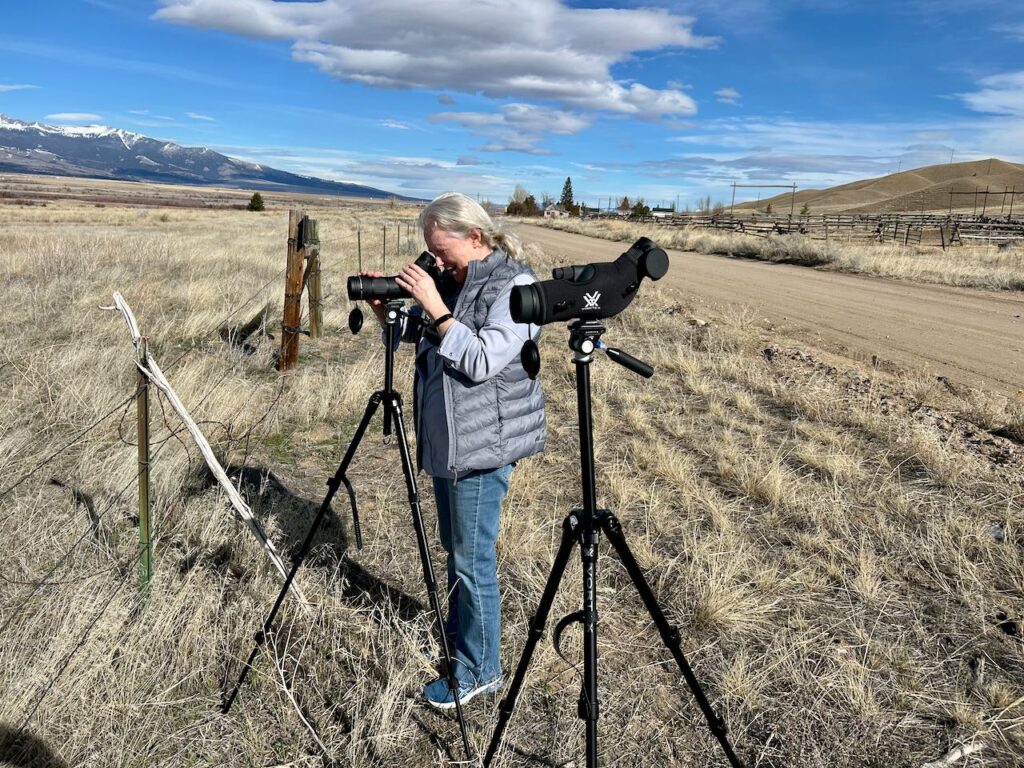
When we first started birding, Braden and I resisted getting a spotting scope because they seemed like such a pain to shlep around. Within a couple of years, we realized that scopes are essential birding equipment. Many, many manufacturers make and sell spotting scopes, but I’ll tell you, this is a purchase you will want to stretch for. We bought a cheaper scope in the $300 range—and are sorry we did. A couple years later, we sprung for a Vortex Viper HD 20-60X85, and love it. I just looked these up at B&H Photo and it looks like they can be had for about $700—a screaming deal. Don’t forget, though, that you also need a tripod to go with that scope. If you can afford it, I recommend buying a Vortex tripod to go with your Vortex scope, so that you won’t have to keep messing with a tripod adapter, which will invariably come loose as you are lugging your scope around.

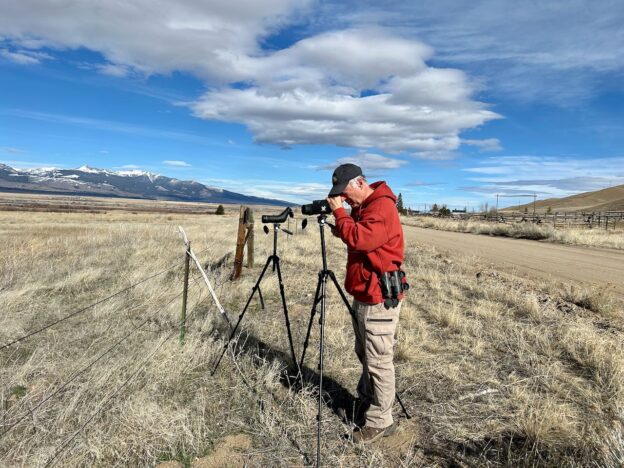
Braden zeroing in on a rare Piping Plover in eastern Montana using our beloved Vortex Viper HD 20-60X85 spotting scope.

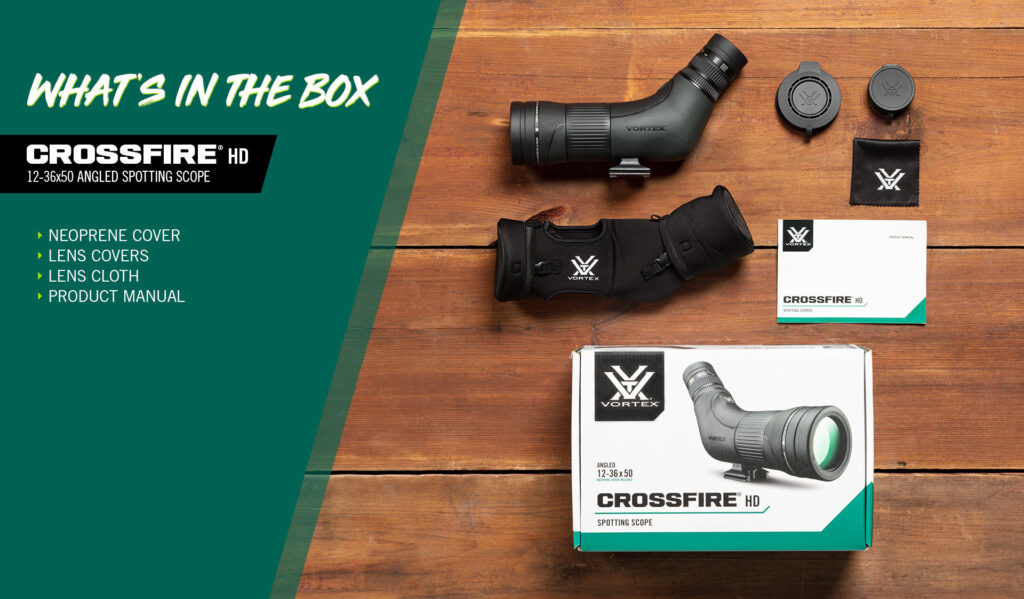
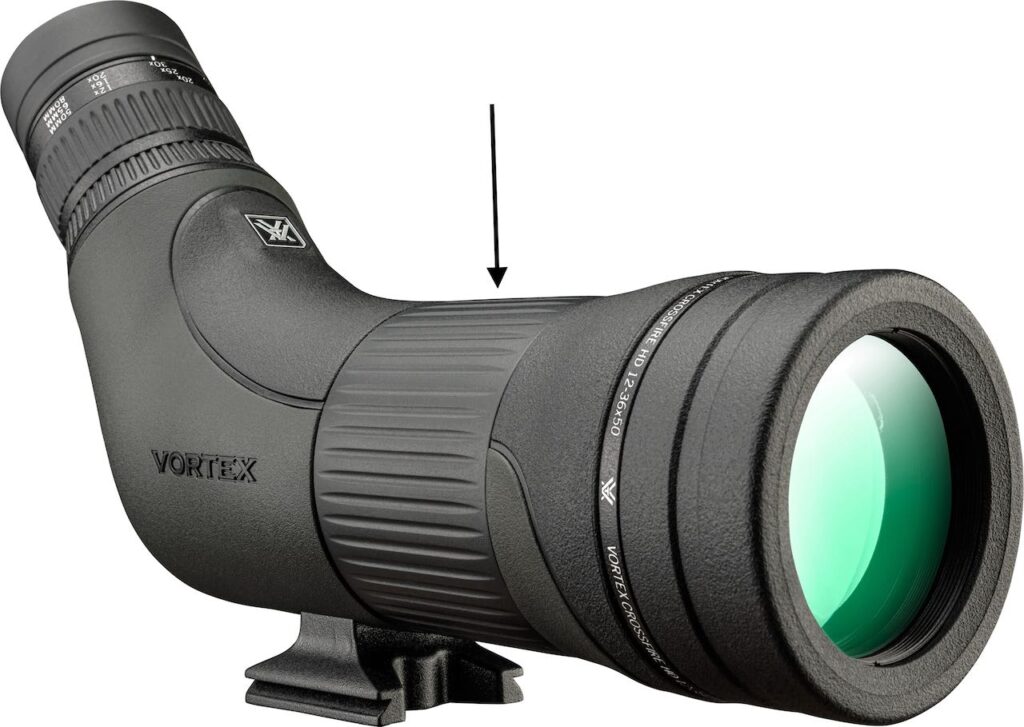
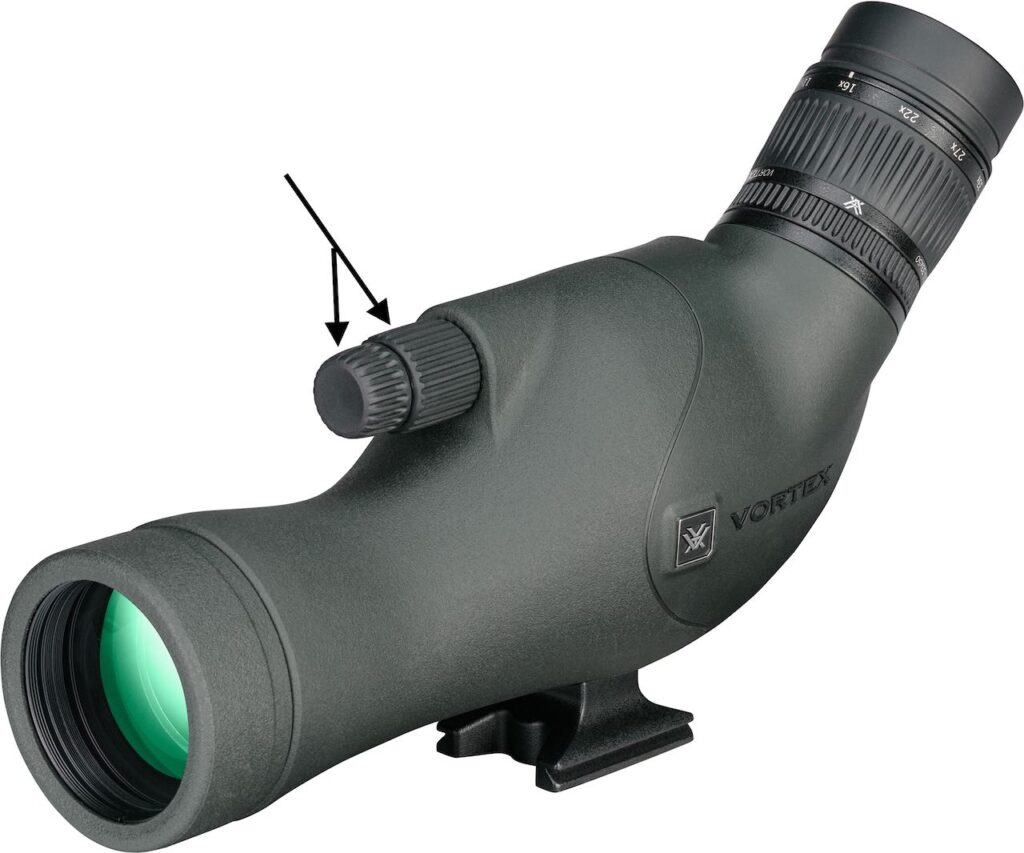
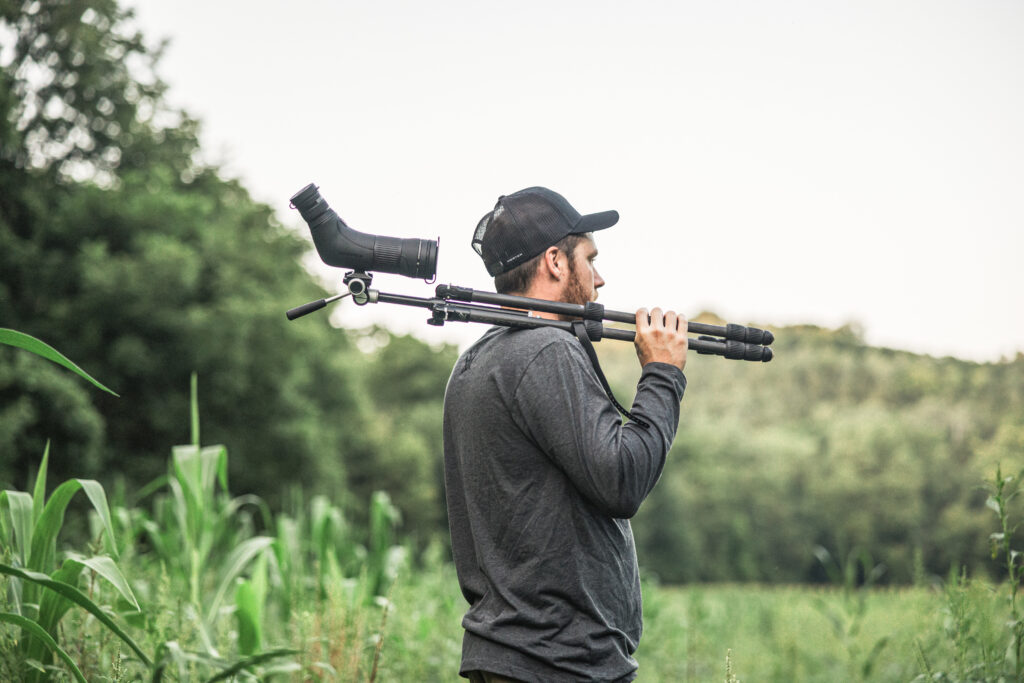
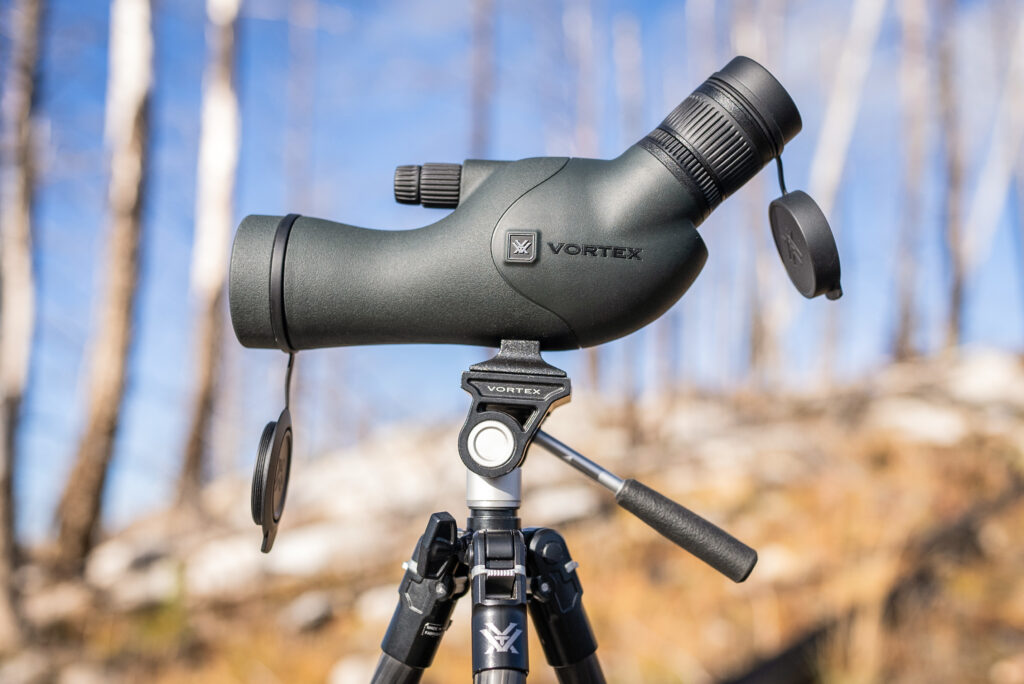
The above scope is definitely a “car model,” meaning it’s heavy enough that you won’t want to carry it more than a couple hundred yards. Last summer, though, I also tested a Vortex Razor HD 13-39X56 spotting scope with Mountain Pass tripod. At a total weight under five pounds, this lightweight combo is perfect for taking on planes in your backpack or even heading out into the wilderness if you’ve got to have a spotting scope with you. Just checking different outlets, it looks like the scope/tripod combo can be had for about $1,000 right now. It won’t pack the magnification of the bigger scope mentioned above, but it’s a great trade-off for those of us who travel a lot. In fact, I didn’t want to send my evaluation scope back to Vortex and am considering buying one for my own holiday gift! See our full review here.

In calm conditions, the Razor HD 13-39X56 and Mountain Pass tripod perform like a dream. Because they are lighter, wind produces more shake, just as it does for all but the heaviest scope/tripod combinations, but a convenient hook allows you to hang a stabilizing weight from the tripod.