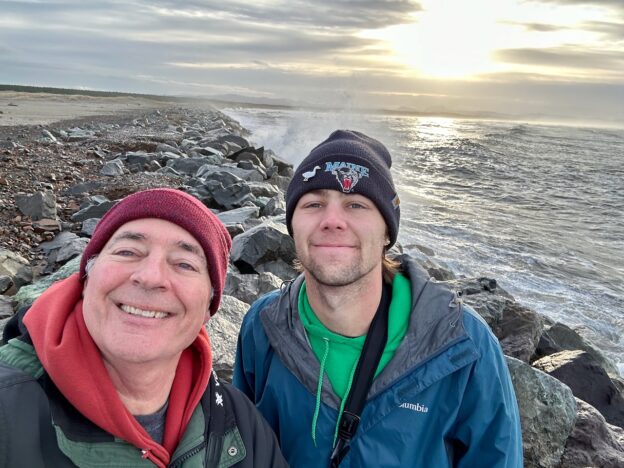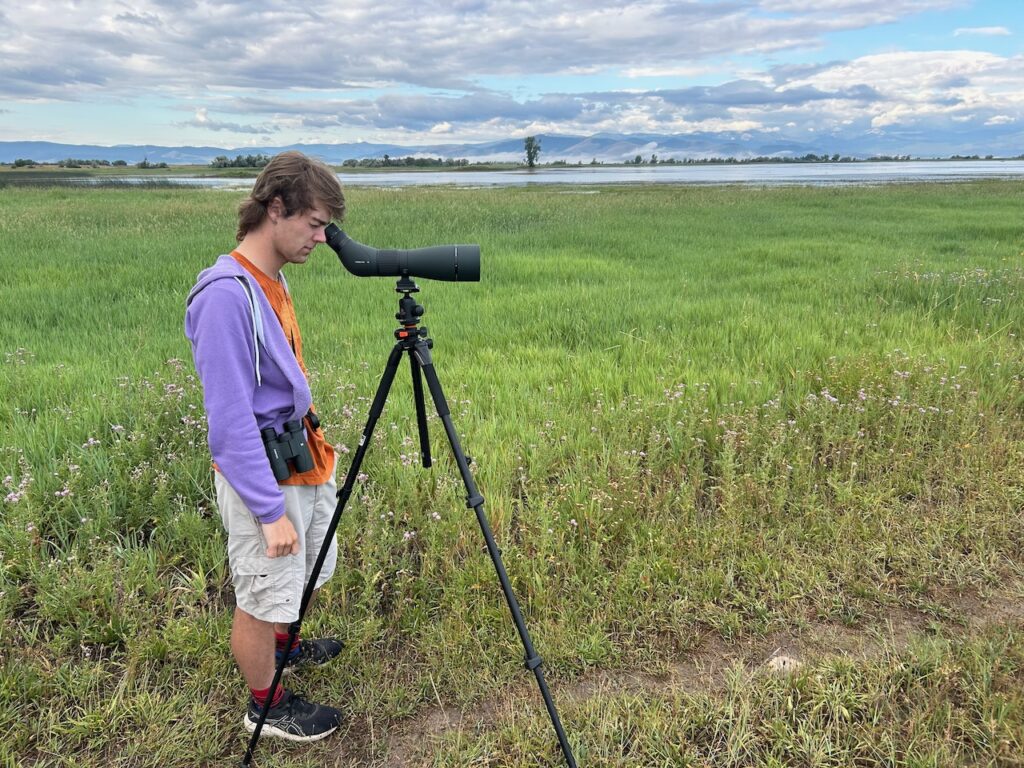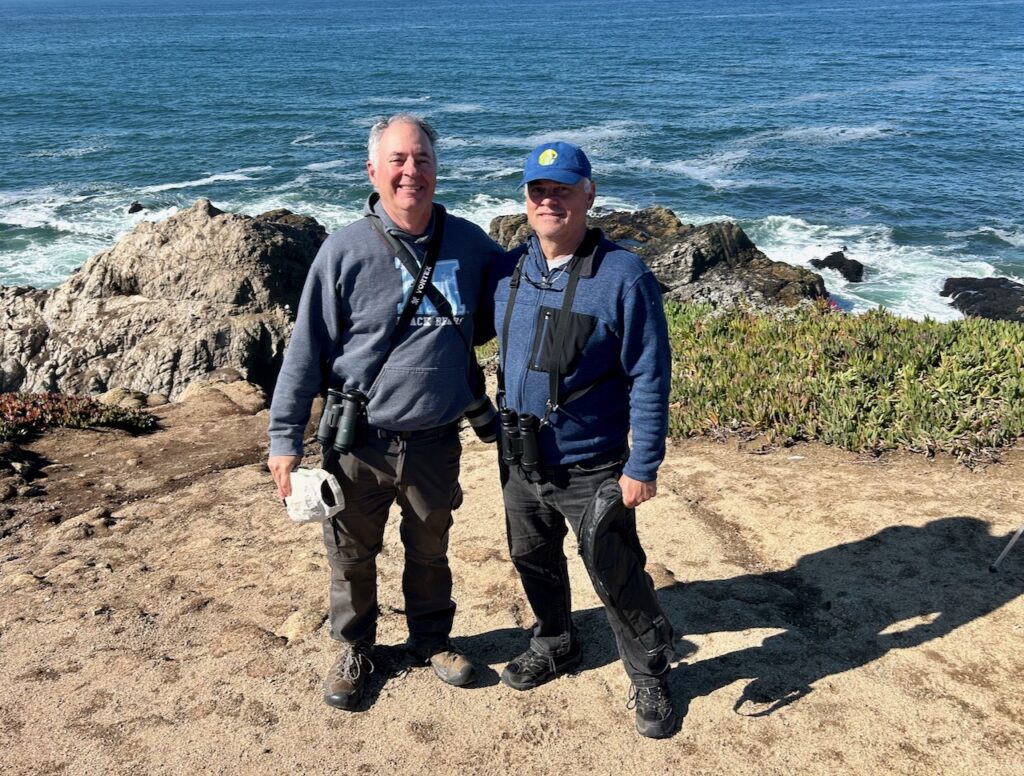
Category Archives: Roger Kohn

2026 Southeast Arizona Birding Festival Recap

Birding Arizona in August??? That is exactly what the SE Arizona Birding Festival offers—and lucky attendees are happy that it does.

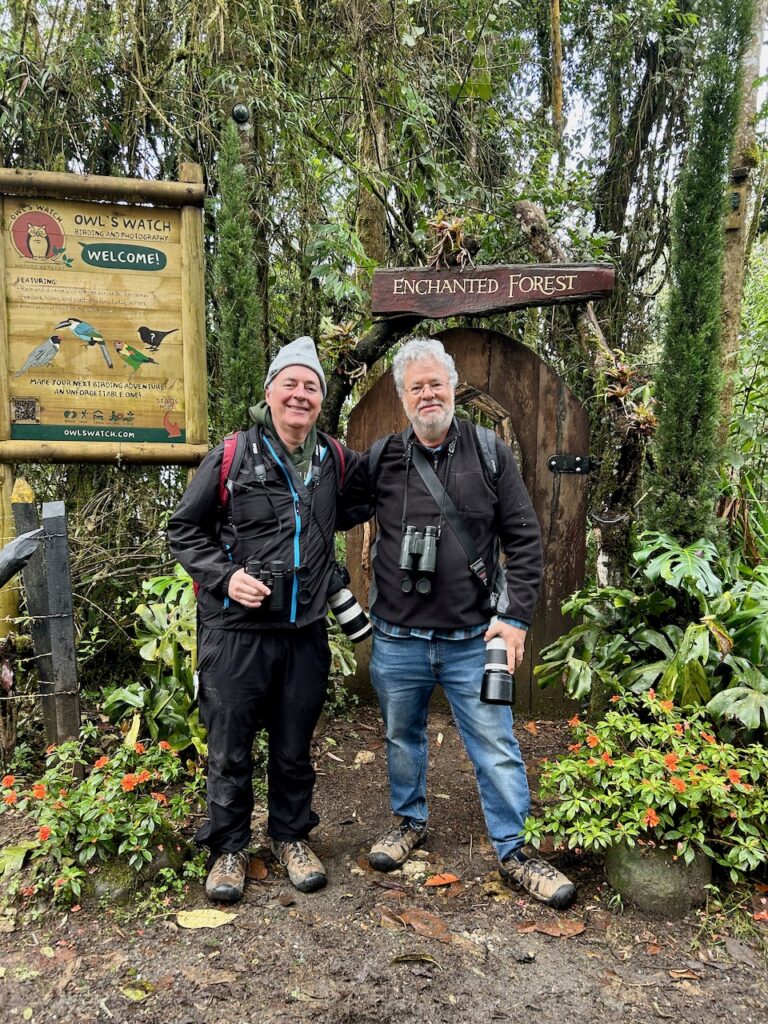
I was fortunate to be invited to speak at and co-lead field trips at this year’s festival, which ran from August 12 to the 16th, and my first thought was “Why would anyone choose the hottest month of the year to bird in the desert?” However, Luke Safford, the festival’s dynamic engagement director, explained to me that a) June and July are actually hotter than August and b) when the weather gods cooperate, monsoon rains can lead to a flurry of August bird activity. “Why not give it a try?” I thought. To make it even more fun, I asked my friend and FSB guest contributor Roger Kohn (see, for instance, Cock-of-the-Rock Extravaganza—with Video!) to join me.
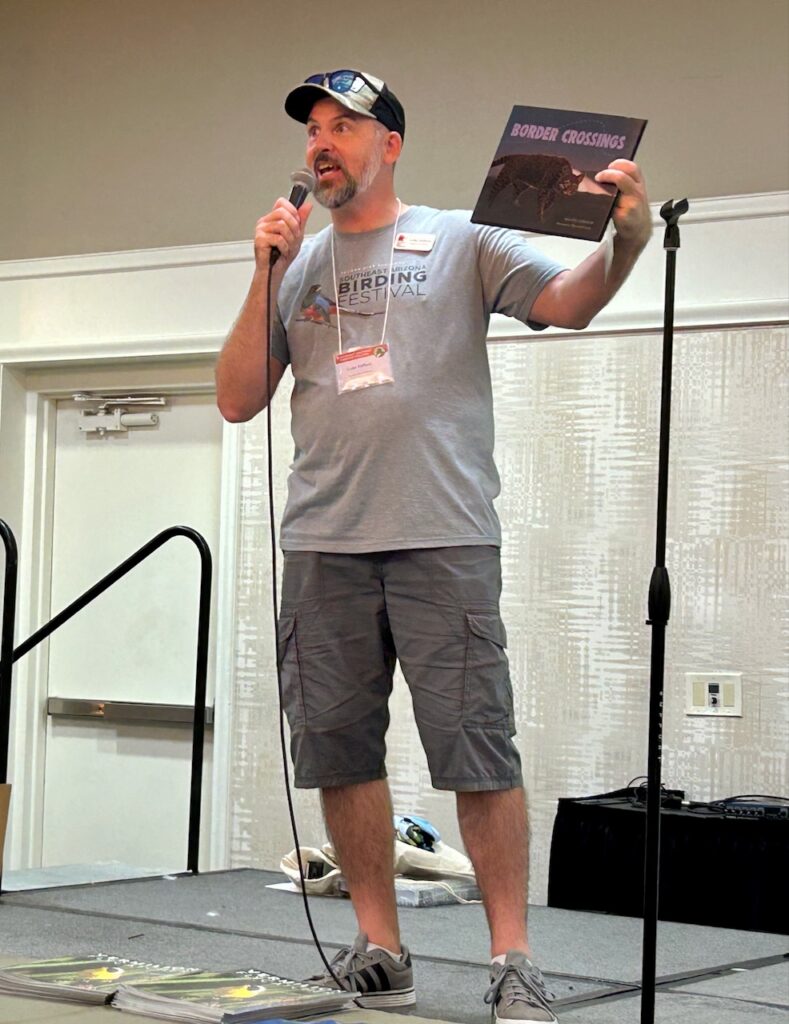
Luke Safford, the festival’s dynamic emcee and one of the chief organizers, helped set an enthusiastic tone for this year’s festival.

As many attendees do, Roger and I decided to head south several days early. Arizona has a well-earned reputation for being one of the best birding states in the country, and both of us felt eager to learn more about its spectacular bird life (see, for example, our post Arizona 2022, Part 3: Trogons and Border Walls). For our first three nights, we made our base camp in Sierra Vista, a spectacular birding location, and one I’ll probably write about in another post. For now, though, let’s focus on this year’s festival.

The festival headquarters was at the Doubletree Hotel just east of downtown Tucson, and kicked off with a party sponsored by Vortex Optics in the exhibition hall. I was thrilled to attend this because it was my first chance to personally meet several people I’d been fortunate enough to work with the past few years, including Donald Ditzenburger of Vortex and BWD Editor Jessica Vaughan. Both of them were just as charming and friendly as I imagined and put me in a great frame of mind for the rest of the event—which for Roger and me kicked off promptly at 5:30 a.m. the next morning, Thursday.
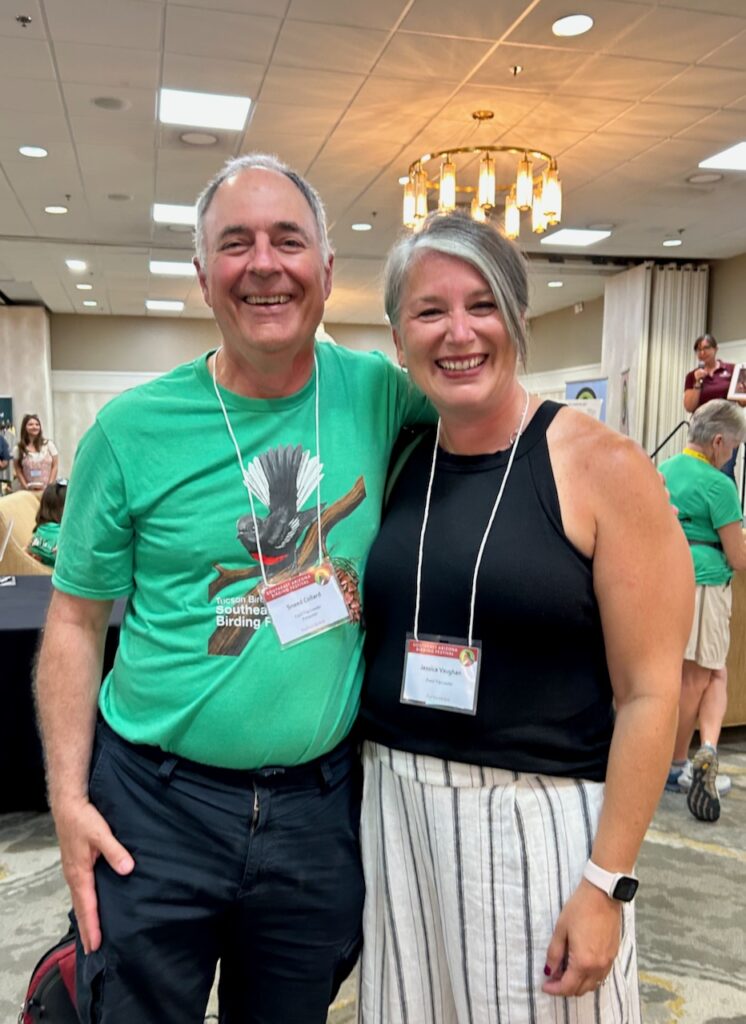
One of the highlights of this year’s festival was getting to meet my BWD (Bird Watcher’s Digest) editor, Jessica Vaughn!

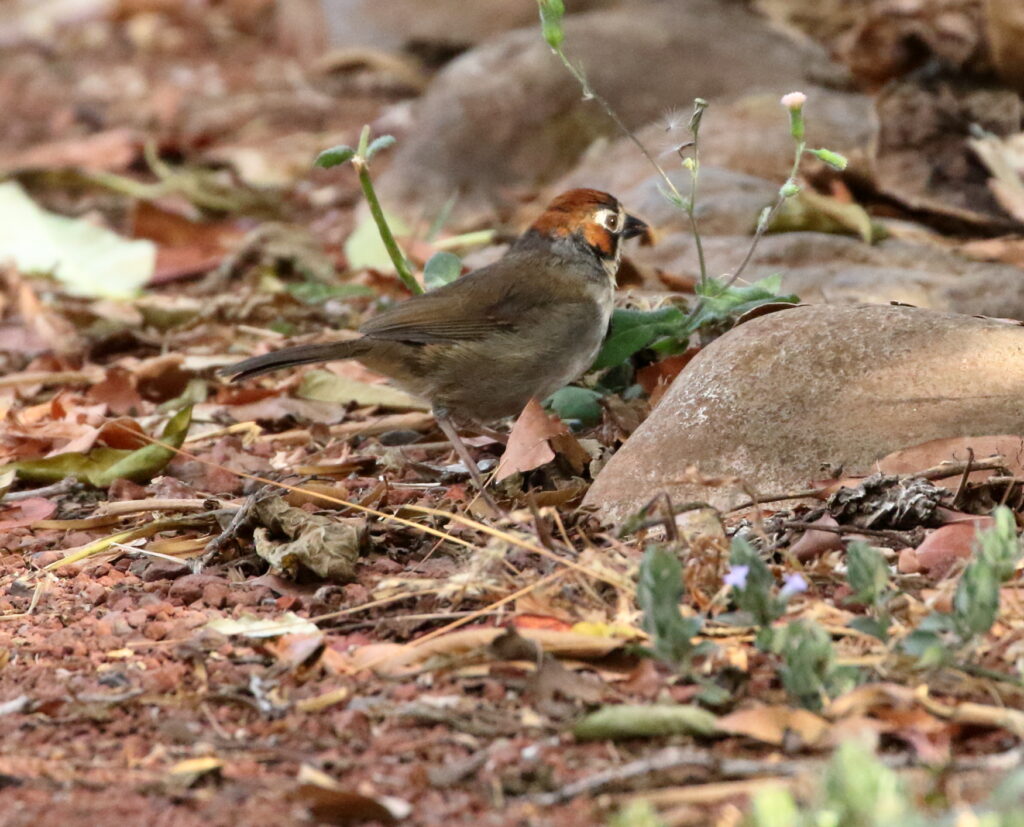
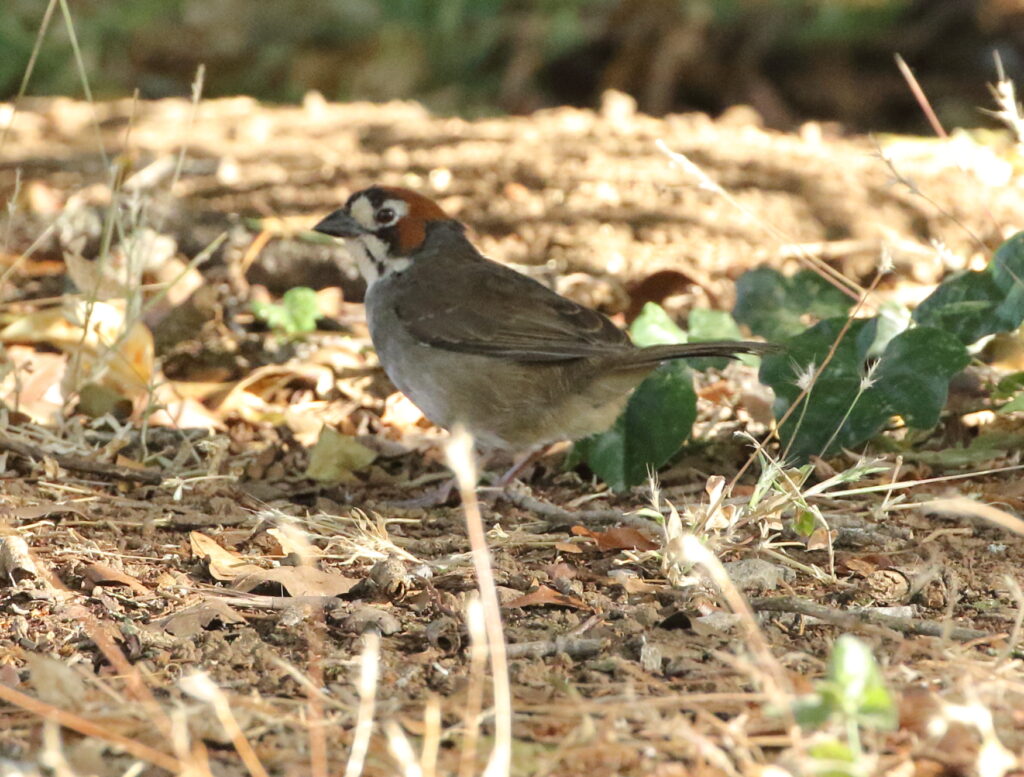
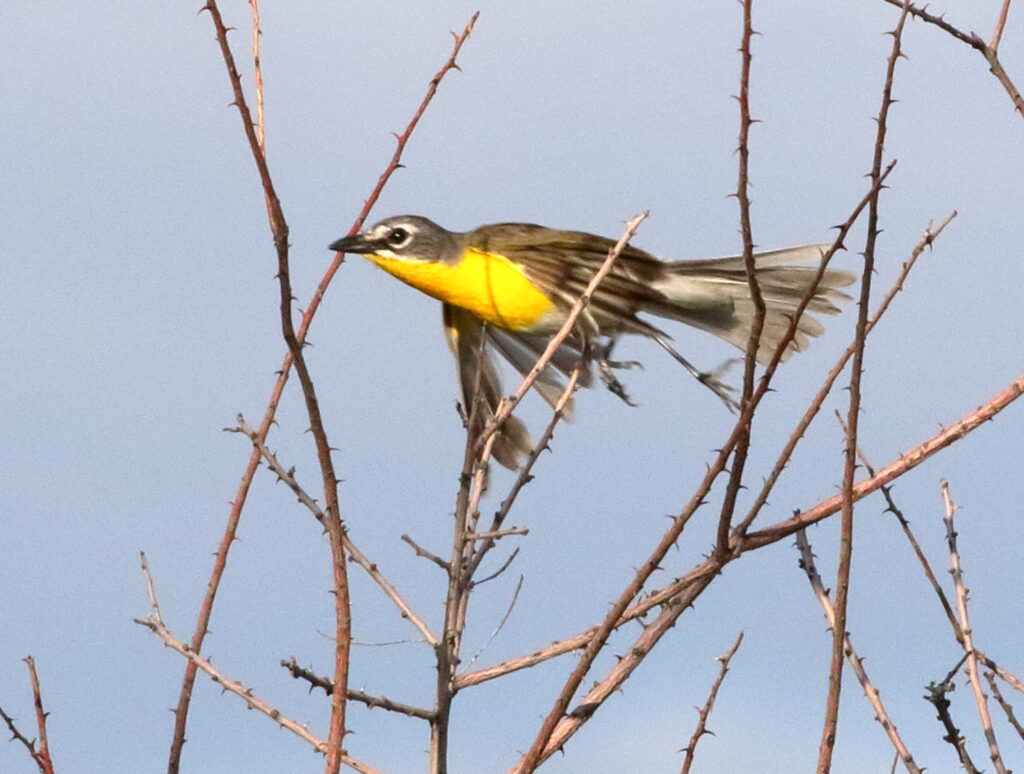
When one is invited to a birding festival, the understanding is generally that one will both give a presentation and be a “celebrity leader” on several field trips. The real field trip leaders, however, were the local experts and for our first trip, Rog and I were lucky enough to accompany Adam Dudley on an extensive tour of riparian habitat on the Santa Cruz River and then up to world-famous Madera Canyon. Besides being as friendly as he could be, Adam had excellent ears that allowed us to detect way more birds than half-deaf birders such as myself. Along the river, we observed and heard 45 species, and got great looks at Inca Doves, Yellow-breasted Chats, Gila and Ladder-backed Woodpeckers, Cassin’s Kingbirds, and Summer Tanagers. For Adam, the coolest find was a local subspecies of Willow Flycatcher that has become increasingly rare. For many of the rest of us, the top score was probably a Rufous-winged Sparrow, another Arizona specialty.
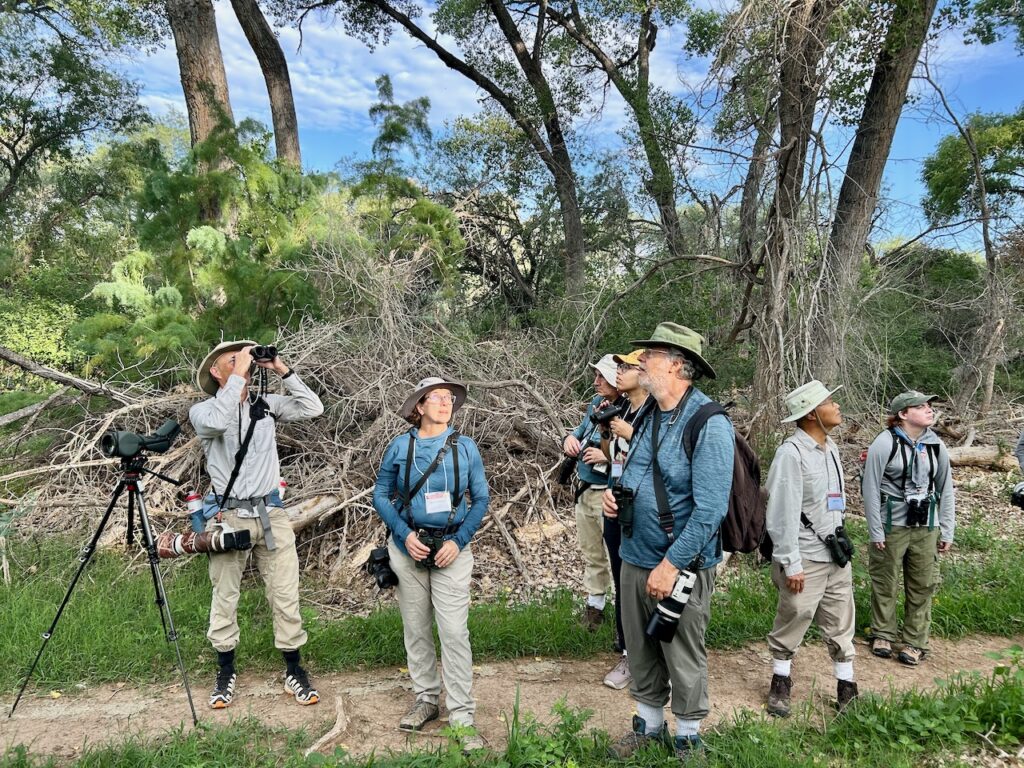
Madera Canyon offered fewer species—but birds Roger and I had especially hoped to see since we wouldn’t be ascending Mt. Lemmon for high-altitude species. I was delighted to find both Yellow-eyed Juncos and Red-faced Warblers, along with Sulphur-bellied Flycatchers, Arizona Woodpeckers, and an absolute stunner of a Hepatic Tanager. Alas, despite a pretty tough three-mile hike, we did not find the day’s number one goal, Coppery-tailed (formerly Elegant) Trogon. Honestly, I didn’t mind a bit since we’d seen so many other great birds.
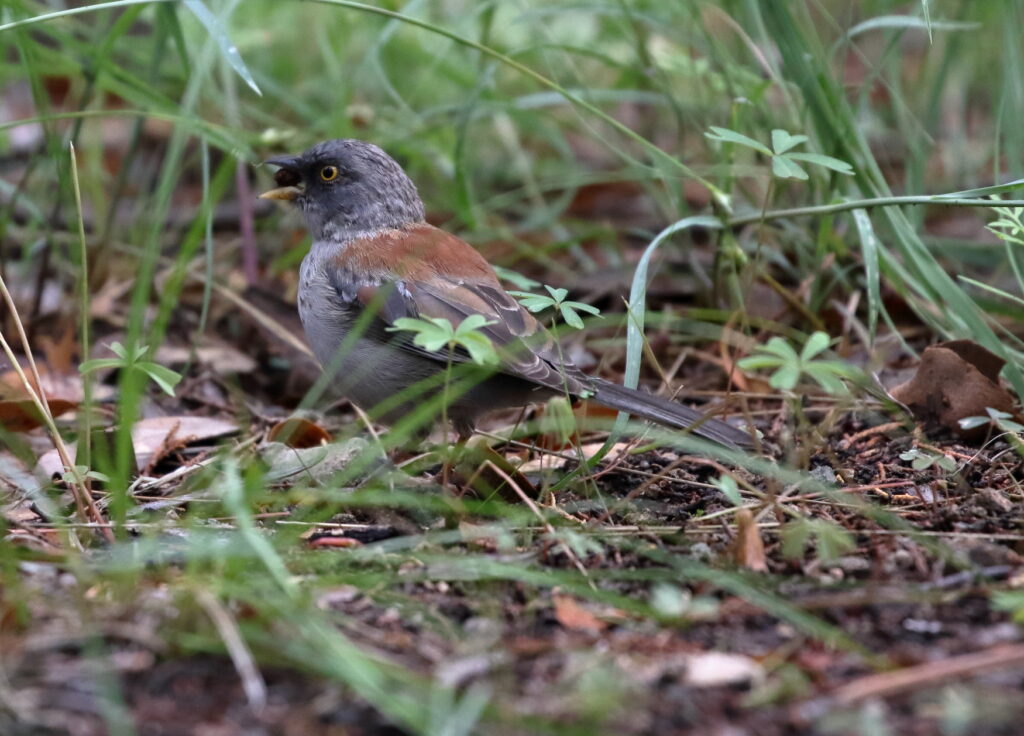
Roger and I were especially thrilled to espy a Yellow-eyed Junco in Madera Canyon since it would be our only chance to see these beautiful, higher altitude birds!

Even better, Adam made a quick pit-stop in between our two destinations so we could see Botteri’s Sparrow—another Arizona specialty and a lifer pour moi.
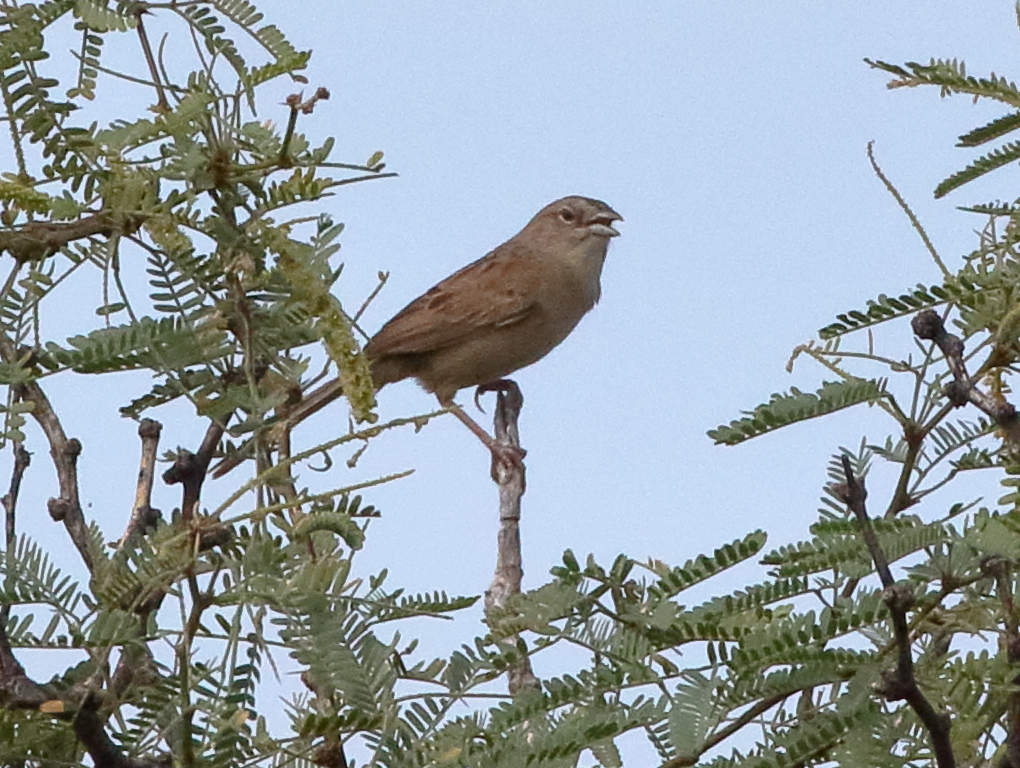
My fourth lifer sparrow of the trip, Botteri’s Sparrow put on a nice show for us among the ocotillo forest near the base of Madera Canyon.

Friday was the day of my talk, so Luke booked us for a half-day field trip with Rob Rutledge, a very knowledgable guide who took us almost to the Mexican border for a tour of Peña Blanca Lake and a couple of riparian spots along the famed Anza Trail along the Santa Cruz River. I was amazed at how verdant the desert looked in the wake of the monsoon rains, which apparently have been excellent this year. We also saw a nice variety of birds including Varied Buntings and Gray Hawks—both adults and juveniles. This was my first real experience with the latter in the US, though Braden and I had recently enjoyed their company in Costa Rica. That night, after a nap and a shower, I delivered my talk to a fun audience of bird enthusiasts, most of whom laughed at my jokes. Can it get better than that?
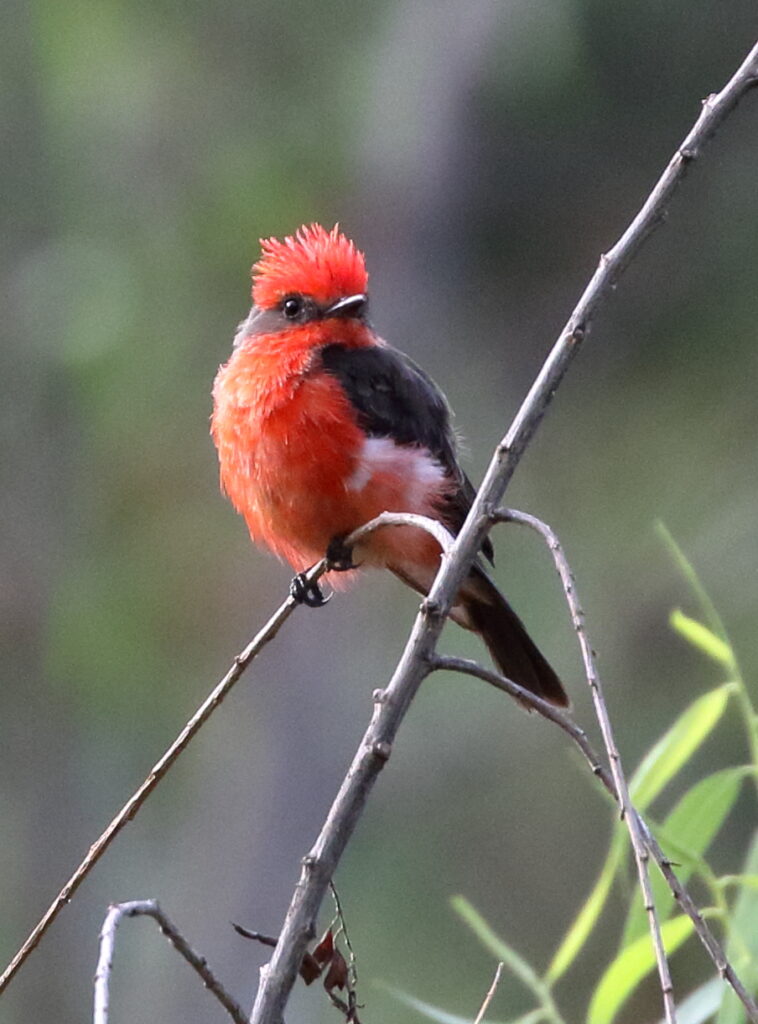
Always a crowd favorite, Vermillion Flycatchers put in daily appearances on our festival outings.

On our final full day of the festival, I drove the trip van ninety minutes to another iconic Arizona birding destination, Ramsey Canyon. Once there, our terrific guide Kristy Gallo first walked us around Brown Canyon Ranch, where we got outstanding views of Blue Grosbeaks and a surprise Olive-sided Flycatcher—in migration, no doubt. As a bonus, I made out the silhouette of a Loggerhead Shrike on a distant tree, backlit by the rising sun.
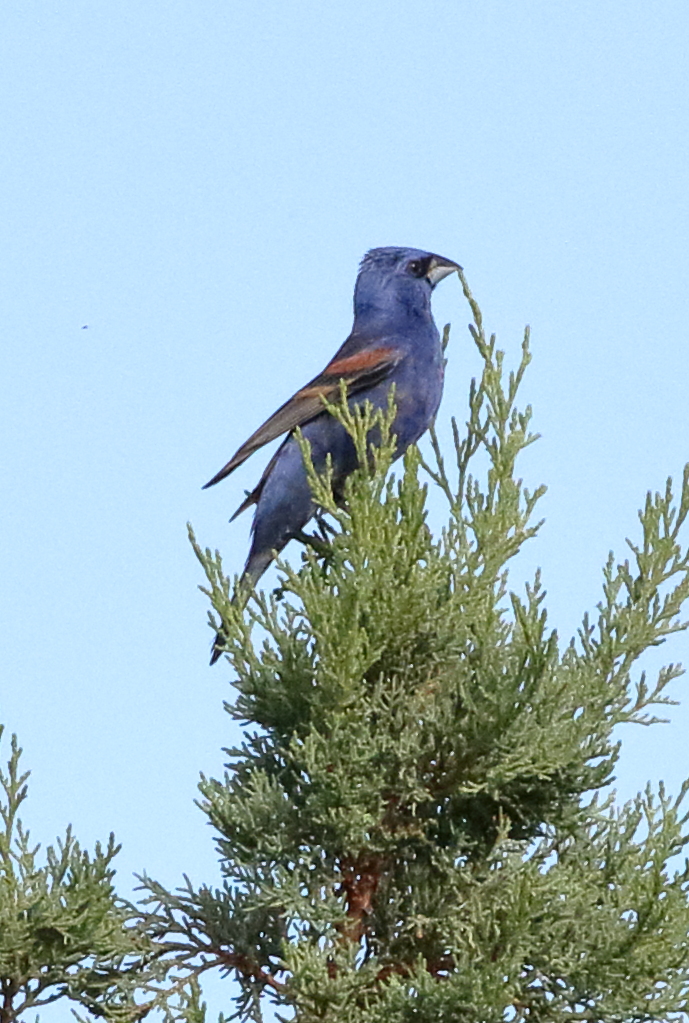
Blue-headed Grosbeaks were downright abundant in SE Arizona during the festival—and who can get enough of them? Not me!

Ramsey Canyon itself got off to a slow start, with the birds staying fairly quiet and out of sight for the first hour. As the day warmed up, so did the birds. We enjoyed wonderful, leisurely views of Sulphur-bellied Flycatchers, Hutton’s Vireos, and the always dazzling Painted Redstarts. Afterward, we picked up seven species of hummers including Rivoli’s and Berylline, which elicited Oohs and Ahs from the crowd. We finished our regular schedule with a brief visit to the Ash Canyon Bird Observatory, watching more hummers as an impressive storm enveloped the Huachuca Mountains. However, upon re-entering Tucson, we got lost on a little side road when suddenly, a familiar shape scurried across the road—a Greater Roadrunner! In the heart of Tucson! It was Roger’s first GRRO of the trip and a lifer for several people in our group!
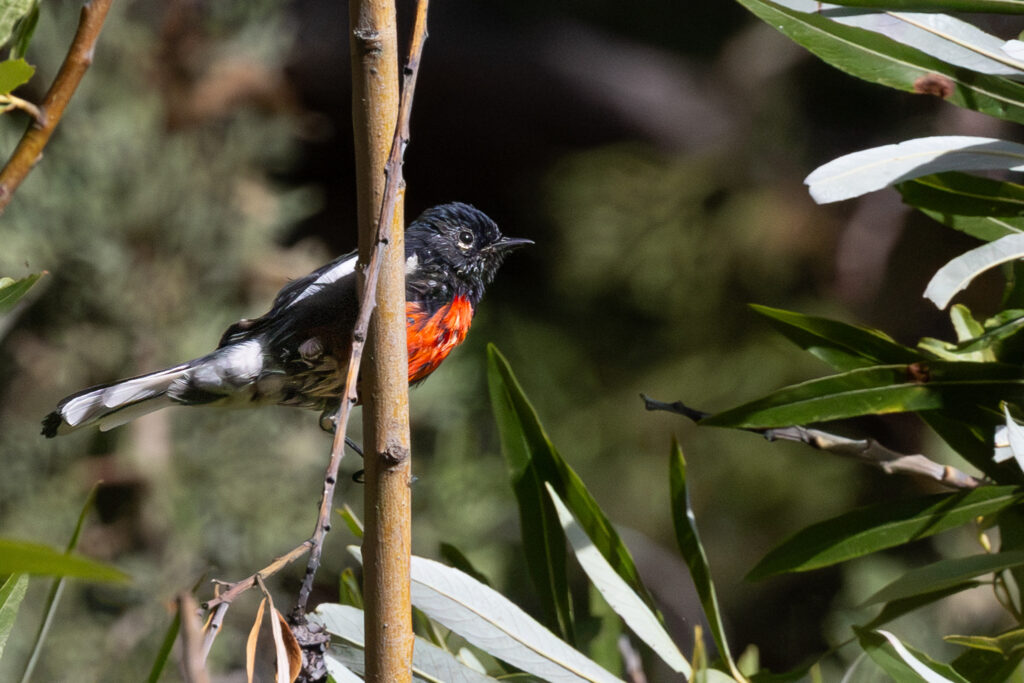
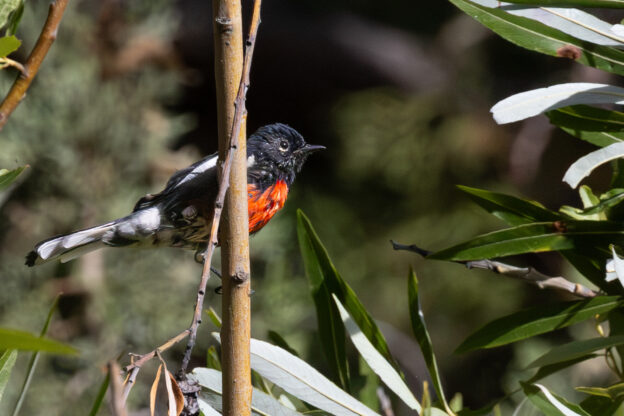
Getting a photo of this year’s festival mascot, Painted Redstart, is never easy—but Roger managed this terrific shot in Ramsey Canyon. (Photo courtesy of Roger Kohn.)

Much to our amazement, our birding discoveries continued after we returned home from the festival. I was going through my photos when I encountered a quick snap of a distant bird I had assumed to be a Western Wood-Pewee. Upon closer inspection, however, I realized “That’s no pewee!” I had a hunch about what it was, but asked Braden to take a look, too. “That’s a Lewis’s Woodpecker!” he exclaimed. I emailed Luke Safford about the find, along with the photo, and it turned out to be the first Lewis’s ever spotted during the festival! Maybe I’ll take more photos from now on!
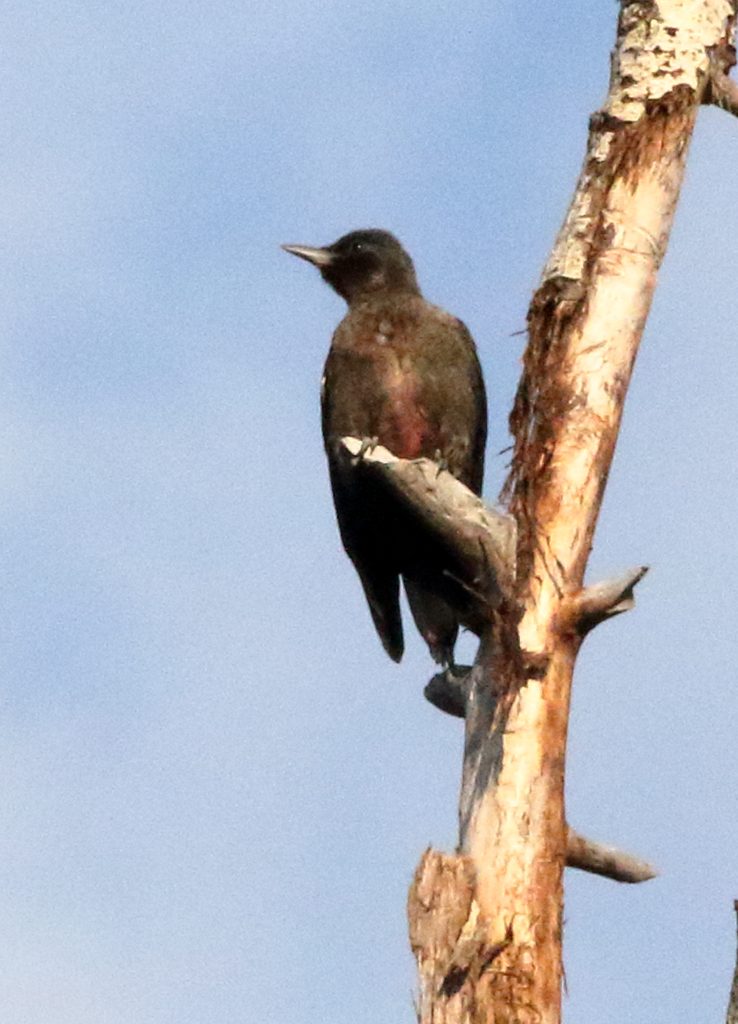
Before I photographed this one in Ramsey Canyon, Lewis’s Woodpeckers had been seen there only once or twice in February and March—and never in summer. This was a first find for the festival, too!

The Southeast Arizona Birding Festival was by far the largest festival I had ever attended and, really, I can’t recommend it enough. The organizers do an incredible job putting on the event and with more than 150 field trips on offer, it caters to almost every birder interest. It is much more than a place to see birds, however. As Luke expressed on opening night, it is really a celebration of birds and a force for bird conservation. Every day offered a variety of talks, and I spent a couple of hours in the exhibit hall talking to vendors, conservation groups, and birding guides from many different countries.
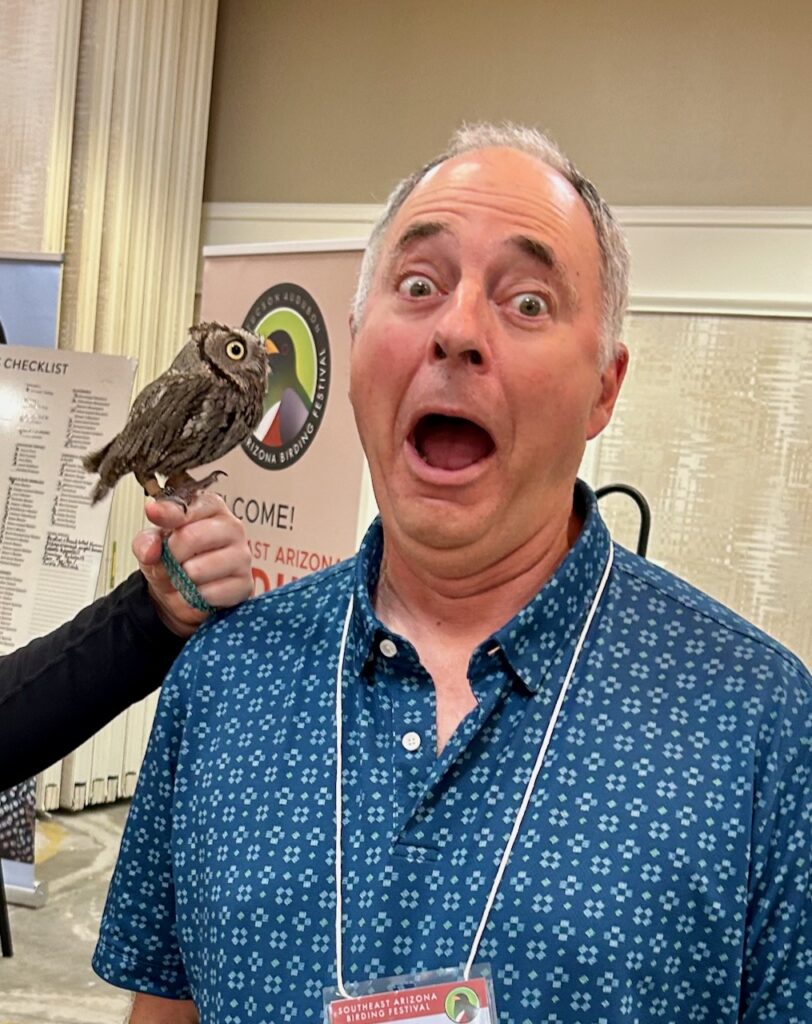
Part of the fun of the SE Arizona Birding Festival is visiting the lively exhibit hall—including surprise encounters with a variety of raptors such as this Western Screech-Owl!

“But what about that heat?” you may be asking. Well, it is something to consider. This year we actually caught a break as temperatures hovered only in the nineties. The year before, however, the mercury had exploded through the top of the thermometer, setting not-to-be-celebrated records. Then again, the early field trip departure times guarantee at least two or three hours of comfortable birding each day. Many of the trips are also at higher elevations, where temperatures are decidedly cooler. In other words, if you keep drinking plenty of water, you’ll probably do fine unless you have a serious health condition.

If you do go—and I hope you do—you may want to keep a few things in mind:

* Make sure you get a room with reliable AC. Our room at the Doubletree barely kept us cool enough to sleep, so call ahead to make sure. There’s plenty of free parking at the festival venue, so you can also consider staying at an Airbnb or perhaps another, nearby hotel.

* Get a room with a fridge. None of the restaurants open by 5 a.m. and you’ll want to have some good protein available before you start your day. The fest does provide snacks, but Roger and I were glad we had some protein bars with us, too. Eggs or yoghurt, though, would be even better.

* Bring plenty of sunscreen and insect repellent. Especially along the rivers, chiggers can really put a dent in your day.

* Make sure you have a good full-brim hat and drink lots of water and/or energy drinks throughout the day—even when you don’t feel thirsty. This will ensure you don’t have any problems with heat and sun.

Most of all, bring a good attitude. We were blessed with delightful people on every one of our trips, including many younger birders. That, more than anything, created a superlative experience for everyone. I can think of no other part of the world that offers the kinds of habitats found in Arizona, nor the selection of birds to go along with them. Why not take the plunge? I’m confident it will end up being one of your most memorable birding adventures ever.

I have to close out this post with a shot of one of my favorite Arizona birds, Sulphur-bellied Flycatcher, which we were fortunate enough to see in both Madera and Ramsey Canyons!

Birding Costa Rica—Beginning at the Airport

Some of our most popular posts have focused on exotic travel destinations, and today we kick off our latest series on one of North American birders’ most popular choices: Costa Rica. Braden and I just returned from an exhilarating, intense, nine-day birding adventure to the land of Pura Vida, and over the next couple of months I’ll be posting blogs on our most memorable birding experiences interspersed with our usual entertaining “paella” of reviews, domestic birding, and other fascinating topics. Again, we do not receive compensation for our blogging efforts, so if you wish to support our work, please purchase a few new copies of Birding for Boomers, Warblers & Woodpeckers, First-Time Japan, or any of Sneed’s other books. If you already have copies, why not pick up some for your friends? With that, let’s dive into Costa Rica at—where else—the airport!

Braden and I arrived at Juan Santamaría International Airport at 10 p.m.—just time enough to get to the rental car office before it closed. After collecting our vehicle, we drove to a nearby Airbnb so we could get a fresh start in the morning. Having spent a lot of time in Costa Rica the past couple of years, Braden had organized our entire birding itinerary and even picked this first place to stay—not only because it was convenient to the airport, but because it happened to have a terrific, little-known birding spot just down the street.

Braden and I from the porch of our Airbnb in Alejuela—practically under the flight path for San Jose’s international airport, and loaded with birds!

Braden and I are big fans of birding near airports, and have often found hidden avian treasures where you’d least expect them. Just last spring, on my final morning in Texas, I had a remarkable birding session in the vacant lot behind my hotel next to the airport in San Antonio, Texas. And during his spring Costa Rica trip last year, Braden had discovered a special little place only two blocks from our Airbnb. This year, as soon as dawn crept over Alejuela (where San Jose’s airport is actually located), he and I grabbed our binoculars and cameras and headed out.

Our destination was a large city park with the even larger name of Caminito Magico de la Tranquilidad. Being unfamiliar with the rather poor-looking neighborhood, I admit that I felt a bit nervous about our safety, but my concerns quickly vanished. At the park, people were jogging, biking, doing exercises, visiting over coffee, and walking around as in any park anywhere. The park covered several hectares, mostly devoted to playing fields, but a lot of trees threaded the fields and lined the park’s perimeter, and Braden led the way in guiding us on a full circuit.

Even at dawn, Caminito Magico de la Tranquilidad park was bustling with people—and birds! Note the giant mall rising in the background—a good place to escape the heat and grab a bite, though a much better little soda (cafe) sits only a block from the park entrance.

I had spent two months in Costa Rica in 1994, but tragically, that was before I took an interest in birds. Since Braden and I started birding a dozen years ago, I had been fortunate to bird in Latin America several times—most recently in Colombia con mi amigo, Roger—but it was fair to say that I was a novice at Costa Rican birds. I had been studying, however, and to my delight Caminito Magico park presented a perfect warm up for the week ahead.

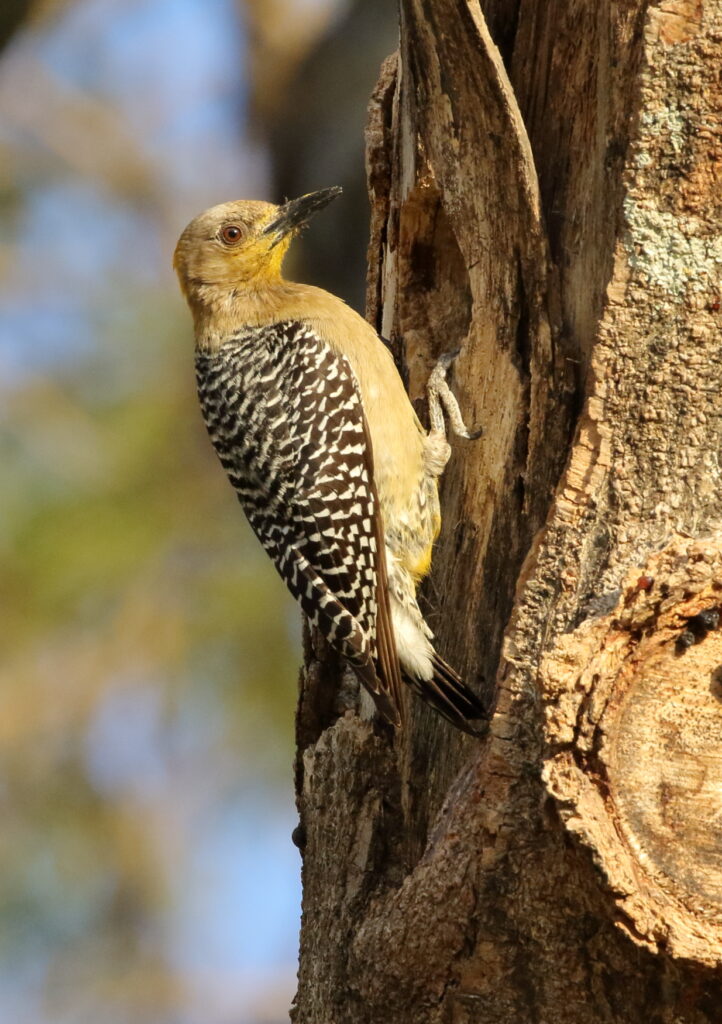
Entering the park, a Squirrel Cuckoo immediately flew across a soccer field in front of us. Braden identified Orange-chinned and Crimson-fronted Parakeets loudly squawking overhead, and I was thrilled to see my first ever Hoffman’s Woodpecker land in a nearby tree.

My very first Hoffman’s Woodpecker put me in an ebullient mood as we kicked off our first Costa Rican birding session!

The park was filled with many of the more common birds any visiting birder will quickly get acquainted with. These included five kinds of pigeons and doves, Tropical Kingbirds, Great Kiskadees, Great-tailed Grackles, and Costa Rica’s national bird, Clay-colored Thrushes. Blue-gray Tanagers flew between trees while Blue-and-White Swallows darted for insects overhead.

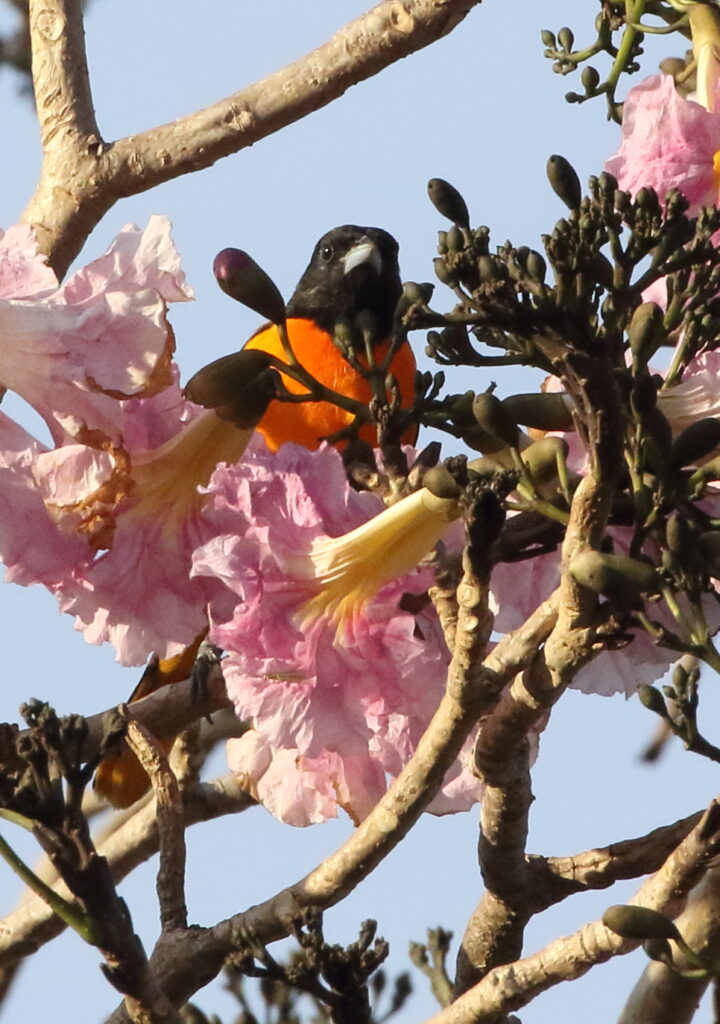
Baltimore Orioles are common throughout Costa Rica—and never fail to raise a smile for a visiting Norteamericano birder!

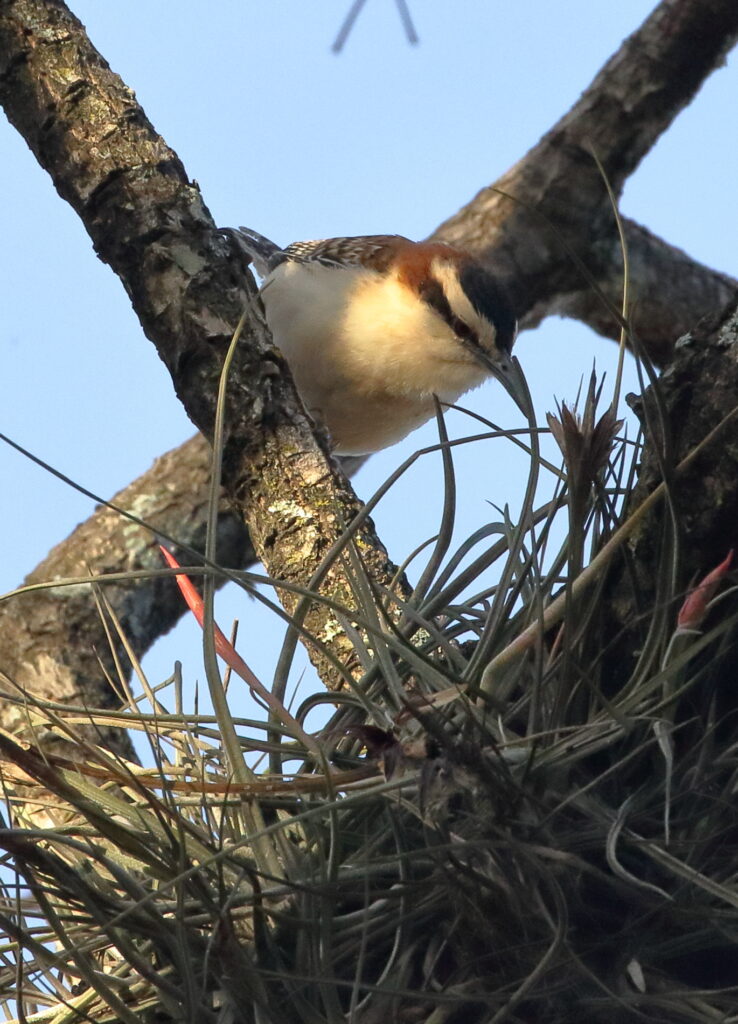
As we reached the far perimeter, I was delighted to find that a creek skirted about half of the park’s boundary. Trees grew thickly here, and following the pleasant path, the birds got even more interesting. Braden began pointing out Chestnut-capped, Northern Yellow, and Tennessee Warblers while I focused in on a stunning male Baltimore Oriole in a flowering tree. Braden also detected several kinds of wrens: Southern House Wren, Rufous-and-White Wren, Cabanis’s Wren, and the beautiful bruisers of the bunch, Rufous-backed Wrens.

This would be the only location on our trip where we would see the “giant” Rufous-backed Wren—another reason to bird the San Jose area before heading into Costa Rica’s hinterland.

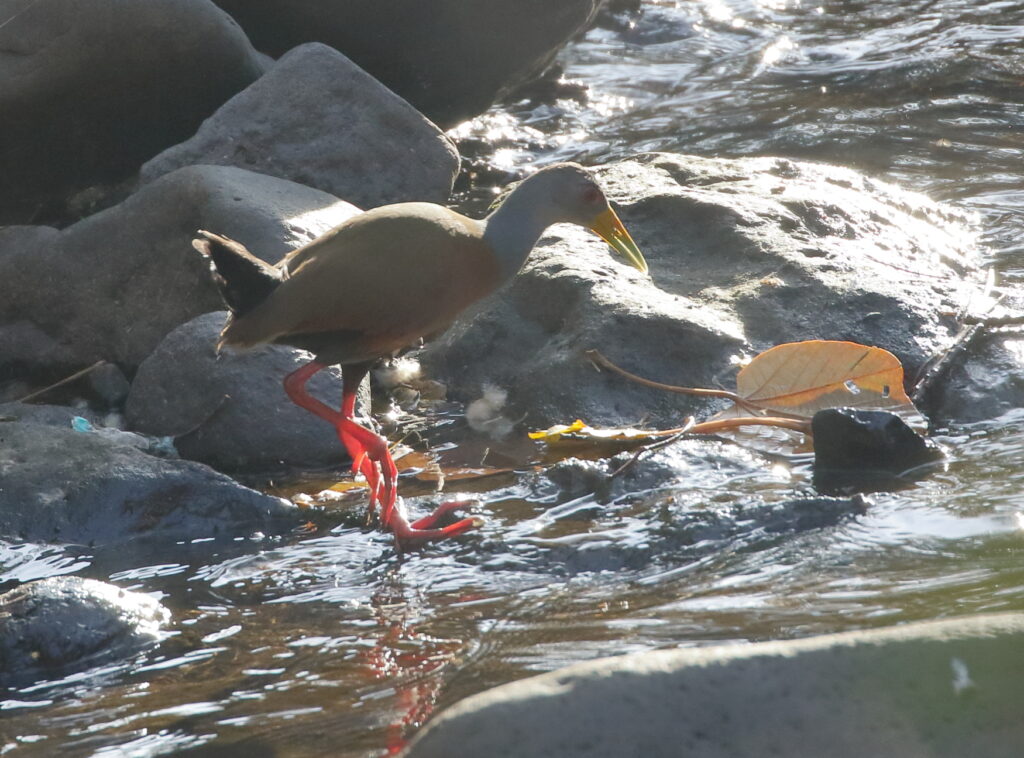
This being in the heart of Costa Rica’s largest city, I gotta tell you that I had no expectations for the creek itself, especially because it was strewn with an assortment of trash. The birds apparently didn’t care and almost immediately, Braden pointed out one of the birds I had most wanted to see on the trip—Bare-throated Tiger-Heron! I was thrilled, but hardly had time to appreciate it as we spotted a quail-sized coot-like bird skulking the banks—a Gray-cowled Wood-Rail!

For me, seeing a Bare-throated Tiger-Heron and Gray-cowled Wood-Rail (above) were stunning surprises in the heart of Costa Rica’s largest city!

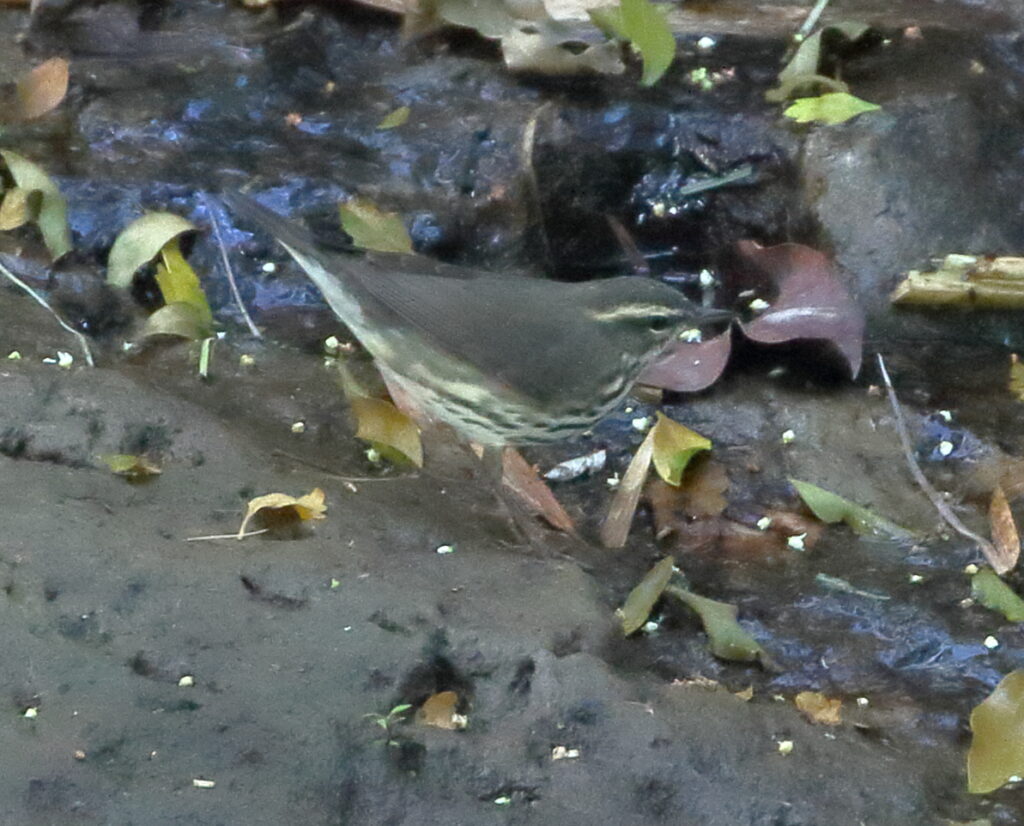
Soon after, Braden pointed out a Northern Waterthrush while I spotted a Green Heron along the opposite bank. This, of course, is one of the magical things about birding the neotropics: how in the midst of all of these amazing new tropical birds, we find many species that are totally familiar to us in North America. It begs the definition of just what a neotropical bird is since in reality, many species we Norteamericanos consider “our birds” are just visiting us for a short time, and can more rightly be considered tropical species. Maybe that’s how this park got the name “Magico”?

Seeing “North American” warblers such as this Northern Waterthrush in the tropics makes you rethink what we consider “our” birds.

Our delightful discoveries were far from over. At the far corner of the park, we met an amateur naturalist who visited this spot almost daily to monitor wildlife, and he generously shared that only minutes before, he had seen one of the San Jose Valley’s most intriguing endemics. We hurried down the trail and only fifty meters later saw them: Cabanis’s Ground-Sparrows.

These are birds that Braden especially wanted to show me—but didn’t think he could. These handsome little guys live only in central Costa Rica, specifically in the valley occupied by San Jose. While not rare, they often tend to be pretty shy, making them challenging to see. They prefer scrubby, disturbed places like forest edges, coffee plantations, and apparently, city parks with lots of places to hide. Braden and I both began clicking off photos, but mostly we enjoyed watching them, one of dozens of unexpected surprises we would encounter over the next nine days.

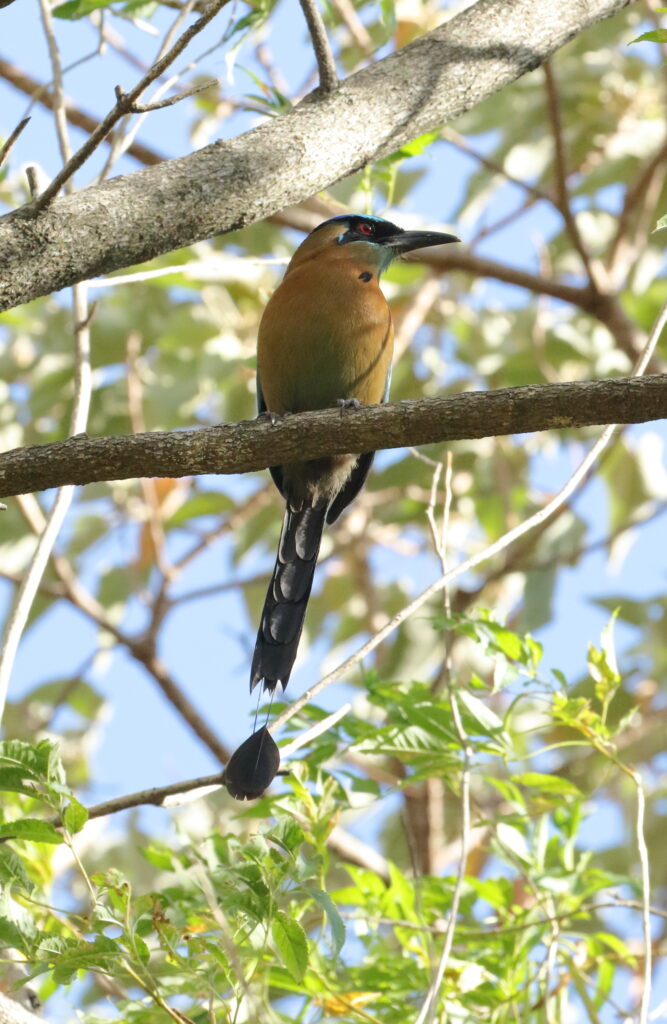
As we were winding down our visit with the Cabanis’s Ground-Sparrows, I saw a larger bird swoop past us and land on a nearby branch. “Braden,” I hissed. “Look!” It was a final gift from this amazing city park: a Lesson’s Motmot! Not only that, it struck an incredible, leisurely pose. Motmots, of course, are some of Latin America’s most distinctive tropical birds and always high on a visitor’s to-see list. I was no exception, and felt enormously grateful to see one in our very first hour or two of Costa Rica birding.

Seeing a Lesson’s Motmot in our first birding session left no doubt that we were birding somewhere far different from Montana!

We finished our list with 47 species—almost as many birds as I’d seen in Montana in the first seven weeks of 2026! It was an awesome kick-start to our expedition, and we celebrated by grabbing our first Tico breakfast of rice, beans, eggs, and fruit at a little family diner only a few meters from the park entrance. We couldn’t predict how many highs and lows the next nine days would hold for us, but we were grateful and happy for such a promising start!

Caminito Magico de la Tranquilidad checklist: https://ebird.org/checklist/S302412338

Keep Costa Rica rolling with our next post on antbirds! https://fathersonbirding.com/arenal-for-antbirds-birding-costa-rica-part-2/

Braden has a passionate fondness for Costa Rican food, and after our first birding session we wasted no time in getting him a traditional Tico breakfast just a block from the park entrance!

Birding 2025: It’s a Wrap

As always, we encourage you to share and link to this post. We absolutely do not give permission to use it to train AI models or for other purposes without permission. Happy New Year, Everyone!

As 2025 rapidly winds up, Braden and I want to thank you for your continuing interest in FatherSonBirding and all that you do for birds. We can’t believe that it’s been almost EIGHT YEARS since we published our very first post, A Quest for Snowy Owls! We certainly wouldn’t have kept at it without your interest and support.

We’re thrilled to report that 2025 has been FSB’s biggest year yet. We published a record 49 posts this year, including our 250th post, “Binoculars and Scopes for the Happy Holiday Birder”. Speaking of that, we also launched FSB equipment reviews—articles we do NOT get paid for, but which have attracted a ton of viewer interest.

FSB received a record 20,000 views in 2025, greatly helped by our equipment and travel reviews!

And speaking of viewers, our site attracted 20,000 views this year, shattering last year’s record of 14,000—with the caveat that about a thousand of those views were likely from AI bots stealing our content without permission (Grrrr…). Still, the vast majority of those extra visitors were legitimate—and from an astounding variety of places. More than 15,000 viewers from 104 countries visited our site this year! Huge gracias, arigatos, mercis, and many more thank yous to our international visitors!

By now, we can hear you pleading, “But please, Sneed and Braden, tell us your Top 5 most popular posts!” Astoundingly, four of our five top posts were equipment review posts:

1) Vortex Triumph 10X42 Binoculars: Entry Level Excellence with 1,425 views. (View post here!)

2) Nikon Monarch HG Binoculars: FSB’s First Equipment Review with 950 views (View post here!)

3) Vortex Razor HD 13-39X56 spotting scope with Mountain Pass tripod: A Perfect Travel Combo? With 580 views (View post here!)

4) Birding Barcelona, Part 1: The Urban Core with 510 views (View post here!)

5) Vortex Viper HD Binoculars (Equipment Review, and/or Texas 2025 Part 2-½) with 480 views (View post here!)

Our 2024 blog about birding downtown Barcelona snuck into the Top 5 for 2025—with several of our Japan and Costa Rica posts close behind!

The numbers reveal some clear trends: with rare exceptions, our most popular posts have been our equipment reviews and reports from travel destinations. Our posts from Japan, Spain, Colombia, Mexico, and Costa Rica have been especially popular—as have posts about very birdy domestic locales such as Texas and San Diego. Our book reviews also have done well, but a decline in America’s literacy rate is clearly evident, as our statistics reveal that many more viewers are interested in buying gear than in reading books.

On a personal level, Braden and I are grateful for the many wonderful birding experiences we got to share, both together and separately. Braden was fortunate to visit both Mexico and Costa Rica in 2025 as well as take an epic cross-continent trip from Maine to Montana following his graduation from the University of Maine. He also birded the heck out of Arizona while on his way to his current job in California, where he’s racking up all kinds of new birding experiences.

As for Sneed, I kicked off the year with a trip to Victoria, Canada, thanks to my wife, Amy—and, honestly, the year never seemed to slow down. As soon as we returned, my buddy Roger Kohn invited me on an epic last-minute trip to Colombia. There followed journeys to Texas, Maine, eastern Montana, California (twice!), and most recently, Georgia and Oregon. Most of the latter were not planned as birding trips, but you won’t be surprised to learn that we saw a ton ‘o birds along the way.

You also won’t be surprised to learn that, quite unintentionally, Braden and I shattered most of our own birding records. Braden finished out his birding year with a remarkable 867 species while I smashed my own previous record with 551 species!

One of the low points for the year was having to say goodbye to our wonderful “birding dog” Lola. She left us far too soon and we still miss her terribly. (See this post.)

Besides finding birds, Lola proved adept at finding marine mammals such as this whale. We miss you Lola!

Moving forward, we hope to continue to publish a wide variety of posts for your reading pleasure, including those about everyday birding experiences that are at the heart of a birder’s joy and wonder. Just a few adventures that we have lined up for 2026 include trips to Costa Rica and Germany, along with visits to birding festivals in Colorado, Arizona, and Montana. Meanwhile, it is our sincerest wish that the next year brings you all good things, including many incredible birding experiences and a brighter outlook for birders, birds, and the planet we all share.

For some ideas about how to help birds this coming year, please visit our last post, Giving Back to Birds—with Great Breaking News! As always, if you would like to help support FatherSonBirding, consider buying new copies of some of Sneed’s books by clicking on the book jackets to the right.

Binoculars & Scopes for the Happy Holiday Birder (FSB Shopping Guide, Part 1)

Today, Braden and I celebrate our 250th blog post! We can hardly believe it ourselves, but it just shows what can happen when the passion of birds and birding infuses your souls. We also celebrate our first year of mixing things up by adding book and equipment reviews. Ahead of the holiday buying season, in fact, we’d like to recap some of our favorite items for that “Bird Nerd” in your life—or maybe even for yourself. If you’re tired of buying stuff, we also include some of our favorite groups working to protect birds around the globe. In Part 1 of this three-part effort, we run down great binoculars and spotting scopes. In our next two posts, we’ll talk about some of our favorite bird books and bird conservation groups. As always, we thank you for your interest and urge you to share these posts with your friends and family—especially if you want them to buy you something!

Serious about upgrading your birding optics? Read on!

As 2025 draws to a close, we don’t claim to have tested every brand and model of optics out there, but have been fortunate to put products from both Nikon and Vortex through the paces. We gotta say that if you’re in need of great optics at reasonable prices and with amazing warranties, you won’t do better than these two brands. Nikon products tend to sell close to their official list prices and can be purchased from their website here, or from third parties (see below). Vortex products, on the other hand, usually can be found at much lower prices than what they list for. To get the best price, start with your local indie sporting goods store, but if you can’t find what you want, Dick’s Sporting Goods, B&H Photo, and Land, Sea, & Sky are solid, reputable businesses we’ve had great experiences with.

Binoculars for around $100

Our most popular post of this year was our review of the Vortex Triumph HD 10X42 binoculars, and for good reason. Not only do the Triumphs offer excellent quality at an amazing price, they come with Vortex’s mind-boggling no-questions-asked replacement and repair warranty, something I still can’t believe even exists! One downside to the Triumph HDs is that their minimum focal length is a fairly long 16 feet. Then again, I only need a closer focus than that once or twice a year, so a casual or beginning birder will hardly be affected. See our full review here.

Vortex Triumph HDs offer excellent value for most beginning birders and, like other Vortex products, come with a lifetime no-questions-asked warranty.

Especially if small and lightweight is your goal—or if you’re buying binoculars for the kid in your life—you will also want to consider the new Vortex Bantam HD 6.5X32. Though aimed at kids, these lightweight little gems are fantastic for travel, backpacking trips, or people with sore backs. I loaned a pair to my brother and he didn’t want to give them back! Even more amazing, they can purchased for about $70—a sizzling deal at a time when many of us have to cut back on spending. See our full review here.

Binoculars for about $300

The first serious binoculars Braden and I ever bought were Nikon 10X42 Monarch M5s—and Braden still uses them today! How can that be, you ask? Well, not only are the Monarch M5s solid, well-built binoculars with sharp, clear optics, Nikon offers great repair and replacement policies. Braden has sent his in twice for repair—and received brand-new replacements free of charge. You can’t beat that. For $300, these are an excellent investment for those on a budget, but still wanting binoculars that are up for almost any birding situation.

Braden and I both relied on our Nikon Monarch M5s for the first eight years of our birding. They are still Braden’s go-to optics!

“Best Bang” Binoculars for about $500

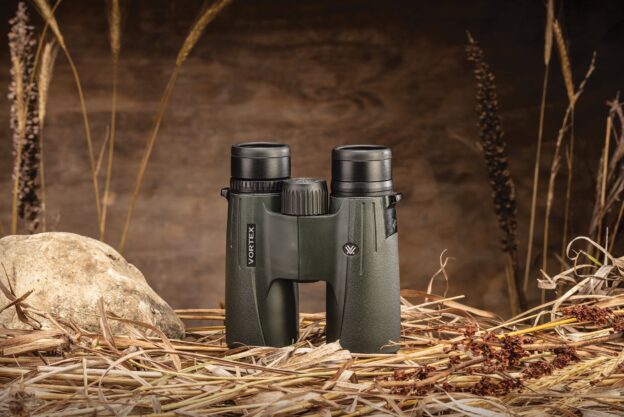
If you’re willing to shell out just a bit more, I was especially impressed with Vortex Viper HD binoculars. In fact, I’ll go so far as to say that these may deliver the best bang for your buck available. During my trip to Texas last spring, they performed extremely well in a variety of conditions. Our guest contributor Roger Kohn and his wife Claudia also use these and are very happy with them. See our full review here.

After testing products across the Vortex line, I have to say that I think Vipers deliver the biggest bang for your birding buck!

Gasp! Shelling out a Grand!

I’ll admit it: I never thought I’d be using $1,000 binoculars, but boy am I glad that I do! Especially if you bird a lot in dark, overcast conditions—or even in shockingly bright ones—stepping up the quality can really make a difference. My top pick in this price range? Nikon Monarch HG 10X42s. I took these on last winter’s trip to Colombia and was uber-impressed. My very first morning, I saw a woodpecker fly into a dark, overhanging branch of a tree at least two or three hundred yards away. I thought “No way will I be able to ID that.” When I raised my Monarch HGs to look, though, I was astonished to be able to recognize it as one of the birds I especially wanted to see: a Crimson-mantled Woodpecker! See our full review here. I must add that because these were the first binoculars I reviewed this year, I didn’t realize just how good the optics are, so if you have the cash, you will not regret getting these.

Also in this price range, you will want to check out the Vortex Razor HDs, also priced at about $1,000. I have been using the Razors extensively since last spring and have been very happy with them. I especially love the extra-smooth center focus knob. See our full review here.

Me and my birding amigo Roger in Colombia last February, where my Nikon Monarch HGs delivered superior performance! Meanwhile, Roger is shown happily birding with his trusty Vortex Vipers.

Ready for a Spotting Scope? Sure You Are!

When we first started birding, Braden and I resisted getting a spotting scope because they seemed like such a pain to shlep around. Within a couple of years, we realized that scopes are essential birding equipment. Many, many manufacturers make and sell spotting scopes, but I’ll tell you, this is a purchase you will want to stretch for. We bought a cheaper scope in the $300 range—and are sorry we did. A couple years later, we sprung for a Vortex Viper HD 20-60X85, and love it. I just looked these up at B&H Photo and it looks like they can be had for about $700—a screaming deal. Don’t forget, though, that you also need a tripod to go with that scope. If you can afford it, I recommend buying a Vortex tripod to go with your Vortex scope, so that you won’t have to keep messing with a tripod adapter, which will invariably come loose as you are lugging your scope around.

Braden zeroing in on a rare Piping Plover in eastern Montana using our beloved Vortex Viper HD 20-60X85 spotting scope.

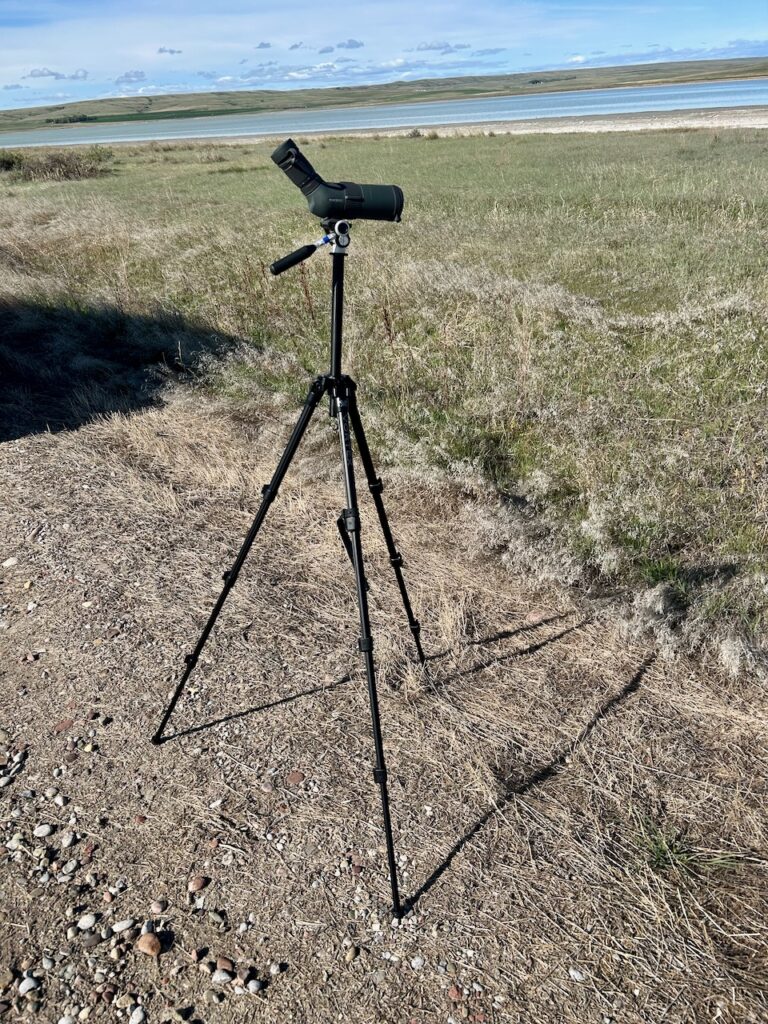
The above scope is definitely a “car model,” meaning it’s heavy enough that you won’t want to carry it more than a couple hundred yards. Last summer, though, I also tested a Vortex Razor HD 13-39X56 spotting scope with Mountain Pass tripod. At a total weight under five pounds, this lightweight combo is perfect for taking on planes in your backpack or even heading out into the wilderness if you’ve got to have a spotting scope with you. Just checking different outlets, it looks like the scope/tripod combo can be had for about $1,000 right now. It won’t pack the magnification of the bigger scope mentioned above, but it’s a great trade-off for those of us who travel a lot. In fact, I didn’t want to send my evaluation scope back to Vortex and am considering buying one for my own holiday gift! See our full review here.

In calm conditions, the Razor HD 13-39X56 and Mountain Pass tripod perform like a dream. Because they are lighter, wind produces more shake, just as it does for all but the heaviest scope/tripod combinations, but a convenient hook allows you to hang a stabilizing weight from the tripod.

Vortex Viper HD Binoculars (Equipment Review, and/or Texas 2025 Part 2-½)

Thank you for checking out our reviews! Braden and I write this blog to share our love of birding and provide useful information for our fellow birders. We do not receive any payment for any of our posts, but if you’d like to support our work, please consider buying one or more *new copies* of Sneed’s award-winning books such as Birding for Boomers or Warblers & Woodpeckers: A Father-Son Big Year of Birding. We appreciate your support and hope that you keep enjoying the world’s greatest activity!

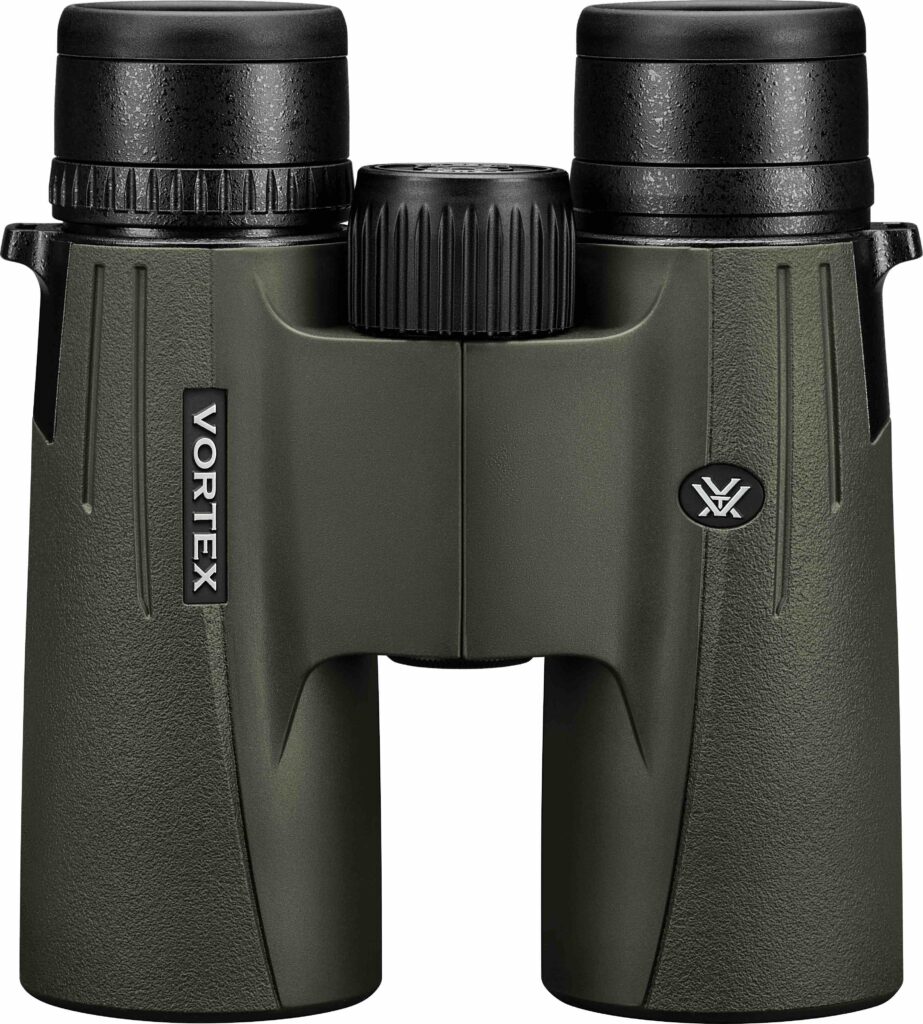
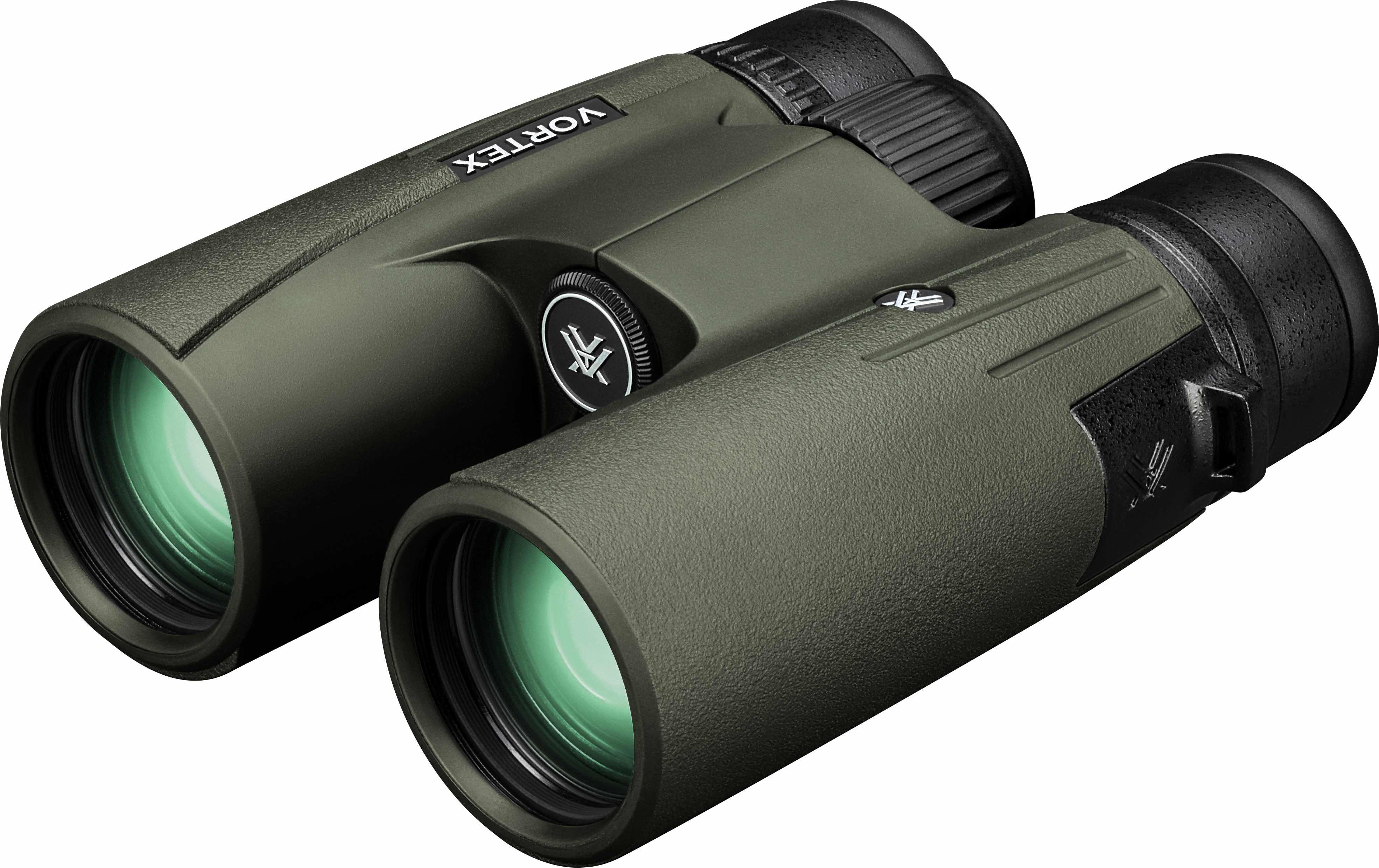
I hope that you’ve enjoyed our last two posts about my recent Texas birding adventures. Never fear, more Texas posts are coming! Today, however, we’d like to offer up another in our popular new series of equipment reviews. Why? Because my Texas trip gave me a wonderful opportunity to field test a pair of Viper HD 8X42 binoculars from Vortex.

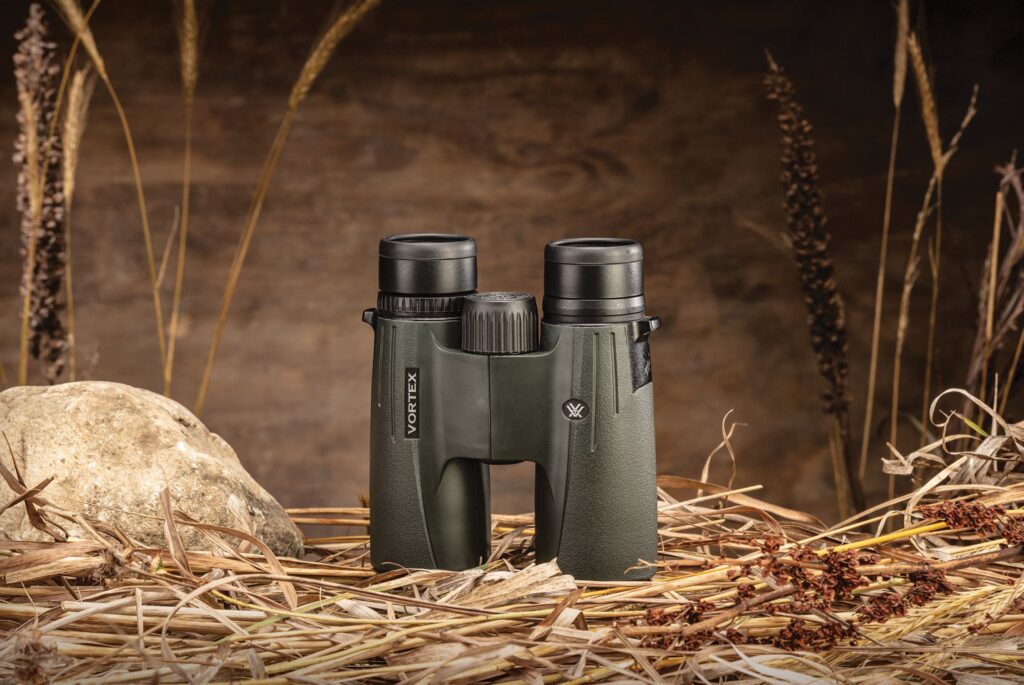
Vortex Viper HDs offer great quality at a reasonable price.

If you’re out in the field a lot, you’ll see many birders using the Viper HDs, and for excellent reasons. In hand, the binoculars are sturdy and comfortable to hold, yet lightweight enough to carry around all day without discomfort. Like all Vortex optics, they come with an incredible no-questions-asked, fully transferable, lifetime warranty—something almost priceless for the peace of mind it offers. But the question remains: how do they perform in the field?

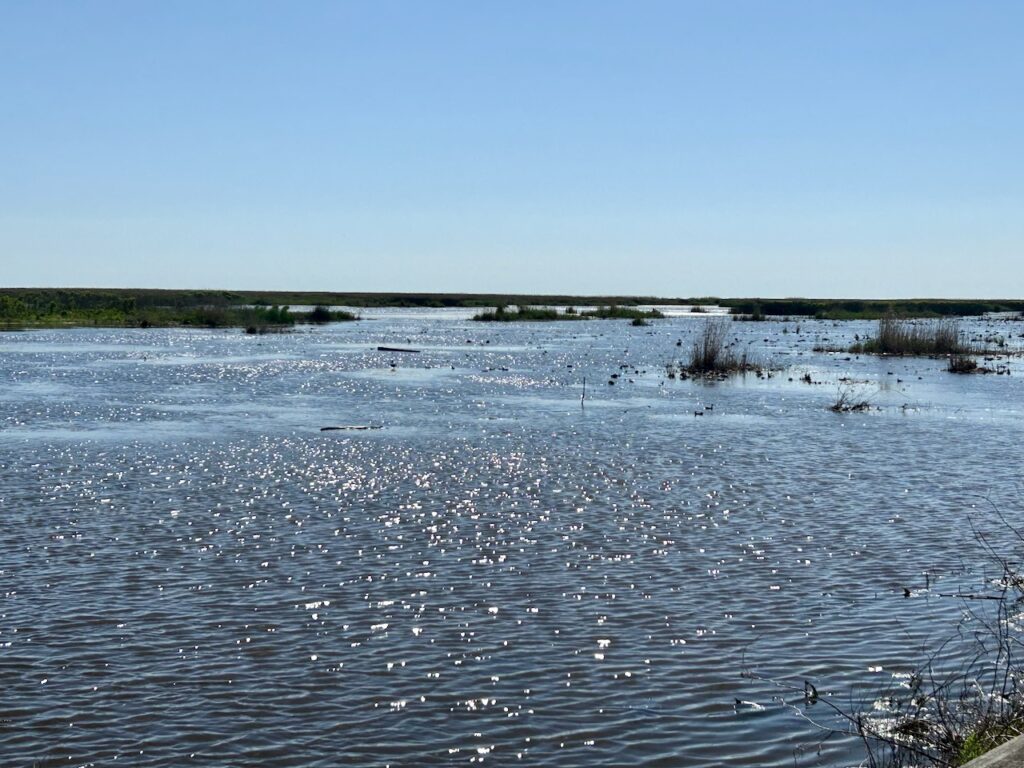
Backlit conditions—especially on water—are one of the true tests of binocular clarity and light transmission. The Viper HDs performed extremely well under these conditions.

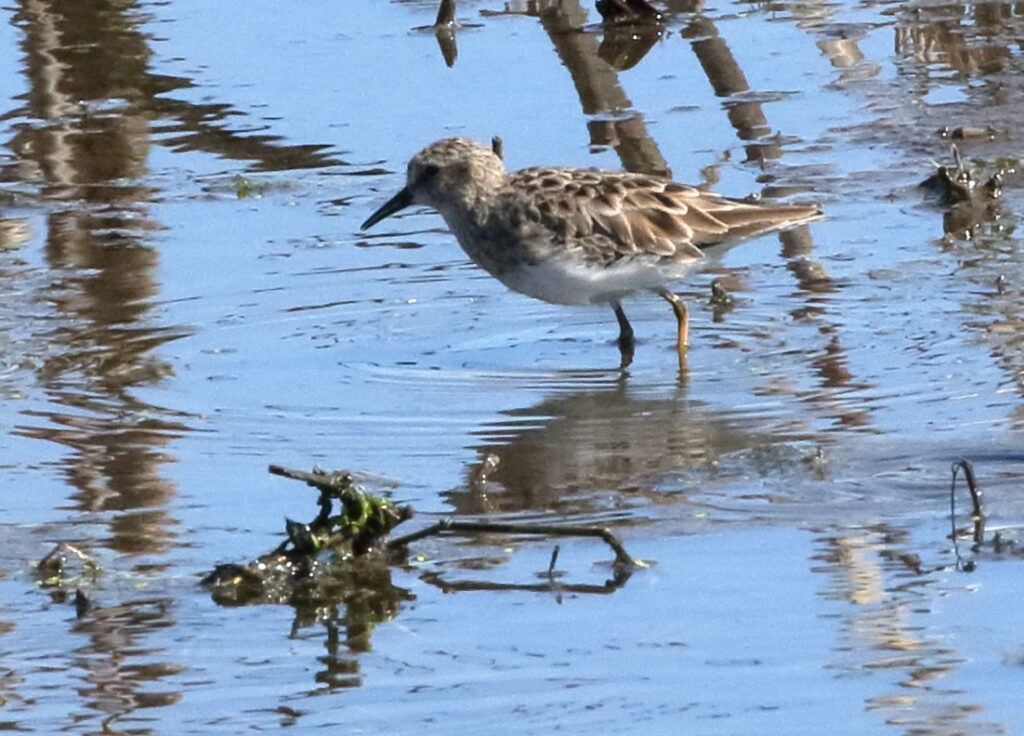
My Texas trip allowed me to test the Vipers in a variety of birding situations. In my last post, I shared my thrilling visit to the Anahuac National Wildlife Refuge (now renamed to the Jocelyn Nungaray NWR), and almost immediately, I was confronted with the daunting task of observing shorebirds and waterfowl under extreme backlit conditions. Anyone who has experienced this knows how difficult it is to discern details of birds when bright glare turns the birds into shadowy figures, and I immediately thought, “Oh man, I don’t know if I’ll even be able to start identifying some of these critters.” To my surprise, the Viper HDs cut right through the glare. One small backlit shorebird particularly caught my attention, and I was sure I wouldn’t be able to see enough details to ID it. Focusing in with the Vipers, the bird’s features just popped—including its yellow legs, which allowed me to identify it as a Least Sandpiper.

The Viper HD’s excellent light transmission allowed me to ID this Least Sandpiper and other shorebirds under badly backlit conditions.

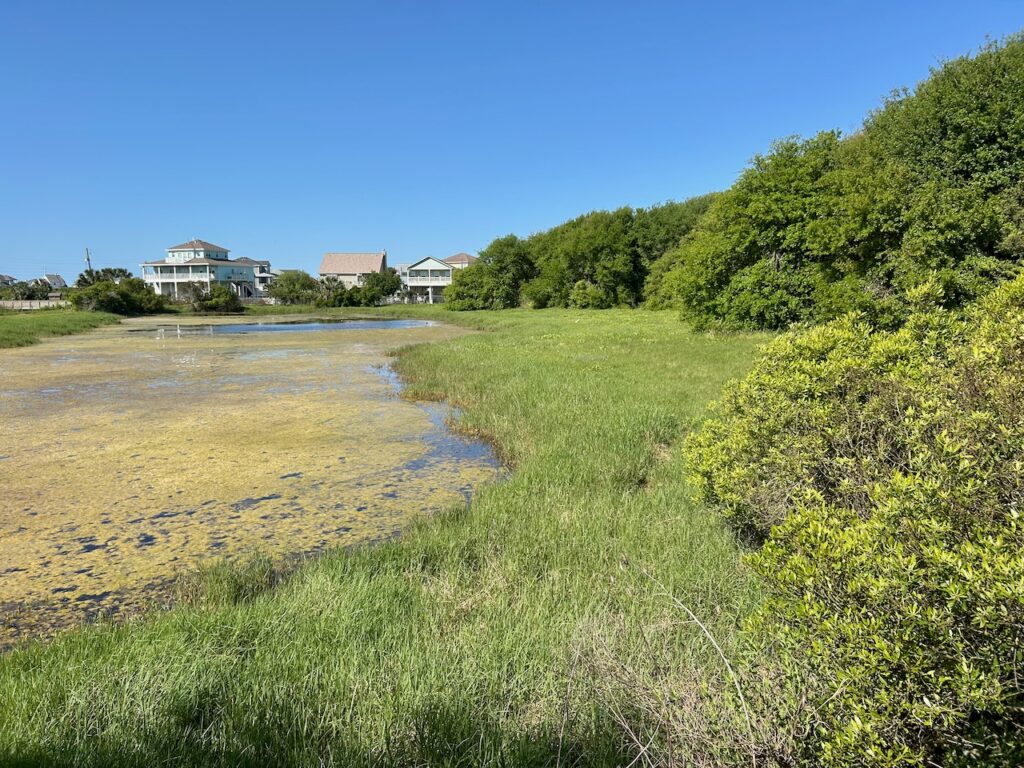
A couple of days later, I arrived at an exciting new (to me) location called Lafitte’s Cove on Galveston Island. This cool little nature reserve sits in the middle of an upscale housing development and features ponds, walking paths, and wooded areas. My main goal was to try to find migrating warblers and, thanks to the advice of some local birders, I staked out a drip in the wooded area that provides fresh drinking water for birds. Soon, I saw two shapes flitting around in deep shadow behind the drip. One leaped out into the sunlight—a Tennessee Warbler. The other bird proved much more cagy. Even as it stayed in the shadows, though, the Vipers gave me the sharp, full-color details that allowed me to confirm that it was a Nashville Warbler—a real surprise since I had never seen one before in the eastern US!

Lafitte’s Cove on Galveston Island was a wonderful addition to my list of spring migration birding hotspots—and helped me test the Viper HDs under dark, shady conditions.

As always, prospective buyers will ask, “Are the Vipers worth what they cost?” On the Vortex website, the 8X42s and 10X42s list for $719.99 and $729.99 respectively—not an inconsiderable sum. However, in “real life” the binoculars can be purchased for under $500, putting them in range of a doable investment for many birders who are ready to get serious, but can’t or don’t want to shell out thousands of dollars. Even for $500, though, you expect binoculars to be durable and weather-resistant, and the Vipers deliver on that count. Other great features include:

* a diopter ring that allows independent focus adjustment for each eye

* long (18 mm) eye relief for those who wear glasses, and smooth, pull-out rubberized eye-relief tubes (or eye cups) for those who don’t

* a close (six-foot) minimum focal distance

A comfortable grip and long, comfortable eye-relief tubes are just two great selling points for the Viper HDs.

As I have tried various brands and models of binoculars, though, for me it has become mainly about clarity. In other words, how well do the binoculars transmit light and how sharp is the image they deliver? As noted above, the Vipers deliver excellent performance in this regard. During my week in Texas, I never found a situation in which I had difficulty picking out colors and other details. That’s because, for the extra price investment, Vipers offer two advantages over many cheaper binoculars:

* extra low-dispersion glass that reduces chromatic aberrations and improves light transmission, even under difficult conditions such as those I experienced above

* high-quality coatings on both the glass and internal prisms which improve light transmission, creating a sharper, clearer image.

I have not yet found the perfect binoculars—if they indeed exist—and one thing I wasn’t crazy about is that I had to turn the focus knob quite a bit to bring the Vipers into focus between near and far situations. Presumably, this allows users to obtain a more precise focus on an object, but I found it wasted a bit of time and effort. This is a personal preference, however, and I’m guessing that most users will be just fine with this.

A final note: frequent FSB contributor Roger Kohn and his wife both happen to use Vortex Vipers. “We are very happy with them,” he says. “Really good quality glass, clear images. Feels good in the hands.”

Conclusion: the Vortex Viper HDs are an outstanding pair of binoculars for those ready to make a mid-range investment into the world’s greatest hobby. Sturdy construction, a light weight, and excellent light transmission make them suitable for almost every situation, and will provide years of satisfaction to the vast majority of birders.

Vortex Vipers

Post Update: After posting this review, I traveled to Maine for our son’s graduation (see post “Graduation Birding Bonanza in Maine”), and I took along a pair of Vortex Viper HD 8X42 binoculars. This was my first chance to use them in rainy conditions and I have to say, they performed incredibly well. While my companions’ bins were fogging up, the Viper HDs stayed clear as a bell during our two-hour drizzly session. I also had a chance to use the Vipers in “almost night” conditions to view the American Woodcock mentioned above. Again, I was impressed with the amount of light they transmitted, allowing me to easily follow the bird’s silhouette in flight. Back at our Airbnb, I let Braden look at a distant loon on the lake and he said, “Wow, those are good binoculars!” I suspect I’ll be using these a lot more!

The author received no financial compensation for this review, but binocular images and sample binoculars are provided courtesy of Vortex.