Braden and I have had an incredibly busy fall so far with Braden birding up a storm and I going back to college! We are pleased to take a break to present a review of what I can only describe as a mind-blowing new technology for outdoor enthusiasts and scientists. Do check it out, along with our many other posts! Remember, FatherSonBirding is written and produced by REAL PEOPLE, and we appreciate your support.
Even since Braden and I leaped into the world’s greatest activity fourteen years ago, technology has revolutionized birding. eBird has brought millions into the hobby by simplifying the process of record keeping and making vast quantities of information available to all. Technologies such as Motus have given scientists and conservationists critical new tools for learning about, tracking, and protecting birds and their habitats. For people such as myself who have hearing deficits, Merlin’s SoundID has made it possible to detect birds even when we can’t hear them. All of this made me especially excited to test out Vortex’s new thermal imaging monocular, the Veil 400 Thermal Monocular.
Anyone who has watched a modern thriller or crime drama is familiar with the concept of thermal imaging. Instead of detecting electromagnetic radiation solely in the human visual spectrum (what we see as colors), thermal imaging devices detect infrared radiation that humans normally sense as heat. These devices then translate those infrared wavelengths into colors that we can see on a screen.
The Veil primarily caters to hunters pursuing their quarry at night. The availability of such a device, however, immediately raises the question: can it be useful for birders, too? To find out, Braden and I ran it through several trials.
Not surprisingly, our first thought was to use the Veil to find owls, so we drove to a nearby park at dusk. Almost immediately, the Veil’s screen picked up a bat flying overhead along with the heat signatures of several moths. After an hour, though, we found nary a bird, despite stopping frequently to scan the trees and brush around us. The lesson? If birds aren’t there, or are hidden in a hole or behind tree trunks, even a sophisticated device such as the Veil ain’t going to show ‘em to you!
Our main problem, we realized, was that it was September, when nocturnal bird activity has generally fallen off. That did make us eager to try again next spring when pointing the Veil into the sky would undoubtedly pick up nighthawks, swifts, and other crepuscular insectivores. Who knows? More owls might be around, too.
Even on that first outing, however, the Veil proved an eye-opener for understanding the environment around us. Most surprising to me were the different heat signatures given off by both living and nonliving objects. The Veil allows one to select four different thermal detection color palettes: White Hot, Black Hot, Red Hot, and Multicolor. My favorite is Red Hot, which reveals warmer images as scarlet red against black, white, and gray backgrounds.
On this setting, Braden and I were astonished to see how tree trunks, leaves, and rocks gave off different heat signatures. That raised all kinds of questions about how other animals see the world, and why detecting heat evolved in, say, certain reptiles, amphibians, and insects, but not in mammals. Or did it? Vampire bats, in fact, can detect heat—but my guess is that the vast majority of mammals have never been tested for this ability.
Undeterred by our nighttime outing, Braden and I again tested the Veil on an overcast morning. Because we were in the heart of fall migration, we visited our local cemetery where we’d often found migrating songbirds. As soon as we stepped out of our trusty minivan, Braden pointed into a tree. “There’s a Swainson’s thrush.”
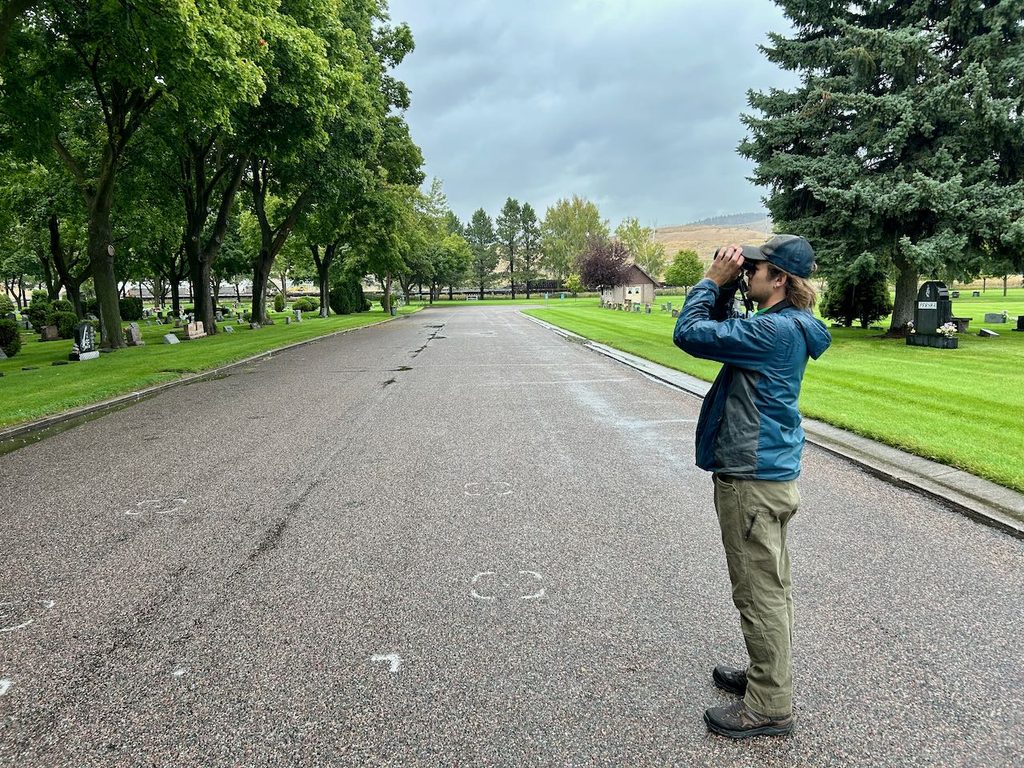
I couldn’t see it, so I pointed the Veil up into the foliage and, sure enough, a bright red shape glowed back at me! “You gotta see this,” I said, handing the device to my son.
We walked to another group of trees and with his sharp ears, Braden began picking up pine siskins, Swainson’s thrushes, and yellow-rumped and Wilson’s warblers. Most of the birds stayed well-hidden in the branches, so I again raised the Veil to my eye and saw dozens of moving objects! At first I thought all were birds—but then realized that many were insects. Scanning the trees, however, I quickly got onto unmistakable moving red shapes that were birds. “Wow, Braden, there are a lot more warblers than we think up in those trees!” With the help of the Veil, in fact, we counted more migrating Wilson’s warblers than we’d ever seen in Missoula in one place—sixteen in all.
A couple of mornings later, I took the Veil out at dawn for yet another test—and had my best time yet. I heard a chirp in a tree and immediately zeroed in on the heat signature of a House Sparrow. I also had leisurely views of an eight-point buck in a field. Upon returning to my neighborhood, I followed chickadees flitting through trees, and then detected movement in a buffaloberry bush. With my binoculars, I IDed it as a Ruby-crowned Kinglet, but the bird was hardly visible deep within the branches. I raised the Veil to my eye, however, and could follow its movements with ease.
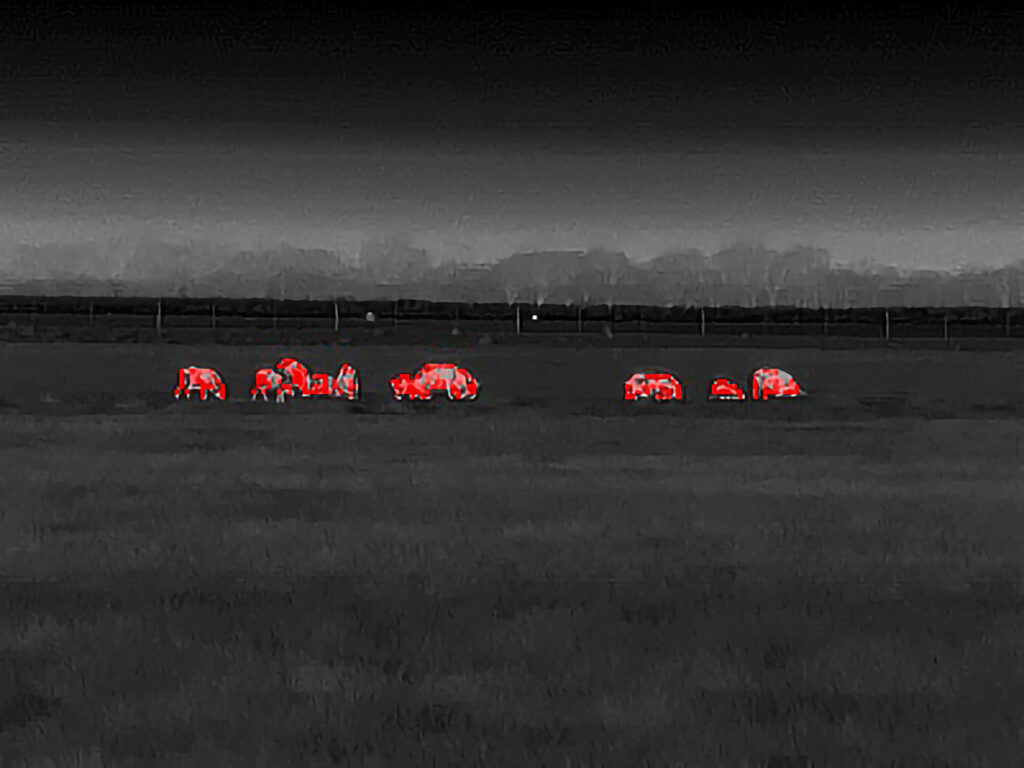
There’s no doubt that the Veil is an impressive device, but birders will ask themselves, “Is it worth a $1,500 investment?” I have several answers to this. For someone with extra resources who is fascinated with the world and would like to understand bird movements and behavior better, the Veil makes a welcome addition to your birding arsenal. For the average birder on a budget, though, the Veil is a piece of equipment that you might want to borrow or rent occasionally instead of purchasing.
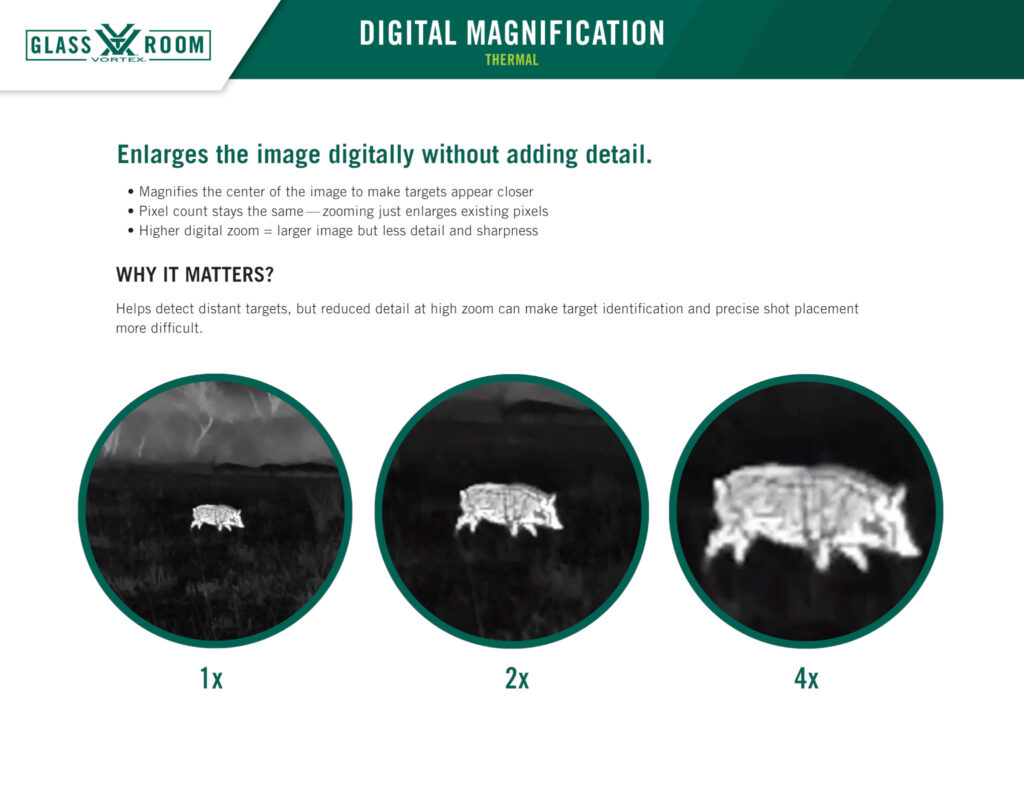
To me, the real utility of the Veil may lie in conducting scientific studies and bird surveys. Braden and I vividly imagined being at Cape May during fall migration watching thousands of nighttime migrants streaming by—or using the Veil to help detect migrating raptors at a hawkwatch site. One of the powerful things about the Veil, as we discovered, is that it is just as useful during the daytime as at night—maybe even moreso. Only when air temperatures reach eighty degrees or so, do heat differences start to wash out.
Conveniently, the Veil can capture both still and video images. These can be downloaded onto a non-Apple computer at present—but unfortunately not on a Mac, which is why I couldn’t show you any here. However, the built-in camera got me imagining a number of different scenarios for using the device to enhance or inspire new studies of birds and other animals. If any of the above possibilities intrigue you, I encourage you to “test drive” a Veil at your local sporting goods store. Whether or not you decide to buy one, it will definitely broaden your perspective on how we and other animals perceive our incredible world. Oh, and you’ll have a lot of fun, too!
Review equipment and images provided by Vortex. Text copyright Sneed B. Collard III and FatherSonBirding.com.
Holy bird…. This post is so fascinating. Really enjoyed learning about the VEIL. Have so enjoyed All of your blogs thru the years. What is Japanese for Sneed and Braden are bird warriors in the woods?
Love to you both. Ma
Thank you, Ma! It truly is a nifty device and was fun to test out 🙂
Very cool, Mr Bond!
“Need I remind you, 007, that you have a license to kill, not break traffic laws.”
Q, Goldenye, 1995
Shoot, I thought the traffic laws thing was a given for a super birder spy!
Very cool. I am so glad that you saved the large price for the end of the article, so I could be let down and dismayed only AFTER I imagined using the device and adding to my eBird lists. The ascending excitement was worth the final collapse of emotion. I recommend you use this literary strategy in your future posts.
The article leads me to wonder a few things. Why doesn’t the manufacturer create an affordable version for birders that is coupled with Lidar technology so us birders can see through tree branches and leaves? It’s the least they can do for us. And shouldn’t they send a Veil to Cornell University?
I’m glad you appreciate the literary artifice that we employ in FSB posts. I’m sure that Vortex will include Lidar tech soon–and that they’ve already provided Cornell with a box of Veils! I hope that you are over your disappointment at not being able to buy one at the local CVS!