Category Archives: Montana

Birding Festivals of the West 2026!

As April proceeds apace, it’s time to greet our spring birds with the word “Tadaima!”—Japanese for “Welcome Home!” However, it’s also an excellent time to finally do something you may have contemplated for years: attend a birding festival!

Never fear, it’s not too late. Particularly as recent geopolitical events make you rethink vacationing in Paris or visiting the Egyptian pyramids, birders have the chance to seize opportunities on our very doorstep. During the past few years, Braden and I have participated in a number of birding festivals and they have always been huge fun. They have allowed us to explore places and see birds that we never imagined, and connect with great birders from all around the world. Pick up a copy of BWD or Birding and you’ll see that there are literally dozens of birding festivals to choose from throughout the year. Today, I’d like to focus on three in the West that I’ll be participating in—and that you may want to consider for yourselves.

The Ute Mountain Mesa Verde Birding Festival, Cortez, Colorado, May 6-10

In just three weeks, I’ll be traveling to the Ute Mountain Mesa Verde Birding Festival in Cortez, Colorado, which runs from May 6 to May 10. Fun story: I was invited to this year’s festival because of a blog post I wrote last summer called In Search of the Green-tailed Towhee. The UMMV organizing committee happened to have chosen that bird as this year’s “mascot” and when they read the blog, Voila!, they invited me to give the keynote!

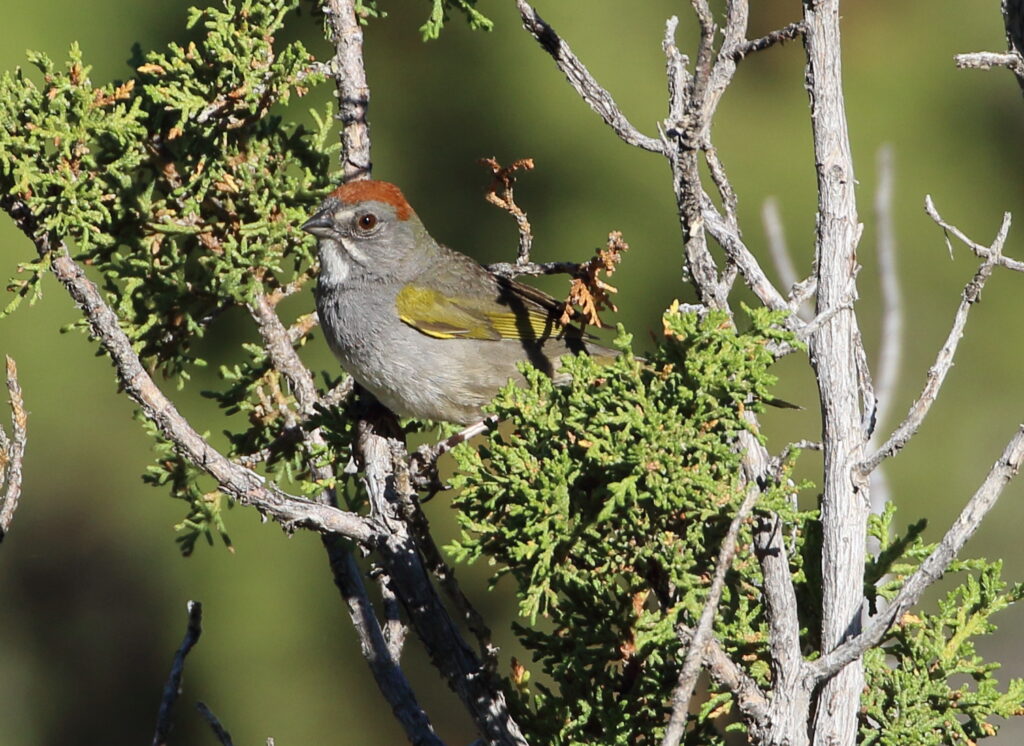
The charismatic Green-tailed Towhee is this year’s featured bird at the Ute Mountain Mesa Verde Birding Festival—but is only one of the cool specialties participants are likely to see!

Now I’ll admit that I’d never considered birding southwest Colorado, but as I delved into the various field trips, I grew more and more excited. The variety of birds and habitats in this part of the country is fabulous and includes many species that can be a challenge to see elsewhere. 180 species have been observed at the festival including waterfowl, shorebirds, raptors, and songbirds. Most exciting to me are the Southwestern birds I rarely get a chance to see including Black-throated and Sagebrush Sparrows, Gray Flycatcher, Woodhouse’s Scrub-Jay, Scaled Quail, Sage Thrasher, Virginia’s Warbler, Juniper Titmouse, and at top of my list, Gray Vireo.

The Ute Mountain Mesa Verde Birding Festival not only offers up great birds, but a chance to explore some of our nation’s most iconic scenery and cultural sites, including Mesa Verde National Park.

What really sets this festival apart is the chance to bird while exploring some of the most breathtaking scenery in America. Think dramatic canyon country like Mesa Verde National Park (see photo above) and Ute Mountain Tribal Park. This Four Corners region is loaded with archaeological sites and a unique culture found nowhere else in the world, and just begs to be explored. In fact, my wife and I are going down a couple of days early to do just that. To get there, we’re flying into Durango and renting a car. If this intrigues you as much as it intrigues us, do check it out! https://utemountainmesaverdebirdingfestival.com/

Wings Across the Big Sky, Kalispell, Montana, June 12-14

This will be Braden’s and my fourth time participating in our home state birding festival, and we couldn’t be more excited. One of the things that makes this festival special is that it travels to different parts of the state each year, allowing birders to explore Montana’s extensive variety of habitats and birds. Braden and I are leading two field trips, including one to the CSKT Bison Range, but all of the trips offer a surprising wealth of bird life. Montana is especially known for its raptors and grassland birds, but most people don’t realize that it’s a great place to see waterfowl and songbirds, too.

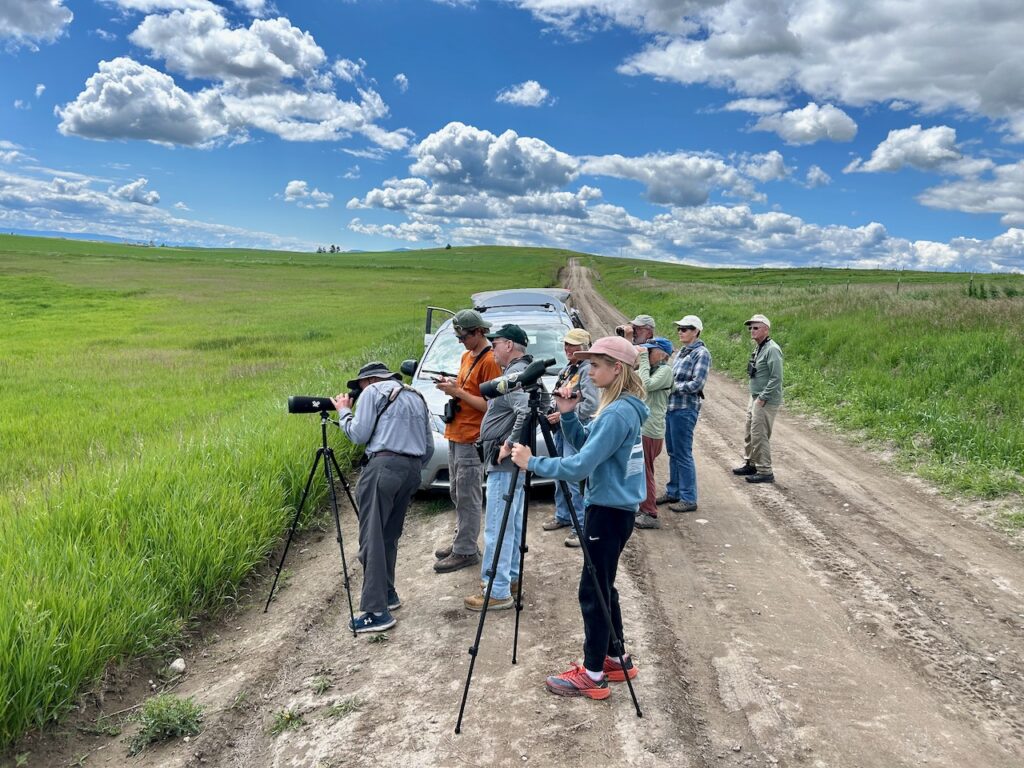
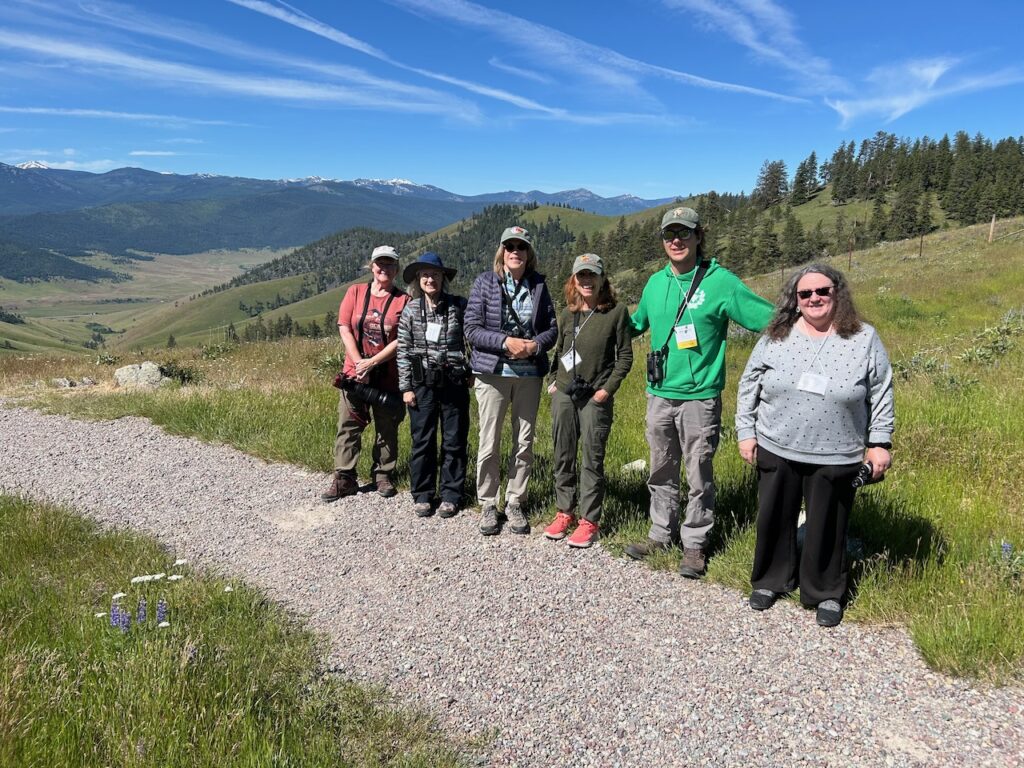
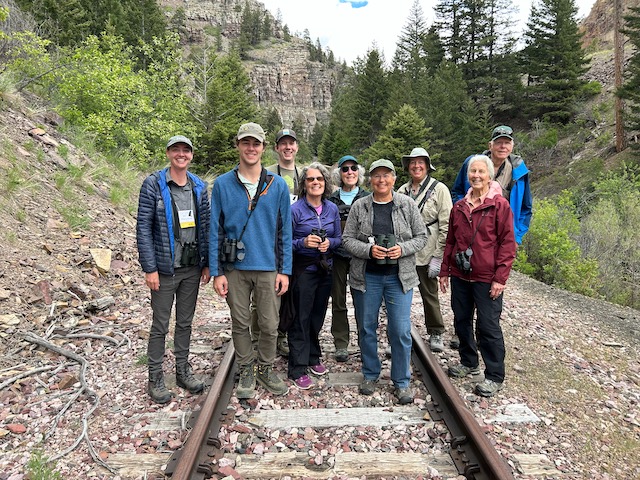
Just one of dozens of field trips at the 2024 Wings Across the Big Sky festival, including trip leaders, field biologist Hilary Turner (far left) and Andrew Guttenberg (third from left). And yes, that’s Braden towering over Hilary on the left!

If you’ve never visited Montana before, I highly recommend the field trips to Glacier National Park. At least ten kinds of warblers can be found in the park, along with four kinds of chickadees (think Boreal Chickadee), and three kinds of grouse, including Spruce Grouse. The park is especially known for breeding Black Swifts, Harlequin Ducks, Common Loons, and American Dippers. Again, you might just want to come a few days early to explore on your own!

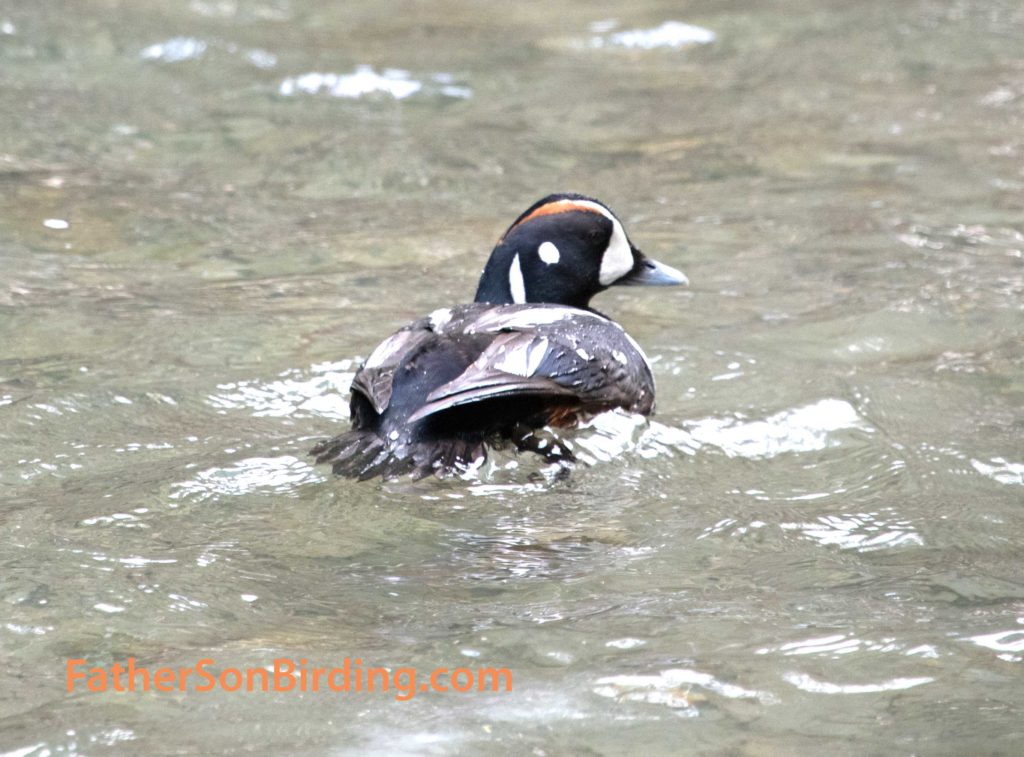
Glacier National Park may be the best place in the Lower 48 to score breeding Harlequin Ducks! Braden and I saw this one, our lifer, on our very first Wings Across the Big Sky festival!

Glacier, though, is not the only draw to this part of Montana. Flathead Lake is the largest natural freshwater lake in the West and hosts a great variety of birds along its shores. The Mission Mountains are truly one of the most spectacular and little-known mountain ranges in the Lower 48, and several field trips will explore the grasslands and wetlands of the Mission Valley. Passionate local trip leaders and Montana hospitality will ensure that you make this festival a regular part of your birding calendar.

For complete information, click here: Wings Across the Big Sky

Southeast Arizona Birding Festival, August 12-16, Tucson, Arizona

The Southeast Arizona Birding Festival has built a reputation as one of the nation’s premier birding festivals, and so when I was invited to speak and co-lead field trips at this year’s festival, I couldn’t have been more thrilled. Of course, the first thing you’re probably asking yourself is “Arizona? In August???” I did, but believe it or not, this is one of the best times to bird the Grand Canyon State.

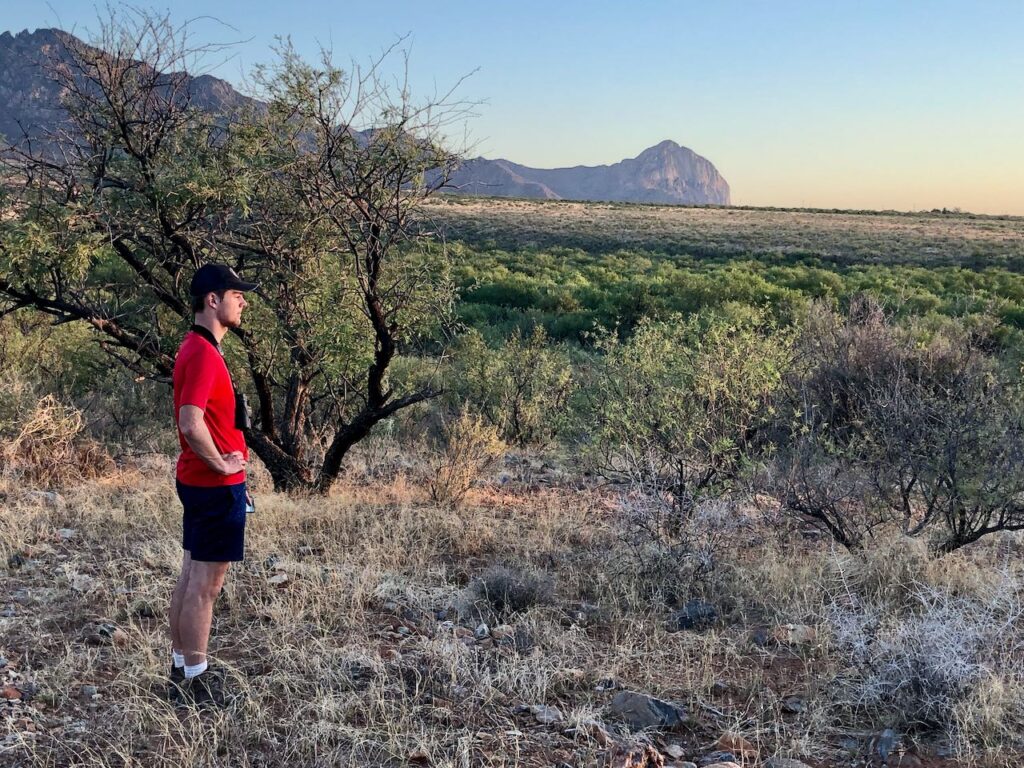
Braden contemplating a glorious sunset near the mouth of Madera Canyon—one of the field trips I’ll be co-leading during the SE Arizona Birding Festival.

Braden and I have been lucky to bird Arizona several times. See our posts “Portal Dreaming” and “Trogons and Border Walls.” One thing that always amazes us is the variety of habitats that can be found there, including wetlands, saguaro forests, and incredible canyons. Of special note are the region’s sky islands. These are mountains and mountain ranges that rise steeply out of the desert to altitudes of over ten thousand feet. Climbing up them, you quickly transition from desert through a variety of habitats, culminating with conifer forests at the top.

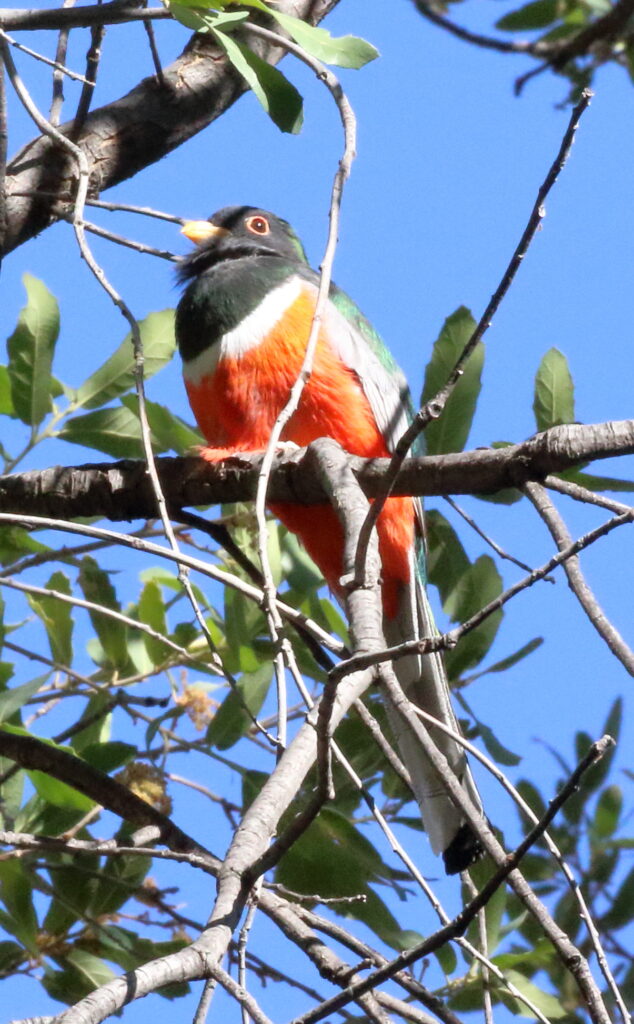
While many people travel to Arizona specifically to see the Coppery-tailed (formerly Elegant) Trogon, Arizona offers an unparalleled diversity of other specialties to US birders.

Sky islands not only provide welcome relief from Arizona’s summer valley heat, they offer an astounding variety of birds, many of which cannot be found anywhere else in the US. On our 2022 trip to Arizona, Braden and I nabbed life bird after life bird including Coppery-tailed (formerly Elegant) Trogon, Red-faced Warbler, Olive Warbler, Scott’s Oriole, Five-striped Sparrow, Mexican Whip-poor-will, and many more.

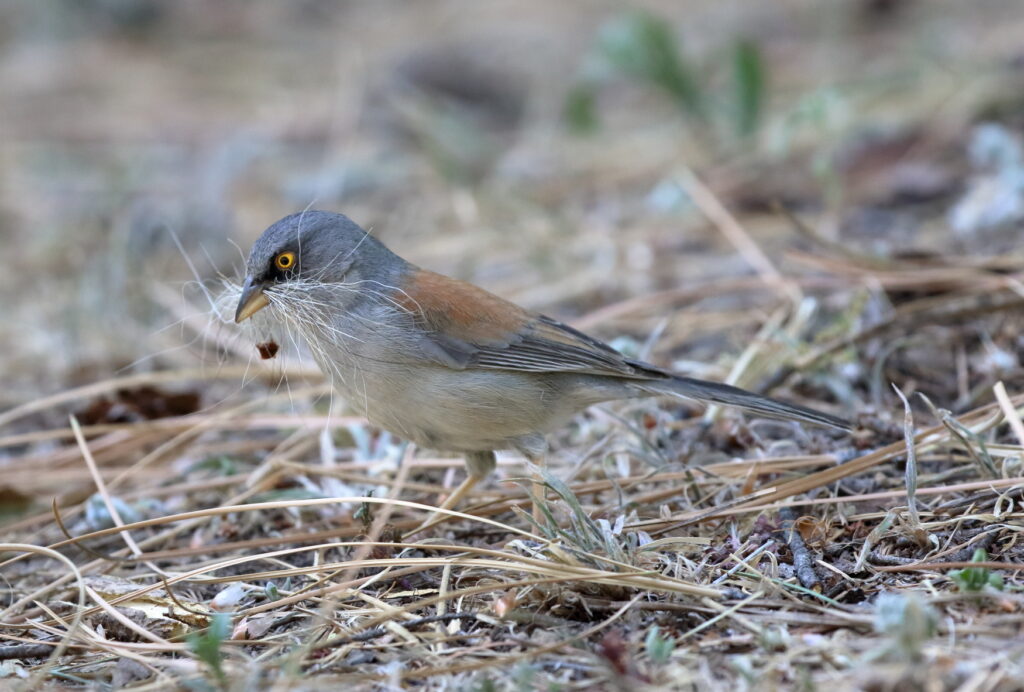
Yellow-eyed Juncos are just one of the many specialty birds that can be found in Arizona during the upcoming birding festival.

In addition to speaking at this year’s festival, I will be co-leading field trips to both Madera and Ramsey Canyons—two of my favorite places I have ever birded. But my buddy Roger and I are flying down a few days early to bird on our own. Registration for the festival begins on April 28, and if you’re interested, I wouldn’t hesitate to get on the website that day to reserve your preferred trips. The festival headquarters hotel, the Tucson Doubletree, is having some reservation issues, so you may want to call them directly as soon as possible to book a room.

SE Arizona Festival Link: https://tucsonbirds.org/festival/

So that’s it for this Festivals of the West post. We hope it has inspired you to give a birding festival a try. If the above festivals are out of reach, look into a local festival near you. For a list of festivals nationwide, check out Cornell’s All About Birds website. We can almost guarantee you’ll be glad you did! And if you spot me at one of the above festivals, please come and say Howdy!

If you’re enjoying FatherSonBirding, please consider subscribing by filling out the box in the column to the right. We won’t ever sell or give away your information and you can unsubscribe at any time. And do feel free to share this blog with others or link to it—but please contact us for any other uses! FatherSonBirding is written by REAL PEOPLE, and if you’d like to support our work, please also consider buying *new copies* of some of Sneed’s books, also shown in the column to the right.

Vortex Viper 11-33X50 and Crossfire HD 12-36X50: Two Travel Scopes, Head to Head (FSB Equipment Review)

We hope you are enjoying our reviews and other posts at FatherSonBirding. A reminder that we do not receive payment for any of our blogging efforts, so if you wish to support our work, please consider purchasing a few *new* copies of Birding for BoomersWarblers & WoodpeckersFirst-Time Japan, or any of Sneed’s other books. If you already have copies, why not pick up some for your friends? 

Sometimes, you just gotta go birding. Such was my feeling recently when my friend and birding buddy Susan Snetsinger collected me for an all-day birding expedition to Butte and back. As a sizzling pink dawn crept over our neighborhood, I felt particularly excited. Why? Because today, we were going to test two spotting scopes ideal for the traveling birder: the Vortex Viper 11-33X50 and the Vortex Crossfire HD 12-36X50.

Vortex classifies both of these scopes as “Compact” in size, but I also refer to them as “travel scopes” because they are small, light, and fit easily into almost any backpack or suitcase. A few months ago I posted a very positive review of Vortex’s top-of-the line compact scope, titled “Vortex Razor HD 13-39X56 spotting scope with Mountain Pass tripod.” I recommend reading that post again before you read this review as it will help provide the entire story about these three scopes—in descending price order. As you’ll recall, the Vortex Razor HD 13-39X56 runs about $1,000 and is well worth the money. It may be out of reach for many birders, though, and that’s one reason I felt so excited about testing the more affordable Viper and Crossfire compact scopes. The Viper lists at $849.99—but can be purchased for about $600. Meanwhile, the Crossfire lists for $299.99—but can be bought for around $200. “But,” Susan and I both wondered, “how will these two more affordable scopes stack up against each other?”

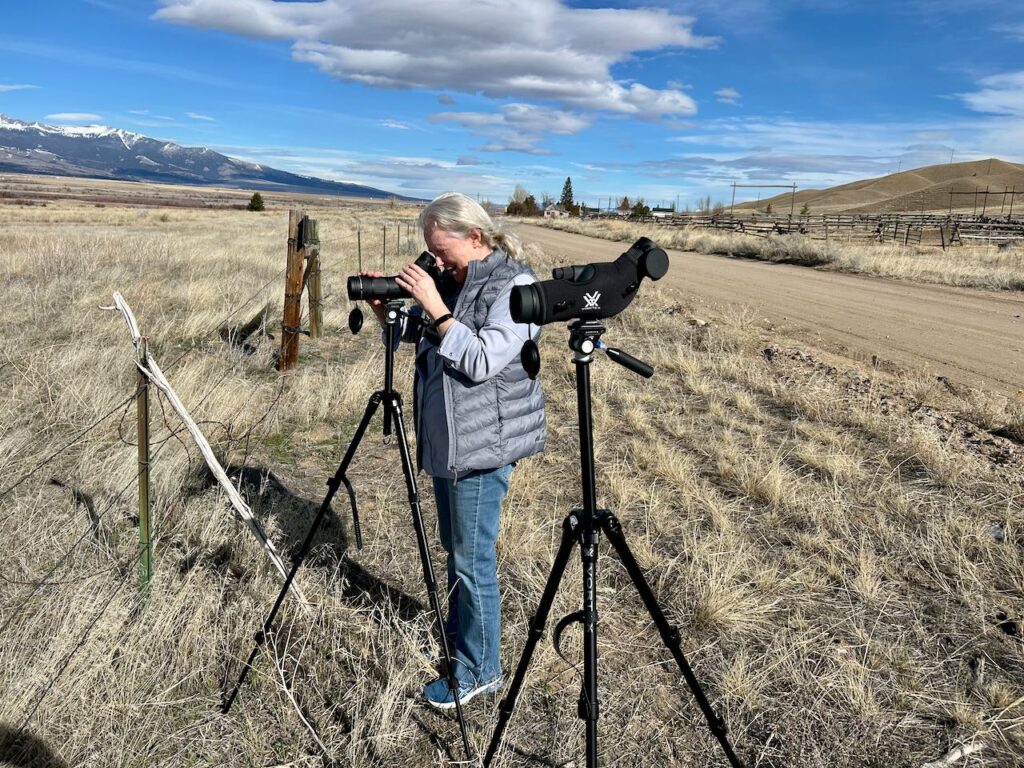
My birding pal Susan testing these scopes side by side at Warm Springs wildlife area.

First, let’s discuss what they have in common:

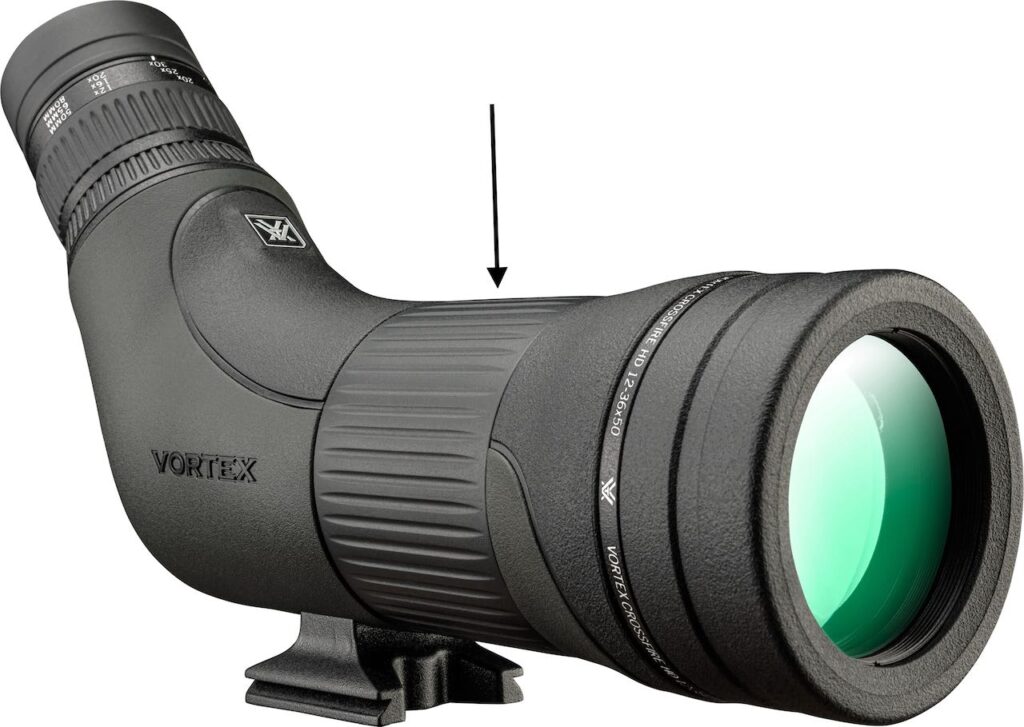
  • Both come in an angled configuration (see image below), which I much prefer to the straight option because it allows for a lower, more stable position on the tripod and easier viewing.
  • Both are about 10.3 inches long and weigh in at about thirty ounces—just under two pounds, or a bit more than an average pair of binoculars.
  • Both have very similar magnifications, the Viper zooming from 11 to 33X magnification, and the Crossfire 12 to 36X.
  • Both are built to fit the Arca-Swiss standard mount, which allows them to be directly fitted to Vortex and many other tripod heads without a pesky adaptor plate.
  • Both come with Vortex’s no-questions-asked lifetime warranty, making either scope a worry-free purchase from the get-go.
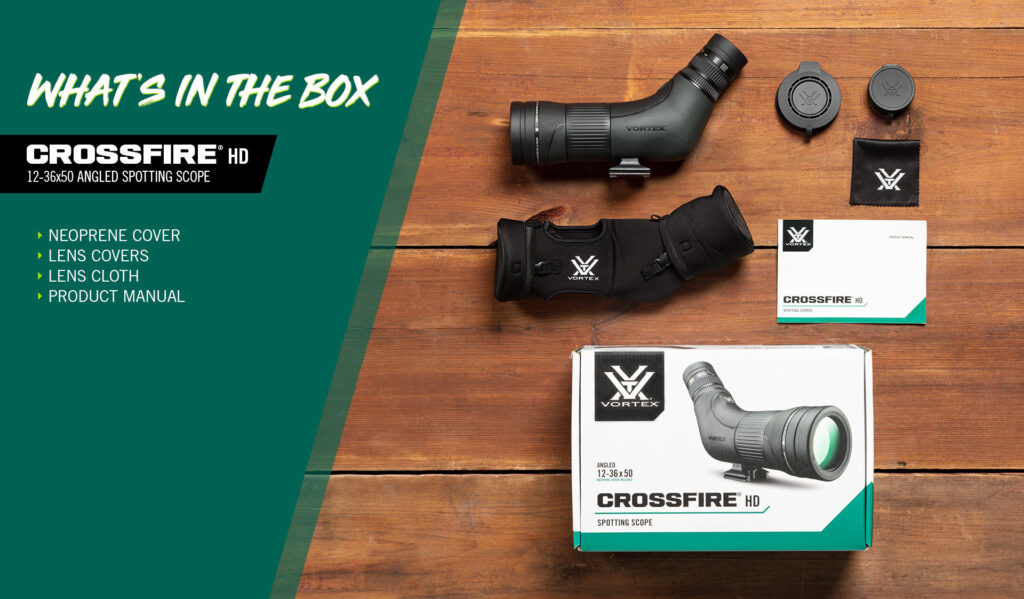
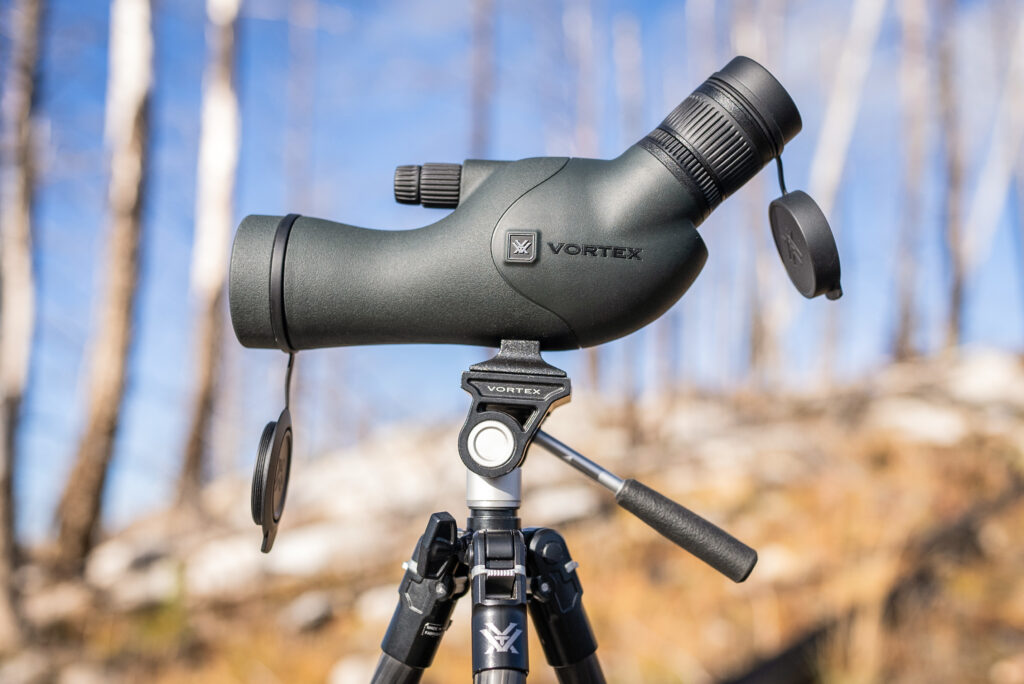
Both scopes come with easy-to-use lens caps and a neoprene sleeve for protection.(Photo provided by Vortex.)

Which leaves the primary question you’re probably asking yourself: Is the Viper worth the extra $400 I would have to spend over the Crossfire? To begin finding out, Susan and I rolled up to our first stop, Racetrack Pond just south of the town of Deer Lodge. We set up the two scopes side by side, each perched on a Vortex Mountain Pass tripod and began scanning the pond. It was still early in the season for most songbird migrants, but ducks, geese, and swans were out in full force and even as we were setting up, we were delighted to see a flock of 22 Snow Geese flying by. However, we began focusing mainly on Common Goldeneyes, American Wigeon, and Ring-billed Gulls puttering around a tiny island a hundred or so yards offshore.

Controls

As with any new equipment, it took us a few minutes to get familiar with the controls on each of the scopes. Both had eye relief tubes that easily pulled out, and both had about the same zooming range. At first we couldn’t figure out how to easily zoom the Crossfire in and out, but it turns out I hadn’t screwed in the eyepiece tightly enough when assembling the scope out of the box. Once I tightened the “knurled ring” at the base of the tripod, the zooming ring functioned just fine.

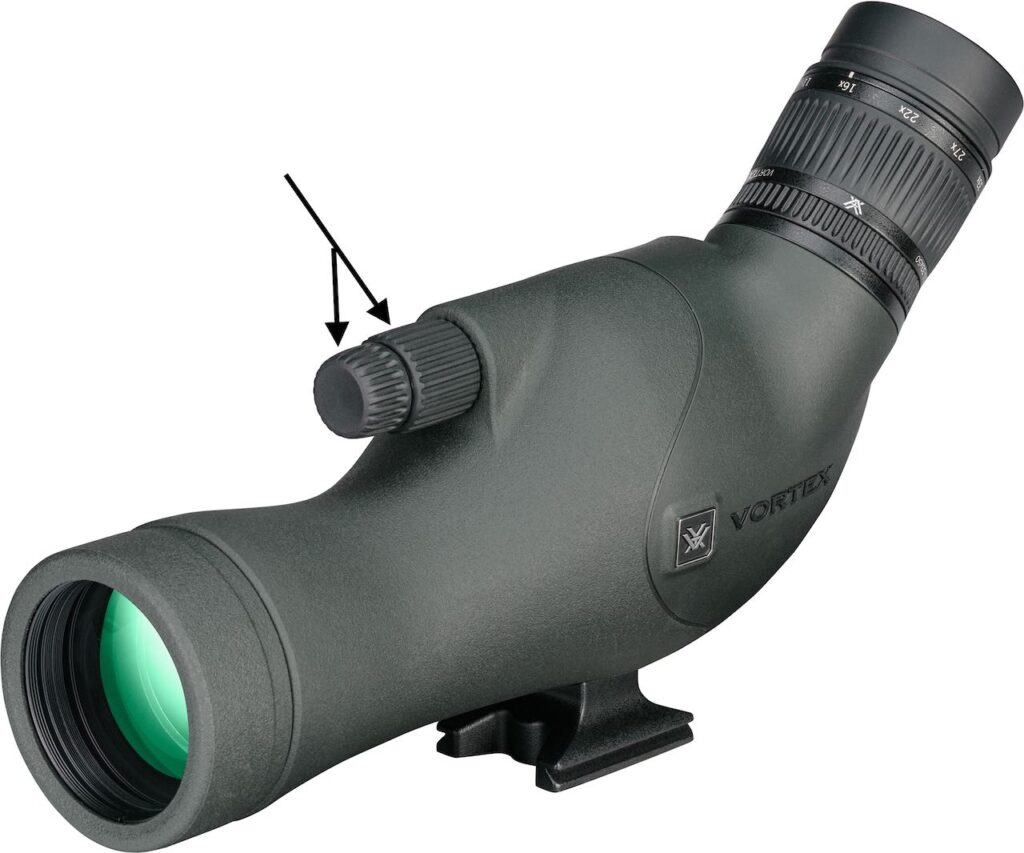
The main difference on the controls between the two scopes is the focusing mechanism (see arrows in images below). The lower-priced Crossfire comes with what’s called a helical focus. This is a ring around the entire scope tube that you twist back and forth to focus. The more expensive Viper comes with what is called a dual fine focus—two small knobs conveniently positioned on top of the scope that allow you to quickly adjust them. Spoiler alert: I’m going to just come out and say that, if you can afford it, the dual fine focus alone justifies the extra expense of buying the Viper over the Crossfire. Not only does this system achieve a sharper focus, it is much faster and more convenient to use. I watched a video about this and the host pointed out that this is especially great for digiscoping, or using your phone to take a photo through a scope. I don’t yet do this myself, but it’s good to know.

Optical Quality

One thing I and many others have discovered is that the brightness and clarity of images through optical devices don’t at first seem that different, even between more and less expensive models. That initially seemed to be the case when Susan and I compared the Viper and the Crossfire. The more we used them during our outing, however, the more it became apparent that the Viper gave us superior images. Not only was light transmission better through the Viper, it achieved sharper, clearer focus. That’s not surprising considering that the Viper comes with better coatings on its glass lenses and prisms, but it was still interesting to notice that difference in the field. Later, I tested the two scopes under very low light conditions, and the brightness of the Viper stood out even more.

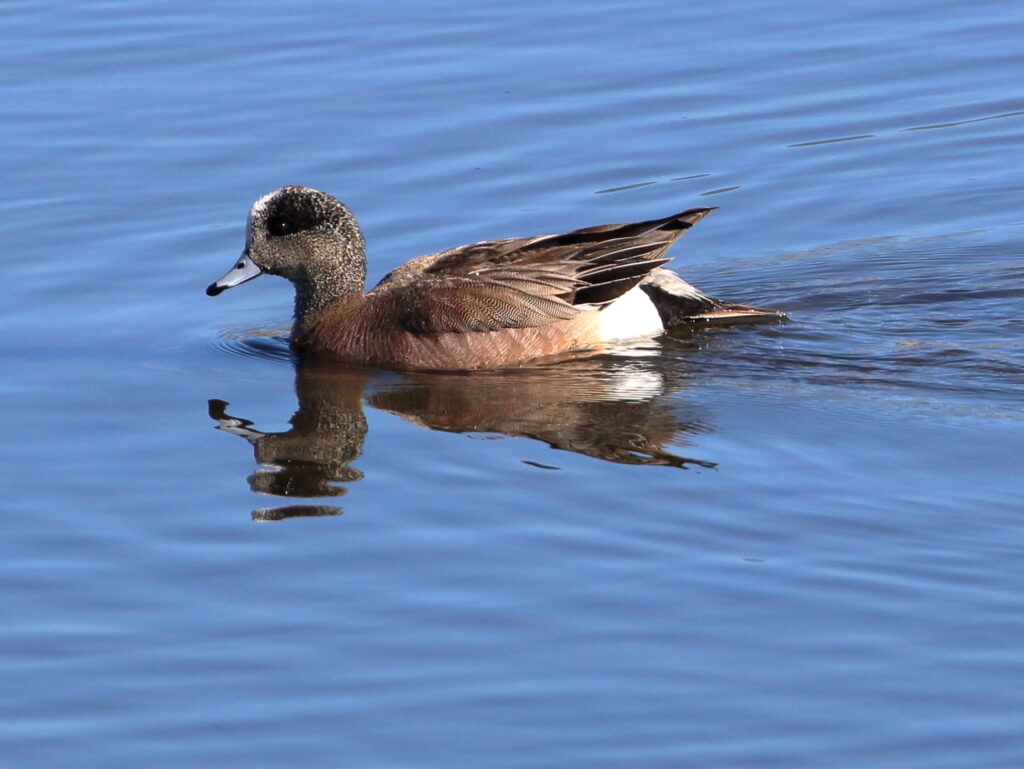
Though still early in the season, American Wigeon and other waterfowl gave us plenty of “targets” to test out the scopes. Though differences in optical quality were subtle at first, after spending a couple of hours looking through each scope, the Viper emerged a clear winner.

Build

Both the Viper and Crossfire appear to be very solid and well built. The Vortex website boasts that the Viper features “ultra rugged construction” while it makes no such claims for the Crossfire, so I assume that better manufacturing and materials go into the Viper. However, my guess is that both of these products will perform very well in the field. Both are fog proof and waterproof, essential features for anyone out watching birds. The Viper is purged with argon gas while the Crossfire is purged with the more standard nitrogen. I asked a rep what the difference meant for consumers, and he answered, “the difference isn’t actually with the optical quality, but instead the longevity of the optic. Argon has a larger atom, and will reduce the rate of leakage over long periods of time when compared to nitrogen. Argon is also less affected by sudden temperature shifts and is much more resistant to extreme temperatures.” He also admitted that most users will probably never notice this until at least 10+ years of use—if ever.

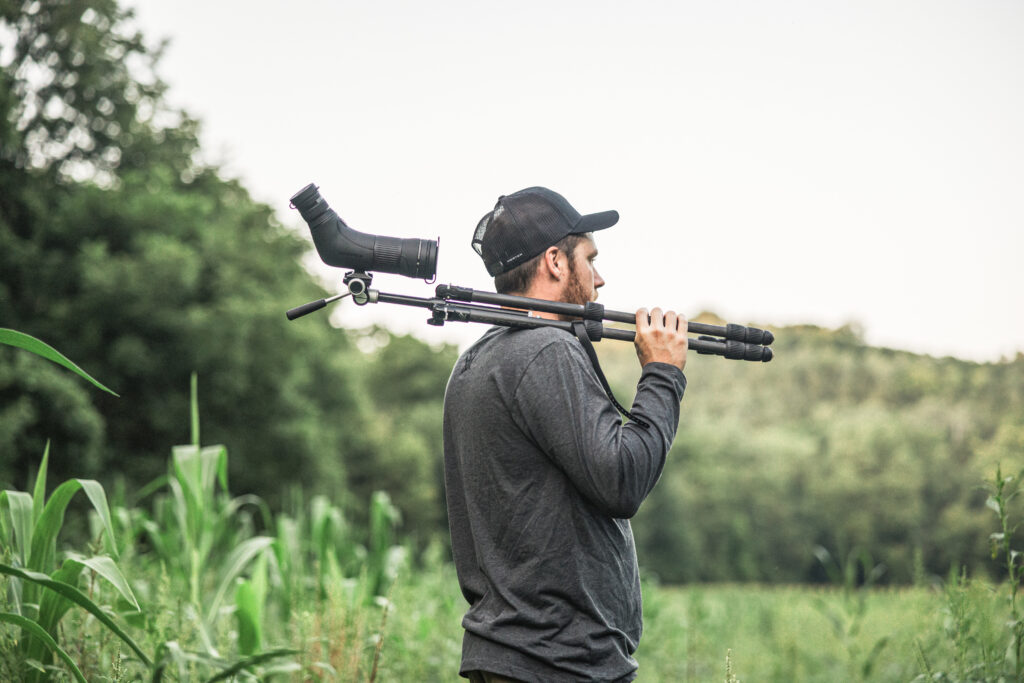
Whichever compact scope you buy, I highly recommend the Mountain Pass tripod to go with it. This combo is both easy to pack and carry over the shoulder on even a long birding hike! (Full confession: I’m not sure this is a Mountain Pass tripod in this photo provided by Vortex, but it looks as small and lightweight.)

Bottom Line

When comparing the Viper and Crossfire head to head, the Viper comes out a clear winner. Both are terrific, lightweight scopes for the traveling birder, but if you can at all afford or save up for the Viper over the Crossfire, I highly recommend it. That doesn’t mean, though, that the Crossfire doesn’t fill an important niche. It’s a great purchase for those on a budget, or those buying a first scope for a beginning birder and, honestly, many people may stay perfectly content with their Crossfires for the foreseeable future. If you need a scope to just carry around in the car or keep in a cabin without having to worry too much about it getting stolen, the Crossfire also could be just what you’re looking for.

Whichever scope you buy, I do highly recommend the Mountain Pass tripod, which is well-suited to both scopes both in weight, dimensions, and cost. I’ll also point out that both scopes work with Vortex’s Pro Car Window Mount. I have not yet used this, but plan to write up a review as soon as Braden and I can head out into Montana’s grasslands this summer.

Though both scopes offer great value for the money, after our testing we both felt that birders will be happier if they stretch their budgets for the Viper rather than going for the more inexpensive Crossfire. (Photo provided by Vortex.)

If you enjoyed this review, check out these other recommended optics for birders:

Vortex Viper HD Binoculars

Nikon Monarch HG Binoculars

Nocs Pro Issue 8X42 Waterproof Binoculars

Vortex Bantam HD 6.5X32 Binoculars

Vortex Razor HD 13-39X56 spotting scope with Mountain Pass tripod

Turning Useless Lawn into Vital Habitat

Today, we repost one of our most popular blogs of the past few years. The timing is no coincidence. It is SPRING, and it has never been more urgent to protect our native birds, insects, and other wildlife. One of the largest untapped potentials for doing this is for homeowners to create native habitat in their yards. If you live in Missoula, we are sponsoring a native plant giveaway of red osier dogwood on Saturday, April 18, 2026 from 10 a.m. to 2 p.m. at 1300 Murray Street on the right just past Lolo St. as you drive up Rattlesnake Drive. The first 50 people will receive a free plant with instructions on how to care for it. Hope to see you there!

As the winter chill wears off, many of us are anticipating how we can spi1300ff up our yards. That can be a tall order when we’ve inherited a landscape of sterile lawns and imported ornamental plants that have no business growing in Montana—or, most likely, wherever else you happen to live. Fortunately, this situation presents us with a wonderful opportunity to bolster the native ecosystems we know and love. How? By replacing exotic species with native plants that are both beautiful and provide real value to birds, insects, and other native wildlife.

Our blue penstemon and other flowering plants feed a host of native insects, including a variety of bumblebees.

A Scientific American article titled “The American Obsession with Lawns,” points out that lawns began sprouting up in America in the nineteenth century. They were an attempt to emulate trendier Europeans and, more important, to display wealth and status. Fast forward to today, and a house doesn’t seem complete without its neatly-mowed spread of Kentucky bluegrass. Unfortunately, our obsession with lawns comes with a host of problems.

As you can see, we aren’t purists. Here, native mock orange (white flowers), snowberry, and fireweed thrive amid California poppies and some kind of honeysuckle I can’t recall the name of!

Especially in the West, lawns gobble up water that we can scarcely afford. Just how much depends on location and other factors, but keeping a lawn alive can devour between 15 and 75% of a family’s household water consumption. Keeping those lawns green and pristine-looking also can be expensive, especially factoring in the gas and electricity required to run lawnmowers, and the fertilizers and herbicides to keep lawns green and weed-free. Speaking of “weed-free,” despite industry claims that herbicides and other garden chemicals are safe, I am skeptical. Do you really want to be dumping things into the soil that may persist for decades and have unknown long-term health risks. I don’t—especially when my yard sits only twenty feet above the aquifer that I and the rest of my community depends on for drinking water.

Despite industry claims, I don’t think we’ll know the full impacts of a lot of chemicals for years. Unless we want to keep repeating chemical disasters, it seems prudent to avoid commercial herbicides and insecticides whenever possible. Replacing at least a bit of your lawn with native plants is a great way to do that.

All that said, my biggest beef with imported lawns and plants is that they have needlessly transformed productive habitat into sterile expanses with almost no useful function. Sure, a lawn is great for kids to play on—we keep a patch of it ourselves—but our grass obsessions have come at an extreme cost to wildlife, especially to native insects and birds. Many of you have probably heard the shocking statistics that America has lost one quarter of its breeding birds in the short space of fifty years. There are many causes for this, but habitat loss probably ranks at the top. While much of this loss may have been unavoidable, in the case of our lawns, it is not.

Even common, beloved birds have seen dramatic declines in the past fifty years, and habitat loss is often a culprit. Yards filled with native plants can be a major step in reversing this trend. (This is a newly-fledged Black-capped Chickadee sitting in one of our mock orange plants.)

Author Douglas Tallamy (Nature’s Best Hope) points out that 40 million acres of our nation’s natural habitats have been converted to turfgrass—an area about 42% the size of Montana! If we “turf owners” convert just half of our lawns to native habitat, it will restore an area larger than the Everglades, Yellowstone, Yosemite, Grand Teton, Canyonlands, Mount Rainier, North Cascades, Badlands, Olympic, Sequoia, Grand Canyon, Denali, and the Great Smoky Mountains National Parks. Talk about your game changer!

One great thing about native plants is that once you put a few in, they find where else they want to be. This patch of beebalm came up totally on its own—much to the delight of honey bees, bumblebees, and butterflies. (Golden currant in the background, angling up to the right.)

Fortunately, converting your yard to native plants is fairly easy to do. A simple online search reveals nurseries that offer native plants all over our state (also check your native plant society—see below). You don’t have to create your own “national park” all at once. Just dig up a strip of your present lawn and put in some native shrubs. Here in Montana, you’ll want to stick to deer-resistant plants such buffaloberry, juniper, or maple sumac—or better yet, protect plants with fencing until they grow large enough to thwart deer. Before planting trees, think about how big that tree is going to be in fifty or one hundred years—and plant it in an appropriate spot. If you live in a fire area, you’ll want to make sure you keep a defensible space around your house, too.

Native plants don’t just “grow” native insects. Many provide fruit and seeds for birds, as this berry-laden serviceberry branch shows.

Incorporating native plants into your yard brings immediate rewards. Our modest native plantings attract chickadees, juncos, wrens, kinglets, and other native birds, many of them feeding on the insects that the plants produce. Why not join the fun? You’ll discover a whole new aspect of gardening, and take satisfaction in helping the wildlife we hold dear.

This House Wren and its mate successfully raised a batch of youngsters in our yard last summer. At times, the pair were bringing caterpillars and other insects to their chicks every two or three minutes! To my satisfaction, I watched them grab most of these insects right off of the native plants in our yard!

Sneed’s Favorite Native Plants for the Yard That Don’t Need Deer Protection: buffaloberry, maple sumac, juniper, mountain mahogany, chocolate coneflower, yellow coneflower, Oregon grape, pussytoes.

Sneed’s Favorite Native Plants That Do Need Deer Protection (at least until they grow larger): golden currant, beebalm, burr oak, purple coneflower, mock orange, aspen, rabbitbrush, serviceberry, cottonwood (need a LARGE space).

A Word of Advice: Never, EVER plant any grasses unless you really know what you’re doing. Even native grasses can quickly get out of hand—as I have learned the hard way.

To find out sources of native plants and seeds, check the website of the Montana Native Plant Society. They have lists of resources for every part of the state! If you don’t live in Montana, you probably have your own native plant society you can look up! Here in Missoula, another great resource is Watershed Consulting, which has a wonderful native plant nursery. You can get their list via:

Website: www.mtnativeplants.com; Email:  hello@mtnativeplants.com; Andy Martinez, manager: 406.529.7746

If you can’t find a good source of native plants near you, call up the wonderful Audubon native plant database. There you can just enter your zip code and begin finding the best plants to put in near you. Even better, you can purchase the plants directly from the website.

For another great, and more detailed post, about transforming your yard into habitat, check out Shane Sater’s excellent post on his “Wild for Nature” website!

FSB’s Third Annual Short-Eared Owl Lousy Photo Shoot!

You knew it was coming. You heard the rumours. You’ve waited patiently, and guess what? Today is the day! Right this second, Braden and I are proud to reveal FSB’s Third Annual Short-Eared Owl Lousy Photo Shoot!

Like many birders, Braden and I try to “bird in” the new year with one or more big days of birding somewhere near our home in Missoula. The past couple of years, we’ve headed to Ninepipe National Wildlife Refuge about an hour north of us, mainly because it’s a reliable place for a variety of birds and is especially good for hawks, falcons, and other raptors. This year, our day was shaped by a couple of fun additional circumstances. One is that our long-time friends Susan Snetsinger and her son (Braden’s pal) Eli Frederickson happily agreed to join us for our birding excursion. The other is that a putative sighting of an Arctic Loon on the north end of Flathead Lake  sent all of us Montana birders into a tizzy. Why? Because an Arctic Loon has never been reported in the state!

For the third year in a row, we decided to head north through the spectacular Mission Valley for our first major birding expedition of the year.

(To view our past two “lousy owl” photo blogs, see our posts Lost in Owls and Plenty of Partridges.)

Unfortunately, on December 30th, yours truly woke up with his first cold in two years and was in no shape to venture out on January 1st. No problem. Everyone agreed to push back our outing to January 3rd and, more important, the Arctic Loon was still being reported! As we set out before dawn, fog and ice covered our route, making driving sketchy, especially with the pre-dawn danger of deer wandering out onto the highway. Braden, though, fearlessly drove us north and as we passed the National Bison Range, a bit of light began seeping in through the fog.

We decided to head to the loon first and that afforded Susan and Eli a once-in-a-lifetime opportunity to join Braden and me at our favorite French breakfast spot, McDaniels, in Ronan. I even convinced the two of them to order my favorite morning birding beverage, a large iced tea, to help power us all through the day.

From left to right, Braden, Sneed, Eli, and Susan as we pursued our spirited quest to locate the “Arctic Loon.”

After a fruitless stop to look for Long-eared Owls near Polson, we arrived at our destination of Somers on Flathead Lake just after 11 a.m. Dan Casey, who first reported the Arctic Loon, had kindly noted several viewing possibilities from the lakeshore, and we began visiting these. Right off the bat, we saw some interesting birds. These included Red-necked Grebes, a species we had never found in Montana at this time of year, and a couple of Blue Jays, a species Braden and I totally missed in our home state last year.

We saw no sign of a loon of any kind, so continued to explore the lakeshore. More fun birds popped up, including a variety of ducks, Trumpeter Swans, and one of our favorite winter birds, Northern Shrikes. We also toured the neighborhood where we’d seen our lifer Snowy Owl eight years ago (see our very first post, A Quest for Snowy Owls). None of the owls have been reported this winter, but we thought, “Might as well give it a try.” We eventually left the Kalispell area both owl-less and loon-less, but none of us really minded. We were still seeing birds and even better, enjoying each other’s company.

Any day you find a Northern Shrike is a good birding day—and we saw three or four of them during our expedition.

90 minutes later, we were turning down Duck Road at Ninepipe. It was only 3 p.m., but this time of year it felt a lot later. Much of the fog at cleared, but mist still hung off of the spectacular mountains in the distance, giving everything an other-worldly feel. We drove slowly and picked up some expected raptors: Rough-legged and Red-tailed Hawks, Northern Harrier, Bald Eagle, and American Kestrel.  

“Should we go drive by the Short-eared Owl place?” I asked Braden.

“Sure,” he answered and began searching for the location on his phone.

We didn’t get that far.

Heading south on Ninepipe Road, he suddenly shouted, “There’s one!”

I am especially proud of this lousy Short-eared Owl Shot. See how I tilted the camera to make it appear that the owl is flying downhill? Well, guess what? It wasn’t! I just used my advanced photo skills to make you think that. This is a highly complex and dangerous technique, however, so don’t try it at home!

I immediately pulled over so we could all look and, sure enough, there was one of our favorite creatures flying low over a marsh area in the distance.

We had barely begun to look at it, however, when Eli shouted, “There’s another one!”

“Oh my god,” Braden added, scanning with his binos, “There’s three more way out beyond that!”

If I’d been trying harder, I would have been able to capture up to five SEOWs in one shot–but that might have made the photo TOO good for this blog!

We clambered out of our minivan, and the more we looked, the more Short-eared Owls we saw. These weren’t quick glances, either. Some of the owls appeared to be hunting, dropping quickly into the marsh for a go at a vole. Others looked to be courting, sparring and jousting “good-naturedly” and briefly locking talons before circling around again. A couple of owls spent a few minutes chasing away a Northern Harrier who apparently lacked the firepower to defend her space.

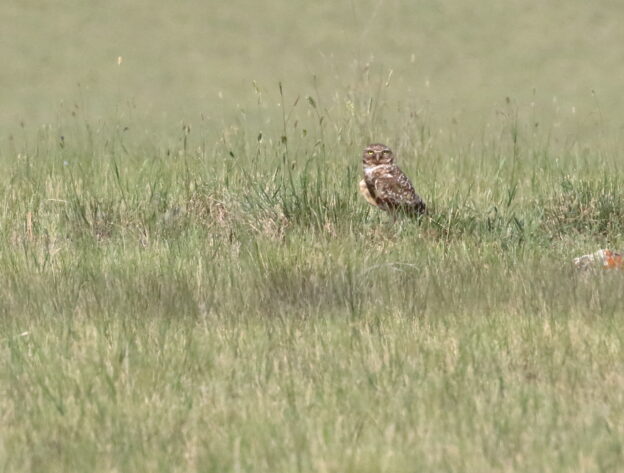
This SEOW did not want its identity revealed, so as you can see I used sophisticated AI processing to blur out its face.

While these weren’t the closest SEOWs we’d ever seen, this was far and away the best Short-eared Owl experience any of us had ever had. Not only were the owls engaging in all kinds of interesting behaviors, we had this winter spectacular all to ourselves.

We encountered nary another birder during our half hour enjoying this “most owl” spectacle!

Oh, and did I mention that I got to take more than a dozen lousy Short-eared Owl photos? That felt particularly gratifying since, after three years, I’ve got a reputation to uphold! We hope you enjoy the gallery and keep tuning in to FatherSonBirding. Even more, we hope you keep having your own magical birding moments.

Happy New Year!

P.S. Oh, it turns out that the Arctic Loon got “downgraded” to a Pacific Loon. C’est la loon!

Even without the owls, a winter visit to the Mission Valley is a soulful, satisfying experience. Oh, and can you find Trumpeter Swans in this picture?

Birding 2025: It’s a Wrap

As always, we encourage you to share and link to this post. We absolutely do not give permission to use it to train AI models or for other purposes without permission. Happy New Year, Everyone!

As 2025 rapidly winds up, Braden and I want to thank you for your continuing interest in FatherSonBirding and all that you do for birds. We can’t believe that it’s been almost EIGHT YEARS since we published our very first post, A Quest for Snowy Owls! We certainly wouldn’t have kept at it without your interest and support.

We’re thrilled to report that 2025 has been FSB’s biggest year yet. We published a record 49 posts this year, including our 250th post, “Binoculars and Scopes for the Happy Holiday Birder”. Speaking of that, we also launched FSB equipment reviews—articles we do NOT get paid for, but which have attracted a ton of viewer interest.

FSB received a record 20,000 views in 2025, greatly helped by our equipment and travel reviews!

And speaking of viewers, our site attracted 20,000 views this year, shattering last year’s record of 14,000—with the caveat that about a thousand of those views were likely from AI bots stealing our content without permission (Grrrr…). Still, the vast majority of those extra visitors were legitimate—and from an astounding variety of places. More than 15,000 viewers from 104 countries visited our site this year! Huge gracias, arigatos, mercis, and many more thank yous to our international visitors!

By now, we can hear you pleading, “But please, Sneed and Braden, tell us your Top 5 most popular posts!” Astoundingly, four of our five top posts were equipment review posts:

1) Vortex Triumph 10X42 Binoculars: Entry Level Excellence with 1,425 views. (View post here!)

2) Nikon Monarch HG Binoculars: FSB’s First Equipment Review with 950 views (View post here!)

3) Vortex Razor HD 13-39X56 spotting scope with Mountain Pass tripod: A Perfect Travel Combo? With 580 views (View post here!)

4) Birding Barcelona, Part 1: The Urban Core with 510 views (View post here!)

5) Vortex Viper HD Binoculars (Equipment Review, and/or Texas 2025 Part 2-½) with 480 views (View post here!)

Our 2024 blog about birding downtown Barcelona snuck into the Top 5 for 2025—with several of our Japan and Costa Rica posts close behind!

The numbers reveal some clear trends: with rare exceptions, our most popular posts have been our equipment reviews and reports from travel destinations. Our posts from Japan, Spain, Colombia, Mexico, and Costa Rica have been especially popular—as have posts about very birdy domestic locales such as Texas and San Diego. Our book reviews also have done well, but a decline in America’s literacy rate is clearly evident, as our statistics reveal that many more viewers are interested in buying gear than in reading books.

On a personal level, Braden and I are grateful for the many wonderful birding experiences we got to share, both together and separately. Braden was fortunate to visit both Mexico and Costa Rica in 2025 as well as take an epic cross-continent trip from Maine to Montana following his graduation from the University of Maine. He also birded the heck out of Arizona while on his way to his current job in California, where he’s racking up all kinds of new birding experiences.

As for Sneed, I kicked off the year with a trip to Victoria, Canada, thanks to my wife, Amy—and, honestly, the year never seemed to slow down. As soon as we returned, my buddy Roger Kohn invited me on an epic last-minute trip to Colombia. There followed journeys to Texas, Maine, eastern Montana, California (twice!), and most recently, Georgia and Oregon. Most of the latter were not planned as birding trips, but you won’t be surprised to learn that we saw a ton ‘o birds along the way.

You also won’t be surprised to learn that, quite unintentionally, Braden and I shattered most of our own birding records. Braden finished out his birding year with a remarkable 867 species while I smashed my own previous record with 551 species!

One of the low points for the year was having to say goodbye to our wonderful “birding dog” Lola. She left us far too soon and we still miss her terribly. (See this post.)

Besides finding birds, Lola proved adept at finding marine mammals such as this whale. We miss you Lola!

Moving forward, we hope to continue to publish a wide variety of posts for your reading pleasure, including those about everyday birding experiences that are at the heart of a birder’s joy and wonder. Just a few adventures that we have lined up for 2026 include trips to Costa Rica and Germany, along with visits to birding festivals in Colorado, Arizona, and Montana. Meanwhile, it is our sincerest wish that the next year brings you all good things, including many incredible birding experiences and a brighter outlook for birders, birds, and the planet we all share.

For some ideas about how to help birds this coming year, please visit our last post, Giving Back to Birds—with Great Breaking News! As always, if you would like to help support FatherSonBirding, consider buying new copies of some of Sneed’s books by clicking on the book jackets to the right.