Category Archives: Tripods

Vortex Viper 11-33X50 and Crossfire HD 12-36X50: Two Travel Scopes, Head to Head (FSB Equipment Review)

We hope you are enjoying our reviews and other posts at FatherSonBirding. A reminder that we do not receive payment for any of our blogging efforts, so if you wish to support our work, please consider purchasing a few *new* copies of Birding for BoomersWarblers & WoodpeckersFirst-Time Japan, or any of Sneed’s other books. If you already have copies, why not pick up some for your friends? 

Sometimes, you just gotta go birding. Such was my feeling recently when my friend and birding buddy Susan Snetsinger collected me for an all-day birding expedition to Butte and back. As a sizzling pink dawn crept over our neighborhood, I felt particularly excited. Why? Because today, we were going to test two spotting scopes ideal for the traveling birder: the Vortex Viper 11-33X50 and the Vortex Crossfire HD 12-36X50.

Vortex classifies both of these scopes as “Compact” in size, but I also refer to them as “travel scopes” because they are small, light, and fit easily into almost any backpack or suitcase. A few months ago I posted a very positive review of Vortex’s top-of-the line compact scope, titled “Vortex Razor HD 13-39X56 spotting scope with Mountain Pass tripod.” I recommend reading that post again before you read this review as it will help provide the entire story about these three scopes—in descending price order. As you’ll recall, the Vortex Razor HD 13-39X56 runs about $1,000 and is well worth the money. It may be out of reach for many birders, though, and that’s one reason I felt so excited about testing the more affordable Viper and Crossfire compact scopes. The Viper lists at $849.99—but can be purchased for about $600. Meanwhile, the Crossfire lists for $299.99—but can be bought for around $200. “But,” Susan and I both wondered, “how will these two more affordable scopes stack up against each other?”
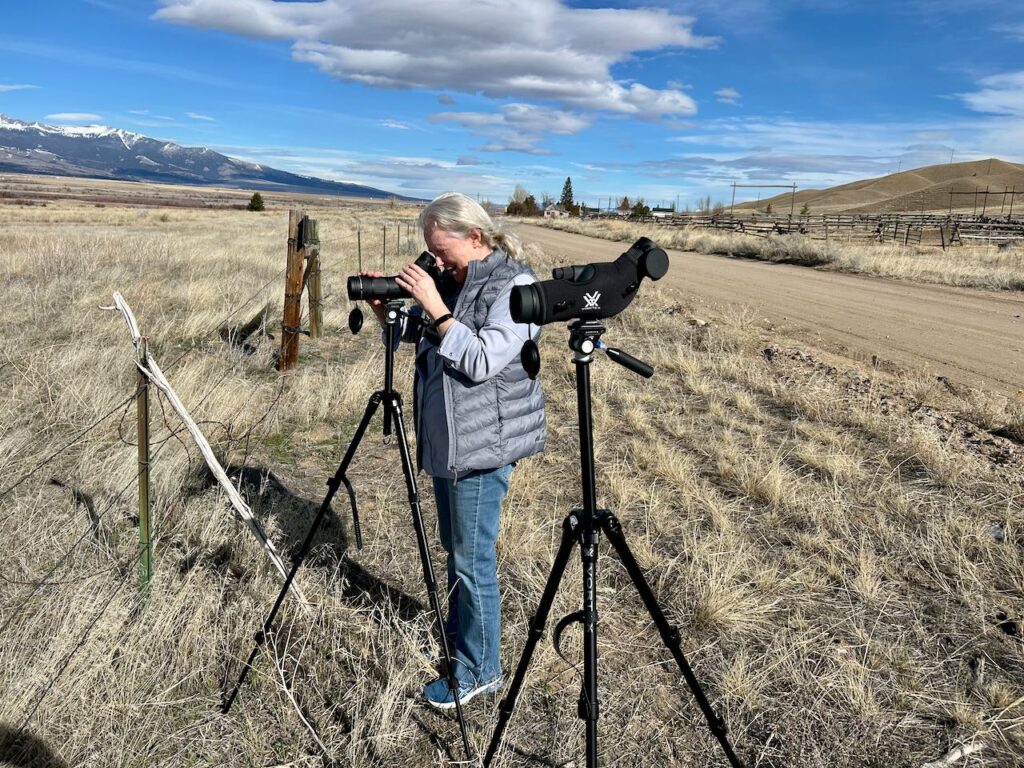
My birding pal Susan testing these scopes side by side at Warm Springs wildlife area.

First, let’s discuss what they have in common:

  • Both come in an angled configuration (see image below), which I much prefer to the straight option because it allows for a lower, more stable position on the tripod and easier viewing.
  • Both are about 10.3 inches long and weigh in at about thirty ounces—just under two pounds, or a bit more than an average pair of binoculars.
  • Both have very similar magnifications, the Viper zooming from 11 to 33X magnification, and the Crossfire 12 to 36X.
  • Both are built to fit the Arca-Swiss standard mount, which allows them to be directly fitted to Vortex and many other tripod heads without a pesky adaptor plate.
  • Both come with Vortex’s no-questions-asked lifetime warranty, making either scope a worry-free purchase from the get-go.
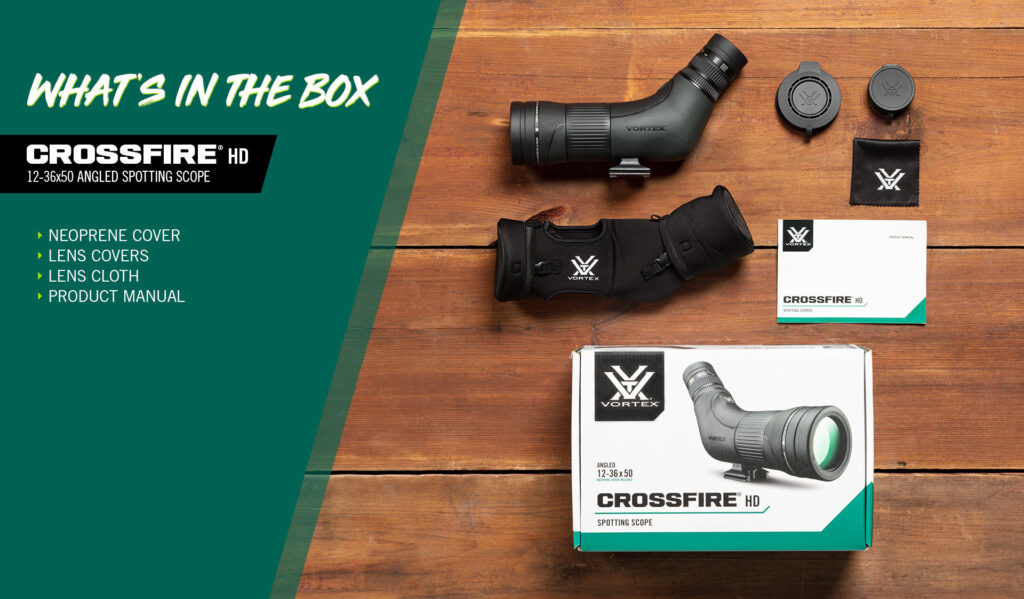
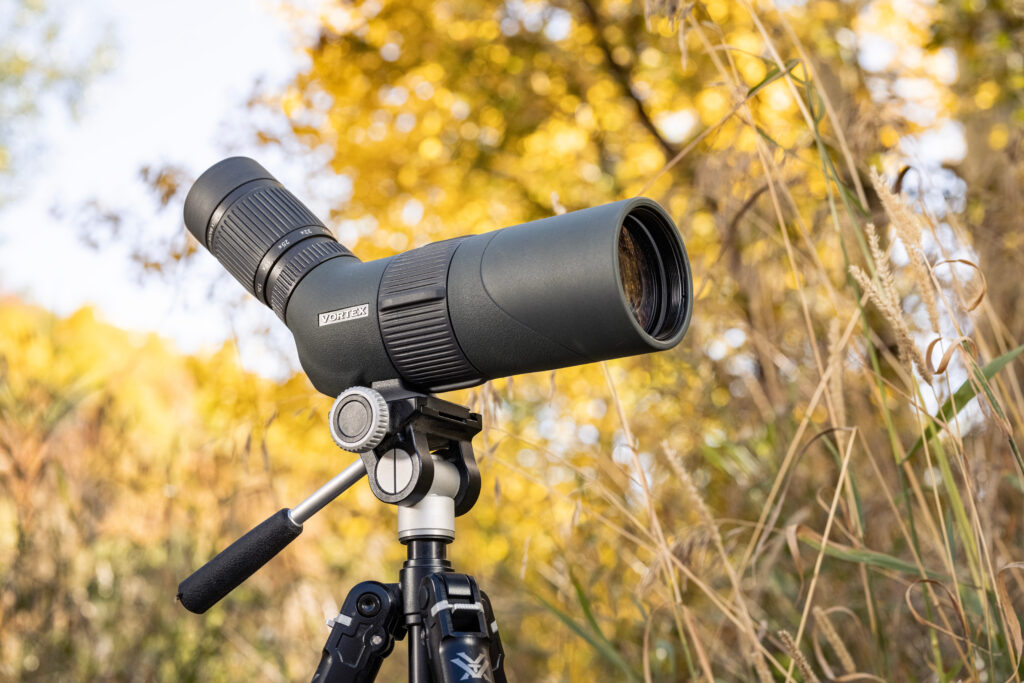
Both scopes come with easy-to-use lens caps and a neoprene sleeve for protection.(Photo provided by Vortex.)

Which leaves the primary question you’re probably asking yourself: Is the Viper worth the extra $400 I would have to spend over the Crossfire? To begin finding out, Susan and I rolled up to our first stop, Racetrack Pond just south of the town of Deer Lodge. We set up the two scopes side by side, each perched on a Vortex Mountain Pass tripod and began scanning the pond. It was still early in the season for most songbird migrants, but ducks, geese, and swans were out in full force and even as we were setting up, we were delighted to see a flock of 22 Snow Geese flying by. However, we began focusing mainly on Common Goldeneyes, American Wigeon, and Ring-billed Gulls puttering around a tiny island a hundred or so yards offshore.

Controls

As with any new equipment, it took us a few minutes to get familiar with the controls on each of the scopes. Both had eye relief tubes that easily pulled out, and both had about the same zooming range. At first we couldn’t figure out how to easily zoom the Crossfire in and out, but it turns out I hadn’t screwed in the eyepiece tightly enough when assembling the scope out of the box. Once I tightened the “knurled ring” at the base of the tripod, the zooming ring functioned just fine.

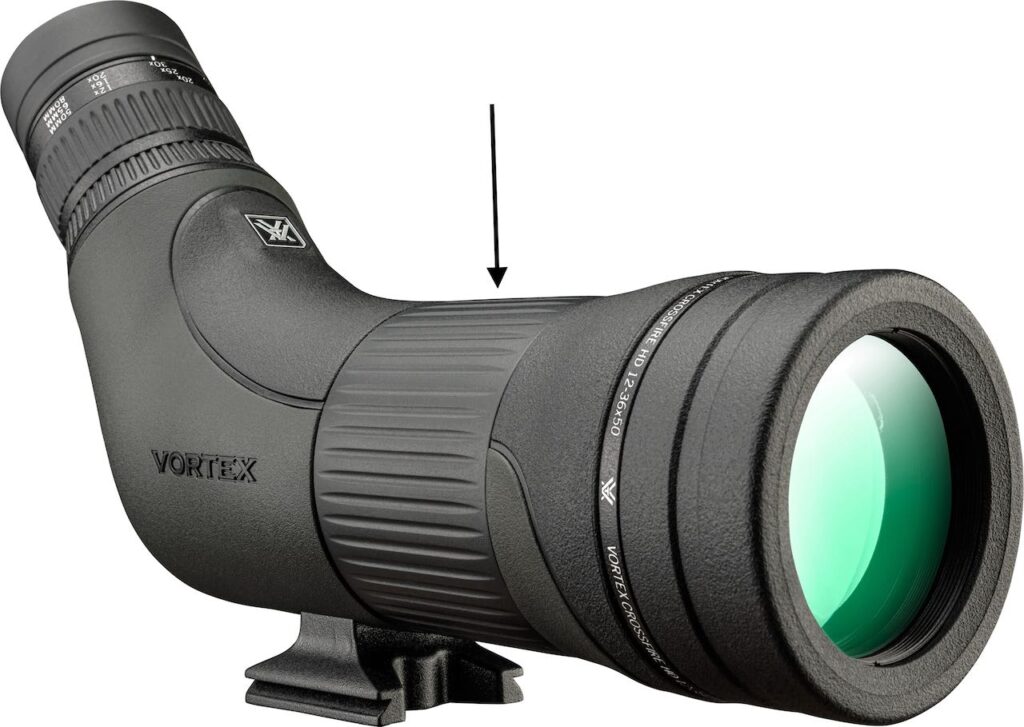
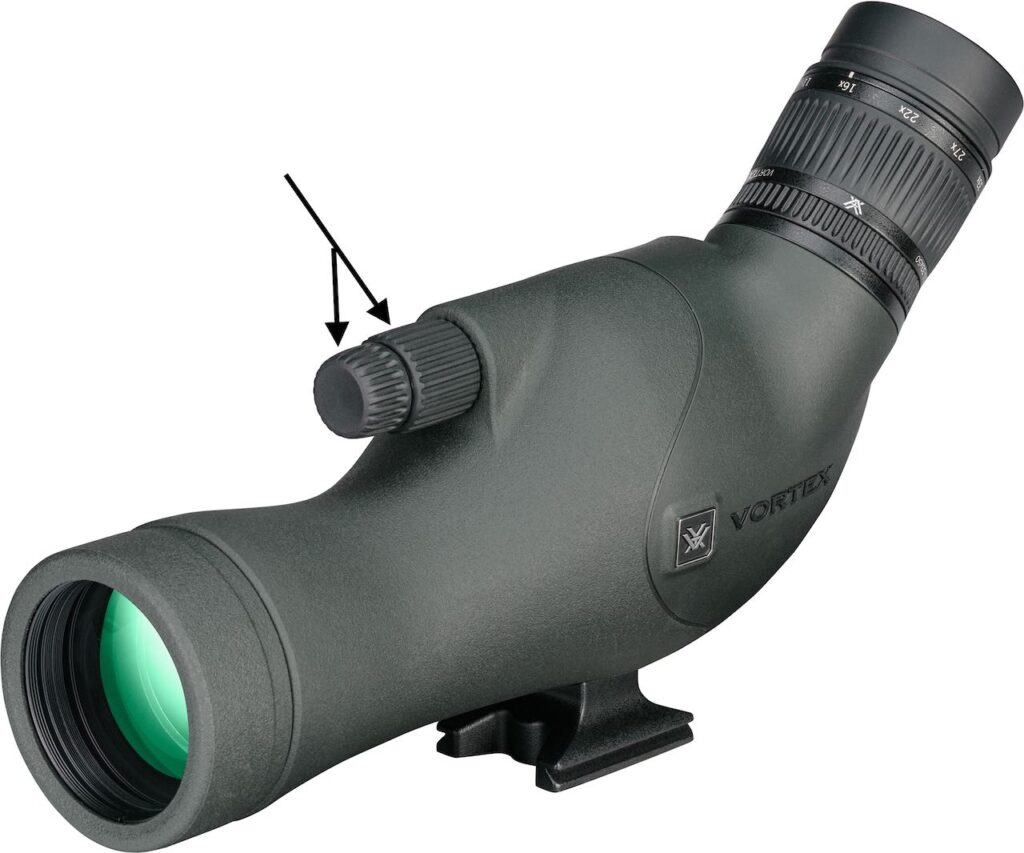
The main difference on the controls between the two scopes is the focusing mechanism (see arrows in images below). The lower-priced Crossfire comes with what’s called a helical focus. This is a ring around the entire scope tube that you twist back and forth to focus. The more expensive Viper comes with what is called a dual fine focus—two small knobs conveniently positioned on top of the scope that allow you to quickly adjust them. Spoiler alert: I’m going to just come out and say that, if you can afford it, the dual fine focus alone justifies the extra expense of buying the Viper over the Crossfire. Not only does this system achieve a sharper focus, it is much faster and more convenient to use. I watched a video about this and the host pointed out that this is especially great for digiscoping, or using your phone to take a photo through a scope. I don’t yet do this myself, but it’s good to know.
Optical Quality

One thing I and many others have discovered is that the brightness and clarity of images through optical devices don’t at first seem that different, even between more and less expensive models. That initially seemed to be the case when Susan and I compared the Viper and the Crossfire. The more we used them during our outing, however, the more it became apparent that the Viper gave us superior images. Not only was light transmission better through the Viper, it achieved sharper, clearer focus. That’s not surprising considering that the Viper comes with better coatings on its glass lenses and prisms, but it was still interesting to notice that difference in the field. Later, I tested the two scopes under very low light conditions, and the brightness of the Viper stood out even more.
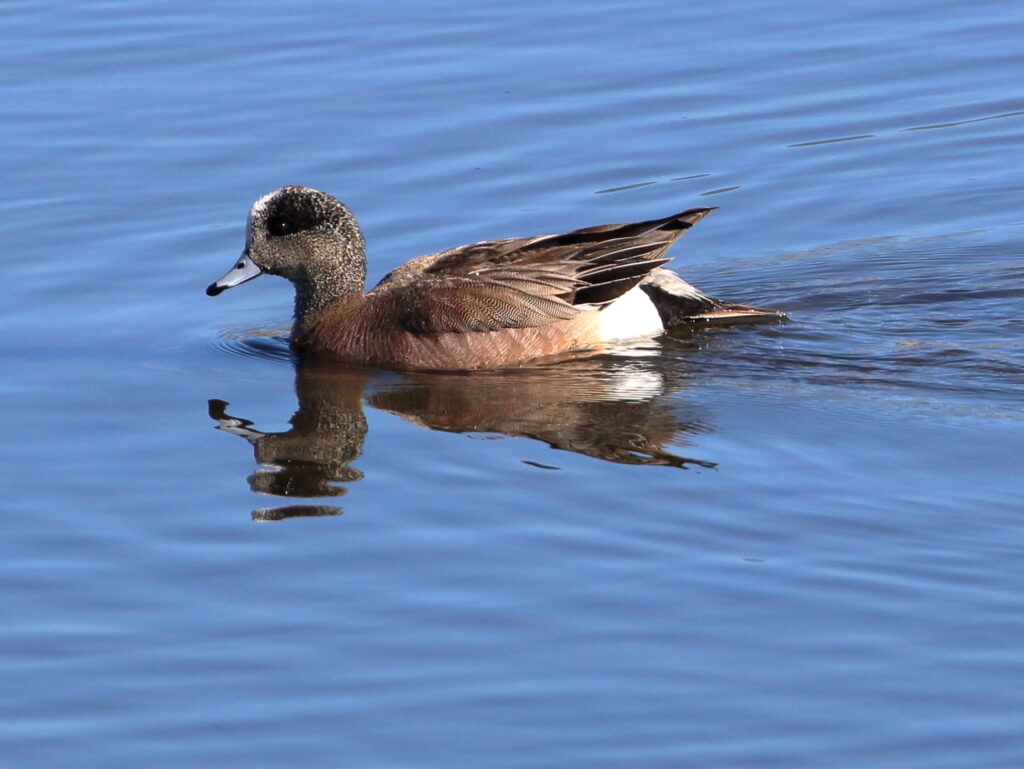
Though still early in the season, American Wigeon and other waterfowl gave us plenty of “targets” to test out the scopes. Though differences in optical quality were subtle at first, after spending a couple of hours looking through each scope, the Viper emerged a clear winner.

Build

Both the Viper and Crossfire appear to be very solid and well built. The Vortex website boasts that the Viper features “ultra rugged construction” while it makes no such claims for the Crossfire, so I assume that better manufacturing and materials go into the Viper. However, my guess is that both of these products will perform very well in the field. Both are fog proof and waterproof, essential features for anyone out watching birds. The Viper is purged with argon gas while the Crossfire is purged with the more standard nitrogen. I asked a rep what the difference meant for consumers, and he answered, “the difference isn’t actually with the optical quality, but instead the longevity of the optic. Argon has a larger atom, and will reduce the rate of leakage over long periods of time when compared to nitrogen. Argon is also less affected by sudden temperature shifts and is much more resistant to extreme temperatures.” He also admitted that most users will probably never notice this until at least 10+ years of use—if ever.
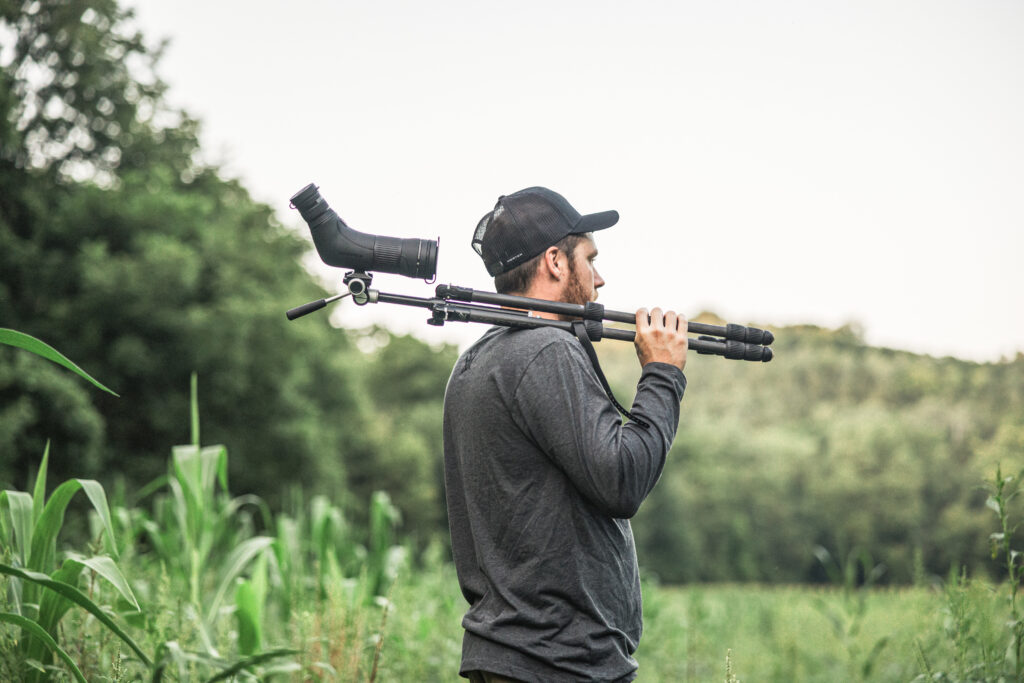
Whichever compact scope you buy, I highly recommend the Mountain Pass tripod to go with it. This combo is both easy to pack and carry over the shoulder on even a long birding hike! (Full confession: I’m not sure this is a Mountain Pass tripod in this photo provided by Vortex, but it looks as small and lightweight.)

Bottom Line

When comparing the Viper and Crossfire head to head, the Viper comes out a clear winner. Both are terrific, lightweight scopes for the traveling birder, but if you can at all afford or save up for the Viper over the Crossfire, I highly recommend it. That doesn’t mean, though, that the Crossfire doesn’t fill an important niche. It’s a great purchase for those on a budget, or those buying a first scope for a beginning birder and, honestly, many people may stay perfectly content with their Crossfires for the foreseeable future. If you need a scope to just carry around in the car or keep in a cabin without having to worry too much about it getting stolen, the Crossfire also could be just what you’re looking for.

Whichever scope you buy, I do highly recommend the Mountain Pass tripod, which is well-suited to both scopes both in weight, dimensions, and cost. I’ll also point out that both scopes work with Vortex’s Pro Car Window Mount. I have not yet used this, but plan to write up a review as soon as Braden and I can head out into Montana’s grasslands this summer.
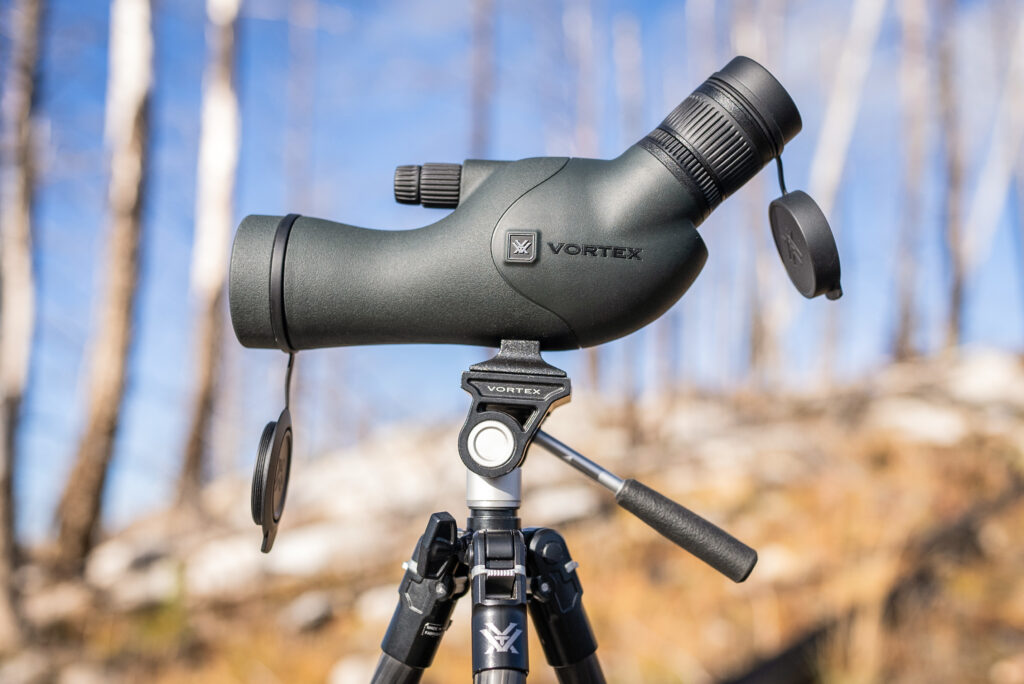
Though both scopes offer great value for the money, after our testing we both felt that birders will be happier if they stretch their budgets for the Viper rather than going for the more inexpensive Crossfire. (Photo provided by Vortex.)

If you enjoyed this review, check out these other recommended optics for birders:

Vortex Viper HD Binoculars

Nikon Monarch HG Binoculars

Nocs Pro Issue 8X42 Waterproof Binoculars

Vortex Bantam HD 6.5X32 Binoculars

Vortex Razor HD 13-39X56 spotting scope with Mountain Pass tripod
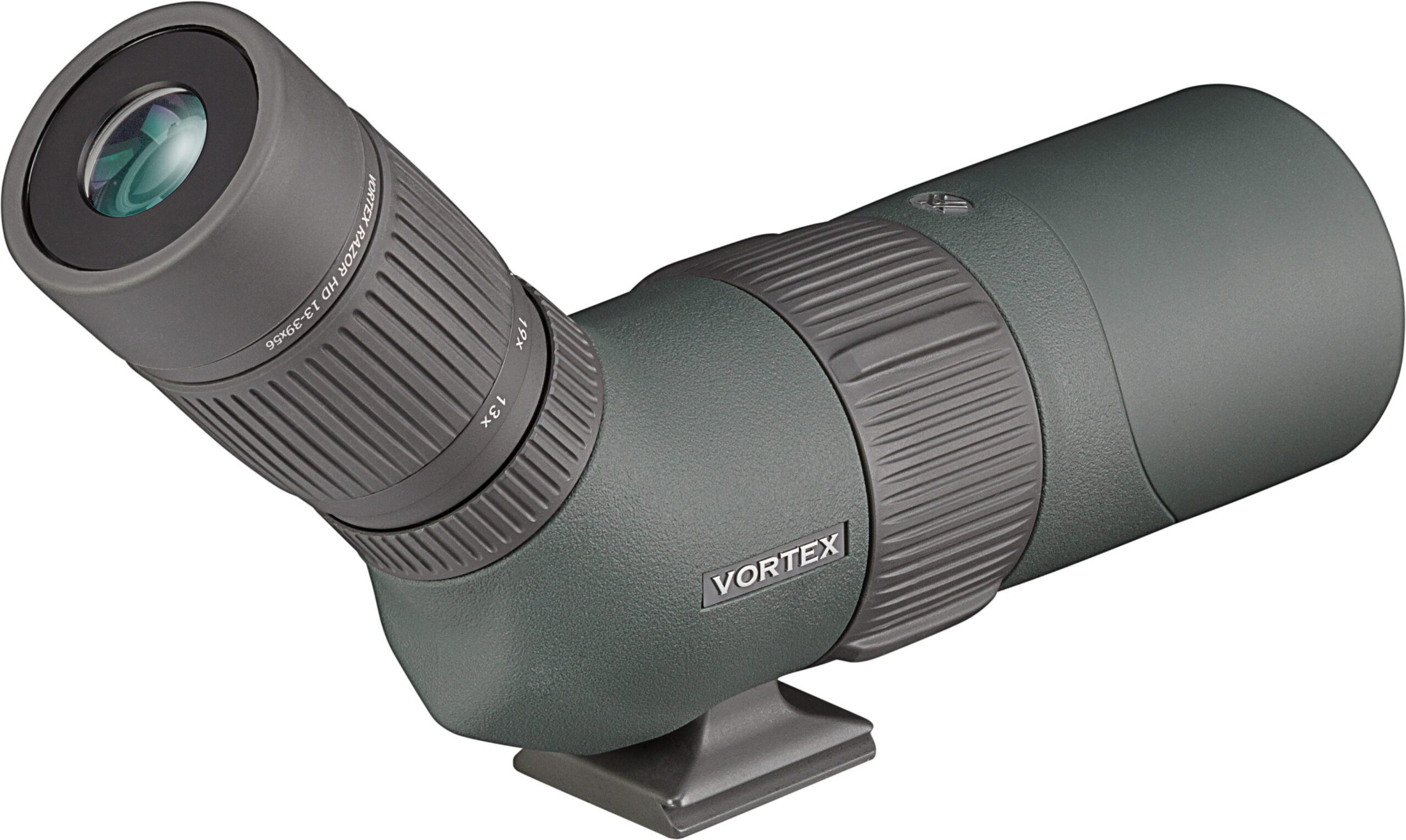
Vortex Razor HD 13-39X56 spotting scope with Mountain Pass tripod: A Perfect Travel Combo? (Equipment Review)

When it comes to equipment, birders tend to follow similar progressions. With binoculars, for instance, most of us start by borrowing any binoculars at hand. From there, we buy our own binoculars, focusing more on the sale price than the quality. Then, one day, we happen to look through a friend’s really good binoculars and it’s like “Whoa! I’ve got to save up for these!” If you’re at that point, check out our two recent reviews of binoculars that we highly recommend:

Birders, though, also go through a progression with spotting scopes, from not thinking we need one at all to wanting to get the best possible scope we can afford. But birders who travel a lot also progress to another step: getting a scope that is easy to travel with. Which is where I currently find myself. After going through the typical birder “evo-scopo-lution,” Braden and I bought ourselves a Viper HD 20-60X85 a couple of years ago. I can’t sing the praises of this scope highly enough. I like it so much that I lugged it with me on recent trips to California (see our post “Chasing Migrants”) and Canada (see our post “Birding Victoria, BC”). The problem? It’s not exactly travel-friendly. At eighteen inches (45 cm) long and weighing in at five pounds (2.3 kg), just the scope alone demands some tough packing decisions. Add in five pounds for a sturdy tripod, and just like that, you’ve increased your travel calculations by an awkward ten-plus pounds!

I was discussing this dilemma with a Vortex dealer account manager recently and I asked him, “Hey, do you have any good travel scope/tripod combos I can try out?” Three days later I received a Vortex Razor HD 13-39X56 scope with a Vortex Mountain Pass tripod. Even better, I was just about to head out on a trip to central Montana where I would be able to put it through its paces (see our last post, “Hi-Line Report”). But before I critique this dynamic duo, let me give you some basic stats:

* Fully assembled, the Razor HD 13-39X56 scope measures only 10.5 inches long—short enough to fit into almost any backpack. When the eyepiece is removed, it shrinks to an incredible 8 inches!

* The Razor HD 13-39X56 weighs only 1 lb. 14 oz—less than one of those silly two-pound weights many of us buy for rehab exercises.

* The Mountain Pass tripod measures just over 21 inches—also short enough to slip into many backpacks—and weighs almost exactly 3 pounds.

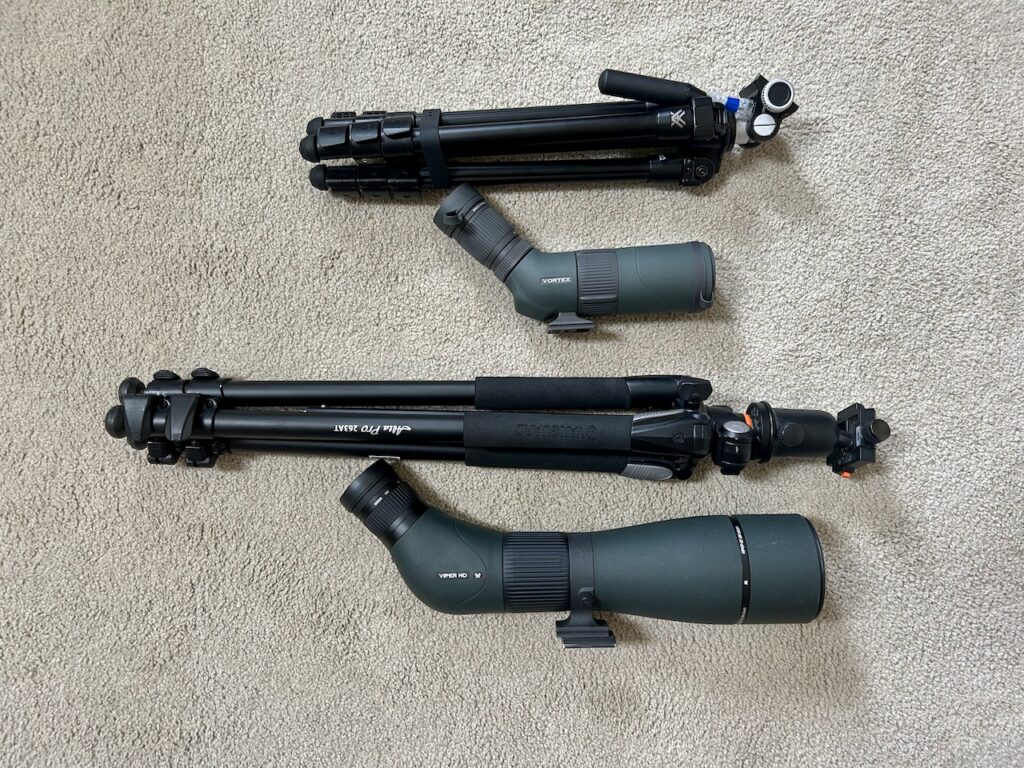
One glance shows the dramatic difference between packing my usual scope/tripod combo (bottom) and the Vortex Razor HD 13-39X56 scope with Mountain Pass tripod (top).

In other words, the entire combo comes in at an almost feather-light 5 pounds—less than half of what I am used to lugging around. This alone gave me a huge crush on it! But (suspense building), how did it perform? I had the chance to use the scope in both optimal and stormy conditions, so let me take those one at a time.

Optimal Conditions: Basically, I could not be more pleased with the Razor HD 13-39X56/Mountain Pass combo in great conditions. For its size and weight, the scope’s optics are terrific, giving sharp, clear images at distances of at least a couple of hundred yards. In fact, under the vast majority of conditions, interference from heat waves and similar air turbulence will distort the image before the scope’s distance precision is exceeded. Birds and other animals look like they are almost right in front of you in all their crisp, colorful glory. What’s more, I took the combo out on a two-mile jaunt at a local birding hotspot and hardly paid it any attention as I strolled along with it resting over my shoulder. This is in sharp contrast to my other, heavier scope/tripod combo, which Braden and I have to frequently trade carrying as it digs into our shoulders.

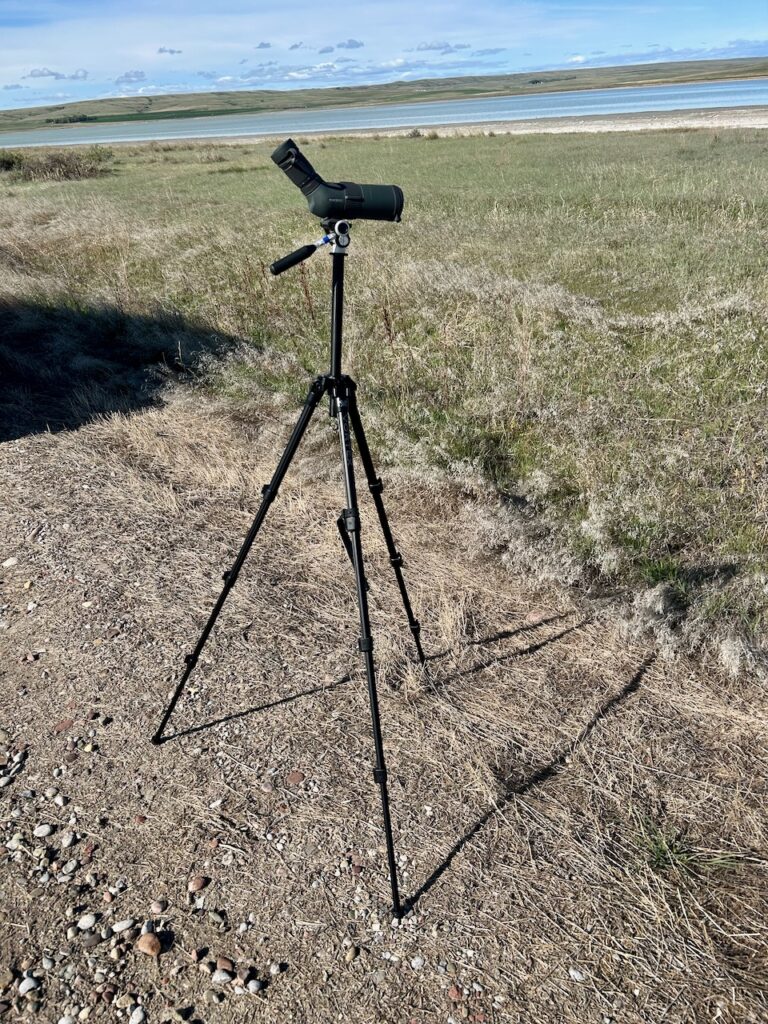
I did not try this myself, but the scope is light and convenient enough to easily mount on a window, say, at Freezeout Lake or Bowdoin? (Special window mount required.)

Stormy Conditions: During my recent trip to Bowdoin National Wildlife Refuge, I unfortunately encountered very gusty conditions. As you might imagine, using the scope/tripod combo proved more challenging. The optics, of course, stayed the same, but the combo’s light weight began to be a factor. I had to hold down the tripod with one hand to reduce shake enough to get on distant ducks and other birds—but this is a problem even with my heavier scope/tripod combo and every other combo that I have used in windy weather. To help compensate for this, the Mountain Pass tripod comes with a hook from which you can hang a stabilizing weight, but that means you have to bring this along with you (or use a boot, young child, or other handy hangable weight). I did not try this myself, but I’d guess that even with the weight, gusty conditions will pose a challenge. That’s no criticism of the combo—just a fact of birding life.

In calm conditions, the Razor HD 13-39X56 and Mountain Pass tripod perform like a dream, as I learned on a recent trip to Freezeout Lake near Great Falls. Because they are lighter, wind produces more shake, just as it does for all but the heaviest scope/tripod combinations.

To help matters, you don’t have to use the lightweight Mountain Pass tripod. The Razor HD 13-39X56 is so good that you might make it your only scope purchase, and if you do, you might consider buying a heavier tripod that will deliver better performance in rough conditions.

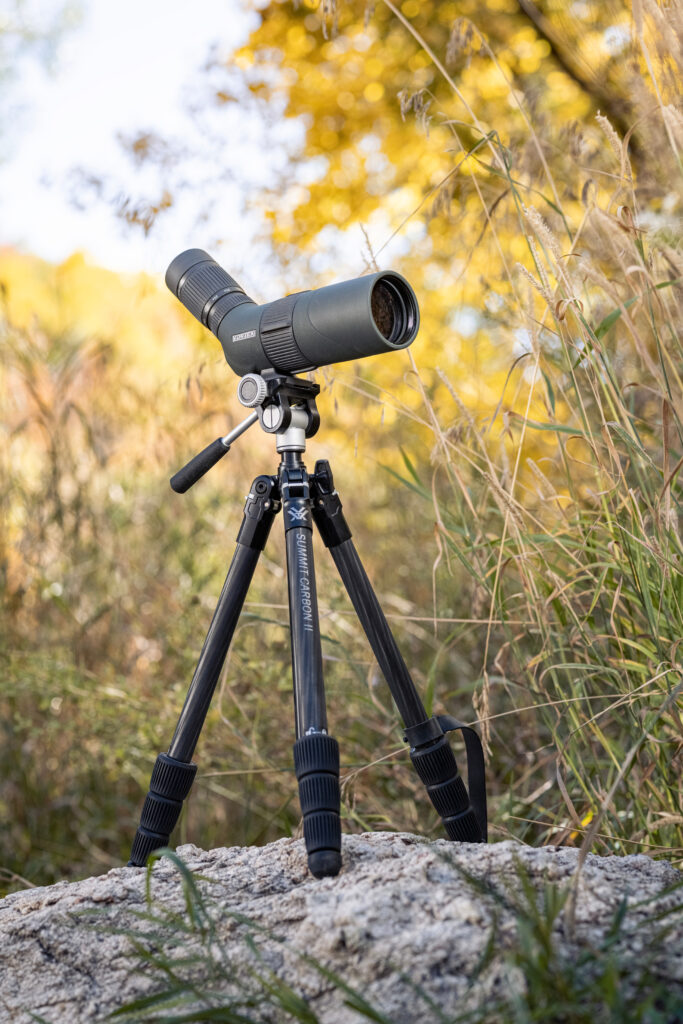
As this photo clearly shows, beefier carbon-fiber tripods are available for the Vortex Razor HD 13-39X56. Check out the Vortexoptics.com for details.

However, the point of this article is lightweight travel, and I have to say that the Razor HD 13-39X56/Mountain Pass combo strikes a wonderful balance between weight, magnification, and quality. An added advantage to this combo is that because Vortex makes both products, you won’t need an additional mounting plate to affix the scope to the tripod. Mounting plates generally are a pain in the rump, always coming loose at inopportune moments, so for me this is a significant advantage.

You are probably asking yourself, “Does the Vortex Razor HD 13-39X56 scope have enough magnification for distant birds?” With a maximum magnification of 39, the answer is that it certainly has less than what I have on my 60X85 scope. That said, I did not feel very limited by this. Again, in my experiences atmospheric disturbances are usually more likely to limit your observations than the power of this scope.

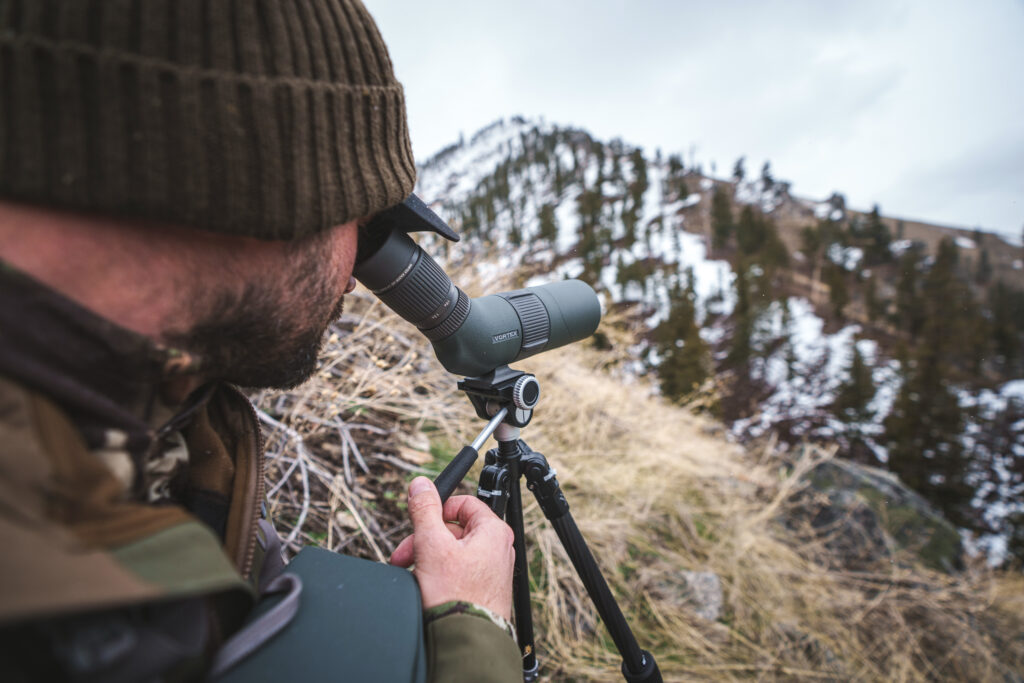
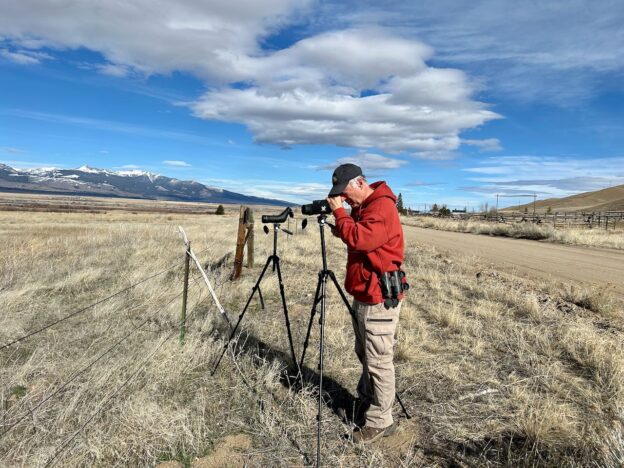
This guy is obviously using his scope to check out a Northern Goshawk for his life list. Er, or maybe he’s looking at an elk. Either way, the Vortex Razor HD 13-39X56 delivers enough oomph (magnification and clarity) to serve as your primary birding scope in most situations.

More about the tripod: I should point out that before receiving the Mountain Pass tripod, I was a strict adherent to “ball head” tripod heads, ones that allow you to quickly tilt and rotate the scope in any direction with a single control knob. The Mountain Pass head, though, comes with a “pan and tilt” head, but unlike some other pan and tilt heads I’ve used, both the pan and tilt also are controlled by a single knob. This makes the whole thing almost as easy to use as a ball head. To lock down the swivel of the head, you just hand-tighten the knob further. I suspect that this may wear out or get stripped over time, but as I’ve mentioned in other posts, Vortex’s lifetime warranty has you covered.

Like many other tripods, the Mountain Pass features four-part, telescoping legs that allow it to adjust to almost any height (though folks over 6-feet tall may want a taller tripod). The tripod legs also have levers that allow them to splay extremely wide for observing, say, a grouse lek at eye level.

Pricing: I have been so taken with this scope that I’ve neglected to mention the price. Although listed considerably higher, the Vortex Razor HD 13-39X56 scope can currently be purchased for right around $1000 while the tripod runs about $150. These are not insignificant sums, but are a great value for the quality you get—as anyone who has used cheaper scopes and tripods will quickly learn.

Bottom line: I love the Vortex Razor HD 13-39X56/Mountain Pass combo and am deeply upset that I have to return it to Vortex. Who are they to ask for their equipment back, anyway? I suspect, however, that I will be purchasing this combo in the future and am already looking forward to using it on a host of future travel birding adventures.

The Vortex Razor HD 13-39X56 delivers a high-quality, reasonably-priced product that is both outstanding for travelers, and powerful enough for most everyday birding situations.