Category Archives: Flycatchers

Costa Rica’s La Angostura Florencia Wetlands: Turning Disappointment into Delight

Today, we wrap up our 2026 Costa Rican adventure with a post from Braden. Our nine-day trip was filled with incredible birds—and a share of setbacks caused by unexpected weather and road closures. In fact, circumstances prevented us from visiting our major final destination, El Copal (see Braden’s 2024 post). That disappointment, however, turned into great good fortune. Why? Because it redirected us to what would become one of our favorite birding locations of the trip.

My dad and I woke to the sound of a Barred Antshrike singing outside our Airbnb. After packing our stuff and stepping outside into the bright, clear morning, we realized that there were two antshrikes, one singing from each side of us. It took little prompting for both the male and the female to come in, giving us the best looks at the species so far on our trip and knocking off another target from my dad’s list. The antshrikes, along with several cooperative White-eared Ground-sparrows on the lawn of the property and the steady flyovers of parrots and oropendolas, started our day off strong.

We’d been so successful with our target birds on the trip that our plans for this morning were simple: bird somewhere not too far out of the way back to San Jose, and spend one last morning enjoying Costa Rica’s birds. The night before, we’d decided on a nearby wetland called La Angostura Florencia, where the wide open habitat would render the birds easier to see than in the dense, rainforests we’d spent the last few days. 

So far, during the trip, we’d had pretty bad luck with just looking at eBird hotspots and trying to bird them. Some hotspots were closed, and we had caught David, the manager of Tranki Garden, off guard by showing up without calling ahead of time. One place we’d gone to was just completely private property (which we hadn’t known ahead of time), and the owner asked us to leave. La Angostura Florencia wetlands, however, was great—no locked gates, no private property signs, just a public, protected wetland nestled into the foothills of the Talamancas. As soon as we pulled onto the dirt road leading towards the water, we started spotting things.

As La Angostura Florencia rolled into view, we immediately became excited by its birding potential—potential that would be fully realized!

The first sighting of the day was our most unexpected. We stopped to scan a little creek, and my dad spotted a Black-crowned Night-Heron lurking on a rock. As I stepped out of the car to look, movement caught my eye—a large, brown mammal trotting through the forest on the other side of the road. As it grew closer to us, I realized this wasn’t a coati (which is a fairly common mammal across most parts of Costa Rica) but a tayra! Tayras are large members of the mustelid group (the group of mammals that includes weasels, otters and martens) and I’d never seen one before, despite all the time I’d spent in Costa Rica. We turned our attention towards the tayra as it scaled a tree and disappeared into the foliage above. Despite the mosquitos moving in on us from all sides, the day was off to a great start!

Though we’d seen a Green Ibis earlier on the trip, this pair at La Angostura Florencia gave us our first close, leisurely looks. Unlike other ibises, the Green Ibis prefers swampy or flooded forests to wide-open wetlands.

We kept driving slowly, rounding a corner and flushing a bird up from the road. “Sunbittern!” my dad yelled as it escaped into the trees. We got out again in an attempt to relocate it, but couldn’t get eyes on it again. Fortunately, there were tons of other birds around, calling, singing and foraging in the trees above and around us. We slowly made our way down the road, identifying warblers and other neotropical migrants above our heads as a variety of species gave us great, eye-level views. The dawn chorus consisted mostly of flycatchers, but we did hear a Thicket Antpitta singing from the shrubby, overgrown edge of the road!

As the wetlands came into view, we again got out and walked towards them, sidestepping a massive mud puddle in front of us. Two Green Ibises croaked from a Cecropia tree a dozen meters away, and we stopped to watch a Gray-headed Kite, our second of the trip, hunting and soaring over us. The heads of waders and waterfowl kept popping up from the grassy marsh in front of us, and we identified them one at a time.

We got wonderful views of this Gray-headed Kite both perched and in flight—one of our best raptor experiences of the trip.

“Snowy Egret!”

“Black-bellied Whistling-Duck!”

“Purple Gallinule!”

“Ooh, that one’s a Limpkin!”

While many of the wetland birds were the same as the birds we’d seen at Caño Negro, seeing them in a new location felt satisfying. Costa Rica isn’t known for its extensive wetlands, but the presence of these birds at La Angostura Florencia meant that at least several populations of these species could be found in abundance in the country. We spotted some fun songbirds in the shrubs on the border of the wetland, too. Both Olive-crowned and Gray-crowned Yellowthroats sang from the grass, and a Slaty Spinetail rattled off from a bush near the road. 

Olive-crowned Yellowthroat

Near the center of the wetland, the grass gave way to a large river. On a sandbar in the river stood a Wood Stork alongside a couple of egrets, and a Muscovy Duck floated by with a horde of babies in tow. From one overlook, my dad and I got both Ringed and Amazon Kingfishers while White-throated Crakes sounded off in the tall grass. 

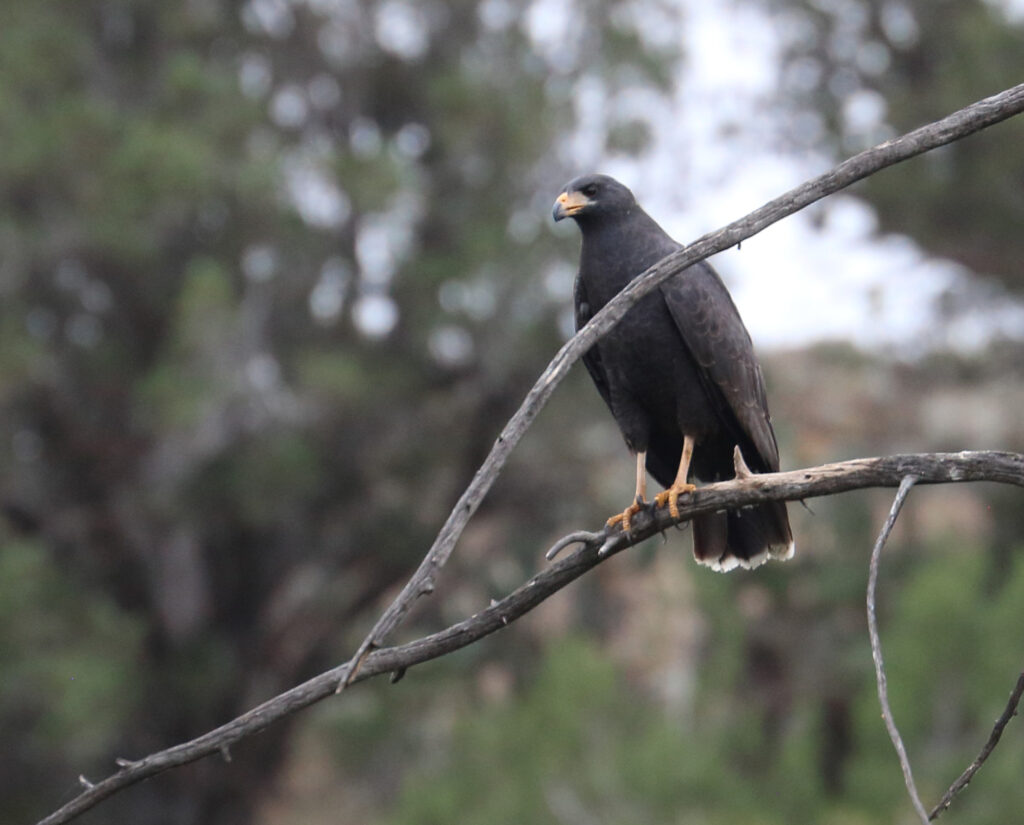
As we reached the end of the road, a flash of movement and tail feathers caught our eye. A small, gray raptor had launched out of trees, just missing what we assumed to be a Squirrel Cuckoo as it dove for the cover of the grass. The raptor landed on a low bough in front of us, and as I raised my binoculars, I realized that it was not the Gray Hawk I’d assumed it to be. No, this was an accipiter, slate gray, with a dark cap, yellow eyes and rufous legs.

“That’s a Bicolored Hawk!” I yelled, probably too loudly, though the bird seemed unperturbed.

One of our best raptors of the trip, Bicolored Hawk was a bird I had longed to see since first coming to Costa Rica two years earlier.

Literally two days ago, after seeing a Black Hawk-Eagle, I had been texting my friend Drew about the raptors I had yet to see in Costa Rica. Raptors are some of the coolest, and most difficult, birds in the neotropics. They’re hard to target and show up seemingly at random. Over the months I’ve spent birding in Central America, I’d slowly accumulated most of the uncommon raptors in the region—White Hawk, Ornate and Black Hawk-Eagle, Barred Hawk, various kites and falcons. But the few that I’d never seen before are not only elusive but quite rare, and the two I wanted most were some of the rarest: Bicolored and Tiny Hawks. Both of these species are widespread across Latin America but very infrequently reported, and while I’d been looking for spots to search for both (especially Bicolored) as my dad and I had journeyed across the country, I’d just had to admit to myself that nowhere were these species reliable. By this last day of the trip, in fact, I’d given up on seeing them.
“You lookin’ at me? I’m lookin’ at you, Braden!”

But suddenly, there was an adult Bicolored, taking in the sunlight, fifty feet away. My brain went into shock as my dad and I stared at it and snapped pictures. It felt like seeing a ghost. After about five minutes, the ghost flew away, leaving its vivid image seared into my memory forever.
My dad and I high-fived, then turned around, not quite believing our luck. And our luck continued.

On the way back down the road, we ran into a trio of birders—two from Great Britain and their guide—who had just spotted a Great Potoo a couple hundred meters away. They wanted to scope the wetlands for Snail Kites first, but said they would walk back to show us where the potoo was afterwards. We forged on ahead, hoping to find the roosting nocturnal bird by ourselves. As we passed a gap in the trees, I spotted exactly what the other birders had been looking for—a single Snail Kite soaring over the marsh. This location was known for the species, and it was only my second sighting of one ever, after the ones I’d gotten to see with Nick in Florida in 2022. (See THIS POST.)

As much as we’d been looking forward to seeing one, we had to admit that our first ever “potoo lump” er, huh, lacked in excitement.

We kept walking, my dad taking the lead, when a small, yellow and white flash caught my eye. I snapped my fingers, alerting my dad to walk back towards me. There, in the shade on the side of the road, perched a White-collared Manakin. My dad had been trying to get good looks at manakins during the whole trip, but they had been incredibly uncooperative. I’d spotted a White-ruffed while he was in the restaurant at Arenal, and we’d spent hours trying to get good looks at Long-tailed a few days before. And now, here was my favorite of the bunch, a spectacular male White-collared, sitting and posing right in front of us. Between the manakin, the Bicolored Hawk and the antshrike this morning, it felt as if the trip had come completely full circle.

This great look at a White-collared Manakin finally ended a string of frustrating close calls my dad had experienced trying to get a good look at one.

To make things even better, the British birders returned and showed us where the Great Potoo was! It was a little underwhelming, given that the bird was far away and completely still, but a lifer’s a lifer! We finished the morning with around 95 species, far exceeding my expectations for the wetland and wrapping up our phenomenal Costa Rica expedition.

Link to our Costa Rica eBird Trip Report: https://ebird.org/tripreport/482094

If you enjoyed this post, here are links to the previous Costa Rica posts in this Series:

Birding Costa Rica—Beginning at the Airport

Arenal for Antbirds

Caño Negro: Costa Rica’s Epic Wetland

A final selfie on what turned out to be one our best birding outings of the trip.

Caño Negro: Costa Rica’s Epic Wetland (Birding Costa Rica, Part 3)

If you’re enjoying FatherSonBirding, please consider subscribing by filling out the box down and to the right. We won’t ever sell or give away your information and you can unsubscribe at any time. And do feel free to share this blog with others or link to it—but please contact us for any other uses!

When blogging about a birding trip to Costa Rica, it’s almost impossible to choose which things to cover. As anyone who’s been there knows, every day offers avian delights, whether you’re walking through rainforest or hanging out in a town or city. One place we simply cannot overlook, however, is Caño Negro Wildlife Refuge.

The lagoon area of Cano Negro, at high water because of recent rains.

Caño Negro is one of Costa Rica’s rare, large interior freshwater wetland areas and lies almost within sight of the Nicaraguan border. I had never heard of it until Braden sang its praises when he studied abroad down there two years ago. As he planned our itinerary for this year’s trip, he left no doubt it was a must-see destination. To reach it, we left the La Fortuna area (see our post Arenal for Antbirds) and drove an hour and a half up highway 35 through flat agricultural country, before turning west on the access road to the refuge.

Seeing such large numbers of Northern Jacanas was a first for me!

The access road is one of those tricks perpetuated with great amusement on tourists. Paved for its first few miles, it suddenly degenerates into a cratered track that reduces the speed of rational drivers to about 10 km/hour. Nonetheless, this road is not to be endured, but to be birded. Along its stretch are a rich variety of grasslands, mini-wetlands, and patches of trees that are loaded with birds. I was thrilled to see my first Northern Jacanas and Purple Gallinules of the trip, but these were quickly overshadowed by the Variable and Morelet’s Seedeaters (see our post Chasing Morelet’s Seedeaters), and Thick-billed and Nicaraguan Seed-Finches. The highlight of the drive was a brief, but spectacular view of yet another lifer for Braden—a Black-collared Hawk!

These overcompensating “giant-billed” Nicaraguan Seed-Finches are a specialty of the northeast part of Costa Rica.

The next morning, we eagerly met our guide, Chambita, and his boat driver/assistant, Yalvin, at one of the town boat docks. Because of the heavy unseasonable rains, the Rio Frio was running higher than usual, but still flowed along at a placid pace perfect for birding. Most birding boat tours have two components—the river itself and a lagoon that feeds into it. From Braden’s past comments, I was most excited about the lagoon, but the river relentlessly amazed us.

Chambita and Braden proved a dynamic duo in detecting Caño Negro’s astonishing bird life.

As we began slowly making our way downstream, I was thrilled to see both new and familiar species. Over the first hour, the kingfishers stole the show, as we saw five of Costa Rica’s six kingfisher species, missing only the most common one—our own Belted Kingfisher that we enjoy back home. The ones we saw included both the big bruiser Ringed Kingfishers and the two that are hardest to find: Green-and-Rufous Kingfisher and American Pygmy Kingfisher.

I’m a sucker for kingfishers and was ecstatic at seeing FIVE species, including this American Pygmy Kingfisher.

Chambita, though, quickly demonstrated why he is a local legend among expert birders by calling out dozens of other bird songs and calls, many of them flycatchers that I had no hope of recognizing, but that Braden raptly absorbed. Then, we spotted a species Braden most hoped to see—Snowy Cotingas.

I’ll just say it: Cotingas are bizarre. And I’m not alone in thinking so. Birds of the World remarks, “No family of birds exhibits more diversity of auditory, behavioral, and plumage elaborations, all the result of rampant sexual selection, than do the cotingas.”

We saw five Snowy Cotingas on our outing—an unusually high number that pretty much made Braden’s entire day.

I actually didn’t think I’d ever seen a cotinga until Braden informed me that two of Latin America’s most spectacular birds, the Andean Cock-of-the-Rock and Three-wattled Bellbird, are cotingas. Even then, I only started getting interested in them as a group when mi amigo Roger and I saw Black-tipped Cotingas last year in Colombia, inspiring a spate of jealousy from Braden.

Today, when we saw the Snowy Cotingas, I had to restrain Braden from jumping out of the boat. “I wanted to see them,” he gushed, “but I didn’t think we would!” That, of course, got me super excited about them, too—delicate white birds perched atop trees high above the river.

Though not rare, Sungrebes can be shy and difficult to find, so we felt lucky to see one. The birds are actually more closely related to rails than grebes.

The river offered many other treasures including a rare Sungrebe, eight species of warblers, three kinds of orioles, and four kinds each of woodpeckers and parrots. Oh, and caimans and monkeys, too. And that’s before we turned around and went to the lagoon.

A troop of Squirrel Monkeys provided us with a welcome bonus as they fearlessly leaped a twenty-foot gap between trees. Look closely and you can see a baby on this one’s back! Talk about Livin’ on a Prayer!

When we reached it, the lagoon presented a totally different view than Braden had previously experienced. On his past visits, the water had been relatively low, i.e. perfect for wading birds. Recent rains, however, had raised the water dramatically. We still found a great diversity of birds, but numbers were lower than usual.

Ever since seeing a Fasciated Tiger-Heron with Roger in Colombia last year, I have been in love with tiger-herons, and this was my first chance to get good looks at Bare-throated Tiger-Herons!

Still, all manner of wading birds presented themselves. My favorites were Bare-throated Tiger-Herons and the uber-strange Boat-billed Herons. It was a tough call, though, with Tricolored Herons, a Roseate Spoonbill, Little Blue Herons, Green Herons, and three kinds of ibises—Glossy, White-faced, and Green—all competing for our attention.

A yawning Boat-Billed Heron is a bird after my own heart. Not only is it one of the coolest birds in Costa Rica, it needs its afternoon nap, just like moi!

A special treat for both Braden and me was getting to see our first Lesser Yellow-headed Vulture, which Chambita identified from a distance as it swooped down low over the lagoon and passed within a couple hundred yards of our boat. Resembling a Turkey Vulture—and sharing many of its characteristics—the Lesser Yellow-headed’s yellow head became visible only as it approached more closely. I love vultures.

This intriguing Lesser Yellow-headed Vulture was a special first for both Braden and me.

As we continued to explore, many more species kept showing up including a couple of Wood Storks, a Greater Yellowlegs, and both Crested and Yellow-headed Caracaras.

Roger and I had seen a Yellow-headed Caracara leap up onto a cow last year in Colombia, but this guy gave Braden and me an even better show.

A couple more of our favorite finds were a pair of Yellow-tailed Orioles and a Black-headed Trogon, all of which offered close up incredible looks.

We were happy that Chambita and Yalvin seemed as excited by the day as we were. They spent far more time with us than was strictly necessary and you can bet we appreciated it.

After bidding them farewell, we headed back out the same cratered road we came in on and were rewarded as richly as on the day before. On the drive, we paused to enjoy Green Kingfishers, Common Tody-Flycatchers, a Fork-tailed Flycatcher, and the perfect capstone to the day—our lifer Red-breasted Meadowlarks! We ended the day with more than 130 species, one of our best days of birding ever. Pura Vida!

Our Caño Negro checklist: https://ebird.org/checklist/S303336007

I was especially thrilled to see a Red-breasted Meadowlark after recently reading that the similar-looking South American Pampas Meadowlark is critically endangered. Loss of grassland habitat and rampant use of pesticides has drastically reduced populations of many meadowlark species, including those found in the US.

To arrange a trip with Chambita, check out his Facebook page: https://www.facebook.com/profile.php?id=100047210666376.

Arenal for Antbirds: Birding Costa Rica, Part 2

Like all FSB posts, this one is written by REAL PEOPLE. Feel free to share it and support real writers and artists everywhere by shunning artificial intelligence. Despite the hype, AI is not “just a tool.” Its primary utility these days is to increase profits by putting people out of work. Don’t make it easy for the giant corporations that control it and are participating in the greatest theft of intellectual and artistic property the world has ever known.

After our surprising morning birding near San Jose’s Juan Santamaría International Airport (see our previous post), Braden and I wasted no time heading into the heart of the region where we would spend the next nine days—the northern Caribbean slope of Costa Rica. Our first destination? The flanks of Arenal Volcano.

Despite having spent more than two months in Costa Rica back in 1994 (when I was writing my books The Forest in the Clouds and Monteverde: Science and Scientists in a Costa Rican Cloud Forest), I had never before explored this region. During his semester abroad here, however, Braden had thoroughly scoured the country for birds and had put together an itinerary that would give us the most bang for our birding buck. The Arenal area—near the bustling tourist town of La Fortuna—held many avian riches, but Braden and I had one group of birds we especially wanted to see: antbirds.

The area around Arenal Volcano was the first major destination of our nine-day itinerary. Unfortunately, heavy rains greeted us during this supposed dry season!

If you’re unfamiliar with them, antbirds are a group of birds that shadow army ant swarms—not to eat them, but to snag the many other invertebrates that the swarms dislodge during their ravenous raiding parties. I had seen many ant swarms during my time in Costa Rica, but again (and tragically), that was before I became a birder and if any antbirds were around, I had cluelessly overlooked them. Braden had, of course, been more alert and seen several kinds of antbirds—but never in the classic “insect-palooza” situation one reads about in scientific narratives.

Braden and I looked forward to finding an antbird flock as much as any other birds on our trip. Note the army ants below the leaf upon which this Bicolored Antbird stands.

We got our first shot at antbirds on our second morning in the country when we birded the internationally famous Arenal Observatory Lodge & Trails, a rather pricey destination with a fabulous sweep of nature to offer visitors. Fortunately, you don’t have to book a room to bird the place, but can simply pay a fee to spend the day. Unfortunately, waves of heavy rain greeted Braden and me when we arrived. Don’t get me wrong. We still had an incredible day here, including bird lists totaling more than 100 species and a fantastic sighting of a northern tamandua, a small, incredibly shy species of anteater—a first for both of us. Alas, we got only a brief glimpse of a single antbird—a Spotted Antbird—and encountered no army ant swarms where more antbirds might be plying their trade.

On our first day of antbird searching, we saw only a single Spotted Antbird that didn’t happen to be following any army ants. Still, a gorgeous creature, verdad? (Note: the featured image at the beginning of this post shows a female Spotted Antbird!)

Still hopeful, the next morning we headed to another nearby spot, a combo nature area and zip-lining destination called Sky Adventures. And guess what? It was again pouring down rain! After spending the previous day pretty much soaked, neither of us looked forward to another day of damp garments and soggy boots. A ray of hope was that one of the Sky Adventures guides told us that he had seen antbirds only the day before and even told us where to look.

Braden wondered if he would see any life birds on this Costa Rican adventures, but quickly spotted this Black-headed Tody-flycatcher, the first of FOUR lifers he would collect this day!

In this kind of weather, we had the trails pretty much to ourselves, and we realized that there was no shortage of birds around us. I should backtrack a bit and explain that while more than a third of the Costa Rican birds I was seeing were lifers, Braden had already seen so many birds in the country that he wondered if he’d get any lifers on our entire trip. That question got answered pretty quickly as we began crossing a spectacular hanging bridge over a lush ravine. Almost immediately, Braden said, “Black-headed Tody-Flycatcher!” Sure enough, on a branch hanging over the bridge, we spotted one of the cutest birds in the tropics—and a lifer for both of us! In fact, a huge variety of amazing birds seemed to be hanging out around the bridge, and before long a yellow and black bird landed just below us. Braden got even more excited by this one. “Black-thighed Grosbeak!” he exclaimed. Ka-ching! His second lifer in ten minutes!

Braden’s second life bird of the day, a Black-thighed Grosbeak, put in a leisurely appearance just below the hanging bridge. Look closely and you can even see the black thighs—though this is still one of the worst bird names ever!

Still, we hadn’t forgotten the antbirds and pressed across the bridge and up a winding trail. And at a sharp left, suddenly, there they were. Antbirds!

I confess that it took both of us a few minutes to embrace exactly what we were looking at. Columns of army ants marched along both sides of the trail, and the antbirds skittered and skaddled all about us.

Braden, looking happily in shock at finding his best antbird mixed-flock ever!

According to Vallely’s and Dyer’s Birds of Central America, Costa Rica hosts nine species of antbirds and we recognized four working the ant columns around us. These included Bicolored, Spotted, and Zelodon’s. It also included the one we both most wanted to see. “I’ve got an Ocellated!” Braden shouted with glee—his third lifer of the day.

One of our top targets of our entire trip, Ocellated Antbirds gave us extensive, if very quick, looks for our full ant swarm visit.

Why were we so excited about this bird? All antbirds are subtly beautiful, but Ocellated has the most distinct patterns of any Costa Rican species. It sports gorgeous blue, black, and rufous colors around the face and eye, and a remarkable scalloped pattern of feathers down its back and chest. As thrilled as we were to find it, we were even more thrilled to watch what the antbirds were doing.

Only a single female Zeladon’s Antbird joined the ant swarm, and apparently these do not usually follow mixed flocks, and are not obligate ant swarm feeders. Males are black instead of brown.

Back and forth they darted snagging insects, spiders, and other arthropods that were startled by or fleeing from the army ants. Braden and I paced back and forth, mesmerized by this performance. At least fifteen or twenty antbirds surrounded us, the most abundant being the Bicolored, who were also the least shy. WATCH THE VIDEO BELOW!

Antbirds, though, aren’t the only birds that join in on following army ant columns. As we watched, we also saw Wedge-billed Woodcreepers, Northern Barred-Woodcreepers, and Fawn-throated Foliage Gleaners. As a bonus, the rain had let up by now, letting us fully enjoy what might be for me a once-in-a-lifetime spectacle. In fact, we spent at least half an hour with these remarkable birds, trying to grasp exactly what they were doing and just appreciating that things like this could still happen in the world. Finally, as the trail’s foot traffic increased, we moved on.

Woodcreepers can be intimidating birds to identify, so I relished spending time with several species at the ant swarm, including this Northern Barred-Woodcreeper.

We, of course, saw many more species on this outing—including Braden’s fourth lifer of the day, a White-throated Shrike-Tanager—but it was the antbirds that would stay with us as we headed to our next, equally spectacular destination, Caño Negro wetlands.   

Our Sky Adventures checklist: https://ebird.org/checklist/S303092147

Birding Costa Rica—Beginning at the Airport

Some of our most popular posts have focused on exotic travel destinations, and today we kick off our latest series on one of North American birders’ most popular choices: Costa Rica. Braden and I just returned from an exhilarating, intense, nine-day birding adventure to the land of Pura Vida, and over the next couple of months I’ll be posting blogs on our most memorable birding experiences interspersed with our usual entertaining “paella” of reviews, domestic birding, and other fascinating topics. Again, we do not receive compensation for our blogging efforts, so if you wish to support our work, please purchase a few new copies of Birding for Boomers, Warblers & Woodpeckers, First-Time Japan, or any of Sneed’s other books. If you already have copies, why not pick up some for your friends? With that, let’s dive into Costa Rica at—where else—the airport!

Braden and I arrived at Juan Santamaría International Airport at 10 p.m.—just time enough to get to the rental car office before it closed. After collecting our vehicle, we drove to a nearby Airbnb so we could get a fresh start in the morning. Having spent a lot of time in Costa Rica the past couple of years, Braden had organized our entire birding itinerary and even picked this first place to stay—not only because it was convenient to the airport, but because it happened to have a terrific, little-known birding spot just down the street.

Braden and I from the porch of our Airbnb in Alejuela—practically under the flight path for San Jose’s international airport, and loaded with birds!

Braden and I are big fans of birding near airports, and have often found hidden avian treasures where you’d least expect them. Just last spring, on my final morning in Texas, I had a remarkable birding session in the vacant lot behind my hotel next to the airport in San Antonio, Texas. And during his spring Costa Rica trip last year, Braden had discovered a special little place only two blocks from our Airbnb. This year, as soon as dawn crept over Alejuela (where San Jose’s airport is actually located), he and I grabbed our binoculars and cameras and headed out.

Our destination was a large city park with the even larger name of Caminito Magico de la Tranquilidad. Being unfamiliar with the rather poor-looking neighborhood, I admit that I felt a bit nervous about our safety, but my concerns quickly vanished. At the park, people were jogging, biking, doing exercises, visiting over coffee, and walking around as in any park anywhere. The park covered several hectares, mostly devoted to playing fields, but a lot of trees threaded the fields and lined the park’s perimeter, and Braden led the way in guiding us on a full circuit.

Even at dawn, Caminito Magico de la Tranquilidad park was bustling with people—and birds! Note the giant mall rising in the background—a good place to escape the heat and grab a bite, though a much better little soda (cafe) sits only a block from the park entrance.

I had spent two months in Costa Rica in 1994, but tragically, that was before I took an interest in birds. Since Braden and I started birding a dozen years ago, I had been fortunate to bird in Latin America several times—most recently in Colombia con mi amigo, Roger—but it was fair to say that I was a novice at Costa Rican birds. I had been studying, however, and to my delight Caminito Magico park presented a perfect warm up for the week ahead.

Entering the park, a Squirrel Cuckoo immediately flew across a soccer field in front of us. Braden identified Orange-chinned and Crimson-fronted Parakeets loudly squawking overhead, and I was thrilled to see my first ever Hoffman’s Woodpecker land in a nearby tree.

My very first Hoffman’s Woodpecker put me in an ebullient mood as we kicked off our first Costa Rican birding session!

The park was filled with many of the more common birds any visiting birder will quickly get acquainted with. These included five kinds of pigeons and doves, Tropical Kingbirds, Great Kiskadees, Great-tailed Grackles, and Costa Rica’s national bird, Clay-colored Thrushes. Blue-gray Tanagers flew between trees while Blue-and-White Swallows darted for insects overhead.

Baltimore Orioles are common throughout Costa Rica—and never fail to raise a smile for a visiting Norteamericano birder!

As we reached the far perimeter, I was delighted to find that a creek skirted about half of the park’s boundary. Trees grew thickly here, and following the pleasant path, the birds got even more interesting. Braden began pointing out Chestnut-capped, Northern Yellow, and Tennessee Warblers while I focused in on a stunning male Baltimore Oriole in a flowering tree. Braden also detected several kinds of wrens: Southern House Wren, Rufous-and-White Wren, Cabanis’s Wren, and the beautiful bruisers of the bunch, Rufous-backed Wrens.

This would be the only location on our trip where we would see the “giant” Rufous-backed Wren—another reason to bird the San Jose area before heading into Costa Rica’s hinterland.

This being in the heart of Costa Rica’s largest city, I gotta tell you that I had no expectations for the creek itself, especially because it was strewn with an assortment of trash. The birds apparently didn’t care and almost immediately, Braden pointed out one of the birds I had most wanted to see on the trip—Bare-throated Tiger-Heron! I was thrilled, but hardly had time to appreciate it as we spotted a quail-sized coot-like bird skulking the banks—a Gray-cowled Wood-Rail!

For me, seeing a Bare-throated Tiger-Heron and Gray-cowled Wood-Rail (above) were stunning surprises in the heart of Costa Rica’s largest city!

Soon after, Braden pointed out a Northern Waterthrush while I spotted a Green Heron along the opposite bank. This, of course, is one of the magical things about birding the neotropics: how in the midst of all of these amazing new tropical birds, we find many species that are totally familiar to us in North America. It begs the definition of just what a neotropical bird is since in reality, many species we Norteamericanos consider “our birds” are just visiting us for a short time, and can more rightly be considered tropical species. Maybe that’s how this park got the name “Magico”?

Seeing “North American” warblers such as this Northern Waterthrush in the tropics makes you rethink what we consider “our” birds.

Our delightful discoveries were far from over. At the far corner of the park, we met an amateur naturalist who visited this spot almost daily to monitor wildlife, and he generously shared that only minutes before, he had seen one of the San Jose Valley’s most intriguing endemics. We hurried down the trail and only fifty meters later saw them: Cabanis’s Ground-Sparrows.

These are birds that Braden especially wanted to show me—but didn’t think he could. These handsome little guys live only in central Costa Rica, specifically in the valley occupied by San Jose. While not rare, they often tend to be pretty shy, making them challenging to see. They prefer scrubby, disturbed places like forest edges, coffee plantations, and apparently, city parks with lots of places to hide. Braden and I both began clicking off photos, but mostly we enjoyed watching them, one of dozens of unexpected surprises we would encounter over the next nine days.

As we were winding down our visit with the Cabanis’s Ground-Sparrows, I saw a larger bird swoop past us and land on a nearby branch. “Braden,” I hissed. “Look!” It was a final gift from this amazing city park: a Lesson’s Motmot! Not only that, it struck an incredible, leisurely pose. Motmots, of course, are some of Latin America’s most distinctive tropical birds and always high on a visitor’s to-see list. I was no exception, and felt enormously grateful to see one in our very first hour or two of Costa Rica birding.

Seeing a Lesson’s Motmot in our first birding session left no doubt that we were birding somewhere far different from Montana!

We finished our list with 47 species—almost as many birds as I’d seen in Montana in the first seven weeks of 2026! It was an awesome kick-start to our expedition, and we celebrated by grabbing our first Tico breakfast of rice, beans, eggs, and fruit at a little family diner only a few meters from the park entrance. We couldn’t predict how many highs and lows the next nine days would hold for us, but we were grateful and happy for such a promising start!

Caminito Magico de la Tranquilidad checklist: https://ebird.org/checklist/S302412338

Keep Costa Rica rolling with our next post on antbirds! https://fathersonbirding.com/arenal-for-antbirds-birding-costa-rica-part-2/

Braden has a passionate fondness for Costa Rican food, and after our first birding session we wasted no time in getting him a traditional Tico breakfast just a block from the park entrance!

Giving Back to Birds—with Great Breaking News! (FSB Holiday Shopping Guide, Part 3)

Holiday Joy! Back in August, we alerted FSB readers to Houston Audubon’s effort to buy a critical piece of land for their globally-important Bolivar Flats refuge. (See this post!) This is a refuge Braden and I have visited and is a vital habitat and staging area for hundreds of thousands of birds annually. When a developer planned to build a housing development smack in the middle of it, Houston Audubon negotiated an option to buy and protect the property. The problem? A $3 million price tag! We were skeptical that it could be done, but guess what? GUESS WHAT??? Thanks to donations by 1,127 donors from 47 states and 8 different countries, Houston Audubon achieved its goal! Donations included a huge check from Roku CEO/Founder Anthony Wood and his wife Susan. (I knew I loved Roku for a reason!) Everyone who donated—and those who didn’t—should be immensely pleased, because this is not only a crucial win for birds, it is a win for all of us. It also is the perfect lead into today’s blog topic—End-of-the-Year giving for birds!

Especially near the end of the year, when tax deadlines are looming, we know that a lot of you are asking yourselves, “What can I do to help birds?” We all know that birds are in big trouble, but it can feel overwhelming to figure out just how to spend our donation dollars most effectively. Today, in order to make your lives a bit easier, we are pleased to present a short list of Braden’s and my favorite groups that are helping birds, and yes, we have donated to every one of them. To find out more, just click on the underlined names below. Then, please, please break out that credit or debit card! We truly are at a global crossroads in the fight to save birds, and we guarantee that every dollar you spend will make you feel just a little bit better. While you’re at it, you might want to join your local Audubon chapter and/or the American Birding Association to help connect you to other birds, share information, and expand the love of birds!

Groups Working Internationally

Cornell Lab of Ornithology—the maker of eBird and Merlin makes huge investments in science and education to raise awareness of birds and promote conservation.

Bird Life International—Braden’s favorite group works on the entire international spectrum of bird threats, and also works with local communities to help protect birds and habitats. (Andean Cock-of-the-rock photo courtesy of Roger Kohn!)

Union of Concerned Scientists—one of Sneed’s favorite groups, we make monthly contributions to this group working to fight rampant disinformation and promote rational, scientific solutions to a host of environmental problems facing us.

Groups Focused Mainly on North America

Audubon—still the biggest name in birding, Audubon promotes bird conservation and education, and works on legislation to protect birds. (Note: the national, state, and local chapters are all independent entities. Donations to national do not trickle down, so consider donating to all three.)

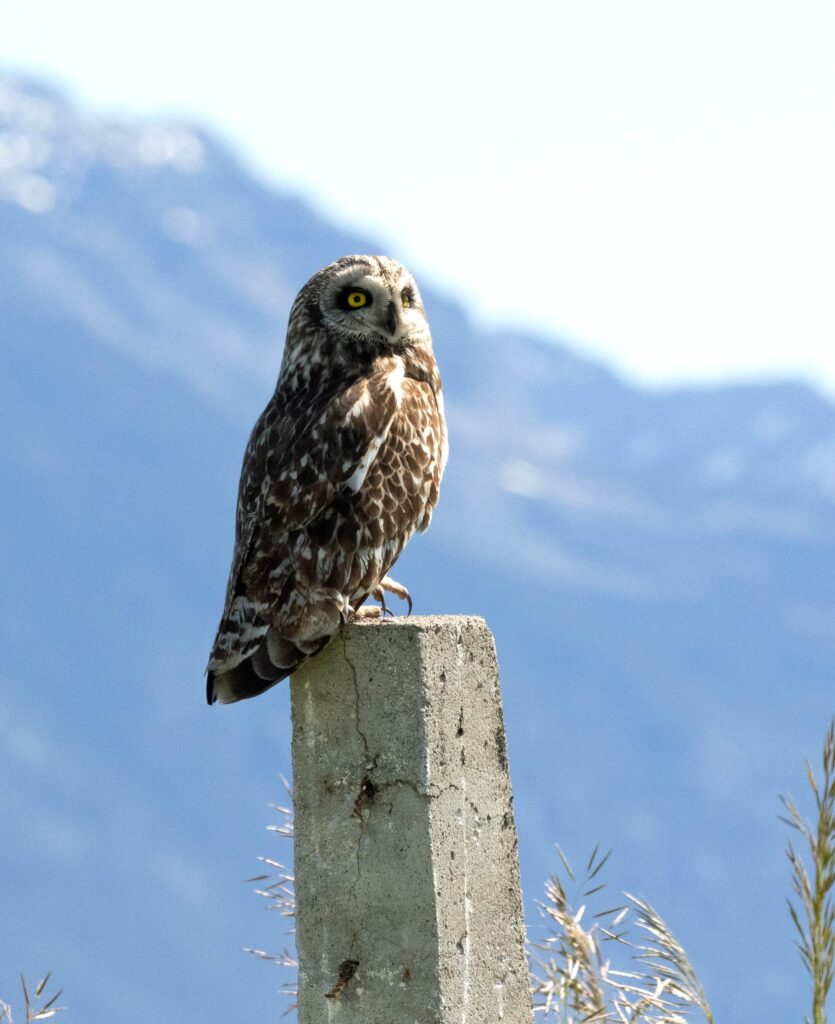
Owl Research Institute—one of the few groups focused on one of the world’s most charismatic groups of birds, ORI has been collecting data on owls for more than thirty years, sharing it with many different entities to shape science and conservation priorities. They especially work to decipher the causes behind the decline of many owl populations—including those of this Short-eared Owl.

American Bird Conservancy—also works on a wide range of bird-related issues including the urgent problem of outdoor cats.

State and Local Groups

Montana Audubon—besides putting on the wonderful Wings Across the Big Sky birding festival every year (and yes, Braden and I plan to be there in 2026!), Montana Audubon works to educate birders, identify the Treasure State’s bird conservation priorities, conduct research on endangered species, and carry out many, many other activities that benefit birds and birders.

Houston Audubon Society—a regional bird powerhouse, promoting bird education and conservation, and protection of vital habitats, especially for migrating birds. Think High Island from the movie The Big Year! (Roseate Spoonbill shown.)

Bird Conservancy of the Rockies—another regional powerhouse with widespread activities including vital research into wintering grounds of grassland birds in the Southwest and Mexico.

University of Montana Bird Ecology Lab (UMBEL)—conducts important research, monitoring, and outreach activities around the region!

Montana Bird Advocacy—a grassroots research organization started by well-known Montana birding legends Jeff Marks and Paul Hendricks, MBA conducts research on little-known Montana birds such as the Gray Flycatcher. (See our post Gray Flycatcher Science.)

An unbanded adult Gray Flycatcher implores: “Donate Now!”