Category Archives: Songbirds

Birding Festivals of the West 2026!

As April proceeds apace, it’s time to greet our spring birds with the word “Tadaima!”—Japanese for “Welcome Home!” However, it’s also an excellent time to finally do something you may have contemplated for years: attend a birding festival!

Never fear, it’s not too late. Particularly as recent geopolitical events make you rethink vacationing in Paris or visiting the Egyptian pyramids, birders have the chance to seize opportunities on our very doorstep. During the past few years, Braden and I have participated in a number of birding festivals and they have always been huge fun. They have allowed us to explore places and see birds that we never imagined, and connect with great birders from all around the world. Pick up a copy of BWD or Birding and you’ll see that there are literally dozens of birding festivals to choose from throughout the year. Today, I’d like to focus on three in the West that I’ll be participating in—and that you may want to consider for yourselves.

The Ute Mountain Mesa Verde Birding Festival, Cortez, Colorado, May 6-10

In just three weeks, I’ll be traveling to the Ute Mountain Mesa Verde Birding Festival in Cortez, Colorado, which runs from May 6 to May 10. Fun story: I was invited to this year’s festival because of a blog post I wrote last summer called In Search of the Green-tailed Towhee. The UMMV organizing committee happened to have chosen that bird as this year’s “mascot” and when they read the blog, Voila!, they invited me to give the keynote!

The charismatic Green-tailed Towhee is this year’s featured bird at the Ute Mountain Mesa Verde Birding Festival—but is only one of the cool specialties participants are likely to see!

Now I’ll admit that I’d never considered birding southwest Colorado, but as I delved into the various field trips, I grew more and more excited. The variety of birds and habitats in this part of the country is fabulous and includes many species that can be a challenge to see elsewhere. 180 species have been observed at the festival including waterfowl, shorebirds, raptors, and songbirds. Most exciting to me are the Southwestern birds I rarely get a chance to see including Black-throated and Sagebrush Sparrows, Gray Flycatcher, Woodhouse’s Scrub-Jay, Scaled Quail, Sage Thrasher, Virginia’s Warbler, Juniper Titmouse, and at top of my list, Gray Vireo.

The Ute Mountain Mesa Verde Birding Festival not only offers up great birds, but a chance to explore some of our nation’s most iconic scenery and cultural sites, including Mesa Verde National Park.

What really sets this festival apart is the chance to bird while exploring some of the most breathtaking scenery in America. Think dramatic canyon country like Mesa Verde National Park (see photo above) and Ute Mountain Tribal Park. This Four Corners region is loaded with archaeological sites and a unique culture found nowhere else in the world, and just begs to be explored. In fact, my wife and I are going down a couple of days early to do just that. To get there, we’re flying into Durango and renting a car. If this intrigues you as much as it intrigues us, do check it out! https://utemountainmesaverdebirdingfestival.com/

Wings Across the Big Sky, Kalispell, Montana, June 12-14

This will be Braden’s and my fourth time participating in our home state birding festival, and we couldn’t be more excited. One of the things that makes this festival special is that it travels to different parts of the state each year, allowing birders to explore Montana’s extensive variety of habitats and birds. Braden and I are leading two field trips, including one to the CSKT Bison Range, but all of the trips offer a surprising wealth of bird life. Montana is especially known for its raptors and grassland birds, but most people don’t realize that it’s a great place to see waterfowl and songbirds, too.

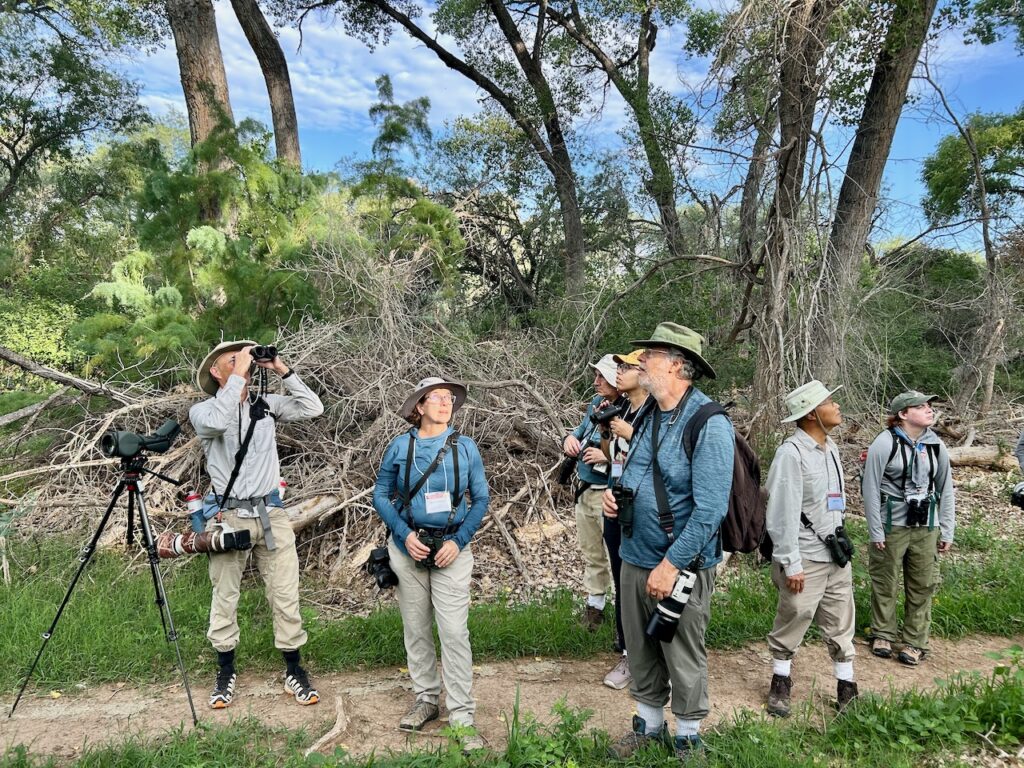
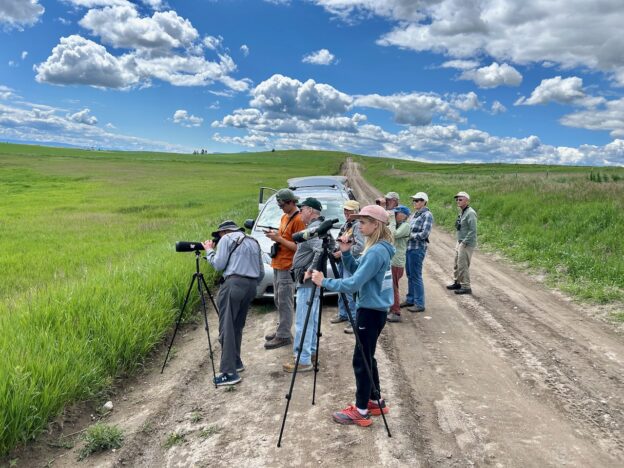
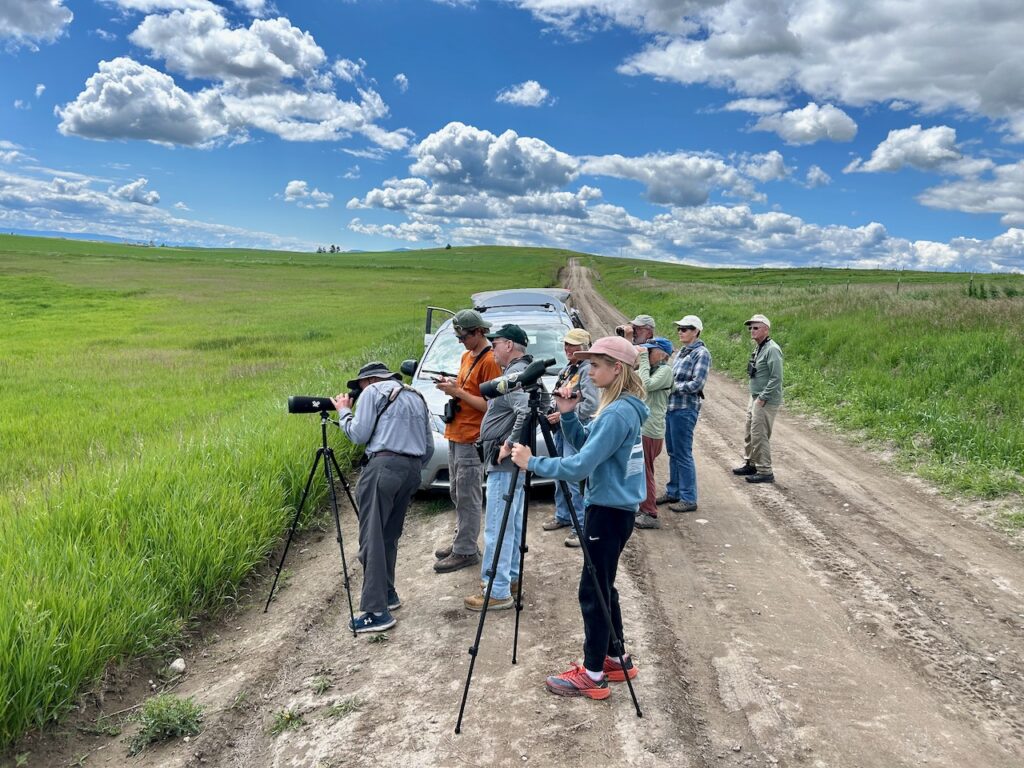
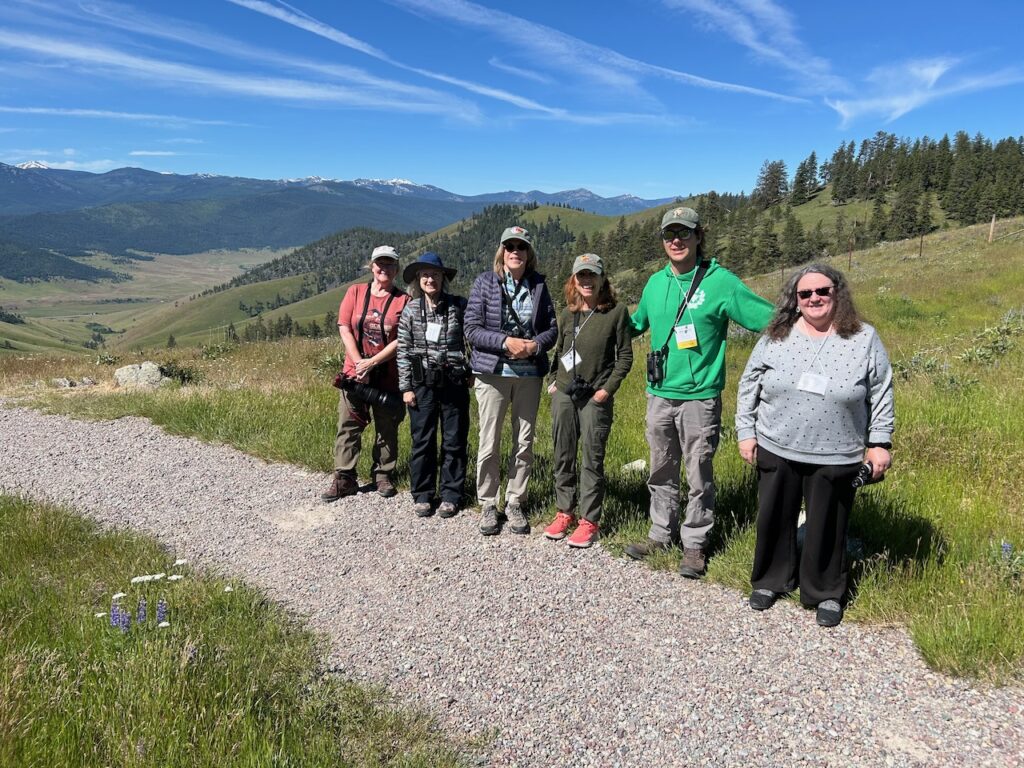
Just one of dozens of field trips at the 2024 Wings Across the Big Sky festival, including trip leaders, field biologist Hilary Turner (far left) and Andrew Guttenberg (third from left). And yes, that’s Braden towering over Hilary on the left!

If you’ve never visited Montana before, I highly recommend the field trips to Glacier National Park. At least ten kinds of warblers can be found in the park, along with four kinds of chickadees (think Boreal Chickadee), and three kinds of grouse, including Spruce Grouse. The park is especially known for breeding Black Swifts, Harlequin Ducks, Common Loons, and American Dippers. Again, you might just want to come a few days early to explore on your own!

Glacier National Park may be the best place in the Lower 48 to score breeding Harlequin Ducks! Braden and I saw this one, our lifer, on our very first Wings Across the Big Sky festival!

Glacier, though, is not the only draw to this part of Montana. Flathead Lake is the largest natural freshwater lake in the West and hosts a great variety of birds along its shores. The Mission Mountains are truly one of the most spectacular and little-known mountain ranges in the Lower 48, and several field trips will explore the grasslands and wetlands of the Mission Valley. Passionate local trip leaders and Montana hospitality will ensure that you make this festival a regular part of your birding calendar.

For complete information, click here: Wings Across the Big Sky

Southeast Arizona Birding Festival, August 12-16, Tucson, Arizona

The Southeast Arizona Birding Festival has built a reputation as one of the nation’s premier birding festivals, and so when I was invited to speak and co-lead field trips at this year’s festival, I couldn’t have been more thrilled. Of course, the first thing you’re probably asking yourself is “Arizona? In August???” I did, but believe it or not, this is one of the best times to bird the Grand Canyon State.

Braden contemplating a glorious sunset near the mouth of Madera Canyon—one of the field trips I’ll be co-leading during the SE Arizona Birding Festival.

Braden and I have been lucky to bird Arizona several times. See our posts “Portal Dreaming” and “Trogons and Border Walls.” One thing that always amazes us is the variety of habitats that can be found there, including wetlands, saguaro forests, and incredible canyons. Of special note are the region’s sky islands. These are mountains and mountain ranges that rise steeply out of the desert to altitudes of over ten thousand feet. Climbing up them, you quickly transition from desert through a variety of habitats, culminating with conifer forests at the top.

While many people travel to Arizona specifically to see the Coppery-tailed (formerly Elegant) Trogon, Arizona offers an unparalleled diversity of other specialties to US birders.

Sky islands not only provide welcome relief from Arizona’s summer valley heat, they offer an astounding variety of birds, many of which cannot be found anywhere else in the US. On our 2022 trip to Arizona, Braden and I nabbed life bird after life bird including Coppery-tailed (formerly Elegant) Trogon, Red-faced Warbler, Olive Warbler, Scott’s Oriole, Five-striped Sparrow, Mexican Whip-poor-will, and many more.

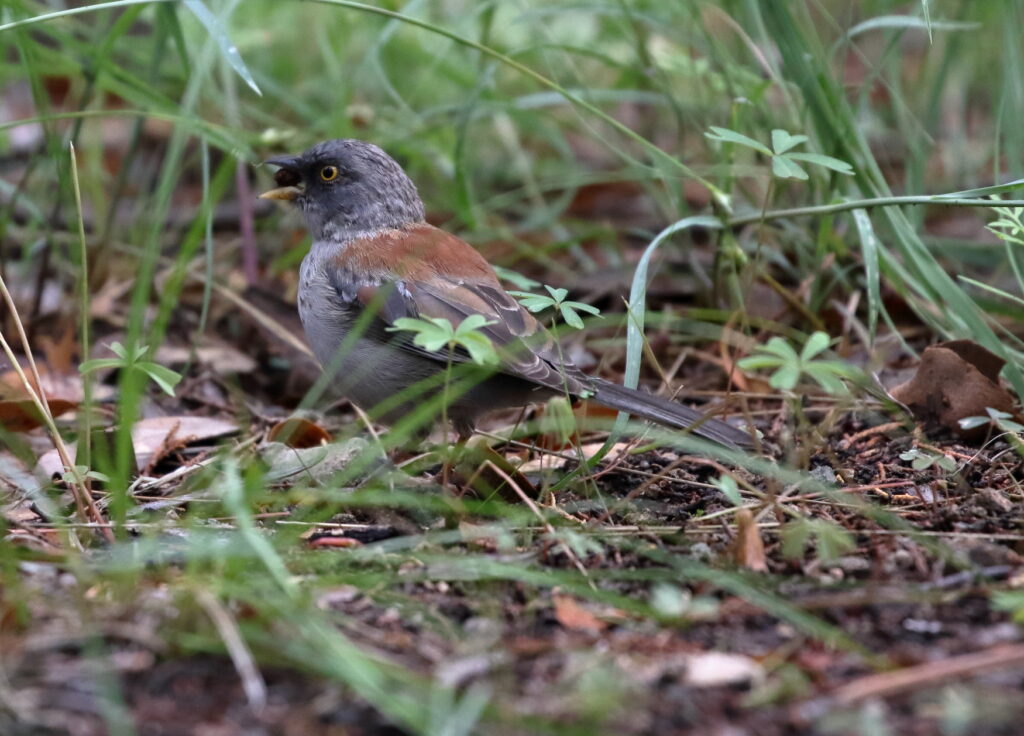
Yellow-eyed Juncos are just one of the many specialty birds that can be found in Arizona during the upcoming birding festival.

In addition to speaking at this year’s festival, I will be co-leading field trips to both Madera and Ramsey Canyons—two of my favorite places I have ever birded. But my buddy Roger and I are flying down a few days early to bird on our own. Registration for the festival begins on April 28, and if you’re interested, I wouldn’t hesitate to get on the website that day to reserve your preferred trips. The festival headquarters hotel, the Tucson Doubletree, is having some reservation issues, so you may want to call them directly as soon as possible to book a room.
SE Arizona Festival Link: https://tucsonbirds.org/festival/

So that’s it for this Festivals of the West post. We hope it has inspired you to give a birding festival a try. If the above festivals are out of reach, look into a local festival near you. For a list of festivals nationwide, check out Cornell’s All About Birds website. We can almost guarantee you’ll be glad you did! And if you spot me at one of the above festivals, please come and say Howdy!

If you’re enjoying FatherSonBirding, please consider subscribing by filling out the box in the column to the right. We won’t ever sell or give away your information and you can unsubscribe at any time. And do feel free to share this blog with others or link to it—but please contact us for any other uses! FatherSonBirding is written by REAL PEOPLE, and if you’d like to support our work, please also consider buying *new copies* of some of Sneed’s books, also shown in the column to the right.

Bluebird Day at Browns Lake!

With all of our recent posts about Costa Rica, you’re probably wondering if we ever bird in Montana anymore! Never fear, we do—a lot! Today we report on an adventure that delivered some remarkable early migration surprises. If you’d like to support our work at FSB, please consider purchasing some of Sneed’s books shown to the right—and support a group such as Birdlife International or Audubon that is working hard to protect birds against climate change and many other perils. Remember: all of our posts are written and photographed by REAL PEOPLE!

I don’t know if it’s because of our recent trip to Costa Rica, my subsequent trip to California, or just the usual spring excitement, but I’ve felt especially eager to get out birding in Montana this spring. At least part of it has to with wanting to learn more about the timing of migration, especially in a year in which Montana hardly experienced winter. How would this impact the birds? I wondered. Would we see things showing up especially early? Fortunately, our friend Susan Snetsinger has felt just as eager to explore, so the past couple of weeks Susan and I have taken all-day adventures to some of our favorite western Montana birding locations. Two weeks ago, we visited Warm Springs and the impressively “remodeled” Lexington Street Pond and wetlands in downtown Butte. We were rewarded with a great variety of waterfowl, including Snow Geese at both locations. The highlight of the day was undoubtedly a great look at a Golden Eagle on the dirt road between Racetrack Pond and Warm Springs.

Snow Geese are always something to celebrate in Montana—including this group at Butte’s fabulously restored Lexington Street wetlands area.

A few days ago, though, Susan and I had a different ambition: to post the season’s first eBird checklist for Browns Lake. This is one of Braden’s and my favorite birding locations, and I don’t think it has ever failed to disappoint. Not only is it a go-to place for breeding Red-necked Grebes and Black Terns, we have found a lot of uncommon species there including Long-tailed Ducks, Pacific Loons, and Ross’s Geese. Notably, this is where Braden made the astounding discovery of a Bay-breasted Warbler two years ago—one of just a handful of sightings ever recorded from western Montana.

Although Browns (sic) Lake is frozen for a good part of the year, it has never disappointed us as a birding destination and we were eager to see what it held so early in the spring.

One challenge with Browns Lake is that it stays frozen until relatively late in the season and I noticed on eBird that no one had yet birded it this year. I wasn’t sure if it had begun to thaw, but I asked Susan if she was game to check it out. She was—and even brought along yummy fried egg and cheese bagels to fuel our adventures.

On the drive up Highway 200, we were rewarded by two pairs of Sandhill Cranes and a glimpse of a Mountain Bluebird—perhaps a preview of things to come? We hoped so, and upon arriving at Browns Lake, were not disappointed. Right near where Braden had discovered the Bay-breasted Warbler, we got out of the car to find a delightful “finchy” mixed flock containing Red Crossbills, Pine Siskins, Evening Grosbeaks, and Cassin’s Finches.

We’re not sure why (though fish and/or animal carcasses probably have something to do with it), but Browns Lake often boasts vigorous Bald Eagle activity—and our early spring visit was no exception. Here, two youngsters contemplate the meaning of ice on this brisk sunny day.

As the lake came into view, we were relieved to see at least a third of it offered open water—and that the waterfowl were not shy about taking advantage! Within twenty minutes, we recorded fifteen species of ducks and geese, including the year’s first Montana Northern Pintails and a lone FOY Cinnamon Teal. A flock of 18-20 Snow Geese erupted out of the fields on the far side of the lake and settled in beneath a huge irrigation line. Even though a brisk wind dropped the wind chill into the teens, we looked hard through our scope for any Ross’s Geese, but came up empty.

Elk anyone? Even though they are mere mammals, this herd against the dramatic background induced us to pull over for an admiring look.

As has become my new routine, I directed Susan out the far side of the lake toward the Ovando-Helmville dirt road, and we were rewarded by two Northern Shrikes (Susan is certain they were separate birds), and a couple more Mountain Bluebirds. After turning left toward Helmville, we hadn’t gone a mile when we saw a sizeable flock of birds badly backlit by the sun.

“Are they some kind of blackbirds?” Susan wondered, and they did look black because of the sun, but I didn’t know. Then, she said, “There are more bluebirds over here.” “There’s a couple over here, too,” I added, still thinking they had nothing to do with the flock we’d just seen.

The bottom line? The flock we had just observed consisted entirely of Mountain Bluebirds!

At first, we weren’t sure what these flocking birds might be, backlit against the sun, but this photo reveals the truth.

This blew both Susan and I away. Neither of us had ever seen more than three or four Mountain Bluebirds at a time, and had no inkling that they ever formed large flocks. Yet here was the evidence in front of us, and we spent a good fifteen minutes watching them forage and swirl around us. Once, a group of at least sixty took to the sky together, only to settle back into the grass a few moments later. Meanwhile, others kept crossing the road in front and back of us, occasionally landing on the fence next to our car.

The Mountain Bluebirds were so active around us that I dared not hope to get a photo of one—until this guy perched 15 feet away from the car window!

We finally pulled ourselves away, wondering if local ranchers observed this kind of grouping every year. I later read up on MOBLs and found one or two mentions of them forming flocks in winter, but it didn’t seem like a well-known phenomenon. Susan and I both agreed that these cavity-nesting birds must be migrating. From here would they spread out into the surrounding mountains? Or did they still have a long way to go before trying to find their own breeding territories? As biologist Dick Hutto had taught me, Mountain Bluebirds especially love recent burn areas where woodpeckers carve out plenty of “condos” in the dead trees (see my book Fire Birds: Valuing Natural Wildfires and Burned Forests). I wondered if, as a flock, they might be better at finding recent burn areas—or did flocking impart other benefits such as greater predator or food detection?

After the Browns Lake area, we headed toward Helena, hoping to find a recently reported Lesser Black-backed Gull. Though I’d seen this species in Israel and again in Oregon, this would be a Montana lifer for me and an outright lifer for Susan.

It was not to be.

At the Helena Regulating Reservoir, we saw plenty of gulls, but many were too far away for our scope, and the ones we did see did not have the dark wings we were looking for. The trip wasn’t a waste, however, as we observed more than sixty Common Mergansers and at least ten Red-breasted Mergansers, also clearly in migration. In fact, the window to see RBMEs is quite tight in Montana, so it was nice to pick them up for 2026.

Though we missed the Lesser Black-backed Gull, the Helena Regulating Reservoir was hosting a “regulating” merganser-pa-looza!

Speaking of 2026, both Braden and I have excellent chances to accidentally break our world Big Year records. My record, set last year, is 552, and only a quarter of the way into this year, I’m at 422. This is not as much of a gimme as it sounds since many of the birds I’ve seen in Costa Rica and California are birds I would normally check off in Montana, but with a little luck and persistence, I feel I will get there. Braden’s record, meanwhile, is 867 and he is already at 546, with hopes to bird abroad at least one more time this year. We no longer put a lot of stock into numbers like these, but they’re a fun thing to keep an eye on.

After saying goodbye to the Helena Regulating Reservoir, Susan and I did a little more birding and then got lunch in downtown Helena. I only mention it because we ate at an excellent little crepe place called—what else?—The Creperie. It featured outstanding food and reasonable prices. It’s open until 3 p.m. most days and is located right next to the lower entrance of the walking part of Last Chance Gulch. If you’ve got the post-birding munchies, check it out!
Our first-of-the-year Browns Lake checklist: https://ebird.org/checklist/S313329879

Turning Useless Lawn into Vital Habitat

Today, we repost one of our most popular blogs of the past few years. The timing is no coincidence. It is SPRING, and it has never been more urgent to protect our native birds, insects, and other wildlife. One of the largest untapped potentials for doing this is for homeowners to create native habitat in their yards. If you live in Missoula, we are sponsoring a native plant giveaway of red osier dogwood on Saturday, April 18, 2026 from 10 a.m. to 2 p.m. at 1300 Murray Street on the right just past Lolo St. as you drive up Rattlesnake Drive. The first 50 people will receive a free plant with instructions on how to care for it. Hope to see you there!

As the winter chill wears off, many of us are anticipating how we can spi1300ff up our yards. That can be a tall order when we’ve inherited a landscape of sterile lawns and imported ornamental plants that have no business growing in Montana—or, most likely, wherever else you happen to live. Fortunately, this situation presents us with a wonderful opportunity to bolster the native ecosystems we know and love. How? By replacing exotic species with native plants that are both beautiful and provide real value to birds, insects, and other native wildlife.

Our blue penstemon and other flowering plants feed a host of native insects, including a variety of bumblebees.

A Scientific American article titled “The American Obsession with Lawns,” points out that lawns began sprouting up in America in the nineteenth century. They were an attempt to emulate trendier Europeans and, more important, to display wealth and status. Fast forward to today, and a house doesn’t seem complete without its neatly-mowed spread of Kentucky bluegrass. Unfortunately, our obsession with lawns comes with a host of problems.

As you can see, we aren’t purists. Here, native mock orange (white flowers), snowberry, and fireweed thrive amid California poppies and some kind of honeysuckle I can’t recall the name of!

Especially in the West, lawns gobble up water that we can scarcely afford. Just how much depends on location and other factors, but keeping a lawn alive can devour between 15 and 75% of a family’s household water consumption. Keeping those lawns green and pristine-looking also can be expensive, especially factoring in the gas and electricity required to run lawnmowers, and the fertilizers and herbicides to keep lawns green and weed-free. Speaking of “weed-free,” despite industry claims that herbicides and other garden chemicals are safe, I am skeptical. Do you really want to be dumping things into the soil that may persist for decades and have unknown long-term health risks. I don’t—especially when my yard sits only twenty feet above the aquifer that I and the rest of my community depends on for drinking water.

Despite industry claims, I don’t think we’ll know the full impacts of a lot of chemicals for years. Unless we want to keep repeating chemical disasters, it seems prudent to avoid commercial herbicides and insecticides whenever possible. Replacing at least a bit of your lawn with native plants is a great way to do that.

All that said, my biggest beef with imported lawns and plants is that they have needlessly transformed productive habitat into sterile expanses with almost no useful function. Sure, a lawn is great for kids to play on—we keep a patch of it ourselves—but our grass obsessions have come at an extreme cost to wildlife, especially to native insects and birds. Many of you have probably heard the shocking statistics that America has lost one quarter of its breeding birds in the short space of fifty years. There are many causes for this, but habitat loss probably ranks at the top. While much of this loss may have been unavoidable, in the case of our lawns, it is not.

Even common, beloved birds have seen dramatic declines in the past fifty years, and habitat loss is often a culprit. Yards filled with native plants can be a major step in reversing this trend. (This is a newly-fledged Black-capped Chickadee sitting in one of our mock orange plants.)

Author Douglas Tallamy (Nature’s Best Hope) points out that 40 million acres of our nation’s natural habitats have been converted to turfgrass—an area about 42% the size of Montana! If we “turf owners” convert just half of our lawns to native habitat, it will restore an area larger than the Everglades, Yellowstone, Yosemite, Grand Teton, Canyonlands, Mount Rainier, North Cascades, Badlands, Olympic, Sequoia, Grand Canyon, Denali, and the Great Smoky Mountains National Parks. Talk about your game changer!

One great thing about native plants is that once you put a few in, they find where else they want to be. This patch of beebalm came up totally on its own—much to the delight of honey bees, bumblebees, and butterflies. (Golden currant in the background, angling up to the right.)

Fortunately, converting your yard to native plants is fairly easy to do. A simple online search reveals nurseries that offer native plants all over our state (also check your native plant society—see below). You don’t have to create your own “national park” all at once. Just dig up a strip of your present lawn and put in some native shrubs. Here in Montana, you’ll want to stick to deer-resistant plants such buffaloberry, juniper, or maple sumac—or better yet, protect plants with fencing until they grow large enough to thwart deer. Before planting trees, think about how big that tree is going to be in fifty or one hundred years—and plant it in an appropriate spot. If you live in a fire area, you’ll want to make sure you keep a defensible space around your house, too.

Native plants don’t just “grow” native insects. Many provide fruit and seeds for birds, as this berry-laden serviceberry branch shows.

Incorporating native plants into your yard brings immediate rewards. Our modest native plantings attract chickadees, juncos, wrens, kinglets, and other native birds, many of them feeding on the insects that the plants produce. Why not join the fun? You’ll discover a whole new aspect of gardening, and take satisfaction in helping the wildlife we hold dear.

This House Wren and its mate successfully raised a batch of youngsters in our yard last summer. At times, the pair were bringing caterpillars and other insects to their chicks every two or three minutes! To my satisfaction, I watched them grab most of these insects right off of the native plants in our yard!

Sneed’s Favorite Native Plants for the Yard That Don’t Need Deer Protection: buffaloberry, maple sumac, juniper, mountain mahogany, chocolate coneflower, yellow coneflower, Oregon grape, pussytoes.

Sneed’s Favorite Native Plants That Do Need Deer Protection (at least until they grow larger): golden currant, beebalm, burr oak, purple coneflower, mock orange, aspen, rabbitbrush, serviceberry, cottonwood (need a LARGE space).

A Word of Advice: Never, EVER plant any grasses unless you really know what you’re doing. Even native grasses can quickly get out of hand—as I have learned the hard way.

To find out sources of native plants and seeds, check the website of the Montana Native Plant Society. They have lists of resources for every part of the state! If you don’t live in Montana, you probably have your own native plant society you can look up! Here in Missoula, another great resource is Watershed Consulting, which has a wonderful native plant nursery. You can get their list via:

Website: www.mtnativeplants.com; Email:  hello@mtnativeplants.com; Andy Martinez, manager: 406.529.7746

If you can’t find a good source of native plants near you, call up the wonderful Audubon native plant database. There you can just enter your zip code and begin finding the best plants to put in near you. Even better, you can purchase the plants directly from the website.

For another great, and more detailed post, about transforming your yard into habitat, check out Shane Sater’s excellent post on his “Wild for Nature” website!

Costa Rica’s La Angostura Florencia Wetlands: Turning Disappointment into Delight

Today, we wrap up our 2026 Costa Rican adventure with a post from Braden. Our nine-day trip was filled with incredible birds—and a share of setbacks caused by unexpected weather and road closures. In fact, circumstances prevented us from visiting our major final destination, El Copal (see Braden’s 2024 post). That disappointment, however, turned into great good fortune. Why? Because it redirected us to what would become one of our favorite birding locations of the trip.

My dad and I woke to the sound of a Barred Antshrike singing outside our Airbnb. After packing our stuff and stepping outside into the bright, clear morning, we realized that there were two antshrikes, one singing from each side of us. It took little prompting for both the male and the female to come in, giving us the best looks at the species so far on our trip and knocking off another target from my dad’s list. The antshrikes, along with several cooperative White-eared Ground-sparrows on the lawn of the property and the steady flyovers of parrots and oropendolas, started our day off strong.

We’d been so successful with our target birds on the trip that our plans for this morning were simple: bird somewhere not too far out of the way back to San Jose, and spend one last morning enjoying Costa Rica’s birds. The night before, we’d decided on a nearby wetland called La Angostura Florencia, where the wide open habitat would render the birds easier to see than in the dense, rainforests we’d spent the last few days. 

So far, during the trip, we’d had pretty bad luck with just looking at eBird hotspots and trying to bird them. Some hotspots were closed, and we had caught David, the manager of Tranki Garden, off guard by showing up without calling ahead of time. One place we’d gone to was just completely private property (which we hadn’t known ahead of time), and the owner asked us to leave. La Angostura Florencia wetlands, however, was great—no locked gates, no private property signs, just a public, protected wetland nestled into the foothills of the Talamancas. As soon as we pulled onto the dirt road leading towards the water, we started spotting things.

As La Angostura Florencia rolled into view, we immediately became excited by its birding potential—potential that would be fully realized!

The first sighting of the day was our most unexpected. We stopped to scan a little creek, and my dad spotted a Black-crowned Night-Heron lurking on a rock. As I stepped out of the car to look, movement caught my eye—a large, brown mammal trotting through the forest on the other side of the road. As it grew closer to us, I realized this wasn’t a coati (which is a fairly common mammal across most parts of Costa Rica) but a tayra! Tayras are large members of the mustelid group (the group of mammals that includes weasels, otters and martens) and I’d never seen one before, despite all the time I’d spent in Costa Rica. We turned our attention towards the tayra as it scaled a tree and disappeared into the foliage above. Despite the mosquitos moving in on us from all sides, the day was off to a great start!

Though we’d seen a Green Ibis earlier on the trip, this pair at La Angostura Florencia gave us our first close, leisurely looks. Unlike other ibises, the Green Ibis prefers swampy or flooded forests to wide-open wetlands.

We kept driving slowly, rounding a corner and flushing a bird up from the road. “Sunbittern!” my dad yelled as it escaped into the trees. We got out again in an attempt to relocate it, but couldn’t get eyes on it again. Fortunately, there were tons of other birds around, calling, singing and foraging in the trees above and around us. We slowly made our way down the road, identifying warblers and other neotropical migrants above our heads as a variety of species gave us great, eye-level views. The dawn chorus consisted mostly of flycatchers, but we did hear a Thicket Antpitta singing from the shrubby, overgrown edge of the road!

As the wetlands came into view, we again got out and walked towards them, sidestepping a massive mud puddle in front of us. Two Green Ibises croaked from a Cecropia tree a dozen meters away, and we stopped to watch a Gray-headed Kite, our second of the trip, hunting and soaring over us. The heads of waders and waterfowl kept popping up from the grassy marsh in front of us, and we identified them one at a time.

We got wonderful views of this Gray-headed Kite both perched and in flight—one of our best raptor experiences of the trip.

“Snowy Egret!”

“Black-bellied Whistling-Duck!”

“Purple Gallinule!”

“Ooh, that one’s a Limpkin!”

While many of the wetland birds were the same as the birds we’d seen at Caño Negro, seeing them in a new location felt satisfying. Costa Rica isn’t known for its extensive wetlands, but the presence of these birds at La Angostura Florencia meant that at least several populations of these species could be found in abundance in the country. We spotted some fun songbirds in the shrubs on the border of the wetland, too. Both Olive-crowned and Gray-crowned Yellowthroats sang from the grass, and a Slaty Spinetail rattled off from a bush near the road. 

Olive-crowned Yellowthroat

Near the center of the wetland, the grass gave way to a large river. On a sandbar in the river stood a Wood Stork alongside a couple of egrets, and a Muscovy Duck floated by with a horde of babies in tow. From one overlook, my dad and I got both Ringed and Amazon Kingfishers while White-throated Crakes sounded off in the tall grass. 

As we reached the end of the road, a flash of movement and tail feathers caught our eye. A small, gray raptor had launched out of trees, just missing what we assumed to be a Squirrel Cuckoo as it dove for the cover of the grass. The raptor landed on a low bough in front of us, and as I raised my binoculars, I realized that it was not the Gray Hawk I’d assumed it to be. No, this was an accipiter, slate gray, with a dark cap, yellow eyes and rufous legs.

“That’s a Bicolored Hawk!” I yelled, probably too loudly, though the bird seemed unperturbed.

One of our best raptors of the trip, Bicolored Hawk was a bird I had longed to see since first coming to Costa Rica two years earlier.

Literally two days ago, after seeing a Black Hawk-Eagle, I had been texting my friend Drew about the raptors I had yet to see in Costa Rica. Raptors are some of the coolest, and most difficult, birds in the neotropics. They’re hard to target and show up seemingly at random. Over the months I’ve spent birding in Central America, I’d slowly accumulated most of the uncommon raptors in the region—White Hawk, Ornate and Black Hawk-Eagle, Barred Hawk, various kites and falcons. But the few that I’d never seen before are not only elusive but quite rare, and the two I wanted most were some of the rarest: Bicolored and Tiny Hawks. Both of these species are widespread across Latin America but very infrequently reported, and while I’d been looking for spots to search for both (especially Bicolored) as my dad and I had journeyed across the country, I’d just had to admit to myself that nowhere were these species reliable. By this last day of the trip, in fact, I’d given up on seeing them.

“You lookin’ at me? I’m lookin’ at you, Braden!”

But suddenly, there was an adult Bicolored, taking in the sunlight, fifty feet away. My brain went into shock as my dad and I stared at it and snapped pictures. It felt like seeing a ghost. After about five minutes, the ghost flew away, leaving its vivid image seared into my memory forever.

My dad and I high-fived, then turned around, not quite believing our luck. And our luck continued.

On the way back down the road, we ran into a trio of birders—two from Great Britain and their guide—who had just spotted a Great Potoo a couple hundred meters away. They wanted to scope the wetlands for Snail Kites first, but said they would walk back to show us where the potoo was afterwards. We forged on ahead, hoping to find the roosting nocturnal bird by ourselves. As we passed a gap in the trees, I spotted exactly what the other birders had been looking for—a single Snail Kite soaring over the marsh. This location was known for the species, and it was only my second sighting of one ever, after the ones I’d gotten to see with Nick in Florida in 2022. (See THIS POST.)

As much as we’d been looking forward to seeing one, we had to admit that our first ever “potoo lump” er, huh, lacked in excitement.

We kept walking, my dad taking the lead, when a small, yellow and white flash caught my eye. I snapped my fingers, alerting my dad to walk back towards me. There, in the shade on the side of the road, perched a White-collared Manakin. My dad had been trying to get good looks at manakins during the whole trip, but they had been incredibly uncooperative. I’d spotted a White-ruffed while he was in the restaurant at Arenal, and we’d spent hours trying to get good looks at Long-tailed a few days before. And now, here was my favorite of the bunch, a spectacular male White-collared, sitting and posing right in front of us. Between the manakin, the Bicolored Hawk and the antshrike this morning, it felt as if the trip had come completely full circle.

This great look at a White-collared Manakin finally ended a string of frustrating close calls my dad had experienced trying to get a good look at one.

To make things even better, the British birders returned and showed us where the Great Potoo was! It was a little underwhelming, given that the bird was far away and completely still, but a lifer’s a lifer! We finished the morning with around 95 species, far exceeding my expectations for the wetland and wrapping up our phenomenal Costa Rica expedition.

Link to our Costa Rica eBird Trip Report: https://ebird.org/tripreport/482094

If you enjoyed this post, here are links to the previous Costa Rica posts in this Series:

Birding Costa Rica—Beginning at the Airport

Arenal for Antbirds

Caño Negro: Costa Rica’s Epic Wetland

A final selfie on what turned out to be one our best birding outings of the trip.

Caño Negro: Costa Rica’s Epic Wetland (Birding Costa Rica, Part 3)

If you’re enjoying FatherSonBirding, please consider subscribing by filling out the box down and to the right. We won’t ever sell or give away your information and you can unsubscribe at any time. And do feel free to share this blog with others or link to it—but please contact us for any other uses!

When blogging about a birding trip to Costa Rica, it’s almost impossible to choose which things to cover. As anyone who’s been there knows, every day offers avian delights, whether you’re walking through rainforest or hanging out in a town or city. One place we simply cannot overlook, however, is Caño Negro Wildlife Refuge.

The lagoon area of Cano Negro, at high water because of recent rains.

Caño Negro is one of Costa Rica’s rare, large interior freshwater wetland areas and lies almost within sight of the Nicaraguan border. I had never heard of it until Braden sang its praises when he studied abroad down there two years ago. As he planned our itinerary for this year’s trip, he left no doubt it was a must-see destination. To reach it, we left the La Fortuna area (see our post Arenal for Antbirds) and drove an hour and a half up highway 35 through flat agricultural country, before turning west on the access road to the refuge.

Seeing such large numbers of Northern Jacanas was a first for me!

The access road is one of those tricks perpetuated with great amusement on tourists. Paved for its first few miles, it suddenly degenerates into a cratered track that reduces the speed of rational drivers to about 10 km/hour. Nonetheless, this road is not to be endured, but to be birded. Along its stretch are a rich variety of grasslands, mini-wetlands, and patches of trees that are loaded with birds. I was thrilled to see my first Northern Jacanas and Purple Gallinules of the trip, but these were quickly overshadowed by the Variable and Morelet’s Seedeaters (see our post Chasing Morelet’s Seedeaters), and Thick-billed and Nicaraguan Seed-Finches. The highlight of the drive was a brief, but spectacular view of yet another lifer for Braden—a Black-collared Hawk!

These overcompensating “giant-billed” Nicaraguan Seed-Finches are a specialty of the northeast part of Costa Rica.

The next morning, we eagerly met our guide, Chambita, and his boat driver/assistant, Yalvin, at one of the town boat docks. Because of the heavy unseasonable rains, the Rio Frio was running higher than usual, but still flowed along at a placid pace perfect for birding. Most birding boat tours have two components—the river itself and a lagoon that feeds into it. From Braden’s past comments, I was most excited about the lagoon, but the river relentlessly amazed us.

Chambita and Braden proved a dynamic duo in detecting Caño Negro’s astonishing bird life.

As we began slowly making our way downstream, I was thrilled to see both new and familiar species. Over the first hour, the kingfishers stole the show, as we saw five of Costa Rica’s six kingfisher species, missing only the most common one—our own Belted Kingfisher that we enjoy back home. The ones we saw included both the big bruiser Ringed Kingfishers and the two that are hardest to find: Green-and-Rufous Kingfisher and American Pygmy Kingfisher.

I’m a sucker for kingfishers and was ecstatic at seeing FIVE species, including this American Pygmy Kingfisher.

Chambita, though, quickly demonstrated why he is a local legend among expert birders by calling out dozens of other bird songs and calls, many of them flycatchers that I had no hope of recognizing, but that Braden raptly absorbed. Then, we spotted a species Braden most hoped to see—Snowy Cotingas.

I’ll just say it: Cotingas are bizarre. And I’m not alone in thinking so. Birds of the World remarks, “No family of birds exhibits more diversity of auditory, behavioral, and plumage elaborations, all the result of rampant sexual selection, than do the cotingas.”

We saw five Snowy Cotingas on our outing—an unusually high number that pretty much made Braden’s entire day.

I actually didn’t think I’d ever seen a cotinga until Braden informed me that two of Latin America’s most spectacular birds, the Andean Cock-of-the-Rock and Three-wattled Bellbird, are cotingas. Even then, I only started getting interested in them as a group when mi amigo Roger and I saw Black-tipped Cotingas last year in Colombia, inspiring a spate of jealousy from Braden.

Today, when we saw the Snowy Cotingas, I had to restrain Braden from jumping out of the boat. “I wanted to see them,” he gushed, “but I didn’t think we would!” That, of course, got me super excited about them, too—delicate white birds perched atop trees high above the river.

Though not rare, Sungrebes can be shy and difficult to find, so we felt lucky to see one. The birds are actually more closely related to rails than grebes.

The river offered many other treasures including a rare Sungrebe, eight species of warblers, three kinds of orioles, and four kinds each of woodpeckers and parrots. Oh, and caimans and monkeys, too. And that’s before we turned around and went to the lagoon.

A troop of Squirrel Monkeys provided us with a welcome bonus as they fearlessly leaped a twenty-foot gap between trees. Look closely and you can see a baby on this one’s back! Talk about Livin’ on a Prayer!

When we reached it, the lagoon presented a totally different view than Braden had previously experienced. On his past visits, the water had been relatively low, i.e. perfect for wading birds. Recent rains, however, had raised the water dramatically. We still found a great diversity of birds, but numbers were lower than usual.

Ever since seeing a Fasciated Tiger-Heron with Roger in Colombia last year, I have been in love with tiger-herons, and this was my first chance to get good looks at Bare-throated Tiger-Herons!

Still, all manner of wading birds presented themselves. My favorites were Bare-throated Tiger-Herons and the uber-strange Boat-billed Herons. It was a tough call, though, with Tricolored Herons, a Roseate Spoonbill, Little Blue Herons, Green Herons, and three kinds of ibises—Glossy, White-faced, and Green—all competing for our attention.

A yawning Boat-Billed Heron is a bird after my own heart. Not only is it one of the coolest birds in Costa Rica, it needs its afternoon nap, just like moi!

A special treat for both Braden and me was getting to see our first Lesser Yellow-headed Vulture, which Chambita identified from a distance as it swooped down low over the lagoon and passed within a couple hundred yards of our boat. Resembling a Turkey Vulture—and sharing many of its characteristics—the Lesser Yellow-headed’s yellow head became visible only as it approached more closely. I love vultures.

This intriguing Lesser Yellow-headed Vulture was a special first for both Braden and me.

As we continued to explore, many more species kept showing up including a couple of Wood Storks, a Greater Yellowlegs, and both Crested and Yellow-headed Caracaras.

Roger and I had seen a Yellow-headed Caracara leap up onto a cow last year in Colombia, but this guy gave Braden and me an even better show.

A couple more of our favorite finds were a pair of Yellow-tailed Orioles and a Black-headed Trogon, all of which offered close up incredible looks.

We were happy that Chambita and Yalvin seemed as excited by the day as we were. They spent far more time with us than was strictly necessary and you can bet we appreciated it.

After bidding them farewell, we headed back out the same cratered road we came in on and were rewarded as richly as on the day before. On the drive, we paused to enjoy Green Kingfishers, Common Tody-Flycatchers, a Fork-tailed Flycatcher, and the perfect capstone to the day—our lifer Red-breasted Meadowlarks! We ended the day with more than 130 species, one of our best days of birding ever. Pura Vida!

Our Caño Negro checklist: https://ebird.org/checklist/S303336007

I was especially thrilled to see a Red-breasted Meadowlark after recently reading that the similar-looking South American Pampas Meadowlark is critically endangered. Loss of grassland habitat and rampant use of pesticides has drastically reduced populations of many meadowlark species, including those found in the US.

To arrange a trip with Chambita, check out his Facebook page: https://www.facebook.com/profile.php?id=100047210666376.