Monthly Archives: September 2026

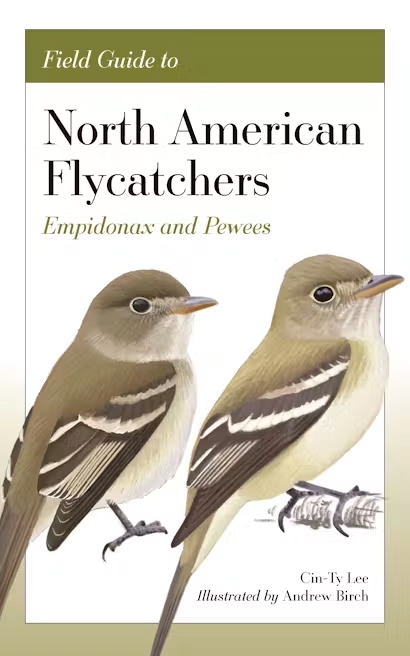
Flycatchers Made Easy: a Review of Field Guide to North American Flycatchers, Empidonax and Pewees

Field guides are an essential part of improving our bird identification skills, and today Braden reviews an outstanding guide to what may be North America’s toughest group of birds. Enjoy, and remember that FSB is written by REAL PEOPLE. Please continue to support the many people who create meaningful—and real—content in our world.

I’ve been birding a lot this fall, and consider myself pretty adept at identifying any bird that lands in front of me. Or at least that would be the case if not for one particularly notorious group of songbirds: the Empidonax flycatchers (or “empids” for short). During spring and summer, these extremely lookalike birds will often sing or call, aiding in their identification. In fall, though, the birds are mostly silent, and I’ll often shrug at the sky when I see one. “Who knows what that could be?”

In 2026, though, something changed: my dad received a review copy of Cin-Ty Lee’s Field Guide to North American Flycatchers—Empidonax and Pewees (Princeton University Press). So on September 14th, when an empid landed in front of me at a local favorite birding spot, instead of shrugging, I snapped as many photos as I could. When I returned home later that morning, I uploaded the photos to my computer, then whipped out the flycatcher guide. I knew already that my bird wasn’t a Willow or Western Flycatcher, and that it fell firmly into a particularly tough group of similar birds that included Dusky, Hammond’s and Least Flycatchers. The first half of the guide gave a page to each major field mark, including lower mandible color, primary projection and wing panel contrast, and I noted what my bird showed, then cross-referenced that with the guide. Most of the field marks I was noticing on the empid I’d photographed were consistent with what the guide showed for Dusky Flycatcher, so I settled on that identification for the bird. Thanks to the flycatcher guide, I’d successfully identified a silent Empidonax!
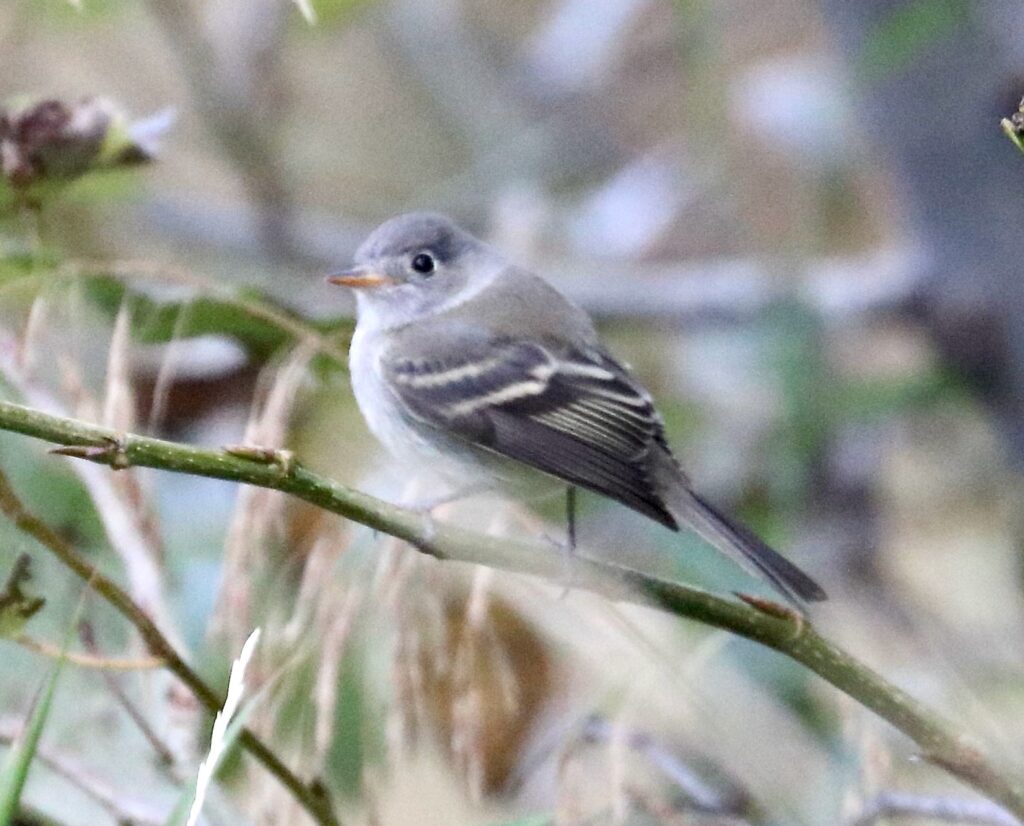
Cin-Ty Lee’s flycatcher guide allowed me (Braden) to ID this almost-impossible-to-identify bird to a Dusky Flycatcher!

Field Guide to North American Flycatchers almost makes the identification of this incredibly tough group of birds seem easy, with its intuitive layout, detailed illustrations (kudos to Andrew Birch!) and the wealth of information packed into its slim volume. It focuses on a “holistic approach” to flycatcher identification, emphasizing that observers should take into account as many visual field marks as possible on each flycatcher they see, as well as behavior, molt, vocalizations, habitat (including microhabitat selected during migration), distribution, and time of year. Each of these factors gets its own page or two of detailed analysis, following an in-depth review of every single visual field mark that birders can use to identify these birds, and which species show them.
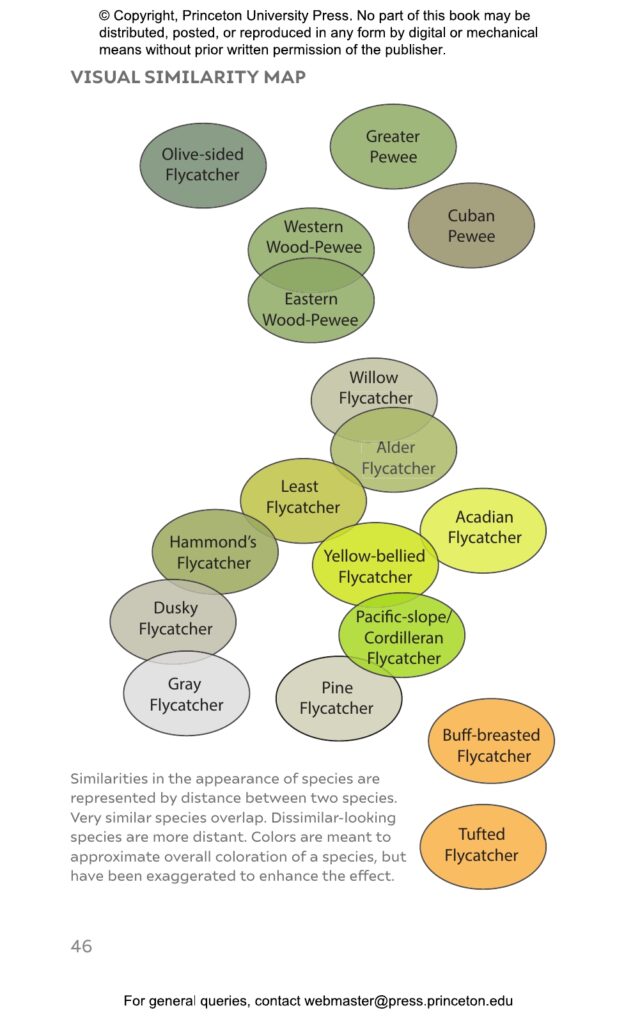
This “visual similarity map” provides a quick gestalt for how similar different flycatchers are to each other.

For example, the first field mark Lee and Birch tackle is “crown shape”, which they divide into four categories: round, flattish, peaked and crested. Illustrations are paired with a list of species that can show each specific crown shape, and this is repeated for every major field mark. At the end of this section, for convenience, the book provides a “field mark matrix” that birders can quickly reference while they’re out in the field. “Oh, my bird has a round crown, medium forehead angle, short bill, medium tail, short primary projection and strong wing panel contrast? It’s probably a Least Flycatcher!” An easily-understandable visual similarity map is also provided showing which species are the most and least similar to each other. 
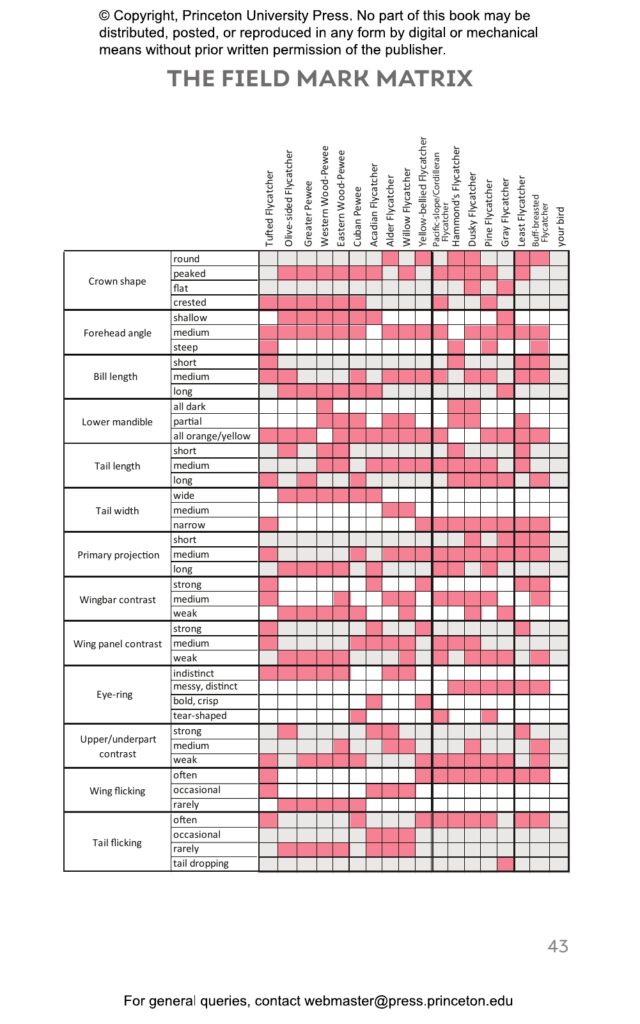
The Field Mark Matrix provides a quick reference for those observing Empids and Pewees in the field.

The latter half of the book is devoted to species accounts. Every Empidonax and Contopus (the pewees), plus Tufted Flycatcher, is covered. Each account gives readers general identification tips, and information on voice, range and habitat, and similar species that can be confused with it. Multiple illustrations are provided of each bird from different angles, with key field marks labelled, and often illustrations of similar species are placed right next to them for direct comparison. Spectrograms, or visual representations of what the birds sound like, are also included, as well as beautiful maps that show the route the birds take during spring and fall migration and what time they arrive and depart in each part of their range. 
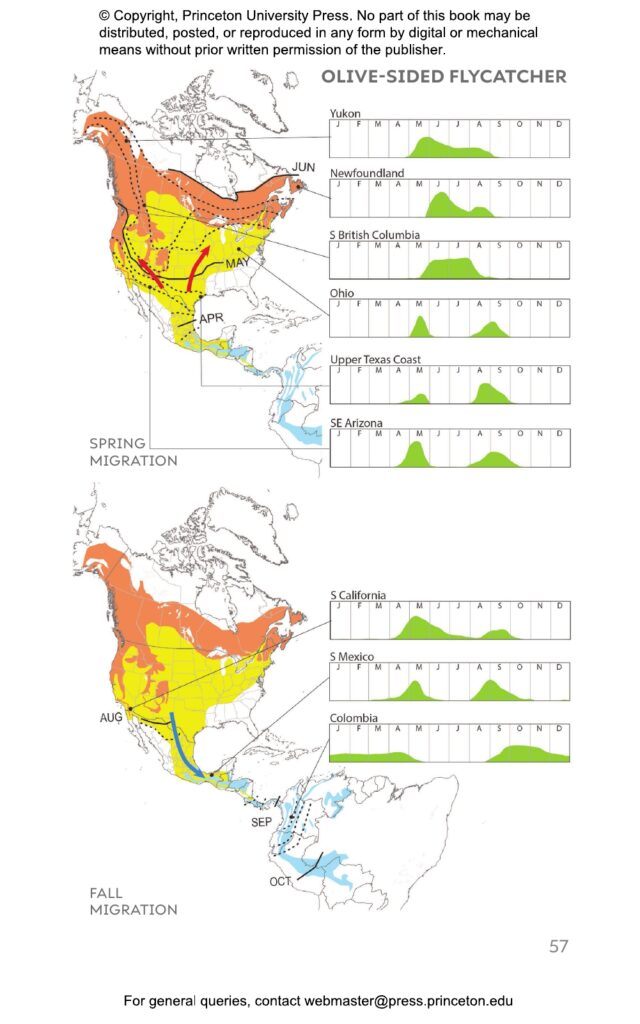
As you would expect, species accounts include a wealth of detailed information about each flycatcher species.

Especially similar species are lumped together, which includes the pewees and the Traill’s Flycatcher complex (which is composed of Willow and Alder Flycatcher), and the last section of the book is completely devoted to comparing and identifying that group I mentioned at the beginning of this post: Dusky, Hammond’s, Least and Gray Flycatchers.
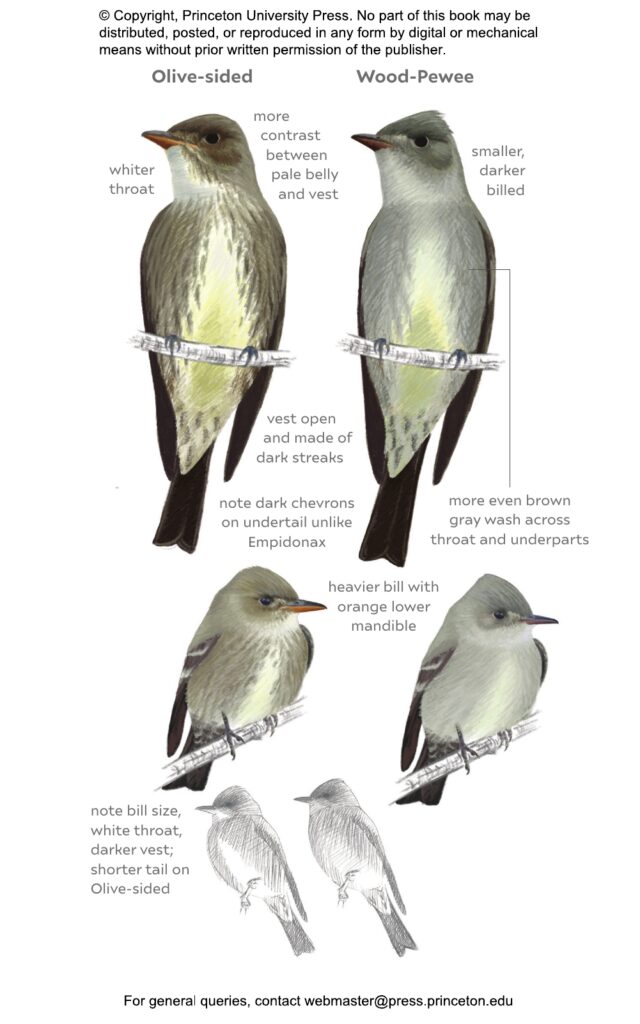
The author does a fantastic job presenting often confusing species side by side for quick comparison.

The way that the author and illustrator present such a large amount of complex information in such a simple, easy-to-understand way is impressive, and it brings hope to many birders like me who used to look at empids and throw their hands up in despair. Don’t just take it from me! I recently visited a bird banding station at MPG Ranch, a conservation-oriented property south of Missoula, where the biologists and field techs had a well-used copy of the book on the table for all to see. Even the pros are using it! The only gripe I have with the book is a small one—it could have used one final proofread before going to press, as there are a fair number of typos and small errors. It isn’t enough to inhibit using it, though, and I would recommend anyone interested in flycatchers to buy this book (and its companion focused on Myiarchus flycatchers and kingbirds!). I’ll leave you with a quote from the intro of the book:

“Of course, not all flycatchers will be identifiable, but we hope this guide will help you see and hear all birds in a new way and make you a better birder.”

To order Field Guide to North American Flycatchers—Empidonax and Pewees CLICK HERE. Also consider the author’s other outstanding flycatcher guide, Field Guide to North American Flycatchers—Kingbirds and Myiarchus.

Review copy and images courtesy of Princeton University Press. Except for noted images, content copyright FatherSonBirding.com.
The Vortex Veil 400 Thermal Monocular: When Birding Meets James Bond (FSB Equipment Review)

Braden and I have had an incredibly busy fall so far with Braden birding up a storm and I going back to college! We are pleased to take a break to present a review of what I can only describe as a mind-blowing new technology for outdoor enthusiasts and scientists. Do check it out, along with our many other posts! Remember, FatherSonBirding is written and produced by REAL PEOPLE, and we appreciate your support.

Even since Braden and I leaped into the world’s greatest activity fourteen years ago, technology has revolutionized birding. eBird has brought millions into the hobby by simplifying the process of record keeping and making vast quantities of information available to all. Technologies such as Motus have given scientists and conservationists critical new tools for learning about, tracking, and protecting birds and their habitats. For people such as myself who have hearing deficits, Merlin’s SoundID has made it possible to detect birds even when we can’t hear them. All of this made me especially excited to test out Vortex’s new thermal imaging monocular, the Veil 400 Thermal Monocular.

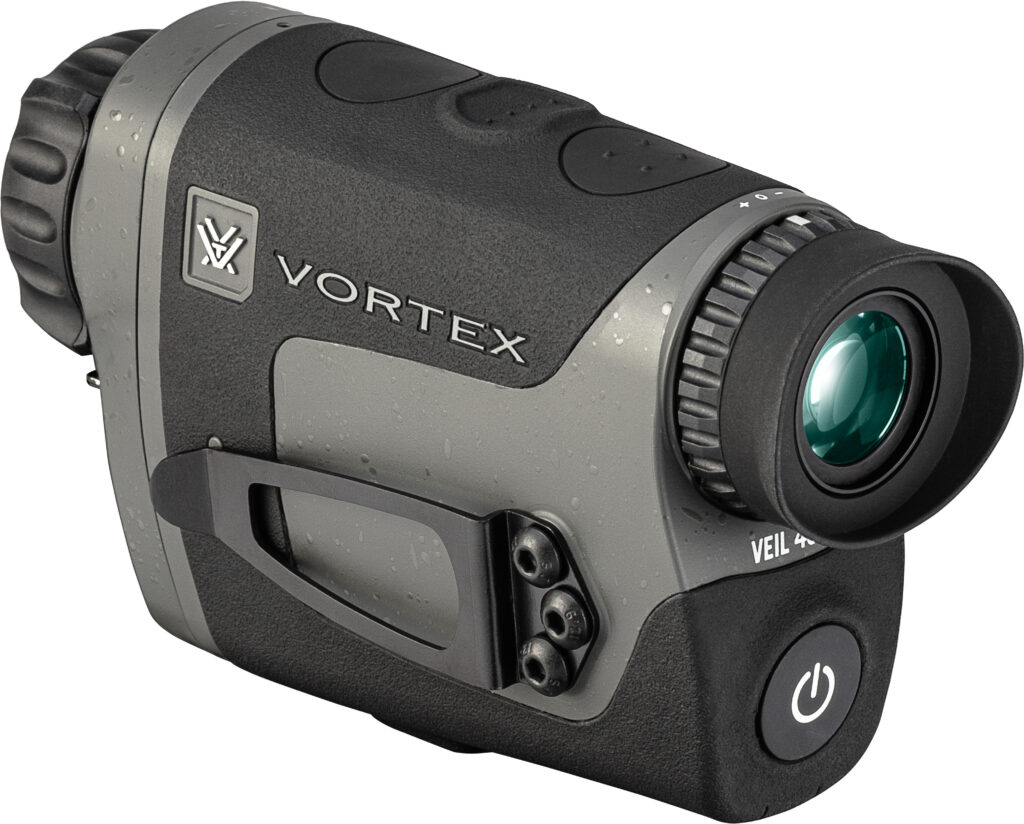
The Veil 400 brings “spy technology” to everyday birders. Despite its sophistication, we found the Veil lightweight, comfortable to hold, and easy to use—great features when you’re on a Top Secret birding mission!

Anyone who has watched a modern thriller or crime drama is familiar with the concept of thermal imaging. Instead of detecting electromagnetic radiation solely in the human visual spectrum (what we see as colors), thermal imaging devices detect infrared radiation that humans normally sense as heat. These devices then translate those infrared wavelengths into colors that we can see on a screen.

The Veil primarily caters to hunters pursuing their quarry at night. The availability of such a device, however, immediately raises the question: can it be useful for birders, too? To find out, Braden and I ran it through several trials.

Not surprisingly, our first thought was to use the Veil to find owls, so we drove to a nearby park at dusk. Almost immediately, the Veil’s screen picked up a bat flying overhead along with the heat signatures of several moths. After an hour, though, we found nary a bird, despite stopping frequently to scan the trees and brush around us. The lesson? If birds aren’t there, or are hidden in a hole or behind tree trunks, even a sophisticated device such as the Veil ain’t going to show ‘em to you!

Our main problem, we realized, was that it was September, when nocturnal bird activity has generally fallen off. That did make us eager to try again next spring when pointing the Veil into the sky would undoubtedly pick up nighthawks, swifts, and other crepuscular insectivores. Who knows? More owls might be around, too.

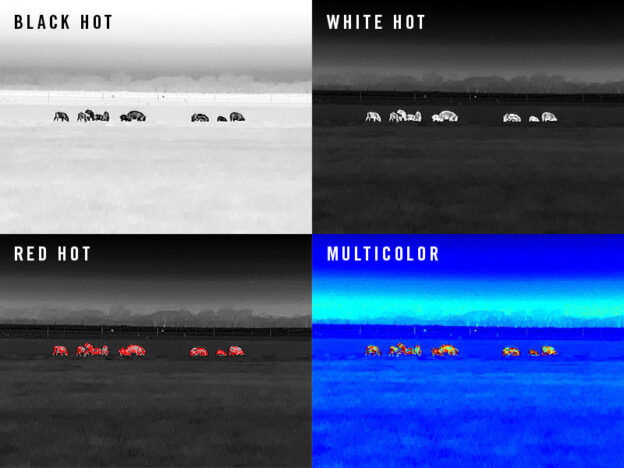
Even on that first outing, however, the Veil proved an eye-opener for understanding the environment around us. Most surprising to me were the different heat signatures given off by both living and nonliving objects. The Veil allows one to select four different thermal detection color palettes: White Hot, Black Hot, Red Hot, and Multicolor. My favorite is Red Hot, which reveals warmer images as scarlet red against black, white, and gray backgrounds.

The Veil allows you to select four different color schemes for distinguishing heat signatures. My favorite, and I think the easiest to distinguish, was the “red” option.

On this setting, Braden and I were astonished to see how tree trunks, leaves, and rocks gave off different heat signatures. That raised all kinds of questions about how other animals see the world, and why detecting heat evolved in, say, certain reptiles, amphibians, and insects, but not in mammals. Or did it? Vampire bats, in fact, can detect heat—but my guess is that the vast majority of mammals have never been tested for this ability.

Undeterred by our nighttime outing, Braden and I again tested the Veil on an overcast morning. Because we were in the heart of fall migration, we visited our local cemetery where we’d often found migrating songbirds. As soon as we stepped out of our trusty minivan, Braden pointed into a tree. “There’s a Swainson’s thrush.”

An overcast day at our nearby cemetery proved an ideal day to compare binoculars with the Veil. (Photo by Sneed B. Collard III)

I couldn’t see it, so I pointed the Veil up into the foliage and, sure enough, a bright red shape glowed back at me! “You gotta see this,” I said, handing the device to my son.

We walked to another group of trees and with his sharp ears, Braden began picking up pine siskins, Swainson’s thrushes, and yellow-rumped and Wilson’s warblers. Most of the birds stayed well-hidden in the branches, so I again raised the Veil to my eye and saw dozens of moving objects! At first I thought all were birds—but then realized that many were insects. Scanning the trees, however, I quickly got onto unmistakable moving red shapes that were birds. “Wow, Braden, there are a lot more warblers than we think up in those trees!” With the help of the Veil, in fact, we counted more migrating Wilson’s warblers than we’d ever seen in Missoula in one place—sixteen in all.

A couple of mornings later, I took the Veil out at dawn for yet another test—and had my best time yet. I heard a chirp in a tree and immediately zeroed in on the heat signature of a House Sparrow. I also had leisurely views of an eight-point buck in a field. Upon returning to my neighborhood, I followed chickadees flitting through trees, and then detected movement in a buffaloberry bush. With my binoculars, I IDed it as a Ruby-crowned Kinglet, but the bird was hardly visible deep within the branches. I raised the Veil to my eye, however, and could follow its movements with ease.

I, unfortunately, was unable to download the bird images I took, but this photo of mammals shows how clearly heat signatures show up on the Veil’s screen.

There’s no doubt that the Veil is an impressive device, but birders will ask themselves, “Is it worth a $1,500 investment?” I have several answers to this. For someone with extra resources who is fascinated with the world and would like to understand bird movements and behavior better, the Veil makes a welcome addition to your birding arsenal. For the average birder on a budget, though, the Veil is a piece of equipment that you might want to borrow or rent occasionally instead of purchasing.

Vortex has wisely kept the controls simple on the Veil, using three buttons to control a variety of features including three well-chosen magnification options.

To me, the real utility of the Veil may lie in conducting scientific studies and bird surveys. Braden and I vividly imagined being at Cape May during fall migration watching thousands of nighttime migrants streaming by—or using the Veil to help detect migrating raptors at a hawkwatch site. One of the powerful things about the Veil, as we discovered, is that it is just as useful during the daytime as at night—maybe even moreso. Only when air temperatures reach eighty degrees or so, do heat differences start to wash out.

Conveniently, the Veil can capture both still and video images. These can be downloaded onto a non-Apple computer at present—but unfortunately not on a Mac, which is why I couldn’t show you any here. However, the built-in camera got me imagining a number of different scenarios for using the device to enhance or inspire new studies of birds and other animals. If any of the above possibilities intrigue you, I encourage you to “test drive” a Veil at your local sporting goods store. Whether or not you decide to buy one, it will definitely broaden your perspective on how we and other animals perceive our incredible world. Oh, and you’ll have a lot of fun, too!

Review equipment and images provided by Vortex. Text copyright Sneed B. Collard III and FatherSonBirding.com.