Tag Archives: Browns Lake

Bluebird Day at Browns Lake!

With all of our recent posts about Costa Rica, you’re probably wondering if we ever bird in Montana anymore! Never fear, we do—a lot! Today we report on an adventure that delivered some remarkable early migration surprises. If you’d like to support our work at FSB, please consider purchasing some of Sneed’s books shown to the right—and support a group such as Birdlife International or Audubon that is working hard to protect birds against climate change and many other perils. Remember: all of our posts are written and photographed by REAL PEOPLE!

I don’t know if it’s because of our recent trip to Costa Rica, my subsequent trip to California, or just the usual spring excitement, but I’ve felt especially eager to get out birding in Montana this spring. At least part of it has to with wanting to learn more about the timing of migration, especially in a year in which Montana hardly experienced winter. How would this impact the birds? I wondered. Would we see things showing up especially early? Fortunately, our friend Susan Snetsinger has felt just as eager to explore, so the past couple of weeks Susan and I have taken all-day adventures to some of our favorite western Montana birding locations. Two weeks ago, we visited Warm Springs and the impressively “remodeled” Lexington Street Pond and wetlands in downtown Butte. We were rewarded with a great variety of waterfowl, including Snow Geese at both locations. The highlight of the day was undoubtedly a great look at a Golden Eagle on the dirt road between Racetrack Pond and Warm Springs.

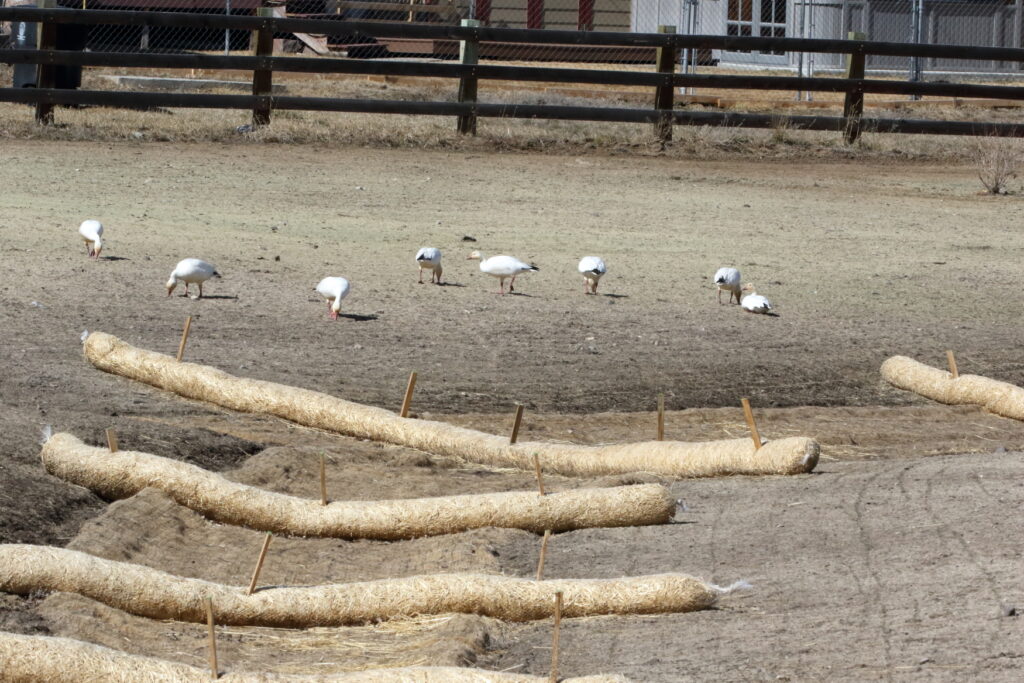
Snow Geese are always something to celebrate in Montana—including this group at Butte’s fabulously restored Lexington Street wetlands area.

A few days ago, though, Susan and I had a different ambition: to post the season’s first eBird checklist for Browns Lake. This is one of Braden’s and my favorite birding locations, and I don’t think it has ever failed to disappoint. Not only is it a go-to place for breeding Red-necked Grebes and Black Terns, we have found a lot of uncommon species there including Long-tailed Ducks, Pacific Loons, and Ross’s Geese. Notably, this is where Braden made the astounding discovery of a Bay-breasted Warbler two years ago—one of just a handful of sightings ever recorded from western Montana.

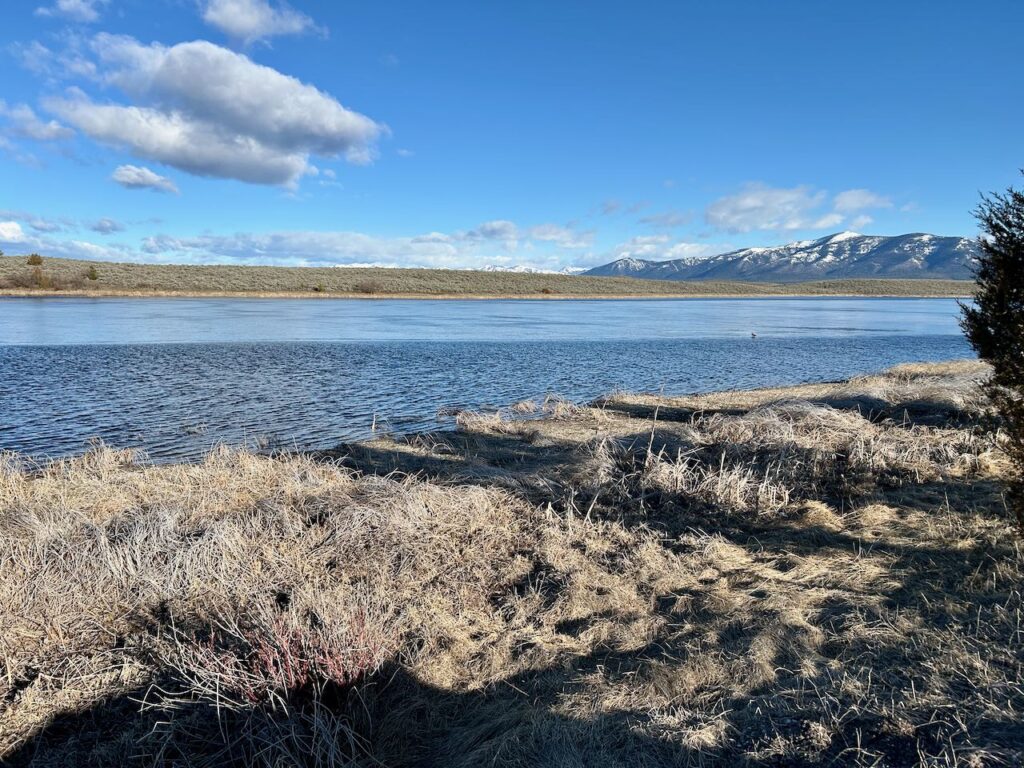
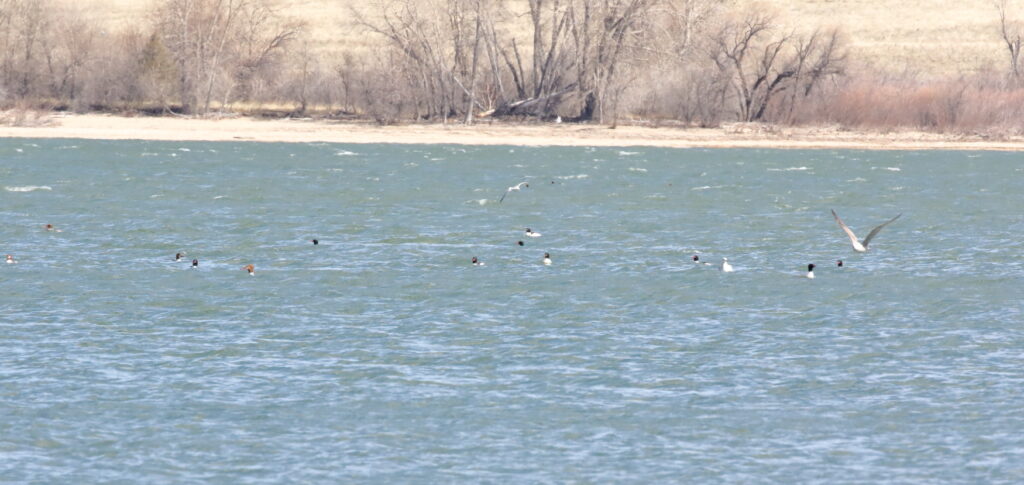
Although Browns (sic) Lake is frozen for a good part of the year, it has never disappointed us as a birding destination and we were eager to see what it held so early in the spring.

One challenge with Browns Lake is that it stays frozen until relatively late in the season and I noticed on eBird that no one had yet birded it this year. I wasn’t sure if it had begun to thaw, but I asked Susan if she was game to check it out. She was—and even brought along yummy fried egg and cheese bagels to fuel our adventures.

On the drive up Highway 200, we were rewarded by two pairs of Sandhill Cranes and a glimpse of a Mountain Bluebird—perhaps a preview of things to come? We hoped so, and upon arriving at Browns Lake, were not disappointed. Right near where Braden had discovered the Bay-breasted Warbler, we got out of the car to find a delightful “finchy” mixed flock containing Red Crossbills, Pine Siskins, Evening Grosbeaks, and Cassin’s Finches.

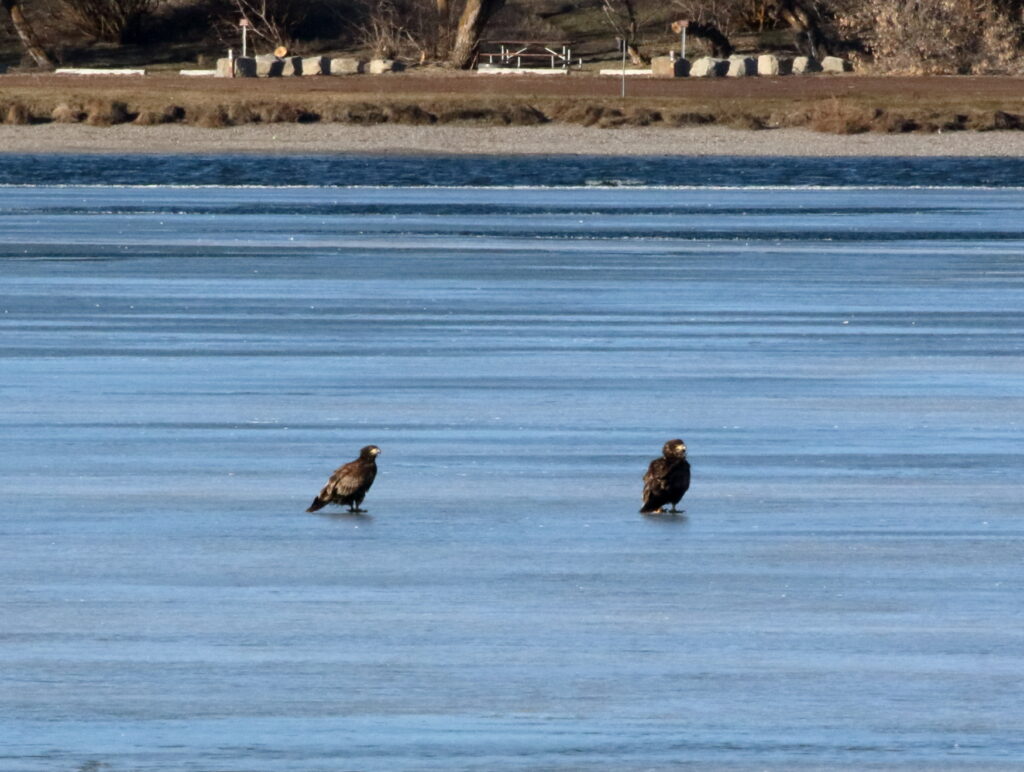
We’re not sure why (though fish and/or animal carcasses probably have something to do with it), but Browns Lake often boasts vigorous Bald Eagle activity—and our early spring visit was no exception. Here, two youngsters contemplate the meaning of ice on this brisk sunny day.

As the lake came into view, we were relieved to see at least a third of it offered open water—and that the waterfowl were not shy about taking advantage! Within twenty minutes, we recorded fifteen species of ducks and geese, including the year’s first Montana Northern Pintails and a lone FOY Cinnamon Teal. A flock of 18-20 Snow Geese erupted out of the fields on the far side of the lake and settled in beneath a huge irrigation line. Even though a brisk wind dropped the wind chill into the teens, we looked hard through our scope for any Ross’s Geese, but came up empty.

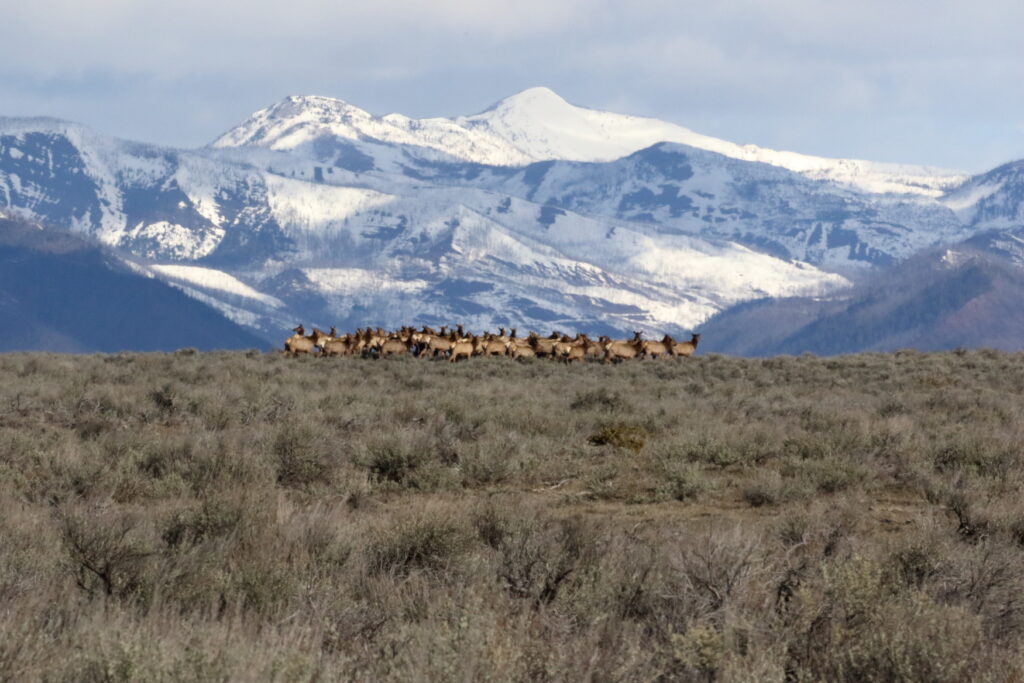
Elk anyone? Even though they are mere mammals, this herd against the dramatic background induced us to pull over for an admiring look.

As has become my new routine, I directed Susan out the far side of the lake toward the Ovando-Helmville dirt road, and we were rewarded by two Northern Shrikes (Susan is certain they were separate birds), and a couple more Mountain Bluebirds. After turning left toward Helmville, we hadn’t gone a mile when we saw a sizeable flock of birds badly backlit by the sun.

“Are they some kind of blackbirds?” Susan wondered, and they did look black because of the sun, but I didn’t know. Then, she said, “There are more bluebirds over here.” “There’s a couple over here, too,” I added, still thinking they had nothing to do with the flock we’d just seen.

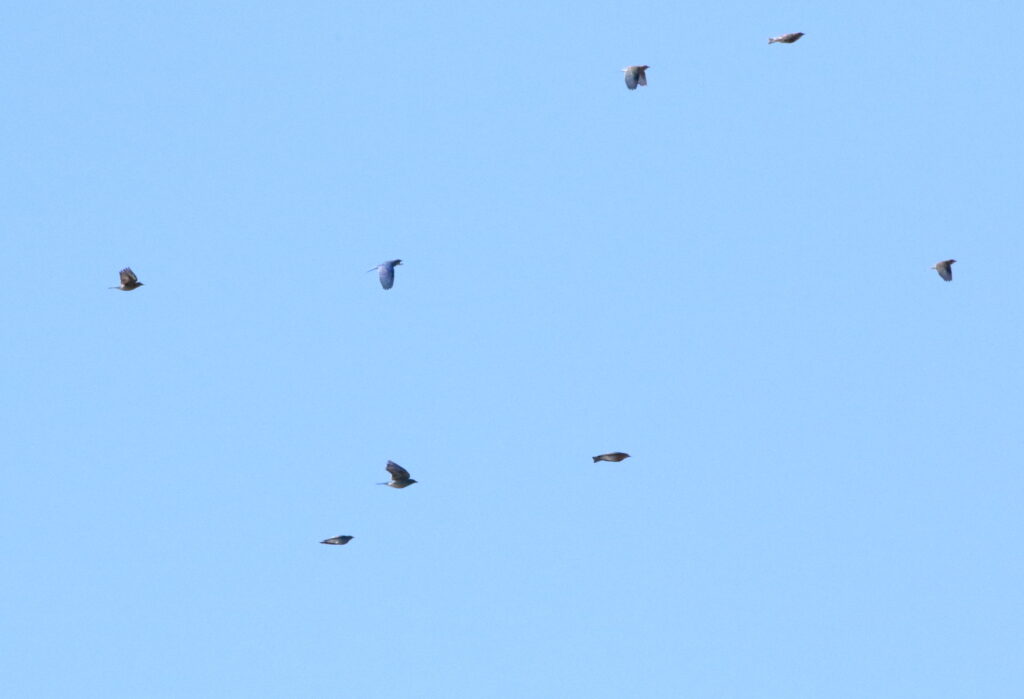
The bottom line? The flock we had just observed consisted entirely of Mountain Bluebirds!

At first, we weren’t sure what these flocking birds might be, backlit against the sun, but this photo reveals the truth.

This blew both Susan and I away. Neither of us had ever seen more than three or four Mountain Bluebirds at a time, and had no inkling that they ever formed large flocks. Yet here was the evidence in front of us, and we spent a good fifteen minutes watching them forage and swirl around us. Once, a group of at least sixty took to the sky together, only to settle back into the grass a few moments later. Meanwhile, others kept crossing the road in front and back of us, occasionally landing on the fence next to our car.

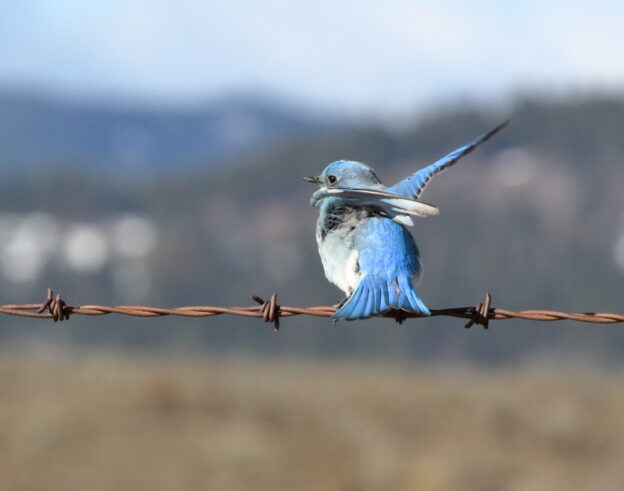
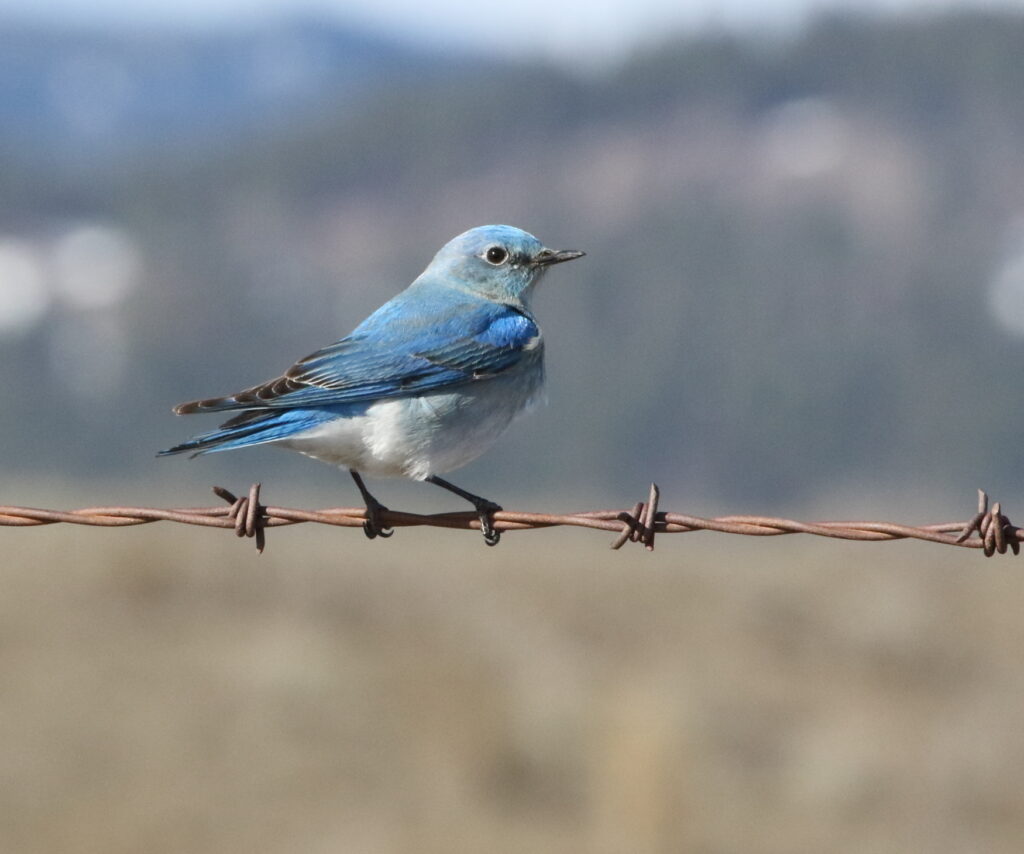
The Mountain Bluebirds were so active around us that I dared not hope to get a photo of one—until this guy perched 15 feet away from the car window!

We finally pulled ourselves away, wondering if local ranchers observed this kind of grouping every year. I later read up on MOBLs and found one or two mentions of them forming flocks in winter, but it didn’t seem like a well-known phenomenon. Susan and I both agreed that these cavity-nesting birds must be migrating. From here would they spread out into the surrounding mountains? Or did they still have a long way to go before trying to find their own breeding territories? As biologist Dick Hutto had taught me, Mountain Bluebirds especially love recent burn areas where woodpeckers carve out plenty of “condos” in the dead trees (see my book Fire Birds: Valuing Natural Wildfires and Burned Forests). I wondered if, as a flock, they might be better at finding recent burn areas—or did flocking impart other benefits such as greater predator or food detection?

After the Browns Lake area, we headed toward Helena, hoping to find a recently reported Lesser Black-backed Gull. Though I’d seen this species in Israel and again in Oregon, this would be a Montana lifer for me and an outright lifer for Susan.

It was not to be.

At the Helena Regulating Reservoir, we saw plenty of gulls, but many were too far away for our scope, and the ones we did see did not have the dark wings we were looking for. The trip wasn’t a waste, however, as we observed more than sixty Common Mergansers and at least ten Red-breasted Mergansers, also clearly in migration. In fact, the window to see RBMEs is quite tight in Montana, so it was nice to pick them up for 2026.

Though we missed the Lesser Black-backed Gull, the Helena Regulating Reservoir was hosting a “regulating” merganser-pa-looza!

Speaking of 2026, both Braden and I have excellent chances to accidentally break our world Big Year records. My record, set last year, is 552, and only a quarter of the way into this year, I’m at 422. This is not as much of a gimme as it sounds since many of the birds I’ve seen in Costa Rica and California are birds I would normally check off in Montana, but with a little luck and persistence, I feel I will get there. Braden’s record, meanwhile, is 867 and he is already at 546, with hopes to bird abroad at least one more time this year. We no longer put a lot of stock into numbers like these, but they’re a fun thing to keep an eye on.

After saying goodbye to the Helena Regulating Reservoir, Susan and I did a little more birding and then got lunch in downtown Helena. I only mention it because we ate at an excellent little crepe place called—what else?—The Creperie. It featured outstanding food and reasonable prices. It’s open until 3 p.m. most days and is located right next to the lower entrance of the walking part of Last Chance Gulch. If you’ve got the post-birding munchies, check it out!

Our first-of-the-year Browns Lake checklist: https://ebird.org/checklist/S313329879

A Rare Warbler in Western Montana—and our Wings Across the Big Sky Festival Report 2024

In case you missed our last post, Sneed’s new book, Like No Other: Earth’s Coolest One-of-a-Kind Creatures, is now out just in time to enhance summer science education. To order, click on the book jacket in the right column!

Have you ever contemplated attending a birding festival? Braden and I have attended festivals in Monterey Bay, San Diego, and Rockport-Fulton near Corpus Cristi. All were terrific. I have to say, though, that our favorite is right here in Montana. After last year’s Wings Across the Big Sky birding festival in Great Falls, I was skeptical that this year’s fest in Helena could match it. How wrong I was! This year’s festival would not only prove wonderful in itself, but provide the perfect launch pad for Braden’s and my 13-day birding safari to eastern Montana. In fact, even before we reached Helena, Braden made what may be his greatest Montana bird discovery yet.

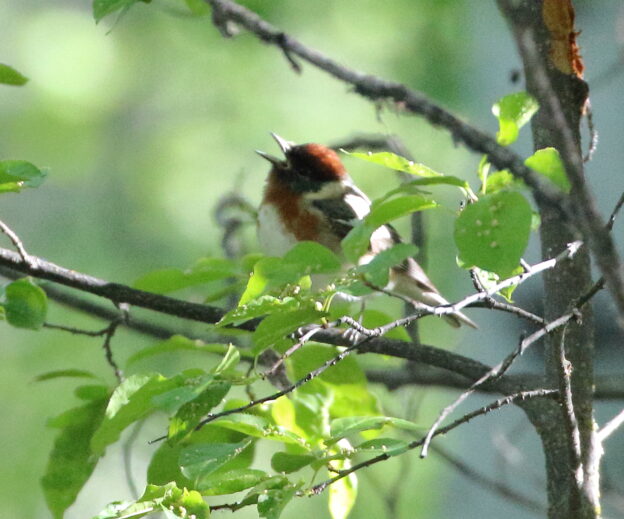
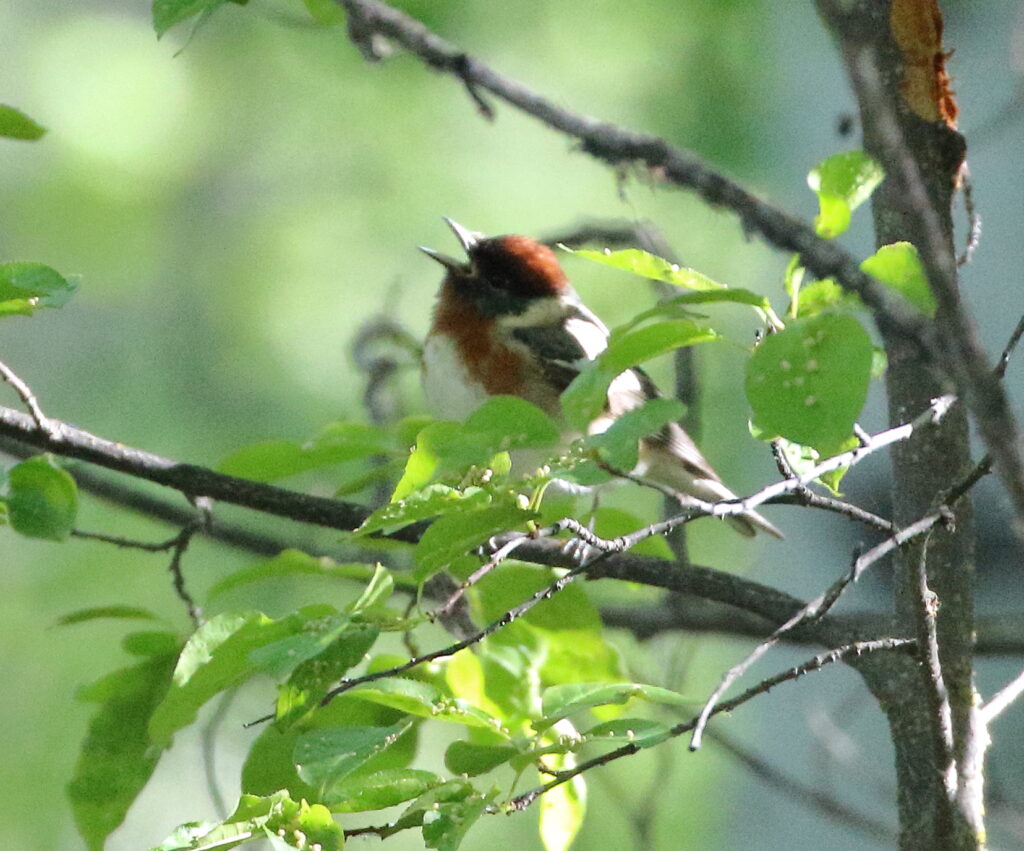
We left Missoula early on Friday, May 31st. Our first destination? Browns Lake, site of many past wonderful birding experiences—but nothing like we would have today. After the turnoff to Browns Lake, we always stop at a little riparian area and, as usual, got out to listen and look. Right away, we heard Dusky Flycatchers, Warbling Vireos, and Yellow and Yellow-rumped Warblers. Then, Braden heard an American Redstart and began “pishing” it in so that we could catch a look. I had my camera focused on a Yellow Warbler when Braden urgently hissed, “Daddy! Get over here now!” I rushed over to find him training his binoculars on a mind-blowing find: a Bay-breasted Warbler!

Perhaps Braden’s best Montana bird find ever, this glorious male Bay-breasted Warbler gave us great looks despite my horrible photos. This bird made the Montana Rare Bird Alert.

For those of you who don’t know it, Bay-breasted Warblers breed mainly in spruce forests of northern Canada across to the far northeast of the U.S. During migration, they almost never pass through eastern Montana, not to mention western Montana. True, I had seen a female in Missoula several years ago, but the gorgeous male in front of us shouldn’t have been anywhere within 500 miles of where we were standing—and, accordingly, made Montana’s Rare Bird Alert.

With that auspicious beginning, we happily proceeded to Carroll College in Helena for the Wings Across the Big Sky opening banquet. That featured an excellent talk by Tiffany Kersten, who set the Lower 48 Big Year record in 2021, and spoke eloquently about the challenges of birding as a solo female. Tiffany now is the proud owner of NatureNinja Birding Tours, and I can only guess that her guiding and tour experiences are not to be missed.

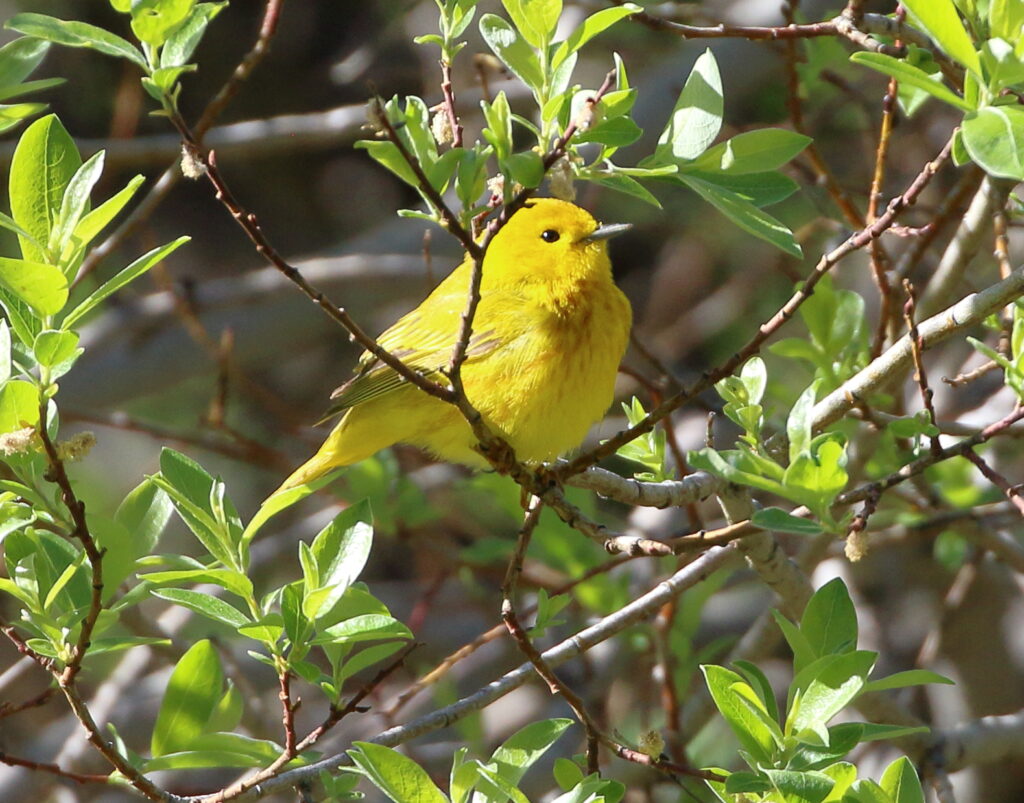
Usually uncooperative, Yellow Warblers gave us great looks at Vigilante Camprground near Helena.

Saturday morning, Braden and I convened at the festival breakfast for our first field trip, led by the highly-skilled veteran Montana birder, Sharon Dewart-Hansen. We were excited about the field trips we had signed up for because they would take us to places we had never before birded, and Sharon led us to Vigilante Campground northeast of Helena. After driving up a spectacular canyon, about 15 of us piled out to bird. Immediately, a Broad-tailed Hummingbird loudly buzzed us—a Montana Lifer for both Braden and me. Walking the campground, we were regaled with the songs of Ovenbirds, MacGillivray’s Warblers, Hammond’s Flycatchers, Veerys, and always my personal favorites, Lincoln’s Sparrows. A Ruffed Grouse drummed cooperatively several times.

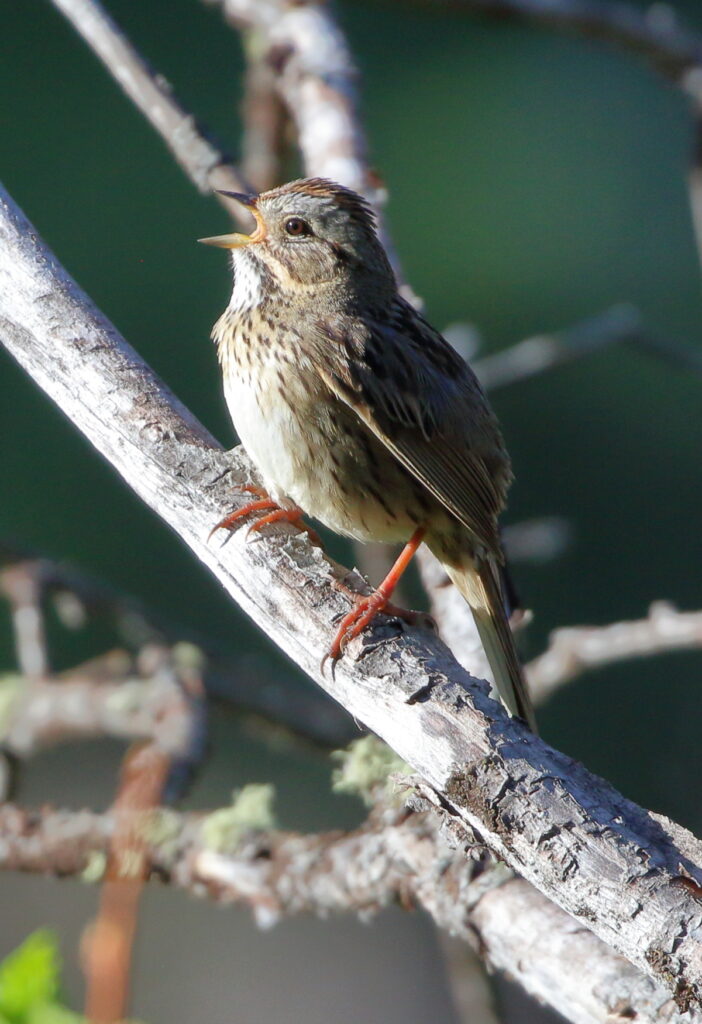
Have I posted more Lincoln’s Sparrows than any other bird on FatherSonBirding? Perhaps, but who can blame me? I just love these guys!

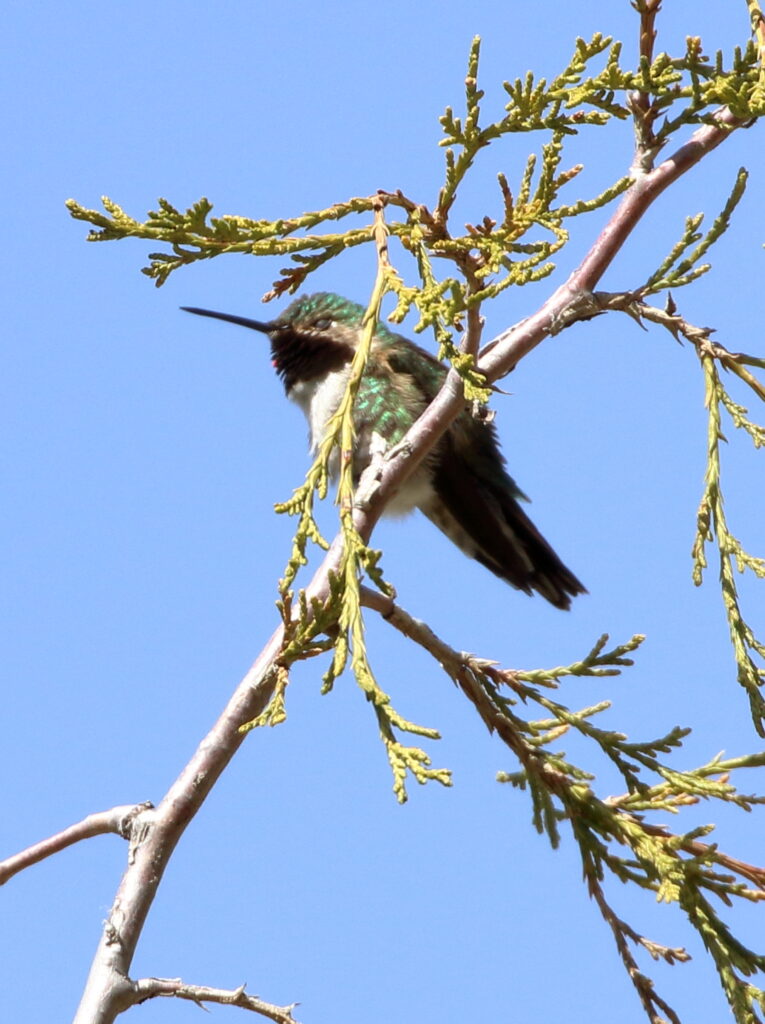
After scouring the campground, we headed up canyon on foot and were treated to Violet-green Swallows and White-throated Swifts. On the way to the Vesta Cerra Ranch, whose owners generously allowed us to stop to eat lunch and admire their hummingbird feeders, we stopped for better looks at Broad-tailed Hummingbirds!

This Broad-tailed Hummingbird was a Montana Lifer for both Braden and me. These birds are quite rare and localized in the state, with the heart of their breeding range south of Montana.

Our Vigilante Campground List.

After some fascinating afternoon seminars, Saturday night’s dinner featured a wonderful report on Montana Audubon’s conservation activities by Executive Director Larry Berrin. These included a program I am particularly excited about, the Audubon Conservation Ranching program, which works with ranchers to maintain vital grassland bird habitat. Most touching was the presentation of Montana Audubon’s annual conservation award to the sixteen pioneering young people who successfully took the State of Montana to court for not taking sufficient actions to protect us all from climate change. Truly inspirational.

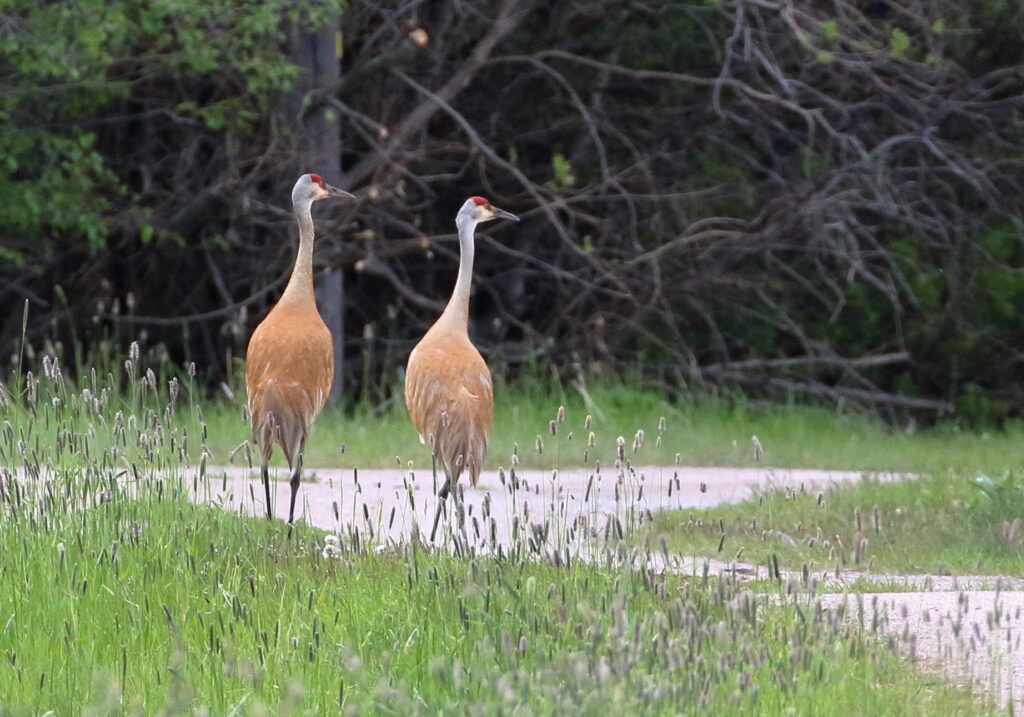
After packing up our car early Sunday morning, we headed out for our second field trip, guided by expert Montana birders Hilary Turner and Andrew Guttenberg. Once again, we were treated to fabulous birding through brand new territory that featured awesome grassland, riparian, and canyon birding. The highlight was a visit to the private Phantom Springs Ranch, where we recorded 45 species, including wonderful looks at displaying Bobolinks. Here, two Sandhill Cranes tried to join our group, but we had to politely inform them that our field trip was full.

These two Sandhill Cranes tried to join our group at Phantom Springs Ranch, but we had to politely turn them away.

After birding several other wonderful spots northwest of Helena, Braden and I sadly said goodbye to our intrepid birding companions. That sadness quickly turned to excitement, however, as we steered north on the next stage of what would become a 2,500-mile birding extravaganza . . .

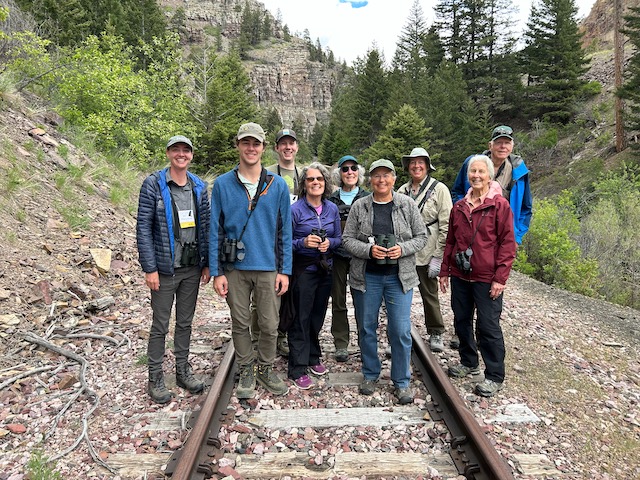
Led by trip leaders, field biologist Hilary Turner (far left) and Andrew Guttenberg (third from left), our group enjoyed superlative birding in places Braden (second from left) and I had never before explored.

Our Phantom Springs Ranch List.

Note: Next year’s Wings Across the Big Sky festival will take place right in our hometown of Missoula. I hope we see you there!