Category Archives: Climate Change

Puffin Party! (Maine to Montana, Part 2)

The state of Maine can be simplified to four things: lobster, moose, blueberries, and puffins (with Dunkin Donuts as a runner-up). During the four years I’d spent going to school in the state, I’d eaten lobster rolls, visited blueberry bogs, and tried my hardest to find a moose, a quest that would continue later this week. Through no fault of my own, I had never even tried to see a puffin and the reason was simple—my school year did not overlap with the Atlantic Puffin school year. This year, however, was different. I was actually still in the state of Maine as puffins were arriving at their breeding colonies, and was not going to miss my last chance to see these iconic seabirds. So, on May 14th, I boarded a large boat in Bar Harbor and took my seat in the cabin, binoculars and camera ready.

Unlike previous boat rides I’d taken to see birds, this cruise was relaxed and family-friendly. About two hundred people crowded the deck, many of whom were just as interested in the Bald Eagles and American Herring Gulls circling above the harbor as the prospect of seeing any alcids (Alcidae is the family of birds that includes puffins, murres, auks, and guillemots). Over the intercom, a very knowledgeable guide spouted off a non-stop stream of facts about the islands, lighthouses, and wildlife of the area as we headed for Egg Rock, a sparse strip of land just barely visible to tourists standing onshore in Bar Harbor. With the coastline of Acadia National Park to our right, we slowed as we approached the island.

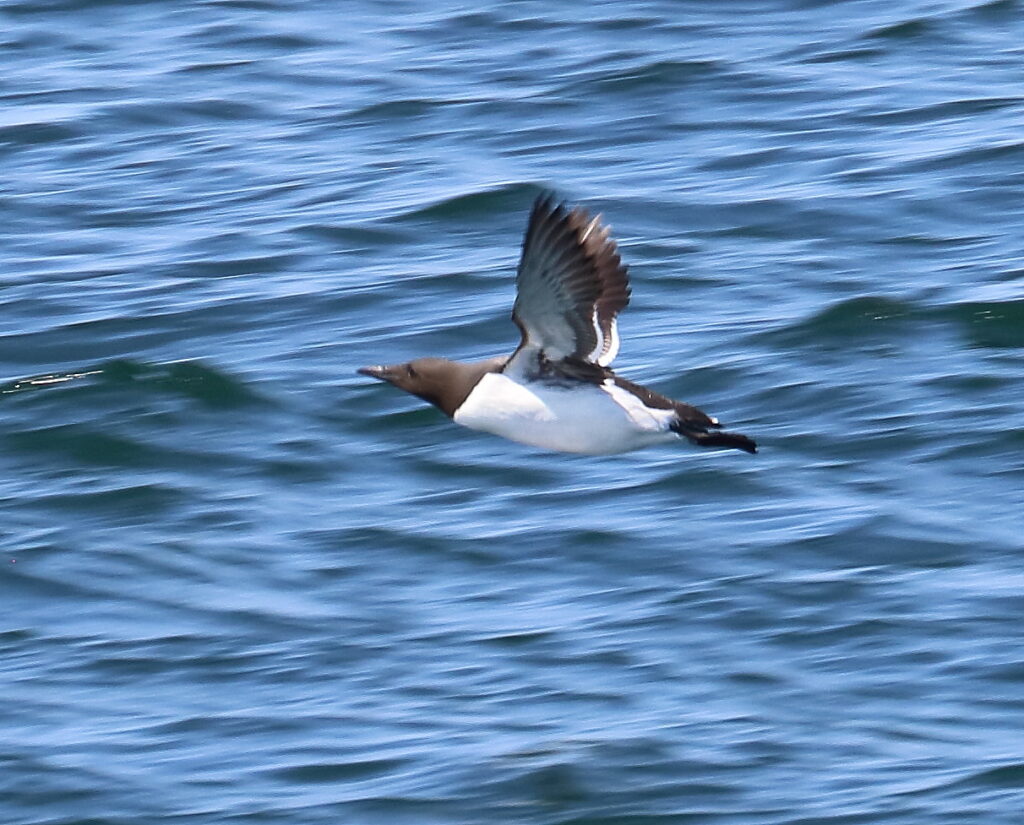
This Common Murre was the only one I saw the whole boat ride. While this species hasn’t yet started nesting at Petit Manan, the ornithologists are hopeful that they will soon!

Egg Rock did not have a puffin colony—it was too close to shore for that. What it did have were colonies of several other species of seabirds. Gulls dominated the island, mostly Herring with scattered numbers of Great Black-backed Gulls mixed in, their charcoal backs sticking out amongst the sea of gray. Cormorants patrolled the southern side of the island, standing tall like gargoyles on the rocks. And in the waters lapping up against the side of the island I saw my first alcids—Black Guillemots! Although guillemots, which are black with white wing patches in the summer and white with black wing patches in the winter, are in the same bird family as Atlantic Puffins, they are far easier to see in Maine. Not only do they breed right on the coast during the warm months, they also stay for the winter—something that the puffins do not do. That’s one of the reasons why I’d never seen puffins here during my time at the University of Maine: From August to April, these birds stay as far from shore as possible, floating around somewhere in the North Atlantic.

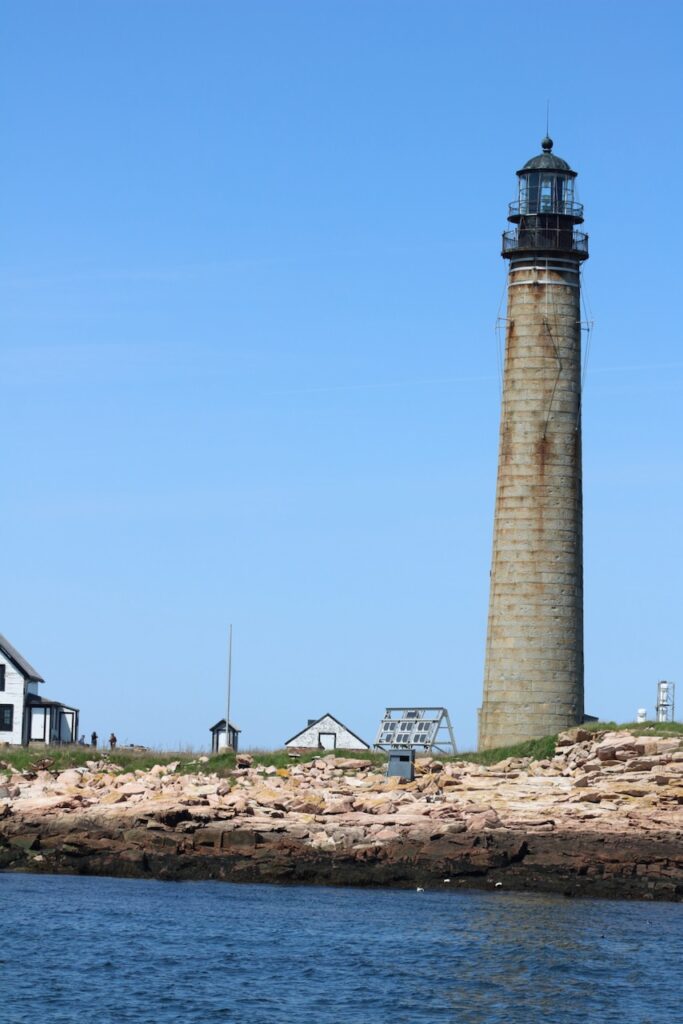
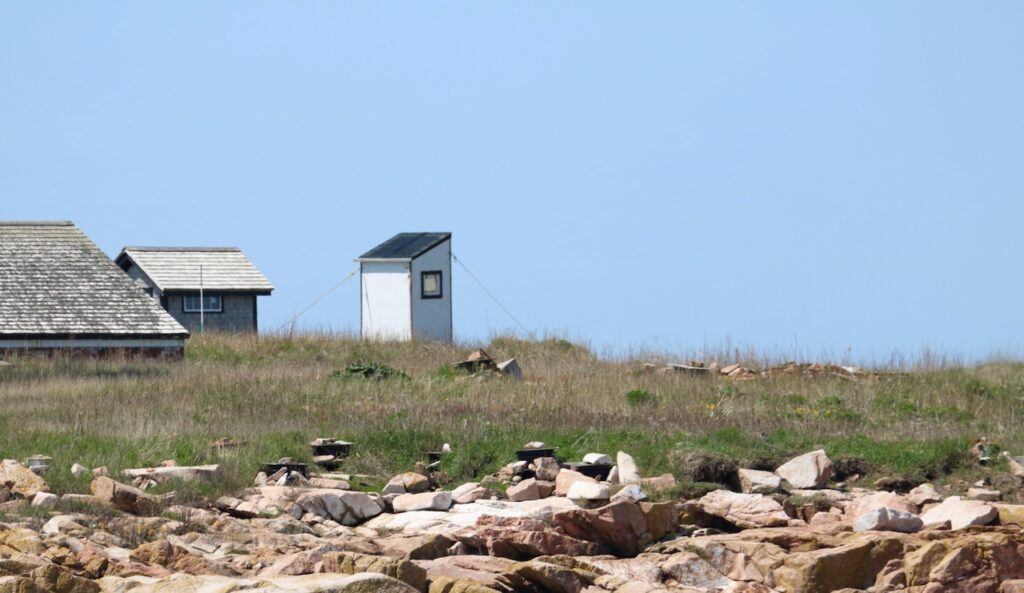
After circling Egg Rock to look at the seabird colonies, as well as the dozens of Harbor and Gray Seals lounging on the rocks, the boat picked up speed and headed out to sea. While we never lost sight of the coastline, it grew hazier and hazier until eventually, a new island appeared on the horizon: Petit Manan. The first thing I noticed about Petit Manan were the buildings. Many islands off the coast of Maine had lighthouses, built during centuries past to help steer ships into harbors. As recently as the late 1900s, lighthouse keepers and their families lived on the islands and maintained the lighthouses, although by now many of the keepers had left, likely because boats had better forms of navigation at their disposal. The houses they left behind had been taken over by people working a very different type of job.

The Lighthouse on Petit Manan Island.

Both Egg Rock and Petit Manan are part of a large reserve known as Maine Coastal Islands National Wildlife Refuge. Every summer, dozens of wildlife technicians head out to these islands to spend weeks and months working with the birds that live there. On some islands, like Petit Manan, this work includes Atlantic Puffins, but it also includes monitoring and conservation of other species like Common, Arctic, and Roseate Terns, Common Murres, Black Guillemots, Razorbills, Common Eiders, and Leach’s Storm-petrels. Several of my peers at the University of Maine worked for Maine Coastal Islands and would be heading out to their assigned locations within the next few weeks.

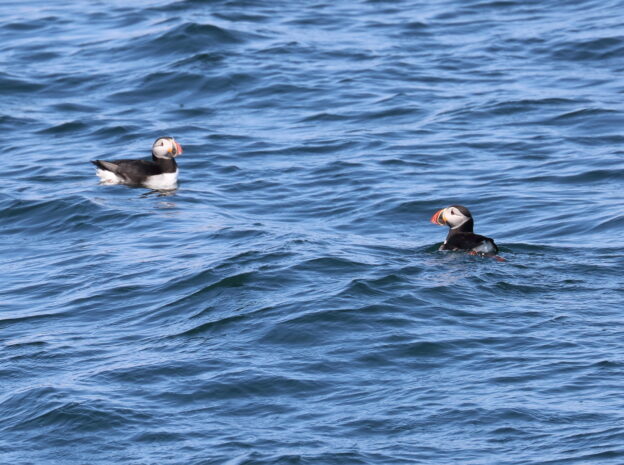
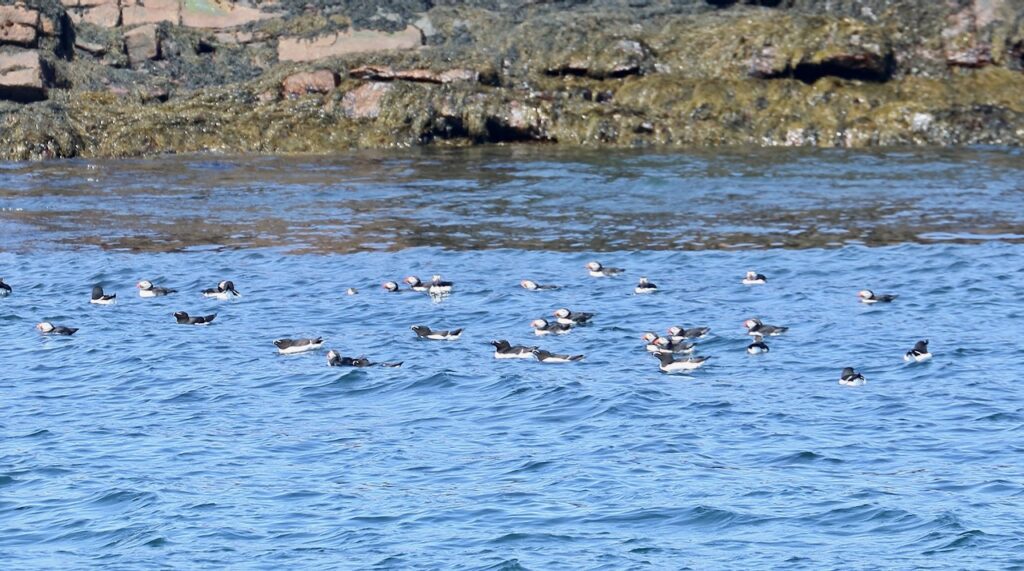
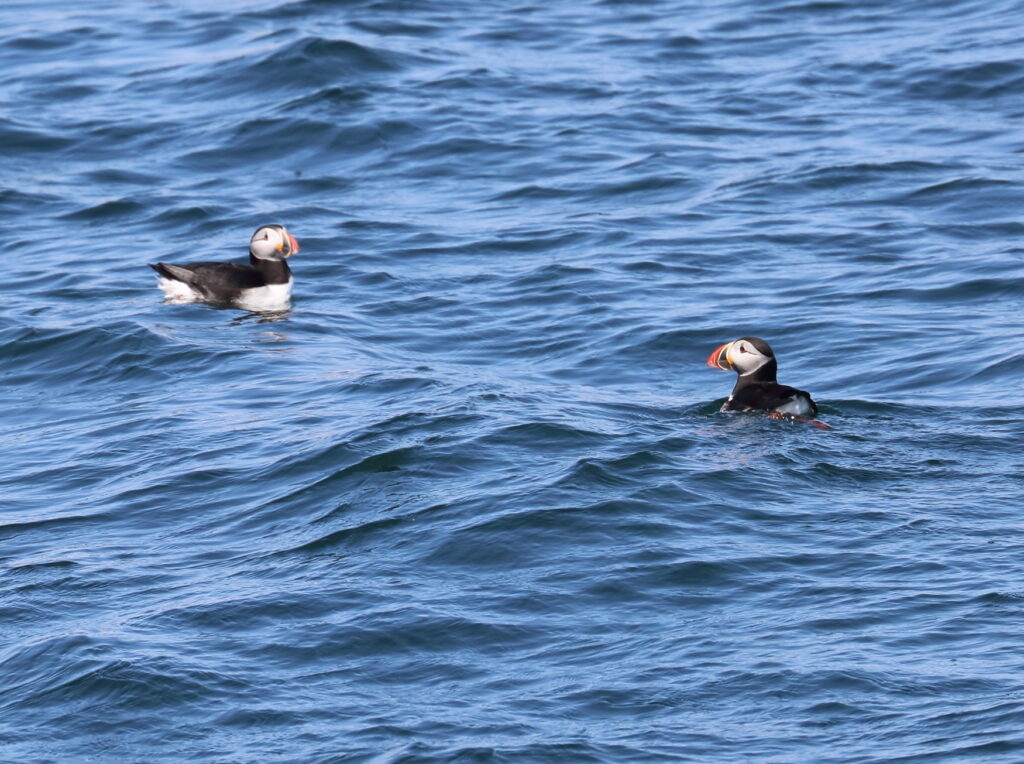
I began to make out large rafts of birds next to the island as our boat approached, and was delighted to spot football-sized alcids with rainbow bills taking off in front of us. I raised my binoculars and smiled—these were the first Atlantic Puffins I’d seen in seven years, since 2018 when I’d been lucky enough to visit Iceland with my grandparents (see my post “All About Alcids”). The birds lounged in the water close to the rocks, and our guide told us that many of them had likely just returned for the summer from their mysterious marine wintering grounds. I counted ninety or so during our half hour stay at Petit Manan.

A raft of Atlantic Puffins and Razorbills!

The puffins weren’t alone. Black Guillemots were here, too, as were a couple dozen Razorbills, another gorgeous black-and-white alcid named after the unique shape and decoration of its beak. I spotted a single Common Murre amongst their ranks, my fourth alcid of the day and a species that had not yet attempted to nest at Petit Manan—but scientists were optimistic! A dozen or so Common Terns circled the island loftily, letting out loud “kyeeeer” calls to notify everyone who was really in charge here. In a few weeks, the numbers of terns would swell into the hundreds, and include Arctic as well as Common. Terns were the aggressive defenders of islands, and would dive-bomb anything they perceived as a threat, including people. I remembered one walk in Iceland when we were asked to hold a tall, wooden stick so the Arctic Terns there would target that instead of our heads!

These birds are the reason that so many alcids nest at Petit Manan. The huge tern colony on this and other islands provide safety for the puffins from predators like gulls and Peregrine Falcons that might otherwise raid their nests. Of course, the biologists working for Maine Coastal Islands NWR were also there to aid these species and chase predators off the island. It hadn’t always been that way, unfortunately.

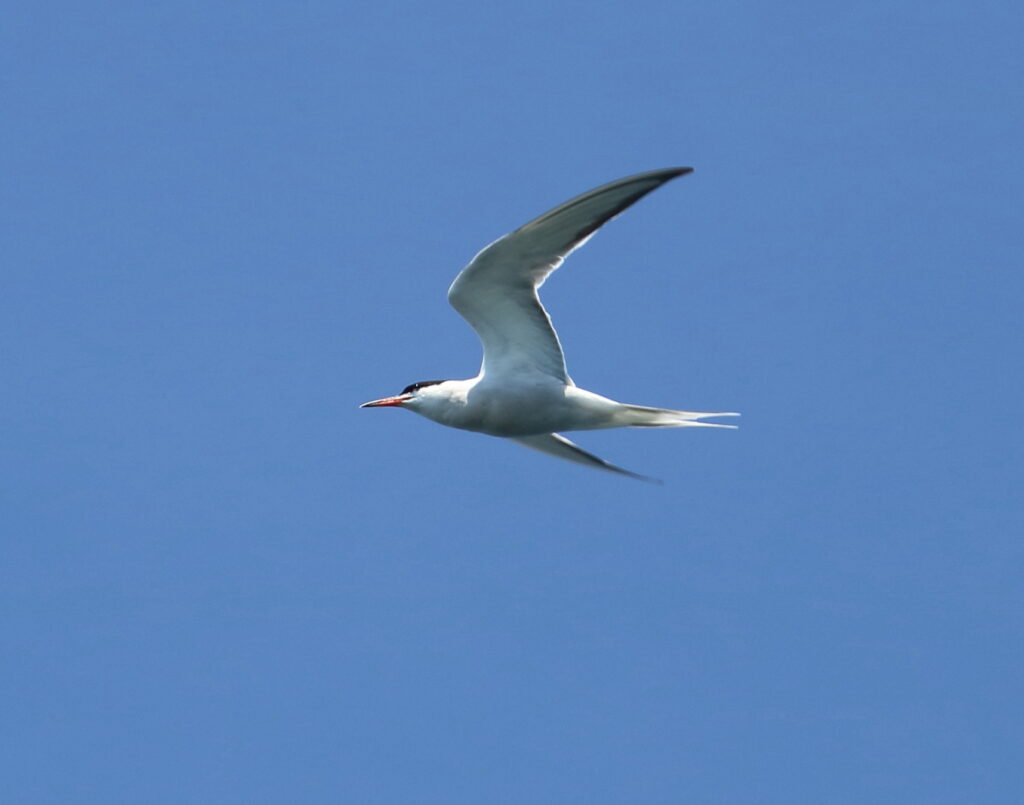
Common Terns nest in huge, aggressive colonies along the Maine coast!

A hundred years ago, feathered hats were all the rage in cities across the east coast of North America. The demand for white feathers meant that large numbers of terns, gulls, and egrets were harvested—to the extent that these species declined dramatically across much of the country. With no terns to protect them, puffins nesting in Maine were faced with higher predation, but not just from other birds. Rampant collection of eggs and puffin meat also plagued many of Maine’s islands, leading to a dramatic decrease in this species down to just two tiny colonies. Sadly, it was looking like the Atlantic Puffin would join the ranks of the Great Auk and Labrador Duck in Maine’s list of extinct birds.

Thankfully, ornithologists and bird-lovers alike noticed how much environmental damage was being caused by these practices and stepped in. Groups like Audubon formed and began lobbying for the protection of birds, eventually leading to the passing of the Migratory Bird Treaty Act of 1918. And in 1973, Audubon launched Project Puffin. Scientists were sent out to islands equipped with broadcasting equipment and decoys, as well as a small number of puffin chicks donated from colonies in Canada. Step one was the rearing of chicks on islands that had previously been occupied by puffin colonies; step two meant attracting terns back to the islands. Finally, with their defenders back in place, Atlantic Puffins began returning to many of the islands they’d previously been extirpated from. They now occupy six colonies in Maine.

Today, Atlantic Puffins are doing well, but are still being monitored very carefully. Puffins feed on fish that thrive in deep, cold water. That’s why the species only nests on the outermost islands in Maine. Our guide told us, “Puffins would lay their eggs in the ocean if they could.” Unfortunately, the Gulf of Maine is warming faster than any other body of water in the world, and this means that puffins are having to travel farther and farther out to sea to obtain their prey items of choice. During particularly warm years, puffins have switched their selected prey entirely to other species. Many of these other species of fish, which are brought back to their chicks on Petit Manan and other islands, differ in their size and the toughness of their skin. Often puffin chicks cannot eat them, and will starve even when food is sitting right there.

The man-made burrows where puffins nest on Petit Manan!

The good news is that there are many, many people keeping an eye on these birds, doing their best to keep their numbers high. Last year was an especially good year for the species, so optimism is in the air. I felt cautiously hopeful for the future of this species as the Bar Harbor Puffin Tour headed back to shore, content with the pictures and new memories I’d experienced with this iconic Maine species.

A pair of Atlantic Puffins!

Plenty of Partridges: Braden & I Kick Off Another Year of Birding!

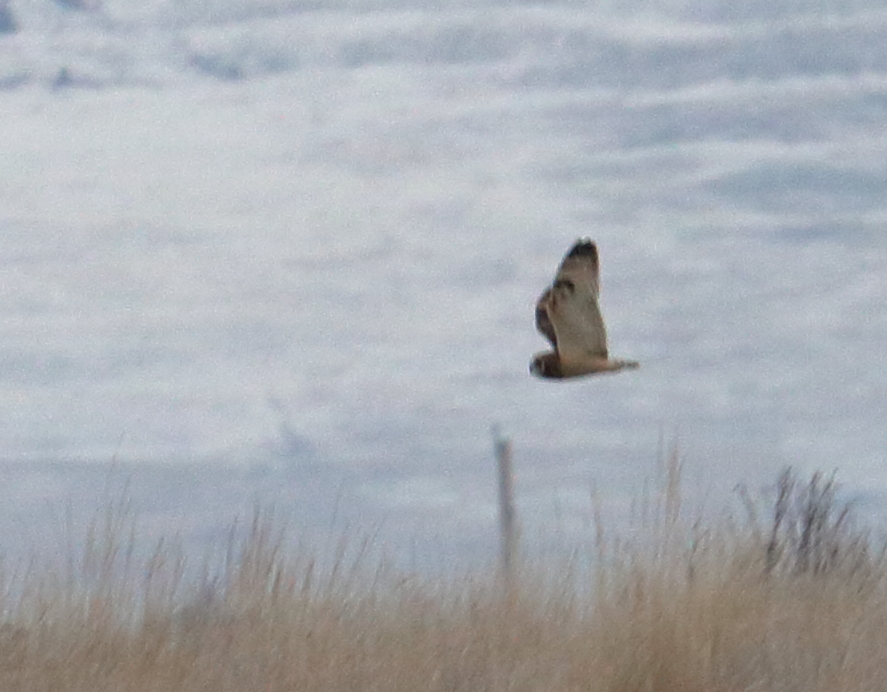
Braden and I kicked off our 2025 at one of our favorite western Montana birding spots: Ninepipe National Wildlife Refuge. While mainly envisioned as a duck factory, the surrounding farms and grasslands provide plenty of grassland bird habitat and raptor hunting grounds, so in winter that’s what we mainly search for. We began the day by looking for Short-eared Owls at a “vole-opolis” our neighbor Tim, a game bird hunter, told us about last year (see our post “Lost in Owls”). Sure enough, we got distant looks at three of these mesmerizing, long-winged raptors as they cruised low over a tapestry of grass and cattails. They were joined by a trio of Northern Harriers, birds that are so similar to Short-eared Owls in appearance and habits that they offer an almost perfect lesson in convergent evolution—the incidence of two unrelated species being shaped in similar ways by natural selection.

After our time with the owls and harriers, we set out on a leisurely cruise northward on dirt roads with the spectacular snow-capped Mission Mountains majestically gazing down on us. The raptors continued to please, with great close-up looks at our first Golden Eagle of the year, three or four Rough-legged Hawks, a couple of American Kestrels, two Merlins, plenty of Red-tailed Hawks, and no fewer than a dozen Bald Eagles.

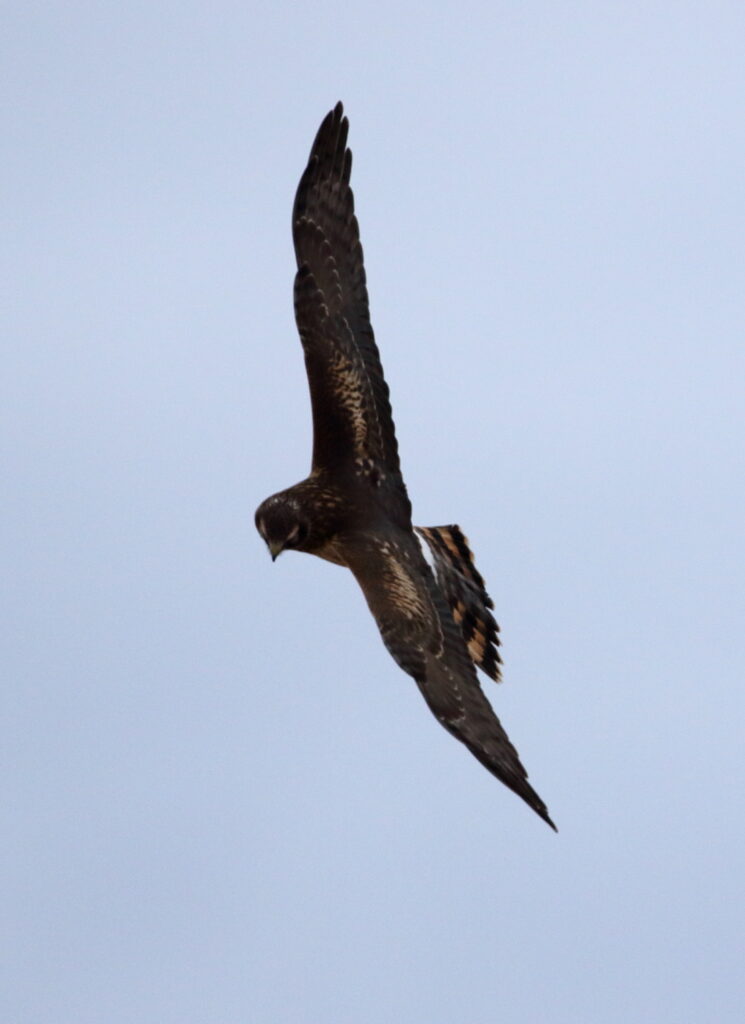
This Northern Harrier is seriously eye-balling a group of Gray Partridges below, but decided not to go for it.

I’ve been worried about a dearth of small song birds all year, and that continued today. Usually, we at least see some waxwings or American Tree Sparrows at Ninepipe, but not today. I’m hoping the warmer winter somehow explains it, but I am especially concerned about the pervasive use of neonicotinoid pesticides and their deadly effects on birds. A future blog post, perhaps.

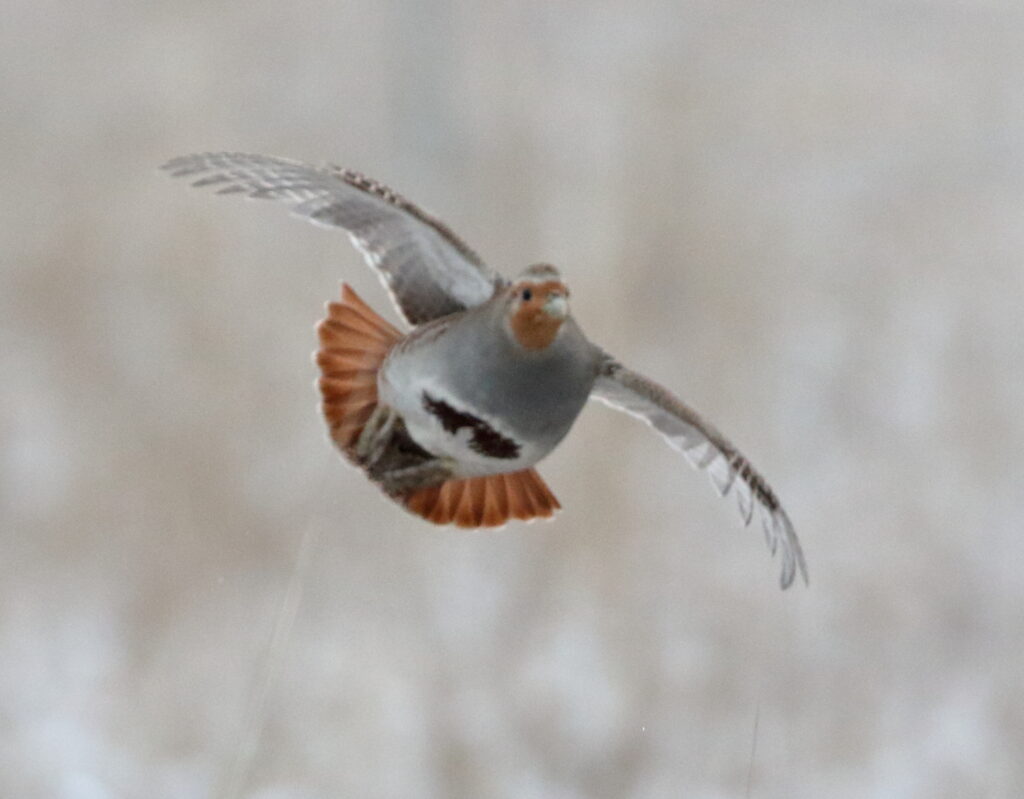
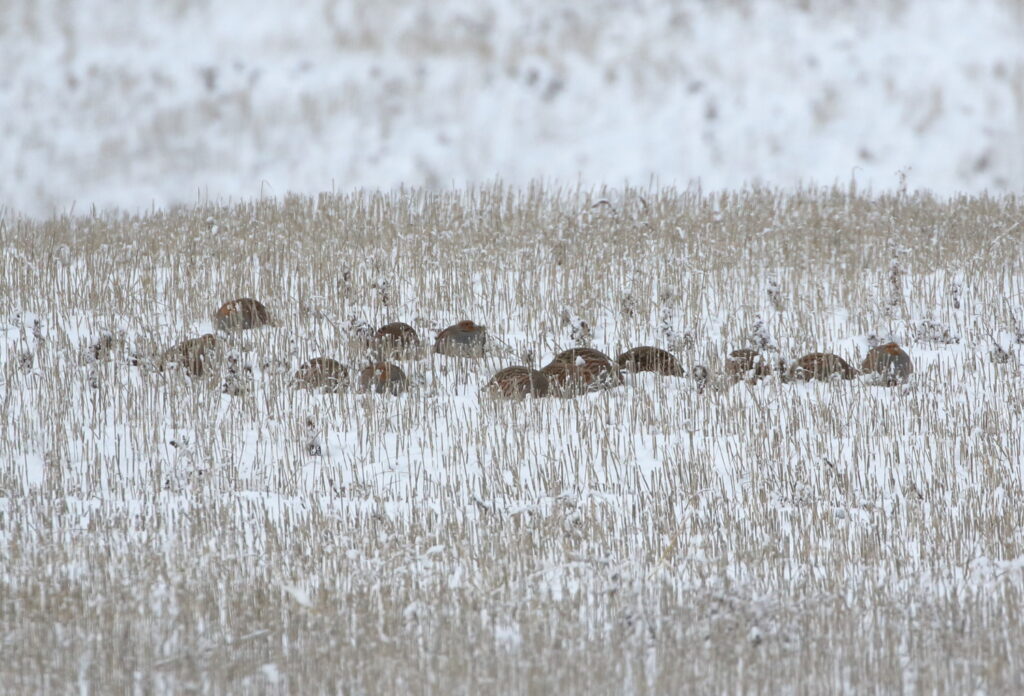
While songbirds were few and far between, we encountered a veritable population explosion of a bird we usually see only once or thrice a year: Gray Partridges! In the space of an hour or two, we saw these birds at least half a dozen times in groups ranging from four to more than a dozen. “I think I’ve seen more Gray Partridges today than in the rest of my life,” I told Braden, and it might have been true, as we totaled almost seventy of these birds. As with the rest of the day, I managed only lousy photos, but we delighted in watching these introduced, but charming, orange-faced critters.

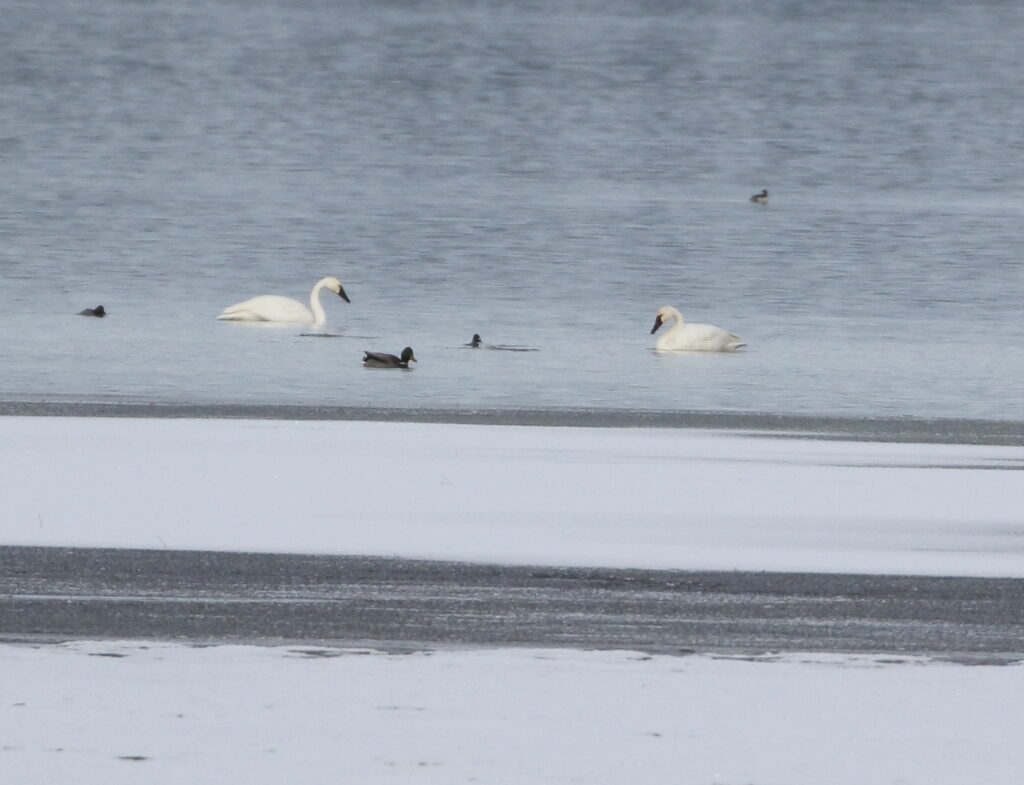
We finished the day scouring the southern shore of Flathead Lake near Polson. We had to look pretty hard, but finally found good numbers of waterfowl and gulls at Ducharme fishing access. Here we were rewarded by more than five hundred Common Mergansers, and much smaller numbers of wigeons, Mallards, Buffleheads, Green-winged Teal, Northern Pintails—and a lone Redhead. Braden also picked out several Tundra Swans from the more numerous Trumpeters.

Tundra Swans on Flathead Lake. These birds can be hard to distinguish from Trumpeter Swans, but they have small yellow patches forward of their eyes, and often have overall whiter heads and necks than Trumpeters.

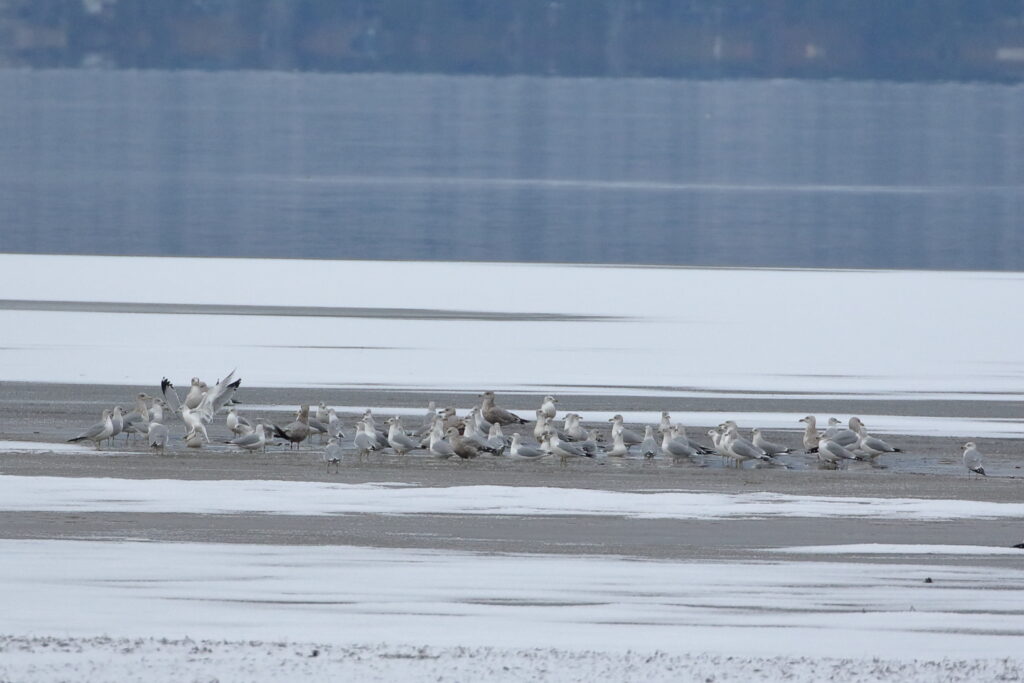
Perhaps my favorite part of this last big session was focusing in on a group of seventy or eighty gulls out on a frozen edge of the lake. Part of my enthusiasm was having just received a review copy of Amar Ayyash’s epic new book, The Gull Guide: North America. I plan to write a full review of this remarkable book soon, but my first perusals have gotten me super excited to learn more about gulls. Even better, as Braden and I studied the group in front of us through our scope, we picked out both Ring-billed and Herring Gulls. Then, I paused on a gull that looked unlike any others. It had pink legs, medium gray wings, dark eyes, light head streaking, and a single red spot on the bill. It also was noticeably smaller than the Herring Gull next to it. Braden suggested a Thayer’s Iceland Gull and I have to say that I agree with him. Unfortunately, I couldn’t get decent photos and gulls are notoriously hard to ID, so we didn’t record it. Still, I’m thinking Thayer’s is what we saw.

Ring-billed and Herring Gulls on Flathead Lake. It’s easy to pick out the Herring Gulls by their large sizes. Maybe I’ll even find some other species after studying The Gull Guide in depth!

And so it begins . . . a great new year of birding! I hope you’ve all been able to get out and enjoy the remarkable avian wildlife our planet is blessed with. In fact, if you haven’t already done so, I urge you to support one or more of the terrific conservation groups working to make sure birds are always with us. For more info, see our post “Saving Birds. It’s Time.” Thanks for reading and I hope to see some of you out there birding soon!

Our 2024 Recap: Spain, Costa Rica, Japan (again!) and More

2024 has been a record-breaking year for FatherSonBirding—and in more ways than one. Let’s start with the stats. Number of views to our site increased by almost 50% over last year to almost 14,000, while the number of visitors increased 65% to about 10,000. Much of what is driving these increases is interest in our posts about foreign birding destinations including Japan, Costa Rica, and Spain. In fact, viewers from 104 different countries visited our site this past year. Top views from countries other than the US were:

Japan: 445

United Kingdom: 384

Canada: 352

Australia: 244

Singapore: 208

Despite being published in 2023, our birding posts from Japan dominated views this year, especially with FSB visitors from foreign countries! Here, Tessa and I visit The Great Buddha, or Daibutsu, of Kamakura—apparently the second largest Buddha in Japan, one that harkens back to about 1252.

So which of our posts received the most views? Here is our Top 10 for 2024 (plus/minus 10 views each, given the quirks of the statistics-accumulating program):

1. Birding Japan, Kyoto: 811

2. Birding Japan, Tokyo Part I: 573

3. Birding San Antonio’s Riverwalk, Are You Nuts?: 568

4. Birding Barcelona Part I, The Urban Core: 463

5. Birding Japan, Kanazawa: 332

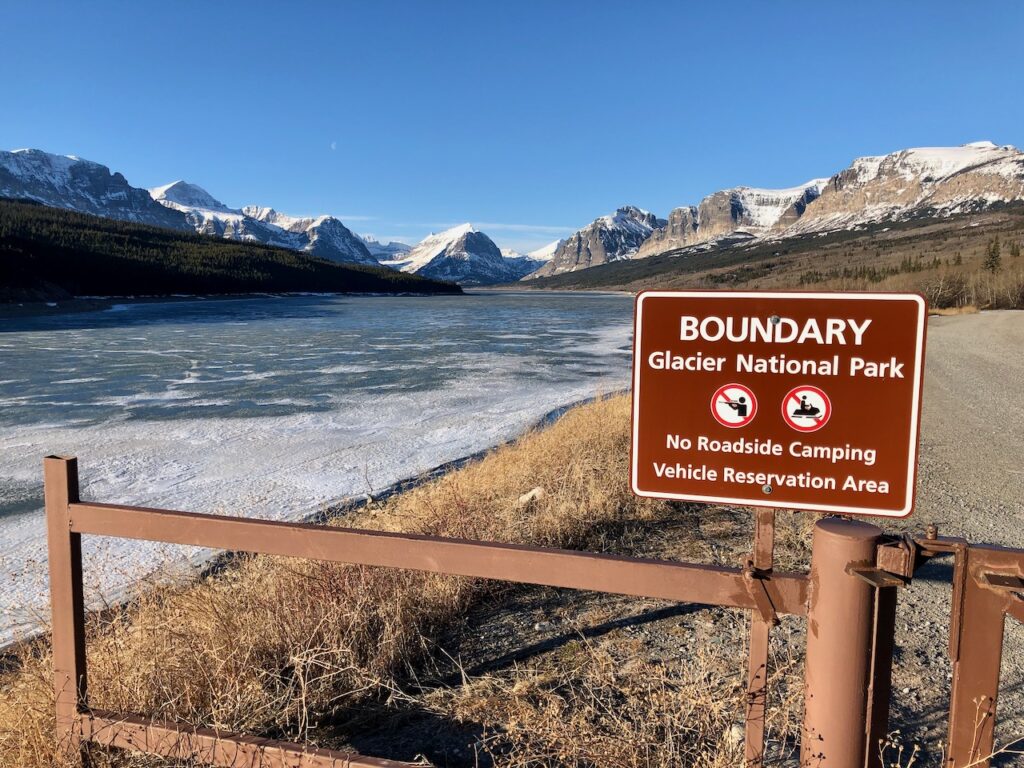
6. Birding Glacier National Park in the “Hot Dry Winter” of 2024: 289

7. Getting Serious About State Birds: 284

8. Braden’s Costa Rica Report #3, El Copal: 249

9. Turning Useless Lawn into Vital Habitat: 196

10. Monotypic Birds, Evolution’s Survivors: 195

A couple of things become evident from this list. One is that many birders are travelers. Even though they are from 2023, our Kyoto and Tokyo posts (links above) continue to get hits every day, often from people outside the United States. Despite this stiff competition, our post about San Antonio’s Riverwalk still wears the crown of our all-time most viewed site. It doesn’t take a genius to figure out that all of this is because of how many birders are out traveling the world!

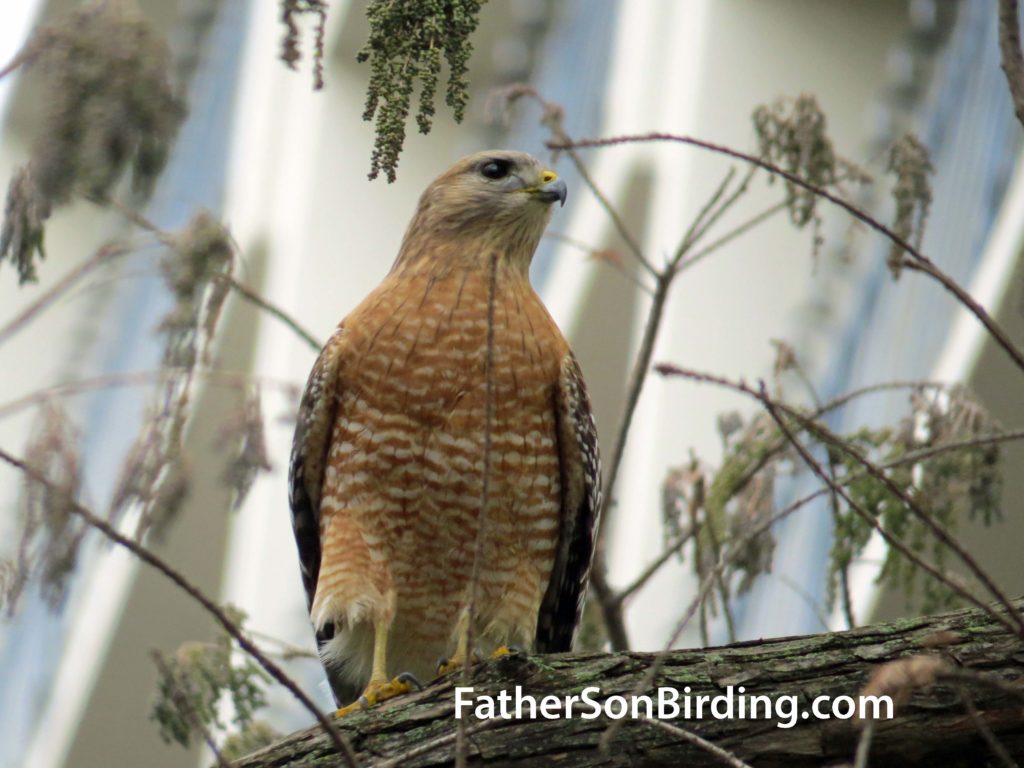
If you remember this Red-shouldered Hawk, you’ve been reading FSB almost from the beginning! Our post on birding San Antonio’s River Walk still holds the title of our most viewed post ever, with almost 2,000 views.

Our top posts, though, also reveal that readers of FSB have a major interest in environmental issues, as is revealed by our Glacier National Park post and our post “Turning Useless Lawn into Vital Habitat.” We take great satisfaction in that because one of the main reasons we write FSB is to help increase awareness of the environmental plight of our planet—and birds in particular—and what we can all do to improve the situation. Planting native plants in our yards is an especially simple, effective approach to increasing vital habitat that birds and their prey depend on. We’re happy that so many people took time to read our post on this topic.

Enthusiasm for our post on the dry hot winter of 2024 revealed a strong interest in the environment among FSB readers. Good job, readers!

But the year is only a little about statistics. Braden and I both had wonderful birding adventures in 2024. Thanks to his semester abroad in Costa Rica, Braden saw a remarkable 736 species of birds in 2024. More important, he got dozens of other young people into birding by starting the wildly successful UMaine Birding Club. The club did all kinds of fun activities, from leading dozens of birding outings to hosting movie nights and launching a project to reduce bird strikes on the UMaine campus building windows. Braden and I also finally got to take the eastern Montana birding safari of our dreams, spending two weeks exploring corners of the state we’d never before visited.

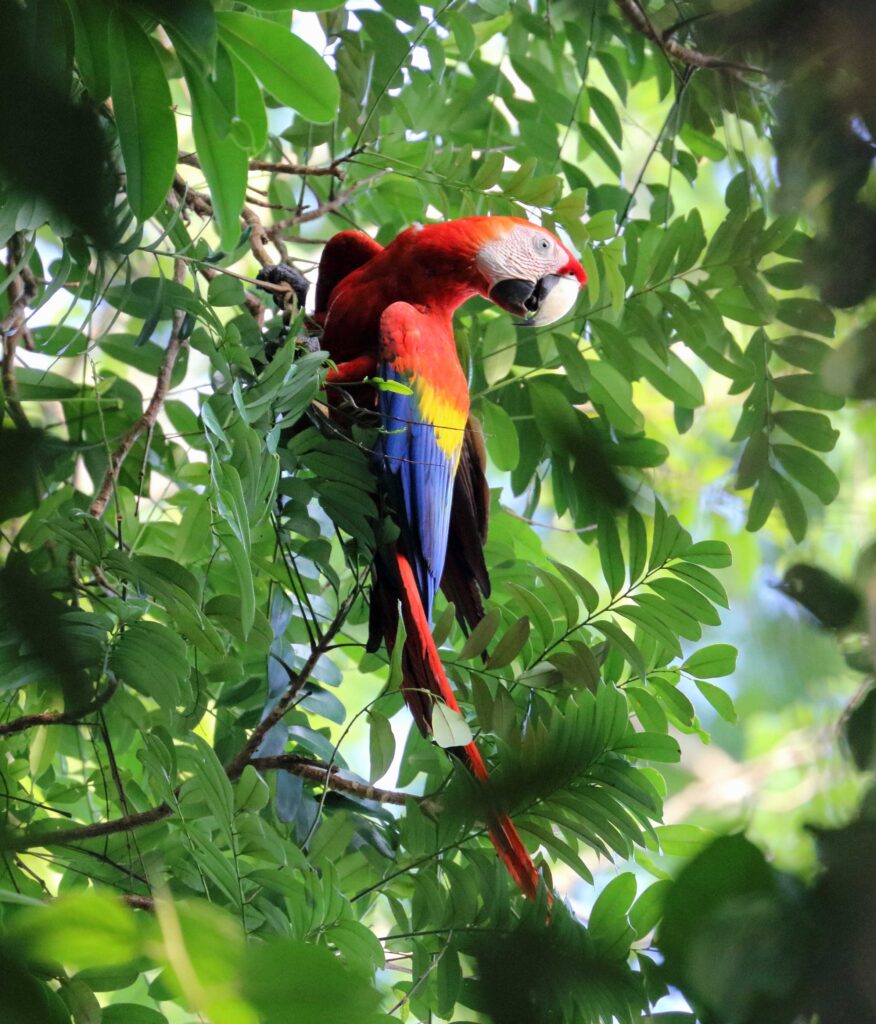
Braden’s adventure-packed semester in Costa Rica led him to see a remarkable 736 species of birds for 2024.

I had my own birding adventures including my wife’s and my trip to Barcelona last February, where I picked up a dozen species for my life list and had a whole lot of fun with Amy. I had two great trips to California: one to show my youngest, Tessa, a couple of potential colleges for next year; the second a great Bay Area trip to visit family and friends, including four fab days of birding with my childhood buddy, Scott. Work travel gave me additional opportunities to bird in Oregon, Washington, and throughout Montana. The highlight of the end of my year was getting to bird Cape Cod with Braden during Thanksgiving Week. I am also elated that my newest book, Birding for Boomers, is off to such a great start, reaching #8 the Pacific Northwest Booksellers Association bestseller’s list for nonfiction paperback books!

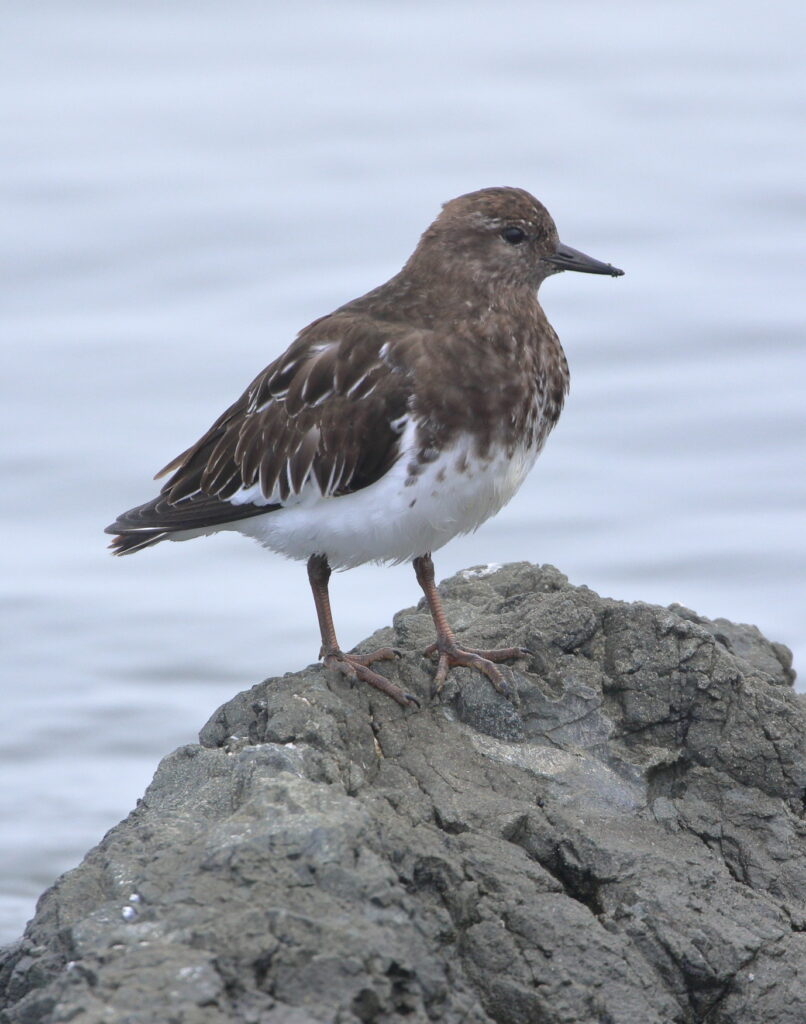
Thanks to the year’s second trip to California, I got to spend more time than usual with friends—and coastal birds such as this Black Turnstone.

As usual, Braden and I have only vague ideas where 2025 will take us and what we will be moved to write about. A few destinations in the mix: Indonesia, Vancouver Island, Texas. Whatever adventures we have and end up writing about, we deeply appreciate all of you for checking in and taking an interest in the coolest group of critters on earth. We also appreciate you supporting our work by buying our books and sharing FSB with your friends, family, and colleagues.

Until next year, Happy New Year, and may 2025 bring you joy, satisfaction, closer connections and, of course, a whole lotta birds!

Sneed & Braden

In Montana, Some Real October Surprises

For birders, October is an odd month—especially in Montana. Our resident birds have left. Winter residents are just arriving. Most migrating birds have passed through the state—but not quite all. The month poses a special dilemma for those trying to set any kind of Big Year milestone, because time for new birds is running out. This year, for instance, I have found myself tantalizingly close to making 2024 my second best Montana birding year ever. 2020 was Braden’s and my best year, when we put a ton of effort into it, and I recorded 266 species on my list (see our post “2020 Wraps, 2021 Underway”). Last year, thanks in part to an Eastern Montana trip with my pal Scott, I notched my second best year with 253 species. As October wound down this year, however, I found myself with 247 species—seemingly within striking distance of breaking that 253 mark. Or was it?

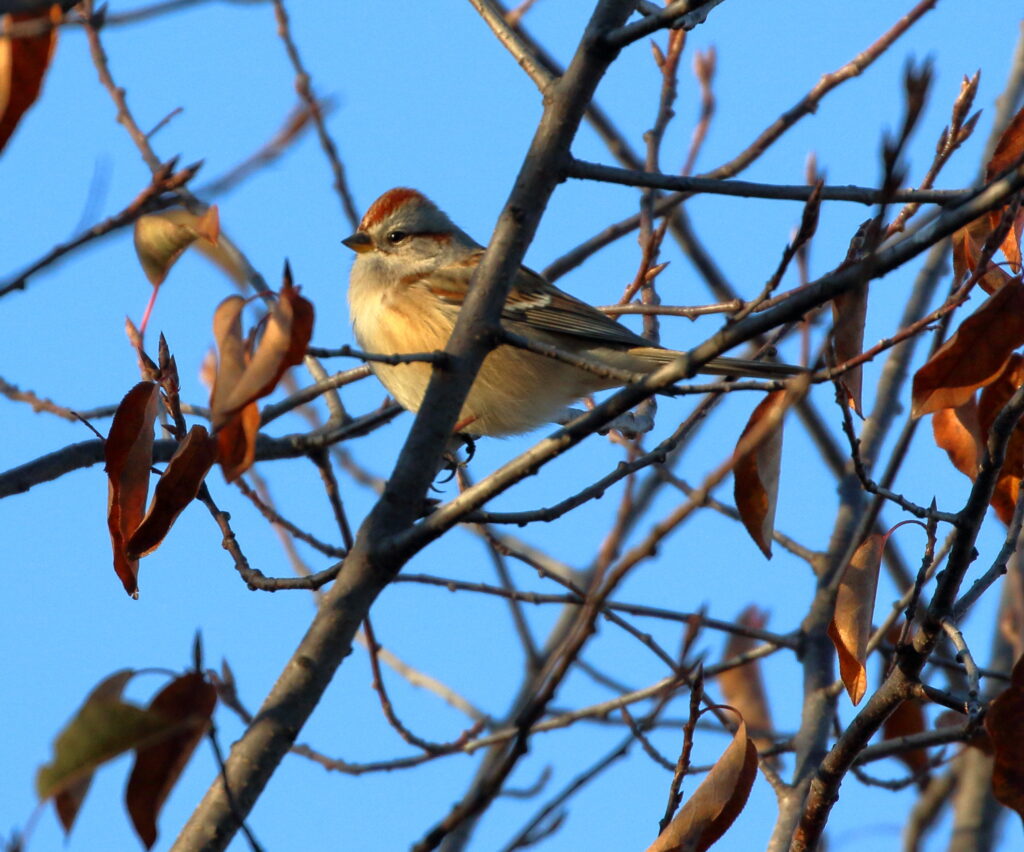
The Fort Missoula gravel quarry delivered our first American Tree Sparrows of the season—a bird that, unbeknownst to me, I had failed to see earlier in the year! This, dear readers, is also where Braden and I got our lifer ATSPs years ago.

A mere seven species might seem like an easy task with three months to go in the year, but that small number is deceiving. As mentioned above, very few new birds arrive this time of year. As for winter arrivals, most birders (myself included) already saw those in January and February. Bottom Line: By October, birders hoping to set a mark need to track down some rarities.

Braden and I have chased plenty of rarities in the past, but I am more reluctant to do so these days. The main reason? Unless I really, really want to see a particular bird, I can’t justify burning up gasoline just to notch another species on my list—especially to break a rather arbitrary record. After all, climate change—powered in large part by burning fossil fuels—is one of the major threats to birds, not to mention to all other species, and my desire to make 2024 my second best year doesn’t rate as a worthy enough goal to place the planet in even greater peril. With Braden gone, chasing rarities also isn’t as much fun.

Still, last week, with the end of the month in sight, I felt like I could use a good birding session to take advantage of our last warm weather and improve my mental health, made particularly jittery by the craziness of the upcoming elections. And then, out of the blue, I got a text from Nick Ramsey: “Hey! Are you in Missoula? And any shot you want to go birding tomorrow?” I didn’t hesitate. “Yes and yes!” I shot back.

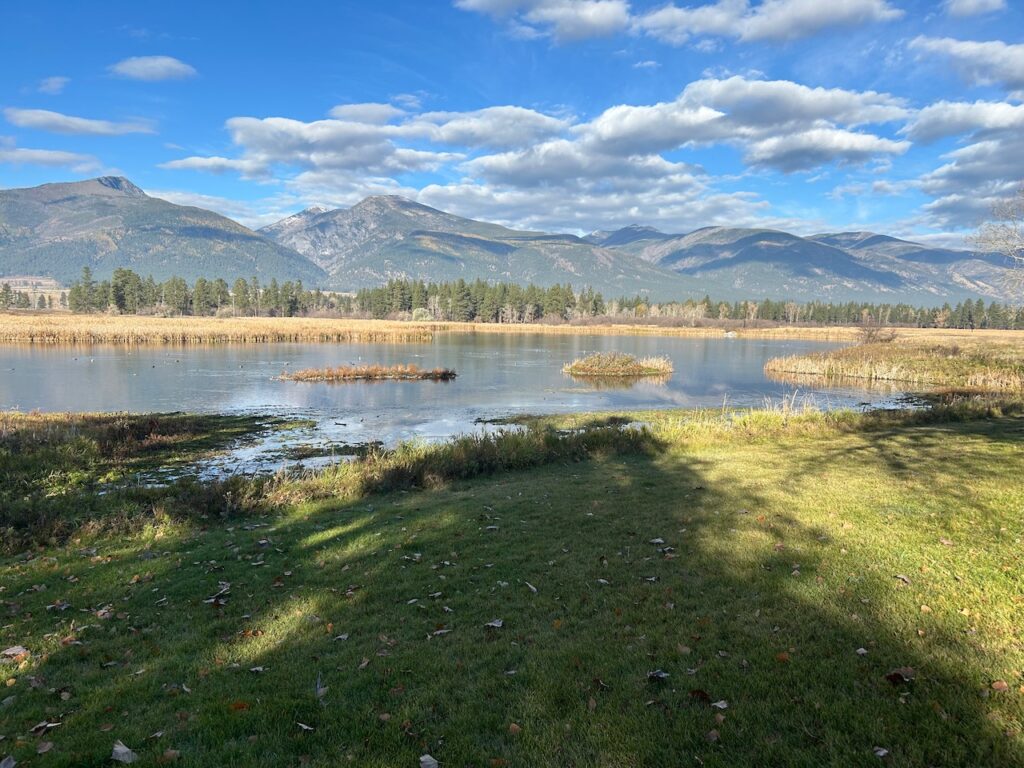
With only hours to spend in Missoula, Nick picked me up for a quick trip to the Fort Missoula gravel quarry and Lee Metcalf NWR, showed above.

Nick, it turns out, had a brief layover in Missoula between a summer field job in Alaska and guiding gigs in Louisiana. Regular readers of FatherSonBirding (or of my new book Birding for Boomers) will recognize Nick both as a member of our extended family, and as our most important mentor when Braden and I first started to bird. We’ve had countless birding adventures together including our first expedition to eastern Montana and Braden’s and Nick’s epic Florida birding trip in 2022. I was thrilled that Nick, who recently graduated from LSU, reached out to me—especially because he had only hours to spare before hitting the road for a 30-hour drive to Louisiana. I asked him what he’d like to do and he suggested visiting the Fort Missoula gravel quarry and Lee Metcalf National Wildlife Refuge. That sounded great to me, and just by coincidence, a Northern Parula had just been sighted at Lee Metcalf.

Decidedly eastern birds, Northern Parulas are almost unheard of in Western Montana. Although chances were low that it would still be there when Nick and I got there the following day, I couldn’t help thinking this could move me closer to tying my “second place” record of 253. For his part, Nick especially wanted to see a Swamp Sparrow, another uncommon bird for Montana. I figured we had almost no hope of finding one of those, but if anyone could, it was Nick.

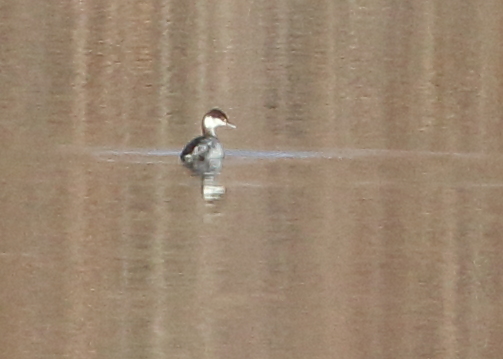
Nick picked me up at eight the next morning, in the company of his adorable diminutive companion, a chihuahua mix named Dixie, who decided that my lap would be her domain for the rest of the day. Our first stop? The gravel quarry. Nick hoped for a Swamp Sparrow here and we both thought it might be a good chance to see scoters, Long-tailed Ducks, or other laggards passing through the area. Unfortunately, a guy flying a drone was most likely scaring off any interesting water birds. Still, we had a nice sparrow session, finding a ton ‘o Song Sparrows, along with White-crowned Sparrows, and the season’s first American Tree Sparrows—which, I didn’t realize I had failed to find earlier in the year! By the time we headed back to the car, the drone flier also had departed, giving us a look at a few Hooded Mergansers. “Hey, there’s also a Horned Grebe!” I told Nick. That was a nice surprise since I’d managed to miss them in Montana the entire year. Click. With the American Tree Sparrows and Horned Grebe, my Montana Year List had leaped from 247 to 249!

I had given up on Horned Grebes for my 2024 Montana list when this one showed itself at the Fort Missoula gravel quarry.

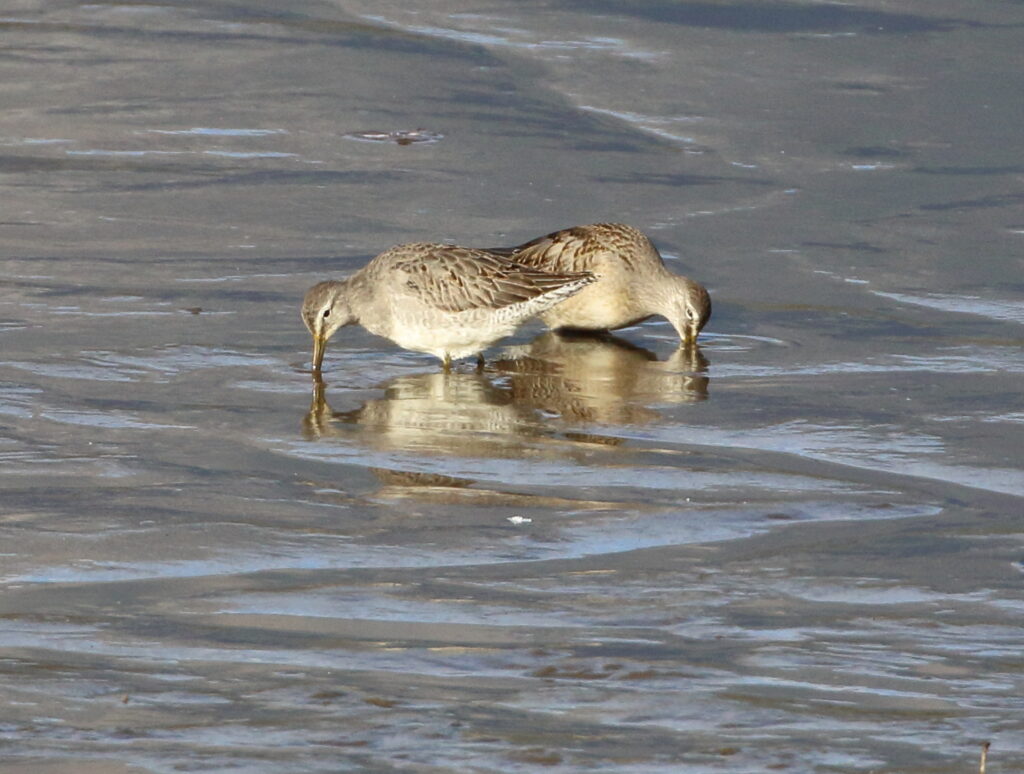
Continuing on to Lee Metcalf, Dixie keeping me warm, Nick and I caught up on the rest of our lives. This, I realized, was the first time Nick and I had ever birded together without Braden along, and though we both missed him, it was a great chance to share our adventures and discuss future birding dreams, plans, and possibilities. In no time, Nick was pulling into the Lee Metcalf visitor’s center parking lot. Several birders had arrived before us, but none seemed aware of the Northern Parula sighting the previous day. The bird had supposedly been seen in the elm trees next to the closest pond, but as we headed over there, what first caught our attention were two shorebirds pumping for food in the mud.

A pair of Long-billed Dowitchers presented our first surprise at Lee Metcalf. More surprises would follow!

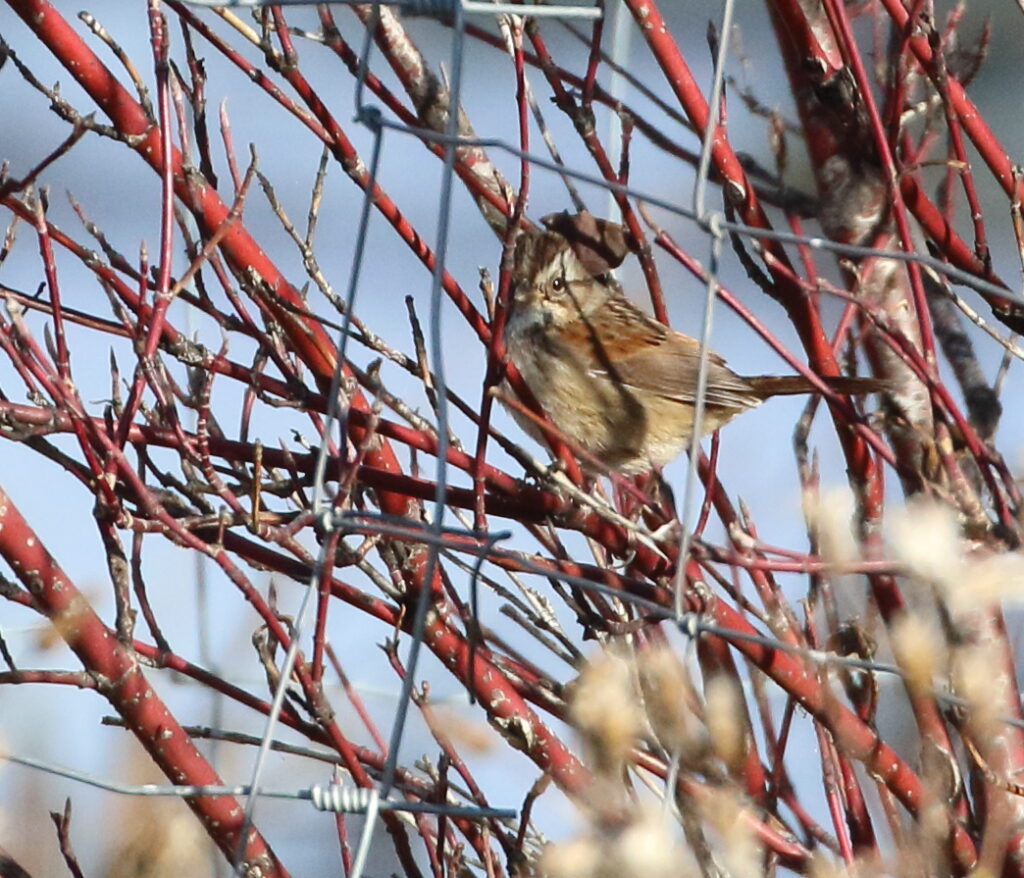
“Are those Long-billed Dowitchers?” I asked Nick. “What are they doing here?” So late in the season, they surprised both of us and immediately made our trip down here worthwhile. While we were studying them, however, Nick’s sharp ears caught something else and he began walking over toward the south edge of the pond. I thought he had heard the Northern Parula, but when I caught up, I found him studying the cattails below us. “I thought I might have heard a Swamp Sparrow,” he explained. Then we saw movement. “There!”

Nick’s Montana lifer Swamp Sparrow was too quick for me to catch in full sunlight, but did pause briefly behind this fence.

Several other birders joined us and it took several minutes for us to get clean looks at the bird. “Furtive” is a good word to describe Swamp Sparrows as they like to stay hidden in reeds along the water’s edge, but finally, the bird gave us full, if brief, views. I was astounded. While only about fifty records exist for Montana, Nick explained that the birds definitely move through the state every year, and Birds of Montana lists several cases where the birds have overwintered. I’d only ever seen one in Montana—in the Shiloh recreation area in Billings—so for me, this was a big deal. Click. 250.

As we moved slowly, following the sparrow to a small brush pile, Nick almost casually said, “The parula’s right behind us.”

What?

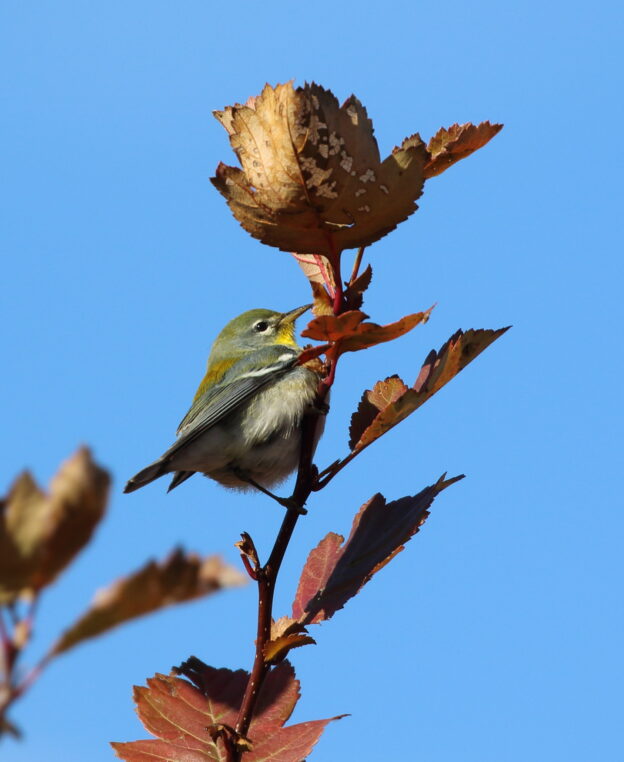
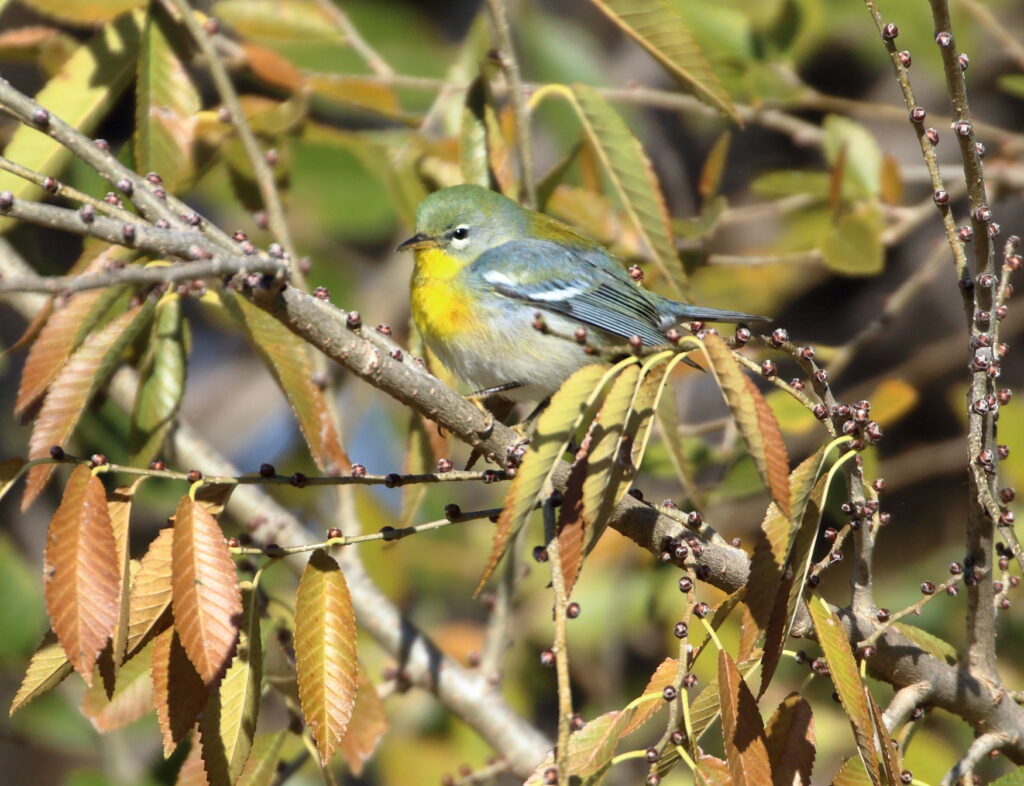
It being fall, I expected that if we saw the Northern Parula, it would be a drab specimen. The gorgeous bird, however, delivered a real October surprise.

I spun around and, sure enough, spotted a spectacular yellow-and-bluish-gray warbler plucking insects from leaves in a deciduous bush not twenty feet from us. Nick called to other nearby birders, and they joined us for one of the most leisurely looks at a rare migrant ever. Much like the Black-throated Blue Warbler that appeared in Lolo last year, this bird seemed little bothered by people. We all hung back about thirty feet, trying to fill up our cameras’ memory cards while the bird fattened up on whatever it could find. Just to mix things up, it flew over to an elm tree for a while, before heading back to the bush. After a hike out to the more distant ponds (still no scoters), Nick and I hit the road back to Missoula, making only a quick nearby stop to get Nick a look at California Quail for the year. In a single outing, and at a most improbably time of year, my year list had advanced to 251 species, making me wonder if I could somehow nab three more species through December. Even better, I had enjoyed a wonderful day of birding and companionship with one of the best rare migrants possible, our friend Nick.

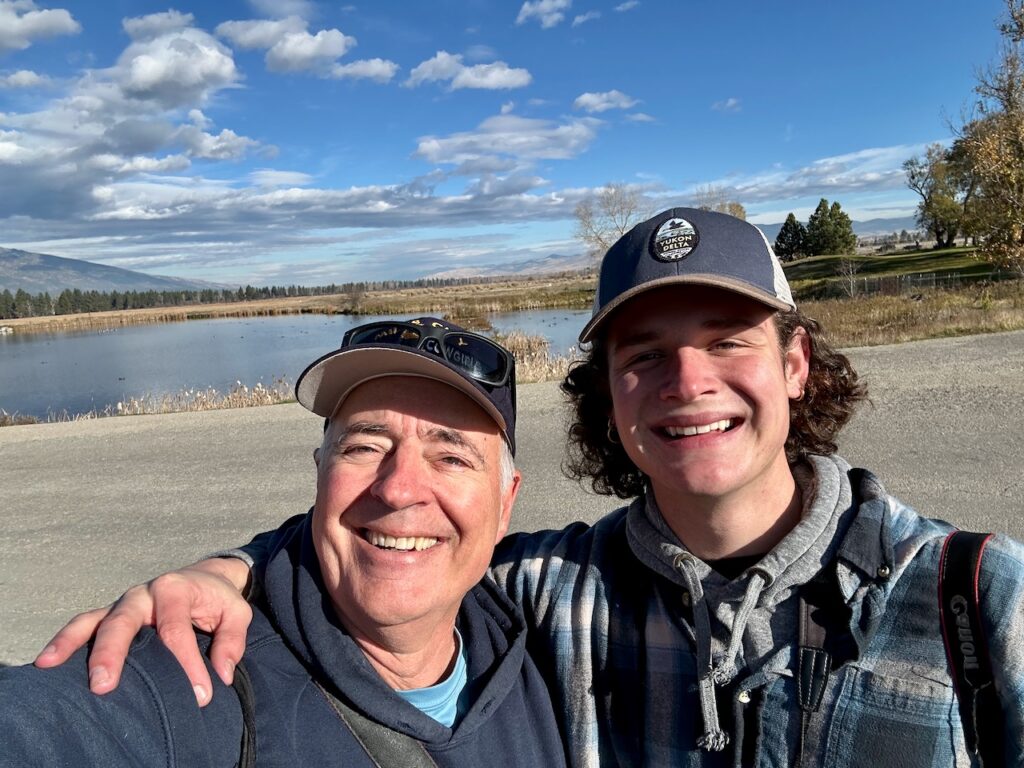
Two happy birders following an improbable day of October rarities.

Eastern Odyssey 2024: Return to Westby

Our fourth post about our epic 2024 eastern Montana expedition takes us to the birding mecca of Westby. Over the years, Westby has grown an outsized reputation in the imaginations of Montana birders. To find out why, read on—and don’t forget to check out Sneed’s newest picture book, Like No Other—Earth’s Coolest One-of-a-Kind Creatures by clicking on the image to the right!

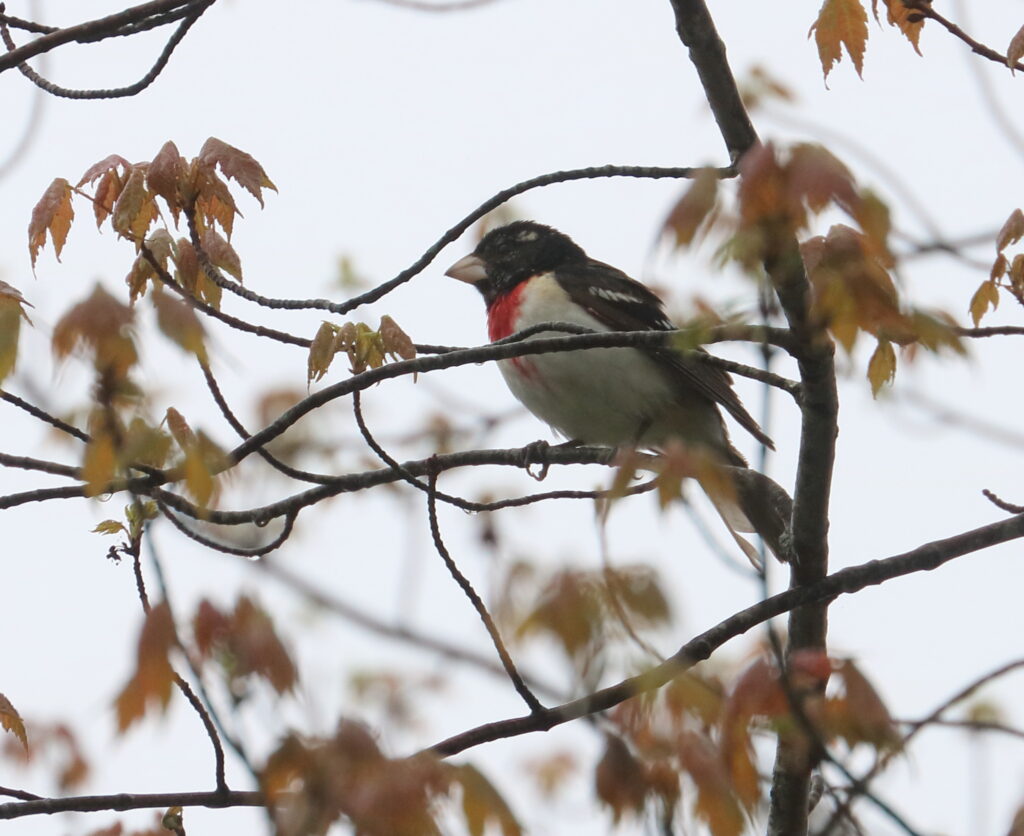
After, to be honest, a pretty disappointing time in Plentywood (see last our last post), Braden and I continued our Eastern Montana Odyssey 2024 by driving twenty-six miles to a place that has obtained almost mythical status among Montana birders: Westby. Westby sits in the very northeastern corner of the state and has long been known as a place where eastern songbirds clip Montana on their way to northern breeding grounds. Some fool cut down some of the best bird habitat there a few years ago, before Braden and I ever visited, but birders still discover rarities such as Mourning Warblers, Black-throated Green Warblers, and Rose-breasted Grosbeaks every year. The bad news? Braden and I were about two weeks late to have a serious shot at anything like that. The good news? We still had a great chance to see migrating shorebirds.

Westby literally straddles the North Dakota border, making it a go-to destination for birders hoping to snag rare migrants for their Montana life lists.

We arrived early and decided not even to waste time looking for songbirds right away. Instead, we immediately drove north out of town toward a series of pothole lakes well known for shorebirds. Changes in water levels can be shocking out here year to year, and I quickly saw with dismay that one pond that had brimmed with water during my visit with my pal Scott Callow last year had gone bone dry. Fortunately, another pond with just a brief window of visibility did have water. “Shorebirds!” I shouted. We broke out the spotting scope and did our best to ID what was out there. Sanderlings could be made out by their distinct dark red heads and boldly black legs and bills. More exciting, we were able to ID Semipalmated Sandpipers and a species we hadn’t seen in Montana for four years, White-rumped Sandpipers.

This is about as close as we got to a White-rumped Sandpiper, but you can see a distinctive ID feature—the dark spots stretching down its side under the wings. Sanderlings are feeding behind it.

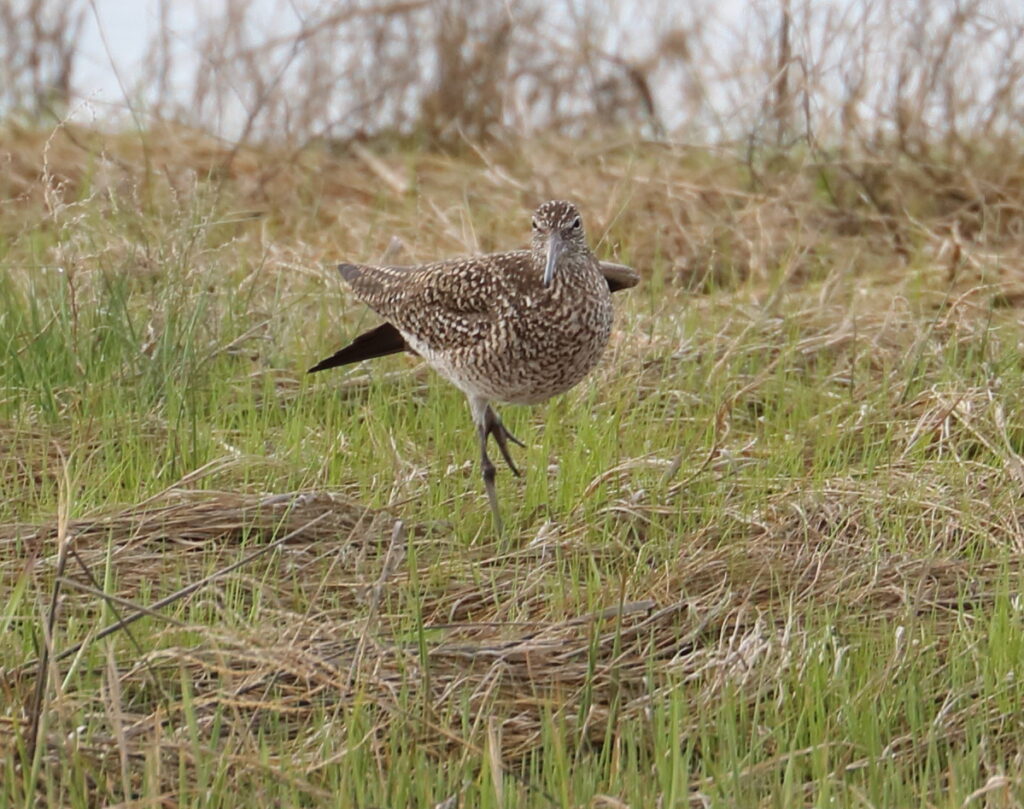
As we continued to explore, we got better looks at all of these birds in various places, along with Wilson’s Phalaropes, Willets, and Marbled Godwits. One bird high on our list was Nelson’s Sparrow, and at a little marshy area right next to the road, Braden was able to hear one, though my crummy hearing once again thwarted me.

A Marbled Godwit checked us out as we were scoping other shorebirds.

We continued to explore the rest of the day, both driving north and south of town and even making a foray across the border into North Dakota, where we picked up a respectable 23 species in a couple of miles. A wonderful development in Westby is a new AirBnB about fifty yards from the border and I had reserved it for two nights. That evening, I took a stroll through town to see what could be seen. No rare warblers, but I did have a lovely visit with a Brown Thrasher and gobs of American Goldfinches feeding on spilled grain next to the grain elevators looming over the north end of town. When I returned, a Say’s Phoebe was sitting on our house!

Thanks to our rented house, we hit the streets of Westby early the next morning. Again, no rare songbirds, but we did see a couple of Swainson’s Thrushes, along with Orchard Orioles and Purple Martins as part of our 22-bird list. Once again, our best surprises popped up as we explored surrounding areas. Venturing north we got great, close looks at the shorebirds we’d seen before, with a soundtrack of Wilson’s Snipe and Soras—one right next to the car—filling the air. Braden identified a Ferruginous Hawk flying overhead and we heard two Baird’s Sparrows and even a Sprague’s Pipit! Braden picked up at least four Nelson’s Sparrows and one popped up right next to our car, giving us our best look ever. Range maps don’t even show that Nelson’s reach into Montana, so this is a great place for birders to pick them up for their Montana life lists!

With few people on the roads, this Wilson’s Snipe took time to check out what we were up to.

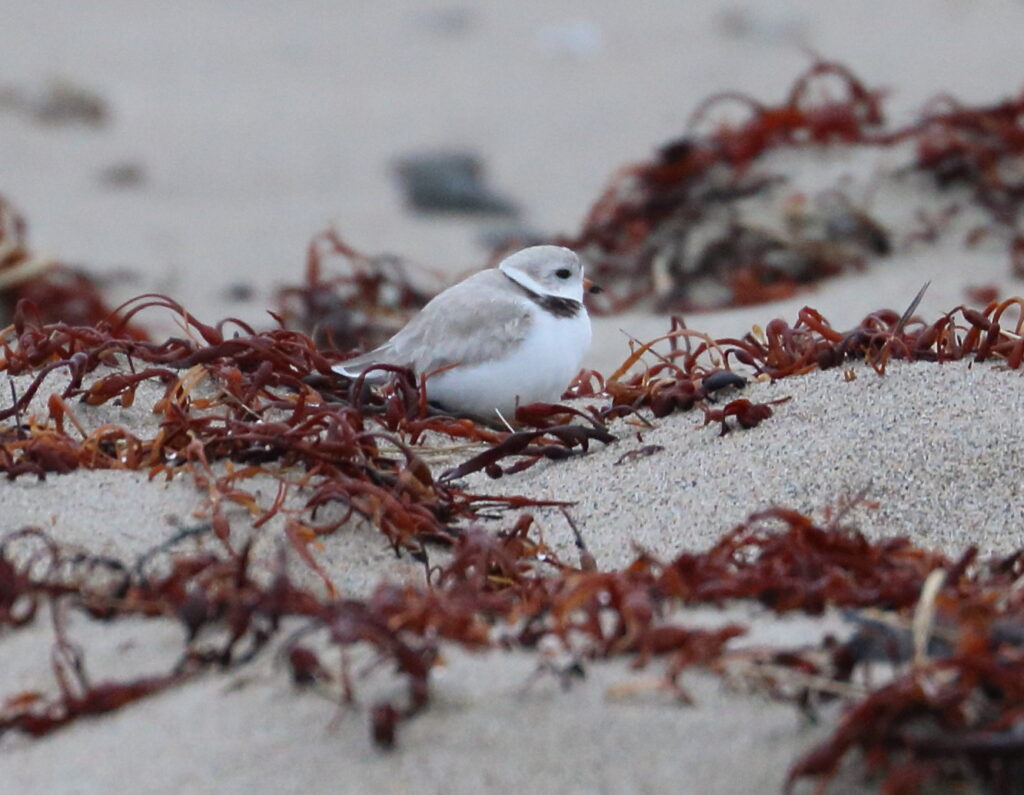
Still, the “catch” of the morning happened as we were skirting Round Lake. Ever since arriving, we had kept our eyes sharp for one particular shorebird. This morning as I drove, Braden suddenly yelled, “Stop!” We quickly got our eyes on it and then set up our spotting scope. It was none other than a Piping Plover! I had seen my Montana lifer PIPL last year with my buddy Scott, but this was Braden’s Montana lifer. Even better, there were two—one stalking another with obviously amorous intentions.

I think that Piping Plover on the left should be looking over its shoulder, don’t you?

North America has three distinct breeding populations of Piping Plovers: one in the Northeast, one in and around the Great Lakes, and one on the northern Great Plains. The world total population may have dropped to as low as 3,000 pairs, but the Great Lakes and Northeast populations have apparently been making a comeback. Montana, is home to a breeding population of perhaps 1-200 pairs of these delightful birds, but the outlook for the northern plains population may not be as rosy as it is for the Northeastern population. Frequent drought (exacerbated by climate change), poor water management practices, pesticides, and an increase of predators make its future dicey. Still, this near-threatened bird is hanging on and our fingers are crossed that some better management practices will also help it increase.

We got an amazing number of great Bobolink photo opportunities on the trip, including this one south of Westby.
This Baird’s Sparrow popped up on the fence while we were scoping a brand new lake south of town.

In the trip’s spirit of birding new places, we decided to head down a new road south of town. We had low expectations, but soon encountered a lake with lush green grasses surrounding it. We got out to scope the lake and discovered at least 250 Sanderlings out on a sand bar. It is while we were scoping that we got our biggest surprises, however. Grassland birds just kept popping up on the barbed wire fence to check us out or perch on plants very close to us. During the next forty or fifty minutes, we got incredible looks at Bobolinks, Baird’s Sparrows, Chestnut-collared Longspurs, Grasshopper Sparrows, Clay-colored Sparrows, Horned Larks, and of course, Savannah and Vesper Sparrows. Every time we looked up, there was another great bird not fifty feet away. It truly was one of the coolest things we’ve ever experienced—and was a great reminder to keep taking the road not birded!

It’s become a tradition to visit this old homestead every time we trek to Westby. Each visit, the old place loses a bit of ground. Soon it will be part of the prairie earth.