Tag Archives: Owls

Wings Across the Big Sky 2026 (FSB Festival Recap)

It’s been a furious month for the Collard Clan. Last week, Braden wrapped up two solid weeks of escorting birding friends around western and central Montana. Before that, we did a Birdathon fundraiser with our good friends Susan and Eli to raise money for Five Valleys Audubon. Then, Friday, Braden and I took off to lead trips at Wings Across the Big Sky 2026.

One special thing about WABS is that it moves to different locations in Montana every year, and this year Kalispell played host. Our very first WABS actually was in Kalispell eight years ago, when we got our lifer Harlequin Ducks in Glacier National Park. Since then, I’ve keynoted the festival and, most recently, Braden and I both attended the event in Helena two years ago. This year, one of the festival’s organizers, Darcy Thomas, asked if we would lead field trips to Tally Lake and the CSKT Bison Range. We, of course, said yes and decided to use the drive up on Friday for a bit ‘o exploration.

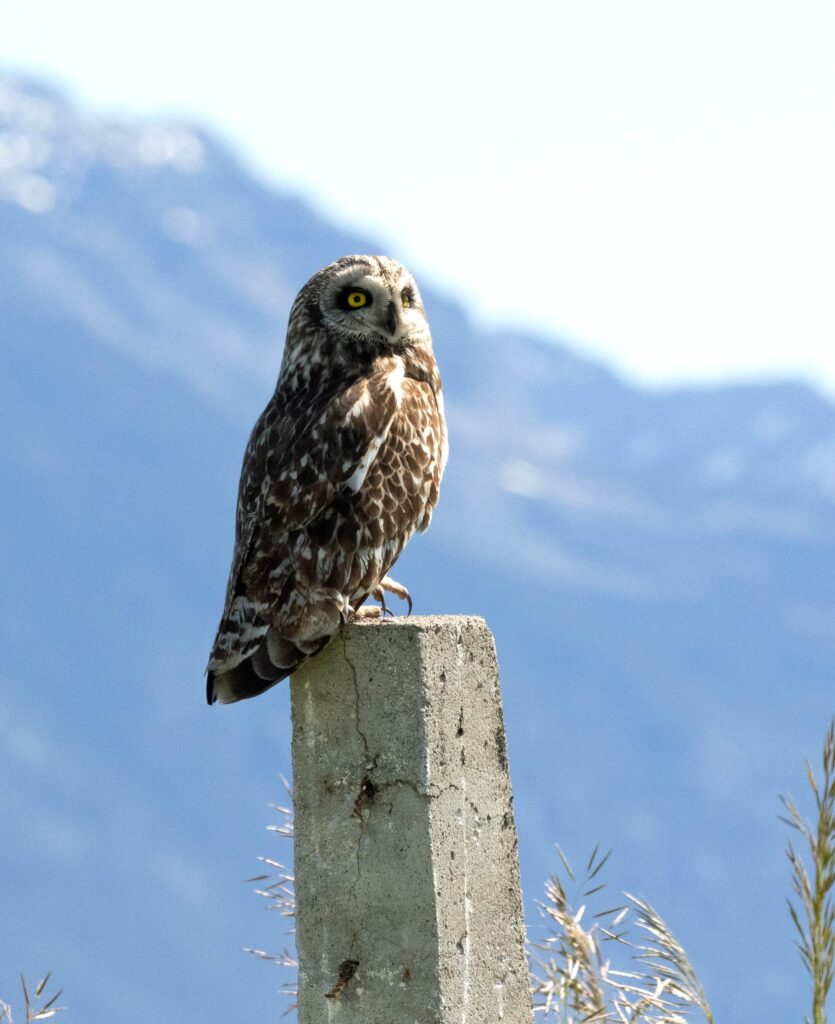
We began Friday by hitting one of our favorite refuges, Ninepipe National Wildlife Refuge. We didn’t see as many birds as we expected, but did find the most photogenic Short-eared Owl in the history of the universe!

Could a Short-eared Owl strike a better pose? Not likely!

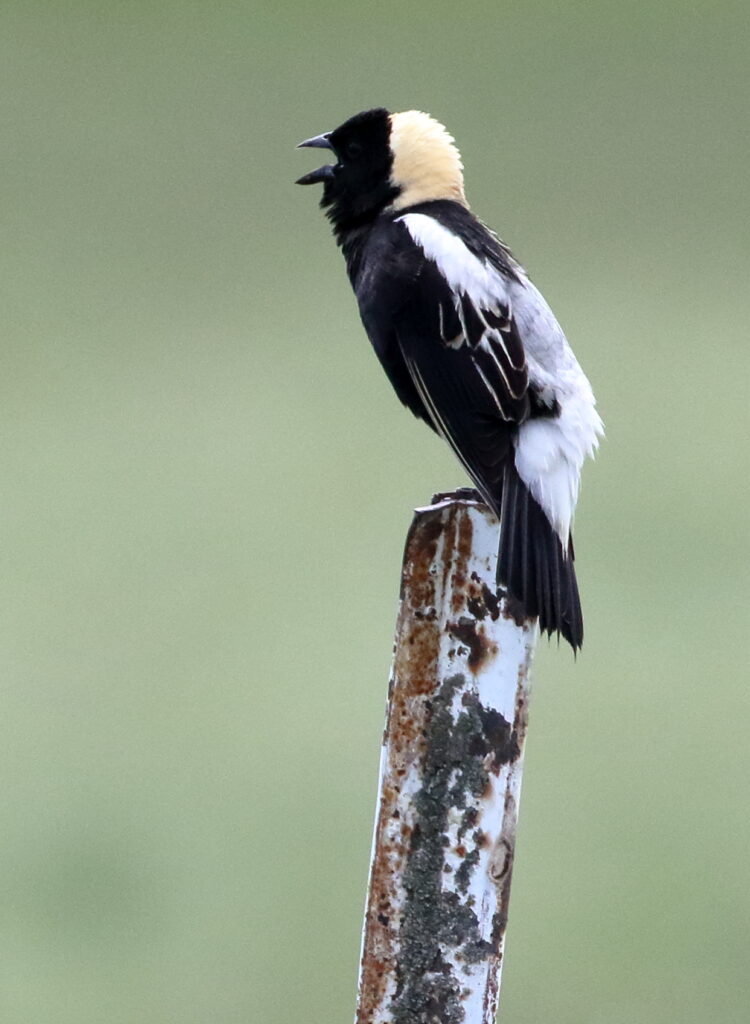
We followed that up by checking out a nearby road that supposedly had Bobolinks. Before finding them, however, we stopped at a delightful little forest spot with both Red-eyed and (Western) Warbling Vireos. It’s rare to get a really good look at the former, so we stood oohing and ahing when one came out onto a branch for a full minute of posing. Just down the road, we were treated to at least five Bobolinks and later found more near the town of Creston—along with the most adorable family of baby skunks ever!

Like Short-eared Owls, Bobolinks require a mandatory stop for photos—and just to appreciate these beautiful, lively songbirds.

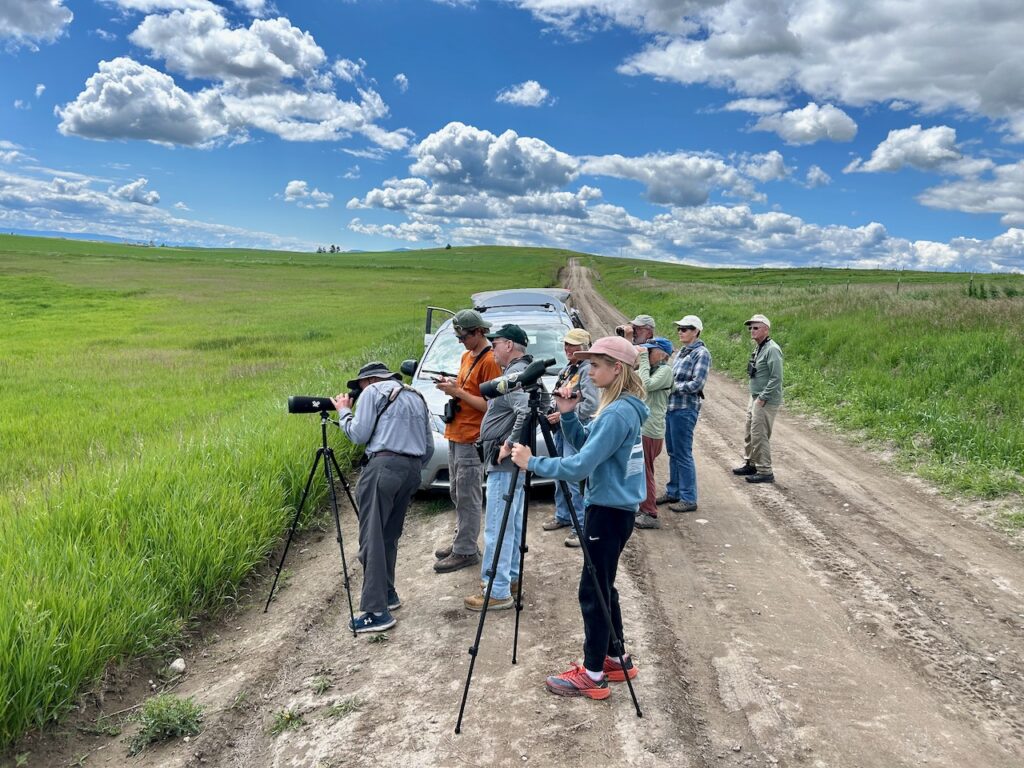
Braden and I felt especially excited to lead the trip to Tally Lake on Saturday because it was a place we had never been. I couldn’t have done the place justice without Braden, because it was a heavy “ear birding” location, full of warblers, vireos, sparrows, and other secretive songbirds. Still, most of the species put in at least one appearance and our friendly birding group ate it up. Braden helped everyone “get on” the various songs and calls, too, so it was a real learning experience.

We had plenty of time after birding Tally Lake, so our group decided to head out to Kalispell’s West Valley Ponds for some waterfowl fun.

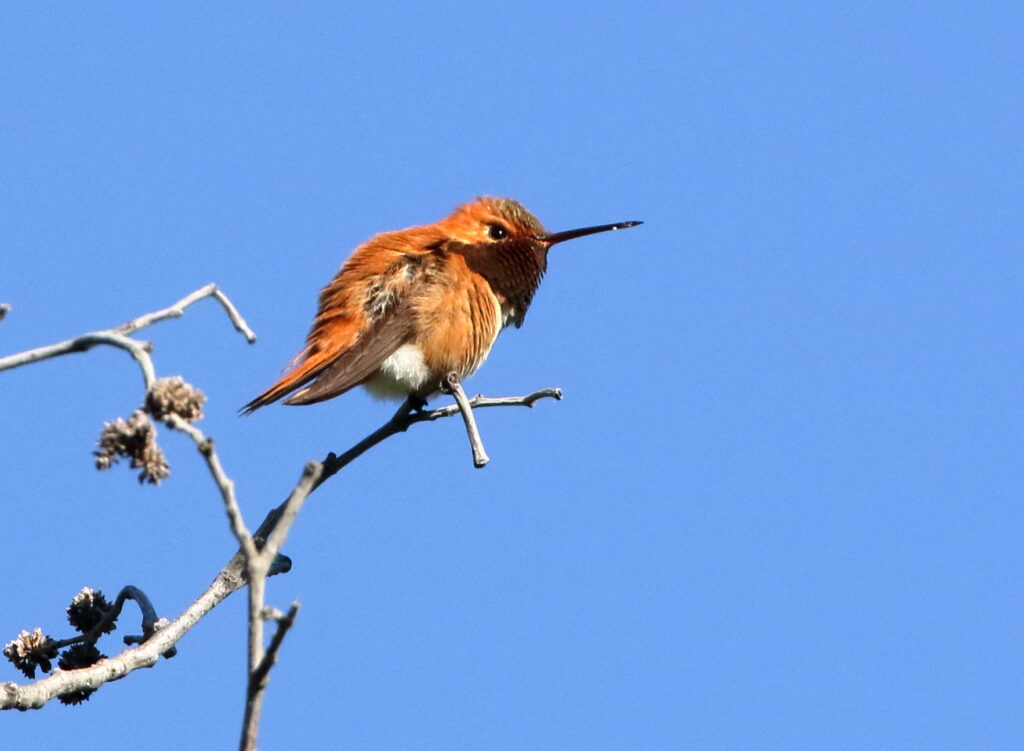
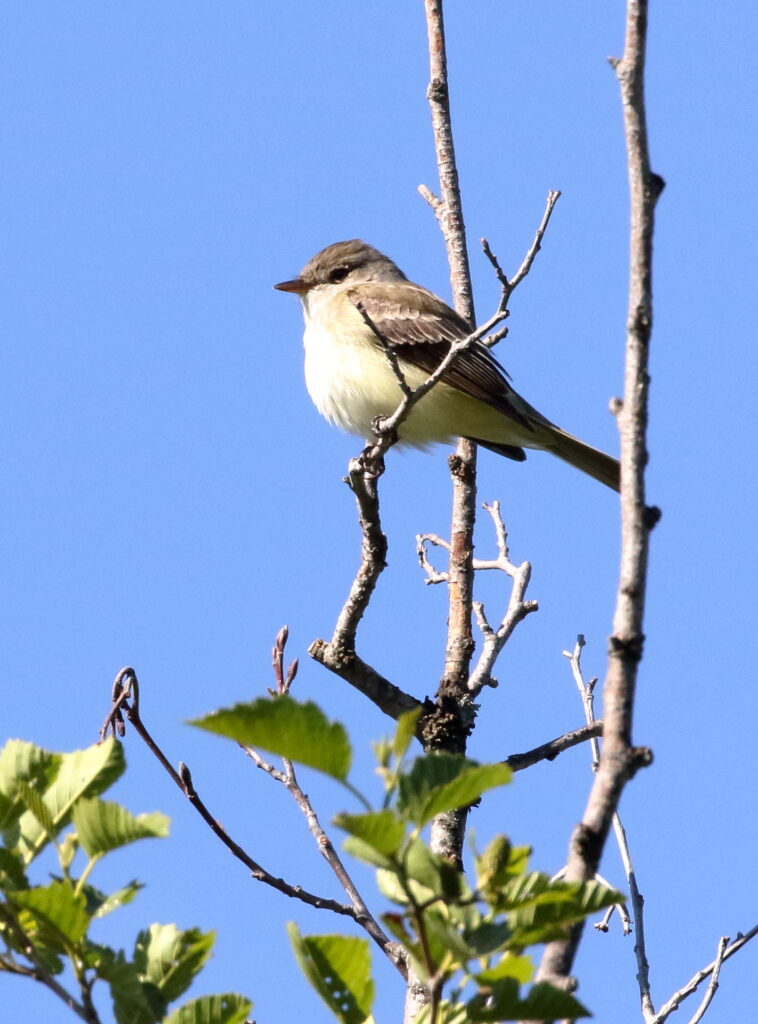
Top Tally Lake honors went to Rufous Hummingbirds, who struck exceptional poses out in the open with the sun glinting off of their stunning orange-brown feathers. I didn’t realize how fierce these guys look until I studied my photos later. Other crowd favorites included a Common Loon, Willow Flycatcher, and for me especially, a Fox Sparrow.

Rufous Hummingbirds grabbed top honors at Tally Lake for best bird views. I didn’t realize how fierce these birds can look till I took this photo!

Exhausted from two straight mornings of rising at 3:30 a.m., Braden and I skipped Saturday evening’s workshops to spend with our friends Erica and Larry Wirtala, who hosted us and are also members of Flathead Audubon—the hosts of this year’s festival. We needed the break since Sunday promised another marathon day!

Our trip to the CSKT Bison Range began with a two-hour drive south from Kalispell, during which our caravan enjoyed stunning scenery along Flathead Lake and in the Mission Valley—and I narrowly missed colliding with a deer. Braden and I really didn’t know what to expect bird-wise at the Bison Range because it had been years since we’d birded it, but we’re so glad we got to lead this trip!

We began our exploration by taking the group to the riparian area just below the visitor’s center. There, we were treated to our best Willow Flycatcher experience ever. These plain-looking “empids” seemed to vocalize from every perch with their quick FITZ-pew songs. The group also got a welcome look at Pileated Woodpeckers and raucous Yellow-headed Blackbirds, too—but it was up on the long, two-hour driving loop that we got our biggest surprises.

At the CSKT Bison Range, Willow Flycatchers especially put on an audio showcase with their almost nonstop FITZ-pew songs!

I remembered the loop as mostly very dry grasslands topped by conifer forests, so imagine our delight to discover an excellent riparian zone early on in the drive. Here, we got our group onto Bullock’s Orioles, Lazuli Buntings, and even a Lewis’s Woodpecker. At one point a Golden Eagle gave us an outstanding look while flying right over the car.

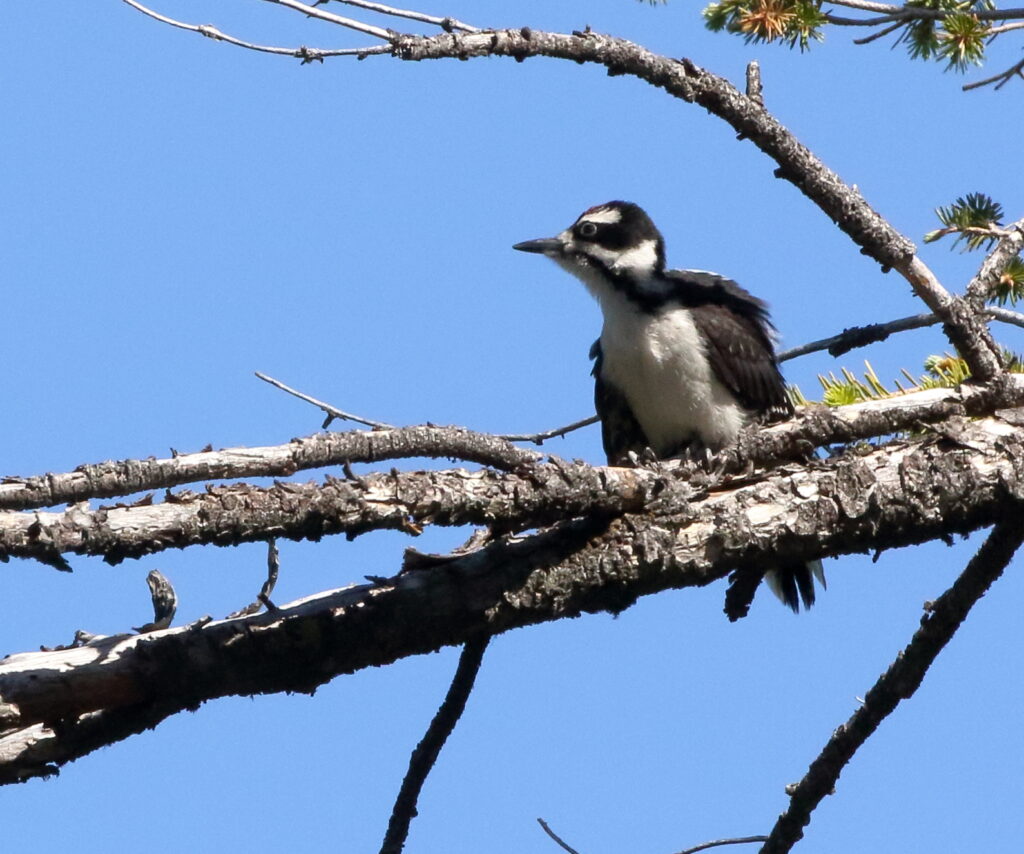
Higher up we caught a glimpse of a mama black bear and cub on a ridge before stopping at the #5 marker. Surprises continued as we scooped up another Pileated, a juvie Hairy Woodpecker, Cassin’s Finches, and a Common Nighthawk that was calling while perched in a tree—something we’d never experienced.

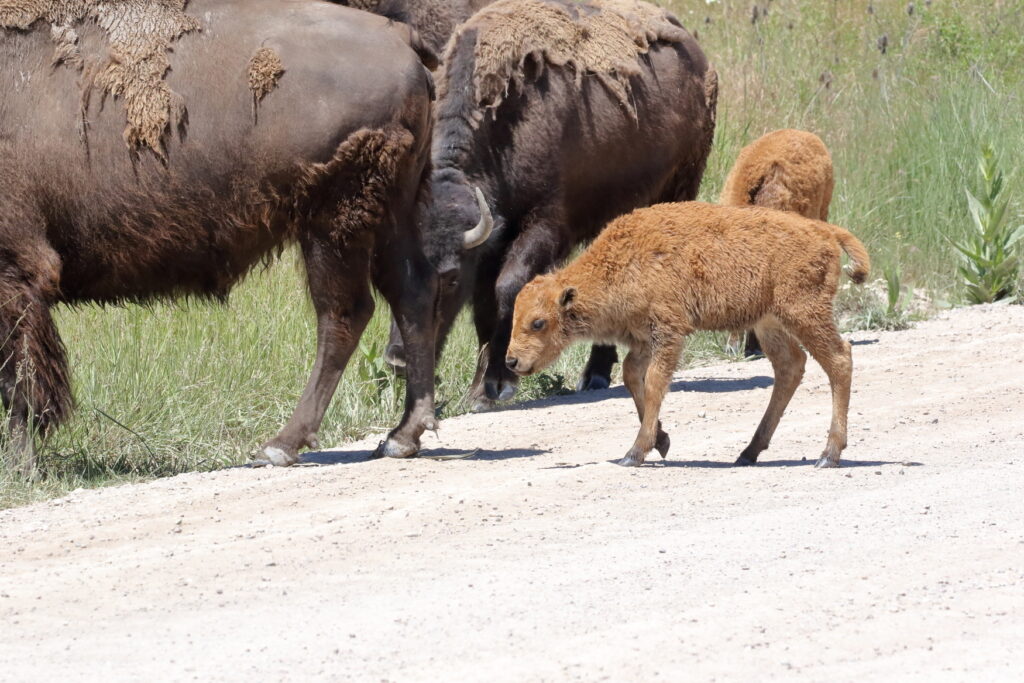
Is there anything more adorable than a juvenile Hairy Woodpecker? Maybe a baby bison? Keep reading to compare.

We ate lunch at the summit overlooking the spectacular Mission Valley. Our group got excellent looks at Lewis’s Woodpeckers, Red Crossbills, and Pine Siskins, but traffic had begun to build, so we began making our way down the far side of the mountain. All this time, we asked ourselves, “Where are the bison?” Supposedly hundreds of the animals occupied the reserve, but we’d only seen three or four far down below us.

Finally, on the last stretch of road at the end of the road, we encountered a dozen or so adult bison with their bright tan calves. We, of course, pulled over to admire these remarkable critters—even if they were mammals.

So what do you think? Woodpecker fledgling or bison? Don’t let your mammalian bias influence you!

As before, Braden and I felt grateful we got to participate in Wings Across the Big Sky, and we highly recommend it to those of you who have always longed to bird in Montana. The trips are always fantastic, and are punctuated by informative workshops and keynotes. This year’s keynote was given Steve Hoffman, founder of HawkWatch International, who opened our eyes to the amazing raptor migrations and counting efforts taking place in the West. (We also felt honored to have Steve on our Tally Lake trip.) Next year’s festival will be in Billings and promises to be a good one. Not only does the Billings area offer outstanding grassland and sagebrush birding, but excellent riparian zones as well. I don’t know about you, but I am already trying to figure out how to attend!

Our Tally Lake eBird list: https://ebird.org/checklist/S356850809

Our Bison Range eBird list: https://ebird.org/checklist/S357543551

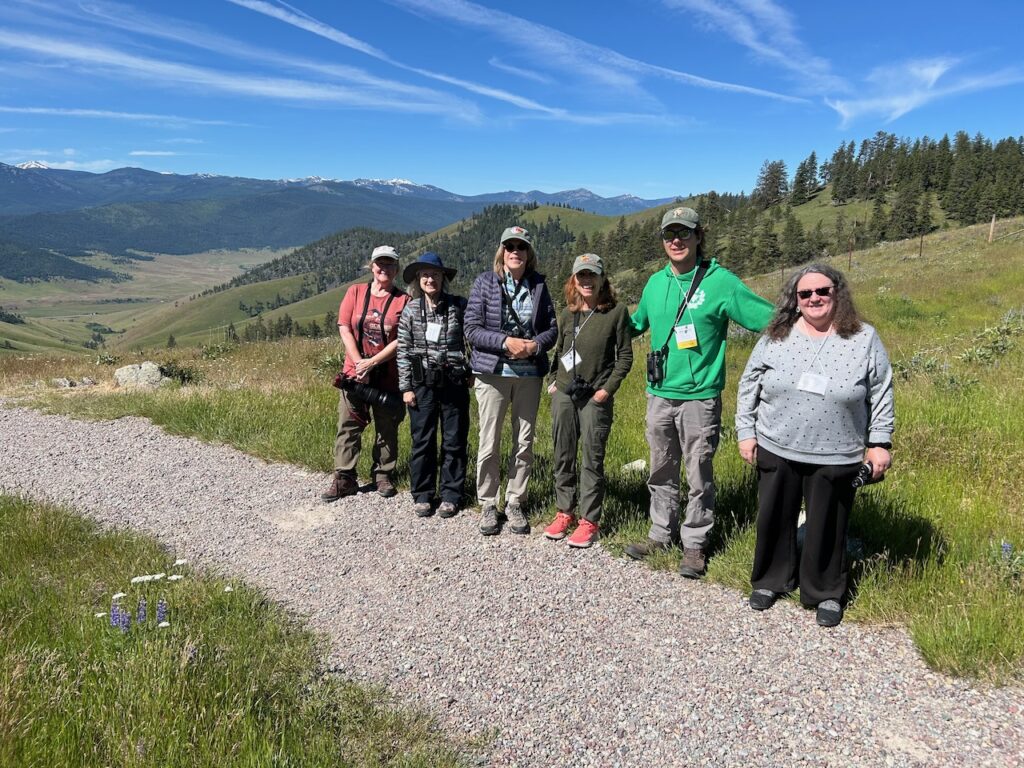
Our Bison Range crew hopes you will be at next year’s Wings Across Big Sky fest in Billings!

Black-chinned Sparrow: Bird #14 on Braden’s ABA Life List Countdown

Today, we continue Braden’s countdown of the remaining birds he needs to complete his American Birding Association life list. For more information on this journey, check out his post, Lower 48 Life List Countdown: Crissal Thrasher. As always, if you’d like to support FatherSonBirding, consider buying new copies of some of Sneed’s books shown to the right. If you already have them all, why not buy a copy for a friend? As always, thanks for reading!

On April 4th, 2026, I left my job of eight months, with my internal compass pointing home. I’d lived and worked in Running Springs, California since late August of 2025, as an educator and camp counselor at Pali Institute for Outdoor Education. I’d seen so much of the country during this time, and met some really cool people, but on April 3rd I finished my last work shift. The next day, I moved out of staff housing and drove south to Ramona near San Diego to stay with my cousins. That night would be the first of many on a twelve-day road trip I’d planned across the American West on my way back to Montana. Though I looked forward to seeing many birds (see my Crissal Thrasher blog) on the trip, I especially set my sights on the last US sparrow that I’d never laid eyes on: Black-chinned.

Black-chinned Sparrows are classic chaparral birds found in canyons and hillsides across much of California, Arizona and New Mexico. They’re particularly drawn to post-fire habitats—the dense shrubbery that rises from the sooty ground five to ten years after a burn. Outside the core of its range, the species can be quite local, which might explain why I hadn’t bumped into one so far. While I have spent extensive time in both central California and southeast Arizona, a lot of the birding I’ve done in these locations is either too wooded or too deserty for Black-chinned Sparrows. The one concentrated effort I made for the species was both at a bad time of year and a bad time of day for the species, when a friend and I had driven up a random road south of San Francisco where a single singing bird had been reported weeks prior.

The Beeline Highway

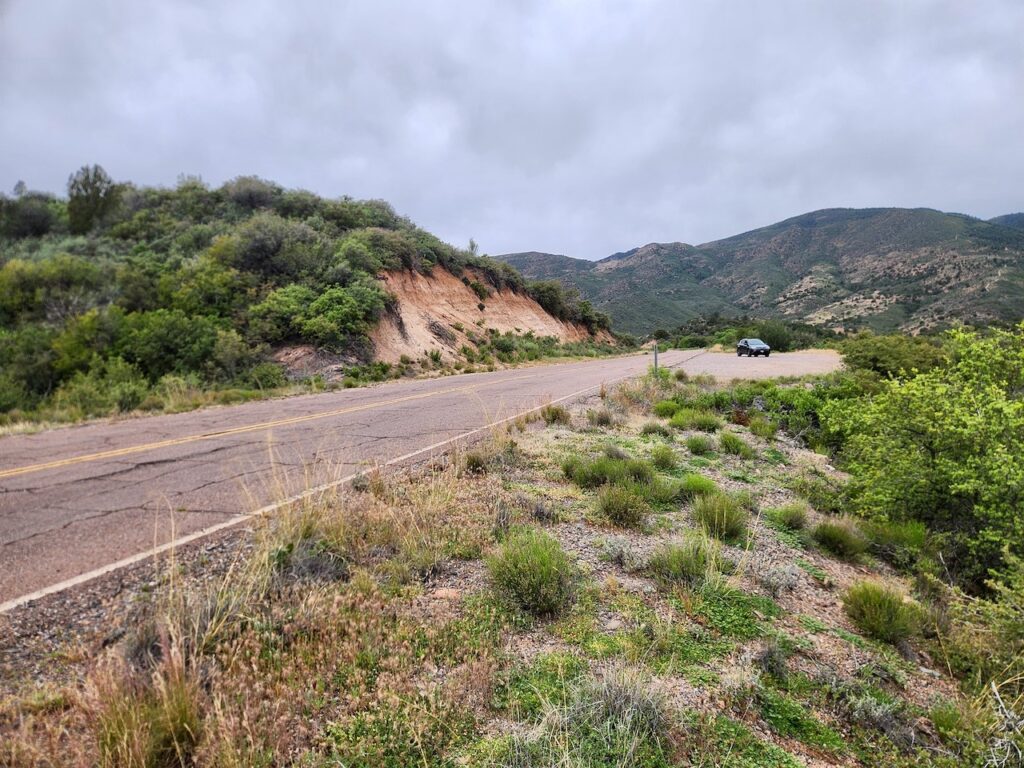
When planning my route home from Running Springs, I had several goals in mind: to explore parts of the West I’d never before visited and to target a few bird species that would either be lifers, or living in new locations I’d never explored. With all of this in mind, I left my cousin’s house in Ramona on April 5th and drove six hours through the Mojave Desert, arriving at a location known as the Beeline Highway an hour or so after sunset. This section of the highway ran through Sycamore Canyon, a middle-elevation canyon that stretched from the saguaro-covered foothills north of Phoenix up towards 7,000-foot Mt. Ord. No longer a through road thanks to a closure on the lower section, it was known to be one of Phoenix’s top birding locations. 

As I began to set up my tent, thinking about all the fun canyon country birds I might see tomorrow, a barking echoed from the creek a couple hundred meters away. I recognized it as a sound I’d only heard a few times: an Elf Owl! Deciding my tent could wait, I grabbed my flashlight and camera, walking towards the sound. When I got to the tree I thought it was coming from, I raised my light and immediately spotted the bird: America’s smallest owl was barking, unperturbed, from a small cavity in the sycamore. Then another Elf Owl landed on a tree on the other side of the road! I’d only heard this species before, never gotten eyes on one, and I hadn’t even realized they lived this far north! Happy, I went to bed as the Elf Owls called into the night.

Sycamore Canyon

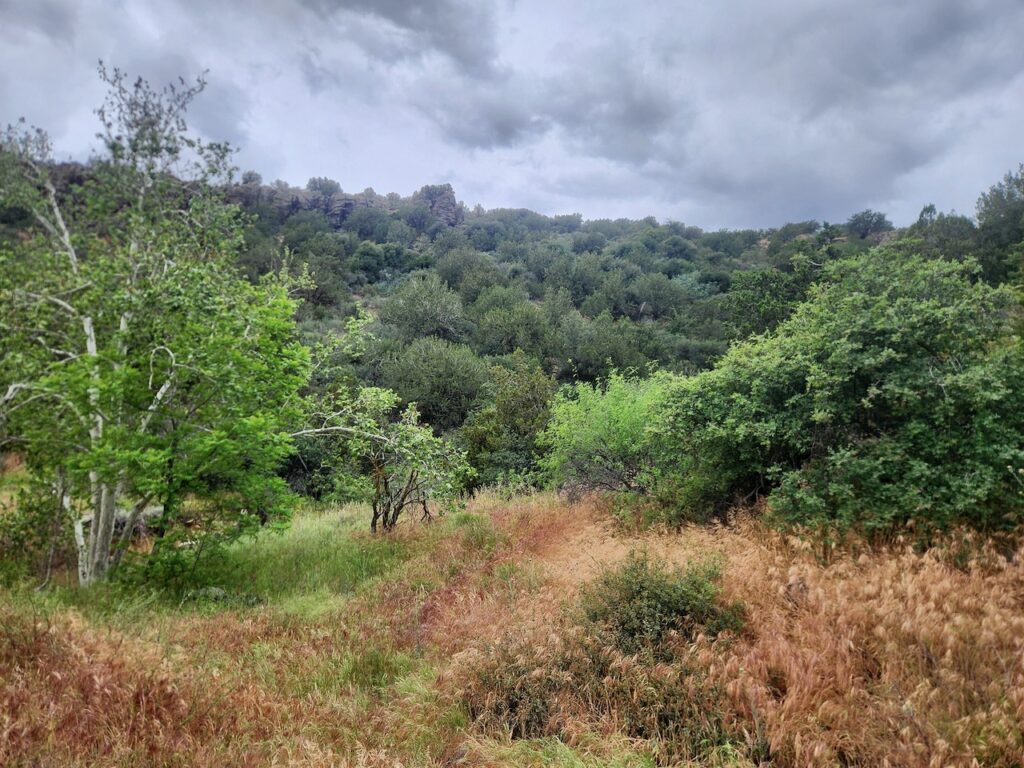
The next morning, unfamiliar bird songs woke me, and I packed my tent before the sun crested the hills. As I headed down the road, I spotted Northern Cardinals and Ash-throated Flycatchers, knowing full well that Black-chinned Sparrow reports were more frequent higher up the canyon but curious as to what else lived below. Arizona sycamores followed the creek down the canyon, which contrasted with the dry, rocky, juniper-covered slopes surrounding me, and created great habitat for birds like Hooded Oriole, Bell’s Vireo and Cassin’s Kingbird. From the hillsides sang Rufous-crowned Sparrows, a southwestern bird with a messy jumble of a song that I’d been learning to love over the last few months. 

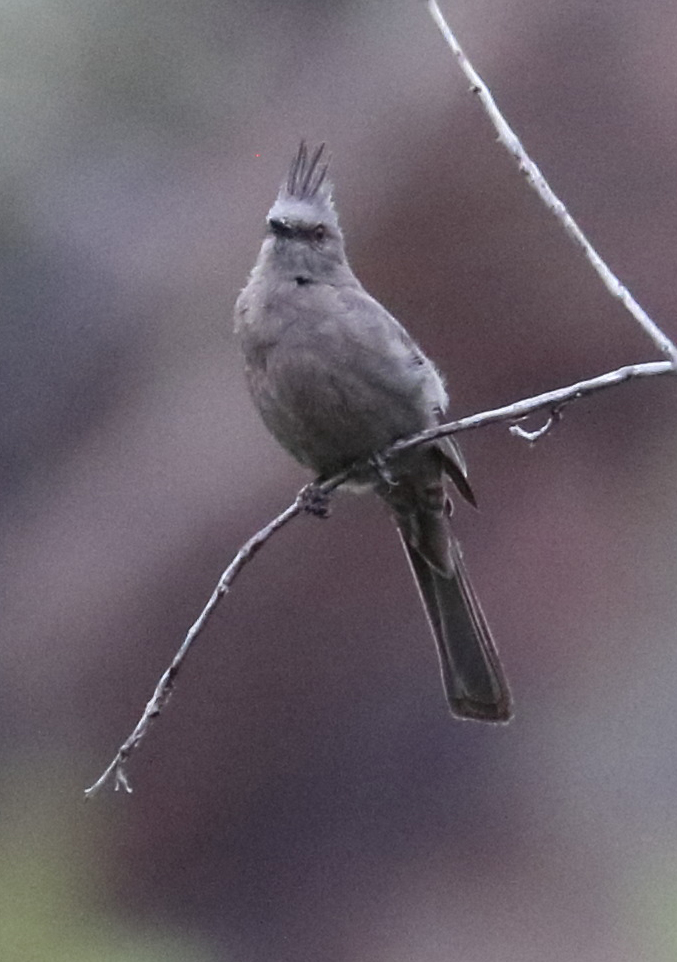
Phainopepla

Forty minutes after I started walking the canyon, another car pulled alongside me. A woman got out, introducing herself as Shannon and stating that she was a local birder. From then on, we mostly birded together, taking turns pointing out cool birds as we encountered them.

“Zone-tailed Hawk above us!”

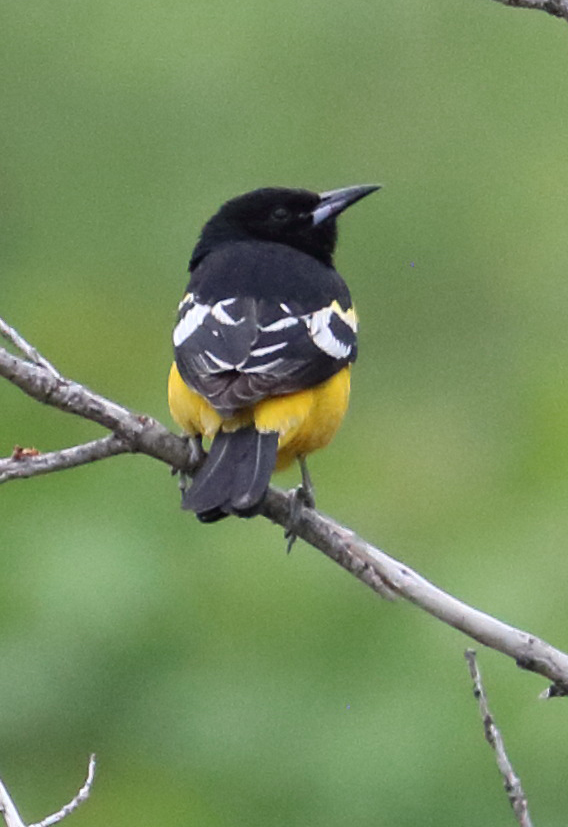
“Check out that male Scott’s Oriole!”

“Oooh, that Costa’s Hummingbird is displaying!”

Scott’s Oriole

Eventually, we arrived at a natural turnaround point—a large, grassy pile of dirt blocking the road. The road continued behind it, but Shannon decided to turn around. I felt that I should keep going a little farther, a birding strategy that I’d adopted in recent years. Often, when I feel like turning around, I decide to push on around ‘just one more corner’, and it’s gotten me some great birds over the years. I did just that, and wasn’t disappointed.

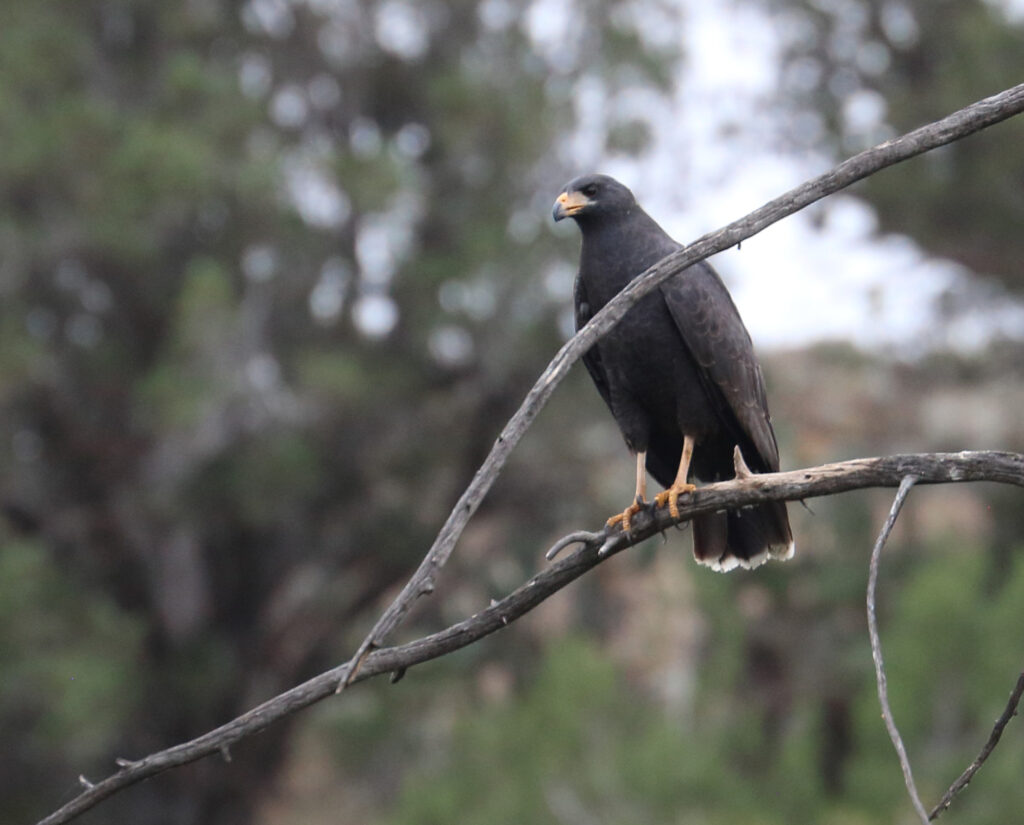
To be honest, Black-chinned Sparrow was not the main reason I’d selected this location. No, the Beeline Highway was known for another species, one I’d seen before in Costa Rica but never in the US—Common Black Hawk. In the tropics these raptors are hard to miss, using mostly coastal habitats, especially mangroves. North of the Mexican border, though, there are fewer than 300 nesting pairs, confined to sycamore-covered canyons. 

Sure enough, after walking around ‘just one more corner’, I spotted it: A Common Black Hawk sitting on a nest in the crook of a sycamore. I snapped a bunch of pictures and watched as it began flying back and forth, its calls bouncing off the walls of the canyon.

Common Black Hawk

I headed back up the canyon and again met Shannon, who gave me a ride to my car. We parted ways and I continued driving slowly with the windows down. I’d seen a ton of cool birds so far, but I couldn’t help feeling a little stressed. Where were the Black-chinned Sparrows?

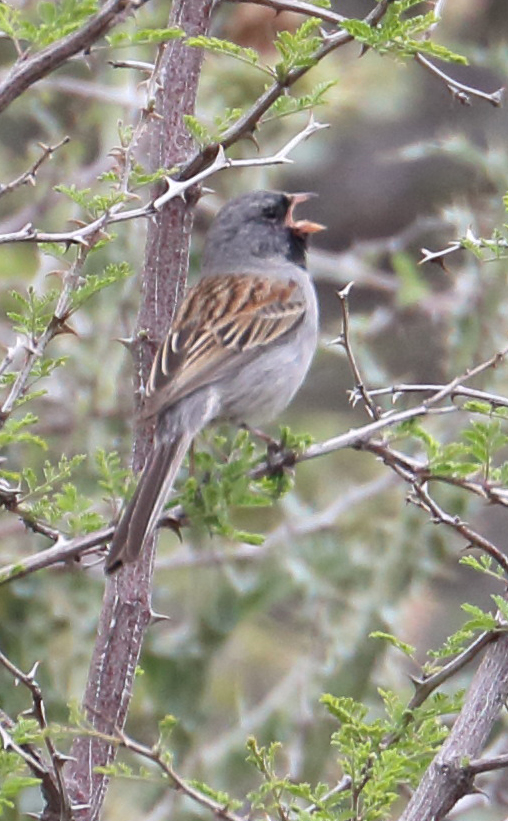
Apparently, near the top of the canyon! Pulling over for probably the fourth time, I immediately heard one sounding off from the valley below—a musical, descending song like that of a Field Sparrow but more piercing. While I don’t enjoy using playback, I went ahead and played its song. My bird didn’t come any closer, but the sound prompted another sparrow to start singing on the other side of the road. I snuck up on him and suddenly, not ten feet from me sat a male Black-chinned Sparrow. Almost immediately, a second male flew in to join him and the two flitted from bush to bush together, never staying in one place for longer than ten seconds but giving me satisfying views. I knew they were both males because only the male of this species has the diagnostic black chin.

Black-chinned Sparrow

The Beeline Highway offered up one more gift before I left. While watching the sparrows, I heard the telltale varied song of a mimid. I walked to the edge of the road expecting a Northern Mockingbird, and instead was treated to great views of a Crissal Thrasher! This high-altitude shrubby habitat differed in nearly every way from the desert wash where I’d seen one in Vegas, but the bird seemed to be thriving here! As I headed north, away from the sycamores and saguaros, I felt a pang of regret since I likely wouldn’t be seeing these birds again for a long time. However, I knew that today’s experience would give me hours of pleasant reflection as I continued my adventure into new, exciting habitats.

FSB’s Third Annual Short-Eared Owl Lousy Photo Shoot!

You knew it was coming. You heard the rumours. You’ve waited patiently, and guess what? Today is the day! Right this second, Braden and I are proud to reveal FSB’s Third Annual Short-Eared Owl Lousy Photo Shoot!

Like many birders, Braden and I try to “bird in” the new year with one or more big days of birding somewhere near our home in Missoula. The past couple of years, we’ve headed to Ninepipe National Wildlife Refuge about an hour north of us, mainly because it’s a reliable place for a variety of birds and is especially good for hawks, falcons, and other raptors. This year, our day was shaped by a couple of fun additional circumstances. One is that our long-time friends Susan Snetsinger and her son (Braden’s pal) Eli Frederickson happily agreed to join us for our birding excursion. The other is that a putative sighting of an Arctic Loon on the north end of Flathead Lake  sent all of us Montana birders into a tizzy. Why? Because an Arctic Loon has never been reported in the state!

For the third year in a row, we decided to head north through the spectacular Mission Valley for our first major birding expedition of the year.

(To view our past two “lousy owl” photo blogs, see our posts Lost in Owls and Plenty of Partridges.)

Unfortunately, on December 30th, yours truly woke up with his first cold in two years and was in no shape to venture out on January 1st. No problem. Everyone agreed to push back our outing to January 3rd and, more important, the Arctic Loon was still being reported! As we set out before dawn, fog and ice covered our route, making driving sketchy, especially with the pre-dawn danger of deer wandering out onto the highway. Braden, though, fearlessly drove us north and as we passed the National Bison Range, a bit of light began seeping in through the fog.

We decided to head to the loon first and that afforded Susan and Eli a once-in-a-lifetime opportunity to join Braden and me at our favorite French breakfast spot, McDaniels, in Ronan. I even convinced the two of them to order my favorite morning birding beverage, a large iced tea, to help power us all through the day.

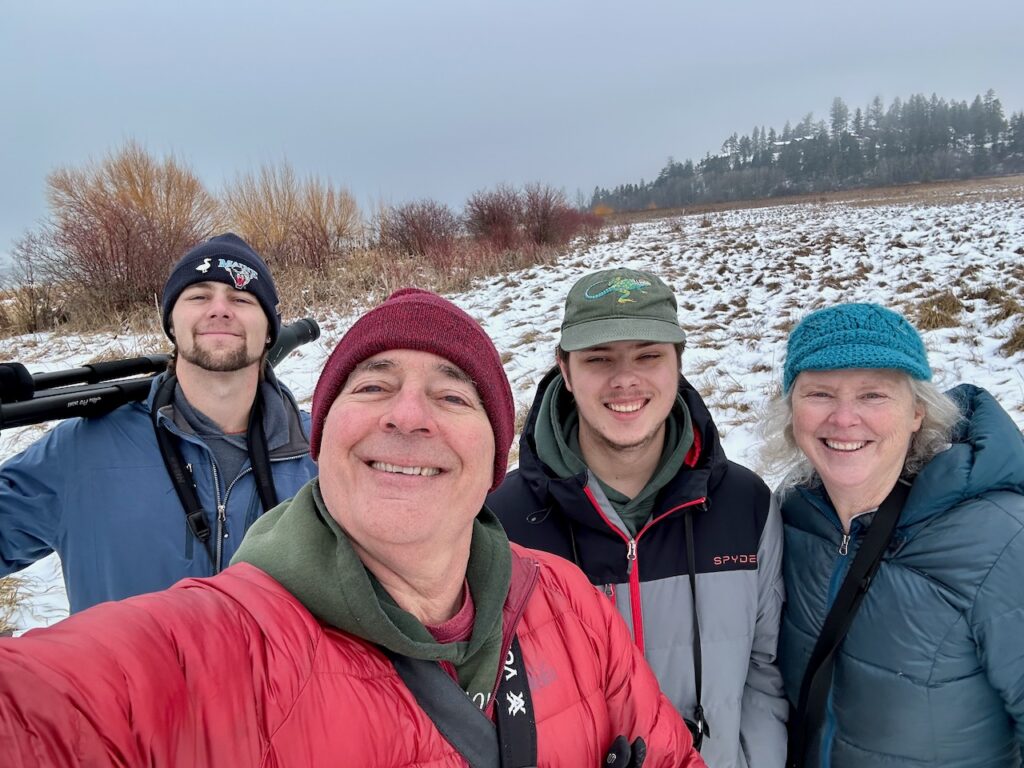
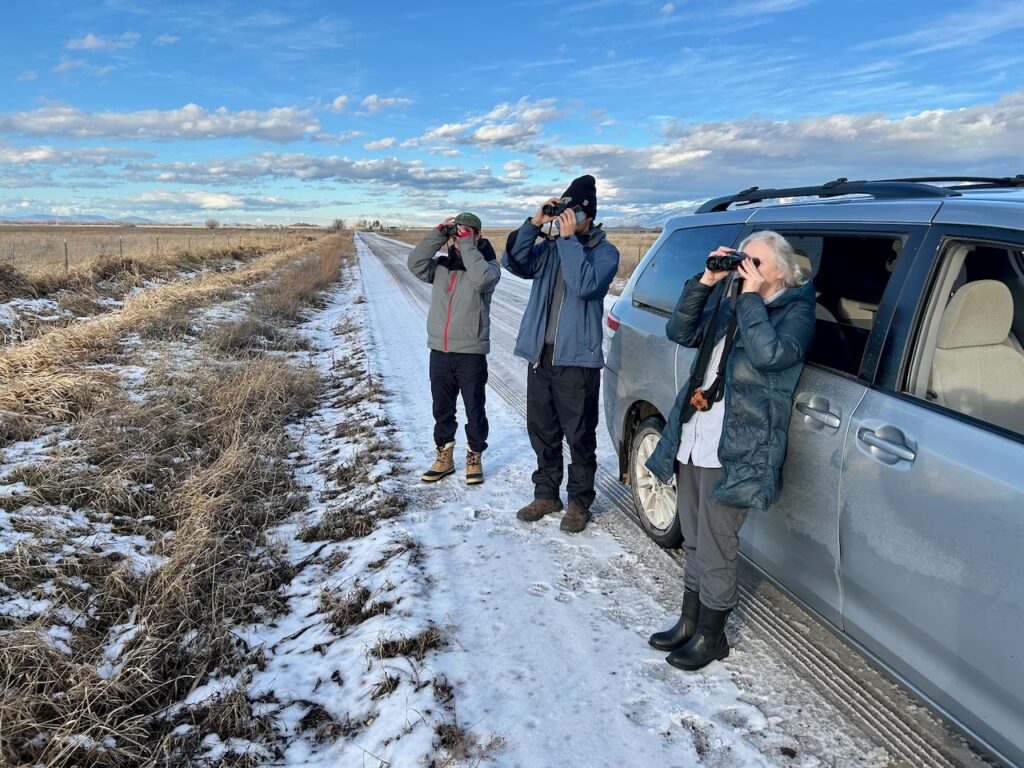
From left to right, Braden, Sneed, Eli, and Susan as we pursued our spirited quest to locate the “Arctic Loon.”

After a fruitless stop to look for Long-eared Owls near Polson, we arrived at our destination of Somers on Flathead Lake just after 11 a.m. Dan Casey, who first reported the Arctic Loon, had kindly noted several viewing possibilities from the lakeshore, and we began visiting these. Right off the bat, we saw some interesting birds. These included Red-necked Grebes, a species we had never found in Montana at this time of year, and a couple of Blue Jays, a species Braden and I totally missed in our home state last year.

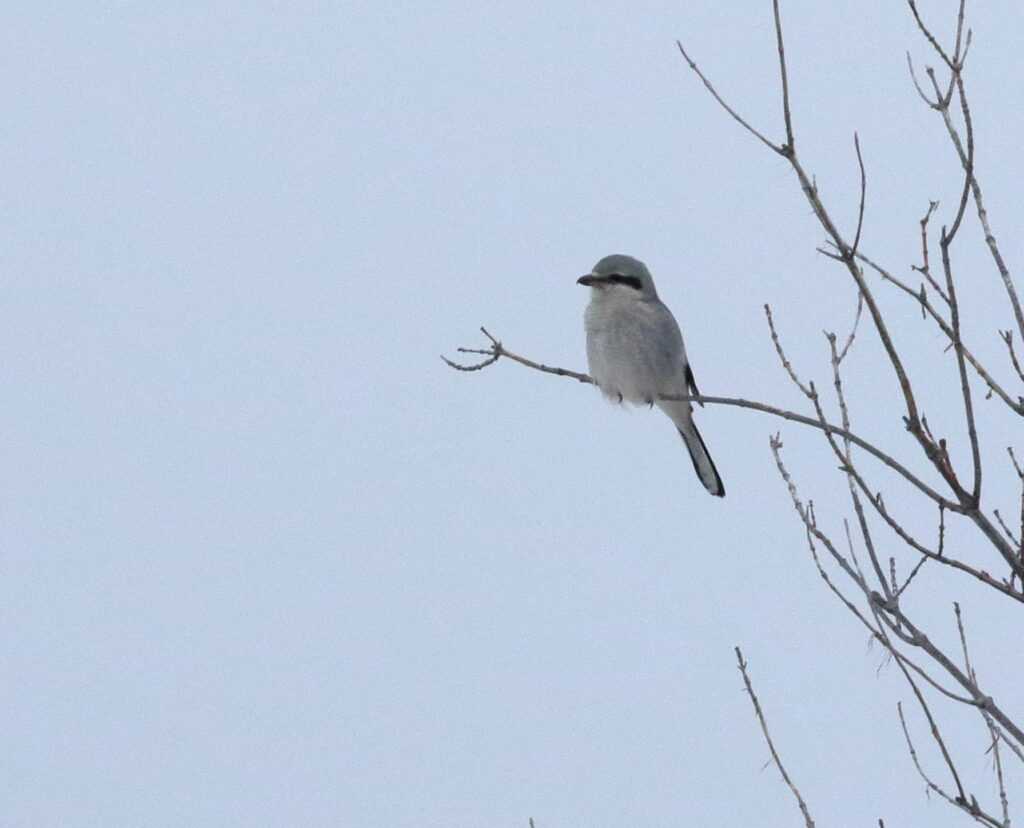
We saw no sign of a loon of any kind, so continued to explore the lakeshore. More fun birds popped up, including a variety of ducks, Trumpeter Swans, and one of our favorite winter birds, Northern Shrikes. We also toured the neighborhood where we’d seen our lifer Snowy Owl eight years ago (see our very first post, A Quest for Snowy Owls). None of the owls have been reported this winter, but we thought, “Might as well give it a try.” We eventually left the Kalispell area both owl-less and loon-less, but none of us really minded. We were still seeing birds and even better, enjoying each other’s company.

Any day you find a Northern Shrike is a good birding day—and we saw three or four of them during our expedition.

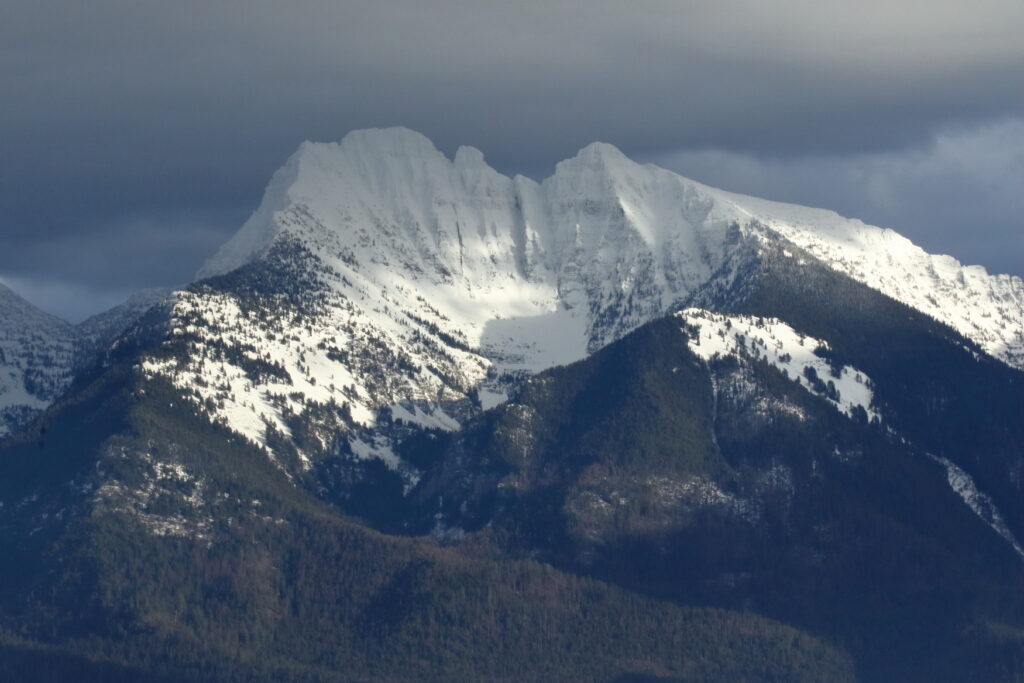
90 minutes later, we were turning down Duck Road at Ninepipe. It was only 3 p.m., but this time of year it felt a lot later. Much of the fog at cleared, but mist still hung off of the spectacular mountains in the distance, giving everything an other-worldly feel. We drove slowly and picked up some expected raptors: Rough-legged and Red-tailed Hawks, Northern Harrier, Bald Eagle, and American Kestrel.  

“Should we go drive by the Short-eared Owl place?” I asked Braden.

“Sure,” he answered and began searching for the location on his phone.

We didn’t get that far.

Heading south on Ninepipe Road, he suddenly shouted, “There’s one!”

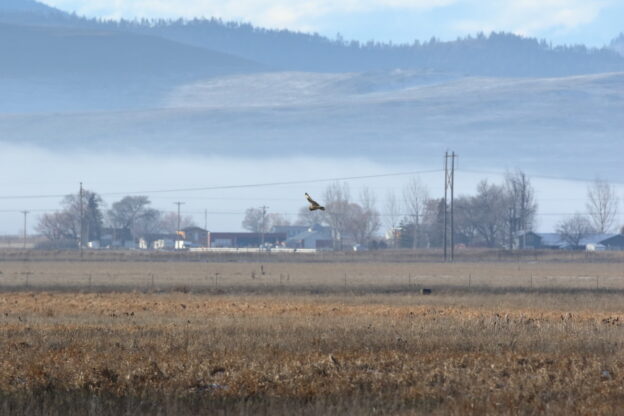
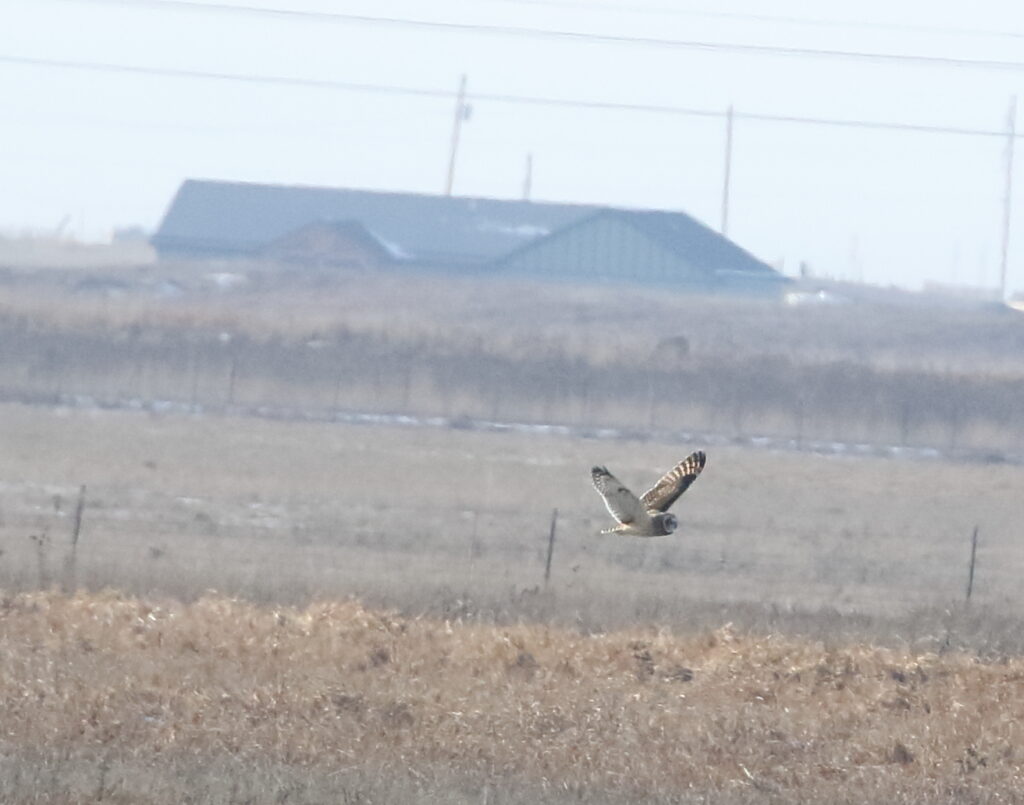
I am especially proud of this lousy Short-eared Owl Shot. See how I tilted the camera to make it appear that the owl is flying downhill? Well, guess what? It wasn’t! I just used my advanced photo skills to make you think that. This is a highly complex and dangerous technique, however, so don’t try it at home!

I immediately pulled over so we could all look and, sure enough, there was one of our favorite creatures flying low over a marsh area in the distance.

We had barely begun to look at it, however, when Eli shouted, “There’s another one!”

“Oh my god,” Braden added, scanning with his binos, “There’s three more way out beyond that!”

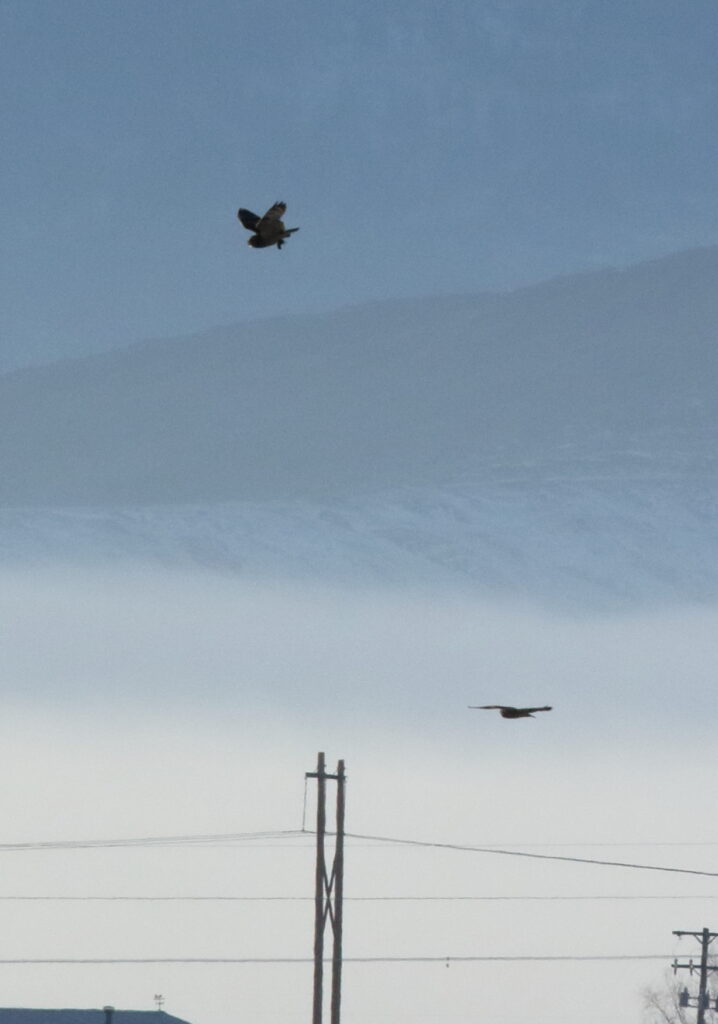
If I’d been trying harder, I would have been able to capture up to five SEOWs in one shot–but that might have made the photo TOO good for this blog!

We clambered out of our minivan, and the more we looked, the more Short-eared Owls we saw. These weren’t quick glances, either. Some of the owls appeared to be hunting, dropping quickly into the marsh for a go at a vole. Others looked to be courting, sparring and jousting “good-naturedly” and briefly locking talons before circling around again. A couple of owls spent a few minutes chasing away a Northern Harrier who apparently lacked the firepower to defend her space.

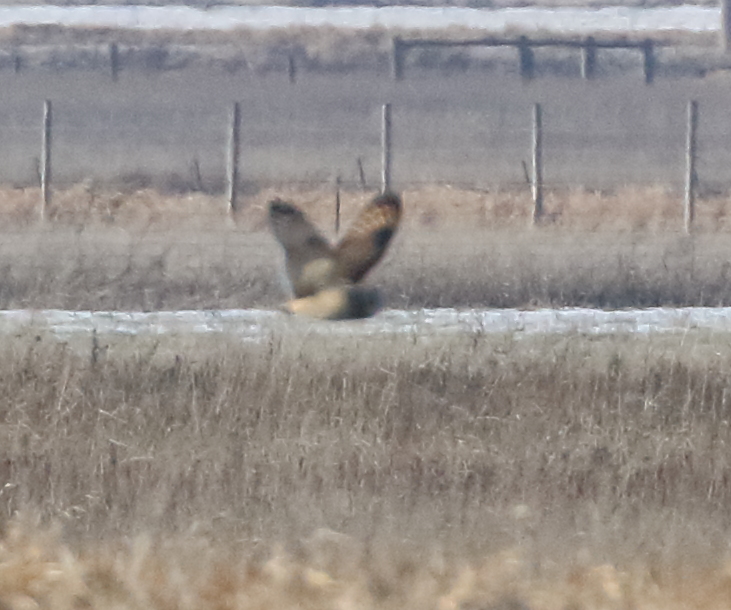
This SEOW did not want its identity revealed, so as you can see I used sophisticated AI processing to blur out its face.

While these weren’t the closest SEOWs we’d ever seen, this was far and away the best Short-eared Owl experience any of us had ever had. Not only were the owls engaging in all kinds of interesting behaviors, we had this winter spectacular all to ourselves.

We encountered nary another birder during our half hour enjoying this “most owl” spectacle!

Oh, and did I mention that I got to take more than a dozen lousy Short-eared Owl photos? That felt particularly gratifying since, after three years, I’ve got a reputation to uphold! We hope you enjoy the gallery and keep tuning in to FatherSonBirding. Even more, we hope you keep having your own magical birding moments.

Happy New Year!

P.S. Oh, it turns out that the Arctic Loon got “downgraded” to a Pacific Loon. C’est la loon!

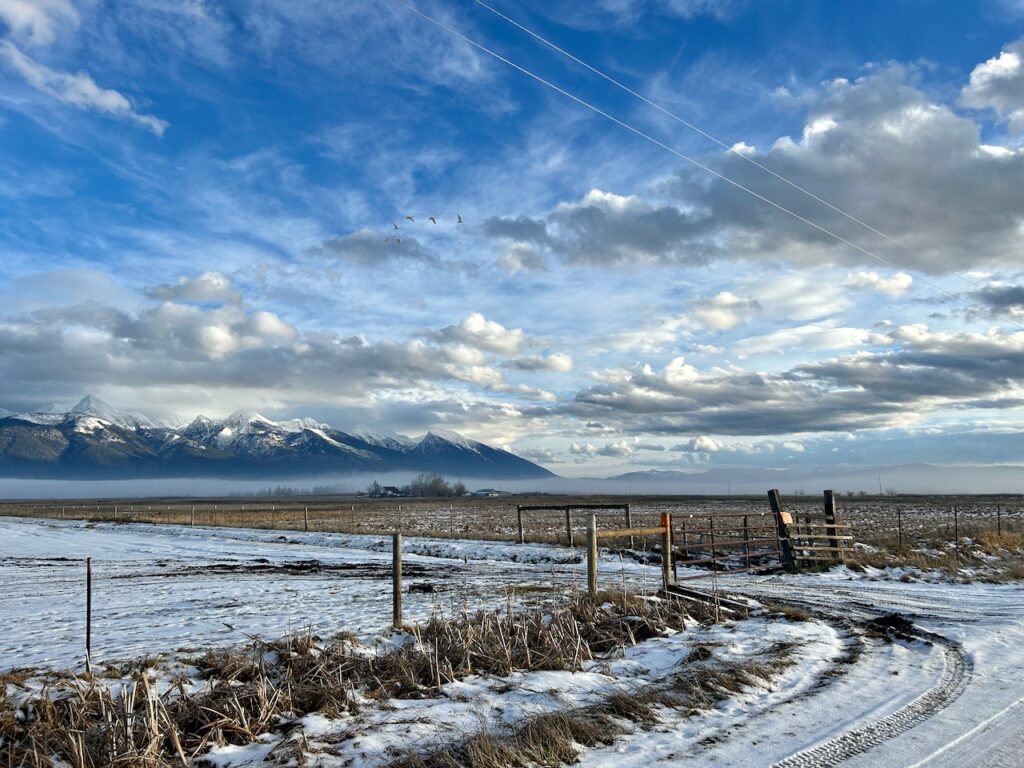
Even without the owls, a winter visit to the Mission Valley is a soulful, satisfying experience. Oh, and can you find Trumpeter Swans in this picture?

Giving Back to Birds—with Great Breaking News! (FSB Holiday Shopping Guide, Part 3)

Holiday Joy! Back in August, we alerted FSB readers to Houston Audubon’s effort to buy a critical piece of land for their globally-important Bolivar Flats refuge. (See this post!) This is a refuge Braden and I have visited and is a vital habitat and staging area for hundreds of thousands of birds annually. When a developer planned to build a housing development smack in the middle of it, Houston Audubon negotiated an option to buy and protect the property. The problem? A $3 million price tag! We were skeptical that it could be done, but guess what? GUESS WHAT??? Thanks to donations by 1,127 donors from 47 states and 8 different countries, Houston Audubon achieved its goal! Donations included a huge check from Roku CEO/Founder Anthony Wood and his wife Susan. (I knew I loved Roku for a reason!) Everyone who donated—and those who didn’t—should be immensely pleased, because this is not only a crucial win for birds, it is a win for all of us. It also is the perfect lead into today’s blog topic—End-of-the-Year giving for birds!

Especially near the end of the year, when tax deadlines are looming, we know that a lot of you are asking yourselves, “What can I do to help birds?” We all know that birds are in big trouble, but it can feel overwhelming to figure out just how to spend our donation dollars most effectively. Today, in order to make your lives a bit easier, we are pleased to present a short list of Braden’s and my favorite groups that are helping birds, and yes, we have donated to every one of them. To find out more, just click on the underlined names below. Then, please, please break out that credit or debit card! We truly are at a global crossroads in the fight to save birds, and we guarantee that every dollar you spend will make you feel just a little bit better. While you’re at it, you might want to join your local Audubon chapter and/or the American Birding Association to help connect you to other birds, share information, and expand the love of birds!

Groups Working Internationally

Cornell Lab of Ornithology—the maker of eBird and Merlin makes huge investments in science and education to raise awareness of birds and promote conservation.

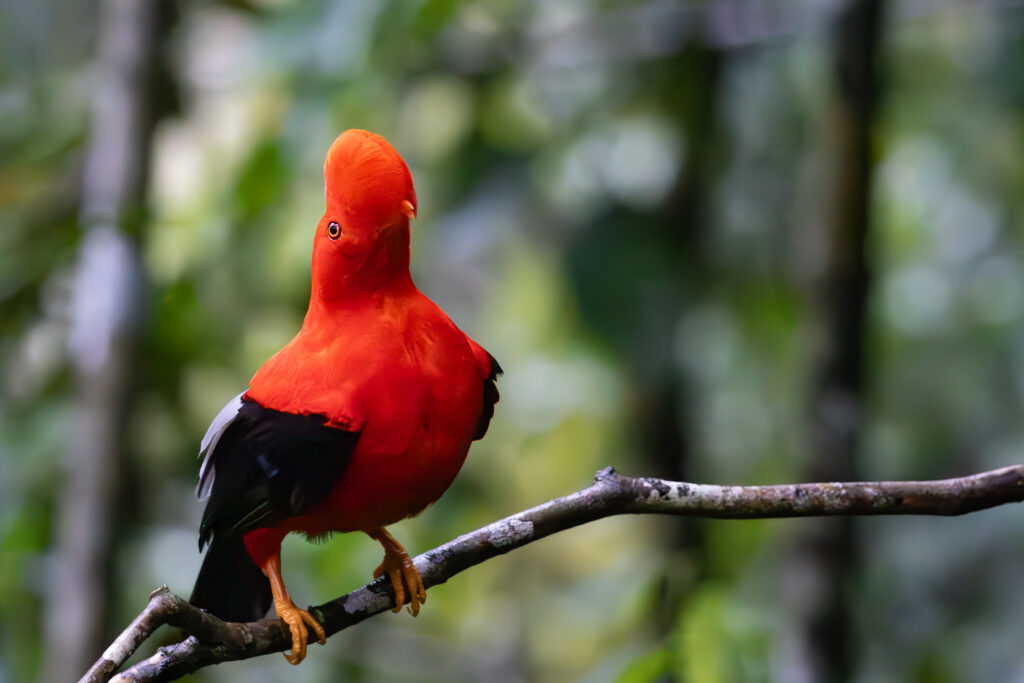
Bird Life International—Braden’s favorite group works on the entire international spectrum of bird threats, and also works with local communities to help protect birds and habitats. (Andean Cock-of-the-rock photo courtesy of Roger Kohn!)

Union of Concerned Scientists—one of Sneed’s favorite groups, we make monthly contributions to this group working to fight rampant disinformation and promote rational, scientific solutions to a host of environmental problems facing us.

Groups Focused Mainly on North America

Audubon—still the biggest name in birding, Audubon promotes bird conservation and education, and works on legislation to protect birds. (Note: the national, state, and local chapters are all independent entities. Donations to national do not trickle down, so consider donating to all three.)

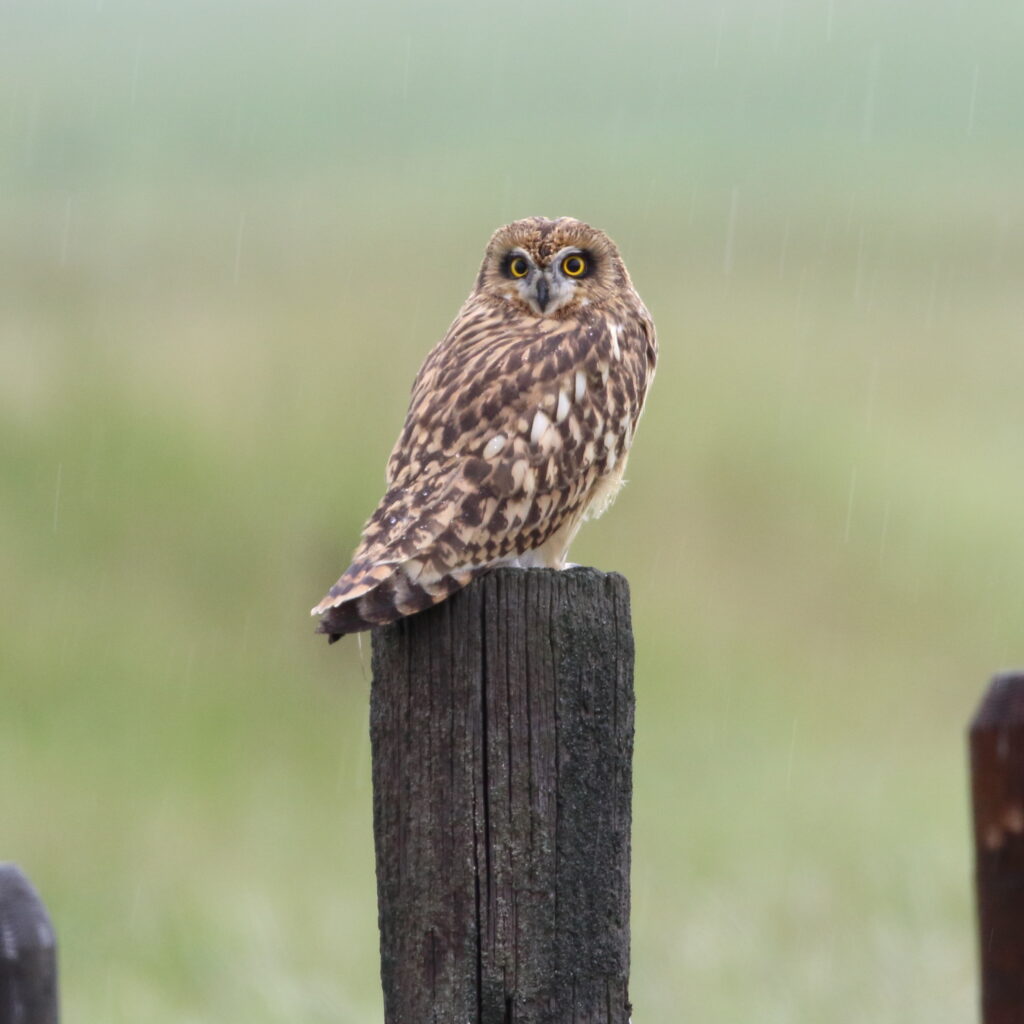
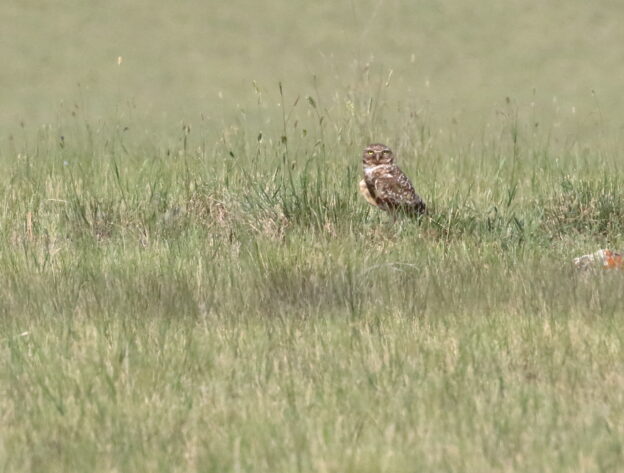
Owl Research Institute—one of the few groups focused on one of the world’s most charismatic groups of birds, ORI has been collecting data on owls for more than thirty years, sharing it with many different entities to shape science and conservation priorities. They especially work to decipher the causes behind the decline of many owl populations—including those of this Short-eared Owl.

American Bird Conservancy—also works on a wide range of bird-related issues including the urgent problem of outdoor cats.

State and Local Groups

Montana Audubon—besides putting on the wonderful Wings Across the Big Sky birding festival every year (and yes, Braden and I plan to be there in 2026!), Montana Audubon works to educate birders, identify the Treasure State’s bird conservation priorities, conduct research on endangered species, and carry out many, many other activities that benefit birds and birders.

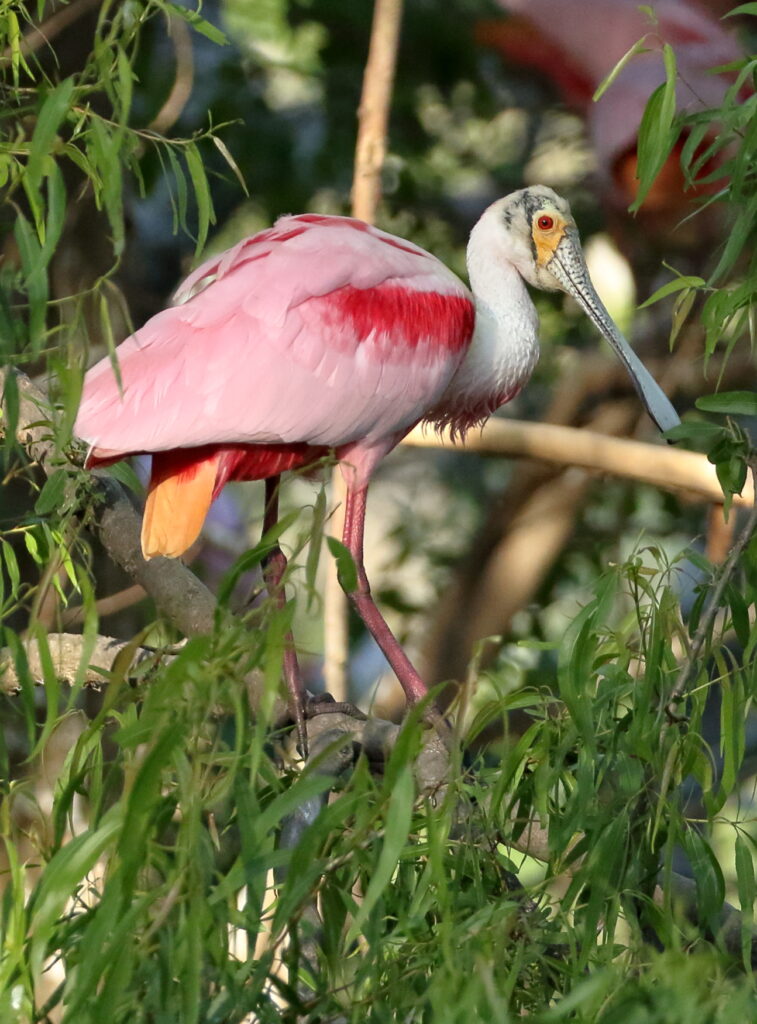
Houston Audubon Society—a regional bird powerhouse, promoting bird education and conservation, and protection of vital habitats, especially for migrating birds. Think High Island from the movie The Big Year! (Roseate Spoonbill shown.)

Bird Conservancy of the Rockies—another regional powerhouse with widespread activities including vital research into wintering grounds of grassland birds in the Southwest and Mexico.

University of Montana Bird Ecology Lab (UMBEL)—conducts important research, monitoring, and outreach activities around the region!

Montana Bird Advocacy—a grassroots research organization started by well-known Montana birding legends Jeff Marks and Paul Hendricks, MBA conducts research on little-known Montana birds such as the Gray Flycatcher. (See our post Gray Flycatcher Science.)

An unbanded adult Gray Flycatcher implores: “Donate Now!”

Swift-ecta!

In an earlier post, we may have let slip that both Braden and I are on a tear for our 2025 global species lists (see our post In Search of the Green-tailed Towhee). That’s due to a variety of factors. Braden not only drove across the country from Maine to Montana this past spring (see last post), he embarked on intense birding trips to Oaxaca, Mexico (see post Birding in Oaxaca, Mexico) and Costa Rica. As for me, I received delightful last-minute invitations to Colombia (post Antpittas and Tody-Flycatchers), thanks to FSB contributor Roger Kohn, and to Texas, where I spoke about my book Birding for Boomers. The upshot of all this is that Braden has seen almost 800 species of birds this year, while I am within twenty birds of breaking my all-time record of 527.

The thing is, twenty birds in Montana in late July is more challenging than it sounds. Birds common in May or June become increasingly difficult to detect and find, so if you don’t have them by August you may not get them at all. That means you’ll have to rely on migrants—which are notoriously unpredictable—or winter arrivals that you probably got earlier in the year. As a result, I’ve recently been focused on picking up the remaining common birds that I so far haven’t seen. Top on my list? Say’s Phoebe.

Last year, I saw a Say’s Phoebe near the base of Missoula’s Pattee Canyon. Alas, that one eluded me this year, forcing me to search farther afield!

Say’s Phoebes are cool little flycatchers that love to nest on human-made structures such as barns, covered porches, and utility buildings. While not rare, they seem to be pretty picky about their accommodations, and we run into them only infrequently in Montana. As I write this, for example, only four sightings have been reported in Missoula County in the past month. While scouring eBird, though, I did note regular sightings up at Kerr Dam below Flathead Lake. Braden and I had discussed doing a birding day trip, so two Tuesdays ago we set out early, Say’s Phoebes our Number One goal.

Before leaving Missoula, Braden asked if we could stop at Greenough Park. He had been pursuing a birding challenge with friends back East to see how many species they could find every day for seven days in a row. “I want to pick up Lazuli Bunting and Swainson’s Thrush,” he told me. This search happened to lead to the first delightful surprise of the day. As we were walking up a dirt trail, we approached a cottonwood tree where Braden had found a Western Screech Owl two days before. Today, he suddenly exclaimed, “Oh my god! It’s a baby!” Sure enough, a WSOW baby sat only a yard from its parent about twenty feet up the tree. Here, our day had just begun and already it had been a wonderful outing!

This adorable little guy was the first baby Western Screech-Owl Braden and I had ever seen!

Still, we had a lot of ground to cover. After a fortifying meal at our favorite French restaurant, McDaniels (in honor of Rogére), we headed up to Ninepipe NWR. We didn’t have any major agenda there except perhaps to snag some shorebirds. For July, it was an unusually cool, overcast day and we joked that we might see some Black Swifts. For those unfamiliar with Black Swifts, they are one of the most elusive and rare birds in the US. They nest mainly behind waterfalls and, especially with climate change, are highly vulnerable throughout their range. In Montana, I had never seen one outside of Glacier National Park, and it was pie-in-the-sky logic to even hope we might see one here out in the valley.

Braden poring through intermolt ducks at Ninepipe.

Anyway, we stopped at one Ninepipe pullout just off Hwy 93. The ducks were in their almost-impossible-to-identify intermolt plumages, but we still saw a nice variety of them plus Trumpeter Swans, American White Pelicans, Double-crested Cormorants, and Great Blue Herons. “Where are the Black Swifts?” I pressed Braden, but he shrugged off my flippant remark.

Though we hadn’t seen any Black Swifts, the low cloud cover at least admitted the possibility that they would venture down into the valleys from their mountain waterfall hideaways.

The phoebes on our minds, we didn’t want to spend too much time at Ninepipe, but decided to stop at one more pullout and, again, found the usual suspects. We both searched the skies for Black Swifts just in case, but didn’t see any. “I have to go to the bathroom,” Braden said, and I kept looking around for various birds. As soon as Braden emerged from the outhouse, however, he shouted, “Black Swifts!” Huh? My eyes darted back toward the low clouds, and there they were—four unmistakable dark shapes scything through the air!

Black Swifts were a stunning find on a day for which we had almost no expectations.

Though I’d seen Black Swifts before, this was my first time really getting to study them, and I noticed both similarities and differences between other swifts. Like other swifts, BLSWs have distinctive almost sickle-like shapes when they fly. With a wingspan of eighteen inches, however, they are significantly larger than Montana’s other swifts, and this shows in their flight. While Vaux’s Swifts zip around with almost mechanically stiff rapid wingbeats, Black Swift wings bend more noticeably. They still look like advanced jet fighters as they zoom through the sky, but with more flexible bodies. Braden also pointed out that Black Swifts show noticeable forks in their tails compared to Vaux’s Swifts, which look like their tails have been chopped off with a cleaver.

Swifts can usually be distinguished from swallows by their stiff-winged, scythe-like silhouette. Note the prominent fork in the tail of this BLSW that distinguishes it from Vaux’s Swifts—though White-throated Swifts can also show a fork.

We watched these rare beauties for a full five minutes before they drifted away across the lake and I even managed some cool photos. After they had gone, Braden and I just looked at each other. “Black Swifts,” he said, and we gave each other a hug.

Swifts always remind me of fighter jets—captured here doing an F-35 impersonation.

Remarkably, it was still only 8:30 and we had a ton of birding ahead of us. Our next stop was the roadside rest stop just south of Ronan where we picked up lone Semipalmated, Spotted, and Solitary Sandpipers, along with a pair of Long-billed Dowitchers, all undoubtedly in migration. After that, we headed to Pablo NWR in hopes of some interesting water birds. We struck out on those—but were amazed to see more than 300 Bank Swallows resting on the dirt road. “They must be migrating, too,” Braden marveled, and I agreed. In fact, it has been a very lucky swallow year for both of us with, for example, great looks at large numbers of migrating Tree Swallows and Cliff Swallows. This was the first time we’d ever seen Bank Swallows in such numbers, though. From there, it was on to our primary destination: Kerr Dam.

Braden had never been to Kerr Dam before, and I’d just gone to the overlook, but the entire site reminded me of a throwback to gentler, more civic times, when people shared more of a vision for the common good. From the overlook, we looked down on the dam itself with the Flathead River backing up into Flathead Lake beyond. Below the dam, dramatic, highly eroded cliffs framed a dramatic canyon full of promising riparian habitat.

Braden and I both wondered what secrets the dramatic cliffs below Kerr Dam might be hiding!

From the overlook, we watched Ospreys and Braden said, “Look, there are some Violet-green Swallows. White-throated Swifts should be here, too.” Not two minutes later, he spotted a pair flying overhead, their sickle-shaped wings and white breasts clearly visible against the blue sky. “Uh-oh,” I said. “That means that we might have to go for the Swift Trifecta and find some Vaux’s Swifts.” Braden sighed in agreement. Darn those swifts!

But we had not forgotten our main target, Say’s Phoebes. “I’m guessing they are down there at the power station below the dam,” I said. “You up for going down there?”

“Sure.”

Squinting into the sun at the overlook to Kerr Dam, the Flathead River running south below the dam in the distance.

Winding our way down to the power station, we were greeted by a cluster of neatly-kept houses and a fenced-in area full of transformers and other “power stuff.” All of this was surrounded by an open, pleasant park-like setting that reminded me of my days working on the Pitt River dam network in northern California just after college. We decided to get out and walk around and immediately started seeing and hearing Western Wood-Pewees, American Goldfinches, robins, Eastern Kingbirds, and other songbirds. We hadn’t walked ten minutes when suddenly, some kind of flycatcher darted out in front of us to snag an insect.

“Say’s Phoebe!” I exulted, and Braden gave me a high five. There weren’t just one, but two, working the area around the fenced-in transformer area. “This is perfect for them,” I said. “Lots of insects and plenty of structures to nest on.” Alas, they didn’t care for our attentions and kept flying away as we approached, but they and the Black Swifts brought my global year total to 509 species—just nineteen shy of breaking my record of 527. Braden already had the phoebe for the year, but the Black Swifts took his global 2025 total to an astonishing 776 species! BUT . . .

This elusive Say’s Phoebe finally cooperated with me for 2025!

There was still that little matter of a swift trifecta on our minds. After a cultural stop at Richwines Burgerville in Polson, we made our way slowly back to Missoula. Nowhere did we see the third Western Montana swift, Vaux’s Swift. “Let’s go to Caras Park,” Braden suggested as we reached Missoula. “I see them there pretty regularly.”

We parked near the iconic metal salmon sculpture and walked out onto the grass below the Higgin’s Street Bridge. The sun was out by now and things were warming up. Cliff Swallows flew to and from their mud nests on the side of the bridge, but I didn’t expect to see any swifts. “There’s one!” Braden suddenly shouted. Sure enough, several birds with fast, mechanical wingbeats darted back and forth after insects above the Cliff Swallows. It was a final satisfying sighting on a totally surprising, remarkable July day in Montana.

Our Day’s Trip Report: https://ebird.org/tripreport/396651?welcome=true

The small size and “chopped off” tails of Vaux’s Swifts are solid ID features to distinguish them from both Black and White-throated Swifts. These wonderful little birds completed our Western Montana “Swift-ecta” and wrapped up one of our best birding days ever.