All posts on FatherSonBirding are written and photographed by REAL PEOPLE.
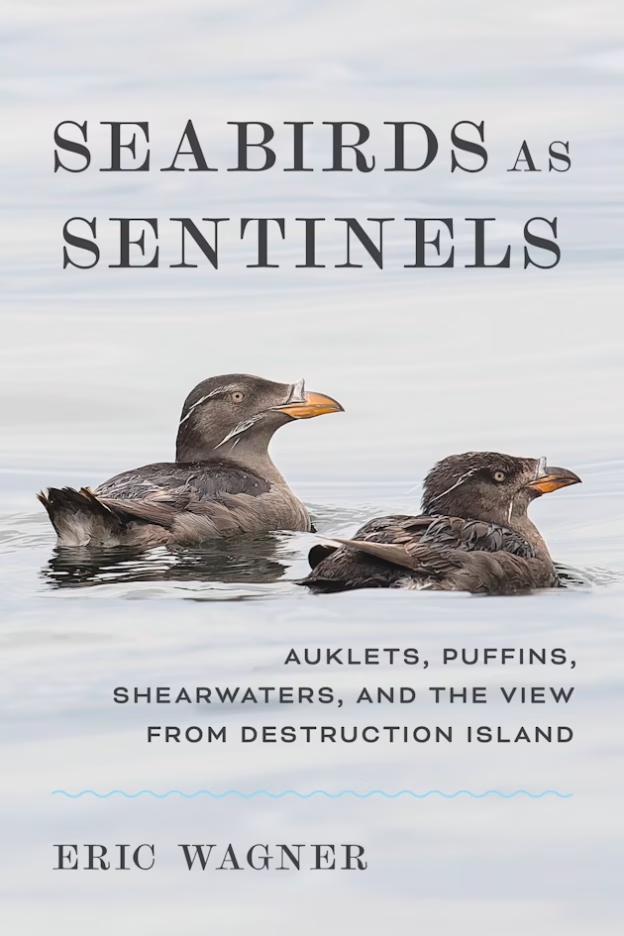
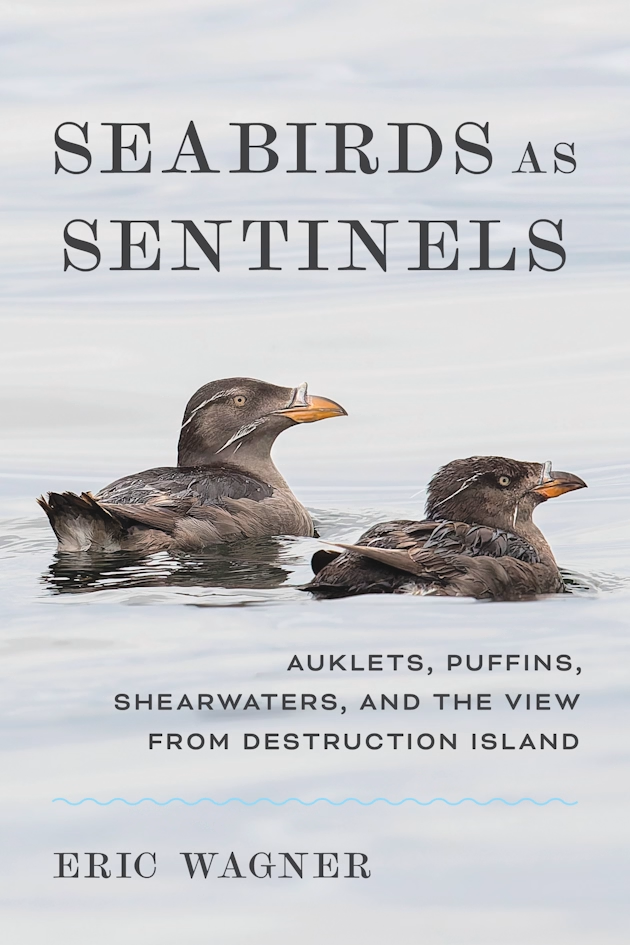
I love living in Montana, but it has one huge drawback: no ocean. This has a particular impact on me and Braden because while we do get a fair number of shorebirds breeding in and passing through the Treasure State, we almost never have the opportunity to observe, study, and enjoy seabirds. You can therefore understand my particular interest in reading Eric Wagner’s new book, Seabirds As Sentinels: Auklets, Puffins, Shearwaters, and the View from Destruction Island (University of Washington Press, 2026).
Seabirds as Sentinels by Eric Wagner, University of Washington Press. Click on image or here to order.
For me and many other birders, seabirds—also referred to as pelagic birds—are almost magical. Not only do they have incredible adaptations to live in what is arguably the world’s harshest environment, they are difficult, if not impossible, for most of us to watch. Loyal FSB readers will recall Braden’s and my account of our pelagic bird cruise during the San Diego Birding Festival (see post San Diego Seabirds). These and a precious few other puke-filled outings gave us rare opportunities to view shearwaters, murres, guillemots, and even albatrosses. Unfortunately, our time with these birds has been altogether too brief—a situation not likely to change anytime soon.
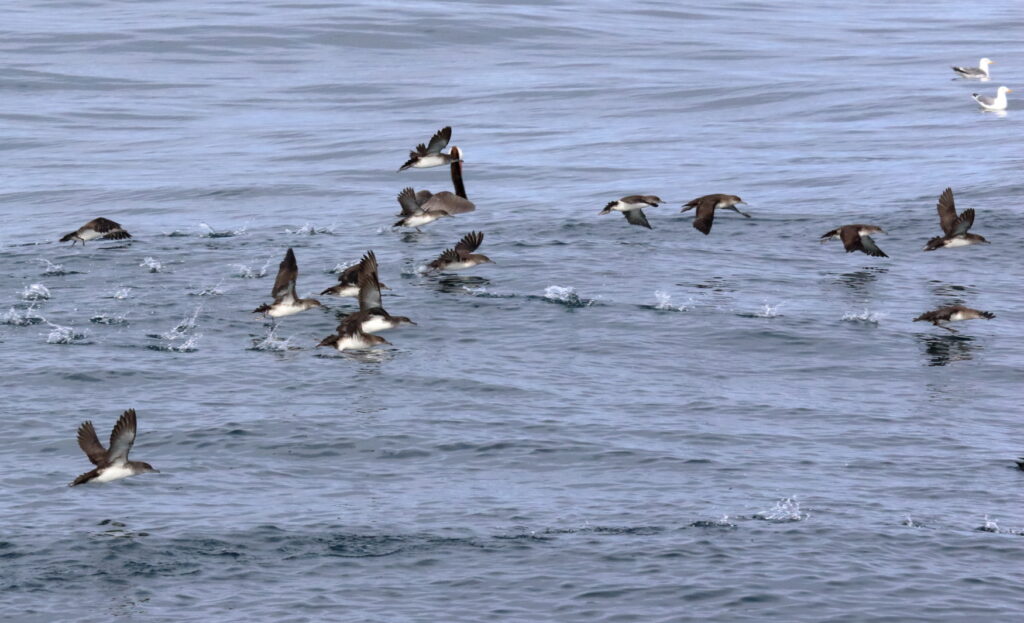
Part of a group of approximately 8,000 Black-vented Shearwaters off the coast of San Diego in 2019.
One of the real delights of Eric Wagner’s book is that he gives readers the chance to hang out with nesting Pacific Northwest seabirds, especially the Rhinoceros Auklet. Before reading Seabirds As Sentinels, I had seen Rhinoceros Auklets a couple of times, but had no idea where they bred. One answer, it turns out, is on certain islands off the coast of Washington and British Columbia. Wagner devotes a good portion of the book documenting scientists’ efforts to tag and learn about these birds as they nest on Destruction Island, only about three miles off the coast of the Olympic Peninsula.
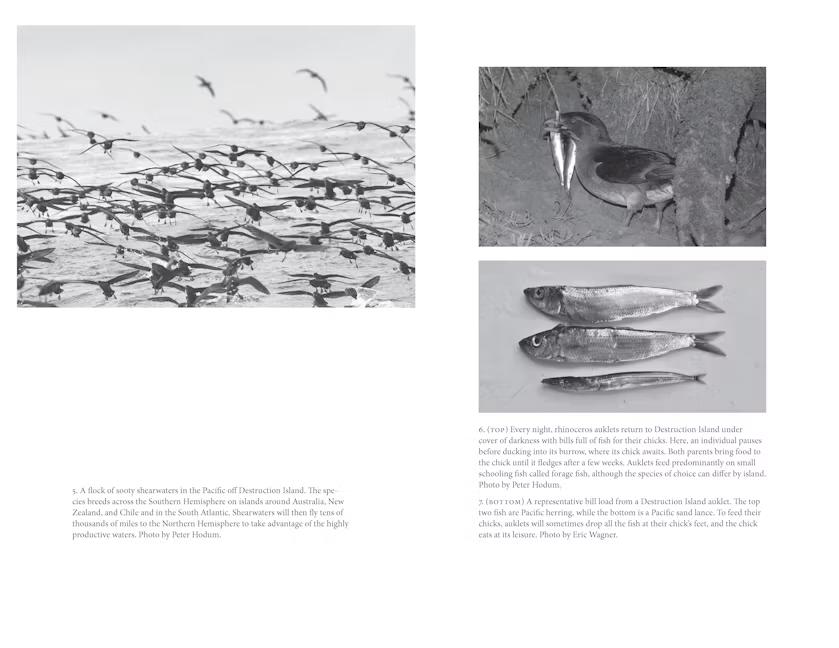
Photos from Seabirds as Sentinels including a Rhinoceros Auklet, bill filled with fish, in the upper right.
His accounts of the birds range from their comical “crash landings” as they return to the island each night to feed their chicks to the birds’ remarkable ability to locate shoals of fish and dive deep underwater to catch them. Similar discussions revolve around Sooty Shearwaters and Tufted Puffins. What makes these accounts so captivating is seeing the birds’ activities “in person” through the author’s eyes, an experience most of us will never have.
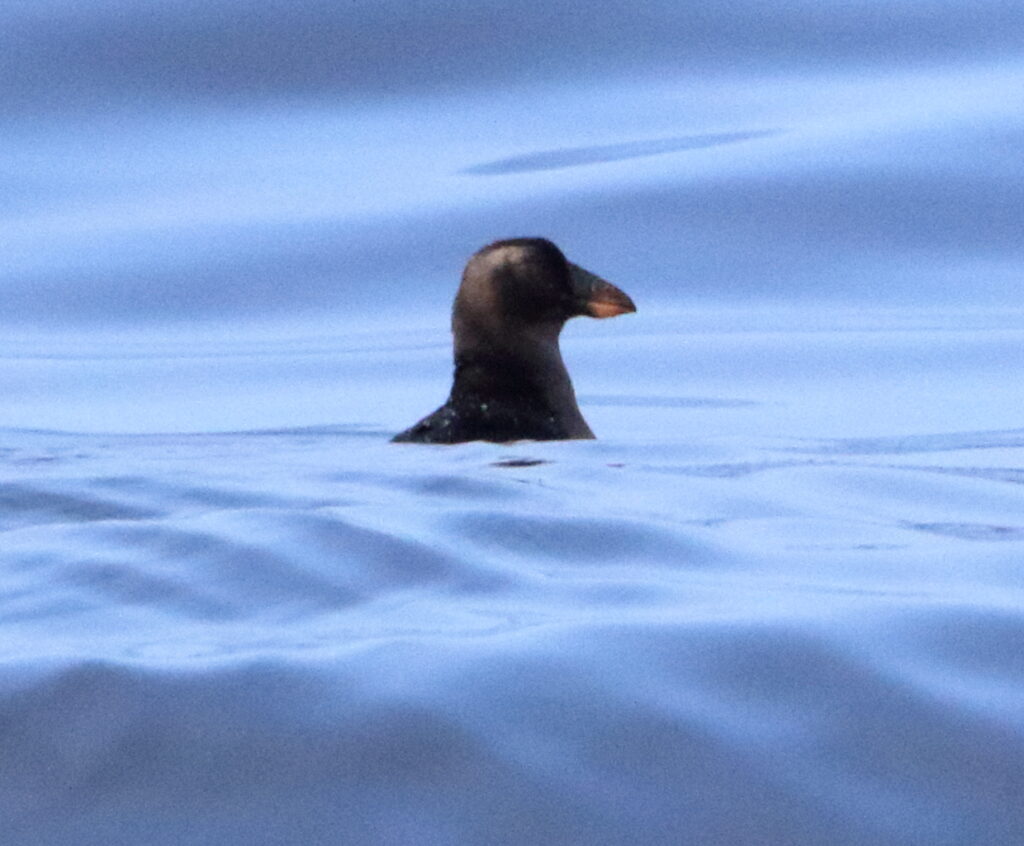
A Tufted Puffin from Braden’s and my first pelagic birding cruise off Monterey, California.
Wagner, though, also wants to educate us, and provides discussions of how the world’s primary ocean currents are generated and how these currents impact marine life. He traces the human history of the region from around the time of first European contact to modern day, including recent tribal efforts to protect an environment increasingly at risk from climate change’s many ramifications.
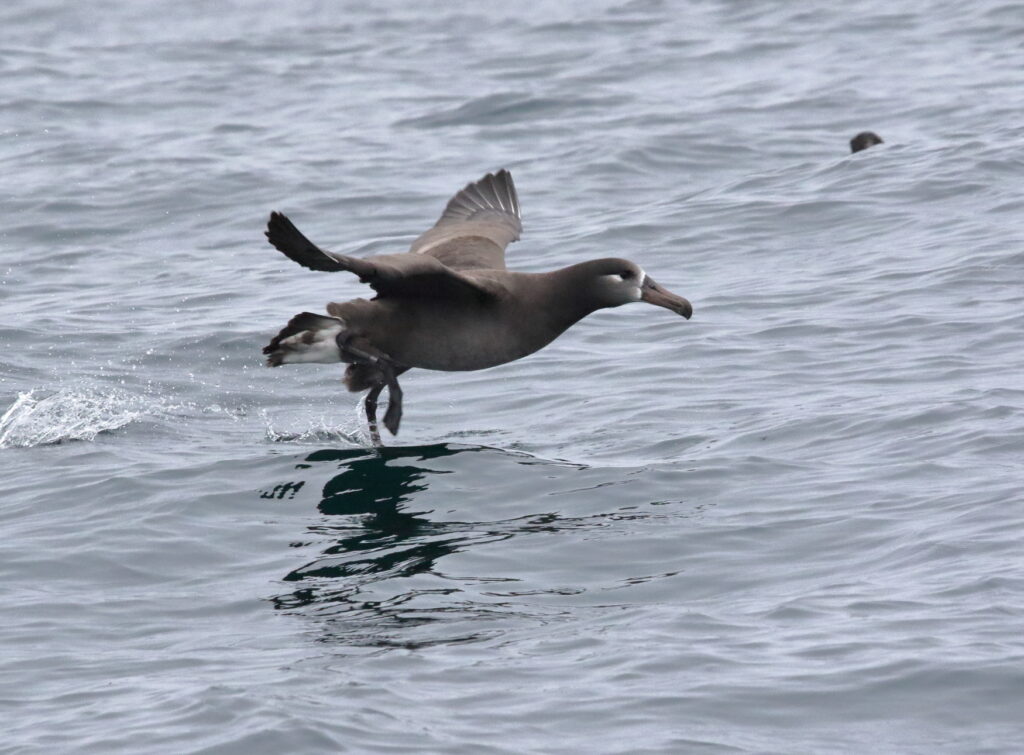
Black-footed Albatrosses are one of the birds most impacted by human activities. According to Wagner, tens of thousands have died in Hawai’i’s longline tuna fishery alone. (Photo taken off the coast of Monterey, California in 2016.)
Unfortunately, it’s impossible to talk about seabirds without pointing out the cataclysmic declines in many species, and the author doesn’t shy away from the topic. As the title suggests, the decline of seabirds mirrors the dramatic impacts human activities are having on our planet. Perhaps most alarming has been the appearance of “blobs,” persistent and unprecedented areas of warm water that either kill or drive away the prey seabirds and a host of other species depend on. Estimates of how many seabirds have died during recent blobs are mind-boggling. As many as four million Common Murres alone may have starved to death as a result of the blob of 2015 and 2016—about half of Alaska’s Common Murre population.
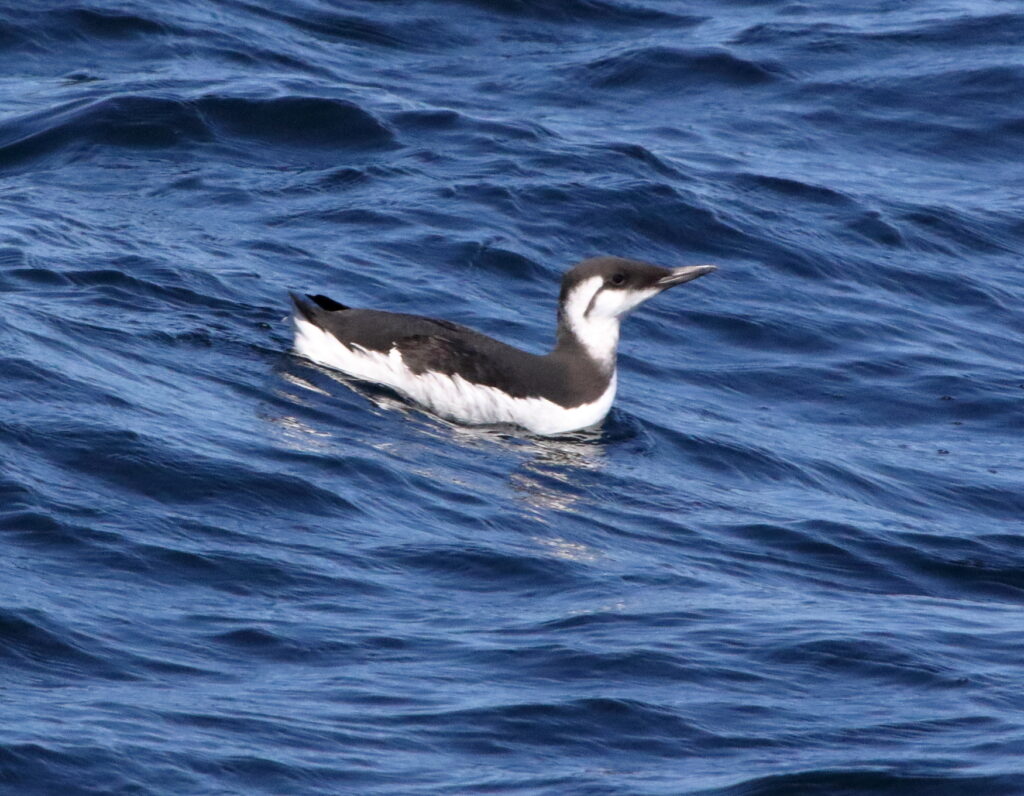
Common Murres have already been severely impacted by warmer ocean temperatures (Monterey, California, 2016).
The author doesn’t provide us with any false solutions about this and other environmental problems. After all, we all know what we have to do. We have to stop burning fossil fuels. We have to stop using our ocean as a dumping ground for plastics and other waste. We have to quit overfishing the prey species thousands of other species also depend on. What the book does do, though, is raise our awareness of why these things matter—and perhaps provide each of us with the resolve to keep working toward a solution in whatever ways we can.
The state of Maine can be simplified to four things: lobster, moose, blueberries, and puffins (with Dunkin Donuts as a runner-up). During the four years I’d spent going to school in the state, I’d eaten lobster rolls, visited blueberry bogs, and tried my hardest to find a moose, a quest that would continue later this week. Through no fault of my own, I had never even tried to see a puffin and the reason was simple—my school year did not overlap with the Atlantic Puffin school year. This year, however, was different. I was actually still in the state of Maine as puffins were arriving at their breeding colonies, and was not going to miss my last chance to see these iconic seabirds. So, on May 14th, I boarded a large boat in Bar Harbor and took my seat in the cabin, binoculars and camera ready.
Unlike previous boat rides I’d taken to see birds, this cruise was relaxed and family-friendly. About two hundred people crowded the deck, many of whom were just as interested in the Bald Eagles and American Herring Gulls circling above the harbor as the prospect of seeing any alcids (Alcidae is the family of birds that includes puffins, murres, auks, and guillemots). Over the intercom, a very knowledgeable guide spouted off a non-stop stream of facts about the islands, lighthouses, and wildlife of the area as we headed for Egg Rock, a sparse strip of land just barely visible to tourists standing onshore in Bar Harbor. With the coastline of Acadia National Park to our right, we slowed as we approached the island.
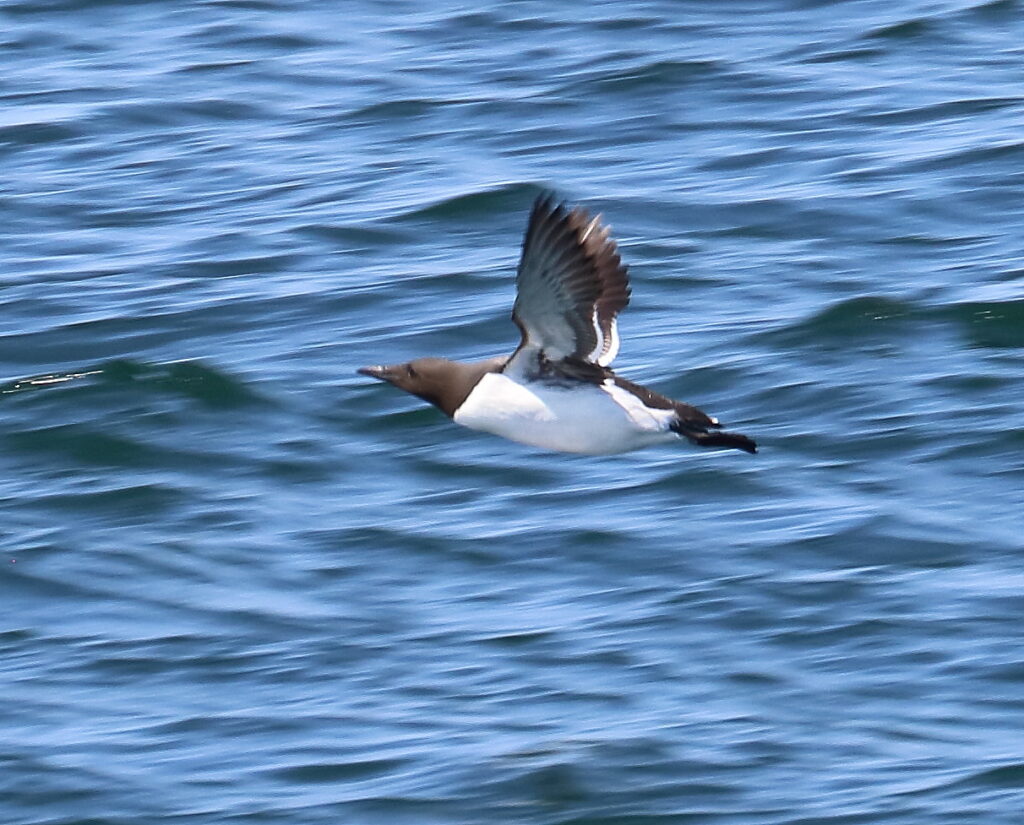
This Common Murre was the only one I saw the whole boat ride. While this species hasn’t yet started nesting at Petit Manan, the ornithologists are hopeful that they will soon!
Egg Rock did not have a puffin colony—it was too close to shore for that. What it did have were colonies of several other species of seabirds. Gulls dominated the island, mostly Herring with scattered numbers of Great Black-backed Gulls mixed in, their charcoal backs sticking out amongst the sea of gray. Cormorants patrolled the southern side of the island, standing tall like gargoyles on the rocks. And in the waters lapping up against the side of the island I saw my first alcids—Black Guillemots! Although guillemots, which are black with white wing patches in the summer and white with black wing patches in the winter, are in the same bird family as Atlantic Puffins, they are far easier to see in Maine. Not only do they breed right on the coast during the warm months, they also stay for the winter—something that the puffins do not do. That’s one of the reasons why I’d never seen puffins here during my time at the University of Maine: From August to April, these birds stay as far from shore as possible, floating around somewhere in the North Atlantic.
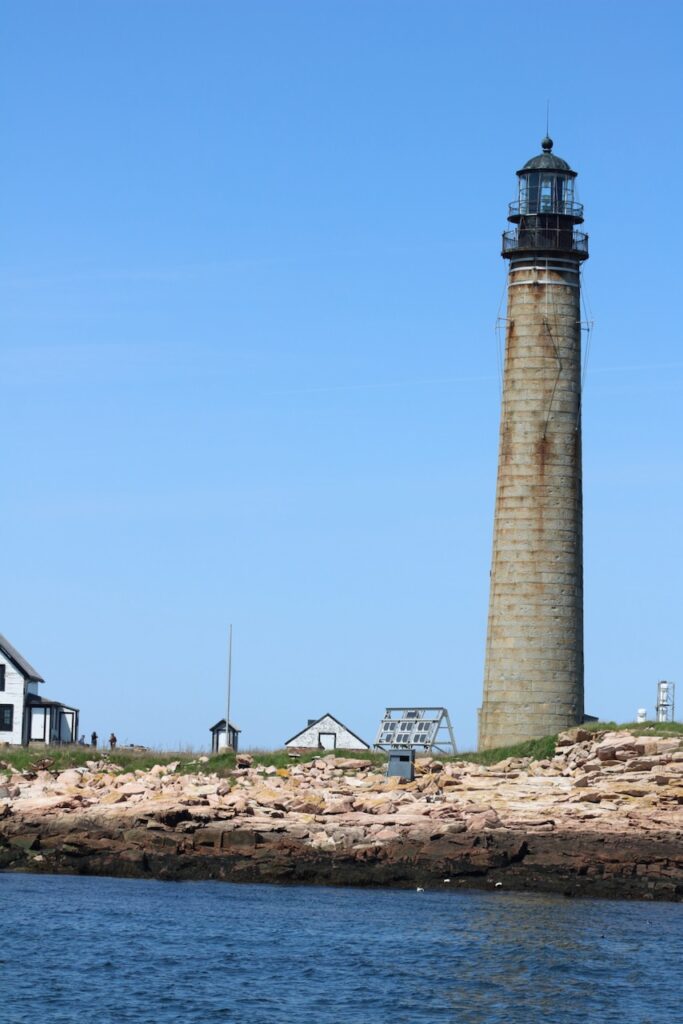
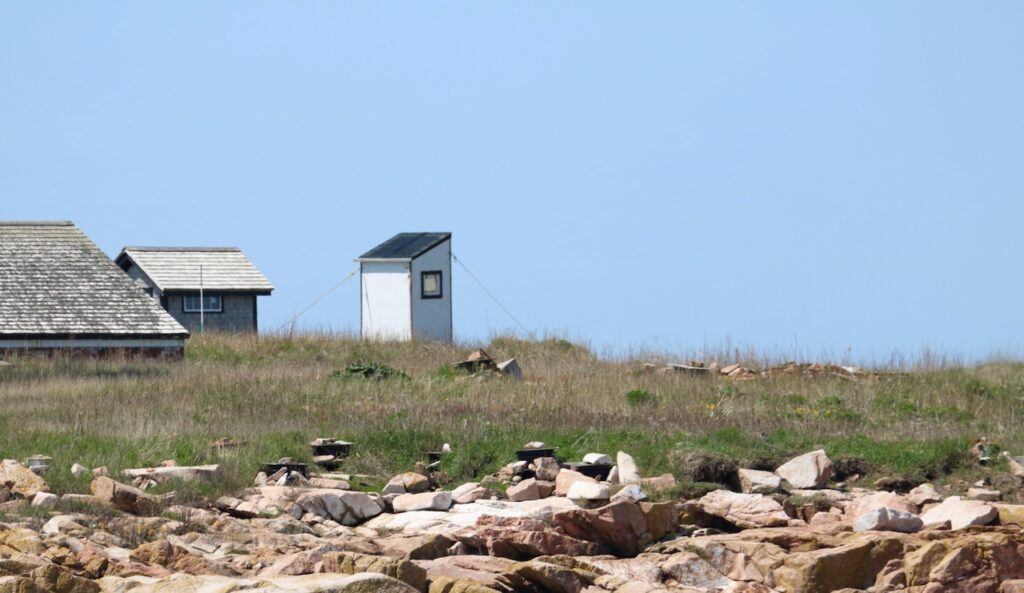
After circling Egg Rock to look at the seabird colonies, as well as the dozens of Harbor and Gray Seals lounging on the rocks, the boat picked up speed and headed out to sea. While we never lost sight of the coastline, it grew hazier and hazier until eventually, a new island appeared on the horizon: Petit Manan. The first thing I noticed about Petit Manan were the buildings. Many islands off the coast of Maine had lighthouses, built during centuries past to help steer ships into harbors. As recently as the late 1900s, lighthouse keepers and their families lived on the islands and maintained the lighthouses, although by now many of the keepers had left, likely because boats had better forms of navigation at their disposal. The houses they left behind had been taken over by people working a very different type of job.
The Lighthouse on Petit Manan Island.
Both Egg Rock and Petit Manan are part of a large reserve known as Maine Coastal Islands National Wildlife Refuge. Every summer, dozens of wildlife technicians head out to these islands to spend weeks and months working with the birds that live there. On some islands, like Petit Manan, this work includes Atlantic Puffins, but it also includes monitoring and conservation of other species like Common, Arctic, and Roseate Terns, Common Murres, Black Guillemots, Razorbills, Common Eiders, and Leach’s Storm-petrels. Several of my peers at the University of Maine worked for Maine Coastal Islands and would be heading out to their assigned locations within the next few weeks.
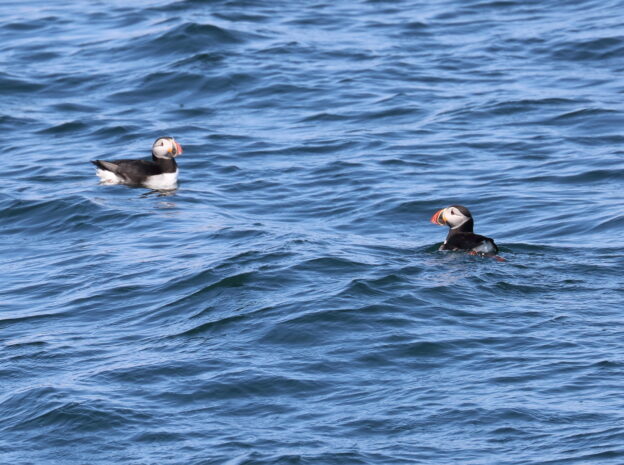
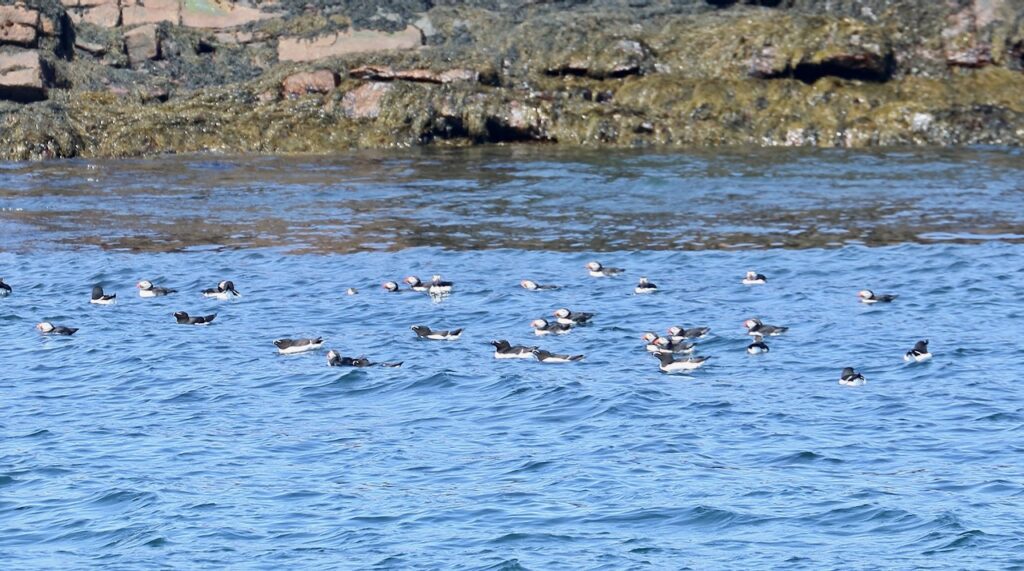
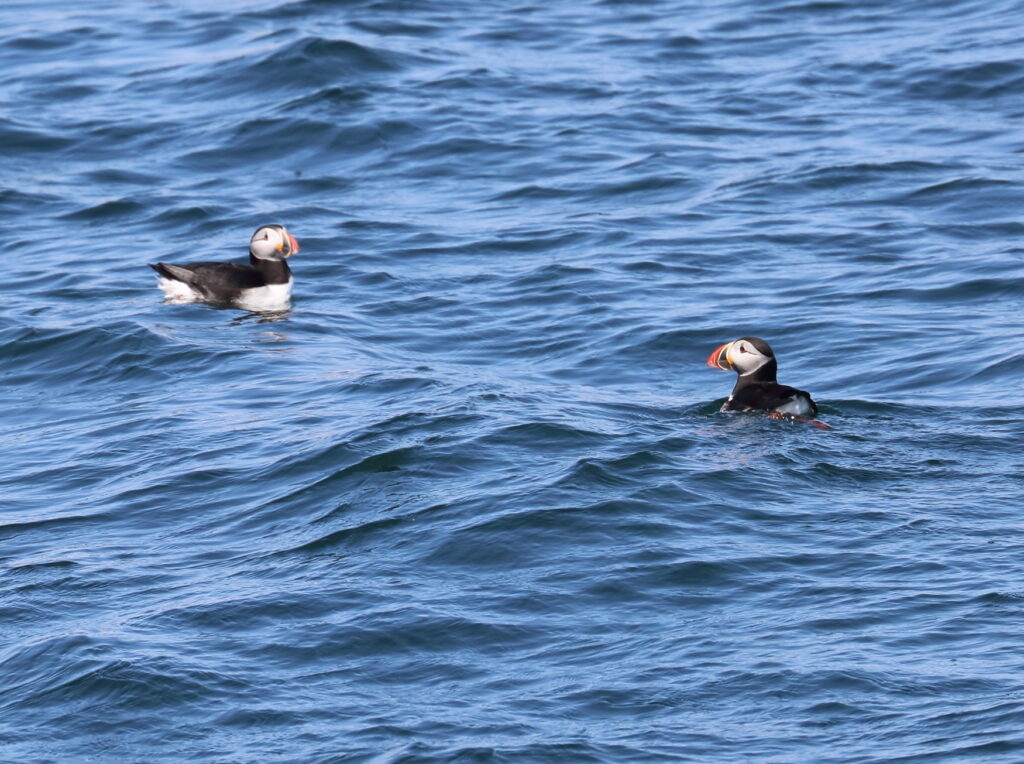
I began to make out large rafts of birds next to the island as our boat approached, and was delighted to spot football-sized alcids with rainbow bills taking off in front of us. I raised my binoculars and smiled—these were the first Atlantic Puffins I’d seen in seven years, since 2018 when I’d been lucky enough to visit Iceland with my grandparents (see my post “All About Alcids”). The birds lounged in the water close to the rocks, and our guide told us that many of them had likely just returned for the summer from their mysterious marine wintering grounds. I counted ninety or so during our half hour stay at Petit Manan.
A raft of Atlantic Puffins and Razorbills!
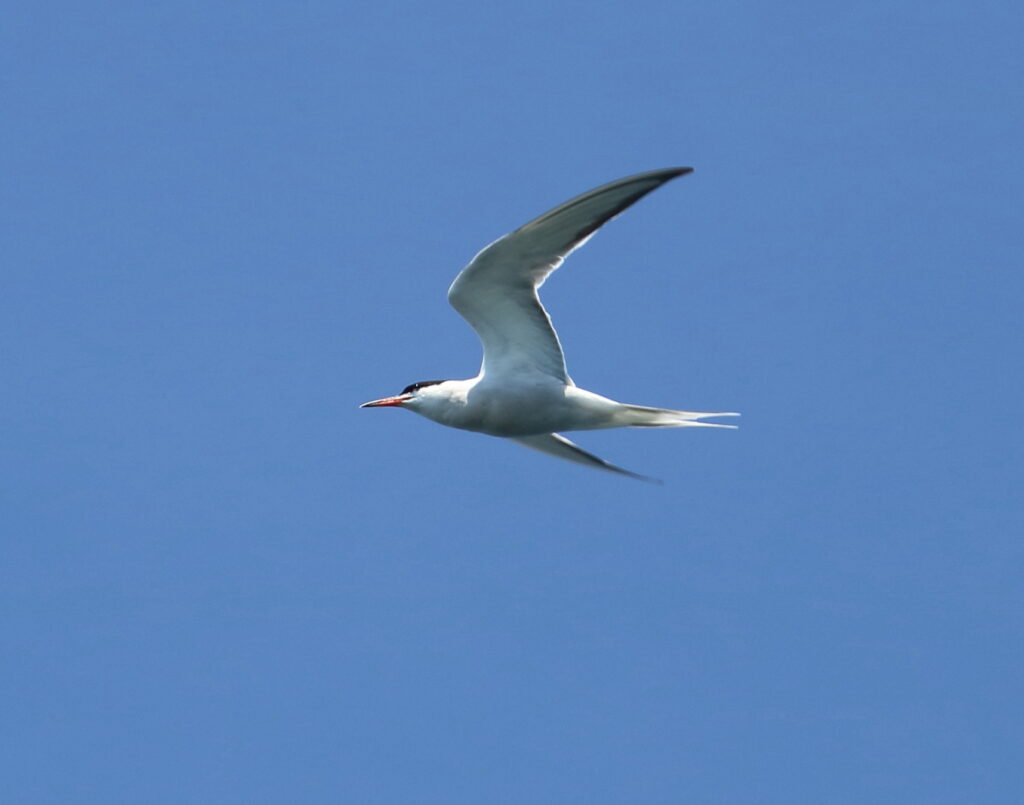
The puffins weren’t alone. Black Guillemots were here, too, as were a couple dozen Razorbills, another gorgeous black-and-white alcid named after the unique shape and decoration of its beak. I spotted a single Common Murre amongst their ranks, my fourth alcid of the day and a species that had not yet attempted to nest at Petit Manan—but scientists were optimistic! A dozen or so Common Terns circled the island loftily, letting out loud “kyeeeer” calls to notify everyone who was really in charge here. In a few weeks, the numbers of terns would swell into the hundreds, and include Arctic as well as Common. Terns were the aggressive defenders of islands, and would dive-bomb anything they perceived as a threat, including people. I remembered one walk in Iceland when we were asked to hold a tall, wooden stick so the Arctic Terns there would target that instead of our heads!
These birds are the reason that so many alcids nest at Petit Manan. The huge tern colony on this and other islands provide safety for the puffins from predators like gulls and Peregrine Falcons that might otherwise raid their nests. Of course, the biologists working for Maine Coastal Islands NWR were also there to aid these species and chase predators off the island. It hadn’t always been that way, unfortunately.
Common Terns nest in huge, aggressive colonies along the Maine coast!
A hundred years ago, feathered hats were all the rage in cities across the east coast of North America. The demand for white feathers meant that large numbers of terns, gulls, and egrets were harvested—to the extent that these species declined dramatically across much of the country. With no terns to protect them, puffins nesting in Maine were faced with higher predation, but not just from other birds. Rampant collection of eggs and puffin meat also plagued many of Maine’s islands, leading to a dramatic decrease in this species down to just two tiny colonies. Sadly, it was looking like the Atlantic Puffin would join the ranks of the Great Auk and Labrador Duck in Maine’s list of extinct birds.
Thankfully, ornithologists and bird-lovers alike noticed how much environmental damage was being caused by these practices and stepped in. Groups like Audubon formed and began lobbying for the protection of birds, eventually leading to the passing of the Migratory Bird Treaty Act of 1918. And in 1973, Audubon launched Project Puffin. Scientists were sent out to islands equipped with broadcasting equipment and decoys, as well as a small number of puffin chicks donated from colonies in Canada. Step one was the rearing of chicks on islands that had previously been occupied by puffin colonies; step two meant attracting terns back to the islands. Finally, with their defenders back in place, Atlantic Puffins began returning to many of the islands they’d previously been extirpated from. They now occupy six colonies in Maine.
Today, Atlantic Puffins are doing well, but are still being monitored very carefully. Puffins feed on fish that thrive in deep, cold water. That’s why the species only nests on the outermost islands in Maine. Our guide told us, “Puffins would lay their eggs in the ocean if they could.” Unfortunately, the Gulf of Maine is warming faster than any other body of water in the world, and this means that puffins are having to travel farther and farther out to sea to obtain their prey items of choice. During particularly warm years, puffins have switched their selected prey entirely to other species. Many of these other species of fish, which are brought back to their chicks on Petit Manan and other islands, differ in their size and the toughness of their skin. Often puffin chicks cannot eat them, and will starve even when food is sitting right there.
The man-made burrows where puffins nest on Petit Manan!
The good news is that there are many, many people keeping an eye on these birds, doing their best to keep their numbers high. Last year was an especially good year for the species, so optimism is in the air. I felt cautiously hopeful for the future of this species as the Bar Harbor Puffin Tour headed back to shore, content with the pictures and new memories I’d experienced with this iconic Maine species.