All posts on FatherSonBirding are written and photographed by REAL PEOPLE.
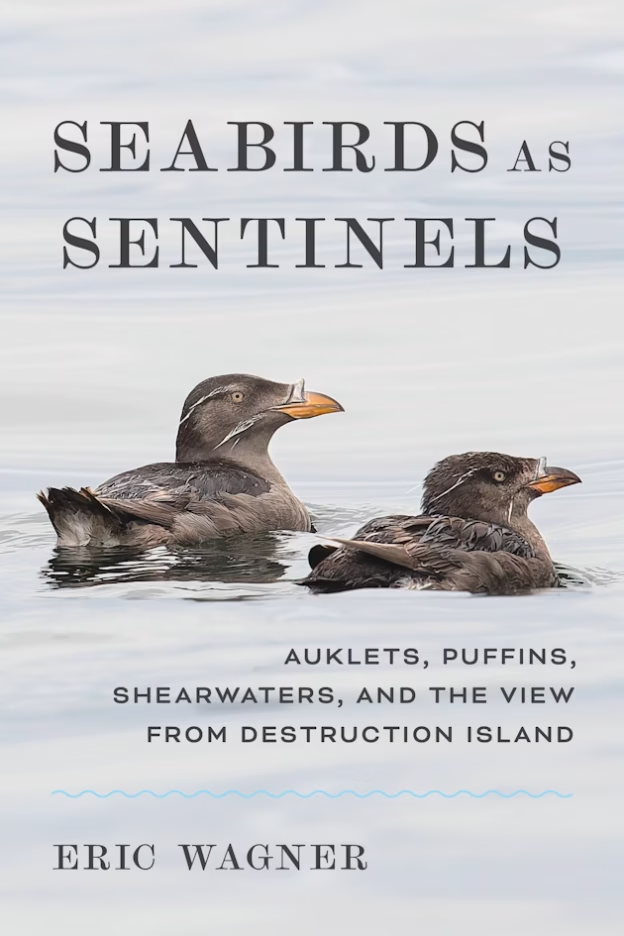
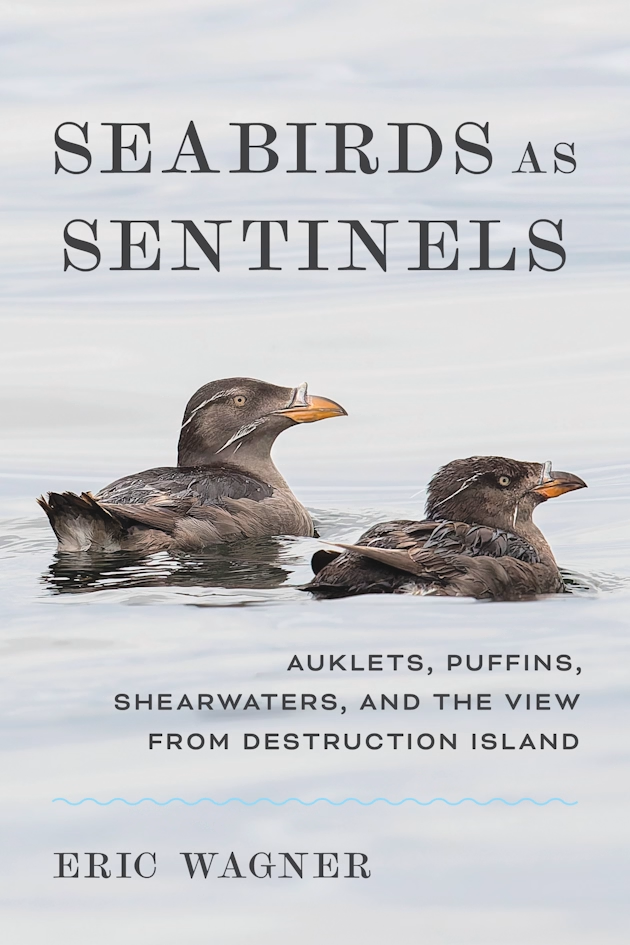
I love living in Montana, but it has one huge drawback: no ocean. This has a particular impact on me and Braden because while we do get a fair number of shorebirds breeding in and passing through the Treasure State, we almost never have the opportunity to observe, study, and enjoy seabirds. You can therefore understand my particular interest in reading Eric Wagner’s new book, Seabirds As Sentinels: Auklets, Puffins, Shearwaters, and the View from Destruction Island (University of Washington Press, 2026).
Seabirds as Sentinels by Eric Wagner, University of Washington Press. Click on image or here to order.
For me and many other birders, seabirds—also referred to as pelagic birds—are almost magical. Not only do they have incredible adaptations to live in what is arguably the world’s harshest environment, they are difficult, if not impossible, for most of us to watch. Loyal FSB readers will recall Braden’s and my account of our pelagic bird cruise during the San Diego Birding Festival (see post San Diego Seabirds). These and a precious few other puke-filled outings gave us rare opportunities to view shearwaters, murres, guillemots, and even albatrosses. Unfortunately, our time with these birds has been altogether too brief—a situation not likely to change anytime soon.
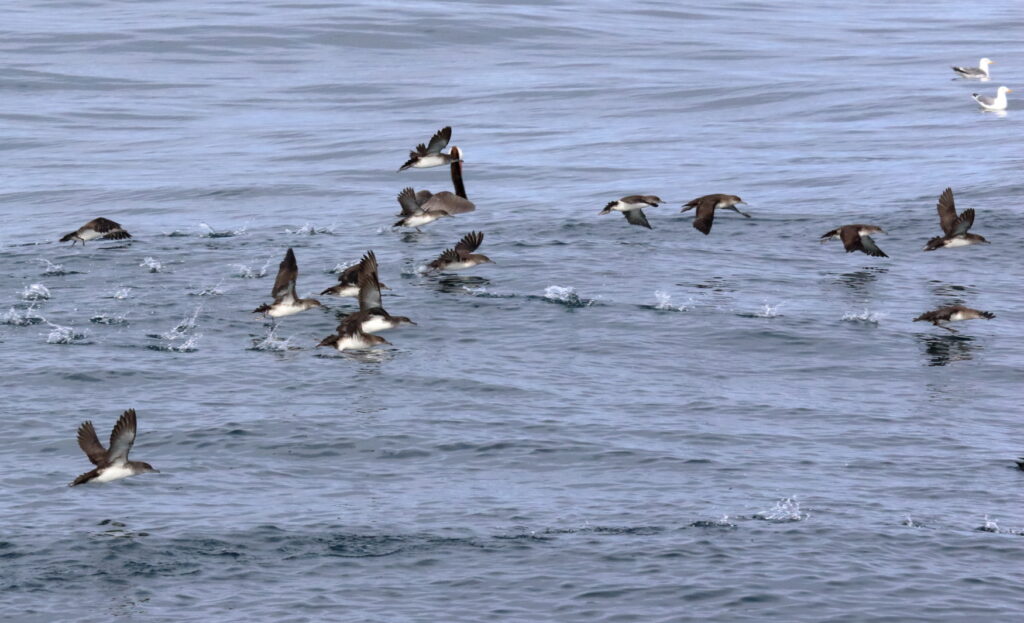
Part of a group of approximately 8,000 Black-vented Shearwaters off the coast of San Diego in 2019.
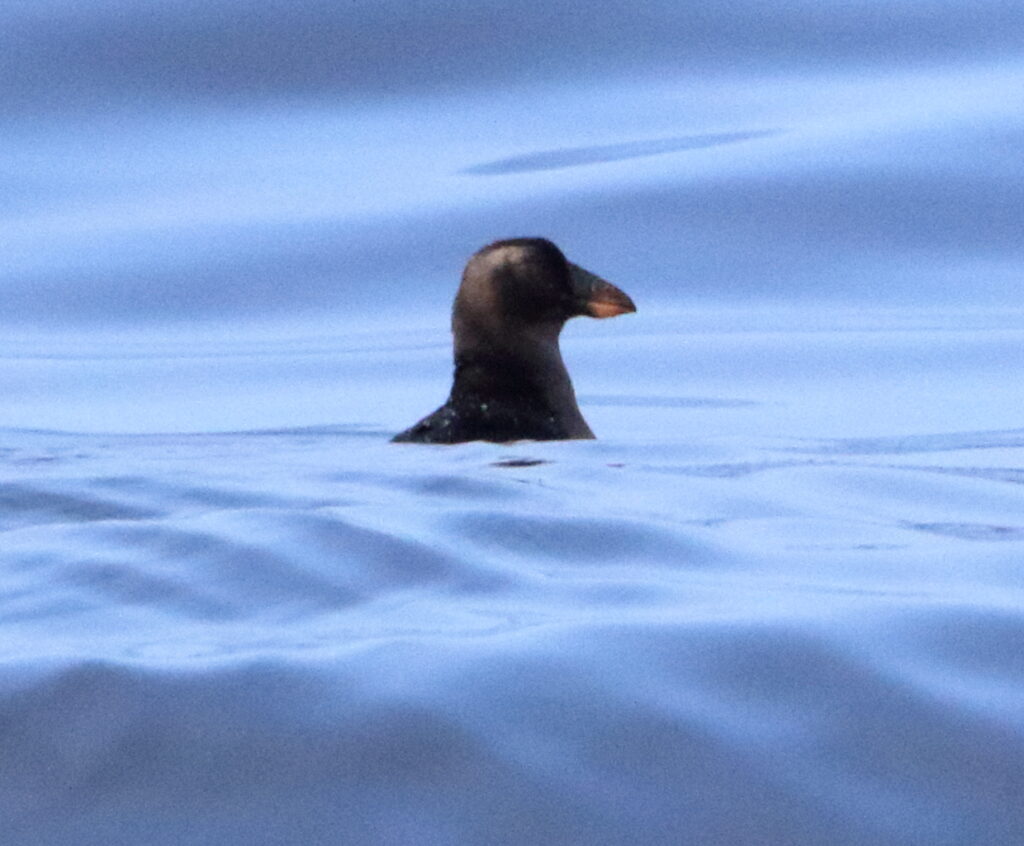
One of the real delights of Eric Wagner’s book is that he gives readers the chance to hang out with nesting Pacific Northwest seabirds, especially the Rhinoceros Auklet. Before reading Seabirds As Sentinels, I had seen Rhinoceros Auklets a couple of times, but had no idea where they bred. One answer, it turns out, is on certain islands off the coast of Washington and British Columbia. Wagner devotes a good portion of the book documenting scientists’ efforts to tag and learn about these birds as they nest on Destruction Island, only about three miles off the coast of the Olympic Peninsula.
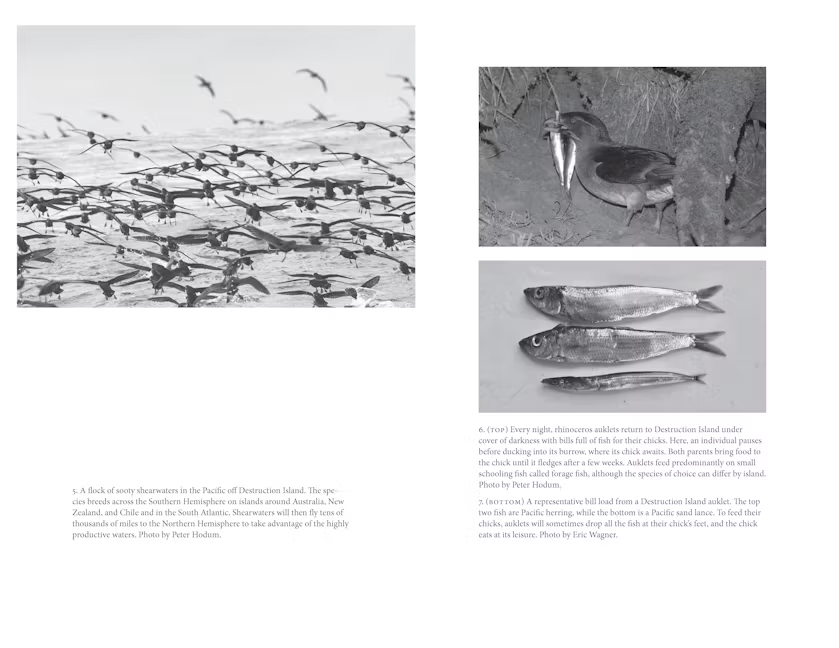
Photos from Seabirds as Sentinels including a Rhinoceros Auklet, bill filled with fish, in the upper right.
His accounts of the birds range from their comical “crash landings” as they return to the island each night to feed their chicks to the birds’ remarkable ability to locate shoals of fish and dive deep underwater to catch them. Similar discussions revolve around Sooty Shearwaters and Tufted Puffins. What makes these accounts so captivating is seeing the birds’ activities “in person” through the author’s eyes, an experience most of us will never have.
A Tufted Puffin from Braden’s and my first pelagic birding cruise off Monterey, California.
Wagner, though, also wants to educate us, and provides discussions of how the world’s primary ocean currents are generated and how these currents impact marine life. He traces the human history of the region from around the time of first European contact to modern day, including recent tribal efforts to protect an environment increasingly at risk from climate change’s many ramifications.
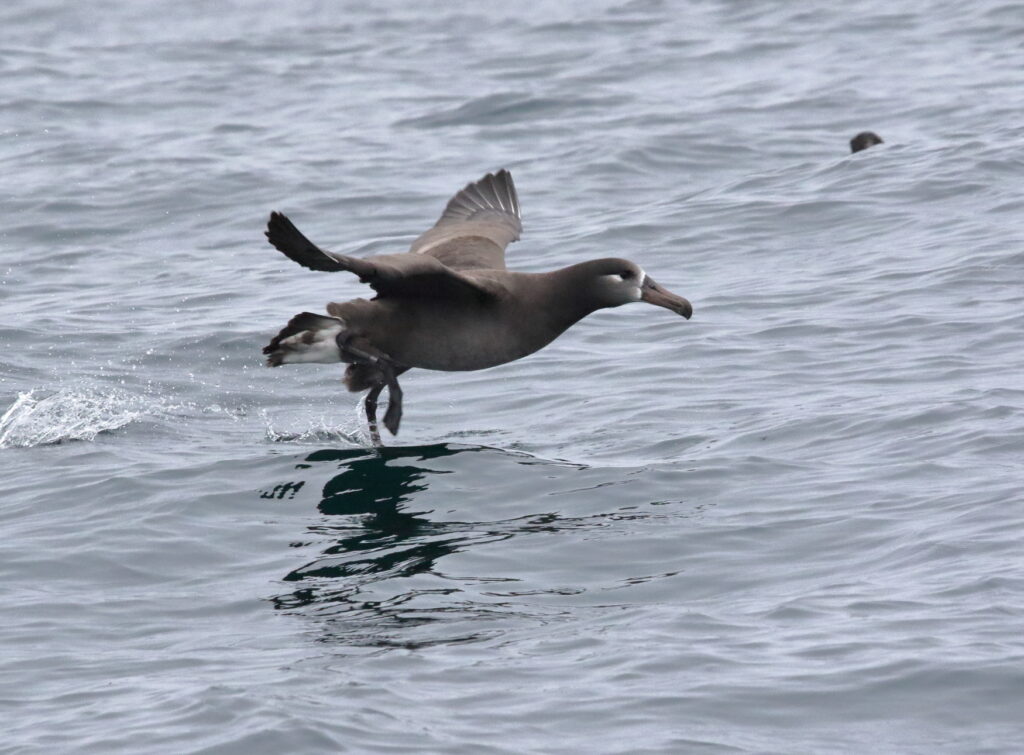
Black-footed Albatrosses are one of the birds most impacted by human activities. According to Wagner, tens of thousands have died in Hawai’i’s longline tuna fishery alone. (Photo taken off the coast of Monterey, California in 2016.)
Unfortunately, it’s impossible to talk about seabirds without pointing out the cataclysmic declines in many species, and the author doesn’t shy away from the topic. As the title suggests, the decline of seabirds mirrors the dramatic impacts human activities are having on our planet. Perhaps most alarming has been the appearance of “blobs,” persistent and unprecedented areas of warm water that either kill or drive away the prey seabirds and a host of other species depend on. Estimates of how many seabirds have died during recent blobs are mind-boggling. As many as four million Common Murres alone may have starved to death as a result of the blob of 2015 and 2016—about half of Alaska’s Common Murre population.
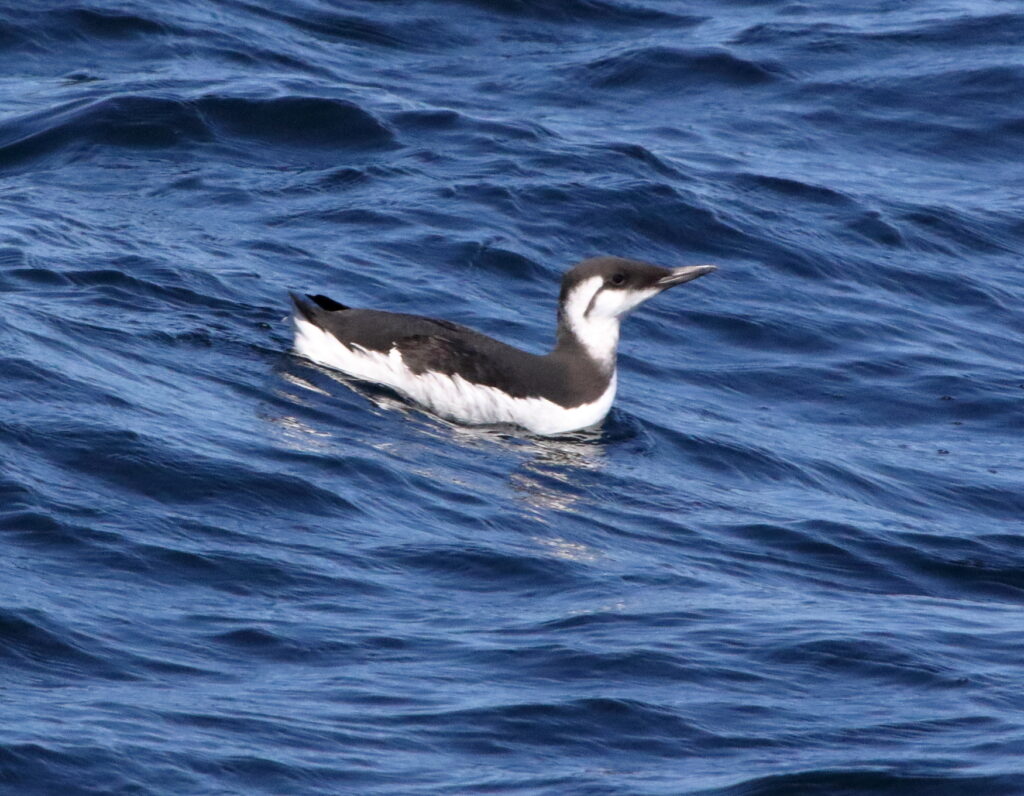
Common Murres have already been severely impacted by warmer ocean temperatures (Monterey, California, 2016).
The author doesn’t provide us with any false solutions about this and other environmental problems. After all, we all know what we have to do. We have to stop burning fossil fuels. We have to stop using our ocean as a dumping ground for plastics and other waste. We have to quit overfishing the prey species thousands of other species also depend on. What the book does do, though, is raise our awareness of why these things matter—and perhaps provide each of us with the resolve to keep working toward a solution in whatever ways we can.
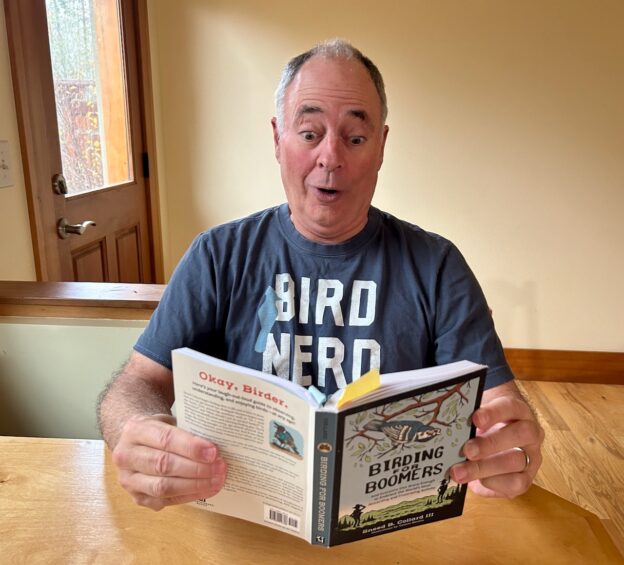
If you’re like me, you never read quite as many books as you’d like. This year, though, I was very fortunate to read and review some outstanding bird-related titles that you’re going to want to consider for your holiday buying. Most—but not all—of these were published in 2025 or late 2024. I’ve also included a few books that aren’t solely about birds—but give great insights into how to protect them. Of course, you will want to begin your shopping with eight or ten copies of my book Birding for Boomers—And Everyone Else Brave Enough to Embrace the World’s Most Rewarding and Frustrating Activity. This popular gift book has received half a dozen awards and even made a couple of bestseller’s lists. Once you’ve placed that order, however, you’ll want to check out the titles below. Please note: we receive no compensation for any of these recommendations (other than a free review copy or two), so the thoughts are all our own. Enjoy!
Purely Enjoyable Bird Storytelling
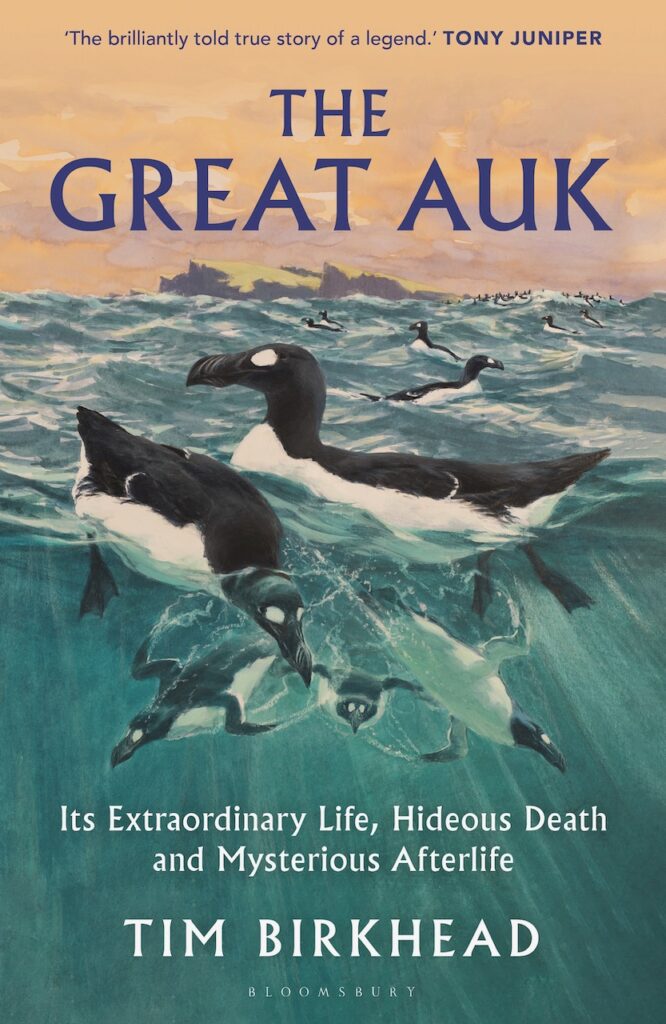
Let’s start with the “most fun” category of reading—great storytelling that just happens to be about birds. In the past, I’ve recommended such titles as Christopher Skaife’s The Ravenmaster, Joshua Hammer’s The Falcon Thief, and Tim Gallagher’s classic, Imperial Dreams. My favorite title from this year’s reading is Tim Birkhead’s The Great Auk: Its Extraordinary Life, Hideous Death and Mysterious Afterlife. This wonderful, often whimsical tale focuses on an extinct species most of us have heard of, but know little about. Birkhead gets totally into Bird Nerd mode by both explaining the biology and history of the Great Auk, and tracing some of the antics of egg collectors who were totally obsessed with obtaining Great Auk eggs. You’ll love this! See our full review here.
The Great Auk by Tim Birkhead (Bloomsbury, 2025)
Also on the short list for this category is Bruce M. Beehler’s Flight of the Godwit, a must-read for anyone interested in the remarkable lives of shorebirds—and who isn’t? Through the tales of his own peregrinations, Beehler follows the migrations of many of North America’s most charismatic shorebirds, telling us all kinds of cool things that I certainly never knew before. See our full review here.
Birding Memoirs
My top pick for this category is Christian Cooper’s 2023 book, Better Living Through Birding: Notes from a Black Man in the Natural World. I admit that I put off reading this book for a couple of years after it came out. It’s sheer popularity made me insanely jealous as an author, but once I picked it up, I was captivated. Cooper’s down-to-earth honesty about his life and passion for birds sucked me right in, both with its engaging storytelling and how it broadened my perspective on birding in our culture.
My second pick for this category is Richard L. Hutto’s new book, A Beautifully Burned Forest: Learning to Celebrate Severe Forest Fire. This book is half memoir and half science book and I enjoyed both parts equally. Perhaps as a fellow Southern Californian, I especially related to Hutto’s boyhood experiences exploring the chaparral ecosystem, but I also appreciated Hutto’s impassioned plea to bring common sense to fire management, especially when it comes to protecting burned forests from the ravages of so-called “salvage” logging. See our full review here.
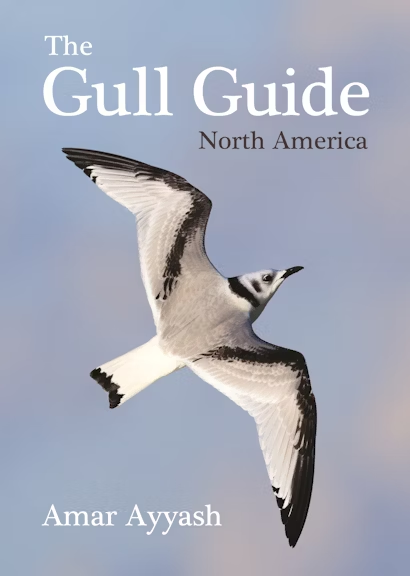
Advanced Bird Nerds will definitely want to add Amar Ayyash’s The Gull Guide: North America to their holiday shopping lists this year. Like most birders, I have been—and remain—incredibly intimidated by gulls. Sure, I recognize the adult plumages of many species, but when you start getting into hybrid gulls and first-, second-, and third-year plumage variations, my brain and confidence begin to melt. The Gull Guide does not solve this problem, but it does accomplish two important things. First, it gives great insight into gulls for the casual birder. Second, it offers myriad minute details for those who are bound and determined to become experts on everything gull. Both of these things are accomplished with an extensive, remarkable collection of photos that serve to educate and guide. See our full review here.
A less technical book that may be more to the taste of the casual birder is The Shorebirds of North America: A Natural History and Photographic Celebration by Pete Dunne and Kevin T. Karlson. This beautiful book strikes a nice balance between detail and readability. A lot, but not all, of the information is fairly general, but the photos are wonderful and if you’re a shorb fan, you will enjoy it. See our full review here.
Three More for the Planet
I’d be remiss if I didn’t mention three more titles that made a big impact on me this year. The first is Sea of Grass: The Conquest, Ruin, and Redemption of Nature on the American Prairie by Dave Hage and Josephine Marcotty. I thought I knew all about the tragic history of the destruction of America’s grasslands. I did not. This highly readable book provides astonishing insights into how we lost most of our grasslands—and why that destruction continues today. Grassland birds are our most imperiled group of birds, losing at least forty percent of their collective populations in just the last fifty years. If you care about these animals and want to know what we can do to slow their precipitous demise, please read this one!
Similarly, Jordan Thomas’s When It All Burns: Fighting Fire in a Transformed World, gives us an inside look at the often counterproductive politics and decision-making behind today’s “fire fighting industrial complex.” With riveting storytelling and astonishing revelations, this is a perfect companion to Hutto’s A Beautifully Burned Forest.
And if you’re wrestling with how to keep from being overwhelmed in today’s world, where we are confronted by one environmental threat after another, I highly recommend the late Thich Nhat Hanh’s Zen and the Art of Saving the Planet. I read a few pages of this every morning and I gotta say that it helps keep me sane in our complicated, highly imperiled world. Not only does it raise serious questions about how we all live, it provides approaches and encouragement for how each of us can truly make a difference.
Don’t miss our holiday guides to birding equipment and, in our next post, charitable giving!
The state of Maine can be simplified to four things: lobster, moose, blueberries, and puffins (with Dunkin Donuts as a runner-up). During the four years I’d spent going to school in the state, I’d eaten lobster rolls, visited blueberry bogs, and tried my hardest to find a moose, a quest that would continue later this week. Through no fault of my own, I had never even tried to see a puffin and the reason was simple—my school year did not overlap with the Atlantic Puffin school year. This year, however, was different. I was actually still in the state of Maine as puffins were arriving at their breeding colonies, and was not going to miss my last chance to see these iconic seabirds. So, on May 14th, I boarded a large boat in Bar Harbor and took my seat in the cabin, binoculars and camera ready.
Unlike previous boat rides I’d taken to see birds, this cruise was relaxed and family-friendly. About two hundred people crowded the deck, many of whom were just as interested in the Bald Eagles and American Herring Gulls circling above the harbor as the prospect of seeing any alcids (Alcidae is the family of birds that includes puffins, murres, auks, and guillemots). Over the intercom, a very knowledgeable guide spouted off a non-stop stream of facts about the islands, lighthouses, and wildlife of the area as we headed for Egg Rock, a sparse strip of land just barely visible to tourists standing onshore in Bar Harbor. With the coastline of Acadia National Park to our right, we slowed as we approached the island.
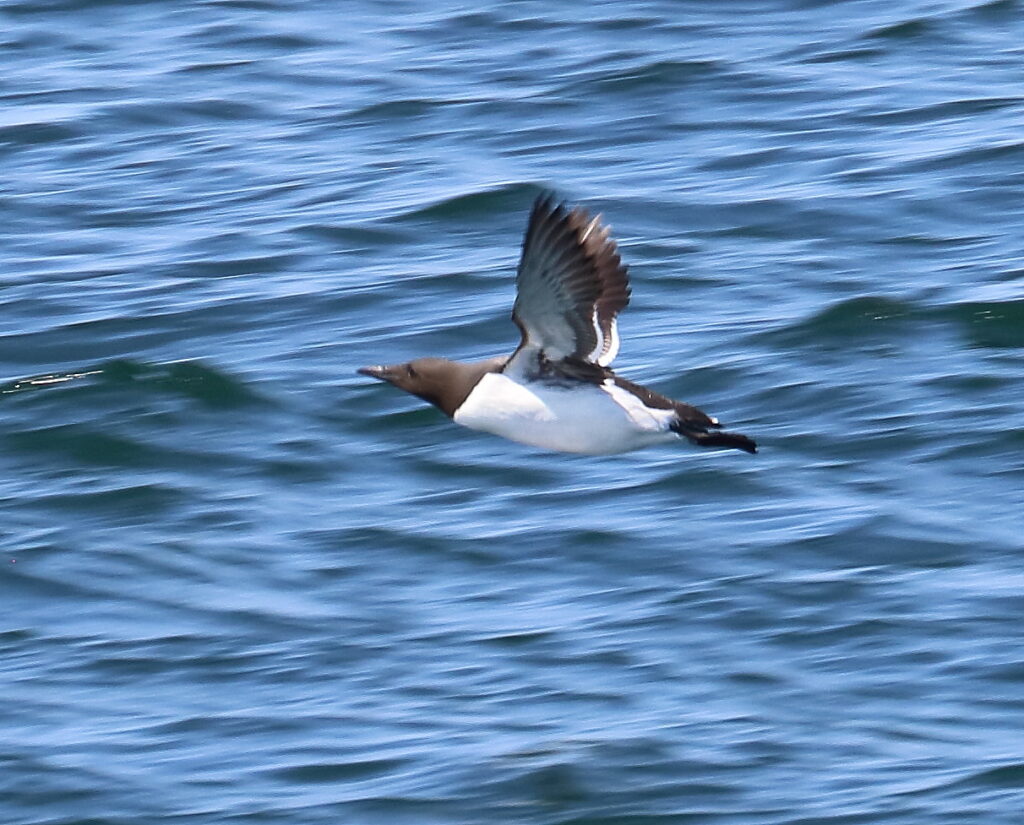
This Common Murre was the only one I saw the whole boat ride. While this species hasn’t yet started nesting at Petit Manan, the ornithologists are hopeful that they will soon!
Egg Rock did not have a puffin colony—it was too close to shore for that. What it did have were colonies of several other species of seabirds. Gulls dominated the island, mostly Herring with scattered numbers of Great Black-backed Gulls mixed in, their charcoal backs sticking out amongst the sea of gray. Cormorants patrolled the southern side of the island, standing tall like gargoyles on the rocks. And in the waters lapping up against the side of the island I saw my first alcids—Black Guillemots! Although guillemots, which are black with white wing patches in the summer and white with black wing patches in the winter, are in the same bird family as Atlantic Puffins, they are far easier to see in Maine. Not only do they breed right on the coast during the warm months, they also stay for the winter—something that the puffins do not do. That’s one of the reasons why I’d never seen puffins here during my time at the University of Maine: From August to April, these birds stay as far from shore as possible, floating around somewhere in the North Atlantic.
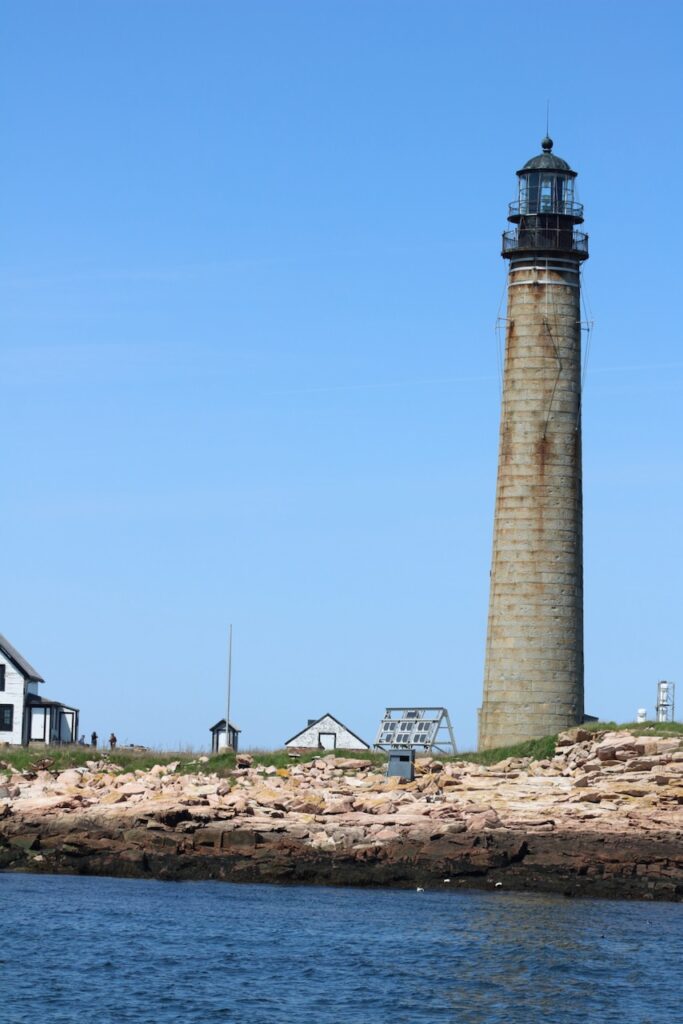
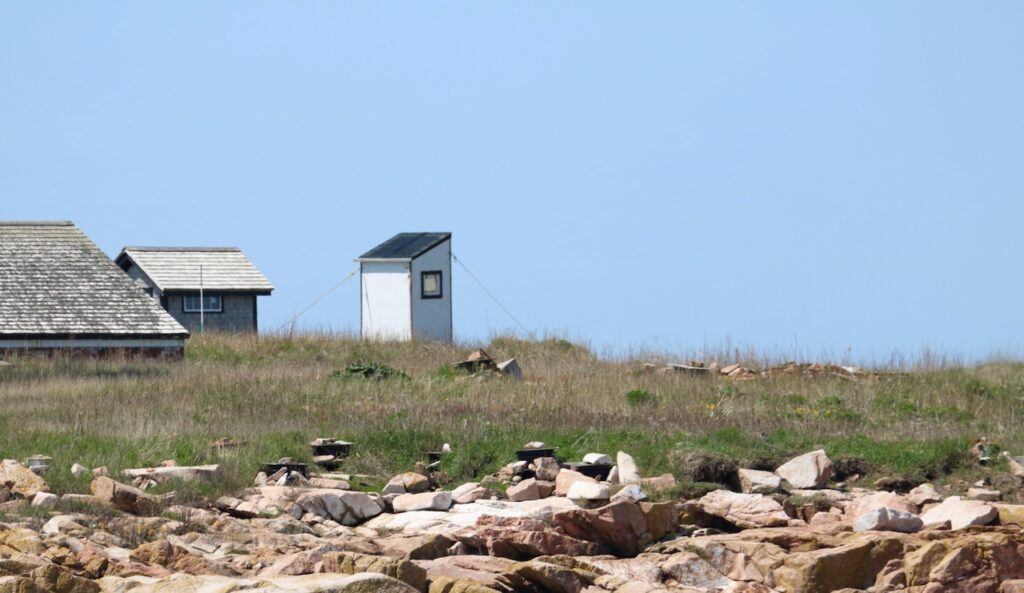
After circling Egg Rock to look at the seabird colonies, as well as the dozens of Harbor and Gray Seals lounging on the rocks, the boat picked up speed and headed out to sea. While we never lost sight of the coastline, it grew hazier and hazier until eventually, a new island appeared on the horizon: Petit Manan. The first thing I noticed about Petit Manan were the buildings. Many islands off the coast of Maine had lighthouses, built during centuries past to help steer ships into harbors. As recently as the late 1900s, lighthouse keepers and their families lived on the islands and maintained the lighthouses, although by now many of the keepers had left, likely because boats had better forms of navigation at their disposal. The houses they left behind had been taken over by people working a very different type of job.
The Lighthouse on Petit Manan Island.
Both Egg Rock and Petit Manan are part of a large reserve known as Maine Coastal Islands National Wildlife Refuge. Every summer, dozens of wildlife technicians head out to these islands to spend weeks and months working with the birds that live there. On some islands, like Petit Manan, this work includes Atlantic Puffins, but it also includes monitoring and conservation of other species like Common, Arctic, and Roseate Terns, Common Murres, Black Guillemots, Razorbills, Common Eiders, and Leach’s Storm-petrels. Several of my peers at the University of Maine worked for Maine Coastal Islands and would be heading out to their assigned locations within the next few weeks.
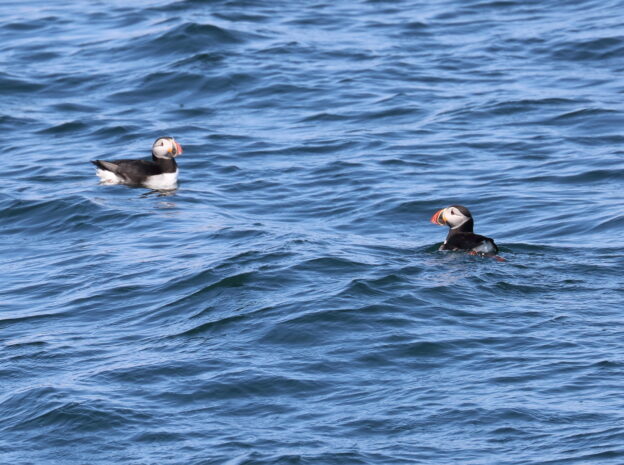
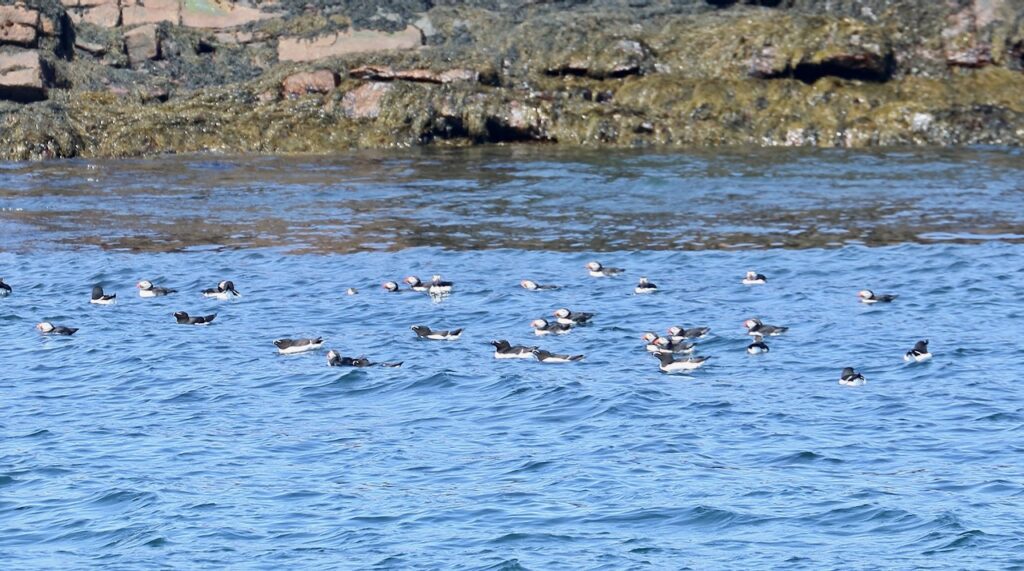
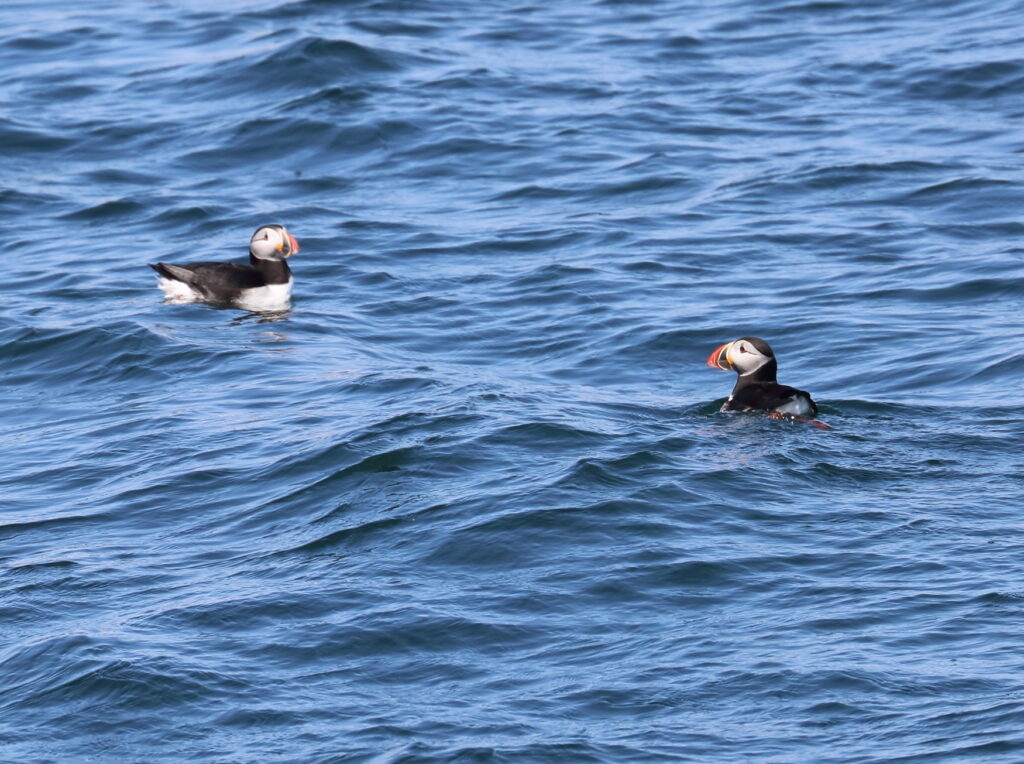
I began to make out large rafts of birds next to the island as our boat approached, and was delighted to spot football-sized alcids with rainbow bills taking off in front of us. I raised my binoculars and smiled—these were the first Atlantic Puffins I’d seen in seven years, since 2018 when I’d been lucky enough to visit Iceland with my grandparents (see my post “All About Alcids”). The birds lounged in the water close to the rocks, and our guide told us that many of them had likely just returned for the summer from their mysterious marine wintering grounds. I counted ninety or so during our half hour stay at Petit Manan.
A raft of Atlantic Puffins and Razorbills!
The puffins weren’t alone. Black Guillemots were here, too, as were a couple dozen Razorbills, another gorgeous black-and-white alcid named after the unique shape and decoration of its beak. I spotted a single Common Murre amongst their ranks, my fourth alcid of the day and a species that had not yet attempted to nest at Petit Manan—but scientists were optimistic! A dozen or so Common Terns circled the island loftily, letting out loud “kyeeeer” calls to notify everyone who was really in charge here. In a few weeks, the numbers of terns would swell into the hundreds, and include Arctic as well as Common. Terns were the aggressive defenders of islands, and would dive-bomb anything they perceived as a threat, including people. I remembered one walk in Iceland when we were asked to hold a tall, wooden stick so the Arctic Terns there would target that instead of our heads!
These birds are the reason that so many alcids nest at Petit Manan. The huge tern colony on this and other islands provide safety for the puffins from predators like gulls and Peregrine Falcons that might otherwise raid their nests. Of course, the biologists working for Maine Coastal Islands NWR were also there to aid these species and chase predators off the island. It hadn’t always been that way, unfortunately.
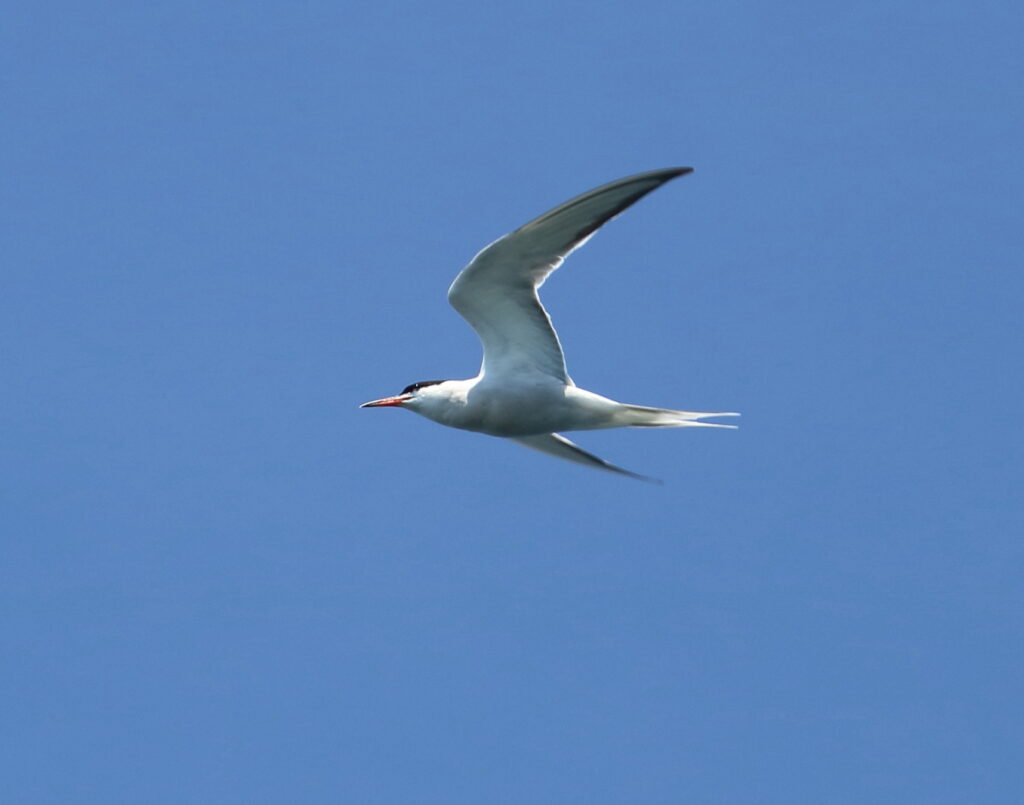
Common Terns nest in huge, aggressive colonies along the Maine coast!
A hundred years ago, feathered hats were all the rage in cities across the east coast of North America. The demand for white feathers meant that large numbers of terns, gulls, and egrets were harvested—to the extent that these species declined dramatically across much of the country. With no terns to protect them, puffins nesting in Maine were faced with higher predation, but not just from other birds. Rampant collection of eggs and puffin meat also plagued many of Maine’s islands, leading to a dramatic decrease in this species down to just two tiny colonies. Sadly, it was looking like the Atlantic Puffin would join the ranks of the Great Auk and Labrador Duck in Maine’s list of extinct birds.
Thankfully, ornithologists and bird-lovers alike noticed how much environmental damage was being caused by these practices and stepped in. Groups like Audubon formed and began lobbying for the protection of birds, eventually leading to the passing of the Migratory Bird Treaty Act of 1918. And in 1973, Audubon launched Project Puffin. Scientists were sent out to islands equipped with broadcasting equipment and decoys, as well as a small number of puffin chicks donated from colonies in Canada. Step one was the rearing of chicks on islands that had previously been occupied by puffin colonies; step two meant attracting terns back to the islands. Finally, with their defenders back in place, Atlantic Puffins began returning to many of the islands they’d previously been extirpated from. They now occupy six colonies in Maine.
Today, Atlantic Puffins are doing well, but are still being monitored very carefully. Puffins feed on fish that thrive in deep, cold water. That’s why the species only nests on the outermost islands in Maine. Our guide told us, “Puffins would lay their eggs in the ocean if they could.” Unfortunately, the Gulf of Maine is warming faster than any other body of water in the world, and this means that puffins are having to travel farther and farther out to sea to obtain their prey items of choice. During particularly warm years, puffins have switched their selected prey entirely to other species. Many of these other species of fish, which are brought back to their chicks on Petit Manan and other islands, differ in their size and the toughness of their skin. Often puffin chicks cannot eat them, and will starve even when food is sitting right there.
The man-made burrows where puffins nest on Petit Manan!
The good news is that there are many, many people keeping an eye on these birds, doing their best to keep their numbers high. Last year was an especially good year for the species, so optimism is in the air. I felt cautiously hopeful for the future of this species as the Bar Harbor Puffin Tour headed back to shore, content with the pictures and new memories I’d experienced with this iconic Maine species.
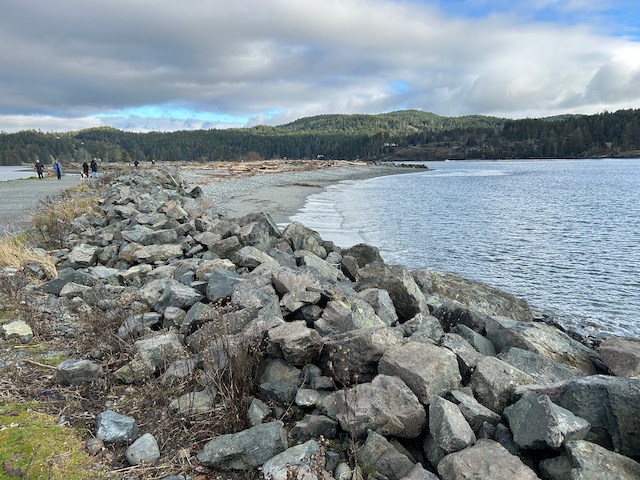
After three nights in Victoria (see last week’s post “Birding Victoria, BC”), Amy and I headed up the Vancouver Island coast toward a spot where we had spent our first nights together as married folk—a lovely establishment called the Point No Point Resort. On the way up, I bamboozled Amy into stopping at one of the most well-known birding hotspots in the area: Whiffin Spit Park. As its rather humorous name implies, the park is a narrow spit of land stretching about a kilometer across the mouth of the bay where the town of Sooke is located, and it has recorded an impressive list of birds.
Whiffin Spit is perhaps the most well-known place to observe ocean and shore birds between Victoria and Port Renfrew. Alas, the many free-roaming pet dogs makes it less than ideal for shorbs.
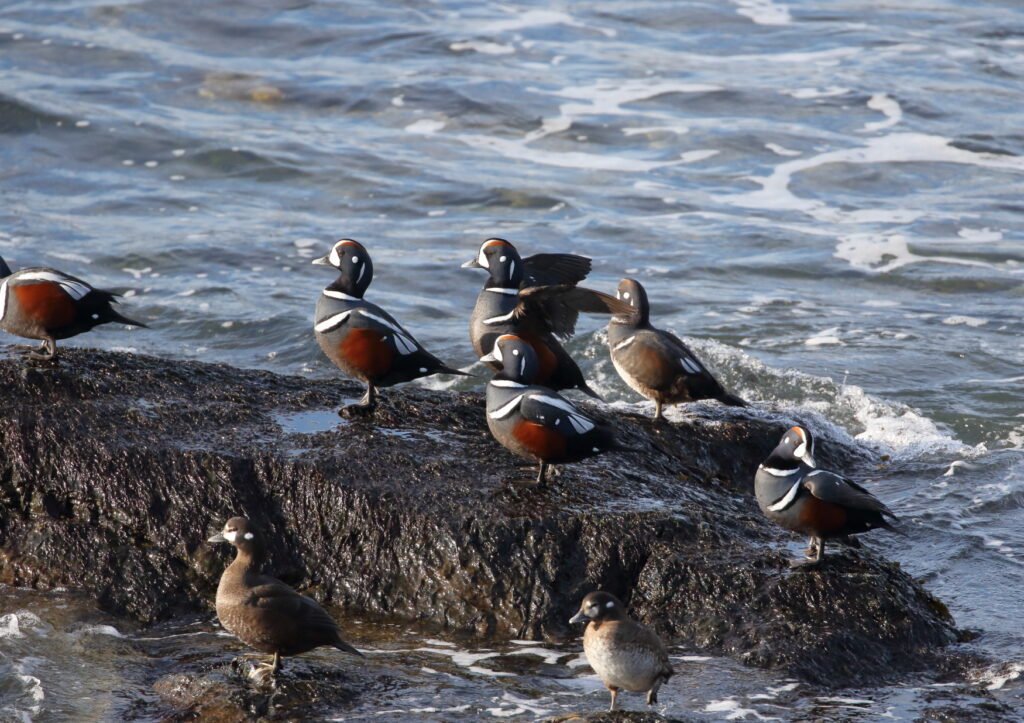
As Amy walked ahead, I schlepped my scope, zooming in on anything promising. Over the next hour, I found Red-breasted Mergansers, more Harlequin Ducks (Yay!), Surf Scoters, Common Loons, and most exciting, a pair of Pacific Loons. Along the path, I also got excellent looks at Black Oystercatchers and Black Turnstones. Alas, the numerous unleashed dogs did not create a bird-friendly environment, and chased off the birds several times. (Our dog, Lola, by the way, informed me that she would never engage in such unruly behavior—cough, cough.)
The longer we stayed on Vancouver Island, the more Pacific Loons I got to see. I have learned to identify these handsome birds by their silvery heads and neck postures, which remind me of cobras ready to strike. Up close, the dark “chin strap” is also diagnostic.
Despite these good birds, I had by now firmly set my mind on seeing alcids, a group of sea birds affectionately dubbed the penguins of the northern hemisphere. These birds include murres, guillemots, Razorbills, Dovekies, and puffins, but the ones I most wanted to see were murrelets. Two kinds frequented the area: Ancient and Marbled. My new birder friend John (see this recent post) had told me that Ancient Murrelets tended to fly around in groups while Marbled Murrelets were most often observed as loners floating on the surface. Either species would be a lifer for me, and I would have been ecstatic to find one. Alas, the task was proving much more difficult than I had hoped. I totally struck out in Victoria, and now I “whiffed” at Whiffin Spit, too.
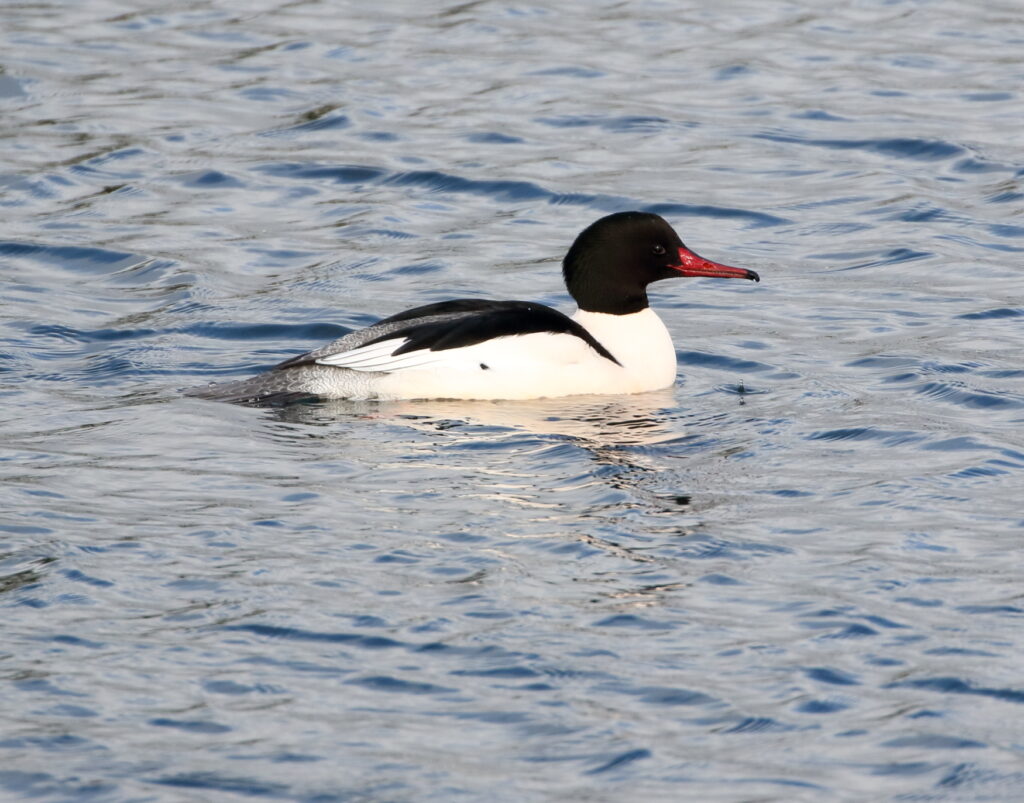
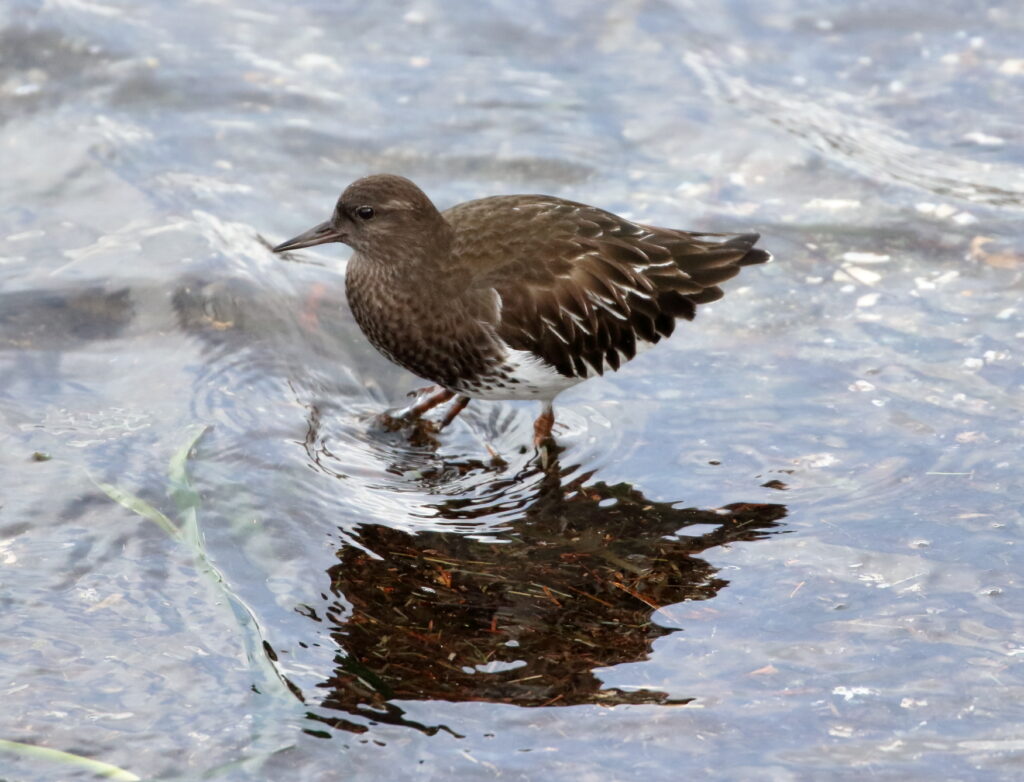
Perhaps my best photo ever of an adult Common Merganser, hanging out on the bay side of Whiffin Spit with an equally stunning female.I could wax eloquently about Black Turnstones, but there’s no need. These bold, attractive birds speak for themselves. They even put up with the many dogs at Whiffin Spit.
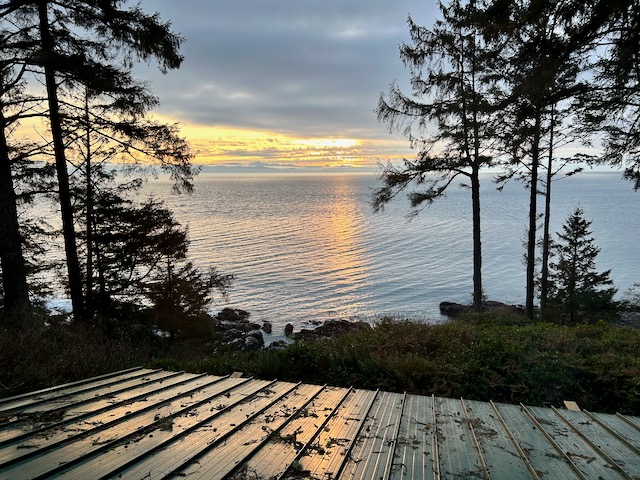
The Point No Point Resort helped ease my disappointment. The cabins and rooms are all cleverly designed for privacy and each looks out over the spectacular Strait of Juan de Fuca (part of the Salish Sea). The sun was setting by the time we checked in—just time for me to set up my spotting scope and find a raft of about forty Surf Scoters floating below us. They would become regular companions of our stay. I also noted a few cormorants and other birds, but alas, no alcids.
Our room at the Point No Point not only offered a mesmerizing view of the Olympic Peninsula across the water, but a chance to scope for more seabirds.
Undaunted, I rose the next morning to hit two nearby spots that had been recommended as great seabird locations: Otter Point and Muir Creek. The birding gods seemed stubbornly pitted against me. I saw a few more loons, including my first Red-throated Loon, along with my first Pacific Wren and a dozen or so species I’d been seeing for the past few days, but nothing that really got my heart racing.
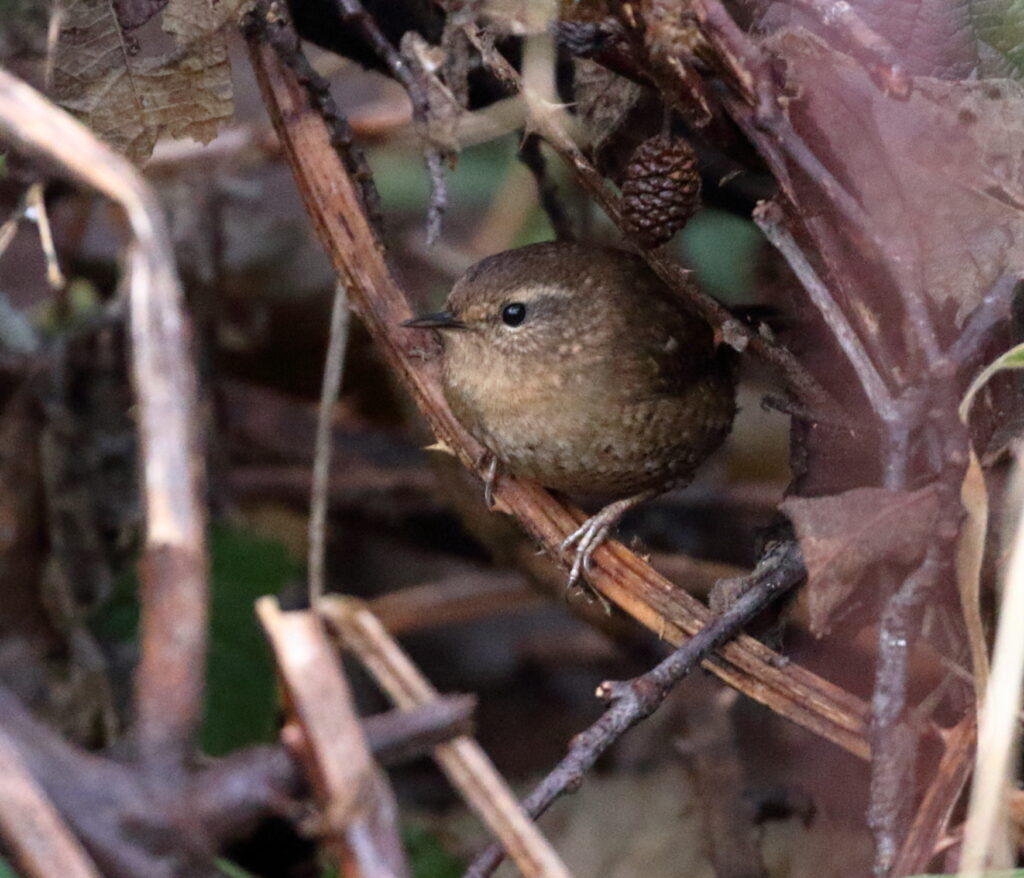
At Muir Creek, I was pleased to get an actual look at a Pacific Wren. Amy and I heard them several other times, but the birds like their privacy!
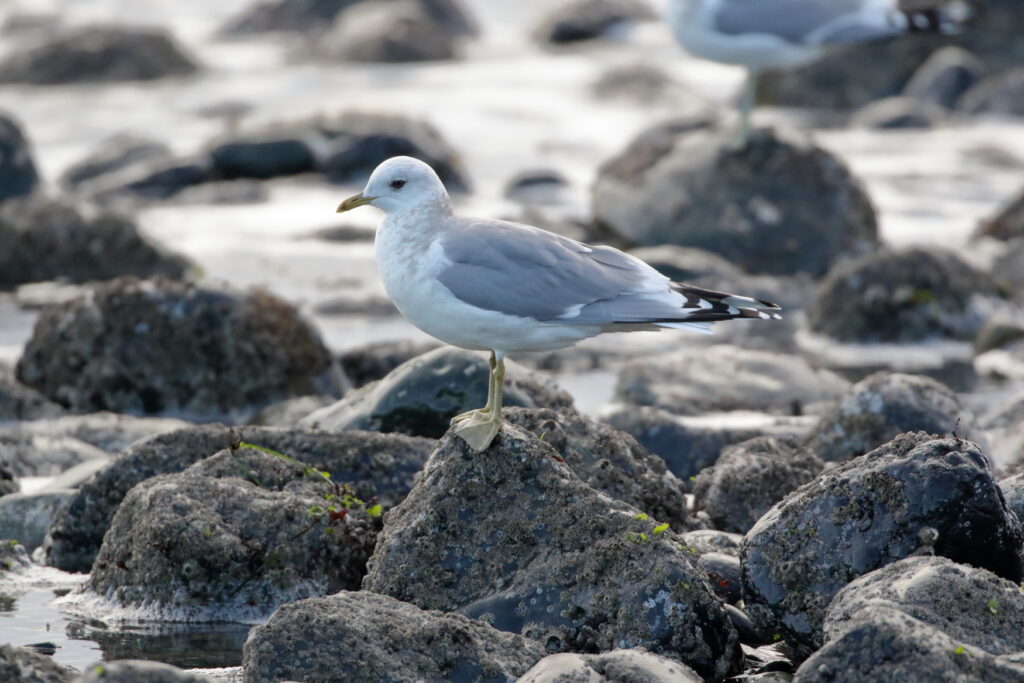
This pattern repeated itself for the next couple of days as Amy and I explored several more places between Sooke and Port Renfrew. Honestly, the birds that most excited me were Short-billed Gulls (formerly Mew Gulls)—birds that I had never seen in such numbers, and had only recently become skilled at identifying myself.
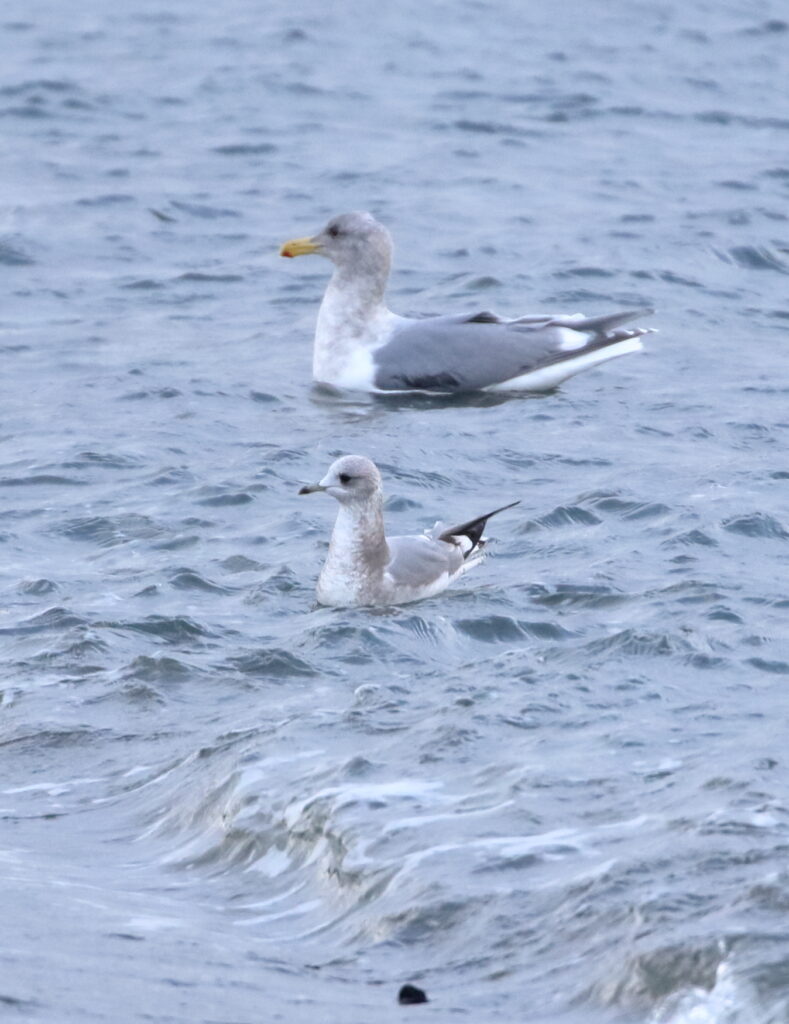
Gulls are notoriously difficult to identify—something I’ll tackle in an upcoming post—but the Short-billed Gull stands out for its smaller size, yellow legs, and overall “cuteness,” as Braden puts it. In breeding, its bill lacks any kind of marking, though as you can see in this photo, adults sport a faint ring at other times of the year. The size difference between Short-billed Gulls (below) and larger gulls such as this Glaucous-winged Gull (top) really stands out when they are next to each other.
Before we knew it, we arrived back at the Point No Point for our last luxurious evening of watching the sea and enjoying the view of the Olympic Peninsula across the water. As we prepared to soak in our private hot tub, though, I picked up my cool new binoculars (see our last post) for one final look at the ocean below us. In the rapidly fading light, I spotted our loyal raft of Surf Scoters, along with gulls and cormorants. Then, I noted a tiny speck in the breaking waves close to shore, and quickly focused in on it. I guessed it was a piece of kelp or driftwood, but then, through the lenses, the unlikely shape of a bird emerged!
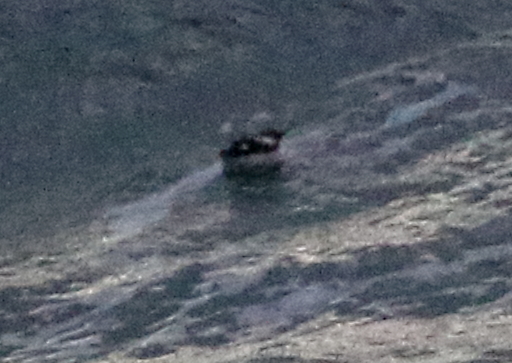
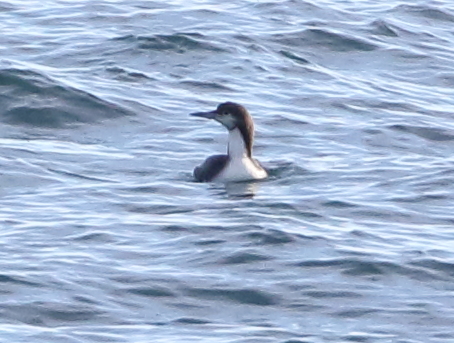
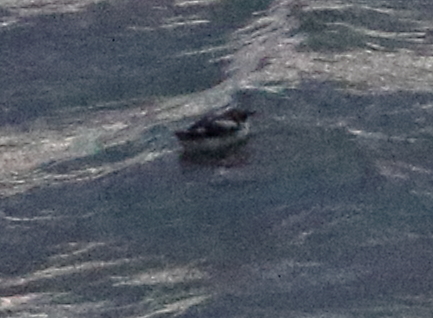
My heart accelerating, I frantically set up the scope which lay at my feet and zoomed in on the shape. “No friggin’ way!” I exclaimed. Honestly, I didn’t know exactly what I was looking it, but I felt sure I hadn’t seen it before. I was also sure I needed some photos, no matter how crummy, so I switched out my scope for my camera on the tripod, and captured a few quick images through our windows before, to my disappointment, the bird drifted out of view behind some trees.
By this time, after a quick consult with my Sibley app, I felt positive that the tiny bird had indeed been a murrelet, but which kind? Studying my horrible photos and comparing them to Sibley, I noted the white patches on the shoulders and near the tail. That ruled out Ancient Murrelet. I also checked the illustrations for all the other alcids that might be in the area. Only one matched my photos: Marbled Murrelet! Even better, ten minutes later the bird reappeared below our window. By now, the light had grown truly dim, but I took my tripod and camera out onto the deck and managed some slightly better shots.
Marbled Murrelet!
My fellow birders can imagine how that one bird pretty much made the entire trip for me. Everything else was just lovely, too, but a Marbled Murrelet? That put the icing on the cake, or for me, the chocolate chips in the cookie. It also sent my imagination racing, seeing that tiny bird deftly negotiate the waves crashing into shore. It was just so comfortable in an environment that would have snuffed me out in a matter of minutes.
Marbled Murrelets defy the imagination for another reason. Unlike other alcids, they nest not in burrows or on cliffs, but in trees! In fact, the nesting location of this bird remained a great ornithological mystery for more than a century as biologists looked everywhere (but not in the tops of trees, evidently) for a Marbled Murrelet nest. “Finally,” recounts Cornell Lab’s Birds of the World, “in 1961 and 1974, the first verified and published nests were reported in Asia and North America, respectively.”
Amazing.
Unfortunately, the birds prefer old-growth coastal forest, forests that have experienced extreme logging pressures over the past century. The birds have also been impacted by fishing gear, forest fires, and other hazards. As a result, the bird is listed as endangered or threatened throughout its North American range. That made it all the more remarkable that one had deigned to show up right below our picture window—almost as if following some kind of cosmic movie script. I felt very fortunate.
Yay! More Harlequin Ducks! During our last session at Clover Point, these stunning birds really put on a show, chasing each other around and posing for one visiting birder.
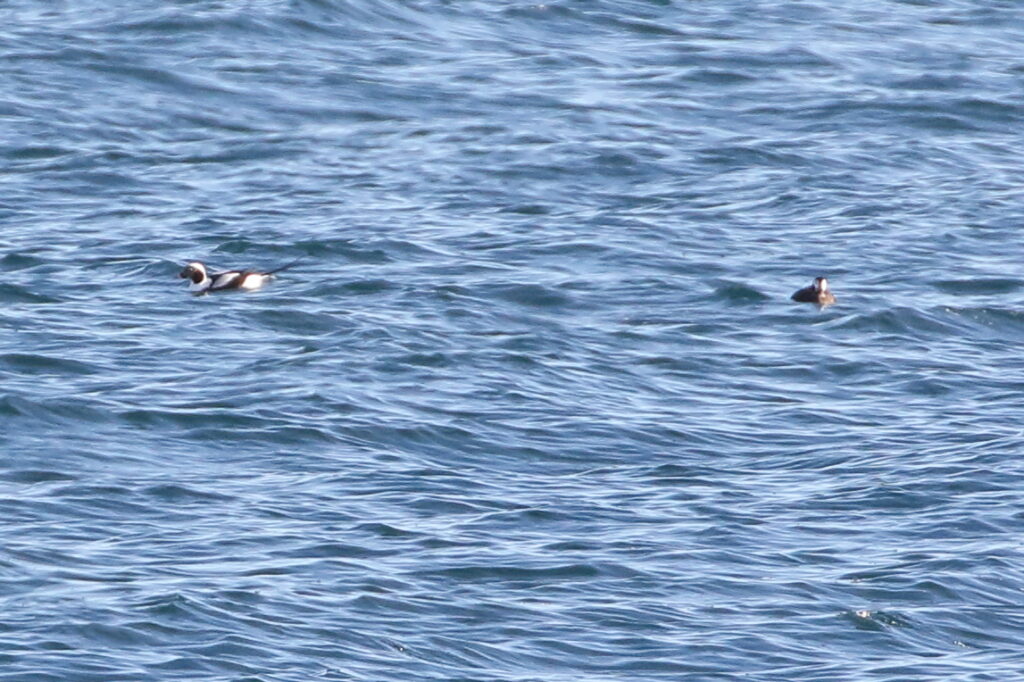
The next day, Amy and I returned to Victoria and another round of birding at Clover Point—my best session there yet. Pacific Loons, Buffleheads, Harlequin Ducks, and Surf Scoters seemed to be everywhere, and I was thrilled to find a pair of immaculately-feathered Long-tailed Ducks far out on the water. Though we would not head home until the following day, it was a great way to wrap up a trip that proved delightfully unexpected in so many ways. Huge gratitude goes to my wife and partner, Amy, for giving me such a wonderful surprise. And now, it was time for us to go celebrate with stiff umbrella drinks and a plate full of chicken enchiladas.
Bird of the Day honors for our last day in Victoria went to these Long-tailed Ducks. Adult male LTDUs (left) are especially striking in full plumage, and I at first assumed that the one on the right was a female. The rich brown back and bold, well-defined white face patch, however, suggests a first-year male.
The week before Thanksgiving, my family had the opportunity to visit a place that featured prominently in my childhood—Cape Cod, Massachusetts. We headed to Boston so that I could accept a big award for my picture book, Border Crossings, but the trip provided many piggybacking opportunities. These included a chance to look at colleges for Braden’s sister, Tessa, and to meet up with Braden for Thanksgiving. After Amy, Tessa, and I spent a few days in Boston, in fact, Braden drove down from the University of Maine and whisked us off to the Cape.
I spent parts of many summers in Woods Hole on the Cape. My father did his post-doc at WHOI—the Woods Hole Oceanographic Institution. My step-father spent dozens of summers in Woods Hole doing research and teaching classes at the MBL—the Marine Biological Laboratories. I have many fond (and some not-so-fond) memories of those summers, but had not been back for (gasp) 45 years! I looked forward to revisiting old haunts and showing my family some of the places that had shaped my childhood. Naturally, Braden and I also considered the birding possibilities.
Race Point Lighthouse.
When Braden first mentioned going to Race Point near Provincetown, I hesitated. I recalled driving up there as a ten-year-old and didn’t relish spending an extra four hours of our vacation in a car. When Braden started telling me what we might find there, however, I quickly changed my mind.
Race Point, it turns out, is one of the nation’s premiere places for spotting seabirds from land. A map reveals an obvious reason: Cape Cod juts miles out into the Atlantic Ocean, and the tip—Race Point itself—is surrounded on three sides by the sea. This means that birders have an opportunity to see both regular beach-type birds and many species that only rarely show up near land. Braden and I especially hoped to see jaegers, “tube noses” such as shearwaters, and any interesting gulls or ducks that happened to be around.
After a delicious breakfast at Liz’s Café in Provincetown, Braden and I left Amy and Tessa to explore while we headed off to the parking lot near Race Point lighthouse. As soon as we approached the beach, we spotted Northern Gannets soaring above wild, wind-raked seas. I’d only ever gotten a brief look at a NOGA before, when Braden and I had visited Acadia National Park three years before, so right away the drive up to Provincetown redeemed itself!
However, the excitement was just beginning.
One of perhaps 150 Northern Gannets we saw at Race Point. Like Blue-footed Boobies, these birds torpedo straight down into schools of fish.
As wind and sand pelted us, groups of White-winged and Black Scoters, Common Eiders, and Long-tailed Ducks skimmed the waves just offshore. Some occasionally landed, but most seemed hell-bent for destinations only they knew about. All were birds I had scant experience with, so I soaked up every sighting.
This was only my second time seeing Common Eiders, and I was uber impressed by the coloration of both females and males.
“There’s a Red-throated Loon!” Braden said, pointing to a bird with an exceedingly pale, long neck reaching up from the surface. It wouldn’t be long before we saw several Common Loons, differentiated by blockier heads, chunkier bills, and more black on their faces.
Only my second Red-throated Loon ever. Note the smooth, rounded head and white “winter” face.
At the top of our To Find list were Great Shearwaters, a potential Lifer for both of us. These birds belong to the “tube noses,” the same group of birds that includes albatrosses, fulmars, and storm-petrels. These birds are truly seafarers, rarely approaching shore. Only a few weeks ago, I had caught a glimpse of Sooty Shearwaters while visiting California’s Point Reyes National Park with my friend Scott. Great Shearwaters had been sighted regularly at Race Point for the past couple of weeks, but alas, we arrived too late to see them today.
Braden fruitlessly searching the seas for Great Shearwaters and jaegers.
We still had plenty of thrilling birds to look at, however. As we trudged the mile and a half through the soft sand toward the very tip of the Cape, flocks of Dunlin and Sanderlings in their winter plumages worked the drifts of foam left on the beach by each encroaching wave. We even saw a group of six Horned Larks, birds we were used to seeing on the backroads of Montana—not here at the end of the world.
It had been years since I’d gotten to hang with Dunlins, and it was a real treat.
Not to be outdone, gulls also put on a show. This was the first time I’d ever gotten to see Great Black-backed Gulls in a natural setting. They are the world’s largest gulls, and I gotta say they looked like they belonged in this rugged, challenging environment.
“Look!” Braden suddenly shouted. “Iceland Gull!” Two of them, in fact. These gulls had until recently been split into Iceland and Thayer’s Gull, and Braden and I had seen the latter at the Helena landfill in Montana. This look was much more memorable as both a juvenile and adult landed near us. Both were gorgeous birds with subtle markings, and they quickly jumped into contention for Bird of the Day honors. Not long after seeing the Iceland Gulls, Braden also spotted a Black-legged Kittiwake. I was grateful he’d gained experience with all of these birds while on the East Coast, because I certainly would have missed a lot of them.
I don’t even want to know what this Great Black-backed Gull is eating, as our two Iceland Gulls look on.
I picked up two Lifers for the day. One was Razorbill, a kind of black-and-white alcid I had dreamed about seeing for years (see our post “All About Alcids”). During our hike to the lighthouse and back, we saw about eighty of these birds in groups, flying low or bobbing up and down in the jagged waves. My second Lifer was a pair of Purple Sandpipers that landed in front of us and shouldn’t have been anywhere near a wide sandy beach. Like its closely-related West Coast cousin the Rock Sandpiper, these are rocky shore birds.
I was especially thrilled to see my Lifer Razorbills, but it’s a tossup whether these or the Iceland Gulls grabbed Bird of the Day honors.
“They must be migrating,” I said, and Braden agreed, though we were well within their wintering latitudes.
As we trudged back toward the car, Braden spotted a fin jutting out of the water. At first we thought it might be the dorsal fin of a shark or orca, but after watching it for a few minutes, we concluded that we were looking at the tail flukes of a larger whale. I’d seen quite a few humpback whales before, and these didn’t look anything like it. “I think it’s a Right Whale,” I said. Later, we learned that Right Whales had been regularly spotted in the area. It was one more unforgettable discovery for a memorable day.