Tag Archives: Montana

In Search of the Green-tailed Towhee

Please support our efforts at FatherSonBirding by buying a *New* copy of Birding for Boomers or one of Sneed’s other books shown to the right—and by donating to Montana Bird Advocacy, a wonderful grassroots scientific organization doing novel and unique research on Montana birds.

Confession: Despite the title of this blog, the the main purpose of last weekend was not to find Green-tailed Towhees; it was to learn about a wonderful study of Gray Flycatchers with biologists Jeff Marks and Nate Kohler. However, as I set out Saturday morning, defiant of the grim weather forecast for the next day, I did have a secondary mission in mind—to find and visit with some of the birds in the arid southwest corner of the state. Over the years, these sagebrush areas, from Bear Canyon (see Bear Canyon—Montana’s “Tropical Birding” Paradise) all the way west to Beaverhead County, had become some of my favorite parts of Montana. I credit that partly to my own childhood living in the dry chaparral country of southern California, but I also just love the ecosystems and birds in this part of Montana. I’d have trouble calling myself a real birder if I didn’t get down there at least once each year.

Since you’re pressing me on the issue, I also had a third objective for this trip—to move closer to breaking my all-time one-year species record. The record belonged to 2017, when our family traveled to Ecuador and Peru and I recorded a total of 527 species for the year. This year, thanks to last-minute invitations to Colombia (see THIS POST) and Texas (see THAT POST) I unexpectedly found myself at 498 species—perilously close to setting a new record. That task loomed more difficult than it might appear since once spring migration has passed and breeding season gets underway, it becomes much more difficult to find new species. Still, a trip to the southwest part of Montana promised to nudge me closer to this new goal, and my first target was one of the state’s coolest birds: Green-tailed Towhee.

On Braden’s advice, my first real birding stops of the trip were along the Jefferson River before Lewis & Clark Caverns.

Green-tailed Towhees winter in the American Southwest and Mexico, but generally breed in the the Great Basin region of the West, including southern Montana. Though the birds are not strictly rare, I could count the number of times I had ever seen one, and I felt eager for another GTTO encounter. To find this bizarre, poorly understood beauty, I hit I-90 at dawn and steered toward Lewis and Clark Caverns, two-and-a-half hours to the east. To entertain me along the way, I had checked out an audio version of Eat, Pray, Love, a book that invites all kinds of snarky comments but, I found, actually proved moderately amusing. On Braden’s advice, I pulled over alongside the road leading to the caverns and was rewarded with a wonderful assortment of river and cliff birds including Rock Wren, Lazuli Buntings, and White-throated Swifts. Once inside Lewis and Clark Caverns State Park itself, I focused on finding Green-tailed Towhees.
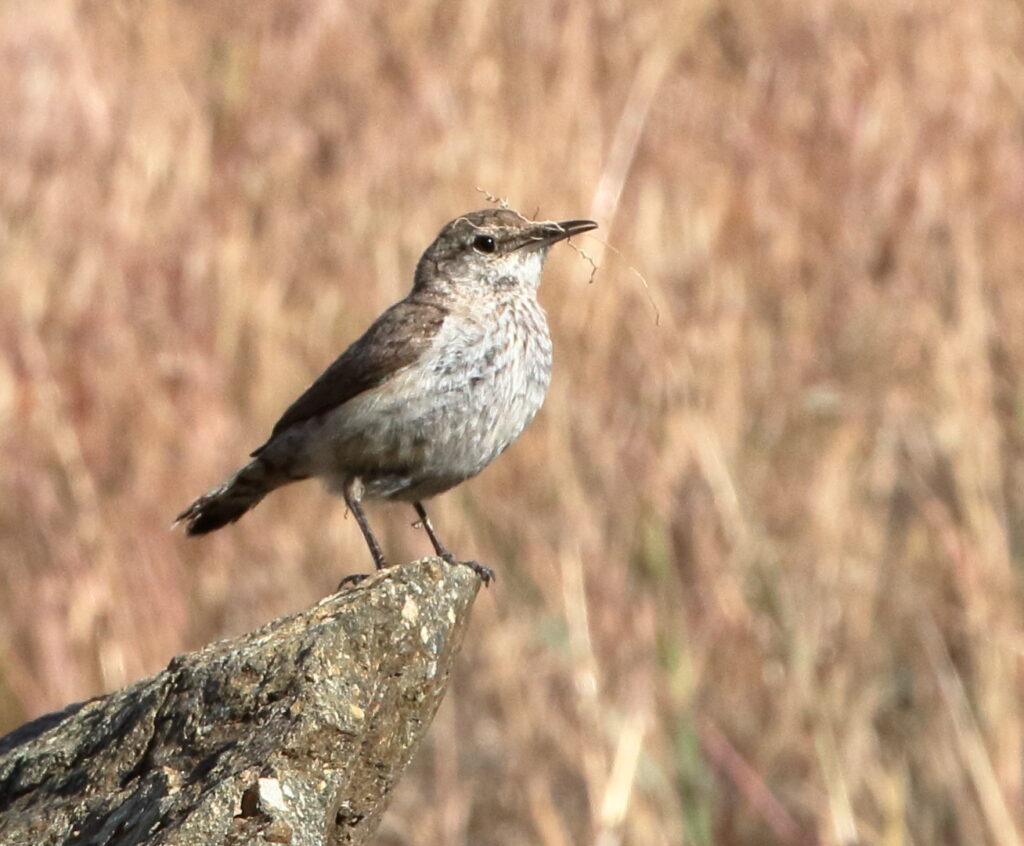
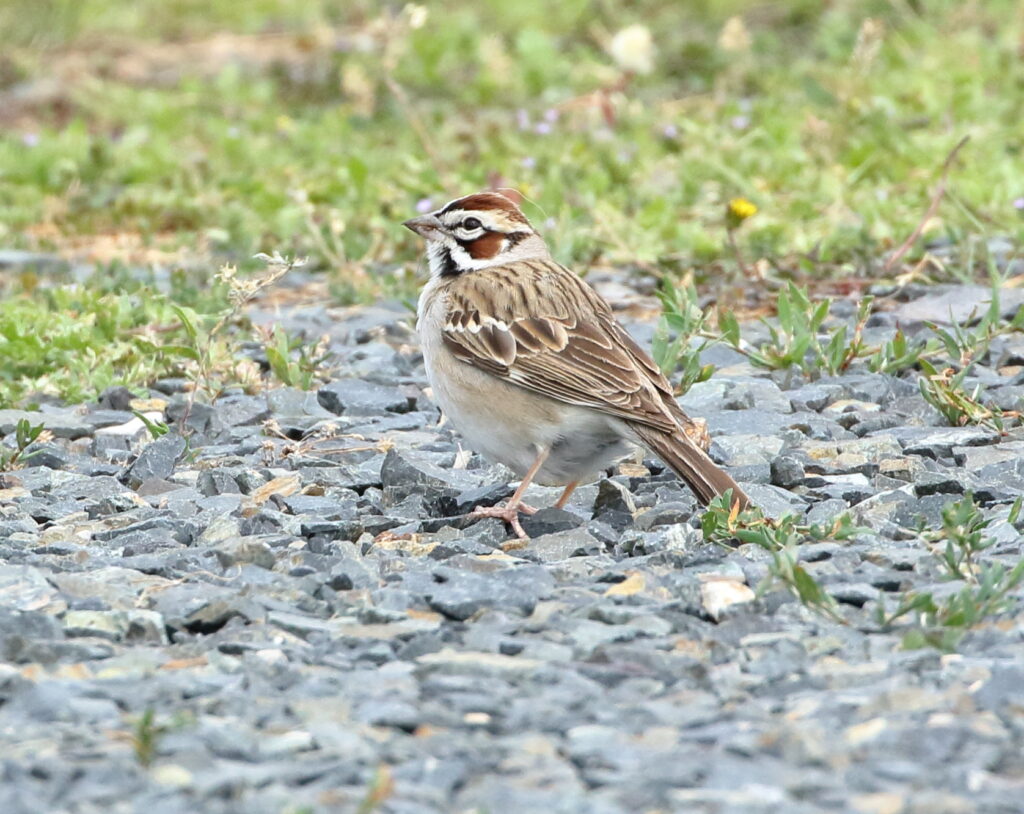
I struck out. I spent a good hour and a half checking along the road, up around the main parking area, and in the campground. Merlin’s Sound ID picked up a putative GTTO song at one point, but I neither heard nor saw a trace of the bird.

I have to admit that this made me feel like a total failure. I mean, here was my first target bird of the trip, and one that shouldn’t be that hard to find, and I totally “whiffed” on it, as Braden might say. I didn’t plunge into despair exactly, but it definitely put a damper on my mood as I began questioning just what I thought I was doing out here pretending to be a birder! Well, I thought, maybe I’ll have better luck at my next destination.

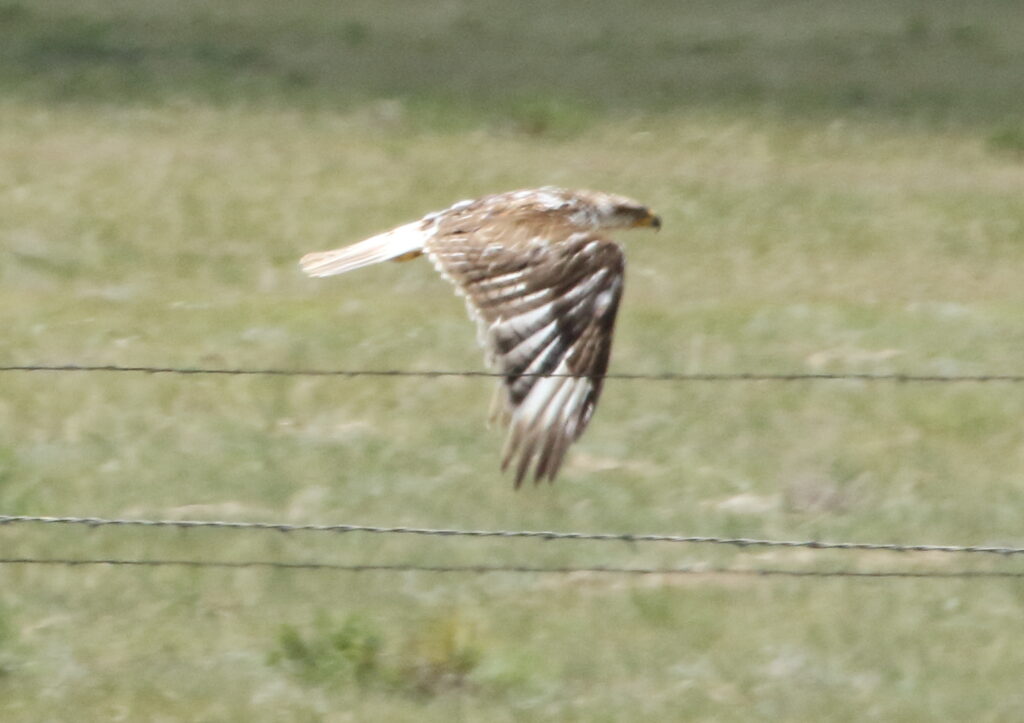
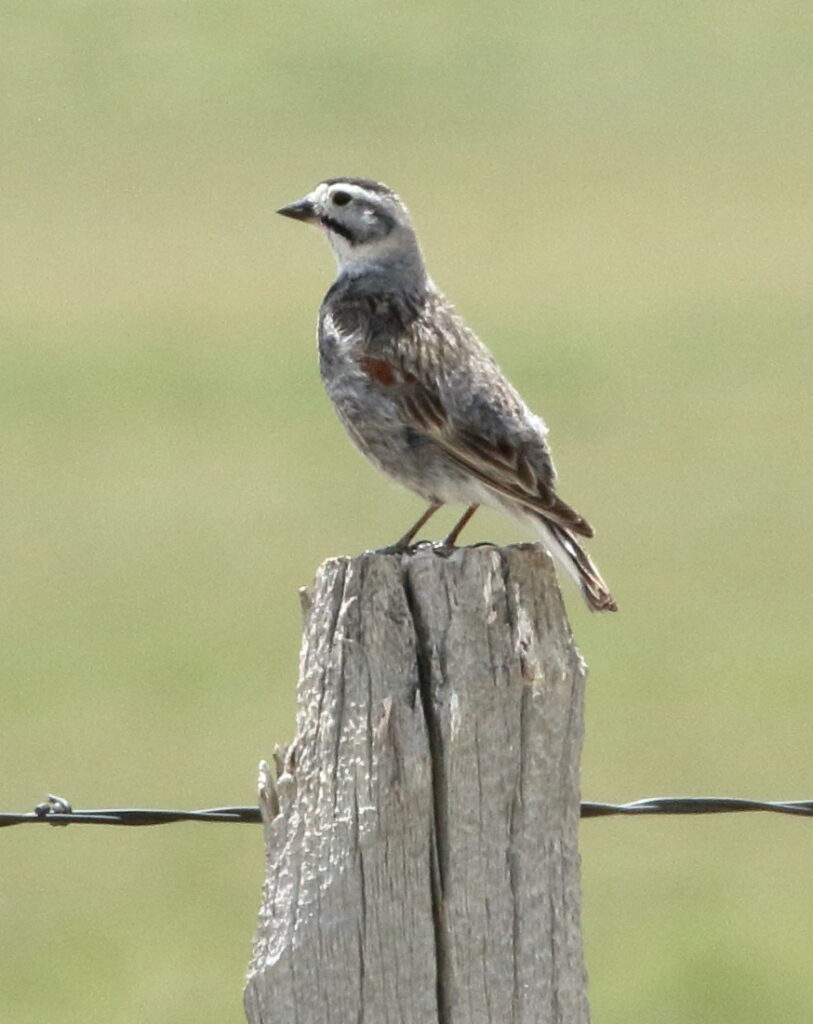
Which happened to be Birch Creek Road north of Dillon in Beaverhead County. Several years before, Braden and I had found our lifer Thick-billed (formerly McCown’s) Longspur on this road, and once again, the road delivered. I’d driven only a mile before I saw a suspicious dark shape on a fence. I actually didn’t think it was a Thick-billed, but my binoculars revealed otherwise. “Yay!” I exclaimed, feeling the weight of my earlier “whiff” lifting slightly. A few minutes later, I was examining another TBLO when I noticed a large shape sitting in a field about one hundred yards away. “Clearly a hawk,” I thought, “but what kind?” The answer: the best kind, at least for my goals for the trip—a ferruginous hawk. This was another bird I needed for the year and one that isn’t always easy to find in the state.
Digging out the peanut butter sandwich I’d made earlier, I tooled down I-15 for my next destination, Clark Canyon Reservoir. Braden and I had only ever birded here once before, and as near as I recall, we hadn’t found much, so I kept my expectations low. I stopped at one overlook and was surprised to see a Common Loon on the water below, along with a Double-crested Cormorant and a couple of Ring-billed Gulls. Violet-green swallows swirled around me and, as always, they brought a smile.

Snaking around the reservoir, I approached a sign for Horse Prairie Campground and spontaneously swerved left onto a dirt access road. The reason? Tall, healthy-looking sagebrush! Hm, this just might have one of my other target birds for the day. Almost immediately, I saw a really cool bird that had not been on my target list—a Common Nighthawk peacefully chillin’ on the split-rail fence. The bird barely blinked as I fired away with my camera through the car window from only thirty feet away.
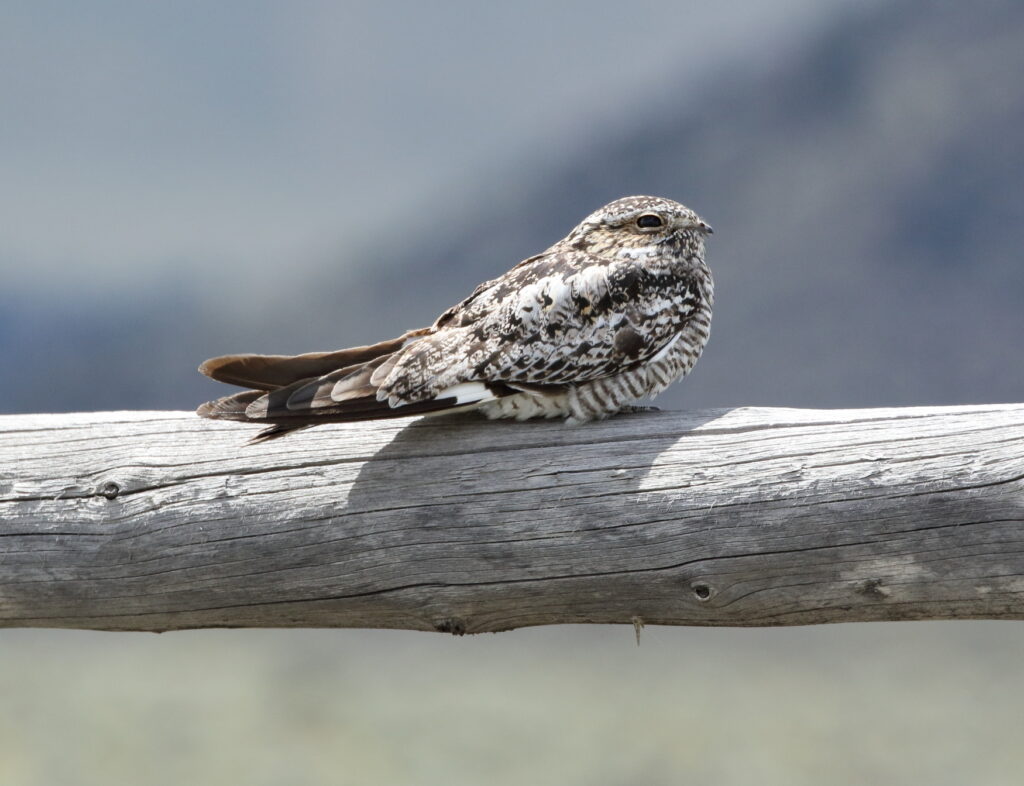
The first of three Common Nighthawks I spotted chilling on the wooden fence leading down to Horse Prairie Campground.

Creeping slowly forward, I heard a song I didn’t recognize—which was no great surprise in itself, but I did have a guess of what it was. Sound ID confirmed it: Brewer’s Sparrow! This bird loves healthy sagebrush and makes up for the world’s dullest plumage with a vigorous song that bewitches any birdwatcher who hears it. A few moments later, one even sat still long enough for a decent photo. Check. Another target bird—but not the one I expected to find here!
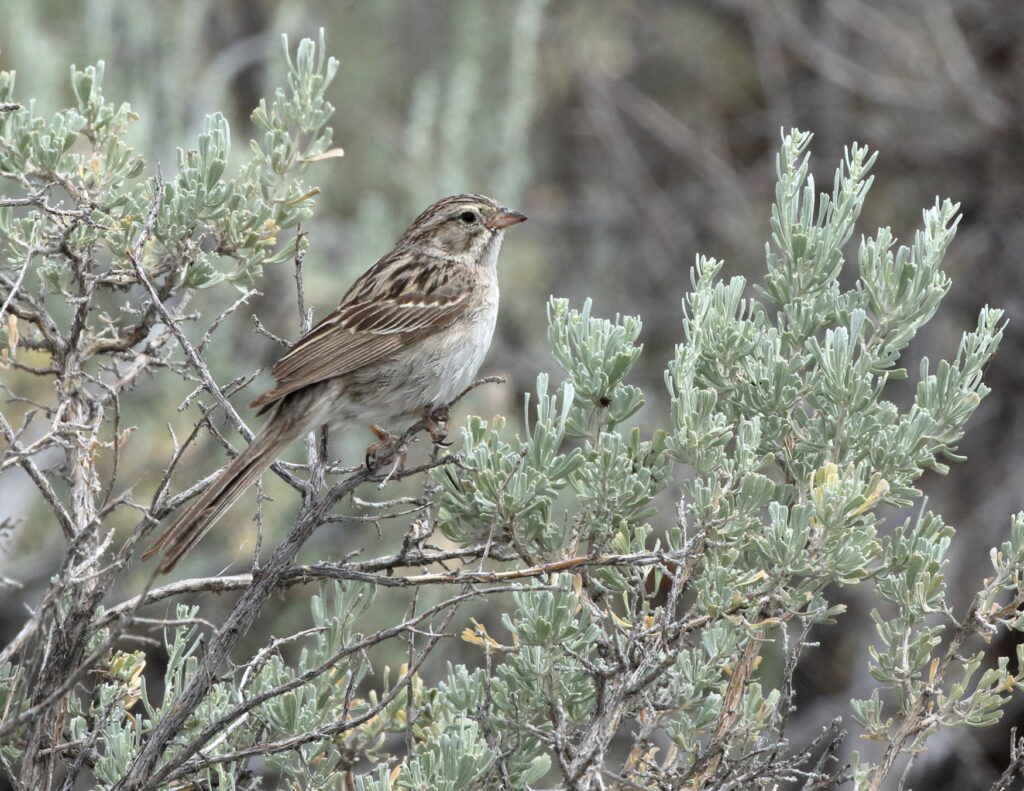
One of Montana’s drabbest birds, the Brewer’s Sparrow has an enchanting song.

I kept driving slowly toward the campground and spotted a medium-sized, slender bird up ahead. Wishfully, I thought it might be a Say’s Phoebe—another bird I happened to need for my year list—but it flew off before I got close. As I pulled into the campground, though, two brownish birds were chasing each other around. I assumed they were robins, but when one landed on a “Day Use Only” sign, I realized with a start that it was exactly the bird I had hoped to find here—a Sage Thrasher!
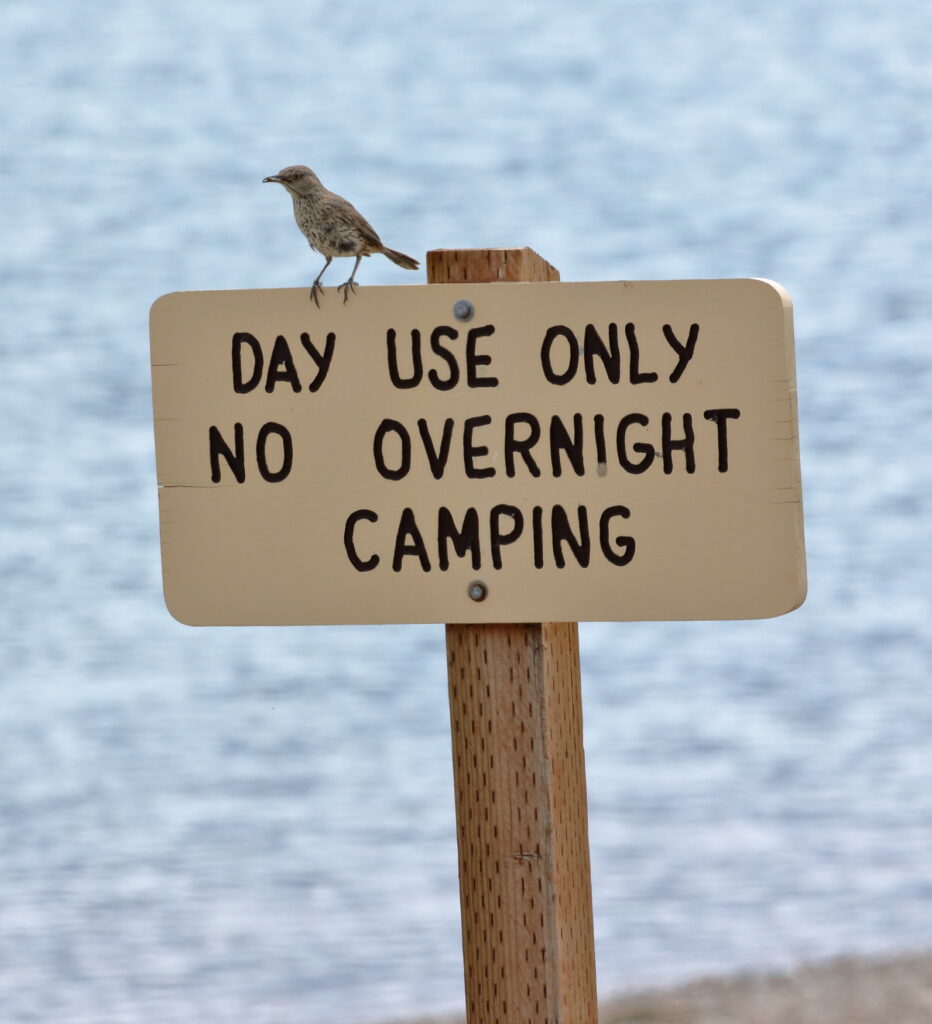
Sage Thrashers are so flighty that seeing one on a sign was about the last thing I expected!

Braden and I have never met a thrasher we didn’t like, but Sage Thrashers hold a special place in our birding hearts. For one, they’re the world’s smallest thrashers—which is why I mistook them for robins or phoebes. For another, they are charismatic songsters and often are the most common bird you see in sage country. As I sat in the car, in fact, I counted three more Sage Thrashers around me. Whoo-Hoo!
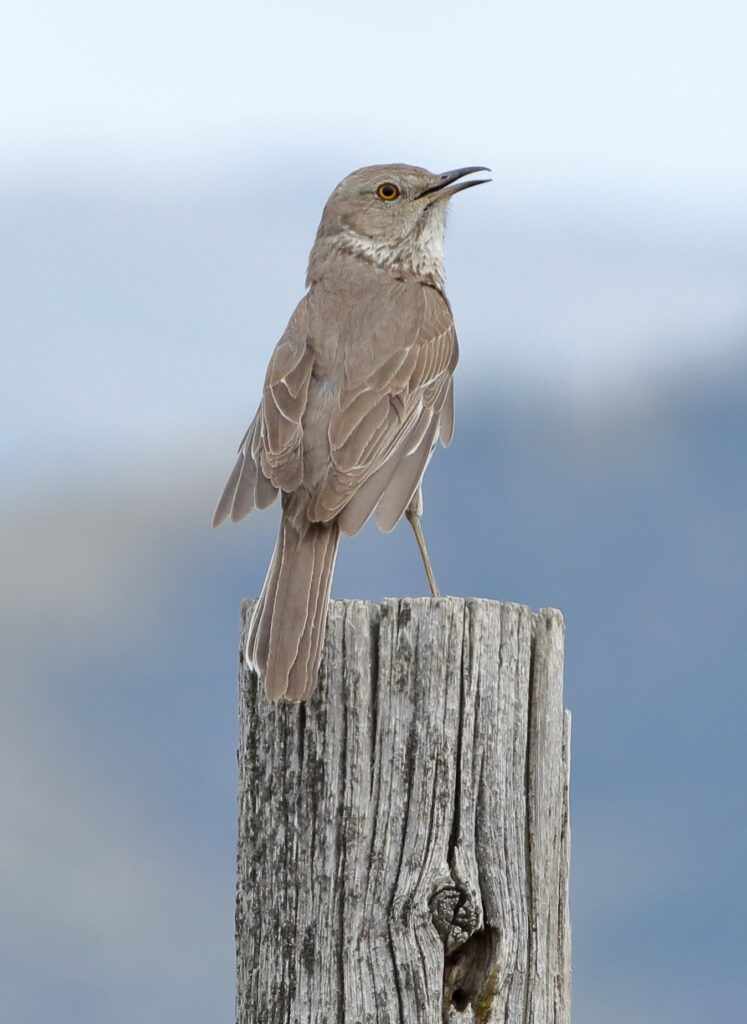
One of our favorite Montana birds, Sage Thrashers seemed to be everywhere I looked this afternoon.

Later, on the road where I was to meet up with Jeff Marks and Nate Kohler, I encountered seven more Sage Thrashers! It was a veritable thrasher party—by far the best experience I had ever had with these good-looking birds.

Unfortunately, the next morning, heavy rain and spitting snow kept me from seeing Gray Flycatchers with Jeff and Nate. More on that in another post. Almost as bad, I began the drive home without a Green-tailed Towhee under my belt and no expectations of seeing one. But bless Nate Kohler’s heart. He told me about a canyon I should check out on the way home. It was still raining when I got there, but I drove slowly and stopped frequently, listening and watching. Lazuli Buntings chattered everywhere and I saw a good variety of birds—but no towhee. Finally, I put on my raincoat, got out of the car and played a Green-tailed Towhee song. Almost immediately, a small shape darted up out of the sagebrush—the bird I was looking for! Not only that, it held still long enough for a photo—but the story hadn’t quite finished.
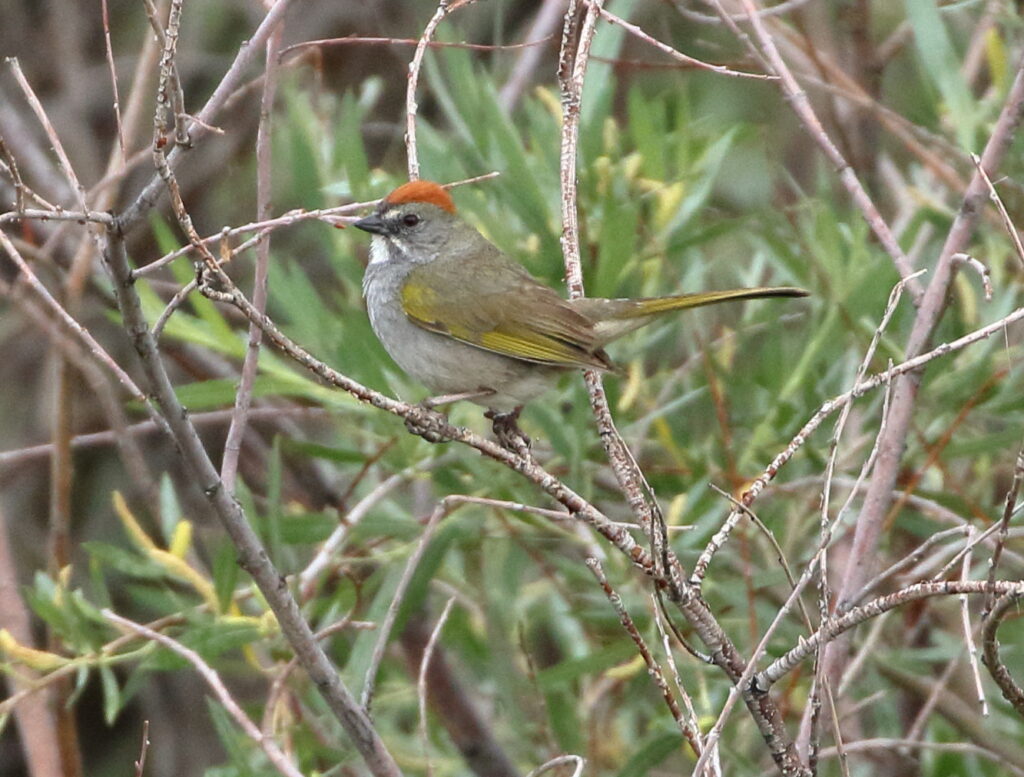
I worked hard for this Green-tailed Towhee—only to find that it wasn’t a year bird after all!

Once I got home and posted all of my checklists for the trip, I was surprised that eBird hadn’t added GTTO to my year list. What’s going on? I thought, and did a quick search to see if I had somehow seen one down in Texas and forgotten about it. Nope. What I did forget was the rare vagrant GTTO I had seen in Victoria, BC during Amy’s and my January trip (see Birding Victoria, BC)! So this one was not a year bird after all, but still a lot of fun to see. Meanwhile, my year list swelled to 503 species thanks to the Thick-billed Longspur, Ferruginous Hawk, Brewer’s Sparrow, Sage Thrasher, and a Prairie Falcon I had spotted the afternoon before. Not exactly the trip I expected, but one I already cherished.

Birding the Burn 2025

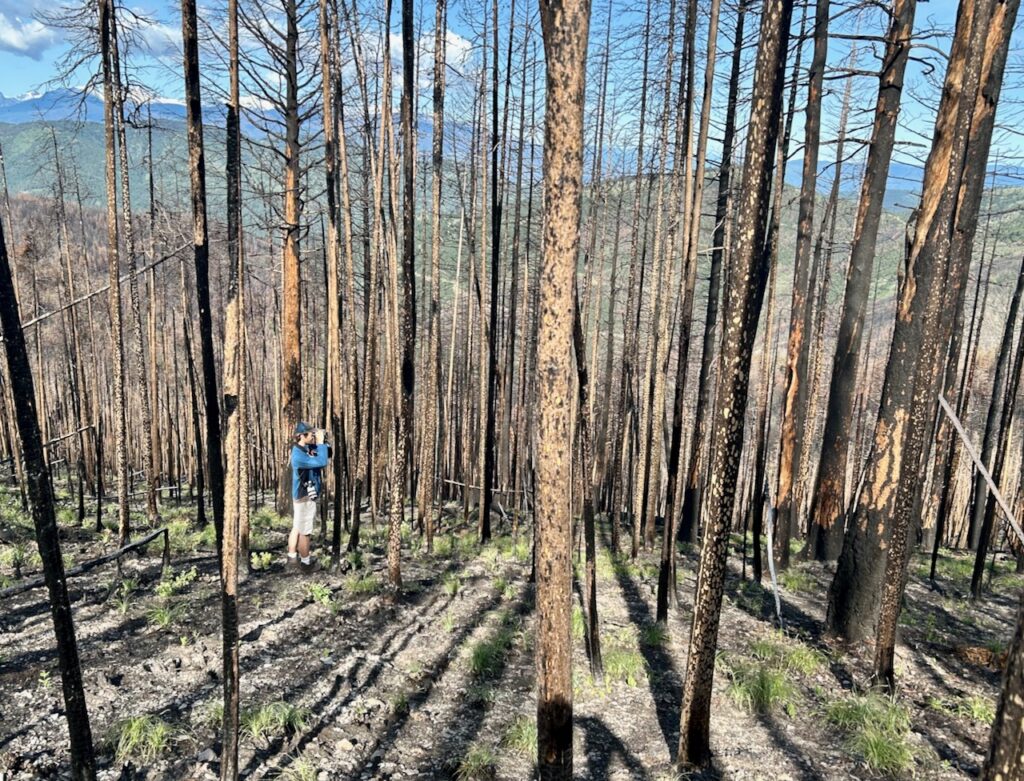
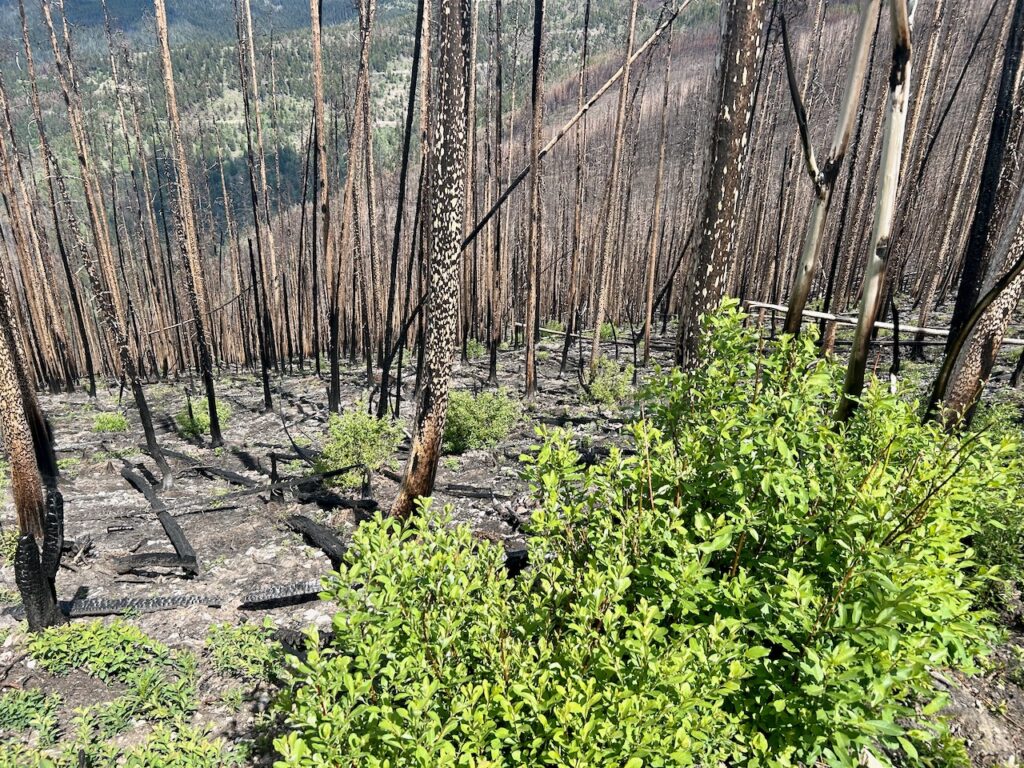
In many ways, my own birding journey began with my book Fire Birds: Valuing Natural Wildfires and Burned Forests. That’s when my birding mentor, UM Professor Dick Hutto, showed me the critical importance of burned forests and the spectacular birds that colonize them. It’s also when Braden and I began birding avidly. Since then, we have explored burned forests many times and they have become some of our favorite places to bird. Last week, we were excited to check out one of our area’s newest burns, last year’s Miller Creek fire area, about an hour from our house. To reach it, we headed all the way out Miller Creek and then wound our way up dirt roads until we reached the burn at Holloman Saddle. On the drive, we passed through terrific riparian and conifer habitat, and Braden could pick out Yellow and Orange-crowned Warblers, Swainson’s Thrushes, and Willow Flycatchers through the car window. At about 6,300 feet elevation, we reached the burn, parked, and began exploring.

Researching and writing Fire Birds: Valuing Natural Wildfires and Burned Forests set me firmly on my birding journey—and propelled Braden and me to start birding burned forests. The multiple award-winning book is a great primer for kids and adults on many little-known aspects of forest ecology. To order a copy, click anywhere on this block!

Thanks to Dick’s tutoring, I had some experience sizing up burns and at first, this one didn’t seem ideal. Three birds essential to “opening up” a burned forest are Black-backed, American Three-toed, and Hairy Woodpeckers. These birds hunt wood-boring beetle grubs in the newly-charred forest and along the way, drill out cavities essential for other cavity-nesting birds. But Dick’s research had shown that Black-backed Woodpeckers need larger-diameter trees to nest in, and the forest that greeted us now mainly seemed full of smaller-diameter trees. I also saw stumps where larger trees had already been removed—another huge problem in human (mis)management of burns.

Braden trying to locate a promising bird call in the Miller Creek Burn.

Through decades of well-intentioned Smokey Bear messaging, we have all been taught that all fires are bad, bad, bad. Even when a natural fire does occur, the forestry Powers That Be have taught us that humans must somehow “save” a burn by salvage logging it. For those unfamiliar with it, salvage logging involves going into a burn and removing trees that retain commercial value. The problem? These trees are exactly the larger-diameter trees that woodpeckers need to drill out their homes and, in the process, provide homes for dozens of other animal species. Salvage logging also often severely compacts forest soils and removes the seed sources (cones of burned trees) needed for the forest to regrow. This means that we now have to pay people to replant the burn site—when the forest was already perfectly equipped to replant itself.

Left to their own devices—i.e. without “salvage logging”—most burned forests recover quickly—and with a much greater variety of plant and animal life than before.

Nonetheless, shortly after Braden and I began walking, we heard the distinctive drumming of either an American Three-toed or Black-backed Woodpecker. These can be distinguished from other woodpeckers because the drumming noticeably slows at the end. To find out which bird was drumming now, we began making our way down a steep hillside toward some larger trees, but the burned ground proved very crunchy and we may have spooked our quarry before we got eyes on it. Disappointed, we climbed back up to the road, and continued walking. Fortunately, the forest around us sang and flitted with bird life.

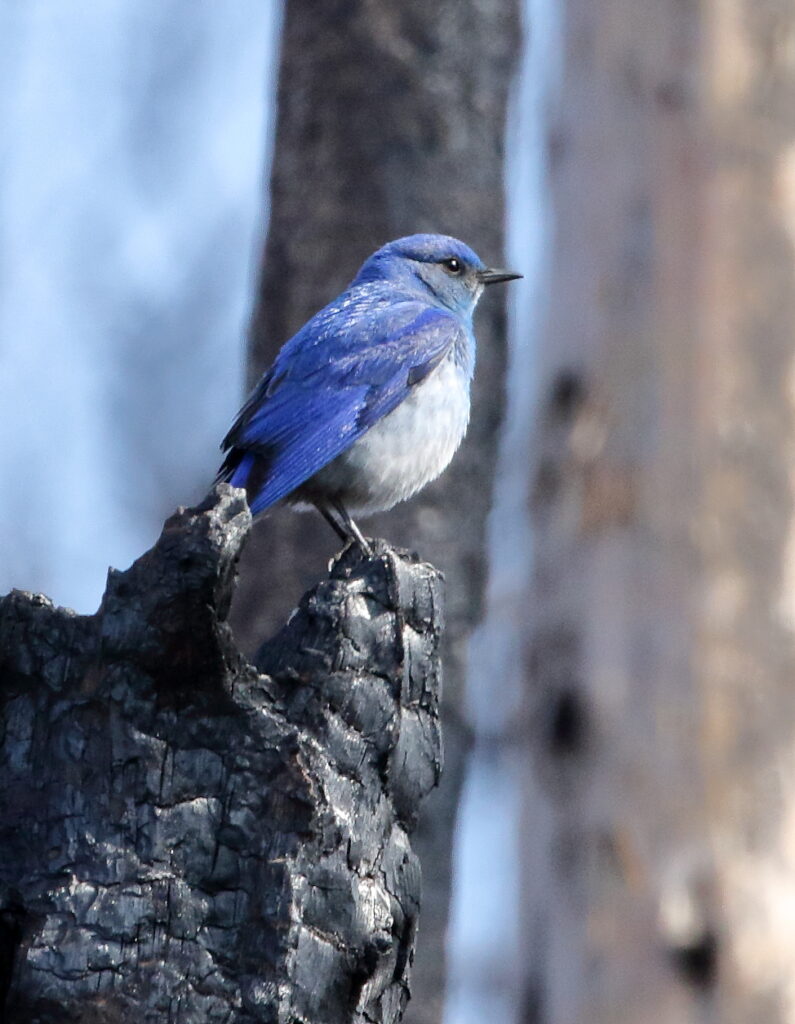
Almost immediately, we began seeing Mountain Bluebirds, one of Montana’s most spectacular species. MOBLs are well-known “fire birds” and their vivid blue plumage looks especially striking against the blackened trunks of a burned forest. Today, we saw these birds everywhere. During our three-mile walk, Braden recorded seven of them, but we both agreed we probably undercounted.

By popular consensus, Mountain Bluebirds are the most stunning “fire birds” you’ll find in burned forests. However, another common fire bird, Western Tanager, might challenge that opinion. Did you know that bluebirds are thrushes? They are relatives of at least four other popular Montana thrushes: American Robin, Swainson’s Thrush, Varied Thrush, and Townsend’s Solitaire.

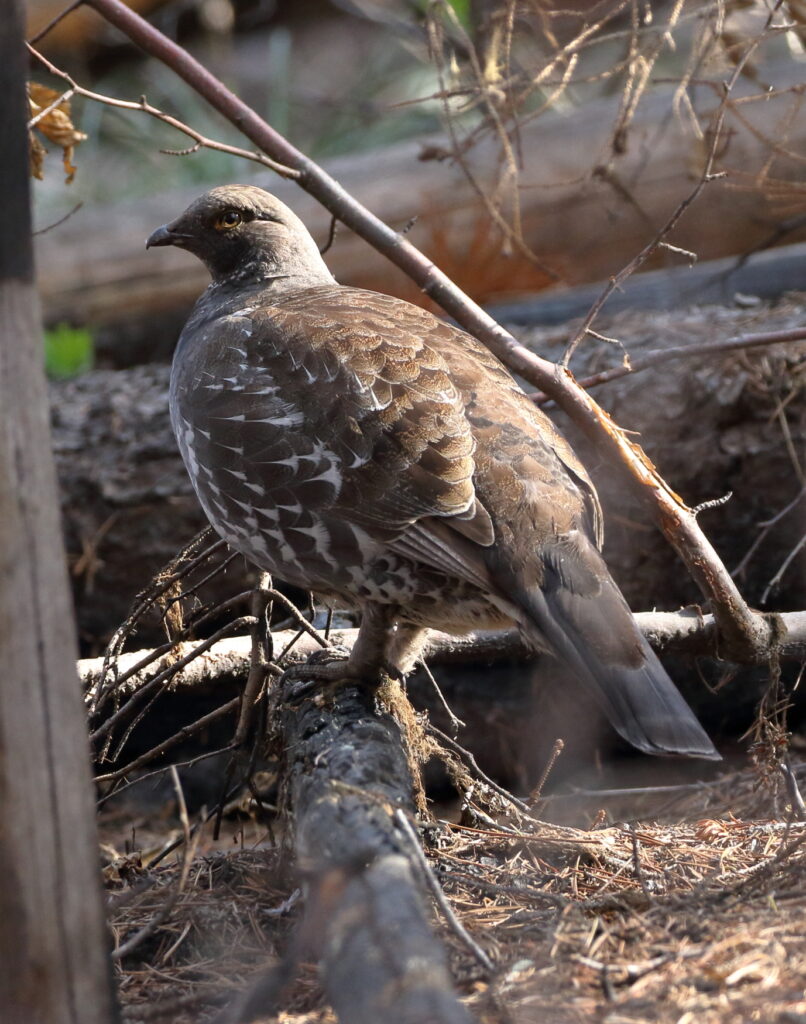
Suddenly, a large shape took off from beside the road and spread its wings as it glided down into the woods. “Dusky Grouse!” Braden exclaimed. It was one of the birds he most wanted to see since arriving back in Montana the previous week. Hoping for a better look, we crept down after the bird and, sure enough, espied it sitting quietly in the shadows. We enjoyed it through our binoculars for five minutes and then slipped away, leaving it in peace.

Before heading out, Braden told me, “I really want to see a Dusky Grouse.” This one obliged perfectly—and it was the first we’d ever seen in a burned forest.

Except for the mystery woodpecker that had drummed earlier, we had not heard a trace of other woodpeckers, but what we did hear was astonishing: wood-boring beetle larvae actually munching away inside of the dead tree trunks! I’d been told that one could hear these, but with my crummy hearing, I didn’t believe that I ever would. Sure enough, in several places, we listened to these big juicy grubs take noisy bites out of the wood!

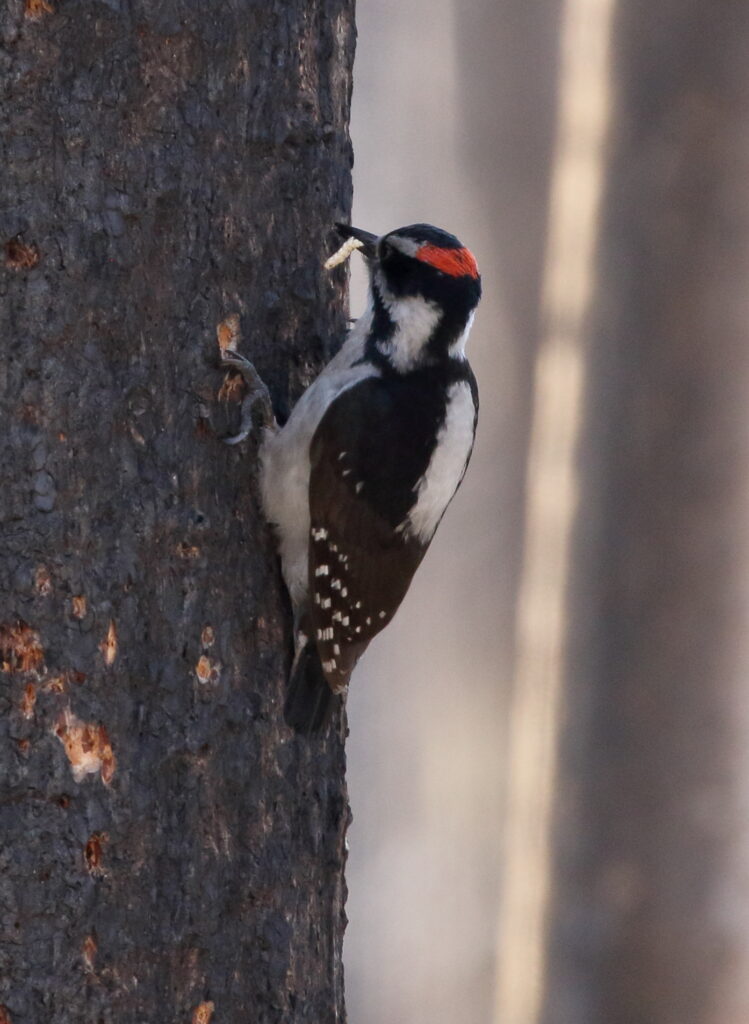
Score! While we watched, this Hairy Woodpecker extracted a juicy beetle grub from a dead tree.

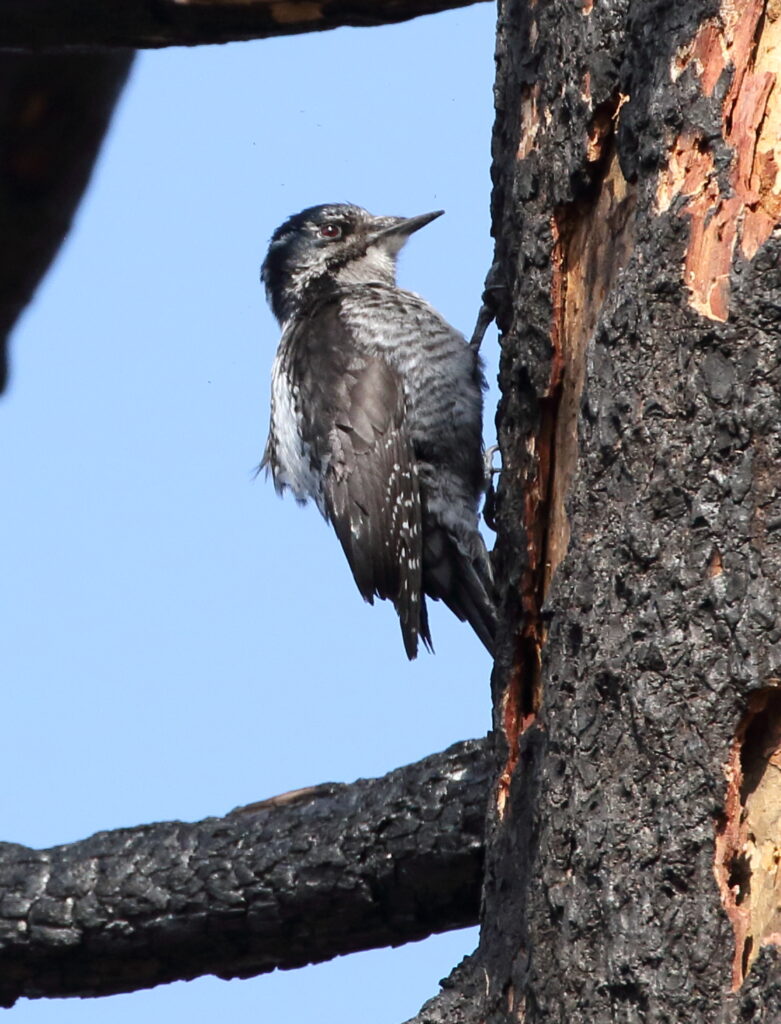
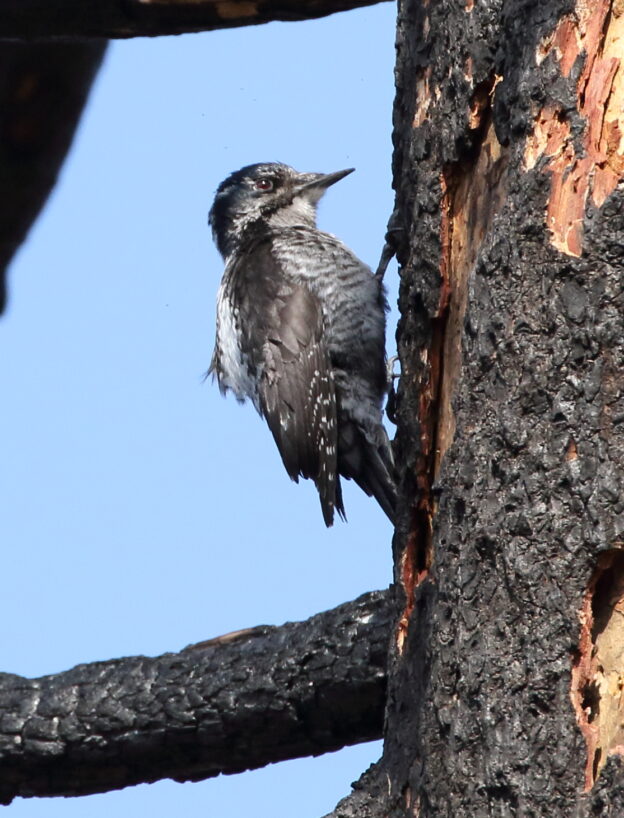
Finally, we also heard tapping on a large tree ahead. Braden got his eyes on it first. “It’s an American Three-toed,” he exulted. We could tell it was a female by the lack of a yellow crown, and we settled in to watch this amazing bird. It was working its way down the trunk, flaking away burned bark, presumably to check for insects hiding underneath. Once in a while, it stopped and really began pounding away after a beetle deeper inside the wood. It sounded like someone driving nails into cement!

Even female American Three-toed Woodpeckers can be distinguished from Black-backed Woodpeckers by having some streaky white on their backs—though not as much as on Hairy Woodpeckers (compare with previous photo).

As we continued our walk, we also saw Hairy Woodpeckers and another three-toed, this one a male. Woodpeckers, though, were just some of the birds making use of the burn. We got great looks at Townsend’s Solitaires, Red Crossbills, American Robins, Dark-eyed Juncos, Yellow-rumped Warblers, and Chipping Sparrows, and heard both Red- and White-breasted Nuthatches. Most of these are classic “burn birds” and we felt exhilarated to see them.

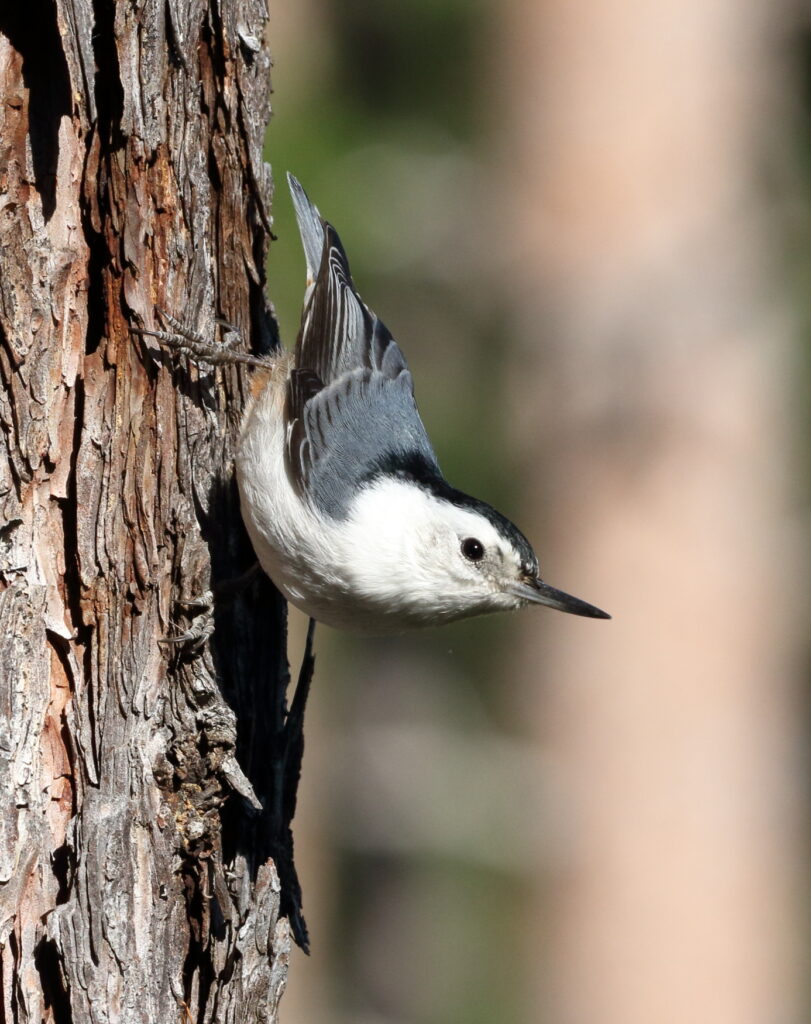
Though we didn’t get eyes on one in the burn, we did hear a White-breasted Nuthatch—and saw this one the day before up nearby Pattee Canyon.

At a couple of places, unburned green scrubby areas abutted the fire boundary, and it was fun to see birds dash from these green protected areas into the burn for quick meals or nesting materials before dashing back to safety. Many birds, in fact, love to “set up shop” at the boundaries of such two contrasting habitats.

We never did find a Black-backed Woodpecker, but that did little to detract from yet another great birding outing. We vowed to return to this spot the next few years, hoping that no one would move in to “save” this precious forest that didn’t need saving. On the drive down, we also stopped at some of the lower riparian areas for great “listens” at MacGillivray’s, Orange-crowned, and Yellow Warblers along with our favorite empid species, Willow Flycatchers. Amid the current chaos of the world, our burn bird outing offered a fun, revitalizing—and yes, inspiring—break. If you’re lucky enough to have a burned forest near you, we hope you’ll check it out.

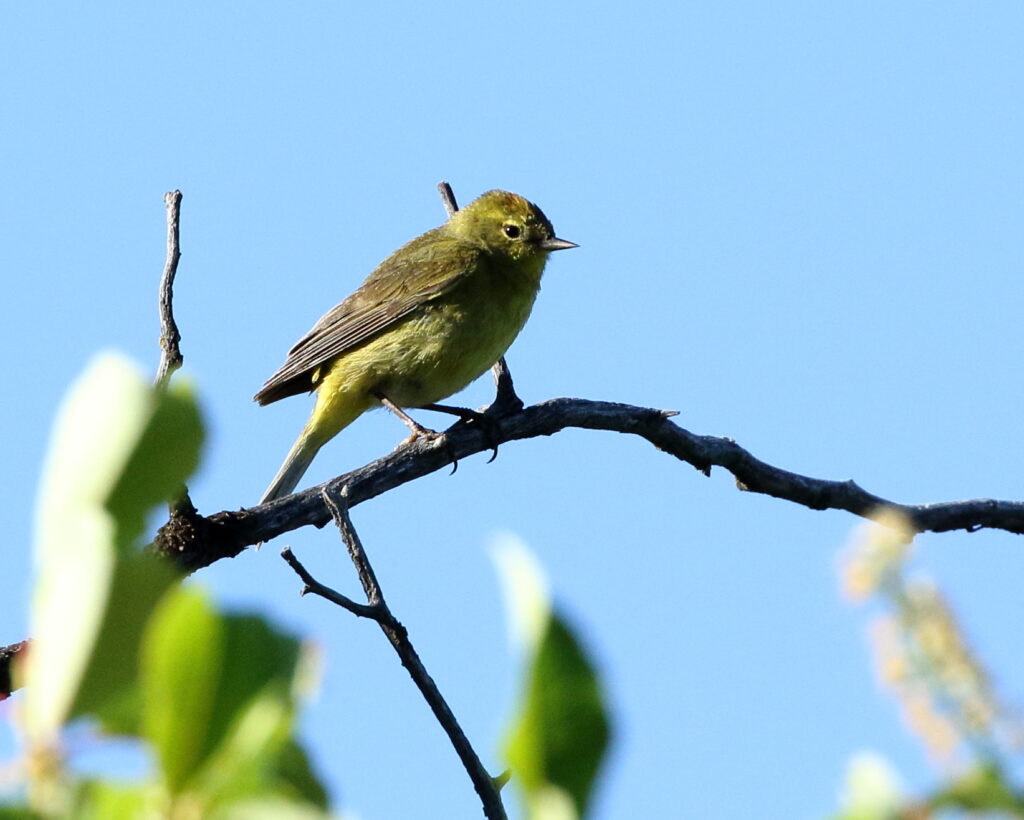
We can’t prove it, but it seems to be a really good year for Orange-crowned Warblers—not always the easiest birds to see in Montana.

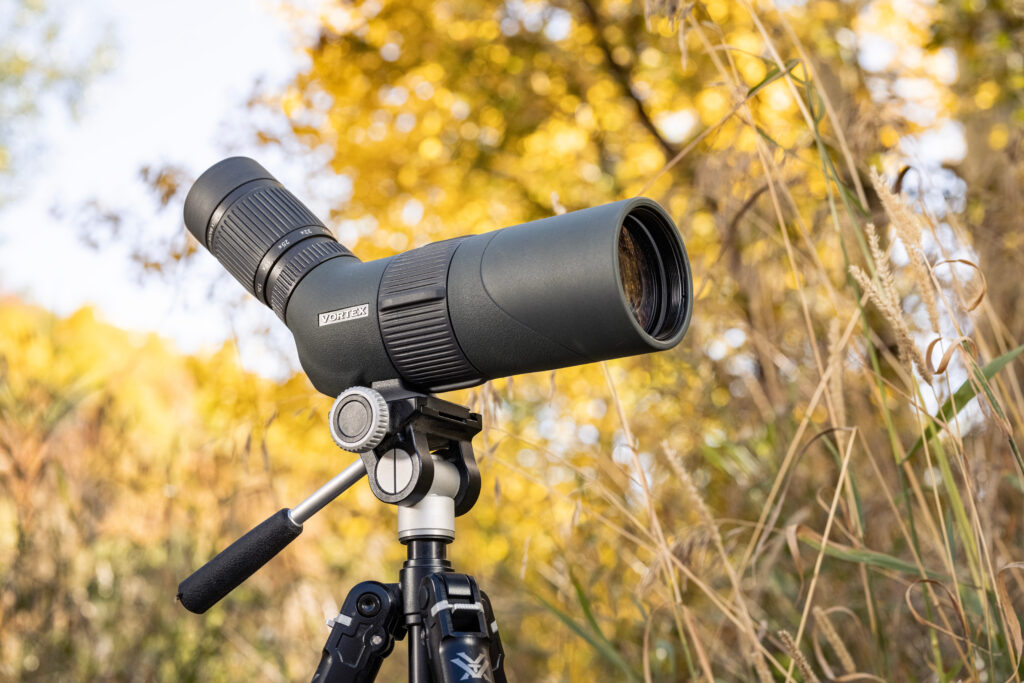
Vortex Razor HD 13-39X56 spotting scope with Mountain Pass tripod: A Perfect Travel Combo? (Equipment Review)

When it comes to equipment, birders tend to follow similar progressions. With binoculars, for instance, most of us start by borrowing any binoculars at hand. From there, we buy our own binoculars, focusing more on the sale price than the quality. Then, one day, we happen to look through a friend’s really good binoculars and it’s like “Whoa! I’ve got to save up for these!” If you’re at that point, check out our two recent reviews of binoculars that we highly recommend:

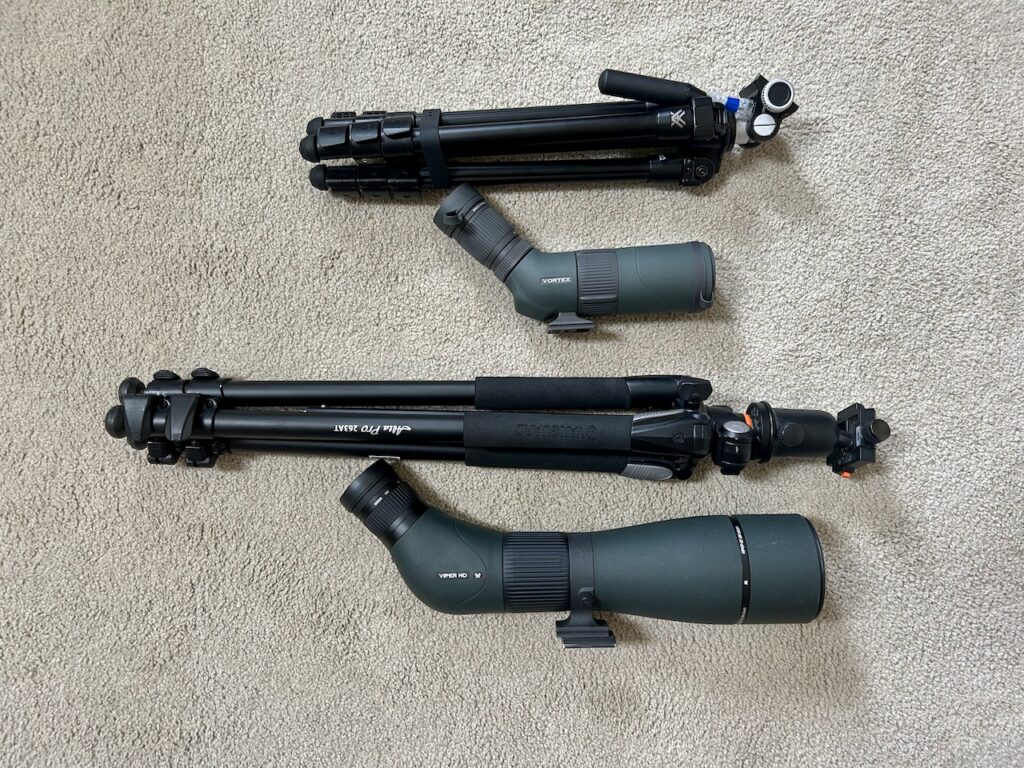
Birders, though, also go through a progression with spotting scopes, from not thinking we need one at all to wanting to get the best possible scope we can afford. But birders who travel a lot also progress to another step: getting a scope that is easy to travel with. Which is where I currently find myself. After going through the typical birder “evo-scopo-lution,” Braden and I bought ourselves a Viper HD 20-60X85 a couple of years ago. I can’t sing the praises of this scope highly enough. I like it so much that I lugged it with me on recent trips to California (see our post “Chasing Migrants”) and Canada (see our post “Birding Victoria, BC”). The problem? It’s not exactly travel-friendly. At eighteen inches (45 cm) long and weighing in at five pounds (2.3 kg), just the scope alone demands some tough packing decisions. Add in five pounds for a sturdy tripod, and just like that, you’ve increased your travel calculations by an awkward ten-plus pounds!

I was discussing this dilemma with a Vortex dealer account manager recently and I asked him, “Hey, do you have any good travel scope/tripod combos I can try out?” Three days later I received a Vortex Razor HD 13-39X56 scope with a Vortex Mountain Pass tripod. Even better, I was just about to head out on a trip to central Montana where I would be able to put it through its paces (see our last post, “Hi-Line Report”). But before I critique this dynamic duo, let me give you some basic stats:

* Fully assembled, the Razor HD 13-39X56 scope measures only 10.5 inches long—short enough to fit into almost any backpack. When the eyepiece is removed, it shrinks to an incredible 8 inches!

* The Razor HD 13-39X56 weighs only 1 lb. 14 oz—less than one of those silly two-pound weights many of us buy for rehab exercises.

* The Mountain Pass tripod measures just over 21 inches—also short enough to slip into many backpacks—and weighs almost exactly 3 pounds.

One glance shows the dramatic difference between packing my usual scope/tripod combo (bottom) and the Vortex Razor HD 13-39X56 scope with Mountain Pass tripod (top).

In other words, the entire combo comes in at an almost feather-light 5 pounds—less than half of what I am used to lugging around. This alone gave me a huge crush on it! But (suspense building), how did it perform? I had the chance to use the scope in both optimal and stormy conditions, so let me take those one at a time.

Optimal Conditions: Basically, I could not be more pleased with the Razor HD 13-39X56/Mountain Pass combo in great conditions. For its size and weight, the scope’s optics are terrific, giving sharp, clear images at distances of at least a couple of hundred yards. In fact, under the vast majority of conditions, interference from heat waves and similar air turbulence will distort the image before the scope’s distance precision is exceeded. Birds and other animals look like they are almost right in front of you in all their crisp, colorful glory. What’s more, I took the combo out on a two-mile jaunt at a local birding hotspot and hardly paid it any attention as I strolled along with it resting over my shoulder. This is in sharp contrast to my other, heavier scope/tripod combo, which Braden and I have to frequently trade carrying as it digs into our shoulders.

I did not try this myself, but the scope is light and convenient enough to easily mount on a window, say, at Freezeout Lake or Bowdoin? (Special window mount required.)

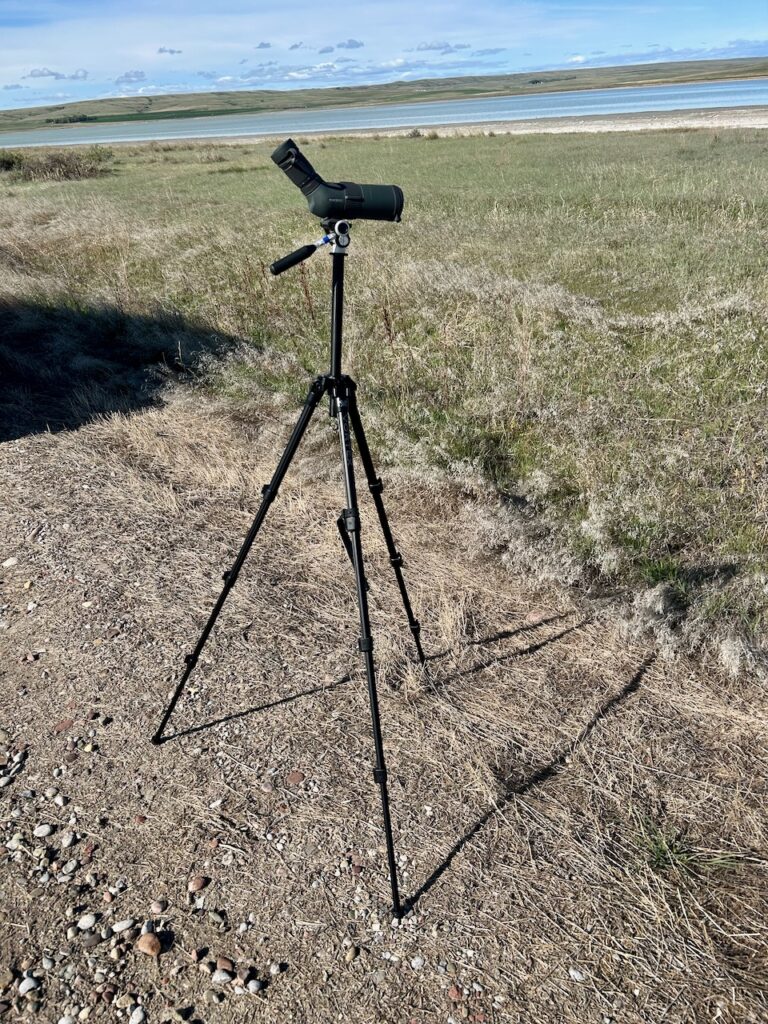
Stormy Conditions: During my recent trip to Bowdoin National Wildlife Refuge, I unfortunately encountered very gusty conditions. As you might imagine, using the scope/tripod combo proved more challenging. The optics, of course, stayed the same, but the combo’s light weight began to be a factor. I had to hold down the tripod with one hand to reduce shake enough to get on distant ducks and other birds—but this is a problem even with my heavier scope/tripod combo and every other combo that I have used in windy weather. To help compensate for this, the Mountain Pass tripod comes with a hook from which you can hang a stabilizing weight, but that means you have to bring this along with you (or use a boot, young child, or other handy hangable weight). I did not try this myself, but I’d guess that even with the weight, gusty conditions will pose a challenge. That’s no criticism of the combo—just a fact of birding life.

In calm conditions, the Razor HD 13-39X56 and Mountain Pass tripod perform like a dream, as I learned on a recent trip to Freezeout Lake near Great Falls. Because they are lighter, wind produces more shake, just as it does for all but the heaviest scope/tripod combinations.

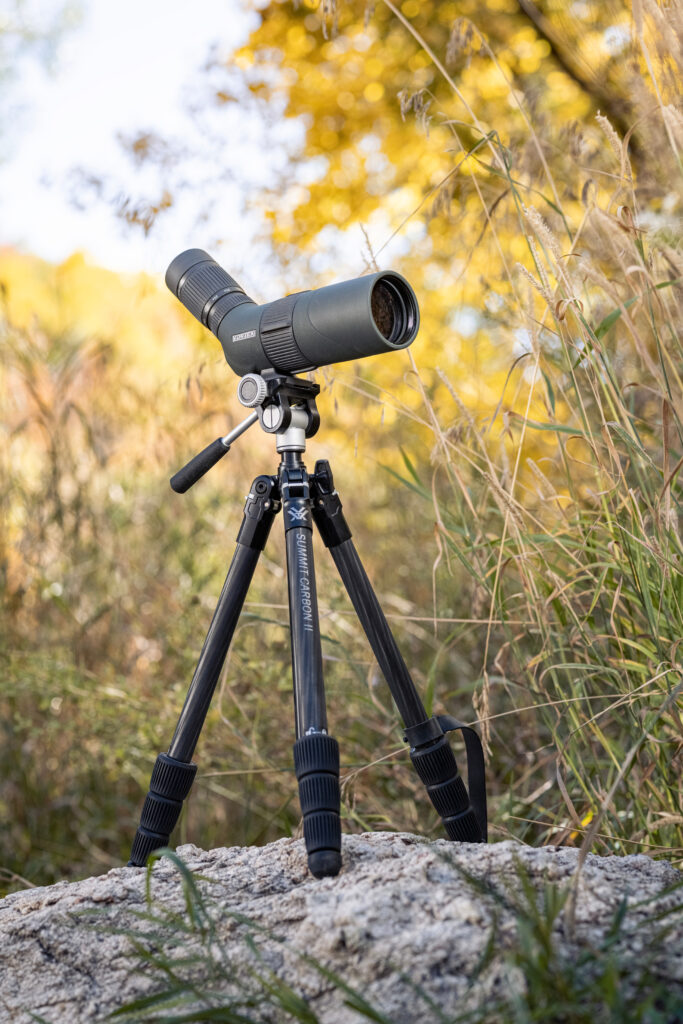
To help matters, you don’t have to use the lightweight Mountain Pass tripod. The Razor HD 13-39X56 is so good that you might make it your only scope purchase, and if you do, you might consider buying a heavier tripod that will deliver better performance in rough conditions.

As this photo clearly shows, beefier carbon-fiber tripods are available for the Vortex Razor HD 13-39X56. Check out the Vortexoptics.com for details.

However, the point of this article is lightweight travel, and I have to say that the Razor HD 13-39X56/Mountain Pass combo strikes a wonderful balance between weight, magnification, and quality. An added advantage to this combo is that because Vortex makes both products, you won’t need an additional mounting plate to affix the scope to the tripod. Mounting plates generally are a pain in the rump, always coming loose at inopportune moments, so for me this is a significant advantage.

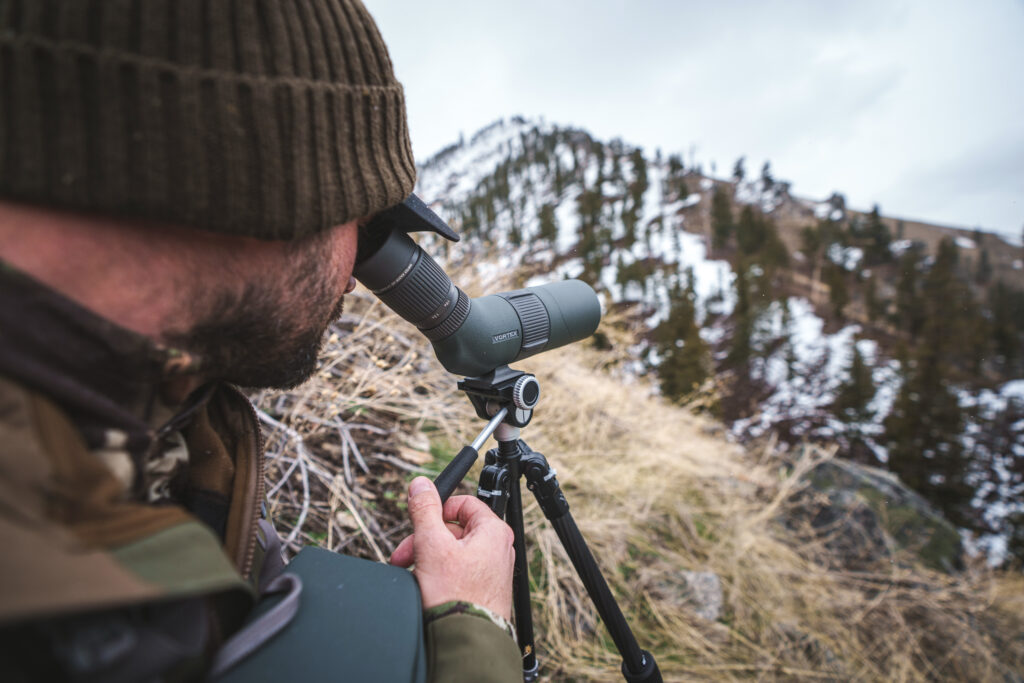
You are probably asking yourself, “Does the Vortex Razor HD 13-39X56 scope have enough magnification for distant birds?” With a maximum magnification of 39, the answer is that it certainly has less than than the maximum of 60X on my 20-60X85 scope. That said, I did not feel very limited by this. Again, in my experiences atmospheric disturbances are usually more likely to limit your observations than the power of this scope.

This guy is obviously using his scope to check out a Northern Goshawk for his life list. Er, or maybe he’s looking at an elk. Either way, the Vortex Razor HD 13-39X56 delivers enough oomph (magnification and clarity) to serve as your primary birding scope in most situations.

More about the tripod: I should point out that before receiving the Mountain Pass tripod, I was a strict adherent to “ball head” tripod heads, ones that allow you to quickly tilt and rotate the scope in any direction with a single control knob. The Mountain Pass head, though, comes with a “pan and tilt” head, but unlike some other pan and tilt heads I’ve used, both the pan and tilt also are controlled by a single knob. This makes the whole thing almost as easy to use as a ball head. To lock down the swivel of the head, you just hand-tighten the knob further. I suspect that this may wear out or get stripped over time, but as I’ve mentioned in other posts, Vortex’s lifetime warranty has you covered.

Like many other tripods, the Mountain Pass features four-part, telescoping legs that allow it to adjust to almost any height (though folks over 6-feet tall may want a taller tripod). The tripod legs also have levers that allow them to splay extremely wide for observing, say, a grouse lek at eye level.

Pricing: I have been so taken with this scope that I’ve neglected to mention the price. Although listed considerably higher, the Vortex Razor HD 13-39X56 scope can currently be purchased for right around $1000 while the tripod runs about $150. These are not insignificant sums, but are a great value for the quality you get—as anyone who has used cheaper scopes and tripods will quickly learn.

Bottom line: I love the Vortex Razor HD 13-39X56/Mountain Pass combo and am deeply upset that I have to return it to Vortex. Who are they to ask for their equipment back, anyway? I suspect, however, that I will be purchasing this combo in the future and am already looking forward to using it on a host of future travel birding adventures.

The Vortex Razor HD 13-39X56 delivers a high-quality, reasonably-priced product that is both outstanding for travelers, and powerful enough for most everyday birding situations.

Hi-Line Report: Bad Weather Can Bring Good Birds

Want to support FatherSonBirding? It’s easy! Simply pick up a copy of Birding for Boomers by clicking here—or by ordering it from your local independent bookstore! We thank you!

Most serious Montana birders try to make it up to the Hi-Line every year. If you’ve never heard of the Hi-Line, it is the northern region of the state that basically follows Highway 2 from East Glacier National Park all the way to the North Dakota Border. It’s an area full of rolling hills, badlands, farms and ranches—and a whole lotta birds. For Braden and me, the region is best represented by the Bowdoin National Wildlife Refuge, a sprawling 15,551-acre refuge near Malta that encompasses a rich variety of wet and dry habitats. We don’t make it up to Bowdoin every year, but this year I was fortunate enough to get invited to visit a school in nearby Chinook. Even better, I timed the visit for spring migration and breeding. I booked an Airbnb in Malta and drove up two days early to give me a full day at Bowdoin. The bad news? The forecast called for rain.

Indeed, when I arrived at the refuge at 6:00 a.m., rain pelted the car, propelled by a cold wind. Geez, I thought. I’m not going to see anything today. It was so cold and wet that I skipped my usual stop at the visitor center and instead headed straight out onto the first, five-mile section of the fifteen-mile loop around the lake. I noted that water levels, although not great, were better than I’d seen them two years before, but the first five-mile section was a time to focus not on water birds, but on denizens of the grass. Normally, in fact, Braden and I spend the most time in this section, stopping frequently to listen for Grasshopper Sparrows, Baird’s Sparrows, Chestnut-collared Longspurs, and other grassland favorites (see our post “Great Grassland Birding”). Today, that proved impossible. Every time I opened the window, wind and rain cascaded in and made it almost impossible to hear calls beyond the heavy-metal songs of Western Meadowlarks.

Steady rain and wind limited my ability to find grassland birds!

Mercifully, a few species took pity on me. Right off the bat, I espied one of our favorite birds, a Bobolink—the only one I would see the entire trip. Then, I spotted a drenched Grasshopper Sparrow perched on a small bush—the lone GRSP I would see that day. Lark Buntings also put in an appearance, along with Horned Larks and Savannah Sparrows. I also was pleased to see shorebirds, but on this section of the drive, they were far away. At one point, I leaped out to set up the scope I was testing out (see our next post), but immediately got drenched and was unable to ID much except for Wilson’s Phalaropes, American Avocets, and a Willet.

Lark Buntings were the most cooperative grassland birds I managed to see on this cold, wet, windy day. Thank you, Lark Buntings!

As I kept driving, however, conditions steadily improved and I got better looks at shorebirds. The phalaropes were especially impressive and I estimated at least a thousand out on the water and working the shore. The vast majority were Wilson’s, but with patience, I found a group of four Red-necked Phalaropes—most clearly identified by their smaller size, overall darker appearance, and distinct light lines running down their dark backs. Ducks were not super abundant, but plentiful and I counted at least ten species, including my first-of-the-year Canvasbacks!

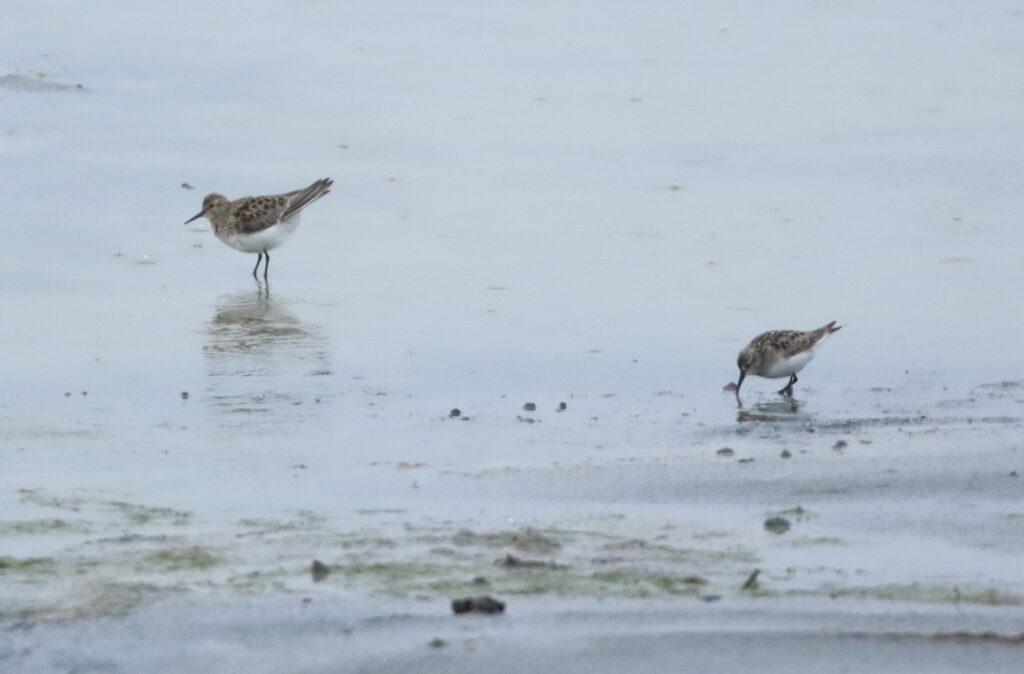
Twice, I drove down to some boat ramps and, despite the rain, nabbed a good “harvest” of shorebirds. I found about half a dozen Semipalmated Sandpipers and one Western Sandpiper. The real surprises, which I confirmed later with Braden’s help, were a Baird’s Sandpiper and a White-rumped Sandpiper! The latter was especially difficult to figure out because it didn’t readily show the diagnostic, thin lines of spots extending from the neck down to below the wings, but the overall appearance and body size fit. I was thrilled to find these birds as we’d never found them at Bowdoin before. Then again, we’d never birded Bowdoin this early in the season, so they were all part of my continuing Montana birding education.

Both this Baird’s (left) and several Semipalmated Sandpipers (right) proved early season surprises on this cold, rainy Bowdoin day. The larger size, long wing tips extending beyond the tail, and “medallion” appearance on the wings help distinguish Baird’s from the smaller peeps.

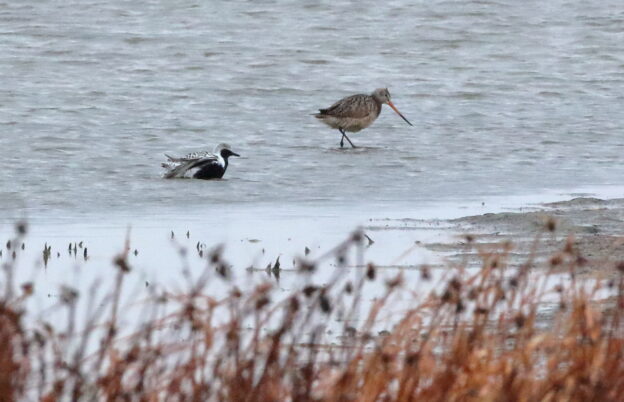
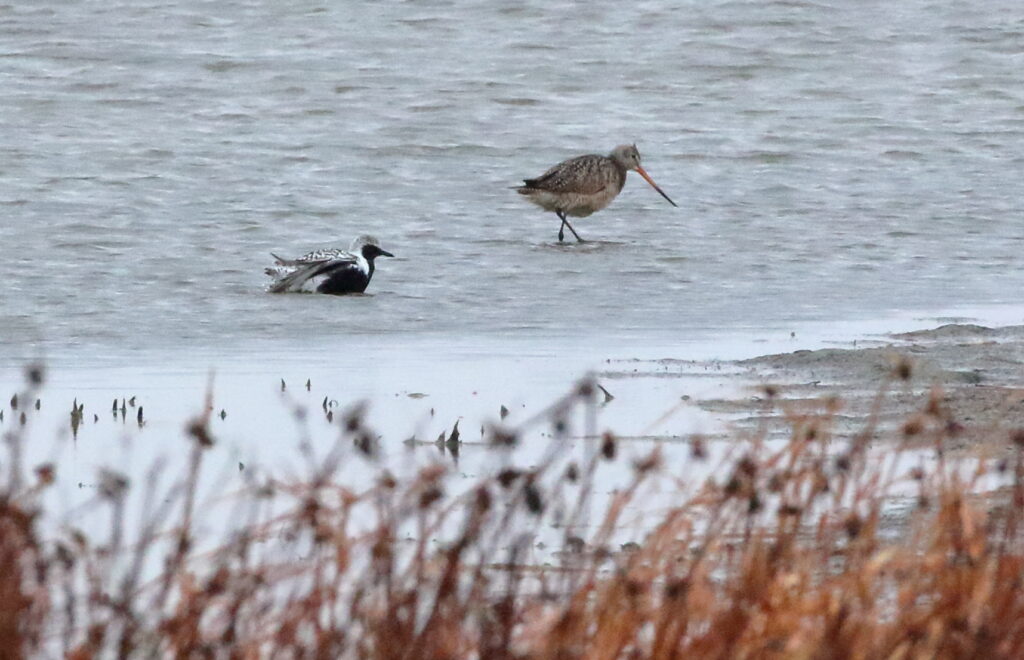
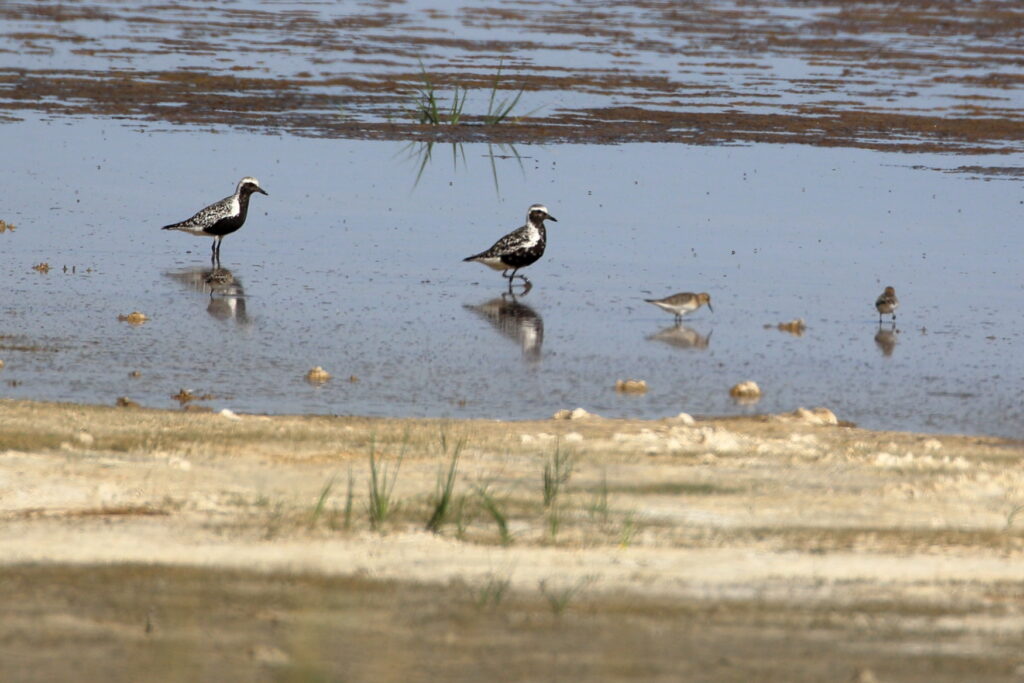
As I was leaving the second boat ramp, I noticed a Marbled Godwit in the parking area. Godwits, like Willets and Long-billed Curlews, are shorebirds and grassland birds. They nest in grasslands, usually near water, so seeing one here didn’t surprise me. I was about to drive off when the godwit suddenly launched itself. As I watched, it flew a hundred yards or so to the shore—and landed next to two birds I had especially hoped to see: Black-bellied Plovers! Loyal FSB readers will note that I’ve written about these fine birds a lot in the past couple of years (see, for instance, this post), and so it was with special pleasure I observed them now—and in their best black-bellied breeding plumage. Thank you, Mr. Godwit, for pointing them out!

This helpful Marbled Godwit (right) made a special effort to point out two Black-bellied Plovers that I had so woefully overlooked!

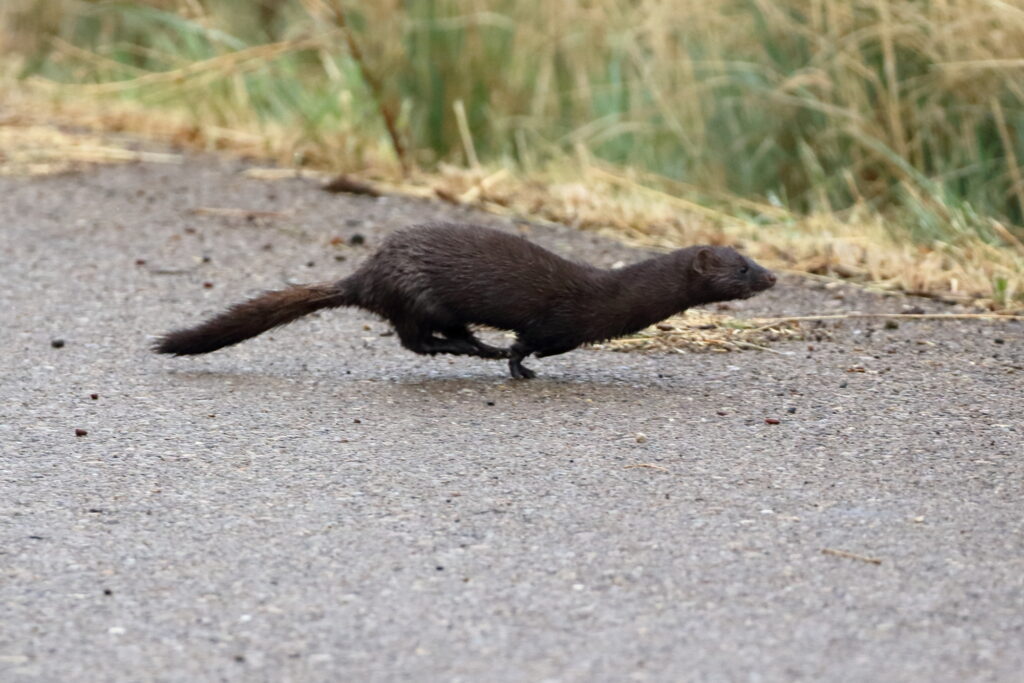
By the time I made it back to the visitor center, my stomach rumbled and, though the rain had slackened, the cold and wind remained. I debated whether I should even get out of the car to explore around the small pond there, but I knew that Braden would never forgive me if I didn’t. Marshaling my determination, I walked over to the start of the little path that circumscribes the pond. Almost immediately, a curious face popped up from behind a bush thirty feet away. “Whoa!” I whispered. At first, I thought it was a weasel, but it was much larger than the three or four weasels I’d observed in the past. Stoat? Ferret? I asked myself. Could it possibly be a mink? I’d never seen a mink and didn’t know if they even lived in Montana, but it seemed to fit the profile. Later, iNaturalist experts helped me confirm that that’s what it was. After looking at me for several moments, the long, bizarre-looking creature loped across the road and disappeared into the brush. The birds, however, were not to be outdone by a mere mammal!

Seeing my lifer American Mink was about the last thing on my mind as I braved Bowdoin’s visitor center area for one last birding effort!

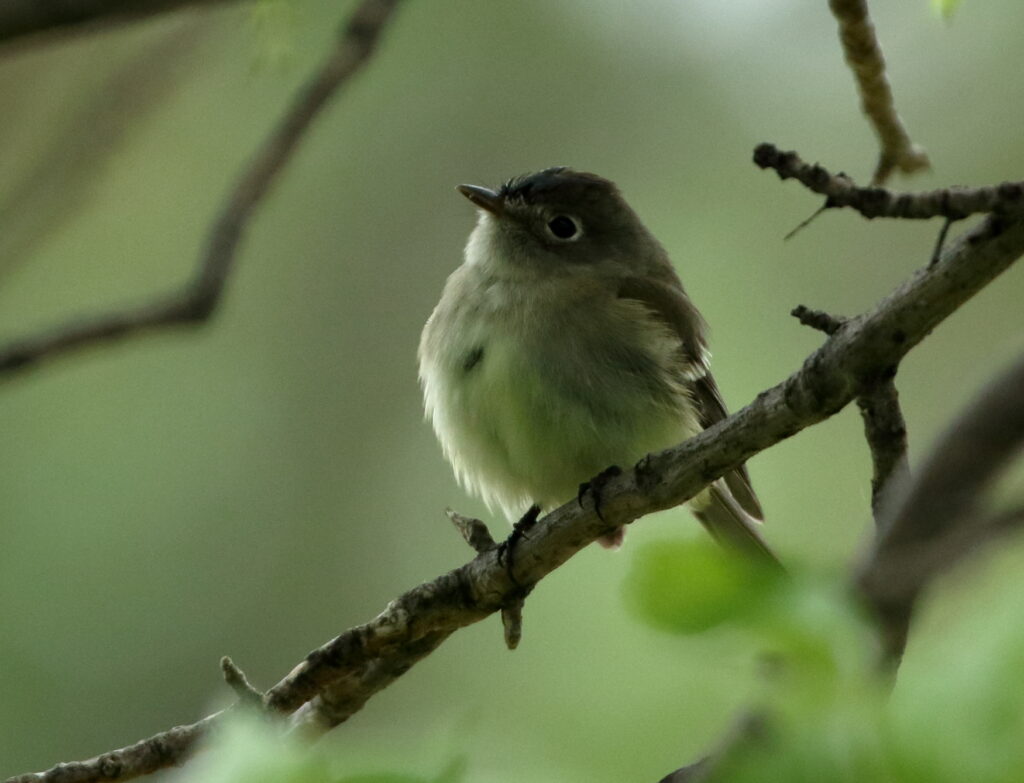
As I began poking around the beginning of the trail, I saw shapes flitting about in the bushes. A brownish bird streaked by me giving off Swainson’s Thrush vibes, but I didn’t see it well enough to definitely identify it. Minutes later, a reddish-backed bird landed on a nearby branch below me—a Veery! Then I got a good look at another Swainson’s Thrush, this time confirming the ID. In the branches above it, an adorable little Least Flycatcher watched me, but none of these would be the stars of the show.

Empidonax flycatchers are notoriously difficult to identify by sight, but this bird’s “cute” appearance—and the fact that no other empids should have been anywhere in the area—helped clinch the ID.

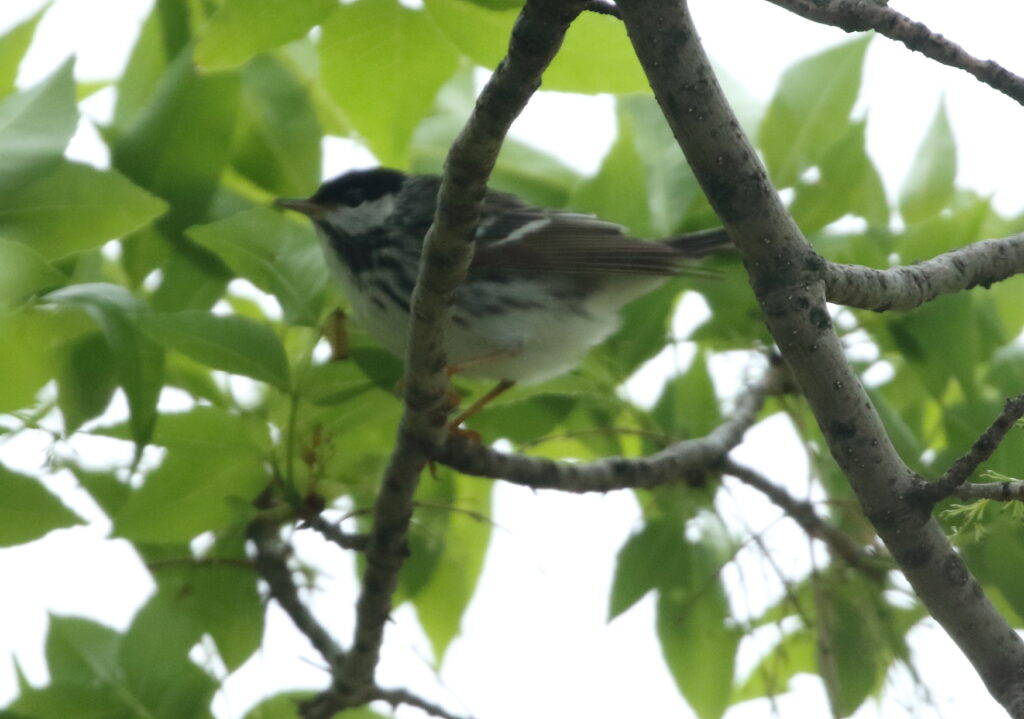
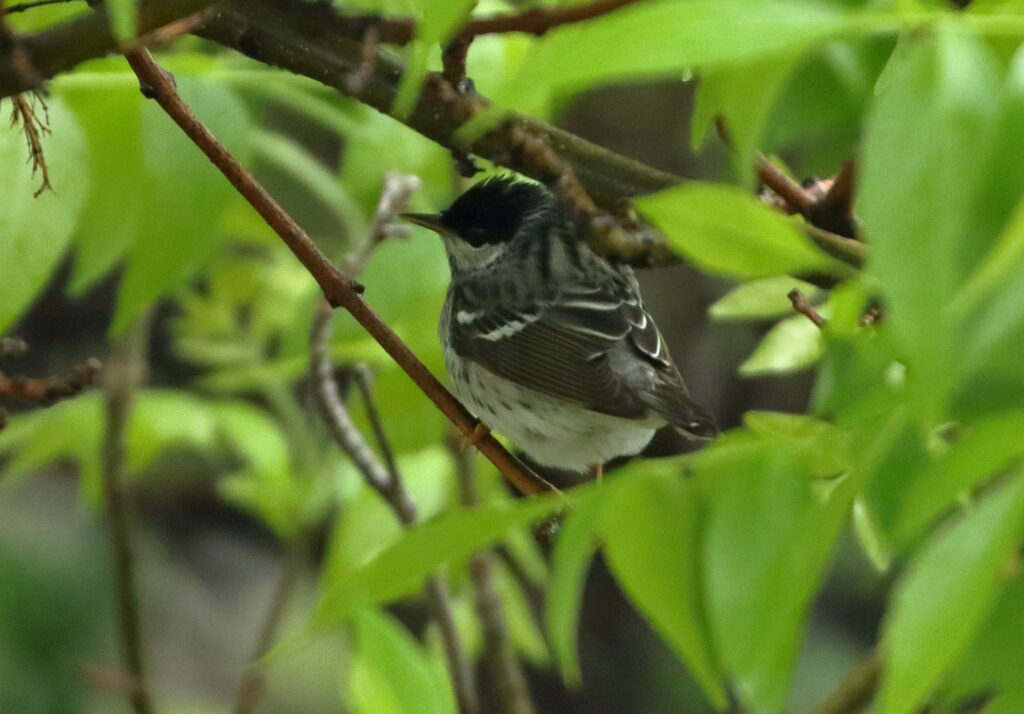
Even through the wind, I could hear both Yellow Warblers and Common Yellowthroats around me, even if I couldn’t get clear looks at any of them. Then, a small songbird landed in a tree about thirty feet away. I got my binoculars up in time to recognize a species I had longed to see—a Blackpoll Warbler! Like the Swainson’s and Veery, the warbler was clearly in migration, on its way to northern breeding grounds in Canada and Alaska. Braden and I had found them three times before in Montana, but always females. Not only did a gorgeous, breeding plumage male now stare back at me, it was the first Blackpoll I had ever found on my own!

As you can tell, the day proved tough for photography all-around, but I managed to get fuzzy ID photos of my Bird of the Trip, Blackpoll Warbler!

You won’t be surprised to hear that the Blackpoll Warbler immediately secured Bird of the Trip honors. Even more, it cemented the notion that just because conditions are bad for birders, they can still be great for birds. In fact, storms often cause birds to hunker in place for a day or two—perhaps the reason I found some of the especially cool birds I found today. I plan to remind myself of that the next time I’m debating whether to venture out into the pelting wind and rain.

The Shorebirds of North America (Book Review)

With spring shorebird migration coming on, we take a break from our Colombian birding series to review a new book that will help prepare you for the exciting, sometimes daunting task of identifying and enjoying some of the world’s most spectacular long-distance migrants. Bird—and read—on!

Legions of FatherSonBirding readers have probably noticed that Braden and I have increasingly become interested—nay, obsessed—by shorebirds over the years. See, for example, our posts

Montana Shorebird Surprise

Abbotts Lagoon, Point Reyes National Seashore (or Chasing Migrants, Part II)

Our fascination may seem odd given that Montana is hardly the world’s epicenter of shorebird activity. Then again, their very rarity here renders them all the more alluring to find and learn about. A natural birding progression also is at work. When beginning one’s birding journey, we birders naturally focus on common, familiar species. As confidence, curiosity, and ambition grow, so does the desire to learn about and identify more difficult groups of birds. When we first began birding, Braden and I focused on woodpeckers, thrushes, waterfowl, waders, owls, and other easier-to-identify species. Over the years, we have plunged into increasingly challenging groups including warblers, sparrows, flycatchers (Braden), gulls, and perhaps more than anything, “shorbs.”

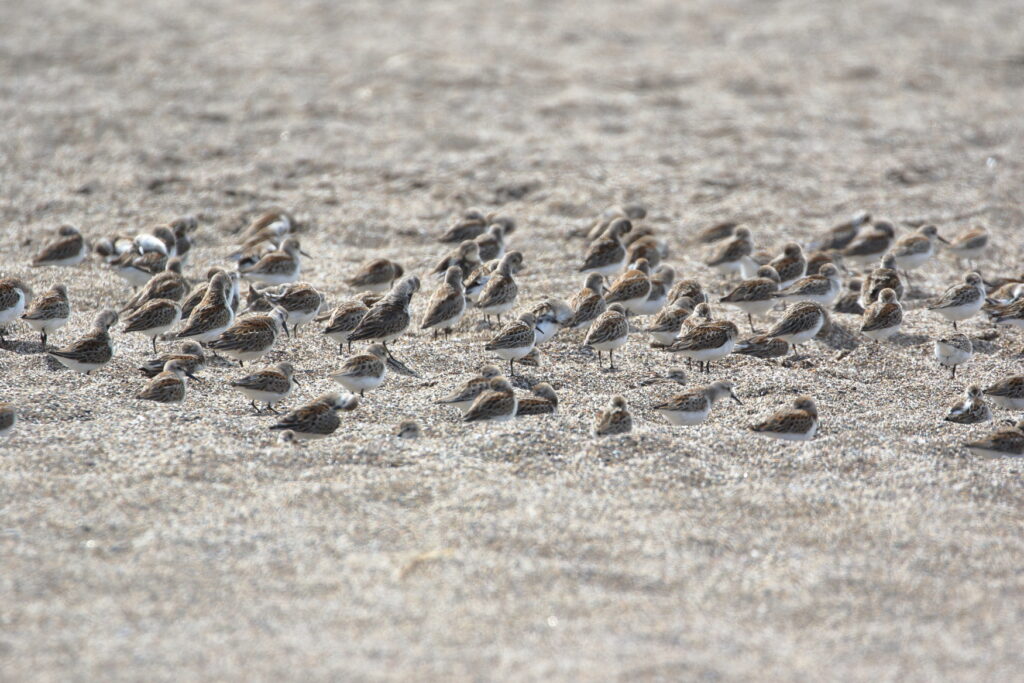
A flock of Western Sandpipers at Point Reyes during my September visit to California with Scott Callow.

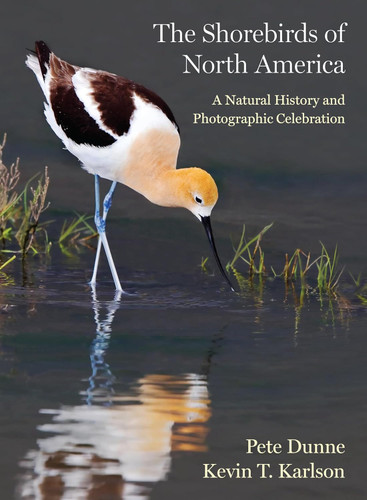
When out scanning beaches or shallow lakes, the most common phrase Braden repeats to me is “Shorebirds are tough.” This usually happens when I am whining about the difficulty in distinguishing between off-season Least and Semipalmated Sandpipers, or White-rumped and Baird’s Sandpipers—especially at a distance. But many shorbs are relatively easy to identify, and over the years both Braden and I have come to appreciate—nay, savor—the entire breadth of these fascinating, superbly adapted critters. Imagine my joy, then, when a brand new, beautifully photographed book about shorebirds arrived on my doorstep: Pete Dunne’s and Kevin T. Karlson’s The Shorebirds of North America: A Natural History and Photographic Celebration (Princeton University Press, 2024).

The Shorebirds of North America by Pete Dunne and Kevin T. Karlson (Princeton University Press, 2024)

To say that The Shorebirds of North America is ambitious would be like calling the 18,000-mile round-trip migration of a Red Knot “neat” instead of “epic” or “mind-blowing.” This terrific addition to birding literature not only gives a wonderful overview of the lives of shorebirds, it provides specific accounts of all the shorebirds likely to interest you. That makes this book a wonderful, highly readable reference for both beginning and advanced birders.

The bulk of the book consists of species accounts of 52 kinds of shorebirds known to breed in North America and my guess is that you, like me, will skip directly to species that happen to interest you at the present time. This is a great approach. One of the first shorebirds I looked up was Black-bellied Plover, a bird I have become more and more enthralled with the past several years. As I started to read, my understanding of this handsome creature immediately swelled. I didn’t realize, for instance, that it is one of the world’s most widely distributed shorebirds, or that it is called Grey Plover outside of North America. What really tickled me was learning how fearlessly aggressive these birds can be:

“On the high Arctic tundra breeding grounds,” the authors write, “this sturdy plover is a fierce protector of its large nest area, and it strikes fear into aerial predators as large as gulls and jaegers. Woe to any flying predator if it hears the whistled alarm call of Black-bellied Plover as it flies swift and low across the tundra before rising to spear the intruder in the belly with its strong bill . . .”

The 4-letter breeding code for Black-bellied Plovers is BBPL. After reading the entry for the bird in The Shorebirds of North America, however, I realized that BBPL could easily stand for “Bad-ass-bellied Plover”.

Who knew that one of my favorite birds is such a bad-ass? Similarly delightful “reveals” can be found in each account, many of them based on the authors’ own personal and scientific experiences with the birds.

Far from just being pretty to look at, the book’s incredible photos add real understanding of each species by showing them in a variety of plumages and situations. I enjoyed just quizzing myself on the photos as I made my way through the book, testing and expanding my knowledge as I went. I cannot imagine the effort Kevin T. Karlson and the book’s other photographers invested in creating what may be the world’s finest collection of shorebird photos.

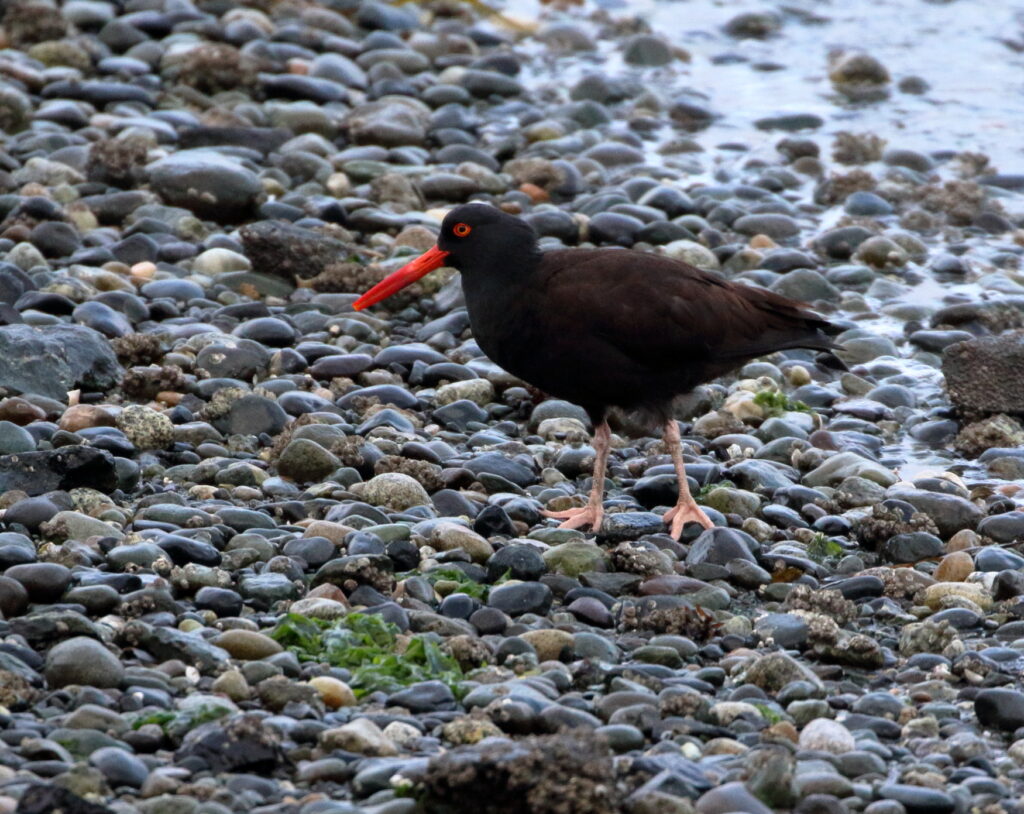
Another thing I learned from The Shorebirds of North America is that the bills of oystercatchers are laterally compressed. You can’t tell this from the typical side view, but this compression turns the bills into excellent chisels for prying limpets, snails, and chitons off of rocks.

As delightful as the species accounts are, I strongly urge readers to read the entire first section straight through. In this section, the authors provide excellent perspective on all shorebirds including their remarkable adaptations, habits, diversity, and evolution. Fascinating anecdotes abound, such as the story of B-95, a banded Red Knot known to have traveled more than 400,000 miles during his 21-year lifetime. The authors don’t bother to hide their admiration for these birds:

“Challenged to design the perfect bird, we would without hesitancy delve into ranks of shorebirds and reach down to the Scolopacidae (sandpipers), the largest of the roughly six or seven family groups in the shorebird order Charadriiformes.”

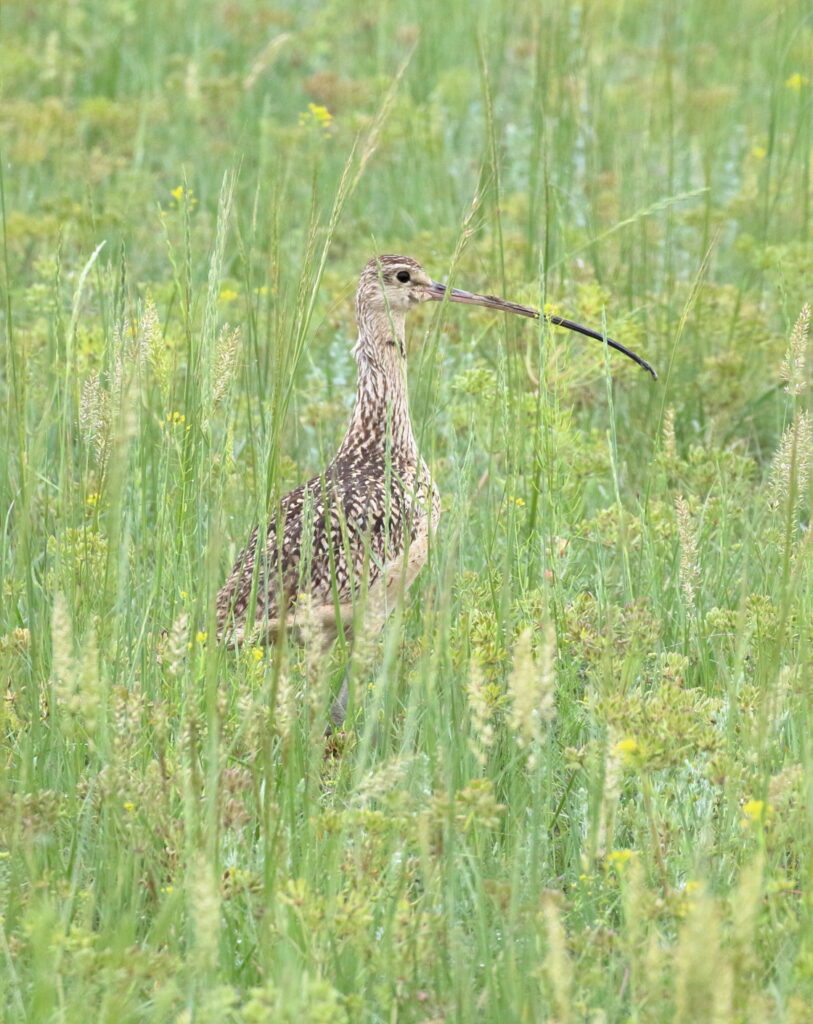
Another fascinating fact I picked up from The Shorebirds of North America is that the curved bills of Long-billed Curlews are almost perfectly designed to snatch fiddler crabs from their long, curved burrows. They’re also great for picking off grasshoppers without alerting them to their imminent doom.

I could keep singing this book’s praises, but really, if you have even the tiniest, nascent interest in shorebirds, you should order a copy yourself. Given its length and full-color format, I expected the book to sell for at least fifty or sixty bucks, but at the time of this posting it can be had for a bargain $35. That puts it within reach of most people—and makes it an investment in your birding future you won’t regret.

One-Sentence Summary: A highly-readable, indispensable resource for both beginning and advanced shorebird enthusiasts.

Overall Rating (on a scale of cool birds): Piping Plover (highest)

You can order The Shorebirds of North America from your local independent bookstore, or directly from Princeton University Press. Please tell them we sent you!

(Except for the cover image, photos in this post are copyright Sneed B. Collard III. Review copy of The Shorebirds of North America provided by the publisher.)