Category Archives: Science

Birding the Burn 2025

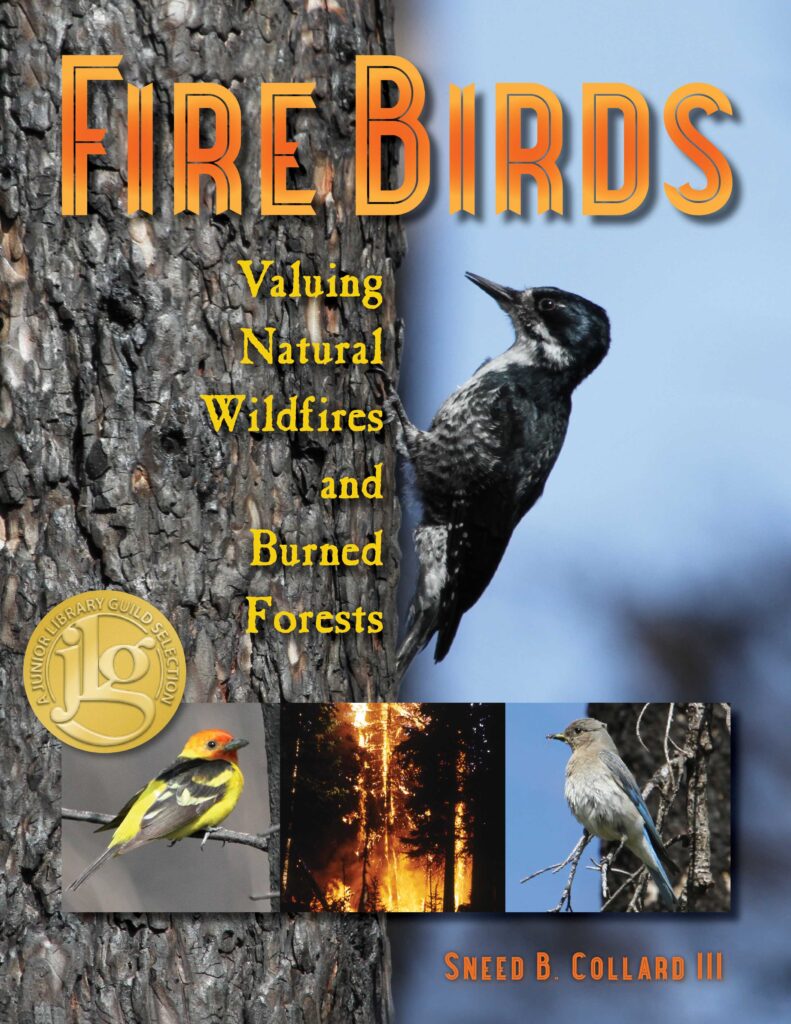
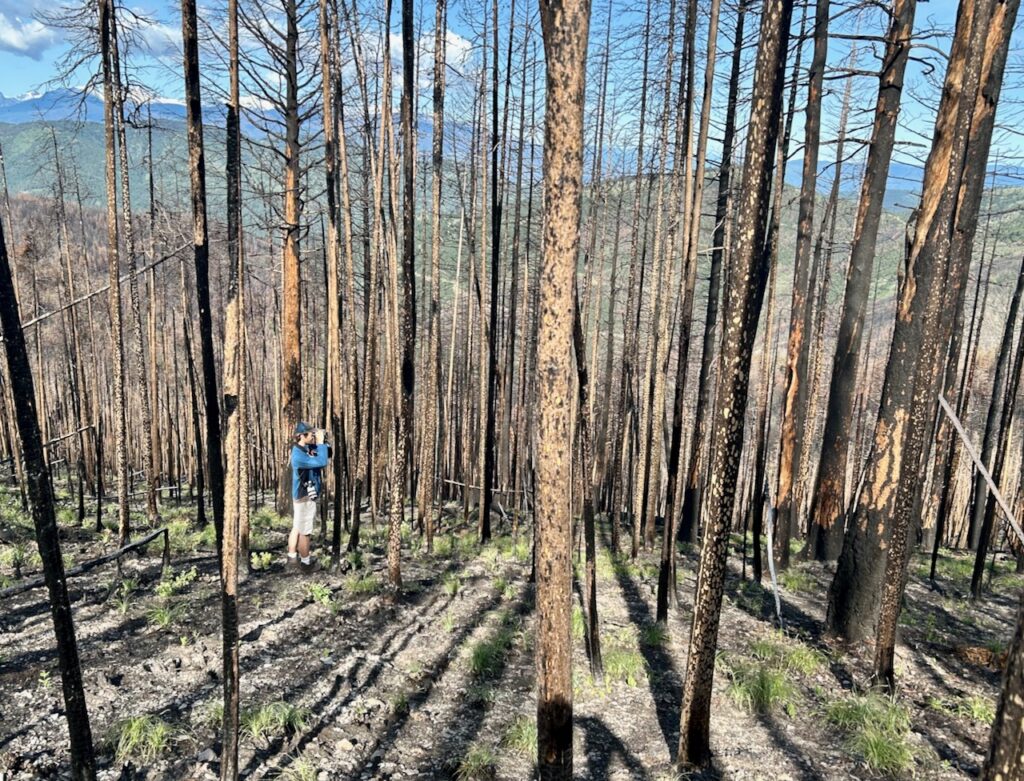
In many ways, my own birding journey began with my book Fire Birds: Valuing Natural Wildfires and Burned Forests. That’s when my birding mentor, UM Professor Dick Hutto, showed me the critical importance of burned forests and the spectacular birds that colonize them. It’s also when Braden and I began birding avidly. Since then, we have explored burned forests many times and they have become some of our favorite places to bird. Last week, we were excited to check out one of our area’s newest burns, last year’s Miller Creek fire area, about an hour from our house. To reach it, we headed all the way out Miller Creek and then wound our way up dirt roads until we reached the burn at Holloman Saddle. On the drive, we passed through terrific riparian and conifer habitat, and Braden could pick out Yellow and Orange-crowned Warblers, Swainson’s Thrushes, and Willow Flycatchers through the car window. At about 6,300 feet elevation, we reached the burn, parked, and began exploring.

Researching and writing Fire Birds: Valuing Natural Wildfires and Burned Forests set me firmly on my birding journey—and propelled Braden and me to start birding burned forests. The multiple award-winning book is a great primer for kids and adults on many little-known aspects of forest ecology. To order a copy, click anywhere on this block!

Thanks to Dick’s tutoring, I had some experience sizing up burns and at first, this one didn’t seem ideal. Three birds essential to “opening up” a burned forest are Black-backed, American Three-toed, and Hairy Woodpeckers. These birds hunt wood-boring beetle grubs in the newly-charred forest and along the way, drill out cavities essential for other cavity-nesting birds. But Dick’s research had shown that Black-backed Woodpeckers need larger-diameter trees to nest in, and the forest that greeted us now mainly seemed full of smaller-diameter trees. I also saw stumps where larger trees had already been removed—another huge problem in human (mis)management of burns.

Braden trying to locate a promising bird call in the Miller Creek Burn.

Through decades of well-intentioned Smokey Bear messaging, we have all been taught that all fires are bad, bad, bad. Even when a natural fire does occur, the forestry Powers That Be have taught us that humans must somehow “save” a burn by salvage logging it. For those unfamiliar with it, salvage logging involves going into a burn and removing trees that retain commercial value. The problem? These trees are exactly the larger-diameter trees that woodpeckers need to drill out their homes and, in the process, provide homes for dozens of other animal species. Salvage logging also often severely compacts forest soils and removes the seed sources (cones of burned trees) needed for the forest to regrow. This means that we now have to pay people to replant the burn site—when the forest was already perfectly equipped to replant itself.

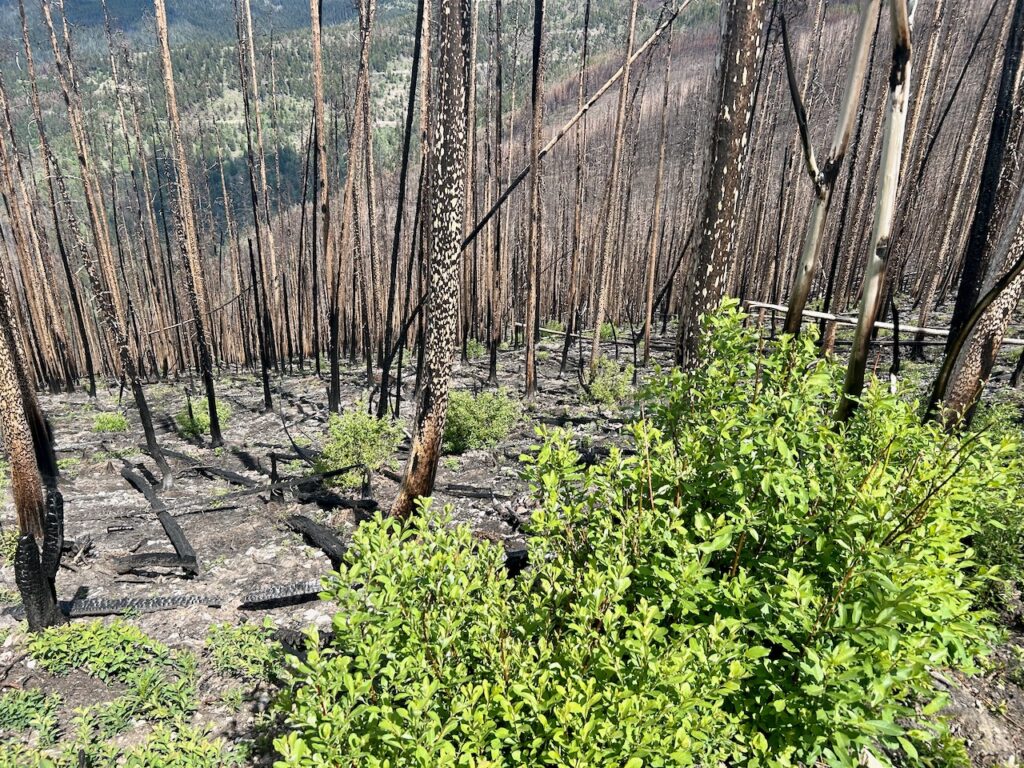
Left to their own devices—i.e. without “salvage logging”—most burned forests recover quickly—and with a much greater variety of plant and animal life than before.

Nonetheless, shortly after Braden and I began walking, we heard the distinctive drumming of either an American Three-toed or Black-backed Woodpecker. These can be distinguished from other woodpeckers because the drumming noticeably slows at the end. To find out which bird was drumming now, we began making our way down a steep hillside toward some larger trees, but the burned ground proved very crunchy and we may have spooked our quarry before we got eyes on it. Disappointed, we climbed back up to the road, and continued walking. Fortunately, the forest around us sang and flitted with bird life.

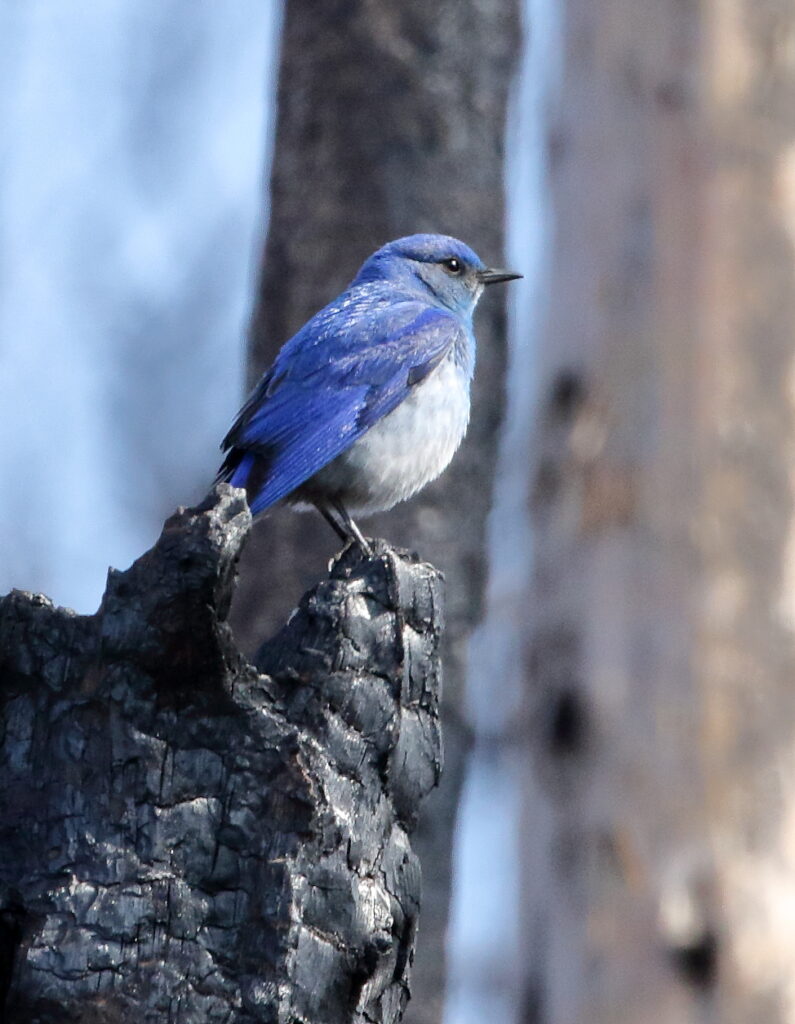
Almost immediately, we began seeing Mountain Bluebirds, one of Montana’s most spectacular species. MOBLs are well-known “fire birds” and their vivid blue plumage looks especially striking against the blackened trunks of a burned forest. Today, we saw these birds everywhere. During our three-mile walk, Braden recorded seven of them, but we both agreed we probably undercounted.

By popular consensus, Mountain Bluebirds are the most stunning “fire birds” you’ll find in burned forests. However, another common fire bird, Western Tanager, might challenge that opinion. Did you know that bluebirds are thrushes? They are relatives of at least four other popular Montana thrushes: American Robin, Swainson’s Thrush, Varied Thrush, and Townsend’s Solitaire.

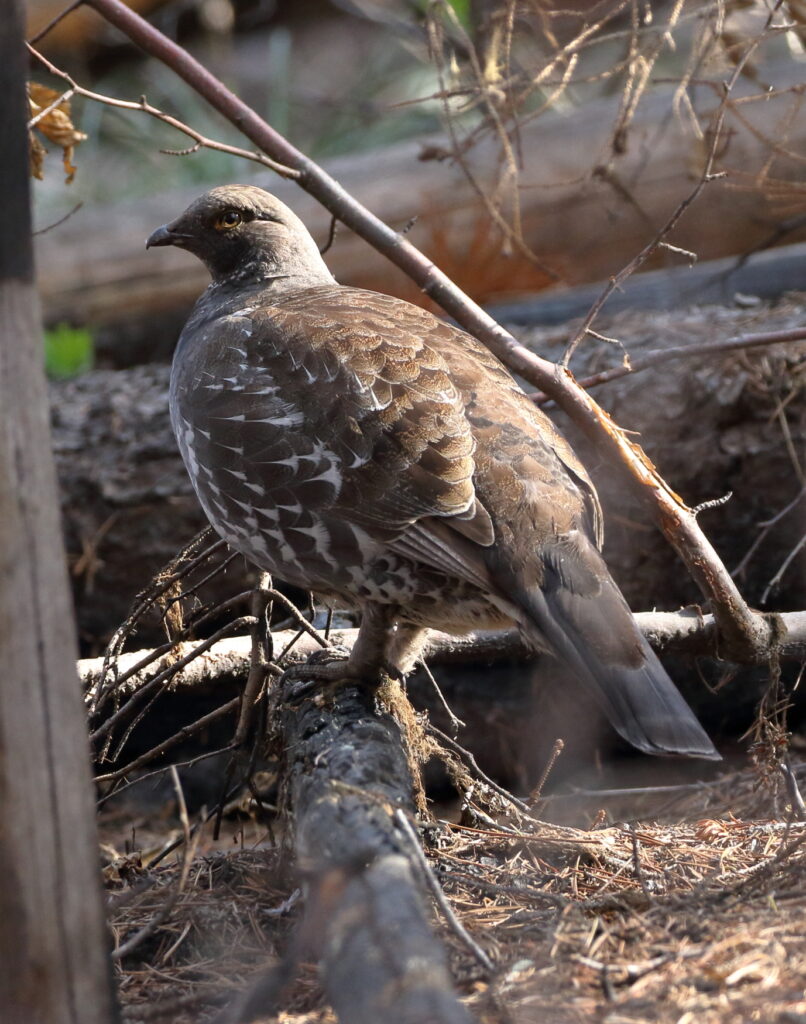
Suddenly, a large shape took off from beside the road and spread its wings as it glided down into the woods. “Dusky Grouse!” Braden exclaimed. It was one of the birds he most wanted to see since arriving back in Montana the previous week. Hoping for a better look, we crept down after the bird and, sure enough, espied it sitting quietly in the shadows. We enjoyed it through our binoculars for five minutes and then slipped away, leaving it in peace.

Before heading out, Braden told me, “I really want to see a Dusky Grouse.” This one obliged perfectly—and it was the first we’d ever seen in a burned forest.

Except for the mystery woodpecker that had drummed earlier, we had not heard a trace of other woodpeckers, but what we did hear was astonishing: wood-boring beetle larvae actually munching away inside of the dead tree trunks! I’d been told that one could hear these, but with my crummy hearing, I didn’t believe that I ever would. Sure enough, in several places, we listened to these big juicy grubs take noisy bites out of the wood!

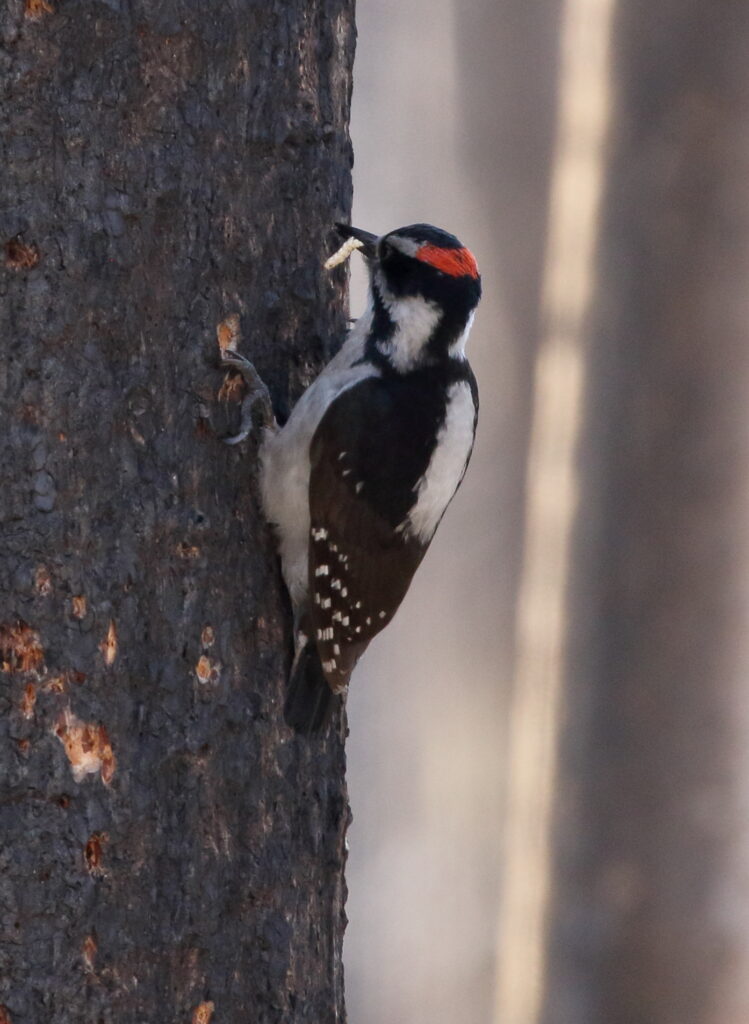
Score! While we watched, this Hairy Woodpecker extracted a juicy beetle grub from a dead tree.

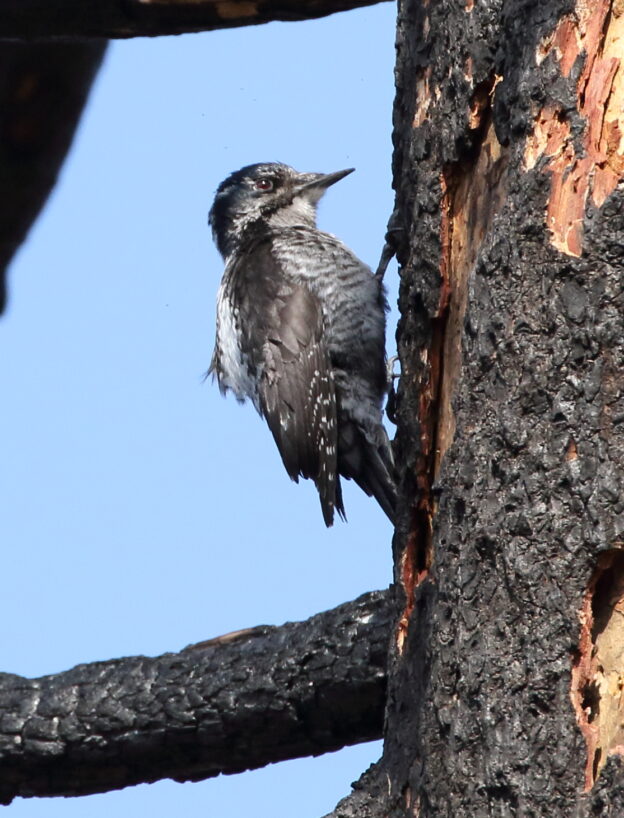
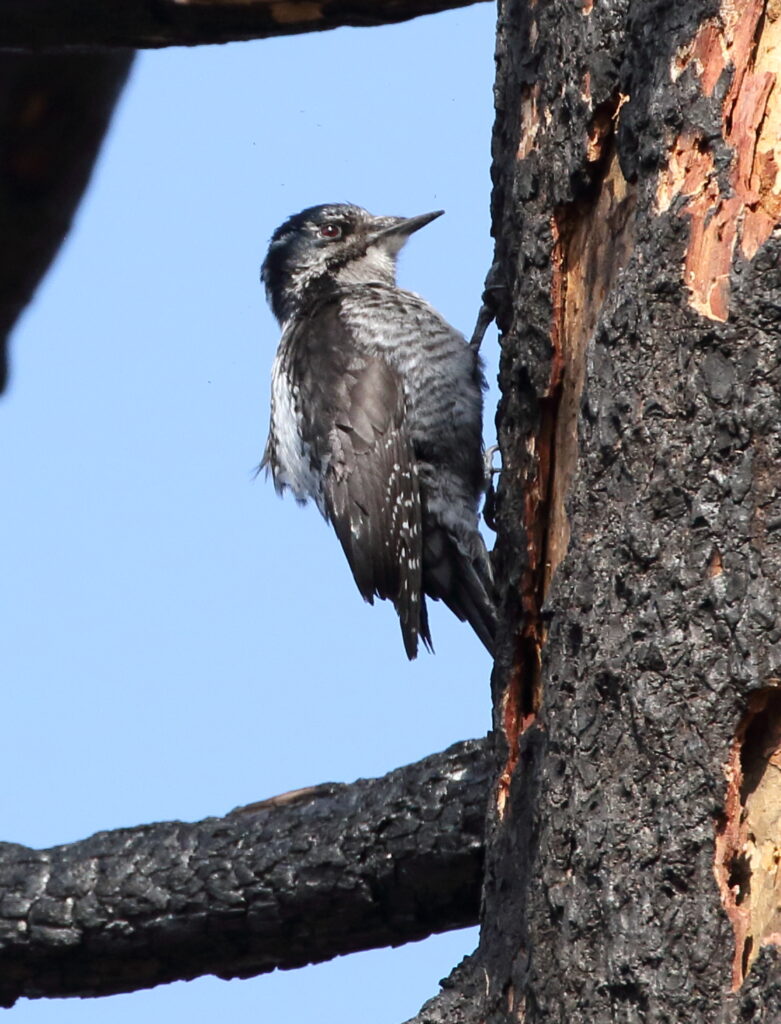
Finally, we also heard tapping on a large tree ahead. Braden got his eyes on it first. “It’s an American Three-toed,” he exulted. We could tell it was a female by the lack of a yellow crown, and we settled in to watch this amazing bird. It was working its way down the trunk, flaking away burned bark, presumably to check for insects hiding underneath. Once in a while, it stopped and really began pounding away after a beetle deeper inside the wood. It sounded like someone driving nails into cement!

Even female American Three-toed Woodpeckers can be distinguished from Black-backed Woodpeckers by having some streaky white on their backs—though not as much as on Hairy Woodpeckers (compare with previous photo).

As we continued our walk, we also saw Hairy Woodpeckers and another three-toed, this one a male. Woodpeckers, though, were just some of the birds making use of the burn. We got great looks at Townsend’s Solitaires, Red Crossbills, American Robins, Dark-eyed Juncos, Yellow-rumped Warblers, and Chipping Sparrows, and heard both Red- and White-breasted Nuthatches. Most of these are classic “burn birds” and we felt exhilarated to see them.

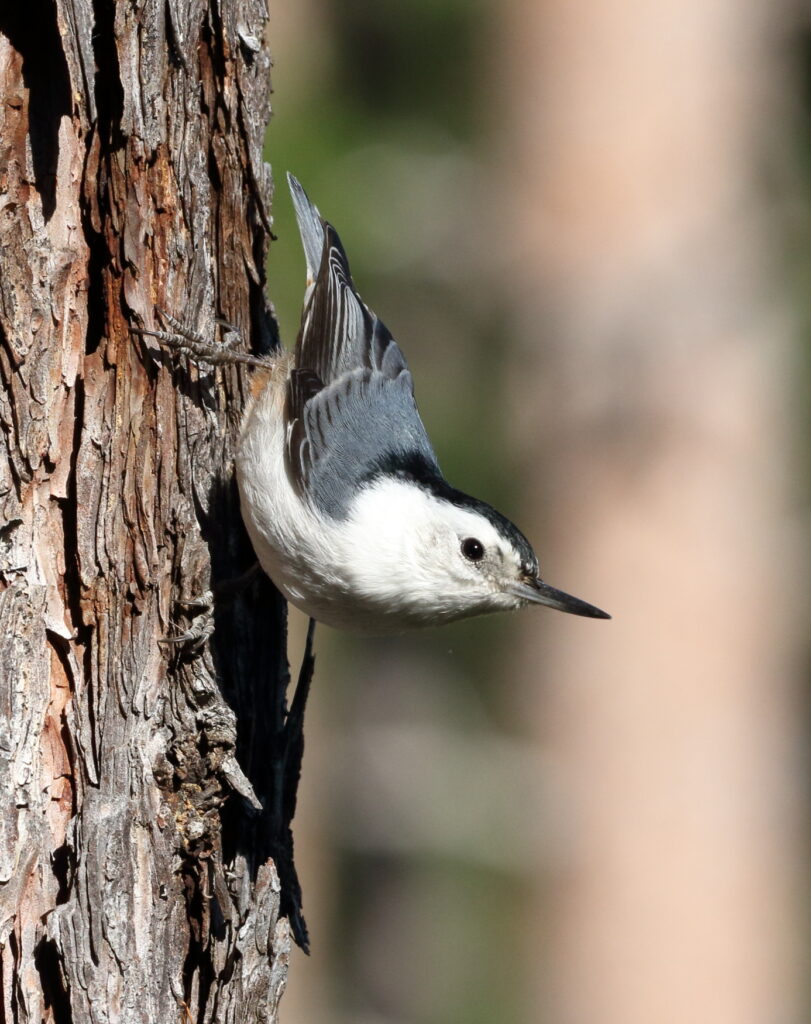
Though we didn’t get eyes on one in the burn, we did hear a White-breasted Nuthatch—and saw this one the day before up nearby Pattee Canyon.

At a couple of places, unburned green scrubby areas abutted the fire boundary, and it was fun to see birds dash from these green protected areas into the burn for quick meals or nesting materials before dashing back to safety. Many birds, in fact, love to “set up shop” at the boundaries of such two contrasting habitats.

We never did find a Black-backed Woodpecker, but that did little to detract from yet another great birding outing. We vowed to return to this spot the next few years, hoping that no one would move in to “save” this precious forest that didn’t need saving. On the drive down, we also stopped at some of the lower riparian areas for great “listens” at MacGillivray’s, Orange-crowned, and Yellow Warblers along with our favorite empid species, Willow Flycatchers. Amid the current chaos of the world, our burn bird outing offered a fun, revitalizing—and yes, inspiring—break. If you’re lucky enough to have a burned forest near you, we hope you’ll check it out.

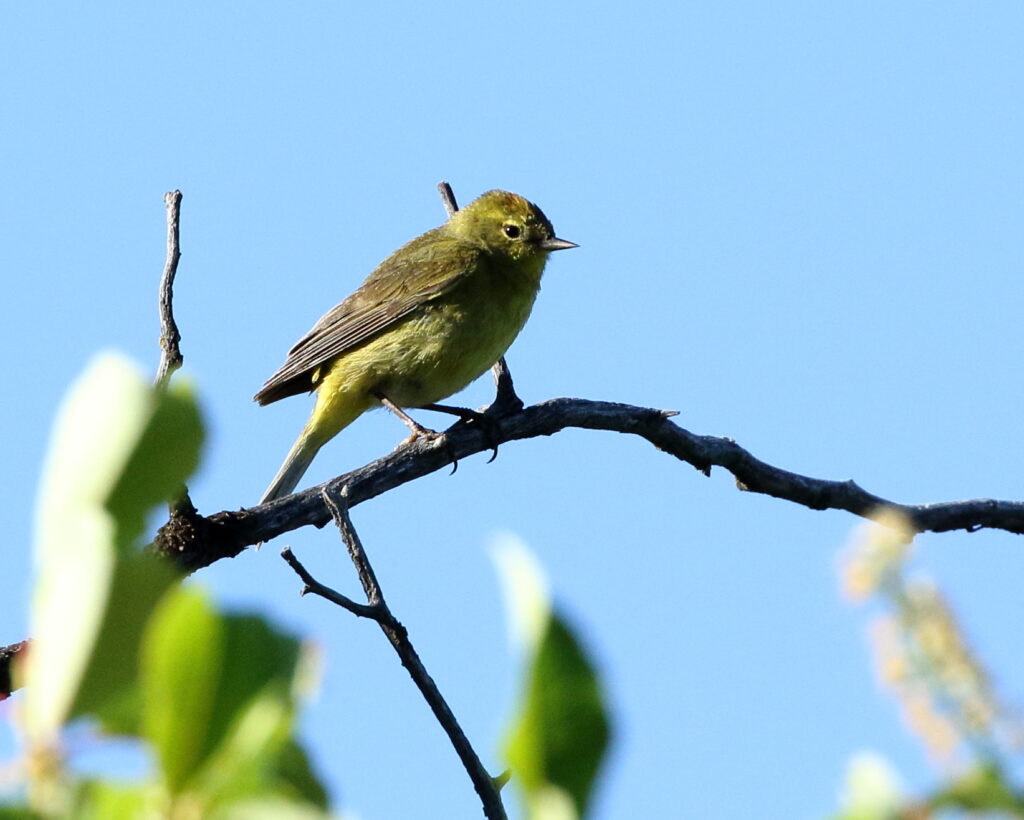
We can’t prove it, but it seems to be a really good year for Orange-crowned Warblers—not always the easiest birds to see in Montana.

Habitats of Africa: A Field Guide for Birders, Naturalists, and Ecologists (Book Review)

To Order, Click Here: https://press.princeton.edu/books/paperback/9780691244761/habitats-of-africa

I’m excited to be heading off to Texas in a few days, to promote my book Birding for Boomers, but also to squeeze in a few days of birding. Before I go, I want to share an exciting new book that will interest anyone who has ever dreamed about visiting Africa. Braden loved a previous book, Habitats of the World, by two of the co-authors, and this follow-up is also full of fascinating facts and insights. Oh, and in case you missed it, you’ll want to read last week’s outstanding guest post by Roger Kohn, “Cock-of-the-Rock Extravaganza—with Video!” Enjoy!

When I first opened my review copy of Habitats of Africa, I thought, “How on earth did the authors put together such a comprehensive guide to such a vast and ecologically diverse continent?” I next wondered how, as a reader, I might possibly absorb the immense amount of information packed into this handsome volume. The answer to the first question is that all three authors have worked as professional nature guides, with extensive experience in Africa. As for the second? I could only answer that by diving in.

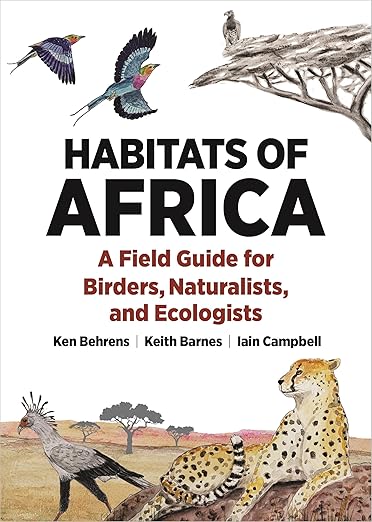
Habitats of Africa: A Field Guide for Birders, Naturalists, and Ecologists by Ken Behrens, Keith, Barnes, and Iain Campbell (Princeton University Press)

The table of contents reveals that Habitats of Africa covers an astonishing seventy-plus different habitats, and honestly, that alone could be overwhelming to the beginning reader. The TOC, though, also provides good clues for how the book is arranged and is therefore worth a few moments of time.

Habitats are organized under a dozen headings, ranging from “Deserts and Arid Lands” and “Warm Humid Broadleaf Forests” to “Savannas” and “Saline Habitats.” The first habitat I read was the Maghreb fir and cedar forest, one of four habitats listed under the “Conifers” heading. I probably started with this one because I don’t usually think about conifer forests growing in Africa. They do, of course, but their ranges are extremely limited, and I wanted to know more about them.

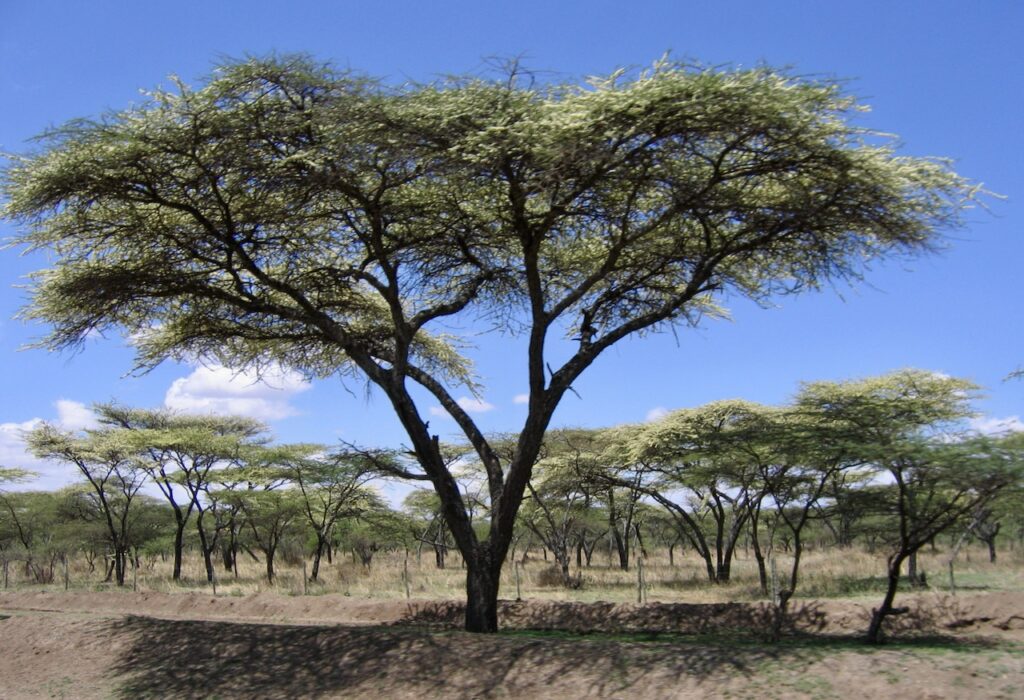
Even those who have never visited Africa easily recognize many of the continent’s distinctive habitats such as this acacia-clad savanna my wife Amy and I observed on our trip to Ethiopia in 2005. This is one of eight distinct kinds of savannas explained in Habitats of Africa.

The listing began with a nice map of where these forests can be found, and then followed with a concise but revealing description of the forest itself. Surprising phrases kept leaping out at me: “Atlas Cedar”, “clusters of oaks”, “winter snowpack”. I mean, where was I, anyway? This sounded more like California than Africa. One of the nice things about the book, however, is that it lists similar forest types found elsewhere in Africa and around the world—including the pinyon-juniper woodland of western North America.

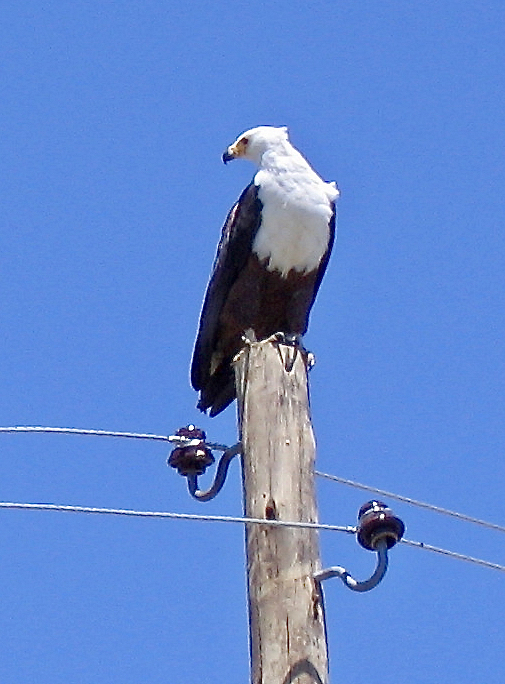
Lamentably, Amy and I visited Africa before I became a birder, but I accidentally managed to take a few bird photos with my point-and-shoot camera, including this magnificent African Fish-Eagle.

After the description, the authors include accounts of a habitat’s conservation status, the particular wildlife that can be found there; and its distribution—including specific places to see it. I found the wildlife sections especially well-done because the authors focused on endemic and other high-interest species while not overloading the reader with information. As a birder, for instance, I discovered that the avifauna of the Maghreb fir and cedar forest shares similarities to what I have observed in the Levant and southern Europe (see posts “Winter Birding in Israel, Part II: Valley of the Cranes” and “Birding Barcelona, Part 1: The Urban Core”)—but that there are also different species such as the Levaillant’s Woodpecker and Atlas Flycatcher.

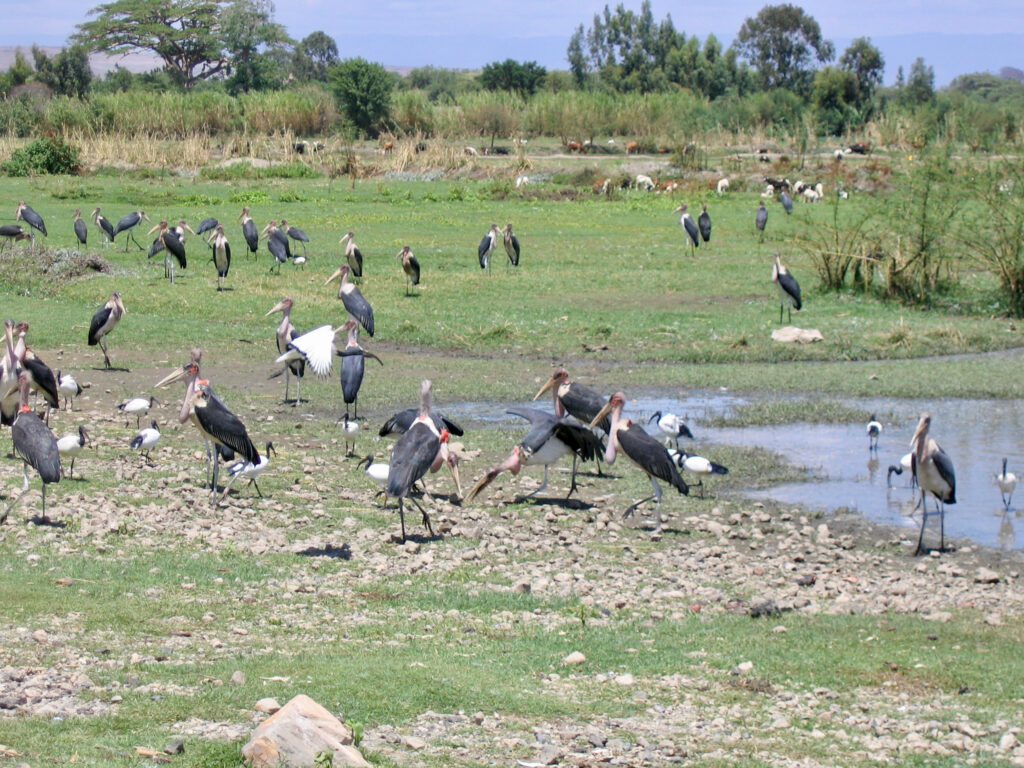
African Sacred Ibis and Marabou Stork attracted to a fish market at a lake south of Addis Ababa, Ethiopia.

There’s no getting around that the conservation status for most of the habitats is alarming. It’s hard to find a habitat in which humans haven’t made a major impact, especially given Africa’s rapidly-growing human population. In fact, the book includes eight habitats under its “Anthropogenic” heading—those with little of their original ecosystems intact. Although depressing on one hand, this conservation information provides a good picture of what is going on in the continent—trends that are distressingly similar to those experienced in many of the world’s other places, including North America. I also found it interesting to read why some habitats appear to be faring better than others. For instance, of southern Africa’s succulent karoo habitat—a habitat I’d never heard of—the authors write, “With limited agricultural potential and not much grass, the land in this biome is not highly sought after for human activity, but there has beeen significant sheep grazing and subsequent erosion.”

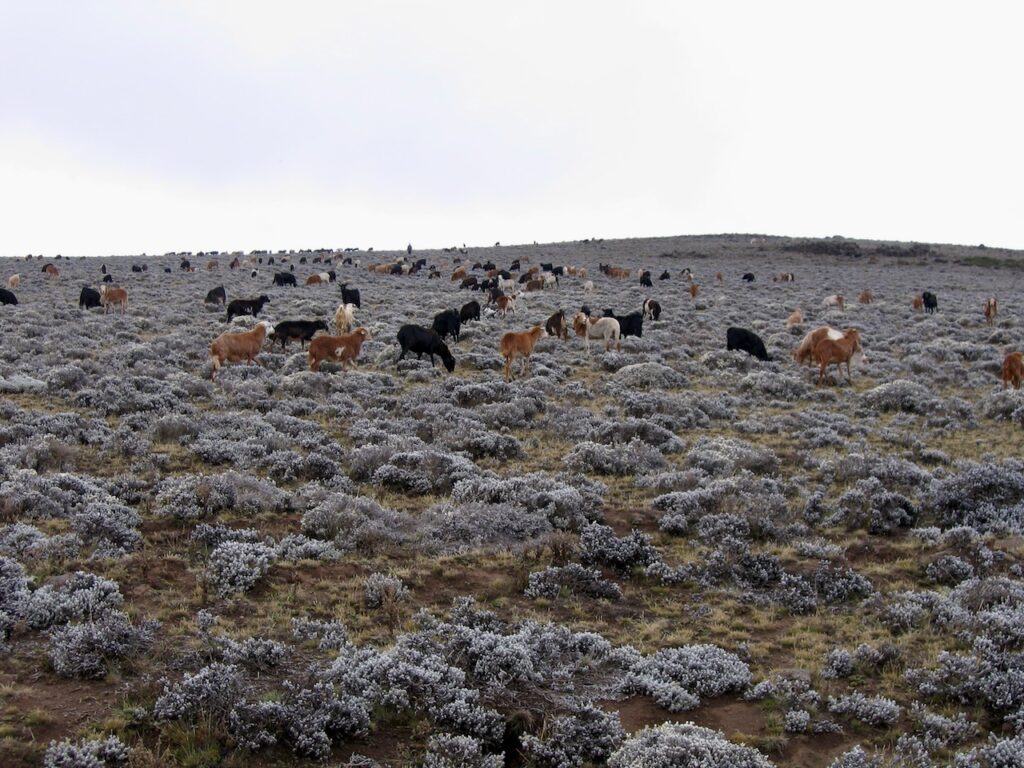
Ethiopia’s burgeoning population and pervasive poverty force livestock owners to illegally graze, even in places such as Bale National Park, one of the last strongholds of the Ethiopian Wolf.

The problem with reading about one habitat, however, is that it immediately made me curious to learn about others. The Maghreb fir and cedar forest discussion, for instance, mentioned that the forest peters out on the southern mountain slopes draining into the Sahara. “But what’s the Sahara really like?” I wondered, so I soon found myself reading up on one of the world’s most inhospitable places, the Saharan reg desert. This is a place that often receives less than one inch of rainfall each year—and where places can go years without seeing a drop. Yet, life persists here. Although much of the large megafauna has been hunted out, fascinating animals such as sand cats and fennec foxes survive, along with an incredible collection of small mammals and reptiles. This is a good place to mention that the book is filled with outstanding photos of the habitats and their various life forms, and in this chapter a photo of Cream-colored Courser caught my eye. Why? Because it looked almost identical to the Mountain Plovers we have in the arid West!

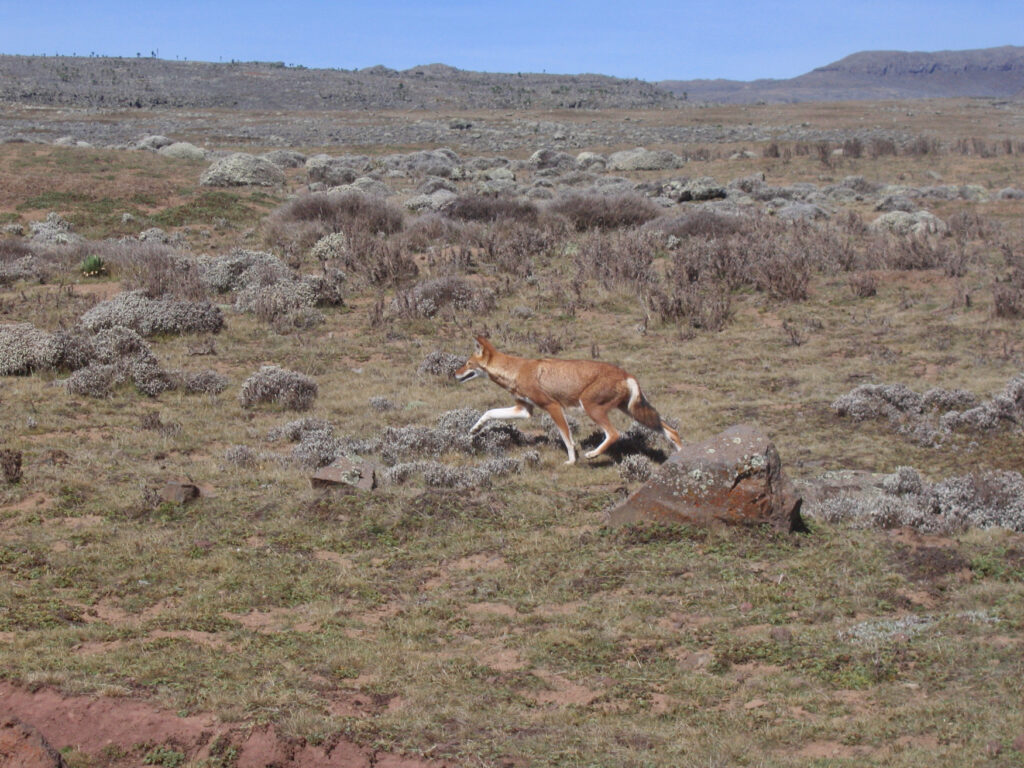
Amy and I were fortunate to see Ethiopian wolves in one of their last strongholds, a high-altitude habitat called afroparamo in Bale National Park. Already by our visit in 2005, grazing in the park (see previous photo) threatened the outlook for the wolves and the giant mole rats that serve as one of their major prey.

That said, one thing the book showed me is that, although similarities can be found between African and other world habitats, many of the ecosystems in Africa are unique—especially if you compare them to North America. And that can have a strange impact on a reader.

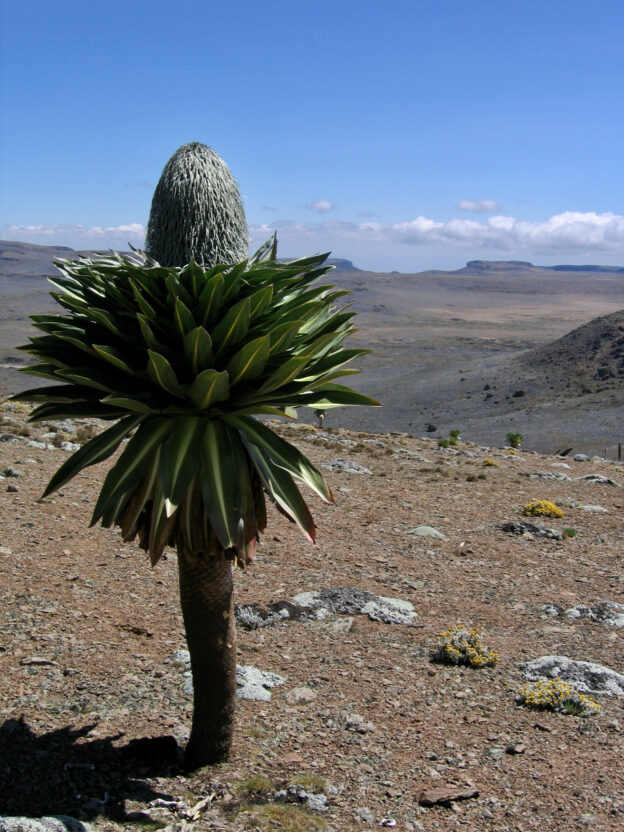
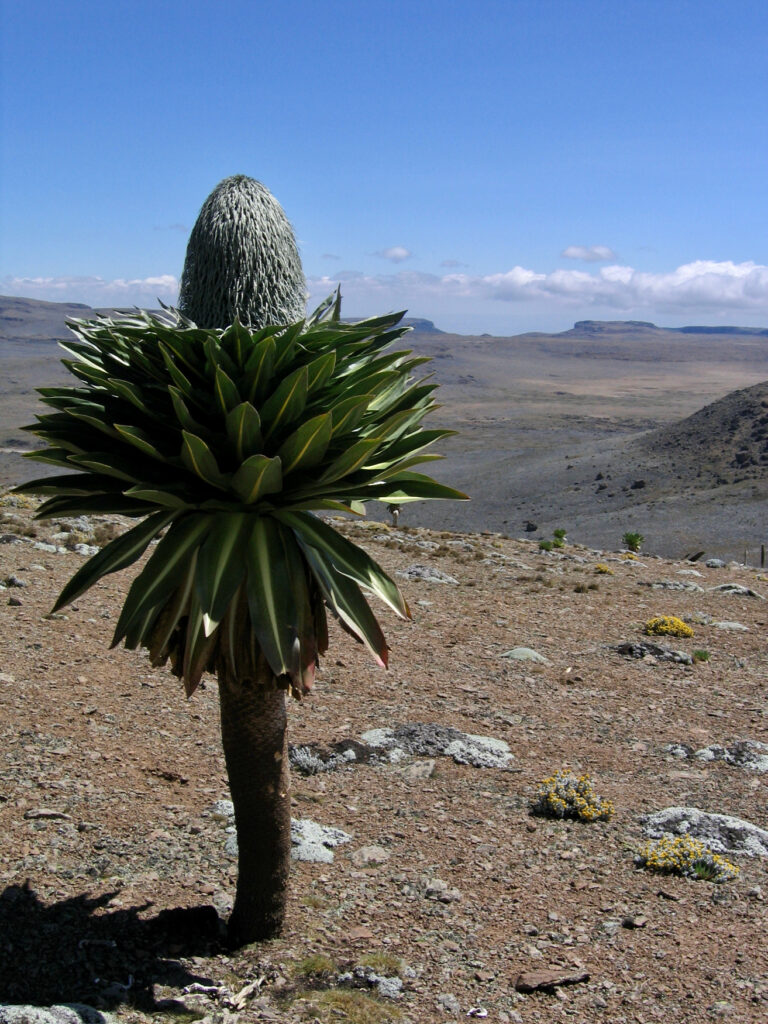
If you have any doubts about the uniqueness of many of Africa’s ecosystems, all you have to do is look at this lobelia tree in Ethiopia’s Bale National Park. The trees reminded me of Joshua trees in the American Southwest, and I can’t help thinking that the two trees might represent a striking case of convergent evolution.

I have only ever been to Africa once, during a school visit to Ethiopia in 2005. What’s more, I thought it unlikely I would ever have a chance to visit again. As I read through Habitats of Africa, however, I kept thinking, “Oh, I want to see that,” and “I want to go there.” It doesn’t mean I will get to, but reading this book may be the next best thing. More than all of the nature documentaries I’ve watched, this volume has given me a plausible idea of the incredible diversity of places and nature that can be seen there. As a birder in particular, it’s also given me a much better idea of the birds that I especially would like to see. It’s a stretch to call the book casual reading, but for anyone interested in nature, or planning their own trip to Africa, it is a well worth your time. If I ever get a chance to return to Africa, you can bet that I’ll be spending even more time with this impressive publication.

Note: Along with the extensive photographs and distribution maps, Habitats of Africa includes a wealth of climate charts, profile sketches, and topical sidebars that enhance the reader’s understanding of each habitat.

One-Sentence Summary: An eye-opening crash course on the nature of perhaps the world’s least understood continent.

Overall Rating (on a scale of cool birds): Rüppell’s Griffon (highest)

You can order Habitats of Africa from your local independent bookstore, or directly from Princeton University Press. Please tell them we sent you!

(Except for the cover image, photos in this post are copyright Sneed B. Collard III. Review copy of Habitats of Africa provided by the publisher.)

Our Favorite Bird Books for the Holidays

In our last post, we detailed where to buy bird-related books. For our 200th post (gasp), we’d like to share some of our favorite bird books. We are by no means attempting to be comprehensive and we apologize to the many fine authors and books we didn’t have space to include. When it comes to holiday shopping especially, however, we realize that “less is more” so we’ve limited ourselves to the books that first soar to mind. Note that we haven’t gone crazy on the hyper-links here, but recommend just calling your local indie bookstore and placing an order (see our last post). Any of these books can also be ordered from Buteo Books or from a certain not-to-be-named e-commerce giant. Please feel free to share this post with friends and others in desperate need of holiday gift ideas!

Field Guides

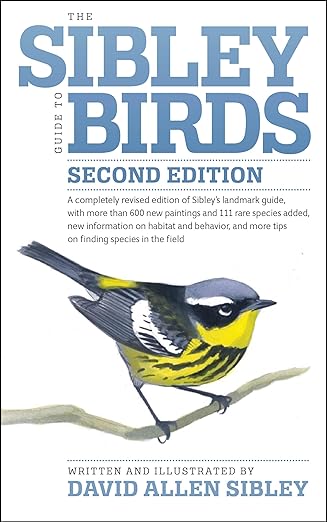
There are so many field guides available that your head will spin considering them. Braden and I have enjoyed field guides by Peterson, National Geographic, Kenn Kaufman, and many other sources. The one we return to again and again, however, is The Sibley Guide to Birds, Second Edition. While many other guides seem cramped or present information in a difficult-to-use format, Sibley strikes the right balance with generous, uncluttered illustrations and to-the-point identification information and range maps. If you’re going to buy one guide for the US and Canada, this is the one. Note that if you need field guides for specific countries or regions, you often won’t have a great deal to choose from. Our first stop is usually Princeton University Press, which seems to have field guides for many of the world’s regions (see our last post).

How To” Guides for Beginners

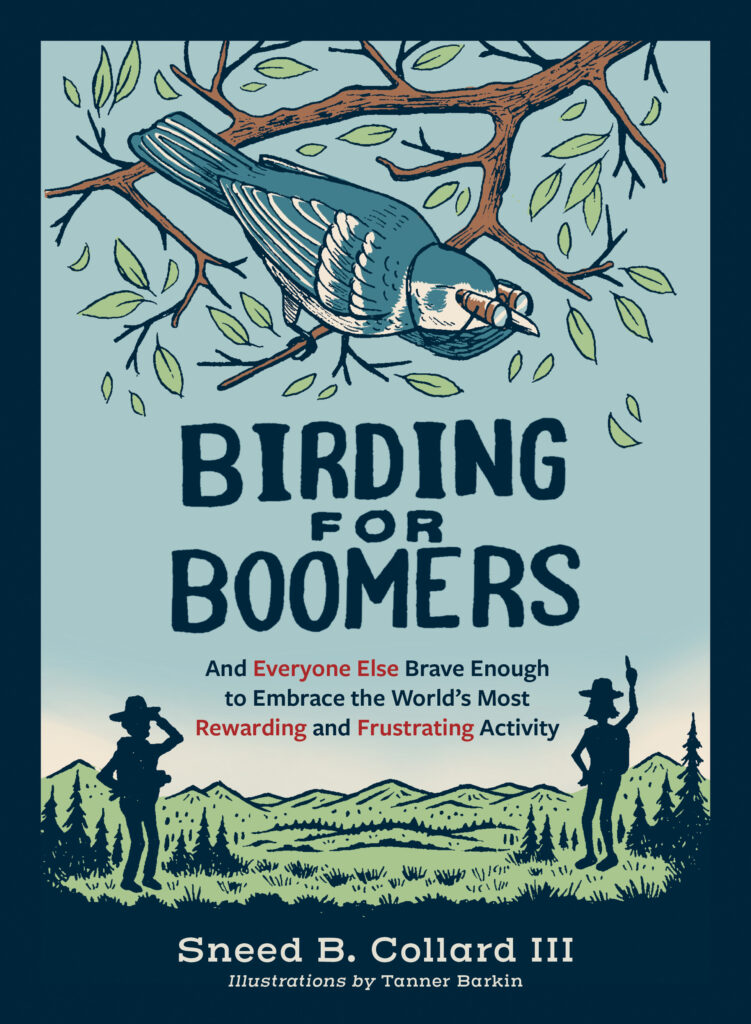
I swear, I wasn’t going to include my own book near the front here, but it logically follows field guides. Especially when it comes to buying a gift for the beginning birder, you can’t beat Birding for Boomers—And Everyone Else Brave Enough to Embrace the World’s Most Rewarding and Frustrating Activity. Here’s a recent review from Foreward Reviews: “Because the book is aimed at new birders, it includes advice about what kinds of binoculars to consider, what clothing and equipment to use, the value of a good field guidebook, and useful online resources. Its guidance is casual, often relayed with light humor and embellished by personal anecdotes. Challenges specific to boomers factor into its advice on birding with hearing, eyesight, and mobility challenges, and into its considerations for those on fixed incomes. It also makes important points about safety for nonwhite and LGBTQ+ birders. With its ranging approach and easy-to-follow advice, Birding for Boomers is a handy guide for all those—boomer or otherwise—who are looking to pick up an ornithological hobby.Click here to order!

Birding Road Trip Books

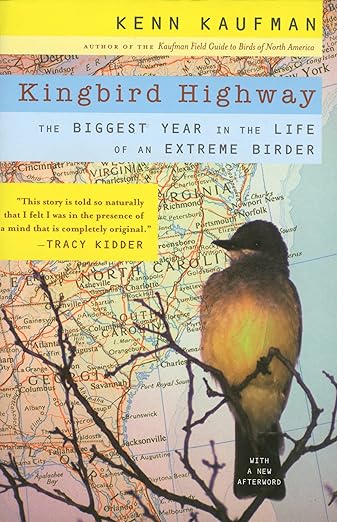
We’re going to stick with two classics here. The first is Wild America: The Legendary Story of Two Great Naturalists on the Road by Roger Tory Peterson and James Fisher. This really is required—and enjoyable—reading for those working on a life list or doing a Big Year, or anyone wanting to educate herself on the history of birding in the United States. Our second choice is Kenn Kaufman’s irresistible Kingbird Highway: The Biggest Year in the Life of an Extreme Birder. This was one of the first birding books Braden and I read and it is still one of our favorites, recounting the passions and pursuits of someone who just couldn’t help but chase and learn about birds. If you need to add a third title to this list, we wouldn’t complain if you picked up Warblers & Woodpeckers: A Father-Son Big Year of Birding!

Natural History and Science

This category could fill several blogs, but we’ll keep it brief except to say that you must read all of the books below—and they all make great gifts for anyone remotely interested in nature.

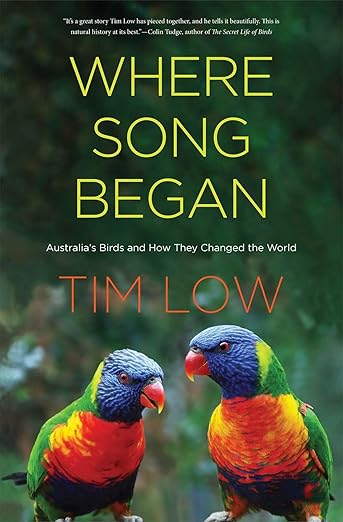
Where Song Began: Australia’s Birds and How They Changed the World by Tim Low: highly entertaining, it will change the way you think about birds.

A Most Remarkable Creature: The Hidden life and Epic Journey of the World’s Smartest Birds of Prey by Jonathan Meiburg: a fascinating account of one of our favorite groups of birds, caracaras.

Far From Land: The Mysterious Lives of Seabirds by Michael Brooke: a wonderful account of birds most of us want to spend more time with—but, sadly, never will.

Hard to Categorize—But Read Anyway

The Ravenmaster: My Life with the Ravens at the Tower of London by Christopher Skaife. The title says it all, but doesn’t come close to reflecting just how entertaining and fascinating this book is!

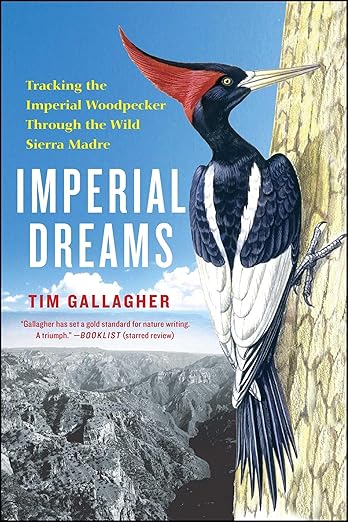
Imperial Dreams: Tracking the Imperial Woodpecker Through the Wild by Tim Gallagher. This book provides a captivating blend of adventure and natural history, following a small group’s dedicated efforts to find a species that now is almost certainly extinct—but just might not be!

The Falcon Thief: A True Tale of Adventure, Treachery and the Hunt for the Perfect Bird by Joshua Hammer. A fascinating look at the world of falcon and egg poaching.

And One More for Montanans

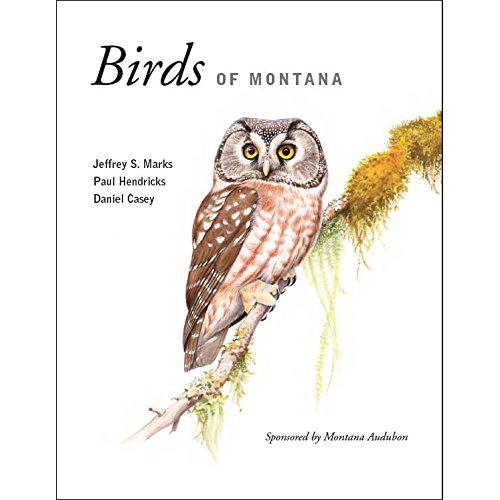
If you really want to buy something special for your Montana birder or birding family, take the plunge on Birds of Montana by Jeffrey S. Marks, Paul Hendricks, and Daniel Casey. This remarkable volume summarizes just about everything that is known about more than 400 Montana resident, migrant, and vagrant bird species. Rarely a week goes by when we don’t dive into this book to learn about a bird we’ve seen or have been thinking about. The book occupies a prominent place on our shelves and is a prized acquisition in our bird book library. Click the image below to order.

A wonderful compendium of information about birds living in, frequenting, or just visiting Montana. As an author, I reference it constantly.

One-of-a-Kind Birds—and a One-of-a-Kind Book to Go With Them

Thank you for sharing this post :)!

This week’s blog focuses on one-of-a-kind birds—and a book to go along with them. For those of you who have been following FatherSonBirding for the past couple of years, you may remember a February, 2022 post about monotypic animals. These are animals that have no other species in the scientific genus to which they belong. At the time of the post, I had begun researching a new children’s picture book about animals that were not only monotypical to genus, but to the family or order taxonomic level. In other words, these animals are really alone in their taxonomic world. What’s more, they often possess wonderful adaptations and behaviors found nowhere else in the animal kingdom. They include both animals you are undoubtedly familiar with such as the platypus, leatherback sea turtle, whale shark, and pronghorn. They also include lesser-known critters such as India’s purple frog and the South American monito del monte.

Often called an “antelope,” the Pronghorn is actually a unique survivor of our Ice Ages, whose closest living relatives are giraffes and okapis.

The good news is that Like No Other: Earth’s Coolest One-of-a-Kind Creatures is now a reality, exploring 13 of earth’s most remarkable creatures! But since this is (mostly) a birding blogsite, let me focus on the one-of-a-kind birds in the book.

Like No Other’s very first animal is Africa’s Secretarybird. I first learned about this bird 25 years ago when I was researching a book called Birds of Prey: A Look at Daytime Raptors. That book is now out of print, but while researching it, I came upon this bizarre-looking, long-legged raptor that often kicks and stomps its prey to death—when it’s not carrying them up into the air and dropping them from great heights. This grassland- and savanna-dwelling bird originally lived throughout much of Africa, but has declined sharply in much of its range. Culprits include habitat loss and degradation, collisions with fences and powerlines, and poisoning from pesticides. It is a dream of mine to see these birds in the wild before I croak (or hit a powerline myself).

Though a bird of prey, the Secretarybird’s appearance, behavior, and ancestry is unlike any other raptor.

The second bird in Like No Other is a bird I’m not sure I’d even heard of before writing the book: South America’s Oilbird. These squat, kind of chubby-looking birds are reminiscent of nightjars such as the Common Nighthawk or Common Pauraque, but similarities stop there. Oilbirds roost in colonies of up to 10,000 birds in caves of forested areas of northern South America and along the spine of the Andes. Like bats, they use echolocation and an excellent sense of smell to locate fruits of forest trees. Birds of the World lists them as of “Least Concern,” but they contain so much fat that in the past they have been boiled down for oil lamp fuel. No one has any idea how long they live.

Oilbirds live in caves in South America and hunt using echolocation, good night vision, and a great sense of smell.

You know me. I would have packed a lot more birds into Like No Other but felt obligated to include a fair number of other vertebrate groups (those darned vertebrates!). I did manage to wedge one more monotypic bird into the pages, however—New Zealand’s enigmatic Kakapo. For those of you who haven’t heard of it, the Kakapo is the world’s heaviest parrot. Even more amazing, it doesn’t fly! I first learned about the birds 35 years ago when I was on a four-month bicycle trip through New Zealand. At the time, fewer than 50 Kakapo were thought to exist, and as is so often the case on Pacific islands, invasive mammalian predators were largely to blame. Thanks to an intensive conservation program that included captive breeding and eradication of introduced species from offshore islands, however, the Kakapo’s future now looks much rosier. Kakapo are by no means out of the woods, but their population is up to about 250 birds, and they are being closely monitored. It’s another wonderful example of what humans can accomplish when we put our minds to it.

The Kakapo provides an inspirational story of what we can do to save species if we try.

Humans are the very last one-of-a-kind creatures in Like No Other. Nothing like us has ever existed on the planet before, and the jury’s still out whether we can figure out what to do with our big brains and ambitions without destroying ourselves. Stories of protecting the Kakapo and other species in Like No Other, though, give me hope we’ll come up with solutions.

Like No Other is available now from your local independent bookstore, online stores, and other outlets.

Like No Other is available now through your local independent bookstore and other outlets.

Welcoming White-crowned Sparrows—with Observer Bias

FatherSonBirding is a totally free, non-commercial blog that Braden and I write to share our passion for birds and birding, and to help educate others about birds and bird conservation. We do not accept donations, but if you would like to support us in our endeavors, please consider purchasing *new copies* of one or more of Sneed’s books—the new picture book Border Crossings, for example. These books are widely available online or can be ordered from your local independent bookstore. Oh, and they make great holiday gifts! Thank you for your support.

In previous posts, we may have mentioned that when we first began birding, Braden and I pretty much ignored the fall. Once spring migration and breeding petered out, we figured, how exciting could it be? The answer, we’ve learned, is: Plenty! In past posts, Braden and I have focused on fall shorebirds, but in the last couple of weeks alone, I’ve also watched waves of Savannah Sparrows, Yellow-rumped Warblers, American Pipits, Ring-necked Ducks, and a whole slew of raptors cascading through Montana. This fall, I’ve especially been impressed by White-crowned Sparrows.

In their adult, or definitive, plumages, White-crowned Sparrows show bold black and white striping on their heads. In fall, however, most of the birds you’ll see sport sub-adult or “1st winter” attire (see below).

If you live in California or parts of the Great Basin, you probably don’t give White-crowned Sparrows much thought. After all, you can see them all year round, and they may even be the most abundant native sparrow you encounter. The same goes for much of the rest of the country, where White-crowned Sparrows overwinter, basically from coast to coast.

Here in Montana, it’s a different story. In spring, White-crowneds zoom through the state on their way to our high mountains or far north Alaska and Canada to breed. Our most impressive encounter? Watching a male singing to high heaven on its breeding territory in Glacier National Park (see our post, “Are You Ready for the Quach?”). Our best chance at seeing them, however, is in the fall, when they saunter through at a more leisurely pace.

Not only have I seen a LOT of White-crowned Sparrows this fall, they have been extremely cooperative in striking fetching poses.

Scientists recognize at least four sub-species of White-crowned Sparrows, and choose them as a favorite research animal both because of how common they are, and how easy they are to keep in captivity. Many studies have focused on song learning in the birds, and it seems that different populations, like humans, learn different dialects based on what they’re hearing around them. Researchers even talk of “bilingual males” that live on the borders between different populations. Breeding males aggressively defend their territories by flying at intruders, puffing out their feathers and crests, and singing loudly. They may even “wrastle” with their feet—a sparrow’s version of Brazilian jiu-jitsu!

Each fall, I usually see White-crowneds in a couple of different locations around Missoula, including a skulky adult that often shows up for a day or two in our backyard. This year, though, it seems I’ve been seeing White-crowned Sparrows almost everywhere I look. In September alone, I recorded seven sightings of White-crowneds. I was sure this must be some kind of personal record, and it led me to believe that these delightful songbirds might be having an especially great year.

Not so fast.

At one of our favorite birding spots, the Missoula Gravel Quarry, White-crowned Sparrows seem drawn to an abundance of seed that will help them fatten up for the rest of their migrations.

One of the wonderful things about eBird is that you can quickly go back through all of your species observations for a particular place and/or time of year. Searching through my White-crowned Sparrow records, this is what I found:

2015: 1 sighting

2016: 0 sightings (our ABA Big Year!)

2017: 8 sightings

2018: 4 sightings

2019: 11 sightings

2020: 18 sightings

2021: 14 sightings

2022: 5 sightings

2023: 11 sightings (so far)

At first glance, you might think this data reveals good and bad years for White-crowned Sparrows. Alas, that may or may not be true. Why? For the simple reason that my birding effort also has its “good” and “bad” years. You’ll note that by far my biggest year for WCSPs was 2020. Well, guess what? That’s the year Braden and I were doing our Montana Big Year, trying to find as many species as possible in our state from January through December. It was the year we most likely spent the greatest number of hours and days birding here, and so it’s no surprise that our White-crowned Sparrow sightings peaked that year.

“Are you lookin’ at me? Are you LOOKIN’ at ME??? Well, if you want this observation to be useful for science, you’d better look HARDER and more consistently.”

If we really wanted to start getting a handle on good and bad years, we would have to introduce some consistency to our birding madness by sampling spots at the same times and same locations throughout the year or season. This, in fact, is one way scientists study bird populations. They return to places at the same times and for the same durations every year. Braden spent this past summer doing “point counts” for songbirds in eastern Pennsylvania. He visited locations (“points”) that other field biologists had sampled in past years and at each point, he looked and listened for ten minutes, recording all of the birds that he detected.

I have done a similar thing in our own neighborhood, but on a much more informal basis. From spring through fall, every weekend or two, I walk our dog Lola on a particular neighborhood route at about the same time of day, recording all the bird species I detect. I call the route “Old Pond Road” and here are this year’s results (also see our post “Best Fall Warbler Flock Ever!”):

May 14: 18 species

June 3: 14 species

June 24: 20 species

July 1: 16 species

July 9: 16 species

July 15: 12 species

July 23: 12 species

August 12: 10 species

August 27: 21 species

September 5: 5 species

September 10: 11 species

September 16: 8 species

September 24: 8 species

September 30: 12 species (this morning)

I am the first to admit that this is not a rigorous study. I birded at different times of the morning, put in varying amount of effort—and I have lousy ears, so I’m definitely not hearing everything that’s around me. Still, you can see some interesting patterns. Species numbers came on strong in the spring breeding season, slumped in mid-summer, and then hit a high for the year in fall migration. Now, as the passerines (songbirds) have mostly passed through heading south, things are settling down to those hardy year-round residents that can handle a Montana winter.

“Just checkin’ out the photographer before I get back to eating!”

I encourage all of you to start your own neighborhood bird studies. Even with my rather haphazard approach, my data may come in useful to a scientist one day. Just as important, this study has taught me a lot about the birds living in my neighborhood—and it will for you, too. To begin, you’ll want an eBird account, of course. After that’s set up, though, just pick out a favorite route and begin birding it at about the same time every week or month. In no time, a year or two will pass and you’ll be able to look back on some interesting results that will teach you and help you appreciate this remarkable world around us.

As for the White-crowneds, I will continue to be glad to see them and will welcome them back any time—whether or not they’re having a particularly good year.