All photos and text on FatherSonBirding.com are strictly protected under copyright law. To request permission for use, contact Sneed at sbcollardiii@gmail.com. You DO NOT have permission to use these posts to train Artificial Intelligence models or do anything else with them without permission.
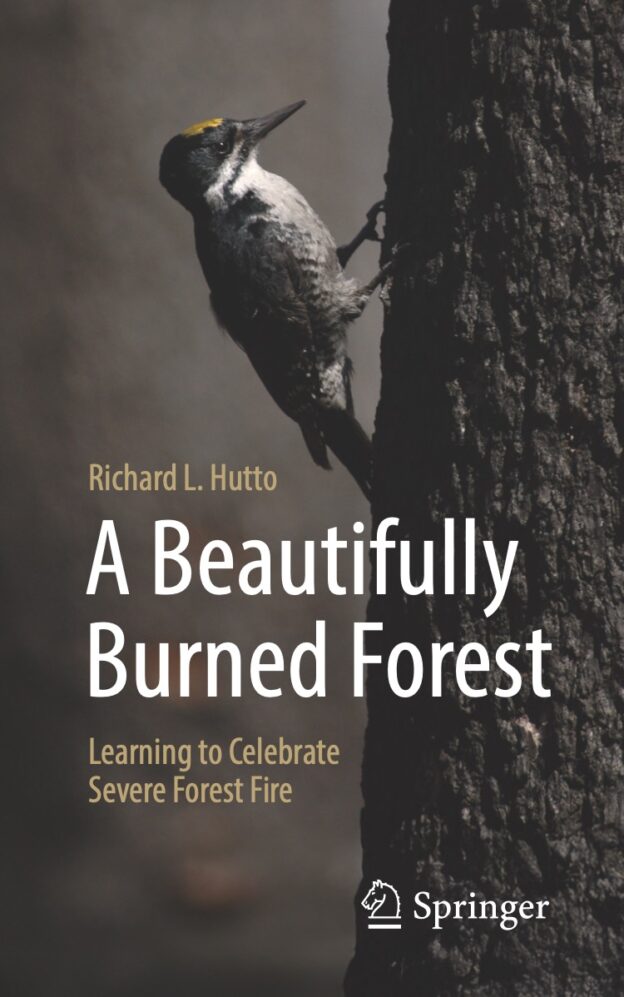
Richard L. Hutto’s new book A Beautifully Burned Forest: Learning to Celebrate Severe Forest Fire(Springer, 2025—click here to order) offers both timely insights into the roles of wildfire in our modern, over-heating world and an engaging memoir of a scientist’s journey. Before I met Hutto—Dick to his friends and colleagues—I had no idea of the vital ecological processes and multitude of species that depend on severe forest fires in the West. Although I had met Dick casually several times through a mutual acquaintance, it wasn’t until I needed someone to teach me about woodpeckers for a proposed children’s book that I reached out to him directly. I asked if he could take me out to show me some woodpeckers and explain a bit about them, and he graciously agreed.
Richard L. Hutto’s A Beautifully Burned Forest is not only a must-read for anyone interested in the health and future of our forests, it makes an, ahem, red-hot Christmas gift idea. Click on the above image to order.
Dick took me to the Blue Mountain burn area just south of Missoula and he did indeed start showing me woodpeckers and telling me about them. What he was really teaching me, I began to realize, is the beauty of a burned forest and how many plants and animals depend on it. I would still eventually write a children’s book about woodpeckers, but first I decided to write Fire Birds: Valuing Natural Wildfires and Burned Forests.
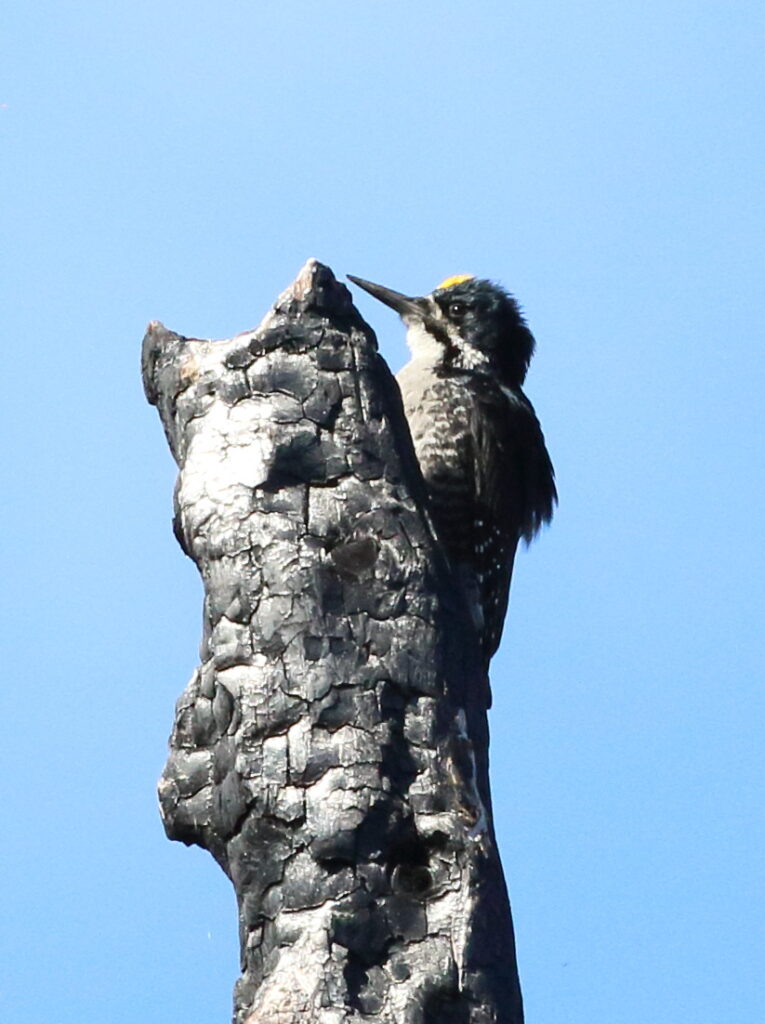
Both of our books focus on Hutto’s groundbreaking research into the many organisms—especially birds—that depend on standing, severely burned forests. The Black-backed Woodpecker is the poster child for burned forests. This bird is highly adapted to blend in with charred tree trunks and excavate wood-boring beetle larvae from the rock-hard wood. In the West, in fact, this bird is found almost exclusively in severely burned forests that have a high density of larger diameter standing trees.
In the West, the Black-backed Woodpecker relies on severely burned forests perhaps more than any other bird species. By excavating holes, these birds and other woodpeckers, also open up the forest for a host of other birds, mammals, and other vertebrates.
Once they move into a fresh burn the Black-backed—along with American Three-toed and Hairy Woodpeckers—open up the forest to many other cavity-nesting birds, mammals, reptiles, and amphibians. They do this by excavating holes in the trees, often many more than they will ever use themselves.
The problem, Hutto points out, is that our society has been conditioned to view all forest fires as bad. As soon as a severe fire roars through an area, the clarion call rings out to somehow “save” the burn by “salvage” logging it. Which trees do loggers take? The best and the biggest—the exact trees that Black-backed Woodpeckers need to hunt and nest in. Hutto also points out that as soon as these large trees are removed, their cones can no longer reseed the forest naturally, necessitating hiring battalions of workers to replant the forest by hand—at taxpayer expense.
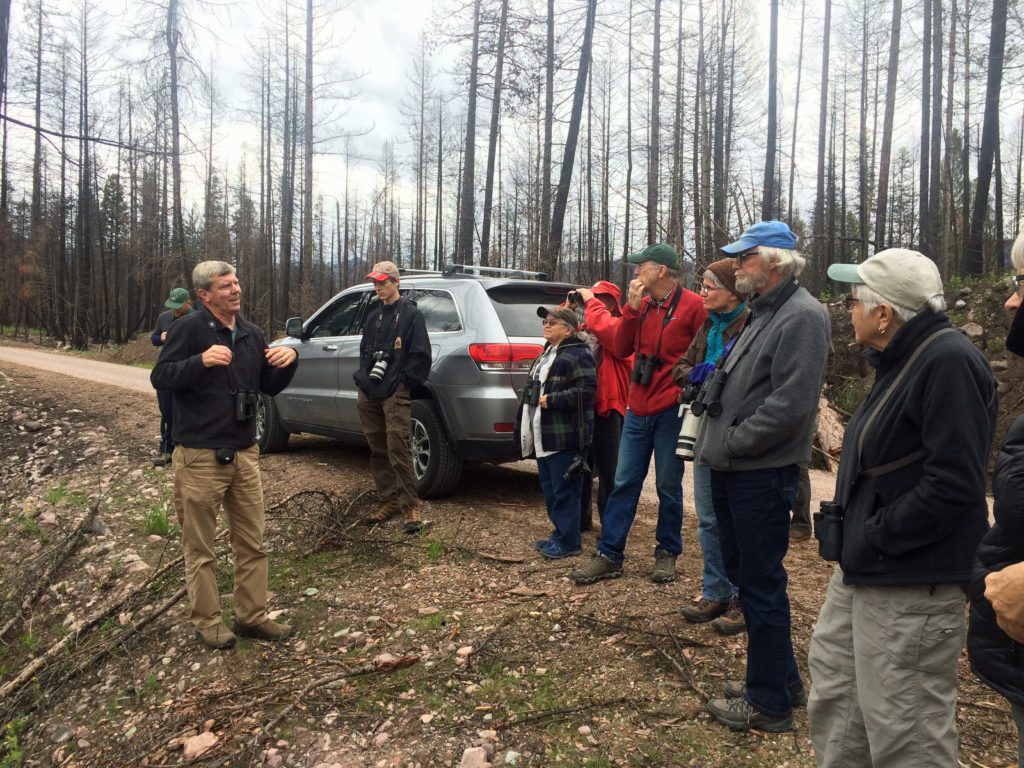
Dick Hutto (left) leads a local birding group through a newly burned forest near Seeley Lake, Montana, explaining the vital ecological role the burned forest plays.
In A Beautifully Burned Forest, Hutto dives deeply into our society’s entire approach to managing forests and fires, tracing the beginnings of fire suppression to the widely spread notion that our forests are somehow “out of whack” and need to be overly managed with thinning and prescribed burns.
Climate change, of course, is a wildcard in the future of forests and wildfires, but Hutto makes a strong plea to focus on solving the underlying problem of reducing greenhouse gas emissions instead of making our forests ecologically less viable through extensive, often poorly planned micromanagement.
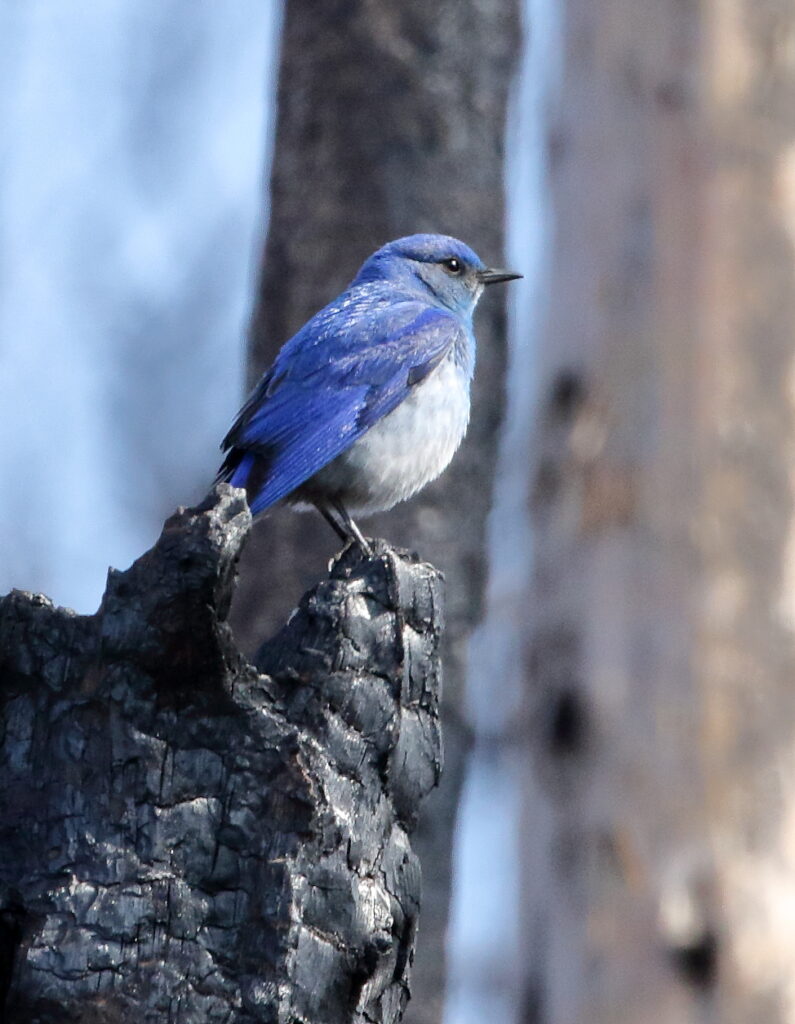
Mountain Bluebirds are just one of dozens of bird species that prefer nesting in burned forests to other habitats. Here they find plenty to eat along with safety from small predators, whose populations are reduced by forest fires.
Anyone with an interest in our forests and wildfires—in other words, every single person living in the American West—should read A Beautifully Burned Forest. It’s a fairly quick read that will change the way you view and understand our spectacularly diverse region. Especially in this day where misinformation rules, Hutto’s book is a valuable step in creating an educated public that insists on smarter management of the lands that sustain us.
Note: If you are interested in Sneed’s children’s book, Fire Birds, supplies are down to a couple of dozen in the warehouse so order soon by clicking here or calling your local indy bookstore. Both Fire Birds and Woodpeckers: Drilling Holes and Bagging Bugs make ideal Christmas presents for grades 3-8 readers.
It’s remarkable that as the impacts of climate change rapidly accelerate across the planet many of our leaders have doubled-down on the myth that climate change is a hoax being perpetuated by “stupid people.” Here’s the thing: To realize how quickly and dramatically warming temperatures are changing our planet, you don’t have to be a climate scientist. You simply have to look around. 100- or even 1000-year weather events are happening every few years in many places, generating catastrophic winds, storms, flooding, and drought. Even since I moved to Montana thirty years ago, summers are hotter, winters are milder, and snowpack is disappearing more quickly. Especially in eastern Montana, drought conditions seem to be setting in for the long haul. Braden and I have seen dramatic evidence of this all over the state (see, for example, my post “Birding Glacier National Park in the Hot Dry Winter of 2024”). Two weeks ago, I had a chance to again witness severe drought when I birded the Rocky Mountain front from Freezeout Lake up to the east side of Glacier National Park.
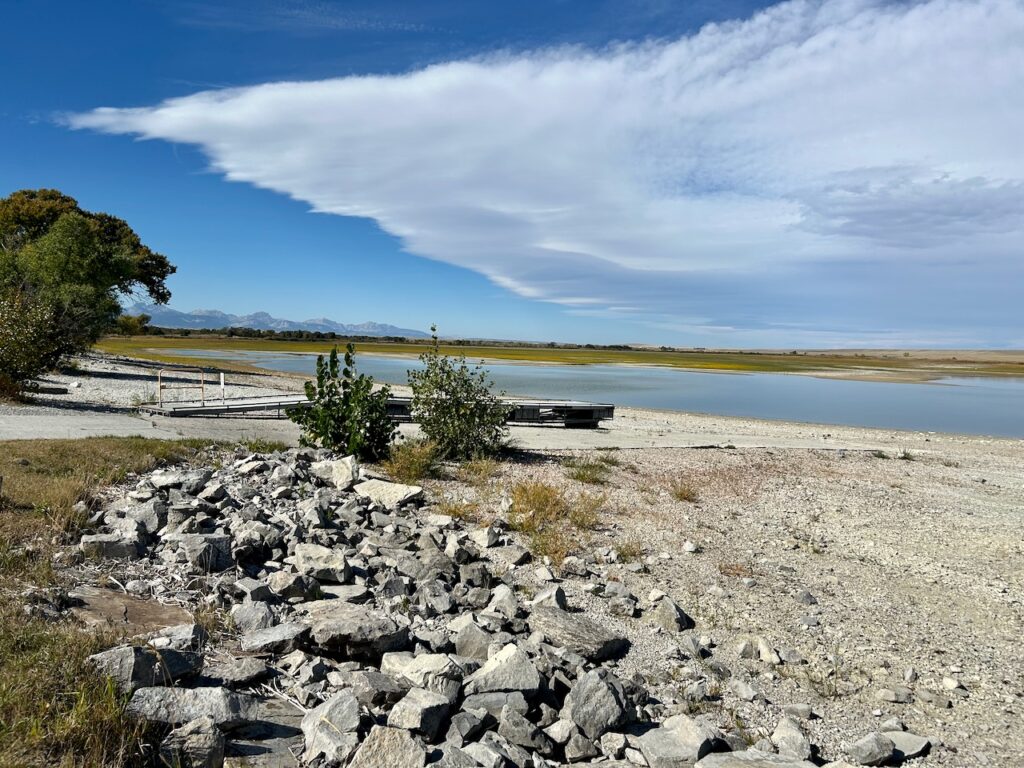
The DRY Dock of the Bay: A rapidly receding shore left this dock high and dry at Eureka Reservoir.
I left Missoula Saturday at the modest hour of 7 a.m. Days are shorter by the end of September so there was less urgency to hit the road early. Just as crucially, Highway 200, which would lead me up and over the Continental Divide, can be a notorious kill zone for deer, elk, and moose at dawn and I thought that waiting an extra hour might keep me and my minivan from ending up in a crumpled heap by the side of the road. My later departure paid off. I managed to spot the two potential deer collisions with plenty of time to brake and after a quick stop near Browns Lake, I arrived at my first destination by 9:30.
I had debated whether to visit Benton NWR near Great Falls or head straight to Freezeout, but eBird reports from the latter proved more enticing so I cast my lot there. As they always do, my excitement levels rose as I passed the refuge headquarters and then turned left to scan the southern bodies of water. It had been a while since I’d visited Freezeout this time of year, and I wasn’t sure what to expect since many birds had undoubtedly departed for their southerly wintering grounds. Rumbling along the gravel road, I did scare up a few Horned Larks and a couple of Western Meadowlarks looking faded and shabby. I also saw that the entire area was as dry and crispy as I’d ever seen it. In good years, water can be found in ditches, shallow pans next to the roads, and elsewhere, but now it was confined to the main lakes on my right. Still, I could see birds on the water.
At the very southern end of the refuge, I spotted about thirty-five American White Pelicans along with some coots, barely identifiable American Avocets, and unidentified, distant ducks. I soon backtracked, though, to where I had noted greater potential.
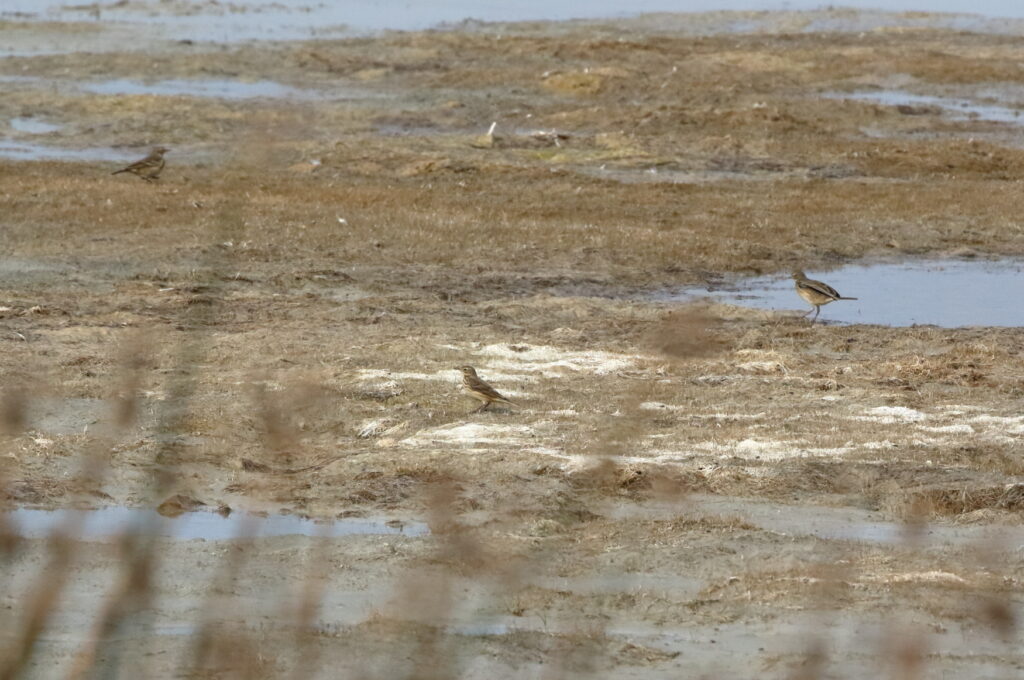
I parked at a pull-out camping area next to a dike/road that led out between two of the large lakes. I couldn’t drive out there, so I shouldered my camera, binoculars, and spotting scope and did what every dedicated birder does: schleps! Am I glad that I did. Almost immediately, I noticed several small birds working some mud off to my right. I ID’ed a couple as Horned Larks, but had a hunch about others so I quickly set up my scope and indeed saw that they were American Pipits! I absolutely love these guys. In Montana, they breed at high altitude, but in spring and fall you can find them migrating through the lowlands. Unfortunately, I had missed them this spring, so that made it doubly sweet to see them now. Even better, it moved me one bird closer to breaking my all-time one-year species count record!
American Pipits working the recently receded shoreline of one of Freezeout’s main lakes.
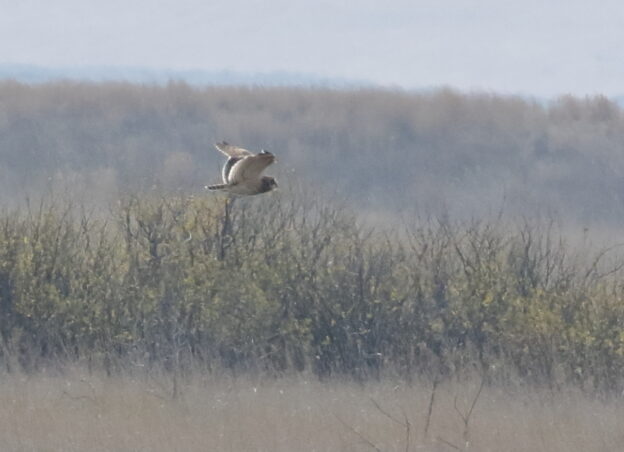
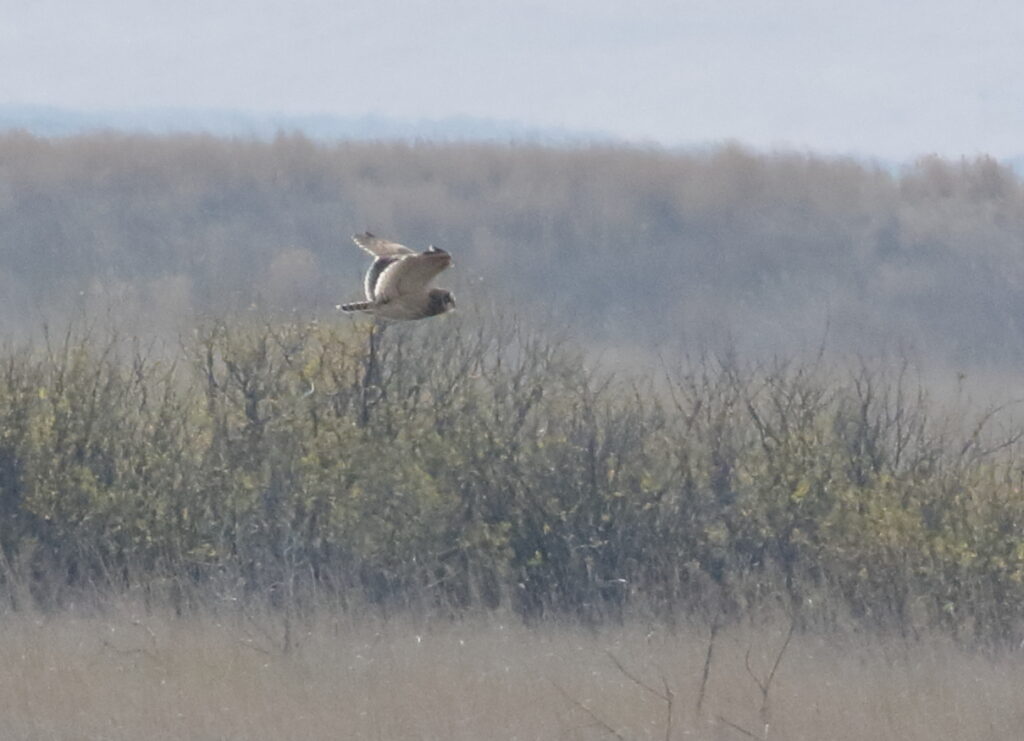
As I resumed walking, I suddenly spotted a large raptor flying low and erratically over fields to my left. My first guess normally would be Northern Harrier, but this was my lucky day. The bird wasn’t a harrier, but a Short-eared Owl! It had been years since I’d seen one here and I couldn’t have been more delighted. These are some of my and Braden’s favorite birds, but we never know when we’ll encounter them. To emphasize the point, the bird was listed as unreported on the eBird filter (presumably just for this time of year), showing how unpredictable the birds can be.
Another in my now-famous series of lousy Short-eared Owl photos!After all, I have a reputation to uphold!
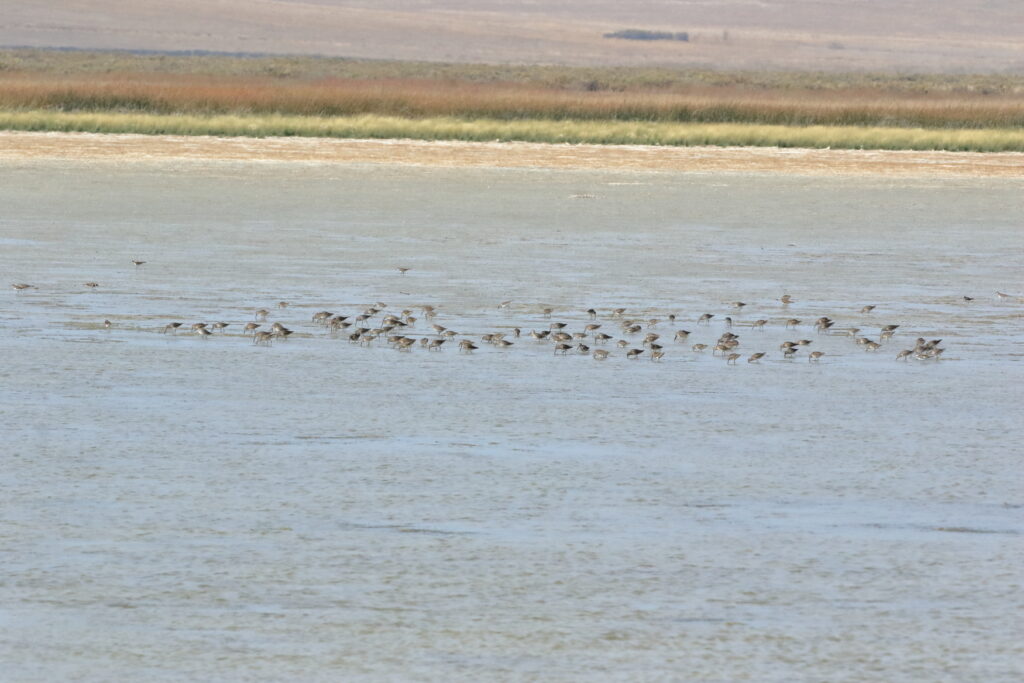
Another couple of hundred yards brought me close enough to set up the scope on the birds I was seeing far out on the water. There were groups of ducks, but those didn’t interest me. What did was a group of about forty or fifty shorebirds. Even with the scope, I wasn’t as close as I would have liked, but their very long bills, pale superciliums (the bands above their eyes) and “oil drilling” probing of the shallows said “Long-billed Dowitchers.” Then, I began to doubt myself. Their bills were so long and from a distance, I could imagine that some of them seemed slightly upturned. “Could they be godwits?” I asked myself, suddenly thrown into confusion. I kept studying them, eventually coming back to dowitchers. What cinched it is that when they took flight I could clearly see the single white stripes running down their backs. Godwits don’t have that. When they again landed, I realized that their numbers had also doubled to about ninety.
Dowitchers always make me happy. I just hope that humans can get our act together in time to make sure they have enough water in the future.
I spent almost an hour studying the water from the dike, and in addition to the Long-billed Dowitchers, I found four sandpipers that I thought were Baird’s Sandpipers but could have been Pectoral Sandpipers—they were just a bit too far away to be sure. I did ID several distant Black-bellied Plovers, too. The rest of Freezeout didn’t offer up much. I saw three Eared Grebes and a Canvasback hidden among scads of Canada Geese and intermolt ducks that were probably mostly Mallards. A stop at Priest’s Lake, however, yielded 2,500—you read that correctly—twenty-five hundred Ruddy Ducks! Ruddies, of course, are one of the BEST ducks, but I’d never seen even close to these numbers before. During fall migration, I guess they like each other’s company!
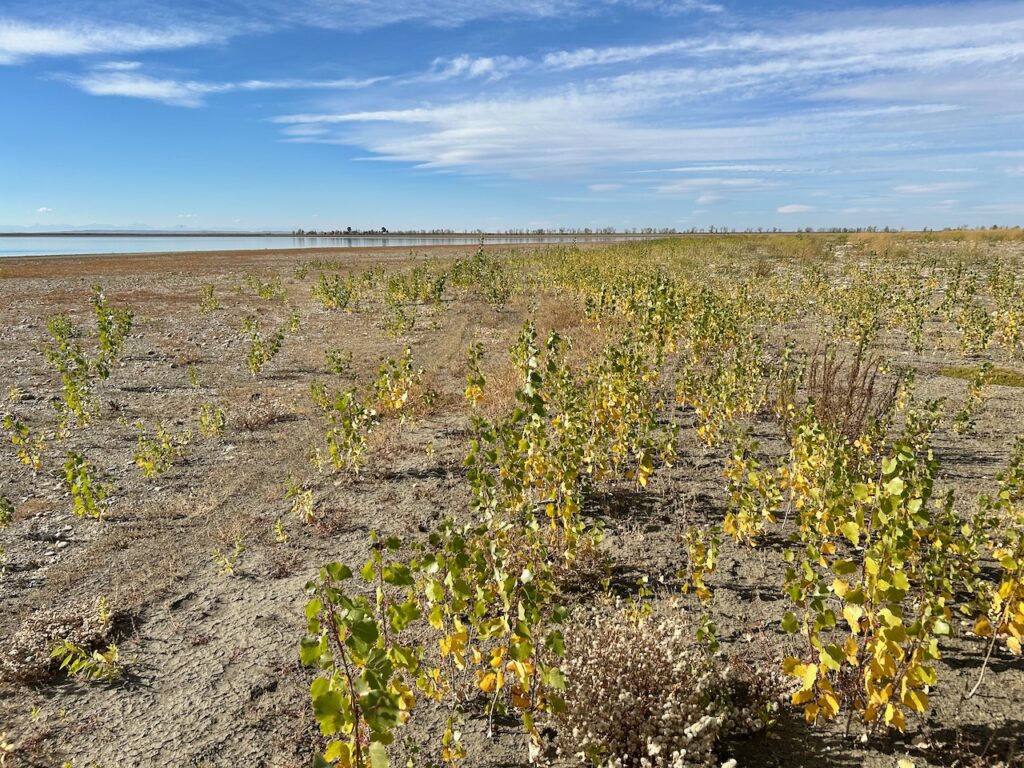
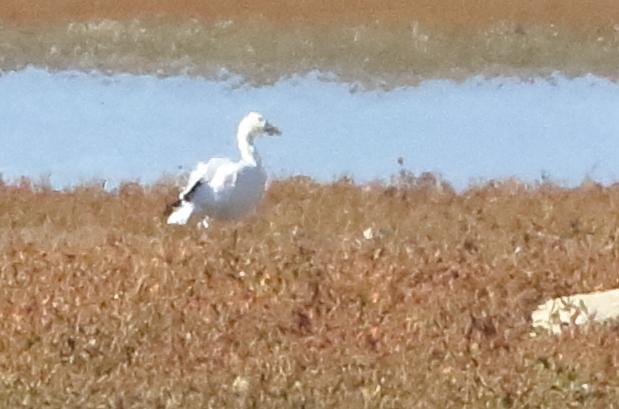
One of my birding goals lately is to try to bird new areas and on my way up to East Glacier, where I would be spending the night, I made two more stops: Eureka Reservoir north of Choteau and Lake Frances near Valier. Neither yielded anything exceptional, but I did pick up my First-of-the-Year Snow Goose, a single specimen at Lake Frances. What both places strongly reinforced was the critical water situation in this part of the world. Both bodies of water had retreated huge distances from their historic lake shores. It’s difficult to tell what percentage of water they’ve lost, but I’d guess that both were at least three-quarters empty.
Lake Frances offered up the most visible impacts of what drought is doing to the Great Plains. I had to walk across a couple of hundred yards of former lake bottom to reach today’s shore.
As I passed through Browning and turned toward East Glacier, I saw more bad news. Braden and I had driven this route at least a dozen times and every time we saw prairie potholes full of water. On this day, every one of those potholes stood bone dry until I’d almost reached East Glacier. This has dire portents for the future of our wild birds. Sure, rainfall goes up and down year to year, but the trend for the West is to get drier and drier. What happens when migrating birds head south and find no water at all?
This lone Snow Goose at Lake Frances brought me to within three birds of breaking my all-time one-year species count record—but it was small consolation for the dire water conditions I saw everywhere.
Honestly, I don’t want to find out, but it adds an urgency to act—and makes current attacks on clean energy both unconscionable and downright reckless. Why are such attacks happening? Just follow the money to the oil and car companies that continue to make trillions in profits while our planet suffers. These corporations have invested heavily in the current administration and are grinning ear to ear as POTUS rails against solar energy and windmills while he tries to sell our fossil fuels to a world that doesn’t want them. I generally try to keep FatherSonBirding apolitical, but if we want the next generation to have half of the beauty and diversity you and I have enjoyed, we have some urgent decisions to make. None of us has to change the world all by ourselves, but we each have to do something, whether it’s donating to causes working for a better planet or taking the plunge on solar panels, an electric vehicle, or eco-friendly hot water heater. The next generation may not ever thank us “stupid people” for what we’re doing, but we’ll know that the world will be better off for our efforts.
One of our goals at FatherSonBirding is to encourage support of scientists and nonprofits working to protect our planet’s many imperiled bird species. We hope that you will consider sending a donation to Montana Bird Advocacy, whose work is featured in today’s blog. You can do this by clicking here. It will be money well spent!
Late July often ushers in the birding doldrums. Having finished courtship and breeding, most birds get super quiet. They often disperse from their breeding territories, too, making them more difficult—or at least unpredictable—to find. But this year I was in luck: I had a writing assignment that would guarantee I see at least a few very cool birds.
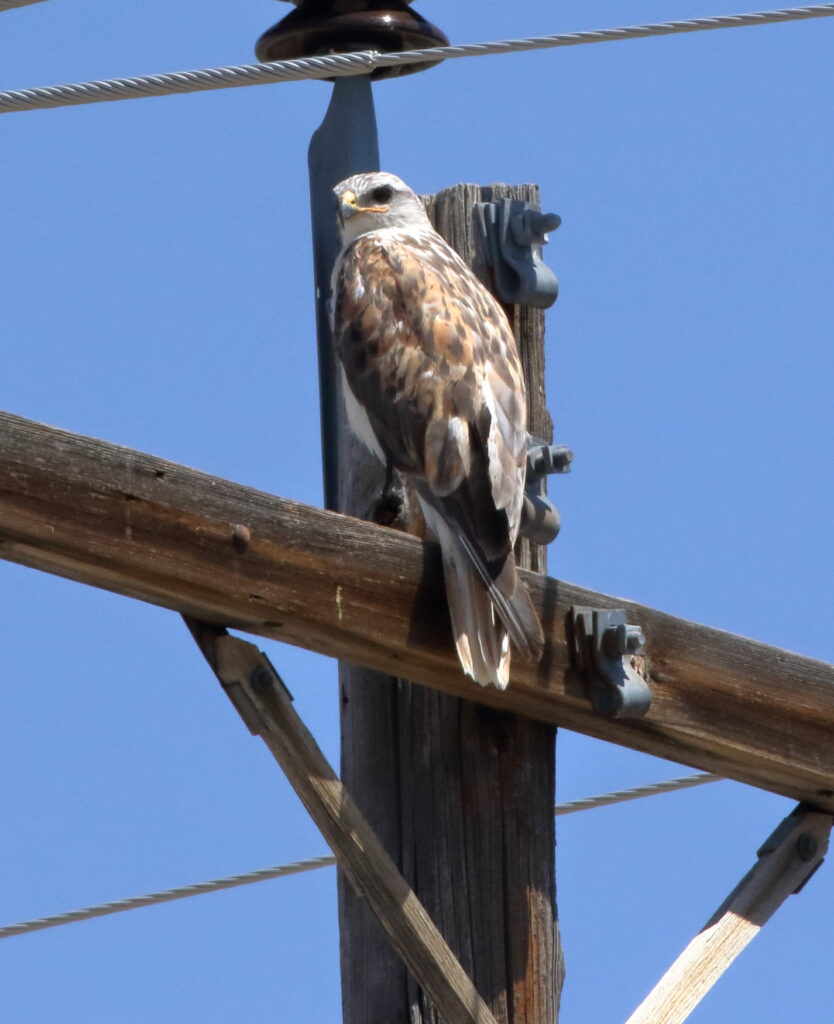
My best look yet at a stunning Ferruginous Hawk proved a delightful bonus to my day near Bannack.
You may recall my unsuccessful June trip down to Beaverhead County (see post In Search of the Green-tailed Towhee) to visit with biologist Jeff Marks, founder of the nonprofit scientific research group Montana Bird Advocacy. There, Jeff and colleague Paul Hendricks are performing a long-term study on one of Montana’s little-known birds, the Gray Flycatcher. When I visited, Paul wasn’t there, but I also got to meet biologist and research assistant Nate Kohler, who has been playing a pivotal role in the study.
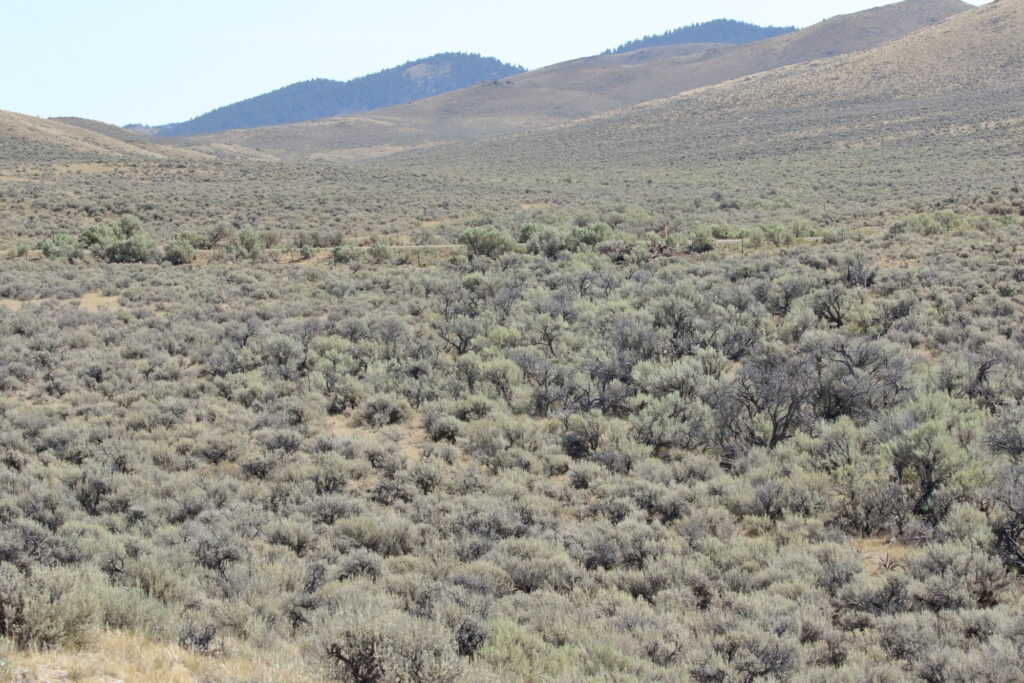
The word “gulch” conjured up a much more verdant image to my mind, but as you can see it takes some pretty special adaptations to survive in this rugged country.
Although my June trip allowed me to see many wonderful birds and interview Jeff and Nate, my intention to see the Gray Flycatchers got squashed by a freak winter storm. Worse, the storm wiped out a whole crop of nestling Gray Flycatchers. The good news? The adults had laid second clutches of eggs, and the babies were getting ready to fledge as I again headed down there the last week of July. This time, the weather would be ideal for seeing them.
Jeff and I headed out at 8:00 a.m. and made our way up Bannack Bench Road, which borders the study area. This was the third season of the study, and its purpose is to figure out some of the basic biology of a bird that scientists know very little about. To do that, Jeff, Paul, and Nate have been banding adult flycatchers with color bands that allow field identification and observation of individual birds. The birds have been a challenge to catch, but the biologists have managed to band about a dozen each year—and with fascinating results. I won’t reveal too much about those results here since I’m also writing an article for Montana Outdoors magazine that will be out next year. However, I will tell you that seeing where these birds nest and what they are doing was a thrill.
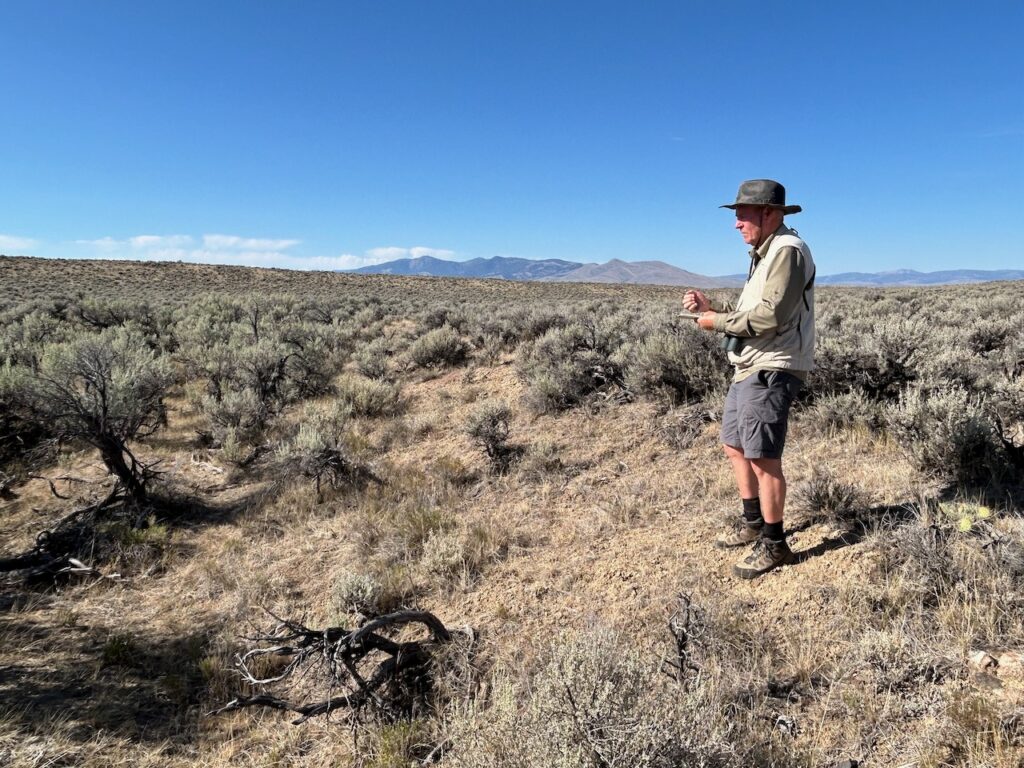
Biologist Jeff Marks takes notes on a Gray Flycatcher nest in his Beaverhead County study area.
When Jeff first told me they were working in a place called Sheep Corral Gulch, I imagined sagebrush plants bordering some kind of verdant riparian zone, perhaps lined with aspens or junipers. Imagine my surprise to see nothing but sagebrush in every direction! Gray Flycatchers breed throughout the Great Basin, but one of the fascinating things about them is that they choose different habitats in different places. In other states, they nest in juniper, pinyon pine, and even ponderosa pine, but in this part of Montana the birds breed almost exclusively in sagebrush plants along dry washes. One thing that these places share in common is that they have open ground for foraging.
Color-banded adults allow Jeff and the Montana Bird Advocacy team to make detailed observations about mating and behavior of these little-known birds.
In Beaverhead County, though, not just any sagebrush will do. The birds nest only in taller plants four to eight feet high—plants that can mainly be found growing in the (usually) dry main stream channels of gulches. This year, Jeff and his colleagues located about a dozen nests, one to two hundred meters apart, and as Jeff and I began hiking, it wasn’t long before we spotted an adult bird up ahead. Using GPS coordinates, it took only minutes for Jeff to locate the bird’s nest—a nest with babies!
“They will fledge any day now,” Jeff told me, “and it looks like both parents are feeding them.” Having two involved parents gives the nestlings a huge survival advantage, and as we watched, we saw a parent deliver a juicy grasshopper to its ravenous chicks.
Most of the Gray Flycatcher nests were bursting with babies itching to head out on their own—after a few more meals from Mom and Dad!
For the next three hours, I followed Jeff as we visited one nest after another, and most were jam-packed with two or three babies champing at the bit to head out on their own. We, of course, made sure to stay well back so as not to spook them out of the nests before they were ready.
An unbanded adult Gray Flycatcher keeps watch on us as we move through its territory: “Move on. Nothing to see here, folks.”
I thought we would see a lot of other birds as we hiked, but especially this time of year, the birds stayed out of sight. We saw a couple of Brewer’s and Vesper sparrows, and a single Sage Thrasher and Northern Harrier. What a contrast from a month earlier when I spotted Sage Thrashers and Brewer’s Sparrows almost everywhere I looked! Nonetheless, I couldn’t have been more thrilled to get these up-close-and-personal looks at one of Montana’s most uncommon species.
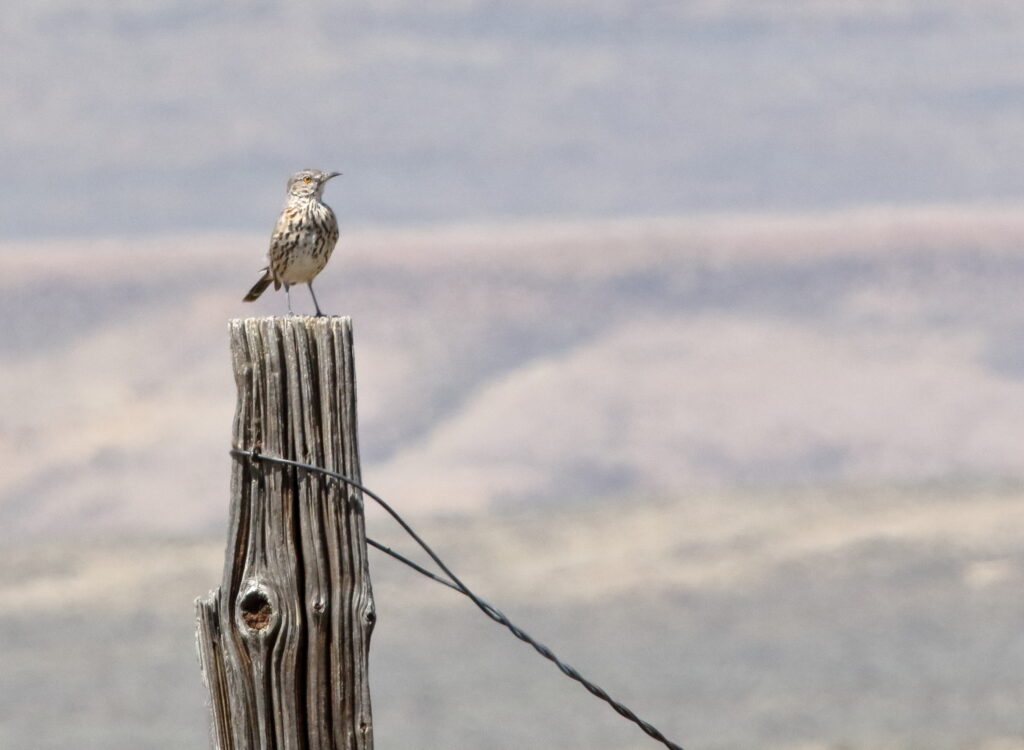
Sage Thrashers were noticeably more elusive than only a month earlier, but this one did pose nicely on a fencepost along Bannack Bench Road.
You may be wondering just where Gray Flycatchers can be found in Montana. That itself is a fascinating story, because they apparently arrived in our state only recently. The first official record occurred in 1999, and Jeff believes that the birds may only have reached the Treasure State as part of an expansion northward from the Great Basin that occurred in the 1970s. Their Montana strongholds are in Beaverhead and Carbon counties (see post Bear Canyon—Montana’s “Tropical Birding” Paradise), but it takes careful observation and listening to distinguish the birds from almost identical-looking Dusky Flycatchers. The fact that the birds are so restricted here in Montana, though, points out how important it is that we protect our fragile sagebrush communities. It also underscores the great value of the work that Montana Bird Advocacy is conducting, because only by understanding the biology of the Gray Flycatcher and other sagebrush species can we know how to protect them.
Please consider supporting the ongoing work of MBA by clicking here and making a donation. The flycatchers will thank you—as will generations of future birders!
While getting ready for the next day at the study site, MBA’s rental cabin offered an idyllic view of pastureland, complete with deer, coyotes, and gobs of Common Nighthawks. Donate to Montana Bird Advocacy by clicking on this picture.
Today, we continue Braden’s epic birding trip from Maine to Montana with an astonishing visit to a place few people get to experience: Algonquin Provincial Park. Enjoy this latest installment, and if you’d like to support FatherSonBirding and independent journalism, please consider buying one of Sneed’s books shown to the right. Oh, and please share this post!
Twelve hours west of the Maine border, I spotted the giant sign reading “Welcome to Algonquin Provincial Park.” When many birders think of Canada, they imagine huge tracts of boreal conifer forest filled with the birds of the north: Canada Jays, Yellow-bellied Flycatchers, crossbills and, of course, Black-backed Woodpeckers and Spruce Grouse. Much of my drive from western Maine towards Ontario did not give that impression at all. In fact, the part of Canada that includes Montreal and Ottawa (both cities that I drove through) is lower altitude than western New England, and much of it lies in the St. Lawrence River Valley, a warmer, more humid region filled with deciduous forests, agriculture and suburbs. The area reminded me more of central Pennsylvania or New Jersey than of western New England, despite being at a similar latitude.
But Algonquin Provincial Park was noticeably different from the St. Lawrence River Valley. Three hours west of Ottawa, this large preserve sat at a higher elevation than the valley. The soil was rockier and because of that, far more conifers grew here, especially around the various lakes and bogs scattered through the park. Finally, I felt like I was back in good boreal habitat.
Algonquin Provincial Park represented a significant departure from lower altitude St. Lawrence River Valley only a few hours away.
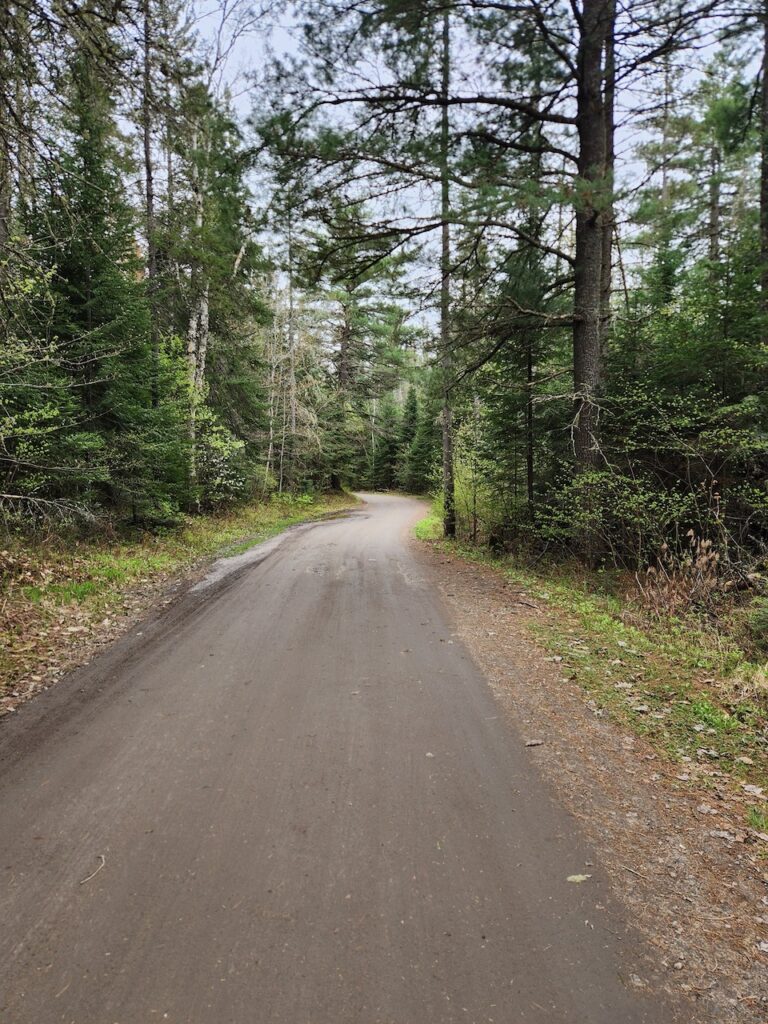
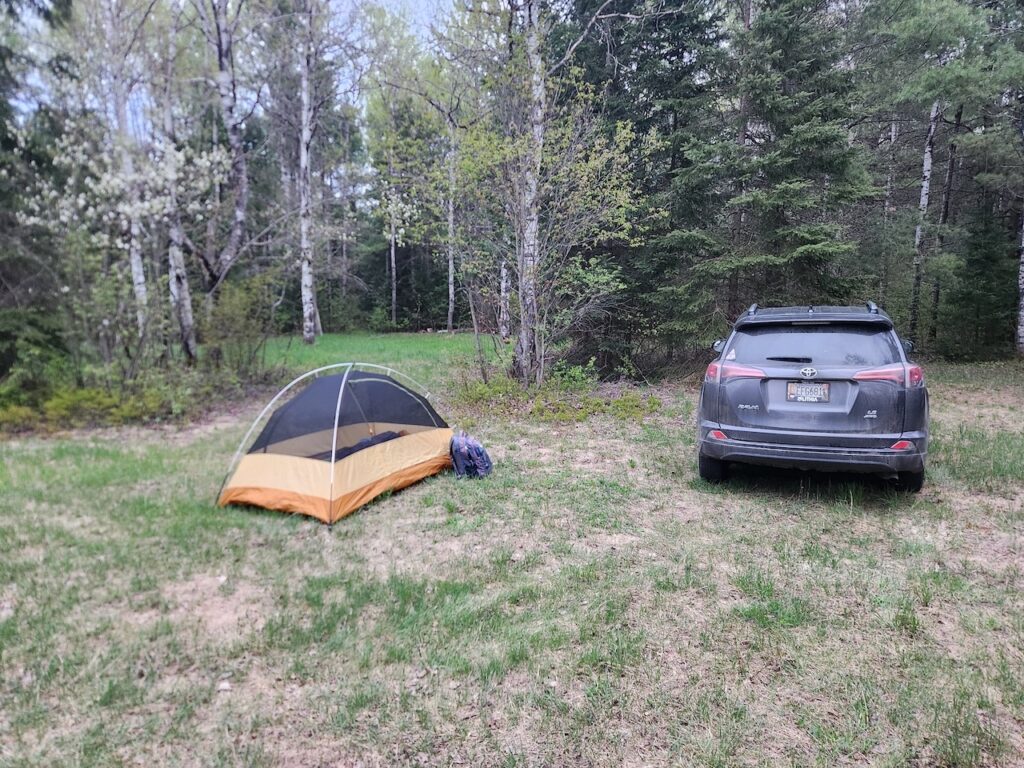
I wasn’t allowed to camp in the park without paying a hefty fine, so I pitched my tent on a dirt road right outside it, in what appeared to be a site for keeping horses on the shore of a large lake. As dusk fell, I heard the twitter of an American Woodcock displaying high above. I’d seemingly settled in the middle of his territory, and he kept me company all night as I dreamed of what birds I’d see the next day.
My impromptu campsite outside of the park rewarded me with an American Woodcock that serenaded me to sleep.
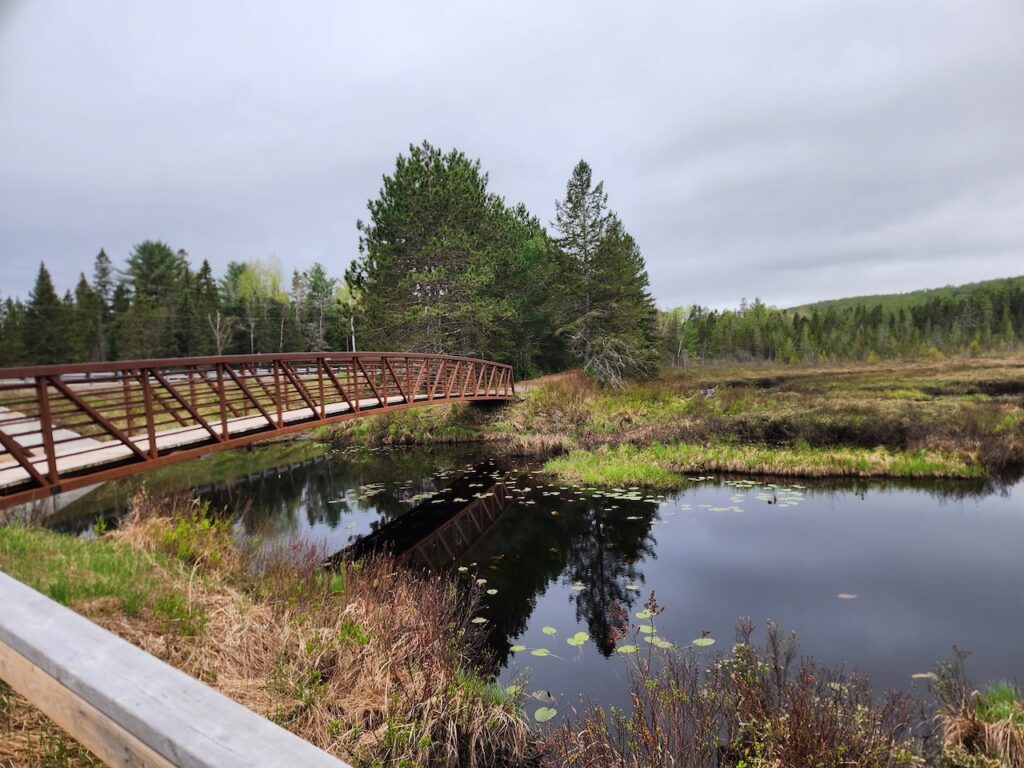
After a short walk around my campsite at dawn, during which I detected a few Cape May Warblers, I headed into the park. My first location: the Spruce Bog Boardwalk. Spruce bogs, which I’d gotten to know during my time in Maine and the Northeast, are strange, almost other-worldly habitats scattered across the northern United States. Generally consisting of an outer area dominated by spruce trees with a core of peat moss floating atop water, they are home to a variety of unique species including carnivorous plants like pitcher plants and sundews. Because of their unique habitat structures, spruce bogs are also havens for a variety of boreal bird species that are otherwise less common in more southern parts of their range. So, as I set foot on the boardwalk, I found myself once again searching for Spruce Grouse and Black-backed Woodpecker—species I find myself looking for frequently.
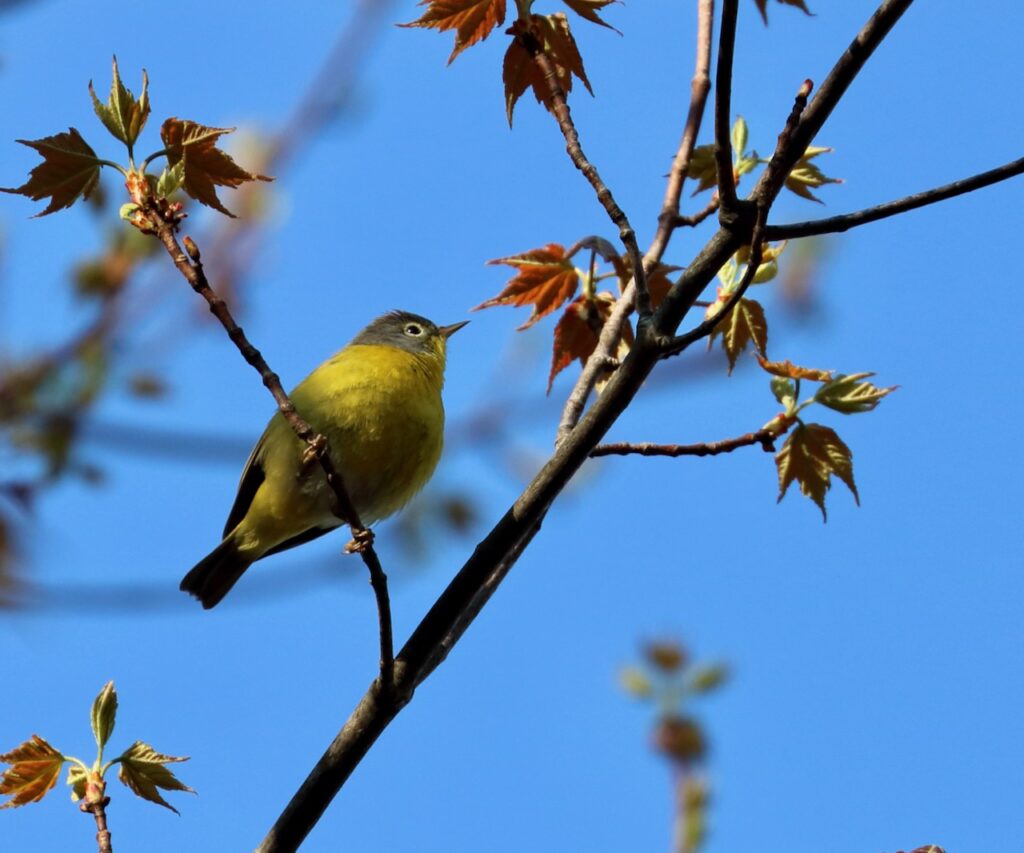
Extensive searching brought no luck, although I did find more boreal warblers, including several Cape May Warblers and another great look at a Bay-breasted. I also heard a Lincoln’s Sparrow, my first of the year, singing from the wet back half of the bog. I had much of the day to bird Algonquin Park, so after striking out on my main targets at the boardwalk, I decided to take a short stop at the visitor center.
I had hoped for both Black-backed Woodpeckers and Spruce Grouse in this spruce bog, but struck out with both species.
Within ten seconds of pulling out onto the road my Toyota RAV4 screeched to a halt. There, ten feet away, staring me down, stood a huge female moose. The animal had to be at least five feet tall, though from my seat in the car it seemed a lot taller! After we shared several seconds of each other’s presence, the moose trotted off into the woods. I didn’t end up seeing any of my bird targets at the visitor center and the center itself was closed, but I was now filled with adrenaline—I’d just scored my most wanted mammal of the trip!
Next, I hit Rock Lake Road. While I hadn’t seen many reports of my target boreal birds here, I figured that this road—a dirt track winding past marshes and through patches of spruce and budding Paper Birch—was as good a spot to try as any! Over the next hour and a half I drove slowly with my head out the window. Again, no woodpecker and no grouse, but I ended up tallying 40 species, 15 of which were warblers! Nashville and Magnolia were the most abundant, along with a smattering of Black-throated Blue, Blackburnian, Canada and others. Near the beginning of the road I also heard several Wood Thrushes singing, a surprise this far north. Along my drive I was also accompanied by the near-constant drumming of Ruffed Grouse, and the loud, piercing whistles of a pair of Broad-winged Hawks.
Though I continued to strike out on BBWOs and SPGRs, Algonquin presented a nice assortment of warblers including Nashvilles, always a favorite!
At this point I admit that I was feeling a bit ungrateful. I’d been birding for three or four hours and had not so much as glimpsed either of my targets—birds that were supposed to be somewhat regular within the park, and had compelled me to drive through Canada in the first place. Sure, I’d seen some great birds and a moose. But if I went the whole day without getting a Black-backed or a Spruce Grouse, I was going to be a bit salty. I jumped on eBird to check on any recent reports of either of them nearby and elected to visit, as my last stop of the morning, Pog Lake Campground. A Black-backed Woodpecker had been seen there only a few days before, and I figured it would be my best chance before continuing my journey west. I parked the car and began walking toward Pog Lake, keeping my ears and eyes peeled for my target species. One of the first birds I heard was a Tennessee Warbler, another boreal species with an electric song, singing loudly from a campsite nearby. I recorded it and continued onwards.
Then, I came across Campsite #512. Surrounded by gorgeous coniferous trees, it at first seemed just like any other campsite in Pog Lake Campground. The first thing that made Campsite #512 stick out, though, was the Ruffed Grouse drumming in the bushes nearby. Now, I’ve heard plenty of Ruffed Grouse drumming in my life—and had heard dozens on this trip already. Seeing one in action was a different story. I’d tried to sneak up on them before, but was always unsuccessful—the birds would flush from under my feet. However, this particular bird sounded incredibly close so I shelved my other goals and went into full stealth mode, sneaking towards the campsite to see if I could watch the grouse in action. After about ten minutes of tiptoeing around, I heard the beating of its wings—and that’s when I spotted it. Through ten feet of dense foliage, there the grouse stood, its wings striking its chest to make the sound that you feel more than hear.
I promptly sat down and spent the next thirty minutes with that grouse. Every five minutes or so, it would stand upright on its mossy log and begin its display. Bom-bom-bom-bom-bom-bom-bom. I watched it drum five or six times—with and without binoculars, and filmed it on my phone’s camera. It was magical. (Click the above image to watch my short clip.)
After twenty minutes, I also heard honking overhead. At first, I couldn’t see any birds above me, but I figured it was just a flyover flock of Canada Geese, though the calls sounded a bit strange. Then, in the gap above Campsite #512, I spotted several flocks of two hundred or so geese—and quickly realized that these were not Canadas. Between a bad view I got through my binoculars and listening to their sounds on Merlin, I realized I’d just seen a massive flock of Brant migrating over me, headed for the Arctic! I’d never seen these birds away from the ocean and never in such numbers! Sure enough, though, Algonquin Park lies right in the middle of Brant’s narrow migration route across Canada, and I’d just happened to be in the right place at the right time.
The Brant disappeared into the distance and the grouse drummed again, and I decided that, even though I hadn’t found my targets, I felt more than satisfied with my experience with Pog Lake Campground. But Campsite #512 hadn’t finished with me.
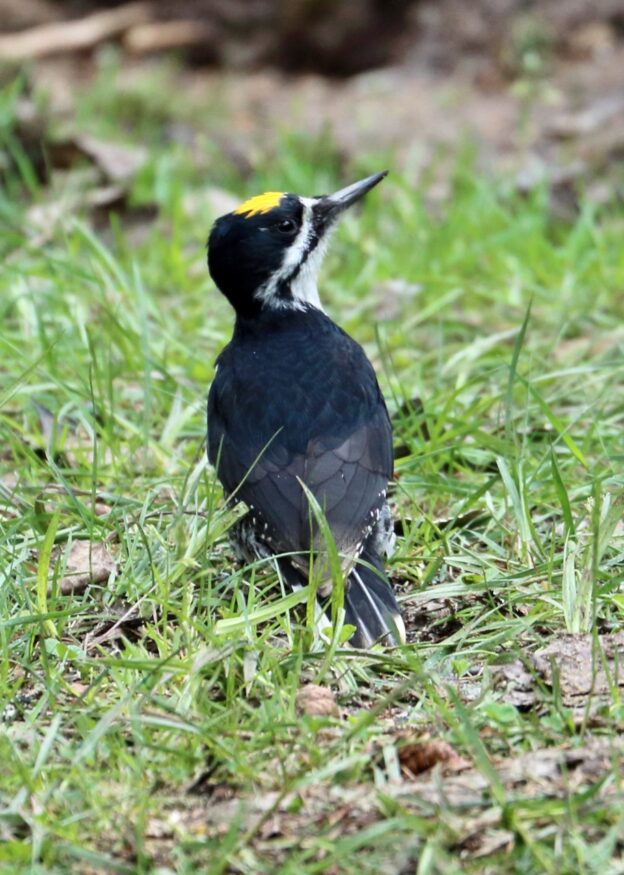
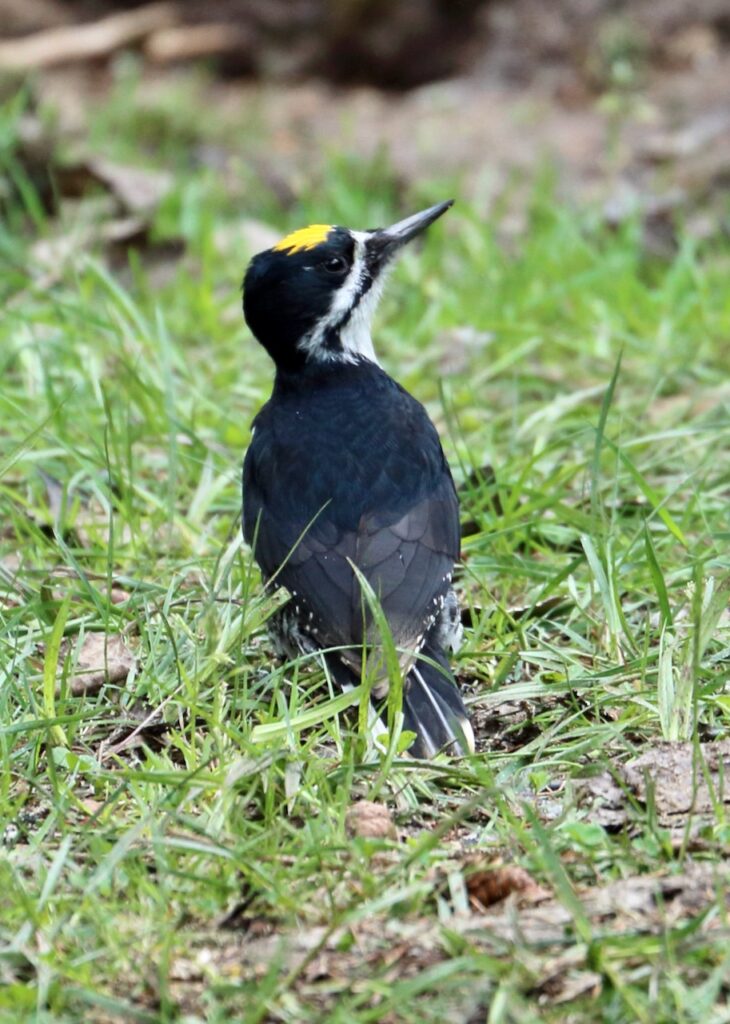
As I slowly stood, taking care not to startle the grouse, I heard strange, frantic calls coming from the woods on the other side of the campsite. I quickly recognized them as calls I’d been listening for all morning, and suddenly, a male Black-backed, decked out in sleek black feathers with a yellow cap, flew into the campsite. It landed on a downed log near me, and proceeded to hop along the ground, getting closer and closer to until it stood only five feet away! It either didn’t notice me or didn’t care, poking for insects in the roots of the nearby spruce trees. After a minute or two, the woodpecker flew away, leaving me debating if I should EVER leave Campsite #512.
My best-ever look at a Black-backed Woodpecker will forever embed Campsite 512 in my birding heart.
As you can probably guess, I did continue on my journey, but knew that my visit to Campsite #512 would become one of my most memorable birding mornings ever, one that would be etched in my brain for a long, long time.
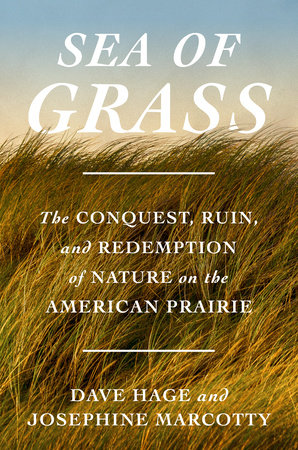
Sea of Grass is required reading for anyone interested in prairie birds and their futures.
In Sea of Grass, authors Dave Hage and Josephine Marcotty have created an impressive work that covers the entire sweep of human understanding and conquest of the American prairie. The authors set the stage by giving us solid background on the richness and diversity of North American grasslands. They recount the geological and climatological conditions that created our great prairies. They give us a glimpse of the remarkable number of species that live both above and below ground, comparing our grasslands favorably to the biodiversity of rainforests and coral reefs. They also explain the incredible amount of carbon that these natural systems sequester.
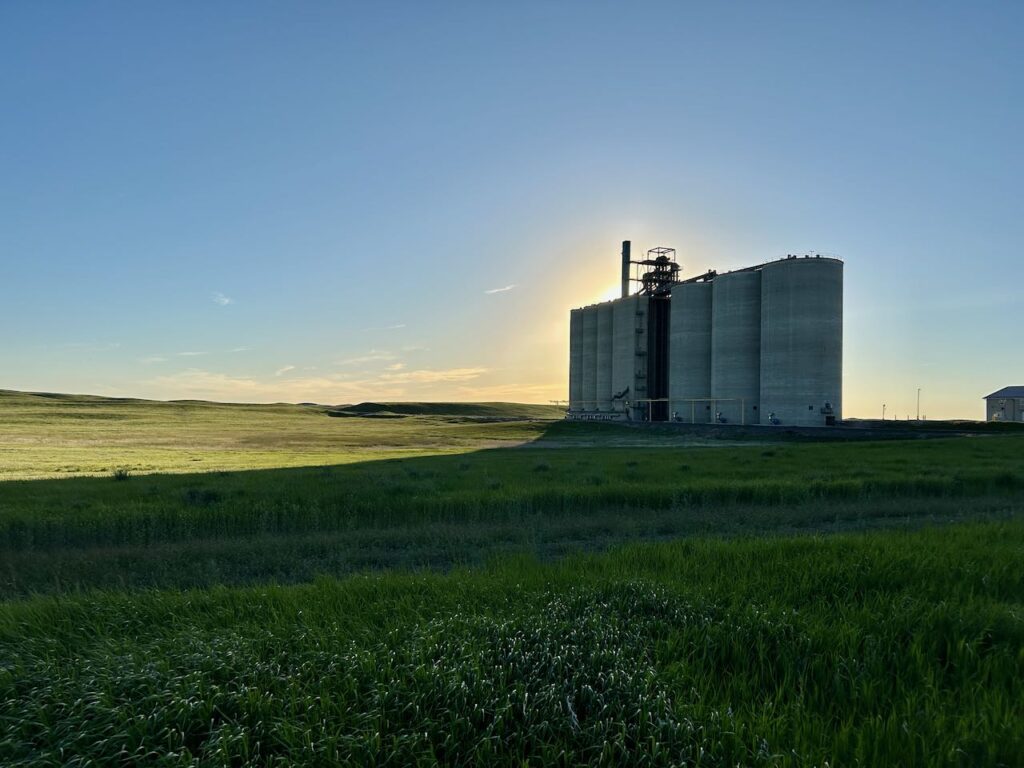
Grain elevators stand as scenic symbols of the Midwest economy—and of continuing threats to our remaining shortgrass prairie.
What really stands out in the book are the chapters documenting the breathtaking exploitation and destruction of tallgrass prairie, and how technology has managed both to raise agricultural production and create almost unimaginable environmental problems. Even as someone who has followed environmental issues all of my life, I learned an astonishing amount. Have you ever heard of tile drainage? I hadn’t, but it is a drainage system that not only allows farmers to raise abundant crops on otherwise unsuitable land, but mightily contributes to funneling harmful fertilizers and pesticides into rivers, lakes, wells, and other water sources throughout the Midwest. Scientists have established clear links between agricultural practices and the enormous dead zones that occur every year in the Gulf of Mexico. Meanwhile, hundreds of cities such as Des Moines have to spend millions—probably billions—of dollars to try to remove harmful fertilizer residues from drinking water supplies.
The authors explain that while Iowa and other Midwest states have lost virtually all of their original tallgrass prairie to agricultural conversion, the arid nature of the shortgrass prairie traditionally rendered it unsuitable for growing crops. Instead, cattle was king on these lands—including much of the Dakotas, Montana, and Wyoming. Alas, genetic engineering and other technologies have now opened up these fragile, dry lands to farming. I had thought that the great era of prairie conversion had ended, but in the US we are now losing more than one million grassland acres to the plow every year.
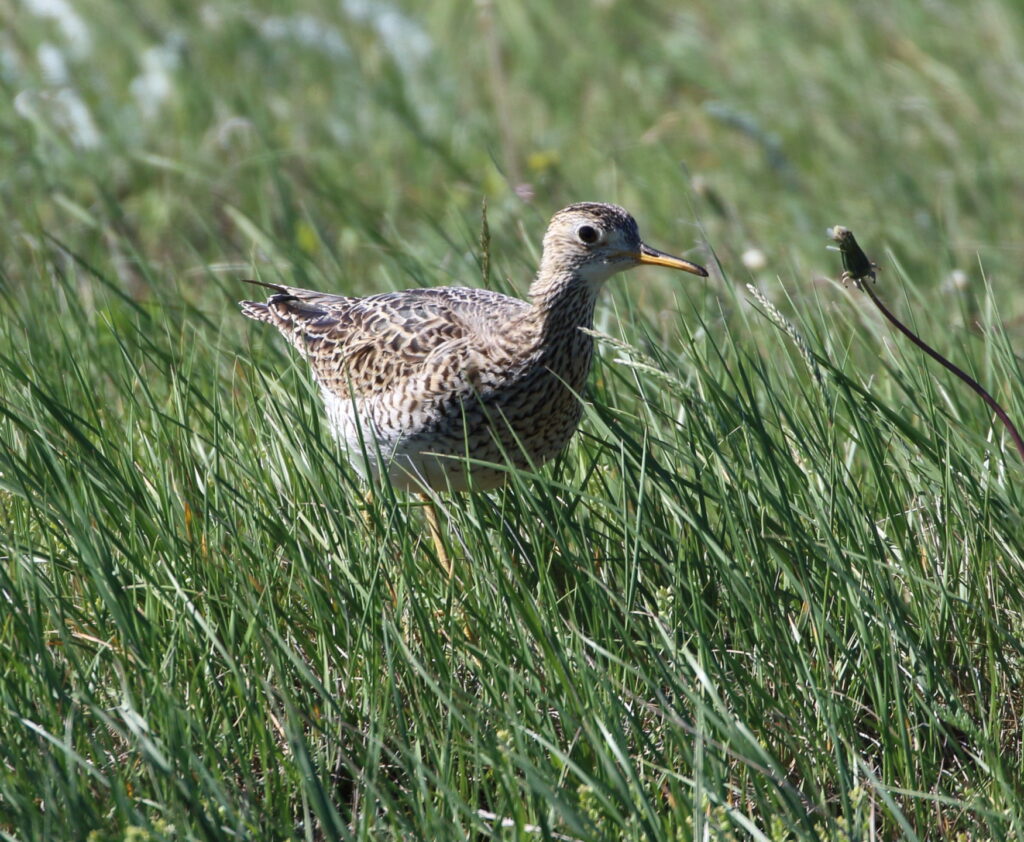
The loss of more than a million acres of shortgrass prairie to farming each year not only threatens grassland birds like this Upland Sandpiper, but an ecosystem with a diversity rivaling that of tropical forests and coral reefs.
For anyone who cares about the incredible diversity found in these grasslands—including its remarkable suite of grassland birds—this is horrible news indeed. It also sheds a positive light on the importance of sustainable cattle ranching and “keeping grass in grass,” as one Montana biologist puts it. What makes the situation especially frustrating is that conversion of grasslands to cropland isn’t primarily driven by demand for food, but by billions of dollars of tax breaks, mandates, and other government subsidies for growing corn to produce ethanol. These subsidies arose from efforts to help America achieve energy independence. Instead, they have helped create a system that continues to destroy natural ecosystems while creating immense quantities of a product that we simply don’t need (see, for instance, this report from Wisconsin). Unfortunately, by driving up corn prices, the ethanol boondoggle has made many corn growers extremely wealthy and politically powerful, almost eliminating the possibility of rolling back this pork barrel waste of taxpayer dollars.
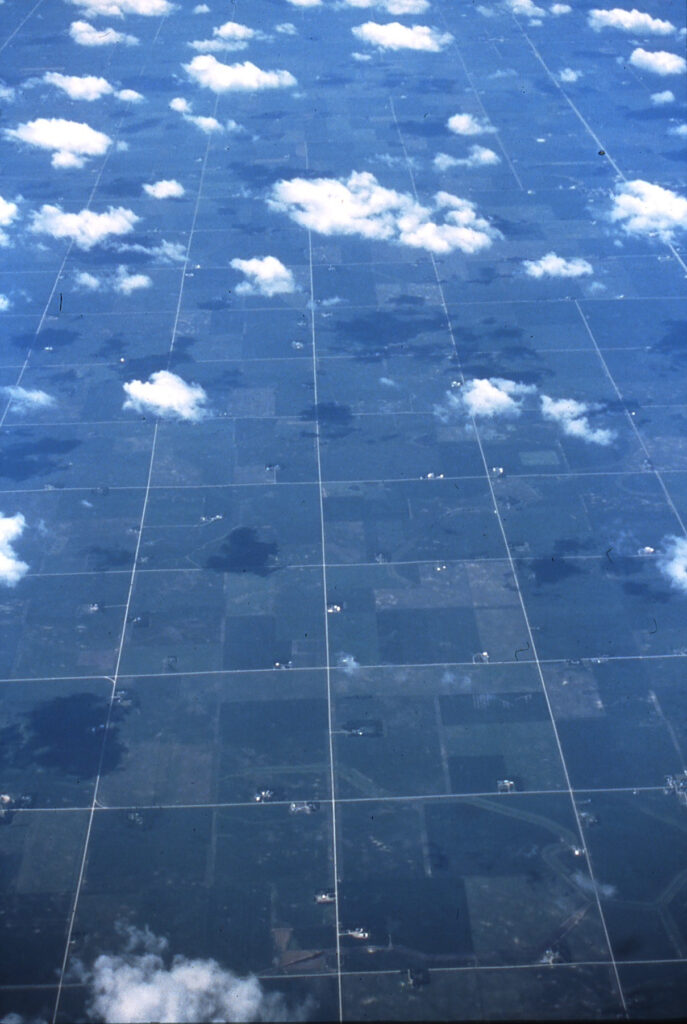
99% of Iowa’s tallgrass prairie was lost to agricultural conversion. Today, wasteful government farm subsidies for ethanol help drive the rapid loss of shortgrass prairie in Montana and other states.
Fortunately, the authors don’t leave us with a totally grim outlook for America’s remaining grasslands. Throughout the book, but especially in the final section, the authors detail a number of small-scale efforts to protect and restore grasslands as well as to reduce the incredible environmental costs of modern-day agricultural methods. In Montana, these range from the creation of American Prairie to the practice of rotational cattle grazing to tribal and ranching successes reintroducing bison back onto the landscape. I don’t want to reveal too much, but I’m confident you’ll find these and other efforts as fascinating and hopeful as I have.
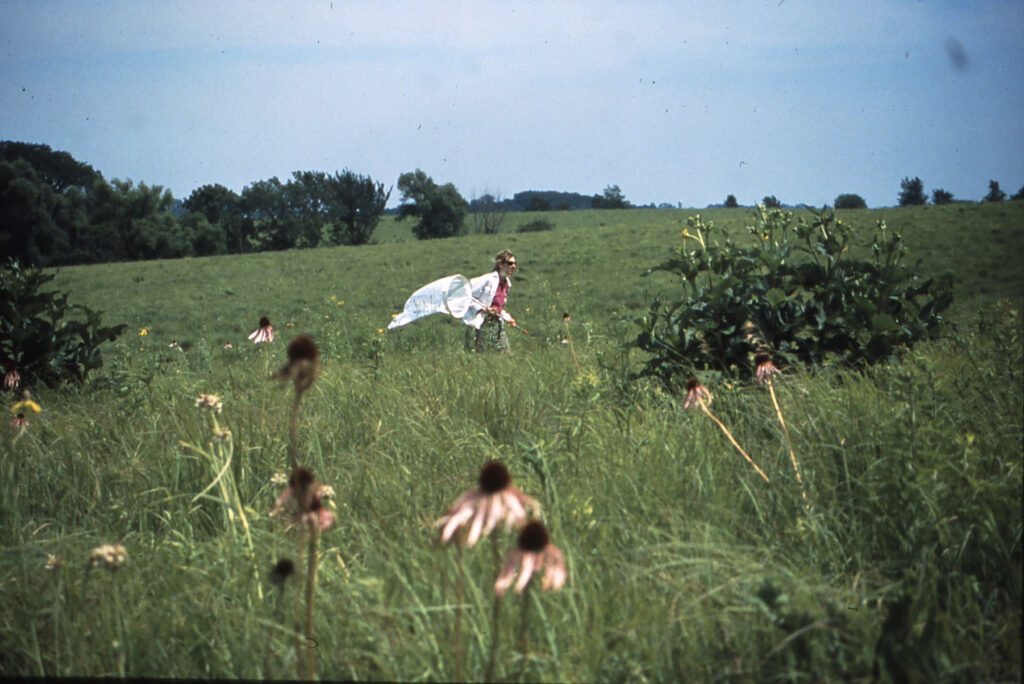
Scientist Diane Debinski searching for rare butterflies at Iowa’s Neal Smith National Wildlife Refuge, one of a handful of projects to restore tallgrass prairie habitat. This project was the subject of my 2005 book, The Prairie Builders.
Although it gives fairly brief coverage to grassland birds, if you care about grassland birds—not to mention bison and grassland ecosystems in general—Sea of Grass is absolutely required reading. Especially if you live in or near the Great Plains, it provides vital insights into the huge economic and cultural forces at work in our region. As a bonus, the authors’ clean, entertaining writing style help make this one of the most worthwhile books you are likely to crack open this year.
Summary: A fascinating crash course on the biological, economic, and cultural history of America’s grasslands and the growing efforts to protect what’s left of these remarkable ecosystems.