Tag Archives: Birding Festivals

Make 2020 a Year of Saving Birds!

Welcome to all of our new subscribers—and thank you for your interest! Please note that Braden and I are about to embark on a once-in-a-lifetime trip to the Middle East, so won’t be posting for a few weeks. When we do, we should have some amazing stories to share!

Season’s Greetings Fellow Birders! Between school exams, swim meets, book deadlines, and the general craziness of life, Braden and I haven’t been out birding a lot in the last few months, but we wanted to wish all of you Happy Holidays and a dawning new year of birding. With your patience, we’d also like to reflect a bit on the past year, the future, and what we can all do to help the animals that we love.

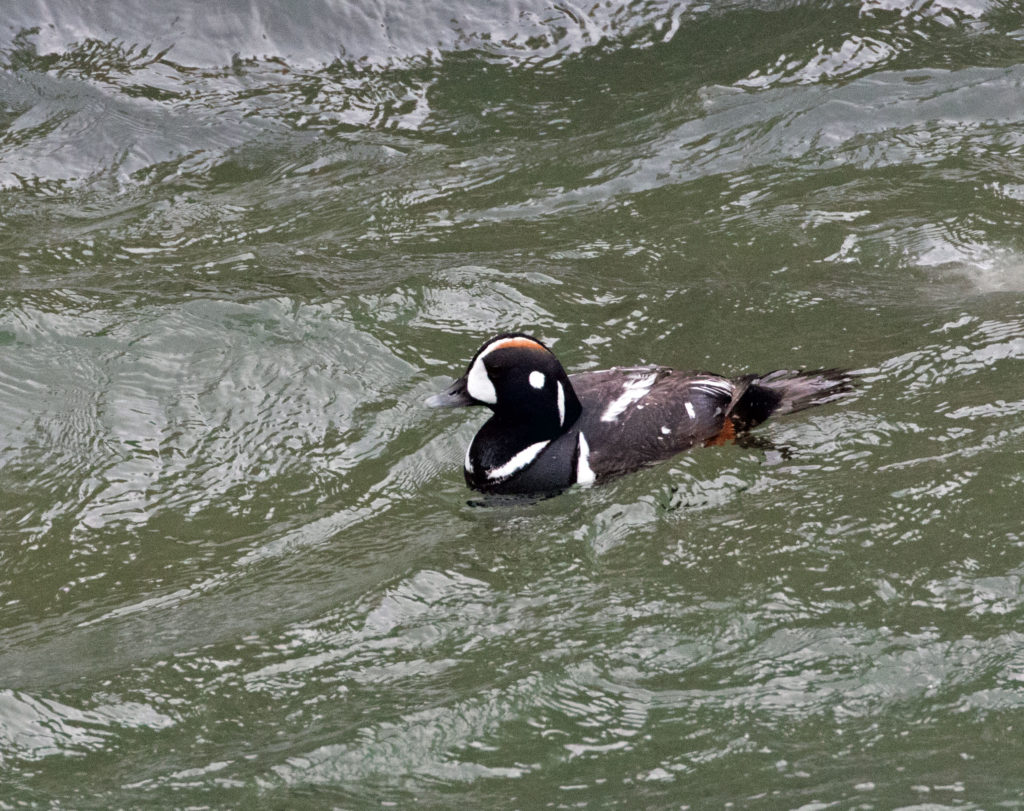
Getting to know Montana birds better—including this fabulous Harlequin Duck on McDonald Creek in Glacier National Park—has been one of the major 2019 achievements for Braden and me.

It was another amazing year of birding for Team Collard. Without intending to, we smashed our Montana Big Year records by at least a dozen birds each, with Sneed logging 222 species in the state (15 more species than in 2017) and Braden recording 225 species—12 more than in 2017. We also broke our combined Big Year record, though we’re too lazy to figure out the total (about 340 species together). This year, Braden tallied 44 new Life Birds while I added 21.

But while statistics are fun and motivating, for us they really aren’t what birding is about. Birding brings so many benefits to our lives, it’s hard to list them all, but top of the list are a chance to get outside, explore new places, see new species, learn about our remarkable planet, educate others about birding, and most of all, spend time together. This year, our favorite experiences included:

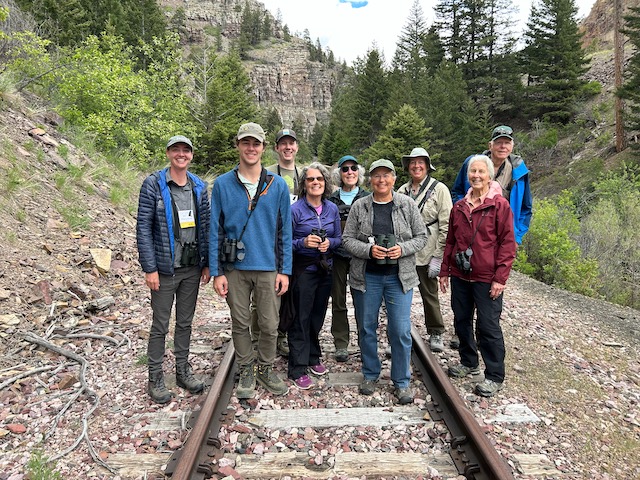
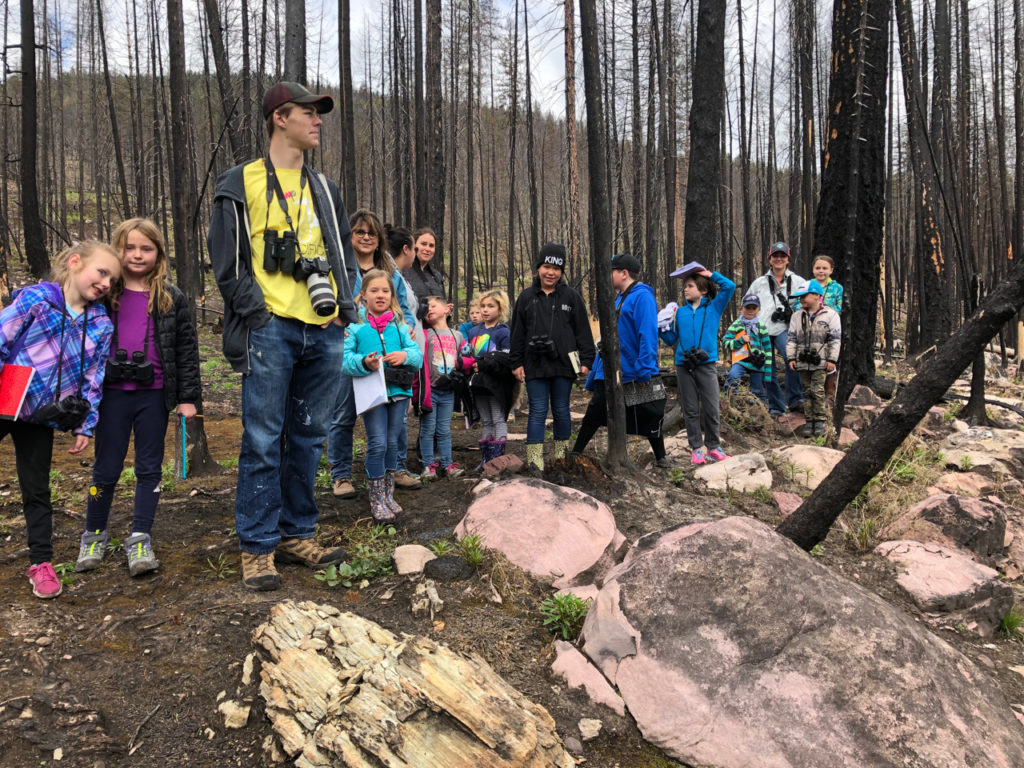
Perhaps our most rewarding 2020 activity? Leading birding trips for a new generation of young—and “almost young”—birders!

1) Participating in the San Diego Bird Festival

2) Getting to know Montana birds better

3) Leading birding trips for school groups and others

That last one brings up an important point. Those of us who love birds owe it to the planet to do as much as we can to protect them. That includes educating other people about the importance of birds and what’s happening to them worldwide. Don’t short-sell yourself. If you’ve ever been birding at all, you have important knowledge to share. Most people know almost nothing about birds, so even teaching a friend how to identify a House Sparrow or an American Goldfinch could be the beginning of a long and rewarding journey.

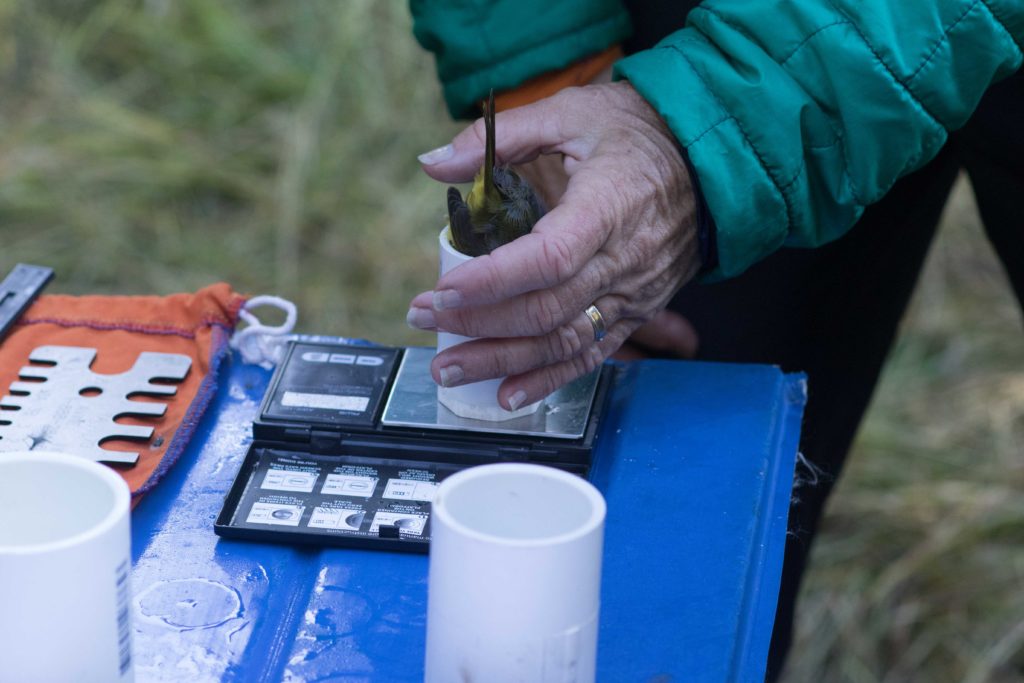
We were thrilled this fall to observe and help participate in long-term studies of bird migrations through western Montana using banding and flight call studies. Here, a Townsend’s Warbler (I think) gets unceremoniously dunked head-first into a weighing canister. This does nothing to harm the bird, but gives scientists at MPG Ranch and the University of Montana’s Bird Ecology Lab important data for monitoring and protecting songbirds.

We especially want to encourage everyone to give as much money—yes, cold hard CASH—as you can to organizations that are helping birds. Because of this year’s higher standard tax deduction, charitable donations have plummeted, and that has hurt a lot of nonprofit groups—especially in an era when they need support more than ever. Keep in mind, too, that if you donate to National Audubon, that doesn’t necessarily do much to support your state and local Audubon chapters. You have to give to all three. Here are some of Braden’s and my favorite groups that we give to:

National Audubon Society, and State and local Audubon chapters

The Cornell Lab of Ornithology

Owl Research Institute

BirdLife International

American Bird Conservancy

Please check out these groups and GIVE UNTIL IT HURTS. We thank you, and appreciate all you do to share your love of birds and, even more, to make sure that the next generation enjoys a bird-rich planet.

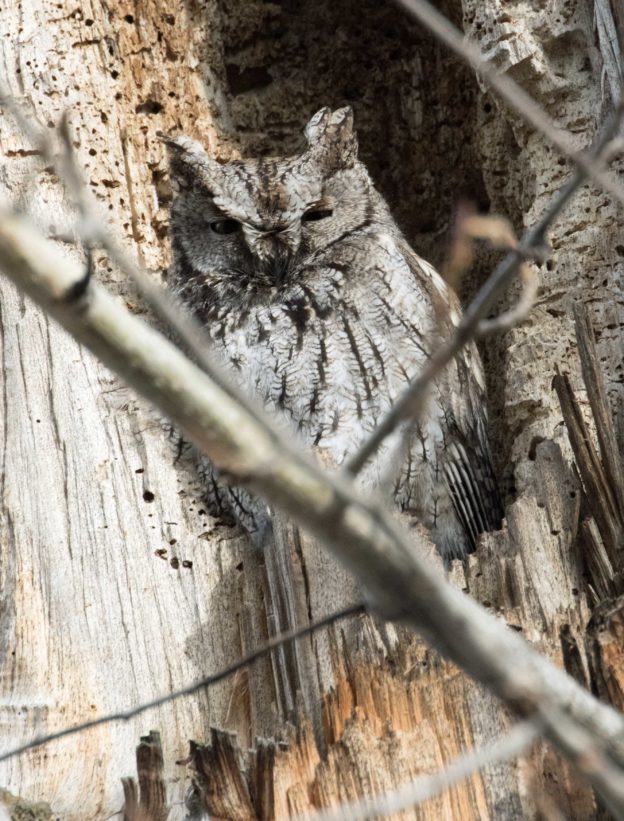
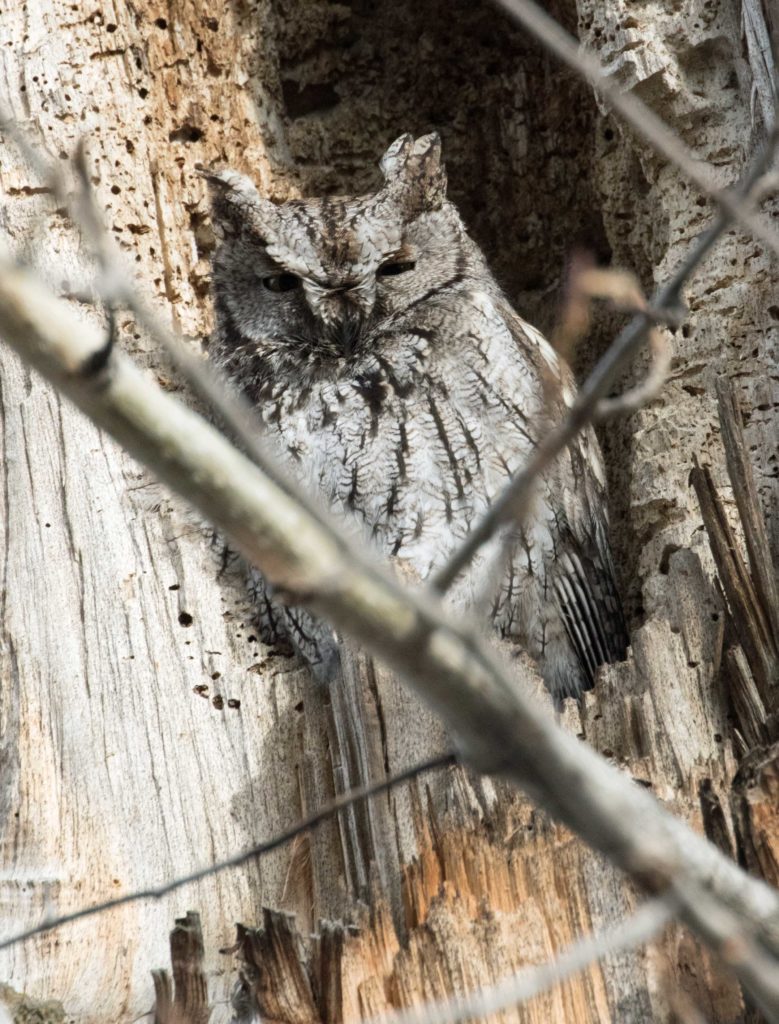
This Western Screech Owl says: “Instead of buying friends and family more junk this holiday season, why not give them a LASTING gift with a donation to the Owl Research Institute and other bird conservation organizations?”

Going For Gulls (Part 1)

Do you love birds and birding as much as we do? Do you want to help educate others about the amazing world of birds? Well, please share this site with other birders, wanna-be birders, and educators—AND follow our adventures by subscribing to FatherSonBirding.com using the box on the right below.

Just returned from a fun speaking road trip, where I got to share Braden’s and my birding adventures with fellow birders at Coeur d’Alene Audubon, the Puget Sound Bird Fest, Edmonds Bookshop, and Eagle Harbor Book Co. Thank you for the great turnouts, everyone! I, of course, also hoped to get in some good birding on the trip, but weather—or perhaps bad birding karma—conspired against me. The one bright spot? Gulls!

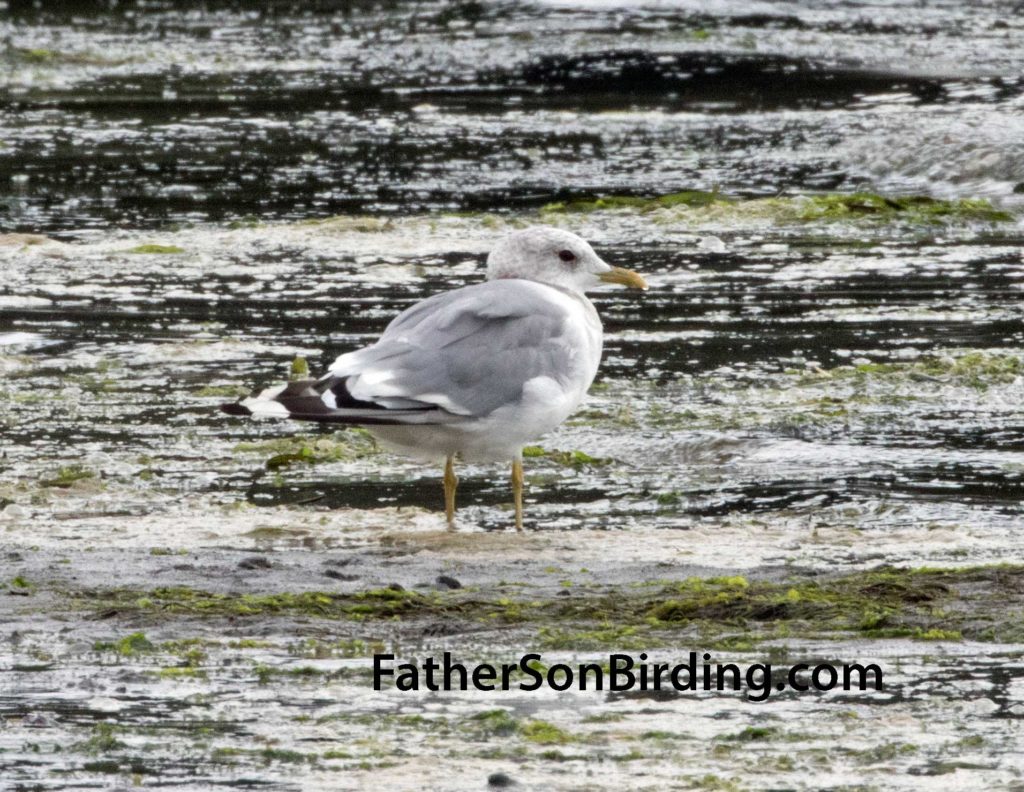
This Mew Gull at The Nature Conservancy’s Foulweather Bluff Preserve was a real surprise—and the first Mew Gull Braden or I had seen on the ground.

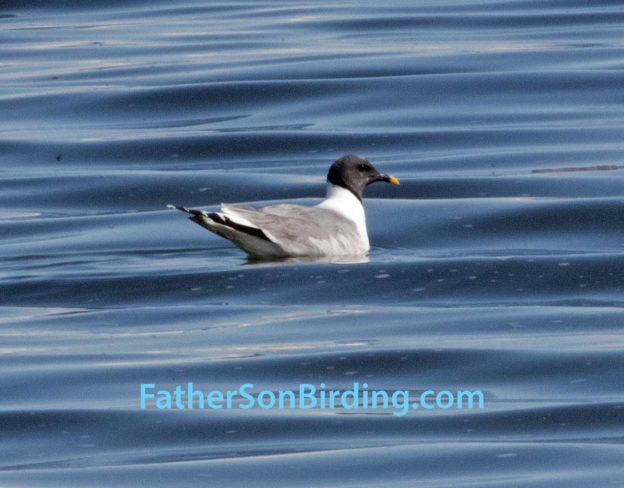
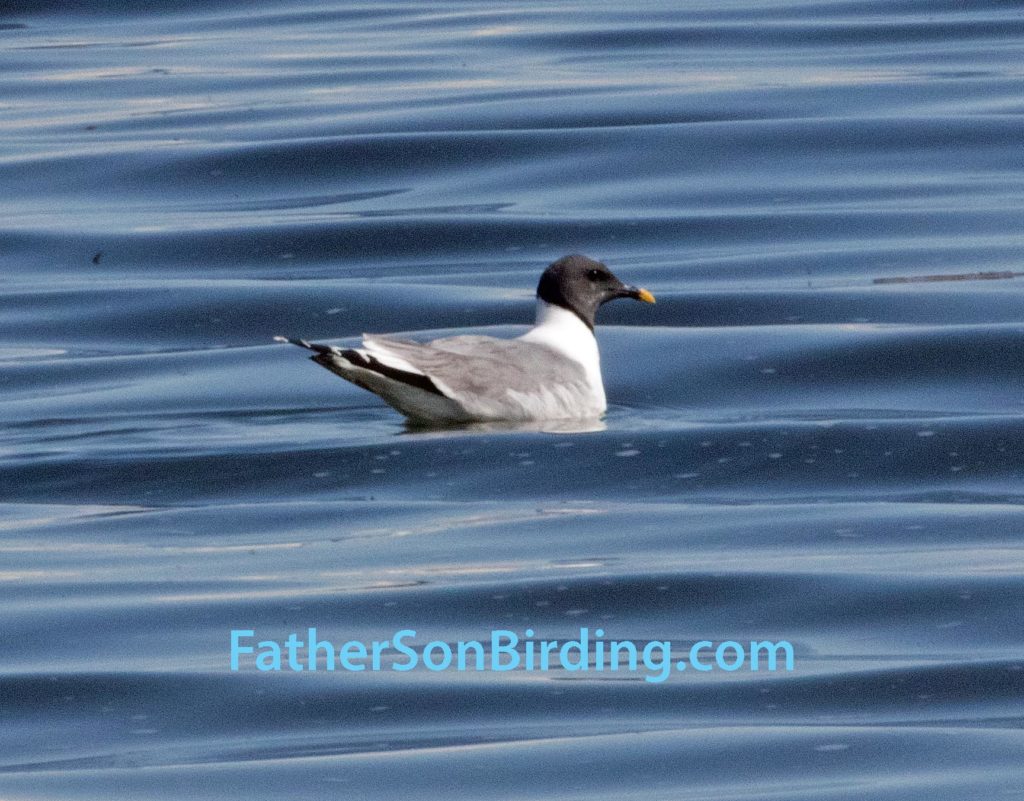
I don’t know about you, but I find gulls vexing. I do not even try to ID immature gulls, but the adults also offer enough variation to render me apoplectic. My first birding stop was Potholes State Park, about thirty miles south of Moses Lake, Washington. I arrived at a crummy time of day, but enjoyed seeing dozens of migrating Yellow-rumped Warblers and few White-crowned Sparrows. Looking out at the reservoir, however, I noticed a black-headed gull in the distance. I tramped toward it, figuring it had to be a Bonaparte’s or Franklin’s Gull. I mean this far inland what else could it be? The problem was the bird’s weird bill, which should have been either red or black. Instead, this bill was black with a yellow tip. “Geez,” I thought. “Maybe it’s turning red.” I called Braden to ask his opinion, but he was stuck in class back in Missoula, so I snapped a few photos and moved on.

What the . . . ? A gull with a black head and half-yellow bill was about the last thing I expected to see in the interior of Washington State. I guessed it was a weird Bonaparte’s Gull—and I was wrong. Read below for the shocking conclusion!

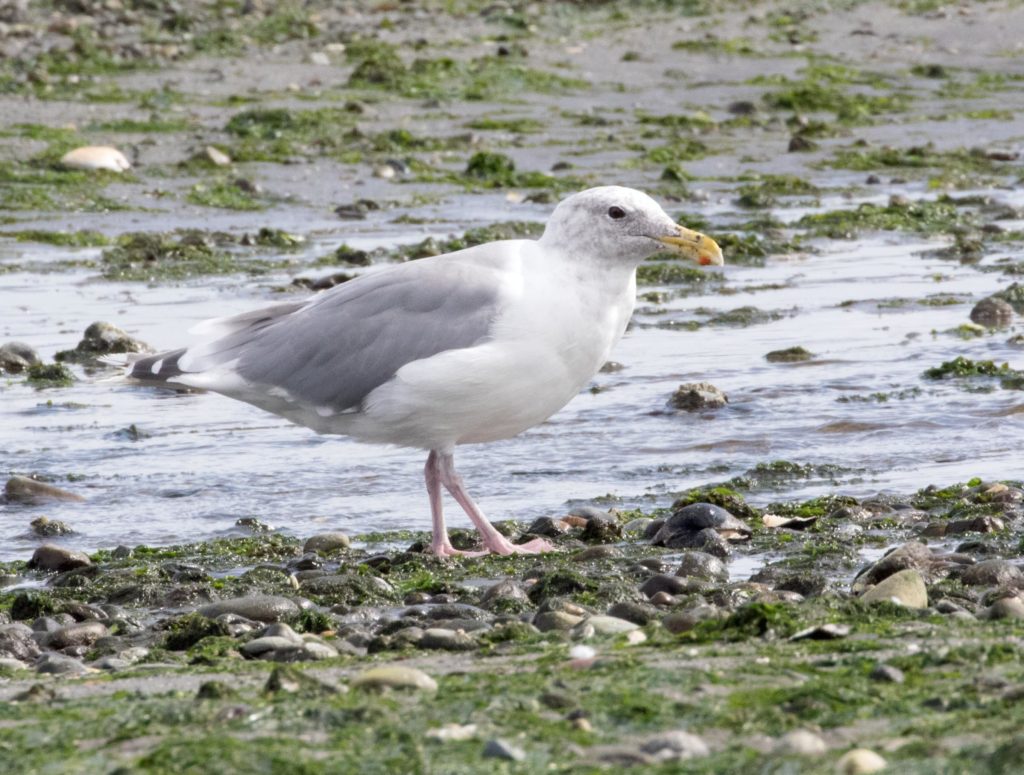
The next day in Seattle, my friends Steve and Carol and I took the ferry to Kingston and drove to Point No Point lighthouse, which had shown a lot of great water bird activity in the past few days. Alas, except for a few Rhinocerous Auklets, very little moved on the beach or offshore so I again turned my attention to gulls. I saw what looked like a Glaucous-winged Gull except that its tail was too dark, so I decided it must be a Herring Gull, as its wings were too light for a Western. Later, however, I ran into a couple of different birders who told me that Puget Sound was awash in hybrid gulls, mostly Glaucous-winged x Herring Gull or Glaucous-winged x Western. I had heard of hybrid gulls before, but didn’t realize they were so abundant and decided the one I had looked at must be a Glaucous-winged x Herring.

“Well-behaved” gulls that follow ID rules are difficult enough to identify. Unfortunately, many gulls make birders’ lives more difficult by hybridizing! Is this a Glaucous-winged x Herring Gull hybrid or a Glaucous-winged x Western Gull hybrid? The lighter wings and tail push me toward the former, but if you disagree, please weigh in!

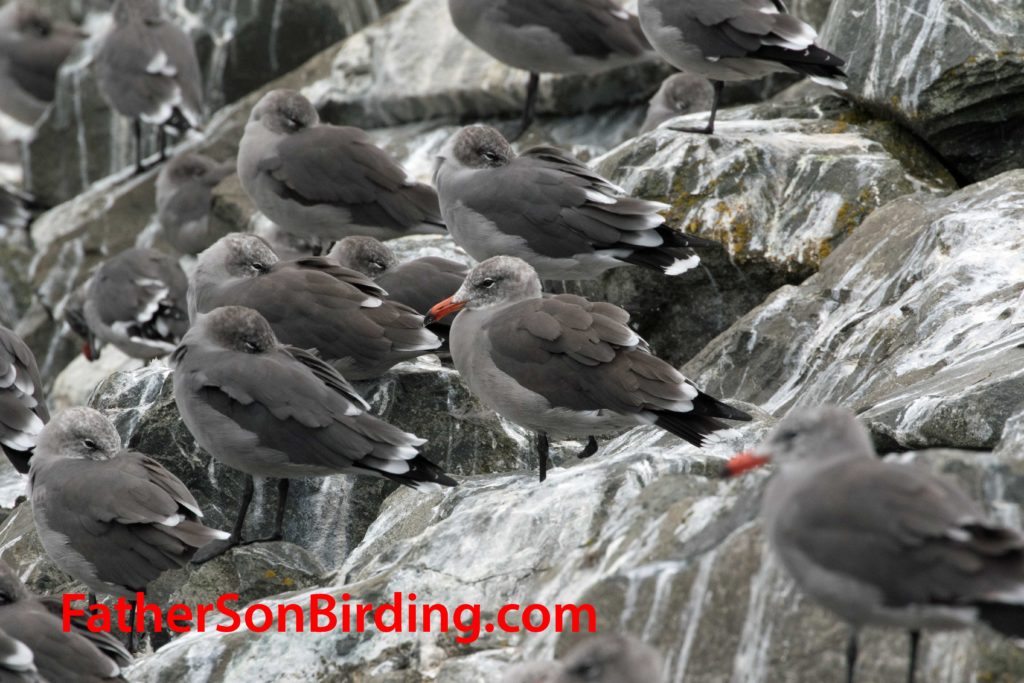
A couple of mornings later, at the Puget Sound Birding Fest in Edmonds, my dismal birding luck continued—except for the gulls! Along the waterfront, I found 400 Heermann’s Gulls—probably Braden’s and my favorite gulls. I also found my first definite California Gull of the trip and settled in to give the hybrids more study. In a later post, I will try to explain the mental flow-chart I use for gulls, but suffice to say, it was a most enjoyable morning spent sharpening my gull skills and knowledge.

Heermann’s Gulls are not only some of the most beautiful gulls, they are among the easiest to identify. Can you tell why Braden and I love them so much?

The best discovery awaited me when I returned to Montana, however, and was showing Braden my gull photos. We found that I had taken a photo of a Mew Gull (which I had assumed was a juvenile of another species). Then, I showed him my “mystery” black-headed gull from Potholes State Park. “You saw that?” he exclaimed. “Well, yeah. Do you know what it is?” “Yeah,” he answered, and pulled up photos of a gull that had never even been on my radar—a Sabine’s Gull! This gull breeds in the Arctic tundra and migrates offshore of the Pacific coast. According to Sibley, “migrants rarely appear on inland ponds, lakes or rivers,” and yet here I’d seen one 200 miles from the coast!

Lesson Number 1: Once again, that birds don’t read the guide books. Lesson #2: That I still have a LOT to learn about gulls—but am making progress!

San Diego Seabirds

Well, it looks like we have solved our Russian hacker problems but we’re still missing half of our subscriber list. You can help by sharing this with your birding friends and urging them to resubscribe. If you have a problem doing this, please let us know at collard@bigsky.net and I’ll subscribe you. We thank you, birder to birder!

Our last day of the San Diego Bird Festival took us away from shore on the mighty birding (and perhaps fishing) vessel New Seaforth. This would be Braden’s and my third California pelagic birding cruise and in many ways it proved the most memorable. Almost immediately upon leaving the safety of Mission Bay, we began seeing dozens of Black-vented Shearwaters heading north and, of course, we followed them. They led us to a massive fish feast, where from 5-10,000 shearwaters gorged themselves on acres of anchovies. At least a thousand gulls, countless cormorants, and sea lions and common dolphins joined the fray.

Every time a shearwater surfaced stuffed with anchovies, gulls mobbed it until it regurgitated part of its catch. Note the shearwater on the far right fleeing the gang ‘o gulls!

After enjoying this spectacle for half an hour, we turned south and angled farther out to sea. Braden said, “I have three priorities today: Scripps’s Murrelets, Pomarine Jaegers, and Brown Boobies.” My own priority was simpler: I really wanted to see a Brown Booby—or any booby for that matter. It wasn’t long before our target species began showing up.

Scripps’s Murrelets were only described for science in 1859 and were heading toward extinction before efforts to rid their nesting islands of invasive rats and cats.

Undoubtedly the stars of the day were the Scripps’s Murrelets. These birds nest only in the Santa Barbara Channel Islands and on Mexico’s Coronado Islands, which loomed in the distance. The murrelets lay gigantic eggs compared to their body sizes—a full twenty percent of an adult’s weight. This advanced “in egg” development is no accident. Only two days after hatching, the chicks sneak away to the ocean to be raised by their parents almost entirely at sea. As we steamed south, we saw more and more of these adorable alcids, usually floating in pairs.

The boat “chummed” with popcorn, and that kept the gulls busy behind the boat, but also attracted brief visits from Braden’s second target, Pomarine Jaegers. Then Paul Lehman, our leader for the day, shouted over the PA, “Brown Booby at 12:00 o’clock, coming straight toward the boat!”

Braden and I had longed to see a booby in American waters since visiting the Galapagos in 2016.

I hurried to the rail in time to see the elegant “gannet shape” of the booby as it sped fifty yards off the port side. The bird even did a quick circuit around the stern, giving us all good looks at its handsome chocolate-covered head and back before speeding away again.

“Yes!” I whispered to myself.

The day wasn’t without its challenges. The steady 3-foot swell took a toll on Braden, forcing him below deck for part of the journey. Still, he agreed that the birds were worth the queasiness and, as if to drive home the point, a pod of common dolphins escorted us part of the way back to the mainland.

Hasta la vista, San Diego—until the next time!

Dolphins are a highlight of any pelagic birding adventure—even if they are mammals!

Big Day Mentality

This is the Big Day Mentality: Every species, no matter how rare, is worth one tally. During a 24-hour period, a team of birders try to collect as many tallies as possible; the end total is the sum of every single bird species seen or heard during the day by at least two members of the team. At the San Diego Birding Festival, my dad and I were invited to be “first lieutenants” on two Big Day field trips.

We co-led our first outing under the expert leadership of veteran birder Phil Pryde, a local San Diegoan who had an ambitious schedule planned out for the day, in order to maximize the amount of species we saw. From dawn to dusk we scoured San Diego county, which is larger than Delaware and Rhode Island combined; a bird only counted if one of the leaders and one of the participants identified it. By the end of the day we had arrived at a total of 113 species, and my dad and I at just over a hundred individually. The number wasn’t bad, and the day had given us a rough idea of how many birds to expect for the next Big Day. Overall, though, the day hadn’t been very “birdy”—we had missed quite a few common species.

At Lindo Lake we spotted several pairs of the most photogenic Wood Ducks we had ever encountered!

On our next Big Day, under the guidance of our good-natured chief, Eitan Altman, we were determined to break this record. Unfortunately, the conditions didn’t look good—a low, wet mist had rolled over the area. Thanks to the rain, we didn’t have to rush inland to get early-morning songbirds (they were probably huddled in their warm, dry nests with no intent on warbling at the weather), so we birded along the coast at a relaxed pace. While doing this, we saw an unexpectedly high number of species, including Common Loon, Surf Scoter and Brant, which had not been a guarantee, a huge flock of Black Skimmers, and rarities such as Glaucous-winged Gull and the well-known Reddish Egret which hung out in the San Diego River Estuary. The eccentric bird’s gait reminded me of Kramer from the TV show Seinfeld.

This Greater White-fronted Goose is a regular at Lindo Lake.

Finally, around nine in the morning, we headed inland to Lindo Lake, the place which had yielded the highest number of species to us on the previous Big Day. We tallied high numbers of waterfowl, woodpeckers and more, including some more rarities: the resident Greater White-fronted Goose hanging out with a flock of domestic geese, not one but two Yellow-bellied Sapsuckers, and a Bonaparte’s Gull that had somehow wound its way inland.

We continued hitting different habitats to nab species, and by three in the afternoon our total sat at 120 species, the most recent being an altitudinally-challenged Band-tailed Pigeon, a calling Canyon Wren and the ever-rare American Robin. As soon as I confirmed our total, Eitan began thinking of other species we could pick up, now determined to beat his personal record of 128. On our way back to the coast we stopped at places to grab specific birds, including White-tailed Kite and Greater Roadrunner. The tide was out now, and at the San Diego River Estuary we grabbed another six species, though unfortunately none of the rarities being reported there (Tricolored Heron, Mew Gull, Eurasian Wigeon) except the spunky Reddish Egret and a beautiful double rainbow.

We spotted a wintering flock of blackbirds at Lindo Lake, including many Tricolored Blackbirds, a California endemic.

As the day grew closer to our deadline of five o’clock, we opted to try and get a few last birds at a place called Fiesta Island, arguing over possible birds:

“Was that a Northern Harrier?”

“I don’t think so.”

“Are you sure?.”

And finally, right at the entrance to the island we hit 130 with a Spotted Sanspiper bobbing along the rocks of the coastline. A pair of American Kestrels on the actual island sealed the deal.

We finished the trip, said our goodbyes, then responded appropriately to our biggest day ever by collapsing into bed.

Birding the Mexican Border

Due to the continuing onslaught of Russian hackers (aka jerks), we’re experimenting with how best to handle new subscriptions. If you’d like to make sure you get subscribed please shoot us an email at collard@bigsky.net with your name and email address and we’ll put you on. You can also use the subscription box down in the right-hand column. Thank you for following us—and for your patience with this crazy world!

Listen to our interview with Sarah Aronson on Montana NPR’s “The Write Question” which aired Thursday, March 7!

Last week, Braden and I had the opportunity to attend the San Diego Bird Festival and do some of the most intense—and fun—birding of our lives. The festival will undoubtedly fill several posts, but before it began, we wanted to do something we’d been thinking about for at least a year—bird the California/Mexico border.

The border couldn’t have provided a greater contrast between the open wetlands and scrub on the U.S. side and the bustling city of Tijuana right across “la frontera.”

Because of a missed connection, we didn’t reach San Diego until 1 p.m., but we picked up our rental car and made a beeline down I-5 toward Tijuana. Our destination was the actual spot where the border meets the Pacific Ocean, and we weren’t sure how close we could drive. We ended up in a parking lot about a mile east and north of our destination and began trekking along a dirt road heading toward the ocean. It was a surreal experience as helicopters circled overhead—Navy fliers, evidently, training for duty—and the city of Tijuana pulsed just beyond the formidable border wall a mile to the south. Around us, though, stretched intertidal wetlands and fields, where we picked up Savannah Sparrows and meadowlarks and collected a number of duck species and a lone Eared Grebe.

This group of 500 Surf Scoters delighted us—especially when Braden identified a Black Scoter among them! Note Mexico’s Coronado Islands in the background—an important nesting site for Scripps’s Murrelets.

After hitting the beach, we headed south, the border fence looming in the distance. Almost immediately, we got a great surprise—a group of 500 or so Surf Scoters floating just offshore. For we Montana boys, this was a true delight—made even more so when Braden discovered a Black Scoter in one of his photos! We were hoping to go all the way to the fence and talk to some folks on the Mexico side, but a stoic Border Patrol agent shooed us back.

The two Heermann’s Gulls on top of these dolphins were vaunted additions to our Mexico list!

Undaunted, Braden said, “Let’s start a Mexico list,” so we spent half an hour watching birds perching on the border fence and flying between nations—without passports! President Trump would have been furious. In all, we tallied seven Mexico species: Rock Pigeon, Willet, Heermann’s Gull, Western Gull, Ring-billed Gull, European Starling, and a lone Willet sitting on the fence. Oh yeah, and a group of twenty Surf Scoters who had drifted across the border without a care in the world!

Next Up: San Diego Big Day #1!

These Willets weren’t the only birds who totally ignored our artificial geopolitical boundary. Go Willets!