Category Archives: Migration

Epic Florida Adventure Day 4: Cruising the Keys for Cuckoos

Welcome to Blog 4 of Braden’s series about his and Nick Ramsey’s remarkable birding excursion through Florida. Nowhere in the U.S. do things get more biologically bizarre than in South Florida, and especially in the Keys. Enjoy and, as always, please feel free to share this post.

A Great Horned Owl, the second owl species of our trip so far, greeted us as a silhouette on a power pole as we raced south from the Everglades at dawn. After waking to the sound of more Chuck-wills-widows, we’d packed up the car, and now were on our way towards the southernmost point in Florida. We crossed a small bridge overlooking the slowly-brightening shallow waters of south Florida, and suddenly, we were there: the Florida Keys. 
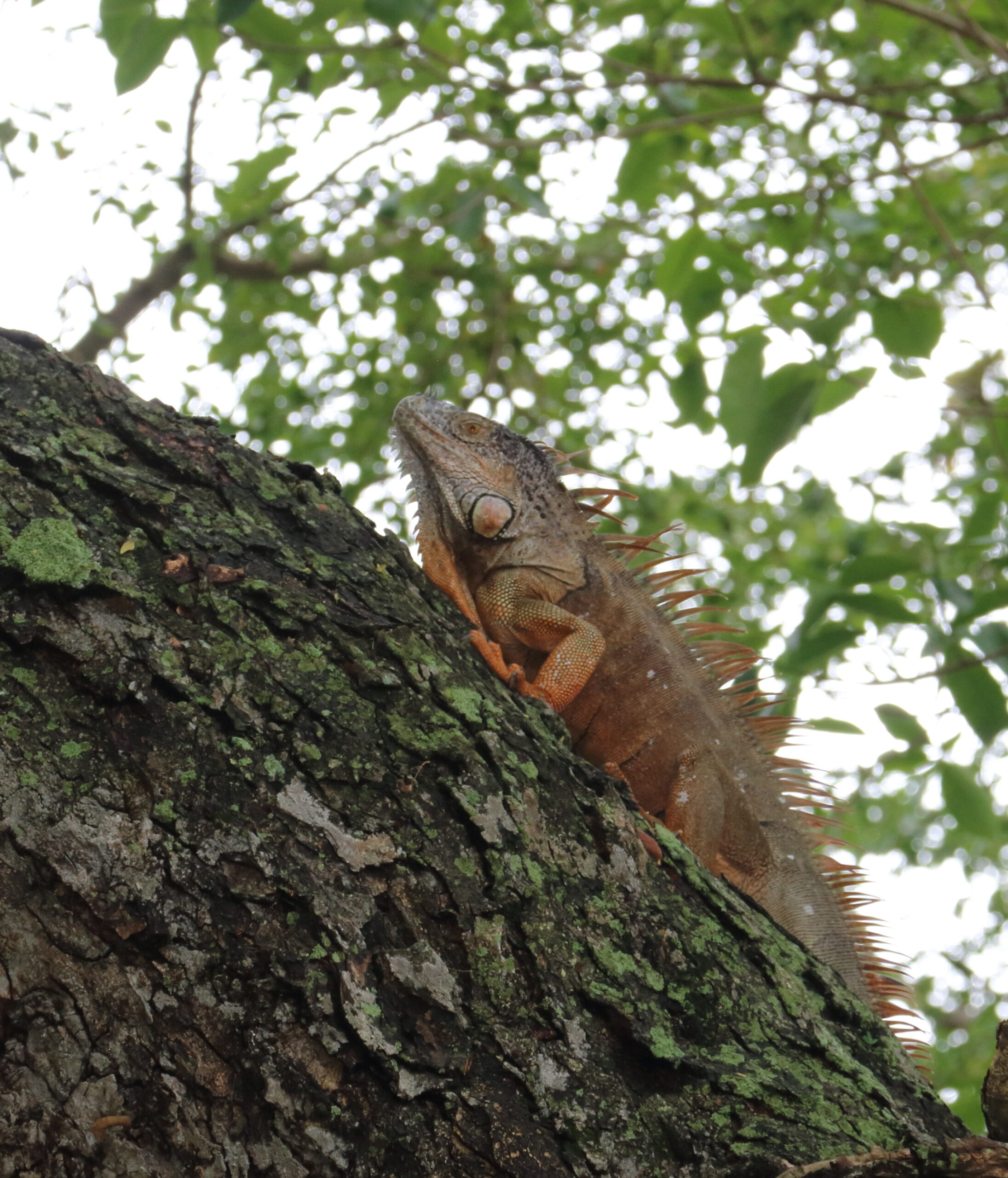
If you need convincing about how invasive species are impacting the planet, go no further than Florida!

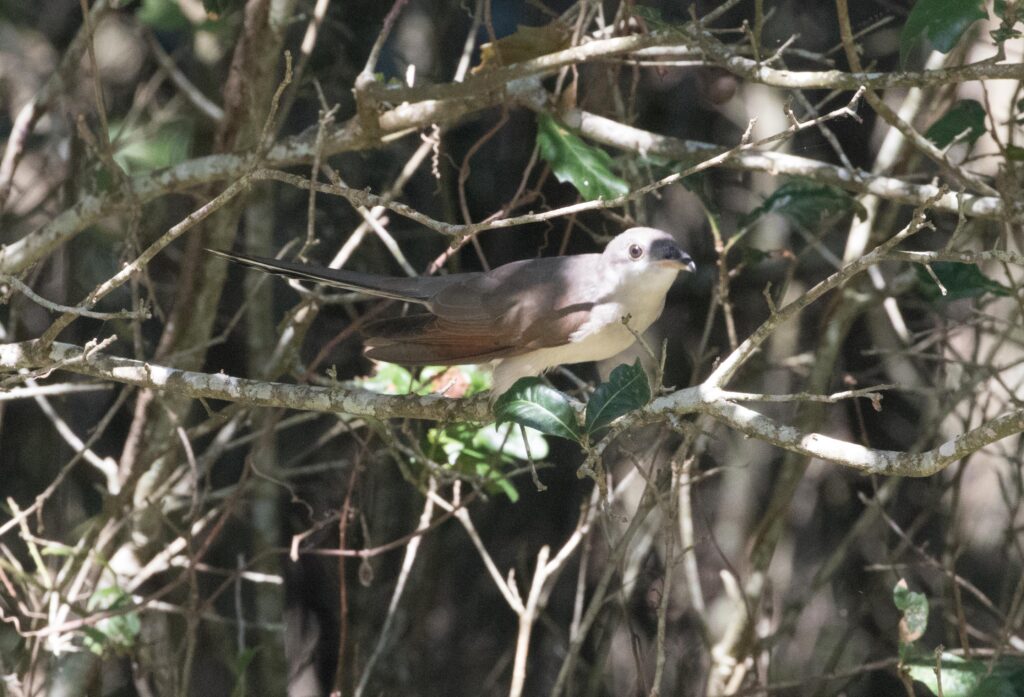
Our first stop, like many of our stops today, had one major target: Mangrove Cuckoo. This species, one of North America’s most elusive, had consistent records only from the very southernmost part of the state, barring a few reliable spots farther up the Gulf side. The habitat looked right—the part of Key Largo we’d just entered was absolutely coated in Red and Black Mangroves, and as we pulled into a dirt parking lot, we were greeted with the songs of White-eyed Vireos, a species I had not expected to breed in the mangroves. This area, especially later in the season, could be stellar for vireos, with Red-eyed, White-eyed, Blue-headed, Yellow-throated, Black-whiskered, Thick-billed, Yellow-green and even Mangrove all possible. Unfortunately, we were still a bit early for many of these birds, and we saw and heard only White-eyed throughout the day.

The first stop was not particularly productive, and we realized that we were in the wrong habitat for the cuckoo. Despite having driven through mangroves to get here, the road wound its way through almost-subtropical deciduous forest rather than the water-submerged trees we needed to find a cuckoo. Dagny Johnson Key Largo Hammock Botanical State Park(say that three times), just down the road, proved considerably better, and as we got out of the car Nick got on a warbler almost immediately.

“Black-throated Blue!”
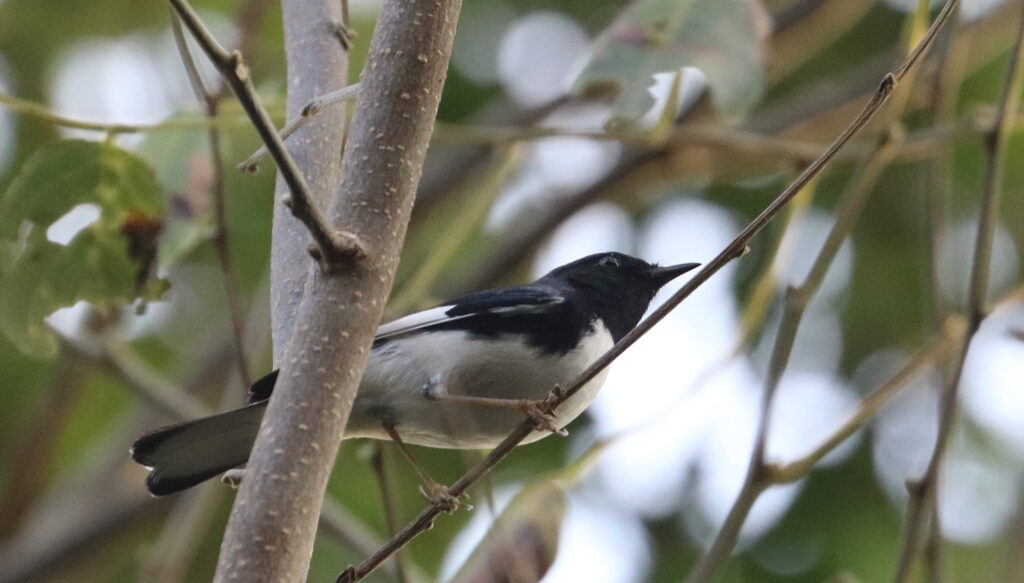
I was thrilled to add this Black-throated Blue warbler to my Life List—one of the last wood warblers I had yet to see.

“Really?” I said, jogging up to where he was standing. Sure enough, a darker, blue and black warbler hopped into view a few feet above us in a tree, and began responding as we played Blue-headed Vireo calls. It was one of my last Eastern wood-warbler needs, and one of the best of them at that. Soon, several parulas and vireos came to the playback as well, and we found ourselves in a miniature mixed winter flock, something we had been hoping to encounter. Continuing down the path, another lifer appeared.

Two dark pigeons flew over, landing in a snag barely lit by the morning sun, and I raised my binoculars, confirming what I’d suspected. While I could make out few other features aside from the dark gray color, the one feature I saw nailed the identification.

“White-crowned Pigeons!”
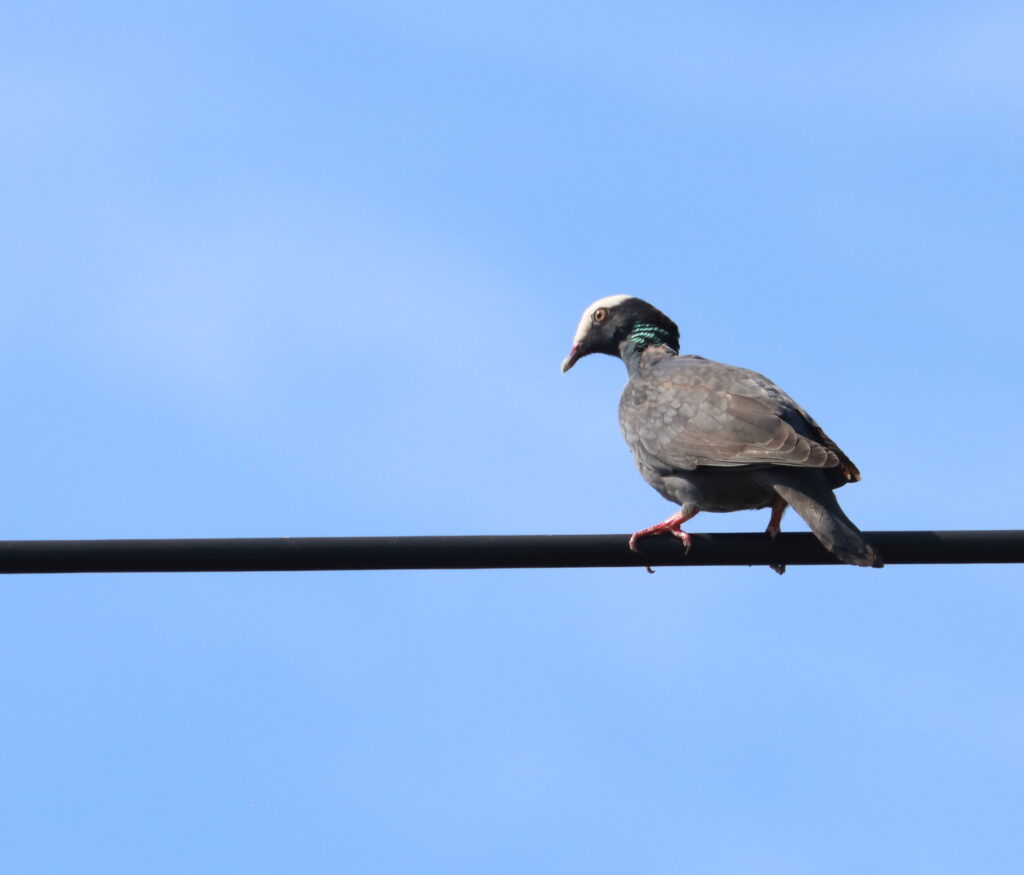
White-crowned Pigeons, another Lifer for me, was but one of six members of the pigeon/dove family to greet us in South Florida.

This species, a Caribbean mangrove specialist like the cuckoo, also had a very restricted U.S. range, but where it did occur—specifically here—they were supposedly quite abundant, something we confirmed as we drove farther south. They weren’t the only member of Columbidae present, though. We tallied an astounding six species including Eurasian Collared, Mourning, Common Ground and White-winged Doves plus Rock and White-crowned Pigeons. Who knew that the Keys would be so good for this seemingly random family!

Every key differed, if only slightly, from the last. Resorts and restaurants covered the larger Keys, like Key Largo, and I was surprised to see how much land existed on them. I’d assumed many of these islands would be completely mangrove, but I had assumed wrong, as everywhere we looked we saw dirt, whether put there by humans or not. The smaller keys were the really neat ones though—sometimes only a couple of hundreds of meters wide, the Overseas Highway divided what little land each had. We stopped on many of these small keys to play for Mangrove Cuckoos, with no success, but we did make other cool discoveries. Shorebirds coated the beaches and lagoons, and Magnificent Frigatebirds circled above as commonly as Red-tailed Hawks in Montana. The two most abundant passerines were Prairie Warblers and White-eyed Vireos, both of which appeared to have distinct breeding populations found in the mangroves. The water itself was a stunning blue-green, and I could see why hotels and resorts were so popular here.
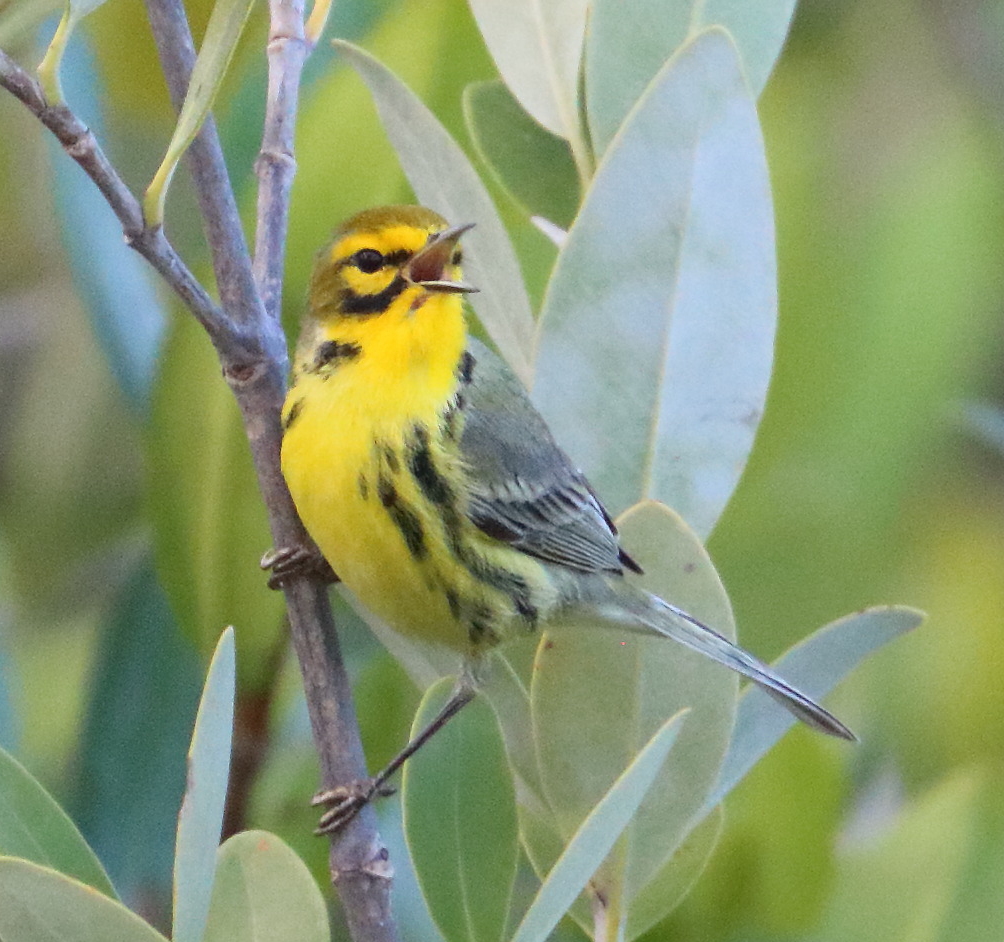
After adding Prairie Warbler to my Life List early in the trip, I was astonished to find that they and White-eyed Vireos practically dripped from every bush in the Keys.

While we drove, I kept an eye on the sky. While we’d gotten our trip Swallow-tailed Kite a few days before (and also happened to get one in the Keys), we were still missing another Florida specialty: Short-tailed Hawk. This raptor had a very small population in the United States, and could be told from other Buteos by its often-dark wings, barred tail and small size. On our drive down, however, we didn’t spot any, growing a bit concerned that we might miss them for the trip.

After driving over water for a while, we soon arrived at Big Pine Key, one of the largest islands, not to mention being one of the farthest south. This island was unique, hosting a rare habitat known as Caribbean Pine Rockland, and this new habitat brought a new endemic subspecies: Key Deer. This deer, a miniature version of a White-tailed Deer, only lived on this cluster of islands, and did not occur on Key West, farther south, or on any of the keys farther north. Several other strange species lived here, including Indian Peacock, which had been introduced and established itself on this island. Indian Peacock, despite being found all over the United States as escapees, was only actually countable in this one place in the entire country!

We spent the day so far in mangroves, but at the Blue Hole nature walk we felt transported back to the Pineywoods section of the state. This habitat, like the Pineywoods, was actually fire-dependent, although I had a hard time imagining how, given the tiny geographic area it occupied in the middle of the ocean. We soon arrived at a small wooden platform overlooking a large, mostly clear pond: the Blue Hole. A slightly obnoxious woman welcomed us, pointing out an alligator lying right below the platform, its entire, scaled body visible in the water below us. Further out in the pond, a large silver fish floated aimlessly.

“Tarpon,” said the woman, “Usually a fish only found in saltwater. These guys got deposited by the last hurricane. You see that?” She pointed at a mark on the platform at about the height of my knees. “That’s how high the water was, all over this damn island.”

Nick and I continued, finding ourselves on a large dirt road. “If we walk down this, we should see some deer,” said Nick, who’d been here before. Sure enough, after a few dozen meters, we came across a few feeding in the yard of a vacation home. While they weren’t mind-bogglingly small, they were smaller than any of the White-taileds I’d seen in Montana or Maine, or even northern Florida for that matter. We kept Dixie on a leash as she stared intently at the Key Deer, which were fairly unimpressed by our presence. Before leaving, we also managed to hear an Indian Peacock from somewhere in the pines—another lifer for me.
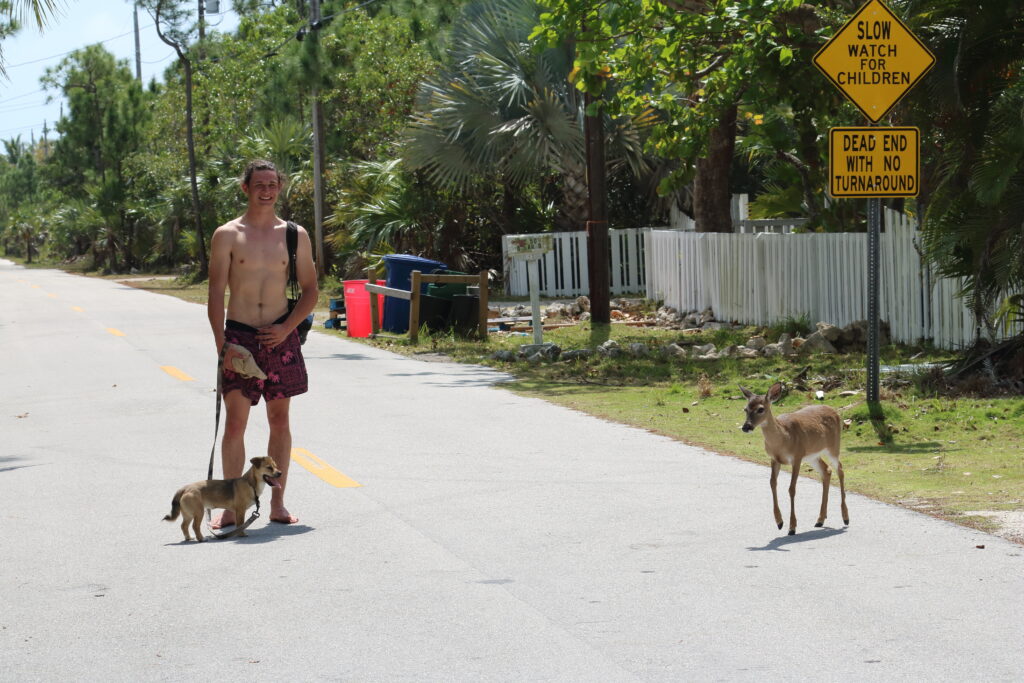
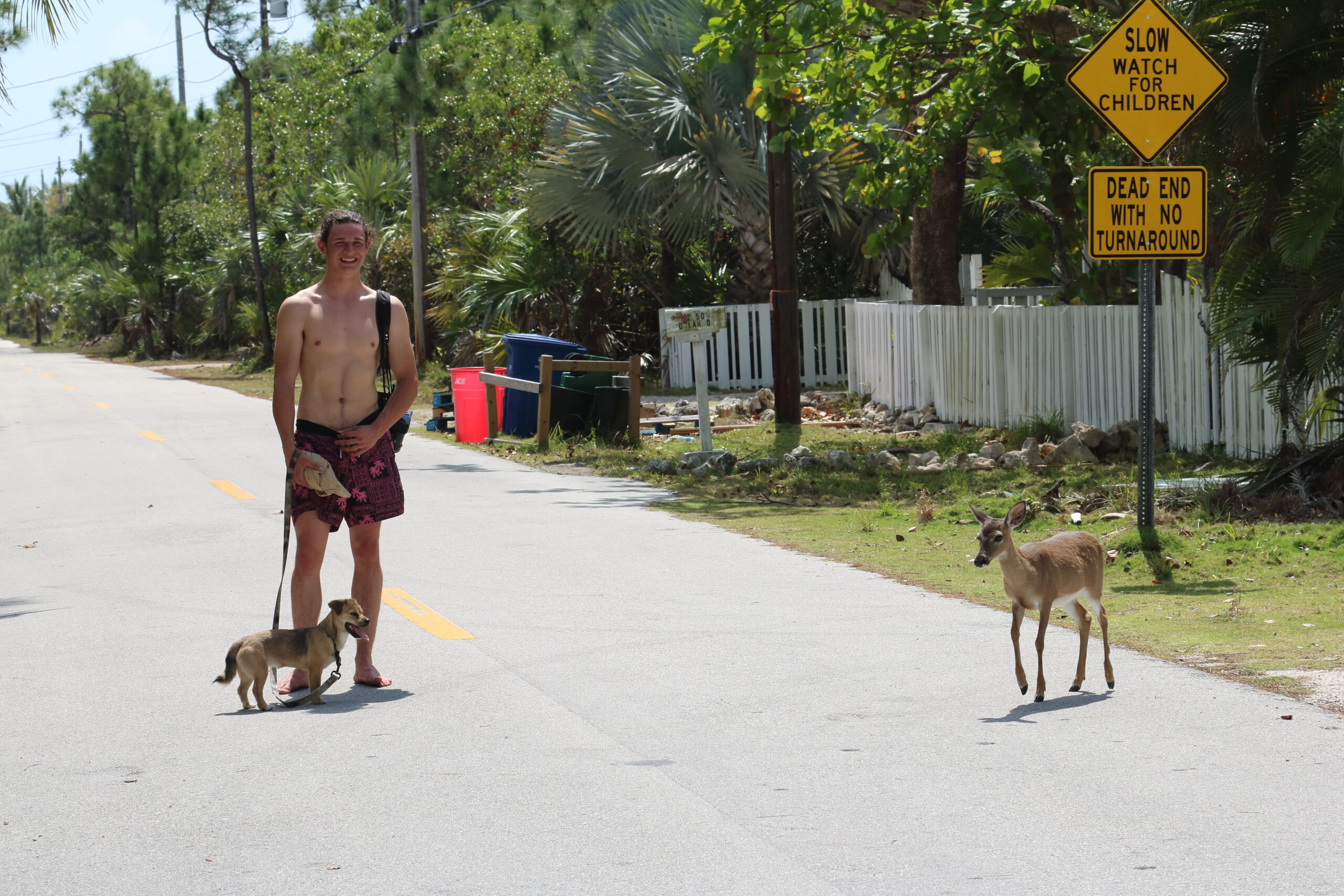
Wait for it . . . finally, a photo of Nick and Dixie! Oh yeah, and a Florida Key Deer on Big Pine Key.

After finding an early Gray Kingbird (see my post “When Montana Birders Collide“), we continued down to Key West, pulling into the parking lot for the Key West Botanical Gardens. It was only forty minutes before closing time and we cursed ourselves, having hoped to get more time at what was surely one of the best spots to bird in the keys. We split up, heading off into the forest of foreign plants to try to tally as many species as possible. After twenty minutes with almost nothing besides a cooperative Black-and-white Warbler, Nick called me. “I’ve got a mixed flock! Get over here!”
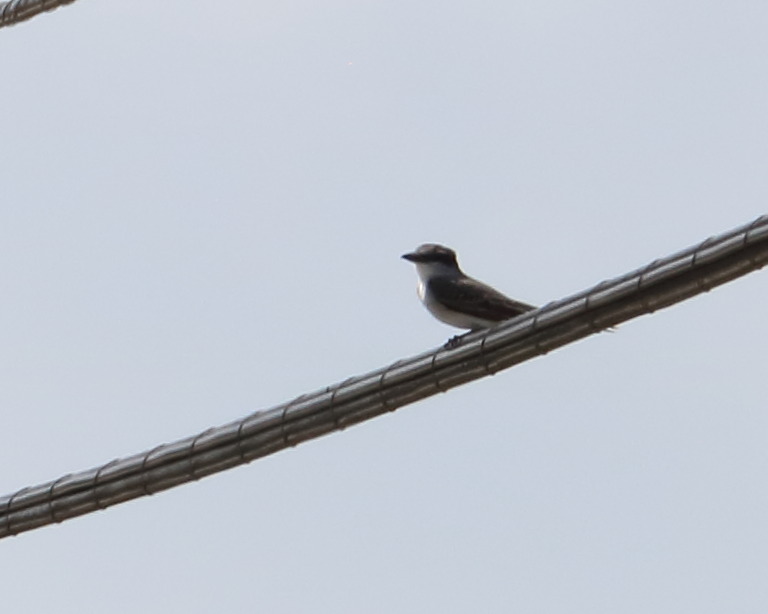
It was odd to see a Gray Kingbird in its natural habitat after seeing a vagrant GRKI in Maine just a couple of months ago.

I was on the other side of the gardens, and took back off the way I’d come, eventually finding him on the other side of a manmade lake. He played his mixed flock playback, and the birds poured in: Prairie, Yellow-throated and Palm Warblers, accompanied by a squadron of catbirds. Two splotchy Summer Tanagers joined the fray, and Nick pointed out a Ruby-throated Hummingbird as it zipped by. I was disappointed in my inability to find anything like this on my own, but was happy that we’d finally found one of the mixed flocks the Keys were known for.

Our last major stop of the day was Fort Zachary Taylor Historic State Park, a manicured tourist destination that had been hosting a Black-faced Grassquit for several months now. Birders were unsure as to whether this grassquit was wild or not, given that they were a popular cage bird, but a wild population did exist on the Bahamas, not all that far from here. Regardless, it was one of the less exciting rarity chases we’d ever done. We pulled up to the spot it had been reported in, following coordinates others had posted, and located the bird deep in a bush, its ashy head poking out every once in a while, and that’s where it stayed. After getting another birder on it, we continued walking around the park, scanning trees for more warbler flocks and brush piles for rarities. A Merlin flew over, spooking the established Red Junglefowl as they strutted around the lawns, but we found nothing spectacular, and were soon back on the road north. The Keys had been some of what we’d hoped them to be. I’d gotten several lifers, and we’d found a rare—
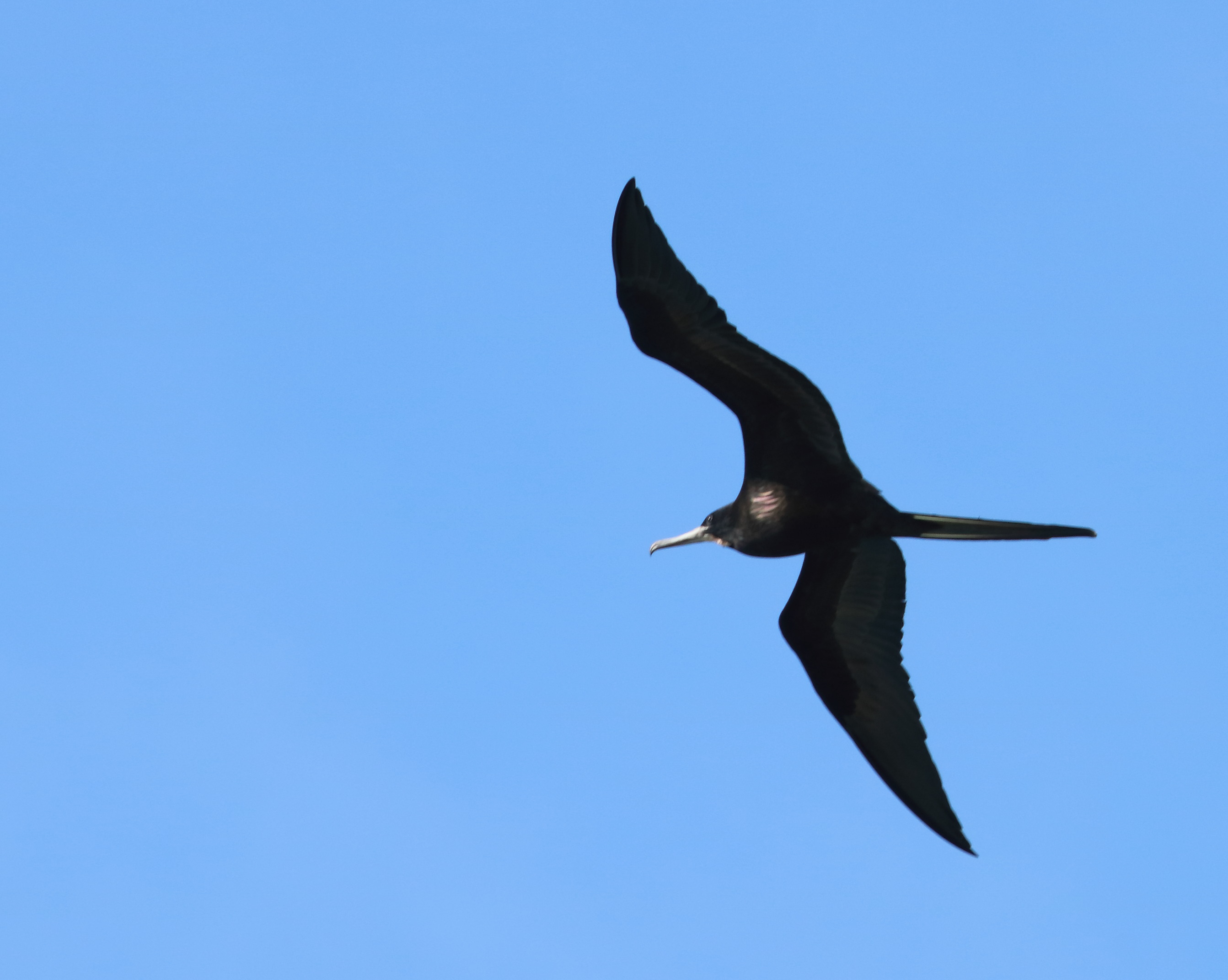
No, this is not the Short-tailed Hawk we saw, but the Magnificent Frigatebirds that frequently flew over us should convince anyone that the Chicxulub meteor did not wipe out all the dinosaurs at the end of the Cretaceous!

“Wait!” I yelled as we headed north from Key West. “Hawk!”

Nick and I peered through the windshield. Above us, at the very top of a flock of vultures, soared a small, dark-winged buteo with a striped tail and pointed wings. 

“Is it Short-tailed?” I asked, trying to think what else it could be.

“There aren’t Red-taileds here,” said Nick, “And dark morph Broad-winged are incredibly rare in the east, if not unreported. That’s a Short-tailed!”
“Woohoo!” I yelled, rolling down the window to get better looks as our car zoomed a hundred meters underneath my last, and best lifer of the day. Okay, so maybe the Keys hadn’t been that bad! We’d missed Mangrove Cuckoo, of course, but Nick and I had a plan for that. A place by the name of Ding Darling National Wildlife Refuge . . .
FatherSonBirding’s 100th Post Video Spectacular: Counting Down Our Top 5 Most Popular Posts!

If you’d like to see us continue our posts, PLEASE SUBSCRIBE by filling out the box down and to the right. We promise we will not share or give away your information to ANYONE—though you can always feel free to share our posts with others who might enjoy them!

Do you remember listening to American Top 40 as a kid? Sure you do! To celebrate our 100th post, we decided to count down FSB’s All-Time Most Popular Posts—with a video!

Yes, believe it or not, this is FatherSonBirding’s 100th post! Since we seem to be evolving toward a video world, Braden and I agreed that a video post would be a fun way to celebrate our last four years of birding and blogging. Just don’t get used to it! Videos take a lot more effort than regular blogging and, frankly, making videos eats into our birding time!

A few notes about the Top 5. They may not be technically correct since for some of our early posts, we may not have been gathering statistics on views. Also, we had not yet switched to a Payola scheme by which people pay us to make sure that certain posts are more popular. Just kidding! About the Payola, that is. I’ll always be curious just how many views our first post, A Quest for Snowy Owls (published March 13, 2018) has really received!

Also, below are some quick links to the posts mentioned in this blog. They are NOT IN ORDER of popularity so there’s no opportunity for cheating here! You’ll just have to watch the video to find out WHAT IS NUMBER ONE! Also, I have misspelled “Maclay Flat” as “McClay Flats” and other permutations. You’ll just have to forgive me!

Thank you for following our birding adventures. We appreciate you and hope this winter brings you plenty of birding adventures of your own!

Links to Blogs mentioned in the video (not in order of popularity):

Lucky Day at Maclay

Birding San Antonio’s River Walk? Are You Nuts?

Incredible Birthday Birding

For Birders, Every Year is a Big Year

Are You Ready for . . . the QUACH?

To view this video post on YouTube, CLICK HERE!

A Montana Nemesis Bird in Maine (Braden’s 2nd Report from Maine)

One thing that surprised me about the birds in Maine is that while many of the state’s breeding birds are different from Montana’s (obviously—did you read the warbler post?), many of Maine’s year-round and winter birds are the same since Bangor, Maine and Missoula, Montana are at very similar latitudes. This means that I can chase birds like Northern Shrike and Snow Bunting in both states, and I will be doing so given that I’ll be spending a portion of my winters in both states over the next four years! Many of the nemeses I had in Montana also carry over, including one that I just happened into while checking my eBird alerts last week.

If you read my dad’s and my blogs last fall, you know that we worked our butts off to get shorebirds in western Montana. While we did find quite a few, our lists still contained a massive hole by the end of shorebird season: American Golden-Plover. We went to the place that they were most frequently-reported in the state (Pablo National Wildlife Refuge) at least four times, just missing the birds by a few days each time. Ironically, I already had seen the other two species of golden-plovers: Pacific (which I got in Hawaii) and European (which I got in Iceland), despite living within the range of American. So when an American showed up on a mudflat less than an hour from the University of Maine, I began talking to everyone I knew that had a car. I convinced Hayden and Nick, two sophomores and fellow nature-lovers I’d gotten to know during the past few months, to make the trip to Sebasticook Lake with me, and that Saturday we got up early and headed west.

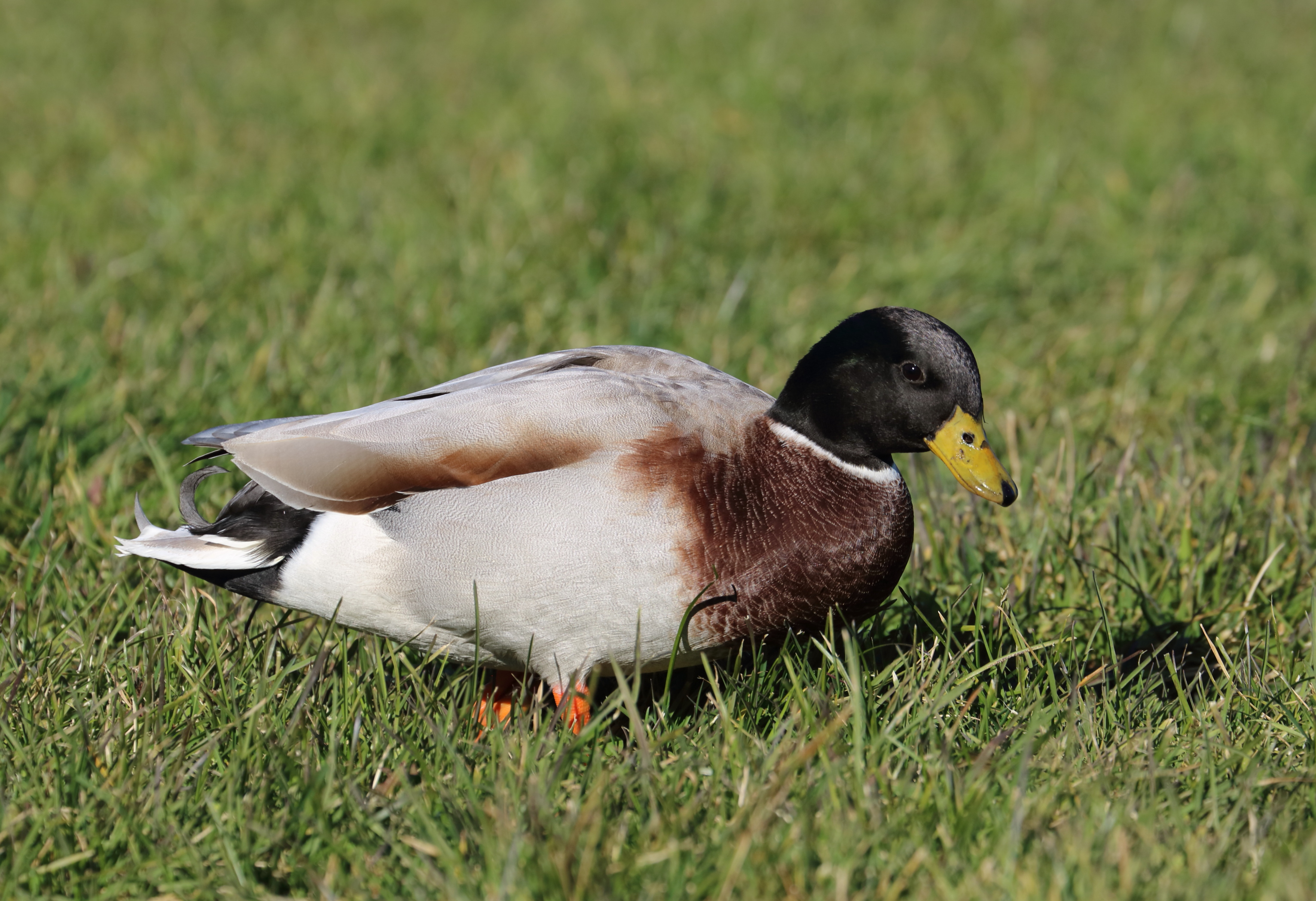
Okay, this isn’t an American Black Duck—but maybe it should be! Have you ever seen a Mallard with such a black head? We’re thinking some kind of hybrid, but feel free to weigh in!

Once we arrived at the lake we started pulling off at every possible point to scan the water and shoreline for shorebirds, waterfowl or anything else that happened to show up. After all, my Maine list is still fairly short, so many common species would still be new for me within the state. In one bay we found a pretty large flock of ducks including some Northern Shovelers that should’ve been much further south and seven American Black Ducks, which were lifers for me!

A few stops later, we found ourselves staring at a massive field of half-frozen mud. The plover had been reported here, along with several dozen Snow Buntings, which I would never pass up the chance to see. Lacking a spotting scope, the three of us just began walking across the mudflat towards the south end. While I scanned the area for shorebirds, Hayden and Nick marvelled over the freshwater mussels and snails that had been exposed by the lake’s receding water. The two boys were Marine Science majors, and in the absence of birds, they taught me a whole lot about freshwater and marine ecosystems. After getting to the other side of the mudflat without seeing anything other than the usual suspects (Ring-billed Gull, Great Blue Heron, Bald Eagle, Double-crested Cormorant), we turned around and began the trudge back to the car. However, upon turning around both me and Nick spotted a small bird lift off on the opposite shore from us. After finding it in my binoculars I concluded that it was definitely a shorebird, but much too far away to distinguish anything else. We saw where it landed though, and began walking, slightly more quickly than before, in that direction.

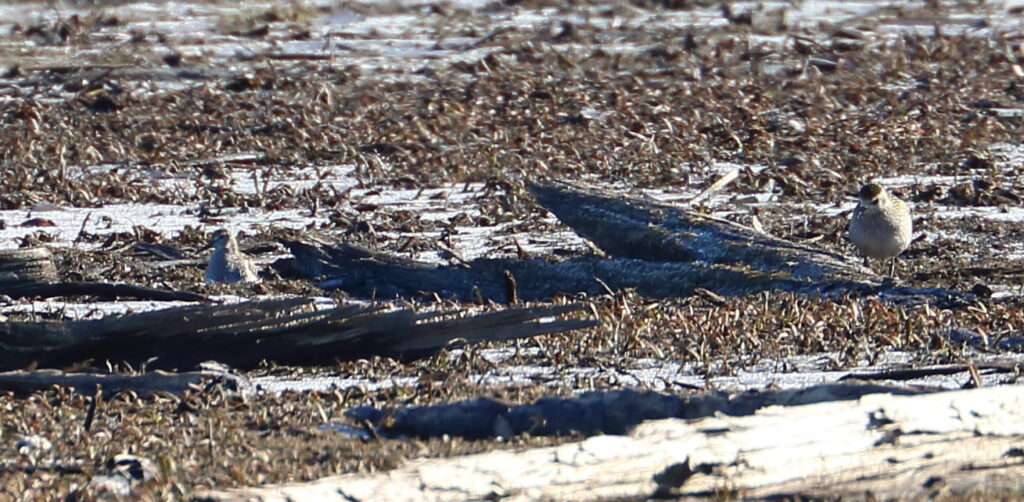
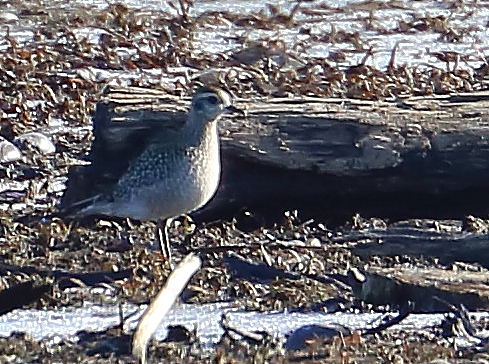
I had to chase American Golden-Plovers from one end of the country to the other, but finally found one!

About fifteen minutes later we got there. All three of us began scanning the mudflats, but finding the bird seemed a bit hopeless. For one, it was a small brown bird hiding amongst a large brown background. And secondly, it easily could have flown away during our trek to where I’d last seen it land. In a last attempt, I played some American Golden-Plover calls on my phone. Suddenly, me and Hayden spotted movement about twenty yards in front of me. I raised my binoculars and there it was: my number one nemesis bird for the last year! The bird was sporting a nice golden-brown nonbreeding plumage and foraging around a log embedded in lake muck, and gave me the impression of a very dainty Black-bellied Plover, which is, taxonomically, basically what it is! I stood in place for at least twenty minutes, firing off photos and admiring the bird that we’d somehow just found. At one point I turned around to see that two more birders had set up their scope behind us and were watching it! It also took at least ten minutes to discover it, but at some point a Pectoral Sandpiper (another late migrant) had joined the plover and was foraging alongside it, although I didn’t pay this second bird very much attention. Eventually I could detect Hayden and Nick getting bored, so I said goodbye to the plover, briefly introduced myself to the other birders (who turned out to be graduate students at the University of Maine!), then we headed out. After a few more spots to try for Snow Buntings, which we did not find, we headed back to campus.

Hey, where did that Pectoral Sandpiper come from? It was a nice bonus to discover it next to the the AMGP!

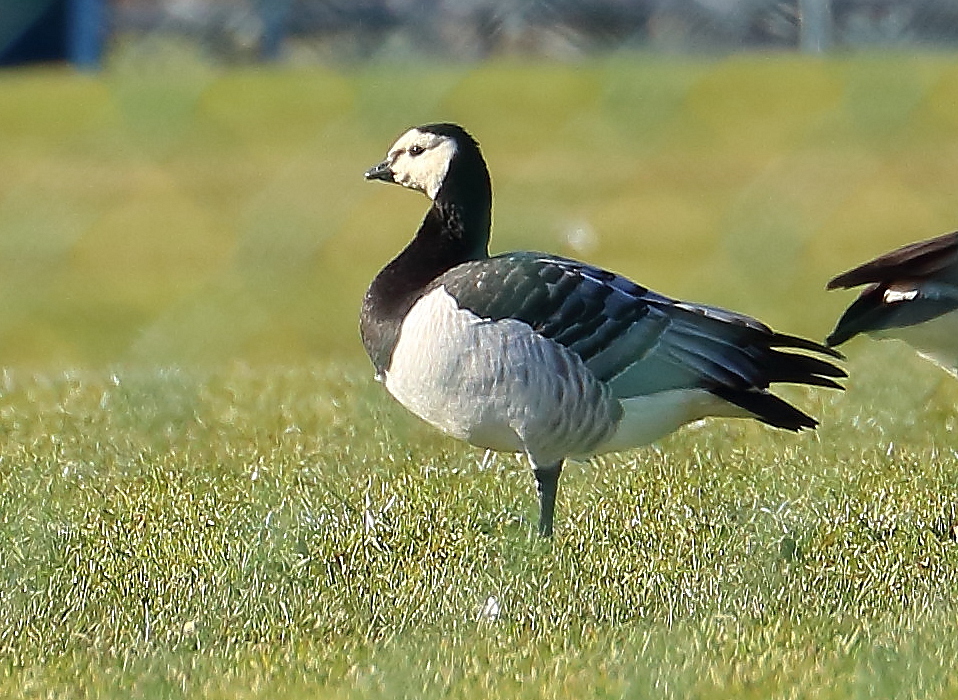
A few days later, me and Hayden found ourselves in a car with those two grad students we’d met at the American Golden-Plover stakeout! I’d gotten in contact with Liam Berigan after hearing that he and Meredith Lewis were going down to Rockland, Maine to chase the Barnacle Goose (either a Code 3 or 4 for the ABA) that had shown up at an elementary school the week before. We decided to carpool, and were now spending our Veteran’s Day driving down the coastal Highway One for the goose. Once in Rockland, we rolled up to the school and immediately spotted the rarity—one that at least fifty people had chased throughout the week—feeding in a field with a few dozen Canada Geese. The goose was smaller than the Canadas, with a much cooler color template and a tiny black visor. Despite the fact that I’d seen the species before in Svalbard and Iceland, I still ogled at it alongside Hayden, Meredith and Liam, for all of whom it was a lifer. It was one of the easiest chases I’d ever participated in.

Now that’s one good-lookin’ goose—and an ABA rarity to boot! Let’s honk for Barnacle Geese!

We hit a coffee shop in Rockland to celebrate, then headed to the coast, which was about a hundred yards away, to look for sea ducks. We found a pair of Surf Scoters and several Black Guillemots in the harbor, then scoped a raft of Common Eider and not one, not two but seven Common Loons from the Owl’s Head Lighthouse. On the way back to campus, we stopped at a lake to try and get Ruddy Duck for Meredith and Liam’s year lists. We missed the ducks but saw a large number of coots, which was unusual so far north in Maine, plus two Bonaparte’s Gulls and a Mallard with a deformed head!

Riding on last week’s high, I decided to hit the Cornfield Loop this morning. After the warblers had left the state, the hotspot’s numbers had fallen dramatically, so I hadn’t been in several weeks. However, this morning started off with a lone Bohemian Waxwing perched atop a tree in the Littlefield Garden, one of the first seen in the state this fall! In the marsh I had a late flyover American Pipit, another state bird for me, and the walk concluded with a cloud of Snow Buntings lifting off the western side of the field, making their bubbly calls as they flew over my dorm and out of sight! Despite the fact that Snow Buntings are more common in Maine than in Montana, they lifted my spirits and continue to enforce that fact that birding doesn’t slow down in winter. I’m excited to see what’s next!

HawkWatch Spectacular!

Don’t be shy—subscribe by filling out the box below and to the right!

My recent trip to Texas offered so many rich avian experiences, I am hard-pressed to blog about them all, but one I simply must add is my first—and entirely accidental—visit to a HawkWatch site. It all began when my friend Jeanette Larson, author of the wonderful book Hummingbirds: Facts and Folklore from the Americas, suggested I bird a place I’d never heard of: Hazel Bazemore park just west of Corpus Christi. Waking up the morning after my last HummerBird Celebration event, I threw my stuff in the rental car and headed through Corpus Christi, experiencing a delay of half an hour when I encountered a shorebird-rich target area at a place called Indian Point!

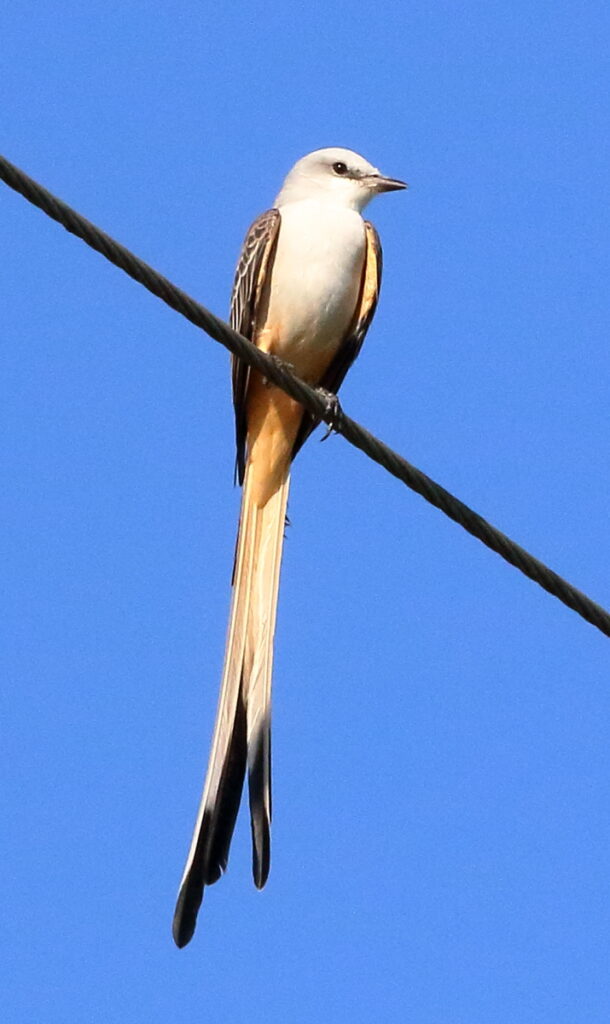
Arriving at Hazel Bazemore, an unassuming park in the suburbs, I spied two people with binoculars and spotting scopes and stopped to ask them where the best places to bird might be. They suggested a couple of spots and let slip that they were there to observe migrating raptors at a platform just across from where we stood. “You can come over and hang out,” they offered, but since they weren’t set up yet, I decided to explore the rest of the park. I’m glad I did as I saw several each Couch’s Kingbirds, Baltimore Orioles, and Scissor-tailed Flycatchers, one of Braden’s and my favorite birds. Little did they prepare me for the main event!

Braden and I have no doubt that the Scissor-tailed Flycatcher should be the Texas State Bird, but instead, their neighbor Oklahoma stole the prize designation!

Looping back to the HawkWatch platform, I watched fascinated as the official observers picked out migrating birds from incredible distances including individual Mississippi Kites, Northern Harriers, Swainson’s Hawks, and more. Just between you and me, I have no idea how they could ID most of them, but assume that thousands of hours staring into the sky had ingrained a mastery of subtle visual and behavioral clues that betrayed each species. A few, such as a Crested Caracara, did fly close enough for me to confirm, but for most, I just had to take their word for it.

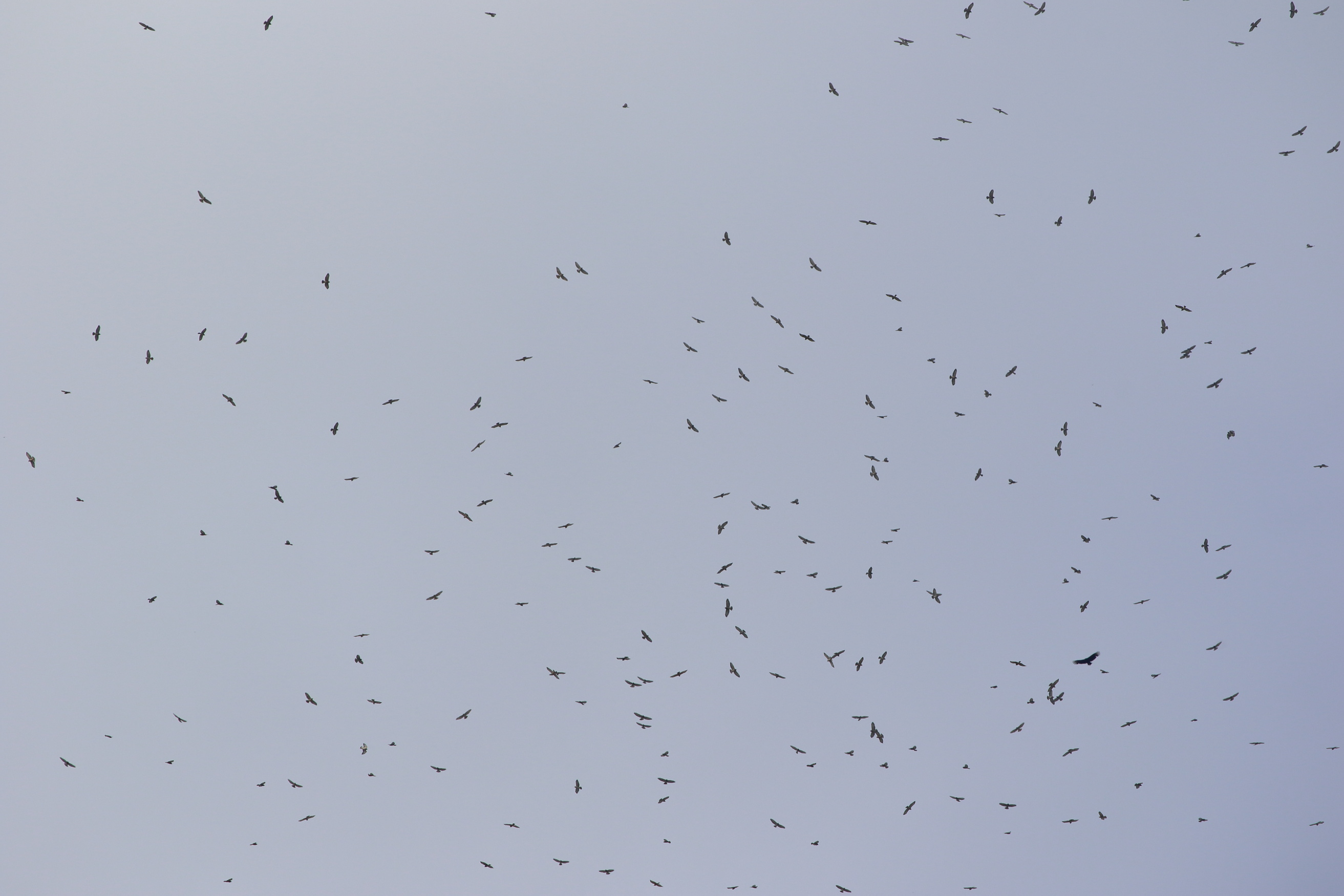
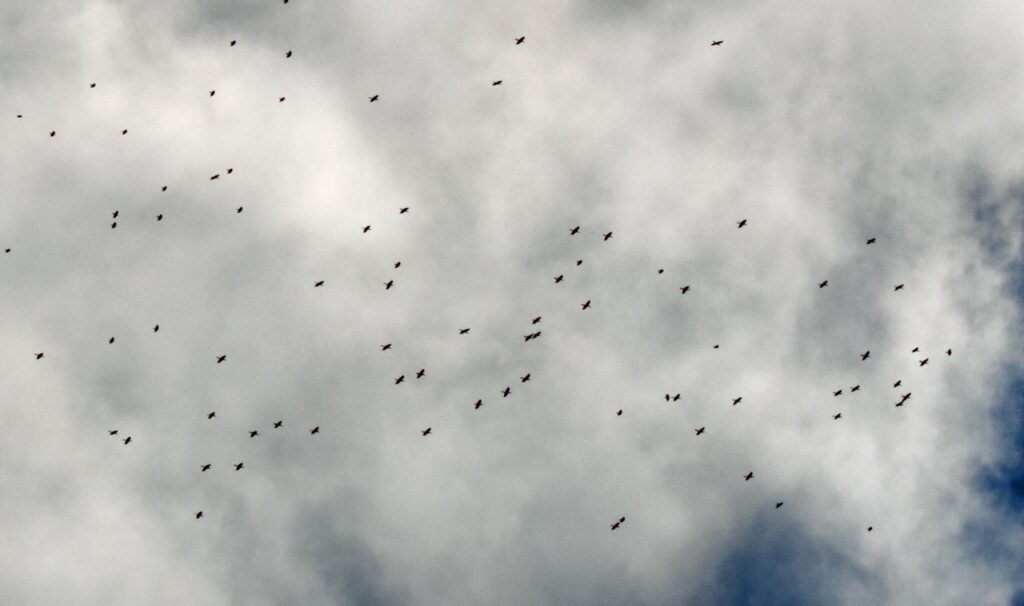
Considering I’d just seen my Lifer Broad-winged Hawk two days before, this kettle of hundreds of Broad-wingeds pretty much gob-smacked me. Can you find the token Turkey Vulture?

Suddenly, one of the observers shouted, “Big group of Broad-winged Hawks!” I, and several other visitors followed the direction of their scopes and, at first, I saw only clouds and blue sky. Then, I saw them—hundreds of black specks moving toward us! The hawks, accompanied by Turkey Vulture escorts, streamed directly overhead at a height of perhaps three or four thousand feet (I forgot to ask), making me forget everything except this magnificent show above me. They weren’t the last group either, as ten minutes later, another large group streamed by on the invisible river of air overhead. The second group did one better and also began circling, or “kettling”, above us, forming about as magnificent a spectacle as one can imagine. In between the two groups, a formation of about fifty Anhingas migrated by—something I didn’t even know they did, while off in the distance, more than one hundred White Pelicans also circled.

Before this trip, I didn’t even realize that Anhingas migrated. To see a large group fly overhead was nothing short of astonishing!

As if that weren’t enough, I also picked up my Lifer Bronzed Cowbird and ABA Lifer Buff-bellied Hummingbird at feeders next to the platform, both thanks to the keen eyes of a fellow birder who had come to join the bird spectacular. This was all enough to make me more interested in HawkWatch International activities. The organization runs or oversees dozens of sites throughout the world for scientific research purposes, including some sites in my home state of Montana, but I have never been to any. Going forward, this is something I need to change!

Going Cuckoo for Fall Warblers in Texas

Please share this post 🙂

In a remarkably fun coincidence, as Braden was immersing himself in Life Birds migrating through Maine, I happened to be observing migrating songbirds in Texas following my recent trip to the HummerBird Celebration in Fulton-Rockport. For the trip, I had a number of goals, including shorebirds and raptors, but seeing migrating warblers perched at the top of my list.

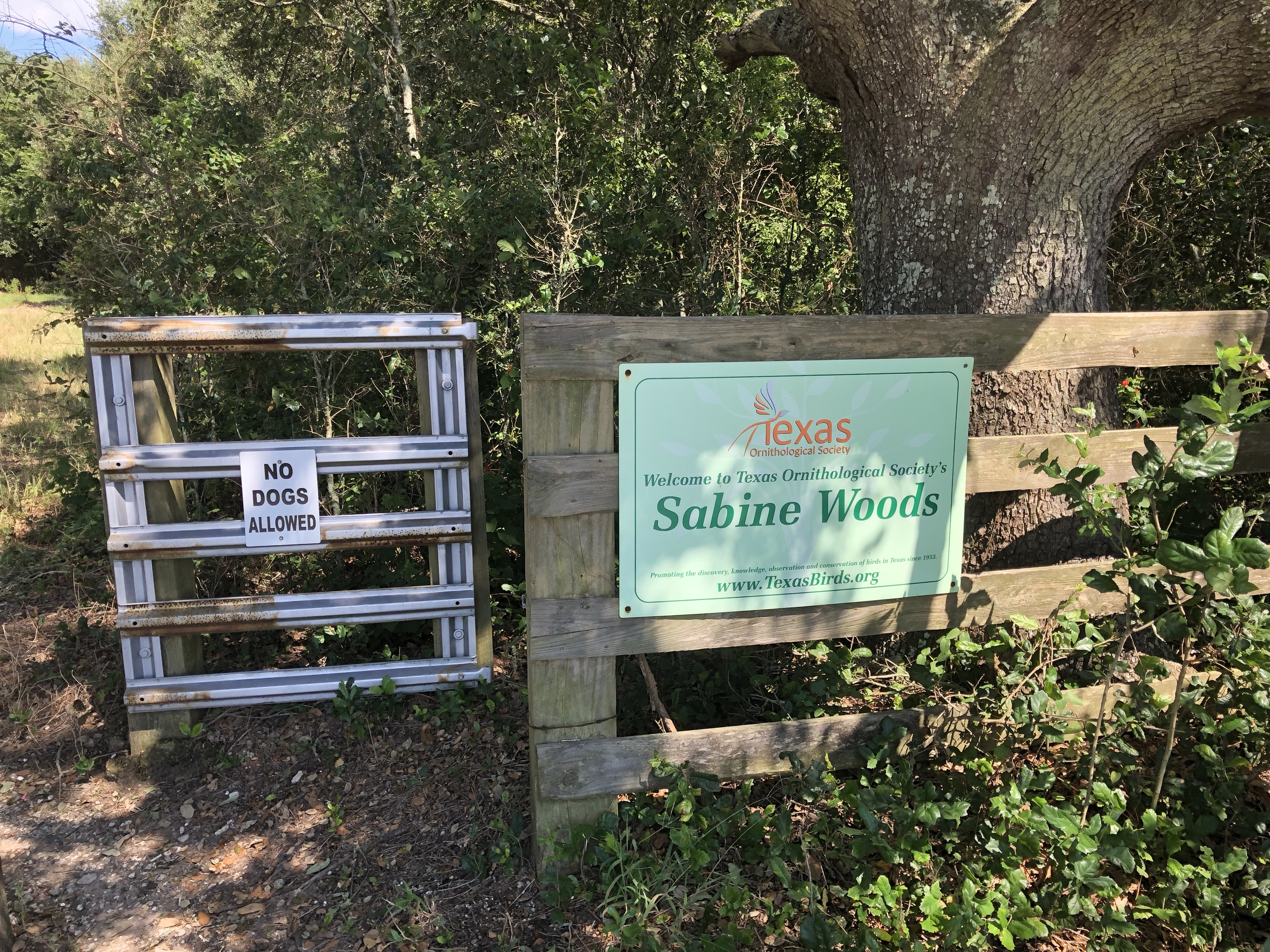
Departing Rockport after HummerBird, I immediately headed to what has become a second home for us while in Texas: Winnie. Winnie is not a lot to write home about, a small town dominated by fast food joints, gas stations, hotels, and donut shops. So why go? Simple. It is surrounded by incredible birding including High Island, the Bolivar Peninsula, Anahuac National Wildlife Refuge, and my first destination upon waking the next morning: Sabine Woods.

Because it takes more effort to reach, Sabine Woods is less visited than High Island, but it can offer up a delicious smorgasbord of birding during migration seasons.

Birders usually flock to coastal Texas in April or May during the height of spring migration. This being fall, my expectations were tempered as I drove east to the vast petrochemical complex of Port Arthur and then south toward Sabine Woods, a tiny preserve owned by the Texas Ornithological Society. Only one other car was parked outside of the entrance and I soon met its owners, a nice birder couple from Austin. They, too, had just started birding, and while we chatted, we saw both Blue-gray Gnatcatchers and a Black-and-White Warbler, boosting my hopes for a productive morning.

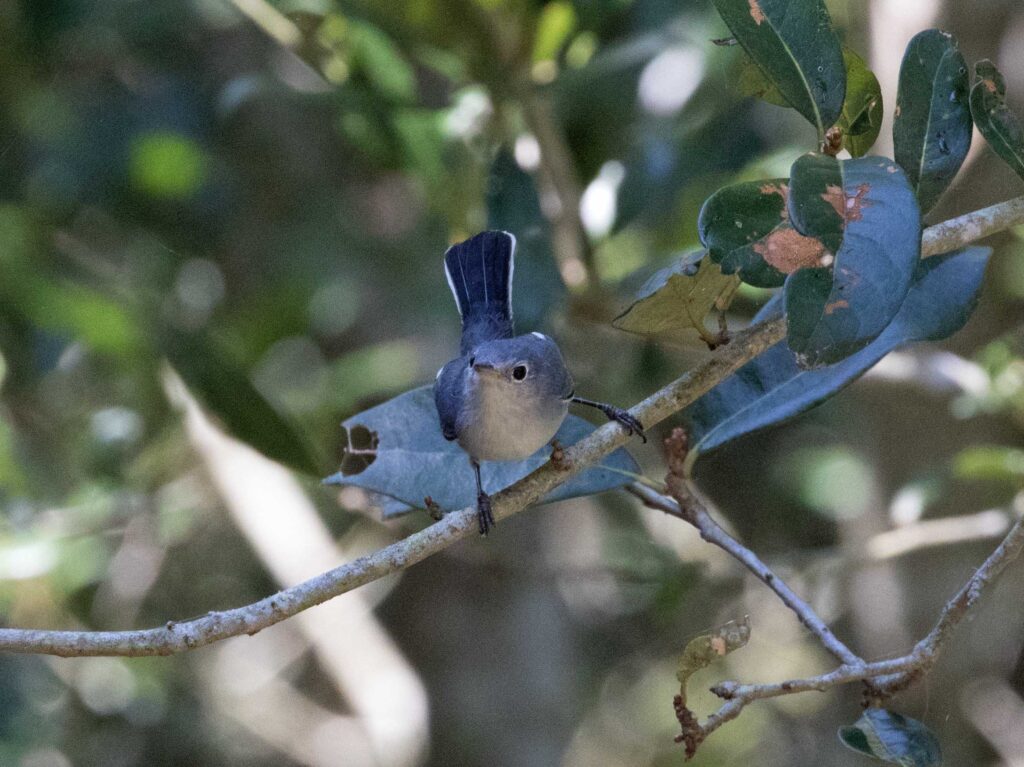
Less shy than most warblers, Blue-gray Gnatcatchers delight Braden and me wherever we find them!

Setting off on my own, the woods seemed quiet except for some Blue Jays calling and the scuffling of hundreds of toads hopping through the dead leaves. After about a hundred yards, however, I suddenly saw a flash of yellow land on a branch and raised my binoculars. Prothonotary Warbler! I smiled because this was the first eastern warbler Braden and I ever saw together during our Big Year back in 2016. As I continued to walk, however, the birds were few and far between. I ended up at a marshier area in the back of the preserve and through some hard birding managed to find a Common Yellowthroat and, with the help of Merlin’s Sound ID, an Acadian Flycatcher. It wasn’t until I ran into Howard Davis, a volunteer from Golden Triangle Audubon, that my luck really began to change. He showed me one of the three drips on the property and, sure enough, I discovered a trio of warblers there: Black-and-White, Wilson’s, and Northern Parula. Still, these were all birds I had seen several times before, and I wanted something new. Something unusual!

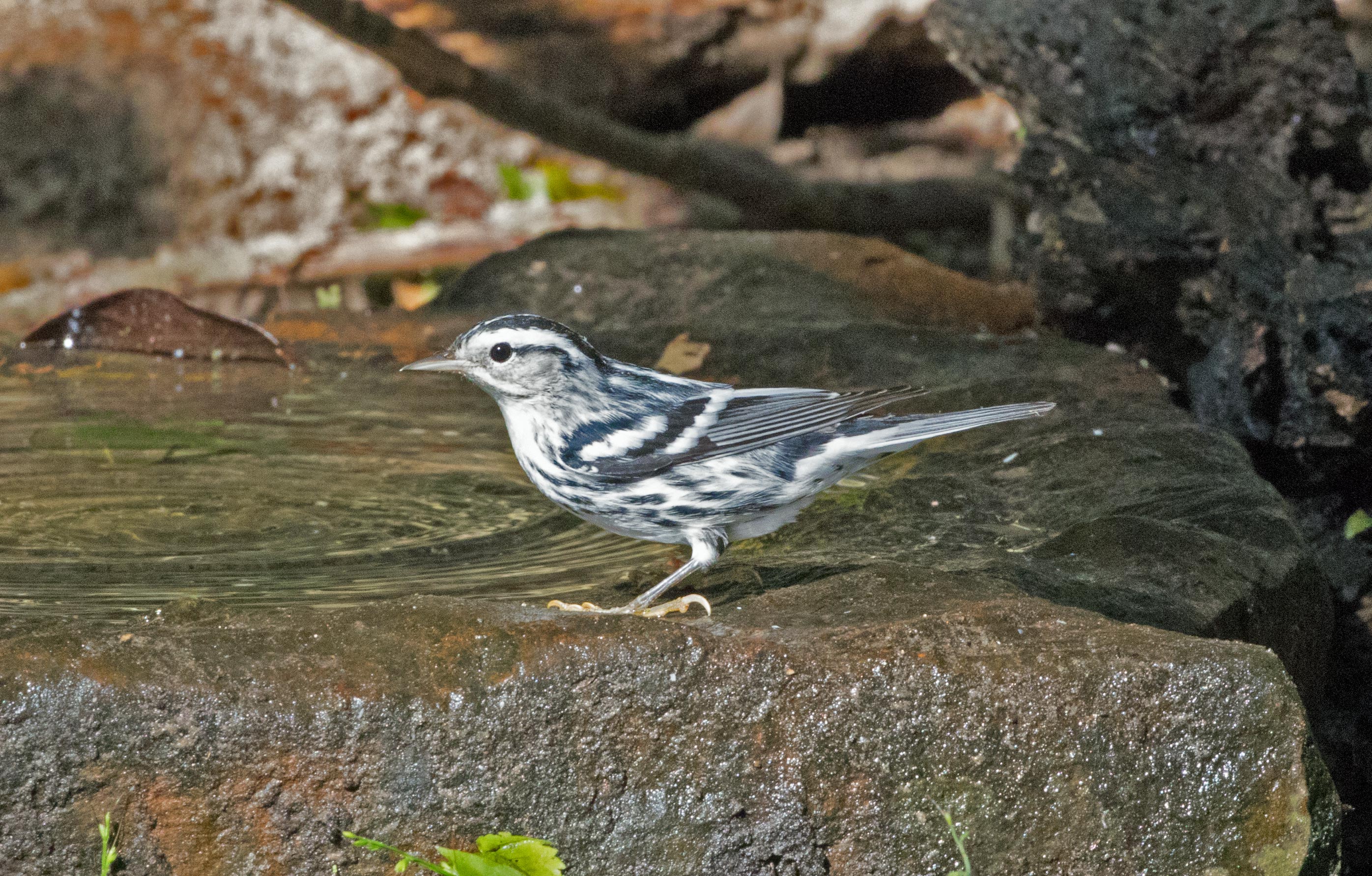
Drips—artificial water sources for birds—are a photographer’s friend, especially when it comes to photographing tiny, fast-moving warblers such as this Black-and-White.

At another drip, Howard and a second birder pointed out the first great score of the day: my Lifer Painted Buntings! Sure, they happened to be females and/or juveniles, so I didn’t get to see the glorious breeding plumage of a male, but I was elated even as I headed off alone again, doubtful I’d see anything more. Then, near where I’d seen the Common Yellowthroat, I spotted another flash of yellow. I got my binoculars up just in time to focus on my first ever Canada Warbler—the thin necklace around the throat a giveaway for the ID! Walking farther, my luck continued as I got a great look at my first Hooded Warbler since 2016.

By this time I’d been birding hard for three-and-a-half hours, so I sat under a tree near the entrance to review my final eBird list and enjoy the Blue-gray Gnatcatchers that frequented the clearing. As I sat there, though, I spotted something large and gray in a nearby tree. At first I thought it might be a jay or dove. As I stared at its partially-concealed form, however, my previous study paid off and a bolt of recognition split my skull: Yellow-billed Cuckoo! It was a great way to wrap up an inspiring session. Braden and I had unsuccessfully searched for cuckoos many times in Montana and Texas without success. Suddenly, to have one appear right in front of me, well, I felt I had earned it!

Sneed’s Sabine Woods List

My Lifer Yellow-billed Cuckoo was totally absent from my radar—and put a delightful exclamation mark on a productive morning of Fall birding.

Note: Only days before my visit, a group of birders had counted twenty species of warblers in Sabine Woods. Such sightings and our own experiences are really changing Braden’s and my opinions of fall birding. While we used to pretty much write off the fall, it has now become one of our favorite birding seasons, whether in Maine, Texas, or Montana.