Tag Archives: Sparrows

The Best Prairie Day Ever: Benton Lake NWR

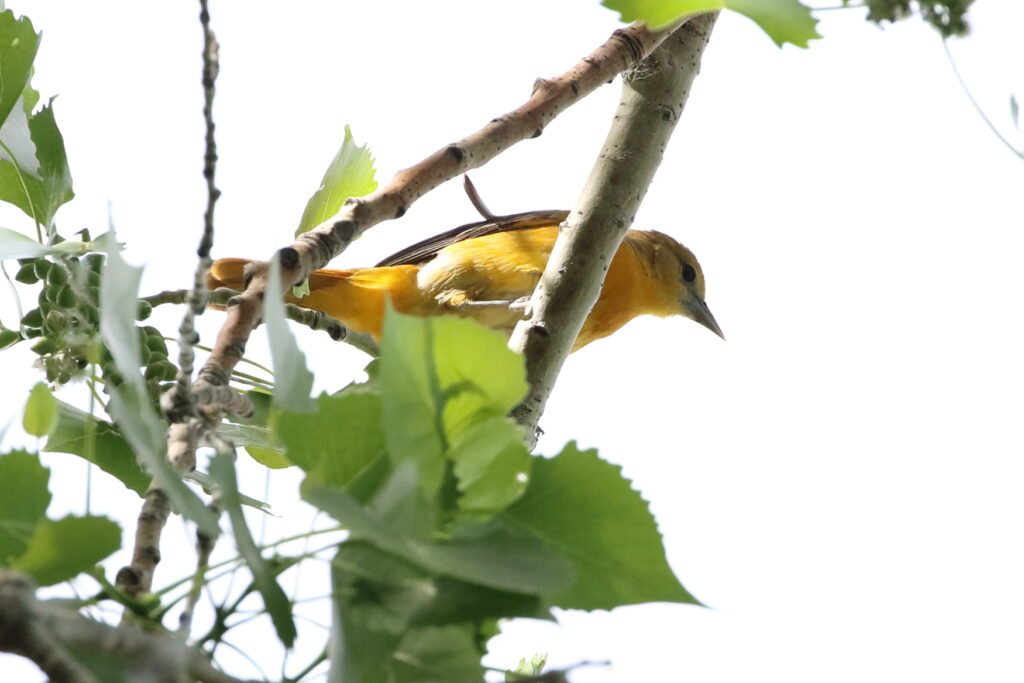
After speaking at the inaugural Billings Kid Lit Festival (see Billing’s Riverfront Park: Montana’s Premier Songbird Hotspot?), I awoke at 4:30 the next morning and hit the road by 5:15. My plan was to book it to Bowdoin National Wildlife Refuge and start driving around the lake by 8:30. The problem? I kept passing ponds with birds in them—and I, of course, had to stop to find out what they were! My efforts were rewarded with a variety of ducks, Wilson’s Phalaropes, American White Pelicans, Sandhill Cranes and more, but delayed my arrival at Bowdoin until 9:30. Then, even greater disaster struck: I ran into way more birds than I expected at the Bowdoin visitor’s center—including both male and female Baltimore Orioles!

Bowdoin NWR lies at the eastern edge of the Baltimore Oriole’s range, but Braden and I have seen them often enough that it seems certain they breed there. Oh, and seeing both the male and this female offers an added clue!

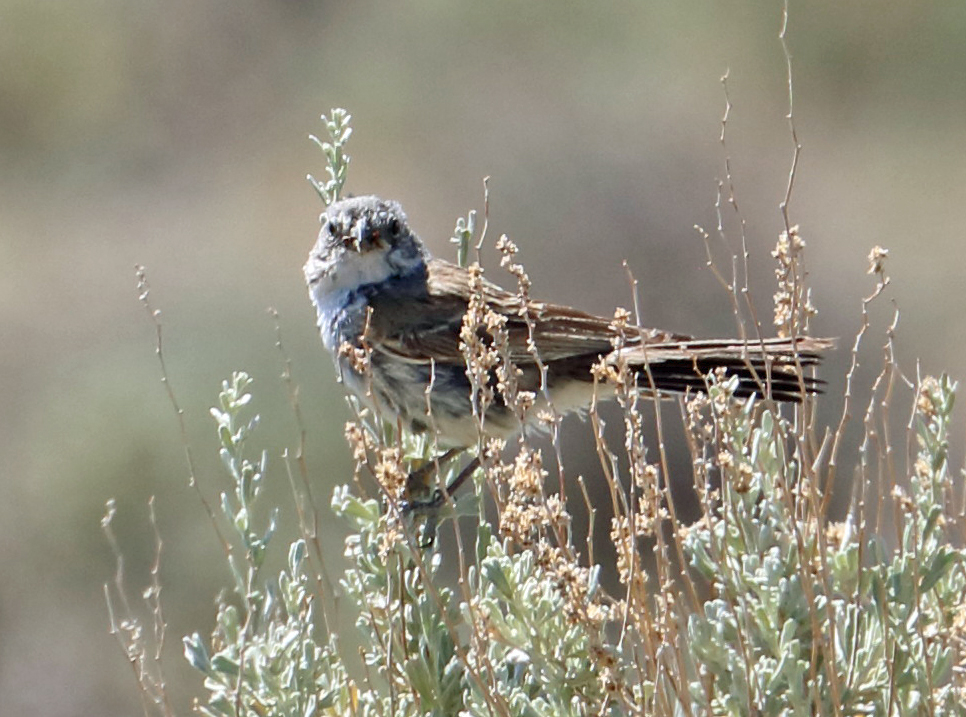
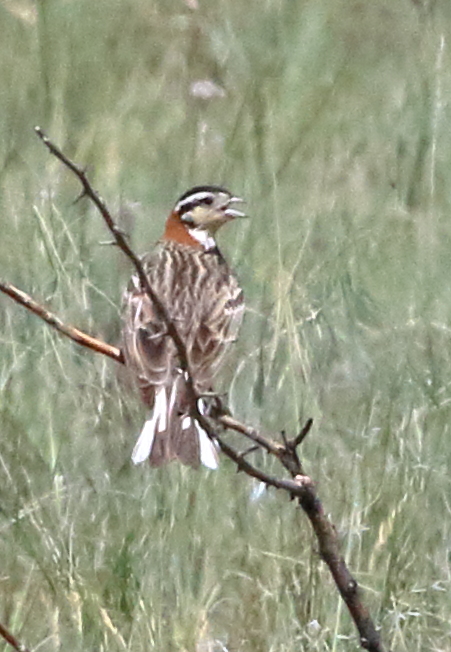
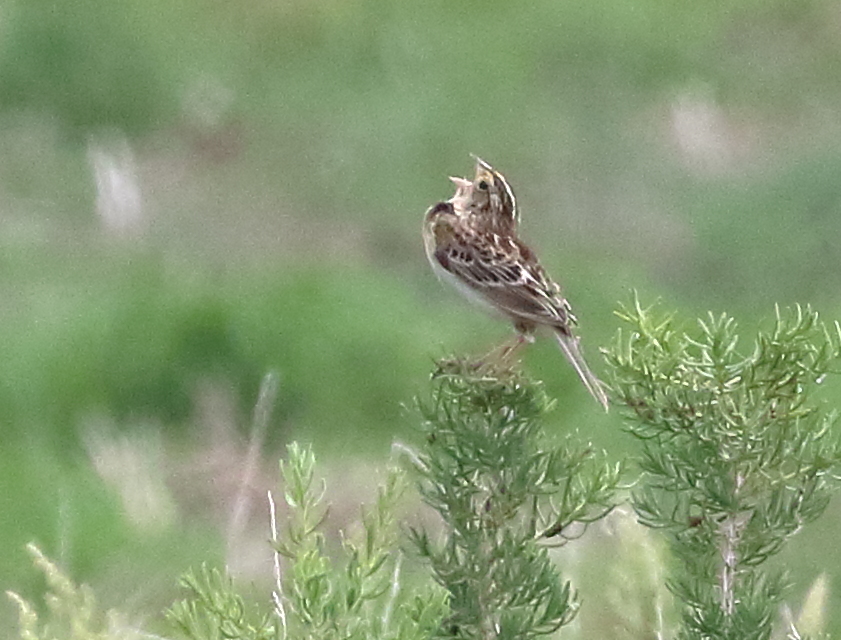
Finally entering the first five-mile stretch of the loop, I was shocked by how much of the lake had been sucked dry by eastern Montana’s multi-year drought. This really was a disaster and I wondered if I would even find any place conducive to water birds. Meanwhile, I encountered great grassland birds including Long-billed Curlews, Loggerhead Shrike, Chestnut-collared Longspurs, Lark Buntings, and Grasshopper, Vesper, Clay-colored, and Savannah Sparrows. Finally, near the end of the lake, I found water but at pathetically low levels. A much-vaunted Cassin’s Sparrow (discovered by Joshua Covill, I believe) had been observed repeatedly at about Mile 7 of the loop and I ran into Robin Wolcott and her husband who had driven over from Big Fork to see it. While we stood there, Robin did hear the sparrow, but with my crummy ears I couldn’t be sure so didn’t count it. I also had many miles to drive so I kept on truckin’, driving the three hours to Great Falls.

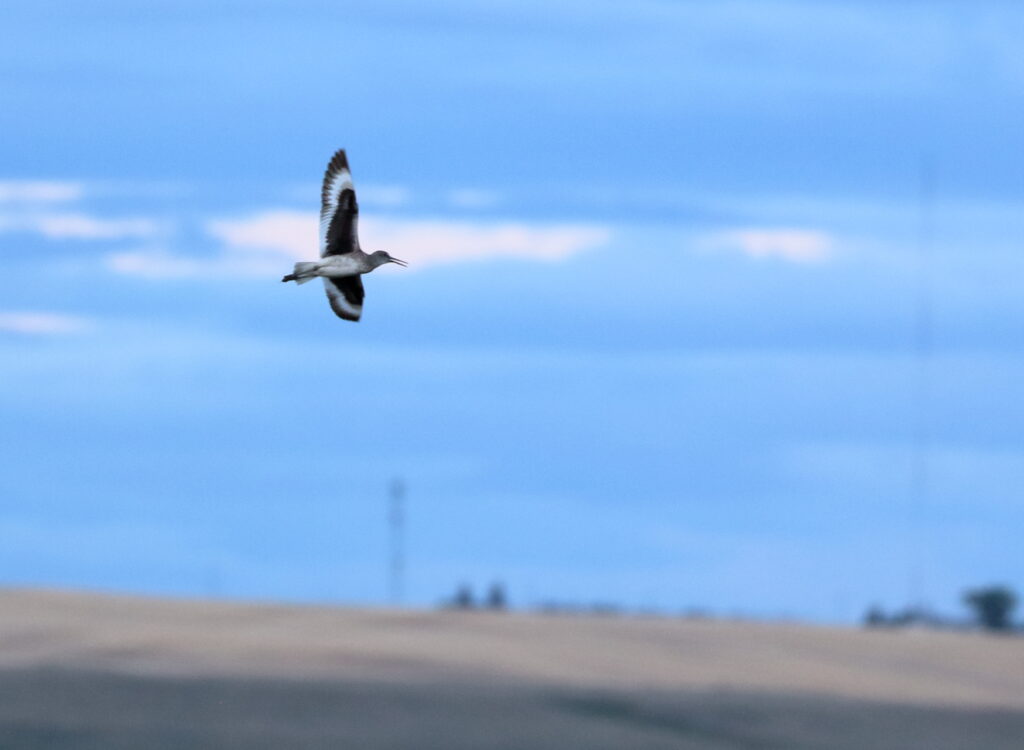
The next morning I again woke early, loaded up the car and arrived at Benton Lake NWR as dawn filtered over the prairie. After the dry conditions at Bowdoin, I fretted about Benton Lake—but my worries were hijacked by what may have been the most astonishing grassland birding experience I’ve ever had. It began with a sighting of a Long-billed Curlew in flight, always a welcome bird. Then, I saw other large shorebirds and stopped to behold the incredible courtship displays of Willets, flying madly around emitting their haunting, looping calls over the prairie. Other curlews joined in and a Marbled Godwit briefly gave chase to a Willet. Meanwhile, meadowlarks sang and a pack of coyotes unleashed their insane yelping cacophony across the landscape—all in the dawn light.

Most birders take Willets for granted, but watching and listening to them display over the prairie where they breed will forever make them a favorite bird ‘o mine.

Suddenly, I spotted a small bird rising high into the sky in an obviously courtship display. “No way,” I excitedly muttered, struggling to focus my camera on the small black dot. My thought? That it could be one of the prairie’s most magical creatures, a Sprague’s Pipit! Alas, Nick Ramsey studied my photos later and suggested it was actually a Horned Lark, and after further study, I agree. Still, it was no less incredible—especially because I didn’t even know that Horned Larks make such displays!

This “Sprague’s Pipit” got me uber-excited, but I learned later that it was almost surely a Horned Lark performing a similar high-altitude display. Thank you, Nick Ramsey, for setting me straight!

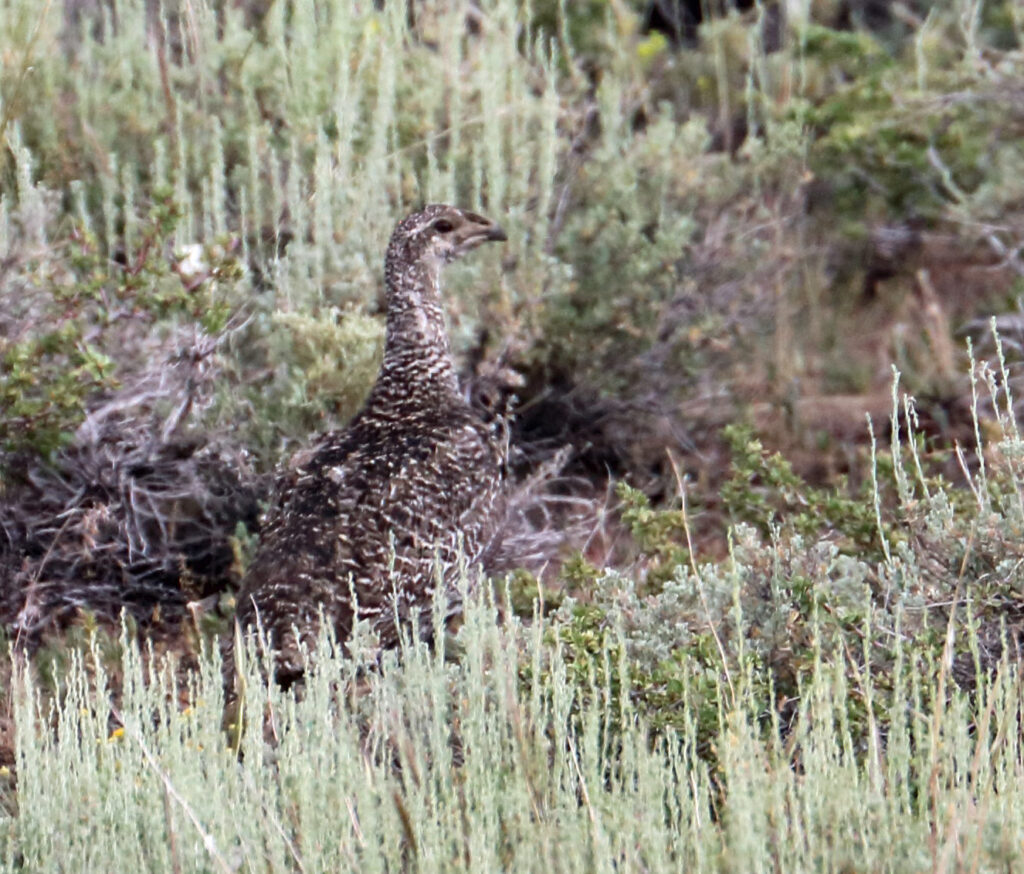
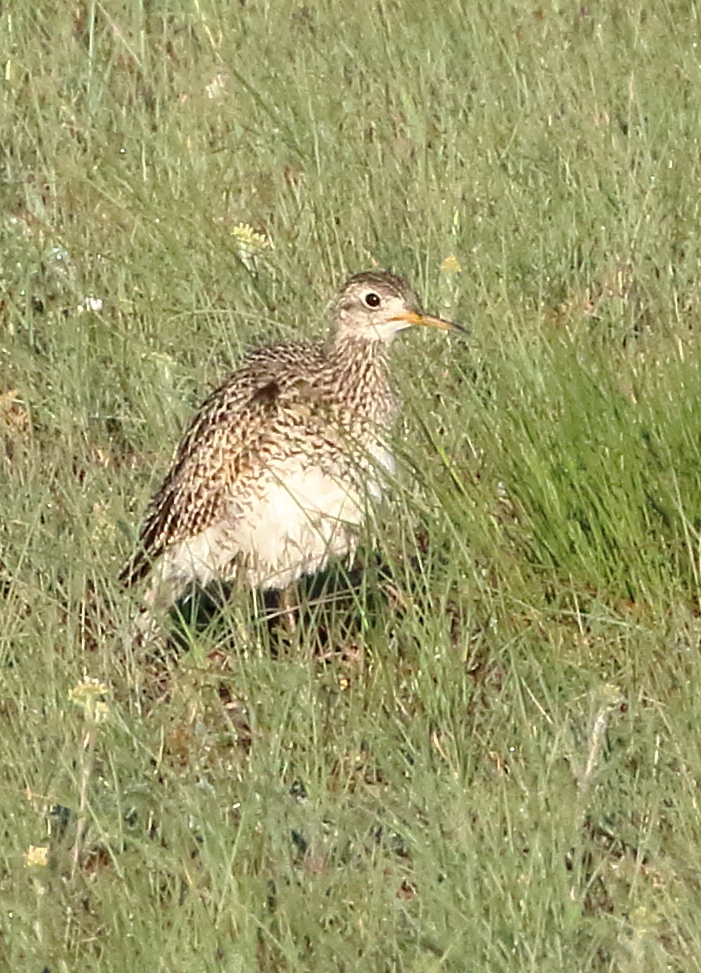
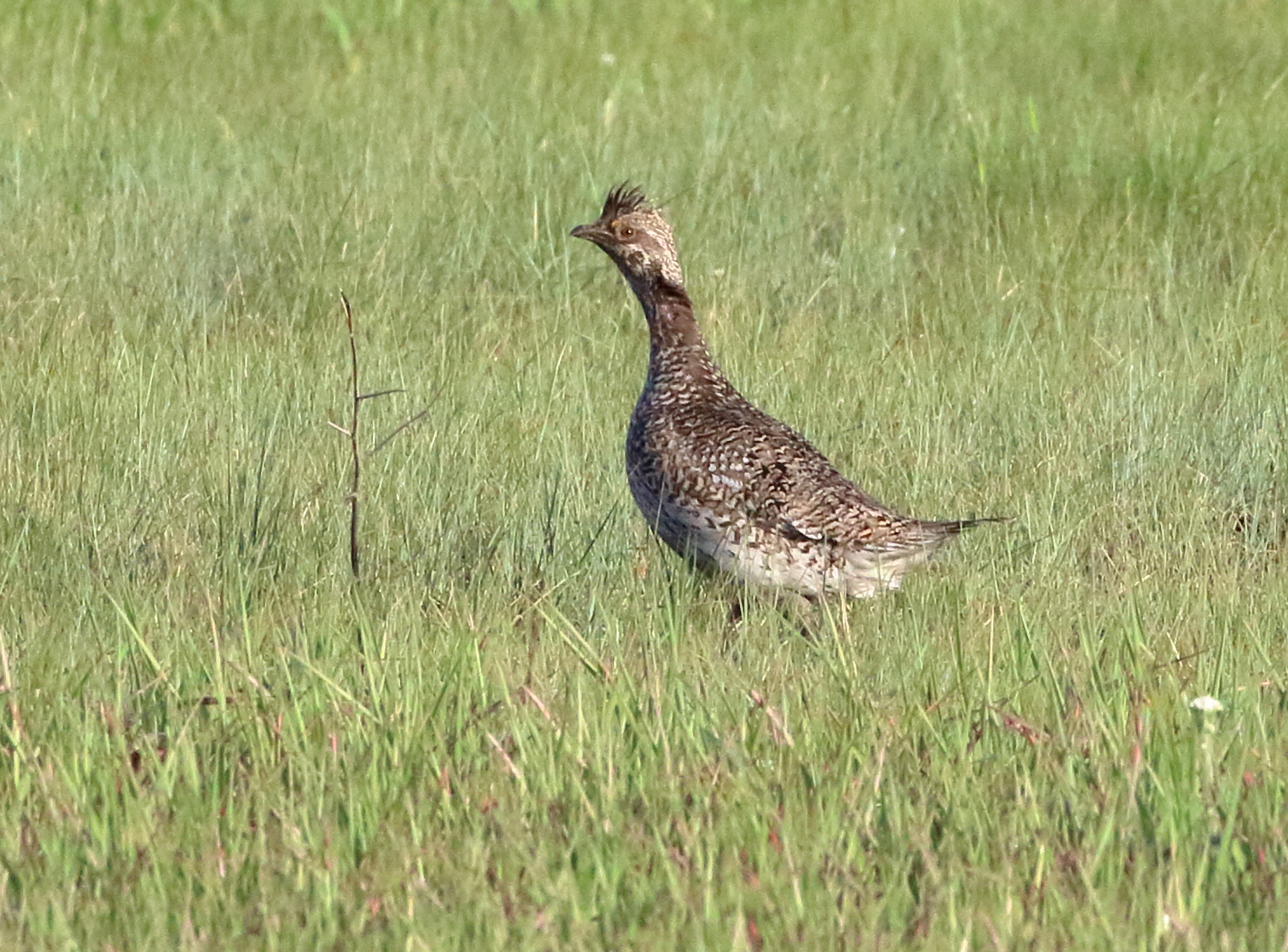
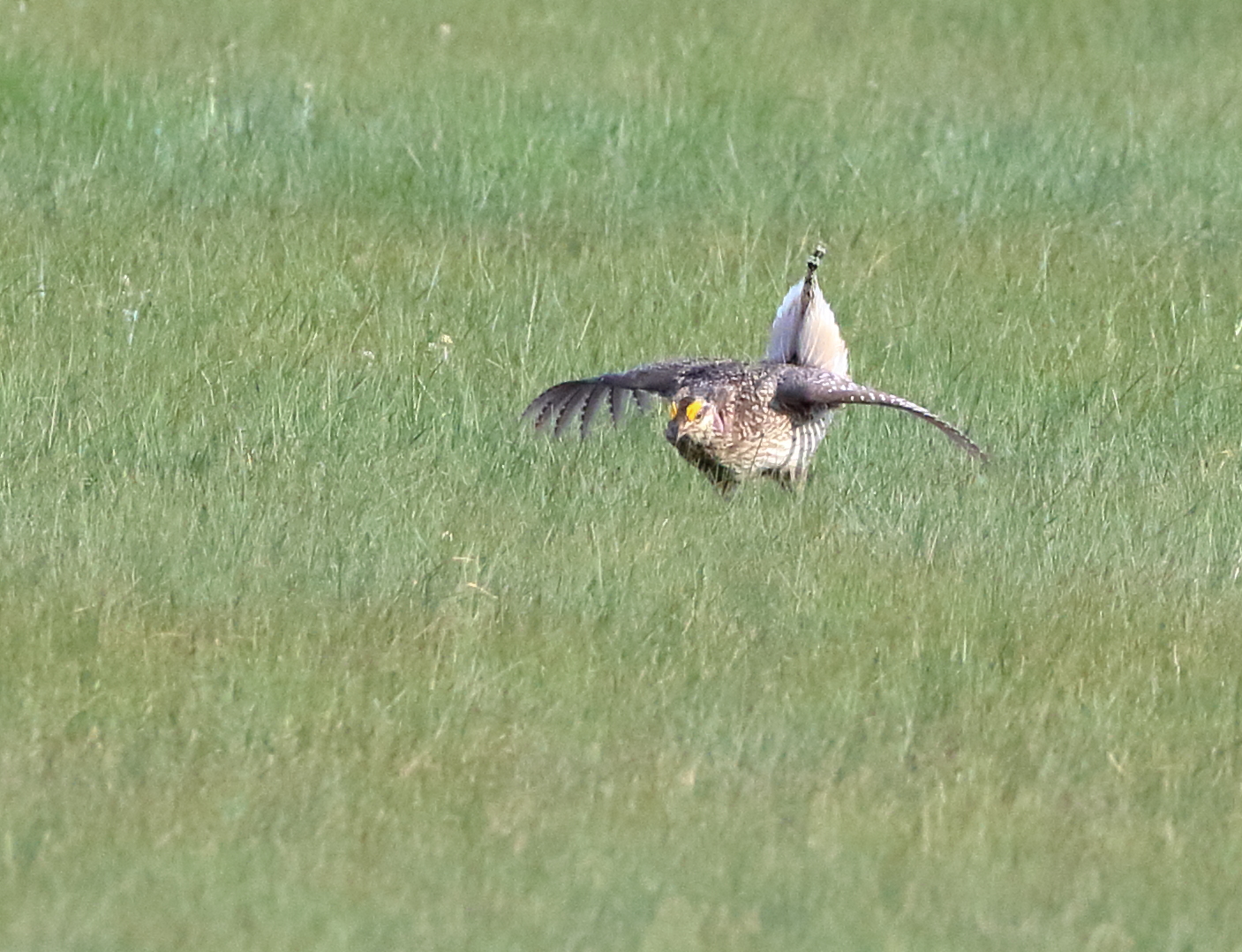
Passing the visitor center, I thought that I would finally make my way to the lake and start looking for water birds. Guess again. As soon as I turned right, down the dirt road, I stopped to look at juvenile Horned Larks and saw more Willets and curlews. Then, I spotted one of my top target birds: Upland Sandpipers! I had barely had a chance to look at them, when I saw another top target bird—a Short-eared Owl! As I was snapping some blurry photos of the owl, eight Sharp-tailed Grouse flew low across the road 100 meters in front of me and zoomed like cruise missiles across the prairie—something Braden and I had never seen at Benton Lake. But the best was yet to come . . .

Upland Sandpipers are one of our favorite grassland species—and they undertake one of Earth’s most incredible migrations, traveling from our prairies to southern South America in a matter of weeks each year!

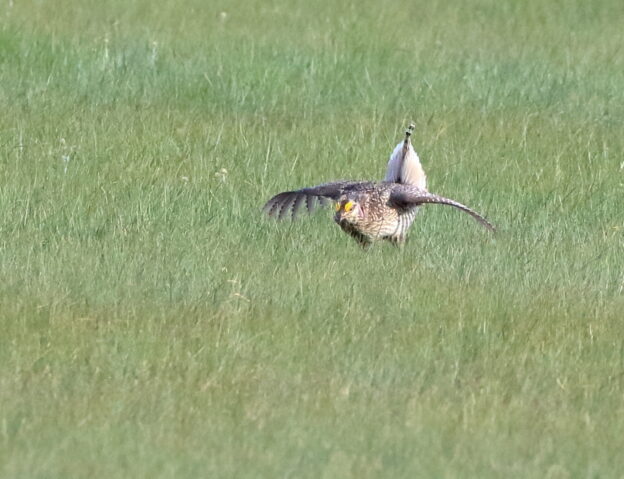
As I was watching the Short-eared Owl, I noticed a white spot perhaps a quarter-mile away. At first I thought it was some man-made structure, but then it moved. I drove closer and raised my binoculars to see a sight I had never in my life observed—a male Sharp-tailed Grouse in full “impress mode” trying to woo a nearby female! Fumbling for my camera, I was so excited that my hands actually shook, and I watched this chase-and-pursue courtship for the next ten minutes. Like so many birds recently, a displaying male grouse was something I never thought I would see, and yet here it was when I was least expecting it!

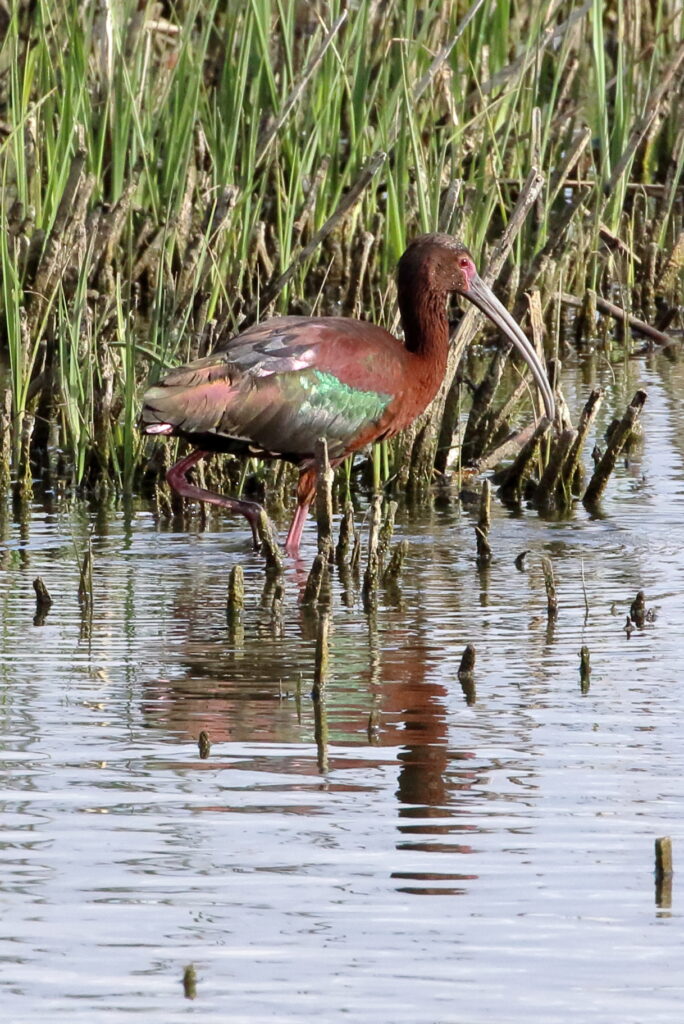
My heart still racing, I finally moved on, and was relieved to see water filling the two main ponds—along with thousands of avocets, ducks, Eared Grebes, Yellow-headed Blackbirds, phalaropes, Forster’s Terns, Franklin’s Gulls, White-faced Ibises and just about everything else I had hoped to see. Water levels looked good to me, but refuge manager Bob Johnson later told me that they struggled to keep the ponds filled. They had the water rights, he said, but it cost so much—think hundreds of thousands of dollars—to pump the water up to the refuge that they had run out of money. That makes it more imperative than ever to support increased funding for our refuges and other wild lands by calling or emailing U.S. Senator Daines and our other representatives.

It’s hard not to love ibises, and I was delighted to see at least nine White-faced during my circumnavigation of Benton Lake.

I had planned to continue on to Freezeout Lake, but after four breathless hours at Benton, I wasn’t sure my sensory systems could handle it. As I said, it was my most incredible grassland birding day ever, and certainly my best at Benton Lake, not just for the species I saw, but for the intimate observations of their natural behaviors as they repeated their ancient life cycles. What’s more, I didn’t see a soul the entire time I was on the driving loop. It gave me a real, reverent feel for what the prairies must have been like before we plowed, grazed, and harnessed the vast majority of them. My wish is that we continue to protect Benton Lake and other vital refuges—and that all of you reading this get to visit there on a summer sunrise of your own.  

My Benton Lake eBird list Oh, and my species count for the trip totaled 110!

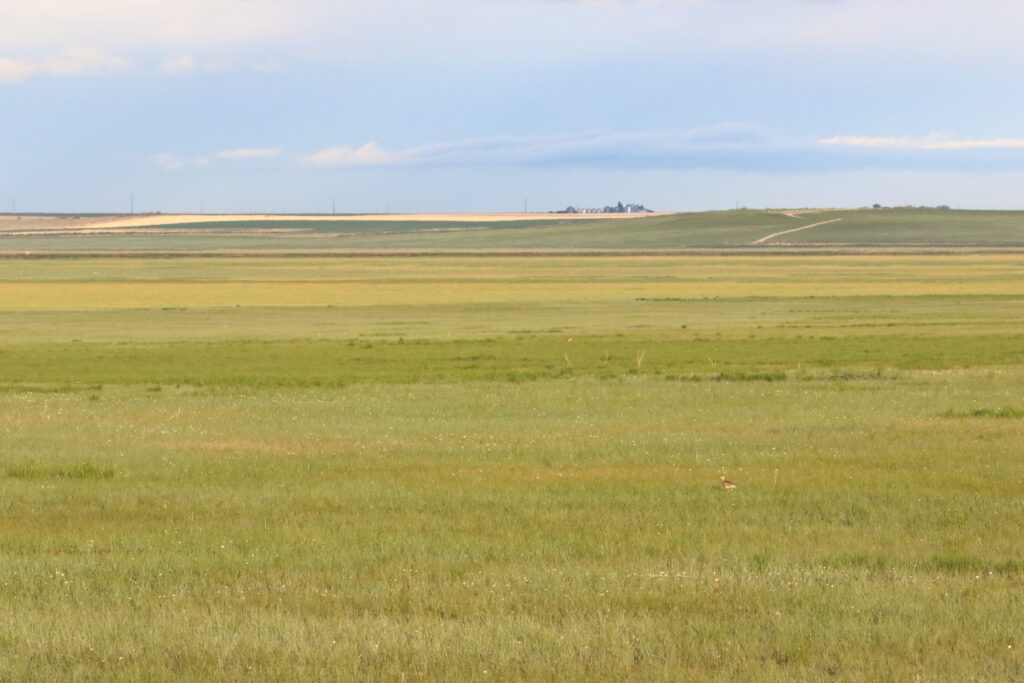
The only thing better than experiencing the beauty of the prairie is to do it in the company of an Upland Sandpiper and Long-billed Curlew. Can you find them?

Arizona 2022, Part 4: To Patagonia Lake, Madera Canyon and Beyond!

This is the last installment of our four-part Arizona adventure. We’ve had a great response to these posts and want to thank you for all of your enthusiasm! Keep birding and supporting birds however you can, and we will share more adventures soon!

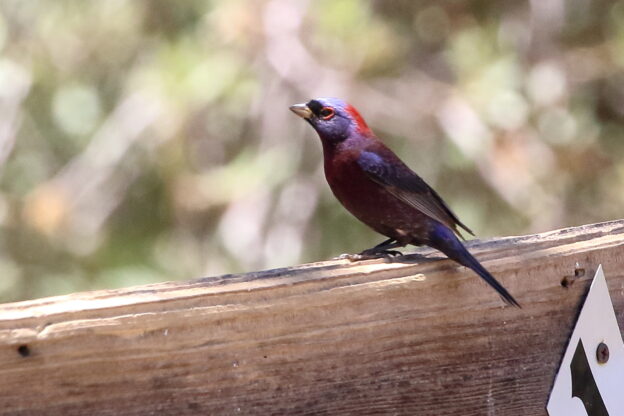
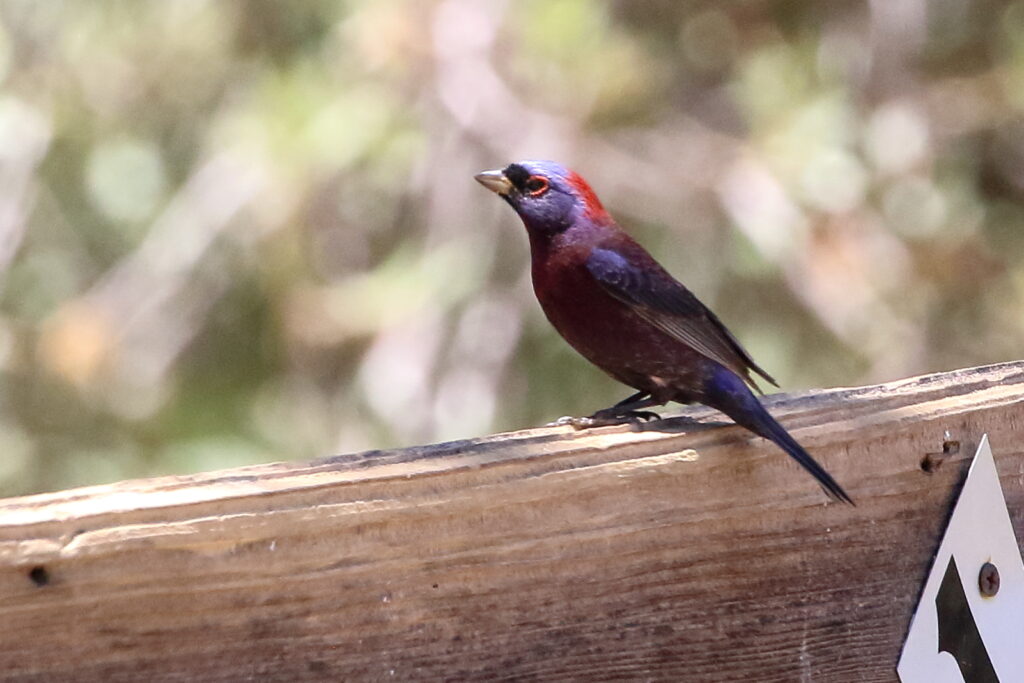
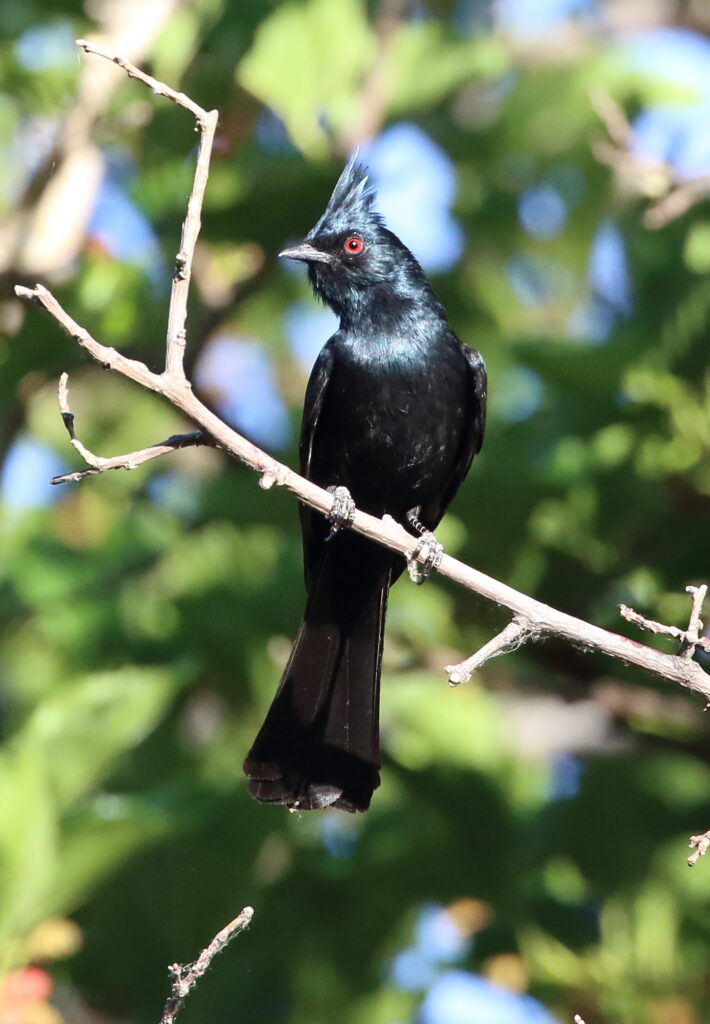
We departed our Nogales hotel the next morning to find a gorgeous Vermillion Flycatcher sitting on a bench outside the front door. It boded well for the day as we headed to our first destination, Patagonia Lake State Park, a place featured in the movie The Big Year, though undoubtedly not filmed there. Patagonia indeed upheld its reputation as a great birding spot, and we checked off two more Life Birds—Northern Beardless Tyrannulet and Bell’s Vireo. We also saw Summer Tanagers and got our best experience ever watching Phainopeplas, which sport the ultimate in cool with their silky black suits and blazing red eyes. Alas, we missed Braden’s top target, Varied Bunting—but picked it up at a small rest area just up the road!

Although we missed Varied Buntings at Patagonia Lake, we got good looks at them at several more sites, including this one at Madera Canyon.

Our Patagonia Lake checklist!

We had seen Phainopeplas before, but got to spend about fifteen minutes watching them flycatch at Patagonia State Park—an experience that made us even more impressed with them!

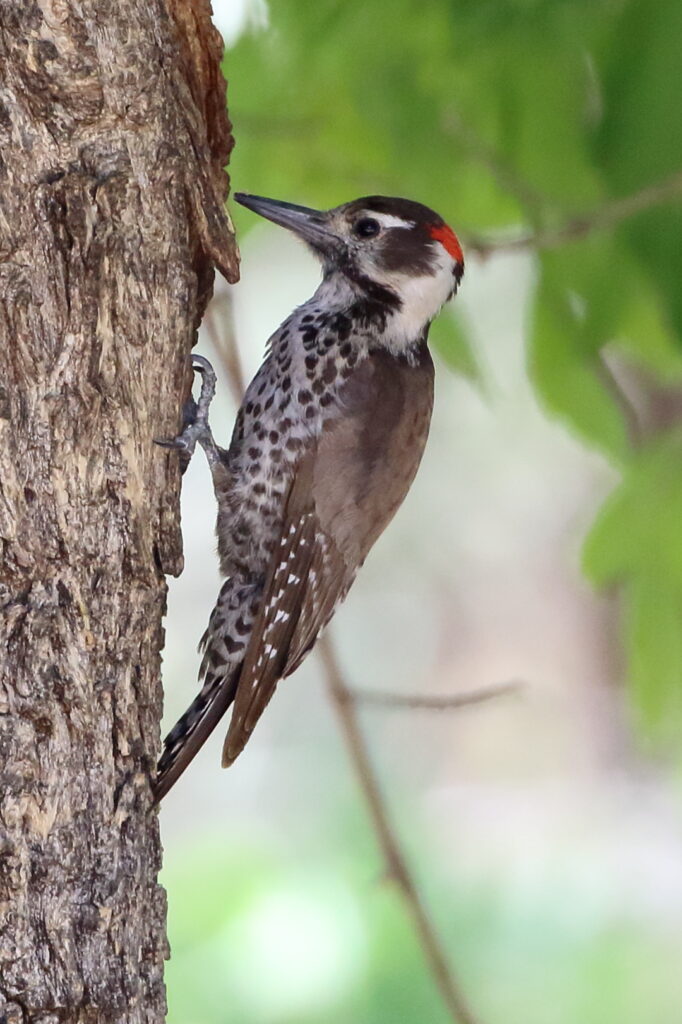
We had debated what to do with the rest of the day and had considered going for Whiskered Screech Owl in the rugged mountains west of Nogales, but with serious heat and the prospect of rough mountain roads to negotiate, we decided for the more comfortable alternative of Madera Canyon, a place we had both adored on our Big Year visit in 2016. We felt grateful for our decision after we staked out a campsite and availed ourselves of the marvelous bird feeders at Santa Rita Lodge. There we picked up Rivoli’s Hummingbird and Arizona Woodpecker for Braden’s Big Year list, and had much better looks at Varied Buntings, Hepatic Tanagers, and more.

We feared we had missed Arizona Woodpecker for the trip, but Madera Canyon delivered. We just love the unique, brown motif of this Arizona specialty.

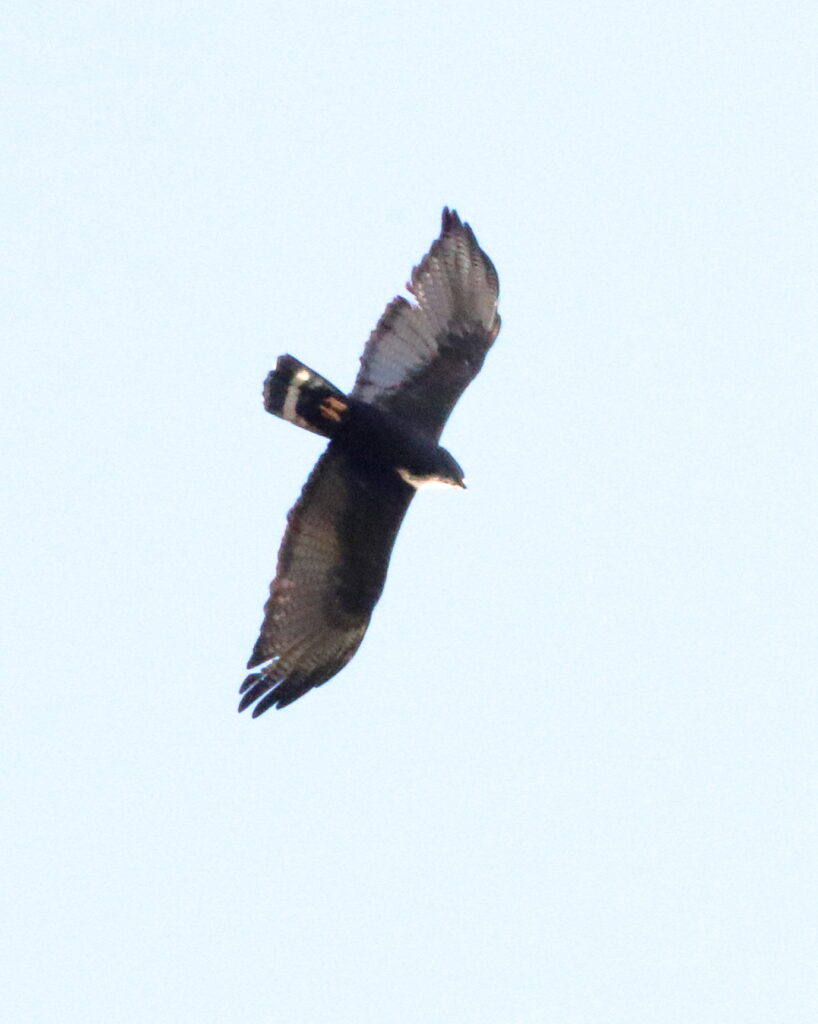
As we were watching a group of Turkey Vultures, I suddenly saw one make a quick move that didn’t look right. “Braden, look at that!” We both got eyes on it and Braden shouted, “Zone-tailed Hawk!” We had seen one before, but had no idea of their close association with Turkey Vultures. In fact, it looked so much like a Turkey Vulture that it left no doubt that some kind of mimicry or convergent evolution had shaped it. Some speculate that potential prey (birds, reptiles, mammals) feel safe with Turkey Vultures overhead—giving a sneaky Zone-tailed a chance for a surprise attack!

The “Turkey Vulture Hawk”, Zone-tailed Hawk, looks so much like a Turkey Vulture, we only ID’ed it after several double-takes.

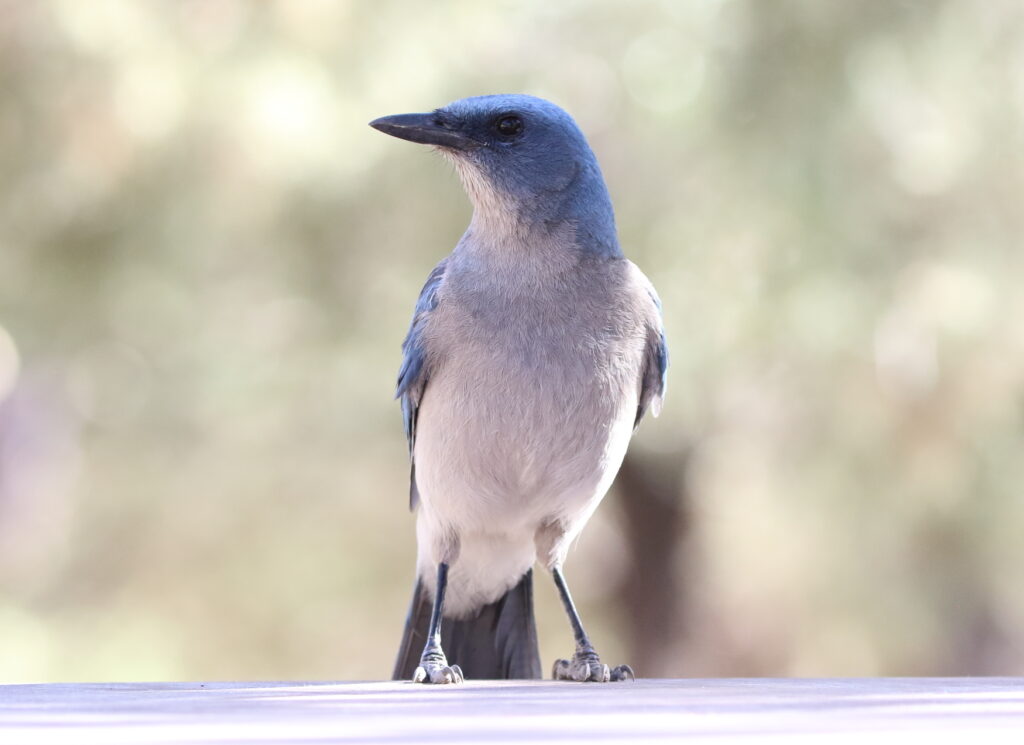
That afternoon we also enjoyed the company of multiple Mexican Jays and Painted Redstarts at our campsite and, later, heard the calls from the same trio of night birds we had enjoyed two nights before in Portal—along with our year’s first Common Poorwills! Oh, and did I mention Braden’s ears also scanned in the calls of Sulphur-bellied Flycatchers and Elegant Trogons? “Again,” Forrest Gump might groan.

This curious Mexican Jay kept us company as Braden and I read aloud to each other at our campsite during the peak of the afternoon heat.

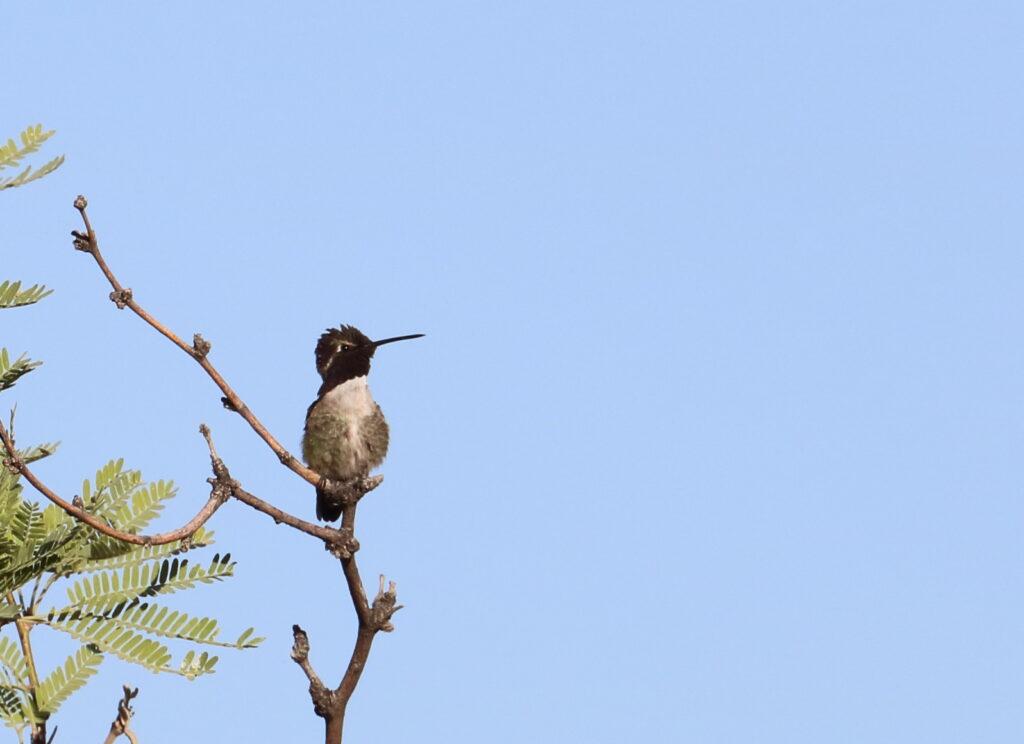
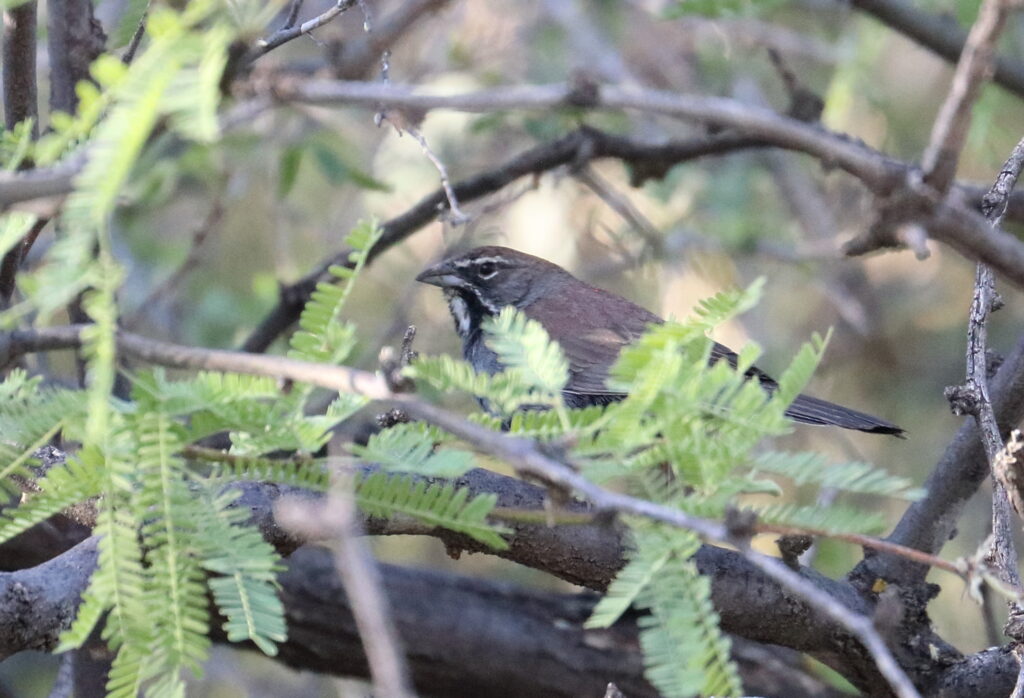
The next morning, before aiming toward California, we had one more task. After rolling up camp, Braden guided us to a place called Montosa Canyon in the same range as Madera. Why? To find a recently-sighted, highly-coveted Five-striped Sparrow. I really didn’t know what our chances might be, but it took about thirty seconds for Braden to locate it, a handsome bird similar to Black-throated Sparrow. As an added bonus, Braden said, “Daddy, look over there.” I focused on a hummingbird and immediately recognized a species I’d read about countless times—a male Costa’s Hummingbird! The Costa’s was superb and we did a little dance, thinking it was Braden’s 400th bird for his Big Year—the goal he had set for himself in January! We later learned, however, that we had inadvertently seen a juvenile Costa’s at Madera the day before, so 400 would have to wait for California Scrub-jay later that afternoon.

Our Montosa Canyon checklist!

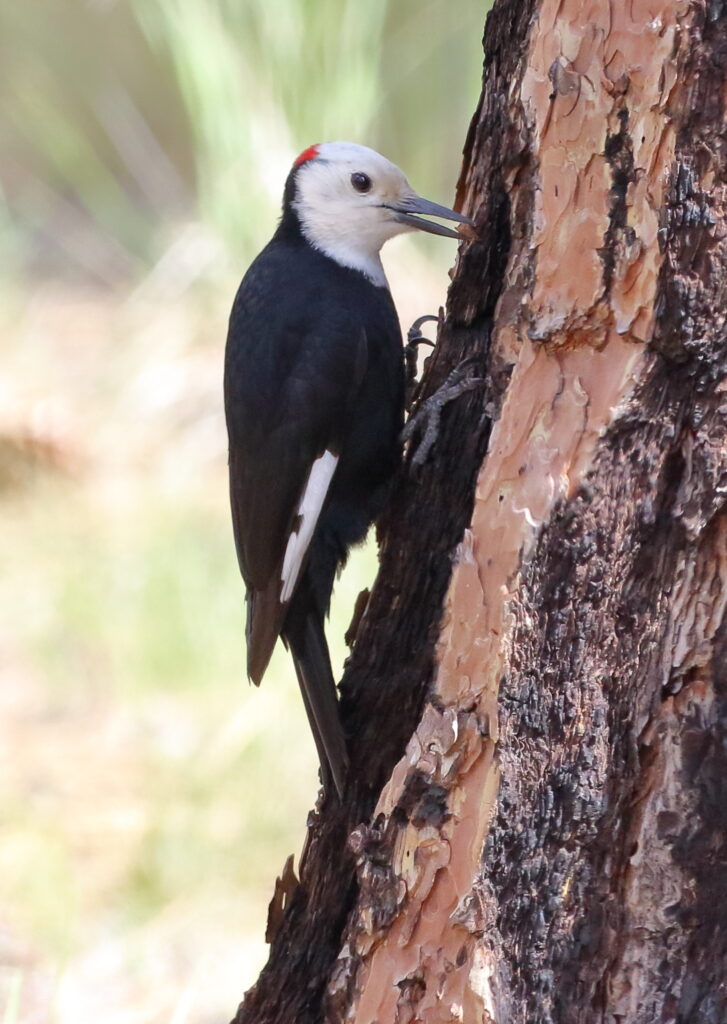
Many more birding adventures would unfold in the coming days as we made our way to San Diego to visit our cousin Laura, and then drove up to the Sierras to deliver Braden to his job monitoring Northern Goshawks for the summer. Sadly, from there I would continue home alone, hitting Modoc National Wildlife Refuge in Alturas and spending a fun three days with my friend and college roommate—not to mention avid reader of FatherSonBirding—yes, you guessed it, Roger Kohn. Roger showed me some of his favorite hotspots around his new home of Bend—and spotted a bird I especially wanted to see, White-headed Woodpecker. He also showed me the delights of Bend’s many brew pubs, but that, unfortunately, concludes this tale. Stay tuned for many more adventures including my recent fabulous birding in Billings and beyond, and Braden’s report(s) from the High Sierras. Who knows, I might even do some more truck birding this summer! Also stay tuned for more progress on Braden’s Big Year. After he hit 400 on our trip, I pushed him to reluctantly lift his target to 450—but between you and me, I think 500 has a much nicer sound to it. Will he go for it? I think he just might!

Braden’s Big Year total when I dropped him off near Sonora, California: 411 (New Goal: 450)

On my way home to Montana, my good friend Roger Kohn and I went in search of—and found—a White-headed Woodpecker. Don’t you love this critter?

Birding Central Park

We continue our spring birding blog blitz by picking up on our New York City trip last week and the nail-biting account of our Central Park birding adventure. If you’re afraid you will get TOO excited while reading this, I suggest you ask someone to hold your hand. And don’t forget to tune in tomorrow for our next post “Birding Brooklyn”!

On Monday, Tessa and I left Amy to continue recovering and rode the Hudson Line up to see our good friends, fellow author Larry Pringle and his delightful wife Susan. After taking a great walk at Nyack Beach State Park and eating a nice lunch, we returned to Manhattan in time to meet Braden at Penn Station after his first year as a college student! Bright and early the next morning, though, he and I jumped on the C train to do something we’d dreamed about since we began birding eight years ago: bird Central Park during spring migration! (Well, after a stop at Liberty Bagels on 35th St., that is.)

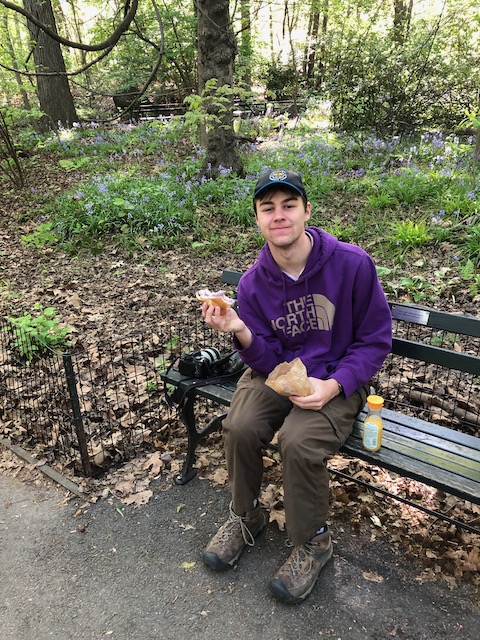
People often ask us the key to successful birding. Our trip to New York provided the definitive answer: bagels.

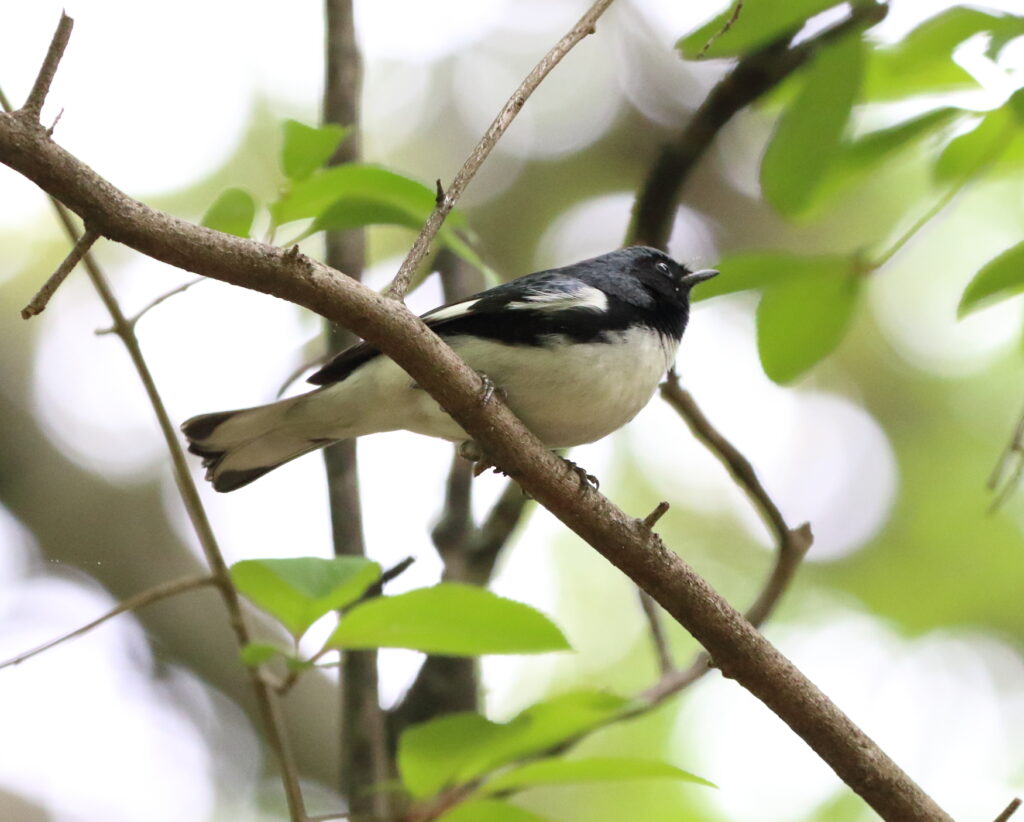
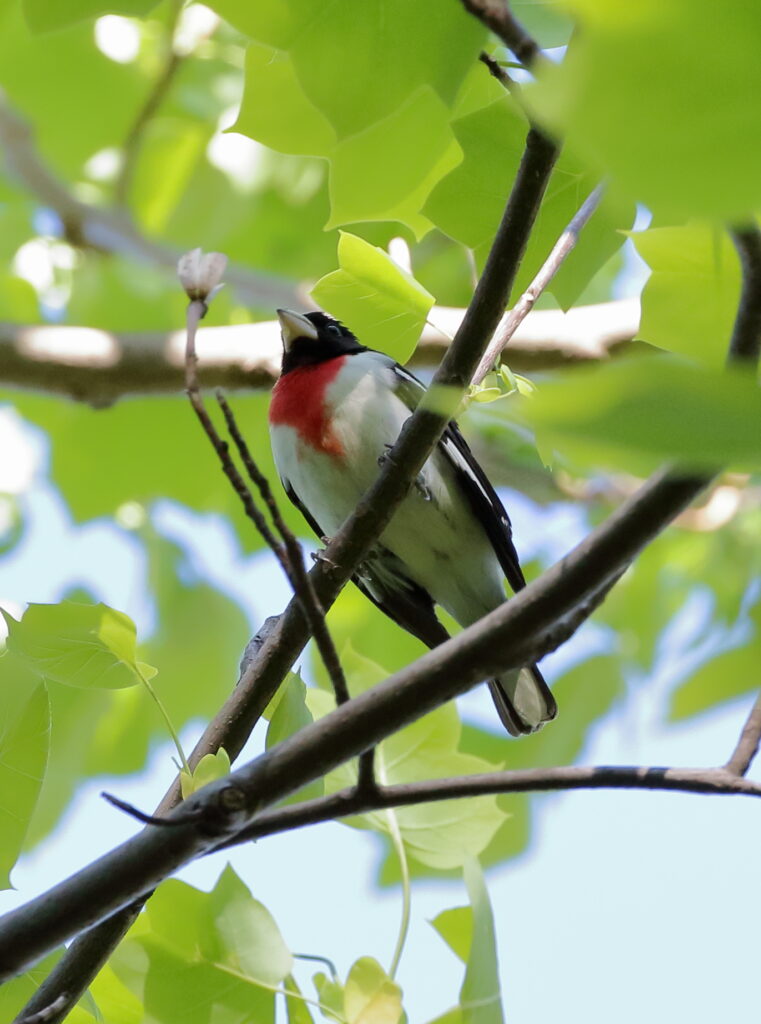
Just as Tessa and I had done two days earlier, we jumped off at 81st St. and immediately crossed over into Central Park, entering a particularly birdy area known as The Ramble. As mentioned in our last post, I worried that the birds might have left NYC already. Most migrating passerines only appear in the park during brief windows ranging from a few days to 2-4 weeks. They also come in waves that one can easily miss. Within a few minutes, however, the birds put my fears to rest when Braden called out a Black-throated Blue Warbler, a Life Bird for me and one of the most stunning of all warblers. Over the next hour and a half, a veritable songbird hit parade followed with sightings of Worm-eating Warbler, Nashville Warblers, Northern Parulas, Northern Waterthrushes, American Redstarts, Swainson’s and Hermit Thrushes, Magnolia Warbler and much more, including a male Rose-breasted Grosbeak high in the trees.

Black-throated Blue Warbler landed at Number 502 on my ABA (American Birding Association) Area Life List—and what an entry it was!
Not the best view, but this was our first male Rose-breasted Grosbeak since we’d hit High Island, Texas during our 2016 Big Year—so we took it!

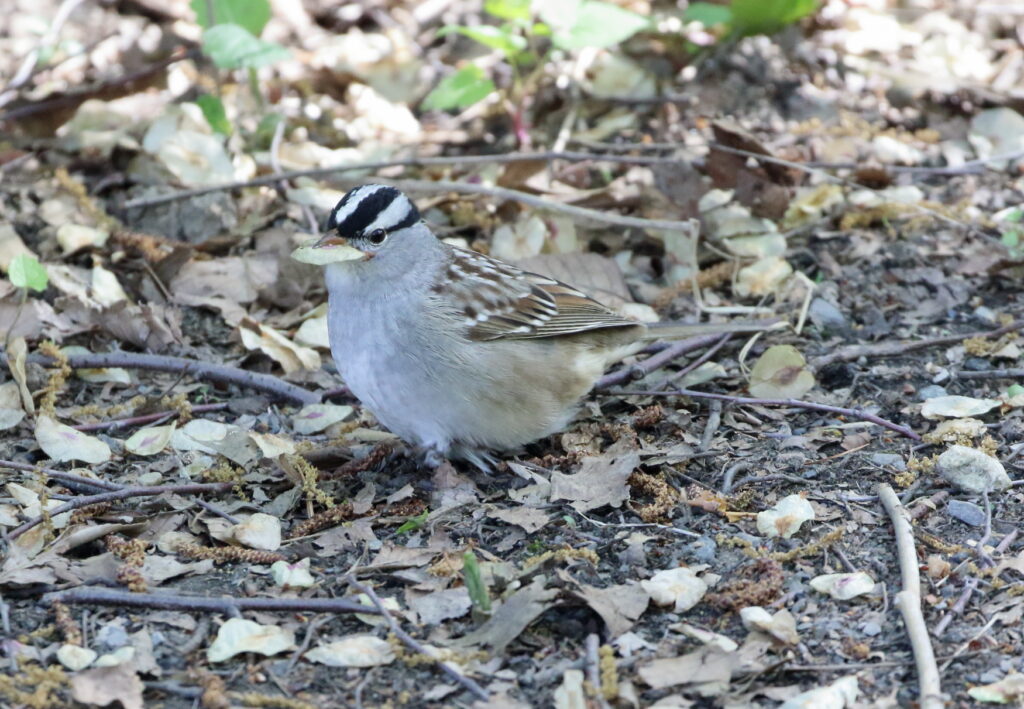
Among birders, it’s a well-known fact that seeing a lot of birds can generate an enormous appetite, so Braden and I were forced to sit down and attack our bagels. Mmmm . . . lox shmear . . . Partly satiated and with cream cheese smearing our faces, we again rose and made our way to our second birdy destination—an area of Central Park called North Woods. Along the way, we passed multiple landmarks familiar to anyone who has ever watched movies or Seinfeld including Belvedere Castle, the Jacqueline Kennedy Onassis Reservoir (where Dustin Hoffman jogged just before getting his teeth ripped out without anesthetic by a sadistic dentist), and the Central Park Tennis Center. We also made more bird discoveries such as a large group of White-crowned Sparrows.

Surprisingly, large numbers of White-crowned Sparrows are rare in Central Park. We were lucky to run across a group of five on our walk up to the North Woods section of the park.

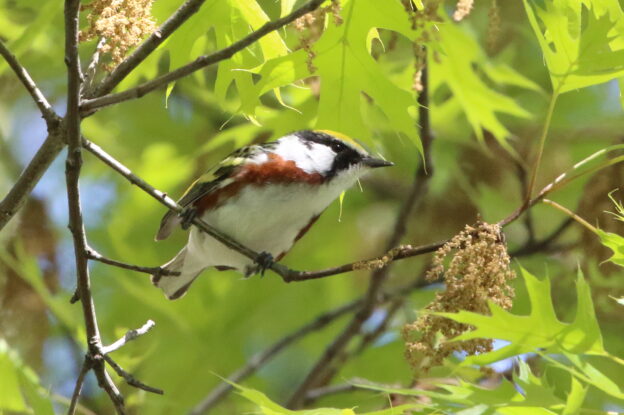
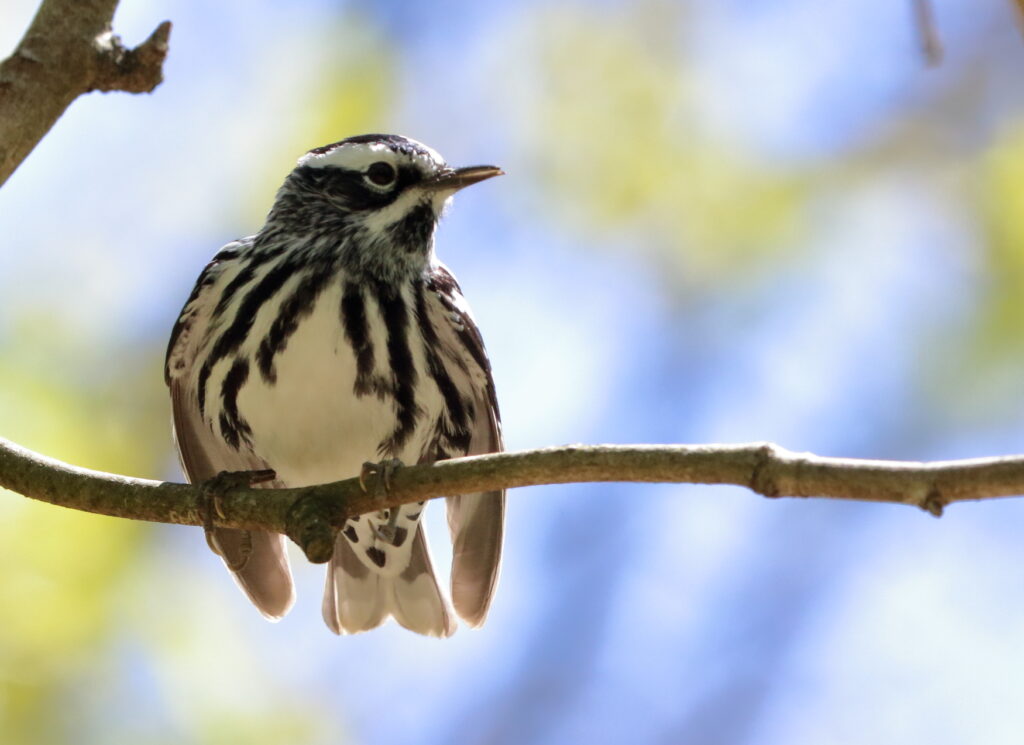
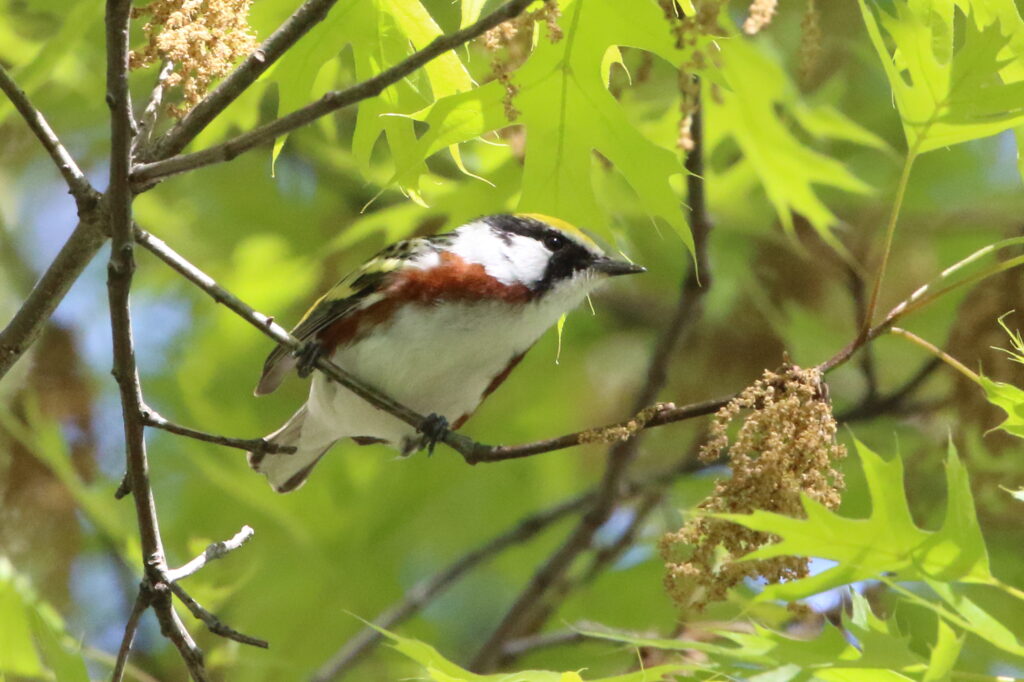
To be honest, however, we didn’t think the North Woods could possibly match The Ramble for birds, but we soon learned that . . . it CAN! Two targets, a Yellow-breasted Chat and a Red-headed Woodpecker had created a buzz in that section of the park, and we (ahem) chatted with several birders about them, but it was the other birds that grabbed our attention. These included incredibly cooperative Black-and-White Warblers, glorious Chestnut-sided Warblers, a Veery and Blue-headed Vireo. We struck out on the chat, but making our way east, we followed the creek through an area called The Loch and continued to rack up amazing sightings. These included a quick glimpse at the now-famous Red-headed Woodpecker, several Red-bellied Woodpeckers, a Yellow-throated Vireo, a Great Egret flying overhead, and a bird I especially wanted to see, Swamp Sparrow.

You wouldn’t think an animal that is just black and white could be so stunning, but Braden and I savor each encounter with Black-and-White Warblers.

By now we had birded for five straight hours and our energy was starting to flag, so we reluctantly dragged ourselves to the 103rd St. subway station and caught a ride back downtown. We learned later that we might have picked up Cape May and Blackburnian Warblers if we had hit a part of the Ramble called the Point, but did we mind? Only a little. In fact, our day had exceeded all of our expectations for birding Central Park. During our long morning, we had logged a remarkable 57 species including an amazing 13 kinds of warblers—as many as we could hope to find during a whole year in Montana!

Our Checklist.

Though I’d seen Chestnut-sided Warblers when taking Braden back to college in Maine last fall, this was my first technicolor, breeding male!

Even better, when we returned to our hotel, Amy was feeling much better and had spent the day with Tessa at Ellis Island and the Statue of Liberty, so we all went out to a nice meal at Kung Fu Kitchen. Can you spell pork soup dumplings???? Then, while Braden and Tessa strolled Times Square, Amy and I set off to see The Book of Mormon, a musical we were supposed to see in Seattle when covid struck. But lest you think Braden’s and my Big Apple birding adventures had concluded, stay tuned for our next post . . .

Epic Florida Birding Adventure: Final Birds & Statistics—including Big Year numbers

We interrupt our New York adventures to bring you Braden’s final post on his and Nick’s epic Florida adventure. As you’ll see, it was a wild ride. Tomorrow we will resume New York with our visit to Central Park. You won’t want to miss it!

A loud bang shook the car as we sped along the highway through the worst rainstorm I’d ever experienced. I looked at Nick.

            “Did you hear that?? That lightning bolt almost hit us!”

            We’d been driving through this hurricane-level rain for about fifteen minutes by now, gripping the edges of our seats as Nick avoided large puddles and watched the lights of the cars in front of us. After reading about flash floods, I had my fingers crossed that our car wouldn’t get swept away. Thankfully, after about half an hour, the water stopped pouring from the sky just as suddenly as it had started, and we celebrated by driving north towards Alabama, with one last place to bird before the sun went down.

Strike a Pose! Many of Florida’s Sandhill Cranes are unusual in that they a) are non-migratory and b) live in very urban areas. As you can see, this makes them a photographer’s best friends!

            That morning had been a rollercoaster of bird-related emotions. We awoke at dawn, saying goodbye to even more Chuck-wills-widows as we drove to a large pineywoods preserve in search of the specialty birds we’d missed on the drive down. While yet again the beauty of this southeastern pine forest dazzled us, we only got fleeting glimpses of a Bachman’s Sparrow, and left the preserve disappointed. Next, we sidled up to a cemetery, home to a wintering population of Henslow’s Sparrows. We stomped around in the thorns for roughly forty minutes, leaving with no sparrows and legs covered in scratches. In a last ditch effort to get a new species for the trip, we found a small park in Gainesville home to a population of Red-headed Woodpeckers. Thankfully, Nick spotted them, flying around a group of burned snags in the distance.

            We grabbed McDonald’s in Gainesville and headed North, planning to stop at several more spots for Bachman’s Sparrow before booking it towards the Alabama border. As we left town, though, my dad called me.

            “Hey guys, how’s it going? Have you guys been to Sweetwater Wetlands yet?”

            “No,” I said, looking at Nick slightly confused, “What’s there?”

            “Snail Kites! And a bunch of other cool things.”

            “Wait, really?!” I said, quickly pulling the hotspot up on eBird. Sure enough, Snail Kites had been seen there yesterday, and seemed to consistently visit the park. Unfortunately, the wetlands were in the opposite direction of where we wanted to go. After a brief discussion, we decided to go anyway—after all, Snail Kites were still one of our biggest targets on the trip. We’d had no idea they could still be found this far north, but if we had one last shot at them, why not take it?

            We pulled up at the wetlands, putting Dixie in Nick’s backpack and starting our speedrun of the hotspot. The area was a large, freshwater marsh, divided by gravel trails quickly warming up under the midday sun. We split up, trying to cover as much ground as possible. Soon, it became apparent to us that there were indeed birds here. 

            Warblers and vireos serenaded us from the massive live oaks standing in the entryway to the area, and water birds were everywhere. Many of these were fearless, too—I managed to get great photos of both Sandhill Cranes and Limpkins standing less than ten feet from me. The Limpkins signaled that there were snails around, and we kept careful eyes on the sky as we walked. Me and Nick met up after half an hour.

Our last-minute visit to Sweetland Wetlands in Gainesville nabbed us our first good looks at Limpkins—and many other birds.

            “Any kites?”

            “Well, there are some over there. But they’re Swallow-tailed, not Snail.”

            “Me neither. I heard a King Rail over here, so we could probably play for that…wait. Are those harriers?”

            Nick pointed behind me at three distant raptors soaring behind us over the marsh. I raised my binoculars. The birds were brown, with white rumps and slender wings, two features common to Northern Harriers. However, they were flying differently. The birds slowly drew nearer, and before long, we could see their striped faces, indicative of juvenile Snail Kites.

            “Snail Kites!” Nick yelled, and we high-fived as we watched one of our top targets for the trip fly closer to us. While the kites never got as close as the Swallow-taileds on our first day, we still got decent views. We’d only seen these birds because my dad had been following our adventure and found us a reliable spot to look for them!

Our last shot at Snail Kites paid off big as we backtracked to Sweetwater Wetlands on a hot tip from my dad!

            Now, as the rain on the highway subsided, I began to reflect on the trip. It had been an absolute whirlwind of fun and disappointment, euphoria and frustration. Had it not been for Sweetwater Wetlands, we would have missed a significant chunk of our targets for the trip (including up-close Sandhill Crane and Limpkin). We’d chased many birds and came up short often, although we had a few successes with the flamingo at St. Marks and grassquit in the Keys. We’d driven hundreds of miles and dozens of hours, sacrificing sleep and food for the birds. And we’d seen so much of the country too, despite only truly getting to know one state. Florida had continued to amaze me, with its extensive saltmarshes and stunted mangrove forests, tacky fishing villages and five-star hotels. We’d birded in so many habitats I hadn’t even realized existed—Florida savannah scrub, Caribbean Pine Rockland, sawgrass glades and urban parks covered in animals from every continent.

We can thank the abundance of Great Egrets and many other birds to the visionary conservation efforts of Teddy Roosevelt who, among other things, helped put a stop to plume-hunting for hats. We need similarly radical action today to save many of our planet’s species—including ourselves.

            As for the birds, we’d done pretty damn well. We’d found success on about half of our chases, missing stuff like the Smooth-billed Ani and Black-headed Gull finding other rarities like the Black-faced Grassquit in the Keys. Thanks to Sweetwater Wetlands, we had hit most of our targets, only missing the Mangrove Cuckoo (which, it turned out, it was the totally wrong season for) and several of the Miami specialties, plus Bachman’s Sparrow, which we still had a shot at. I’d obtained some of the best photos I’d ever gotten, including Prairie Warbler and Blue-headed Vireo, and really gotten to know several species that I’d had little to no experience with prior to the trip. The two species that topped my “Bird of the Trip” list were the aforementioned Prairie Warbler and Swallow-tailed Kite. I’d “discovered” an entirely new breeding population of the warblers, having had no idea that this species could thrive in coastal Floridian mangroves, and learned to recognize their buzzy, rising song every time Nick and I had set foot in that strange, coastal habitat. The kites had accompanied us everywhere we’d gone, and we’d seen them soaring above us almost every day of the trip, not discriminating between any certain habitat. Even after I returned to Maine the next day, it was hard to break the habit of scanning the skies for these sharp-looking black and white birds.

As the sun set on our Florida adventure, one of our nemesis birds—Bachman’s Sparrow—finally put in a solid appearance, and in a place where my dad used to camp with his dad fifty years ago.

            As our car raced towards the Alabama border, Nick and I decided to make one last stop. We were driving past Pensacola, where I’d gone for Thanksgiving the previous fall, and we headed north, heading to Blackwater State Forest following a Google Maps pin that supposedly had Red-cockaded Woodpeckers. The Honda Pilot pulled over on a dirt road as the sun began to set, dangerously low on gas, and we jumped out, cameras and binoculars in hand. Dixie immediately took off into the tall grass, covering herself in the mud formed by the intense rainstorm that had just ended. The longleaf pines towered upwards around us—this was the healthiest patch of this habitat we had seen during the whole trip. Suddenly, as we began walking, a melodious song echoed across the pine savannah.

            “Bachman’s Sparrow!” said Nick, whipping out his phone to play for the bird. Almost as soon as the song escaped the phone’s speakers, a small, brown sparrow zipped towards us, landing on the low branch of a tree. I raised my binoculars, and sure enough, there it was–a bird I’d searched for and missed half a dozen times in the last six months. The bird’s plumage was not particularly special, but the music it created stuck with me for hours after we left. Several more sparrows began singing from the grass as the sun set, and were joined by a chorus of Pine Warblers and Brown-headed Nuthatches. On our way back to the car, we suddenly heard some loud calls similar to that of a Hairy Woodpecker. We looked over in the trees just in time to see a family group of Red-cockaded Woodpeckers fly in, moving up and down the pines energetically. I walked off into the grass in an attempt to get some photos, and called my dad back.

Despite the lousy photo, finding Red-cockaded Woodpeckers in a place my dad had spent his summers proved the perfect way to round up our epic adventure.

            “We got the woodpeckers…hell, we got everything!”

            We’d ended the trip right where we’d started, in these strange, fire-dependent southeastern forests. Not everything had gone right, but Nick and I had gotten a great story out of it. We’d seen so many birds, and mammals, and plants, and reptiles and more, and as I boarded the plane from New Orleans the following morning, wearing clothes that hadn’t been washed in a week and clutching my camera and binoculars, I smiled. Florida had dragged me in, and I couldn’t wait to return to the land of the grass pines.

Trip Statistics!

Miles Driven: 2,100

Hours Driven: 31

Bird Species: 197

States Driven Through: 4

Counties Driven Through: 43

Life Birds: 23

Year Birds: 143

Bird(s) of the Trip: Prairie Warbler, Swallow-tailed Kite and Bachman’s Sparrow

Birds to Date for Braden’s Big Year: 244 (at end of Florida trip)

Birding the Big Apple: Manhattan Practice Runs

We know you’ve been dying for Braden’s last installment of his Florida trip, but just to keep you waiting impatiently a bit longer, here is the first of a new series for you: our spring trip to New York—during migration season! Stay tuned for rapid installments, and to make sure you don’t miss a single one, be sure to subscribe by filling out the boxes down and to the right!

All birders have bucket lists and birding New York’s Central Park during spring migration stood close to the top of ours. Just when that would happen, we didn’t know, but this year the end of Braden’s spring semester, ahem, pigeon-tailed perfectly with my daughter’s desire to return to New York City, so we decided to make a family trip of it. We did not plan the exact dates around spring migrants, but first encounters bore promise.

Seeing an original copy of Audubon’s Birds of America in all its giant glory was an unexpected, great way to launch my New York birding experience!

Amy, Tessa, and I arrived Friday, May 6, but Braden wouldn’t pull into Penn Station until the following Monday and I tried to hold off birding until then. I failed. Despite a rainy day Saturday, we wandered back through Bryant Park after an excursion to the New York Public Library, where I got to see a copy of Audubon’s original Birds of America (WOW!). Bryant Park lacked good habitat, but in a few short minutes I glimpsed Gray Catbirds, White-throated Sparrows, and a Hermit Thrush. The message was clear: THE BIRDS ARE HERE! Even more exciting, Tessa and I planned to take Amy to a well-known hotspot, Governor’s Island, for Mother’s Day the next day. Alas, that night Amy came down with a crummy cold, so Tessa and I decided to instead plan a visit to the American Museum of Natural History (AMNH).

“I’ve been framed!” Actually, this Gray Catbird is not in jail—just visiting the Bright Lights and Big City Life on its way to breeding grounds.

The next morning, as is my wont, I rose way before Tessa so decided to do a bit ‘o bird reconnoitering before we hit the AMNH. Our overpriced, mediocre hotel stood fairly close to the Hudson and I thought There’s gotta be some birds down along the river, right? Uh, not really. Sure, I saw a cormorant, robins, a couple of fish crows (identified by their anemic calls) and the usual city birds—along with a giant aircraft carrier—but was disappointed by the paucity of greenery. On Google Maps, however, I noted a park a few blocks uptown and decided, “What the heck.”

My first cool bird of NYC, White-throated Sparrows are one of Braden’s and my favorites—probably because we have to work so hard to see them in Montana!

DeWitt Clinton Park would be considered a “postage stamp park” in Montana, but I’m guessing it’s an invaluable resource for its neighborhood New Yorkers, consisting of a doggie park and various courts. More important, even before entering I saw that it held trees and strips of shrubbery, and my pulse quickened with the possibilities. Sure enough, as soon as I walked up the first steps, I spotted a small shape scampering along a tree trunk—one of my favorite birds, Black-and-White Warbler! My Bird Excitement Meter surging, I hunkered down to some serious birding, and was rewarded by more catbirds and White-throated Sparrows, and then saw both Hermit and Swainson’s Thrushes. The biggest surprise? A Common Yellowthroat, very far from water—an obvious migrant passing through!

What are you doing here? Seeing a Common Yellowthroat in a postage stamp park in Manhattan both surprised me—and got me really excited about what else might be passing through the crowded megalopolis!

Returning to the hotel, I made sure Amy had what she needed for a day in bed, and then Tessa and I caught the C train up to 81st St. We had ANHM entry reservations for noon and arrived early enough for a quick stroll of Central Park across the street. I kept my expectations low as it was an overcast day and, well, I just didn’t know what spring migration might be like Out East. Within a couple of hundred yards, however, I spotted a small tan bird on the ground with a bold stripe on its crown. “Worm-eating Warbler?” I considered. “No, Ovenbird!” And not just one, but two.

Another bird challenging to find in Montana, Ovenbirds were evidently swinging through Manhattan in large numbers the week we arrived!

Emboldened, we continued walking, seeing catbirds, a blue jay, more WTSPs, a Red-tailed Hawk, and a surprise Chipping Sparrow. Then, a bold flash of yellow caught my eye. I had worried that I might not be able to ID some of the Eastern warblers, but this was a bright, bold male. Even better, it’s a bird I had for years been staring at on the cover of The Sibley Guide to Birds—Magnolia Warbler! Honestly, the bird was just stunning. I didn’t have my camera, but in a way that was better as I could just focus on enjoying this first male MAWA I had ever seen. Even Tessa, a non-birder, appreciated the warbler’s sublime beauty. With a twenty-minute list of 12 species (not even including Rock Pigeon!), we headed off to the museum, fingers crossed that the birds would still be here when Braden and I would get to bird Central Park in earnest two days later.