Tag Archives: songbirds

Montana County Sweep: Our Final Eastern Montana Odyssey Post

Just so you don’t get lost in the narrative below, be sure you catch up with our last post—or, better yet, begin with the first post in this series!

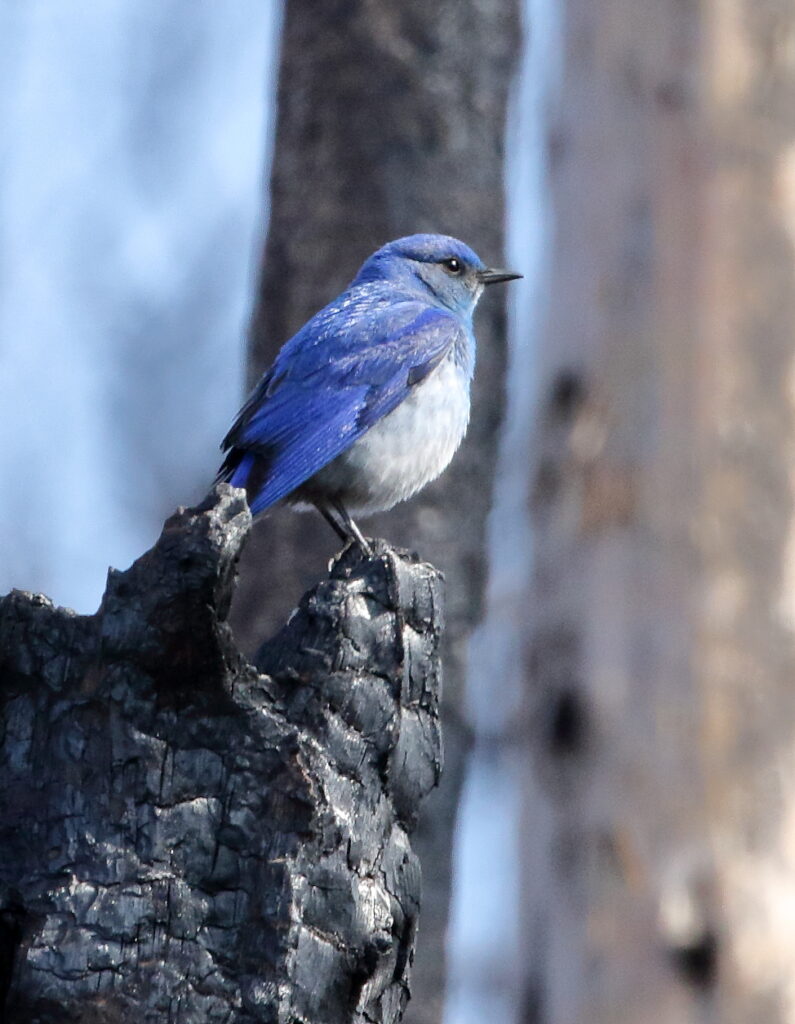
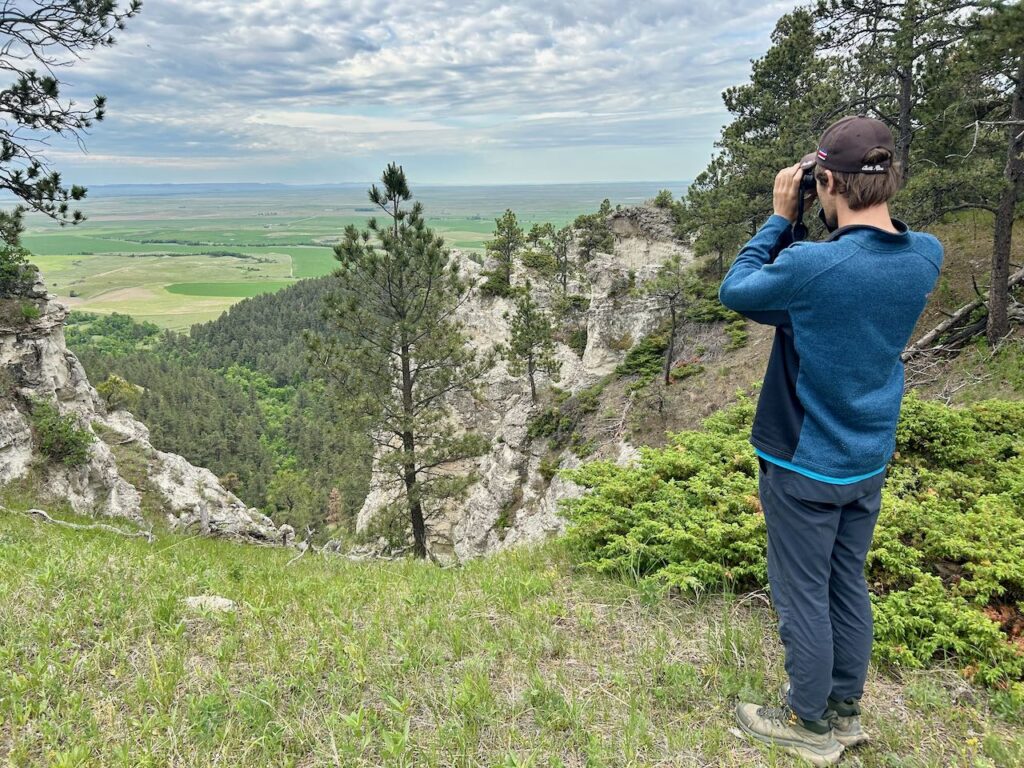
We made our way out of the Ekalaka Hills along a different road than the one we came in on—and are so glad that we did! This route paralleled the top of a dramatic rim that dropped hundreds of feet to the plains below. As we drove, we experienced a wealth of warblers, nuthatches, Mountain Bluebirds, wrens, and other songbirds. I wasn’t quite satisfied with our view, though, so I told Braden, “Pull over. I want to walk to the edge.”

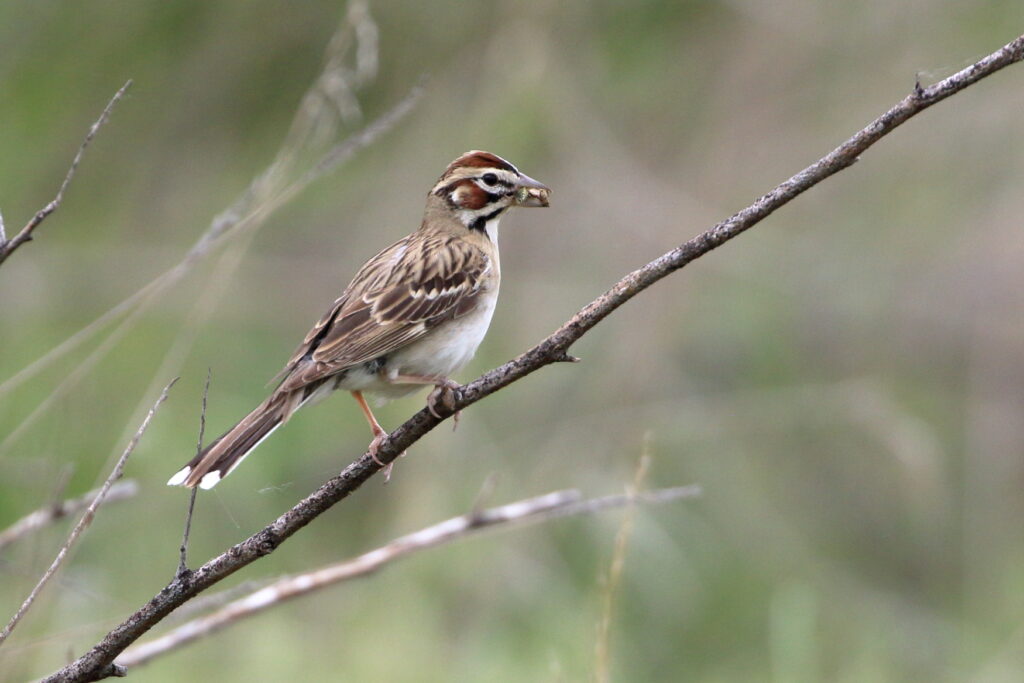
I will never get tired of watching and photographing Lark Sparrows, but this one along the Ekalaka Hills rim was especially cooperative!

Even as I approached the rim, I could see White-throated Swifts and Violet-green Swallows working the cliffs, and once we got there we experienced breathtaking views, perhaps all the way to South Dakota . Then I saw the bird I especially had been hoping for. “Braden!” I called. “Prairie Falcon!”

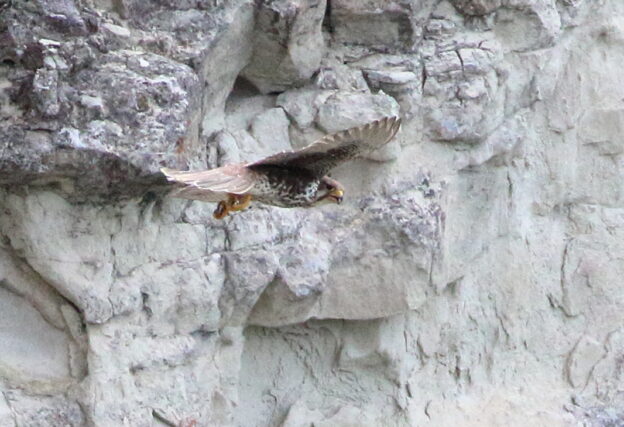
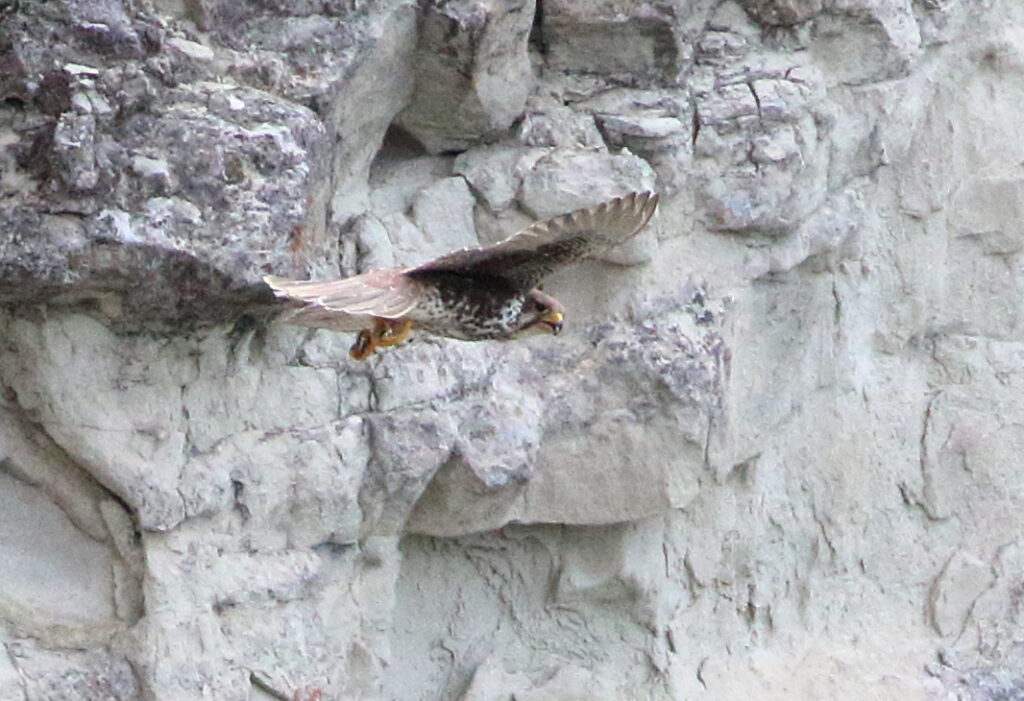
The cliffs on the south side of the Ekalaka Hills gave us our best-ever experience watching Prairie Falcons hunting.

This was a bird we had wanted to see the entire trip, but never dreamed of seeing in such dramatic circumstances. Braden hurried over to join me and we watched as this powerful, brown-backed bird deftly cut through the skies in front of us. “Wait. There’s a second one,” I said. “You’re right,” Braden exclaimed.

We spent a full ten or fifteen minutes enjoying the prowess of these magnificent hunters, and it made both of us feel good to know that the pair was undoubtedly nesting in a perfect place for them. Alas, we still had some serious goals ahead of us that day, so we reluctantly said goodbye and continued on our way.

Braden watching the Prairie Falcons performing their acrobatic flights along the Ekalaka Hills rim.

As mentioned in our last few posts, we began our trip needing to bird seven Montana counties to totally fill in our Montana eBird map. In the past week we had knocked off Daniels, Prairie, Wibaux, Fallon, and Carter Counties (see our last post, “Adventures in Ekalaka”). Today we faced the final two: Powder and Treasure Counties. The first proved easy. Driving twenty or so miles south of the Ekalaka Hills, we cut SW along a well-maintained dirt road to Hwy 212 and then turned NW. Eight miles later, we crossed into Powder River County, and immediately began picking up Mourning Doves, Eastern and Western Kingbirds, meadowlarks, and other “roadside attractions.” To meet our ten-species minimum, however, we stopped at a small riverside fishing access in Broadus. There, we collected 13 species including Lark Sparrows, Lazuli Buntings, Yellow Warblers, and yet another Red-headed Woodpecker! Continuing on toward Miles City, we left Powder River County with a total of 21 species. Not bad for just passing through!

By the time we reached Miles City, our trip had taken us almost 2,000 miles, and I guess a collective fatigue had caught up with us. “Do you mind if we just find a coffee shop and chill out for a while?” I asked Braden. He was totally agreeable, so we spent an hour or so relaxing in a City Brew I’d frequented while teaching a writing workshop there several years before. It was just what we both needed. More important, it prepared us for our last lifetime Montana county!

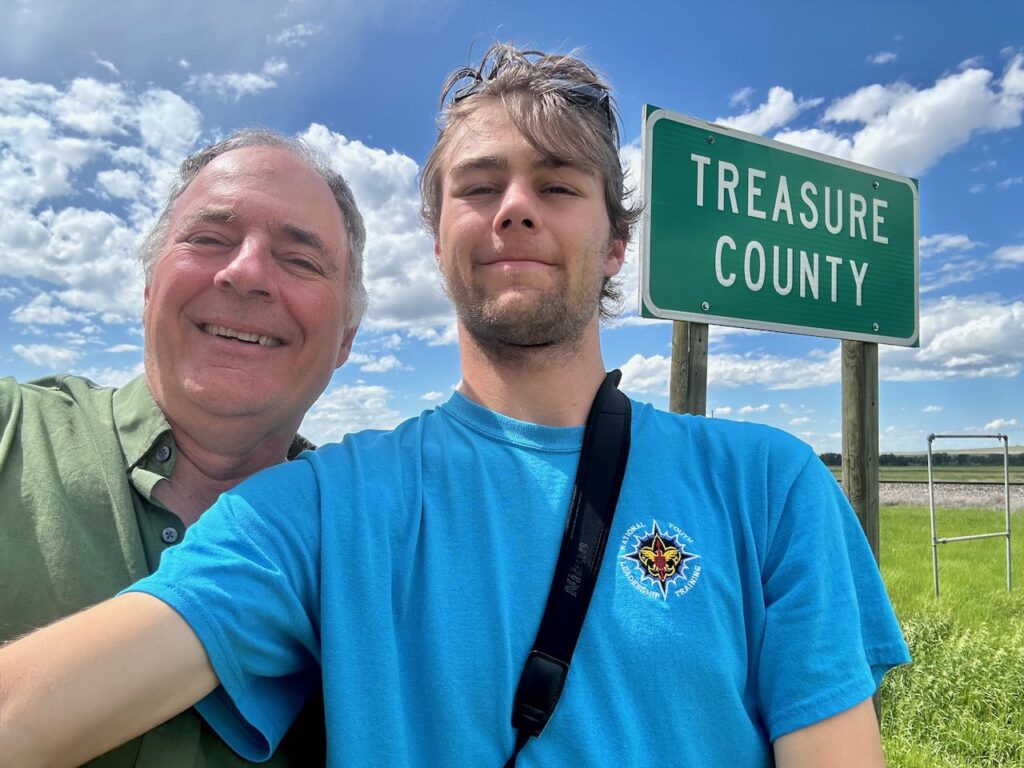
We did it! Our very last county we birded in Montana. And it only took us 11 years!

To reach Treasure County, we tooled down I-94 to the town of Forsyth, and then paralleled the Yellowstone River, driving west. About fifteen minutes later, we reached a sign marking the county line! We, of course, got out to immortalize the moment with our phone cameras, but even posing next to the sign we could hear and see Red-winged Blackbirds, a Western Meadowlark, and four or five other birds. We continued driving until we encountered a likely dirt road leading off to the north. We intended to try to reach the Yellowstone River, but found a promising thicket right before the road crossed some railroad tracks. “Let’s stop here,” I said.

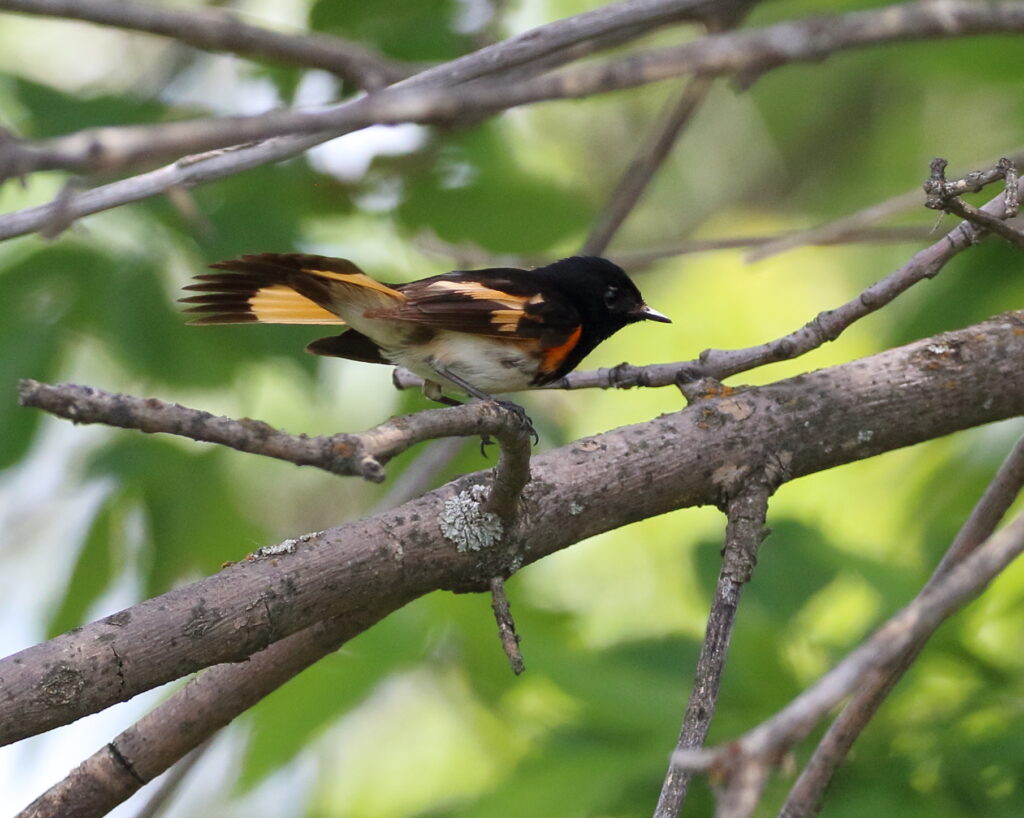
Immediately, we were rewarded with a Lazuli Bunting, American Goldfinch, Yellow Warbler, Yellow-breasted Chat and other birds. The stars? A pair of American Redstarts that landed right in front of us, posing beautifully. Unlike with the Plumbeous Vireo (see our last post), I was prepared this time and took what may be my best American Redstart photos ever! Braden and I delighted in watching these birds for more than a minute before they flitted off into the thicket. But one more Treasure County surprise lay in wait.

One of our best looks ever at American Redstarts, this warbler was our reward for completing our mission to bird every Montana county!

Driving a bit farther, looking for a place to turn around, we headed left down a dirt road. “Uh, this looks like a driveway to that farm over there,” I said, but right then we both saw it—yet another Red-headed Woodpecker! (See our last post.)

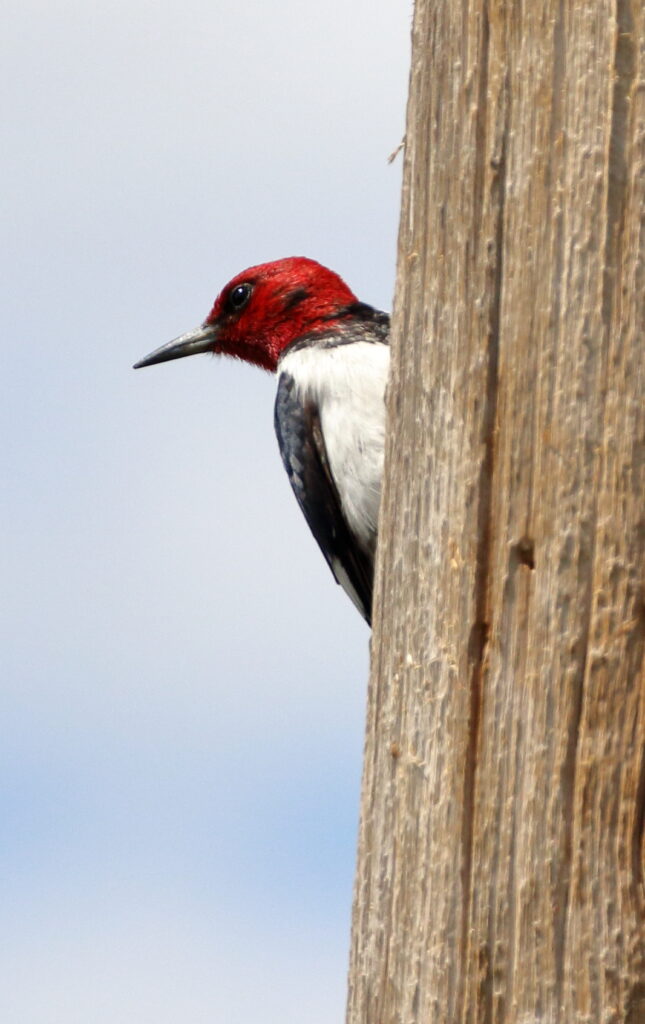
I, of course, climbed out to try to get a decent photo since none of the other RHWOs had cooperated on the trip. This one, fortunately, did—more or less—peaking out behind a telephone pole. It was a great way not only to wrap up our Treasure County list (21 species total), but to punctuate the completion of our goal of birding every county in the vastness of Montana.

This Red-headed Woodpecker both surprised and delighted us when we pulled over to pad our Treasure County list—our last Montana county to fill in our eBird map!

Our Eastern Montana adventure was far from over. It would take us on a wonderful adventure to a private ranch, back to perhaps my favorite Montana place to bird (see our post Bear Canyon—Montana’s “Tropical Birding” Paradise), and above ten thousand feet to witness the enchanting lives of Black Rosy-finches. Rather than blog about these last adventures, though, I’ve decided to write a book, so you’ll just have to be patient. Braden and I hope that you’ve enjoyed these posts, however, and rest assured, we have enjoyed sharing them with you. Please be sure to share, and if you’d like to support FatherSonBirding, consider purchasing new copies of some of Sneed’s books. Speaking of that, his long-awaited new adult book, Birding for Boomers, is now available for pre-order. Don’t be shy. Click on the cover below now!

Trip Stats:

Total Species Observed: 203 (from a goal of 185)

Total eBird checklists: 209

New Montana Life Birds: 5 + 1 (Broad-tailed Hummingbird, Broad-winged Hawk, Least Tern, Eastern Bluebird, Black Rosy-Finch plus—for Braden—Piping Plover)

Miles Driven: 2,482

Our eBird Trip Report: https://ebird.org/tripreport/246744

More than a decade in the making (sort of), my newest adult book, BIRDING FOR BOOMERS, will be available on September 1st—but you can order it now by clicking on the cover above!

Wedding Birding in Washington State, Part II

Braden and I write FatherSonBirding in the hopes of sharing the wonders of birds and birding, and the urgency to protect them. We do not accept advertising or donations, but if you’d like to support our work, please consider buying *NEW* copies of some of Sneed’s books—First-Time Japan, for instance, or my forthcoming picture book for younger readers, Like No Other: Earth’s Coolest One-of-a-Kind Creatures, available for pre-order now. We appreciate your interest and hope you will keep reading!

In case you missed Wedding Birding Part I, click here!

Saturday was the long-anticipated wedding day of our friends, Jazz and Brad, but the Big Event wasn’t kicking off until 3:30 p.m. True to my recent trend, I awoke at 3:30 a.m. with ample time to hit the birding spot that I most looked forward to on the trip: March Point. Why? Because I thought it might offer my best opportunity to find both seabirds and shorebirds. Looking at a map, in fact, March Point looked like a wonderful, natural area and I was already envisioning pristine beaches and offshore waters loaded with birds. Imagine my surprise when I arrived at 6:00 a.m. to find that March Point is actually the site of a gigantic Marathon Petroleum refinery!

March Point was not quite the undisturbed natural area I was expecting!

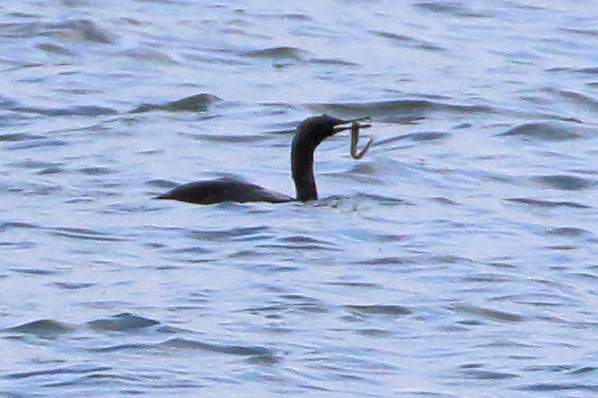
It was a cold, blustery morning, but undeterred, I pulled over and scanned the offshore waters. I spotted several groups of presumed Pelagic Cormorants, but precious little else on the waters or the shore. With some persistence, I did locate another Pigeon Guillemot out near the ginormous pier jutting out into Puget Sound, but it was slim pickins.

What do you suppose this Pelagic Cormorant is about to eat? I’m guessing an eel-like fish called a wrasse!

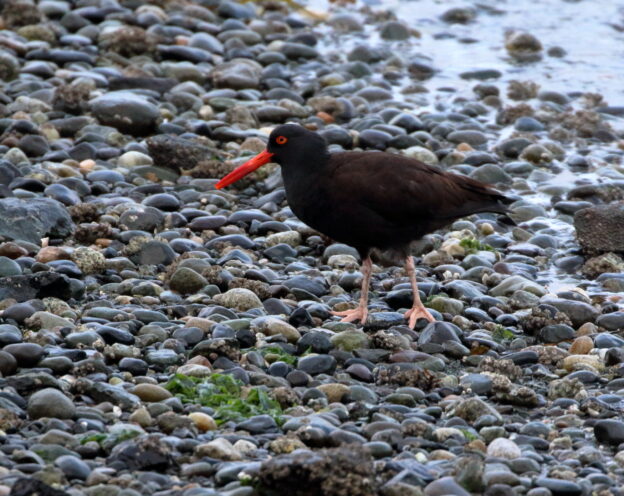
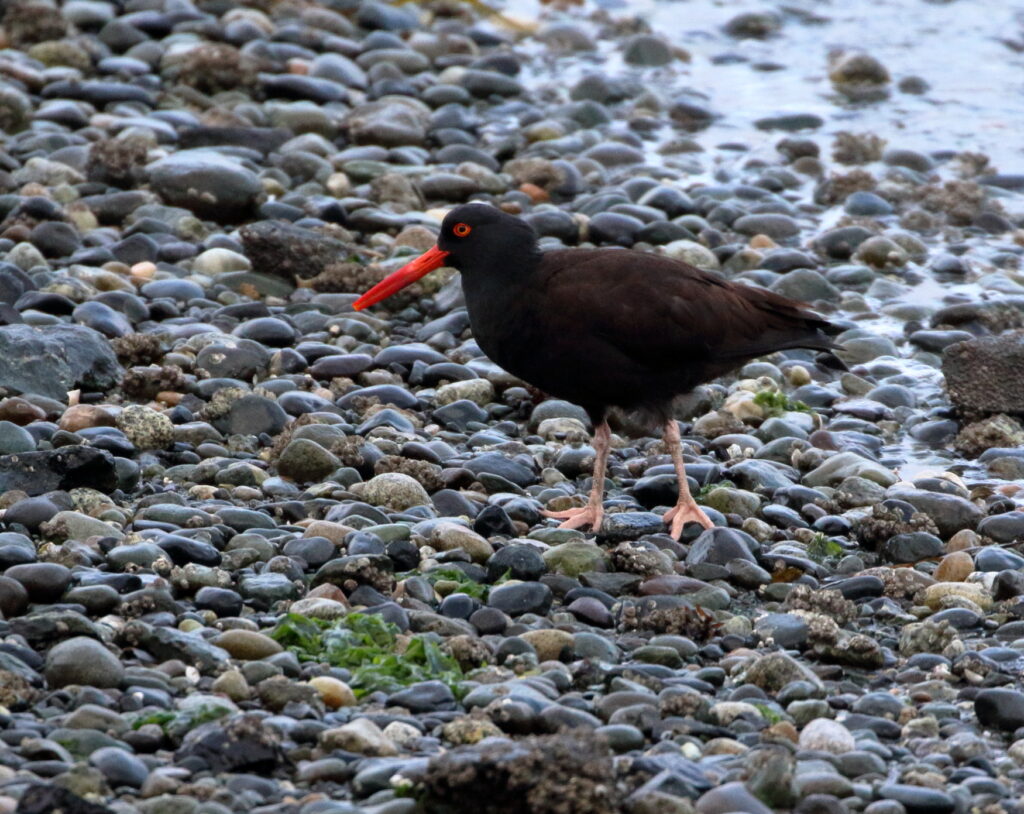
I kept driving, pulling over now and then to scan the shore—no doubt closely monitored by the refinery’s security team. Finally, at one pull-out, I spotted a bird near the top of my trip wish list: a Black Oystercatcher. I watched this magnificent bird from my car for several minutes before it flew off, leaving a smile on my face.

This Black Oystercatcher at March Point definitely strolled into contention for “Trip Bird” honors for our Wedding Day weekend.

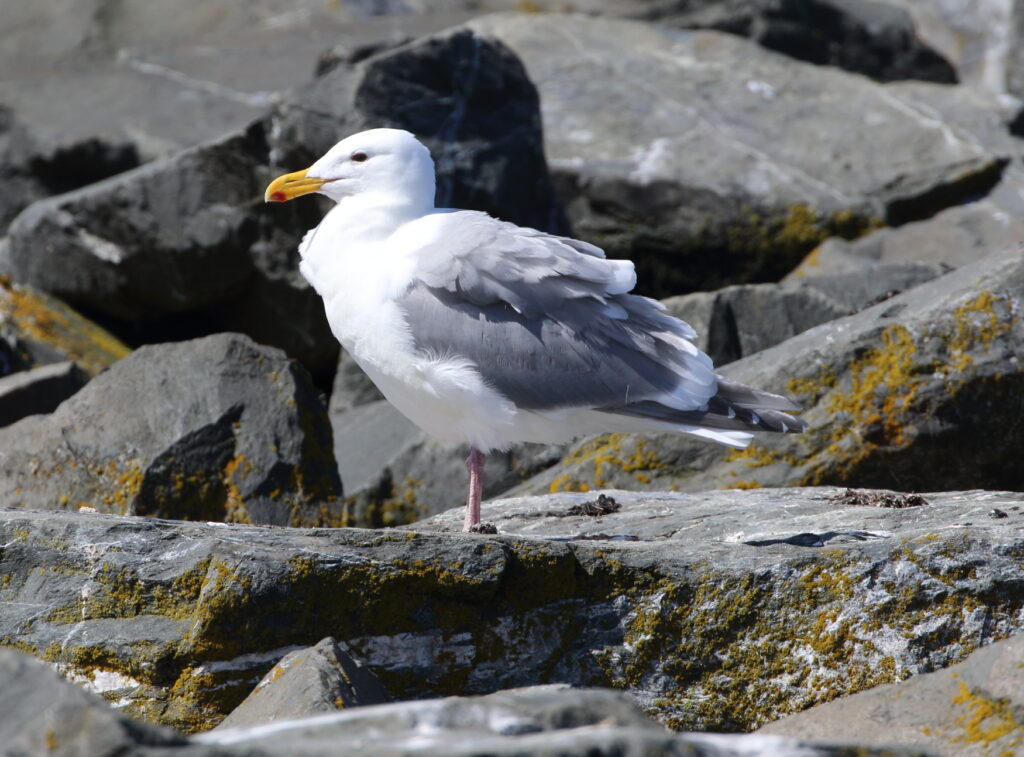
Turning around, I made my way back around immense oil storage tanks and stopped to study some Glaucous-winged X Western hybrid gulls. It took some research and a discussion with Braden to figure out exactly what these gulls were. Glaucous-winged Gulls are known for beautiful soft gray wings and wing tips, but all of the gulls I was seeing looked too dark—yet not dark enough to be Western Gulls. According to Braden, though, this part of Washington State was dead center in the transition zone between the two species, and accordingly, most of the birds were hybrids.

This Glaucous-winged X Western hybrid gull is typical of the gulls I saw during our entire trip to Washington: too dark for Glaucous-winged, too light for Western. Very educational!

On my way back to the hotel, I stopped at Padilla Bay at the base of March Point for a nice visit with some warblers and swallows. There, I heard my year’s first Black-headed Grosbeak giving off its frenetic robin-like song. Then, it was back to Burlington to prepare for the wedding.

The wedding was a smash hit, full of love and music and joy. And never fear, dear readers, I did amass an eBird list of six species at the wedding venue, including the year’s first look at a Black-headed Grosbeak, singing in celebration of Jazz and Brad’s big day. Oh, and they (Jazz and Brad, not the grosbeaks) served Thai food at the wedding. How good is that???

Alas, the next day, we were due to return to Seattle for our flight home. Fortunately, we didn’t need to be at the airport until noon or one o’clock, leaving time for one last morning birding adventure. I really wasn’t sure where I should go. I wasn’t having much luck along the coast, and felt I’d seen most of the forest birds that interested me. But there were two more species I wanted to take a shot at: Black-throated Gray Warbler and Red-breasted Sapsucker.

Ted Reep Park offered the trip’s last birding opportunity—and my best shot at seeing both Red-breasted Sapsuckers and Black-throated Gray Warblers. A bit of bush-whacking required!

It had been years since I’d seen either one of these birds and, well, I was missing them. Lucky me, eBird showed a spot only a mile from our hotel which had recorded both birds in the past month. I wasn’t sure what my chances of finding them might be, but after a quick bowl of oatmeal, I made my way over to Ted Reep Park. I parked in the deserted YMCA lot, despite warning signs threatening that I would be towed. After all, I was a member of the Missoula YMCA!

From the time I pulled up, the spot looked—or rather, sounded—promising. Merlin’s Sound ID immediately picked up White-crowned Sparrow, Black-headed Grosbeak, Warbling Vireo, Song Sparrow, Yellow Warbler, and more, and I soon started seeing some of these birds.

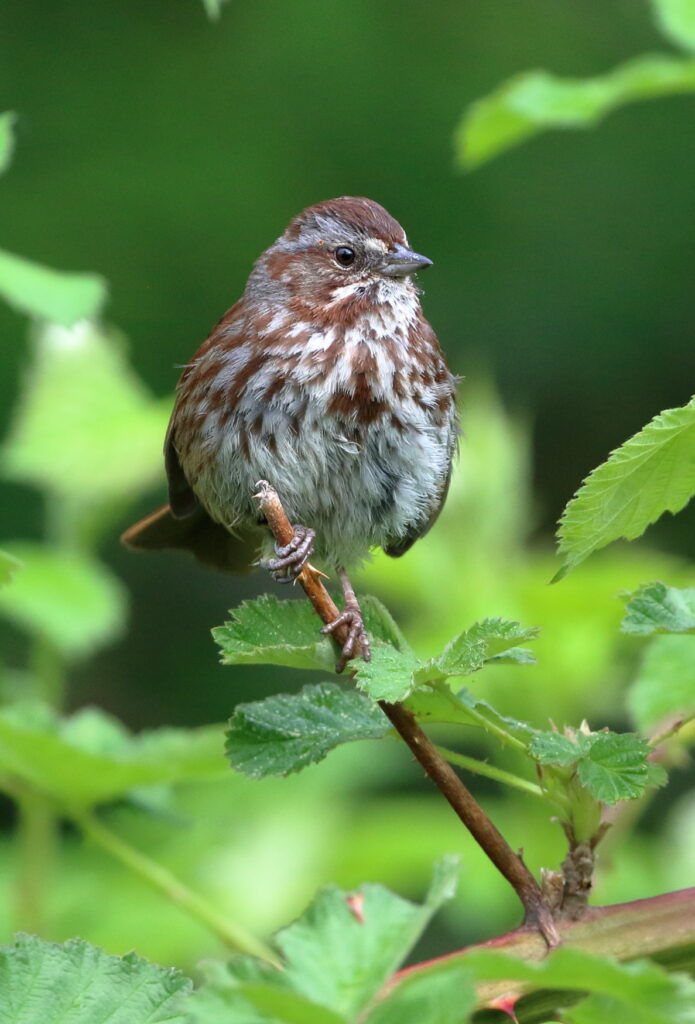
You just gotta love Song Sparrows. Not only are they incredibly handsome critters, they often pose for close-up photographs!

This was thick riparian habitat, however, where visuals were hard to come by and most birding was by ear—not ideal for someone like myself with hearing disabilities and a brain that had trouble remembering bird vocalizations. My new hearing aids were a vast improvement over my old ones, though, and with the help of Sound ID I began teasing out most of the species around me. Then, I heard something that got me really excited: a stuttering drumming sound, like a car having trouble starting up! A sapsucker! But which one?

A quick look at my Sibley app told me that Red-breasted was the only sapsucker remotely likely to be in this area, so I plunged into the woods, following the trail toward the stutter-step drumming. Predictably, the trail grew more and more sketchy, and I soon found myself crawling under and over logs that had fallen across the path. Nevertheless, after five minutes, I found myself standing directly beneath the sapsucker drumming.

There were at least two sapsuckers—but probably three or four—and it became evident that they were dueling, perhaps over territories or mates. But darn it, try as I might, I could not spot any of them against the backlit tree trunks and branches! Just as frustrating, the birds kept moving around, so like a Keystone Cop I chased the birds up and down the trail. Finally, I despaired of getting a look at any of them, but by now I at least was confident that these were indeed Red-breasted Sapsuckers. And wouldn’t you know, as soon as I decided that, two of the birds chased each other right by me, their red heads clearly visible even in the dark forest!

Happy, I bushwhacked through raspberry vines and a swath of chest-high grass until I ran into another trail that led me back toward my car. I still hadn’t seen a Black-throated Gray Warbler, and didn’t find one on the hike back, but I was delighted to have discovered such a wonderful birding spot. It again reaffirmed how important it is to protect natural habitats for animals and people. Bravo Washington for protecting places like Ted Reep Park!

Washington Wedding Trip Report!

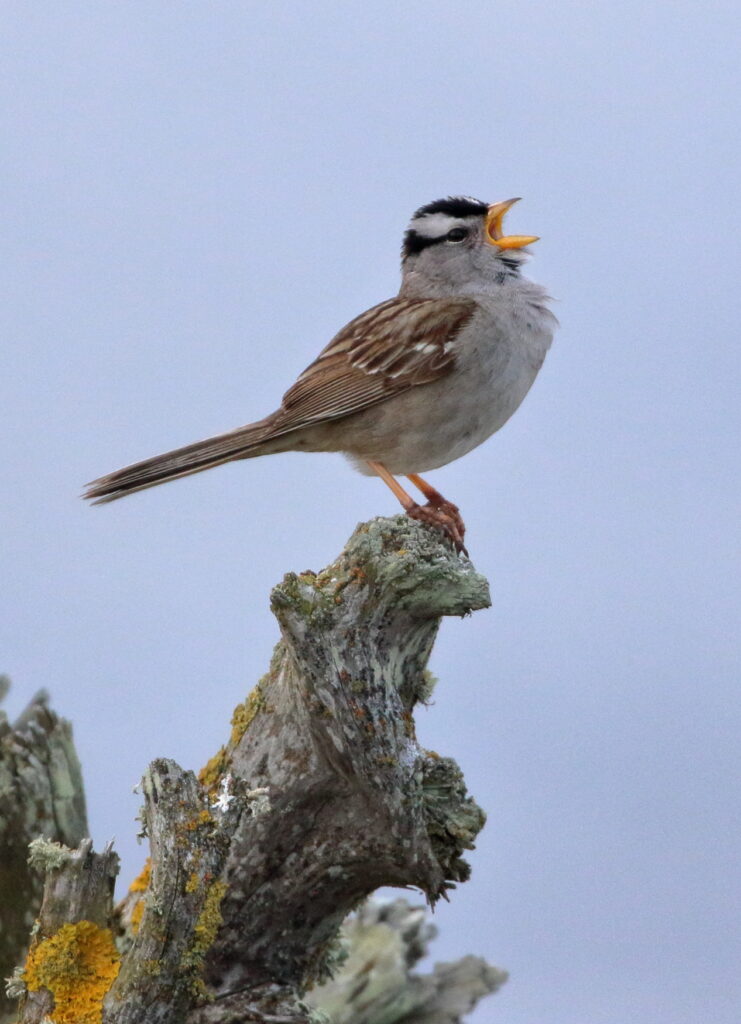
I failed to capture any photos of the Red-breasted Sapsuckers, but just love this White-crowned Sparrow’s pose out at March Point. I think he’s singing “Once we all wean ourselves off of fossil fuels, we can turn this place back into the natural habitat it is meant to be!” At least that’s what Google Translate came up with.

Wedding Birding in Washington State, Part I

Braden and I write FatherSonBirding in the hopes of sharing the wonders of birds and birding, and the urgency to protect them. We do not accept advertising or donations, but if you’d like to support our work, please consider buying *NEW* copies of some of Sneed’s books—First-Time Japan, for instance, or my forthcoming picture book for younger readers, Like No Other: Earth’s Coolest One-of-a-Kind Creatures, available for pre-order now. We appreciate your interest and hope you will keep reading!

If you’ve followed our adventures for a while, you probably realize that Braden and I are opportunistic birders. Sure, we take occasional trips solely for the purpose of birding, but more often we exploit other travel opportunities in the pursuit of our birding passions. This piggy-backing not only reduces our carbon footprints relative to taking dedicated birding trips, it provides cheaper ways to bird places we never would have imagined. Last weekend, for instance, Braden was invited by the nonprofit group Defenders of Wildlife to Washington, D.C., to speak with Maine’s Congressional delegation about the importance of safeguarding and improving the Endangered Species Act—one of the most important pieces of conservation legislation ever enacted in this country. While there, he birded the National Mall, the botanical gardens, and several other places. As Braden winged his way back to Missoula, Amy and I headed to the “other Washington,” Washington State.

Amy and I enjoying the Edmonds waterfront before the big wedding event. You may see some clues that I was also looking hard for seabirds!

We flew to Washington to attend the wedding of the youngest daughter of some of our dearest friends, the Isaacsons, and as we were planning the trip, I have to admit that birding didn’t enter my mind. Shocking, huh? As the date approached, however, I realized I might be able to sneak in a couple of birding outings. Then, as I remembered Amy’s penchant for sleeping in and realized how busy our friends would be preparing for the wedding, I recognized that I might be able to sneak in more than one or two birding sessions; I might be able to hit quite a few different places! I set several goals for myself:

* Bird new places I’d never birded before.

* Find as many seabirds and shorebirds as possible.

* Pick up some songbird targets I rarely got to see.

* Avoid getting killed in Seattle’s traffic.

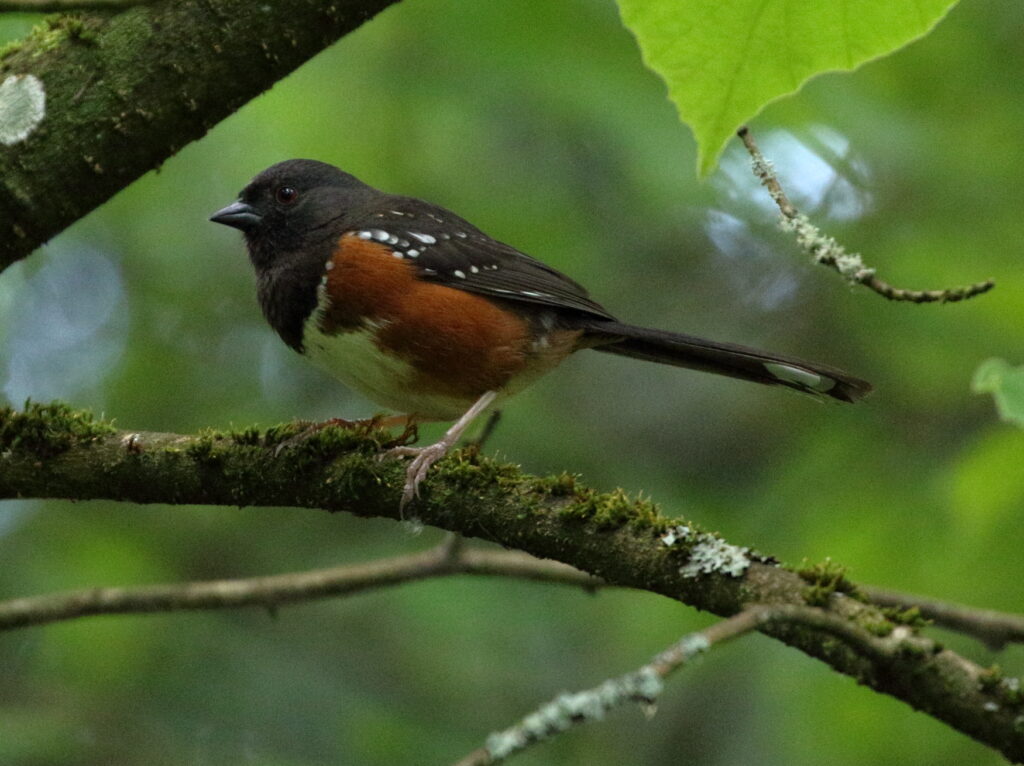
Although short of waterfowl and shorebirds, Washington Park Arboretum offered a nice urban birding location to see a variety of songbirds including this Spotted Towhee.

We spent our first night in Seattle, and the next morning I woke at 5:30 and made my way to the Washington Park Arboretum, which seemed to have habitat for both songbirds and waterfowl. Here, I made a disappointing discovery—waterfowl and shorebirds had pretty much fled coastal Washington for breeding areas farther north. Bummer, right? I mean, I kind of suspected as much since many of these birds had already passed through or arrived in Montana, but I guess I was hoping to run into a few. On the plus side, I found songbirds aplenty and enjoyed seeing my first Western Tanagers of the year and hearing my first Western Flycatcher—which led to the observation that migrating songbirds probably reach Washington a week or two ahead of Montana.

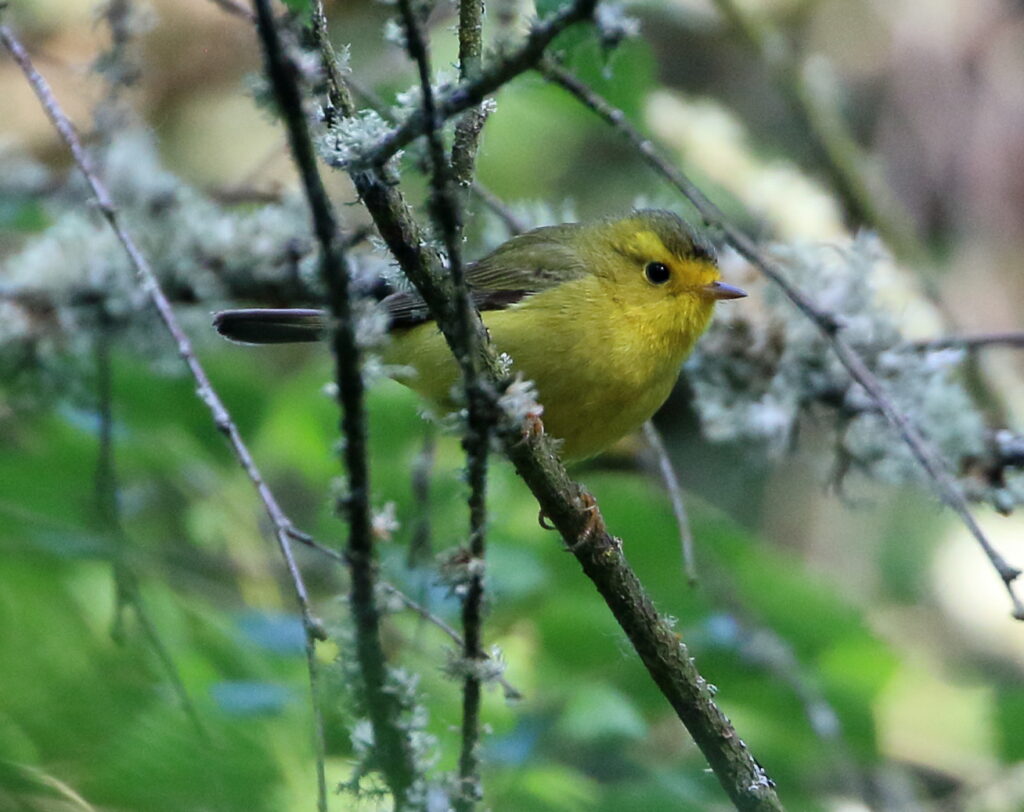
I’m a sucker for Wilson’s Warblers, which can be hard to find in Montana, and our wedding trip offered several good looks at them.

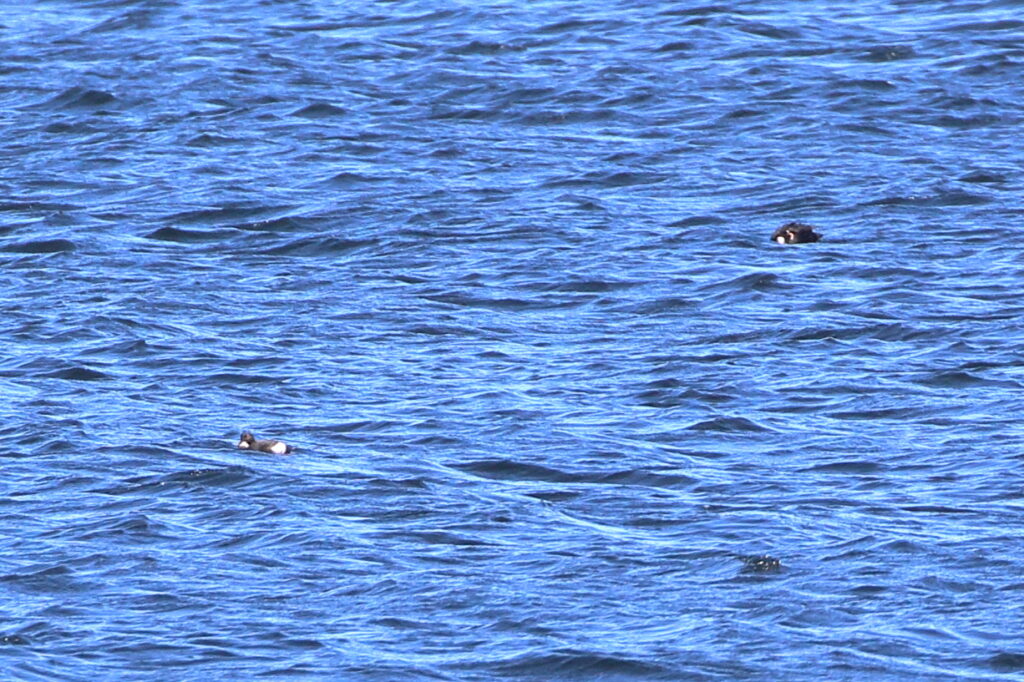
After collecting Amy and checking out of our hotel, we decided to explore Edmonds, twenty minutes away. Edmonds is a cute little town where the ferry to Kingston departs, but we mostly wanted to poke around looking for coffee shops, bookstores, and other items of interest—including birds. Alas, as we walked along the waterfront area, the waters of Puget Sound looked disappointingly empty. I spotted a few Pelagic Cormorants and hybrid Glaucous-winged X Western gulls, but none of the big rafts of scoters and pelagic species I had hoped for. Nonetheless, I stood on a little rocky viewpoint and carefully scoured the choppy seas with binoculars, wishing I had a proper spotting scope. Suddenly, I saw a black bird with a white head patch and orange-and-white bill about a quarter mile offshore. Surf Scoter! my brain shouted, but I immediately lost it in the chop. As I tried to “reacquire” my target, however, I saw a black bird that looked much different. This one had no colored bill that I could see, but did have a prominent white patch on its flanks. My heart soared as I recognized one of the birds I had most hoped to encounter on the trip: Pigeon Guillemot! Hooray! Ten minutes later, I got a bonus PIGU on the other side of the ferry dock—a perfect reward for my perseverance.

Without a spotting scope, I had to work hard to locate these two dark birds offshore. Can you identify them? The upper-right bird is a Surf Scoter (at the moment hiding its head), and the lower left bird is one of my favorite pelagic species, a Pigeon Guillemot.
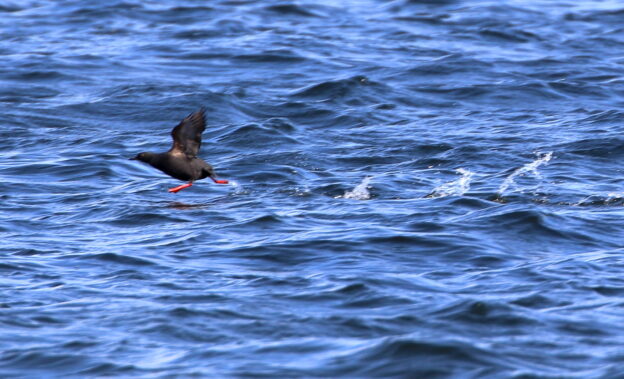
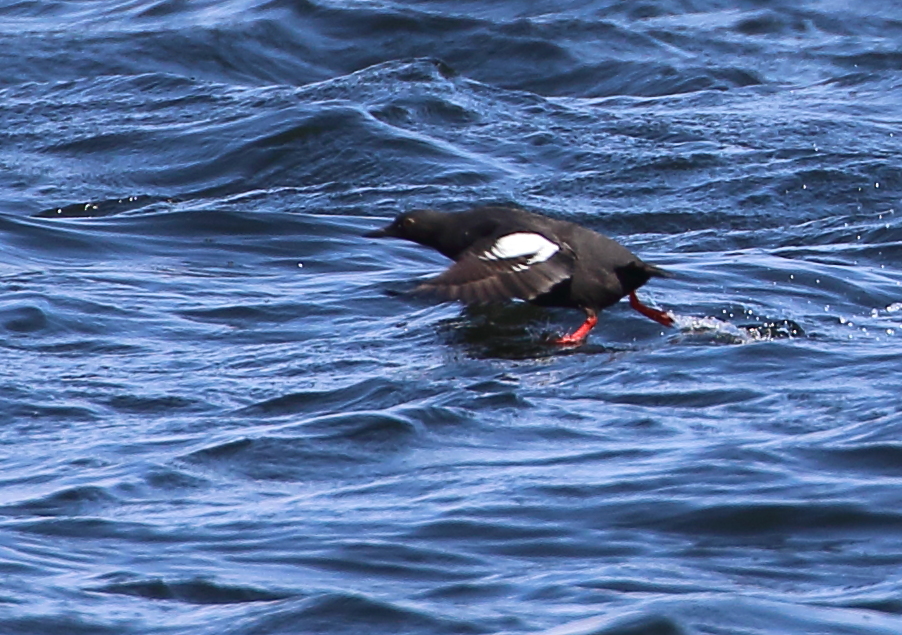
Not the best photo, but it does show the Pigeon Guillemot’s distinctive white wing patch as this bird prepares to take off.

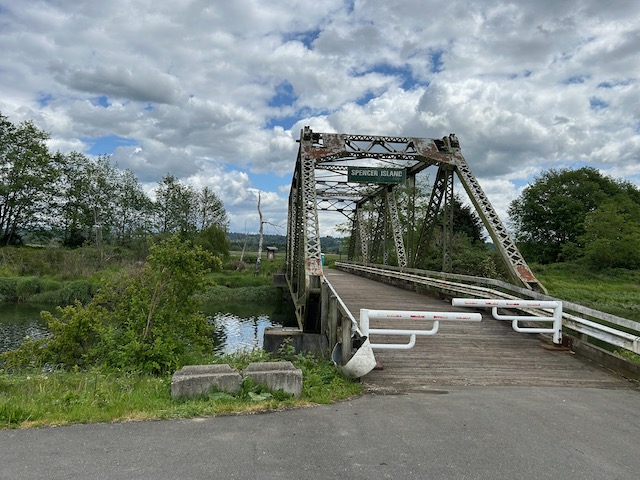
The wedding was to be held up near Burlington, Washington, and on the drive up I convinced Amy to stop at another place I had driven by many times but never visited. I wasn’t even sure what it was called, but at various times of year I had seen dozens of ducks spread out across big ponds there. A little research revealed that it was Spencer Island, site of both sewage treatment settling ponds and some restored natural wetland areas. Thank god for Google Maps, because it required quite a convoluted route to reach it off of the freeway.

Spencer Island was a challenge to get to, but undoubtedly offers some incredible “water birding” during winter and migration seasons. During our visit, it was the songbirds that put on a show.

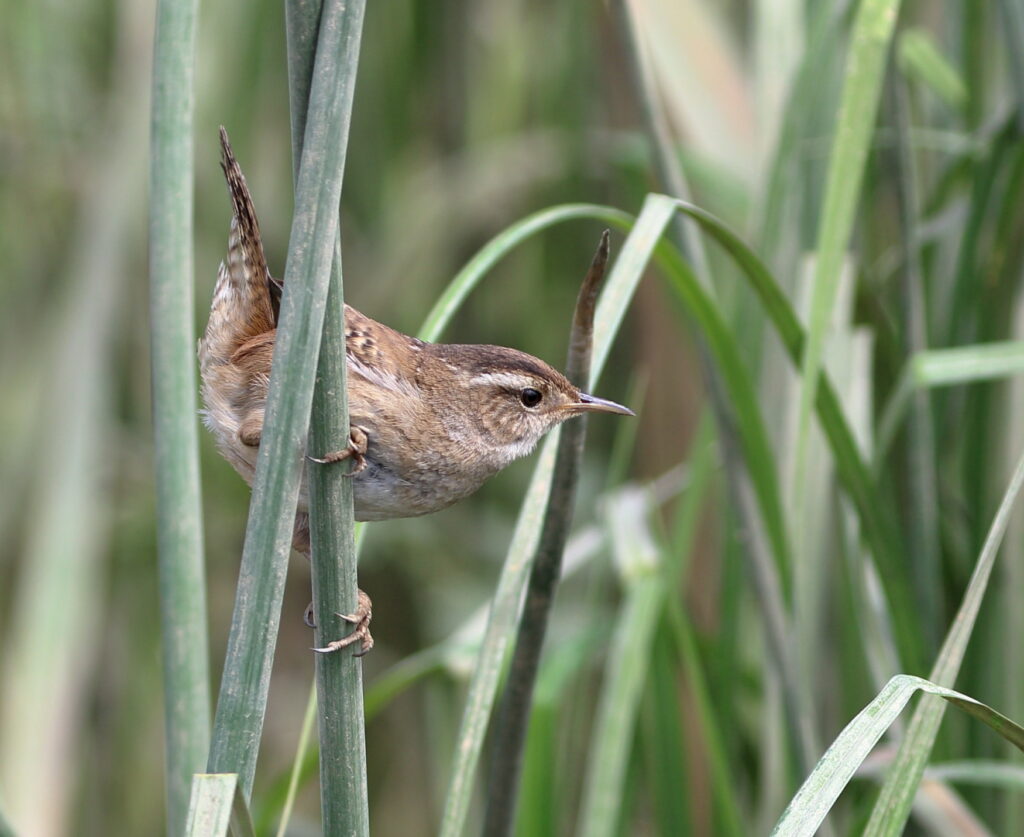
Alas, here as elsewhere, most of the water birds had fled, but a short walk did net us my best look ever at Marsh Wrens, along with glimpses of Anna’s Hummingbirds, which are rare in Montana. However, I encountered my biggest score as we were driving out. I had the window rolled down, when I heard a distinctive “kiddick-kiddick!” from the marsh to our left. In previous years, I doubt I would have even noted it, but one of the great things about birding is that the longer you live, the more experience you acquire, and this time, I knew what it was: a Virginia Rail! My third one of the year already, which is quite astonishing given that Braden have spent entire years never seeing or hearing one at all.

Spencer Island offered only a few waterfowl, but did provide my best-ever Marsh Wren experience along with the year’s third Virginia Rail.

From Spencer Island, my early day was catching up with me, so Amy and I headed straight to our hotel in Burlington for a pleasant afternoon eating Mexican food, reading, and enjoying being on holiday. The wedding was the next day and we looked forward to that. Unbeknownst to moi, however, the trip’s best birding also lay ahead . . .

Stay tuned for Part II on Friday!

Untangling Birdsong with Merlin’s Sound ID

Braden and I write FatherSonBirding in the hopes of sharing the wonders of birds and birding, and the urgency to protect them. We do not accept advertising or donations, but if you’d like to support our work, please consider buying *NEW* copies of some of Sneed’s books—First-Time Japan, for instance, or my picture book for younger readers, Birds of Every Color. We appreciate your interest and hope you will keep reading!

The birds are back! Well, at least a lot of them. Last weekend, our dog Lola and I hiked our favorite four-mile loop from our house up to a ridge called the Mount Jumbo Saddle and then back down past what has become my favorite “bird thicket” in Missoula. We first began hiking this route when I was training to take Braden’s scouting troop to Philmont Scout Camp in 2019. Honestly, Lola isn’t crazy about the route since she hates loud noises and we often hear guns firing from a range a couple of miles away. I keep making her do it, though, because I’ve discovered that it’s a great way to keep up with the neighborhood bird community, especially in spring. The past couple of years, I’ve tried to do this route on a regular basis, carefully recording new arrivals and learning more about their migration patterns.

The past couple of years, Lola and I have regularly hiked up to Mount Jumbo Saddle and back to check in on which birds are currently in residence. Lola likes the route except for the gunshots she hears from east Missoula!

Songbird migration builds slowly here in Montana. This year in late March, I noted the first Western Meadowlarks, Western Bluebirds, and Spotted Towhees on the route—but four weeks later, April 21, not much had changed. Two weeks after that—yesterday—the dam broke. I set off up the hill hoping to see perhaps the year’s first Vesper Sparrows, but quickly discovered that new arrivals were spouting off everywhere I turned. It began halfway up Jumbo Saddle when I heard a song that reminded me of a Western Meadowlark and I guessed that it was my season’s first Vesper Sparrow. The problem? I didn’t know for sure—a situation faced by millions of birders who have not, or cannot, learn more than a few bird vocalizations.

In our neck of the woods, Spotted Towhees are among the earliest spring songbird migrants. Fortunately, their weird “bouncing ball” rattle is easy to pick out.

What to do?

In the past couple of years, I have developed a strategy for dealing with these situations—one that might help you, too. It used to be that when you heard a song or call that you couldn’t identify, one’s options were limited. You could just guess, and play various bird calls on your app, hoping to land on the right one. You could record the call and play it back to an expert. More often, you’d try to follow the song and get a visual on the bird to see what it was. Unfortunately, all of these methods are slow and cumbersome, and in spring, well, there are just too many vocalizations to keep up with.

And then along came Merlin’s Sound ID feature.

Sound ID is (almost) every birder’s dream. You simply tap a button on the Merlin phone app and it begins recording and identifying the songs and calls around you in real time. The app is not infallible. You have to be fairly close to birds for it to pick up and identify them, and the app has difficulty handling background noises such as wind, rushing streams, and cars roaring by on a freeway. The app also makes mistakes. Starlings, mockingbirds, and Steller’s Jays can fool it with their imitations of other birds. If the app only picks up part of a call, it sometimes can mistake one bird for another. The bottom line: you should never use the app alone to identify a bird.

So how do you make proper use of it? I employ it in two ways.

Strategy One: Confirmation

The first is to confirm a song or call that I may be somewhat familiar with—but am not 100% sure about. The putative Vesper Sparrow in the second paragraph is a perfect example. In past years, I had learned that a Vesper Sparrow kind of sounds like the call of a Western Meadowlark—but a bit simpler and cruder. When I heard a “somewhat meadowlark” call near Mount Jumbo Saddle, I immediately thought “Vesper Sparrow” but couldn’t be sure, so I started Sound ID. Sure enough, the song lit up as Vesper Sparrow. Other things made me confident about this ID, too. The timing was right from previous years. Most important, I was standing in perfect Vesper Sparrow habitat—open meadows with tall grass and scattered perching shrubs.

The arrival of Vesper Sparrows is a cause célèbre for Braden and me. I always need to confirm its meadowlark-like song, however.

As my hike continued, in fact, I used Sound ID to confirm several other birds in this way, including Steller’s Jay and the year’s first Chipping Sparrows and Yellow-rumped Warblers. Things were about to get more challenging, however.

Strategy Two: Possible Presence

Not long after hearing my first (and second, third, and fourth) Vesper Sparrow, I reached a nice brushy area where Braden and I have heard Orange-crowned Warblers in previous years. Unfortunately for me, I have a very difficult time distinguishing one warbler song from another. I usually recognize Yellow-rumped Warblers when they first show up, but as other species arrive they plunge me into, in the words of Sir Topham Hatt, “confusion and delay.” This morning, I could hear what sounded like warblers—but I didn’t know which ones.

Again, Sound ID comes in very useful in these situations because it can give you an idea of what to look for. I started a new recording and the app failed to come up with any Orange-crowned Warblers. It did, however, identify Yellow-rumped, Yellow, and most exciting, Nashville Warblers! I did not log any of these on eBird, however—not right away. Because I am not good with warbler songs, I needed to confirm these in at least one or two other ways.

Once the Orange-crowned Warblers arrive, I know I’m in for a real challenge to start distinguishing different warblers by song. That’s when I lean heavily on Sound ID.

One is to compare what you are hearing with known recordings on other apps. If what you are hearing is identical to vocalizations in the Merlin sound library or on the Sibley app, depending on your experience, I feel confident that you can go ahead and record the bird—again keeping in mind the caveat that some birds imitate others.

Still, I only do this when I am really sure the two songs are the same—understanding that bird songs from the same species can vary tremendously. If I have any doubts, I wait to log a bird on eBird until I have confirmed it with a visual sighting or by running it past an expert. With this technique, Sound ID isn’t cinching the identification for me, but it is helping me a lot by giving me a better idea of what to look for.

This morning, however, I could not find any of the three warblers in the first thicket, so Lola and I kept hiking. Ten minutes later, I spotted a Yellow-rumped Warbler in a tree—and recorded it—but it was the Nashville Warbler I was really after.

Lincoln’s Sparrows are hands-down one of my and Braden’s favorite songbirds. Unlike the warblers, they also seem kind of curious and make themselves for visible to the eager birder.

Eventually, I came to another thicket, and here I was thrilled to see my first Lincoln’s Sparrow of the year. Just as enticing, I also was hearing warbler sounds all around me so I turned on Sound ID once again. This time, Orange-crowned and Nashville songs started lighting up Sound ID like a pinball machine. Thanks to the app, I was quickly able to distinguish the two species by ear, and I confirmed these by playing other recordings on the Merlin library. Soon after, I actually saw the birds for myself. Yes! I thought, and finally logged them onto eBird.

Sound ID has helped me find many more Nashville Warblers than when Braden and I first started birding ten years ago.

All together, Lola and I saw eight new first-of-year species on our hike. For several of them, Sound ID not only helped me identify them, it alerted me to look for them in the first place. I want to emphasize, however, that Sound ID is not a substitute for putting in the hours to learn and identify birds yourself. Recently, Cornell has issued friendly cautions not to rely on it as your sole basis for identification. Instead, I consider Sound ID a wonderful “helper tool” that can especially assist beginning birders, as well as more experienced birders like myself who just find it difficult to learn vocalizations. And did I mention the Merlin app (with Sound ID) is free? Cornell Lab, the app’s developer, has generously made it available to anyone who wants it. Even better for our international readers, Cornell Lab is rapidly expanding what the app can identify to countries around the globe. All you need is a phone. Learn more at https://merlin.allaboutbirds.org/.

Checklist 1: https://ebird.org/checklist/S172160962

Checklist 2: https://ebird.org/checklist/S172176329

Birding Barcelona, Part 1: The Urban Core

Since Braden and I started FatherSonBirding in 2018, I’ve posted a lot about birding in the company of Braden (of course) and my daughter, Tessa. You parents, though, may recognize that with growing kids at home it can be difficult to get one-on-one time with your actual spouse. Last week, Amy and I began to rectify this situation with our first couples vacation in seven years. Our destination was a place we had dreamed of visiting for more than a decade—Barcelona, Spain.

It’s no accident that I booked a hotel near what may be Barcelona’s largest urban park.

I admit that Barcelona did not draw me for its birding opportunities. The promise of stunning architecture, great tapas, and practicing my Spanish, though, outweighed any potential avian shortcomings. Nonetheless, it will come as no surprise that I felt determined to scour this remarkable European city for every bird possible. I set a goal of 50 or 60 species for the week. Even more intriguing, my life list stood at 999 species. “Which bird will put me over the top?” I wondered.

I booked us into the Park Hotel, an awesome little place in the historic El Born neighborhood near the Barceloneta Metro Station, the Estacio de Franca train station, the waterfront, and hundreds of uber cool restaurants and shops. I did not admit to Amy that I also booked the place because it sat only a block from one of the city’s largest urban parks, Parc de la Ciutadella. As soon as our plane landed, we bought 5-day Metro passes and rode the subway into town. Emerging from Barceloneta Station, I immediately saw both Rose-ringed and Monk Parakeets noisily flying overhead—and then I spotted a black bird atop a light post. I recognized it right away as my bird #1,000—a Spotless Starling!

Bird 1000! A Spotless Starling! Under FatherSonBirding Rules of Full Disclosure, I am still waiting for someone to tell me that this is actually a European Starling. Apparently, they sometimes also take on this “all black” appearance. If that does turn out to be the case, Yellow-legged Gull will assume Bird #1000 honors!

It wasn’t until the next morning, though, that I seriously plunged into Barcelona birding by rising early and heading over to Ciutadella. It was a glorious, crisp morning and even before I reached the park gates, I noted a procession of parakeets, gulls, magpies, and Western Cattle Egrets flying toward the park. Like many urban parks, Ciutadella has a rather down-trodden, worked-over feel to it. Leaves have been obsessively raked, precluding the development of healthy soil layers (and the insect prey they could produce), and very little mid-sized vegetation exists. Still, I set out optimistically and almost immediately encountered Great Tits, a Eurasian Blue Tit, a European Robin, and my lifer European Serin.

Though I never got a great photo of one, Merlin’s Sound ID picked up European Serins in multiple places I birded. I worried I wouldn’t be able to recognize these as a number of yellowish, stripy, finchy birds live in Catalonia.

Wandering haphazardly, I quickly discovered that the park was the Monk Parakeet capital of Barcelona. Not only did this introduced South American species seem to love roosting and nesting in the palms, many people actually enjoyed feeding them, even early in the morning. This included several people who had pitched their tents in the park and evidently lived there (the tents had been cleared out by the end of the week—perhaps in preparation for a giant convention that was about to descend on the city).

Aaaaaaw! Monk Parakeets in love. Or at least sharing food. Or perhaps trying to peck each other’s eyes out.

I kept picking up birds, though, including Common Chiffchaffs, Eurasian Blackbirds, Eurasian Magpies, Rose-ringed Parakeets and then, an especially exciting discovery—my lifer Sardinian Warblers!

Before the trip, I spent a lot of time learning the differences between Sardinian Warblers (shown here) and Eurasian Blackcaps. Once in the field, it was easy to tell them apart—as long as I managed to get a decent look!

What I hadn’t seen so far were any water features, but crossing under a giant gold-plated monument (the Monòlit a la festa de l’arbre de 1899), I encountered a couple of reflecting ponds. In them, I saw a “must-see” species I had somehow never observed in all of my travels—Graylag Goose! Along with the geese, I got good looks at both Black-headed and much beefier Yellow-legged Gulls. I kept an eye out for Lesser Black-backed Gulls, but could never confirm one the entire week.

https://ebird.org/checklist/S161951923

I scored my lifer Graylag Geese right down the block from our hotel, in Ciutadella park. Note the Black-headed Gulls frolicking in the background.

I ended my session with a surprisingly robust 23 species, but my week of birding Barcelona had just begun. During the next few days, I kept my travel binoculars slung around my neck, birding tourist-jammed city streets as well as any greenery I could find. I spotted my only Eurasian Jackdaw in a tree on the well-known avenue, Passeig de Gracia. I was delighted to discover a flock of 20 adorable introduced (and lifer) Common Waxbills in the Placa de Gaudi, right across the street from the modern wonder, Sagrada Familia. (This cathedral, designed by the brilliant Catalan architect Antoni Gaudí, is reason enough to visit Barcelona!) I finally saw the trip’s first European Greenfinches and Long-tailed Tits in the marvellous Parc Güell—one of the city’s better urban birding places and another great place to see Gaudí’s handiwork. My best urban birding opportunity, though, still lay ahead.

Though Common Waxbills are species introduced from Africa, I was thoroughly enchanted by these little “red bandits” when I encountered them across from Sagrada Familia (phone photo).

On our fourth day in Barcelona, we caught the H14 bus to the Parel-lel Metro station, but instead of boarding the Metro, we rode the funicular up the hill to Montjuïc, a prominent mini-mountain overlooking the city’s southern area. Only a couple of hundred meters away from the exit stood one of our top cultural destinations, Fundació Joan Miró, aka the Miró museum. A bit less famous than Picasso, Miró was Picasso’s contemporary, and even better, we caught a joint exhibit featuring the work of both men. After a thoroughly enjoyable hour or two there—and excellent quiche in their café—we walked up the hill heading for an even more exciting destination. Along the way—and with the help of Merlin’s Sound ID—I located my lifer Eurasian Blackcap.

One of the most common birds I encountered in Spain, the Common Chiffchaff always brought a smile to my face, both for its name and its lively behavior. That said, I also always doubted my ID of this bird since they come in several shades of yellow and brown.

We emerged onto a road running along the top of Montjuïc and were making our way gradually downhill toward the Olympic stadium, when I spotted what looked like a prairie dog in a small field below and to our right. I had other suspicions, however, and raised my binoculars to find those suspicions confirmed: a Eurasian Hoopoe! I hadn’t seen one since Israel, but they are apparently a lot less common in Spain, and I was delighted to see its Picasso-esque crest, long curved bill, and graphic brown, white, and black color pattern. I was glad to show it to Amy, too, since we had first seen one together in Ethiopia almost 20 years before!

The first Black Redstart I saw in Spain was working over balcony planters in a densely packed neighborhood of apartment buildings in Barceloneta—a clue to how adaptable this handsome species is.

Another couple of hundred meters brought us to Jardí Bòtanic de Barcelona, and my pulse accelerated as we paid our 3-Euro entry fees and entered. Finally, I would get to bird a somewhat natural area! The only question was, what I would find?

The visit got off to a great start with sightings of Black Redstarts, European Robins, and another blackcap. Making our way around to a little pond, the excitement grew with half a dozen flycatching Common Chiffchaffs, another Black Redstart, and a pair of White-Wagtails—the fourth country I’ve now seen this bird in.

Though I’d seen European Robins in Amsterdam, Israel, and Japan, this is the first one that ever fully cooperated with my camera. Love it!

As we headed up to the higher parts of the gardens, a series of unfamiliar high notes pierced the air. I looked around and detected movement on a nearby tree trunk. It belonged to none other than a pair of Short-toed Treecreepers, a bird stunningly analogous to our Brown Creepers, and a species I never thought I’d see in Spain. Awesome!!!!

A series of high sharp notes alerted me to the presence of several Short-toed Treecreepers, a species I had only dared hope to see in Spain.

The treecreepers weren’t the last birds we saw in the gardens, but they were probably the coolest. Our 80-minute visit plus the Miró museum marked this as our most fun day so far—but I had one more major Barcelona birding adventure scheduled for the last day of the trip. Find out what it was by reading my next post. Same bird time. Same bird channel.

https://ebird.org/checklist/S162445992