After my morning exploring Peveto Woods (see last post), I had intended to visit another favorite coastal Texas location, Sabine Woods (see “Going Cuckoo for Fall Warblers in Texas”). Alas, my long previous travel day caught up with me so I decided to grab a siesta back at my hotel in Winnie. Besides, it didn’t look like the warblers and other migrants were showing up in large numbers, and I reasoned that I wasn’t likely to see much more at Sabine Woods than I’d seen at Peveto that morning. Instead, that afternoon I decided to visit another Texas favorite of Braden’s and mine: Anahuac National Wildlife Refuge.
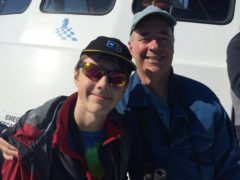
Braden during our first visit to Anahuac NWR in 2016.
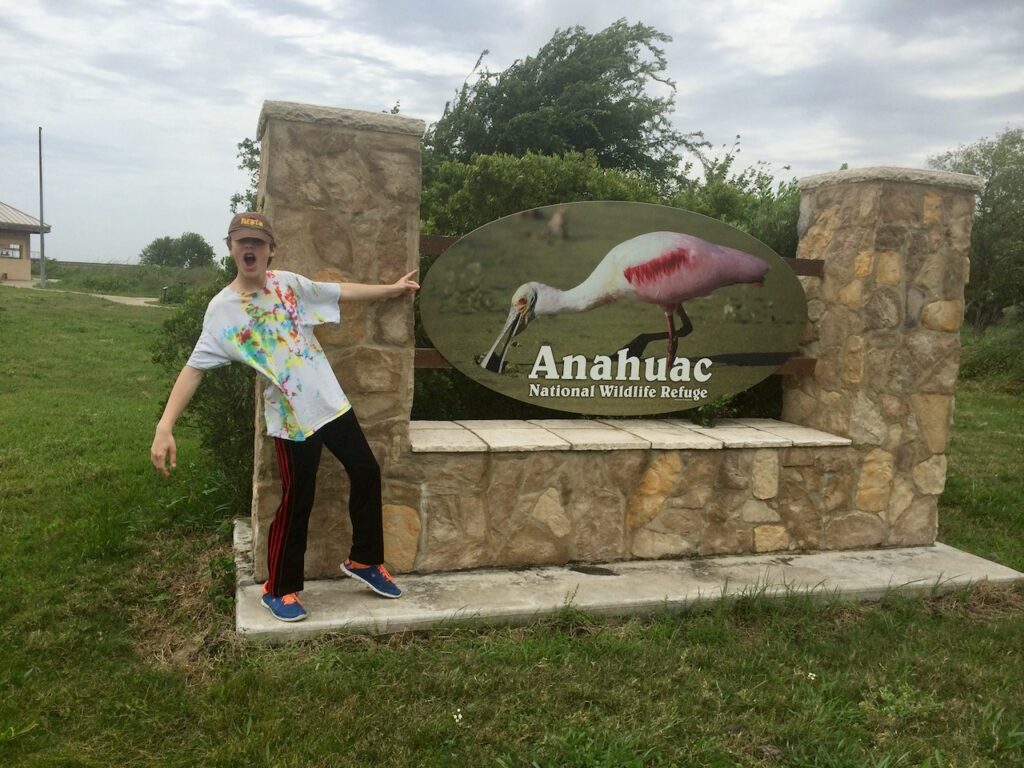
The refuge lies about halfway between Winnie and High Island, and Braden and I had many fond memories of it. During our Big Year in 2016, we’d seen our first Scissor-tailed Flycatcher here, along with our first Common Yellowthroat. I especially liked driving a route called the Shoveler Pond Loop. This afternoon, I didn’t expect any major surprises, but it was a pleasant way to watch Roseate Spoonbills, Common Gallinules, and a variety of other water birds. As I approached the refuge entrance, however, I got my first major surprise: the refuge had a new name! Only in the past few weeks, Anahuac had been renamed the Jocelyn Nungaray NWR. I later looked up how the name change had come about. I like to keep this blog politics-free, but I will just say that the new name resulted from both a tragic story and crass political shenanigans that apparently caught everyone off-guard. Feel free to look it up yourself and draw your own conclusions.
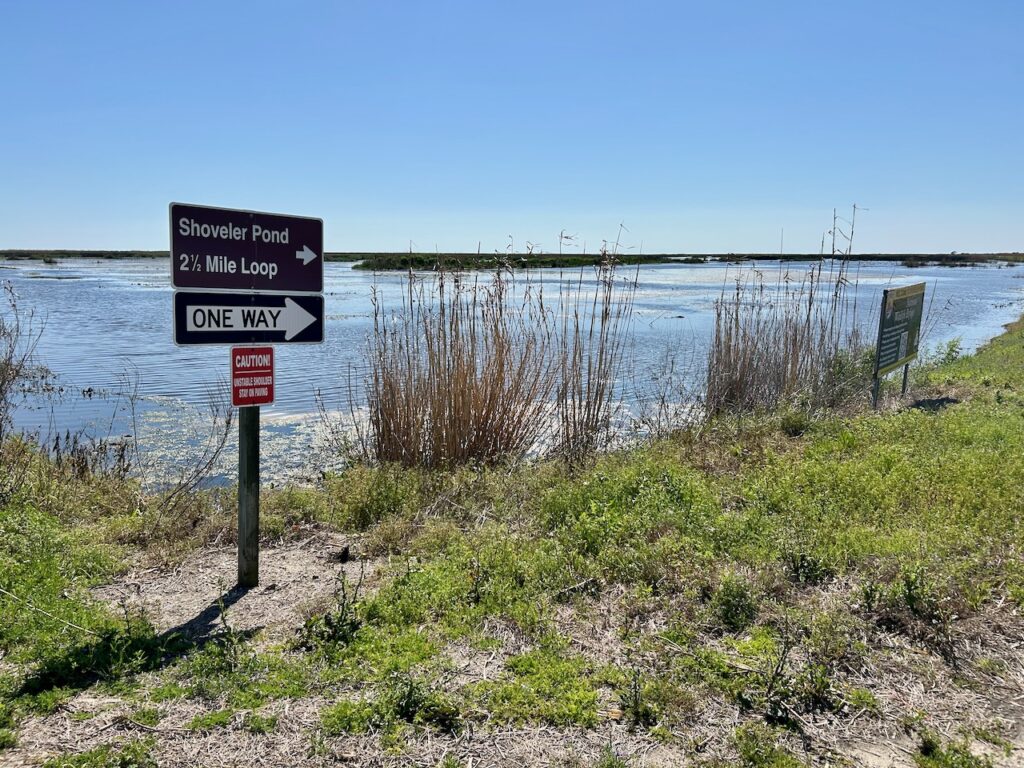
The good news? Shoveler Pond Loop looked better than I’d ever seen it! The loop consists of a 2.5-mile road that circumnavigates a 300-acre wetlands, and the last time I’d visited, in 2021, the latter seemed clogged with vegetation. Not so today. A large area at the loop’s beginning had been cleared out to create wonderful habitat for wading and dabbling birds and as I proceeded, I noticed many other revived sections as well. In preparation to write this post, I called the refuge to make sure that I wasn’t imagining things, and Park Ranger Chris Campbell confirmed that a couple of years ago, they had drained the wetlands and taken steps to remove large areas of cane grass.
Shoveler Pond Loop is definitely one of my Top 5 “car birding” routes in the United States.
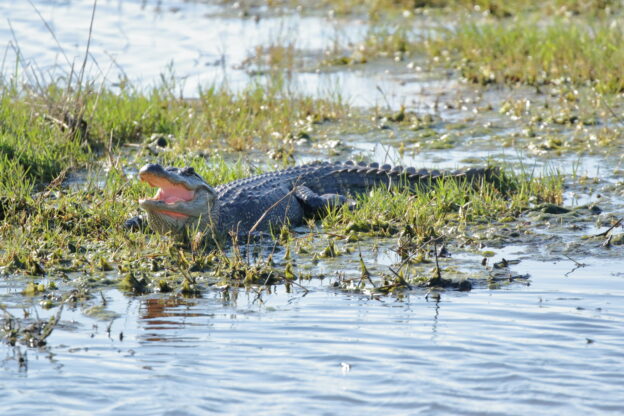
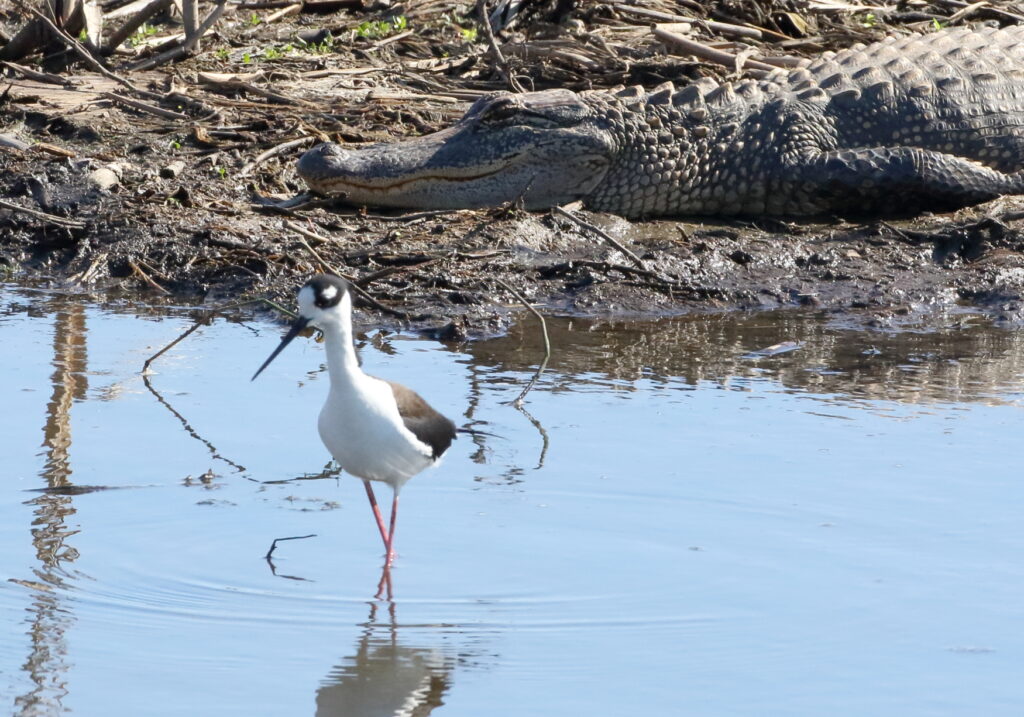
The results looked terrific. As I began making my way around the loop, I immediately noticed large numbers of Black-necked Stilts and dowitchers—probably Long-billed, according to Campbell. Both Greater and Lesser Yellowlegs made a good show of it, too, and it wasn’t long before I began obsessing over some smaller shorbs. I eventually IDed two of these as Dunlins, and was especially pleased to find a Least Sandpiper as well. Alligators also seemed to relish the new-and-improved loop, and I watched with amusement as Black-necked Stilts nonchalantly probed the shallows only a few feet from the six- or eight-foot crocodilians.
Uh, Mr. Black-necked Stilt, have you looked over your shoulder lately?
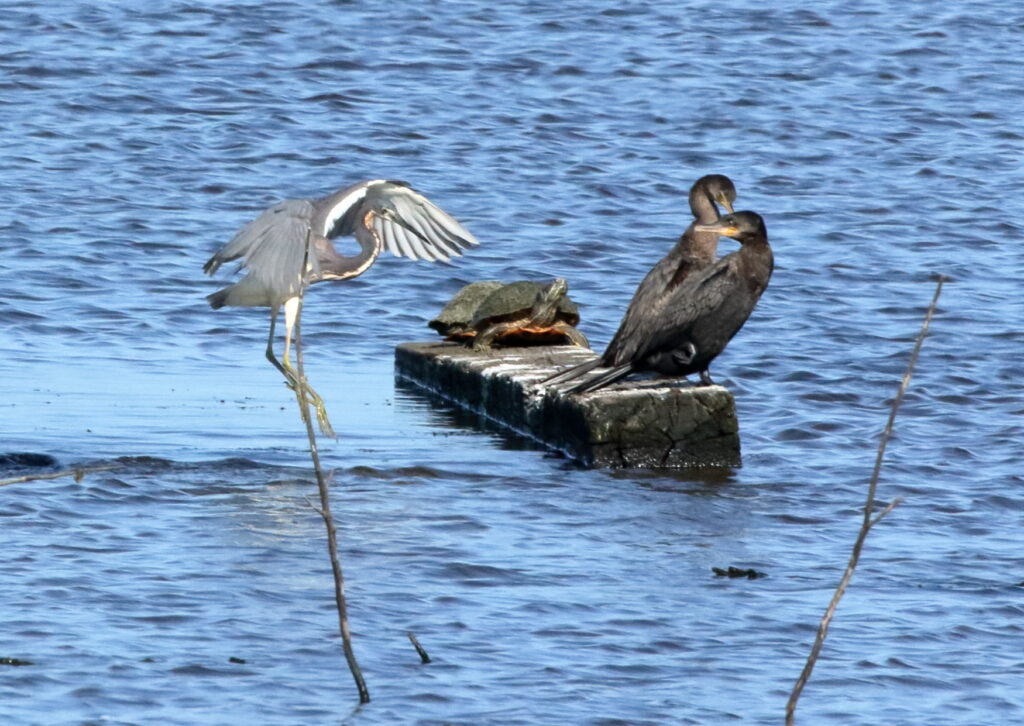
I soon found a great collection of waders including Roseate Spoonbills, Tricolored Herons, Snowy Egrets, and both White and White-faced Ibises. It was when I turned the first corner, however, that the real excitement began.
“Uh, just where do you think you’re landing, Mr. Tricolored Heron? Us Neotropic Cormorants and the herps over there were here first.”
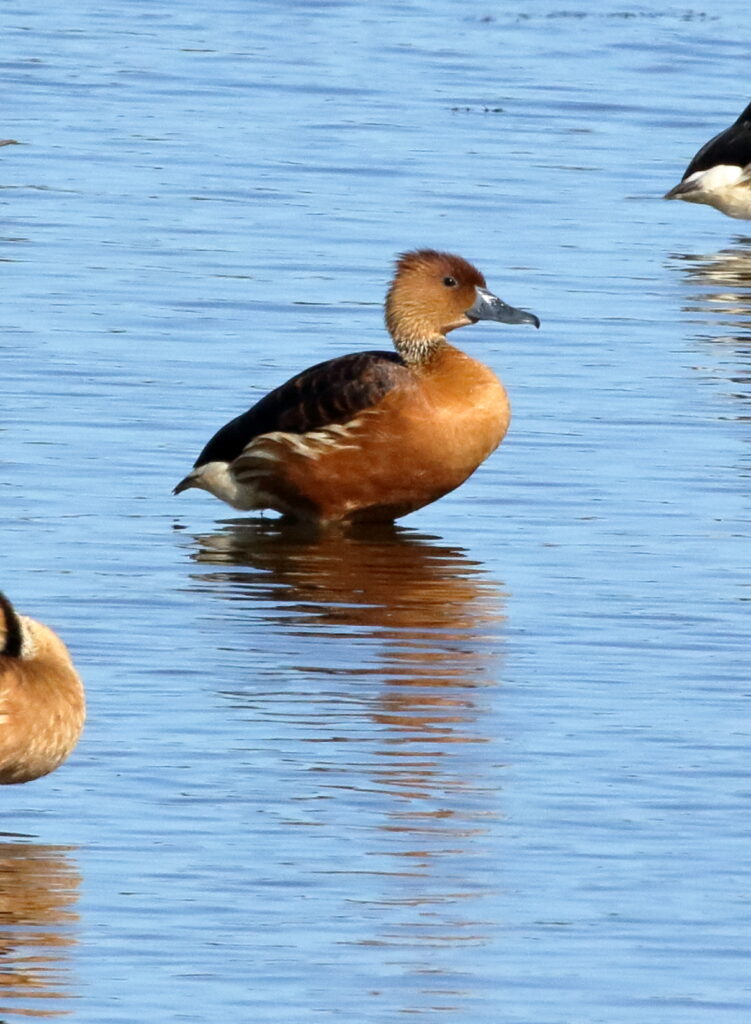
First up? A kind of duck neither Braden nor I had ever seen before: Fulvous Whistling Ducks! “Wow! Lifer!” I exclaimed out loud. For some reason, it never occurred to me that I would see these ducks, but there they were—sitting only fifty feet from their compadres, Black-bellied Whistling Ducks! And the hits were just getting started.
My first lifer of the day, Fulvous Whistling Ducks.Black-bellied Whistling Ducks are much more common than their Fulvous congeners. They are easily recognizable in flight by the contrasting black and white stripes running the lengths of their wings.
As I rounded the second corner, a narrow canal paralleled the road to my left, and suddenly, a medium-sized, reddish-brown bird flew out from beneath the road to some reeds across the canal. Astonishingly, it was another lifer, one that I recognized immediately: a Least Bittern! One of the smallest members of the heron family, Least Bitterns apparently are not all that rare. Ranger Campbell told me that they are very common year-round at the refuge, but the thing is, they are incredibly shy. I will just tell you that I never really expected to see one, and yet here one was! Not only that, it struck a pleasing pose while I kept my camera shutter clicking.
Seeing my lifer Least Bittern not only justified the entire trip, it captured Bird of the Trip honors!
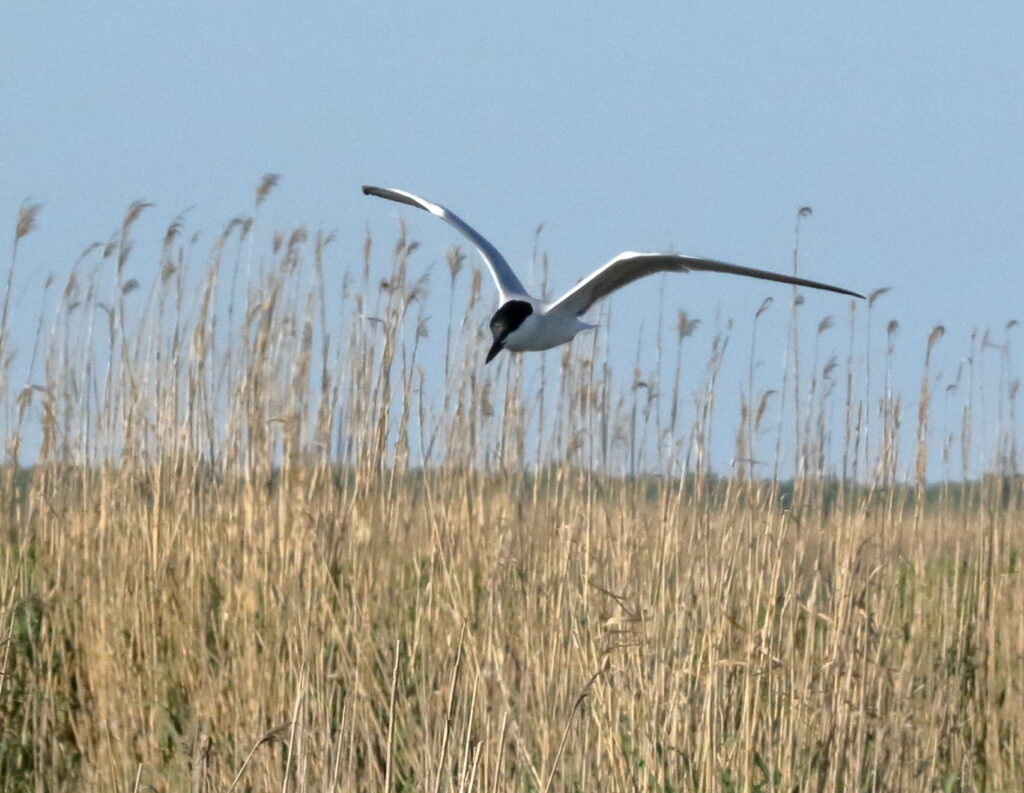
I had barely started again when I noticed a couple of terns flying around. Generally while I am birding, I ignore terns and gulls until I’ve identified everything else. As one of the terns zoomed by my car, however, I noticed that it had an oddly blunt thick black bill. “No way,” I said, rushing to take some ID photos. My hunch was correct. These were Gull-billed Terns—lifer Gull-billed Terns!
Terns favor the prepared mind. If I hadn’t been birding for more than a decade, the black bill on this guy may never have caught my attention.
Really, I could hardly believe it. I arrived at Anahuac expecting to see birds that I had seen many times before. Now, within the space of ten minutes, I added three new species to my life list! It seemed so preposterous that I laughed out loud. What’s more, this was still only my first day of birding on my Texas trip. One thing was for sure: I never would have had such success if it weren’t for the hard-working government employees we all depend on. It just shows the wisdom of investing in protecting our natural resources for the common good.
FatherSonBirding is a labor of love for both Braden and me, and our goal is to entertain and educate, and to promote bird conservation. If you’d like to support our work, please consider buying one or more of Sneed’s books and make a donation to one of the bird-related groups mentioned below. Thank you!
There’s a good reason the blog has been quiet the past couple of weeks. Braden is finishing up his honor’s project before graduating (gasp!) from the University of Maine while I jumped on a chance to head to Texas for the sixth time since Braden and I began birding. The trip arose from an invitation to talk about my book Birding for Boomers at the Mountains and Plains Independent Booksellers Association spring conference in San Antonio. Happily, the event took place during spring migration, so I of course booked three extra nights before and three extra nights after the conference to see some birds!
As soon as I picked up my rental car in San Antonio, I high-tailed it the four hours to Winnie, Texas on the coast just east of Houston. Why Winnie? Because it provides great access to several well-known stopover places for migrating songbirds and offers a chance to soak up a variety of coastal and aquatic species as well. For this trip, though, I was determined to explore some new birding areas, and my first morning I got up before dawn and headed to my first destination, Peveto Woods Sanctuary, just across the border in Louisiana.
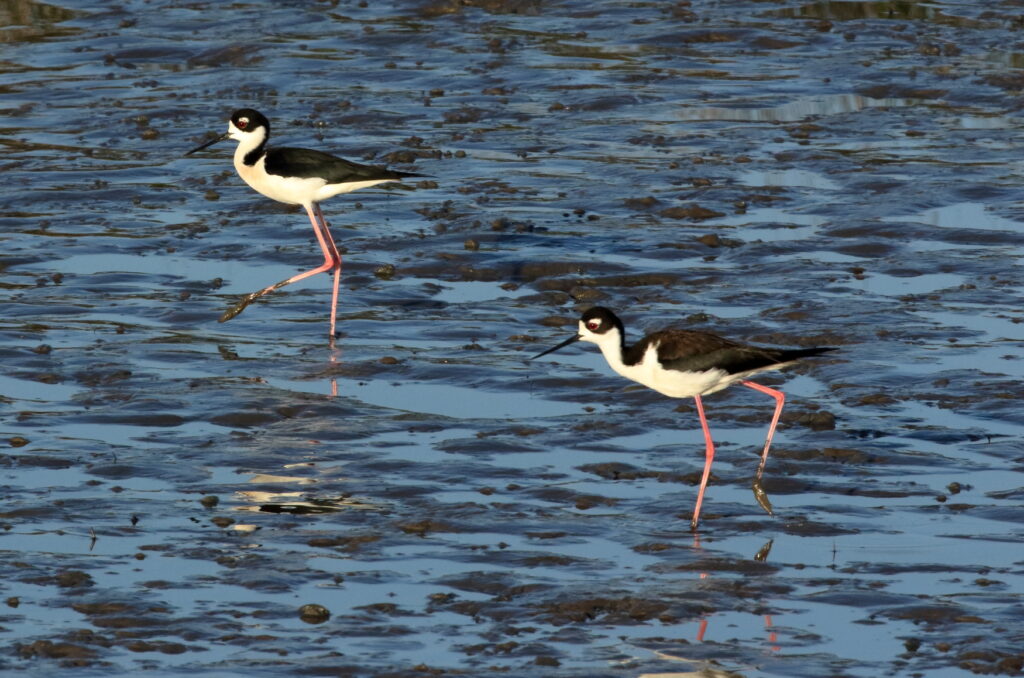
A bonus to driving to Peveto Woods is that once you cross the bridge into Louisiana at Sabine Pass, you can find a wonderful little shorebird area, especially if it happens to be low tide. And by the way, I don’t think I’ll ever get tired of posting Black-necked Stilts. So sue me already!
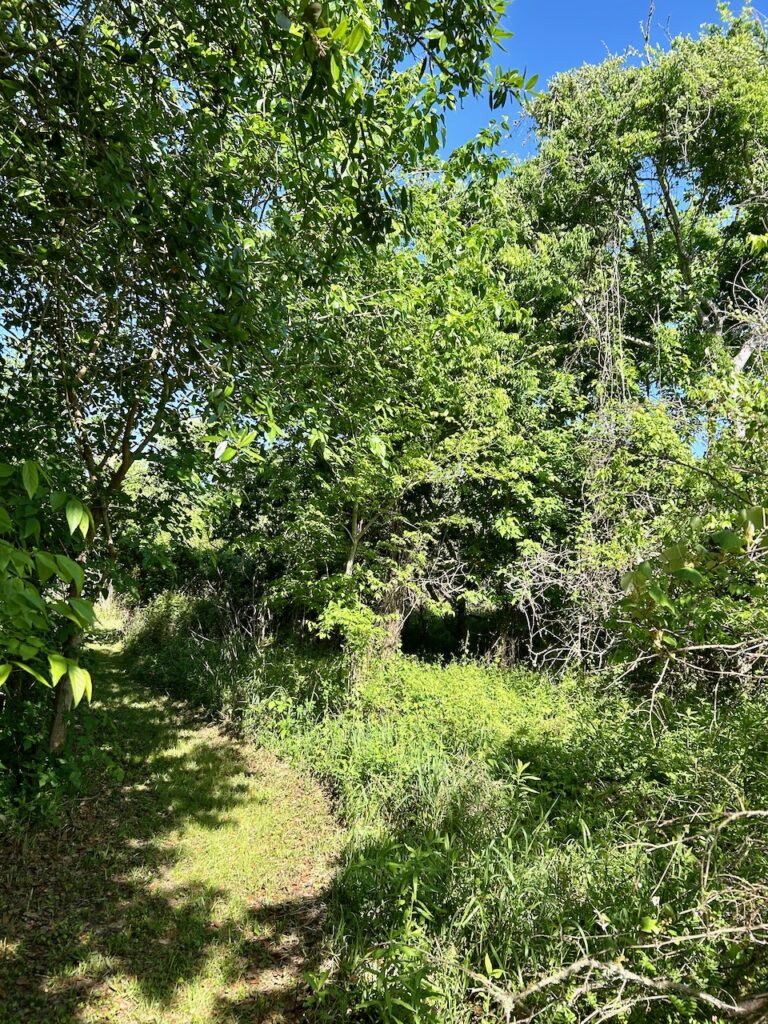
Peveto Woods offers delightful paths through trees, any one of which could be hiding a migrating songbird!
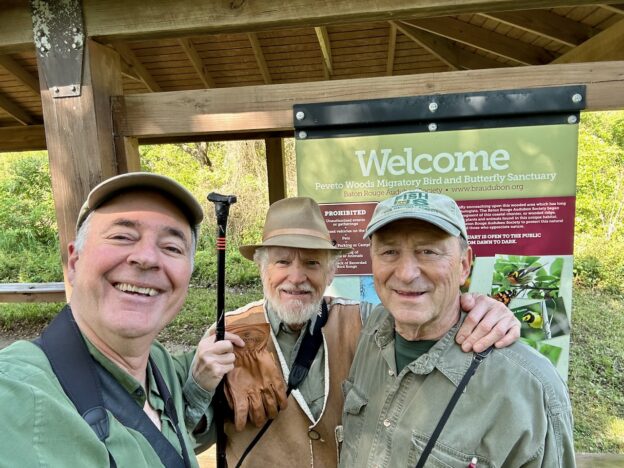
Peveto Woods is owned and operated by the Baton Rouge Audubon Society and like Sabine Woods run by the Texas Ornithological Society and the more famous High Island sanctuaries operated by Houston Audubon, Peveto consists of a patch of forest right along the shore. As soon as I pulled up, I knew I was going to like it. Trails headed off in all directions, crisscrossing forty acres of mostly oak-dominated woodlands. I saw two friendly-looking guys, Scott Delaney and Paul Wallace, who looked like they knew their way around and asked the best way to explore. It turns out, they had been volunteering their time here for many years and suggested I make my way to the east fence line and work my way back. They also explained that the land where the woods sat was called a chenier, a place where wave actions had piled sand and shells up higher than the surrounding area, allowing trees to grow. Hurricanes still occasionally obliterated the place, but the vegetation recovered quickly.
Hey, I’m gettin’ pretty good at these selfies–this one with my new birding friends, Paul (center) and Scott.
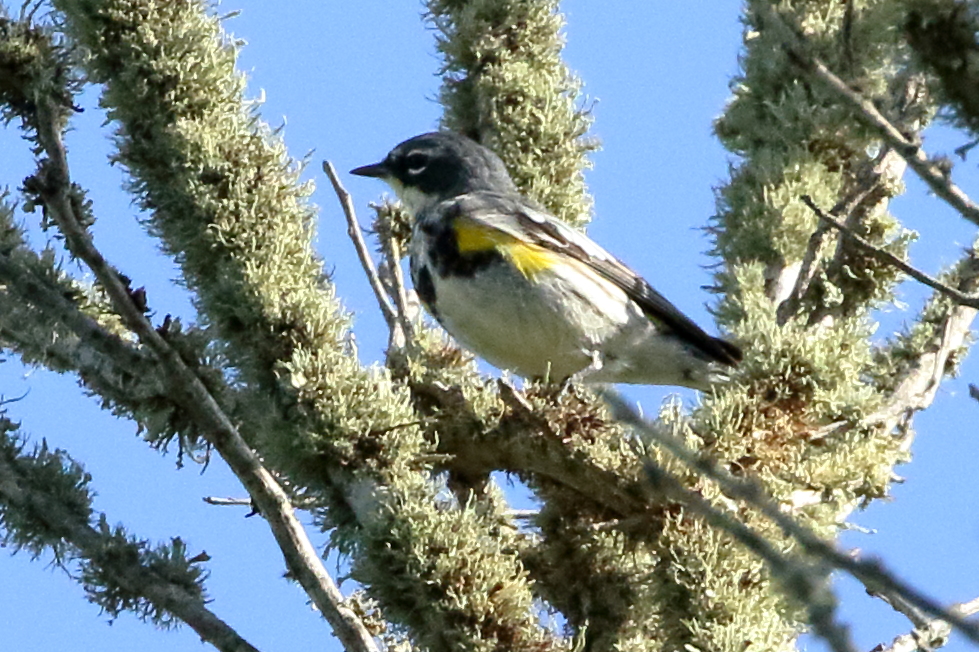
Unfortunately, I quickly learned that the main birds I had hoped to see—warblers—had not yet arrived in significant numbers. I was about a week early for many species and, for now, northerly winds had kept others grounded in the Yucatan. Only one hundred yards down the trail, however, I encountered a nice little mixed flock of other species. Sound ID picked up a White-eyed Vireo, and I quickly saw a Warbling Vireo along with at least four Red-eyed Vireos. Joining them were several Orchard Orioles, a couple of Yellow-rumped Warblers, and an Orange-crowned Warbler. Most were flitting about high in the trees, making photography difficult, but my heart warmed at seeing them.
Although the more exotic warblers had yet to reach the Gulf coast, this (Myrtle) Yellow-rumped Warbler tried to hold down the fort till they arrived!
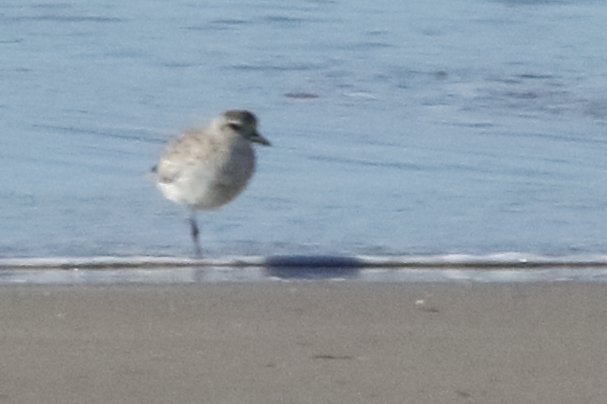
One awesome thing about Peveto is that you can walk right out to the beach and here I saw the trip’s first Black-bellied Plover, along with a couple of Royal Terns and Willets.
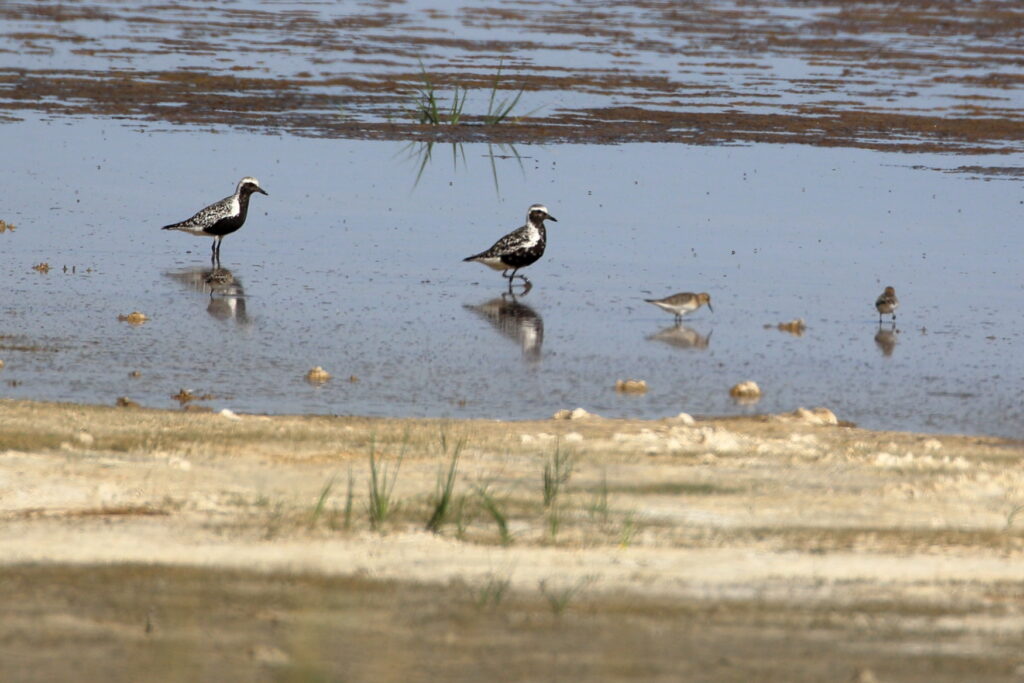
For those aware of my love of Black-bellied Plovers, you can imagine how delighted I was to find the first one of the trip on my very first outing.
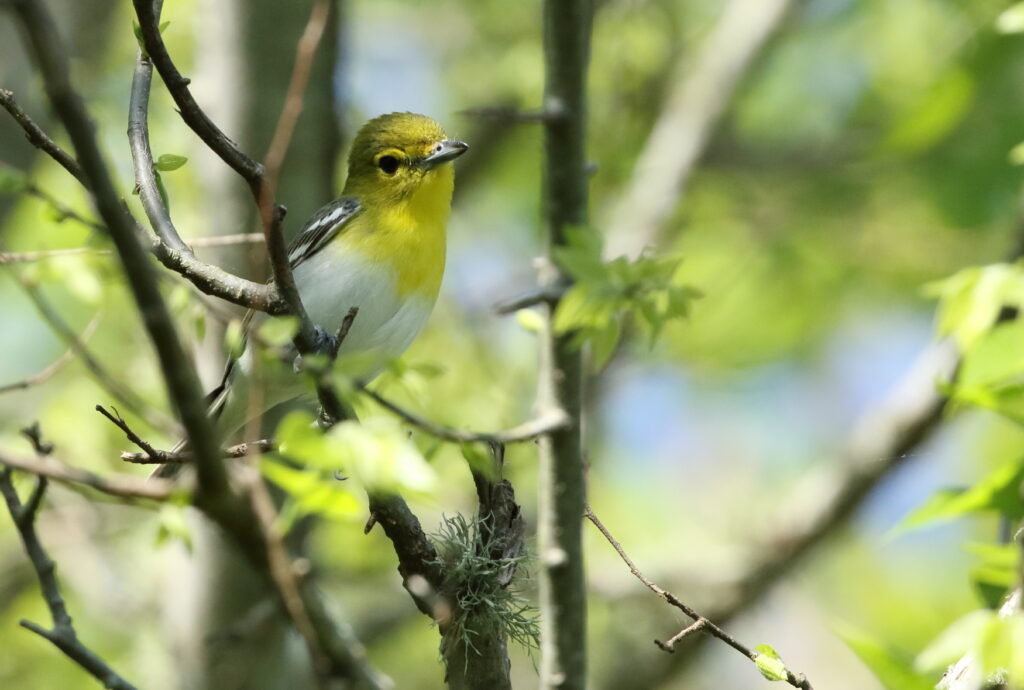
Returning to the woods, I kept strolling, finding migrating Gray Catbirds and pre-migration White-crowned Sparrows. A couple of Anhingas flew over, and then Sound ID picked up what would be the star of my visit: a Yellow-throated Vireo.
I just fell in love with this Yellow-throated Vireo. In fact, YTVIs are one of my new favorite birds, and I would see or hear them twice more on the trip.
I had seen YTVIs before, but so early in my birding career that they had gotten lost in the steepness of my learning curve. Now, a bird in glorious yellow, white, and gray plumage perched right above me. I shot some quick photos, and then just stood and admired this incredible creature. Like most other vireo species, this one had migrated from Central or South America, completing the eighteen-hour or so flight directly across the Gulf of Mexico.
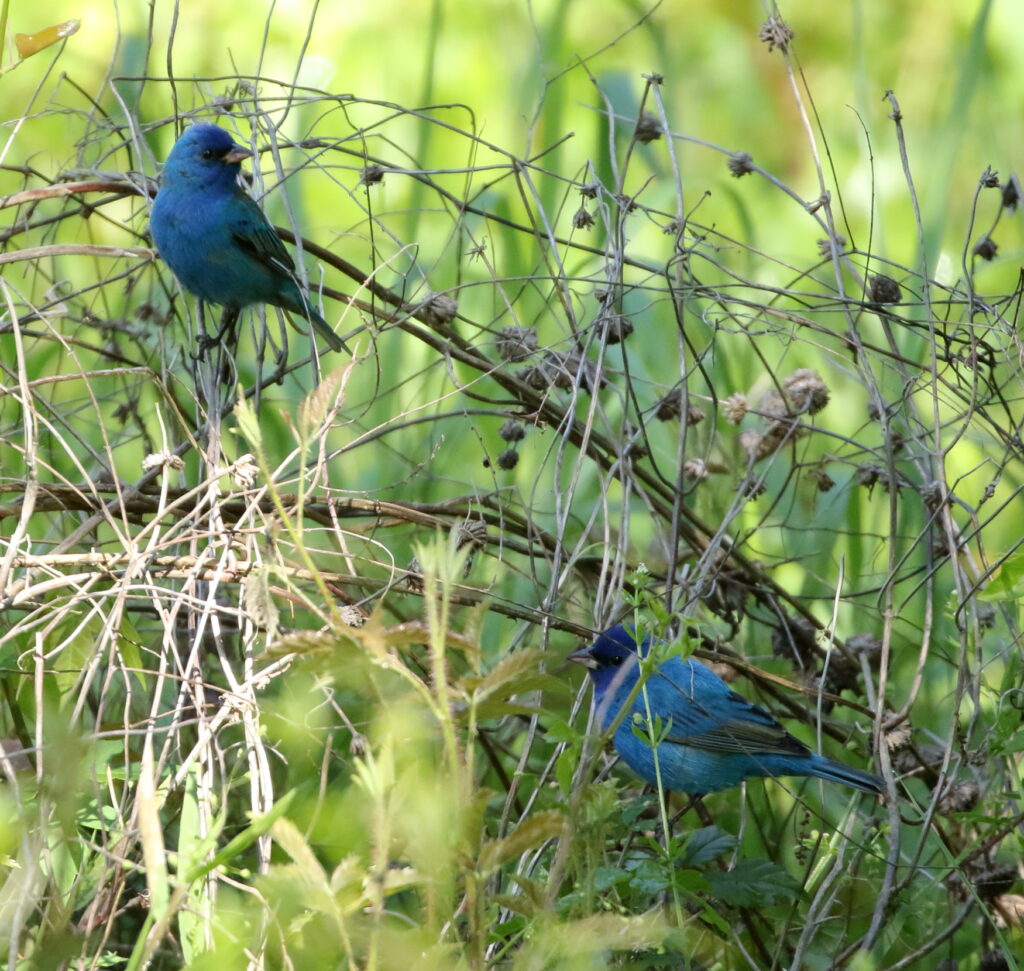
It seemed like years since I’d seen Indigo Buntings—and then, only females or juveniles. That made it all the more sweet to find these two “Sharp-dressed Men.”
It did make me wonder, though, why the vireos had made it “on time” but most of the warblers had not. “Are vireos stronger fliers?” I wondered. Or had they just timed things better? Either way, I was delighted to see them and get to know them better. And that’s birding for you. Even if the birds don’t always meet your own timetable, they always present a fascinating learning opportunity or two—or, as today, a chance to embrace and enjoy a new group of birds. I rounded off my morning by finding a couple of gorgeous Indigo Buntings on the brushier end of the preserve. I exchanged email addresses with my new friends Scott and Paul, and invited them to look me up when they came to Montana. I suspected, though, that I might make it back to Peveto Woods long before they got to Montana!
With spring shorebird migration coming on, we take a break from our Colombian birding series to review a new book that will help prepare you for the exciting, sometimes daunting task of identifying and enjoying some of the world’s most spectacular long-distance migrants. Bird—and read—on!
Legions of FatherSonBirding readers have probably noticed that Braden and I have increasingly become interested—nay, obsessed—by shorebirds over the years. See, for example, our posts
Our fascination may seem odd given that Montana is hardly the world’s epicenter of shorebird activity. Then again, their very rarity here renders them all the more alluring to find and learn about. A natural birding progression also is at work. When beginning one’s birding journey, we birders naturally focus on common, familiar species. As confidence, curiosity, and ambition grow, so does the desire to learn about and identify more difficult groups of birds. When we first began birding, Braden and I focused on woodpeckers, thrushes, waterfowl, waders, owls, and other easier-to-identify species. Over the years, we have plunged into increasingly challenging groups including warblers, sparrows, flycatchers (Braden), gulls, and perhaps more than anything, “shorbs.”
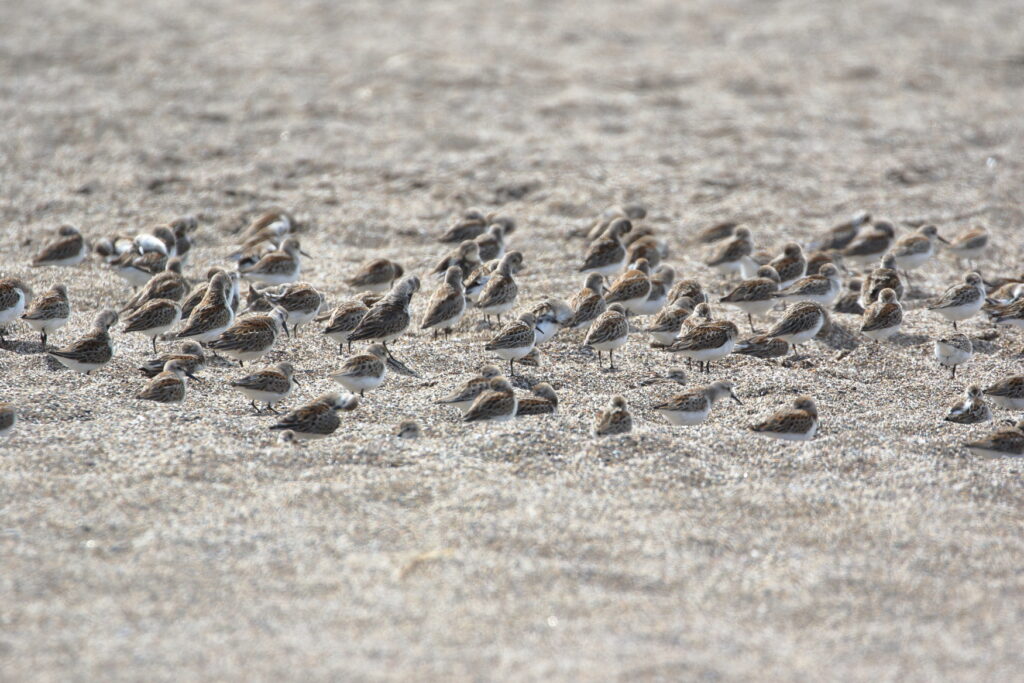
A flock of Western Sandpipers at Point Reyes during my September visit to California with Scott Callow.
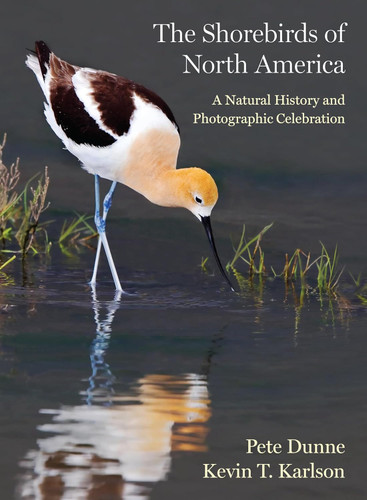
When out scanning beaches or shallow lakes, the most common phrase Braden repeats to me is “Shorebirds are tough.” This usually happens when I am whining about the difficulty in distinguishing between off-season Least and Semipalmated Sandpipers, or White-rumped and Baird’s Sandpipers—especially at a distance. But many shorbs are relatively easy to identify, and over the years both Braden and I have come to appreciate—nay, savor—the entire breadth of these fascinating, superbly adapted critters. Imagine my joy, then, when a brand new, beautifully photographed book about shorebirds arrived on my doorstep: Pete Dunne’s and Kevin T. Karlson’s The Shorebirds of North America: A Natural History and Photographic Celebration(Princeton University Press, 2024).
To say that The Shorebirds of North America is ambitious would be like calling the 18,000-mile round-trip migration of a Red Knot “neat” instead of “epic” or “mind-blowing.” This terrific addition to birding literature not only gives a wonderful overview of the lives of shorebirds, it provides specific accounts of all the shorebirds likely to interest you. That makes this book a wonderful, highly readable reference for both beginning and advanced birders.
The bulk of the book consists of species accounts of 52 kinds of shorebirds known to breed in North America and my guess is that you, like me, will skip directly to species that happen to interest you at the present time. This is a great approach. One of the first shorebirds I looked up was Black-bellied Plover, a bird I have become more and more enthralled with the past several years. As I started to read, my understanding of this handsome creature immediately swelled. I didn’t realize, for instance, that it is one of the world’s most widely distributed shorebirds, or that it is called Grey Plover outside of North America. What really tickled me was learning how fearlessly aggressive these birds can be:
“On the high Arctic tundra breeding grounds,” the authors write, “this sturdy plover is a fierce protector of its large nest area, and it strikes fear into aerial predators as large as gulls and jaegers. Woe to any flying predator if it hears the whistled alarm call of Black-bellied Plover as it flies swift and low across the tundra before rising to spear the intruder in the belly with its strong bill . . .”
The 4-letter breeding code for Black-bellied Plovers is BBPL. After reading the entry for the bird in The Shorebirds of North America, however, I realized that BBPL could easily stand for “Bad-ass-bellied Plover”.
Who knew that one of my favorite birds is such a bad-ass? Similarly delightful “reveals” can be found in each account, many of them based on the authors’ own personal and scientific experiences with the birds.
Far from just being pretty to look at, the book’s incredible photos add real understanding of each species by showing them in a variety of plumages and situations. I enjoyed just quizzing myself on the photos as I made my way through the book, testing and expanding my knowledge as I went. I cannot imagine the effort Kevin T. Karlson and the book’s other photographers invested in creating what may be the world’s finest collection of shorebird photos.
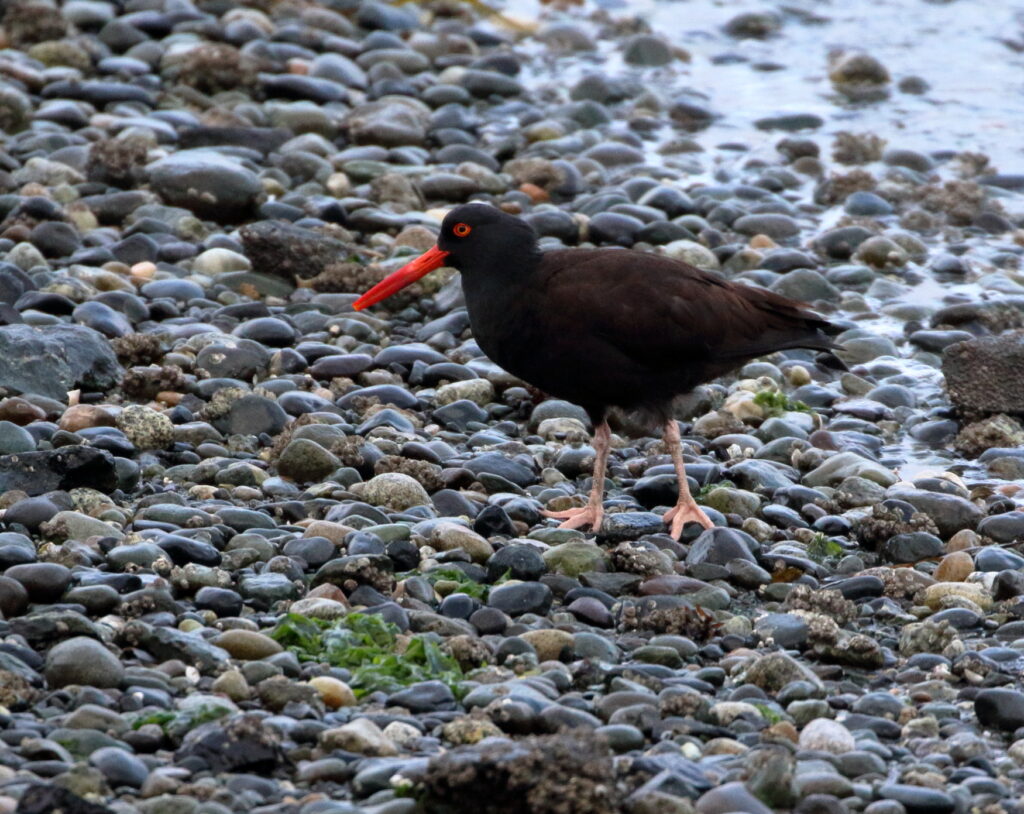
Another thing I learned from The Shorebirds of North America is that the bills of oystercatchers are laterally compressed. You can’t tell this from the typical side view, but this compression turns the bills into excellent chisels for prying limpets, snails, and chitons off of rocks.
As delightful as the species accounts are, I strongly urge readers to read the entire first section straight through. In this section, the authors provide excellent perspective on all shorebirds including their remarkable adaptations, habits, diversity, and evolution. Fascinating anecdotes abound, such as the story of B-95, a banded Red Knot known to have traveled more than 400,000 miles during his 21-year lifetime. The authors don’t bother to hide their admiration for these birds:
“Challenged to design the perfect bird, we would without hesitancy delve into ranks of shorebirds and reach down to the Scolopacidae (sandpipers), the largest of the roughly six or seven family groups in the shorebird order Charadriiformes.”
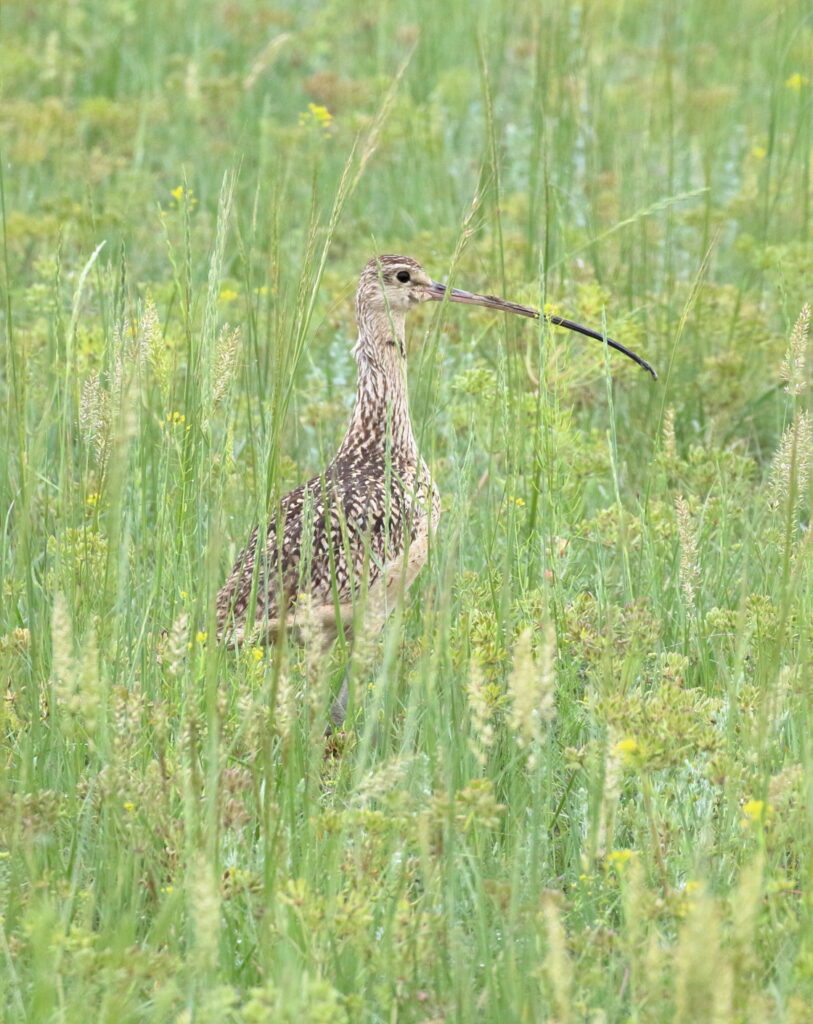
Another fascinating fact I picked up from The Shorebirds of North America is that the curved bills of Long-billed Curlews are almost perfectly designed to snatch fiddler crabs from their long, curved burrows. They’re also great for picking off grasshoppers without alerting them to their imminent doom.
I could keep singing this book’s praises, but really, if you have even the tiniest, nascent interest in shorebirds, you should order a copy yourself. Given its length and full-color format, I expected the book to sell for at least fifty or sixty bucks, but at the time of this posting it can be had for a bargain $35. That puts it within reach of most people—and makes it an investment in your birding future you won’t regret.
One-Sentence Summary: A highly-readable, indispensable resource for both beginning and advanced shorebird enthusiasts.
Overall Rating (on a scale of cool birds): Piping Plover (highest)
You can order The Shorebirds of North America from your local independent bookstore, or directly from Princeton University Press.Please tell them we sent you!
(Except for the cover image, photos in this post are copyright Sneed B. Collard III. Review copy of The Shorebirds of North America provided by the publisher.)
This week we are delighted to present our first guest post from Scott Callow. Scott and I (Sneed) met in the fourth grade, endured Boy Scouts together, and have spent hundreds of hours in the outdoors together. Scott majored in environmental studies and is one of the first people ever to take me birding, at Coal Oil Point in Santa Barbara. We have refreshed our friendship many times, including with several memorable recent birding adventures (see our posts “Chasing Migrants, Part I: Swifts, Peeps, and Plovers” and “Abbotts Lagoon, Point Reyes National Seashore”). We are also fortunate to have photos by Scott and his buddy Steve Rosso (the bird photos) to share. If you are enjoying FatherSonBirding, why not subscribe by filling out the “Subscribe Now” box down in the right-hand column?
(All photos copyright Steve Rosso or Scott Callow.)
My former work colleague, Steve, and I spent 2 hours deciding which walks and talks we would do at our first winter Morro Bay Bird Festival. It was just over a week since the registration opened. Everything we chose turned out to be full, even with over 263 events, 191 of them field trips. Lesson learned. (We later learned that the Pelagic Boat Trip filled within an hour.) We were able to sign up for two outings, a Big Day at the inland Santa Margarita Lake and a “Back of the Bay” walk in Los Osos. Steve also made the wise demand to stop at the Pinnacles National Monument on our way down, and convinced me to spend the extra money ($55) on a boating tour of Morro Bay itself. (Readers are encouraged to open up a map of the region.)
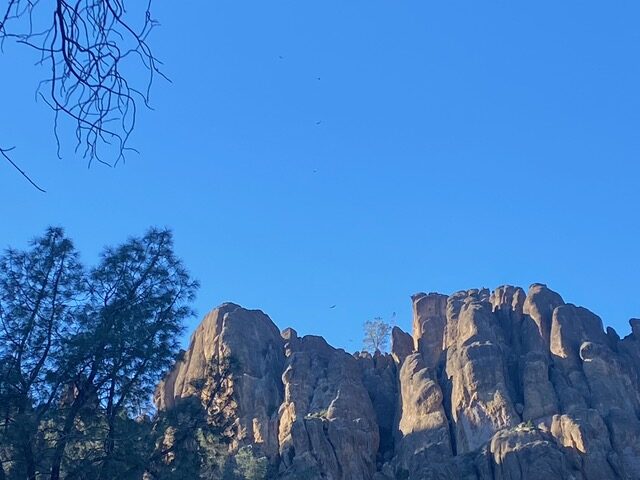
Our first stop was along the lonely Highway 25 between Hollister and Pinnacles’ east entrance. We badly wanted one soaring raptor to be a California Condor but it turned out to be a Golden Eagle. Later (2-3pm), at the observation overlook a mile up the Condor Gulch Trail, more than 15 dark soaring birds suddenly appeared as a group from behind the eroded sandstone Hain’s Peak. I confidently identified four as Condors, one as a Golden Eagle (clearly seeing the difference between each’s white markings on the undersides), and many Turkey Vultures. Steve’s new camera clicked away. At the trailhead, a ranger told us that, years ago, the population was below 10 individuals when reintroduction began and now the local population had swelled to “three digits.”
Pinnacles National Park. And yes, at least some of those black specks are California Condors!
The next morning we embarked on our first festival field trip: a Big Day at Santa Margarita Lake. It was led by Mark Holmgren, retired curator of the natural history museum and collection at UC Santa Barbara (my alma mater and where Sneed got his master’s degree). Highlights included comparing Eared, Horned, Western, Clark’s and Pied-billed Grebes, listening to Fox’s Sparrows, California Thrashers, and Wrentits, and observing raptor behavior. Speaking of, we saw Ospreys and Bald Eagles fishing (one birder theorized the adult eagles were teaching the juvenile), two Peregrine falcons mobbing a raven, and two Peregrines (perhaps the same) apparently fighting over food in mid-air or in courtship display. I got good looks at the yellow lores of a White-throated Sparrow.
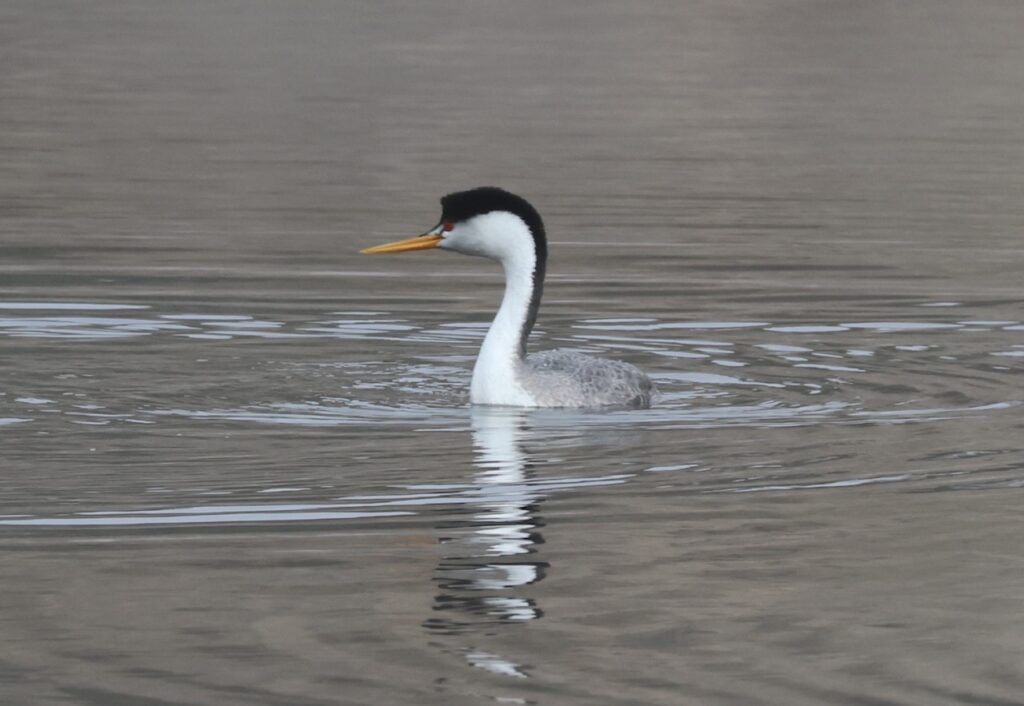
Winter is a nice time to compare Clark’s (shown here) and Western Grebes, which can sometimes be difficult to tell apart. Clark’s Grebes have more orangish bills versus greenish-yellowish on Westerns. The black also rises above the eye on Clark’s, though that’s not as clear-cut on this individual.
Tired from our long day, we drove to the Morro Bay Community Center downtown and attended one of the two receptions. Included in the cost of registration were free local wines (multiple pours allowed), and extensive noshing trays of cheese, meats, veggies, crackers, and artisan chocolates. The adjacent bazaar impressed with booths for 3-4 high-end binocular/gear manufacturers, book shops, authors, nature art and nature organizations. The bazaar was well attended and the noise generated rivaled that of a Spring morning chorus.
The bird fest’s exhibit area had a nice variety of vendors and non-profits to occupy us between birding trips, talks, and meals.
Our dinner at Morro Bay’s affordable, healthy and creative Asian fusion cafe, Chowa Bowl is recommended, as is the lunch combo Big Deal of sushi roll and ramen noodles at Baywood-Los Osos’ funky hangout, Kuma. This is important info to a birder even though food and beverages are barely mentioned in The Avian Survival Kit chapter of Birding for Boomers. Good food and libations can elevate a birding trip. (Editor’s Note: We at FSB take exception to this criticism, as we have frequently mentioned fine dining establishments such as McDonald’s, Wendy’s, and Starbucks.)
Next day’s Back of the Bay trip was not only highlighted by lunch, but by Audubon’s Sweet Springs Nature Preserve. It’s a small preserve with a spring-fed creek and excellent views from its wooden observation decks of the bay’s mudflats and its shorebirds, ducks, gulls, and terns—tons of them (which is saying a lot since birds are so light.) With Morro Rock and Morro Dunes in the background, we saw Lesser and Western Sandpipers, too many Brants to count, 30+ Green-winged Teals, 4 Blue-winged Teals, American Wigeon, Northern Shoveler, Bufflehead, Long-billed Curlew, Killdeer, Black-bellied Plover, Great Egret, and Greater Yellowlegs. We learned the Greater has three notes in its call compared to the two notes of the Lesser. Ring-billed Gulls, Belted Kingfishers, and Forster’s Terns were seen flying above the bay.
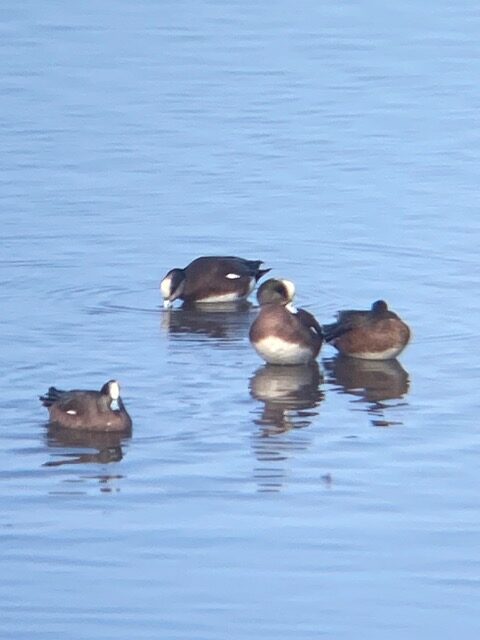
These are the ducks that inspired The Guess Who’s 1970 Number One single “American Wigeon”. Fun Fact: Sneed saw The Guess Who’s lead singer, Burton Cummings, perform this song live in Rapid City, South Dakota in 1977.Sneed was favorably impressed by this performance—until ZZ Top took the stage and basically burned the place down.
In the narrow woodland area between street and bay we saw both Hairy and Nuttall’s Woodpeckers, and Chestnut-backed Chickadee. Then, local guide Dean led our car caravan down the road apiece to his friend’s house which sported about six bird feeders that earned a hot spot ranking on eBird. More chickadees, the ubiquitous House Finch, the most common local warblers—Yellow-rumped, Orange-crowned, Townsend’s—and Lincoln’s, Golden-crowned and White-crowned Sparrows. We also saw our Oak Titmouse, formerly lumped with Plain Titmouse, at the bird feeders. Its range is mostly endemic to California (stretching into parts of Oregon and Mexico) and the bird shares its place with the Acorn Woodpecker as a signature species in California’s oak woodlands.
Dean also shared his mnemonic for our (Pacific Group) White-crowned Sparrow – “Awf man!, I dough-ont wanna see”. It’s a bit of a stretch but “I don’t want to see” sums up many people’s self-engineered denials of science nowadays, so I decided to add it to my mnemonic checklist.
The rarity highlight of the trip was the sole Blue-winged/Cinnamon Teal hybrid. I “put good eyes on it” but Steve left his camera in the car because he logically thought he’d get better shorebird and bay bird shots on the following day’s boating trip.
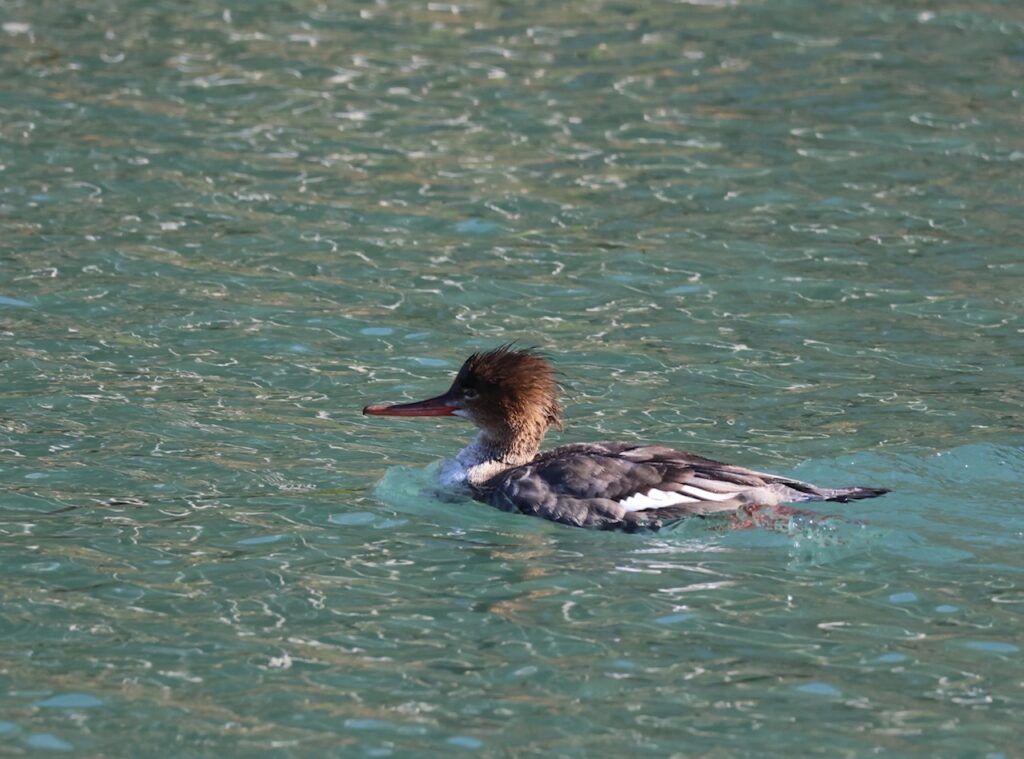
Female, juvenile, and nonbreeding Red-breasted Mergansers (above) can be difficult to distinguish from Common Mergansers, especially in winter, when they can be swimming side by side. We think this is a Red-breasted because of its a) slightly thinner, upturned bill b) indistinct transition between the brown and gray on its neck and c) its crazier “hair-do”.
Our inside-the-bay boat trip the next day also included a fellow (and local) birder, Mike, who led bird trips. Steve and I learned a lot from him. The trip was created as a photography outing and the leader focused on pointing out good shots. The captain, also a birder, put the boat in good lighting and locations for the photographers. We were inspired to overtip him. The trip started in a downtown marina and we made a loop up to Morro Rock, along the rock jetties past the bay’s opening to the ocean, and then back into the bay to the mudflats of the Morro Bay Estuary. As we returned back to the docks, we passed the Morro Bay State Park Boardwalk, the Museum of Natural History, the Morro Bay Water Access, and Heron Rookery Natural Preserve—all excellent spots to bird from the shore, and perfect for photographers from the water due to the sun’s location.
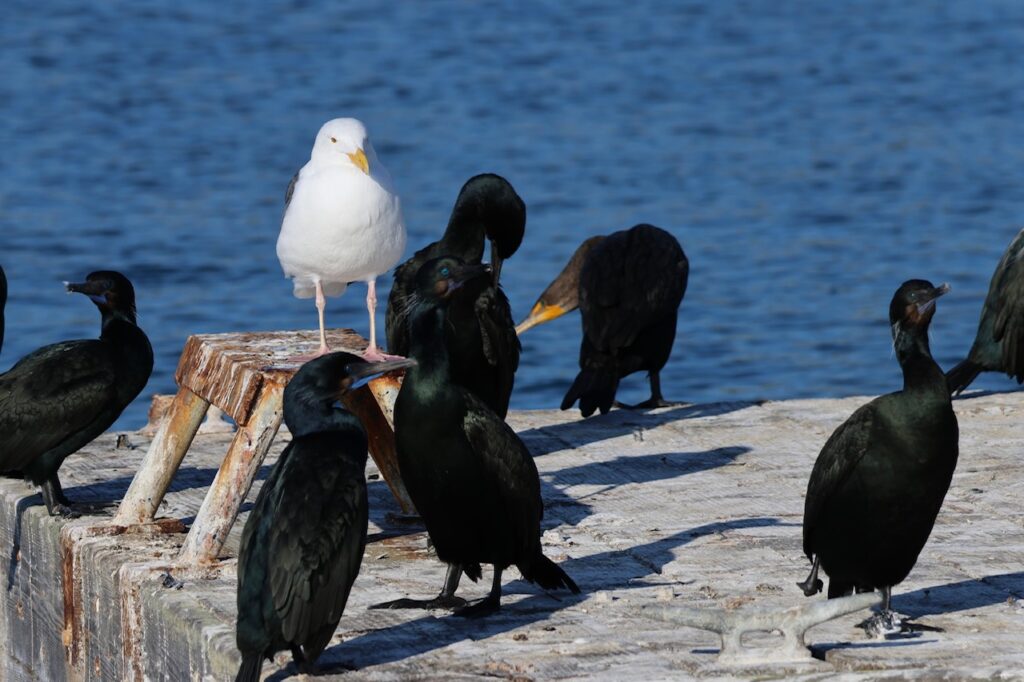
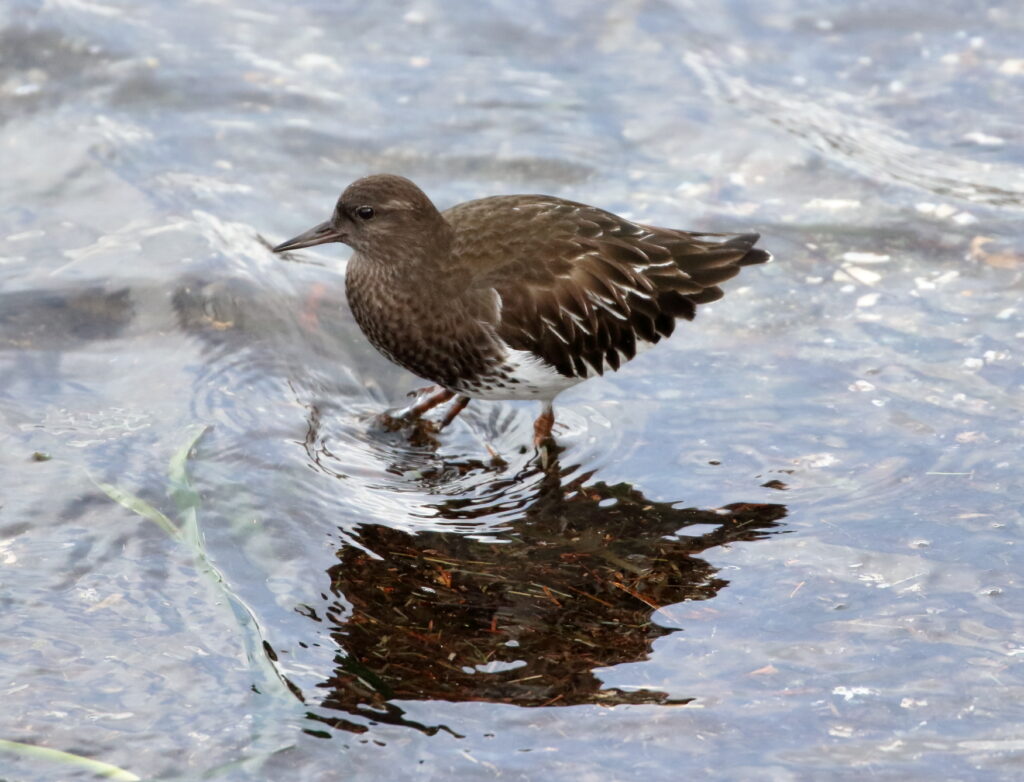
We saw Peregrine Falcons above The Rock, Black Oystercatchers and Black Turnstones on the rocks, Black-crowned Night Herons in the trees, Ospreys on the masts, Common and Red-breasted Mergansers, several Eared Grebes and a Horned for comparison, and a nice collection of Brandt’s, Pelagic, and Double-crested Cormorants floating on a wooden raft. The Brandt’s Cormorants were especially striking with their iridescent coats and bright blue throat pouches. We were surprised to see some of the adults sporting very early breeding plumage marked by brilliant white “whisker” feathers around the ears and shoulders.
Cormorants put on a show under the gaze of their Western Gull overlord. Note the brilliant blue gular pouches on the Brandt’s Cormorants, along with their wispy white breeding feathers on the necks. A Double-crested with yellow markings skulks in the background.
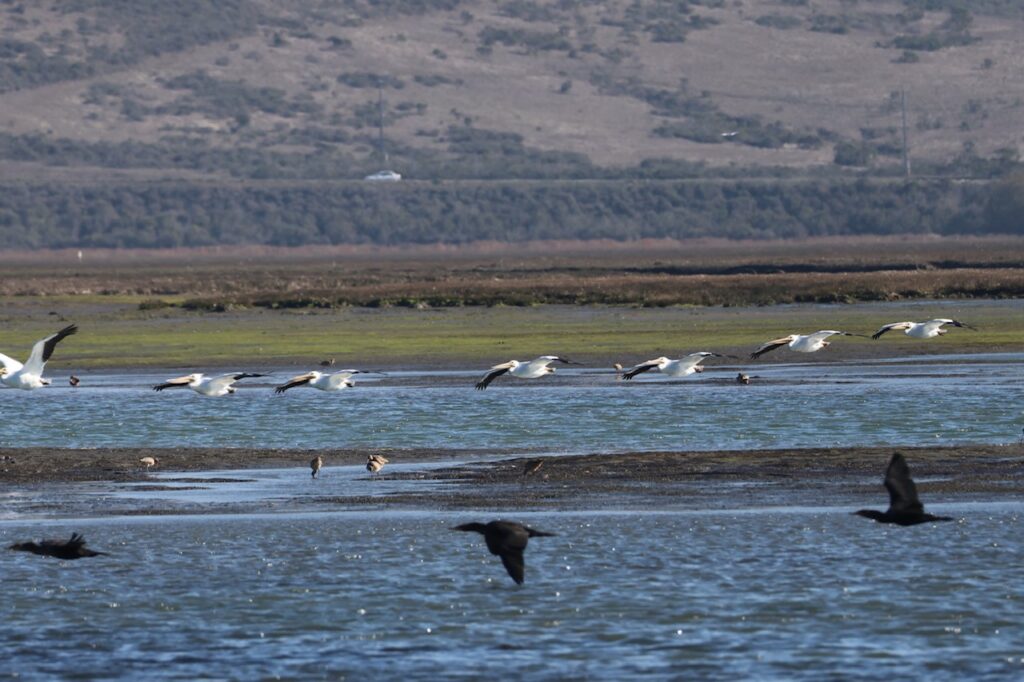
Further inside the bay near the mudflats we saw large numbers, reaching into the hundreds, of Double-crested Cormorants, Marbled Godwits, and other shorebirds too far away to ID, plus good showings of White Pelicans, Ospreys, Ring-billed and Western Gulls, Northern Pintails, Buffleheads and Long-billed Curlews, Willets, and Greater Yellowlegs, as well as other common shorebirds not listed. Mike told us that the Pelagic Boat Trip ($160) was fantastic. If interested, check the bird list from the trip on the festival’s website.
Our “Inside of the Bay” boat trip featured a great variety of seabirds and shorebirds. Here, American White Pelicans earn extra style points.
The last night’s keynote speaker was Kenn Kaufman, author of Kingbird Highway, multiple nature guides, and his new The Birds that Audubon Missed: Discovery and Desire in the American Wilderness. He extolled birders to persist in their nature explorations, even beyond birds, and to pause the inclination to aggressively list in order to truly observe. He described the Morro Bay region as a “globally important ecological area” and the all-volunteer festival as top-notch and well organized, ranking it among the highest of the many he has attended.
232 species were identified collectively during the 5-day festival in mid-January. Events included typical bird walks, birding by boat, bicycle and kayak, birding for youth, beginners and advanced birders, birding with wine and olive oil tastings. Sites extended beyond the Morro Bay area including the Kern National Wildlife Refuge, the Carrizo Plains Ecological Reserve, various ranches, Atascadero, San Luis Obispo, and Pismo Beach. Check out the Long Report of the Festival Events Including Details on the website. More details than you will need to convince you to make next year’s festival are found at morrobaybirdfestival.org.
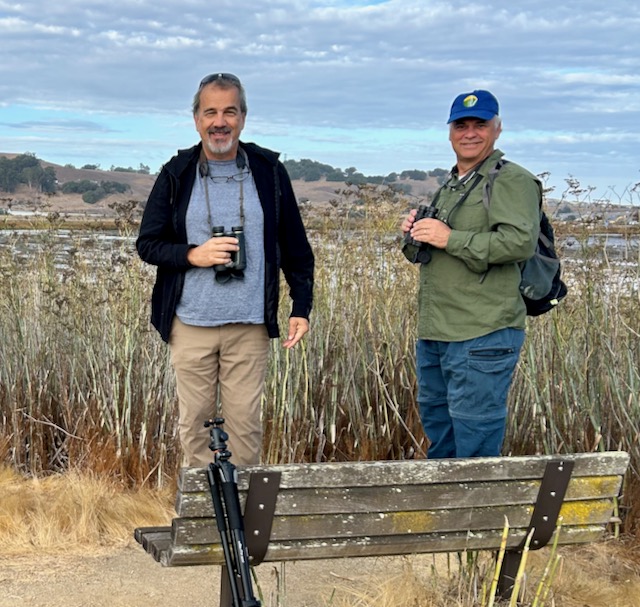
Scott (right) and Steve (left) while birding with Sneed in Marin County last fall. (I don’t know why Scott’s head looks a bit squished. I blame climate change, not my photographic skills.)
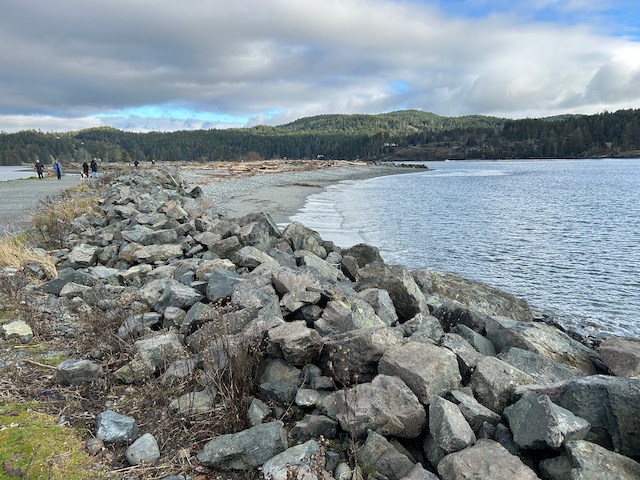
After three nights in Victoria (see last week’s post “Birding Victoria, BC”), Amy and I headed up the Vancouver Island coast toward a spot where we had spent our first nights together as married folk—a lovely establishment called the Point No Point Resort. On the way up, I bamboozled Amy into stopping at one of the most well-known birding hotspots in the area: Whiffin Spit Park. As its rather humorous name implies, the park is a narrow spit of land stretching about a kilometer across the mouth of the bay where the town of Sooke is located, and it has recorded an impressive list of birds.
Whiffin Spit is perhaps the most well-known place to observe ocean and shore birds between Victoria and Port Renfrew. Alas, the many free-roaming pet dogs makes it less than ideal for shorbs.
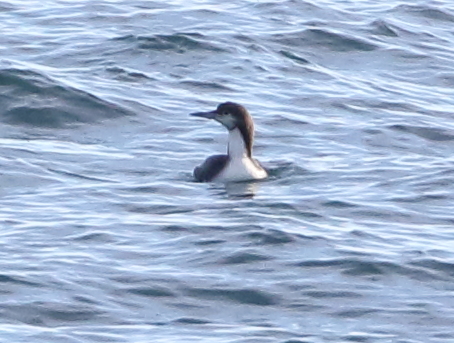
As Amy walked ahead, I schlepped my scope, zooming in on anything promising. Over the next hour, I found Red-breasted Mergansers, more Harlequin Ducks (Yay!), Surf Scoters, Common Loons, and most exciting, a pair of Pacific Loons. Along the path, I also got excellent looks at Black Oystercatchers and Black Turnstones. Alas, the numerous unleashed dogs did not create a bird-friendly environment, and chased off the birds several times. (Our dog, Lola, by the way, informed me that she would never engage in such unruly behavior—cough, cough.)
The longer we stayed on Vancouver Island, the more Pacific Loons I got to see. I have learned to identify these handsome birds by their silvery heads and neck postures, which remind me of cobras ready to strike. Up close, the dark “chin strap” is also diagnostic.
Despite these good birds, I had by now firmly set my mind on seeing alcids, a group of sea birds affectionately dubbed the penguins of the northern hemisphere. These birds include murres, guillemots, Razorbills, Dovekies, and puffins, but the ones I most wanted to see were murrelets. Two kinds frequented the area: Ancient and Marbled. My new birder friend John (see this recent post) had told me that Ancient Murrelets tended to fly around in groups while Marbled Murrelets were most often observed as loners floating on the surface. Either species would be a lifer for me, and I would have been ecstatic to find one. Alas, the task was proving much more difficult than I had hoped. I totally struck out in Victoria, and now I “whiffed” at Whiffin Spit, too.
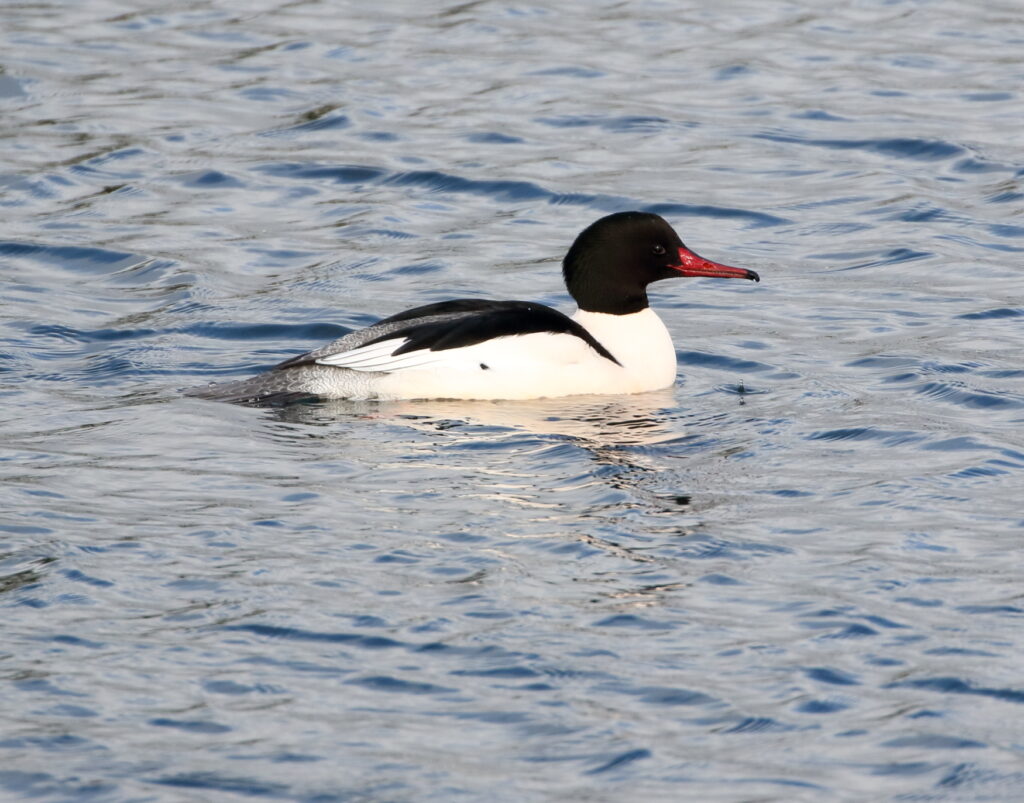
Perhaps my best photo ever of an adult Common Merganser, hanging out on the bay side of Whiffin Spit with an equally stunning female.I could wax eloquently about Black Turnstones, but there’s no need. These bold, attractive birds speak for themselves. They even put up with the many dogs at Whiffin Spit.
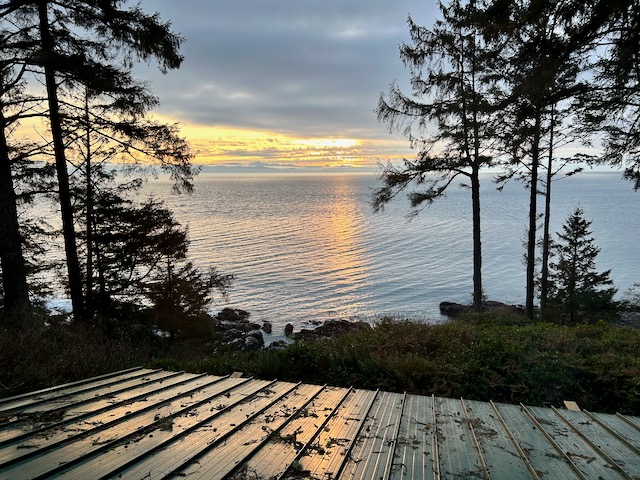
The Point No Point Resort helped ease my disappointment. The cabins and rooms are all cleverly designed for privacy and each looks out over the spectacular Strait of Juan de Fuca (part of the Salish Sea). The sun was setting by the time we checked in—just time for me to set up my spotting scope and find a raft of about forty Surf Scoters floating below us. They would become regular companions of our stay. I also noted a few cormorants and other birds, but alas, no alcids.
Our room at the Point No Point not only offered a mesmerizing view of the Olympic Peninsula across the water, but a chance to scope for more seabirds.
Undaunted, I rose the next morning to hit two nearby spots that had been recommended as great seabird locations: Otter Point and Muir Creek. The birding gods seemed stubbornly pitted against me. I saw a few more loons, including my first Red-throated Loon, along with my first Pacific Wren and a dozen or so species I’d been seeing for the past few days, but nothing that really got my heart racing.
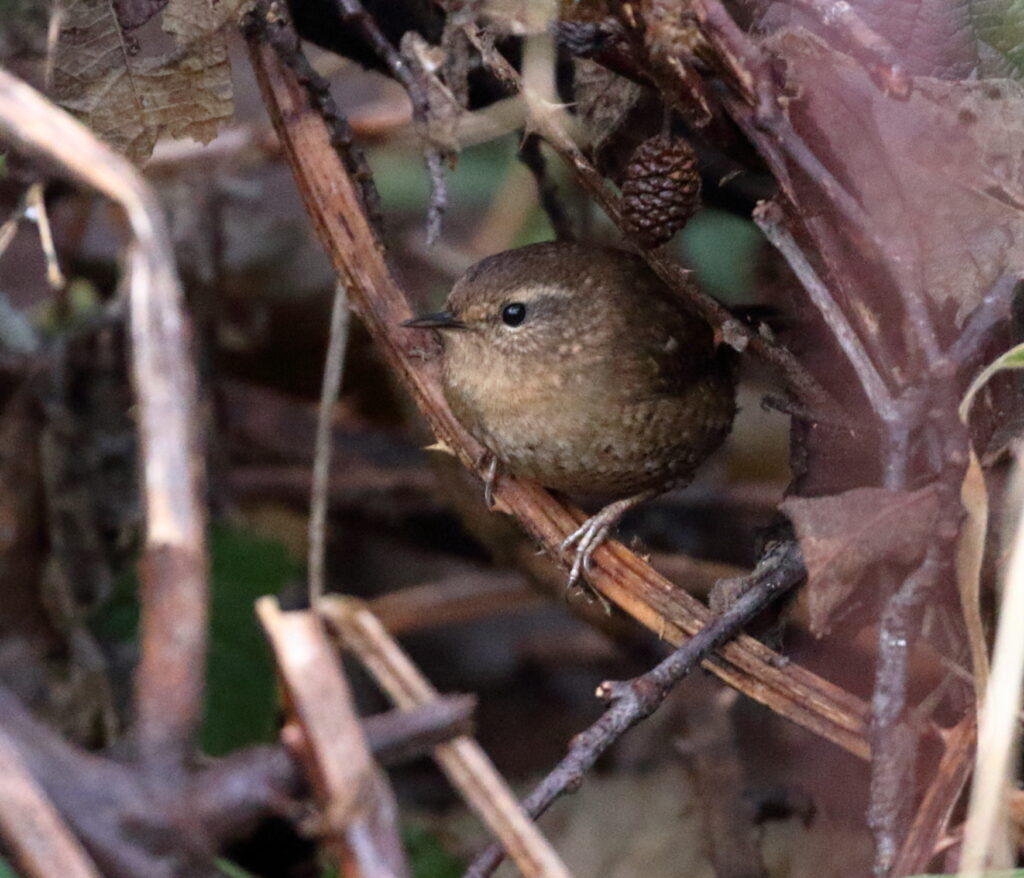
At Muir Creek, I was pleased to get an actual look at a Pacific Wren. Amy and I heard them several other times, but the birds like their privacy!
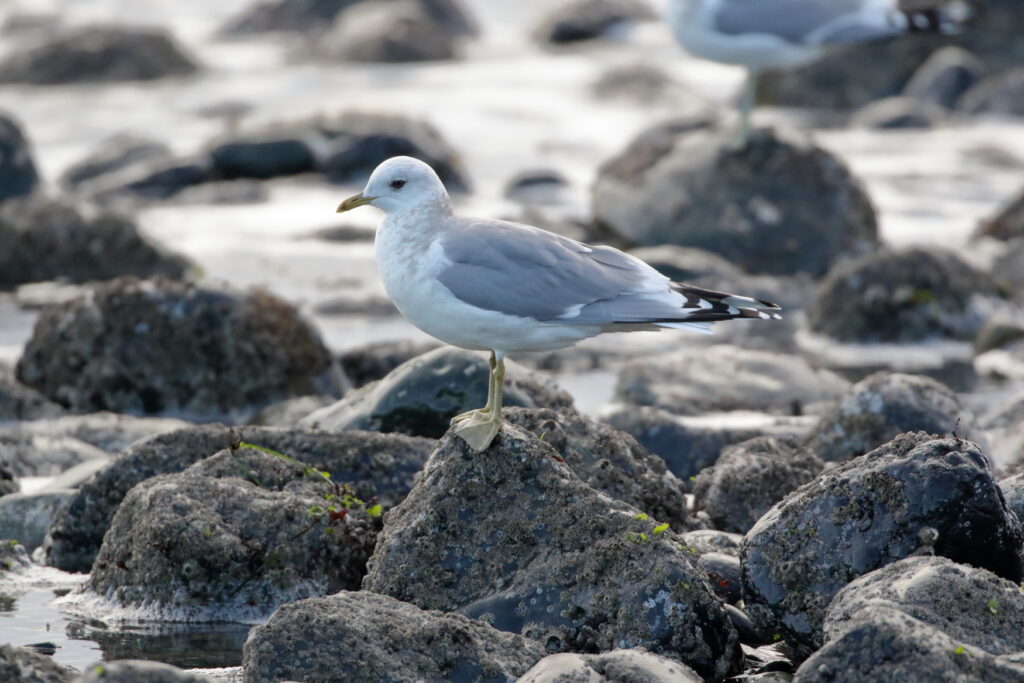
This pattern repeated itself for the next couple of days as Amy and I explored several more places between Sooke and Port Renfrew. Honestly, the birds that most excited me were Short-billed Gulls (formerly Mew Gulls)—birds that I had never seen in such numbers, and had only recently become skilled at identifying myself.
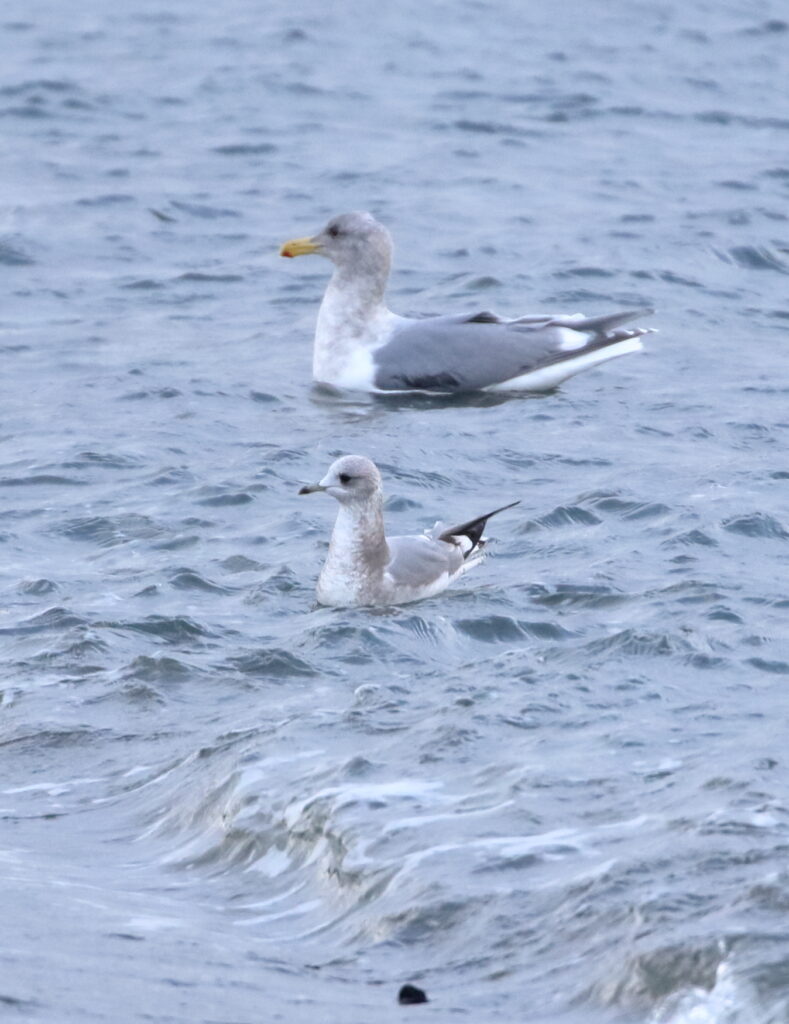
Gulls are notoriously difficult to identify—something I’ll tackle in an upcoming post—but the Short-billed Gull stands out for its smaller size, yellow legs, and overall “cuteness,” as Braden puts it. In breeding, its bill lacks any kind of marking, though as you can see in this photo, adults sport a faint ring at other times of the year. The size difference between Short-billed Gulls (below) and larger gulls such as this Glaucous-winged Gull (top) really stands out when they are next to each other.
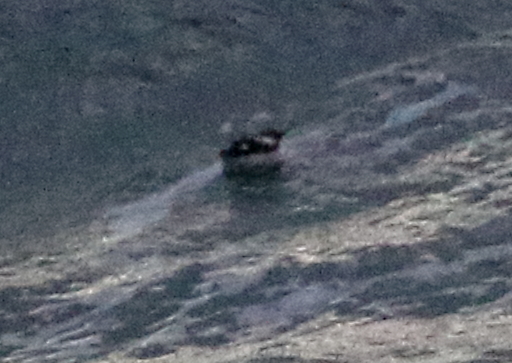
Before we knew it, we arrived back at the Point No Point for our last luxurious evening of watching the sea and enjoying the view of the Olympic Peninsula across the water. As we prepared to soak in our private hot tub, though, I picked up my cool new binoculars (see our last post) for one final look at the ocean below us. In the rapidly fading light, I spotted our loyal raft of Surf Scoters, along with gulls and cormorants. Then, I noted a tiny speck in the breaking waves close to shore, and quickly focused in on it. I guessed it was a piece of kelp or driftwood, but then, through the lenses, the unlikely shape of a bird emerged!
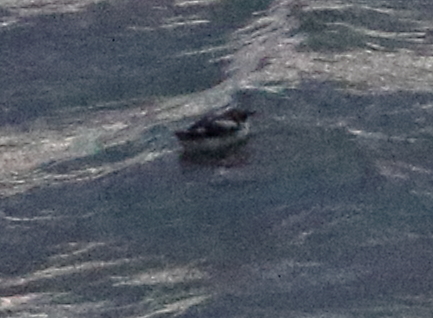
My heart accelerating, I frantically set up the scope which lay at my feet and zoomed in on the shape. “No friggin’ way!” I exclaimed. Honestly, I didn’t know exactly what I was looking it, but I felt sure I hadn’t seen it before. I was also sure I needed some photos, no matter how crummy, so I switched out my scope for my camera on the tripod, and captured a few quick images through our windows before, to my disappointment, the bird drifted out of view behind some trees.
By this time, after a quick consult with my Sibley app, I felt positive that the tiny bird had indeed been a murrelet, but which kind? Studying my horrible photos and comparing them to Sibley, I noted the white patches on the shoulders and near the tail. That ruled out Ancient Murrelet. I also checked the illustrations for all the other alcids that might be in the area. Only one matched my photos: Marbled Murrelet! Even better, ten minutes later the bird reappeared below our window. By now, the light had grown truly dim, but I took my tripod and camera out onto the deck and managed some slightly better shots.
Marbled Murrelet!
My fellow birders can imagine how that one bird pretty much made the entire trip for me. Everything else was just lovely, too, but a Marbled Murrelet? That put the icing on the cake, or for me, the chocolate chips in the cookie. It also sent my imagination racing, seeing that tiny bird deftly negotiate the waves crashing into shore. It was just so comfortable in an environment that would have snuffed me out in a matter of minutes.
Marbled Murrelets defy the imagination for another reason. Unlike other alcids, they nest not in burrows or on cliffs, but in trees! In fact, the nesting location of this bird remained a great ornithological mystery for more than a century as biologists looked everywhere (but not in the tops of trees, evidently) for a Marbled Murrelet nest. “Finally,” recounts Cornell Lab’s Birds of the World, “in 1961 and 1974, the first verified and published nests were reported in Asia and North America, respectively.”
Amazing.
Unfortunately, the birds prefer old-growth coastal forest, forests that have experienced extreme logging pressures over the past century. The birds have also been impacted by fishing gear, forest fires, and other hazards. As a result, the bird is listed as endangered or threatened throughout its North American range. That made it all the more remarkable that one had deigned to show up right below our picture window—almost as if following some kind of cosmic movie script. I felt very fortunate.
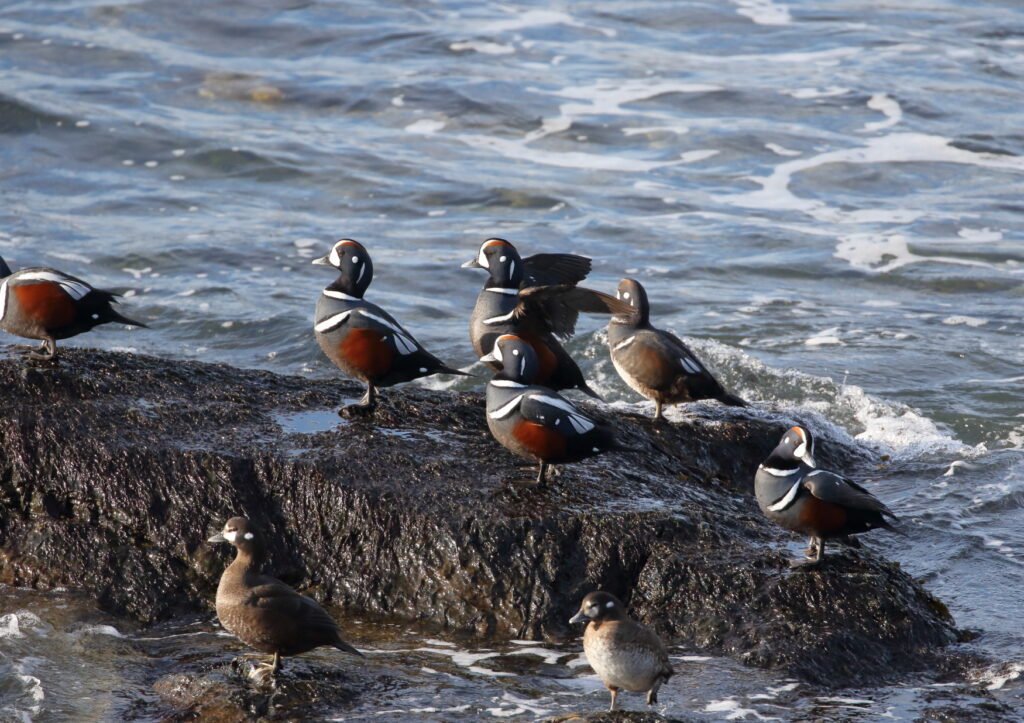
Yay! More Harlequin Ducks! During our last session at Clover Point, these stunning birds really put on a show, chasing each other around and posing for one visiting birder.
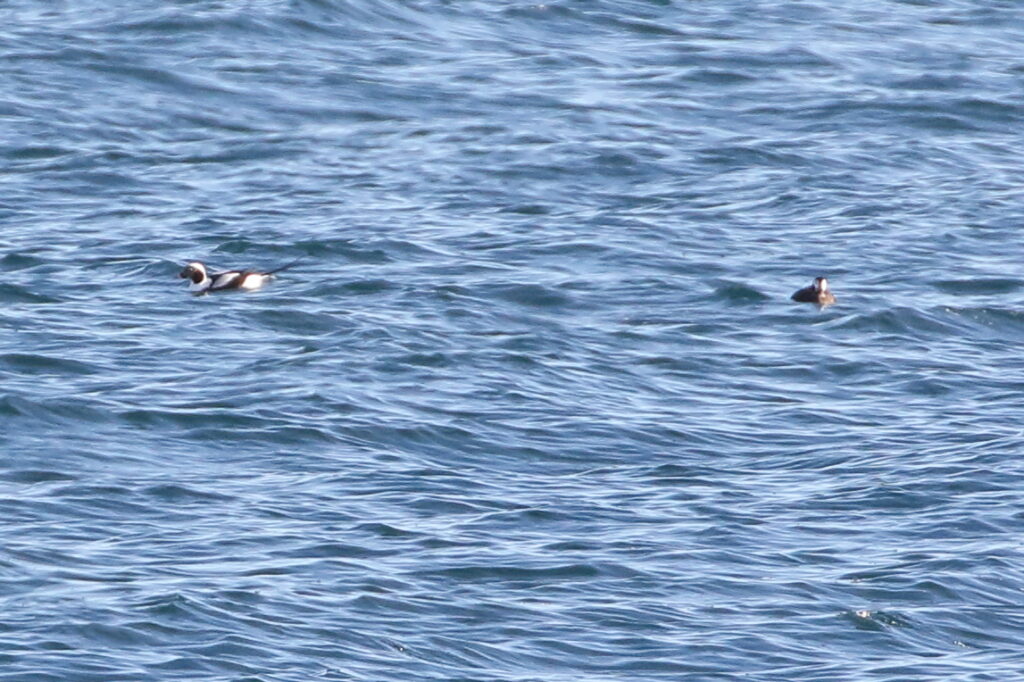
The next day, Amy and I returned to Victoria and another round of birding at Clover Point—my best session there yet. Pacific Loons, Buffleheads, Harlequin Ducks, and Surf Scoters seemed to be everywhere, and I was thrilled to find a pair of immaculately-feathered Long-tailed Ducks far out on the water. Though we would not head home until the following day, it was a great way to wrap up a trip that proved delightfully unexpected in so many ways. Huge gratitude goes to my wife and partner, Amy, for giving me such a wonderful surprise. And now, it was time for us to go celebrate with stiff umbrella drinks and a plate full of chicken enchiladas.
Bird of the Day honors for our last day in Victoria went to these Long-tailed Ducks. Adult male LTDUs (left) are especially striking in full plumage, and I at first assumed that the one on the right was a female. The rich brown back and bold, well-defined white face patch, however, suggests a first-year male.