Tag Archives: Montana

Owl Opportunity

See Sneed read from his book Woodpeckers and Warblers at River Oaks Books in Houston, November 17 at 3 p.m. and at The Well-Read Moose in Coeur d’Alene (Idaho) on November 23 at 6 p.m.

On Thursday, November 8th, my friend Eli and I were in the middle of a heated game of “Cup of Bluff” when my phone began going off. I saw that it was Nick and answered it.

“What’s going on?”

“Shh!” He was whispering.

“What?”

“I am at the Gravel Quarry standing, like, ten feet from a Saw-whet right now! Get your dad and get down here!”

He hung up and texted me his exact location. I raced upstairs and into my dad’s dark bedroom, abruptly waking him up from a nap. I told him the news. He yawned, and said, “Well, get your stuff! Let’s go!”

We rolled out of the house 10 minutes later, when Eli started his piano lesson with my mom. Nick was waiting for us at the Quarry, and as we pondered which routes would get us there the fastest, he sent us constant updates. According to him, it seemed like every bird at the Quarry was trying to make us miss the owl:

“A shrike just flew in and scared the owl, but it’s still in the same bush.”

“A mob of chickadees is trying to attack it! No!”

“Don’t let the Merlin distract you on the way in—go straight to the owl.”
This last thing was going to be particularly hard, as my dad still did not have Merlin for the year. Fortunately (and a little unfortunately), when we finally arrived, the Merlin was nowhere to be seen. We tiptoed down the hill into the forest section, and spotted Nick and his mom staring at a tree.
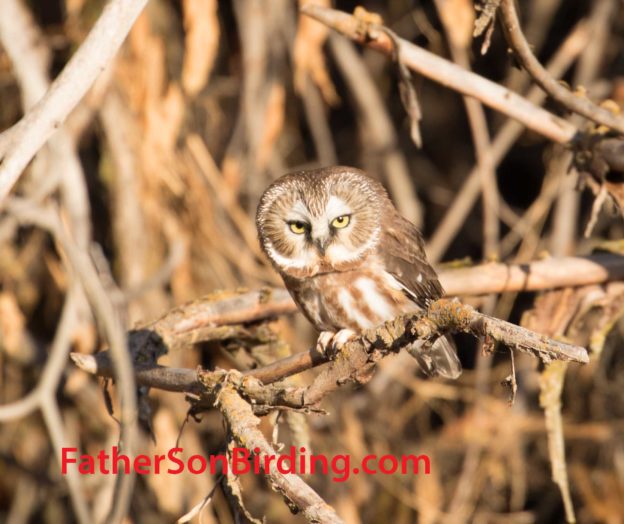
Though bored-looking, this Saw-whet was actually one of the most active owls we’ve ever seen!

“Look,” he said pointing straight into the tangle of branches, “See that puffball? That’s the bird.”

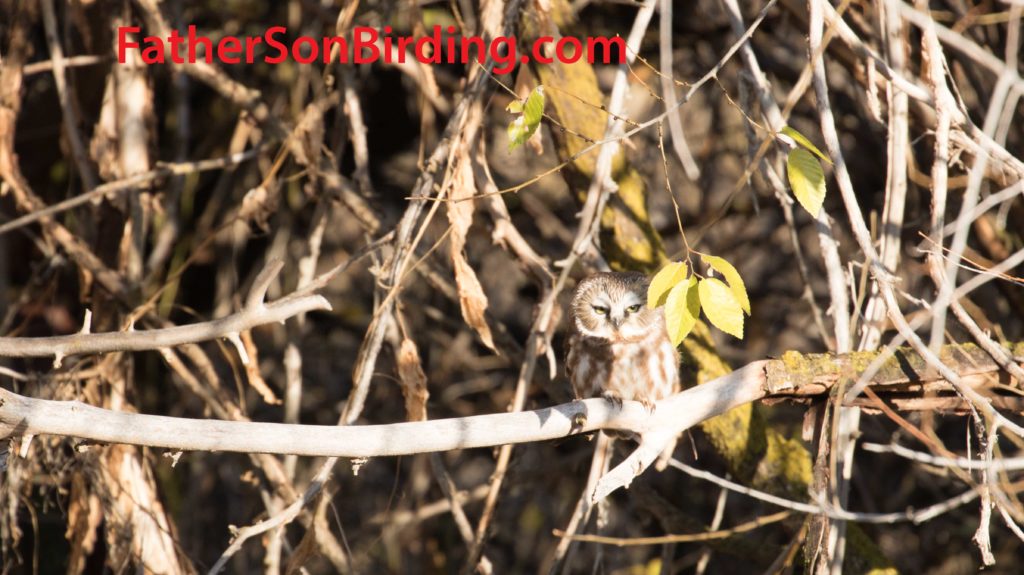
We looked right through and saw what Nick was calling the Northern Saw-whet Owl. It was looking away from us, but we could still sort of identify it. The view disappointed us, though, and my dad went around back of the tree to attempt some photos.

After about five minutes, the owl suddenly cocked its head and flew closer to my dad. We quietly joined him, and saw that the owl was now wide awake and perched in full sunlight.

“This is what he was doing when I first saw him,” whispered Nick.

“Look, there must be a mouse under there,” I said.

The Saw-whet’s eyes was intently following the rustle of leaves beneath him. Suddenly, he dove and retreated back to his previous spot within the bush. He hadn’t gotten the mouse, though, and eventually came back out into full view, his warm brown streaks and adorable golden eyes highlighted by the light of the sunset.

After about a half hour of photographing and staring at this new lifer, we left him alone.

The Gravel Quarry had scored again.
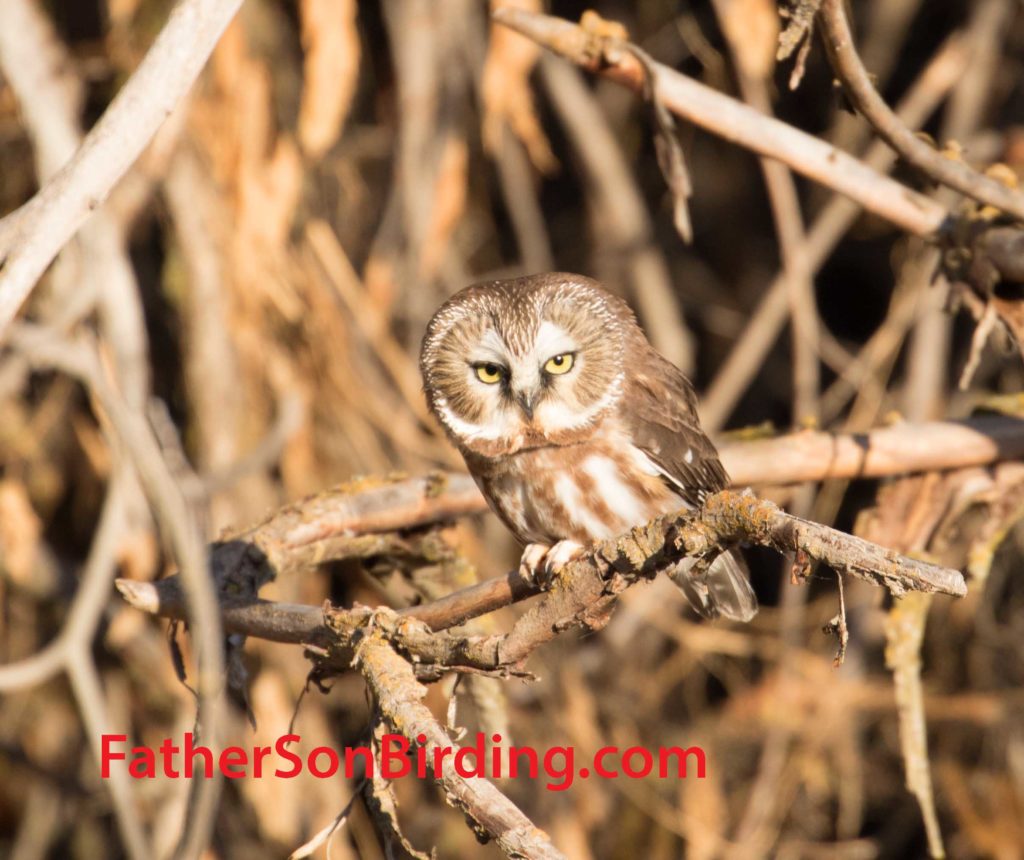
Northern Saw-whet Owl–another nemesis ticked off, and another great experience!
 

Fall Surprises

Fall birding can be tough—at least in Montana.

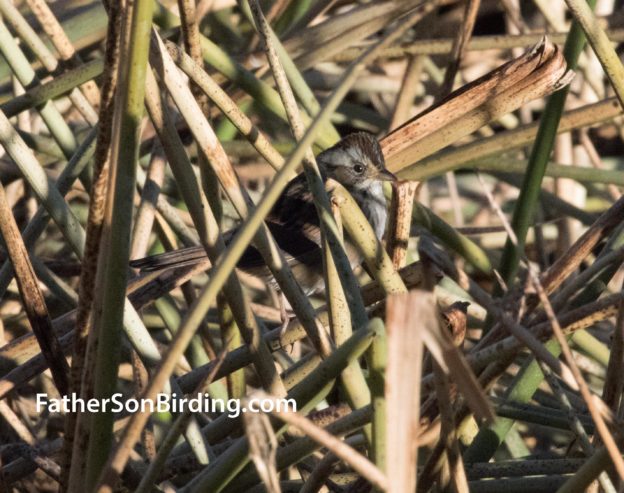
I just completed a five-day return trip from Missoula to Billings, mainly to promote my new book Warblers & Woodpeckers, and I have only question: Where were the birds? Sure, I found some, but with much lower abundance and diversity than I expected. Even at places I’d seen a lot of fall species before, my best lists barely cracked a dozen. I would have notched more if I’d been better at identifying LBBs—Little Brown Birds. For instance, I took photos of a sparrow at Shiloh Conservation Area in Billings and glimpsed another intriguing group at Two Moons Park, but couldn’t ID any of them.

Lousy, no-good rotten sparrows.

Our first-ever Montana Surf Scoter—to be followed by a second one (a female) a few days later.

I shouldn’t really complain since Braden and I have seen some wonderful birds the past few weeks. About two weeks ago, we saw our very first Montana Surf Scoter at one of our favorite birding spots, the gravel quarry. The bird was a stunning black male and just what such an ocean-loving bird was doing in Montana is a matter for debate. Since we started birding five years ago, however, scoters seem to be rare but reliable visitors.

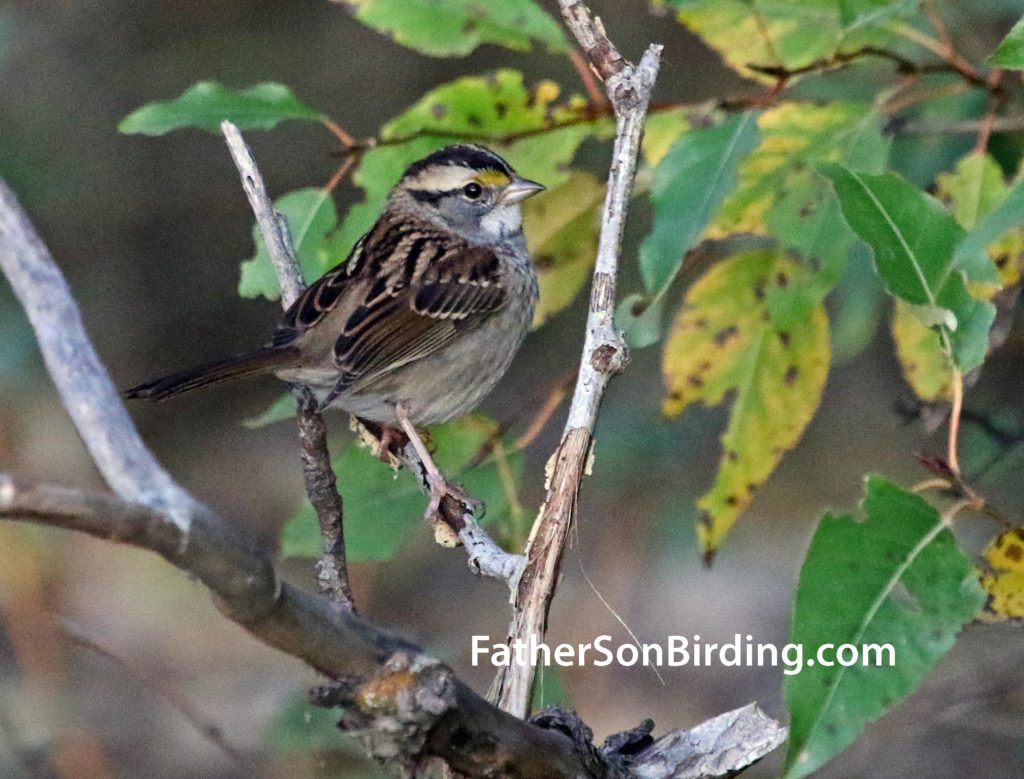
A few days later, I was giving Braden a driving lesson in the parking lot of the Rocky Mountain Elk Foundation. After practicing parking thirty or forty times, I said, “C’mon. Let’s grab our gear and go see if any birds are around.” Not five minutes later, Braden spotted not one, but two White-throated Sparrows. Normally Eastern birds, these are real finds for Missoula and can only be spotted with diligent effort—and a lot of luck—during fall migration.

This was only our second location seeing White-throated Sparrows in Montana. A delightful surprise!

Alas, we’ve seen fewer warblers and other fall migrants than last fall, and that was reinforced on my trip across the state. I saw a smattering of good ducks (Redheads, Barrow’s Goldeneyes, and Ruddy Ducks) at Warm Springs, Three Forks ponds, and Lake Elmo State Park. I also spotted a Common Loon at Three Forks, and a nice variety of Western, Horned, Eared, and Pied-billed Grebes in most places I looked. But songbirds? They seemed to totally shun me on the trip.

When I returned home, I shared my photos with Braden. As we flipped through them, he nodded and politely murmured, “Nice. Uh-huh. Good one.”

Until I came to that mystery sparrow from Shiloh.

“Whoa. Wait a minute!” he exclaimed, opening Sibley’s. “Now I’m excited.”

“Why? What do you think it is?” I asked.

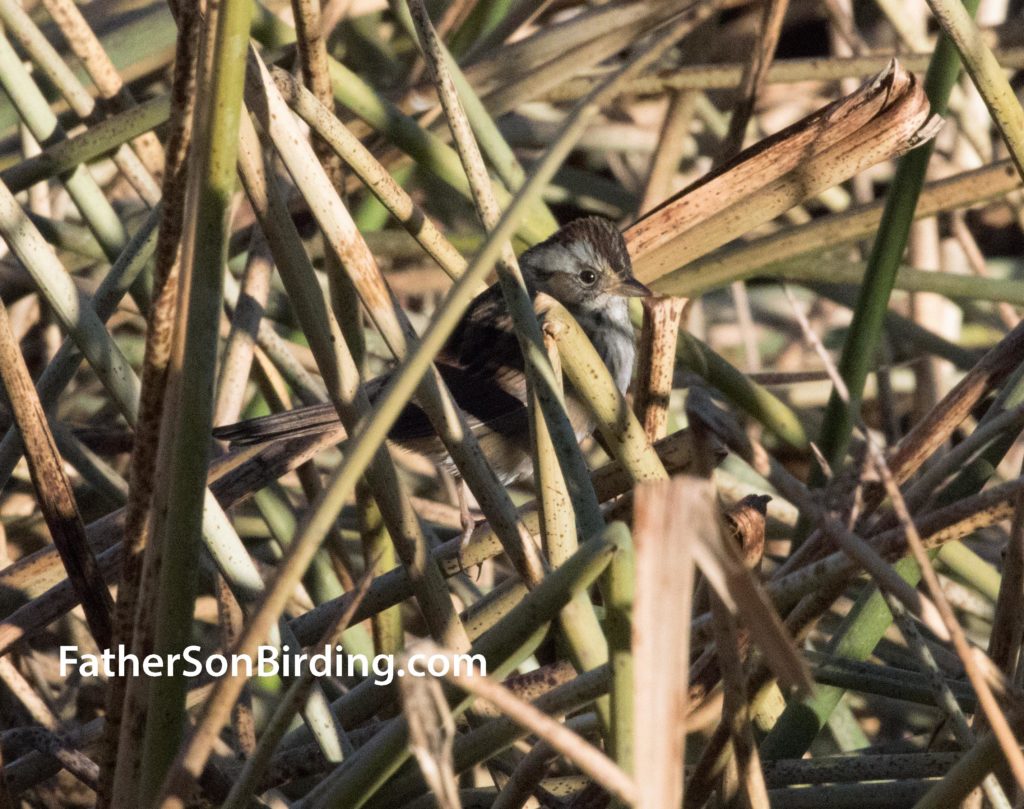
There are only about fifty records of Swamp Sparrows in Montana. Lucky me, this one decided to say hello!

“What do you think it is?” he countered.

“I couldn’t decide,” I said. “It looks kind of like a Song Sparrow, but doesn’t have the stripes. I thought maybe Lincoln’s, but it doesn’t have the orange colorings.”

Braden handed me Sibley’s. “I’m pretty sure it’s a Swamp Sparrow. They’re like, Code 4 for Montana.”

Now, my adrenaline was pumping too. “Really?”

We pored through the descriptions and compared it with my photos. Not only did the bird look identical to its description and illustration, I had found it in just the kind of habitat that Swamp Sparrows love.

Maybe fall birding in Montana isn’t so bad after all!

The Backyard Jungle

Braden is currently in Iceland, where he is birding with mom and grandparents—and will undoubtedly write some great upcoming posts about that—so I thought this would be a great time to talk about backyard bird habitat.

When we moved into our neighborhood in 2006, we faced a daunting task: transforming our property from a biological desert that had been scraped clean by bulldozers into something that not only looked nice, but provided habitat for native animals and plants. It hasn’t been easy. Aside from the usual tasks of battling weeds and keeping plants alive, we’ve faced a ravenous army of deer that consistently ignore signs that read “Deer-Resistant Plants.” Finally, after twelve years, however, we are enjoying a yard that truly resembles the habitat we set out to create.

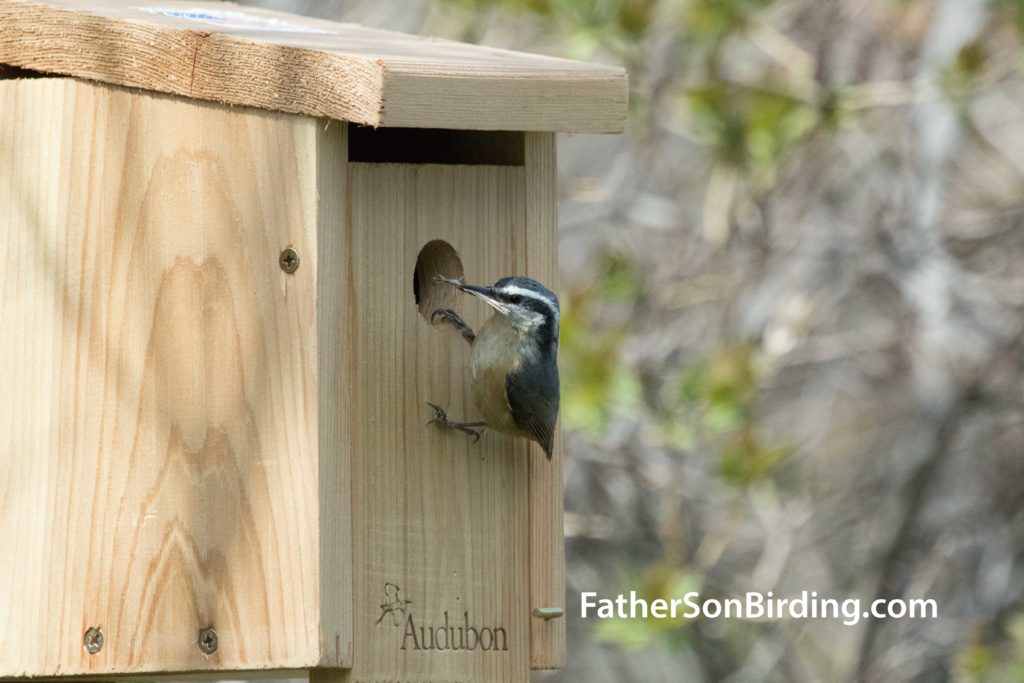
A pair of Red-breasted Nuthatches took immediate advantage of this new bird condo in our messy yard this year. Audubon, I will expect my product placement check soon. (Photo by Sneed B. Collard III)

Food has certainly been a key to our success. Through luck and persistence, we’ve managed to establish a wide variety of plants that provide berries, nectar, seeds, and insects to multiple bird species. Oh yeah, and a backyard sunflower seed feeder doesn’t hurt!

One thing I underestimated when we began is the importance of structure. Sure, we planted trees, some of which have reached twenty feet or more, but we also have an array of buffalo berry, maple sumac, ocean spray, golden currant, and mountain mahogany that have proved extremely “bird popular” for their cover as much as for their food. We’ve also been helped by a row of lilacs along the back fence that were already here when we moved in and serve as a vital launch pad for birds wanting a turn at the feeder.

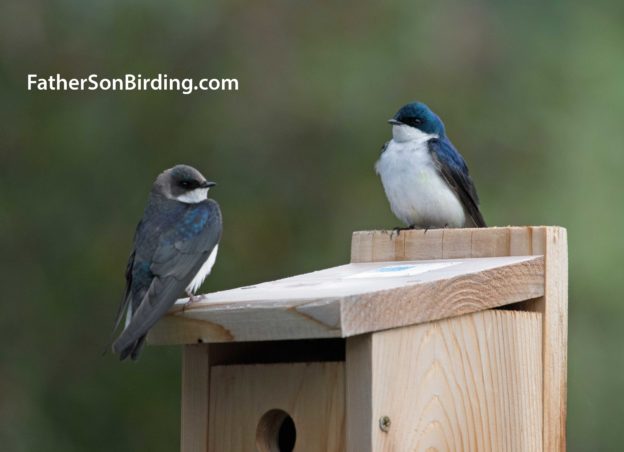
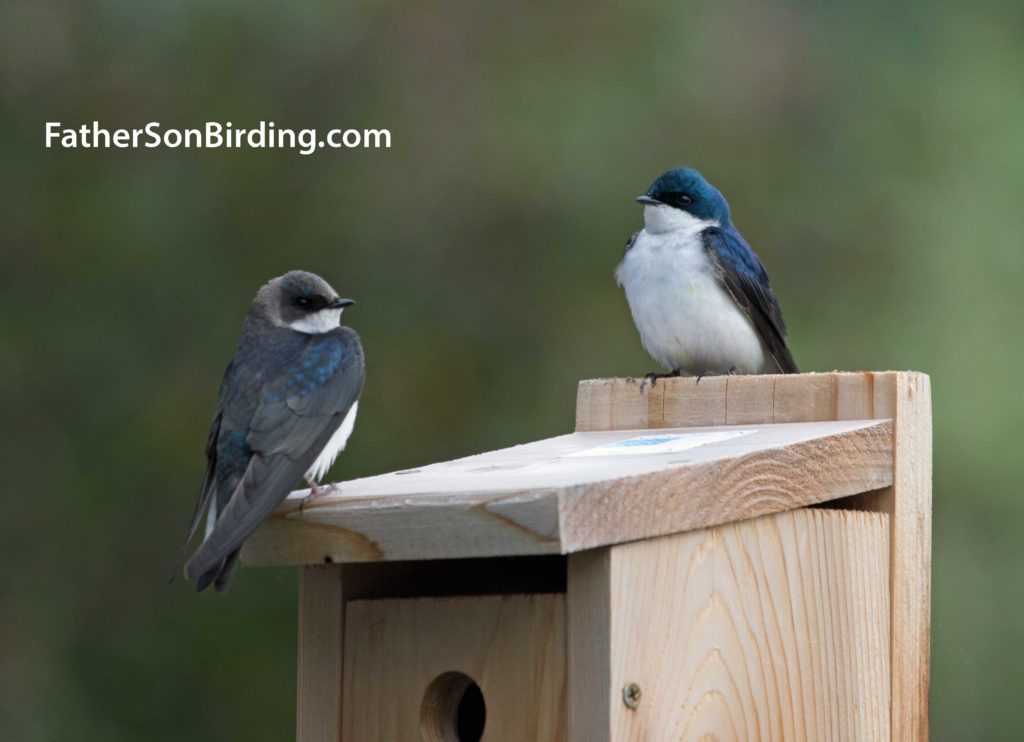
Female to Male Tree Swallow at our front birdhouse: “Hm, honey, I like the neighborhood, but the front door is a little small.” (Photo by Sneed B. Collard III)

One final thing we did just this year is put in two chickadee houses. Within days, one had been staked out by Black-capped Chickadees and the other by Red-breasted Nuthatches. For further fun, Violet-green Swallows nest under our eaves while a surprise robin pair has raised a family in a bordering fir tree. We believe that a Song Sparrow pair has also successfully raised chicks, but we’re not sure where!

The end result is that this year has seen an explosion of birds around our house—more than forty species to date, shattering our previous record. The most common residents have been the nesting birds, Evening Grosbeaks, Cassin’s Finches, Song Sparrows, Cedar Waxwings, Pygmy Nuthatches, Flickers, and yes, those pesky House Finches and House Sparrows. We’ve also made sightings of Pileated and Hairy Woodpeckers (thanks to the ponderosa pines behind the house), Common Nighthawks, American Goldfinches, Western Wood Pewees, and Rufous Hummingbirds.

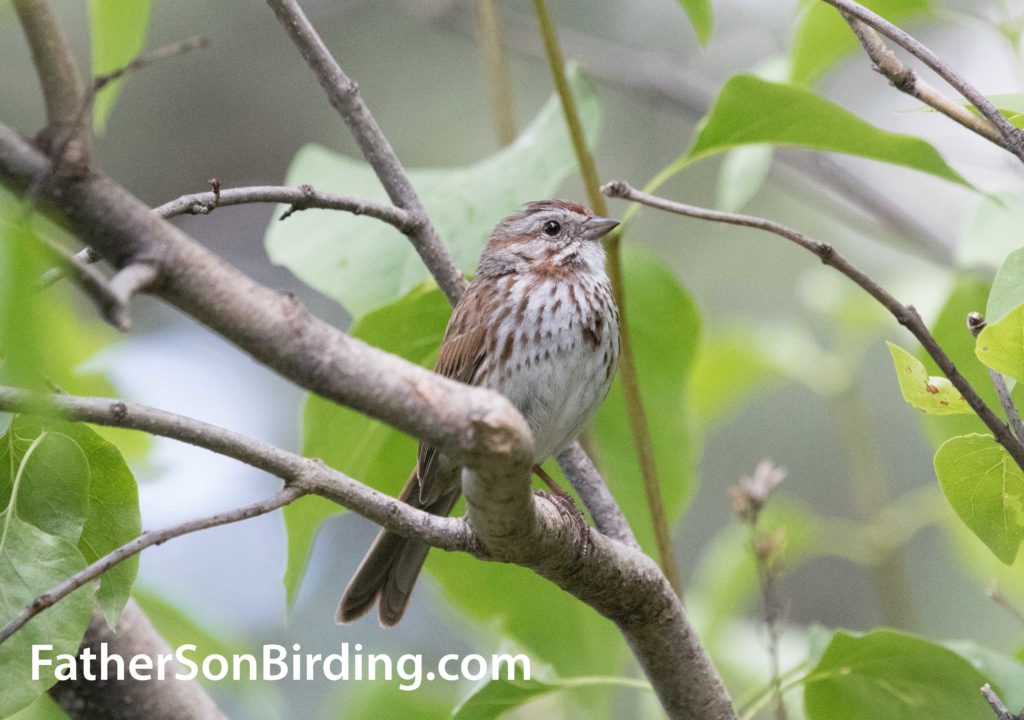
One of this year’s delights has been the daily appearance of our first, apparently resident, Song Sparrows. (Photo by Sneed B. Collard III)

Sadly, few of our neighbors have followed our example in creating habitat, most sticking with pointless lawns and non-native shrubbery that is virtually useless to native animals. I like to hope, though, that our “messy” yard of diverse and unruly plants inspires at least the occasional passerby to boldly go where traditional landscape companies fear to tread. After all, those of us lucky enough to own a home with a yard have a responsibility to give back to the plants and animals that our extravagant human “nests” have displaced.

Fire In The Hole!


To Subscribe to FatherSonBirding, please fill out your (brief) information in the appropriate box in the column to the right. Thanks!

Braden here.

At 6:30 on Sunday, June 17th, retired UM Professor Dick Hutto picked up my dad and me to go birding. In the passenger seat of Dick’s car was Dick’s former graduate student Hugh Powell, who was in Missoula to write an article for the Cornell Lab of Ornithology. Our mission was simple: see a Black-backed Woodpecker.

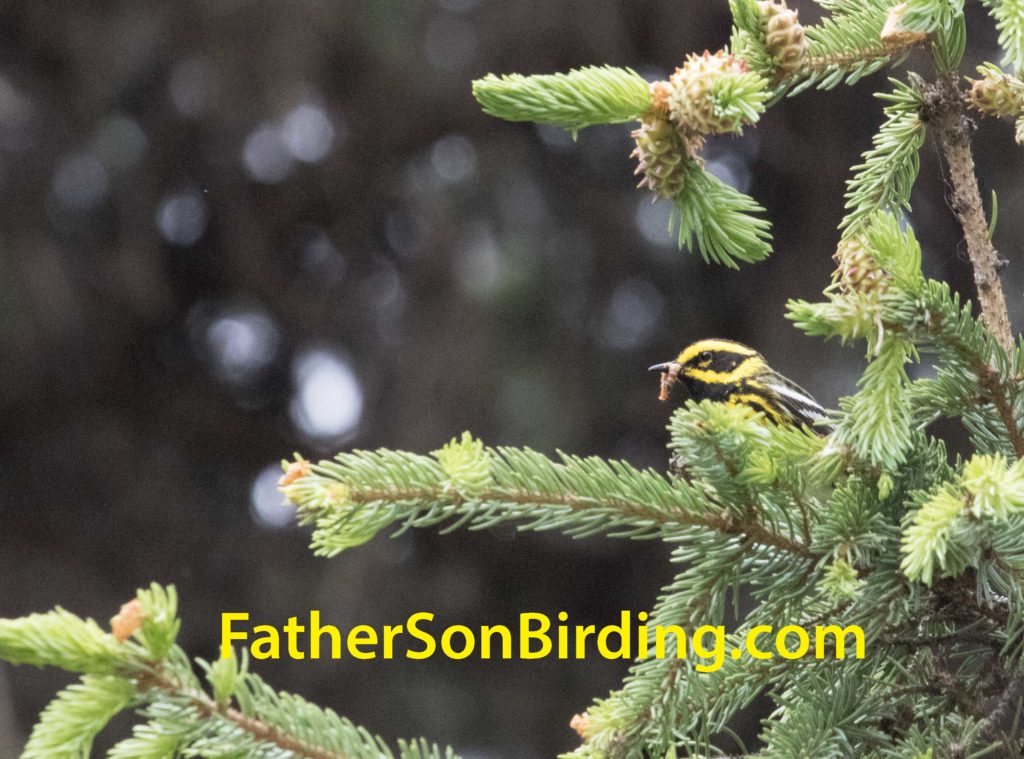
Townsend’s Warbler. (Photo by Sneed B. Collard III)

We were headed to an area known as the Rice Ridge Fire (after a quick coffee stop), to the northeast of Missoula. The first time we had heard about this trip was at Montana Audubon’s Wings Across the Big Sky Bird Festival. A birder from Helena told us that Dick (who had an abundance of bird knowledge, specifically about birds that liked fire) was leading a field trip up to the burn and mentioned we might want to come along. My dad, who knew Dick well, jumped at the chance and asked Dick if we could get a ride up with him. Well, here we were.

At Seeley Lake, a large tourist area as well as great birding stop, we met the rest of the group, all birders of different experience levels from Helena. Knowing that this area was good for American Redstarts and Northern Waterthrushes, my dad and I persuaded the group to look around Seeley before hitting the burn. We quickly saw and heard 15 species, including the uncommon Willow Flycatcher, identified by its characteristic call, Fitz-bew.

We slowly made our way up Rice Ridge Road, stopping regularly to look for our goal, the Black-backed. The burn area had not been logged, thankfully, and every time we stopped Dick emphasized that it should not be logged, either—why not just cut trees near town instead? Burn areas have some of the highest levels of biodiversity in the country! (For more information on this, check out my dad’s book, Fire Birds: Valuing Natural Wildfires and Burned Forests.)

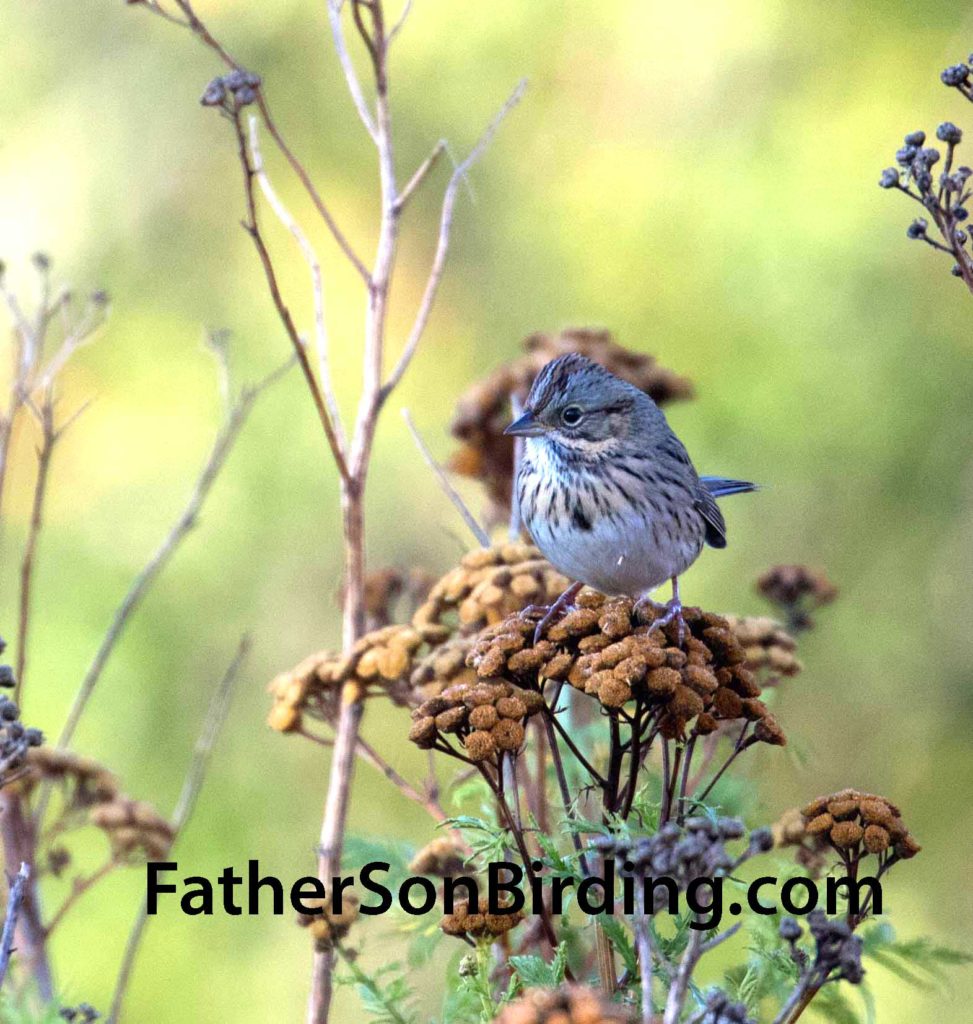
Lincoln’s Sparrows are known for nesting in higher altitude wet areas. (Photo by Braden Collard)

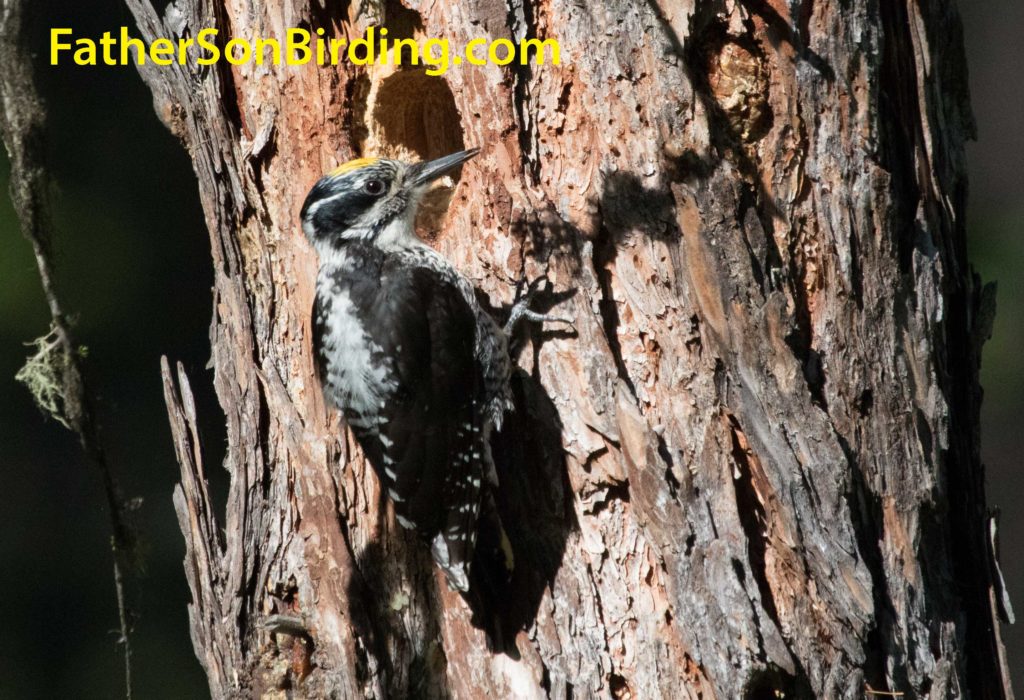
No Black-backeds showed, but the birds did not disappoint—MacGillavry’s Warblers and Lincoln’s Sparrows skulked in the low brush, Bluebirds danced across the black trunks, and woodpeckers of many species drummed and called. On that one stretch of road we observed four species—Northern Flicker, Hairy Woodpecker, Williamson’s Sapsucker, and (new for the year) at least three American Three-toed Woodpeckers, the Black-backed’s slightly less burn-dependent cousin.

In one spot, sort of a mix of burn and old-growth with a creek running through it, we were amazed with the number of species. A dipper, nesting under the bridge. Great looks at a Townsend’s Warbler. Large numbers of Western Tanagers and robins, both burn-preferring species. Sharon Dewart-Hansen, a Helena woman who was first in the state for the year, pointed out a new call for us—the Whip Three Beers of the Olive-sided Flycatcher.

Dick was slightly disappointed at the low number of woodpeckers, saying they would reach their peak two or three years from now, but everyone else was ecstatic. It had been a great trip, Black-backed or not.

The number of American Three-toed Woodpeckers that are in burns is double that of those not in burns. (Photo by Sneed B. Collard III)

Warblers Across Montana

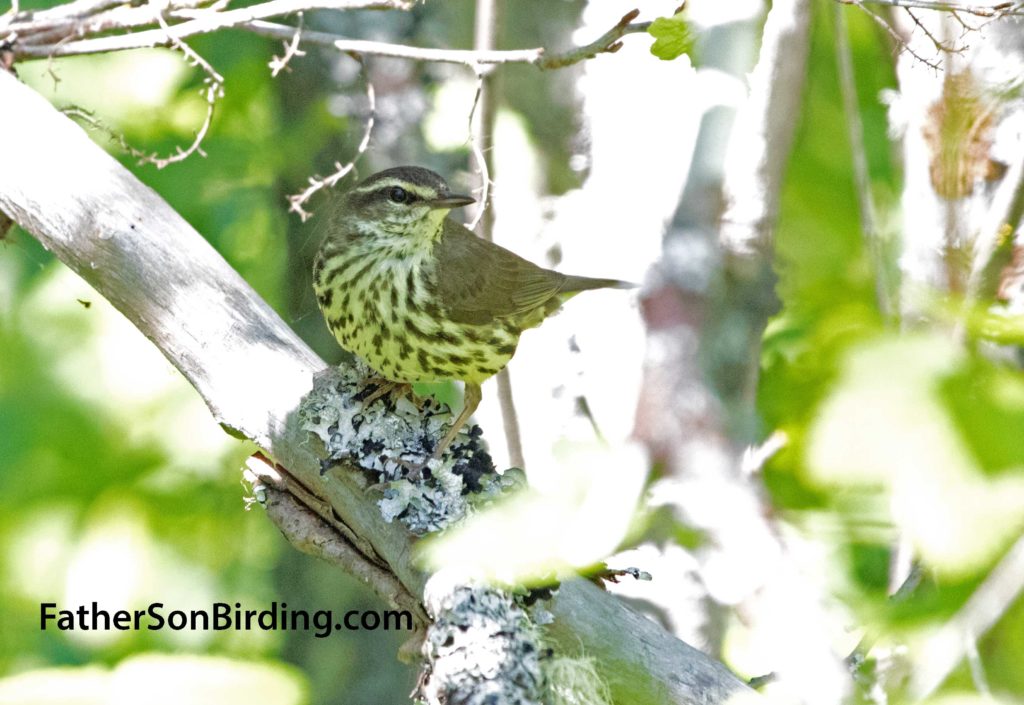
We heard more Northern Waterthrushes than saw them, but did manage an occasional glimpse. (photo by Sneed B. Collard III)

During our 2016 Big Year, Braden and I were fortunate to attend the Monterey Bay Birding Festival. Our all-day “California Specialties” field trip was one of the most exhilarating days of birding we’d had to that point and ever since, we’d wanted to attend a similar event. Last weekend, we finally got our chance by going to Wings Across the Big Sky, held in Kalispell, Montana. As you might imagine, the event was loaded with terrific speakers, good food, and amazing field trips.

Picking our field trips proved a challenge, but on Saturday Braden and I opted to bird in Glacier National Park. Our top target species? Varied Thrush, Chestnut-backed or Boreal Chickadees, Harlequin Duck, and a pie-in-the-sky possibility, the endangered Black Swift. Shortly after 6 a.m., we followed our intrepid leader, Steve Gniadek, out of Kalispell and by 7:30 were birding the woods around Apgar. Almost immediately, we picked up one of our target birds, Chestnut-backed Chickadee, but what really stunned us was the profusion of warblers. In the thick, damp woods, seeing the birds proved a challenge, but their calls rang out all around us and, under Steve’s tutelage, we did our best to start learning them. Over the next two hours, we heard (and eventually saw) eight species—Yellow, Yellow-rumped, Townsend’s, American Redstart, Northern Waterthrush, Orange-crowned, Common Yellowthroat and MacGillivray’s. For Montana, it was an astounding total and almost a quarter of the 33 species we recorded.

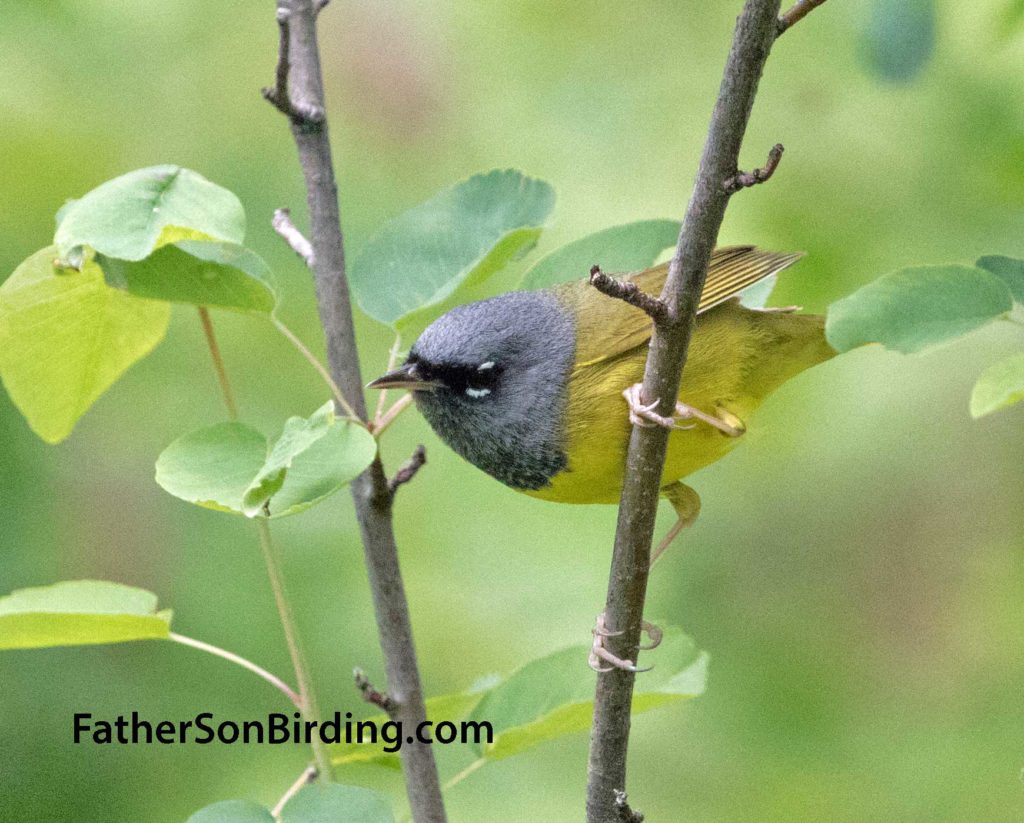
MacGillivray’s Warblers have become one of Braden’s and my favorite summer arrivals in Montana. (photo by Sneed B. Collard III)

Our group’s next mission: Harlequin Ducks. The iconic Going-to-the-Sun Road was still closed, but we drove to Avalanche Creek to find a mob scene of hikers and bikers taking advantage of the closed road before cars were allowed up and over Logan Pass. In the confusion, our cars got separated, but as soon as our group stepped out of our car, we heard the eerie, drawn-out call of a Varied Thrush. “Let’s find it!” Braden exclaimed, leading us into a patch of conifers and, sure enough, we caught good, brief glimpses of this spectacular bird.

No sooner had we stepped out into the open, Braden and another member of our group shouted “Black Swifts!” We looked overhead to see several large black birds zooming about 100 feet above us. “How do you know they’re not Vaux’s?” I asked. The large size and slower wing beats strongly suggested Black Swifts, but a few minutes later, we got a clear answer when a Vaux’s and a Black Swift flew right next to each other, articulating the size difference between the two.

Elated with this bonus—a Lifer for both Braden and me—we headed down to MacDonald Creek to try to locate Harlequin Ducks. We didn’t find them, but got a great look at a Fox Sparrow and heard yet more warblers. By this time our comrades had reformed and we all decided to walk up Avalanche Creek. None of us expected to find the ducks, but at our last stop along the creek, I happened to glance at a shady eddy upstream—just in time to see a large shape disappear beneath the surface!

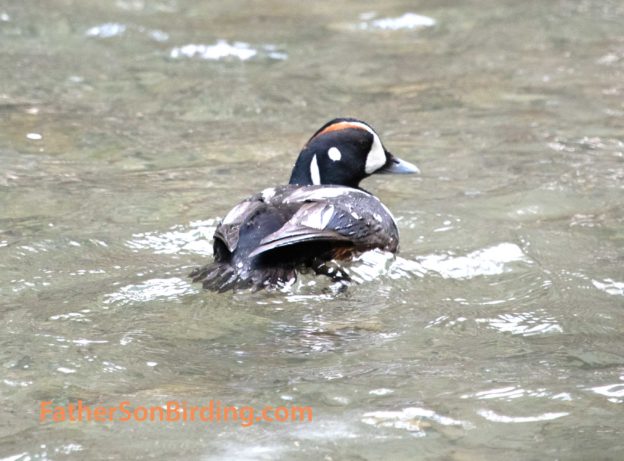
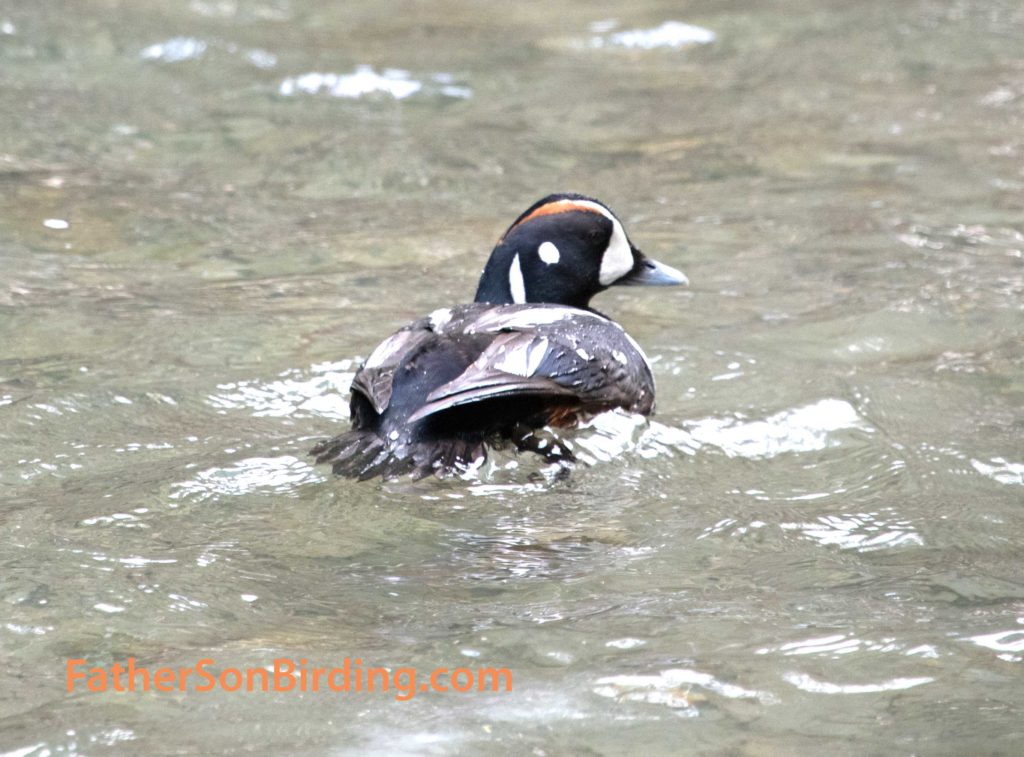
A Lifer for me, this Harlequin Duck put an end to a two-year search. (photo by Sneed B. Collard III)

I grabbed Braden’s arm. “Braden, watch that spot!” A few seconds later, a gorgeous male Harlequin Duck popped to the surface. The duck performed for our group for twenty minutes. I can’t say I got great photos, but watching this happy, rare white-water paddler enjoy the currents is something Braden and I will never forget.

Breaking News: My fall book, Warblers and Woodpeckers: A Father-Son Big Year of Birding is now available for preorder from Amazon. Click Here!