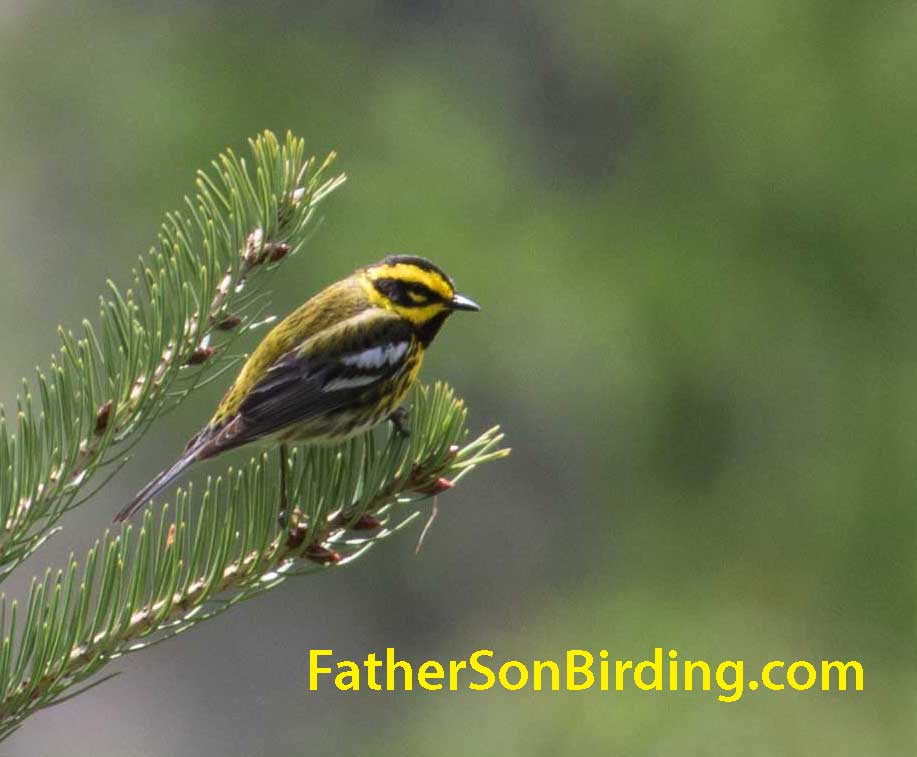
Townsend’s Warbler, Glacier National Park.
Braden present.
Ever since 2016, the year we did our Big Year, my dad and I have had a tradition of going all out on Memorial Day weekend. That year, with our friend Nick Ramsey guiding us, we raced from Lee Metcalf Widlife Refuge south of Missoula to the Seeley-Swan Valley close to Glacier National Park, picking up a variety of great birds: Black-backed Woodpecker, Ruffed Grouse, American Redstart (not as common for us as for you Easterners), and one of my favorite birds: Common Yellowthroat. The following year, we again focused on our area and racked up 56 species in 3 hours, including a stunning pair of Red-naped Sapsuckers.
This year, when I first heard that I had to go up to go to a Boy Scout camp called Grizzly Base on Memorial Day weekend, I was disappointed. As we grew closer to the date, though, I began realizing two things: Grizzly Base itself could be good birding, and we were only there for a day and a half, leaving almost three more days to bird. For the latter idea, I was thinking we could get up to Glacier National Park; it was pretty close and convenient to where we would be staying. Fortunately, we did even better than that.
The camp was really fun. I learned a lot of things, and got to know the people and place I would be working with this summer. Grizzly Base’s birds were nothing to look down upon either as we spotted more than twenty species including a Bufflehead nest, Townsend’s Solitaires, a Pileated Woodpecker, a Western Tanager and a pair of Wood Ducks.
Early Saturday afternoon, though, my dad and I packed up and set out to bird in earnest.
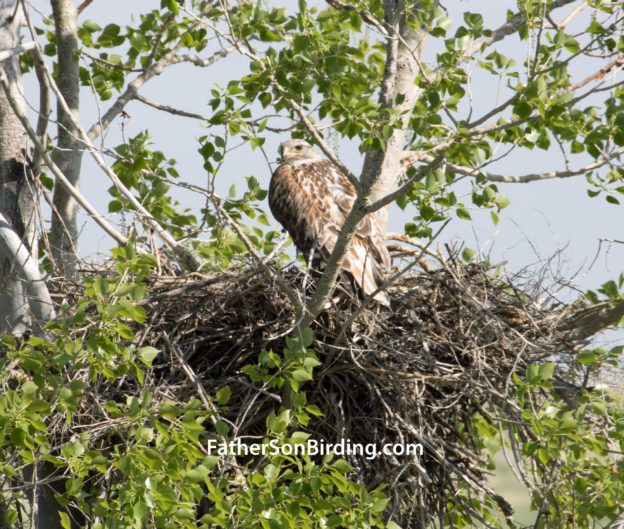
We followed Highway 2 around the southern border of Glacier National Park. We stopped at a spot for my dad to take a nap, and I was surprised to see and hear several Townsend’s Warblers, along with lots of Yellow-rumpeds and a pair of Rufous Hummingbirds. As we crossed the continental divide, things got drier. First, it was just drier forest; soon we were on the dry northern part of Montana known as the High Line, prairie pothole country. We stopped to photograph a Ferruginous Hawk nest right off the road, and spotted American Avocets, Wilson’s Phalaropes and dozens of ducks in the small ponds we passed.
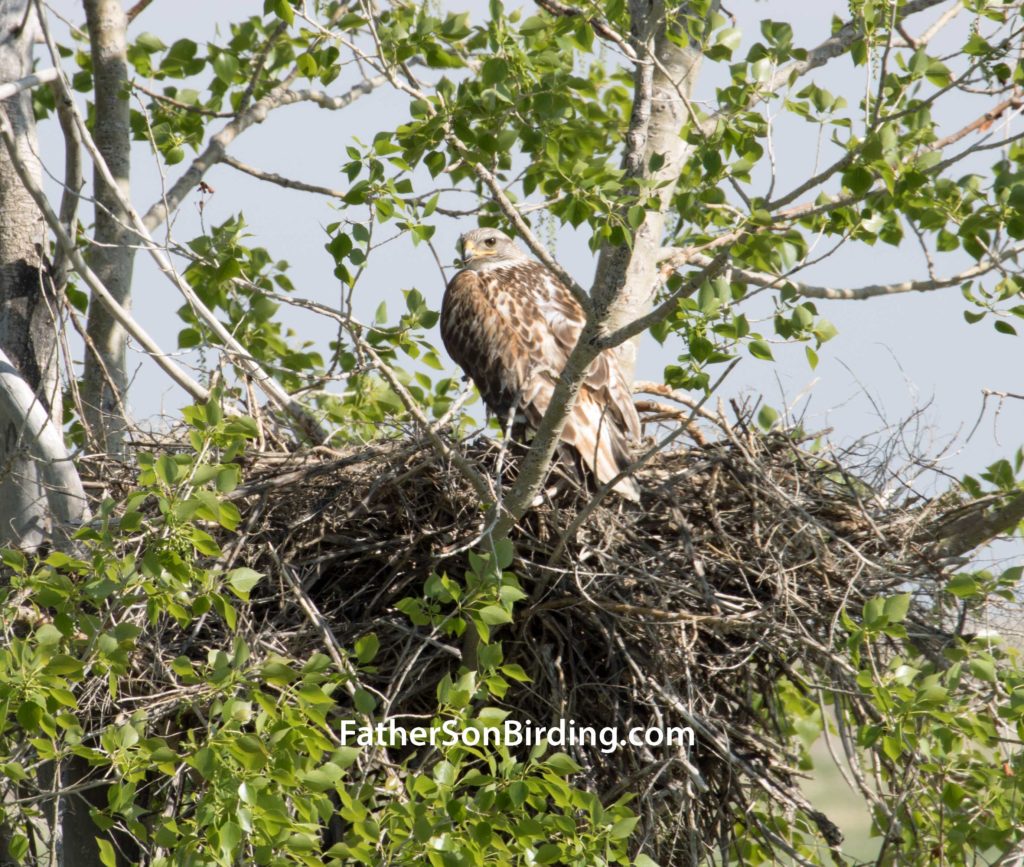
Ferruginous Hawks are a generally a rare sighting–so finding a nest was amazing!
We also made a list of goal year birds. The three we had just seen were on there, along with as many small birds as possible: Lark Sparrow, Lark Bunting, Clay-colored Sparrow, Brewer’s Sparrow, Chestnut-collared Longspur, Grasshopper Sparrow, Baird’s Sparrow, Sprague’s Pipit. Baltimore Oriole topped our list, as it was on my Top Ten ABA Life needs list, and several had been reported around Malta the last couple days.
As we reached Havre, a large-ish city about halfway through Montana, the long drive was starting to get to us. Not helping was the fact that the road signs kept displaying Malta as at least 80 miles away, and we weren’t sure if we could make it. My dad kept driving, determined as ever.
As we headed east from Havre, the ranches that had been lining the road transformed into crop farms instead; particularly irrigated fields. Red-winged Blackbirds lined the fences and gates, and I casually glanced at every one to verify its identity. Once, as we passed another one, the bird turned away from highway. The back of its head was a large patch of cream, and its back was a brilliant pattern of white.
“Bobolink!! Turn around!!” I shouted as we screamed by.
“What?! Do we have to?”
“Yes!” So we did. That Bobolink, a rare sighting for us, got us to Malta, where our intensive birding would begin.
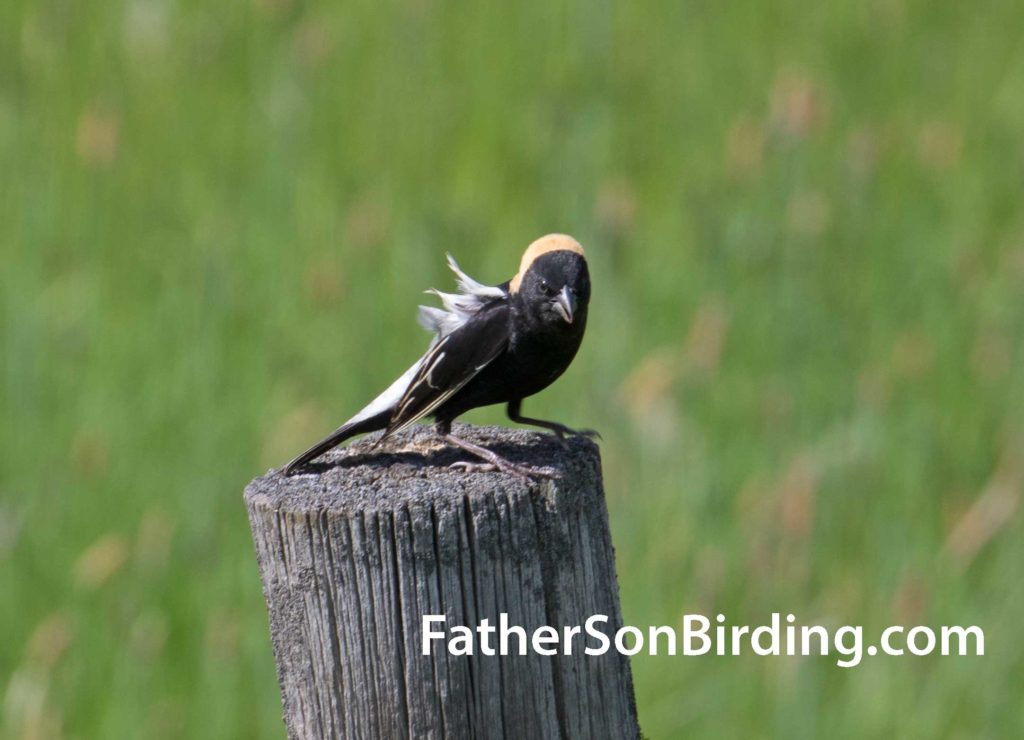
As more prairie has been converted to farmland, Bobolinks have switched their habitat from tallgrass prairie to irrigated fields.