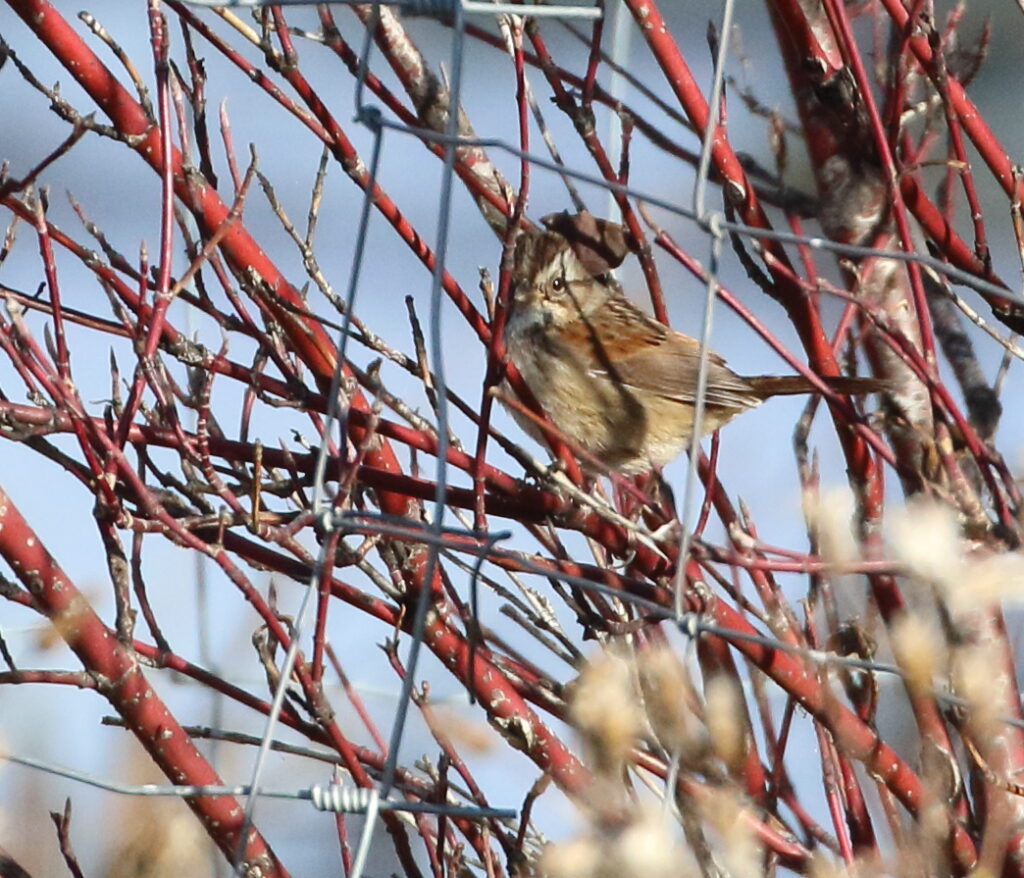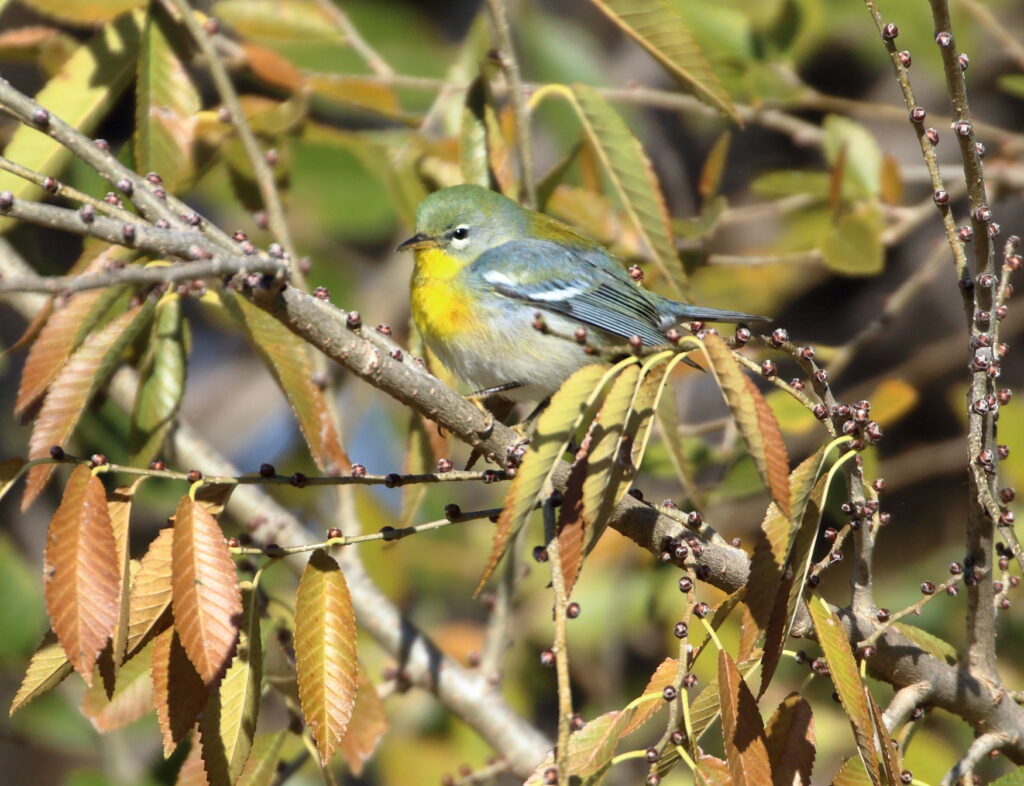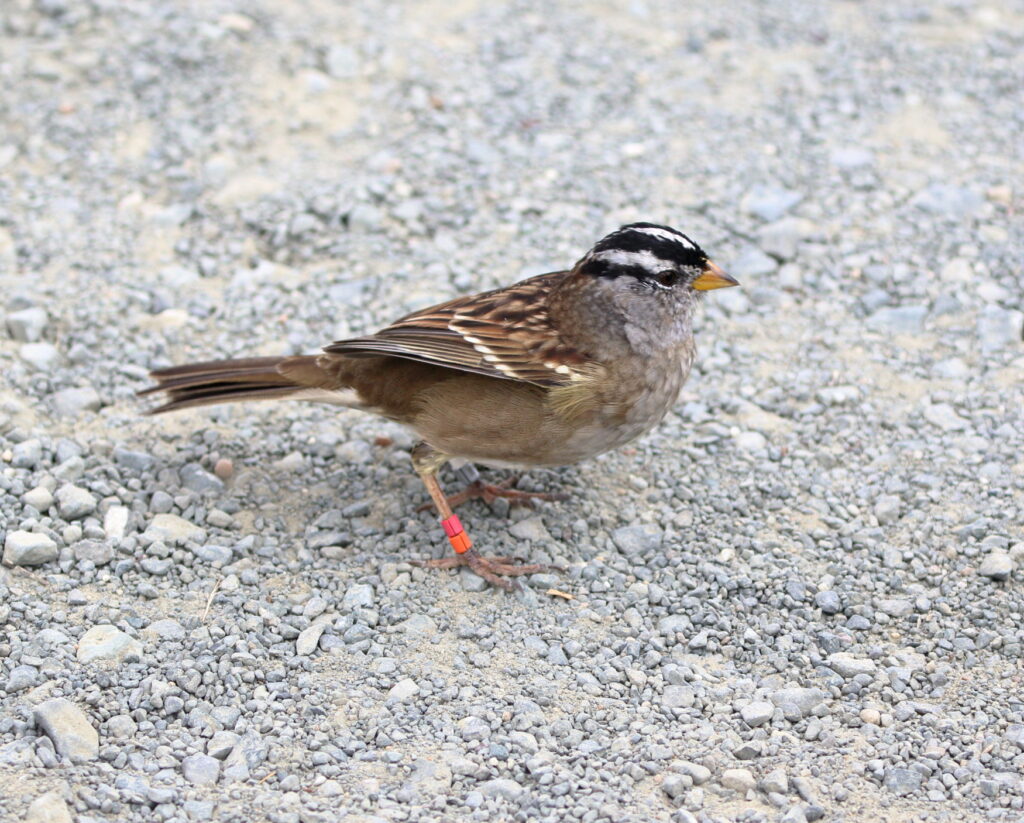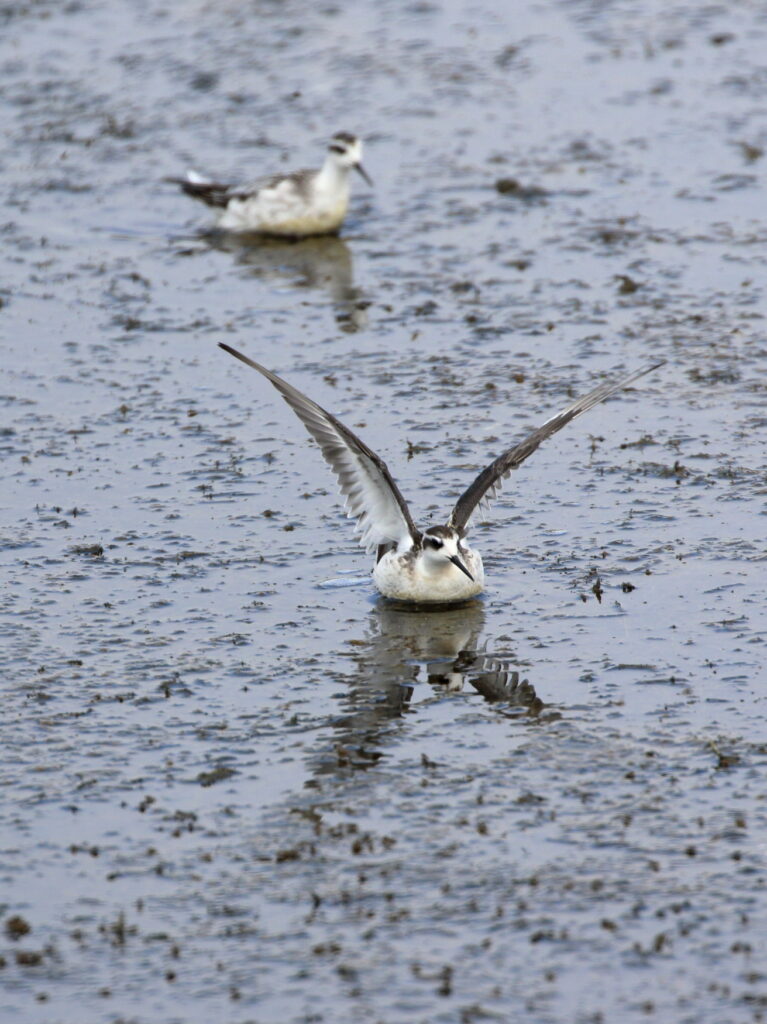
Tag Archives: fall migration

Abbotts Lagoon, Point Reyes National Seashore (or Chasing Migrants, Part II)

After our amazing encounter with Vaux’s Swifts and shorebirds (see our last post), Scott and I had another productive session the next morning at the Ellis Creek water recycling facility and Tubbs Island, both in Sonoma County. As an added bonus, we got to bird with two of Scott’s pals, Steve and Sean. Steve and Scott began birding about the same time and were still in the beginning phases of their birding careers, but Sean grew up birding and taught us all some cool ID features. Most important, he confirmed that the peeps Scott and I saw the day before were indeed Least Sandpipers. With his help, we were also able to identify a couple of sneaky Western Sandpipers that were comingling with the approximately 400 Least Sandpipers in front of us. As much as we enjoyed these sessions, what Scott, Steve, and I looked forward to the next day even more. That’s when we planned to bird legendary Abbotts Lagoon.

(L to R) Sean, Steve, and Scott investigating the wilds of the Ellis Water recyling plant!

Abbotts Lagoon sits within Point Reyes National Seashore, and none of us had ever before birded it. However, Braden and our occasional guest contributor, Roger Kohn, had both been there and given it high marks. As we crested the mountains at Point Reyes and drove down toward the coast, I didn’t know what we would find, but held my hopes high.

Reaching the beginning of the lagoon requires a mile or so hike through remarkable dwarf-like vegetation that reminded me of steppe or tundra, probably because fog enshrouded the lands around us. I hadn’t realized we would have to hoof it so far, but I was grateful because we got great looks at many California residents: California Quail, California Scrub-Jays, White-crowned Sparrows, and most exciting, Wrentits. One of these, in fact, popped up no more than fifteen feet from us—unusual for a generally secretive bird. Nontheless, it was the lagoon and beach beyond that propelled us forward and when we reached the lagoon we found . . .

Though a bit of a hike, the mile-long walk to the lagoon offered a nice variety of songbirds and raptors, including this banded White-crowned Sparrow.

Nothing.

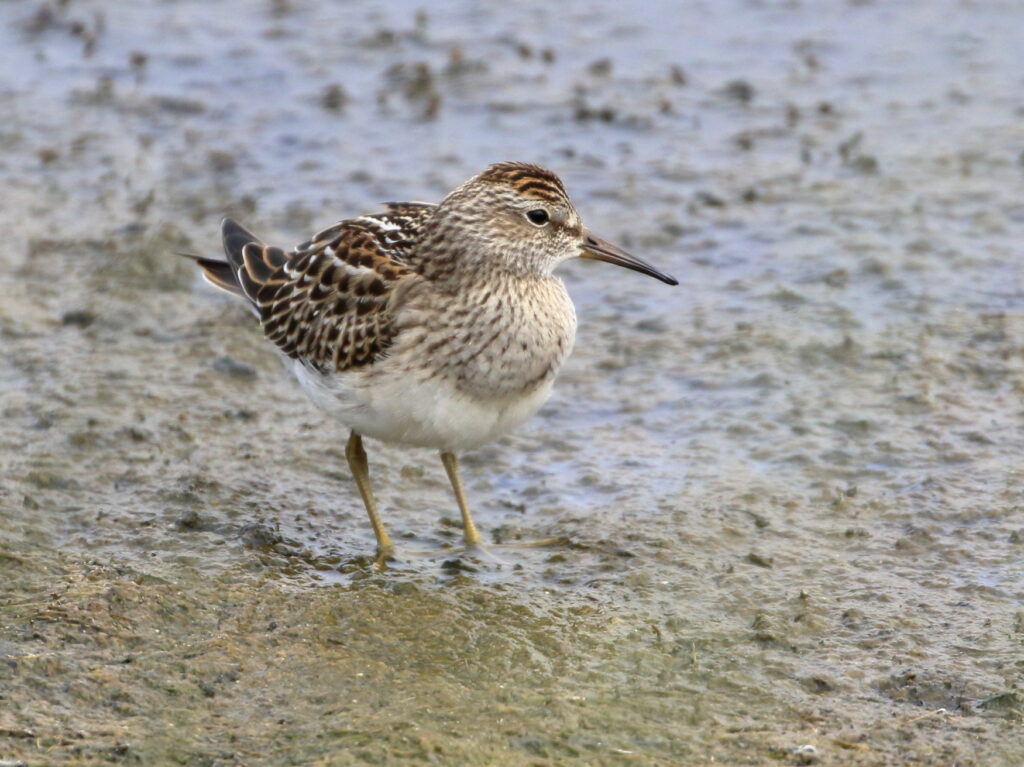
Well, almost. Instead of vast rafts of shorebirds ripping up the mud, only a couple of wading birds and American White Pelicans could be made out as far as the eye could see. Darn, I thought to myself. But if there’s an, ahem, cardinal rule to birding it is this: You Never Know. So we plowed ahead, following the harder beach sand, and soon came to a little bend where we got great close-ups of three Red-necked Phalaropes and a Pectoral Sandpiper—a bird I recognized only from my hours studying them in Montana. This bird, in fact, was quite interesting because PESAs show up only in small numbers on the West Coast, and generally only in fall. A lifer for Scott and Steve!

Continuing toward the ocean, we spotted two Black-bellied Plovers and a flight of shorebirds in the distance, but it wasn’t until we reached the ocean that we got some real action.

I was just as excited by pelagic bird possibilities as I was by shorebirds, and once on the beach I immediately set up the spotting scope we’d lugged the two miles out there. Like shorbs, I rarely have a chance to observe pelagic birds, and I felt determined to make the most of this rare opportunity. Right away, I saw a number of dark shapes out on the water—shapes that appeared and disappeared on the four-foot swell. Oh man, I thought to myself, I’m never going to be able to figure out what those are. In such situations, I have learned to relax and just hang in there, and that’s what I did now.

From studying before the trip, I came up with several likely possibilities of species that could be out there. These included Common Murres, Pigeon Guillemots, various storm-petrels, and Sooty Shearwaters. In fact, as we arrived, I noticed at least eight medium-sized dark birds swooping low over the water. When they turned, I spotted light patches under the wings. First victory: Sooty Shearwaters.

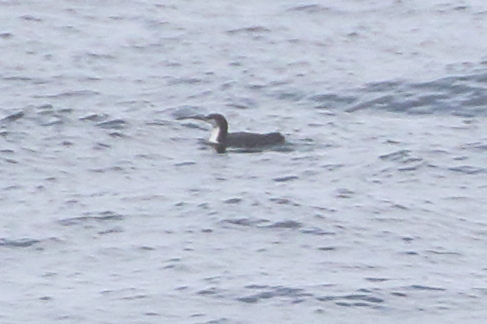
Then, I saw a larger bird floating a couple of hundred yards offshore. The shape shouted “Loon” and I thought, “Hm, that looks like it has a silvery sheen on its head.” Victory #2: Pacific Loon!

Identifying pelagic birds at great distance can take great patience and not a little skill, but in time, many species reveal themselves. The keys to this Pacific Loon? A silvery sheen on its head, a thinner bill than found on Common Loons, and a thin black “chin strap” or collar around the neck.

After that, it got harder, but I did manage to ID some distant Common Murres by the white around the face and neck, thinner “up-pointed” bills, and longer body lengths. A seabird expert undoubtedly would have found additional species, but as a seabird novice, I felt satisfied. Humorously, as I was looking through the scope, I suddenly saw a whale’s tail emerge behind several of the birds. Did I look up? Of course not! Who has time for pesky mammals when there are ocean birds to be seen!

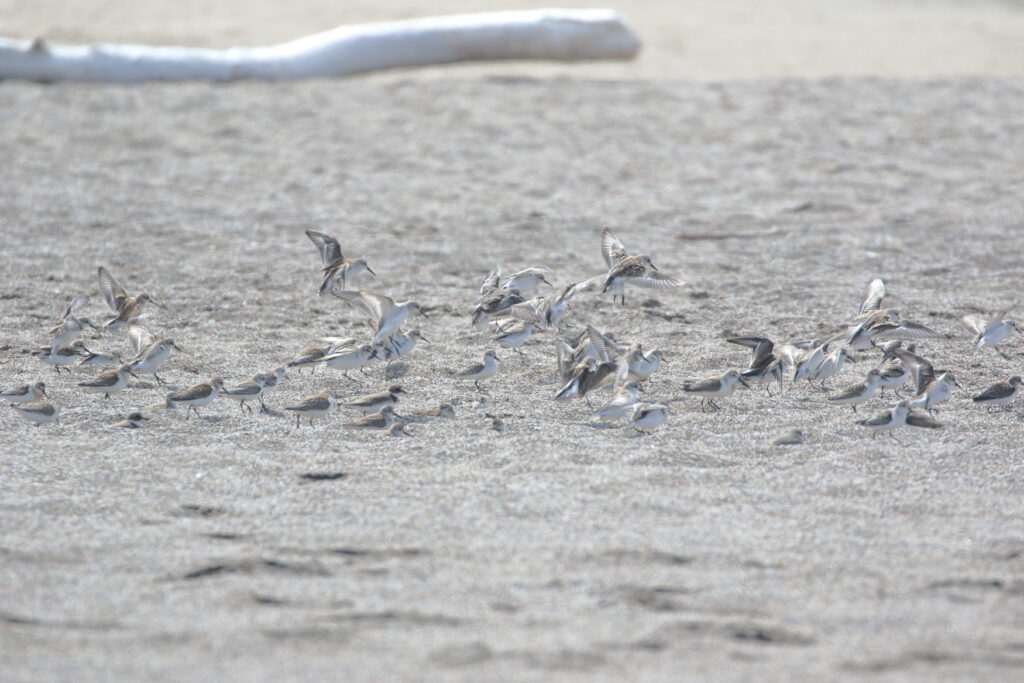
But let us not ignore the beach itself. As Scott, Steve, and I enjoyed the waves and emerging sun, the shorebirds decided to put on a show. On one side of us, a flock of at least 150 Least Sandpipers landed only a hundred yards away. On the other side, a couple of hundred Western Sandpipers settled down. Talk about your perfect conditions for comparison! In fact, this was my first chance ever to get good, leisurely looks at Westerns and I took full advantage of it.

The beach at Abbotts Lagoon offered by far my best opportunity ever to study Western Sandpipers. Note (if you can) the overall pale appearance and the reddish “shoulder blades” typical of juveniles this time of year. WESAs also tend to have longer, more curved bills than other peeps.

You remember that Sesame Street song “One of these things is not like the other?” Studying the Least Sandpipers, I spotted a much paler bird with a thick black bill and black legs. Another peep: Sanderling!

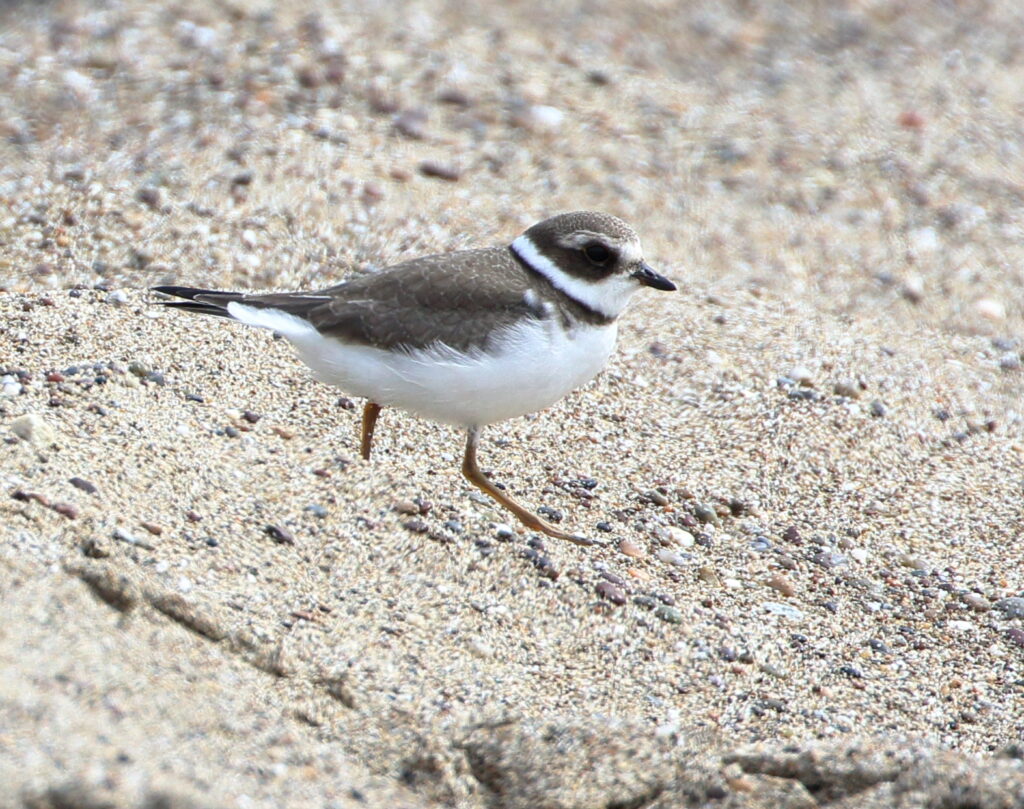
Meanwhile, among the Western Sandpipers, I espied smaller birds with shorter bills and dark collars around their necks—Semipalmated Plovers!

I was especially tickled to find half a dozen Semipalmated Plovers among the Western Sandpipers. Go plovers!

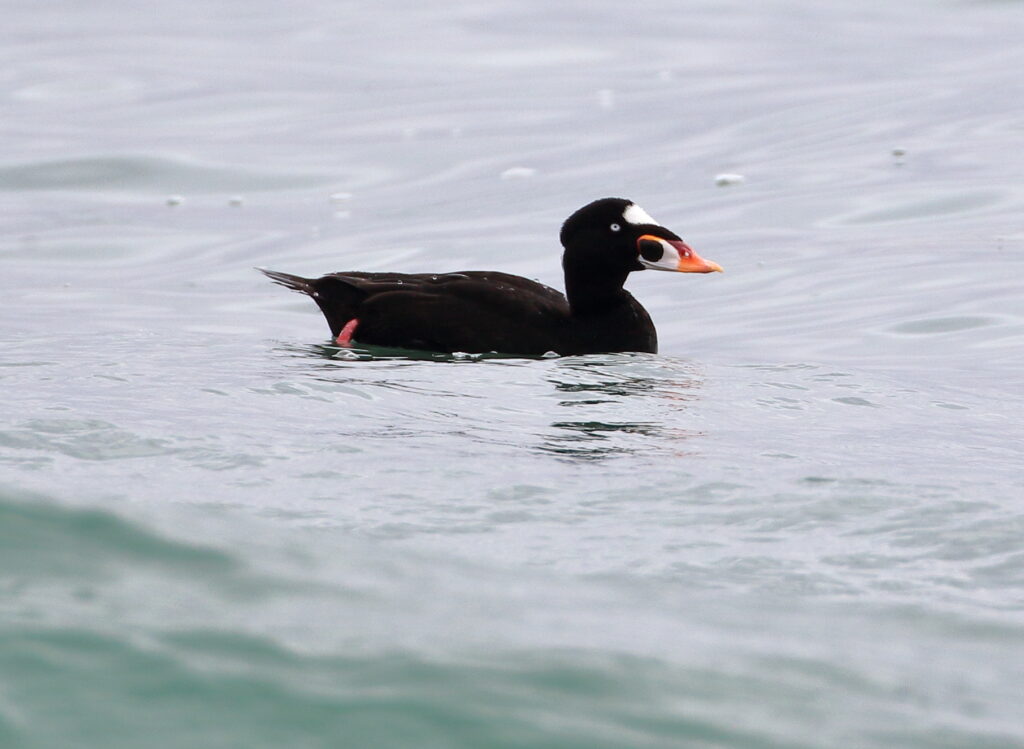
To add to the show, a Peregrine Falcon landed on the sand behind us, and on the way back we saw several other raptors including a White-tailed Kite. After Abbotts, we got a delicious lunch at Inverness Park Market, and then headed to Limantour Beach for great looks at Surf Scoters. All in all, it was an awesome day chasing migrants, featuring good birds, good food, and best of all, great company.

Trip Report: https://ebird.org/tripreport/276917

Compared to the Abbotts Lagoon Beach, Limantour Beach was a bit of a desert, but did offer up three nice Surf Scoters.

Chasing Migrants, Part I: Swifts, Peeps, and Plovers

In case you missed our last post, be sure to check out my new book, Birding for Boomers. It’s a great gift for anyone you know of any age or background who might be interested in getting into birds. It’s also a great way to support our efforts here at FatherSonBirding! Why not order one or two copies—or even a dozen—right now?

I’ve had little time to catch up on our birding adventures this time of year. With new books to promote, house guests to entertain, seeing Braden off to his senior year at UMaine, and more, life has been a juggling act through August and September. I did manage two lovely trips to Freezeout Lake in August, one with my occasional birding buddy Steve Flood, the other with Braden right before he headed East. In mid-September, I also rewarded myself with a personal trip to the Bay Area to visit friends and relatives—and, of course, see as many birds as possible. Like the recent trips to Freezeout, my primary objective was to find and study as many migrating shorebirds as possible.

Despite birding for more than a decade, I still feel like a beginner when it comes to shorebirds. My recent trips to Freezeout were “study sessions” more than birding excursions, and I was grateful that Baird’s Sandpipers, Red-necked Phalaropes, Semipalmated Sandpipers and other species offered hours of observation and ID practice on each trip. I hoped for similar sessions in California. After I spent a few days with relatives in Oakland and reconnected with the delightful birds of oak woodlands, my friend Scott (see Eastern Odyssey 24: Return to Westby) whisked me off to the North Bay, where serious birding adventures commenced.

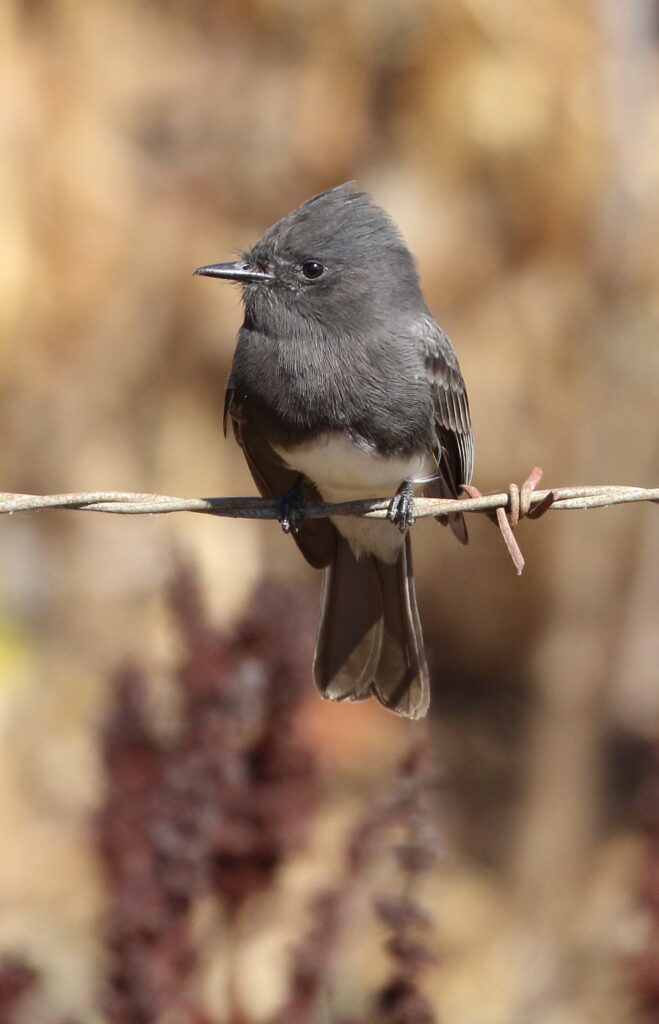
Before heading across the Richmond Bridge, we gave McLaughlin Eastshore State Park in Berkeley a try, but our timing was off as high tide covered the mudflats. Next, we visited the Las Gallinas Valley Sanitary District in Marin County. I enjoyed that, but again, we saw nothing spectacular. I was surprised to spot a lone Vaux’s Swift—a lifer for Scott—and eight or nine Black Phoebes put on a show, but it was a slow start to meeting our birding ambitions. Fortunately, things would pick up—dramatically.

Though they didn’t perch at the top of our target list for the day, Black Phoebes charmed us at the Las Gallinas water treatment ponds in Marin County.

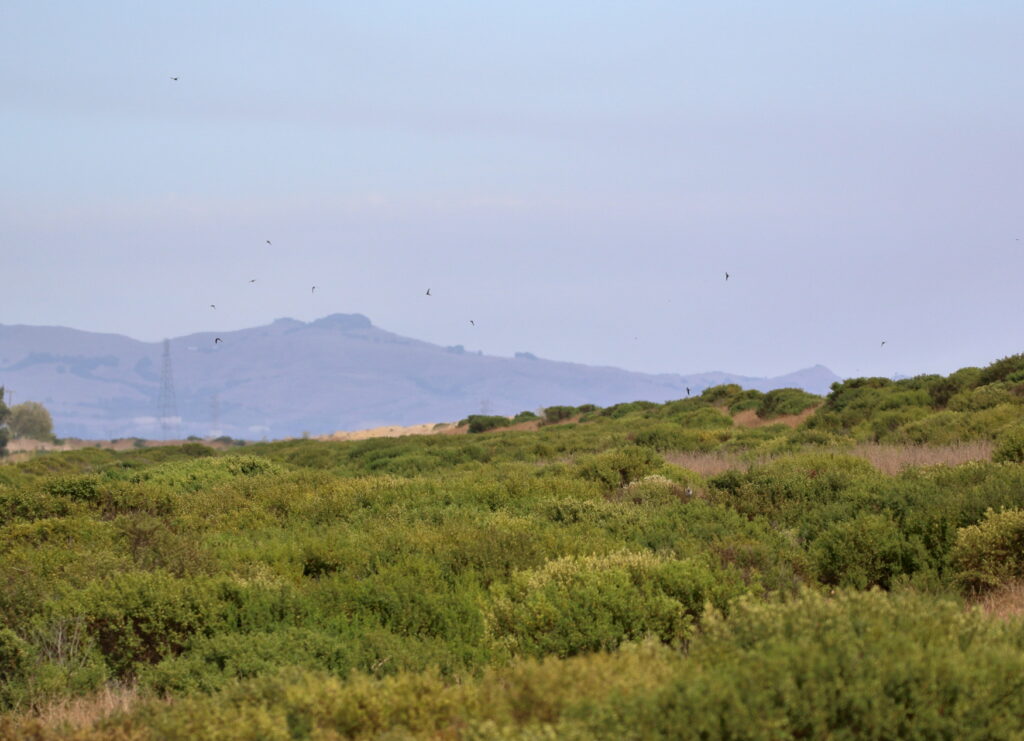
After Las Gallinas (“The Hens”), Scott drove us to Reclamation Road in the San Pablo Bay National Wildlife Refuge, where we hoped—finally—for some shorebird action. Our first surprise wasn’t shorebirds, however. As soon as we got out of the car, I spotted four tiny shapes frantically flying west. “Hey, there’s more Vaux’s Swifts.” I really hadn’t expected to see these, but it did make sense. I knew they’d departed Montana in the past few weeks and that they followed the West Coast down to their wintering grounds in Mexico and Central America. Our four birds were merely a prelude, however. As Scott and I walked out toward the shore, we saw half a dozen more swifts. Then a dozen. Then, as we looked east, we witnessed a veritable river of Vaux’s Swifts flying toward us.

This photo doesn’t begin to capture the remarkable river of migrating Vaux’s Swifts that passed over our heads. Yes, those “dots” are the swifts! Swifts are a species of concern because of the loss of old growth forests and other natural roosting sites. Ironically, saving old brick chimneys should be a priority for those interested in protecting these birds.

“This is amazing,” Scott said as the birds stiff-winged it over our heads. “Have you ever seen anything like this?”

I shook my head. The most VASWs I’d ever seen at one time was perhaps a couple of dozen. Now, hundreds streamed past us—probably thousands! We learned from a passerby that they were most likely heading to the chimney of an old brick-making plant, a well-known roosting place for them. Scott and I were suitably awed by the sight. It was enough to make the whole day worthwhile, whether or not we ended up seeing shorebirds.

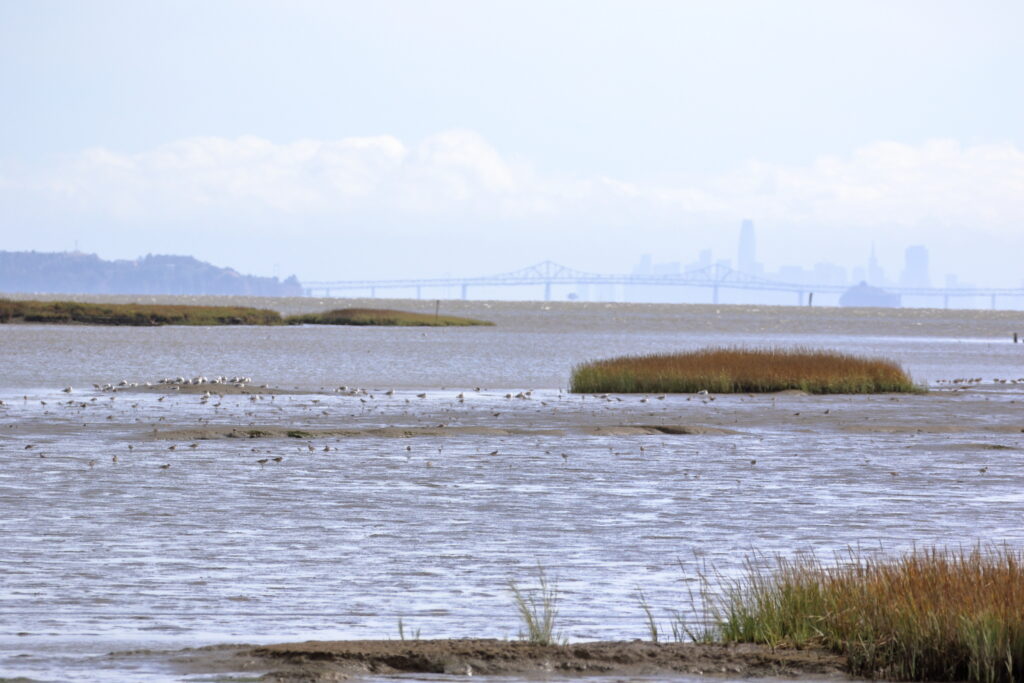
Nonetheless, as we walked out to the bay I was gladdened to see shallow mudflats and hundreds of dots scattered over them. “Shorebirds!” I rejoiced.

With San Francisco in the distance, you couldn’t ask for a more dramatic setting to study shorebirds! Many of those specks in the foreground are Least Sandpipers—though you’ll see a lot of other species mixed in!

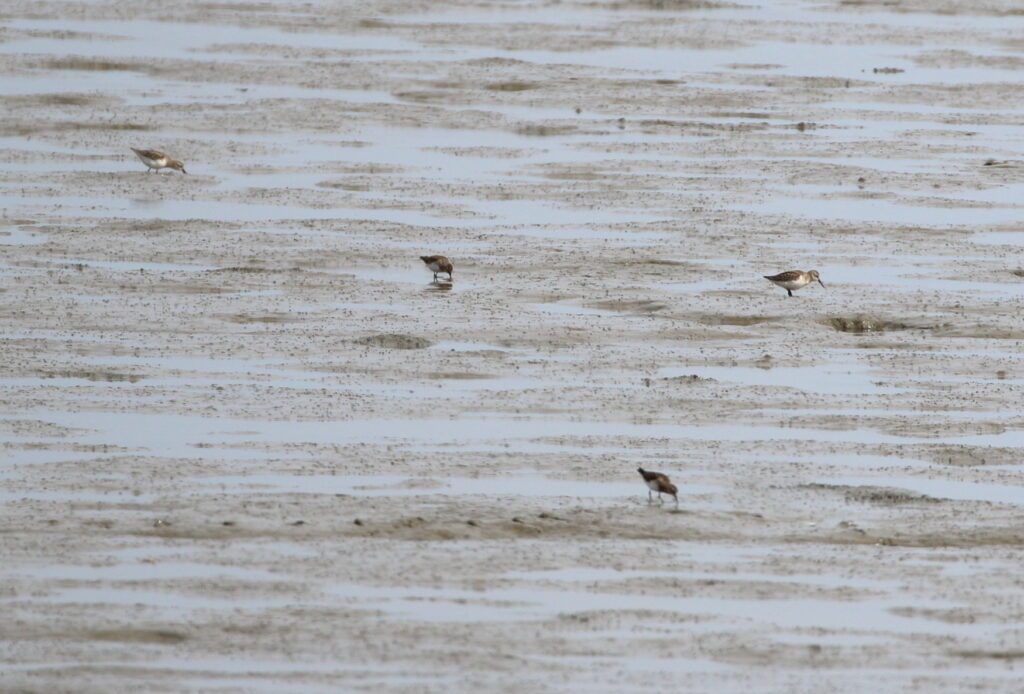
As we drew closer, I set up the spotting scope, and quickly zoomed in on a dozen-plus Long-billed Curlews, at least fifty Willets, and what would turn out to be a couple of hundred Marbled Godwits. These were easily-enough identified. Not so the hundreds of small sandpipers, or “peeps,” that peppered the scene in front of us. Birders generally include four species under the “peep” category: Sanderlings, Western Sandpipers, Semipalmated Sandpipers, and Least Sandpipers. Since it was the nonbreeding season, Sanderlings should have given off a distinctive whitish vibe by now, so I ruled them out, but what of the other three? The problem with peeps is that their coloration, size, bill shape and bill length overlap to a frustrating degree, and I just didn’t have enough experience with these to make a call. Least Sandpipers can be easy to pinpoint if you can see their leg color—yellow compared to black for Westerns and “Semipalms”—but when they were feeding in the mud, determining leg color often proved impossible.

As I often do in such situations, I called Braden. I described what I was seeing and said, “I am guessing that they are Semipalmated Sandpipers, but I just don’t know.”

“Well,” he informed me, “the good news is that if there are large numbers of them, they aren’t Semis because Semipalmated Sandpipers don’t move through the West Coast.”

With Braden’s help, I narrowed down these far-away “peeps” to either Least or Western Sandpipers. Confirmation would have to wait until later, however.

Doh! This surprised me because we do see them in Montana. I never realized, though, that our Montana birds were on the western edge of their migration pathway from their northern breeding grounds to their wintering grounds in the coastal tropics.

“If I had to guess,” Braden continued, “I’d say you’re looking at Least Sandpipers. You said that they’re darker brown and Westerns give off a grayer color.”

Still, even through the scope, the birds were too far away for me to be sure, so I recorded “peep sp.” in my eBird checklist—at least for now.

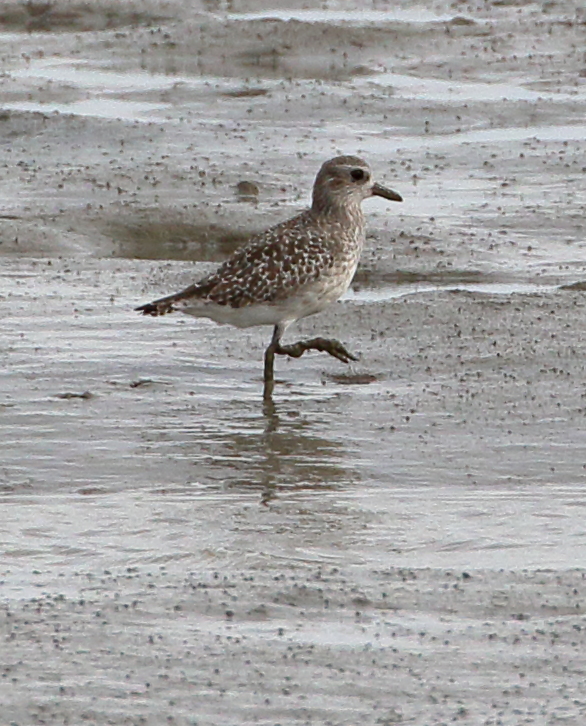
One species, however, excited me more than all the others. Almost as soon as we reached the mudflats, I spotted birds that I had especially hoped to see: Black-bellied Plovers. Black-bellied Plovers are one of the world’s largest plovers, and they have the widest distribution. Like many shorebirds, they breed mainly in the arctic regions, but in winter they disperse to coastal areas of every continent sans Antarctica.

At San Pablo Bay NWR, I was especially excited to see Black-bellied Plovers mixed in with Long-billed Curlews, peeps, Marbled Godwits, and other shorebirds.

Braden and I had only ever seen Black-bellied Plovers about twenty times—and only four times as they migrated through Montana. The birds are known to flock up in winter, but even in places such as California and Texas, we generally only saw a few at a time. Now, as I trained my scope out over the mudflats, I began picking out more and more of these birds. At first, their light color and larger size made them look kind of like gulls, but their more erect posture and stubbier dark bill gave them away. One bird they can easily be confused with are American Golden Plovers, which look almost identical except for their smaller bill, head, and overall size. Some AGPLs also show flecks of gold color even in winter, but today, I saw no AGPL suspects and counted sixty Black-bellied Plovers in front of me.

“I don’t think I’ve ever seen this many before!” I effused to Scott. “This is really amazing.”

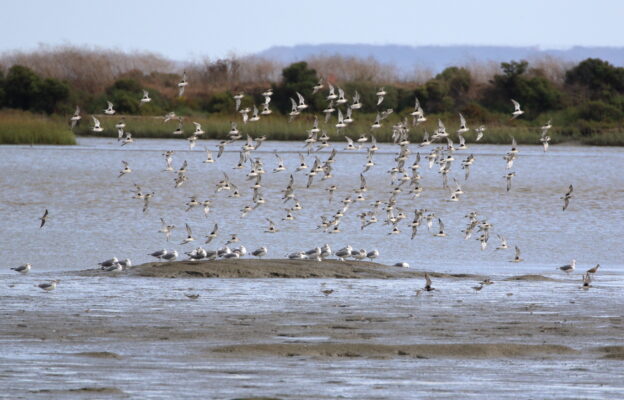
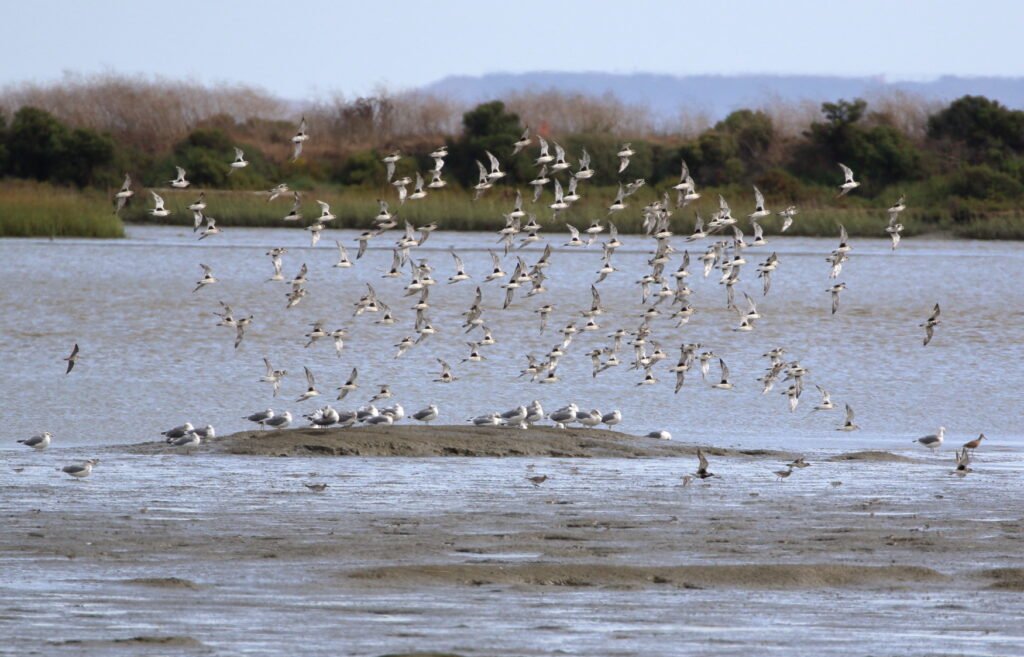
What I didn’t realize is that I vastly undercounted. I took a couple of photos of shorebirds in flight and later, going over the images, I made a startling discovery. One of the flying flocks consisted of at least 140 Black-bellied Plovers! How could I tell they were BBPLs instead of other shorebirds? In this case, it happened to be easy. Black-bellied Plovers are the only shorebirds to show distinct black armpits under their wings!

When I took this photo, I didn’t realize these birds were Black-bellied Plovers—easily the largest flock I have ever seen. The black armpits make IDing this species particularly easy in flight.

It was a great way to end the day for both me and Scott and we celebrated with a fabulous Mexican food dinner with Scott’s wife Ginny and step-daughter Hayley. I went to bed happy—but eagerly looked forward to more migrating bird opportunities ahead.

https://ebird.org/checklist/S195291789

August: It’s Just Weird

August is a weird month to bird. As we’ve no doubt mentioned before, we used to just write off August. I mean, most birds have stopped singing. No songbirds are migrating. Oh, and in Montana, hot, smoky weather often sucks the motivation from every pore of our bodies. Over time, however, our “bad August attitude” has, like the current presidential race, suffered a total reversal. Now, Braden and I cautiously look forward to August birding. The only problem? We’re never sure what we’re going to find. (See, for instance, last year’s August post “Birding Treasure at Garnet Ghost Town.”)

This August has been no different, but we began the month with some clear objectives. As Braden’s summer in Montana dwindles ahead of his final year of college, he had accomplished most of his summer birding goals save one: finding a Spruce Grouse. I could relate! After all, I saw my lifer spruce grouse only last year (see our post “Gambling on a Grouse-fecta”). As for me, I too coveted another Spruce Grouse on top of other Year Birds that had so far eluded me. The latter included Olive-sided Flycatchers, and Three-toed and Black-backed Woodpeckers. We both wanted to see migrating shorebirds, but realized it might be a tad early for some of them.

Sadly, Braden and I probably had only one day left to bird together before he departed, so any strategy to accomplish our remaining goals would involve compromise. Nonetheless, we set off last Sunday morning for a place we’d never birded together—Skalkaho Pass east of Hamilton. We got on the road before seven and made a brief stop at Lee Metcalf NWR hoping for shorebirds. No luck, probably because water levels were too high, but we did see a lot of the other usual suspects. Most surprising? Vaux’s Swifts, which I myself had probably never seen at Metcalf before, and at least half a dozen Sandhill Cranes—an unusually high number for that location. “Hm,” we thought, “Maybe some birds are already on the move for their fall migrations!”

There was something off about this Sandhill Crane at Lee Metcalf. I just can’t quite figure out what it was!

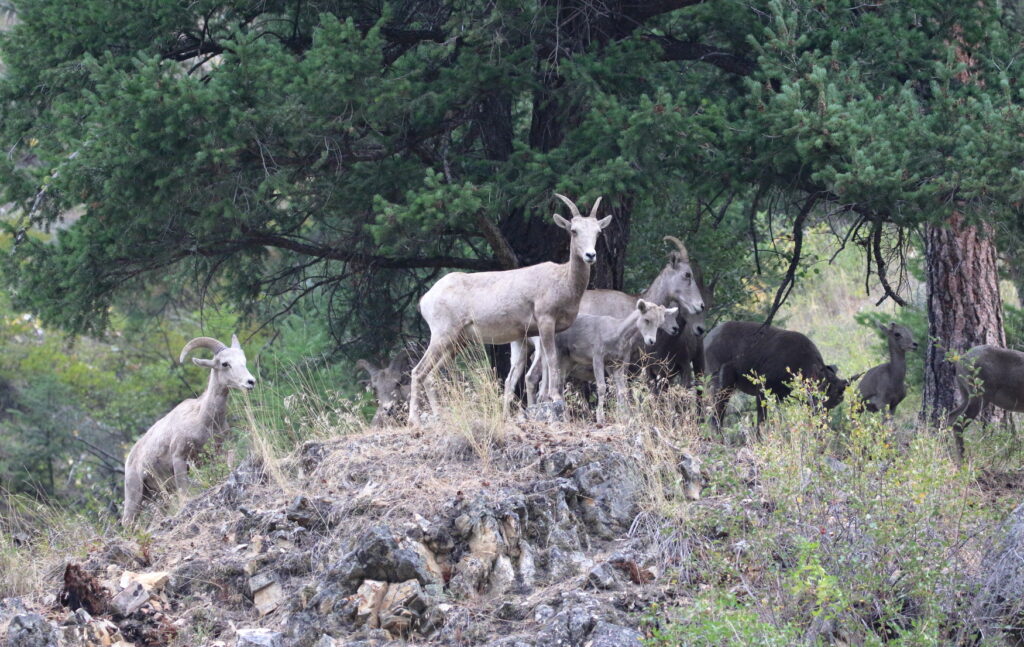
After a quick stop in Hamilton for breakfast sandwiches, we headed toward Skalkaho, the road transitioning from a two-lane road with a painted yellow line, to a “one track” paved road, and finally to dirt. We encountered an early surprise with a herd of bighorn sheep, and then climbed through a gorgeous forest canyon that gave off moist Pacific Northwest vibes and hosted a huge variety of trees. Here, we heard Pacific Wrens and Golden-crowned Kinglets, but our real destination lay high above us.

A great advantage of birding is that we see a huge variety of mammals during our adventures—including these bighorn sheep.

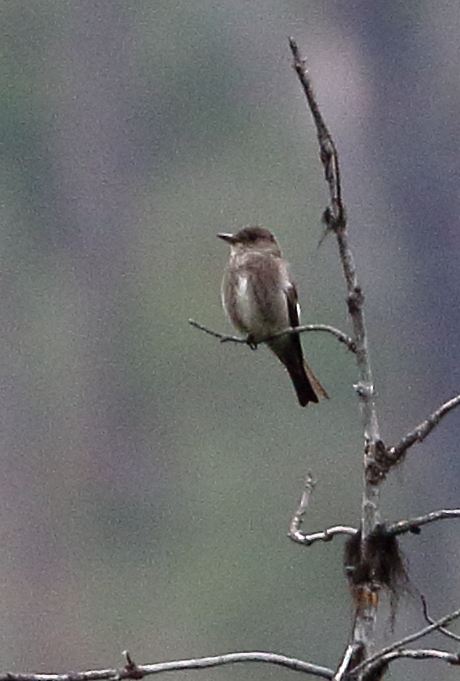
As the road snaked upward, we entered large burn areas that looked about ten years old. If you’ve been reading this blog (or my book Fire Birds) at all you know that we love to bird in burned forests. Not only do they provide great visibility, standing dead trees attract some of Montana’s most special birds. We pulled over a couple of times to listen for woodpeckers, but didn’t hear anything. Getting out of the car for the third time, however, we were greeted by a loud “Quick! Three Beers!” Braden and I laughed.

Though not a great photo, this is exactly the kind of pose we usually find Olive-sided Flycatchers striking in a burned forest.

“Olive-sided!” he exclaimed. And not just one, either. We would count at least half a dozen in the next couple of hours.

When we passed 7,000 feet we at last felt we had reached proper Spruce Grouse country. I had located a promising dirt road on the map, but before we reached it, we spotted another dirt road leading to the left. “That looks good,” I told Braden. “Let’s take that.”

“Sounds good,” he answered.

The burns near Skalkaho Pass were custom-made for finding cool birds.

It felt like a good day to find a Spruce Grouse. As on my Spruce Grouse excursion with Braydon Luikart last year, the day was overcast and misty, and I kept expecting to see bevies of grouse sitting in the middle of the road. That didn’t happen. In fact, we drove slowly for about twenty minutes, I keeping my eye on the road while Braden searched trees and openings along the road.

“C’mon, grouse,” I urged them, but it seemed like it might end up being a grouse-less day after all.

Then, Braden said, “Stop! Back up a few feet.”

I obeyed. “There, next to that stump,” he told me. “That definitely looks like a grouse.”

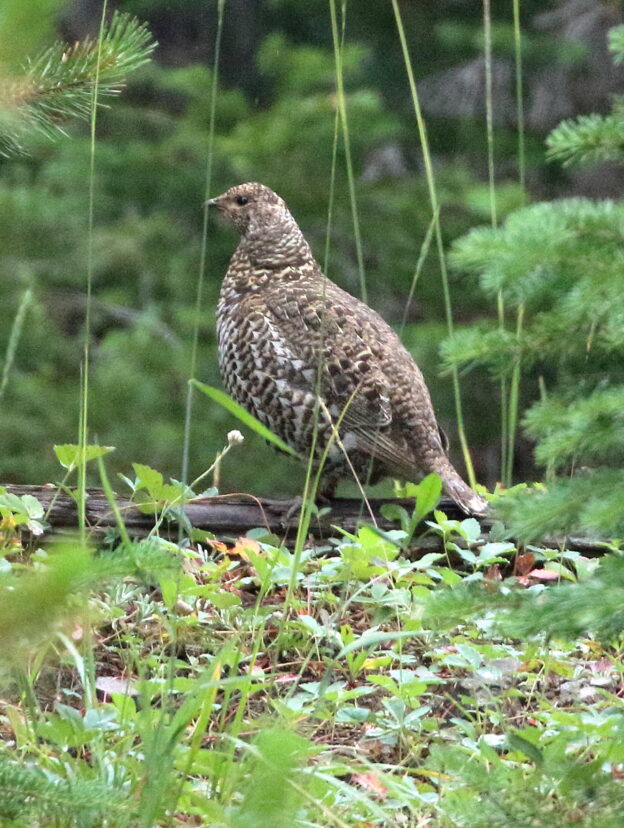
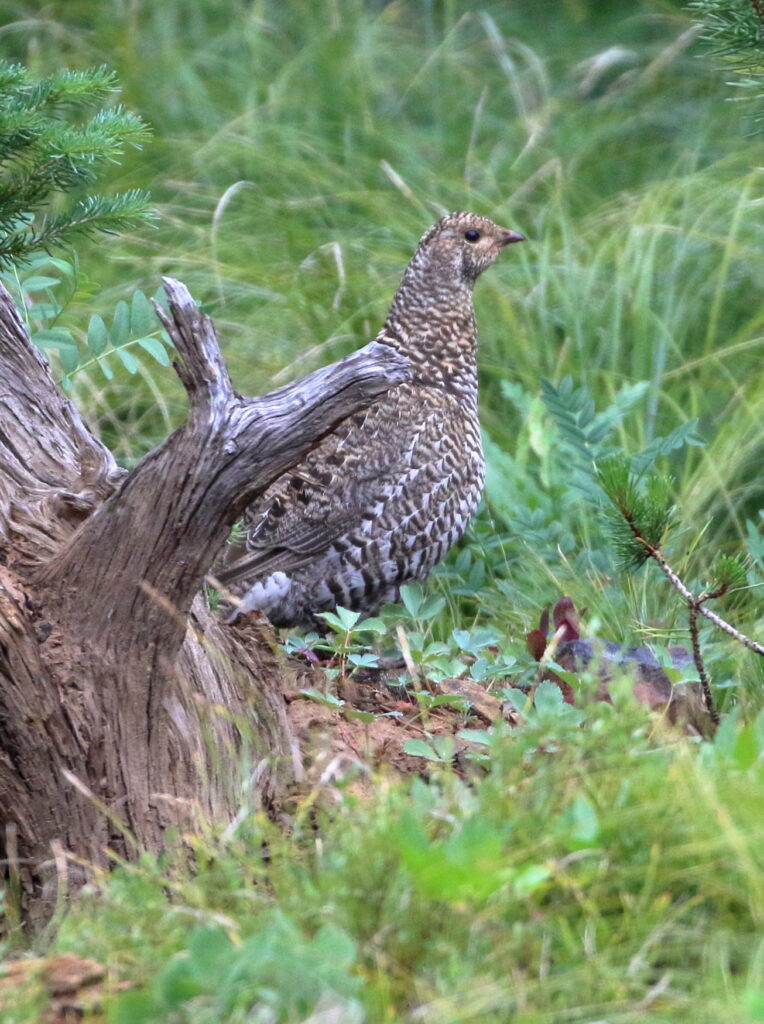
Sure enough, it was a gorgeous female emanating a distinctly Spruce Grouse aura. Just to make sure, I called up my Sibley app and compared it to a female Dusky Grouse. The two looked very different. Most diagnostic were this bird’s golden-brown patina and horizontal stripes across its breast and belly. Dusky females are grayer with more vertical barring in front.

We could have easily driven past this female Spruce Grouse as it imitated a tree stump, but Braden’s sharp eyes caught it as we rumbled by.

“We did it!” I affirmed. “We found a Spruce Grouse!” Neither of us could quite believe it. Even better, we spotted two babies popping their heads up and down right behind mom.

We continued up the road for another ten minutes, hoping to glimpse a male, but didn’t see one, so turned around and began bumping back toward the main road. We were not finished with this promising area, though. At another burn area, I pulled over. “Let’s just walk up the slope a bit,” I suggested, grabbing my camera and binoculars. We did, scanning the forest of dead tree trunks for any sign of woodpeckers. Then, we heard drumming to our right and our eyes locked.

“Let’s go over there,” Braden said, and we began picking our way over fallen logs and slash, and through fresh, thriving young trees and shrubs. As we walked, the drumming sound was replaced by tapping, and we grew closer and closer until we felt sure it was coming from a tall tree right in front of us.

“Do you see it?” I asked peering hard at the trunk against a backlit sky. Braden shook his head, so I circled around the tree, trying to spot it from different angles. Finally, I saw movement down low behind a green branch of a living tree. “I got it,” I called to Braden.

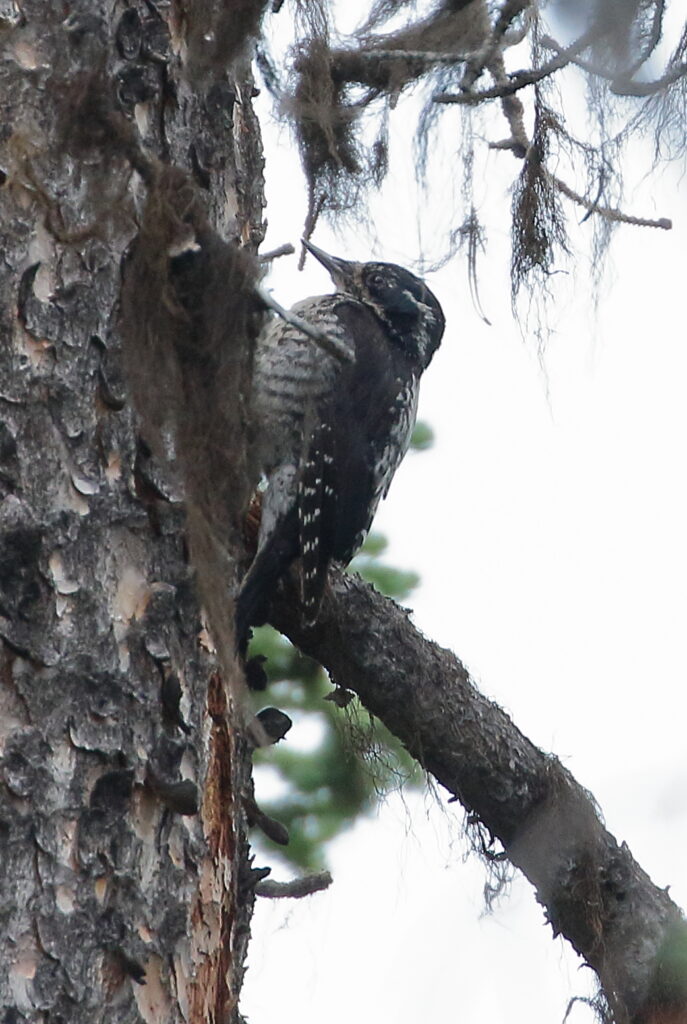
It took some time to get a clear look at it, and the first thing I saw was a lot of white showing on its back. This led the pessimistic side of me to conclude it was a Hairy Woodpecker. After all, no yellow showed on its head—the clear sign of a male Three-toed or Black-backed. As Braden also got his eyes on it, though, we began going through its other features. Most prominent? Black barring on its breast.

“Do Hairys have those black markings?” I asked, quickly consulting Sibley. “They don’t!”

This female American Three-toed Woodpecker provided an ideal “study bird” for teasing out the finer details of this species. We were thrilled to find it!

“It’s a Three-toed!” Braden agreed.

Wow. On this one day we had set aside to bird at elevation, we had found almost all of the birds we longed for, missing only a Black-backed Woodpecker.

We weren’t as successful with shorebirds, but that didn’t surprise us. Making our way over to Warm Springs, we found a nice group of Long-billed Dowitchers, and Greater and Lesser Yellowlegs, but not the Baird’s or Pectoral Sandpipers or small “peeps” (Least, Semipalmated, or Western Sandpipers) we were hoping for. Still, we did discover a surprise Black-crowned Night-Heron at the main Warm Springs ponds—something totally off our radar. In fact, I had started the day hoping for maybe one or two Year Birds, and ended up with six! Our success was only dampened by the knowledge that it might be our last big day of birding together this summer. Still, that is the yin and yang of birding—and of life. You just gotta enjoy it all.

Our grouse eBird checklist: https://ebird.org/checklist/S190227269

“Zoning Out” on Zonotrichia Sparrows

You may have noticed that many of my recent posts have centered on a) sparrows and b) nemesis birds. This post will combine those topics in a way that I hope will elicit six-figure offers for film rights along with invitations to various network morning shows. Strap in, because it promises to be a thrilling ride. Or mildly entertaining. Or at least more interesting than scrubbing the bathroom sink. Here goes.

Do you see the Golden-crowned Sparrow in this roadside pullout? I didn’t either.

In my recent pursuits of nemesis birds (see From One Nemesis Bird to Another and Gambling on a Grouse-fecta), one bird that I have sorely neglected is the Golden-crowned Sparrow. In fact, it may have been the most common species still missing from my Montana life list. Braden and I first beheld one of these gorgeous birds at the Moonglow Dairy outside of Monterey, California while we were pursuing our first Big Year back in 2016. Since then, we’ve seen them several times in California and Oregon—which is probably why they never became a top priority for us in Montana. Nonetheless, stray GCSPs show up in Montana often enough that they should have been beeping more loudly on our radars. Last week, when Braydon Luikart (see Gambling on a Grouse-fecta) notified me that a Golden-crowned had been spotted in Missoula, well, I guess I was finally alert enough to seize the opportunity. I threw Lola into our trusty minivan and headed out to LaValle Creek Road near the airport.

As I turned onto the muddy track, it was clear that word had gotten out when I began passing a veritable Who’s Who of Missoula birding. These included avian biologist William Blake (formerly of MPG Ranch, now with the American Bird Conservancy), and veteran birders Adam Mitchell, Thomas Kallmeyer, and Di Litz. William and Adam gave me directions to the sparrow spot, and a mile or so later, I pulled over onto a muck-filled turnout.

“It should be right there,” William had told me, but when I climbed out of the car with my binoculars and camera, I didn’t see a thing. Figures, I thought. I’m going to be the only birder in Missoula who doesn’t see this bird.

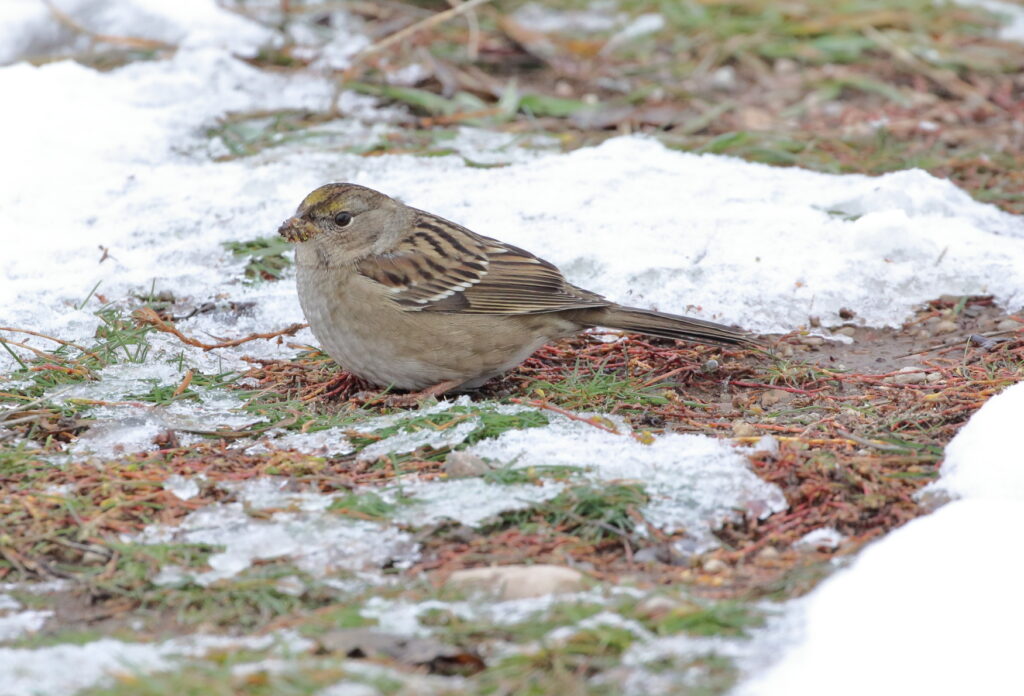
I studied the surrounding bushes and road without spotting anything, then took a couple of steps forward. Suddenly, I saw movement at my feet. The Golden-crowned! It was so perfectly camouflaged with the muddy ground that my eyes scanned over it two or three times without detecting it! Talk about your easy nemesis birds! I had a nice long visit with this fellow, admiring its subtle yellow lores and crown, boldly striped back, and finely striped breast. Its gray bill indicated it was a “1st winter bird,” fledged this past summer. Whoo-Hoo! Montana Lifer #303!

Golden-crowned Sparrows breed in western Canada and Alaska, but a few clip Montana every year on their way to their wintering grounds along the West Coast.

William and Adam had told me they’d seen Pine Grosbeaks and Gray-crowned Rosy-finches further up the road, so I continued on to a place locally known as “the corral.” There, I found UM grad student Tim Forrester also looking for the birds. Tim’s been all over the U.S. and many places abroad studying birds, and we had a nice conversation while waiting for other birds to show up. Alas, I guess I’d hit my limit for great birds for the day—though I did see a nice pair of American Tree Sparrows on the drive out.

As I always do after a great find, I called Braden to share the news. After congratulating me, he asked, “You know what this means, don’t you?” “Uh, no.”

“It means,” he said, “that you’ve seen all four of Montana’s Zonotrichia sparrow species!” He recounted the four species for me, and I realized that they were four of my favorite sparrows: White-crowned, White-throated, Harris’s, and now Golden-crowned. What’s more, I’d seen all but Harris’s Sparrow this year.

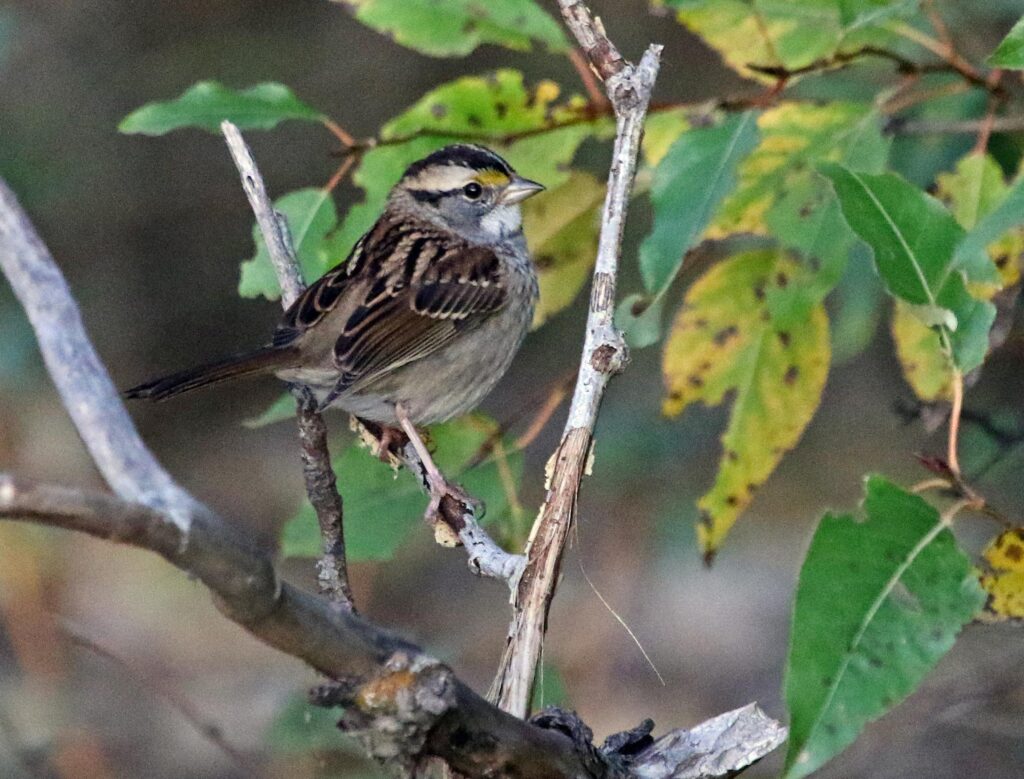
Braden and I find White-throated Sparrows almost every fall in Missoula—but we have to work hard for them.

“But what exactly are Zonotrichia sparrows?” you may be asking. Good question!

Birds in the genus Zonotrichia are among our largest sparrows. They all have heavily-streaked backs and are ground-feeders, snagging seeds, grain, insects, and spiders. At first, their bold head markings look quite different from each other, but if you compare the four species side-by-side, you will see that they bear strong similarities. White-crowned Sparrows (see Welcoming White-crowned Sparrows—with Observer Bias) and White-throated Sparrows (see March Madness Birding in Missouri) have the widest distributions and are probably the “Zones” that people are most familiar with. In Montana, Harris’s probably have the greatest cool factor. Braden and I have seen them only once together (see A Quest for Snowy Owls), and I saw them once more a couple of years ago. No two ways about it, though, adding Golden-crowned to my Montana list made my day.

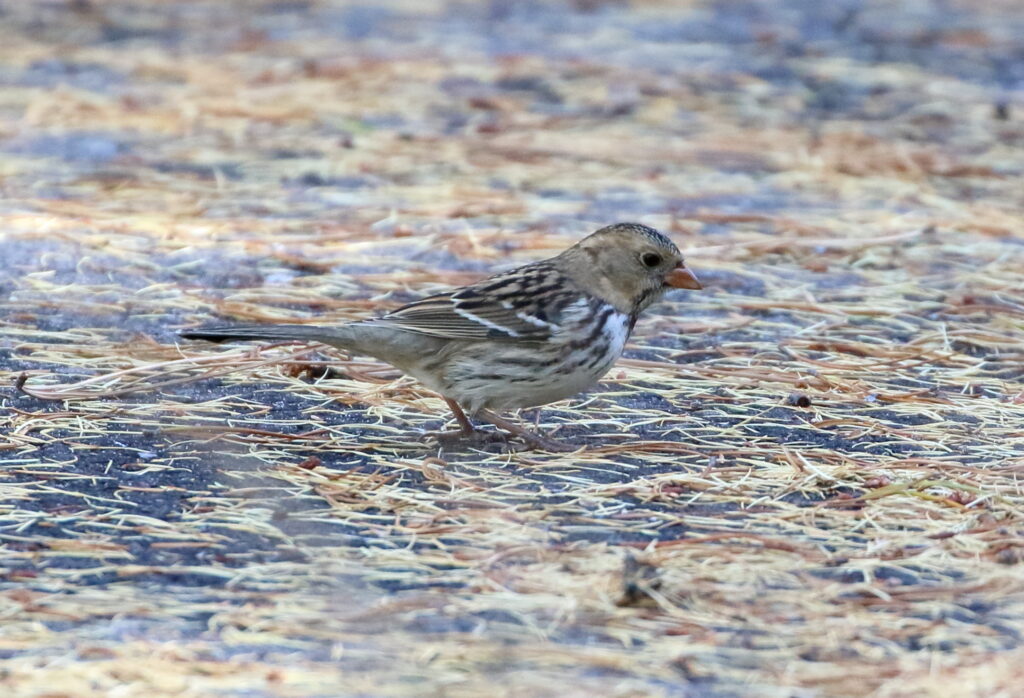
Only the second Harris’s Sparrow I’d ever found—while looking for loons with Amy at Seeley Lake. And no, we didn’t find the loons!

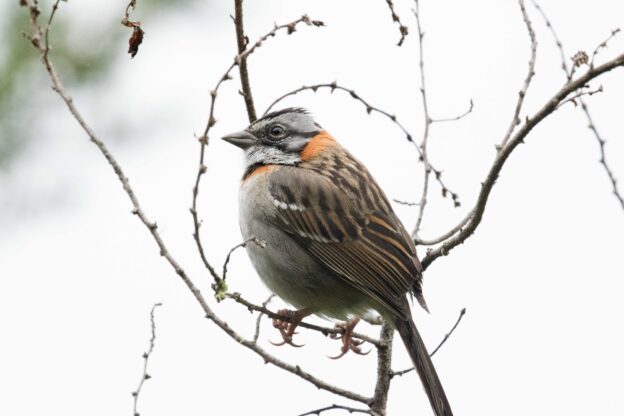
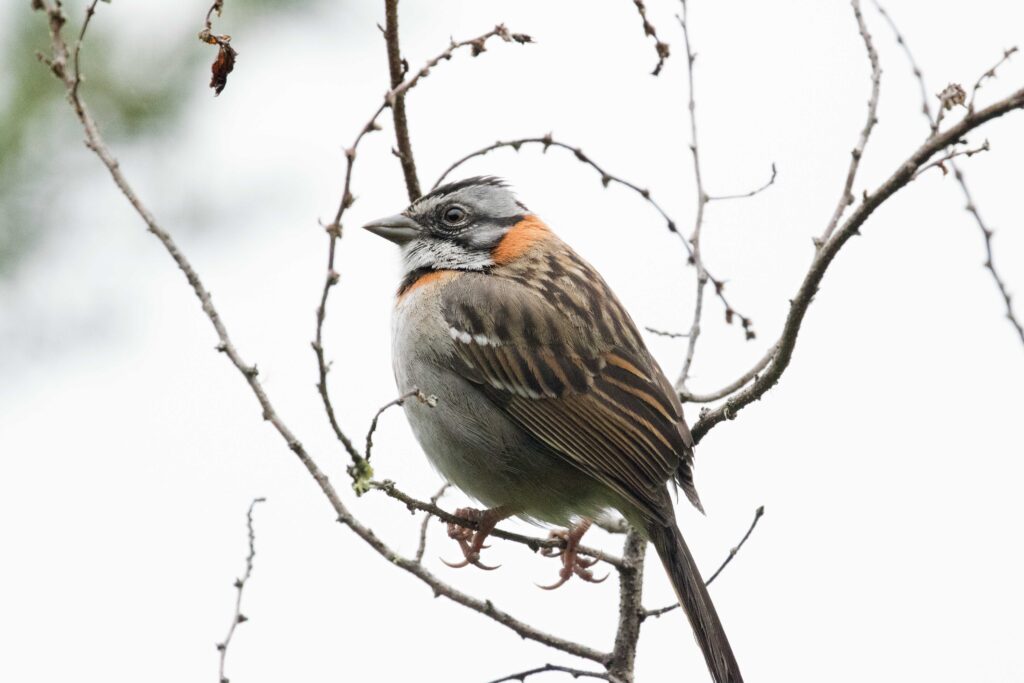
I’m not quite finished zoning out, however. So far, I’ve mentioned four species of Zonotrichia, but there’s a fifth, and it’s one almost anyone visiting Latin America will recognize: the Rufous-collared Sparrow. Braden and I first encountered these handsome critters during our 2017 family trip to Ecuador and Peru, though I’m sure I saw them in Costa Rica before I became a birder. In fact, this is probably the most common bird we saw in urban and suburban settings—so common, that we soon began taking them for granted. I hereby pledge not to ever do that again. Meanwhile, wherever you are, I invite you to zone out for yourself. Especially if you live in the southern half of the U.S., the West Coast, and much of the Atlantic seaboard, I guarantee there’s some Zonotrichia near you. Braden and I will be waiting for your reports!

White-crowned Update: In writing my recent post “Welcoming White-Crowneds,” published October 1st, I felt pretty sure that I had seen my last White-crowned for the season. However, just yesterday, October 31st, I saw yet another one out at the Fort Missoula Gravel Quarry, reinforcing my feeling that these “Zoned-Out” birds are having a very good year!

The “Fifth Zone,” Rufous-collared Sparrows were our constant companions during our 2017 family trip to Ecuador and Peru. (Photo by Braden Collard—no relation to Rufous Collard.)

Sifting Through Maine’s Fall Migrants

Congratulations to Braden for having his first full-length article published, in the July/August 2023 issue of Bird Watcher’s Digest! The editor actually plucked the piece from our blog post “Montana Shorebird Surprise”! If you don’t already subscribe to BWD, I strongly encourage you to do so. It is packed with fun and interesting articles about all aspects of birds and birding—and honestly, magazines like this need our help to keep promoting bird conservation and foster our birding community. Learn more by clicking here. Meanwhile, enjoy Braden’s new fall migration report from Maine.

October, in Maine, is usually a major cutoff point for neotropical migrants. Warblers, specifically, seem to disappear from the state right around October 1st, having already moved through in large numbers in late August and September. Last year, I barely detected any warblers after the October curtain dropped, with my only species being Yellow-rumped and Palm Warblers (which are later migrants and do stick around until November) and two Tennessee Warblers that I worked my butt off to find on the first of the month.

Because of this knowledge, I had no expectations when I hit the University of Maine Bike Path last weekend, October 7th. I had already birded the path several times this fall, once by myself (when I scored great looks at two Ovenbirds and a Canada Warbler, both of which were long gone by now) and once with the University of Maine Birding Club, which I had restarted in mid-September. This was the same path, though, that offered up American Woodcocks and American Bitterns in spring; the same place that hundreds of salamanders and frogs would migrate across on rainy nights in April. Unfortunately, none of those animals were active now, so again, I had no expectations and was pleasantly surprised to run into a flock of Yellow-rumped Warblers and other birds right off the bat. 

Ruby-crowned Kinglets are one of the “later” songbird migrants—in Maine as well as in Montana. I saw 17 of them on this outing!

In fall, my birding strategy is to find the mixed flocks and sift through them until I’m reasonably sure I’ve identified all of the species. I did just this with the flock, finding a Palm Warbler, several Ruby-crowned Kinglets, and a Blackpoll Warbler in its drab, green winter plumage, adorned with orange feet. In terms of warblers, Blackpoll Warblers are one of the later migrants in Maine, and travel the farthest of any of the group, heading east from their boreal breeding grounds before flying south straight across the Atlantic Ocean to South America. I’d seen several in the Adirondacks this summer, in their spiffy black and white plumage, and it was nice getting to wave goodbye to them for the winter.

Swamp Sparrows are a real find in Montana, but on my birding walk today, I counted at least 33 of them—a low estimate!

After pishing in a few more mixed flocks, I reached one of the the bike path’s main attractions—a large, weedy field, hosting tall goldenrod and other plants that reminded me of the Fort Missoula gravel quarry back home. This, like the gravel quarry, was Sparrow Central. I waded out into the grass, flushing flocks of Song and Swamp Sparrows into the bushes, from where they watched me carefully as I checked each and every one of them. Ruby-crowned Kinglets chattered from the aspens and birches lining the perimeter of the field, and I pished at them with every chance I got, searching for anything rare. Soon, amongst a group of White-throated and Savannah Sparrows, I spotted a smaller, more crisply-patterned sparrow hop up onto a bramble: the Lincoln’s I had been hoping for! My dad and I had gotten our lifer Lincoln’s Sparrows in fall, and while I had seen and heard many this summer between the Adirondacks and the joint Western Field Ornithologists and Colorado Field Ornithologists conference I attended in alpine Colorado, I still sought out these stunning birds every time the colors on the trees began to change.

My dad went out four times last week before he found a White-throated Sparrow migrating through Missoula. I counted 23 of them on my single outing!

The Lincoln’s Sparrow abruptly disappeared as a small, yellow bird took its place: a Nashville Warbler, about a week after the last Nashville Warblers should have left for Central America! A few minutes later, in another horde of kinglets, I briefly spotted a Tennessee Warbler. Yay! The warblers were still here!

It wasn’t until I circled back over to the far end of the grassy field, however, that I found my real prize. As I sorted through yet another flock of kinglets and sparrows, I spotted it: a greenish, grayish warbler. Now, in Maine, in fall, this could describe just about every species of warbler since most have adopted relatively drab nonbreeding plumage. Nonetheless, I started checking off options in my head, narrowing it down.

The body was mostly green, with a green throat. That eliminated Palm, Pine, Nashville, Yellow-rumped, and any of the more colorful fall warblers. The head, meanwhile, contrasted with the green—it was slate gray, and the bird had broken eye-arcs. Those two features alone, plus a total lack of yellow or white, eliminated Blackpoll, Bay-breasted and Chestnut-sided. That left two species. Tennessee Warblers are easily identified in fall by their white vents (butt feathers)—but this bird’s vent was green. The bird I was looking at was one my dad has surely seen many times this fall and paid little attention to—an Orange-crowned Warbler!

While migrating fall Orange-crowned Warblers are fairly common in Montana, in Maine they qualify as a genuine rarity!

Orange-crowned Warblers are fairly common in most of the United States. They breed throughout the Rockies and are commonly seen in migration and winter across the country. They avoid Maine in migration, however, and don’t breed in the state, so this warbler is quite a rarity here! What’s more, early October is actually one of the best times to find them here, which is not the case for any other common Maine warbler. I celebrated for a moment before whipping out my camera to snap some photos of the bird, which I assumed I would need to prove that I’d actually seen it.

After the Orange-crowned Warbler moved on, I continued to walk the rest of the bike path, finding more flocks of sparrows, thrushes, and the occasional warbler. I even heard a few pipits fly over as I headed to McDonald’s for a respite from UMaine’s dining hall food. I’d had my best fall day of birding so far this year. Hopefully, more great birding was to come!