Tag Archives: fall migration

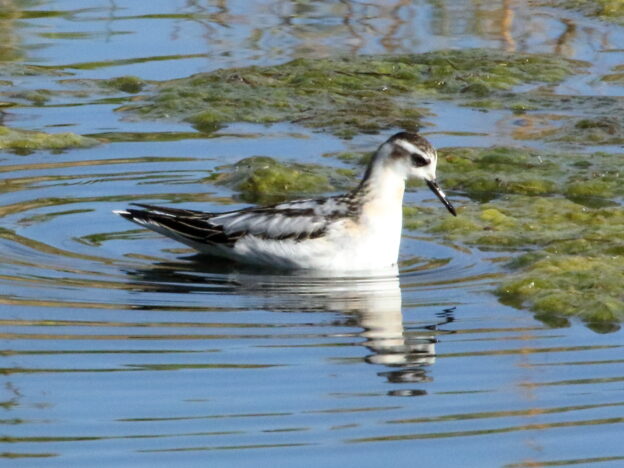
Seeing Red—Phalarope, That Is

Conservation Update: Not long ago, I wrote about an amazing opportunity to protect a key piece of habitat on the famed Bolivar Peninsula in Texas. This property is a critical resting point and staging area for birds migrating across the Gulf of Mexico, and Houston Audubon is leading the effort to raise $3 million to purchase the property. To learn more, please read our recent blog post, and if you have not already done so, consider contributing to this once-in-a-lifetime opportunity to protect birds by clicking here. So far, more than four hundred donors have chipped in, but many more are needed! Thank you and please spread the word!

For birders, fall migration is a season like no other. That’s because birds fail to look at the range maps of where they are supposed to be and show up in all kinds of unusual and surprising places! You may recall that recently, I have been moving perilously close to breaking my all-time one-year global species record of 527, but instead of frantically trying chase down species (and burning up a lot of gas in the process), I have decided to see how many species just come to me during the fall. Last week, I picked up a Clark’s Grebe in the local Missoula Gravel Quarry, moving me to within seven species of a new record. That really wasn’t too surprising since a few pairs of Clark’s do breed in Western Montana, and it made sense that one might end up passing through my home town. A couple of days ago, however, when I saw a report of a Red Phalarope, my mind shouted “Whoa!”
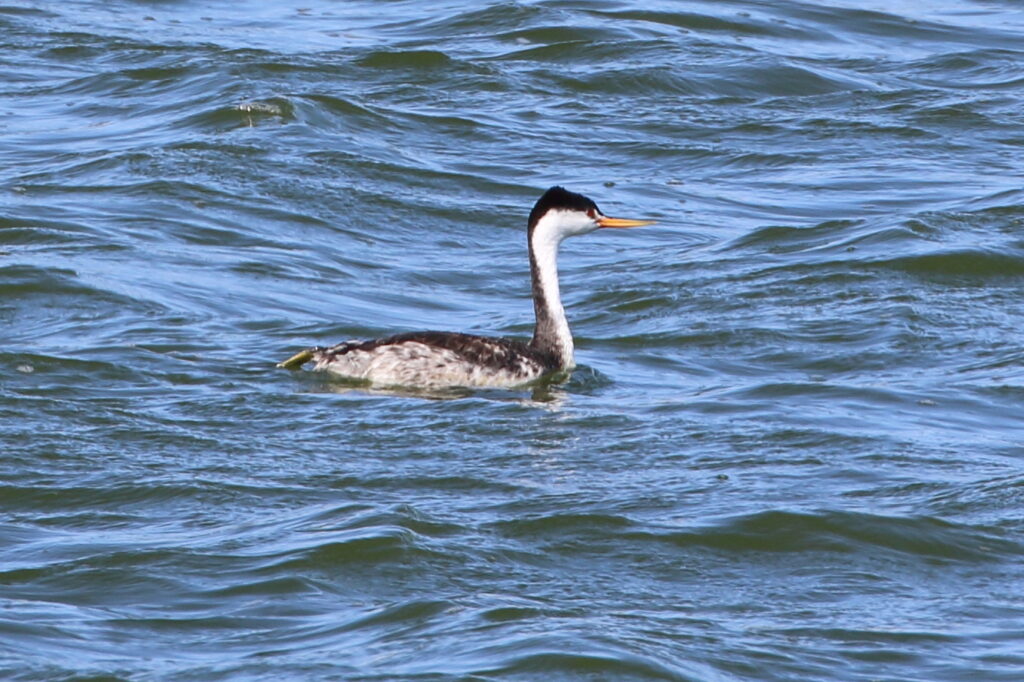
A Clark’s Grebe at the Fort Missoula Gravel Quarry helped push my 2025 world species count to 521. (A different CLGR shown here.)

Braden and I have mentioned phalaropes in several past blogs (see, for instance, THIS POST), and they are fascinating birds. Phalaropes are shorebirds in the family Scolopacidae and in the entire world, there are only three species: the Wilson’s, Red-necked, and Red (called the Gray Phalarope in Europe). Montana is fortunate to host Wilson’s Phalaropes each spring and summer, as they are the only phalarope to breed in the interior of the continent. The first time we encountered these beauties was in 2015 at Lee Metcalf National Wildlife Refuge. I had barely heard of phalaropes when we drove past the main pond at Metcalf and Braden—who was and still is better prepared than I—shouted Wilson’s Phalaropes! Since then, I have become increasingly enchanted by these birds and, according to eBird, have seen them 123 times.
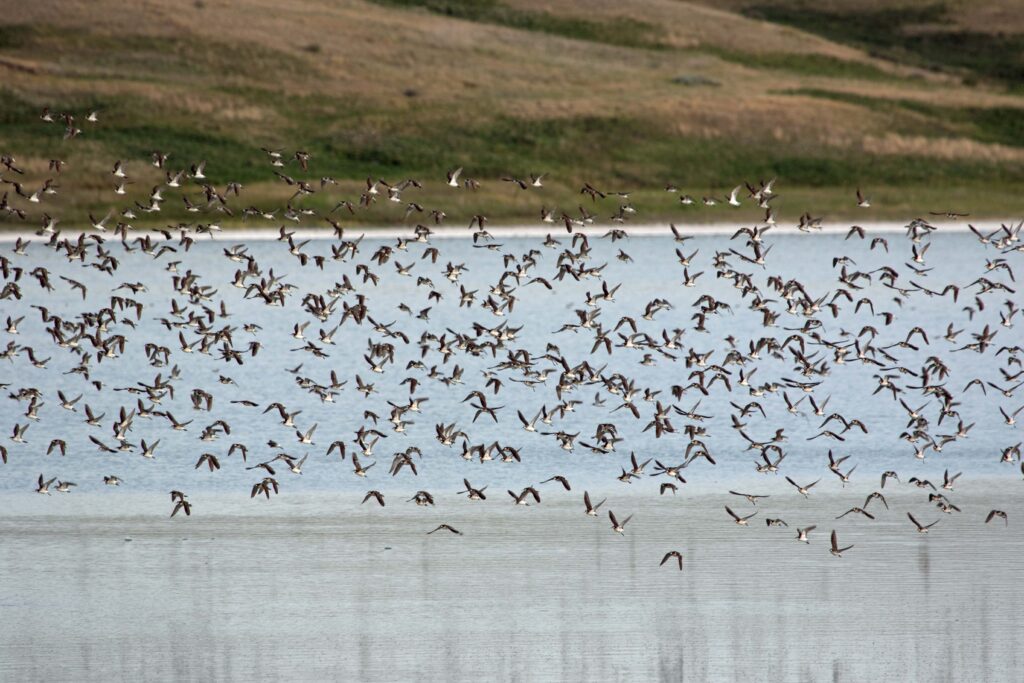
Wilson’s Phalaropes gather in large numbers at some Montana breeding locations—including this flock Braden and I observed near Westby.

Several things make phalaropes stand out from other birds. For one thing, they flip the rule on “males are brighter than females.” With phalaropes, it is the female that is the stunning, brightly-colored sex during breeding, not the male. Females compete for males to mate with and may even “service” several different males, leaving the guys totally in charge of parental care once the eggs are laid. Can I hear legions of human females shouting “Amen”?
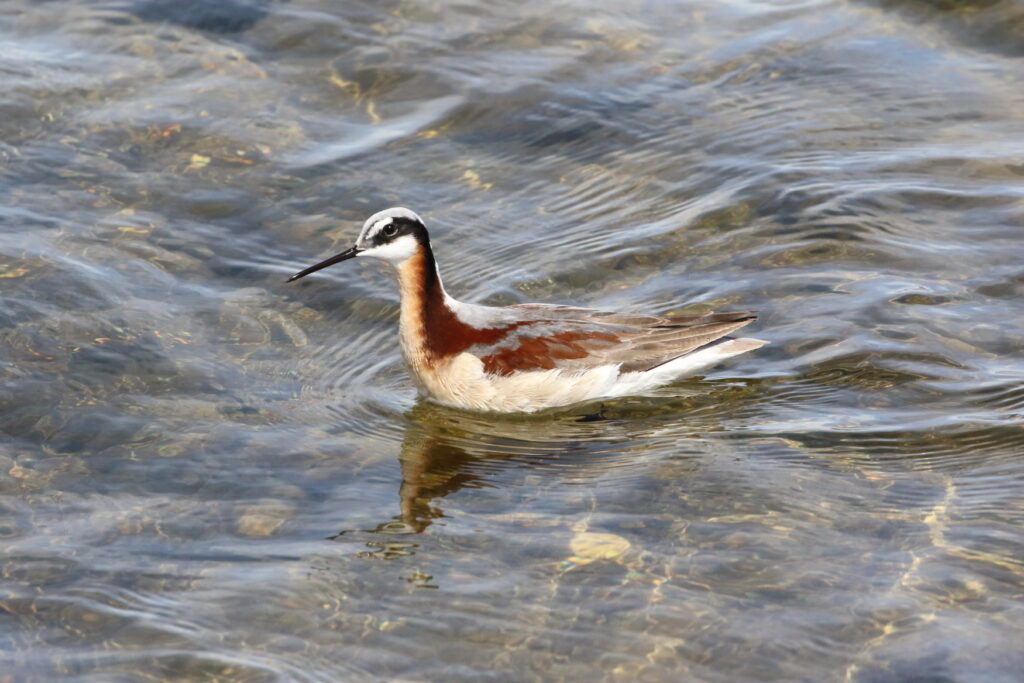
Female phalaropes such as this Wilson’s Phalarope are undoubtedly some of our most beautiful shorebirds. Note the longer, thinner bill compared to the Red Phalarope shown later.

Another thing everyone loves about phalaropes is their method of hunting by spinning rapidly on the surface of the water. This spinning creates a little aqueous “tornado” that sucks up crustaceans and other invertebrate prey from below. The birds also hunt in more traditional shorebird manners by probing shallows and even picking off prey from nearby vegetation.
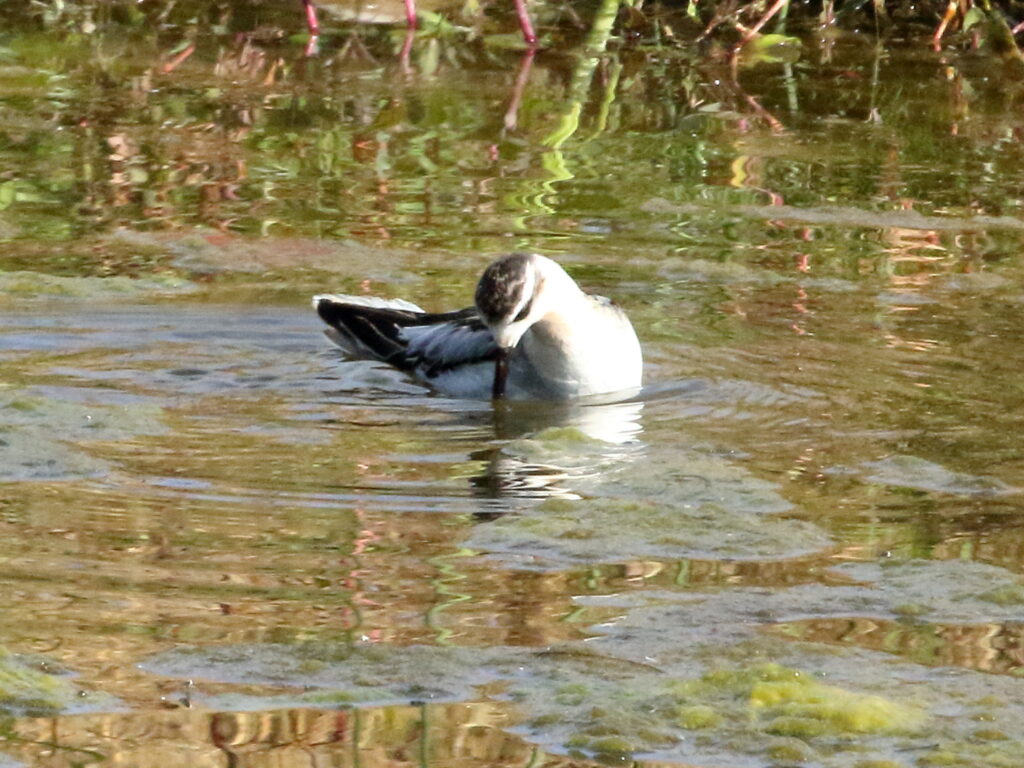
Spinning is not just a yuppie exercise class, but a method for phalaropes to draw up prey from below the surface. (Red Phalarope shown here.)

Whenever Braden and I are lucky enough to visit eastern Montana in spring and summer, we usually see large numbers of Wilson’s Phalaropes feeding and setting up nesting sites (see THIS POST). If our timing is right and we stay persistent, we also usually spot a few Red-necked Phalaropes. With their dramatically contrasting red, white, and dark gray heads, these phalaropes are even more stunning than the Wilson’s. The window to see them is short, however, as they breed high in the Arctic and can only be “caught” while they are resting or staging for their final journeys north. A couple of times we have also spotted them heading back south in August, when they are invariably in their duller gray-and-white plumages.
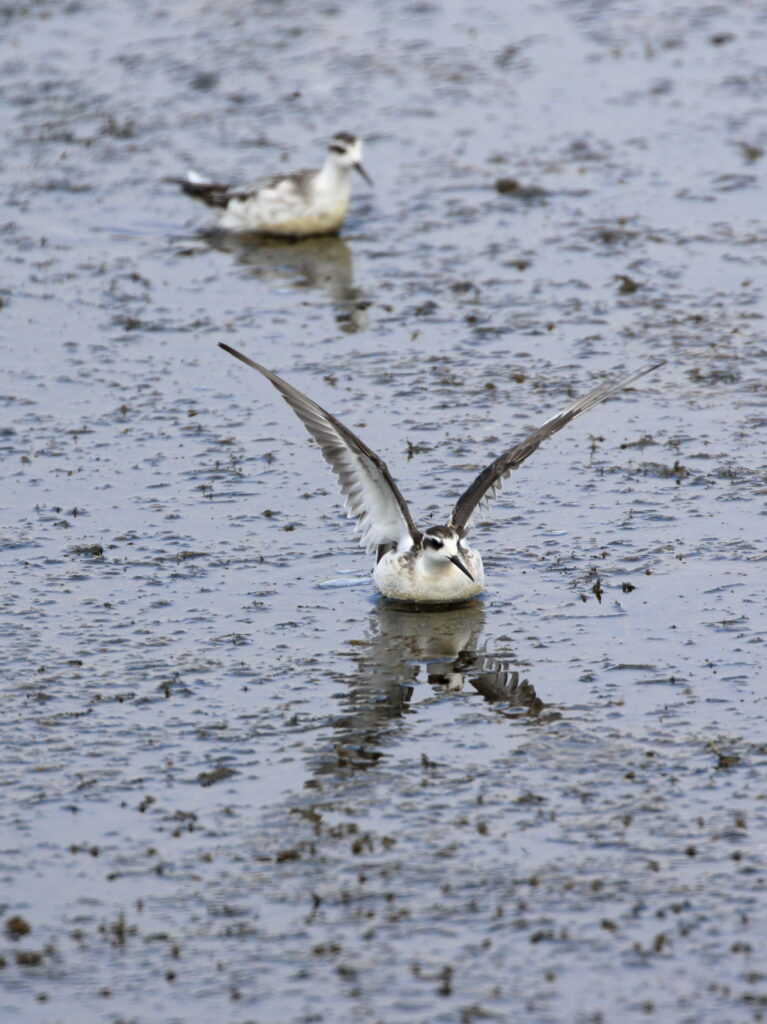
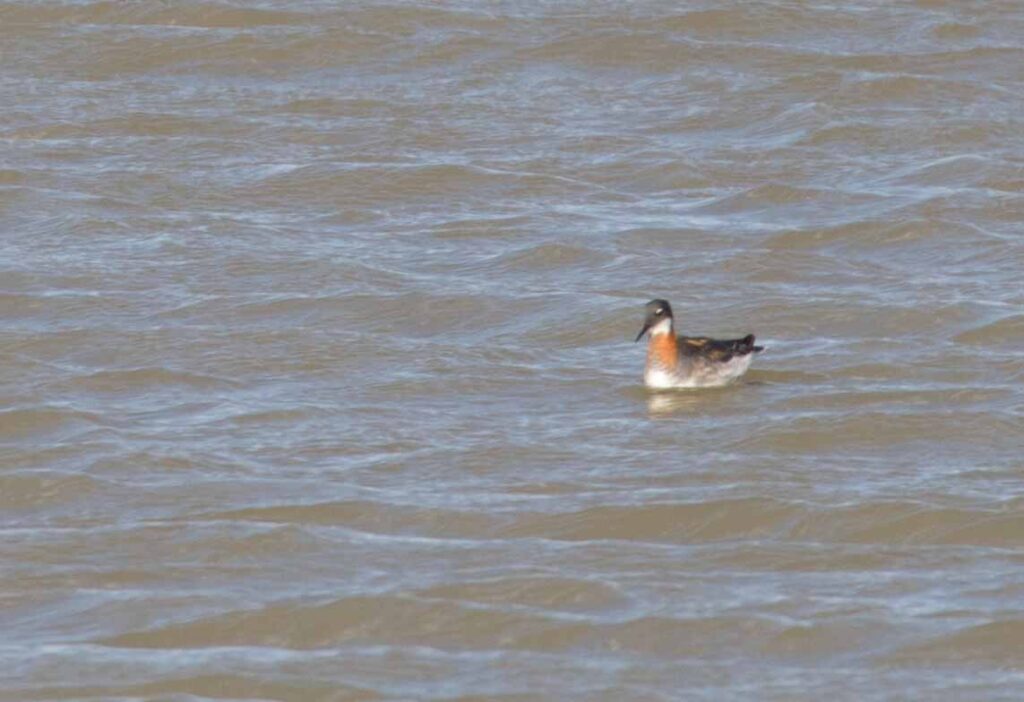
However, one phalarope that we have never seen in Montana in more than a decade of birding is the Red Phalarope. The reason is that, in general, these birds migrate over the ocean—not over the interior of the continent. Red Phalaropes are the most pelagic of the three phalaropes and, except during breeding, spend their lives out at sea. In fact, the only Red Phalaropes that Braden and I ever saw was a single pair off the coast of San Diego during the San Diego Birding Festival several years ago. Only about twenty sightings have ever been reported in Montana.

Naturally, when I read the recent report of a Red Phalarope in Missoula, my excitement went into overdrive. The next morning, after Amy and I went to a pickleball class, I convinced her to drive down to a little spot called Cattail Corner where the Red Phalarope had been reported. Mind you, this is not where one would expect to see a rare bird. It’s just a tiny wetland wedged between a shopping center, a gas station, and two busy roads. I used to bird there a lot just to see what I could find, and recently the dense cattails had been cleared out, creating more open water and even a bit of shoreline. Early this spring, Braden and I were surprised to find several Spotted Sandpipers hopefully setting up breeding territories there, but still . . . a Red Phalarope???????
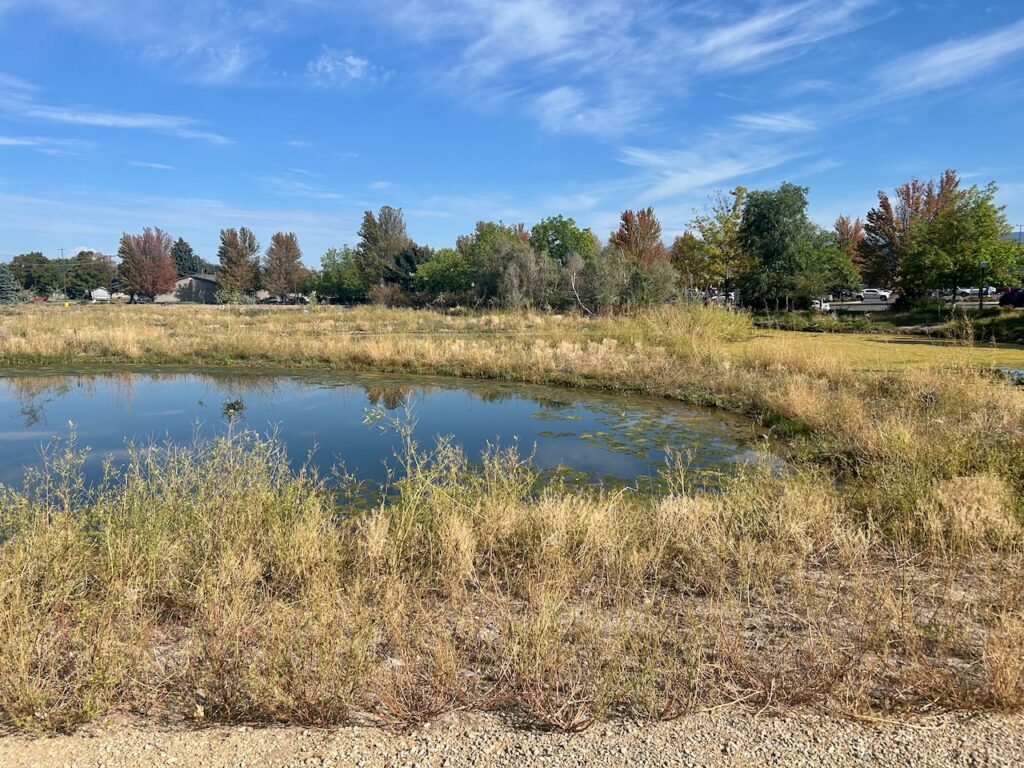
Finding a rare bird such as a Red Phalarope at the tiny, worked-over Cattail Corner seemed unlikely at best. (Bonus: Can you spot a phalarope in this photo?)

As soon as we parked, I grabbed my camera and binoculars and Amy and I began circumnavigating the little wetland. My natural pessimism kept repeating, Oh, I’m sure it’s gone now. After all who would want to hang out in this crummy little wetland? Sure enough, Amy and I spent thirty minutes walking around the ponds without a single sighting of anything resembling a phalarope. Oh, well.

As we were leaving, our friend and fellow birder Susan Snetsinger arrived. We told her we hadn’t seen the phalarope, but if she happened to spot it to please call right away. Then, we got back in the car and began heading home, a bit disappointed but not surprised at failing to find the bird. Besides, Amy had a lot to do and I needed to tackle a number of chores myself.

We were just passing Tremper’s shopping center when the phone rang. I hit the “answer” button on the steering wheel and it was Susan. “Did you see a phalarope at all?” she asked. “No.” “Well, I’m looking at one now, but I’m not sure it’s a Red Phalarope.” “We’ll be right there!” I told her.

I made a quick U-turn and in five minutes was again parking the minivan. We quickly spotted Susan on the far side of the shore, and even before reaching her, I could see a phalarope on the water. “How on earth did I miss that?” I asked Amy. What’s more, the phalarope seemed blissfully unconcerned as we drew close enough for good viewing and photographs. The problem? This bird was in basic (nonbreeding) plumage and it looked remarkably similar to a Red-necked Phalarope in the same plumage. In the fall, both birds are basically gray and white, with prominent black patches behind the eyes. Red Phalaropes are a bit larger than Red-neckeds, but if they aren’t side-by-side that’s not a useful feature. According to Sibley, Red-neckeds also are streakier on their backs—but this bird before us also looked pretty darned streaky to me.
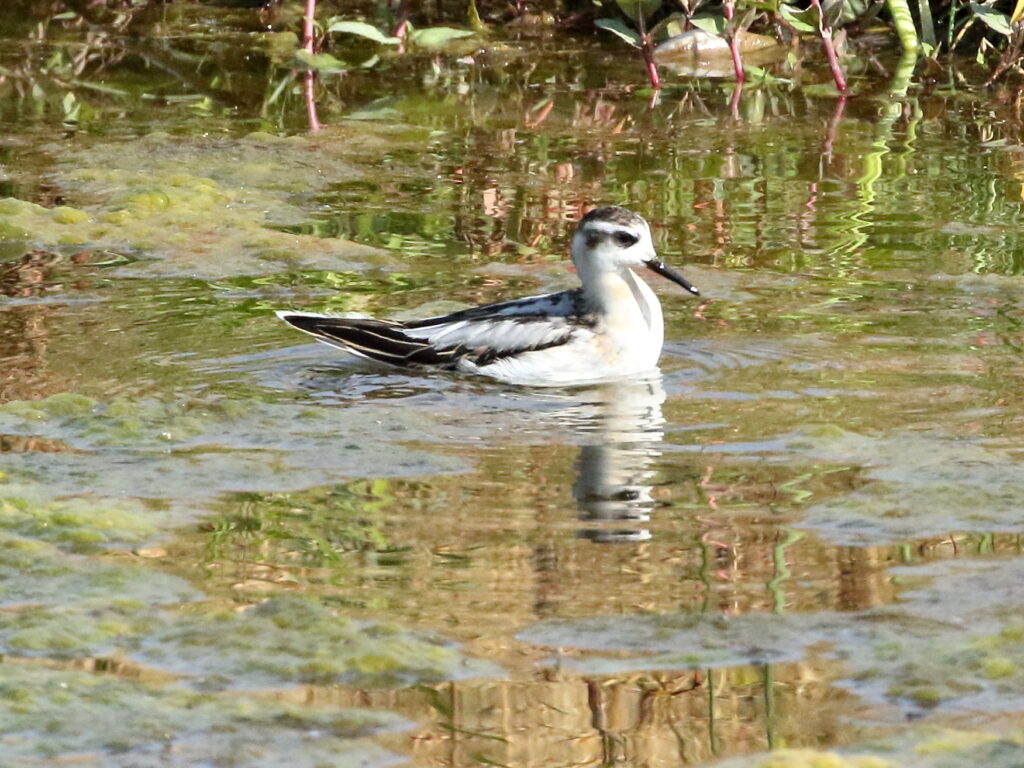
The slightly thicker bill of this Red Phalarope was a key to its identification.

From what I can glean, the key ID feature that distinguishes the two birds is the thickness of their bills. While Red-neckeds have thinner, needle-like bills, those of Reds are thicker, almost pencil-like. The bird in front of us did indeed seem to have a thicker bill, but there is so much variation in these kinds of features that I still felt less than confident—even though this bird had already been confirmed as a Red Phalarope by the eBird Powers That Be. Later Dan Casey, prominent Montana birder and co-author of Birds of Montana, sent me a phalarope comparison guide that helped convince me further. This can be found at:

Phalarope Photo ID Guide

We watched the phalarope for about ten minutes and then, to my surprise, it climbed ashore and disappeared into the weeds. “Ah, that’s why we didn’t see it earlier,” I told Amy, grateful that the bird had decided to put in an appearance out on the water where we could see it.
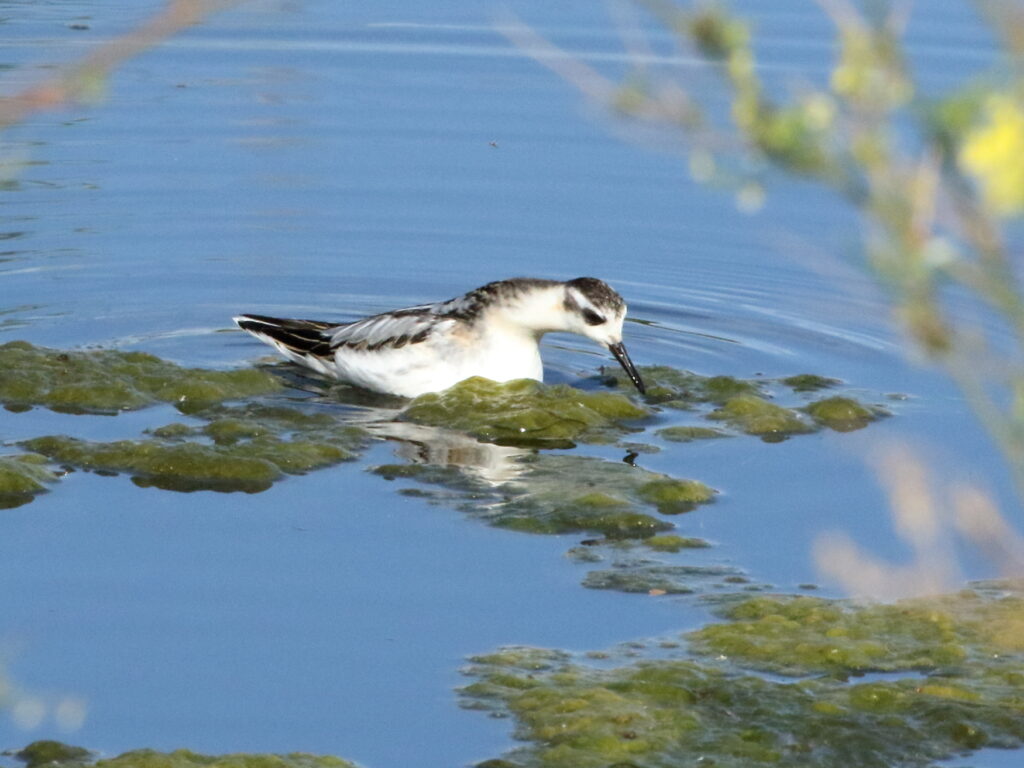
Phalaropes are mainly visual predators, picking off invertebrates wherever they see them.

But the Bottom Line? Red and Red-necked phalaropes are very difficult to tell apart in their basic, nonbreeding plumage, so never assume you’re looking at one or the other. Personally, I hope to get more chances to observe and get to know them in the field in the future.

The other Bottom Line? It was WAY COOL to see a Red Phalarope here in my hometown and it became my Montana Lifer #312. As a bonus, I now need only six more species to break my all-time one-year record. Hm . . . I wonder what will show up next?

To learn more about phalaropes, we recommend the book The Shorebirds of North America, reviewed here.
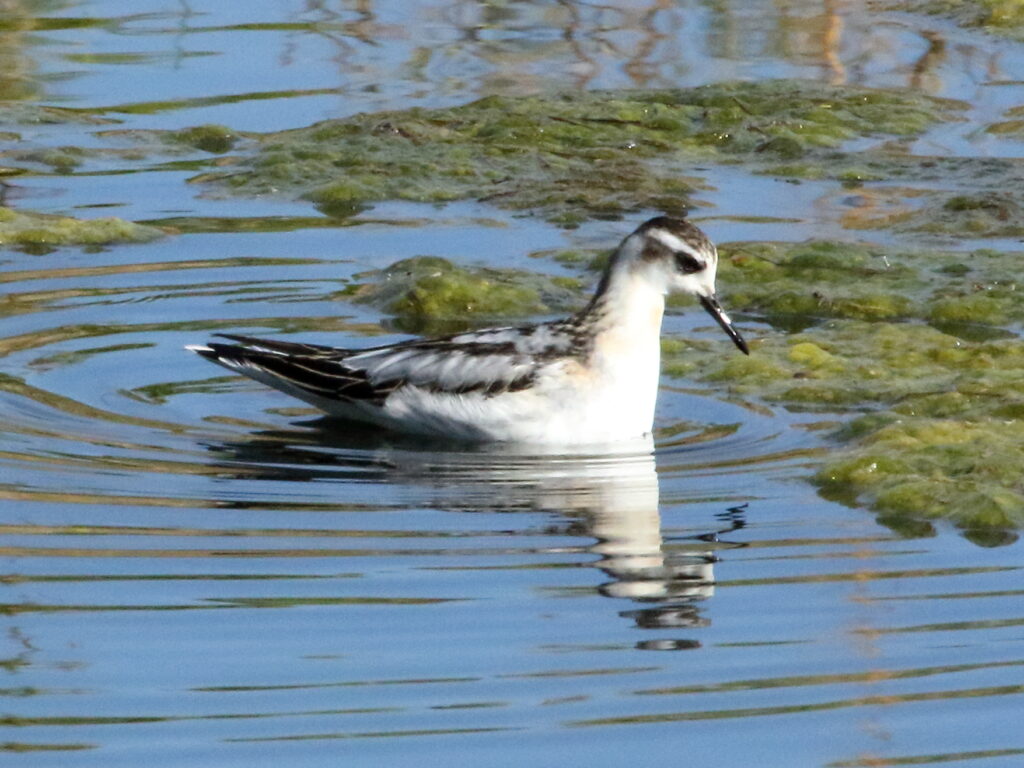
Sneed’s Bird #522 for 2025. Will I get to 528? It may be up to rare migrants such as this Red Phalarope!

Records and Road Trips

Need a good book to read? Birding for Boomers recently racked up its fifth award of the year and has been a hit at indie bookstores throughout the West. Why not help support our efforts at FatherSonBirding by picking up a new copy of “Boomers” or one of Sneed’s other books? Just click on one of the images to the right.

After a slow start, August saw the Collard family shift into hyperdrive as Braden drove to Southern California to take a job as a nature guide and camp counselor, and Amy and I saddled up the minivan to drive Tessa to her freshman year of college at Cal State Chico. Braden left a few days early so that he could bird the summer heat of Arizona before arriving at his job. It seemed like a (heat) rash thing to do, but his efforts paid off as he saw 201 species and scored 9, count ‘em, NINE Lifers! These included Montezuma and Scaled Quail, Lucifer Hummingbird, Buff-breasted Flycatcher, Gray Vireo, Cassia Crossbill, and Rufous-winged, Botteri’s, and Cassin’s Sparrow. Just listing the above stats, in fact, makes me hesitant to bring up my own relatively modest birding luck driving to California—but let’s back up a second.

Our drive to California—complete with a stop in Ashland, Oregon—promised to prove crucial to my quest to break my own one-year species record of 527 species. (Sadly, I did not pick up any Year Birds while watching this Shakespeare play!)

As mentioned in previous posts, both of us Collards are having record-breaking years. Braden’s World Species total for 2025 sits at an astonishing 833 species, thanks not only to trips to Mexico and Costa Rica, but his cross-country drives to Montana from Maine and his recent journey to California via Arizona. As for moi, when last I reported (see our post “Swift-ecta!”), I needed twenty birds to break my all-time one-year World Species total of 527. The thing is, twenty species this late in the year was looking a bit dicey. While it might be possible to pick up twenty more species here in Montana, I was counting on the drive to California to put a major dent in that number. Nonetheless, I birded hard before our departure and by the time we hit the road, my year total had crept upward to 512, leaving only sixteen species to break my record.

Normally, I would have thought, “Piece of cake,” especially since I hadn’t visited any West Coast states so far in 2025. But not so fast. Remember that little winter trip Amy planned for us last January (see post “Birding Victoria, BC”)? Well, believe it or not, in Victoria I had already nabbed Bushtits, Anna’s Hummingbirds, and Chestnut-backed Chickadees, removing three potential gimmes from the California trip. Even my Colombia trip with Roger (see post “Antpittas and Tody-Flycatchers”) had allowed me to pick up Acorn Woodpecker and Lesser Goldfinch, removing those bird potentials as well.

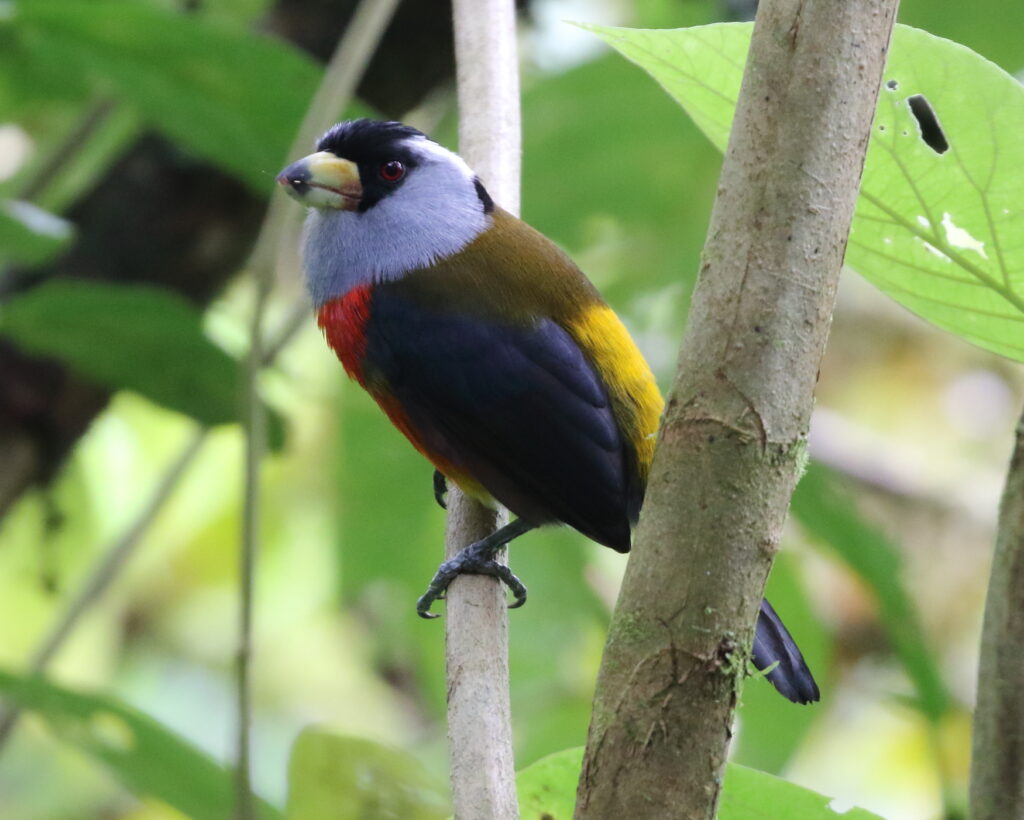
The birds of Colombia, including this stunning Toucan Barbet, seen on Roger’s and my trip, are one reason my single year species record has crept tantalizingly to within reach.

Nonetheless, I remained cautiously optimistic as Amy, Tessa, and I hit I-90 for our first stop of the trip, Portland, Oregon. We would spend only two nights there, but I wasted no time, getting up early the first morning to hit Broughton Beach along the Columbia River. My goal was to find cool shorebirds, and I did find both Least and Western Sandpipers—but no Year Birds. While there, though, I met a very nice birder named Ted who told me about another cool spot, Force Lake, and I decided to head over there. I was rewarded by Long-billed Dowitchers and Red-necked Phalaropes—but again, no Year Birds. In fact, the only Year Birds I nabbed in Portland were California Scrub-Jay in the backyard of my in-laws and Black Phoebe at another new spot I visited, Whitaker Ponds Nature Park. As we rolled out of Portland, I hoped that the rest of the trip would prove more productive.

I got turned on to Force Lake by another Portland area birder. It’s a place I’ll return to often, as it offers the best shorebird habitat I’ve found in Portland. Alas, it yielded no Year Birds on our recent trip.

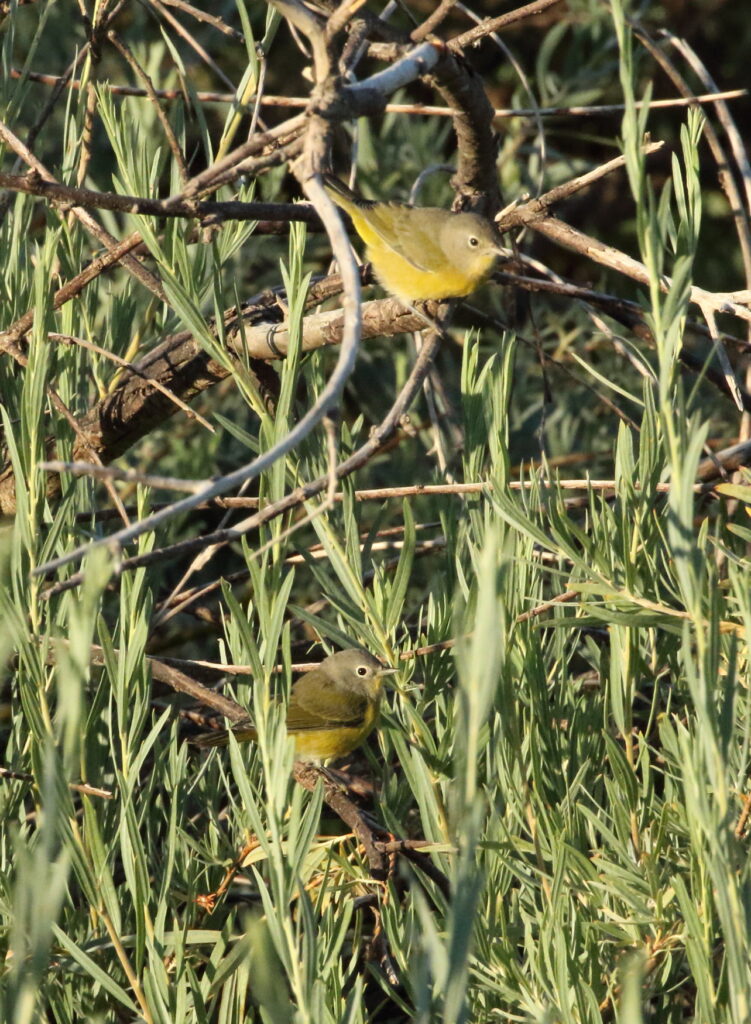
Our next stop was Ashland, Oregon, where Amy had bought us tickets for the Shakespeare play The Merry Wives of Windsor and the musical Into the Woods. Both were excellent productions, but I felt so sleepy I barely made it through them without crashing to floor. Our first morning there, though, I hit another new birding spot, Emigrant Lake (South Shore). Here, I managed to nab three more Year Birds: Oak Titmouse, Bewick’s Wren, and California Towhee. My biggest surprise were a pair of Nashville Warblers. In fact, it’s been a great year for learning about these birds as I saw them migrating through Texas last April and now, making the return migration through California. (Though I must point out that this species has an unusual “bifurcated” distribution so the birds in Texas and California probably came from separate, distinct populations.)

Finding Nashville Warblers along the shore of Emigrant Lake was one of the day’s best surprises.

Chico greeted us with 104-degree temperatures, less than ideal for birding. Our major goal here, of course, was to get Tessa settled into university housing, but you know me. My first morning, I was up at dawn to explore Hooker Oak Park, a great city park I’d discovered when first bringing Tessa to check out Chico (see post “College Search Birding in California”) in 2024. This morning, the park did not disappoint. One of my favorite birds, Acorn Woodpeckers, were flying everywhere and I had a wonderful encounter with Anna’s and Rufous Hummingbirds, who put on a real show for me in a dry riverbed. As far as Year Birds go, however, my only score was a bird that happened to earn Bird of the Trip honors.

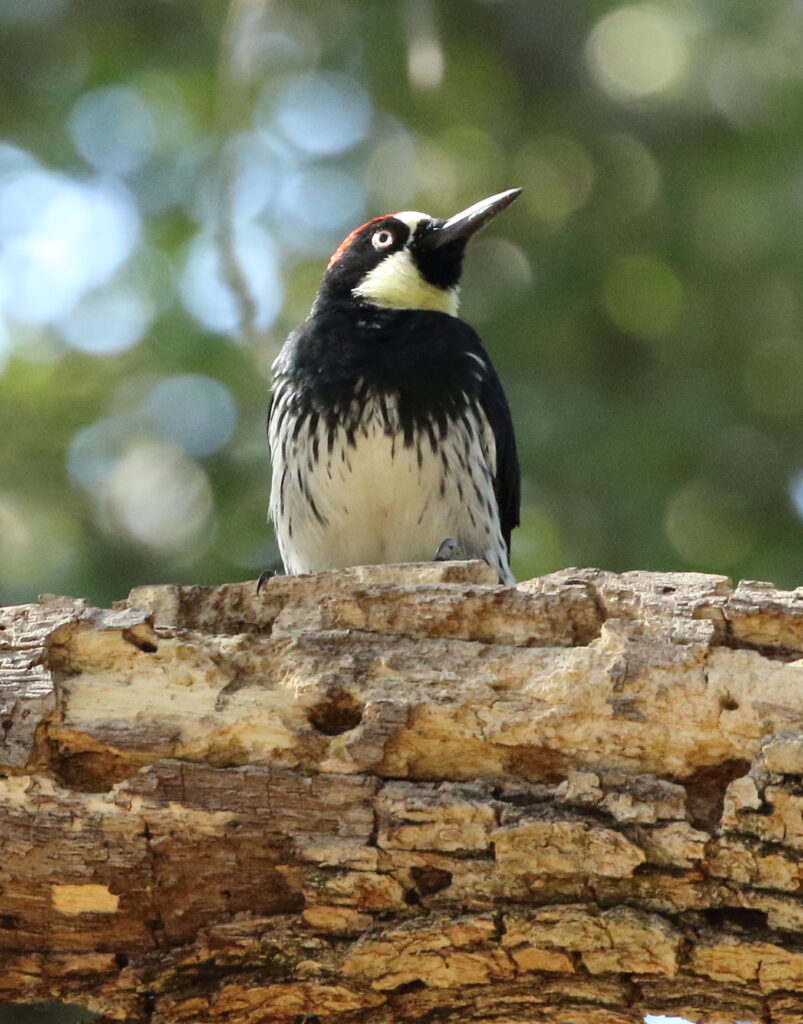
I recorded more than two dozen Acorn Woodpeckers in Chico’s Hook Oak Park. Good thing they are one of my favorite birds!

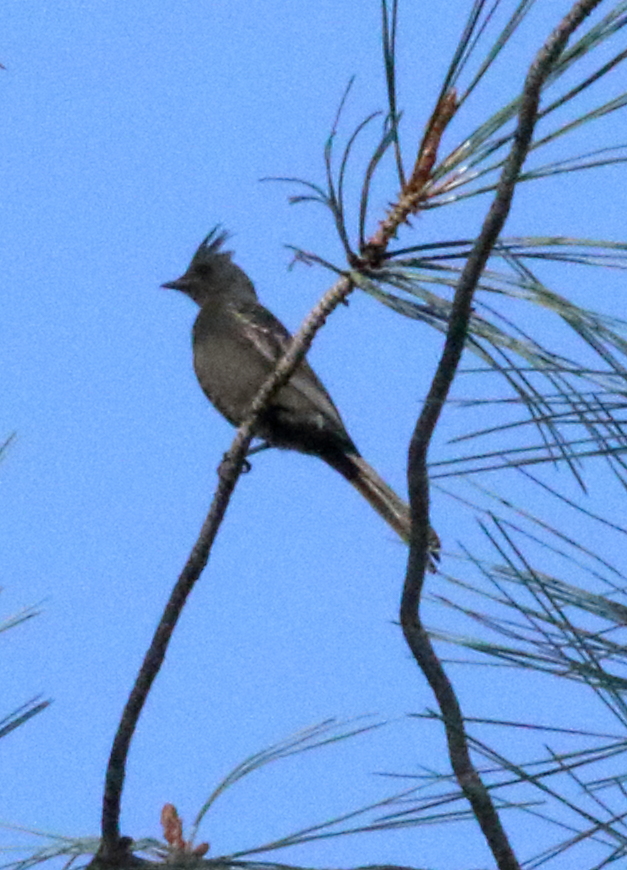
As I was leaving the hummingbirds and walking back down the dry wash, I glanced up at a medium-sized black bird landing high in the top of a pine tree. The bird showed a distinctive, tall peak on its head like it had styled its feathers with pomade, and at first I thought, “Is that a Stellar’s Jay?” Though I knew STJAs were common in the adjacent mountains, it didn’t seem likely that they’d be here on California’s Central Valley floor. However, as I stared at the bird—and three others that joined it—a wave of delight crept over me. I was looking at Phainopeplas!

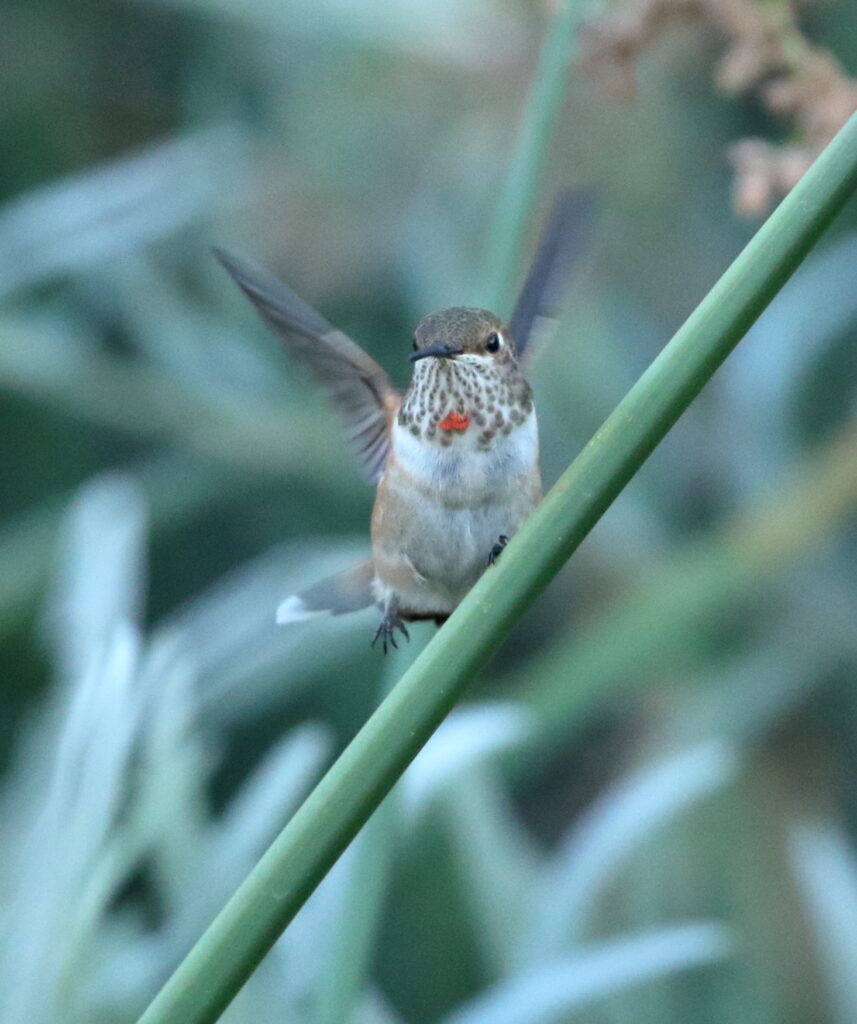
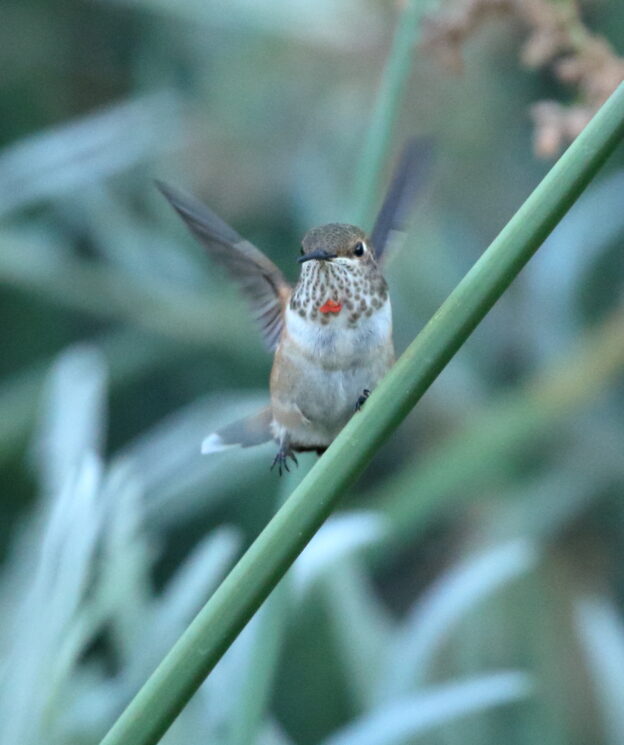
I love that the orange throat patch of this Rufous Hummingbird looks like an upside-down heart! Several of the birds were aggressively chasing each other—and a few Anna’s that were around.

At first I didn’t believe it. While I knew that Phainopeplas lived in Southern California, I’d only ever seen the birds in Arizona and here in Chico they seemed wonderfully out of place. Quickly calling up Merlin on my phone, however, the range map showed a tiny, seasonal finger stretching up the Central Valley—and stopping almost exactly where I was standing!

With their surprise appearance in Chico, Phainopeplas easily nabbed Bird of the Trip honors for our sojourn to Chico.

These, of course, are the moments a birder lives for—amazing surprises in new places—and the encounter put a bounce in my step as I returned to the hotel for a day of getting Tessa ready for college. Alas, the PHAIs were the last Year Bird I managed to find on the trip. I returned to Montana at 520 species for my Year List. Since then, I’ve managed to add Clark’s Grebe to my list, but that still falls seven short of breaking my record.

Will I make it? Do I have any surprise opportunities up my sleeve to put me over the top? And what of Braden? Could he reach that magical 1,000 number for the year? Well, you know the answer: you’ll just have to keep reading to find out!

A fun visit to Emigrant Lake south of Ashland, Oregon helped nudge me closer to breaking my all-time one-year species count record—but not close enough!

Swift-ecta!

In an earlier post, we may have let slip that both Braden and I are on a tear for our 2025 global species lists (see our post In Search of the Green-tailed Towhee). That’s due to a variety of factors. Braden not only drove across the country from Maine to Montana this past spring (see last post), he embarked on intense birding trips to Oaxaca, Mexico (see post Birding in Oaxaca, Mexico) and Costa Rica. As for me, I received delightful last-minute invitations to Colombia (post Antpittas and Tody-Flycatchers), thanks to FSB contributor Roger Kohn, and to Texas, where I spoke about my book Birding for Boomers. The upshot of all this is that Braden has seen almost 800 species of birds this year, while I am within twenty birds of breaking my all-time record of 527.

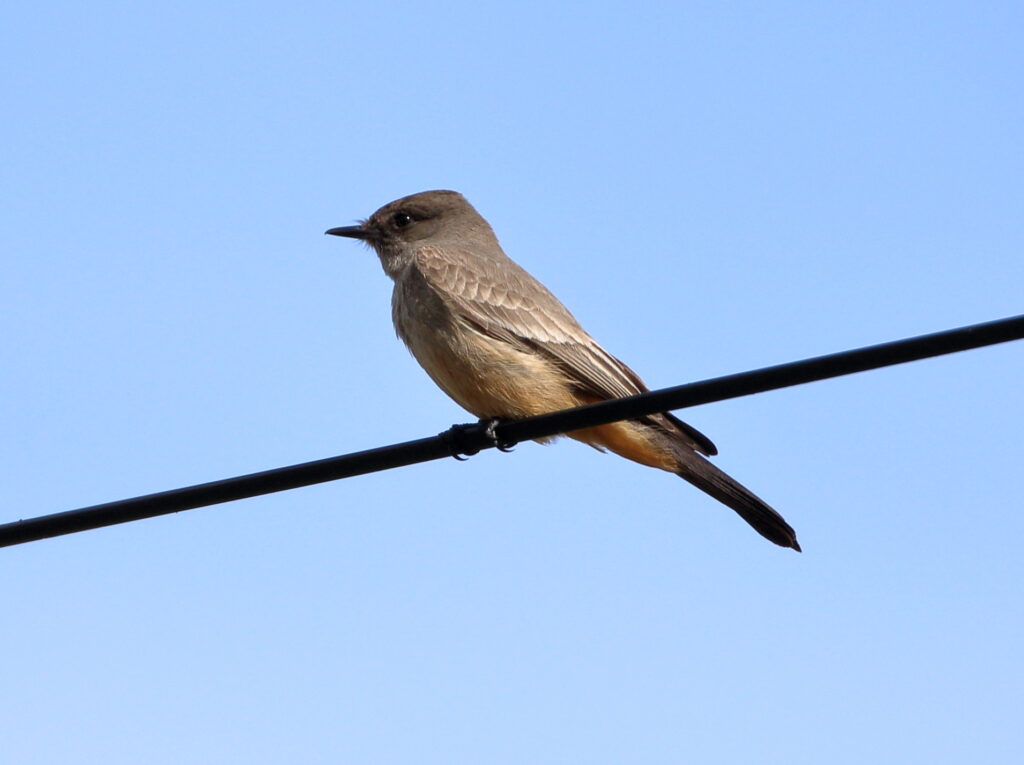
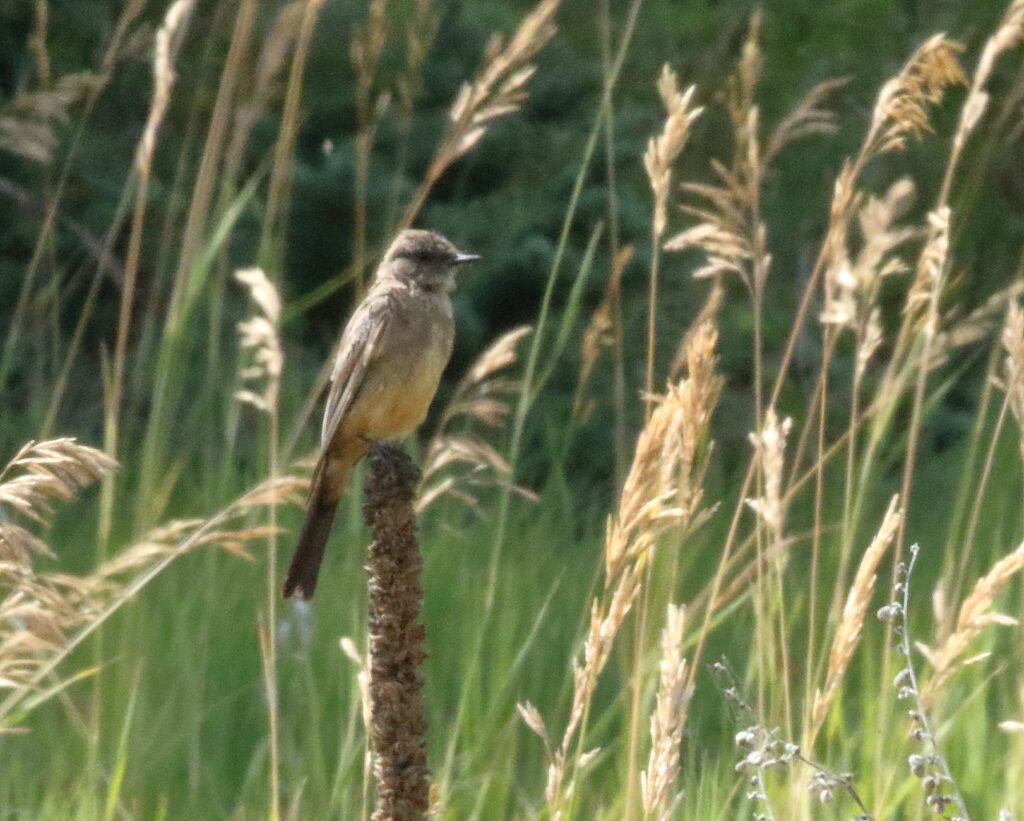
The thing is, twenty birds in Montana in late July is more challenging than it sounds. Birds common in May or June become increasingly difficult to detect and find, so if you don’t have them by August you may not get them at all. That means you’ll have to rely on migrants—which are notoriously unpredictable—or winter arrivals that you probably got earlier in the year. As a result, I’ve recently been focused on picking up the remaining common birds that I so far haven’t seen. Top on my list? Say’s Phoebe.

Last year, I saw a Say’s Phoebe near the base of Missoula’s Pattee Canyon. Alas, that one eluded me this year, forcing me to search farther afield!

Say’s Phoebes are cool little flycatchers that love to nest on human-made structures such as barns, covered porches, and utility buildings. While not rare, they seem to be pretty picky about their accommodations, and we run into them only infrequently in Montana. As I write this, for example, only four sightings have been reported in Missoula County in the past month. While scouring eBird, though, I did note regular sightings up at Kerr Dam below Flathead Lake. Braden and I had discussed doing a birding day trip, so two Tuesdays ago we set out early, Say’s Phoebes our Number One goal.

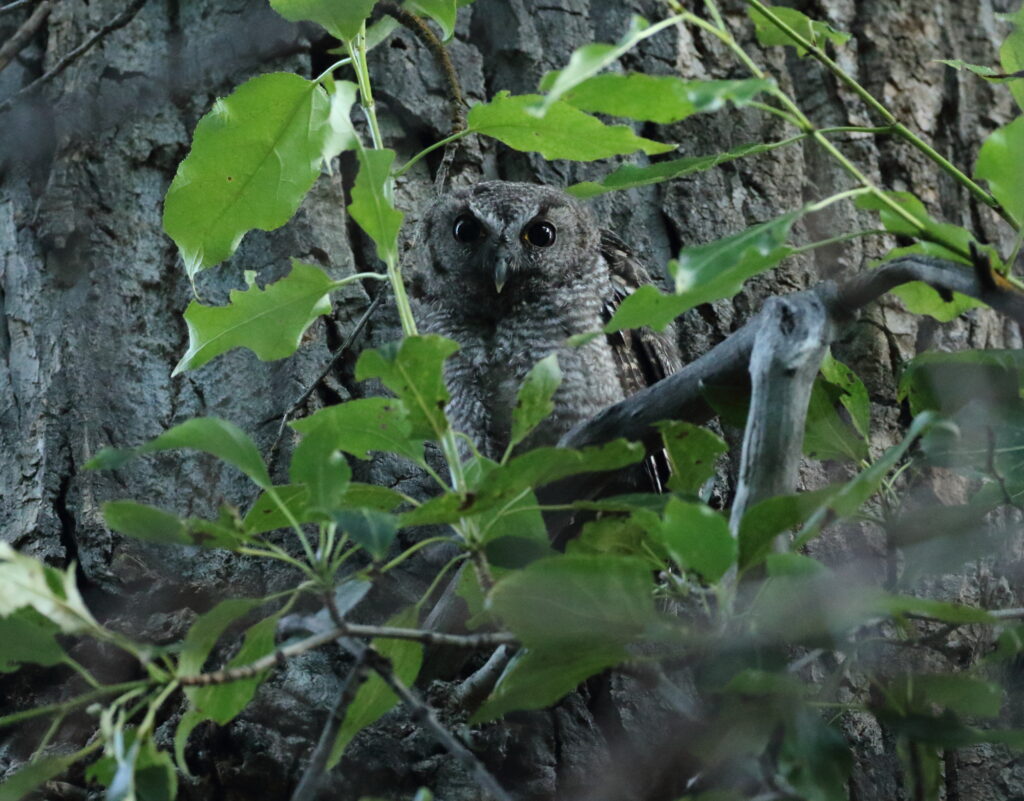
Before leaving Missoula, Braden asked if we could stop at Greenough Park. He had been pursuing a birding challenge with friends back East to see how many species they could find every day for seven days in a row. “I want to pick up Lazuli Bunting and Swainson’s Thrush,” he told me. This search happened to lead to the first delightful surprise of the day. As we were walking up a dirt trail, we approached a cottonwood tree where Braden had found a Western Screech Owl two days before. Today, he suddenly exclaimed, “Oh my god! It’s a baby!” Sure enough, a WSOW baby sat only a yard from its parent about twenty feet up the tree. Here, our day had just begun and already it had been a wonderful outing!

This adorable little guy was the first baby Western Screech-Owl Braden and I had ever seen!

Still, we had a lot of ground to cover. After a fortifying meal at our favorite French restaurant, McDaniels (in honor of Rogére), we headed up to Ninepipe NWR. We didn’t have any major agenda there except perhaps to snag some shorebirds. For July, it was an unusually cool, overcast day and we joked that we might see some Black Swifts. For those unfamiliar with Black Swifts, they are one of the most elusive and rare birds in the US. They nest mainly behind waterfalls and, especially with climate change, are highly vulnerable throughout their range. In Montana, I had never seen one outside of Glacier National Park, and it was pie-in-the-sky logic to even hope we might see one here out in the valley.

Braden poring through intermolt ducks at Ninepipe.

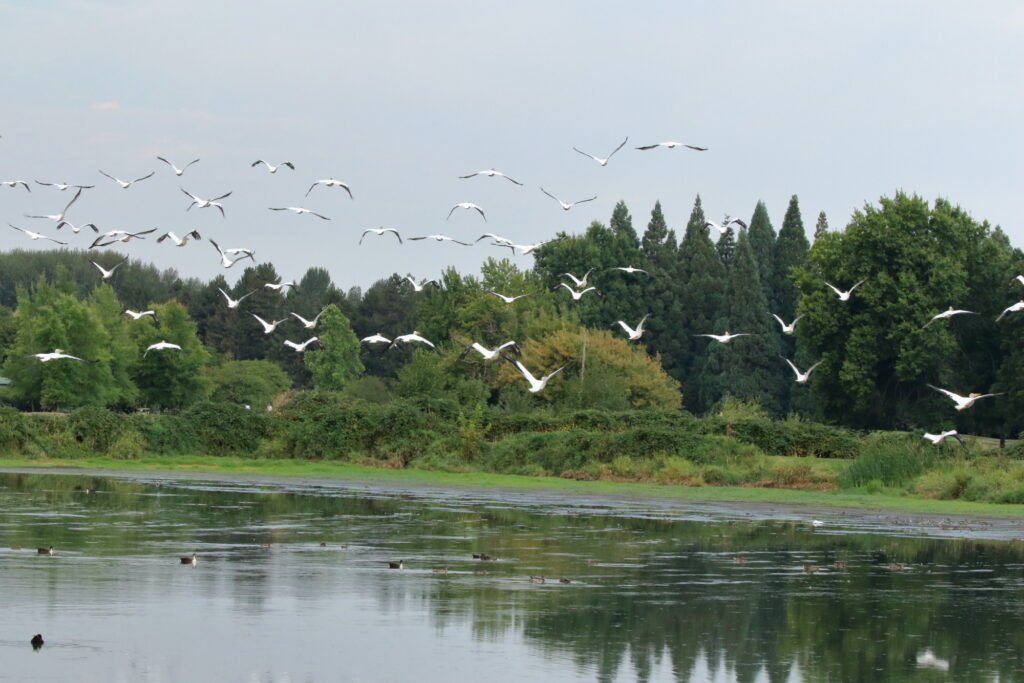
Anyway, we stopped at one Ninepipe pullout just off Hwy 93. The ducks were in their almost-impossible-to-identify intermolt plumages, but we still saw a nice variety of them plus Trumpeter Swans, American White Pelicans, Double-crested Cormorants, and Great Blue Herons. “Where are the Black Swifts?” I pressed Braden, but he shrugged off my flippant remark.

Though we hadn’t seen any Black Swifts, the low cloud cover at least admitted the possibility that they would venture down into the valleys from their mountain waterfall hideaways.

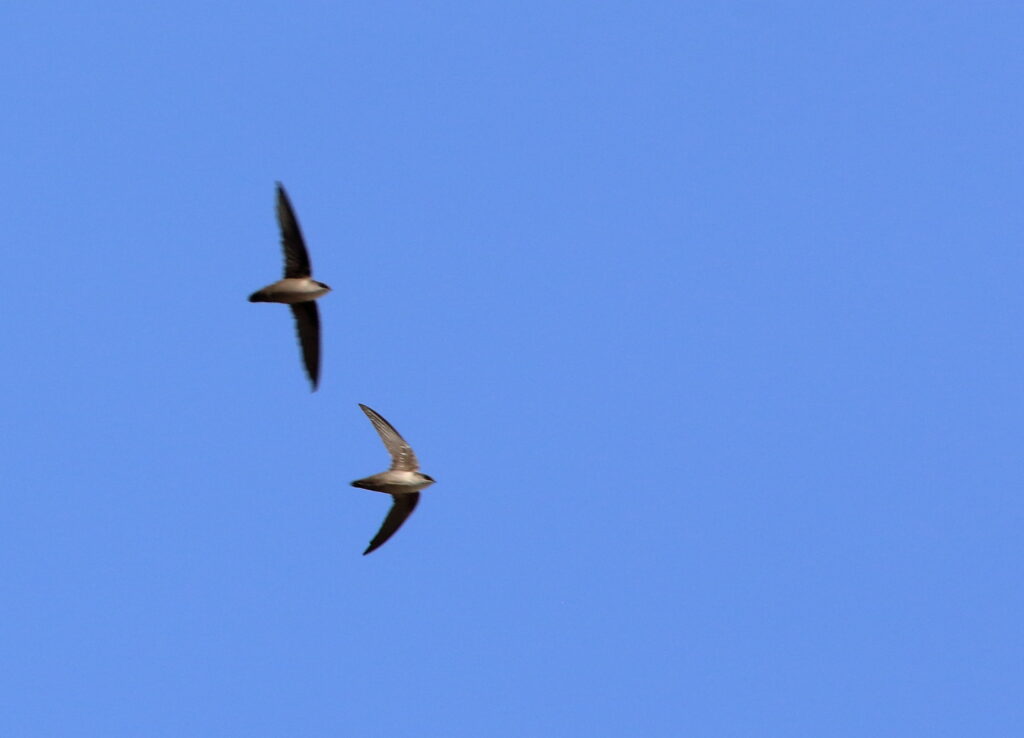
The phoebes on our minds, we didn’t want to spend too much time at Ninepipe, but decided to stop at one more pullout and, again, found the usual suspects. We both searched the skies for Black Swifts just in case, but didn’t see any. “I have to go to the bathroom,” Braden said, and I kept looking around for various birds. As soon as Braden emerged from the outhouse, however, he shouted, “Black Swifts!” Huh? My eyes darted back toward the low clouds, and there they were—four unmistakable dark shapes scything through the air!

Black Swifts were a stunning find on a day for which we had almost no expectations.

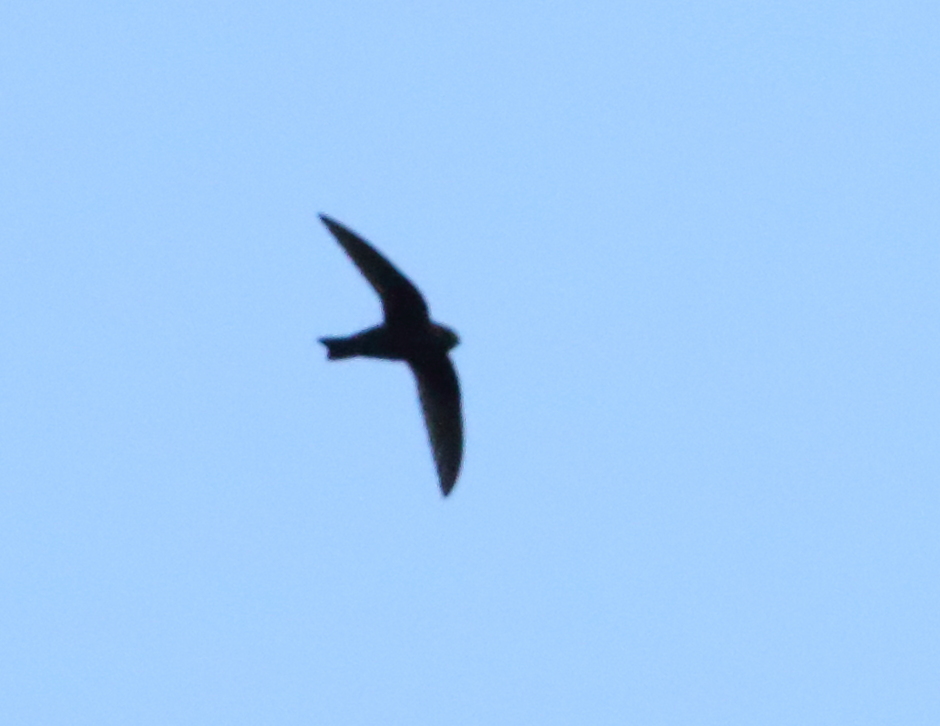
Though I’d seen Black Swifts before, this was my first time really getting to study them, and I noticed both similarities and differences between other swifts. Like other swifts, BLSWs have distinctive almost sickle-like shapes when they fly. With a wingspan of eighteen inches, however, they are significantly larger than Montana’s other swifts, and this shows in their flight. While Vaux’s Swifts zip around with almost mechanically stiff rapid wingbeats, Black Swift wings bend more noticeably. They still look like advanced jet fighters as they zoom through the sky, but with more flexible bodies. Braden also pointed out that Black Swifts show noticeable forks in their tails compared to Vaux’s Swifts, which look like their tails have been chopped off with a cleaver.

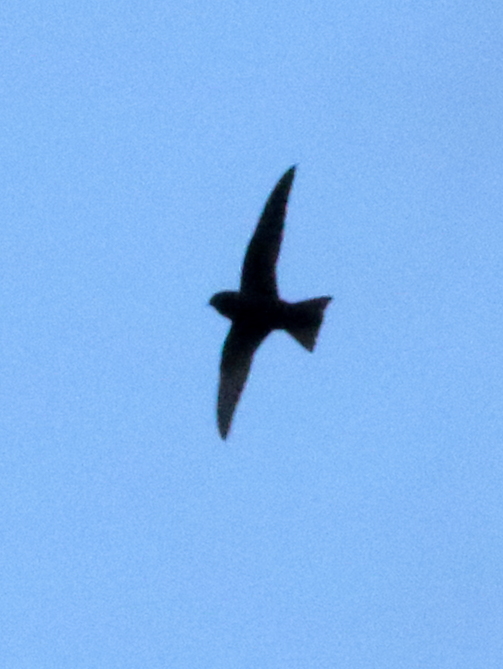
Swifts can usually be distinguished from swallows by their stiff-winged, scythe-like silhouette. Note the prominent fork in the tail of this BLSW that distinguishes it from Vaux’s Swifts—though White-throated Swifts can also show a fork.

We watched these rare beauties for a full five minutes before they drifted away across the lake and I even managed some cool photos. After they had gone, Braden and I just looked at each other. “Black Swifts,” he said, and we gave each other a hug.

Swifts always remind me of fighter jets—captured here doing an F-35 impersonation.

Remarkably, it was still only 8:30 and we had a ton of birding ahead of us. Our next stop was the roadside rest stop just south of Ronan where we picked up lone Semipalmated, Spotted, and Solitary Sandpipers, along with a pair of Long-billed Dowitchers, all undoubtedly in migration. After that, we headed to Pablo NWR in hopes of some interesting water birds. We struck out on those—but were amazed to see more than 300 Bank Swallows resting on the dirt road. “They must be migrating, too,” Braden marveled, and I agreed. In fact, it has been a very lucky swallow year for both of us with, for example, great looks at large numbers of migrating Tree Swallows and Cliff Swallows. This was the first time we’d ever seen Bank Swallows in such numbers, though. From there, it was on to our primary destination: Kerr Dam.

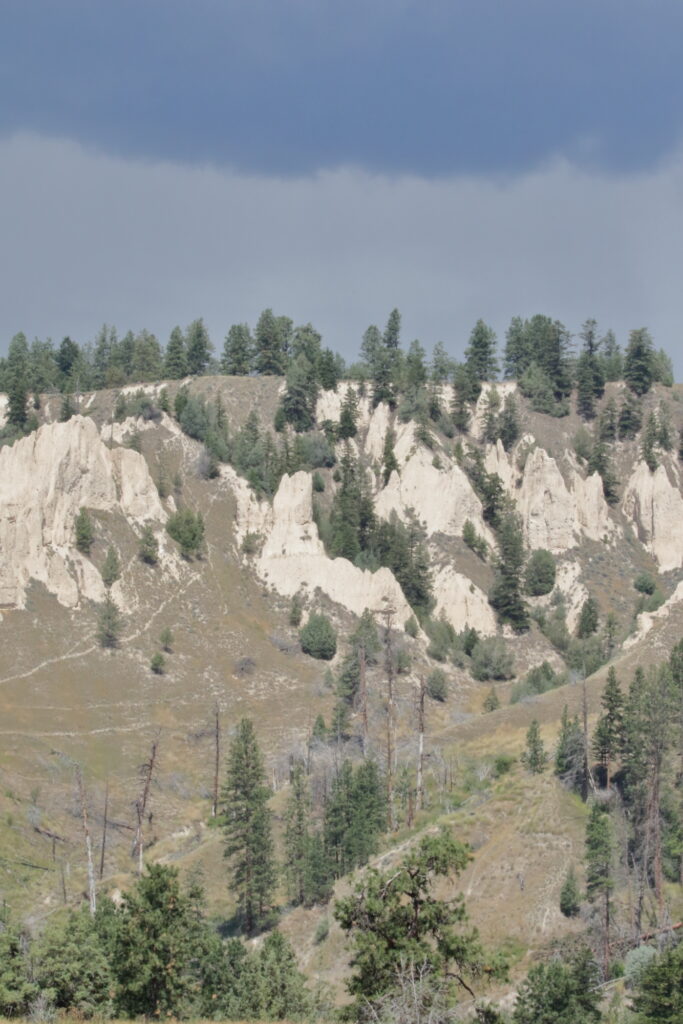
Braden had never been to Kerr Dam before, and I’d just gone to the overlook, but the entire site reminded me of a throwback to gentler, more civic times, when people shared more of a vision for the common good. From the overlook, we looked down on the dam itself with the Flathead River backing up into Flathead Lake beyond. Below the dam, dramatic, highly eroded cliffs framed a dramatic canyon full of promising riparian habitat.

Braden and I both wondered what secrets the dramatic cliffs below Kerr Dam might be hiding!

From the overlook, we watched Ospreys and Braden said, “Look, there are some Violet-green Swallows. White-throated Swifts should be here, too.” Not two minutes later, he spotted a pair flying overhead, their sickle-shaped wings and white breasts clearly visible against the blue sky. “Uh-oh,” I said. “That means that we might have to go for the Swift Trifecta and find some Vaux’s Swifts.” Braden sighed in agreement. Darn those swifts!

But we had not forgotten our main target, Say’s Phoebes. “I’m guessing they are down there at the power station below the dam,” I said. “You up for going down there?”

“Sure.”

Squinting into the sun at the overlook to Kerr Dam, the Flathead River running south below the dam in the distance.

Winding our way down to the power station, we were greeted by a cluster of neatly-kept houses and a fenced-in area full of transformers and other “power stuff.” All of this was surrounded by an open, pleasant park-like setting that reminded me of my days working on the Pitt River dam network in northern California just after college. We decided to get out and walk around and immediately started seeing and hearing Western Wood-Pewees, American Goldfinches, robins, Eastern Kingbirds, and other songbirds. We hadn’t walked ten minutes when suddenly, some kind of flycatcher darted out in front of us to snag an insect.

“Say’s Phoebe!” I exulted, and Braden gave me a high five. There weren’t just one, but two, working the area around the fenced-in transformer area. “This is perfect for them,” I said. “Lots of insects and plenty of structures to nest on.” Alas, they didn’t care for our attentions and kept flying away as we approached, but they and the Black Swifts brought my global year total to 509 species—just nineteen shy of breaking my record of 527. Braden already had the phoebe for the year, but the Black Swifts took his global 2025 total to an astonishing 776 species! BUT . . .

This elusive Say’s Phoebe finally cooperated with me for 2025!

There was still that little matter of a swift trifecta on our minds. After a cultural stop at Richwines Burgerville in Polson, we made our way slowly back to Missoula. Nowhere did we see the third Western Montana swift, Vaux’s Swift. “Let’s go to Caras Park,” Braden suggested as we reached Missoula. “I see them there pretty regularly.”

We parked near the iconic metal salmon sculpture and walked out onto the grass below the Higgin’s Street Bridge. The sun was out by now and things were warming up. Cliff Swallows flew to and from their mud nests on the side of the bridge, but I didn’t expect to see any swifts. “There’s one!” Braden suddenly shouted. Sure enough, several birds with fast, mechanical wingbeats darted back and forth after insects above the Cliff Swallows. It was a final satisfying sighting on a totally surprising, remarkable July day in Montana.

Our Day’s Trip Report: https://ebird.org/tripreport/396651?welcome=true

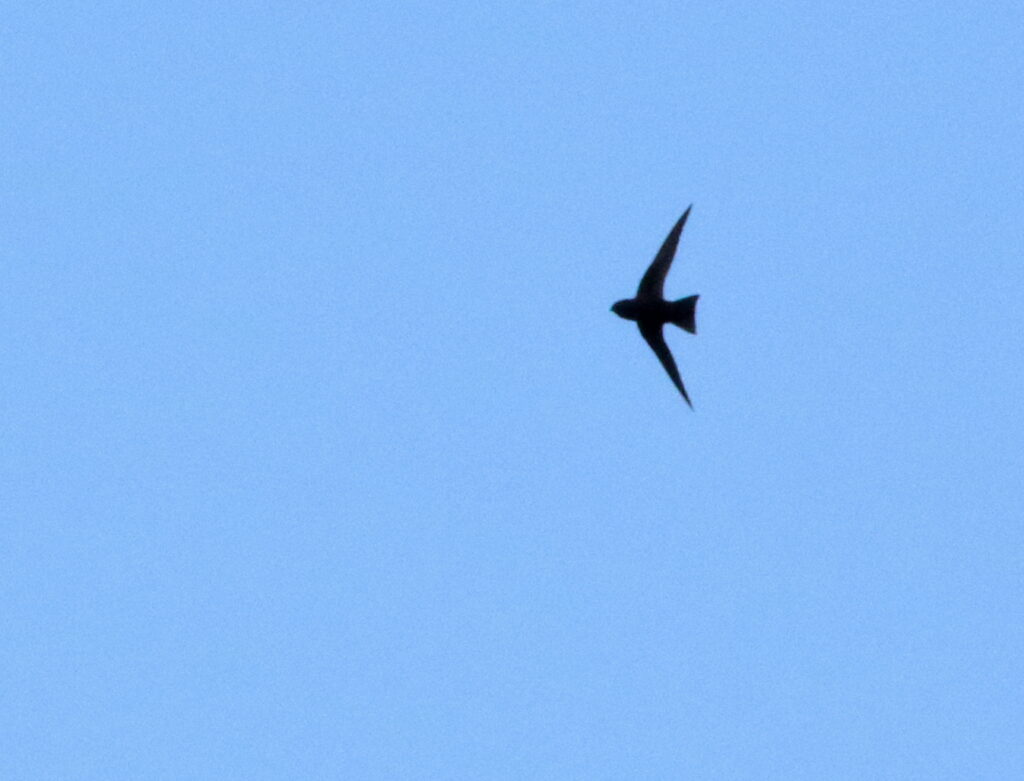
The small size and “chopped off” tails of Vaux’s Swifts are solid ID features to distinguish them from both Black and White-throated Swifts. These wonderful little birds completed our Western Montana “Swift-ecta” and wrapped up one of our best birding days ever.

The Shorebirds of North America (Book Review)

With spring shorebird migration coming on, we take a break from our Colombian birding series to review a new book that will help prepare you for the exciting, sometimes daunting task of identifying and enjoying some of the world’s most spectacular long-distance migrants. Bird—and read—on!

Legions of FatherSonBirding readers have probably noticed that Braden and I have increasingly become interested—nay, obsessed—by shorebirds over the years. See, for example, our posts

Montana Shorebird Surprise

Abbotts Lagoon, Point Reyes National Seashore (or Chasing Migrants, Part II)

Our fascination may seem odd given that Montana is hardly the world’s epicenter of shorebird activity. Then again, their very rarity here renders them all the more alluring to find and learn about. A natural birding progression also is at work. When beginning one’s birding journey, we birders naturally focus on common, familiar species. As confidence, curiosity, and ambition grow, so does the desire to learn about and identify more difficult groups of birds. When we first began birding, Braden and I focused on woodpeckers, thrushes, waterfowl, waders, owls, and other easier-to-identify species. Over the years, we have plunged into increasingly challenging groups including warblers, sparrows, flycatchers (Braden), gulls, and perhaps more than anything, “shorbs.”

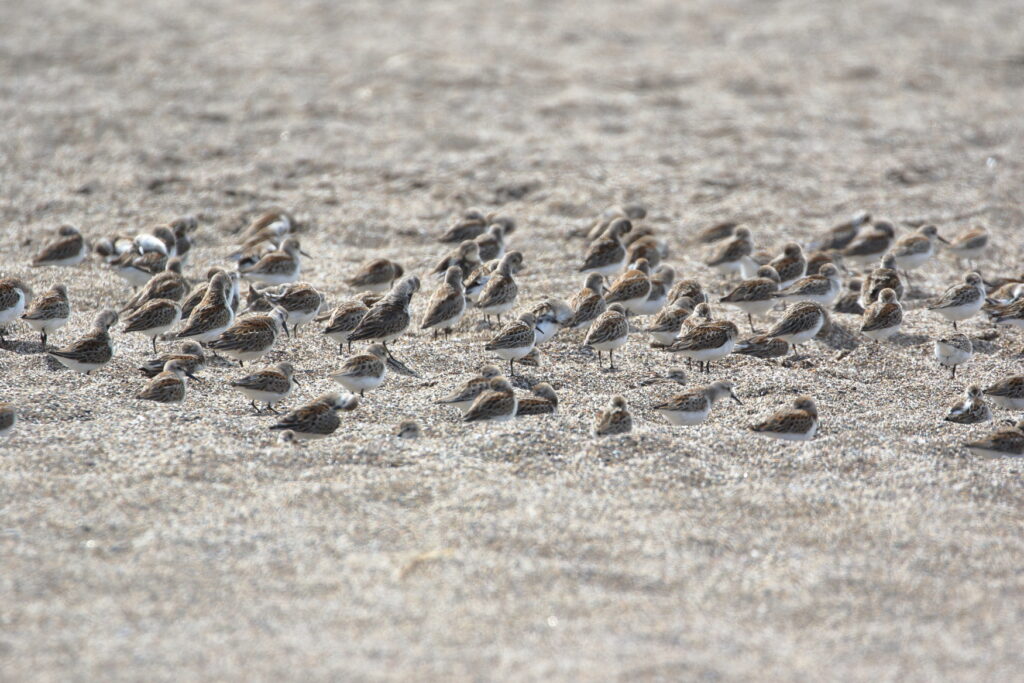
A flock of Western Sandpipers at Point Reyes during my September visit to California with Scott Callow.

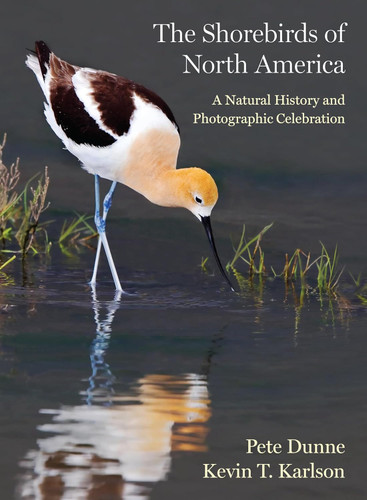
When out scanning beaches or shallow lakes, the most common phrase Braden repeats to me is “Shorebirds are tough.” This usually happens when I am whining about the difficulty in distinguishing between off-season Least and Semipalmated Sandpipers, or White-rumped and Baird’s Sandpipers—especially at a distance. But many shorbs are relatively easy to identify, and over the years both Braden and I have come to appreciate—nay, savor—the entire breadth of these fascinating, superbly adapted critters. Imagine my joy, then, when a brand new, beautifully photographed book about shorebirds arrived on my doorstep: Pete Dunne’s and Kevin T. Karlson’s The Shorebirds of North America: A Natural History and Photographic Celebration (Princeton University Press, 2024).

The Shorebirds of North America by Pete Dunne and Kevin T. Karlson (Princeton University Press, 2024)

To say that The Shorebirds of North America is ambitious would be like calling the 18,000-mile round-trip migration of a Red Knot “neat” instead of “epic” or “mind-blowing.” This terrific addition to birding literature not only gives a wonderful overview of the lives of shorebirds, it provides specific accounts of all the shorebirds likely to interest you. That makes this book a wonderful, highly readable reference for both beginning and advanced birders.

The bulk of the book consists of species accounts of 52 kinds of shorebirds known to breed in North America and my guess is that you, like me, will skip directly to species that happen to interest you at the present time. This is a great approach. One of the first shorebirds I looked up was Black-bellied Plover, a bird I have become more and more enthralled with the past several years. As I started to read, my understanding of this handsome creature immediately swelled. I didn’t realize, for instance, that it is one of the world’s most widely distributed shorebirds, or that it is called Grey Plover outside of North America. What really tickled me was learning how fearlessly aggressive these birds can be:

“On the high Arctic tundra breeding grounds,” the authors write, “this sturdy plover is a fierce protector of its large nest area, and it strikes fear into aerial predators as large as gulls and jaegers. Woe to any flying predator if it hears the whistled alarm call of Black-bellied Plover as it flies swift and low across the tundra before rising to spear the intruder in the belly with its strong bill . . .”

The 4-letter breeding code for Black-bellied Plovers is BBPL. After reading the entry for the bird in The Shorebirds of North America, however, I realized that BBPL could easily stand for “Bad-ass-bellied Plover”.

Who knew that one of my favorite birds is such a bad-ass? Similarly delightful “reveals” can be found in each account, many of them based on the authors’ own personal and scientific experiences with the birds.

Far from just being pretty to look at, the book’s incredible photos add real understanding of each species by showing them in a variety of plumages and situations. I enjoyed just quizzing myself on the photos as I made my way through the book, testing and expanding my knowledge as I went. I cannot imagine the effort Kevin T. Karlson and the book’s other photographers invested in creating what may be the world’s finest collection of shorebird photos.

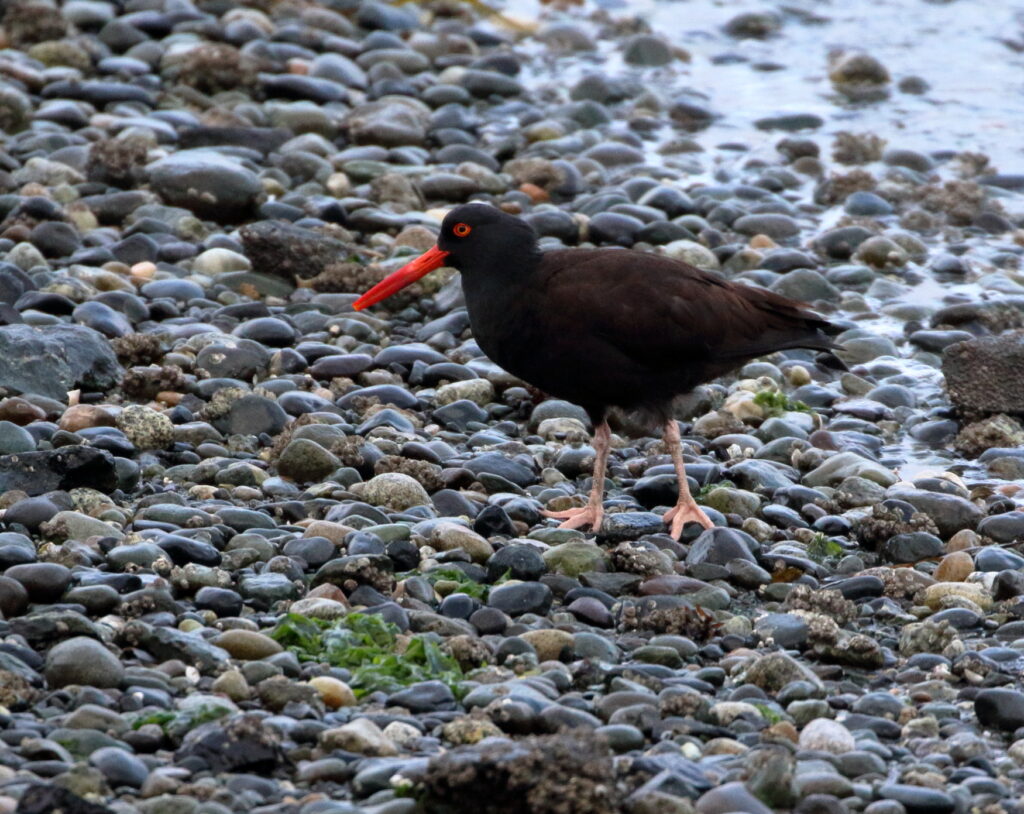
Another thing I learned from The Shorebirds of North America is that the bills of oystercatchers are laterally compressed. You can’t tell this from the typical side view, but this compression turns the bills into excellent chisels for prying limpets, snails, and chitons off of rocks.

As delightful as the species accounts are, I strongly urge readers to read the entire first section straight through. In this section, the authors provide excellent perspective on all shorebirds including their remarkable adaptations, habits, diversity, and evolution. Fascinating anecdotes abound, such as the story of B-95, a banded Red Knot known to have traveled more than 400,000 miles during his 21-year lifetime. The authors don’t bother to hide their admiration for these birds:

“Challenged to design the perfect bird, we would without hesitancy delve into ranks of shorebirds and reach down to the Scolopacidae (sandpipers), the largest of the roughly six or seven family groups in the shorebird order Charadriiformes.”

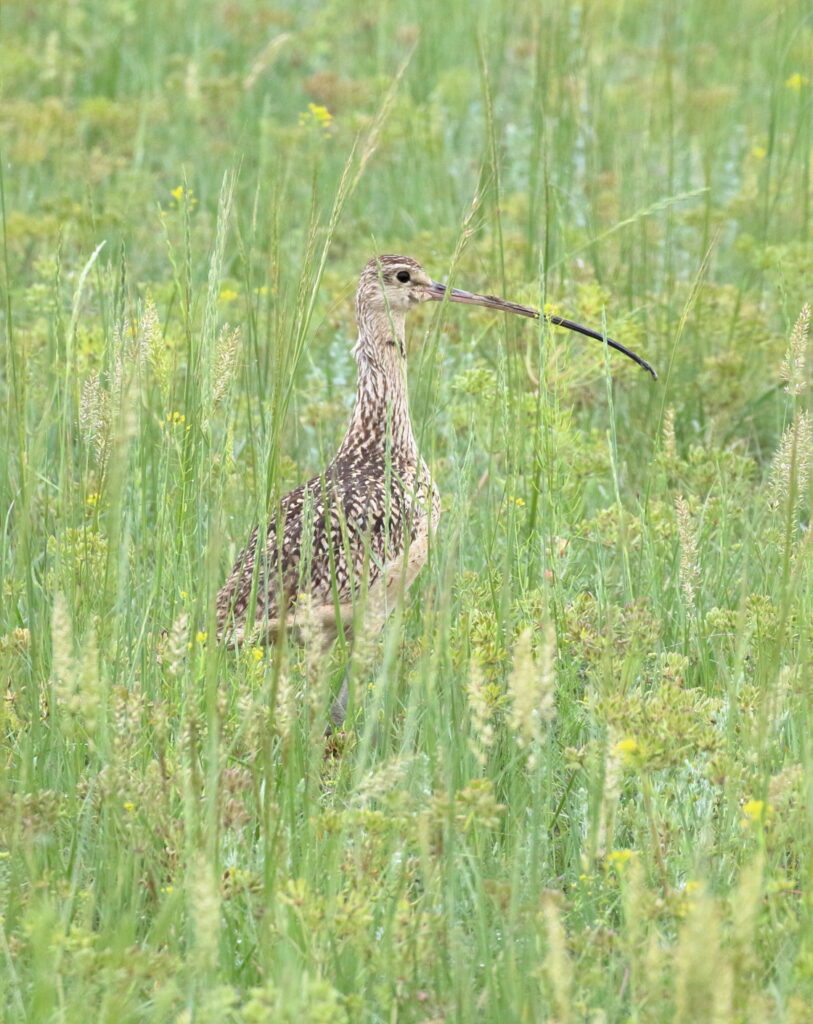
Another fascinating fact I picked up from The Shorebirds of North America is that the curved bills of Long-billed Curlews are almost perfectly designed to snatch fiddler crabs from their long, curved burrows. They’re also great for picking off grasshoppers without alerting them to their imminent doom.

I could keep singing this book’s praises, but really, if you have even the tiniest, nascent interest in shorebirds, you should order a copy yourself. Given its length and full-color format, I expected the book to sell for at least fifty or sixty bucks, but at the time of this posting it can be had for a bargain $35. That puts it within reach of most people—and makes it an investment in your birding future you won’t regret.

One-Sentence Summary: A highly-readable, indispensable resource for both beginning and advanced shorebird enthusiasts.

Overall Rating (on a scale of cool birds): Piping Plover (highest)

You can order The Shorebirds of North America from your local independent bookstore, or directly from Princeton University Press. Please tell them we sent you!

(Except for the cover image, photos in this post are copyright Sneed B. Collard III. Review copy of The Shorebirds of North America provided by the publisher.)

Birding Race Point: Cape Cod’s Pelagic Playground

The week before Thanksgiving, my family had the opportunity to visit a place that featured prominently in my childhood—Cape Cod, Massachusetts. We headed to Boston so that I could accept a big award for my picture book, Border Crossings, but the trip provided many piggybacking opportunities. These included a chance to look at colleges for Braden’s sister, Tessa, and to meet up with Braden for Thanksgiving. After Amy, Tessa, and I spent a few days in Boston, in fact, Braden drove down from the University of Maine and whisked us off to the Cape.

I spent parts of many summers in Woods Hole on the Cape. My father did his post-doc at WHOI—the Woods Hole Oceanographic Institution. My step-father spent dozens of summers in Woods Hole doing research and teaching classes at the MBL—the Marine Biological Laboratories. I have many fond (and some not-so-fond) memories of those summers, but had not been back for (gasp) 45 years! I looked forward to revisiting old haunts and showing my family some of the places that had shaped my childhood. Naturally, Braden and I also considered the birding possibilities.

Race Point Lighthouse.

When Braden first mentioned going to Race Point near Provincetown, I hesitated. I recalled driving up there as a ten-year-old and didn’t relish spending an extra four hours of our vacation in a car. When Braden started telling me what we might find there, however, I quickly changed my mind.

Race Point, it turns out, is one of the nation’s premiere places for spotting seabirds from land. A map reveals an obvious reason: Cape Cod juts miles out into the Atlantic Ocean, and the tip—Race Point itself—is surrounded on three sides by the sea. This means that birders have an opportunity to see both regular beach-type birds and many species that only rarely show up near land. Braden and I especially hoped to see jaegers, “tube noses” such as shearwaters, and any interesting gulls or ducks that happened to be around.

After a delicious breakfast at Liz’s Café in Provincetown, Braden and I left Amy and Tessa to explore while we headed off to the parking lot near Race Point lighthouse. As soon as we approached the beach, we spotted Northern Gannets soaring above wild, wind-raked seas. I’d only ever gotten a brief look at a NOGA before, when Braden and I had visited Acadia National Park three years before, so right away the drive up to Provincetown redeemed itself!

However, the excitement was just beginning.

One of perhaps 150 Northern Gannets we saw at Race Point. Like Blue-footed Boobies, these birds torpedo straight down into schools of fish.

As wind and sand pelted us, groups of White-winged and Black Scoters, Common Eiders, and Long-tailed Ducks skimmed the waves just offshore. Some occasionally landed, but most seemed hell-bent for destinations only they knew about. All were birds I had scant experience with, so I soaked up every sighting.

This was only my second time seeing Common Eiders, and I was uber impressed by the coloration of both females and males.

“There’s a Red-throated Loon!” Braden said, pointing to a bird with an exceedingly pale, long neck reaching up from the surface. It wouldn’t be long before we saw several Common Loons, differentiated by blockier heads, chunkier bills, and more black on their faces.

Only my second Red-throated Loon ever. Note the smooth, rounded head and white “winter” face.

At the top of our To Find list were Great Shearwaters, a potential Lifer for both of us. These birds belong to the “tube noses,” the same group of birds that includes albatrosses, fulmars, and storm-petrels. These birds are truly seafarers, rarely approaching shore. Only a few weeks ago, I had caught a glimpse of Sooty Shearwaters while visiting California’s Point Reyes National Park with my friend Scott. Great Shearwaters had been sighted regularly at Race Point for the past couple of weeks, but alas, we arrived too late to see them today.

Braden fruitlessly searching the seas for Great Shearwaters and jaegers.

We still had plenty of thrilling birds to look at, however. As we trudged the mile and a half through the soft sand toward the very tip of the Cape, flocks of Dunlin and Sanderlings in their winter plumages worked the drifts of foam left on the beach by each encroaching wave. We even saw a group of six Horned Larks, birds we were used to seeing on the backroads of Montana—not here at the end of the world.

It had been years since I’d gotten to hang with Dunlins, and it was a real treat.

Not to be outdone, gulls also put on a show. This was the first time I’d ever gotten to see Great Black-backed Gulls in a natural setting. They are the world’s largest gulls, and I gotta say they looked like they belonged in this rugged, challenging environment.

“Look!” Braden suddenly shouted. “Iceland Gull!” Two of them, in fact. These gulls had until recently been split into Iceland and Thayer’s Gull, and Braden and I had seen the latter at the Helena landfill in Montana. This look was much more memorable as both a juvenile and adult landed near us. Both were gorgeous birds with subtle markings, and they quickly jumped into contention for Bird of the Day honors. Not long after seeing the Iceland Gulls, Braden also spotted a Black-legged Kittiwake. I was grateful he’d gained experience with all of these birds while on the East Coast, because I certainly would have missed a lot of them.

I don’t even want to know what this Great Black-backed Gull is eating, as our two Iceland Gulls look on.

I picked up two Lifers for the day. One was Razorbill, a kind of black-and-white alcid I had dreamed about seeing for years (see our post “All About Alcids”). During our hike to the lighthouse and back, we saw about eighty of these birds in groups, flying low or bobbing up and down in the jagged waves. My second Lifer was a pair of Purple Sandpipers that landed in front of us and shouldn’t have been anywhere near a wide sandy beach. Like its closely-related West Coast cousin the Rock Sandpiper, these are rocky shore birds.

I was especially thrilled to see my Lifer Razorbills, but it’s a tossup whether these or the Iceland Gulls grabbed Bird of the Day honors.

“They must be migrating,” I said, and Braden agreed, though we were well within their wintering latitudes.

As we trudged back toward the car, Braden spotted a fin jutting out of the water. At first we thought it might be the dorsal fin of a shark or orca, but after watching it for a few minutes, we concluded that we were looking at the tail flukes of a larger whale. I’d seen quite a few humpback whales before, and these didn’t look anything like it. “I think it’s a Right Whale,” I said. Later, we learned that Right Whales had been regularly spotted in the area. It was one more unforgettable discovery for a memorable day.

Race Point eBird Checklist: https://ebird.org/checklist/S203601766

Race Point selfie!