Category Archives: Migration

Target Birds and a Shocking Surprise in the Texas Hill Country (Texas 2025 Part 3)

After spending two glorious birding days along the east Texas & Louisiana coasts (see “Peveto Woods, Louisiana: Spring Migration Hotspot.”), I returned to San Antonio for my four minutes—yes, you read that right—four minutes of work to promote my book Birding for Boomers. While there, I reprised my now-sort-of-famous birding route along San Antonio’s Riverwalk (see our post “Birding San Antonio’s Riverwalk—Are You Nuts?”). Once again, I found birds—but not enough to write another blog about it. As soon as I finished my speaking gig, though, I headed west into the Texas hill country. Why? To try to find two birds Braden and I had talked about our entire birding careers.

Leaving San Antonio, I drove two hours to the hot, fairly flat town of Uvalde and booked myself into a Hampton Inn. That afternoon, I picked up a few nice birds in the town’s Memorial Park including another Yellow-throated Vireo and my first—and only—Green Jay of the trip. I also grabbed an excellent Tex-Mex meal at El Herradero de Jalisco restaurant. The next morning, I hit the road before dawn.

One bonus to birding is that we birders invariably get to see spectacular sunrises and sunsets. As I headed north, I witnessed an unforgettable sizzling orange sunrise on one side of the car while an equally spectacular orange full moon set in the west. It boded well for what would be arguably the most important—and most demanding—birding day of my trip: my quest to find Black-capped Vireos and Golden-cheeked Warblers.

Anyone who has been birding for more than a couple of years has probably heard of these two Texas specialties. Of the near-threatened Black-capped Vireo, Braden simply says, “It’s the best vireo.” Quite a statement considering how cool other vireos are! The bird winters in Mexico, and its primary breeding range lies in central Texas—though it technically extends from far northern Mexico to southern Kansas. The endangered Golden-cheeked Warbler winters in Central America and far southern Mexico, but breeds exclusively in central Texas.
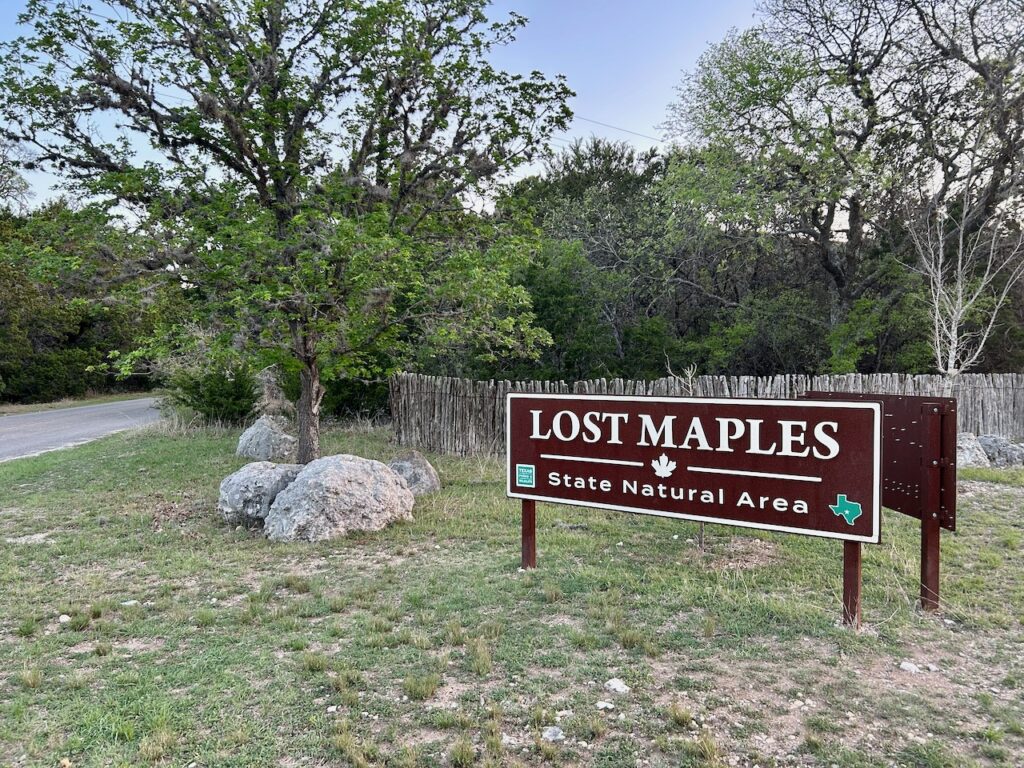
According to eBird lists, Lost Maples State Natural Area is one of the most reliable places to find both Black-capped Vireos and Golden-cheeked Warblers.

As usual, I felt a bit skeptical of my ability to find these birds. Call it psychological protection against failure. Nonetheless, I did have a plan. After scouring eBird hotspots, bar charts, and birding lists before the trip, I settled on Lost Maples State Natural Area as the most reliable location to find both species. Indeed, when I pulled into the parking lot, I met a couple who had staked out a bush where they had seen a Black-capped Vireo the previous day. “We saw Golden-cheeked Warblers in that tree about fifteen minutes ago,” the woman added, motioning to a nearby oak tree. I briefly pondered waiting around for either species, but the canyon before me beckoned and I reasoned I could hang around the parking lot later if need be.
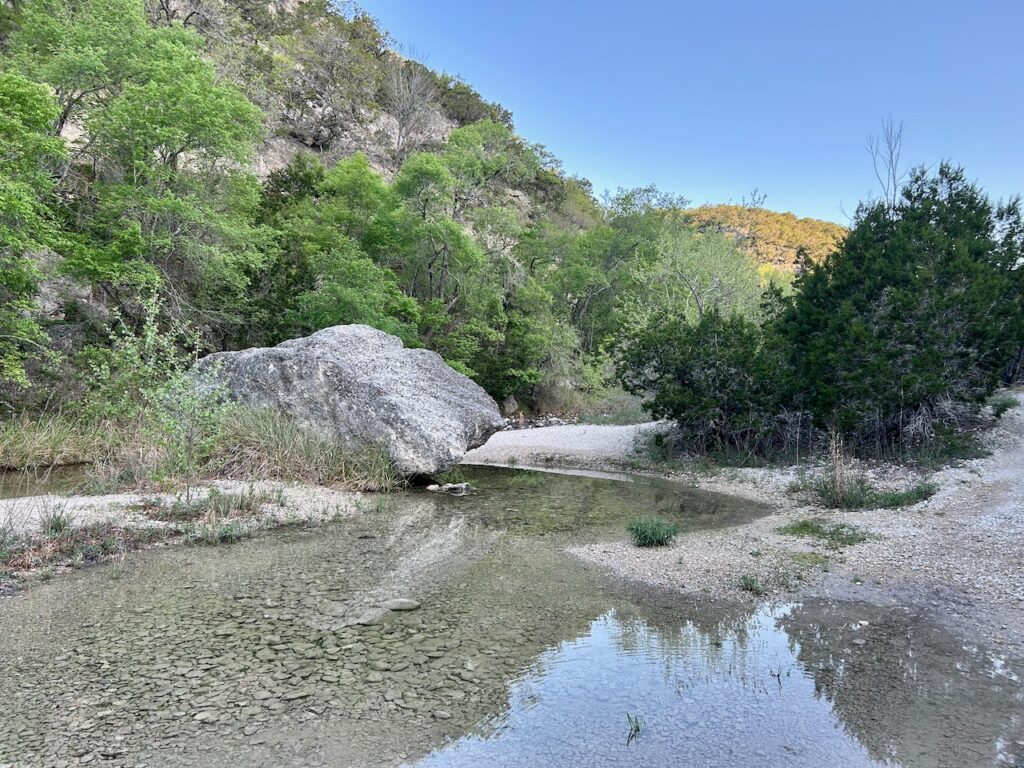
I immediately loved Lost Maples, especially since its habitat reminded me of the chaparral and oak woodland I’d grown up with in Southern California.

I headed up the park’s East Trail and immediately felt at home in the scenic canyon’s xeric landscape full of oaks, junipers, mesquite, and other classic Western vegetation. I also realized that I had tackled some tough birding! Birdsong rang out all around me, but I got few glimpses of actual birds. Thank god for Merlin’s Sound ID, which I ran multiple times to get an idea of what might be around me: an impressive list that included Canyon and Carolina Wrens, Olive Sparrows, Yellow-breasted Chats, and at least four (other) kinds of vireos. Finally, however, “Black-capped Vireo” popped up on Sound ID and I stopped to seriously scour the nearby vegetation. Over the next five minutes, I got a brief glimpse of a Blue-headed Vireo and good looks at a White-eyed Vireo.
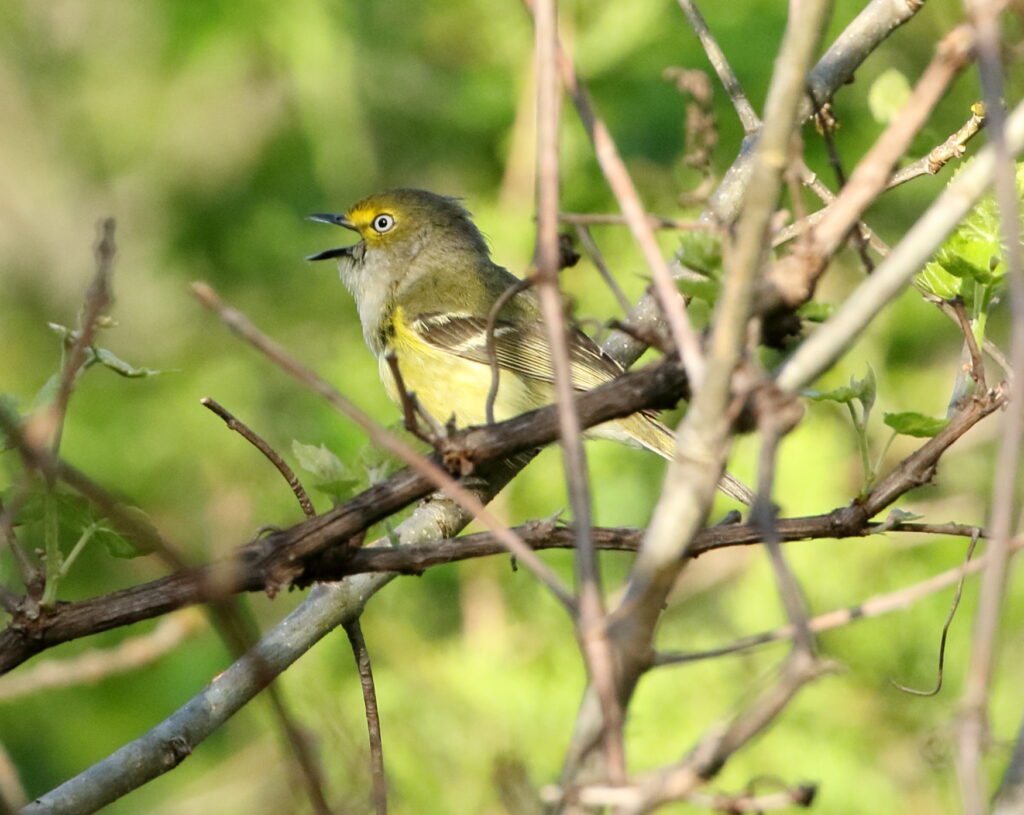
I had to work hard for actual bird sightings at Lost Maples, but managed a great look at a White-eyed Vireo—one of five vireos on my checklist for the day.

Finally, I saw the distinctive black head and white spectacles of the bird I most hoped to see: a Black-capped Vireo! Soon, I saw another. The birds definitely did not want to strike a pose and I followed them as they flitted almost frantically from bush to tree and tree to bush. I finally managed a couple of ID photos, and then just tried to relax and observe them. It was a good moment, and I felt glad I hadn’t just waited around the parking lot hoping for one to appear.
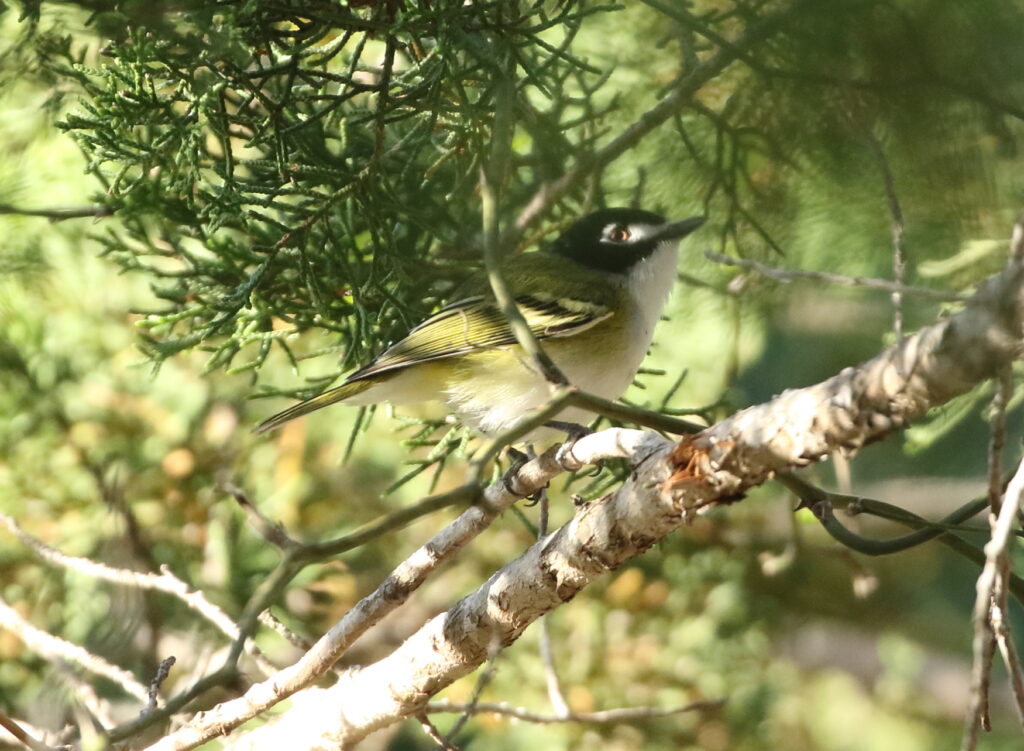
I was so glad that I hadn’t waited around the parking lot to find my Lifer Black-capped Vireos!

That left the Golden-cheeked Warbler. Sound ID had picked it up a couple of times as I hiked the canyon, but it wasn’t until I was back in the park next to my car that I began to figure out the bird’s song. With my imperfect hearing, it sounded like a high-pitched buzzing trill—a lot like an insect, but distinct from any other bird calls around me. Soon, I found myself standing for five minutes directly in front of an oak tree as a Golden-cheeked sang repeatedly.

I never saw it.

This frustrating experience repeated itself several times. I eventually added the bird to my eBird list (“Heard only”), but I was not a happy camper and I thought I might remove it later. As shy as they were, the Black-capped Vireos had been publicity hogs compared to the Golden-cheekeds! Knowing when I was beaten, I headed off to some bird feeders set up in the park about a mile away. There, I tried to console myself with leisurely views of Woodhouse’s Scrub-Jays and Scott’s Orioles. I also told the bird hostess about my lack of success actually seeing a Golden-cheeked Warbler. “Any suggestions?” I asked.
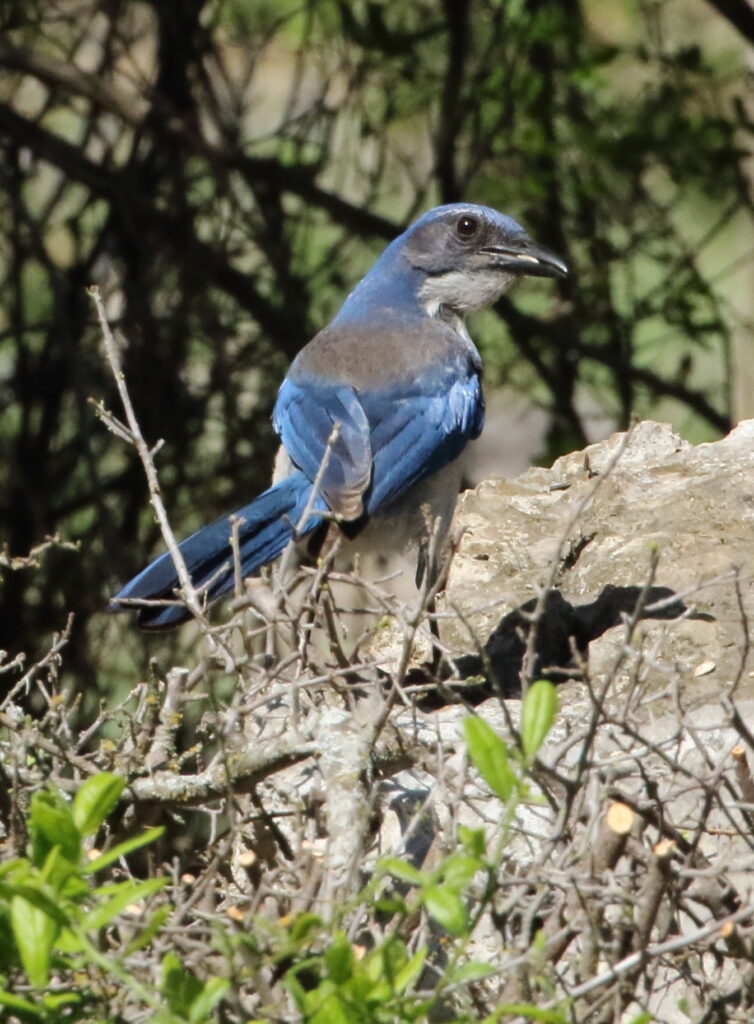
While pondering my next moves, I spent a pleasant half-hour watching Woodhouse’s Scrub-Jays and Scott’s Orioles at the Lost Maples bird feeders.

“Well,” she said, “I’d head up the East-West Trail right here until you come to the ponds about a mile on. Just keep scanning the trees as you walk.”

By now, the heat had built into the low 80s. Another hike did not sit high on my priority list, but darn it, I hadn’t come all the way to the Texas hill country for nothing! Slinging my camera and new Vortex Viper 8X42s over my shoulders I resolutely started marching.

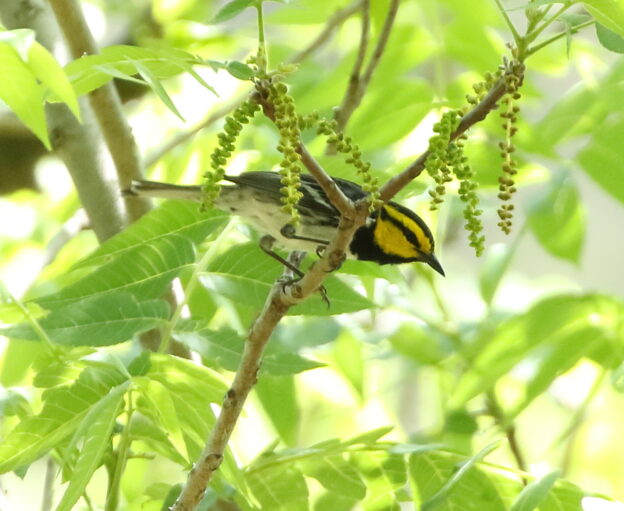
Fortunately, a number of beautiful oak trees provided shade to parts of the trail. I kept stopping frequently and soon enough began hearing more Golden-cheeked Warblers. Again, they absolutely refused to be seen, even when I seemed to be standing right in front of them! As I was scouring one oak tree, though, I detected movement and a flash of yellow. My excitement rose . . . but something didn’t look quite right. Finally, I got my binoculars on the bird and I realized what it was. This wasn’t a Golden-cheeked Warbler. For me, it was even better: my lifer Yellow-throated Warbler!
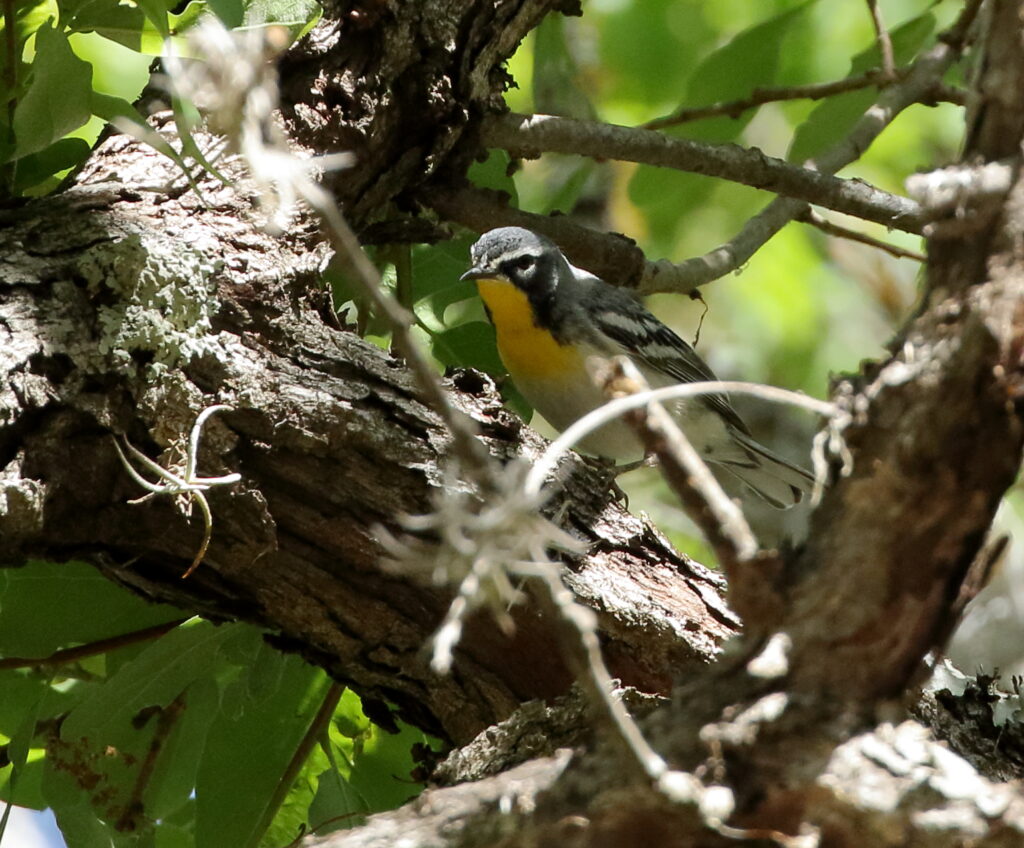
My Bird of the Day wasn’t actually the Black-capped Vireos or Golden-cheeked Warblers I’d set out to find. It ended up being my Lifer Yellow-throated Warbler—a complete surprise!

I couldn’t have been more thrilled. On other trips, I had hoped to see one of these birds multiple times without success, but today, it hadn’t even been on my radar! The bird was every bit as beautiful as a Golden-cheeked, and a quick look at the Merlin app confirmed that I was indeed within its breeding range—but just barely. According to Cornell’s Birds of the World, it has a relatively small, disjunct breeding range in central Texas separate from its more extensive breeding range across the Southeast. While fortunately not endangered or threatened, this bird had assumed an almost mythical status in my mind and to see it now . . . well, it felt exhilarating.
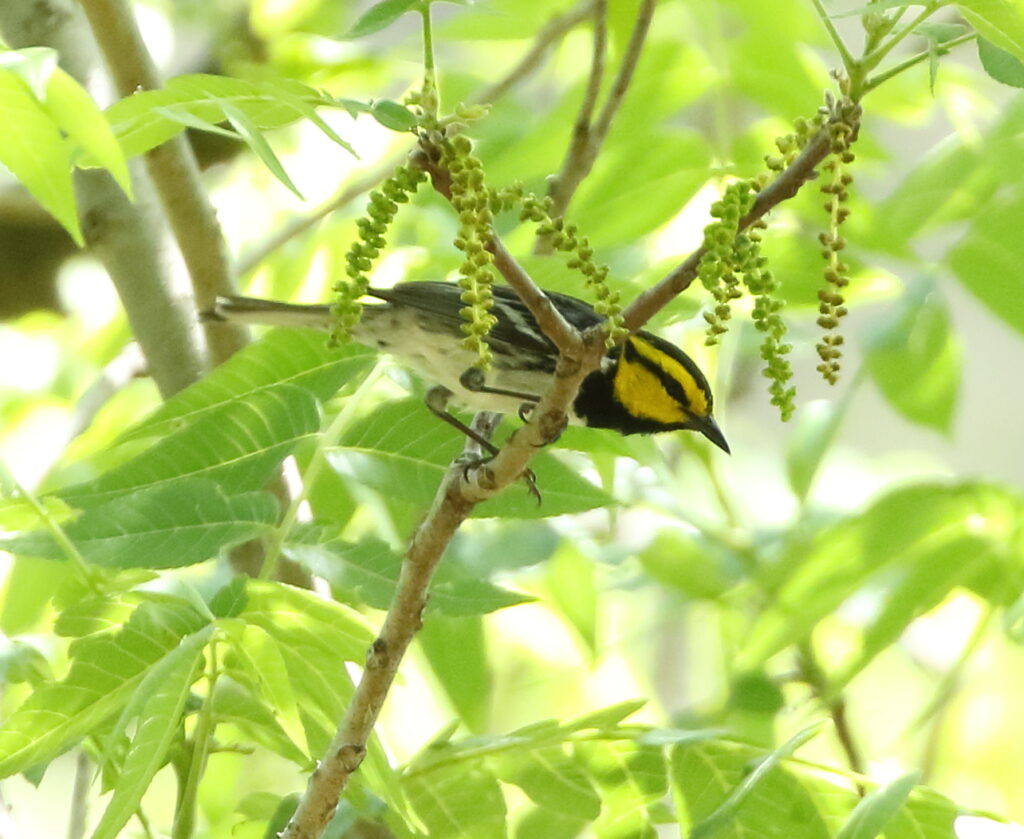
I felt both grateful and relieved to finally see a single Golden-cheeked after multiple GCWAs had taunted me all day!

Long story short: I finally spotted a single Golden-cheeked Warbler after spending almost an hour standing in front of trees where one or another GCWA sat singing and taunting me. While I had hoped to add just the Black-capped Vireo and Golden-cheeked Warbler to my life list during my entire Texas week, I had now seen an amazing seven lifers. Even better, having tracked down the BCVI and GCWA, I now had the entire next day to pursue one more. Check out the next post for details!
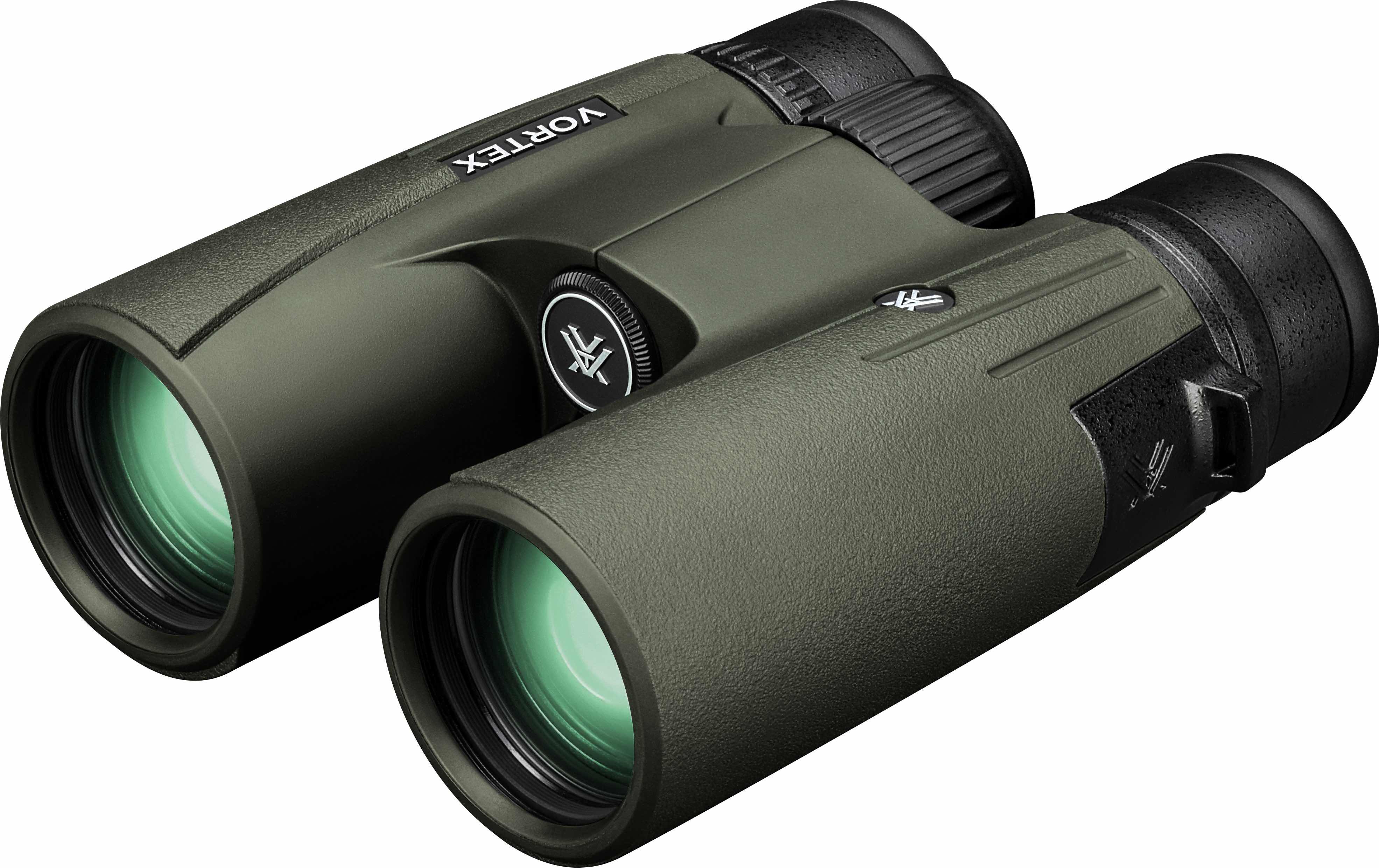
Shopping for a great new pair of binoculars that are reasonably priced? Be sure to check out our recent (unpaid!) review of Vortex Viper HDs by clicking here!
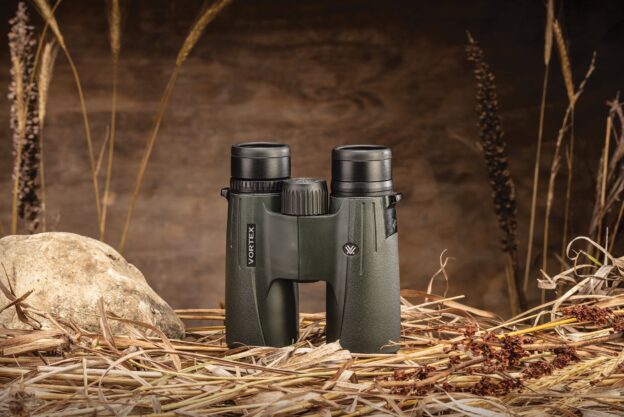

Vortex Viper HD Binoculars (Equipment Review, and/or Texas 2025 Part 2-½)

Thank you for checking out our reviews! Braden and I write this blog to share our love of birding and provide useful information for our fellow birders. We do not receive any payment for any of our posts, but if you’d like to support our work, please consider buying one or more *new copies* of Sneed’s award-winning books such as Birding for Boomers or Warblers & Woodpeckers: A Father-Son Big Year of Birding. We appreciate your support and hope that you keep enjoying the world’s greatest activity!

I hope that you’ve enjoyed our last two posts about my recent Texas birding adventures. Never fear, more Texas posts are coming! Today, however, we’d like to offer up another in our popular new series of equipment reviews. Why? Because my Texas trip gave me a wonderful opportunity to field test a pair of Viper HD 8X42 binoculars from Vortex.

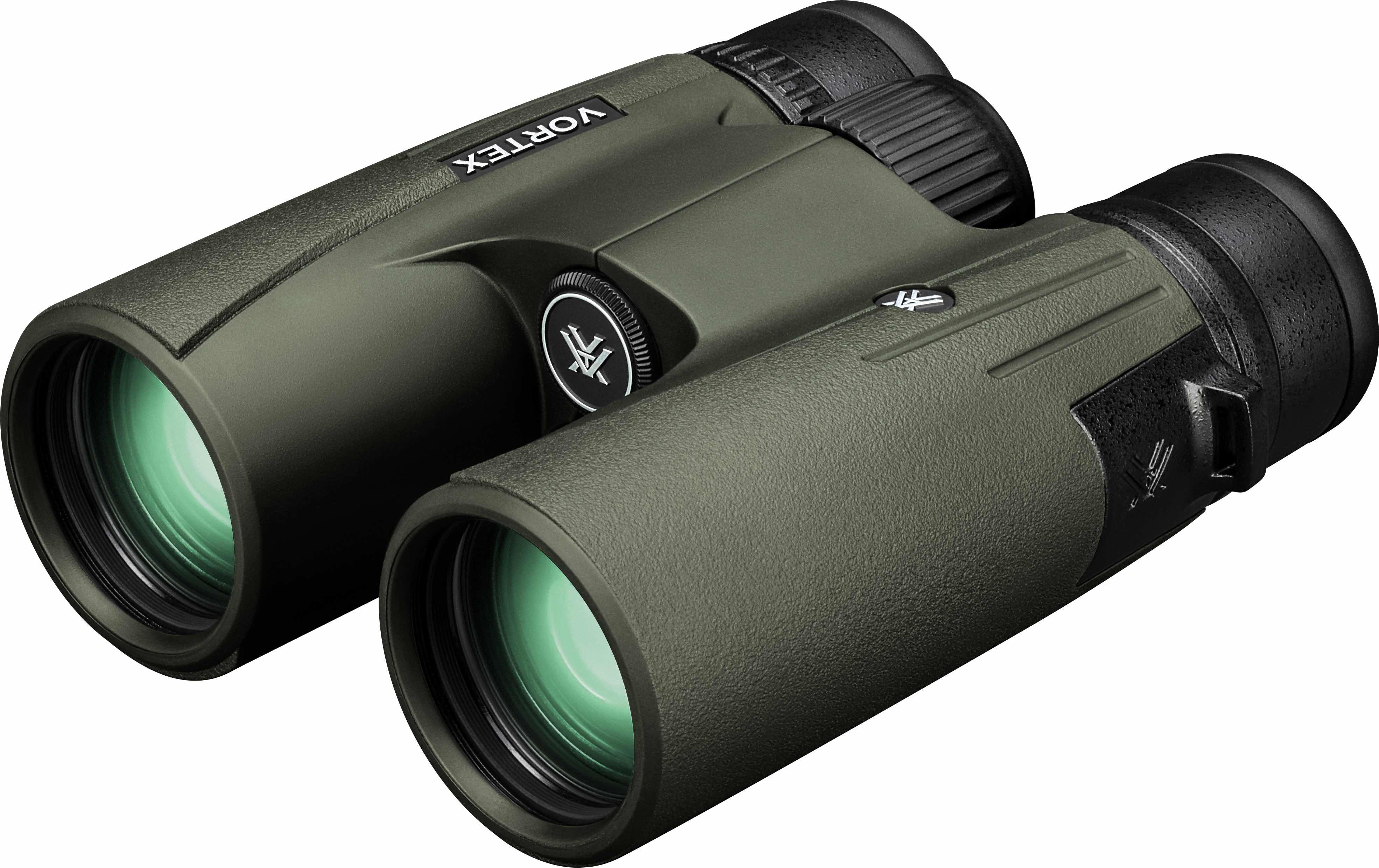
Vortex Viper HDs offer great quality at a reasonable price.

If you’re out in the field a lot, you’ll see many birders using the Viper HDs, and for excellent reasons. In hand, the binoculars are sturdy and comfortable to hold, yet lightweight enough to carry around all day without discomfort. Like all Vortex optics, they come with an incredible no-questions-asked, fully transferable, lifetime warranty—something almost priceless for the peace of mind it offers. But the question remains: how do they perform in the field?

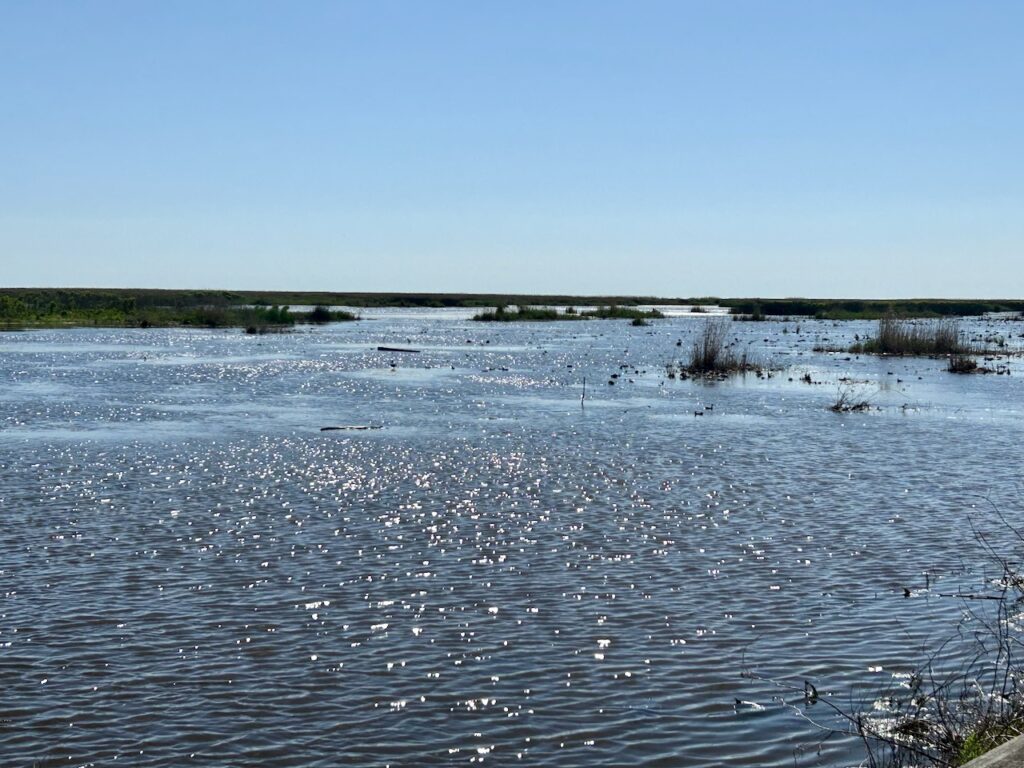
Backlit conditions—especially on water—are one of the true tests of binocular clarity and light transmission. The Viper HDs performed extremely well under these conditions.

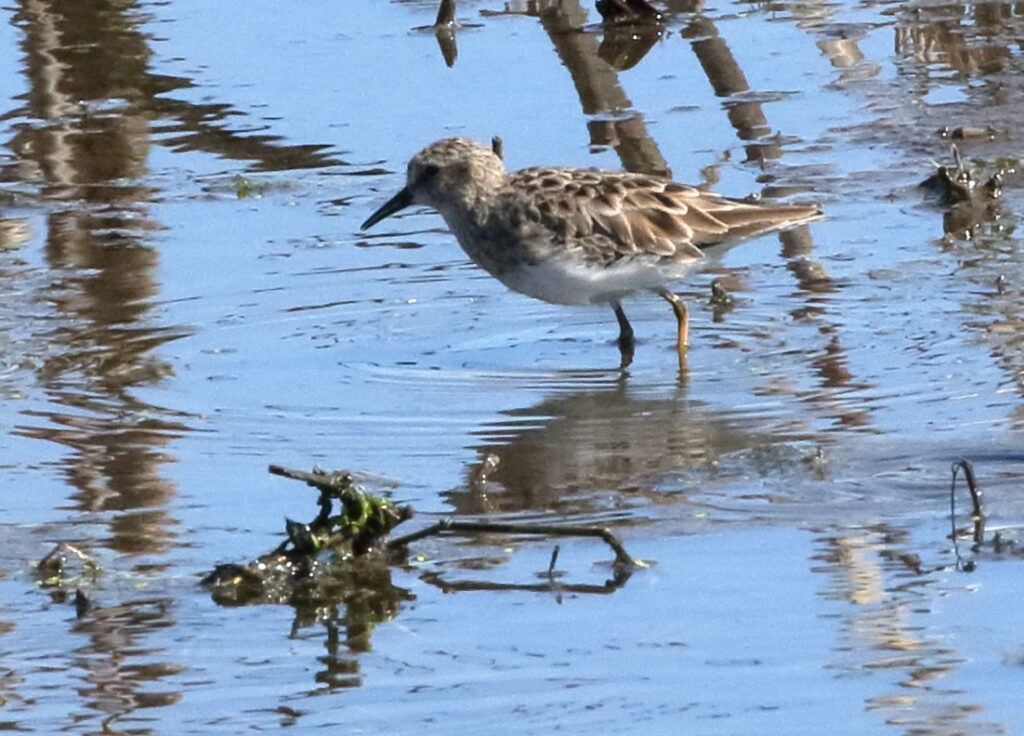
My Texas trip allowed me to test the Vipers in a variety of birding situations. In my last post, I shared my thrilling visit to the Anahuac National Wildlife Refuge (now renamed to the Jocelyn Nungaray NWR), and almost immediately, I was confronted with the daunting task of observing shorebirds and waterfowl under extreme backlit conditions. Anyone who has experienced this knows how difficult it is to discern details of birds when bright glare turns the birds into shadowy figures, and I immediately thought, “Oh man, I don’t know if I’ll even be able to start identifying some of these critters.” To my surprise, the Viper HDs cut right through the glare. One small backlit shorebird particularly caught my attention, and I was sure I wouldn’t be able to see enough details to ID it. Focusing in with the Vipers, the bird’s features just popped—including its yellow legs, which allowed me to identify it as a Least Sandpiper.

The Viper HD’s excellent light transmission allowed me to ID this Least Sandpiper and other shorebirds under badly backlit conditions.

A couple of days later, I arrived at an exciting new (to me) location called Lafitte’s Cove on Galveston Island. This cool little nature reserve sits in the middle of an upscale housing development and features ponds, walking paths, and wooded areas. My main goal was to try to find migrating warblers and, thanks to the advice of some local birders, I staked out a drip in the wooded area that provides fresh drinking water for birds. Soon, I saw two shapes flitting around in deep shadow behind the drip. One leaped out into the sunlight—a Tennessee Warbler. The other bird proved much more cagy. Even as it stayed in the shadows, though, the Vipers gave me the sharp, full-color details that allowed me to confirm that it was a Nashville Warbler—a real surprise since I had never seen one before in the eastern US!

Lafitte’s Cove on Galveston Island was a wonderful addition to my list of spring migration birding hotspots—and helped me test the Viper HDs under dark, shady conditions.

As always, prospective buyers will ask, “Are the Vipers worth what they cost?” On the Vortex website, the 8X42s and 10X42s list for $719.99 and $729.99 respectively—not an inconsiderable sum. However, in “real life” the binoculars can be purchased for under $500, putting them in range of a doable investment for many birders who are ready to get serious, but can’t or don’t want to shell out thousands of dollars. Even for $500, though, you expect binoculars to be durable and weather-resistant, and the Vipers deliver on that count. Other great features include:

* a diopter ring that allows independent focus adjustment for each eye

* long (18 mm) eye relief for those who wear glasses, and smooth, pull-out rubberized eye-relief tubes (or eye cups) for those who don’t

* a close (six-foot) minimum focal distance

A comfortable grip and long, comfortable eye-relief tubes are just two great selling points for the Viper HDs.

As I have tried various brands and models of binoculars, though, for me it has become mainly about clarity. In other words, how well do the binoculars transmit light and how sharp is the image they deliver? As noted above, the Vipers deliver excellent performance in this regard. During my week in Texas, I never found a situation in which I had difficulty picking out colors and other details. That’s because, for the extra price investment, Vipers offer two advantages over many cheaper binoculars:

* extra low-dispersion glass that reduces chromatic aberrations and improves light transmission, even under difficult conditions such as those I experienced above

* high-quality coatings on both the glass and internal prisms which improve light transmission, creating a sharper, clearer image.

I have not yet found the perfect binoculars—if they indeed exist—and one thing I wasn’t crazy about is that I had to turn the focus knob quite a bit to bring the Vipers into focus between near and far situations. Presumably, this allows users to obtain a more precise focus on an object, but I found it wasted a bit of time and effort. This is a personal preference, however, and I’m guessing that most users will be just fine with this.

A final note: frequent FSB contributor Roger Kohn and his wife both happen to use Vortex Vipers. “We are very happy with them,” he says. “Really good quality glass, clear images. Feels good in the hands.”

Conclusion: the Vortex Viper HDs are an outstanding pair of binoculars for those ready to make a mid-range investment into the world’s greatest hobby. Sturdy construction, a light weight, and excellent light transmission make them suitable for almost every situation, and will provide years of satisfaction to the vast majority of birders.

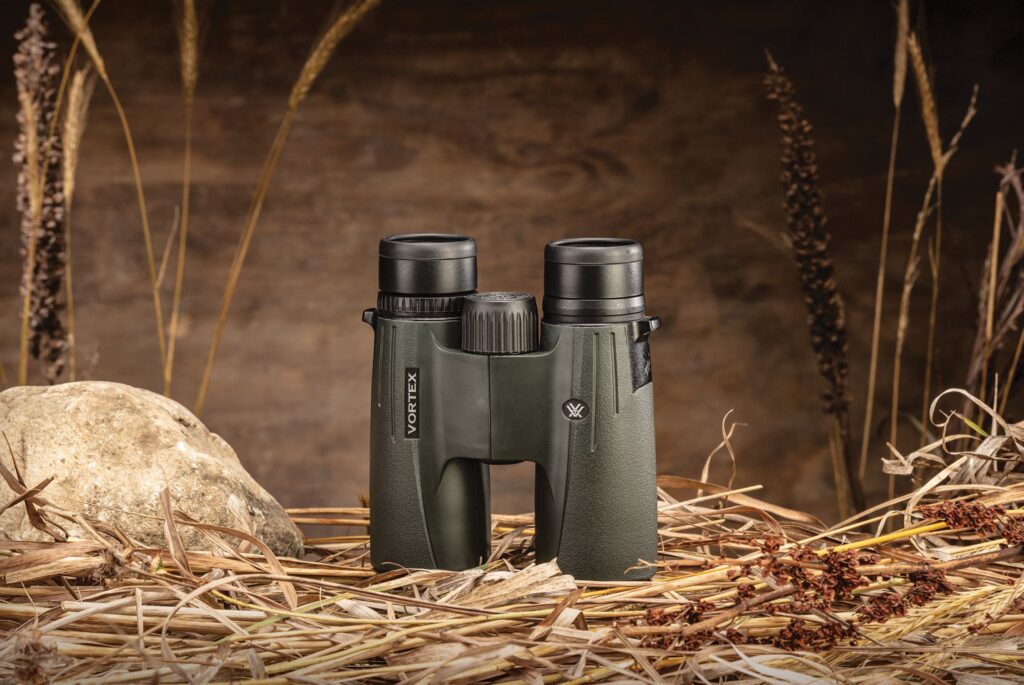
Vortex Vipers

Post Update: After posting this review, I traveled to Maine for our son’s graduation (see post “Graduation Birding Bonanza in Maine”), and I took along a pair of Vortex Viper HD 8X42 binoculars. This was my first chance to use them in rainy conditions and I have to say, they performed incredibly well. While my companions’ bins were fogging up, the Viper HDs stayed clear as a bell during our two-hour drizzly session. I also had a chance to use the Vipers in “almost night” conditions to view the American Woodcock mentioned above. Again, I was impressed with the amount of light they transmitted, allowing me to easily follow the bird’s silhouette in flight. Back at our Airbnb, I let Braden look at a distant loon on the lake and he said, “Wow, those are good binoculars!” I suspect I’ll be using these a lot more!

The author received no financial compensation for this review, but binocular images and sample binoculars are provided courtesy of Vortex.

Peveto Woods, Louisiana: Spring Migration Hotspot

FatherSonBirding is a labor of love for both Braden and me, and our goal is to entertain and educate, and to promote bird conservation. If you’d like to support our work, please consider buying one or more of Sneed’s books and make a donation to one of the bird-related groups mentioned below. Thank you!

There’s a good reason the blog has been quiet the past couple of weeks. Braden is finishing up his honor’s project before graduating (gasp!) from the University of Maine while I jumped on a chance to head to Texas for the sixth time since Braden and I began birding. The trip arose from an invitation to talk about my book Birding for Boomers at the Mountains and Plains Independent Booksellers Association spring conference in San Antonio. Happily, the event took place during spring migration, so I of course booked three extra nights before and three extra nights after the conference to see some birds!

As soon as I picked up my rental car in San Antonio, I high-tailed it the four hours to Winnie, Texas on the coast just east of Houston. Why Winnie? Because it provides great access to several well-known stopover places for migrating songbirds and offers a chance to soak up a variety of coastal and aquatic species as well. For this trip, though, I was determined to explore some new birding areas, and my first morning I got up before dawn and headed to my first destination, Peveto Woods Sanctuary, just across the border in Louisiana.

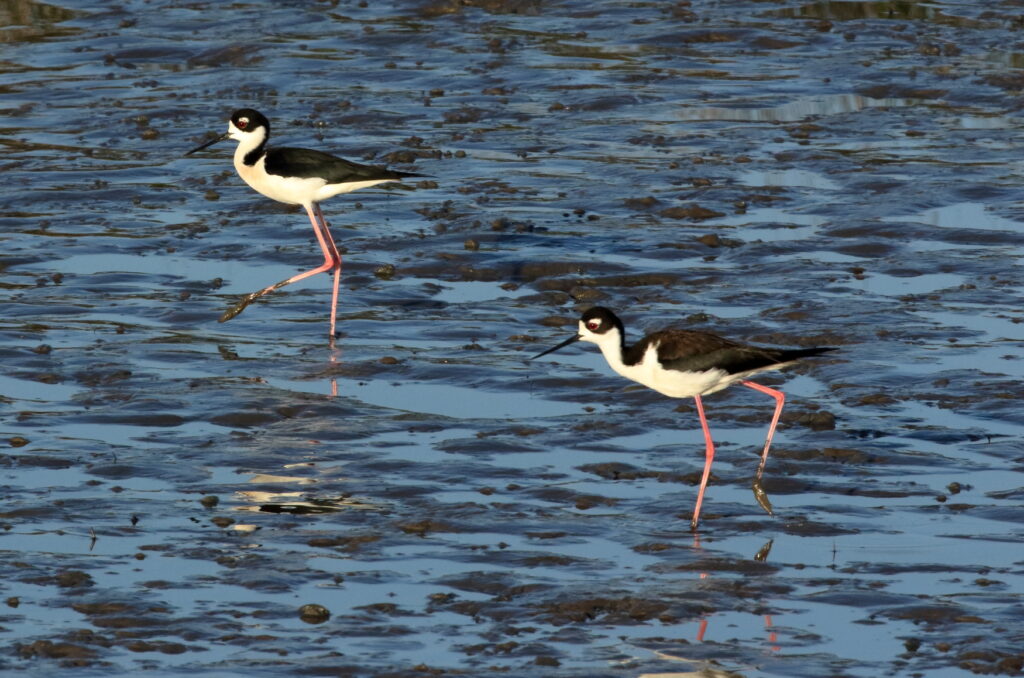
A bonus to driving to Peveto Woods is that once you cross the bridge into Louisiana at Sabine Pass, you can find a wonderful little shorebird area, especially if it happens to be low tide. And by the way, I don’t think I’ll ever get tired of posting Black-necked Stilts. So sue me already!
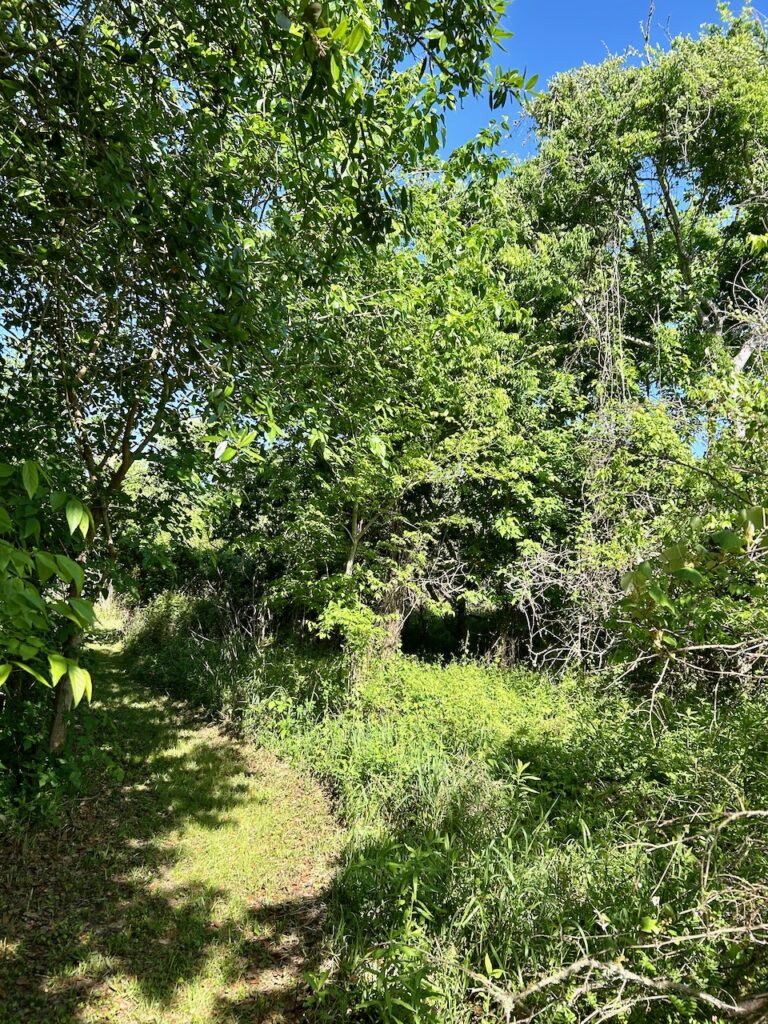
Peveto Woods offers delightful paths through trees, any one of which could be hiding a migrating songbird!

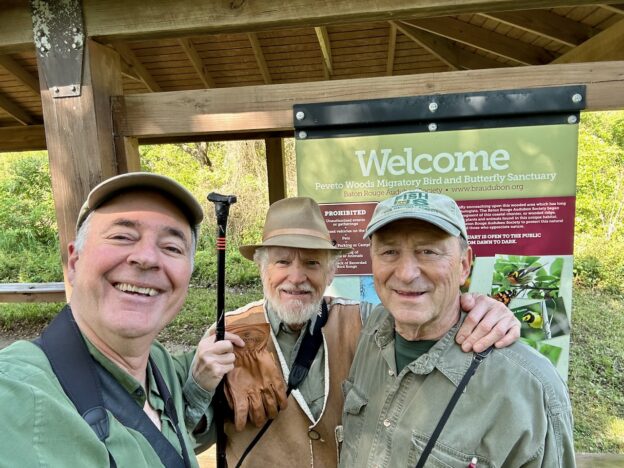
Peveto Woods is owned and operated by the Baton Rouge Audubon Society and like Sabine Woods run by the Texas Ornithological Society and the more famous High Island sanctuaries operated by Houston Audubon, Peveto consists of a patch of forest right along the shore. As soon as I pulled up, I knew I was going to like it. Trails headed off in all directions, crisscrossing forty acres of mostly oak-dominated woodlands. I saw two friendly-looking guys, Scott Delaney and Paul Wallace, who looked like they knew their way around and asked the best way to explore. It turns out, they had been volunteering their time here for many years and suggested I make my way to the east fence line and work my way back. They also explained that the land where the woods sat was called a chenier, a place where wave actions had piled sand and shells up higher than the surrounding area, allowing trees to grow. Hurricanes still occasionally obliterated the place, but the vegetation recovered quickly.

Hey, I’m gettin’ pretty good at these selfies–this one with my new birding friends, Paul (center) and Scott.

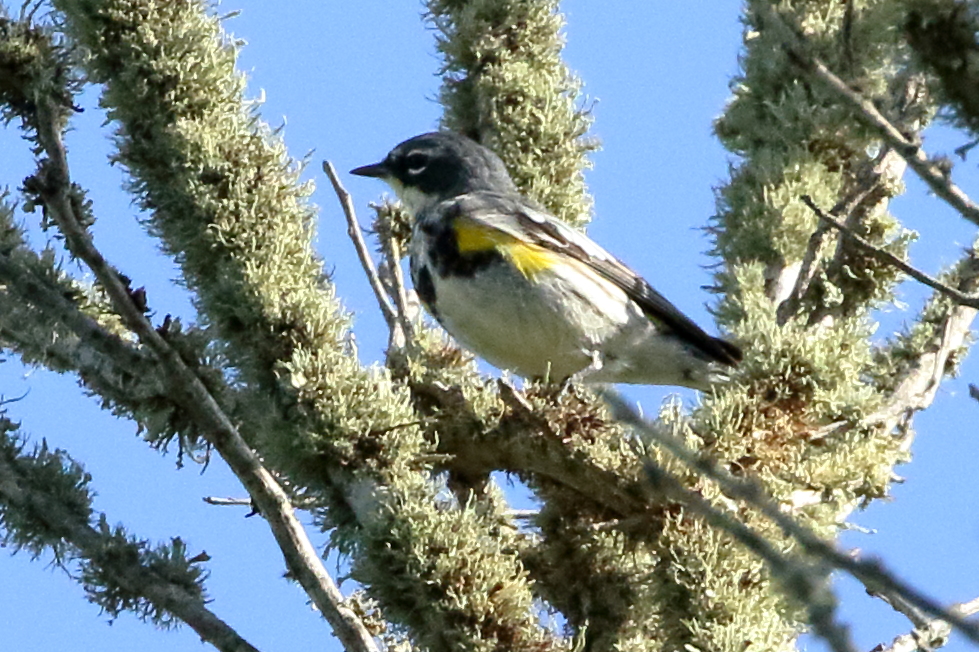
Unfortunately, I quickly learned that the main birds I had hoped to see—warblers—had not yet arrived in significant numbers. I was about a week early for many species and, for now, northerly winds had kept others grounded in the Yucatan. Only one hundred yards down the trail, however, I encountered a nice little mixed flock of other species. Sound ID picked up a White-eyed Vireo, and I quickly saw a Warbling Vireo along with at least four Red-eyed Vireos. Joining them were several Orchard Orioles, a couple of Yellow-rumped Warblers, and an Orange-crowned Warbler. Most were flitting about high in the trees, making photography difficult, but my heart warmed at seeing them.

Although the more exotic warblers had yet to reach the Gulf coast, this (Myrtle) Yellow-rumped Warbler tried to hold down the fort till they arrived!

One awesome thing about Peveto is that you can walk right out to the beach and here I saw the trip’s first Black-bellied Plover, along with a couple of Royal Terns and Willets.

For those aware of my love of Black-bellied Plovers, you can imagine how delighted I was to find the first one of the trip on my very first outing.

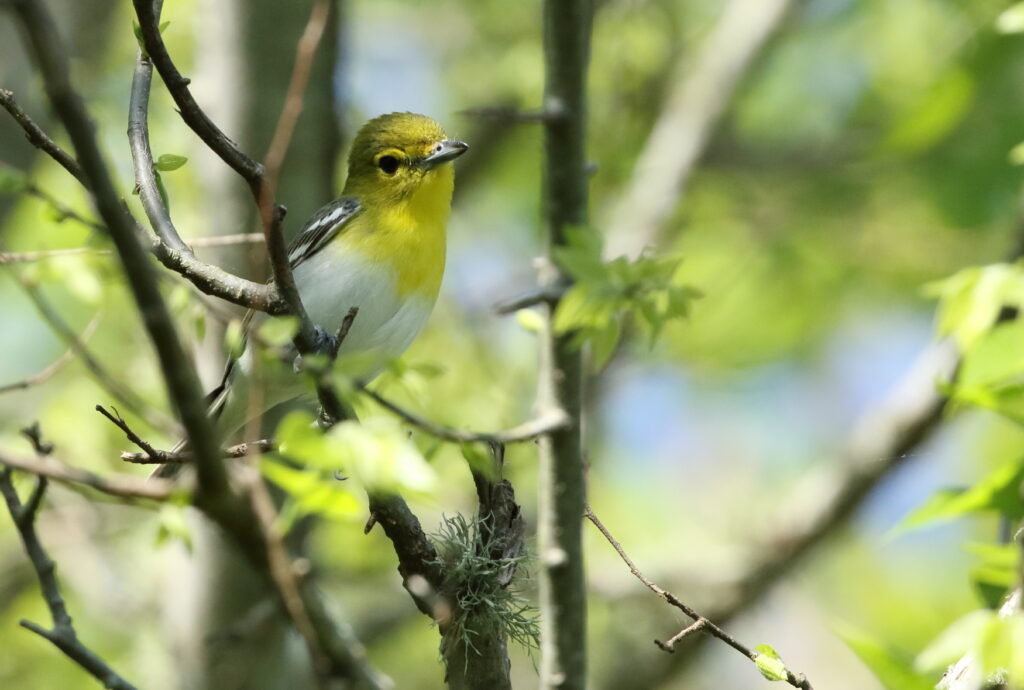
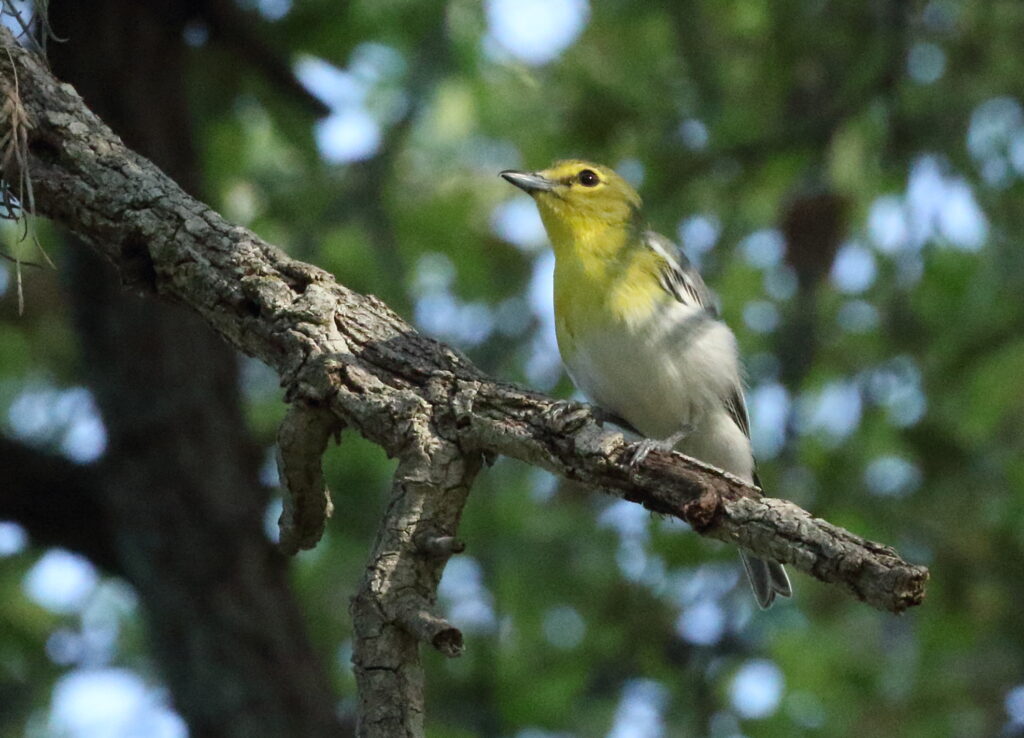
Returning to the woods, I kept strolling, finding migrating Gray Catbirds and pre-migration White-crowned Sparrows. A couple of Anhingas flew over, and then Sound ID picked up what would be the star of my visit: a Yellow-throated Vireo.

I just fell in love with this Yellow-throated Vireo. In fact, YTVIs are one of my new favorite birds, and I would see or hear them twice more on the trip.

I had seen YTVIs before, but so early in my birding career that they had gotten lost in the steepness of my learning curve. Now, a bird in glorious yellow, white, and gray plumage perched right above me. I shot some quick photos, and then just stood and admired this incredible creature. Like most other vireo species, this one had migrated from Central or South America, completing the eighteen-hour or so flight directly across the Gulf of Mexico.

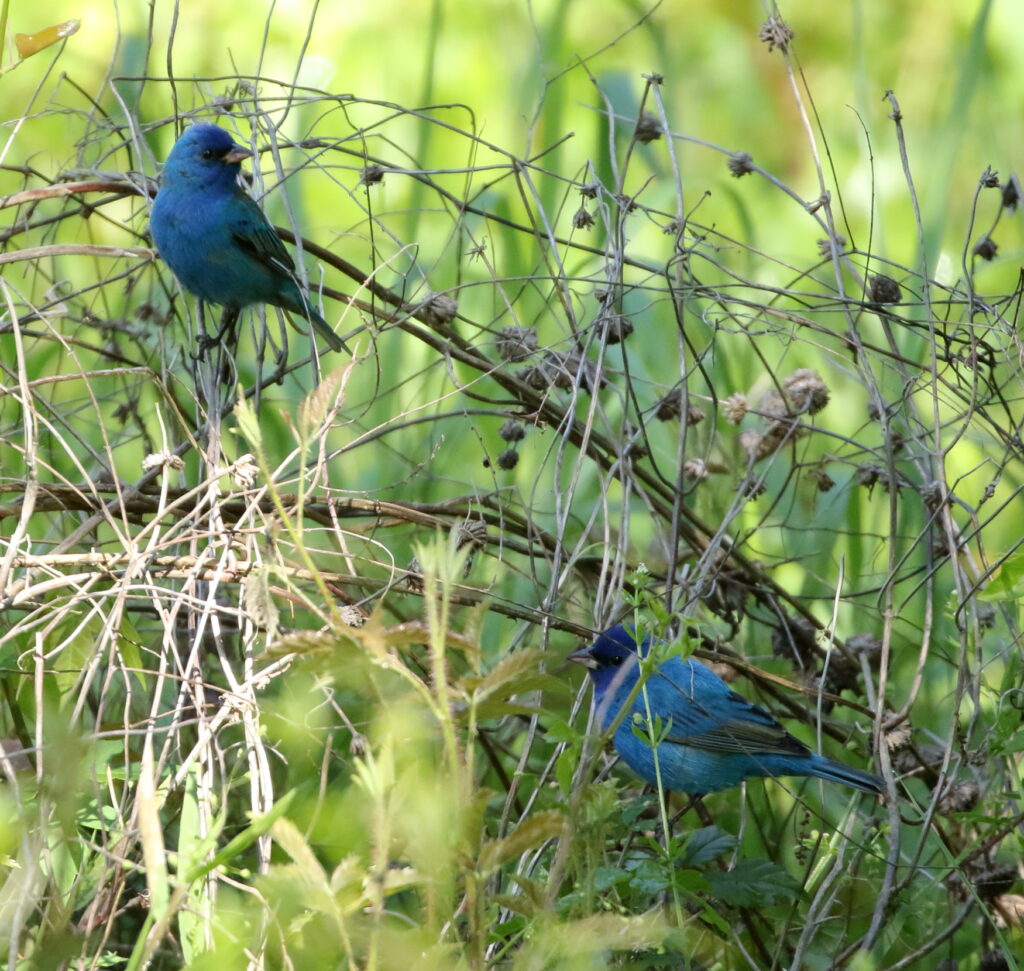
It seemed like years since I’d seen Indigo Buntings—and then, only females or juveniles. That made it all the more sweet to find these two “Sharp-dressed Men.”

It did make me wonder, though, why the vireos had made it “on time” but most of the warblers had not. “Are vireos stronger fliers?” I wondered. Or had they just timed things better? Either way, I was delighted to see them and get to know them better. And that’s birding for you. Even if the birds don’t always meet your own timetable, they always present a fascinating learning opportunity or two—or, as today, a chance to embrace and enjoy a new group of birds. I rounded off my morning by finding a couple of gorgeous Indigo Buntings on the brushier end of the preserve. I exchanged email addresses with my new friends Scott and Paul, and invited them to look me up when they came to Montana. I suspected, though, that I might make it back to Peveto Woods long before they got to Montana!

My checklist: https://ebird.org/checklist/S223902911

Note: As I post this, the warblers are definitely arriving at Peveto Woods. If you live nearby, what are you waiting for?

Video Post: A Visit to Araucana Lodge (Colombia Birding Part 4)

Roger and I could easily write another ten or twelve posts about our recent birding adventures to Colombia, but I thought it would be fun to pack a lot of our experiences into a video featuring our main destination down there, the Araucana Lodge. The video not only introduces you to the joys of lodge birding, but features some of the famous birds and birding opportunities to be had in the mountains above Cali. Since large files don’t always work well on this blog host, we embed a YouTube link below. Let us know what you think—and enjoy the show!

Click Here to see the first of our Colombian birding post!

The Shorebirds of North America (Book Review)

With spring shorebird migration coming on, we take a break from our Colombian birding series to review a new book that will help prepare you for the exciting, sometimes daunting task of identifying and enjoying some of the world’s most spectacular long-distance migrants. Bird—and read—on!

Legions of FatherSonBirding readers have probably noticed that Braden and I have increasingly become interested—nay, obsessed—by shorebirds over the years. See, for example, our posts

Montana Shorebird Surprise

Abbotts Lagoon, Point Reyes National Seashore (or Chasing Migrants, Part II)

Our fascination may seem odd given that Montana is hardly the world’s epicenter of shorebird activity. Then again, their very rarity here renders them all the more alluring to find and learn about. A natural birding progression also is at work. When beginning one’s birding journey, we birders naturally focus on common, familiar species. As confidence, curiosity, and ambition grow, so does the desire to learn about and identify more difficult groups of birds. When we first began birding, Braden and I focused on woodpeckers, thrushes, waterfowl, waders, owls, and other easier-to-identify species. Over the years, we have plunged into increasingly challenging groups including warblers, sparrows, flycatchers (Braden), gulls, and perhaps more than anything, “shorbs.”

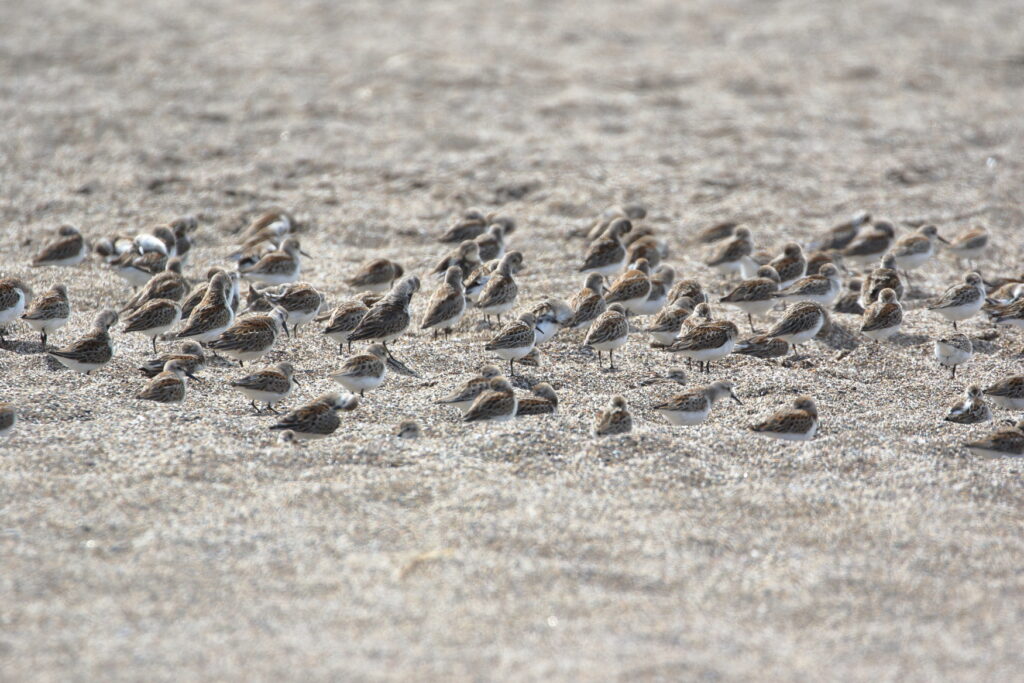
A flock of Western Sandpipers at Point Reyes during my September visit to California with Scott Callow.

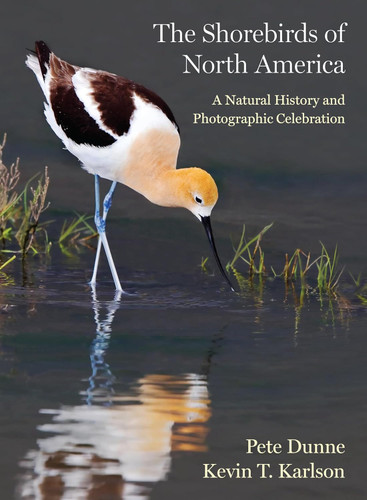
When out scanning beaches or shallow lakes, the most common phrase Braden repeats to me is “Shorebirds are tough.” This usually happens when I am whining about the difficulty in distinguishing between off-season Least and Semipalmated Sandpipers, or White-rumped and Baird’s Sandpipers—especially at a distance. But many shorbs are relatively easy to identify, and over the years both Braden and I have come to appreciate—nay, savor—the entire breadth of these fascinating, superbly adapted critters. Imagine my joy, then, when a brand new, beautifully photographed book about shorebirds arrived on my doorstep: Pete Dunne’s and Kevin T. Karlson’s The Shorebirds of North America: A Natural History and Photographic Celebration (Princeton University Press, 2024).

The Shorebirds of North America by Pete Dunne and Kevin T. Karlson (Princeton University Press, 2024)

To say that The Shorebirds of North America is ambitious would be like calling the 18,000-mile round-trip migration of a Red Knot “neat” instead of “epic” or “mind-blowing.” This terrific addition to birding literature not only gives a wonderful overview of the lives of shorebirds, it provides specific accounts of all the shorebirds likely to interest you. That makes this book a wonderful, highly readable reference for both beginning and advanced birders.

The bulk of the book consists of species accounts of 52 kinds of shorebirds known to breed in North America and my guess is that you, like me, will skip directly to species that happen to interest you at the present time. This is a great approach. One of the first shorebirds I looked up was Black-bellied Plover, a bird I have become more and more enthralled with the past several years. As I started to read, my understanding of this handsome creature immediately swelled. I didn’t realize, for instance, that it is one of the world’s most widely distributed shorebirds, or that it is called Grey Plover outside of North America. What really tickled me was learning how fearlessly aggressive these birds can be:

“On the high Arctic tundra breeding grounds,” the authors write, “this sturdy plover is a fierce protector of its large nest area, and it strikes fear into aerial predators as large as gulls and jaegers. Woe to any flying predator if it hears the whistled alarm call of Black-bellied Plover as it flies swift and low across the tundra before rising to spear the intruder in the belly with its strong bill . . .”

The 4-letter breeding code for Black-bellied Plovers is BBPL. After reading the entry for the bird in The Shorebirds of North America, however, I realized that BBPL could easily stand for “Bad-ass-bellied Plover”.

Who knew that one of my favorite birds is such a bad-ass? Similarly delightful “reveals” can be found in each account, many of them based on the authors’ own personal and scientific experiences with the birds.

Far from just being pretty to look at, the book’s incredible photos add real understanding of each species by showing them in a variety of plumages and situations. I enjoyed just quizzing myself on the photos as I made my way through the book, testing and expanding my knowledge as I went. I cannot imagine the effort Kevin T. Karlson and the book’s other photographers invested in creating what may be the world’s finest collection of shorebird photos.

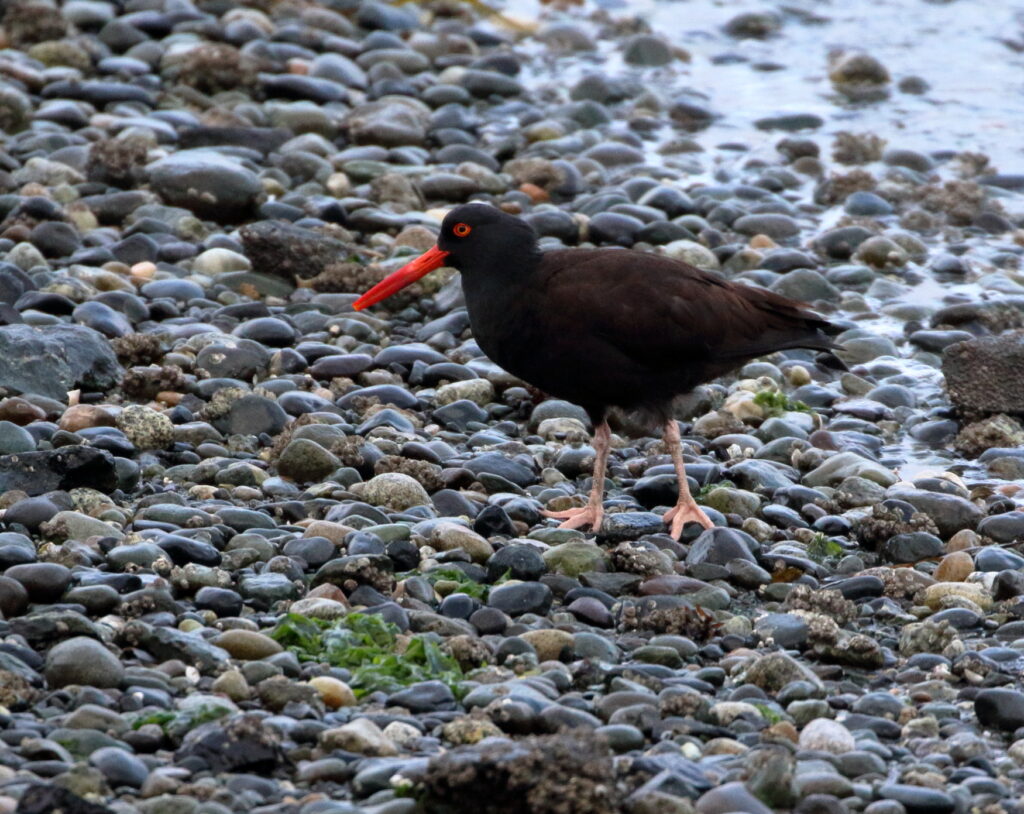
Another thing I learned from The Shorebirds of North America is that the bills of oystercatchers are laterally compressed. You can’t tell this from the typical side view, but this compression turns the bills into excellent chisels for prying limpets, snails, and chitons off of rocks.

As delightful as the species accounts are, I strongly urge readers to read the entire first section straight through. In this section, the authors provide excellent perspective on all shorebirds including their remarkable adaptations, habits, diversity, and evolution. Fascinating anecdotes abound, such as the story of B-95, a banded Red Knot known to have traveled more than 400,000 miles during his 21-year lifetime. The authors don’t bother to hide their admiration for these birds:

“Challenged to design the perfect bird, we would without hesitancy delve into ranks of shorebirds and reach down to the Scolopacidae (sandpipers), the largest of the roughly six or seven family groups in the shorebird order Charadriiformes.”

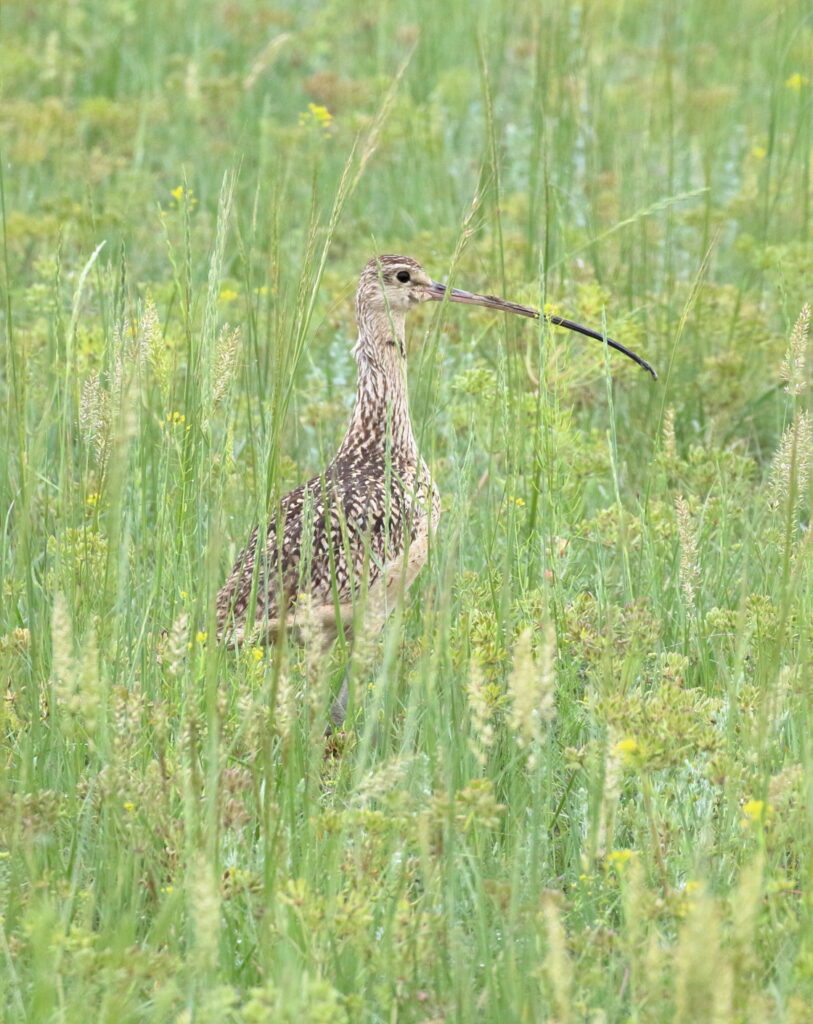
Another fascinating fact I picked up from The Shorebirds of North America is that the curved bills of Long-billed Curlews are almost perfectly designed to snatch fiddler crabs from their long, curved burrows. They’re also great for picking off grasshoppers without alerting them to their imminent doom.

I could keep singing this book’s praises, but really, if you have even the tiniest, nascent interest in shorebirds, you should order a copy yourself. Given its length and full-color format, I expected the book to sell for at least fifty or sixty bucks, but at the time of this posting it can be had for a bargain $35. That puts it within reach of most people—and makes it an investment in your birding future you won’t regret.

One-Sentence Summary: A highly-readable, indispensable resource for both beginning and advanced shorebird enthusiasts.

Overall Rating (on a scale of cool birds): Piping Plover (highest)

You can order The Shorebirds of North America from your local independent bookstore, or directly from Princeton University Press. Please tell them we sent you!

(Except for the cover image, photos in this post are copyright Sneed B. Collard III. Review copy of The Shorebirds of North America provided by the publisher.)