As always, we appreciate you sharing this page, and hope that all of you are staying healthy and sane during these difficult times!
Very Unhealthy. That’s what Missoula’s air quality had been pegged at for the last five days, thanks to smoke from the catastrophic fires raging across the West. Braden and I were supposed to stay indoors, but faced a huge problem: fall migration, when waves of birds were traversing the state. Birds we could only see now. What to do? Simple. Go birding.
Unlike our past few outings, we decided to stick to the Missoula Valley, and began by heading out to Frenchtown to see if we might catch a rare Sabine’s Gull or Greater White-fronted Goose. We arrived at our intended water-filled gravel pit and what did we see? Exactly one American Coot on the water. Then, we spotted some action in a few sad-looking invasive trees along the road. We sauntered over to discover a delightful assortment of American Goldfinches, Yellow-rumped Warblers, and Lincoln’s Sparrows, along with a surprise Red-naped Sapsucker, a species we thought would be long gone by now. A duet of American Pipits flying overhead capped off our visit.
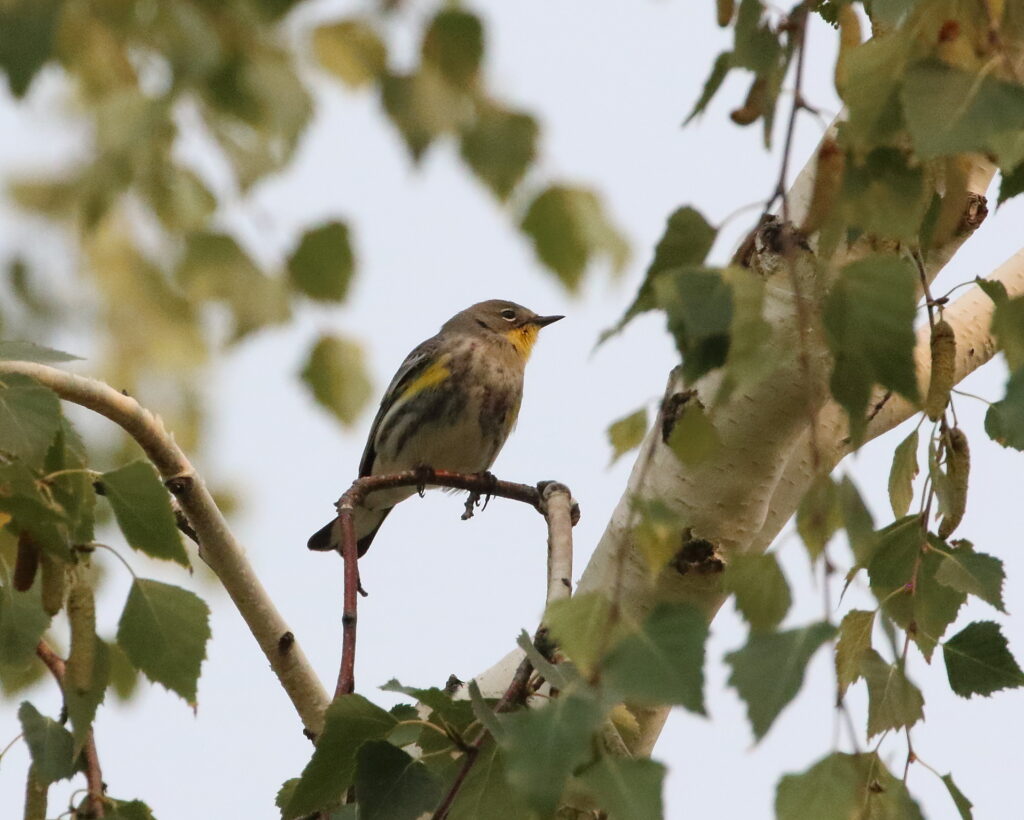
Even though Yellow-rumped Warblers are our most common Montana warblers, it’s so much fun to see them moving through in big fall groups.
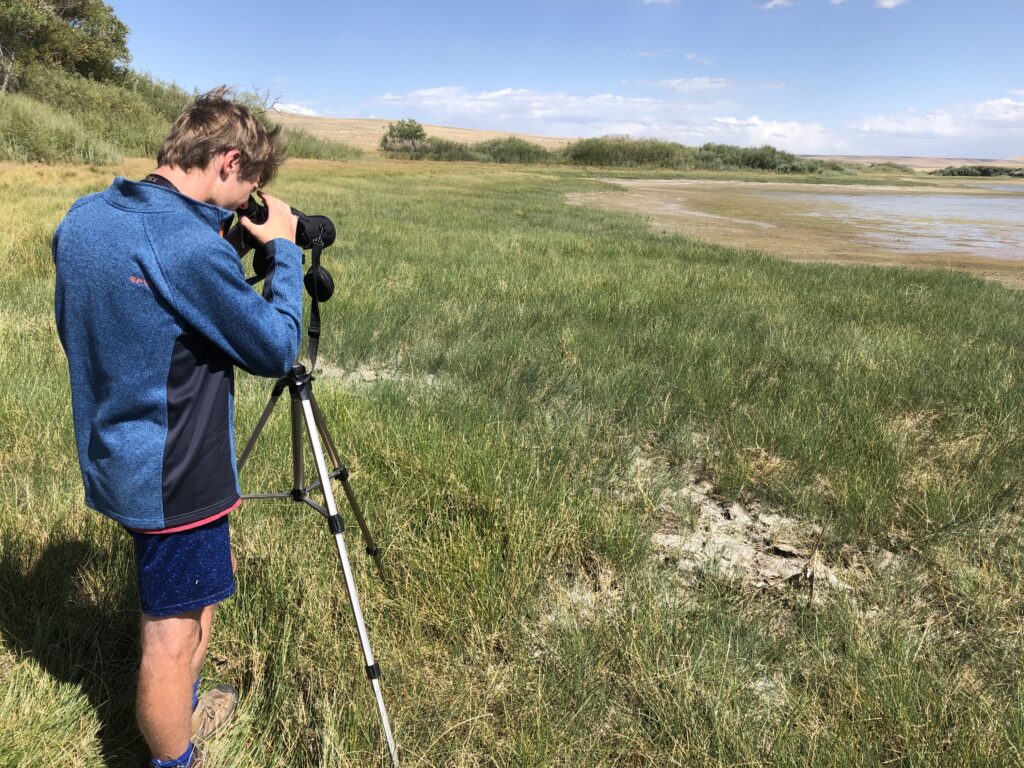
After an uneventful stop at the Frenchtown Slough, we headed to our main destination, Mocassin Lane. This road is always hit and miss for us, but in previous years runoff irrigation has created muddy pools that sometimes attracted shorebirds. Since we’d had fairly dismal luck in our last few outings, we harbored no real expectations, but we hit the jackpot! Setting up our spotting scope, we identified a surprising assortment of ducks, and then focused in on our real treasure: shorebirds. “There’s a ton of Wilson’s Snipe out there,” Braden said, scanning slowly. “Oh, wait. I’ve got a Pectoral Sandpiper!” In fact, there wasn’t just one, but 17—the most we’d ever seen at one time. It was also the most snipe—13—we’d ever seen in one place. Other delights included a lone Red-necked Phalarope and more than twenty pipits. It was a great chance to study birds we rarely came in contact with, and we spent a good hour enjoying them.
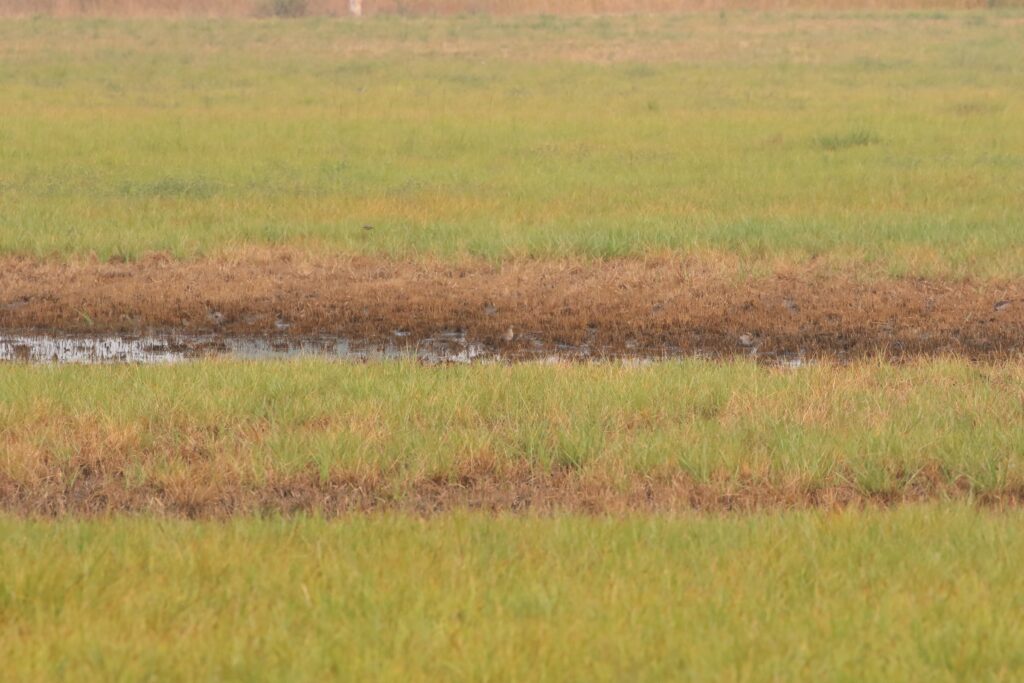
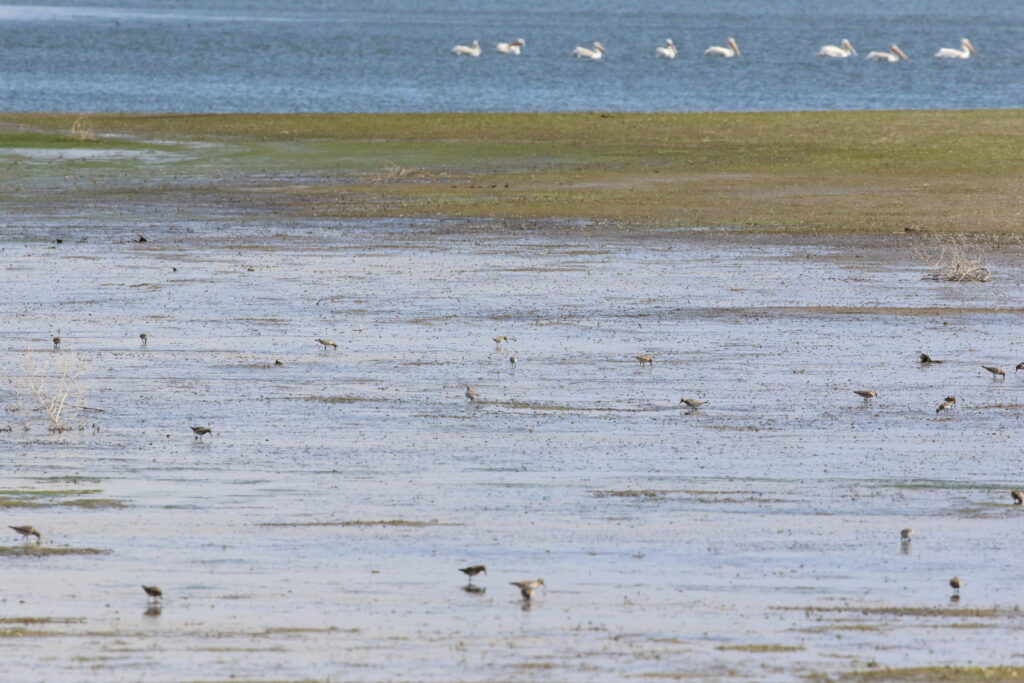
How many shorebirds do you see? This photo perfectly encapsulates how challenging it is to detect, observe, and identify species. See what you come up with—answer at the end of the post!
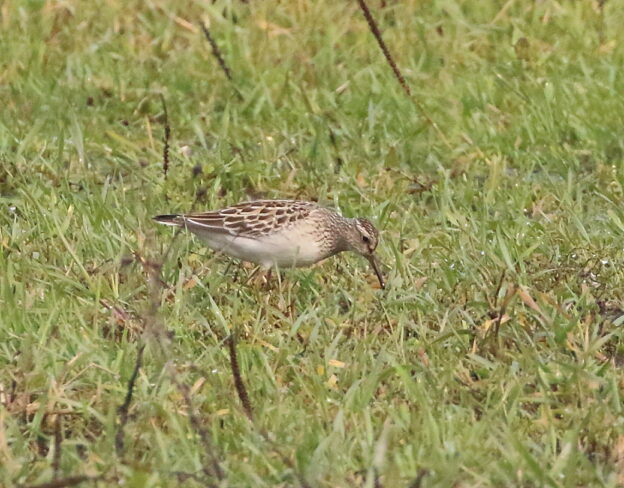
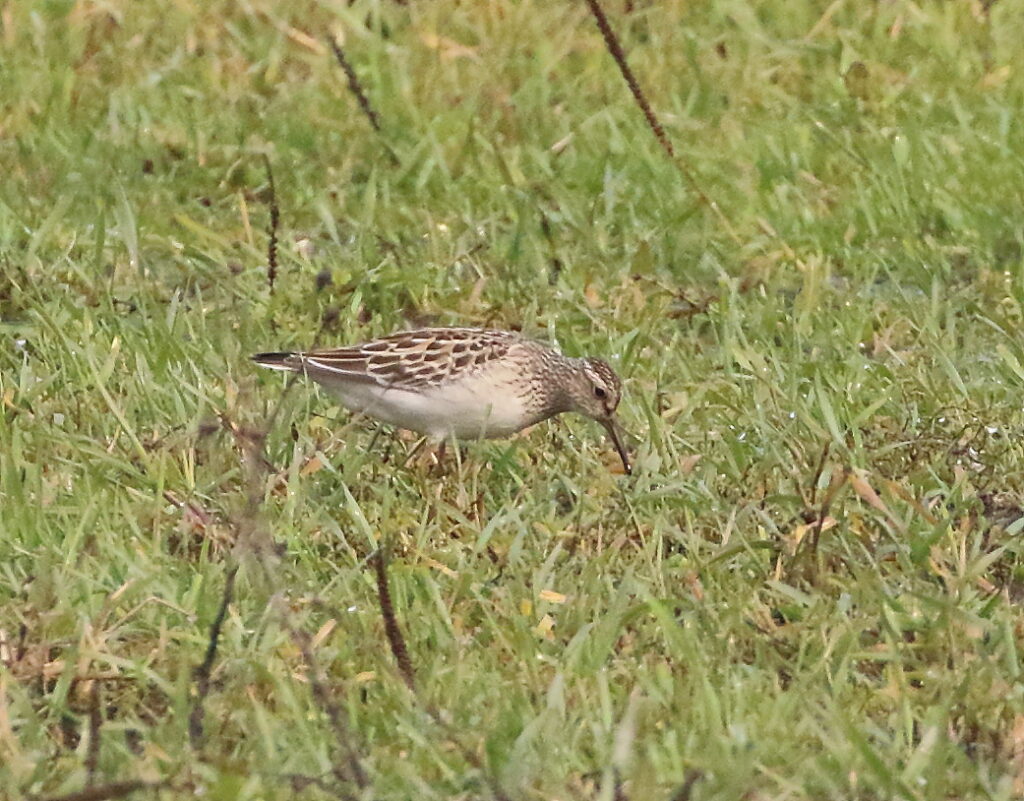
Our outing yesterday was by far our best look ever at Pectoral Sandpipers. The striped breast and yellow legs are distinguishing marks for these handsome birds.
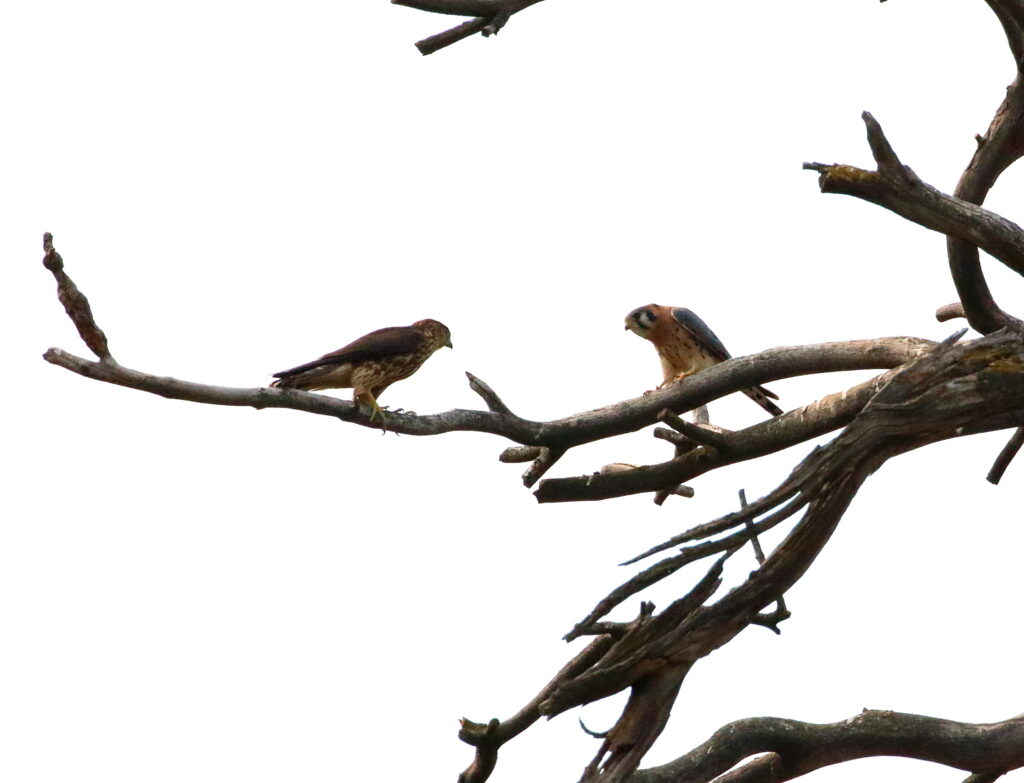
After our big shorebird score, we thought we’d exhausted the day’s luck, but at Council Grove State Park we again landed amid a great assortment of birds including the Nuthatch Trifecta (Pygmy, White-Breasted, and Red-breasted), another Lincoln’s Sparrow, and a late-season Spotted Towhee. The highlight? A Merlin and American Kestrel perched face-to-face on a bare branch. We couldn’t tell if they were trying to make friends or face off like Clint Eastwood and Lee Van Cleef in a spaghetti western. Either way, it was a great cap to a great day that netted us 55 species, firmly sending us into record territory for September birding. Meanwhile, our Montana Big Year totals now stand at 256 species for me and a whopping 263 for Braden. Take that, fire smoke!
Falcon Stand-off: “A bird with a rifle will win over a bird with a pistol any time.”
Shorebird Answer: Well, I count at least nine shorebirds in this photo including at least four Pectoral Sandpipers, one Killdeer, and four Wilson’s Snipe—with a couple American Pipits thrown in for good measure!
Ever since learning about it, my dad and I have always wanted to attend the self-proclaimed “Biggest Week in American Birding” at the Black Swamp Observatory in Northwestern Ohio. This festival, set in the “Warbler Capital of the World” in mid-May, may be among the largest in the United States and even the world! In recent years up to 70,000 birders have attended the festival, funding (well, almost) the entire Midwestern economy for months on end. The reason that so many birders flock to this out-of-the-way state this time of year is the same reason we drive out to Freezeout Lake every March: spring migration. Instead of Snow Geese, though, the Black Swamp Observatory’s main attraction is passerines; specifically, warblers. Rivaling the giants of Central Park and High Island,Texas, thirty-warbler days are not uncommon.
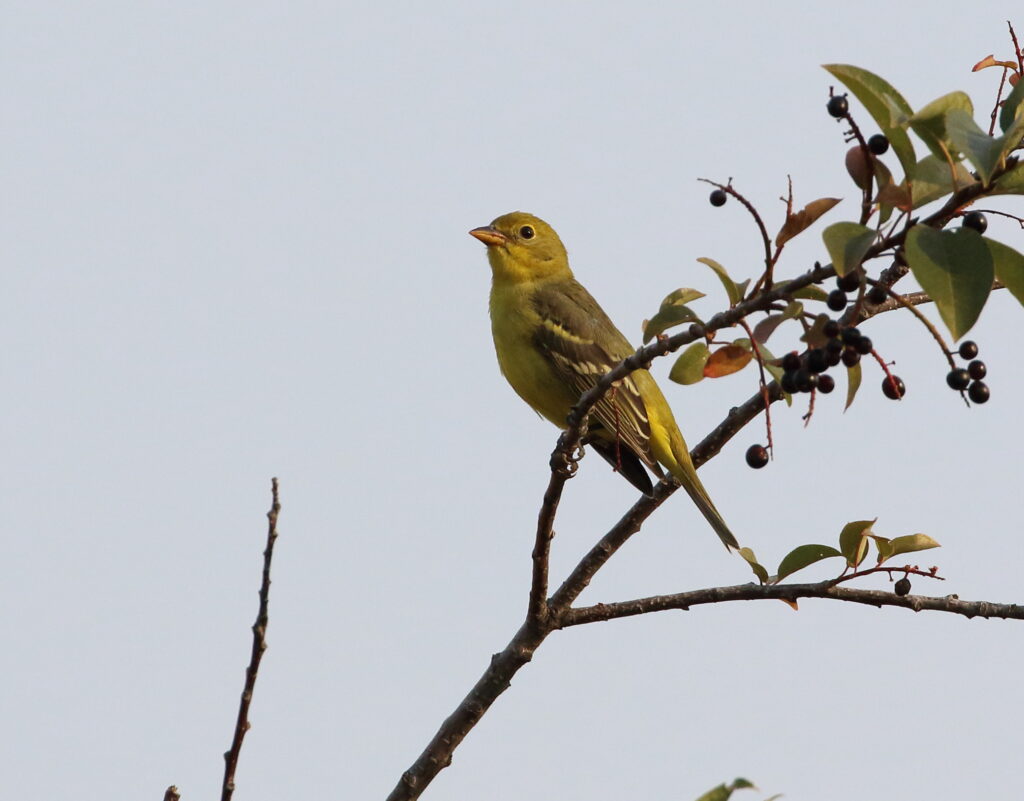
Flocks of Western Tanagers have been a delightful sight the past couple of weeks, both in Missoula and Helena—and have allowed us plenty of practice with our ID skills.
Unfortunately, thanks to a strike by the BWWLU (Blue-winged Warbler Labor Union), the festival shut down this year (oh, and perhaps COVID-19 played a role?), and our chances of getting a slot next year before I graduate are fairly slim, so it looked like we’d have to find the warblers in our own state instead. This May, we scored Tennessee and Blackpoll Warblers in the east, but recently we were given a second chance to snag rare Eastern warblers: the less well-known but possibly more productive month of September. The first two weeks of September in Montana may be the best time for songbird migration statewide, with Westby delivering large numbers of Magnolia, Mourning and other, rarer warblers to those who make the drive. Across the rest of the state, we can always depend on a few wandering warblers to show up, and this year has been no exception.
A few days ago, my dad and I woke up at 6, planning to drive up the Ninepipe valley to look for shorebirds and some reported Mew Gulls. On our way out of the house, though, a Montana Rare Bird Alert email changed our minds—a place called “Nature Park” in Helena had reported Chestnut-sided and Black-and-White Warblers the day before. Soon, we found ourselves driving to Helena for the second time in two weeks.
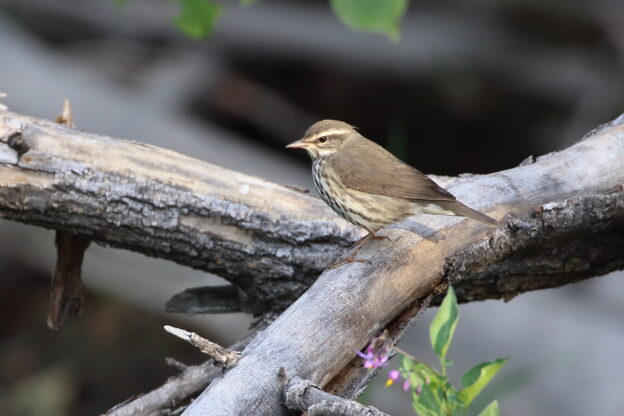
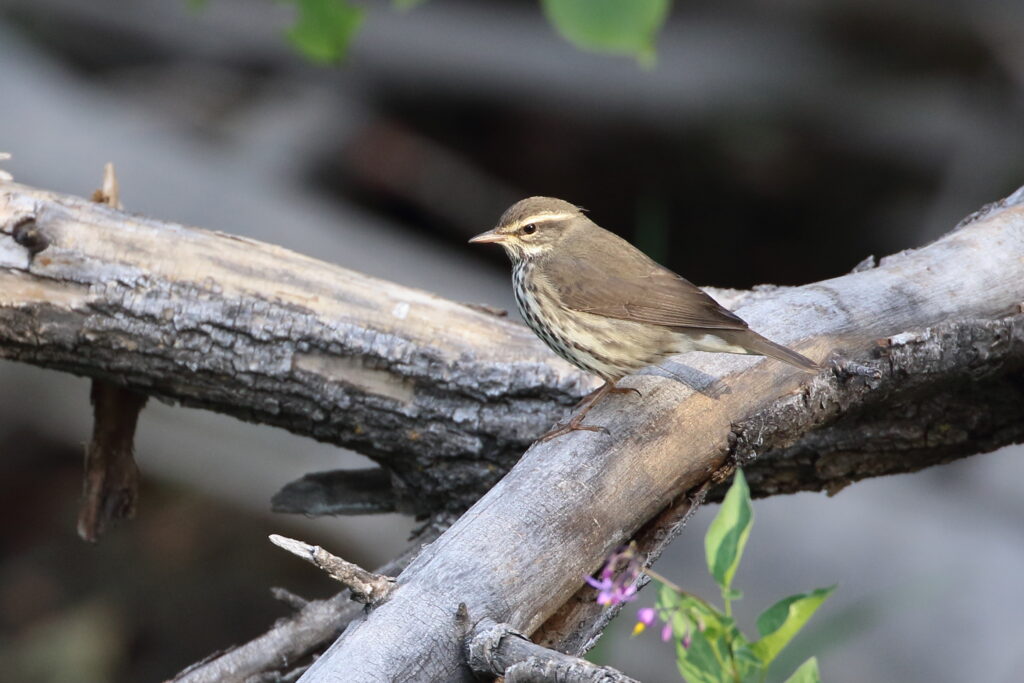
Northern Waterthrushes are notoriously difficult to catch out in the open, but this one obviously wanted to show off for the Helena birding crowd!
We pulled into the parking lot of the uniquely-named Nature Park, and almost immediately spotted some migrants: the White-crowned Sparrows and Wilson’s Warblers that Montana fall migration was known for. After scouring the trees and bushes for anything rare for 100 meters, we found a wet impression filled to the brim with members of Helena Audubon, including a few people and names we recognized: Sharon Dewart-Hansen, Kyle Strode, and Pat Grantham. Wilson’s Warblers coated the shrubs, and we picked out American Redstart, MacGillivray’s, Yellow-rumped, and Orange-crowned Warbler, Northern Waterthrush and Cassin’s Vireo among the splendid mixed flock. After talking birds for a while with the other birders (both rare warblers had departed), we headed to Warm Springs and then home, energized by the experience.
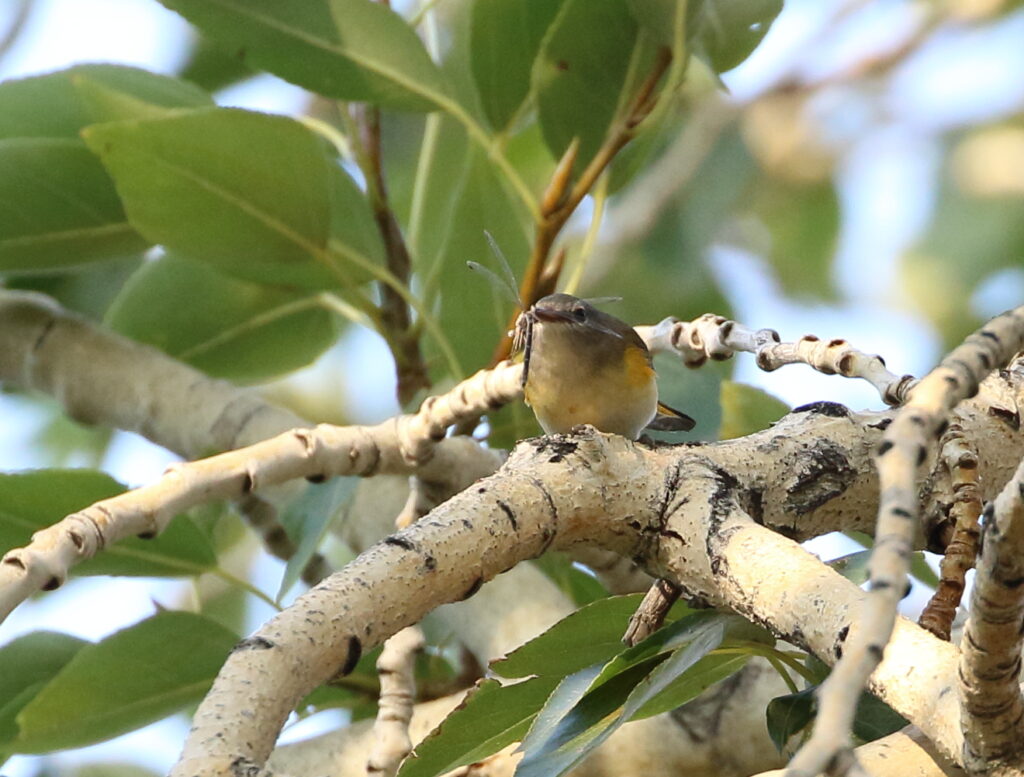
Breakfast anyone? Several American Redstarts were putting on a show, and it’s always amazing just how much food they can find!
Today, we were given another opportunity for an Eastern warbler closer to home. I had just sat down for the evening to work on my Calculus homework when Nick Ramsey, who had recently started school in Louisiana, called me.
“Cole Wolf just reported a Blackpoll Warbler in Greenough Park, you should check it out!”
“I’m on it,” I said, swatting my Calculus homework aside like an annoying younger sibling.
I hopped in the Forerunner and was at the Northeast corner of the park before even Cole had been given the chance to drop his dogs off.
“You got here quick,” he said, and we quickly found the bird again high in a Ponderosa. I snapped some decent photos before it disappeared. Upon showing the photos to Cole, he squinted.
“That actually looks more like a Bay-breasted,” he said, showing me the fall-plumaged Bay-breasted on the Sibley app on his phone.
Not being Eastern birders, my dad and I have never experienced the difficult identification of Blackpoll vs. Bay-breasted Warblers in fall migration. As more birders began to arrive in search of the rarity, I picked up some ID tips from each of them on distinguishing between the two similar plumages.
After about forty minutes, half a dozen more birders had arrived, but the warbler had not shown itself. Other birds kept us entertained for a while, primarily a Merlin snacking on a siskin and a particularly tame Pileated Woodpecker, but the passerine pickings were slim. I headed back towards the bridge at the top of the park, ready to head home, when I glimpsed a dull yellow bird with obvious wingbars in a bush next to me.
“I’ve got it!” I said, waving the rest of the birders over. While they watched it hop between cottonwoods and mountain ashes, I called my dad.
“You need to get down here!”
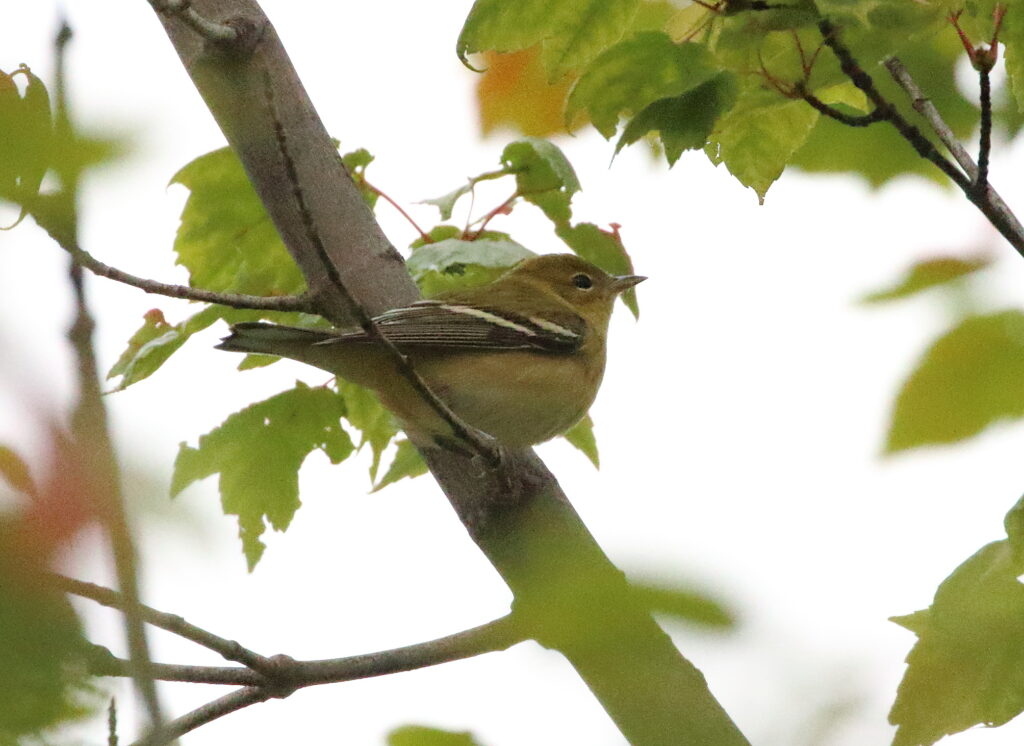
Though perhaps a little drab to other birders, this rare Bay-breasted Warbler was a thing of beauty to the Western Montana birding crew!
He arrived just as the last of the birders headed out, and we continued searching the areas where I had seen it. The day grew dark, however, and most of the birds that had been active earlier had disappeared. Nick, meanwhile confirmed via text that the consensus on the bird on the Montana Birding Facebook page was that it was a Bay-breasted, based on buffy undertail coverts, faded spectacles, and black legs. This was definitely rarer than a Blackpoll, which would have been a treat by itself!
I couldn’t refind the bird for my dad, so we headed back to the cars. In the trees next to the street, though, I could hear chickadees, and I held up my binoculars, hoping for another mixed flock. A Warbling Vireo passed through my vision, and my hopes began to rise—there had been a WAVI with the warbler last time we had seen it! Sure enough, the tiny yellowish warbler hopped into view again, alongside several Western Tanagers, and my dad got great looks! Maybe we didn’t need to travel to Ohio to find Eastern warblers after all.
Spring migration traditionally sparks furious activity by both birds and birders. If you want to see a ton of species, you’d better hit spring migration—and hit it hard. Fall migration, on the other hand, is often pretty much ignored. At least Braden and I ignored it until the last couple of years. Then we discovered that we’d better get our tail feathers out there in fall if we want to see some key species—especially shorebirds.
You wouldn’t think that Montana would be a great place for shorebirds. After all, shorebirds like, well, ocean shores, don’t they? Sure, but a surprising number of shorebird species pass through Montana every fall on their way to their wintering grounds. That doesn’t mean that finding them is easy! Especially here in western Montana, finding shorebirds can take persistence and dedication. We began our fall shorebird pursuit last week with a trip up to Ninepipe National Widlife Refuge, about an hour from our house. We were especially hoping to find a Short-billed Dowitcher, a rare Montana visitor that we still needed for our Year List. And guess what? No dowitcher. I did add Least Sandpiper to the year’s tally, and we enjoyed a terrific visit with a perched Peregrine Falcon, but clearly, (more) desperate measures were called for.
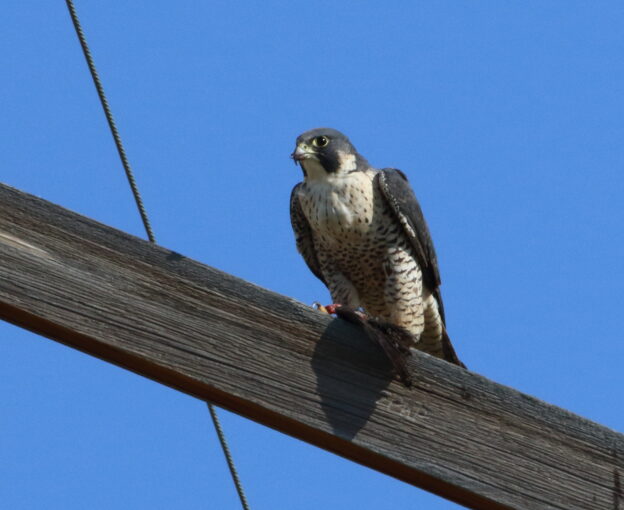
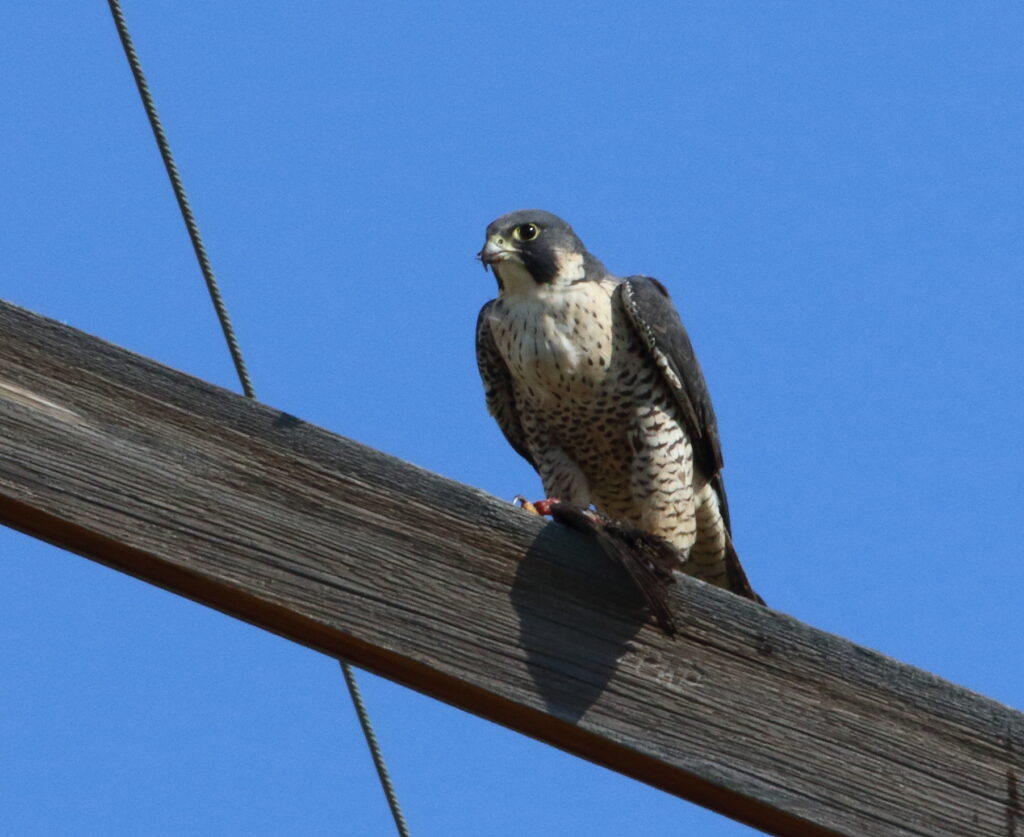
As the Rolling Stones sang, “You can’t always find the birds you want,” but we’ll take a visit with a Peregrin Falcon on any outing!
A few days later, Braden and I left the house at 6 a.m., heading for Helena, where large numbers of shorebirds had been reported during the past week. We made stops at Lake Helena and the Helena Valley regulating reservoir and saw some nice birds, including some pelicans, but . . . no shorebirds.
One of the great difficulties of IDing shorebirds is that they are often far, far away, necessitating hours hunched over a spotting scope. Unfortunately, our scope is not the best, either. Swarovski or Zeiss or Leica, are you listening??? We’d be happy to mention your name in the next ten posts for a free scope!
Heading south, we reached the day’s major destination, Canyon Ferry Lake. After spending thirty minutes on a fruitless search of one area, we finally reached the place hundreds of shorebirds had been reported just two days earlier. Thankfully, a few—a very few—still remained. That, however, was only the beginning of our challenge because this time of year, shorebirds are even harder to identify than usual. Mixed in with adults that are losing their breeding plumage are countless juveniles who, frankly, are a real pain in the butt to ID. Fortunately, Braden had been studying like crazy and was able to pick out Baird’s, Semipalmated, and Least Sandpipers—and a Year Bird for both of us, Pectoral Sandpiper. Hooray—but where had all the other shorebirds gone?
After much searching, we finally located a flock of Baird’s Sandpipers at the Willow Creek Reservoir near Harrison—along with a nice raft of American Pelicans behind them.
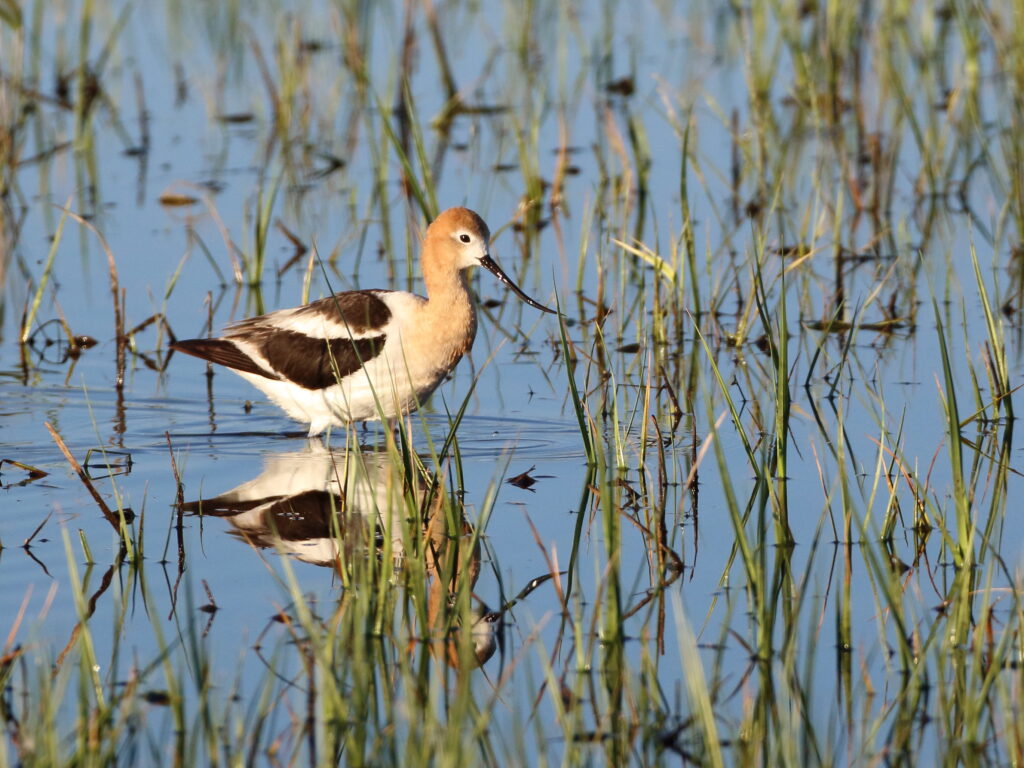
We decided to chase them by driving to a place neither of us had ever birded—Willow Creek Reservoir about thirty minutes south of Three Forks—and there, we found at least some of the missing Baird’s Sandpipers that had been farther north before. In fact, we found a flock of 64 of them, along with a pair of beautiful American Avocets. Even better, hiding among them were two “Semis” and a Western Sandpiper—another Year Bird for us! We drove the long route back to Missoula tired but satisfied. Fall migration doesn’t have the glamour and wow factor of spring, but for the patient, it can reap a beach full of rewards.
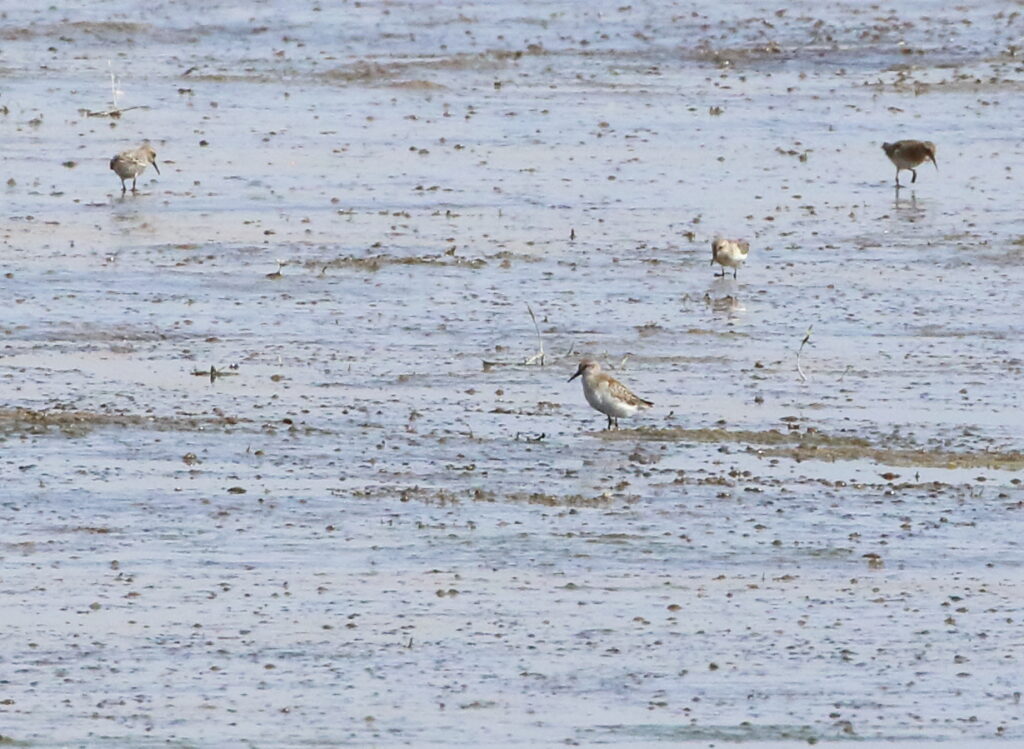
It takes some real sleuthing to discern and ID sandpipers, but Braden found this Western Sandpiper (center) and the Semipalmated Sandpiper (behind it) among a flock of 64 Baird’s Sandpipers (the other two birds)!
As always, we encourage you to share this post in the hopes that it might keep education rolling during these difficult, unprecedented times.Thank you!
In our last post, I explained how close Braden and I had come to reaching our goal of 250 Montana species for the year. Braden, in fact, had reached 245 birds while I pulled up the rear with 239. Now, as some of your comments pointed out, 250 species would seem like a slam dunk with six months to go in 2020, but not so. Not only had we exhausted our supply of “easy birds”, but another large birding safari seemed unlikely—until, that is, Braden and his birding buddy Nick Ramsey came up with the idea for a Big Day. The plan? To get up before dawn and drive 500 miles, birding Ninepipe National Wildlife Refuge, the Swan River Valley, Glacier National Park, all the way to Malta, home of Bowdoin NWR. Insane? Yes. Would we do it? Definitely!
None of us knew how many species we might see in a day. Our record for a day in Montana was only in the 80 or so species range, but we’d never attempted anything like this and hoped we might get as many as 150. Alas, the weather gods frowned on us the morning of June 30, with steady drizzling rain. Undaunted, we set off, missing a number of target species here in Missoula and near the National Bison Range. At Ninepipe NWR, however, we hit Short-eared Owl City! Braden and Nick both still needed SEOWs for their Year Lists, but neither of us had ever seen one at Ninepipe until I spotted one about a month ago. This morning, driving Duck Road in the rain, we hadn’t gone a mile before Braden shouted, “There’s an owl!” In the next three miles, we saw NINE MORE! Maybe they should call the refuge Nineowls?
Our first Big Success of our first Big Day was to hit the Short-eared Owl Jackpot at Ninepipe NWR.
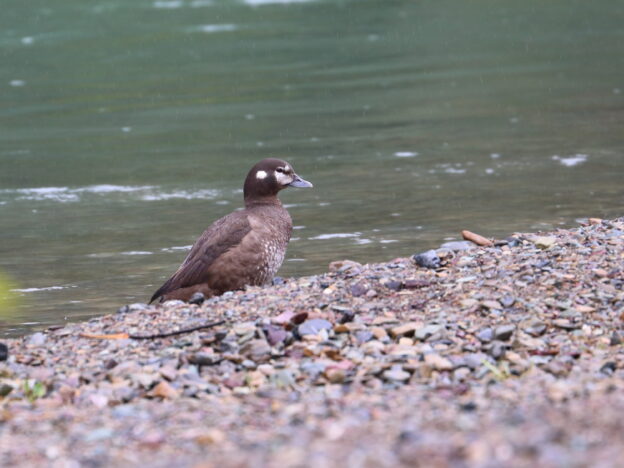
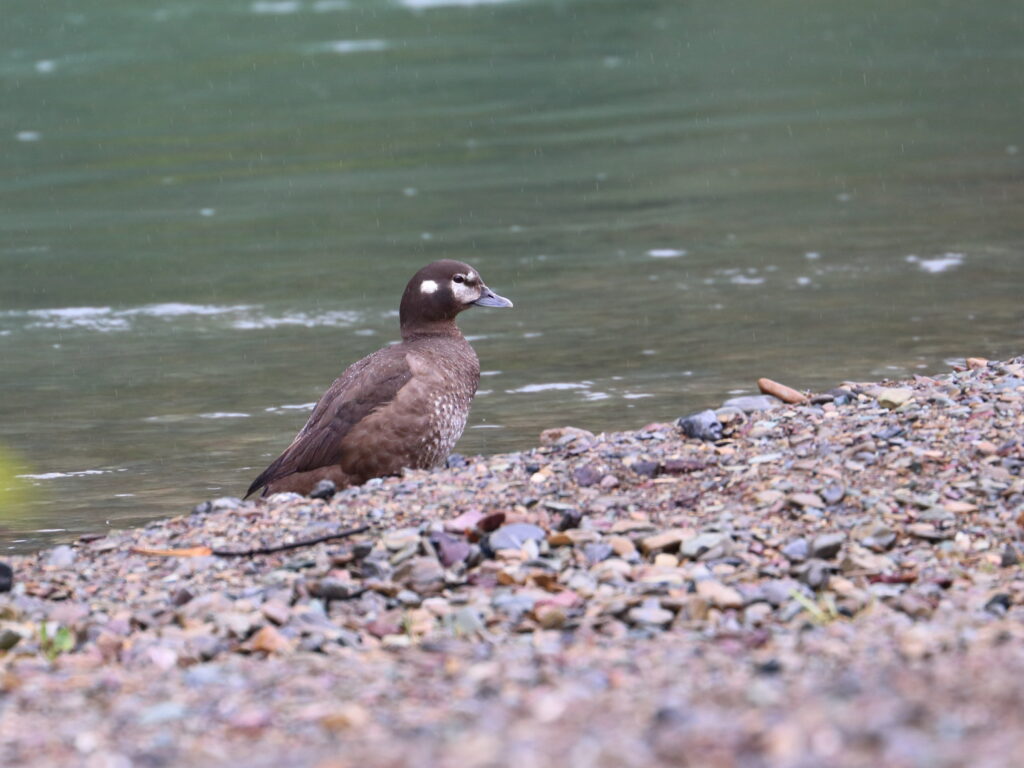
After missing LeConte’s Sparrow at Swan Valley (but seeing lots of Lincoln’s Sparrows), we headed to Glacier, where my top priority of the trip just might be located: Harlequin Duck. With the coronavirus raging, we didn’t know what kind of traffic we might expect, but the poor weather ended up a blessing as we cruised right into the park and made record time to Avalanche Creek. Still, none of us really expected to see a Harlequin Duck as the males had fled and breeding was probably winding down. We walked out onto the beach on the river, though, and sixty seconds later, we all saw a duck flying downstream. It was a female Harlequin! Even better, it landed fifty feet from us! None of us could believe it. After admiring the beautiful creature, we walked around a bit, picking up the eerie calls of Varied Thrushes, but failing to get our pie-in-the-sky target, Black Swifts. Still, our stop a success, we headed back out to West Glacier and began the six-hour drive to Bowdoin, picking up new birds all along the way and ending up with a day’s total of 119 species—a personal Montana record and not bad given the weather.
One of my favorite all-time birds, this Harlequin Duck was just waiting for us as we zoomed into Glacier National Park during our (first) Big Day!
Of course, the problem with doing a Big Day that finishes up in a place like Malta, Montana, is that you have to get back home again! Not surprisingly, we spent two days finding our way home—and not without some adventures that included Braden almost stepping on a rattlesnake, almost getting our minivan permanently mired in mud far from civilization, and getting a rear tire blowout—fortunately, just at an exit in Butte.
On Day 2 of our, ahem, Big Day, we had some of our best experiences with nesting shorebirds—including the spectacular American Avocet at Bowdoin National Wildlife Refuge!
“So did you make your 250 birds?” you may be asking yourselves. Well . . . YES! Braden finished the trip with 255 species for the year while I slipped in there with 251. Which begs another question, “What now?” Well, fortunately birding is fun, interesting, and educational even without keeping track of lists. Every day, in fact, we see cool birds and learn more about them. Will we object if our species counts climb higher in the next six months? No way, but do we need them to? Naw. Birds are great any time and in any season—even if we’ve seen them before.
It continues to be a crazy year for everyone, and we feel deeply for all of those who are being directly or indirectly affected by the coronavirus, either through their physical or mental health, loss of employment, or simply missing their friends and family. It stinks. One bright spot is that many people are rediscovering the simple pleasures of spending time outdoors, and for many, birding is a big part of that. A reminder that Braden and I have posted several bird-related educational videos on my YouTube channel, including a Birding Basics that introduces people how to bird and some common birds to look for. Our friend, ornithologist Dick Hutto, and his wife Sue Reel, have also been posting some great short tip videos for you to look at.
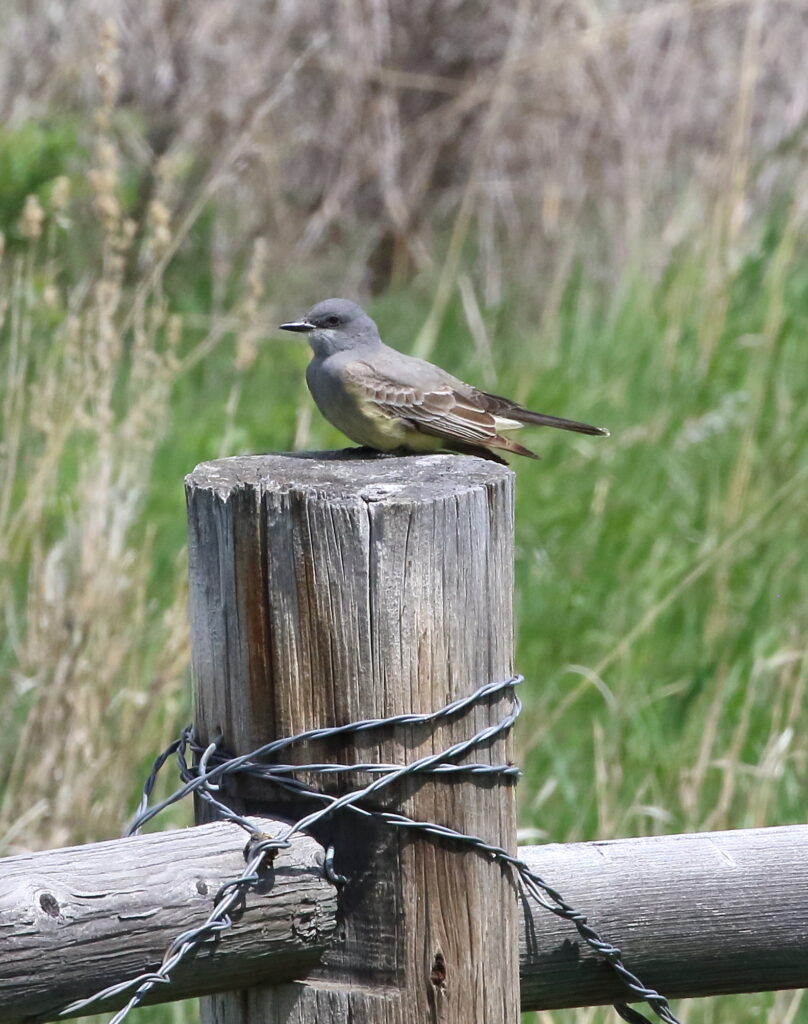
Cassin’s Kingbirds were one of seventy Year Birds we found on our epic Eastern Montana birding safari.
As you can see from our last post, we haven’t been blogging as much—but we have been birding. In fact, once we returned from Israel, we decided to shoot for 250 Montana birds as our goal for the year. We spent an exhilarating week taking an eastern Montana birding safari, during which we saw more than 180 species of birds—including about 70 Year Birds. Braden also has been conducting an independent bird-related science project for his upcoming senior year of high school. So how are we doing?
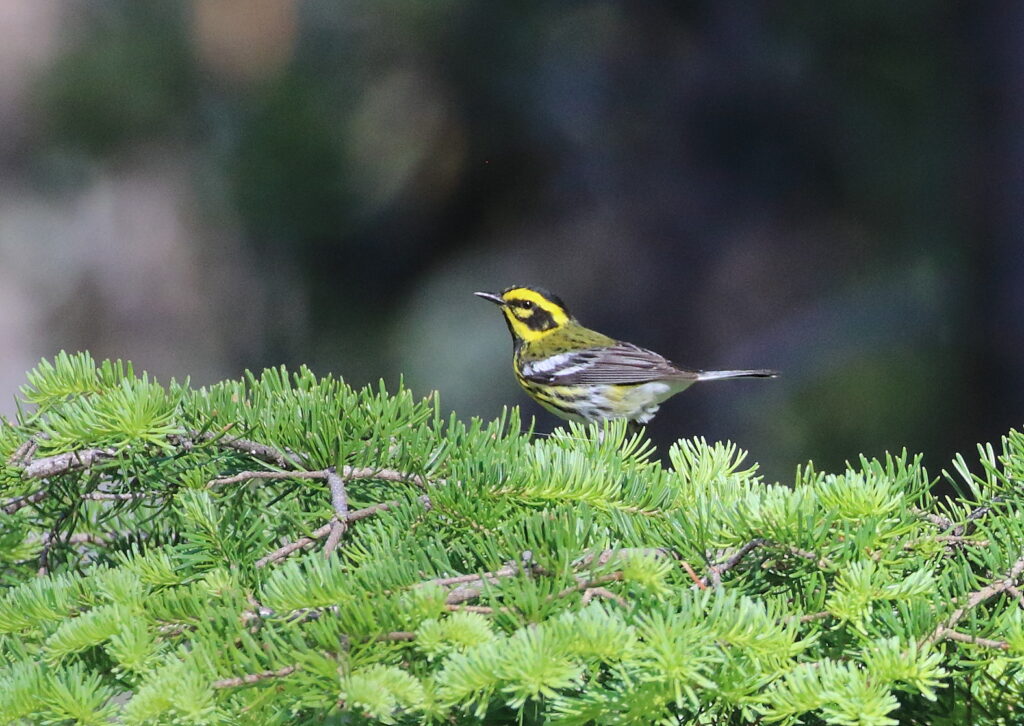
A great thing about climbing a mountain is that it can put you at birds-eye level with spectacular species you usually just see from below. Meet a Townsend’s Warbler!
By the beginning of this week, Braden had seen 243 species of birds while I was pegged at 234. Now for non-birders it might seem like a shoe-in for us to hit 250, but believe it or not, we were (and remain) more than a little anxious about our prospects. For one thing, we have seen virtually every one of the “easy” species there is to see in Montana. For another, birds are “quieting down” now that they are in the process of, or have already finished, nesting, making them more difficult to find. In other words, every new Montana Year Bird we get from now on will take significant effort, luck, or both. Undaunted, we woke early Wednesday morning to investigate a new birding location for us just west of the town of Lolo. A logging road led up into the high country from there, and even more intriguing, it passed through a two-year-old burn area where we hoped to see one of our most coveted species, the Black-backed Woodpecker.
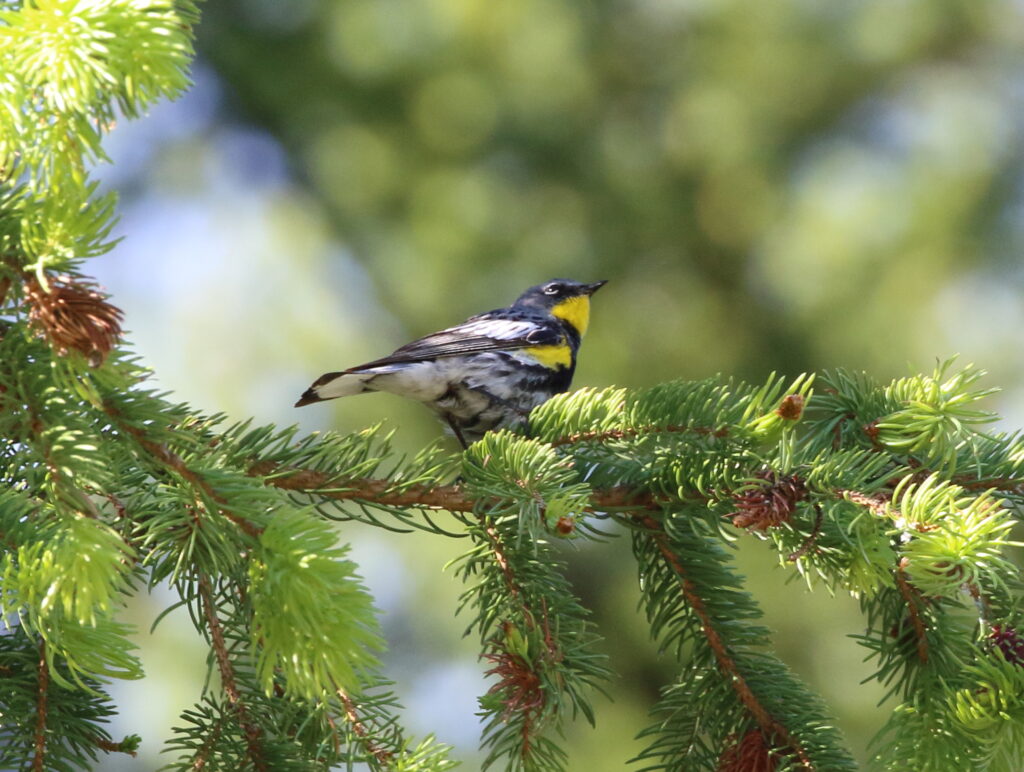
On the day, we located five of the dozen or so common warbler species that breed in Montana, including this stunning Yellow-rumped.
It was a flawless day, and we pulled over a couple of times to listen for birds in green, lusher forest. Thanks to Braden’s sharp ears and ear-birding skills, we immediately picked up a host of species including several kinds of warblers, Swainson’s Thrushes, Warbling Vireos, and a surprise flock of Gray Jays (I refuse to cede this species to Canada!). Driving further, we finally reached a burn area where Braden had seen a Three-toed Woodpecker several days before. The burn had mostly smaller trees and I wasn’t optimistic, but Braden played a Three-toed drumming call and a Hairy Woodpecker immediately responded. Then, a blacker bird swooped in. “Three-toed!” Braden shouted. Ka-ching. A Year Bird for me.
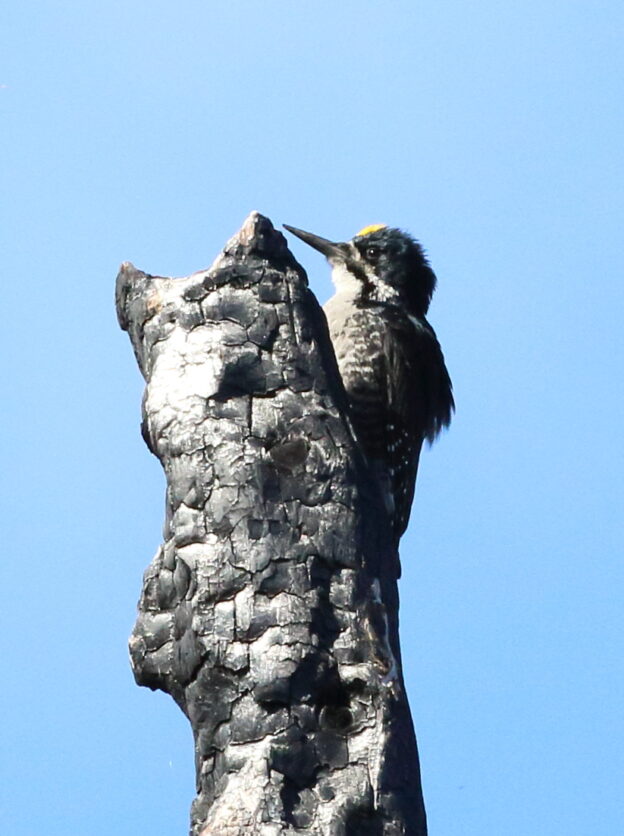
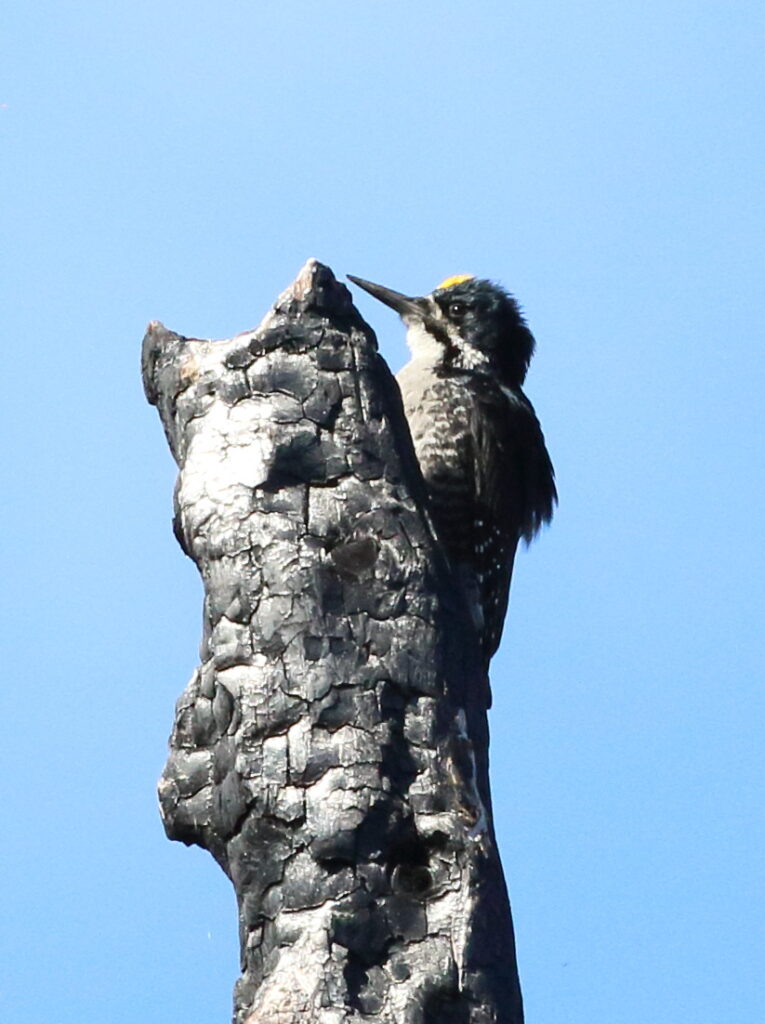
Black-backed Woodpeckers aren’t endangered, but can usually only be found in burned forests 1-5 years old that have NOT been salvage-logged. This one immediately leaped into our Bird of the Year competition!
A mile or so further, we reached an even better burn area with larger-diameter trees. I pulled over and we played a Black-backed drumming call. Within fifteen seconds, a gorgeous female Black-backed arrived to investigate, but that wasn’t all. Another half-mile up the road, we found a yellow-crowned male! “A Black-backed! We found Black-backed Woodpeckers!” Braden exulted several times. They were our first since doing our Big Year in 2016. The day was far from finished, either. Over the next couple of hours, we added Sharp-shinned Hawk to our Year lists, and I added two more that Braden already had: Fox Sparrow and Golden-crowned Kinglet, both of which Braden found me by ear. We also found Wilson’s Warblers on their nesting grounds—our first time doing so near Missoula.
The day brought our totals to 245 and 239 respectively. Will we make it to 250? We’re finally starting to feel better about our prospects, but stay tuned. We still have a lot of birding to go!