Tag Archives: Raptors

Winter Birding in Israel, Part II: Valley of the Cranes

This week, enjoy Braden’s Part II of an Undetermined Series of Posts about our recent birding adventures in Israel and Jordan!

Over the next few days, our host family showed us around Northern Israel. We explored Akko, a seaside town with a great market full of delicious Arab and Jewish food and tall, Crusader-era walls. In Haifa, we took a drive around Mount Carmel and dined on amazing pizza and fantastic pistachio ice cream. My dad and I even spotted a Eurasian Griffon soaring over a residential area, a rare species of vulture that nested in the Carmel range. 

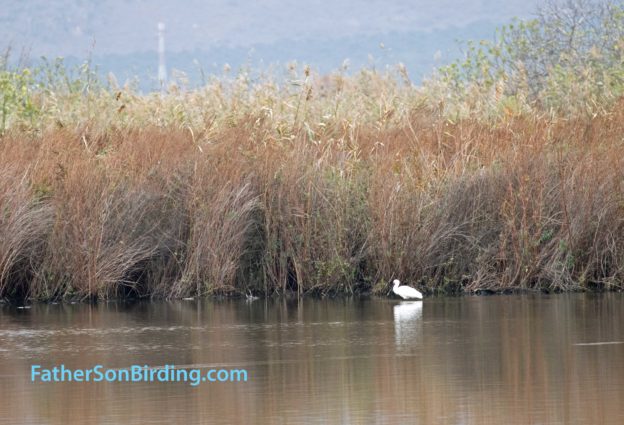
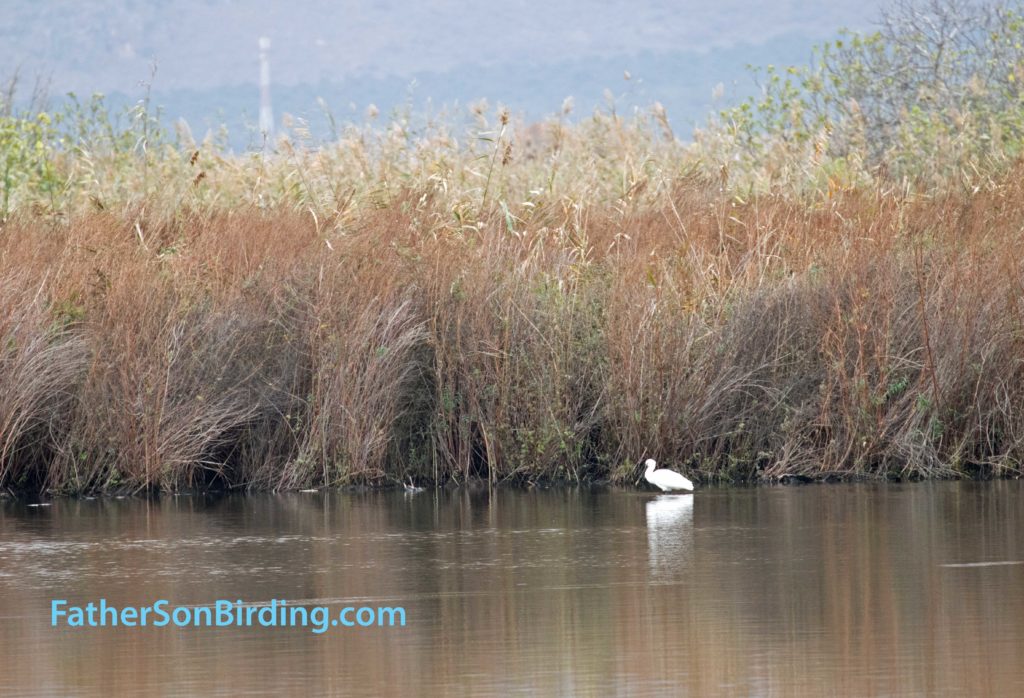
A lone Eurasian Spoonbill enjoys refuge in the Hula Valley Nature Reserve, once part of a vast wetlands that covered much of north-central Israel.

After sightseeing, though, we were ready to do some serious birding. One day, my dad, one of our friends named Noam and I hopped on the train to Haifa (spotting flamingos feeding in salt ponds on the way), where we were picked up by our host’s brother Barak and father Avi. We headed north, stopping only to grab a snack at a roadside falafel & humus stand overlooking the vast Sea of Galilee and its nearby canyons and mosques. Soon, though, we left the mountains, driving past agricultural fields filled with Common Cranes. Eventually we arrived at the Hula Valley Nature Reserve, and were greeted by a large, modern visitor center. The best way to sightsee the refuge was to rent a golf cart, and that we did, setting off around a lake at Formula 1 speeds—about 10 miles per hour. We were soon greeted by hundreds of cranes, as well as various tactics that farmers used to prevent the birds from eating their crops. Every few minutes a gunshot, firework or horn would echo across the landscape (the birds were protected, don’t worry), and we even glimpsed a few people chasing the huge flocks.

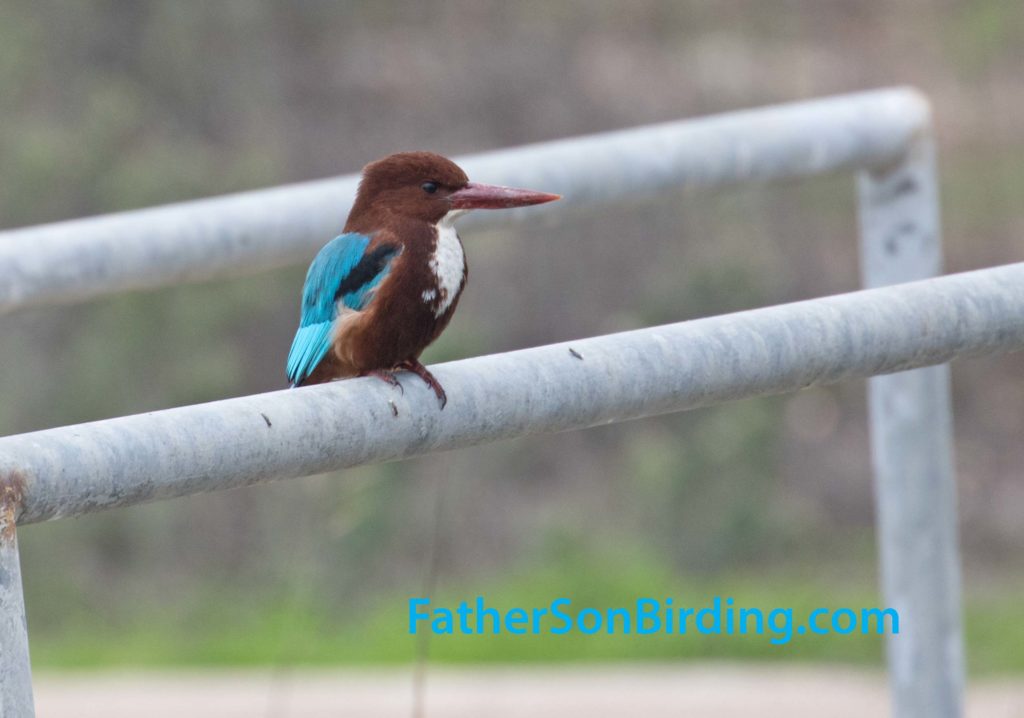
In the Hula, we got our first great look of the trip at what would prove to be one of our Top Five favorite Israeli birds—the White-throated Kingfisher.

Before reaching the main lake, we stopped at a forested spot and were immediately astonished to see not one, but two birds that we’d been hoping to see: a White-throated Kingfisher and a Eurasian Hoopoe! The large kingfisher showed off its azure wings as it scanned the ground for rodents, while the hoopoe foraged quietly like a flicker, probably looking for ants. Spur-winged Lapwings, birds with sharp patterns of black and white on their wings, stood right by the path, unafraid, and almost every bird in the area allowed us to snap sharp, close-up photos. Before leaving we spotted a pair of European Goldfinches, chirping cheerfully despite their “sunburnt” faces.

At the lake itself bird activity increased substantially. Raptors were abundant, including Black and Black-winged Kites, Eurasian Marsh-Harriers, Common Buzzards and Eurasian Kestrels, all flying over the marshes. One kestrel even posed for us on a sign, devouring a mouse right in front of us! The species diversity of ducks was low, but those that were here, primarily shovelers, mallards and teal, foraged in the fields in huge numbers, and Eurasian Coots, Eurasian Moorhens and Little Grebes floated on the water. Shorebirds and waders also were present, and we spotted a few Glossy Ibises, Black-winged Stilts, Ruff and a single Eurasian Spoonbill by the shoreline. Gray Herons, Great, Cattle and Little Egrets and Great and Pygmy Cormorants topped every bare branch and island in the area.

As this Eurasian Kestrel can attest to, there’s nothing like a good stretch after tearing the head off a mouse!

At a lookout a helpful naturalist pointed out several harder-to-see species to us, including Black-tailed Godwits and Northern Lapwings hiding in the distance among the huge numbers of cranes. I snapped photos of several raptors that flew by, later identifying them as eagles! The two we spotted were Booted and Greater Spotted, just a small percentage of the eagle species the Old World supported. Pied Avocets floated on the waves of the pond like ducks.

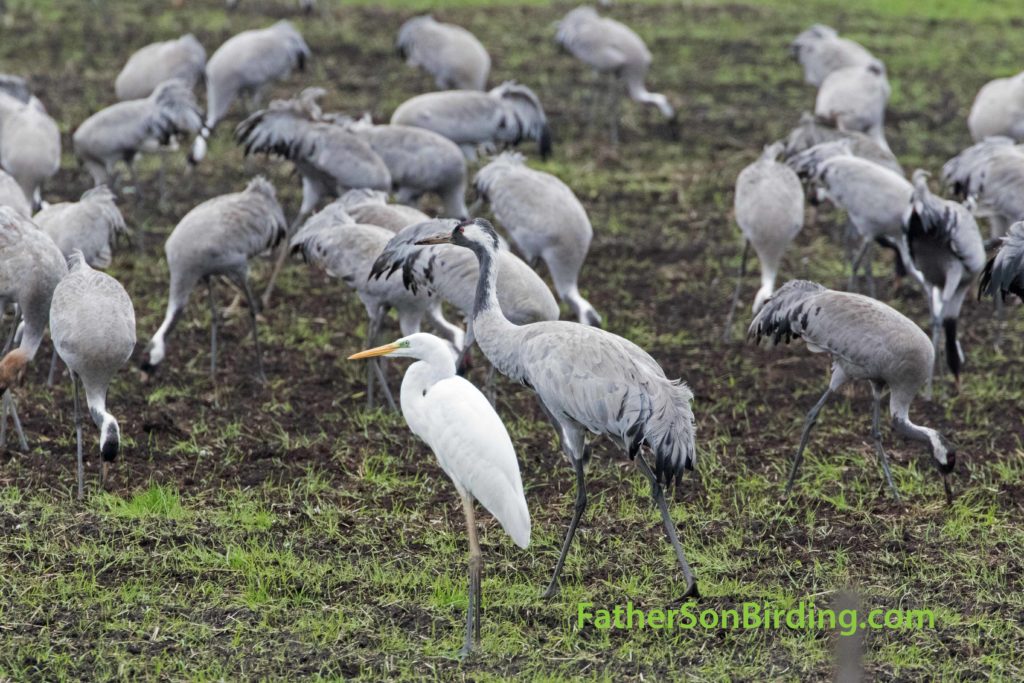
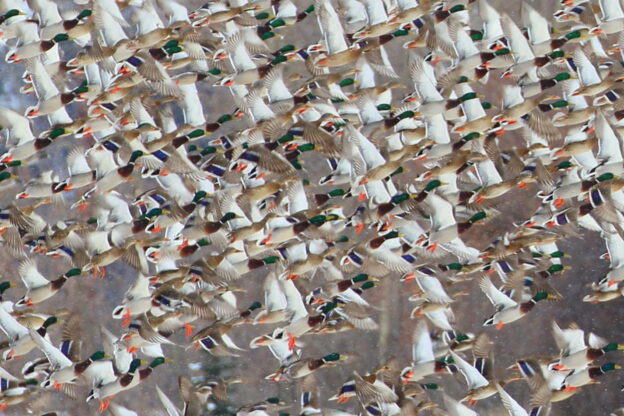
Sing along with us: “One of these things is not like the other. One of these things is not the same. One of these things—” Oh, you get the idea. It’s hard to blend in with 30,000 Common Cranes!

We completed our loop, tracking down cranes for better photos and spotting a Common Kingfisher skulking in the brush back at the visitor center, the only one we’d see for the rest of the trip! This little refuge, surrounded by farmland, was all that remained of the huge wetlands that had once covered much of this area and supported hippos, ostriches and cheetahs. While much of the diversity of the past had disappeared, Hula still provides habitat for thousands of birds during all seasons and efficiently allows the public to experience them. The day had not disappointed. 

All photos and text on FatherSonBirding.com are strictly protected under U.S. copyright law. To request permission to use, contact Sneed at sbcollardiii+2@gmail.com.

Birding San Antonio’s River Walk? Are You Nuts?

To Subscribe to FatherSonBirding—and nothing else—please fill in your email address in the box down in the column to your right. Thanks!

If you’ve ever visited the downtown River Walk area of San Antonio, you’d be forgiven if you viewed it as less than a premier birding destination. Grackles, starlings, pigeons, and freakazoid hybrid ducks that grew up too close to Chernobyl overrun the place. Still, as a birder, I felt obligated to give it a legitimate chance, so on my work trip last weekend, I determined to explore the River Walk’s distant outposts.

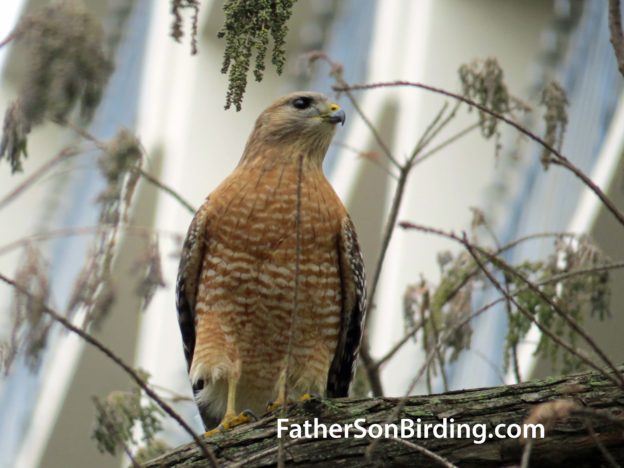
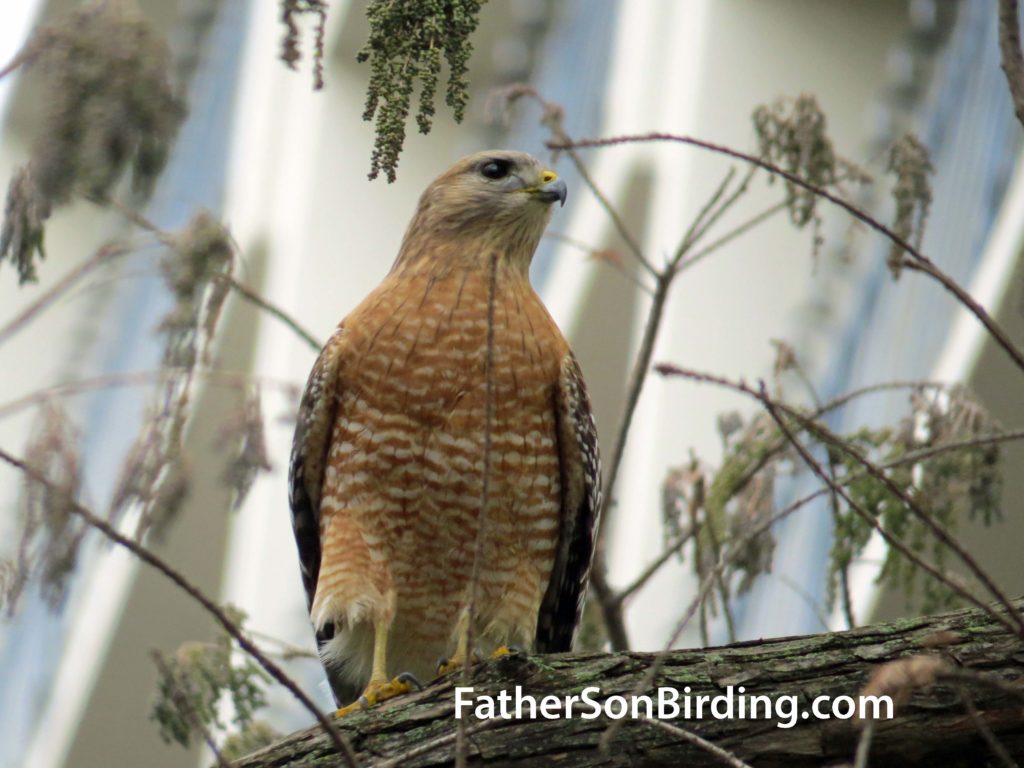
From our recent trips to Texas and Georgia, we are learning just how well Red-shouldered Hawks adapt to an urban lifestyle. A big thank you to my daughter for letting me steal her point-and-shoot camera for the trip!
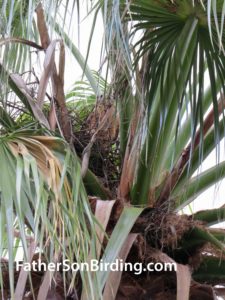
How many margarita-wielding tourists do you suppose notice this Red-shouldered nest?

Day 1: Even before leaving the main tequila-drenched tourist loop, I caught a surprising shape flashing above the river and landing in a nearby tree. I hurried to the top of a bridge for a closer look and, sure enough, IDed a Red-shouldered Hawk surveying potential prey (tourists?) below. Its mate soon swooped by and I located their nest in a tall palm near the junction of Commerce Street. “Whoa! Good start,” I thought to myself, but more surprises awaited me.

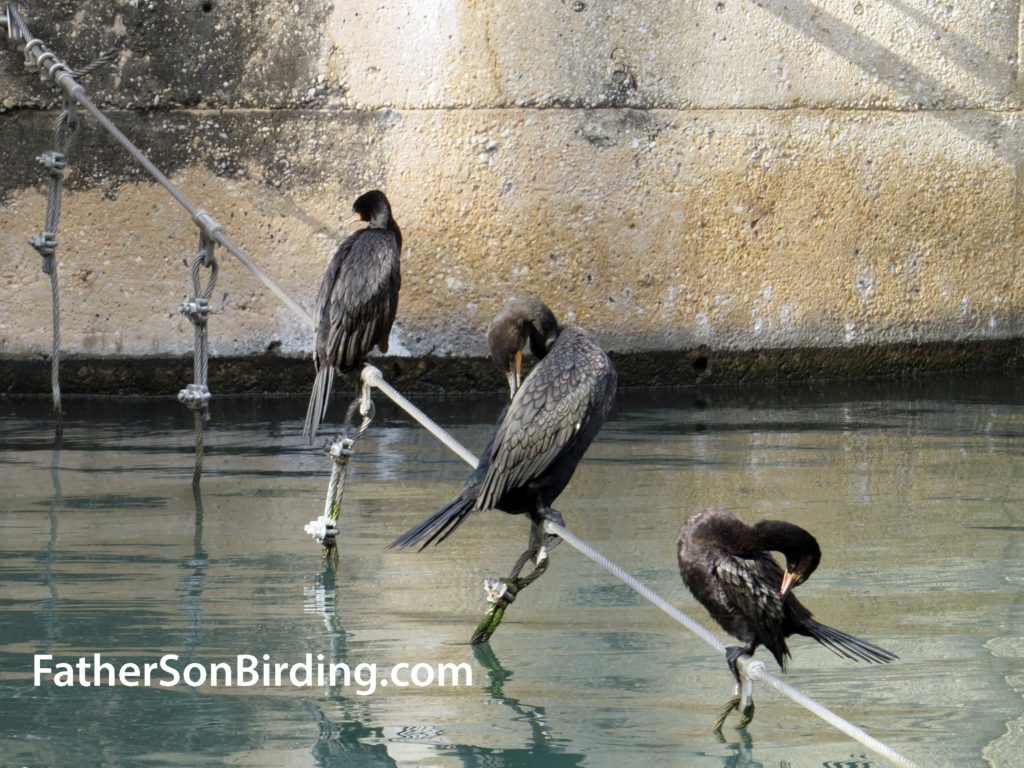
In the nearby Villita market area, I picked up Blue Jays, White-winged Doves, mockingbirds, and an unanticipated Orange-crowned Warbler diving into a drainage grate. Then, joining the main river, I began working my way downstream to meet a trio of Double-crested Cormorants near a small dam. “What the heck are they doing here?” I asked, astonished—but then found seven Neotropic Cormorants nearby! Before hurrying back to my conference, I rounded out my three-mile expedition by picking up Yellow-rumped Warblers, Ruby-crowned Kinglets, Northern Cardinals and my biggest prize of the day, a Lincoln’s Sparrow co-mingling with some House Sparrow hoi polloi.

Even though I saw them on the eBird checklist, the presence of cormorants on the uber-engineered San Antonio River caught me by surprise.

Day 2: After delivering a keynote address at the wonderful TCTELA conference, I had nervous energy to burn so decided to skip lunch and head directly upstream. As on the previous day, the farther I got from downtown, the better the habitat, and the better the birds. I saw some of the same species as the day before, but was delighted to flush six Inca Doves and a Yellow-rumped on the grounds of the San Antonio Museum of Art while two Black Vultures circled overhead.

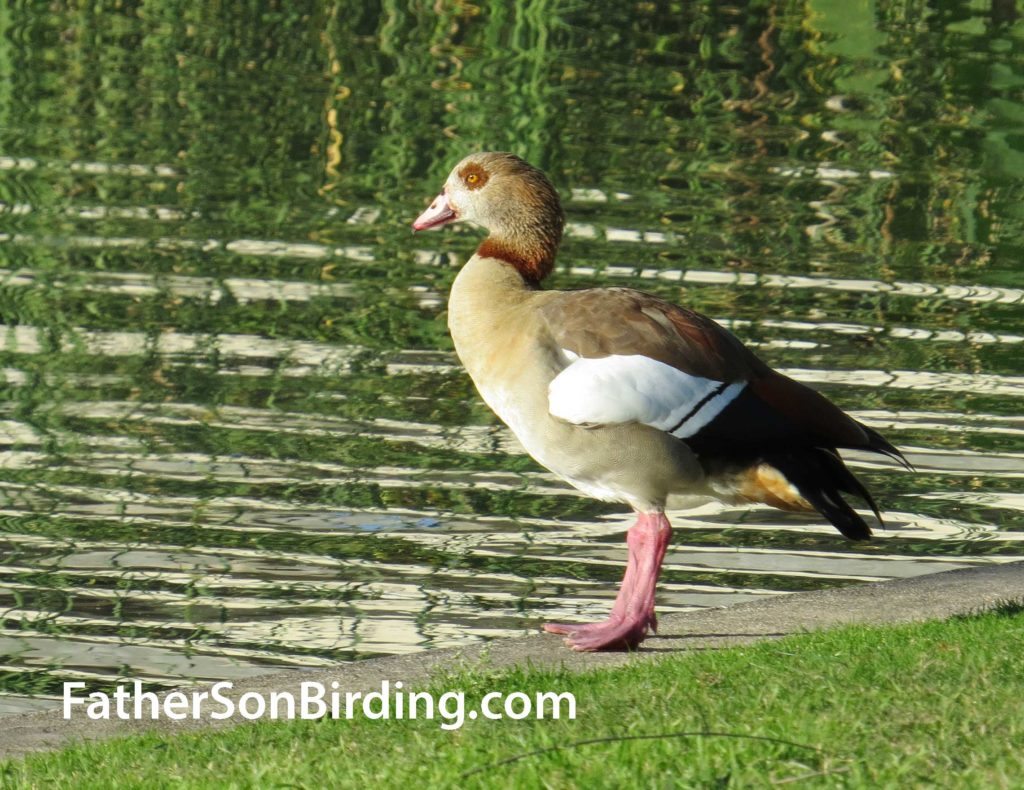
I hadn’t intended to hike all the way to Brackenridge Park (about three miles each way), but am glad I did. In oaks along the trail, a Rufous Hummingbird landed next to me and I spotted an elusive songbird of some sort moving through the trees. I spent five minutes trying to get a clear view, and then . . . Blue-headed Vireo! Only my second one ever! In the marsh at the south end of Brackenridge, I added a lone Egyptian Goose, an Eastern Phoebe, and a Great Egret to my growing list. Then, I saw a startling splash of red fly to a nearby branch. Vermillion Flycatcher!

Okay, I admit it. When I saw this Egyptian Goose, I at first thought it was a Black-bellied Whistling Duck. In my defense, it was only the second time I’d seen these guys!

The lesson? Once again, that birding never fails to surprise and please, and can turn any trip into an adventure. After returning to the main tourist area, I decided to reward myself for my exploits with cheese enchiladas and a Corona, all the while gazing up at the flights of grackles and starlings above me.

Up next: my report on my first Uber ride and San Antonio’s Botanical Gardens—if Braden doesn’t come up with something even better!

Winter Birding in Atlanta’s Surprising Piedmont Park

To Subscribe to FatherSonBirding—and nothing else—please fill in your email address in the box down in the column to your right. Thanks!

When we were invited to my brother’s wedding in Atlanta, Braden and I immediately began wondering which birds we might encounter in the “Dogwood City” in mid-January. Our first morning there, we determined to find out by taking a loop around Piedmont Park in the company of our good friend—and famous “Hidden Figures” movie extra—Erica Brown. Almost immediately, the birds came out to meet us!

Sneed and Braden trying to track down a Carolina Wren in some brush at Piedmont Park. (Photo by Erica Brown)

Making a loop to the north from the parking lot, we soon found common hoped-for Northern Cardinals, Blue Jays, and Carolina Chickadees, but then surprised a gorgeous Red-shouldered Hawk lurking along the stream bed. The birds only got better from there.

This Red-shouldered was a real delight—and proof that a thriving bird community can exist in the heart of an urban environment. (Photo by Braden Collard)

Continuing north, we picked up Tufted Titmouse, Ruby-crowned Kinglets, Carolina Wrens, Eastern Phoebes, and to my delight, a Golden-crowned Kinglet, which I was especially glad to see because my crummy hearing doesn’t allow me to find these by sound. Looping back on the far side of the park, I began wondering where the woodpeckers might be when I spotted a small candidate in a tree. “There’s a Downy,” I pointed to Braden. “I see it,” he said, “but that’s not a Downy. It’s a Yellow-bellied Sapsucker!” “Huh?” Turns out, we’d been looking at different birds!

We never get tired of watching phoebes—especially one that we rarely get to see, the Eastern Phoebe. (Photo by Braden Collard)

Our real jackpot turned out to be a large, muddy puddle next to some dead grasses. There, we picked up Swamp, Chipping, Song, and White-throated Sparrows, Eastern Towhees, and my favorite, a pair of Brown Thrashers. All told, we bagged 28 species, far exceeding our wintry expectations. Better yet, Braden scored three Lifers: Eastern Towhee, Swamp Sparrow, and Yellow-bellied Sapsucker!

This Eastern Towhee proved a Lifer for both of us! (Photo by Braden Collard)

As a bonus, that night, we got to visit with the wonderful folks of Atlanta Audubon at my book signing with A Cappella Books, held at Brickworks Gallery. What a fun group! The welcoming people—and welcoming birds—left only one burning question: what could “Hot’lanta” possibly be like during spring migration? One day, we hope to find out!

Next Post: another urban birding report from my upcoming trip to San Antonio for the TCTELA Conference.

Lucky Day at Maclay

To Subscribe to FatherSonBirding—and nothing else—please fill in your email address in the box down in the column to your right. Thanks!

As we pulled out of the garage, my dad asked, “So, where to? Mt. Sentinel for rosy-finches? The Gravel Quarry?”

“How about we go look for the Great Gray Owl at Maclay Flat?” I asked.

“Well, okay, even though Maclay always disappoints me—it’s kind of empty.”

This was true—while we had spotted excellent birds at Maclay, including Barred, Great Gray and Northern Pygmy-Owls, it generally didn’t hold up in terms of overall species. For instance, on the day we saw the Barred Owl, we only logged about five species. Dog-walkers and cross-country skiers also loved Maclay, and the number of people might have affected bird numbers.

Fortunately, when we pulled up in the parking lot with our dog Lola, it seemed barren of people—maybe people had other things to do with their holiday break. A thin, fluffy layer of snow covered the ground and trees, and a few clouds dotted the sky. We pulled on our snow boots and layers, then trudged into the forest, our eyes open for large gray shapes watching us from the upper branches.

Our year lists sat within reach of our  Montana year records, with my dad and I needing two and three, respectively. I hoped we could get Merlin and Golden-crowned Kinglet today, which would buff my dad’s list. Other birds that topped our Montana needs included Ruffed Grouse, Northern Goshawk (which we had unsuccessfully chased up Pattee Canyon a few days earlier), Gray-crowned Rosy-finches (which we could hopefully nab with a hike up the “M”), Gyrfalcon and Snow Bunting (grrrrrrr). A ski trip could also get my dad Gray Jay.

Right beyond the parking lot we encountered one of Maclay’s famous mixed flocks, containing three Black-capped Chickadees, two Mountain Chickadees, Red-breasted Nuthatches and a Brown Creeper, which was a nice surprise.

My dad and I bushwhacked through the trees and slid down ditches searching for the owl, or any owl. We investigated a stand of aspen near the edge of a huge field that had cavities that should have contained screech-owls, but to no avail. From a distance, though, we did spot a handsome adult Bald Eagle perched on a huge snag.

Suddenly, we spotted a raptor zip out of the trees, chasing a collared-dove. I tore off my mittens and set my camera on overexposed, then snapped as many photos as I could. We’d had a similar experience in this same field a few years ago, but the look had been too quick for identification. This time we were ready.

Our Lifer Northern Goshawk, heading home after an unsuccessful pursuit of a Collared Dove.

The bird sported a long tail and slim wings, and was fairly large—definitely a falcon or accipiter species. Remarkably, my photos showed a slate-gray body and a black eyeline. Northern Goshawk! We’d never seen this bird before, and it was one of our long-time nemesis birds. Finally, we’d gotten to see this rare raptor in action!

Seeing the goshawk definitely made up for not spotting the Great Gray. As we walked back to the car, we finished up the birding with another great mixed flock, including two Downy Woodpeckers. Happy New Year!

Montana Christmas Bird Count #2: Deer Lodge Discoveries

Unless a Northern Hawk-Owl or flock of Pine Grosbeaks lands in our backyard, this will most likely be our last post of the year. We thought we’d wish you a Happy Holidays and New Year by recounting, what else, our second Christmas Bird Count of the year! See you in 2019!

Only five days after participating in the Missoula Christmas Bird Count, Braden and I awoke at 5:45 a.m. on December 20 for our second bird count of the season: the Deer Lodge Valley count, near Butte. After making the 90-minute drive, we were delighted to see the parking lot full at our rendezvous point, Grant-Kohrs Ranch National Historic Site. Veteran birder and biologist Gary Swant headed up today’s count. Gary is well-known in Montana for doing bird monitoring related to the superfund cleanup of the Butte-Anaconda mining complex, but this was our first chance to meet Gary in person!

Braden and I were fortunate to be able to bird with Laura Swant and Shane Sater—even if we lost several digits to frostbite during our fruitless search of the Deer Lodge Golf Course!

Me and Braden, who was playing hooky from school, had two target species for the day: Snow Bunting and Gyrfalcon, both of which have foiled us throughout our four-year birding careers. Gary, though, paired us with his wife, Laura, and Carroll College Environmental Studies major Shane Sater to survey the area closest to where the Gyrfalcon had last been sighted, two weeks before.

We began our survey near Deer Lodge State Prison, slowly crawling along an icy road that bordered prison property and led toward spectacular forested mountains a few miles away. On the way, we stopped to observe Bald Eagles, Rough-legged Hawks, and frequent ravens and magpies. After turning around, however, a flock of smaller birds flew right at us. Laura identified Horned Larks, and Shane called out Snow Buntings—but neither Braden nor I got good enough looks to count them. Those sneaky, soul-scarring Snow Buntings!

Raptors proved the stars of our Deer Lodge CBC—including this Rough-legged Hawk contemplating the wisdom of going after a cow next to Deer Lodge State Prison.

Only a few minutes later, however, I spotted a group of nine Gray Partridges in a narrow draw—the second week in a row we’d seen these handsome, elusive critters. Not too long after that, an entirely humorless guard from the State Prison pulled over to inform us that we were not allowed to watch birds within site of the prison. And Merry Christmas to you, too, buddy!

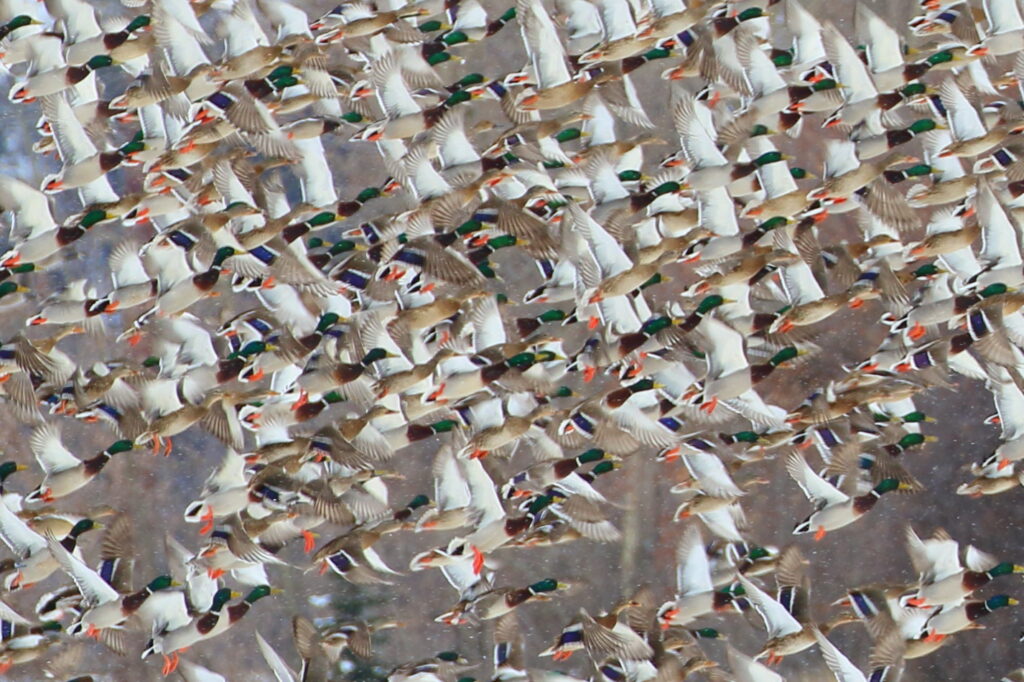
We ventured a short walk around the Deer Valley Golf Course, but the stiff wind quickly drove us back to our cars with only a few more pigeons and ravens to show for our suffering. As we kept exploring our sector, we happened upon a flock of about a thousand mallards. We saw more Bald Eagles and Roughies. Then, I spotted a raven on a telephone pole up ahead. I rolled down my window to take a picture.

“That’s not a raven,” Shane exclaimed. “That’s a raptor.”

“What?” I asked, not believing him.

Though foiled in our quest to find a Gyrfalcon, our first look at a Harlan’s morph Red-tailed Hawk made up for it. Love these stunning black-and-white birds!

Sitting on the pole was Braden’s and my first ever Harlan’s hawk—an unusual black and white morph of the common Red-tailed. It was a stunning bird, and I got out to take a (poor) photo of it as it stared back at me with suspicious eyes.

After the count, we were treated to a scrumptious lunch of broccoli-cheddar soup and chicken salad crossant sandwiches provided by the Timber Eatery in Deer Lodge (do check them out—yummy!). As we polished off the last of the cookies, Gary did a quick check of the room to find that our combined species total reached 43 for the day. That wasn’t nearly as high as other parts of the state—Missoula had logged 86 species the week before—but the interesting terrain and great company more than compensated. After saying our farewells, Braden and I spent another hour searching for the Gyrfalcon and Snow Buntings, but the birds continued to scorn us. Maybe next year. Until then, Happy Holidays Everyone!

Though not as species-rich as other parts of the state, the Deer Lodge Valley offers stunning scenery and raptors galore!