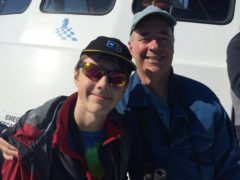
Day 3 of Birding Week Therapy proved an easy task thanks to my daughter’s regular Wednesday night soccer practice out at Fort Missoula—a location that happens to sit next to what may be Missoula’s best birding location, affectionately known as “the gravel quarry.” Over the past years, Braden and I have birded the quarry dozens of times and counted about 130 different species there, including a number of rarities such as Long-tailed Duck, Pacific Loon, and Eurasian Wigeon that swing by during spring and fall migrations. This time of year, I was especially keen on finding some cool sparrows, which can also drop in for a week or two at a time. I would have preferred a morning visit, but birders can’t always be choosers, so after dropping my daughter off, our dog Lola and I set off to see what we could find.
The late-season Merlin was a real treat, especially watching it in action hunting another bird!
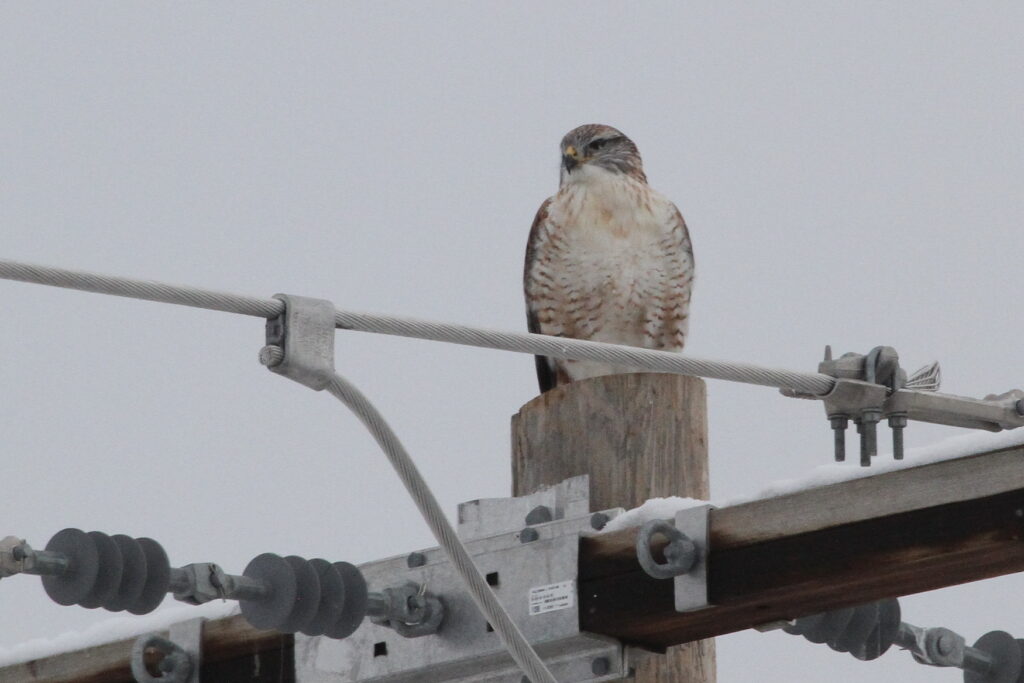
Few ducks graced the pond and they were too far away to ID without a scope, so we hurried on to the river to look for sparrows. Alas, the action proved pretty slow, but as I was peering into one of my favorite sparrow spots, two larger birds dived into a patch of tansy. One flew off again before I could ID it, but the other extricated itself and perched on a nearby tree. Its behavior led me to believe it was a Sharp-tailed Hawk, but on closer inspection I saw that it was a Merlin! And quite late in the year for the location! I took my time studying it since I often have difficulty identifying these in the field.
Cooper’s Hawks are common at the quarry, but I wondered if this was a resident or just passing through.
Minutes later I saw another raptor circling and just assumed it was the Merlin, but no, it proved to be a Cooper’s Hawk! Braden later reminded me that raptor migration was in full swing so both sightings made sense, along with the lone Turkey Vulture I saw in the distance.
I never tire of watching Sandhill Cranes and it seems we’ve been finding them at this location more consistently the past couple of years.
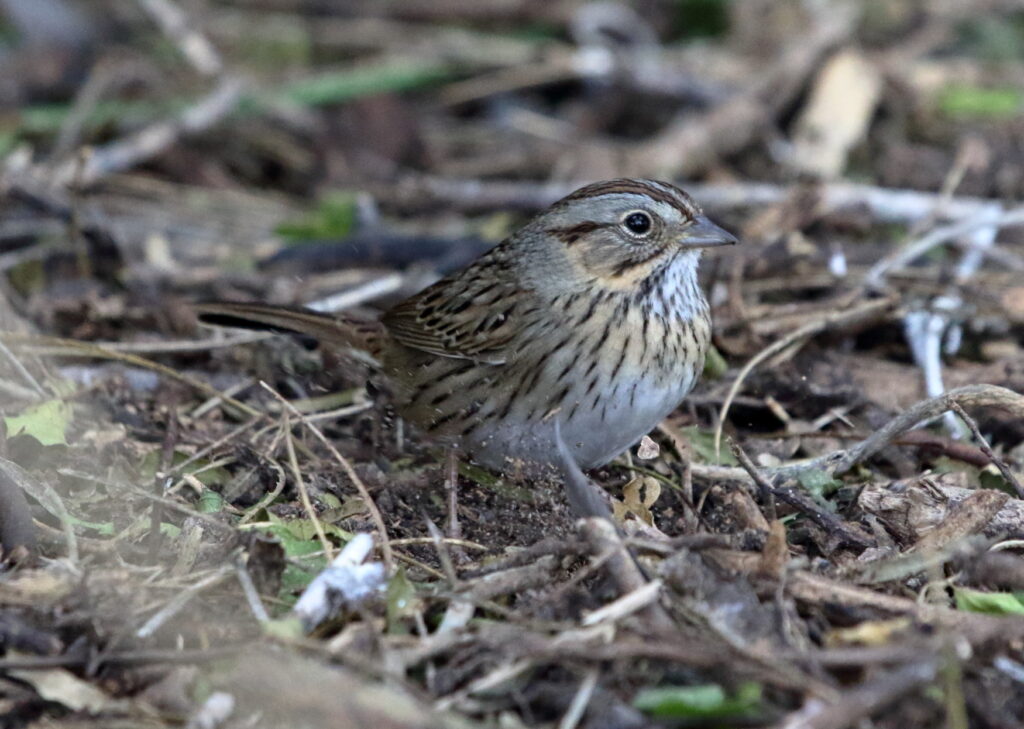
Soon, I heard weird guttural calls that I have come to love—Sandhill Cranes. Three of them caught the gorgeous evening light and I am guessing they breed nearby since they’ve become a common sight out there. Alas, songbirds proved scarce but on our way back to the car, Lola and I finally dissected a White-crowned Sparrow from some brush. I’d had bigger days at the quarry—and better photos, too—but also much worse days. I knew, though, that I’d be returning for Day 6 of Birding Therapy Week—and in the morning!
Ever wanted to visit the Amazon—the rainforest, not the store? Check out Sneed’s new travel article at Perceptive Travel online magazine!
So after getting home from my Blue Mountain hike on Monday, I began planning Tuesday’s birding therapy outing to the Missoula Cemetery, a place I have monitored since the pandemic began last year. Almost immediately, however, I received a message from a friend of a friend (FOAF) about a putative Peregrine Falcon pair a few miles from our house. Peregrines are not uncommon in Montana with well over a hundred nesting pairs—a remarkable resurgence considering the DDT disaster that devastated dozens of bird species through the 1960s and 70s. However this possible nest site was one that neither Braden nor I had heard of, so instead of hitting the cemetery Tuesday morning, I convinced Braden to skip first period and go check it out by bike.
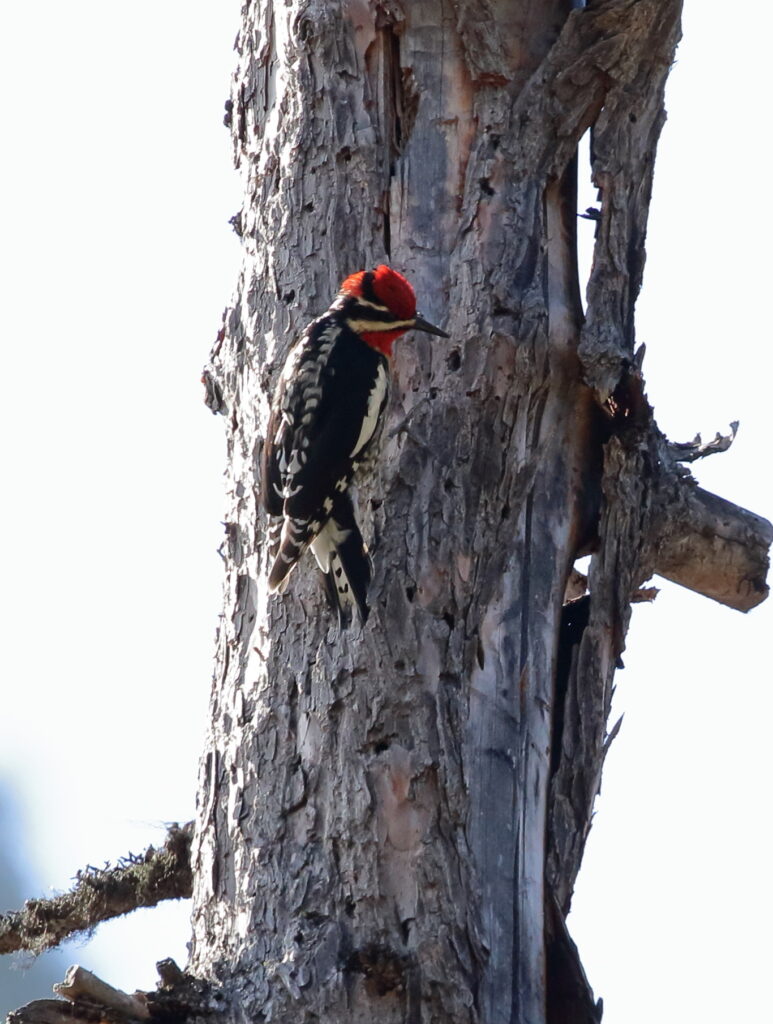
Braden and I never tire of seeing Red-naped Sapsuckers, especially in a new location!
It was a perfect morning for a bike ride and we spotted or heard Black-capped and Mountain Chickadees, Red-breasted Nuthatches, and an assortment of other birds—Braden more than I thanks to his Bionic Ears of Youth! We were especially excited to find a nice boggy area with a couple of Red-naped Sapsuckers drumming on snags. Finally, we reached the area the FOAF had described and almost immediately thought that we heard the peregrines calling. We set up “camp” and watched, hoping to catch sight of them. No luck. Even worse, Braden had to leave to get back to school. “Well crap,” I thought. I didn’t want to see them without him, but also knew I might not head back to the spot anytime soon so decided to stay longer.
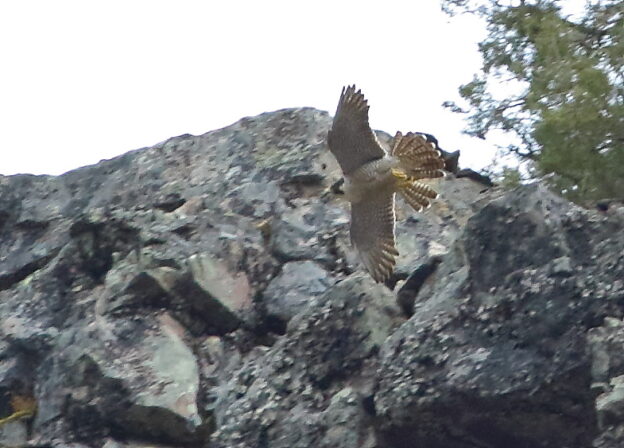
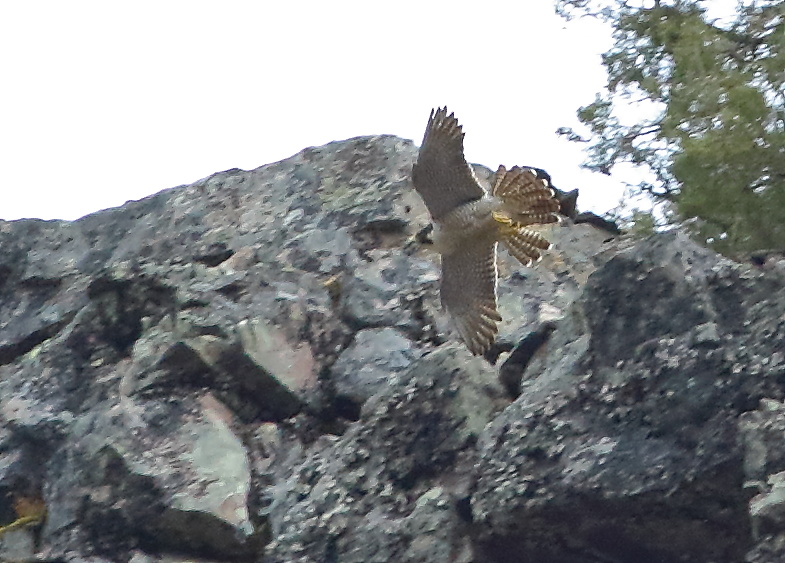
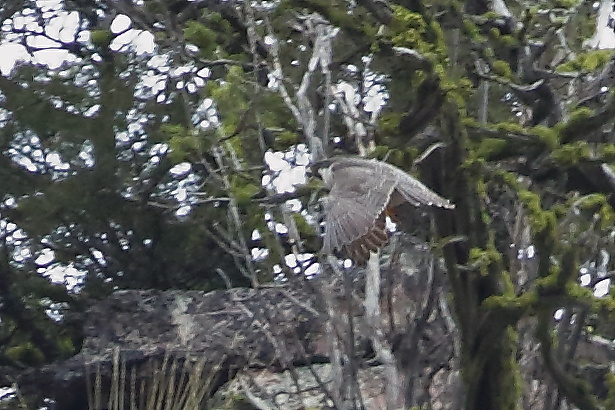
One of the benefits of hauling a camera with you is to “slow down” birds that are too fast and too far away to easily observe. Peregrine Falcons are a case in point!
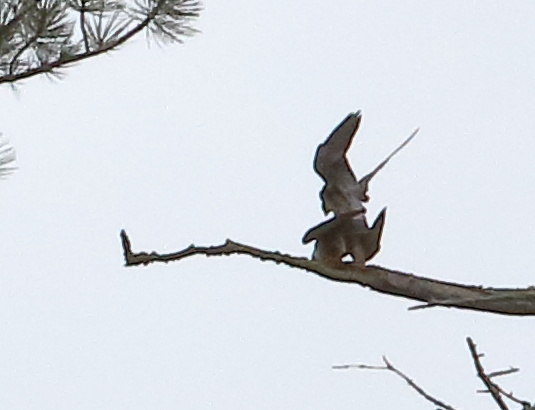
I pulled out my phone to play a peregrine recording—not to attract them but to make sure what they sounded like. WHAM! Almost instantaneously a loud answering call hit me from above and I looked up to see the unmistakable shape of a falcon flying against the gray skies. That turned out to be just the opening salvo in an amazing twenty-minute aerial exhibition that the peregrine and his mate put on for me. I watched them chase off another raptor, skim forest treetops, and in a grand finale, copulate on the branch of a tree! Granted, the birds were far away, but I can’t recall a more exciting raptor experience—well, at least since seeing the Gyrfalcon with Braden earlier this year.
I got in touch with the Montana Peregrine Institute to see if they knew about this particular nest and it turns out that the pair was first discovered in 2020 and had apparently successfully fledged three young! My FOAF went even further and single-handedly convinced the Forest Service to delay a controlled burn that was supposed to happen this last week—right in the peregrines’ territory! Hopefully, the burn will go ahead in the fall—and give the birds a wonderful larder of new prey to raise their next batch of chicks.
Even though the birds were far away, it was thrilling to watch them mate—something that will hopefully ensure a new crop of peregrines this year!
Gamblers and fishermen are famous for being superstitious. Birders aren’t much better. Sure, we feed ourselves platitudes such as, “The more you get out, the more you’ll see,” but deep down, we know that the birding gods control our fates, and that our success depends on whether we’re deemed worthy. In our last post, I recounted how Braden and I spent six hours and two days looking for a Gyrfalcon near White Sulpher Springs, only to endure the gods’ wrath. Yesterday morning, when we set out on a quest for a Snowy Owl, we wondered if the gods would continue to scorn us, or whether we had proven ourselves humble and dedicated enough to curry their birdly favor.
Northern Harriers and other raptors were abundant wherever we looked. They, unfortunately, were not the birds we set out to see!
We left the house at 6:30 a.m. and by 7:30 were at Ninepipe National Widlife Refuge, where we hoped to score an elusive Year Bird, Short-eared Owl. We drove the dirt roads for more than an hour and saw more than a dozen Red-tailed Hawks, Rough-leggeds, Bald Eagles, Harriers—even a Merlin. No Short-eared Owl. “Ah, well,” I told Braden. “We’ll get ‘em next time.” Inside, though, I was thinking, “Oh, man. Is it going to be that kind of day? Again?”
Well, apparently, it was. Reaching the Snowy Owl neighborhood near Kalispell, we again drove for more than an hour without so much of a glimpse of a white owl. By now, I realized that the BGs must be really pissed at us. We decided to chase some other birds and come back later, however, and did score our first Gray-crowned Rosy-finches in three years at the Kalispell dump—while getting bawled out by the “dump lady” for our efforts. We also found a White-winged Crossbill among a flock of Red Crossbills feeding on some nearby spruce trees. Nice, but not a Snowy Owl.
Mallards are no doubt the most underrated duck, but this flock of five thousand birds made a big impression on Braden and me!
After a lunch at Panera Bread (hey, more chicken in my Napa Almond Chicken Salad Sandwich, please!), including our favorite kitchen sink cookies, we hit an amazing field full of about 5,000 Mallards. Stunning! Then, we returned to the Snowy Owl site, where we encountered several other birders. None of them had had any success, either, but while we were commiserating, a photographer named Dick Walker introduced himself and asked, “Are you the father-son birding team?” We’d never been called that, but I answered “Yes,” and he started talking about the Mallard spot we’d just left. He showed us photos of Lapland Longspurs and, most exciting, a Gyrfalcon he had seen only thirty minutes before!
We tore back to the place, forever hopeful. No longspurs. No falcon. After fifteen minutes, though, a massive group of a thousand Mallards lifted off and seconds later, a sleek, jet-fighter shape zoomed across our field of vision. “It’s the Gyr!” Braden shouted.
Our first Gyr was a darker bird and left no doubt it was master of the skies. We’ll never forget it!
Indeed it was. We quickly lost it in the distance and decided to race over to another road closer to where it disappeared. We got there and jumped out of the car just as the amazing raptor reappeared, obviously enjoying terrifying the thousands of ducks and geese swirling around it. While Braden set up our scope, I tracked the bird with my binoculars. It seemed to toy with a large group of ducks, but its madness had some method as more and more Mallards peeled off until only two remained. As I watched, breathless, the Gyr hit one of them and took it to the ground. “It got a duck!” I shouted.
I was astounded how quickly this Baldie swooped in to steal the Gyr’s kill. It made me wonder how many ducks the falcon has to kill before it actually gets to eat one!
Its victory was temporary. Within thirty seconds, a much larger brown shape swooped in—an immature Bald Eagle. It effortlessly drove the Gyr from its kill, eliciting shouts of outrage from yours truly. We continued watching the amazing creature for another fifteen minutes before it vanished again. Then, after another unsuccessful Snowy Owl circuit, we began the long drive home. As we headed south along Flathead Lake, I thought about BB King, who often talked about paying his dues, and asked myself why we’d seen a Gyrfalcon here, in the last place we’d ever expected. “Maybe our efforts in White Sulphur Springs satisfied the birding gods after all,” I speculated. “Or maybe we just had to pay our birding dues to see the Gyr.” Either way, it had been one of the best birding days Braden and I had ever experienced—even without the Snowy Owl.
The sun was still asleep as the Collard minivan circled the roundabout, turning off on the road leading to MPG Ranch. Thirteen months ago, we had had our first banding experience with the University of Montana Bird Ecology Lab on Upper Miller Creek road, and now we were back for more—Erick Greene, a UM professor working with my dad on an article, had invited us to join the Ranch team. We pulled up to the gate, and soon enough the banders arrived. We followed them through the gate and onto MPG Ranch, a place neither my dad nor I had been in at least two years. A brand new sign pointed directions to familiar places, and we followed the truck towards the Orchard House, where Nick Ramsey and I had spent many days watching the feeder birds. We passed the Duck Mahal, a seasonally-flooded building, located adjacent to a slough that provided habitat for the first Bullock’s Orioles, Gray Catbirds, Wood Ducks and Red-naped Sapsucker I had ever seen.
While we hoped that the wind would die down, UMBEL’s Mike Krzywicki gave us a tour of their MPG banding site. Just the week before, they’d caught a rare Gray Flycatcher here.The research carried out at MPG Ranch grows more and more important as climate change worsens and we grapple with how to protect and restore fragile Western ecosystems.
The vehicles parked in a lot north of the Duck Mahal, and from there we followed Mike, the lead bander, down into a shrubby riparian area. The rising sun brought with it constant gusts of wind, and the gray sky threatened us with rain.
“Well,” said Mike, “It looks like we won’t be banding for a while, so why not go birding?”
As we walked around the floodplain, we learned about what projects UMBEL and each of the individual banders and students were working on. The birds, for the most part, were completely hunkered down, and most of the songbirds we recorded as flyovers. One group of birds was out in full force, however; it was peak raptor migration.
Pairs of Red-tailed Hawks performed acrobatics in the sky as the wind sprinkled rain around us. A golden-bellied female Northern Harrier passed right in front of us as we scanned the brush for warblers, and several accipiters made close passes (including one that sat on a bare log that we puzzled over for several minutes).
It is definitely raptor migration season as we are seeing large numbers of birds riding mountain ridges and, when we’re lucky, coming close to the ground.(Red-tailed Hawk)
The weather did not lighten, and so, for the safety of the birds, the banding session closed before it opened. My dad and I, still thirsty for species, said our thanks and drove back across MPG’s windswept plain towards another old friend: Lee Metcalf National Wildlife Refuge.
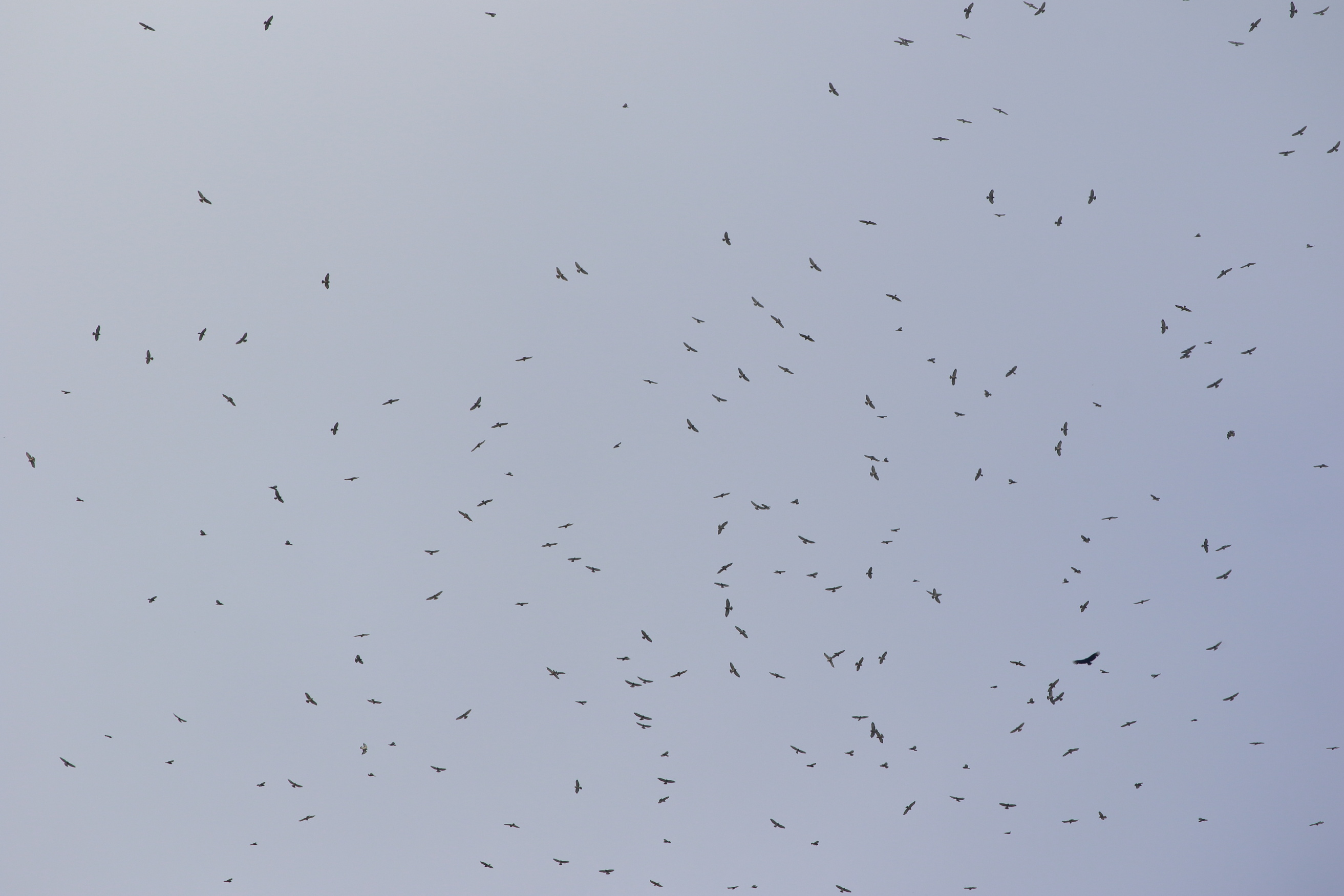
What we discovered upon arriving at the main ponds by the Refuge visitor center is that the season of brown, unidentifiable ducks was wrapping up, and the open water produced great looks at breeding-plumaged American Wigeon, Northern Pintail and Gadwall alongside prehistoric white pelicans. We hadn’t seen this much waterfowl in a long time, yet, again, our eyes turned to the sky. Raptors continued to stream over the Bitterroot Valley, and we studied each Red-tailed carefully, hoping to spot a Broad-winged Hawk, a rare but regular migrant this time of year. No Broad-wingeds appeared, but rafts of Turkey Vultures did. On our way out of the refuge, we spotted yet another raptor, one we had just begun to get familiar with: a crisply-patterned Peregrine devouring a blackbird on a fencepost.
Most people still think of the Bitterroot Valley as relatively untrammeled. As this photo shows, the valley is filling up fast, and we need careful planning to protect the wildlife that all Montanans cherish. (American White Pelicans at Lee Metcalf NWR)
Next, my dad and I headed to Kootenai Creek Road—not the road leading to the trailhead, but the one I’d accidentally driven earlier this summer. Why? California Quail, an introduced resident of the Bitterroot Valley, had been abundant the last time I’d been here, and this was the first time my dad had gotten his butt down here to add them to his year list. Nabbing quail was a necessity. Thankfully, we spied a lone male on our way back down the road, adding another year bird to at least one of our lists after a two-week drought.
Okay, we admit it. A lone California Quail isn’t likely to make the cover of “Hollywood Birds Tonight”, but when it’s a Year Bird? Heck ya, we’ll take it!
Finally, we hit the Fort Missoula Gravel Quarry, a birding classic, before heading home. Upon entry, we were hit with a large flock of robins feeding on berries, and soon began pulling other species from the flock. Butterbutts (Yellow-rumped Warblers) flycaught above leaf-gleaning Orange-crowned Warblers, and we spotted a pair of Cassin’s Vireos, adorned in yellow vests and white eyeglasses. As we made our way towards the water, I heard a high, metallic “chip” coming from a bush behind us. After about a half hour of pishing, using playback and circling the bush multiple times, an adult “tan-striped” White-throated Sparrow popped into view for a second, adding another species to my dad’s year list (I’d found one at the Rocky Mountain Elk Foundation a few weeks prior). Like at MPG and Lee Metcalf, raptor silhouettes lined the horizon, and we continued scouring the sky for Broad-wingeds. Unfortunately, we didn’t find any, but there would be other days.
On the way home we hit another old favorite: Taco Bell. It had been a day of new experiences and old memories. We had no choice but to feel fulfilled.
As always, we appreciate you sharing this page, and hope that all of you are staying healthy and sane during these difficult times!
Very Unhealthy. That’s what Missoula’s air quality had been pegged at for the last five days, thanks to smoke from the catastrophic fires raging across the West. Braden and I were supposed to stay indoors, but faced a huge problem: fall migration, when waves of birds were traversing the state. Birds we could only see now. What to do? Simple. Go birding.
Unlike our past few outings, we decided to stick to the Missoula Valley, and began by heading out to Frenchtown to see if we might catch a rare Sabine’s Gull or Greater White-fronted Goose. We arrived at our intended water-filled gravel pit and what did we see? Exactly one American Coot on the water. Then, we spotted some action in a few sad-looking invasive trees along the road. We sauntered over to discover a delightful assortment of American Goldfinches, Yellow-rumped Warblers, and Lincoln’s Sparrows, along with a surprise Red-naped Sapsucker, a species we thought would be long gone by now. A duet of American Pipits flying overhead capped off our visit.
Even though Yellow-rumped Warblers are our most common Montana warblers, it’s so much fun to see them moving through in big fall groups.
After an uneventful stop at the Frenchtown Slough, we headed to our main destination, Mocassin Lane. This road is always hit and miss for us, but in previous years runoff irrigation has created muddy pools that sometimes attracted shorebirds. Since we’d had fairly dismal luck in our last few outings, we harbored no real expectations, but we hit the jackpot! Setting up our spotting scope, we identified a surprising assortment of ducks, and then focused in on our real treasure: shorebirds. “There’s a ton of Wilson’s Snipe out there,” Braden said, scanning slowly. “Oh, wait. I’ve got a Pectoral Sandpiper!” In fact, there wasn’t just one, but 17—the most we’d ever seen at one time. It was also the most snipe—13—we’d ever seen in one place. Other delights included a lone Red-necked Phalarope and more than twenty pipits. It was a great chance to study birds we rarely came in contact with, and we spent a good hour enjoying them.
How many shorebirds do you see? This photo perfectly encapsulates how challenging it is to detect, observe, and identify species. See what you come up with—answer at the end of the post!
Our outing yesterday was by far our best look ever at Pectoral Sandpipers. The striped breast and yellow legs are distinguishing marks for these handsome birds.
After our big shorebird score, we thought we’d exhausted the day’s luck, but at Council Grove State Park we again landed amid a great assortment of birds including the Nuthatch Trifecta (Pygmy, White-Breasted, and Red-breasted), another Lincoln’s Sparrow, and a late-season Spotted Towhee. The highlight? A Merlin and American Kestrel perched face-to-face on a bare branch. We couldn’t tell if they were trying to make friends or face off like Clint Eastwood and Lee Van Cleef in a spaghetti western. Either way, it was a great cap to a great day that netted us 55 species, firmly sending us into record territory for September birding. Meanwhile, our Montana Big Year totals now stand at 256 species for me and a whopping 263 for Braden. Take that, fire smoke!
Falcon Stand-off: “A bird with a rifle will win over a bird with a pistol any time.”
Shorebird Answer: Well, I count at least nine shorebirds in this photo including at least four Pectoral Sandpipers, one Killdeer, and four Wilson’s Snipe—with a couple American Pipits thrown in for good measure!