Category Archives: Science

Braden’s Tales from the High Sierras, Episode 3: Goin’ for Goshawks

“The Northern Goshawk (Accipiter gentilis) is an apex predator occurring across North America and Eurasia. The species has received considerable conservation focus in late-seral conifer forests of western North America, where its habitat has been substantially reduced and altered by timber harvest and is increasingly at risk from high severity fire, drought, and forest pathogens. In the Sierra Nevada range of California, management and conservation of goshawks are hampered by a lack of knowledge of their basic space use and movement ecology.” —from abstract of Blakey et al. “Northern Goshawk (Accipiter Gentilis) Home Ranges, Movements, and Forays Revealed by GPS-Tracking” J. Raptor Res. 54(4):388–401.

In this third installment of his California adventure, Braden describes his job surveying for Northern Goshawks (see paragraph above for why). The birds are extremely difficult to locate, but as the team heads out into a particularly difficult survey block, success may be just around the corner . . .

The point of my “volunteer position” (with stipend) this summer is to find as many Northern Goshawks in Stanislaus National Forest as possible. The Institute for Bird Populations, my employer, has developed a protocol for looking for goshawks, one that my team follows to the best of our ability, although heat, brush, and apparently, bears, sometimes cause us to modify our schedule and strategy. 
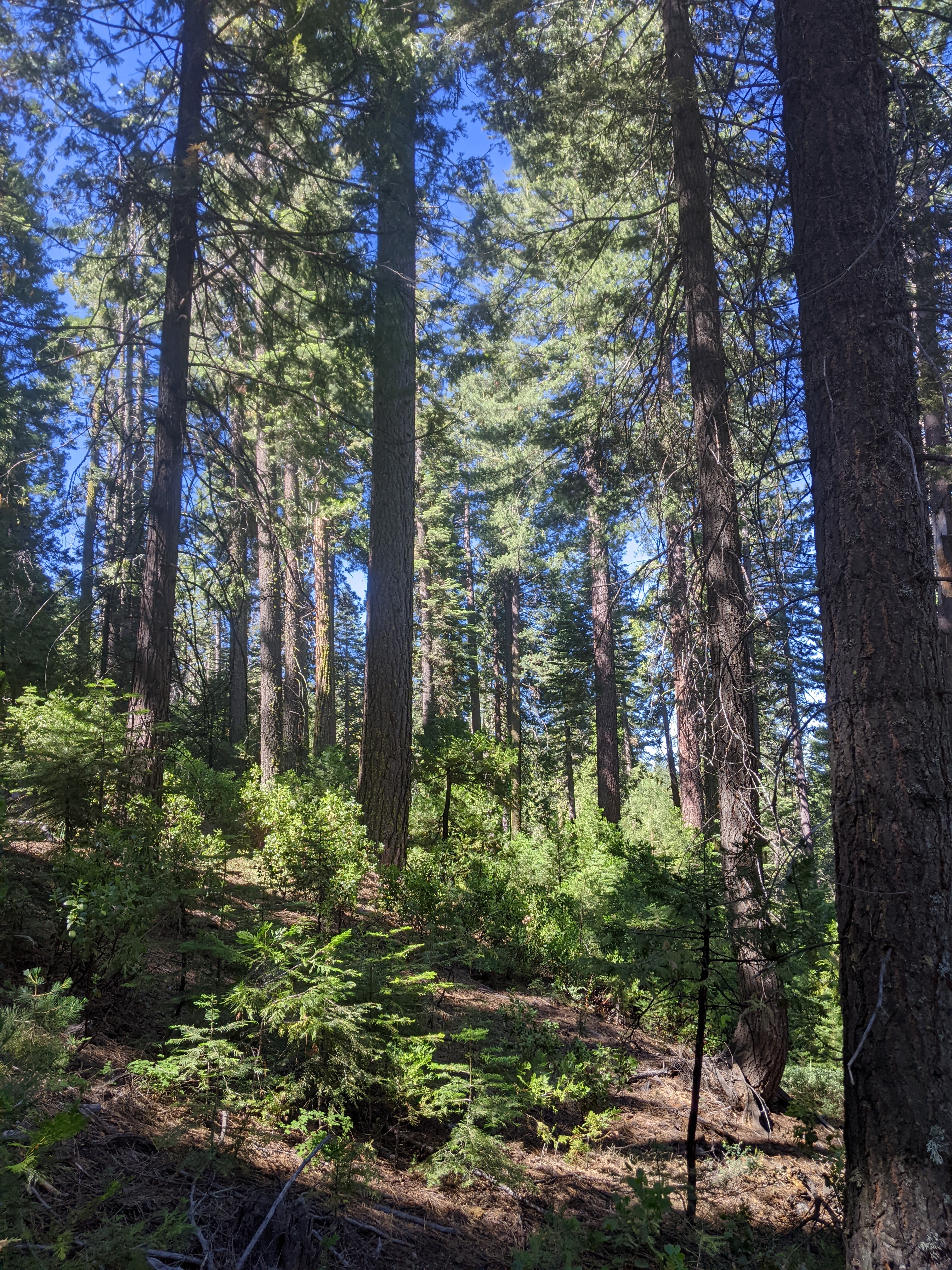
While PACs like this one are fairly easy to negotiate, on others we earn every penny of our summer stipends!

In late June, after roughly two weeks without any goshawks, we arrived early to another one of our PACs—the areas created for us to survey based on Northern Goshawk territory sizes, analysis of goshawk habitat from GIS and private property lines. I am not allowed to reveal the PAC’s location without violating half a dozen National Security laws, but this one looked particularly difficult. We also got off on the wrong foot when I had to walk back to the truck and retrieve batteries for our FoxPro—aka the “FoxSparrow”—the large speaker we use to call for goshawks. As we finally got started, however, we spread out thirty feet from each other, then followed our compasses north down an intensely steep ravine littered with decaying logs. What’s more, this PAC was the shape of a paint splatter, with all sorts of offshoot areas that would require us to walk up and down the sides of ravines over and over. The Mountain Misery we’d experienced at Brushy Hollow had been a piece of cake compared to this.

After six hundred meters of our first transect, Ivara’s voice crackled through the radio. “Whitewash.”

Now, whitewash (the term for bird poop on a branch or base of a tree) could be evidence for any bird species. After all, every bird poops—I’ve seen statues covered in pigeon whitewash in the middle of cities. However, what caught our attention was what Ivara said next: “Lots and lots of whitewash.”

The four of us halted, scanning the ground for evidence of raptors, and I quickly noticed additional whitewash all over the ground and trees around us. And then Sam spoke up.

“I’ve got an active raptor nest.”
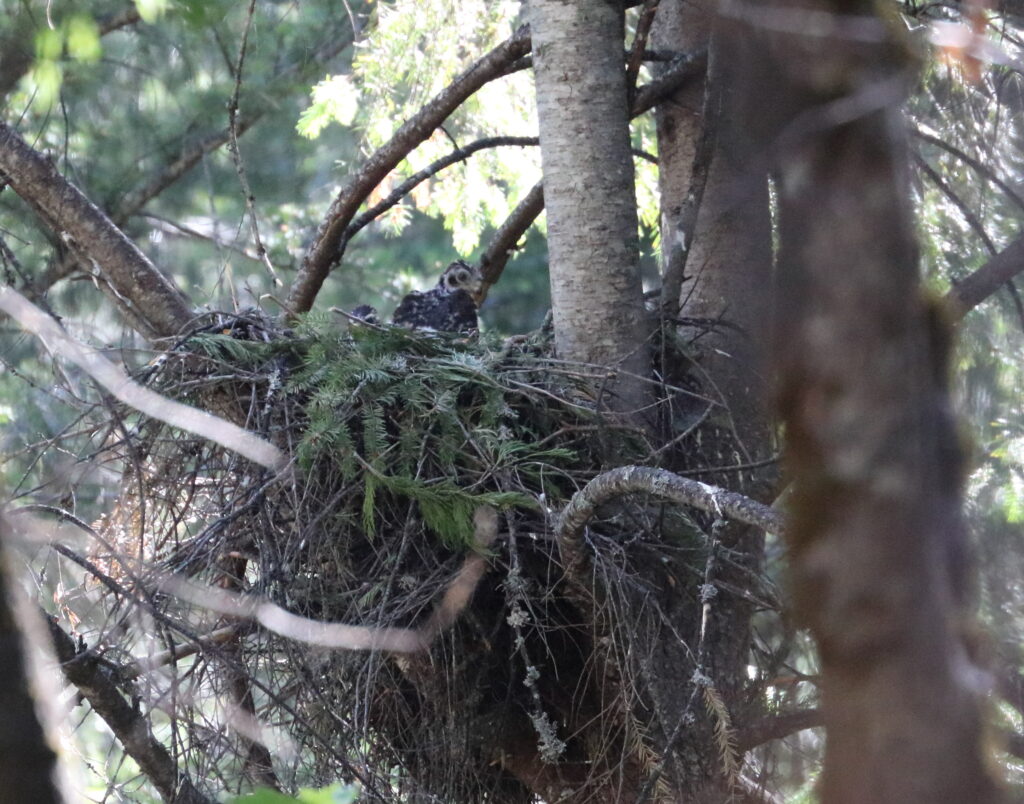
These bizarre-looking Northern Goshawk babies were a real cause célèbre for our crew after searching for weeks to find a new nest.

Within minutes, all four of us had gathered to watch the nest from Sam’s vantage point, puzzling over the chicks inside it. 

“They don’t look like the Red-tailed chicks we saw at Lyon Ridge.”

“Live boughs are a good indication of a goshawk nest.”

“That thing is so shaded. Would a Red-tailed nest there?”

We hiked a little closer, heading to a nearby hill so I could document the nest and chicks with my camera. Then we waited. No one in our crew had much experience identifying baby raptors, although we certainly got good views of them, but it was only a matter of time before the adult returned. Then we’d have our answer.

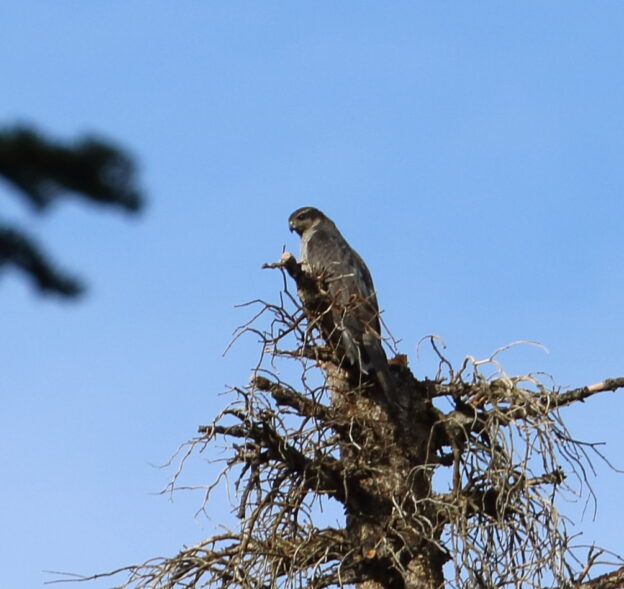
And return the adult did, after about twenty minutes. All four of us heard it simultaneously—the call we’d been broadcasting from the FoxSparrow for the last two weeks. The goshawk appeared through the trees, heading right for us. It swooped low, then alighted on a branch above our heads, immediately giving me the best looks I’d ever had of a Northern Goshawk. Miles and Sam quickly went off down the slope towards the nest tree to look for prey remains and identify the tree species, and the adult began to circle us, screaming its head off. After we collected the information we needed, we took one last look at the majestic creature and its babies, then got out of there.
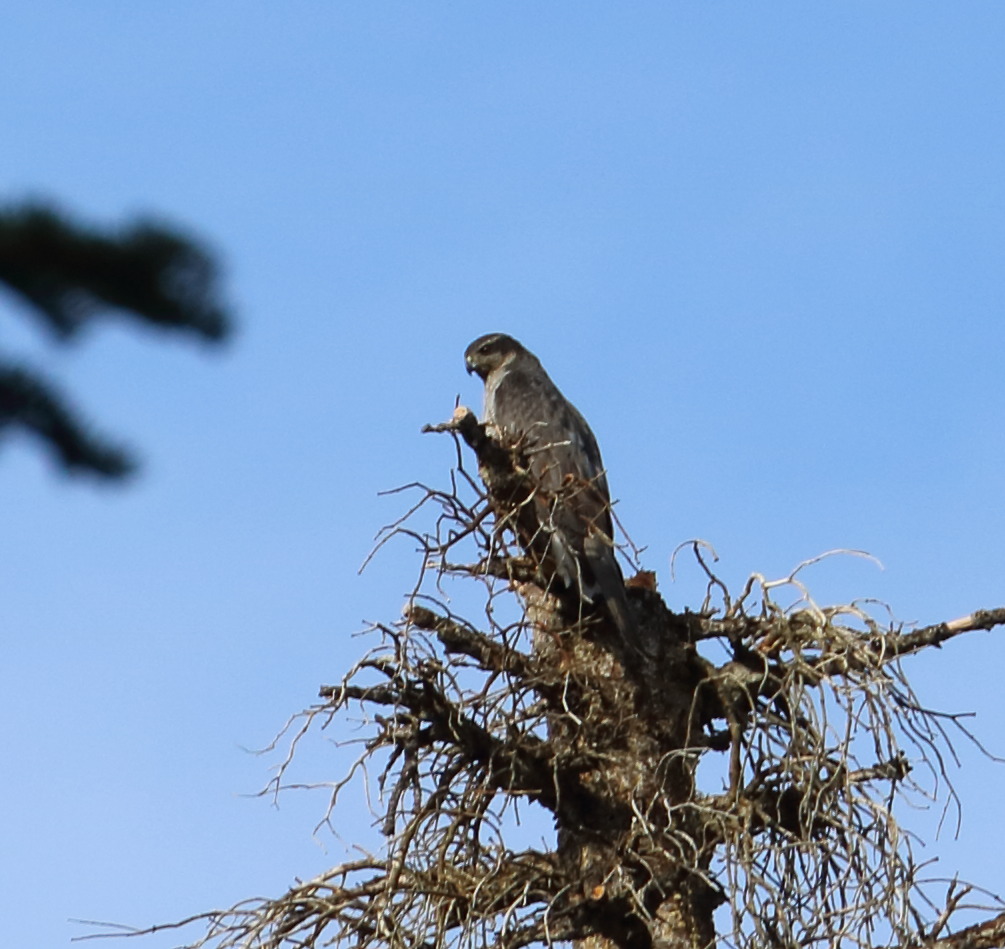
Our patience waiting at our first “self-found” NOGO nest was rewarded when this adult returned to check us out and try to drive us away.

It was our first nest of the season, and the first goshawks we’d detected all on our own! Arriving back at the truck at roughly 9 in the morning, we crossed the PAC off of our list, then headed into town to pick up some celebratory s’mores.
Braden’s Tales from the High Sierras, Episode 1: Stumbling into Saw-whets

We want to thank all of you for making June our biggest month ever at FatherSonBirding! The number of you viewing our posts absolutely demolished all previous records with more than 1300 visits to our site. We kick off July with the first of a series of posts from Braden. Since early June, he has been working as a field intern for The Institute for Bird Populations. His job? Monitoring Northern Goshawks on the west slope of California’s Sierras. While searching for the elusive accipiters, he and his four-person team are having birding adventures most of us only dream about. Here is his first field report: an encounter with Northern Saw-whet Owls.

Northern Saw-whet Owl

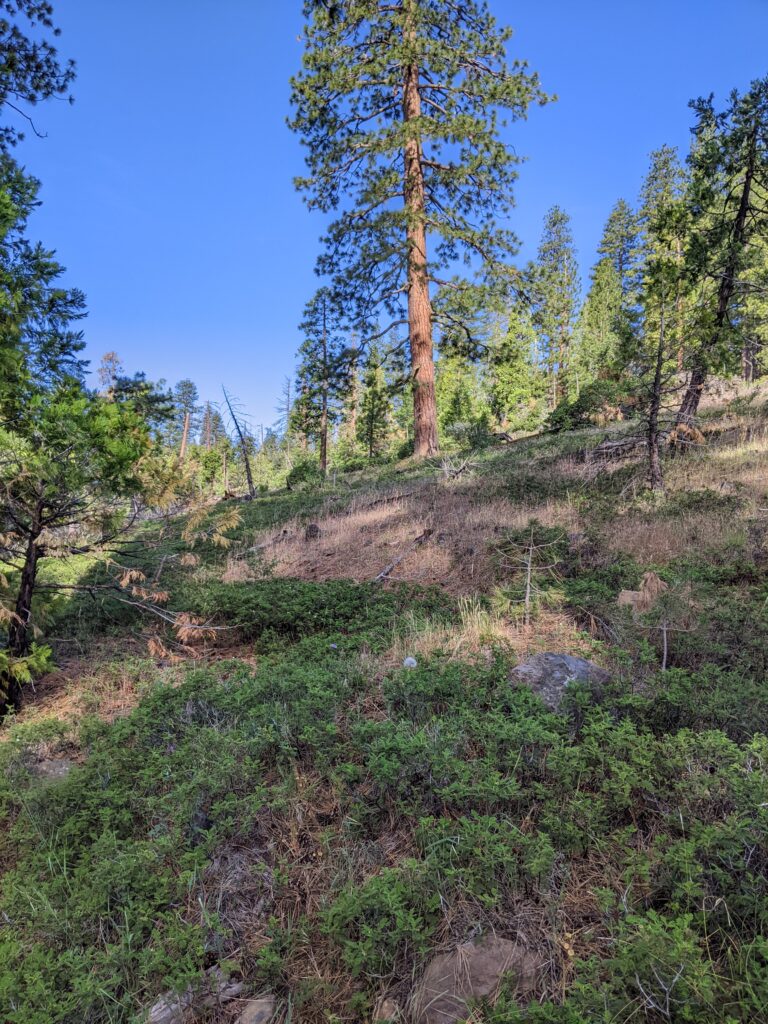
In our first week on the job my team leader, Ivara, decided that we would get the Black Oak PAC over with. A PAC is basically an area of land chosen kind of arbitrarily based on goshawk habitat, territory size and private land boundaries that we survey, and we usually try to complete a PAC every two days. Black Oak was by far the toughest PAC, but we dove right in, bushwhacking through brush in search of any signs of Northern Goshawks. Unfortunately, we couldn’t really focus on scanning the trees above us for nests given the sheer density of the vegetation growing on the slope in front of us. While birds certainly loved all of the brush, with Fox Sparrows and Nashville Warblers singing from exposed perches around me, the foliage did not welcome me as it did them. After about thirty minutes, I found myself wildly off my compass bearing, following the edge of an intimidating thicket in an attempt to get back to my correct line. We considered being five degrees off as “off course”. I was off by thirty!

Some of the typical Sierras terrain where we conduct our Northern Goshawk Surveys.

I took a deep breath, plunging into the vegetation in the direction of my coworkers and my correct bearing. I bent to avoid spiderwebs stretching between branches, jumping on top of decaying logs at any chance I got to relieve myself from the sticks that drew blood from my legs. After about fifty meters, the brush somehow worsened. I couldn’t see three feet in front of me, but I pressed on. And suddenly, I flushed a bird.

At first, my mind went to American Robin. It was a medium-sized, brown species, and it darted away from me as if planning to disappear into the impossible maze ahead. Instead, it landed on a nearby tree branch. I lifted my binoculars, peering through a small gap in the leaves, and exhaled in shock. My voice quavered as I spoke into my radio.

“Holy cow. I just found a baby Saw-whet Owl.”

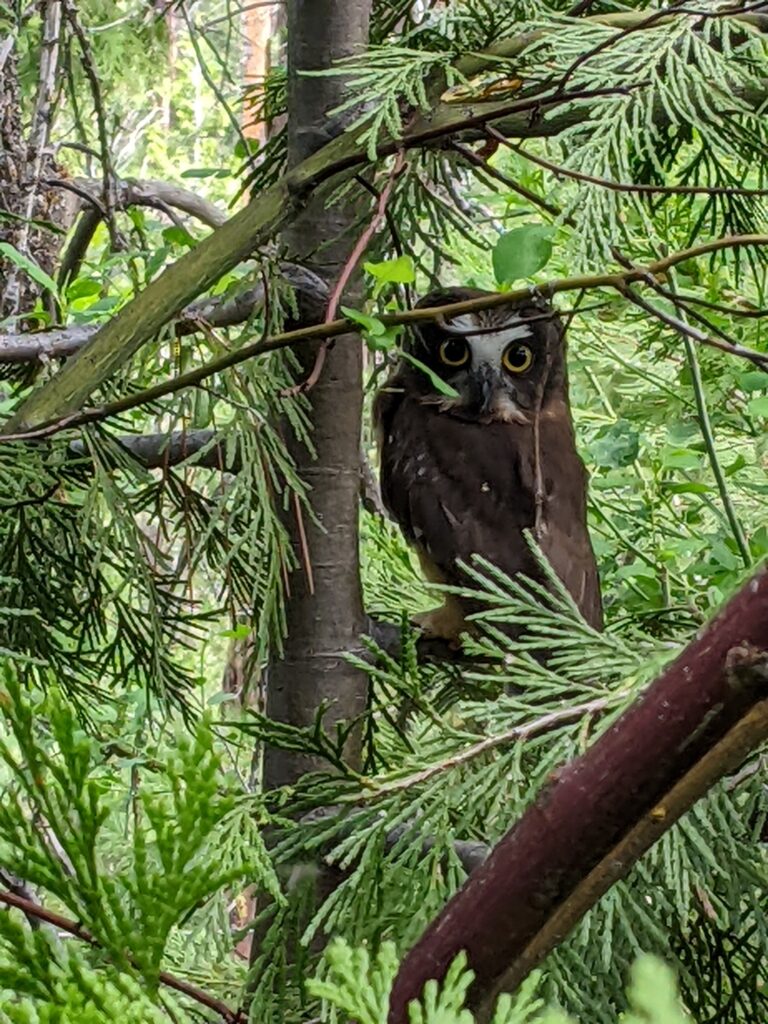
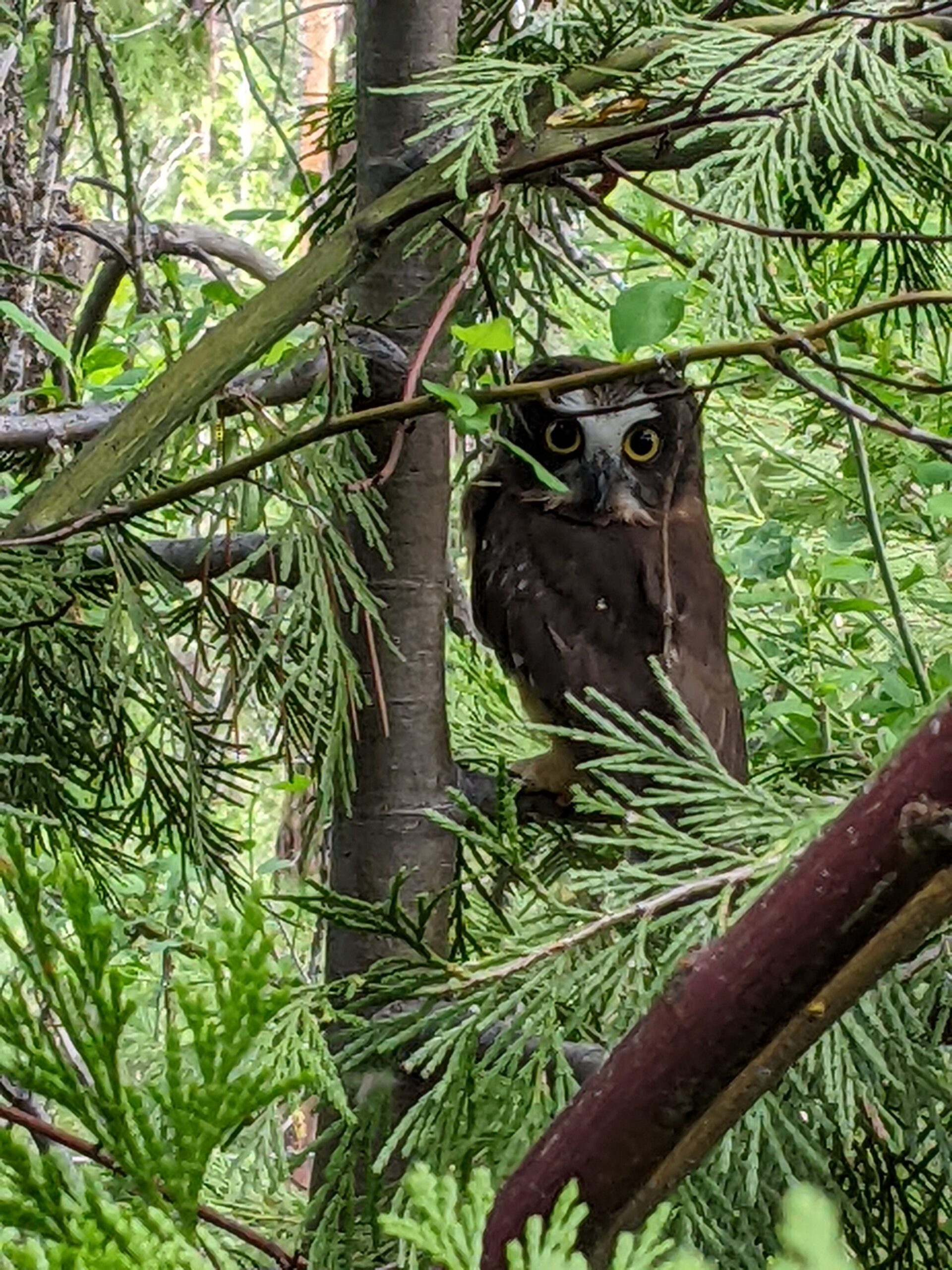
I’d only seen pictures of juvenile Saw-whets once before, on a checklist from Missoula that I’d stared at with jealousy. This bird stared right back at me, its curious, unmoving eyes gazing at the beast that had just disturbed it. The bird’s back was a creamy brown color, adorned with a few spots, and a bushy unibrow accented golden eyes. I could barely see its tiny talons clutching the branch, complemented by buffy feathers that coated its legs.

Unfortunately, I was too lost to direct my coworkers to come see the owls, but I was in no hurry to continue the goshawk search. Our rule: looking for goshawks is important, but so is watching cool wildlife that happens to pop up! On cue, in fact, a second bird flew to a lower branch on the same tree. It was another juvenile owl! My brain registered that it must have just abandoned its day roost mere feet from where I stood. That meant—

My eyes scanned the foliage immediately around me and I saw it: a third baby owl who had not yet flushed in a young pine tree two feet from my face. Staring intensely at me. I didn’t dare move, shifting my gaze between this third, most fearless owl and its siblings in the mature tree behind it. I’d left my camera behind in anticipation of the tough bushwhacking, but slowly snapped a few photos with my phone. I’d never found a roosting owl all on my own before, and here I’d just blundered into three! 

This third, and most fearless, of the three baby Saw-whet Owls I discovered will forever be one of my most memorable birding encounters.

After about twenty minutes of staring contests with the cutest birds I’ve ever seen, I slowly backed out the way I had come, taking a left into more brush. Soon, I was on my stomach, army-crawling through somehow-worse vegetation, but I couldn’t be happier. Little did I know that this would mark only the first of many unforgettable wildlife encounters I would experience in the coming weeks . . .

Our First Guest Post: “Rare Rail Round-ups” by Nick Ramsey!

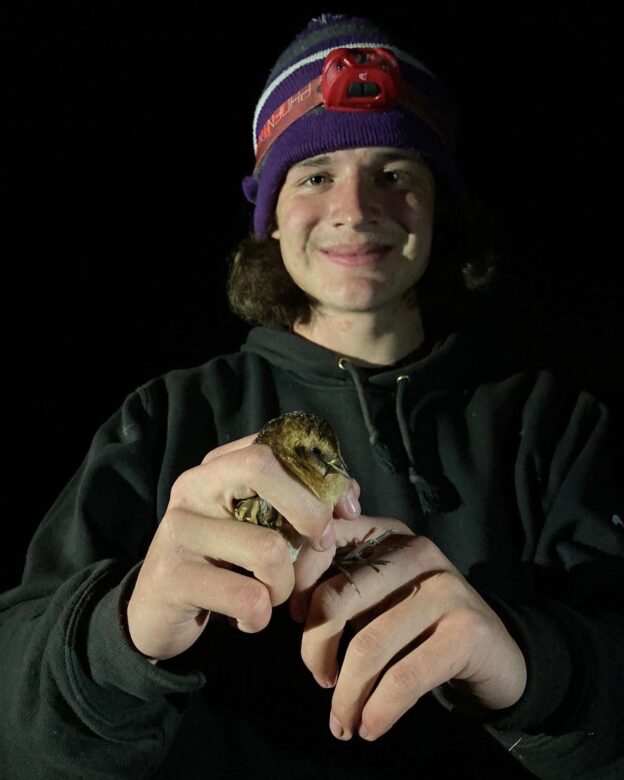
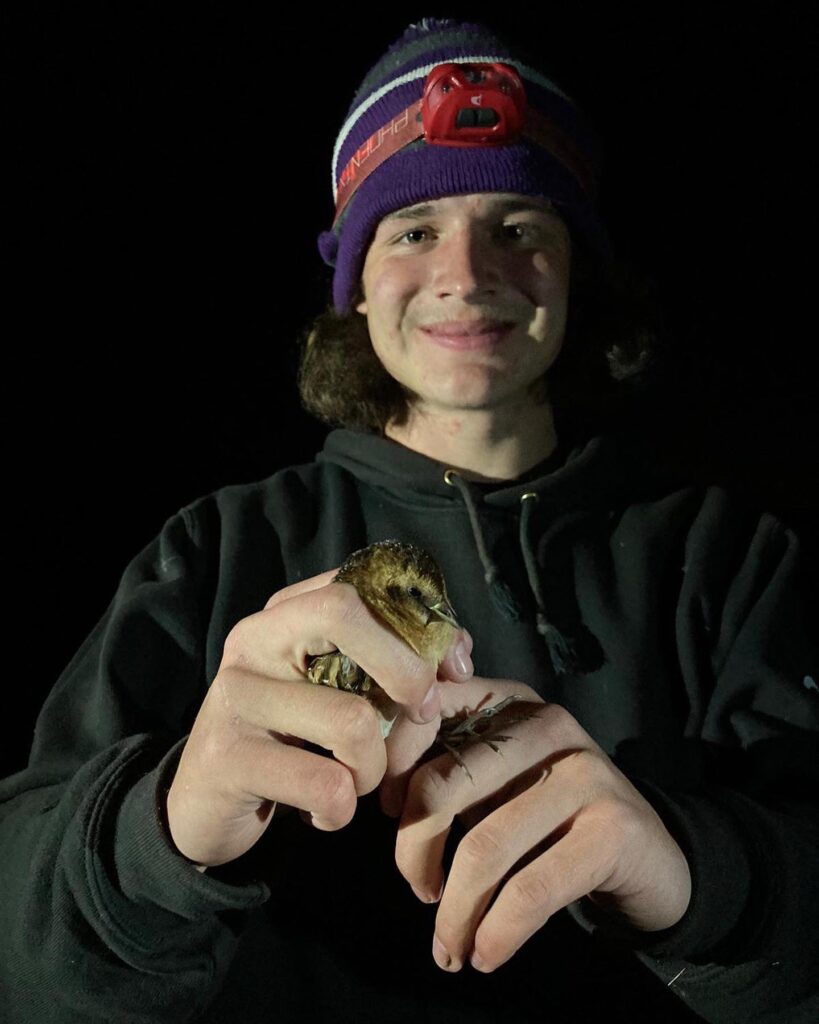
This week we are thrilled to offer a post by our good friend and Montana Native Son, Nick Ramsey. Helping to lead a new wave of outstanding young birders dispersing throughout the country, Nick was there at the beginning as Braden and I took our first tentative steps into serious birding. The list of “firsts” he showed us would take up a whole blog by itself, but includes our first Black Terns, Northern Saw-whet Owl, and perhaps most memorable, Sprague’s Pipit. Currently, Nick is a sophomore at Louisiana State University majoring in Natural Resource Management and Ecology with an emphasis on Wildlife Ecology. We hope this is the first of many blogs he will write for FatherSonBirding. (Nick shown here holding a Yellow Rail.)

Our Special Guest Contributor Nick Ramsey holding a Yellow Rail captured for banding.

Yellow Rails are one of the most sought-after, most elusive species for birders in North America. Usually, they are near impossible to see. Most people that have them on their lists have gone in the evening to tall upland marshes in their northern breeding range, just to hear a soft song akin to pebbles getting hit together. Finding one in the winter is nearly impossible – right?

Not quite. I’ve serendipitously encountered Yellow Rails twice. Once, in eastern Montana with Braden and Sneed, we were looking at our lifer Nelson’s Sparrows at Bowdoin National Wildlife Refuge, one of their westernmost breeding sites in the state. The habitat looked great for Yellow Rails, and it was on the back of my mind. While I was taking photos of the sparrows, Braden asked for us to be quiet. Soon, I heard what he was hearing – the clicking of a distant Yellow Rail! And in broad daylight, no less! A lifer for all of us, and quite a rarity for the state of Montana, although there were historical records from the area. We were never able to see the bird, which is just part of the experience with Yellow Rails. 

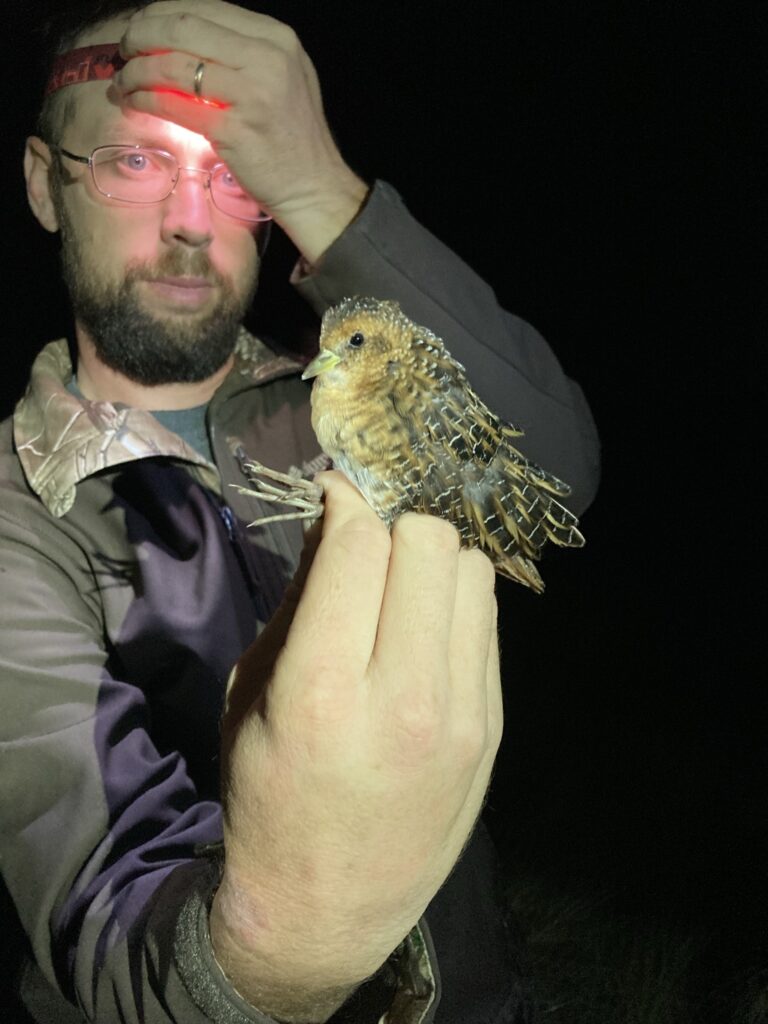
Audubon Marshbird Biologist Jonathon Lueck holding a secretive Yellow Rail—a bird Nick, Braden, and Sneed first encountered at Bowdoin National Wildlife Refuge.

The second time, I was stomping around an old helipad at St. Mark’s National WIldlife Refuge in the Florida Panhandle. The tall, wet grass was home to a wintering LeConte’s Sparrow and potentially Henslow’s Sparrows. As I worked the grasses, hoping to flush one of these seldom-seen sparrows, a bird jumped up. It wasn’t much bigger than the sparrows I was searching for, but its legs were dangling beneath it. And – it had white secondaries!! It was a Yellow Rail! It landed only about 15 feet from me, but despite another hour of searching I was unable to flush it again. I was hooked – these shy rails had quickly become one of my favorite birds.

In Louisiana there is an active effort to survey populations of Yellow Rails, in conjunction with work on endangered Black Rails and other secretive marsh species. We are also home to the Yellow Rails and Rice Festival, where people from all over flock to Louisiana’s rice fields as combines flush rails during the rice harvest. Researchers use this opportunity to band rails and monitor Yellow Rail populations. As with most conservation efforts, they operate on a tight budget, so they love volunteers. They especially love college students, because when we trip in a marsh or a rice field after chasing a rail, we bounce. The older subset of birders that volunteer is not quite as bouncy. 

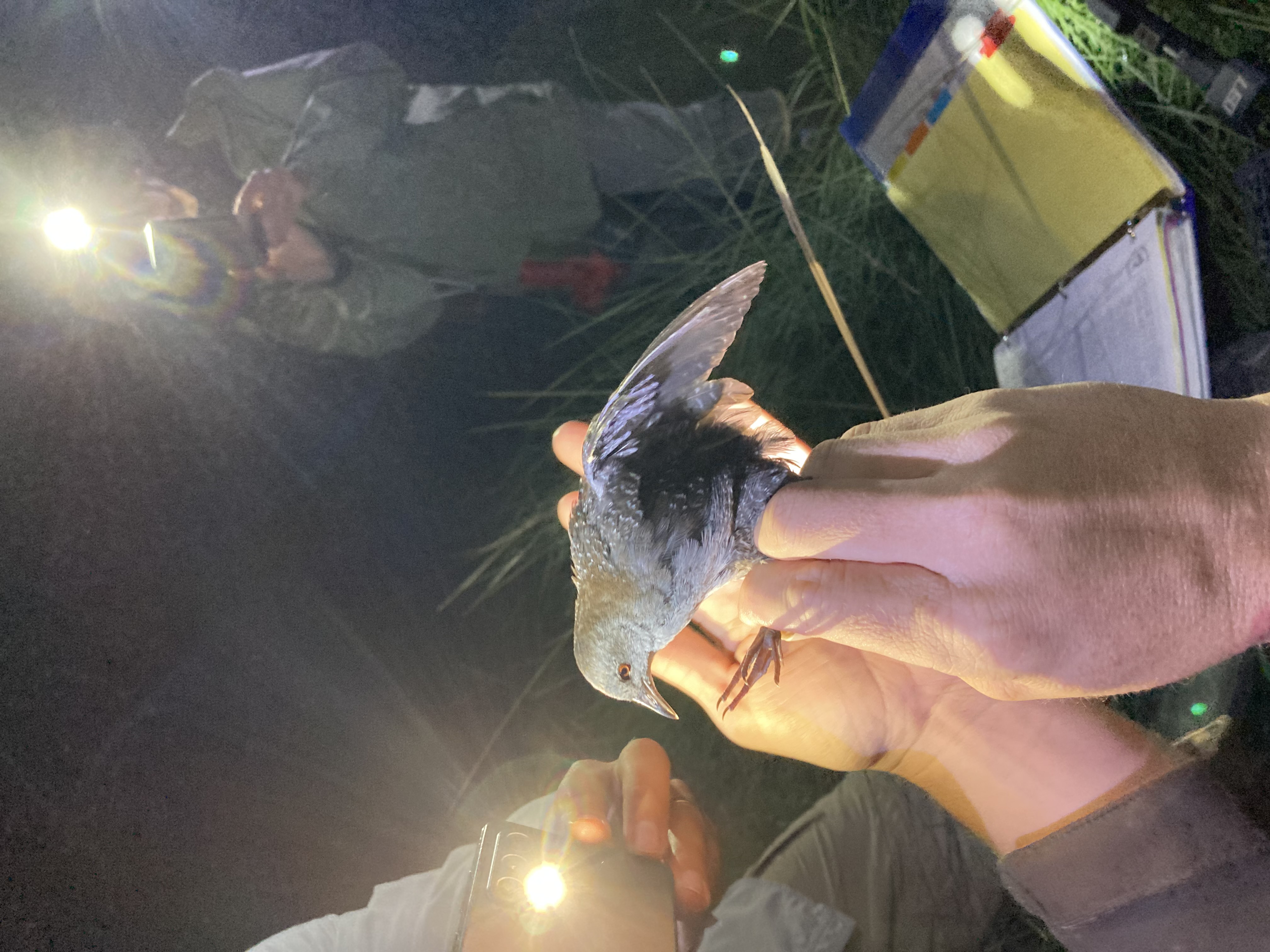
Jonathon Lueck holding a prized Black Rail.

On three occasions this winter, I’ve been able to volunteer on rail surveys, targeting Black, Yellow, and other rails. The primary method for these surveys is the “rail drag.” Four to eight people drag a rope about 50 feet long through prime rail habitat – wetter for Clapper, King, and Virginia Rails, dryer high marsh for Black and Yellow Rails. The line is fixed with a few gallon jugs full of cat toys spread out evenly. These serve two purposes. First, they weigh the line down, assuring no rails just hide in the grass while the line passes over them, and second, they make a ton of noise, frightening the rails into flight. These drags are conducted at night, and everyone carries a net and a flashlight. Once a rail is spotted, the lights temporarily freeze the bird and we gallop through the marsh to go catch it! This is my favorite part. 

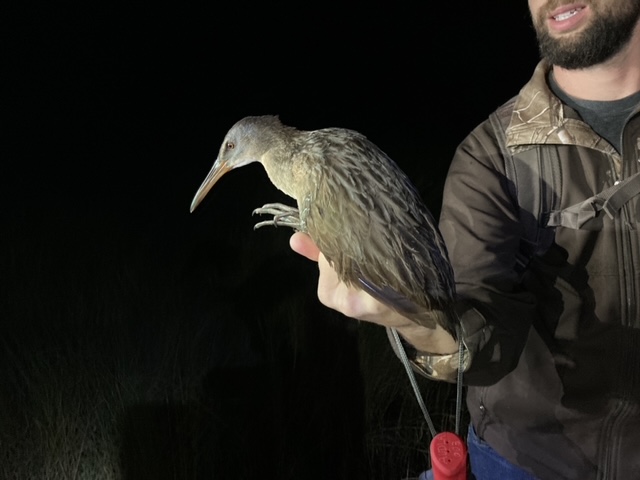
Jonathon Lueck with a Clapper Rail in hand.

The first time this winter that I volunteered we were lucky to catch Black, Clapper, Yellow, and Virginia Rails on the Cameron Coast of southwest Louisiana. I personally netted a clapper, and chased after lots of other birds. We also netted a couple of Sedge Wrens, abundant in the drier marshes we dragged. Several weeks later, I was able to get back out to the Cameron coast with my friends Kraig and Ravynn, who’d never birded outside of Baton Rouge. After a fruitful day birding near the coast with 100 species, including my stater White-tailed Kite and over thirty lifers for my friends, we set out to go catch some rails. We met Audubon Delta’s marsh bird biologist, Jonathan Lueck, as well as a couple other volunteers, at the site. Jonathan is a character – he had a skinned-out otter and a skinned-out raccoon in the bed of his truck amongst the rail netting supplies. He found them on the side of the highway and was using the fur to make gloves, hats, and other products as a side hustle (ornithology is fun, but it doesn’t pay very well.) Jonathan passed out the nets and lights, and we got started! The first two transects didn’t yield anything, but there was another site just down the road that needed to be surveyed as well. On the way back to the car, I flushed a Clapper Rail! Kraig ran ahead and caught it. It was his first time seeing one, and getting to hold it made it that much cooler. After processing the bird, we went to the next site. This one was a lot more productive, yielding two Yellow Rails! We also flushed several of the larger species, but weren’t able to catch them. Kraig was the man of the hour, catching a Yellow Rail and a Clapper (as well as spotting many of our best birds earlier in the day, like Limpkin and American Bittern.) After a great night, we made the three hour drive back to Baton Rouge, capping off 22 hours straight of birding and travel. 

I’ve been very lucky to get involved with a ton of fun research here, and the Yellow Rail banding might be my favorite. Every time we catch one we widen the window into the natural history of these adorable little birds. 

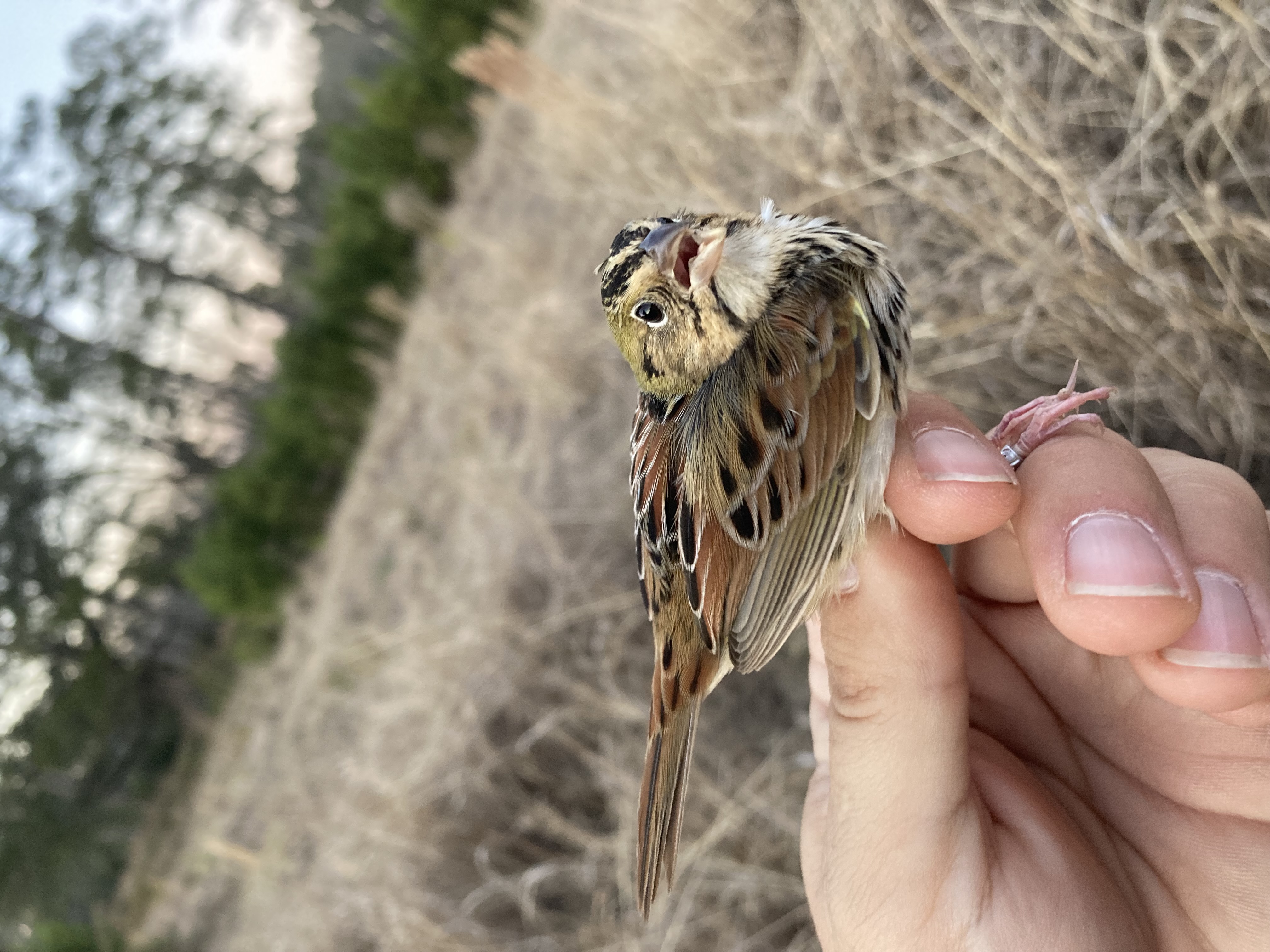
Rail-hunting can lead to some great bonus birds such as this Henslow’s Sparrow with new bird band.

All photos copyrighted, courtesy of Nick Ramsey.

Save an Endangered Bird . . . Magazine! A Review

Please share this post—and don’t forget to subscribe 🙂

News Flash: As if to underscore how difficult it is to keep a magazine going these days—and how much bird-related magazines need our help—as soon as I posted this I learned that Bird Watcher’s Digest was sadly forced to close its doors. But see the next paragraph . . .

Summer 2022 Update: I am happy to announce that Bird Watcher’s Digest is back in business! Its passionate staff found new backers for this venerable bird publishing icon. To subscribe, click here—and you might even find an article by yours truly!

Birds aren’t the only things that need our help these days. So do bird and birding magazines! You all probably know about Audubon, and yes, it is first rate. But are you aware of the many other great birding magazines out there? Braden and I have devoured quite a few and thought it might be useful to share our recommendations. At least a couple of these magazines/organizations have seen a big drop in advertising revenue because of covid and the limitations on bird-related travel, so we encourage you to take the plunge and subscribe or join. Not only will you receive great content, you will help support the larger birding community that is so essential to protecting the birds that we love. And no, we are not being compensated by any of these journals—though we would dearly love a free trip to South Georgia and the South Sandwich Islands. Hello? Is anyone listening? O’well. Here goes:

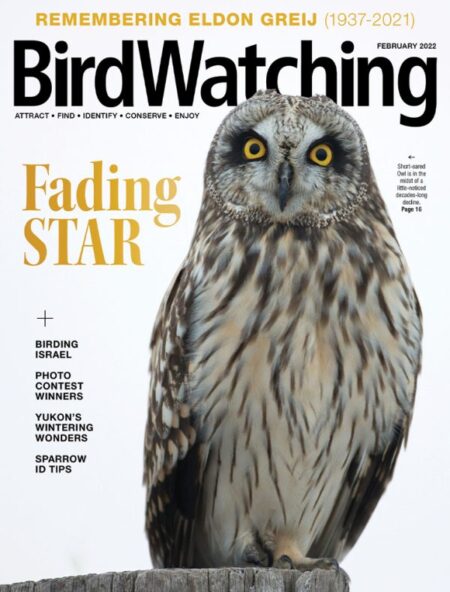
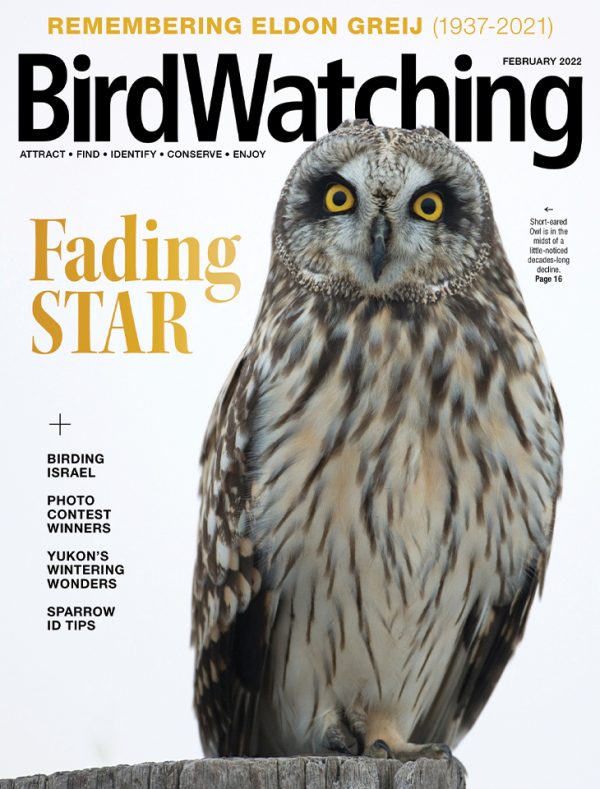
BirdWatching may be my favorite birding magazine—and not just because I write for it. It offers a wonderful variety of news, ID Tips, and science, but also entertaining features on conservation, travel, and photography. It regularly features columns by Laura Erickson, Pete Dunne, Kenn Kaufman, David Allen Sibley and other top birding experts. Subscribe here.

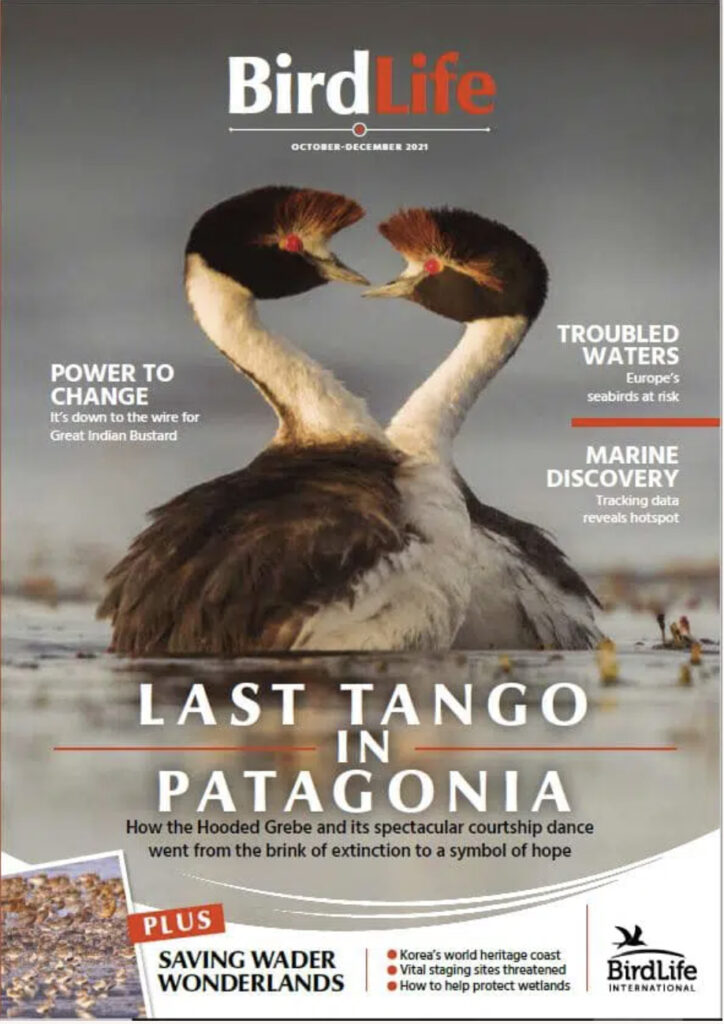
BirdLife is Braden’s favorite magazine because of its focus on bird conservation. This quarterly—which comes with membership to BirdLife International—offers an engaging mix of conservation news, alerts, science, and stories about the group’s many successes. It’s impossible to read this without feeling more engaged and hopeful about what humanity is doing to protect birds. Join here.

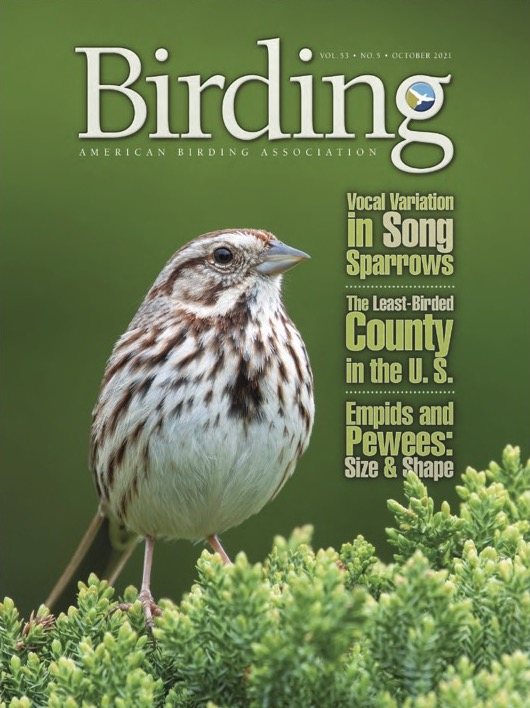
Birding caters to members of the American Birding Association, offering a wonderful mix of articles on birds, birding, travel, science, and conservation. It appeals especially to “listers” but also will interest anyone else with a love of birds. Plus, you will receive other ABA benefits when you join. Join the ABA here.

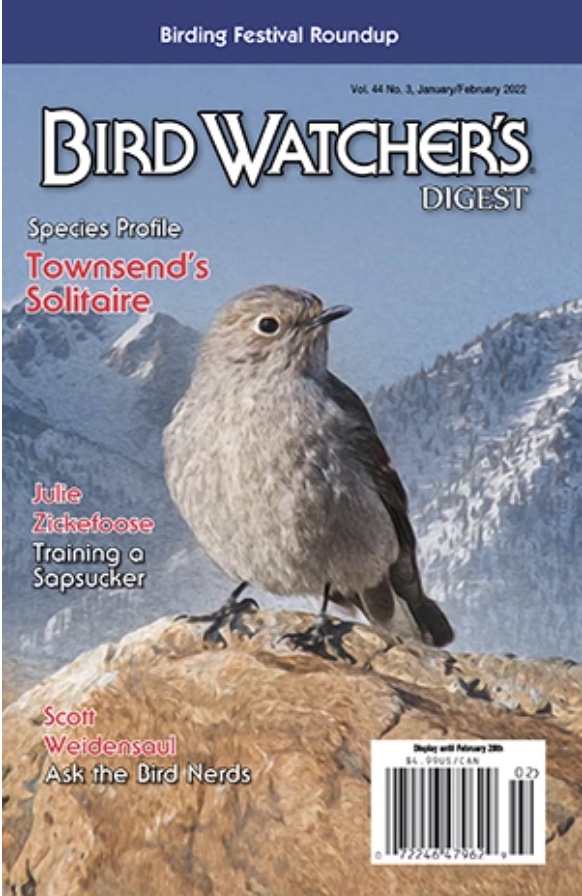
(See note at top of blog!) Bird Watcher’s Digest may be a more familiar name for many of you, and gives off a more informal “Mom and Pop” vibe, but don’t let that fool you. Despite its smaller, “hand-held” trim size, it is loaded with interesting articles, species accounts, ID tips, and other resources that I always find useful. My article “Messier is Betterer” appears in their Jan/Feb electronic version of the magazine. Learn More.

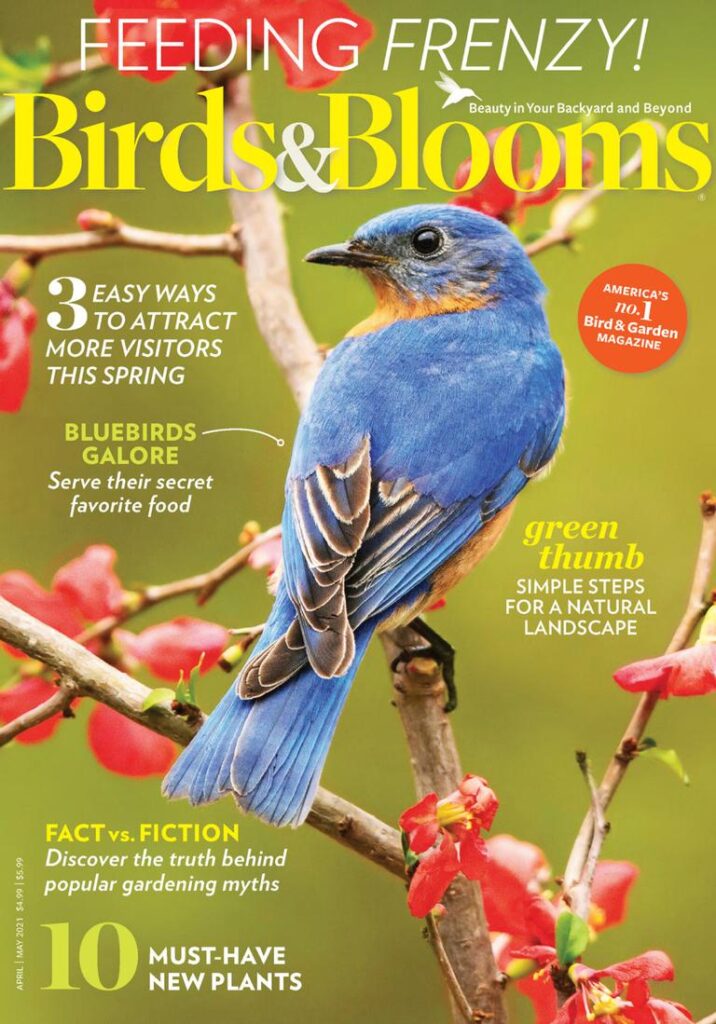
To round out our review, I want to mention Birds & Blooms, a magazine that focuses more on backyard birding and creating gardens that provide birds with the resources they need. It’s definitely given me a greater appreciation of the many plants that benefit birds and butterflies. If only I had more time for yard work! Subscribe here.

HawkWatch Spectacular!

Don’t be shy—subscribe by filling out the box below and to the right!

My recent trip to Texas offered so many rich avian experiences, I am hard-pressed to blog about them all, but one I simply must add is my first—and entirely accidental—visit to a HawkWatch site. It all began when my friend Jeanette Larson, author of the wonderful book Hummingbirds: Facts and Folklore from the Americas, suggested I bird a place I’d never heard of: Hazel Bazemore park just west of Corpus Christi. Waking up the morning after my last HummerBird Celebration event, I threw my stuff in the rental car and headed through Corpus Christi, experiencing a delay of half an hour when I encountered a shorebird-rich target area at a place called Indian Point!

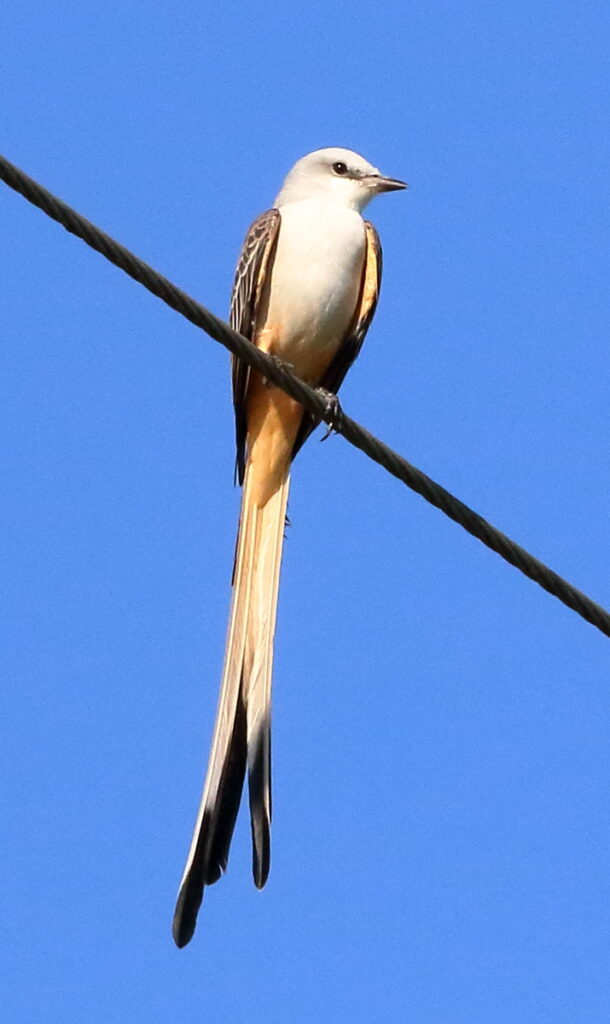
Arriving at Hazel Bazemore, an unassuming park in the suburbs, I spied two people with binoculars and spotting scopes and stopped to ask them where the best places to bird might be. They suggested a couple of spots and let slip that they were there to observe migrating raptors at a platform just across from where we stood. “You can come over and hang out,” they offered, but since they weren’t set up yet, I decided to explore the rest of the park. I’m glad I did as I saw several each Couch’s Kingbirds, Baltimore Orioles, and Scissor-tailed Flycatchers, one of Braden’s and my favorite birds. Little did they prepare me for the main event!

Braden and I have no doubt that the Scissor-tailed Flycatcher should be the Texas State Bird, but instead, their neighbor Oklahoma stole the prize designation!

Looping back to the HawkWatch platform, I watched fascinated as the official observers picked out migrating birds from incredible distances including individual Mississippi Kites, Northern Harriers, Swainson’s Hawks, and more. Just between you and me, I have no idea how they could ID most of them, but assume that thousands of hours staring into the sky had ingrained a mastery of subtle visual and behavioral clues that betrayed each species. A few, such as a Crested Caracara, did fly close enough for me to confirm, but for most, I just had to take their word for it.

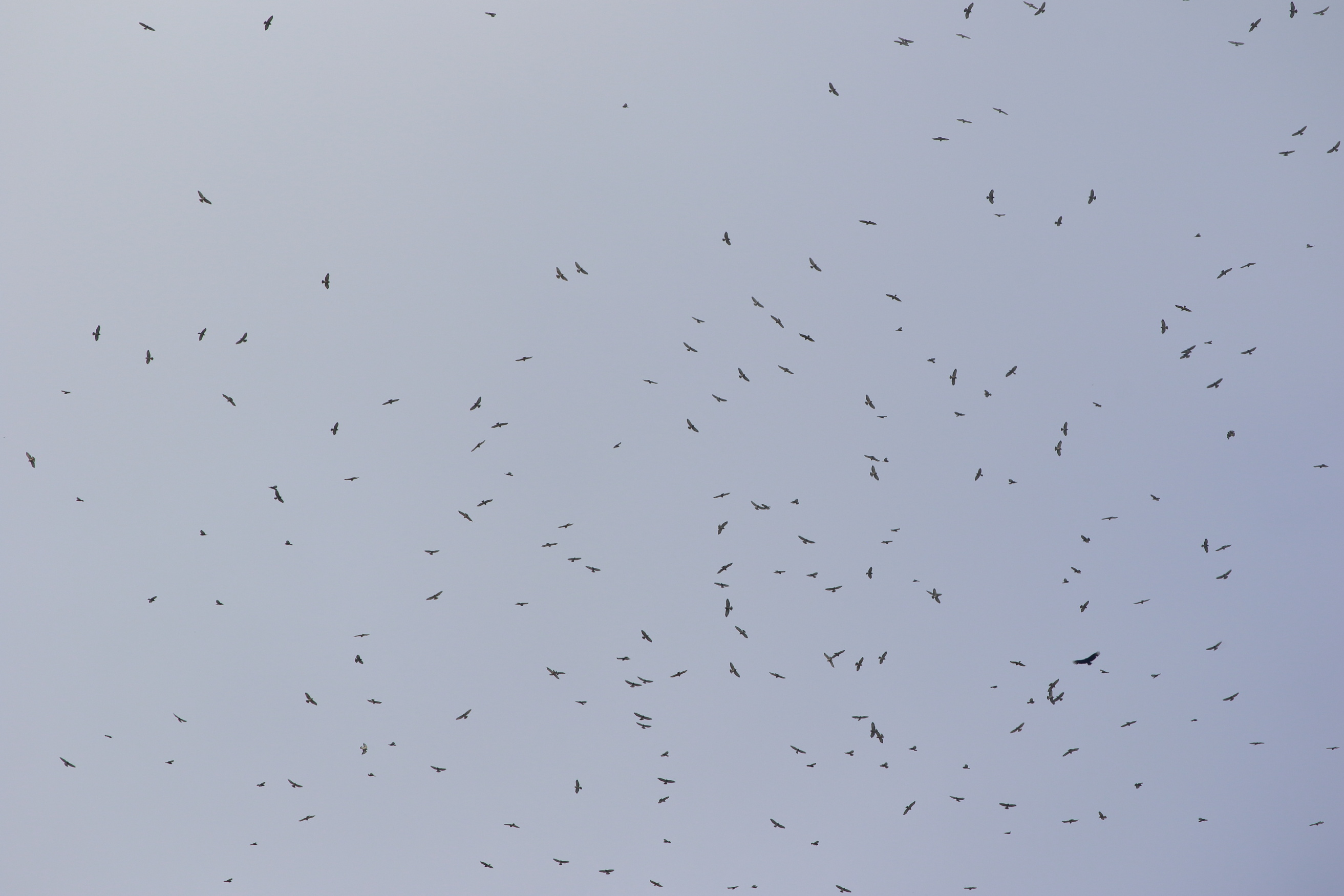
Considering I’d just seen my Lifer Broad-winged Hawk two days before, this kettle of hundreds of Broad-wingeds pretty much gob-smacked me. Can you find the token Turkey Vulture?

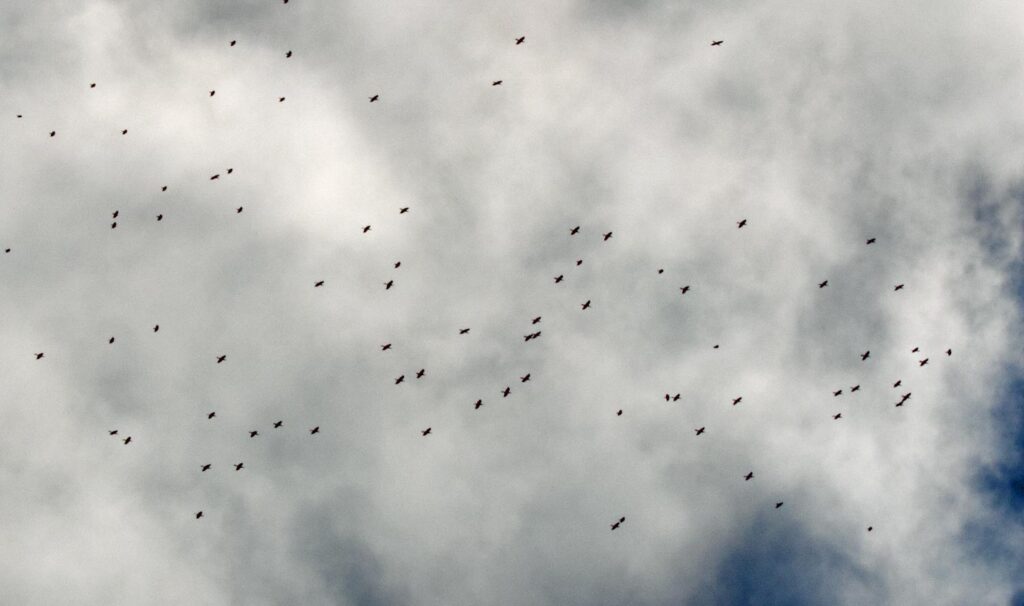
Suddenly, one of the observers shouted, “Big group of Broad-winged Hawks!” I, and several other visitors followed the direction of their scopes and, at first, I saw only clouds and blue sky. Then, I saw them—hundreds of black specks moving toward us! The hawks, accompanied by Turkey Vulture escorts, streamed directly overhead at a height of perhaps three or four thousand feet (I forgot to ask), making me forget everything except this magnificent show above me. They weren’t the last group either, as ten minutes later, another large group streamed by on the invisible river of air overhead. The second group did one better and also began circling, or “kettling”, above us, forming about as magnificent a spectacle as one can imagine. In between the two groups, a formation of about fifty Anhingas migrated by—something I didn’t even know they did, while off in the distance, more than one hundred White Pelicans also circled.

Before this trip, I didn’t even realize that Anhingas migrated. To see a large group fly overhead was nothing short of astonishing!

As if that weren’t enough, I also picked up my Lifer Bronzed Cowbird and ABA Lifer Buff-bellied Hummingbird at feeders next to the platform, both thanks to the keen eyes of a fellow birder who had come to join the bird spectacular. This was all enough to make me more interested in HawkWatch International activities. The organization runs or oversees dozens of sites throughout the world for scientific research purposes, including some sites in my home state of Montana, but I have never been to any. Going forward, this is something I need to change!