
Category Archives: Raptors

Morro Bay Bird Festival report (Guest Post by Scott Callow)

(All photos copyright Steve Rosso or Scott Callow.)

My former work colleague, Steve, and I spent 2 hours deciding which walks and talks we would do at our first winter Morro Bay Bird Festival. It was just over a week since the registration opened. Everything we chose turned out to be full, even with over 263 events, 191 of them field trips.  Lesson learned. (We later learned that the Pelagic Boat Trip filled within an hour.) We were able to sign up for two outings, a Big Day at the inland Santa Margarita Lake and a “Back of the Bay” walk in Los Osos. Steve also made the wise demand to stop at the Pinnacles National Monument on our way down, and convinced me to spend the extra money ($55) on a boating tour of Morro Bay itself. (Readers are encouraged to open up a map of the region.)

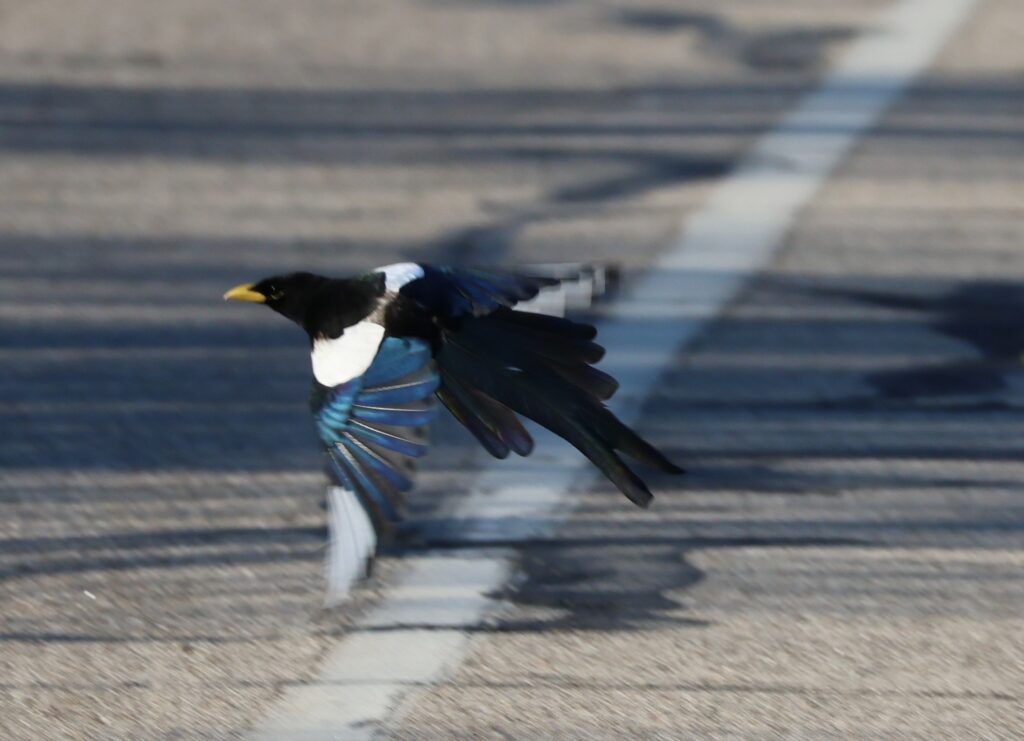
On our trip down, we got good looks at a well-known California endemic, Yellow-billed Magpie (see post “College Search Birding in California”).

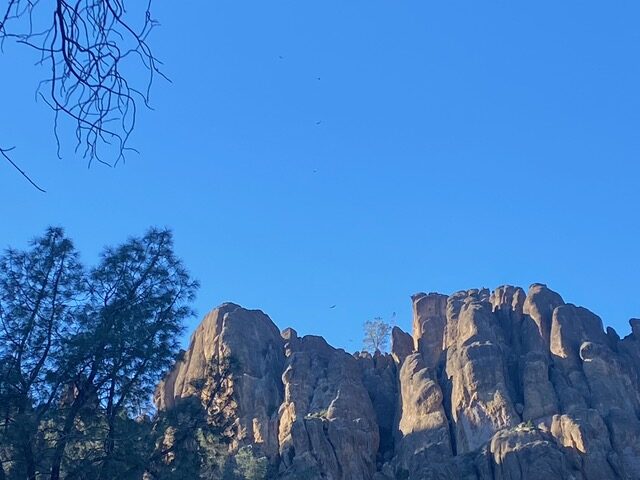
Our first stop was along the lonely Highway 25 between Hollister and Pinnacles’ east entrance. We badly wanted one soaring raptor to be a California Condor but it turned out to be a Golden Eagle. Later (2-3pm), at the observation overlook a mile up the Condor Gulch Trail, more than 15 dark soaring birds suddenly appeared as a group from behind the eroded sandstone Hain’s Peak. I confidently identified four as Condors, one as a Golden Eagle (clearly seeing the difference between each’s white markings on the undersides), and many Turkey Vultures. Steve’s new camera clicked away. At the trailhead, a ranger told us that, years ago, the population was below 10 individuals when reintroduction began and now the local population had swelled to “three digits.”

Pinnacles National Park. And yes, at least some of those black specks are California Condors!

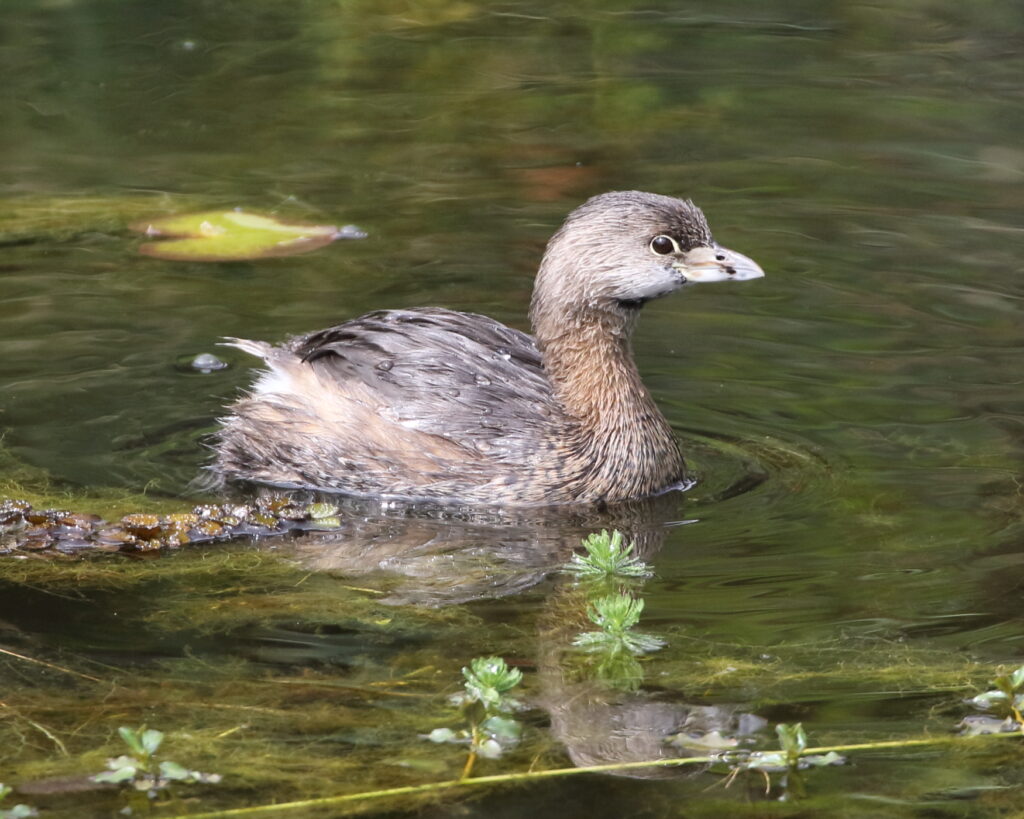
The next morning we embarked on our first festival field trip: a Big Day at Santa Margarita Lake. It was led by Mark Holmgren, retired curator of the natural history museum and collection at UC Santa Barbara (my alma mater and where Sneed got his master’s degree). Highlights included comparing Eared, Horned, Western, Clark’s and Pied-billed Grebes, listening to Fox’s Sparrows, California Thrashers, and Wrentits, and observing raptor behavior. Speaking of, we saw Ospreys and Bald Eagles fishing (one birder theorized the adult eagles were teaching the juvenile), two Peregrine falcons mobbing a raven, and two Peregrines (perhaps the same) apparently fighting over food in mid-air or in courtship display. I got good looks at the yellow lores of a White-throated Sparrow.

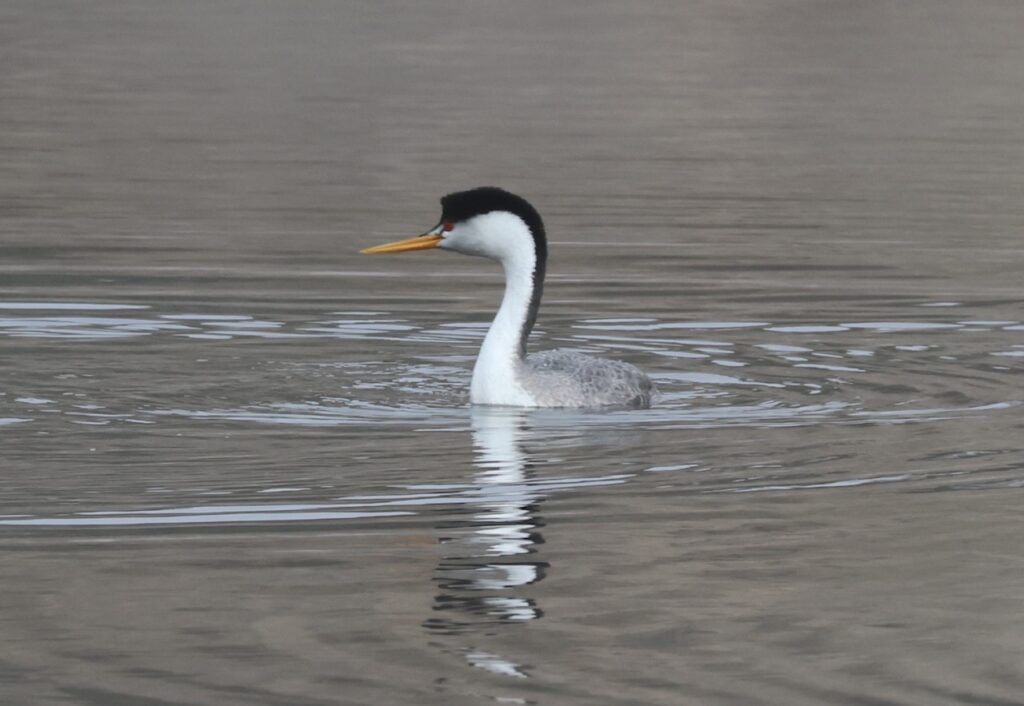
Winter is a nice time to compare Clark’s (shown here) and Western Grebes, which can sometimes be difficult to tell apart. Clark’s Grebes have more orangish bills versus greenish-yellowish on Westerns. The black also rises above the eye on Clark’s, though that’s not as clear-cut on this individual.

Tired from our long day, we drove to the Morro Bay Community Center downtown and attended one of the two  receptions. Included in the cost of registration were free local wines (multiple pours allowed), and extensive noshing trays of cheese, meats, veggies, crackers, and artisan chocolates.  The adjacent bazaar impressed with booths for 3-4 high-end binocular/gear manufacturers, book shops, authors, nature art and nature organizations. The bazaar was well attended and the noise generated rivaled that of a Spring morning chorus.

The bird fest’s exhibit area had a nice variety of vendors and non-profits to occupy us between birding trips, talks, and meals.

Our dinner at Morro Bay’s affordable, healthy and creative Asian fusion cafe, Chowa Bowl is recommended, as is the lunch combo Big Deal of sushi roll and ramen noodles at Baywood-Los Osos’ funky hangout, Kuma. This is important info to a birder even though food and beverages are barely mentioned in The Avian Survival Kit chapter of Birding for Boomers. Good food and libations can elevate a birding trip. (Editor’s Note: We at FSB take exception to this criticism, as we have frequently mentioned fine dining establishments such as McDonald’s, Wendy’s, and Starbucks.)

Next day’s Back of the Bay trip was not only highlighted by lunch, but by Audubon’s Sweet Springs Nature Preserve. It’s a small preserve with a spring-fed creek and excellent views from its wooden observation decks of the bay’s mudflats and its shorebirds, ducks, gulls, and terns—tons of them (which is saying a lot since birds are so light.) With Morro Rock and Morro Dunes in the background, we saw Lesser and Western Sandpipers, too many Brants to count, 30+ Green-winged Teals, 4 Blue-winged Teals, American Wigeon, Northern Shoveler, Bufflehead, Long-billed Curlew, Killdeer, Black-bellied Plover, Great Egret, and Greater Yellowlegs. We learned the Greater has three notes in its call compared to the two notes of the Lesser. Ring-billed Gulls, Belted Kingfishers, and Forster’s Terns were seen flying above the bay.

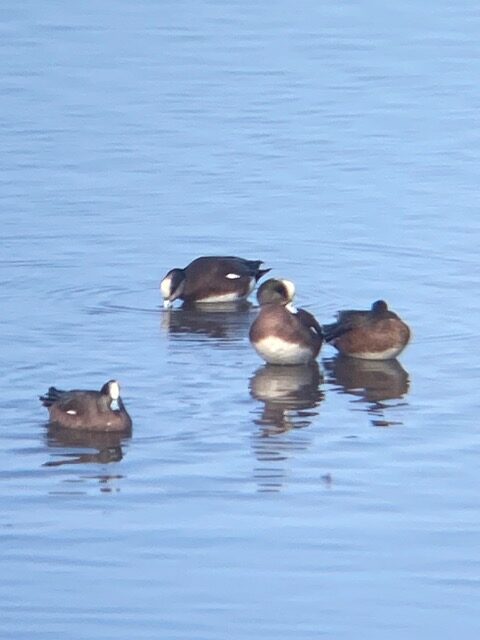
These are the ducks that inspired The Guess Who’s 1970 Number One single “American Wigeon”. Fun Fact: Sneed saw The Guess Who’s lead singer, Burton Cummings, perform this song live in Rapid City, South Dakota in 1977. Sneed was favorably impressed by this performance—until ZZ Top took the stage and basically burned the place down.

In the narrow woodland area between street and bay we saw both Hairy and Nuttall’s Woodpeckers, and Chestnut-backed Chickadee. Then, local guide Dean led our car caravan down the road apiece to his friend’s house which sported about six bird feeders that earned a hot spot ranking on eBird. More chickadees, the ubiquitous House Finch, the most common local warblers—Yellow-rumped, Orange-crowned, Townsend’s—and Lincoln’s, Golden-crowned and White-crowned Sparrows. We also saw our Oak Titmouse, formerly lumped with Plain Titmouse, at the bird feeders. Its range is mostly endemic to California (stretching into parts of Oregon and Mexico) and the bird shares its place with the Acorn Woodpecker as a signature species in California’s oak woodlands.

Dean also shared his mnemonic for our (Pacific Group) White-crowned Sparrow – “Awf man!, I dough-ont wanna see”. It’s a bit of a stretch but “I don’t want to see” sums up many people’s  self-engineered denials of science nowadays, so I decided to add it to my mnemonic checklist.

The rarity highlight of the trip was the sole Blue-winged/Cinnamon Teal hybrid. I “put good eyes on it” but Steve left his camera in the car because he logically thought he’d get better shorebird and bay bird shots on the following day’s boating trip.

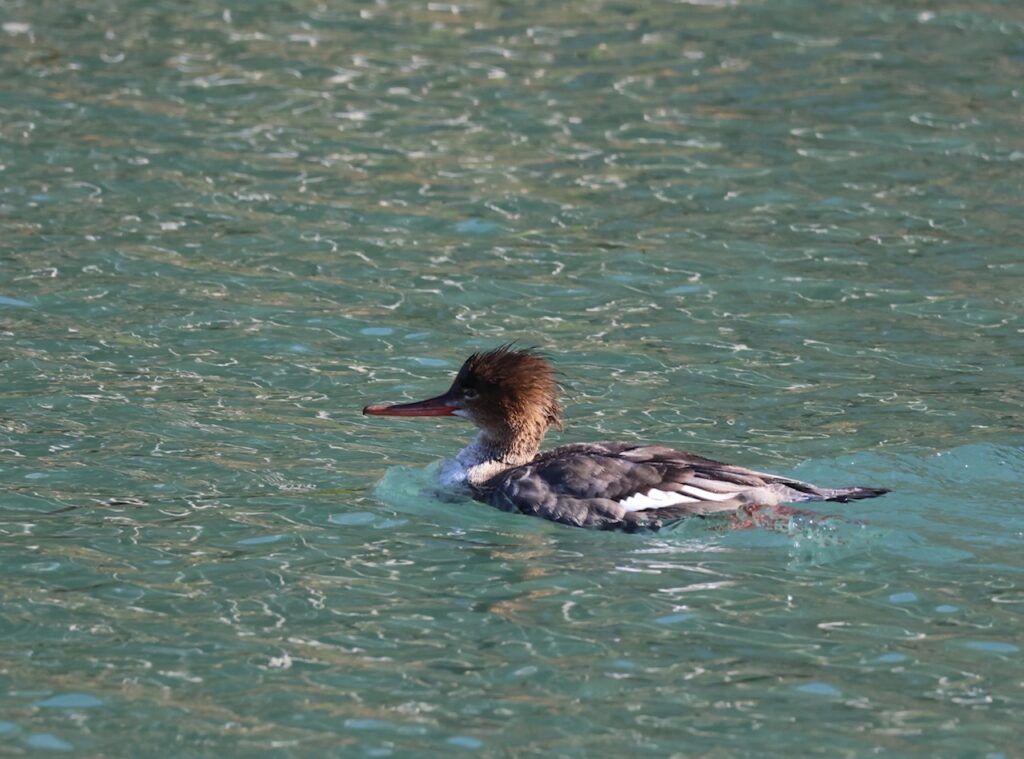
Female, juvenile, and nonbreeding Red-breasted Mergansers (above) can be difficult to distinguish from Common Mergansers, especially in winter, when they can be swimming side by side. We think this is a Red-breasted because of its a) slightly thinner, upturned bill b) indistinct transition between the brown and gray on its neck and c) its crazier “hair-do”.

Our inside-the-bay boat trip the next day also included a fellow (and local) birder, Mike, who led bird trips. Steve and I learned a lot from him. The trip was created as a photography outing and the leader focused on pointing out good shots. The captain, also a birder, put the boat in good lighting and locations for the photographers. We were inspired to overtip him. The trip started in a downtown marina and we made a loop up to Morro Rock, along the rock jetties past the bay’s opening to the ocean, and then back into the bay to the mudflats of the Morro Bay Estuary. As we returned back to the docks, we passed the Morro Bay State Park Boardwalk, the Museum of Natural History, the Morro Bay Water Access, and Heron Rookery Natural Preserve—all excellent spots to bird from the shore, and perfect for photographers from the water due to the sun’s location.

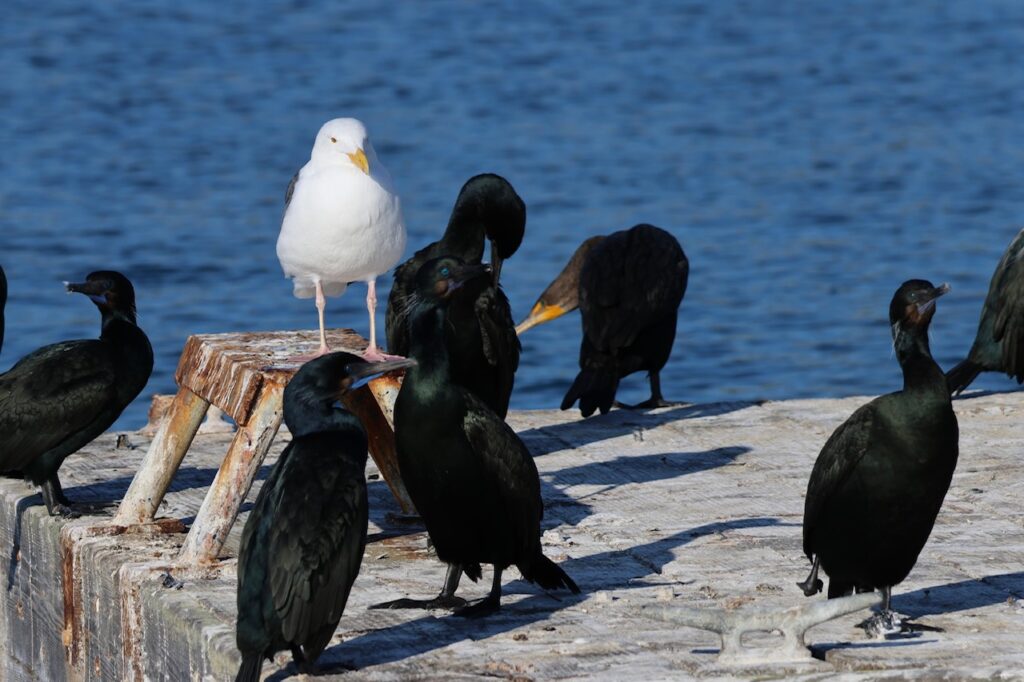
We saw Peregrine Falcons above The Rock, Black Oystercatchers and Black Turnstones on the rocks, Black-crowned Night Herons in the trees, Ospreys on the masts, Common and Red-breasted Mergansers, several Eared Grebes and a Horned for comparison, and a nice collection of Brandt’s, Pelagic, and Double-crested Cormorants floating on a wooden raft. The Brandt’s Cormorants were especially striking with their iridescent coats and bright blue throat pouches. We were surprised to see some of the adults sporting very early breeding plumage marked by brilliant white “whisker” feathers around the ears and shoulders.

Cormorants put on a show under the gaze of their Western Gull overlord. Note the brilliant blue gular pouches on the Brandt’s Cormorants, along with their wispy white breeding feathers on the necks. A Double-crested with yellow markings skulks in the background.

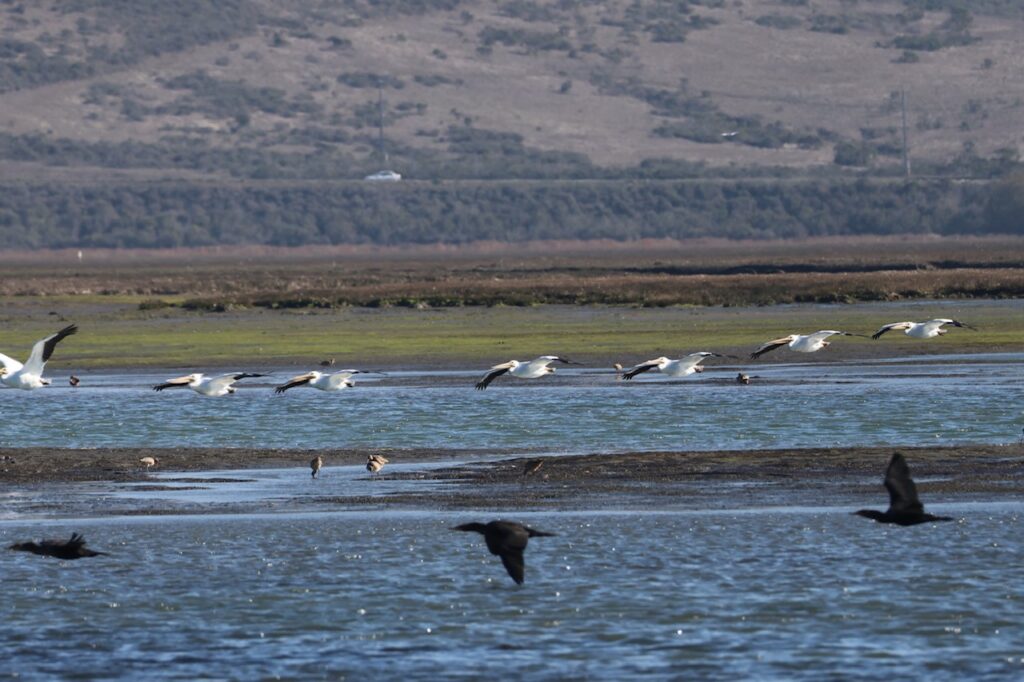
Further inside the bay near the mudflats we saw large numbers, reaching into the hundreds, of Double-crested Cormorants, Marbled Godwits, and other shorebirds too far away to ID, plus good showings of White Pelicans, Ospreys, Ring-billed and Western Gulls, Northern Pintails, Buffleheads and Long-billed Curlews, Willets, and Greater Yellowlegs, as well as other common shorebirds not listed.  Mike told us that the Pelagic Boat Trip ($160) was fantastic. If interested, check the bird list from the trip on the festival’s website.

Our “Inside of the Bay” boat trip featured a great variety of seabirds and shorebirds. Here, American White Pelicans earn extra style points.

The last night’s keynote speaker was Kenn Kaufman, author of Kingbird Highway, multiple nature guides, and his new The Birds that Audubon Missed: Discovery and Desire in the American Wilderness. He extolled birders to persist in their nature explorations, even beyond birds, and to pause the inclination to aggressively list in order to truly observe. He described the Morro Bay region as a “globally important ecological area” and the all-volunteer festival as top-notch and well organized, ranking it among the highest of the many he has attended. 

232 species were identified collectively during the 5-day festival in mid-January. Events included typical bird walks, birding by boat, bicycle and kayak, birding for youth, beginners and advanced birders, birding with wine and olive oil tastings. Sites extended beyond the Morro Bay area including the  Kern National Wildlife Refuge, the Carrizo Plains Ecological Reserve, various ranches, Atascadero, San Luis Obispo, and Pismo Beach. Check out the Long Report of the Festival Events Including Details on the website. More details than you will need to convince you to make next year’s festival are found at morrobaybirdfestival.org.

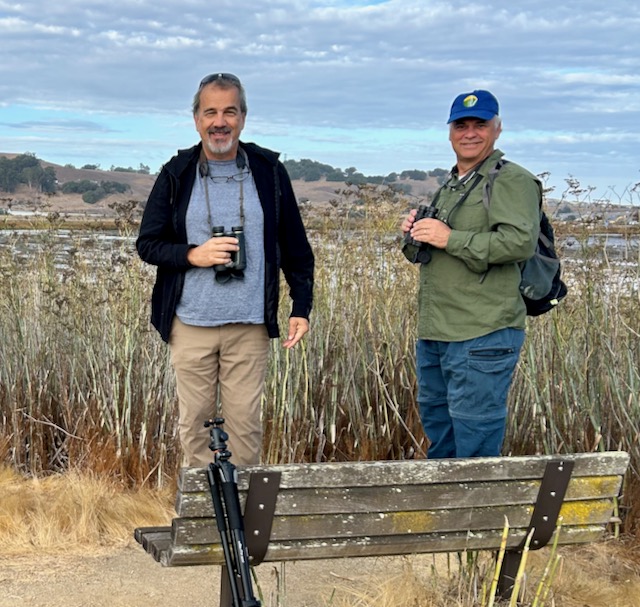
Scott (right) and Steve (left) while birding with Sneed in Marin County last fall. (I don’t know why Scott’s head looks a bit squished. I blame climate change, not my photographic skills.)

Our Favorite Bird Books for the Holidays

In our last post, we detailed where to buy bird-related books. For our 200th post (gasp), we’d like to share some of our favorite bird books. We are by no means attempting to be comprehensive and we apologize to the many fine authors and books we didn’t have space to include. When it comes to holiday shopping especially, however, we realize that “less is more” so we’ve limited ourselves to the books that first soar to mind. Note that we haven’t gone crazy on the hyper-links here, but recommend just calling your local indie bookstore and placing an order (see our last post). Any of these books can also be ordered from Buteo Books or from a certain not-to-be-named e-commerce giant. Please feel free to share this post with friends and others in desperate need of holiday gift ideas!

Field Guides

There are so many field guides available that your head will spin considering them. Braden and I have enjoyed field guides by Peterson, National Geographic, Kenn Kaufman, and many other sources. The one we return to again and again, however, is The Sibley Guide to Birds, Second Edition. While many other guides seem cramped or present information in a difficult-to-use format, Sibley strikes the right balance with generous, uncluttered illustrations and to-the-point identification information and range maps. If you’re going to buy one guide for the US and Canada, this is the one. Note that if you need field guides for specific countries or regions, you often won’t have a great deal to choose from. Our first stop is usually Princeton University Press, which seems to have field guides for many of the world’s regions (see our last post).

How To” Guides for Beginners

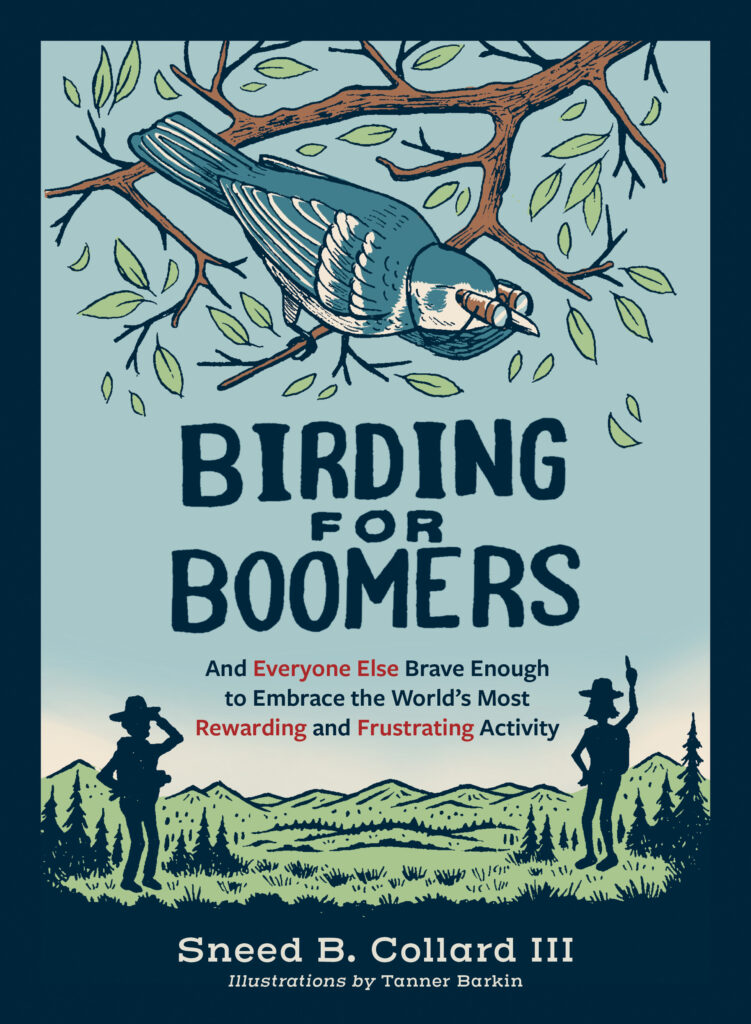
I swear, I wasn’t going to include my own book near the front here, but it logically follows field guides. Especially when it comes to buying a gift for the beginning birder, you can’t beat Birding for Boomers—And Everyone Else Brave Enough to Embrace the World’s Most Rewarding and Frustrating Activity. Here’s a recent review from Foreward Reviews: “Because the book is aimed at new birders, it includes advice about what kinds of binoculars to consider, what clothing and equipment to use, the value of a good field guidebook, and useful online resources. Its guidance is casual, often relayed with light humor and embellished by personal anecdotes. Challenges specific to boomers factor into its advice on birding with hearing, eyesight, and mobility challenges, and into its considerations for those on fixed incomes. It also makes important points about safety for nonwhite and LGBTQ+ birders. With its ranging approach and easy-to-follow advice, Birding for Boomers is a handy guide for all those—boomer or otherwise—who are looking to pick up an ornithological hobby.Click here to order!

Birding Road Trip Books

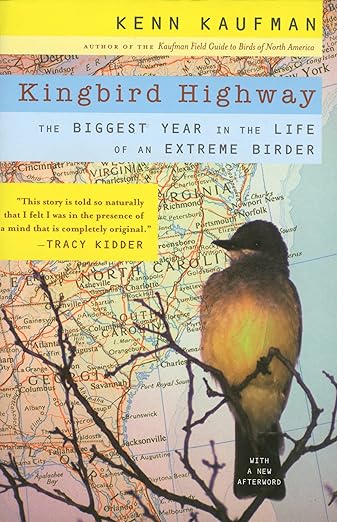
We’re going to stick with two classics here. The first is Wild America: The Legendary Story of Two Great Naturalists on the Road by Roger Tory Peterson and James Fisher. This really is required—and enjoyable—reading for those working on a life list or doing a Big Year, or anyone wanting to educate herself on the history of birding in the United States. Our second choice is Kenn Kaufman’s irresistible Kingbird Highway: The Biggest Year in the Life of an Extreme Birder. This was one of the first birding books Braden and I read and it is still one of our favorites, recounting the passions and pursuits of someone who just couldn’t help but chase and learn about birds. If you need to add a third title to this list, we wouldn’t complain if you picked up Warblers & Woodpeckers: A Father-Son Big Year of Birding!

Natural History and Science

This category could fill several blogs, but we’ll keep it brief except to say that you must read all of the books below—and they all make great gifts for anyone remotely interested in nature.

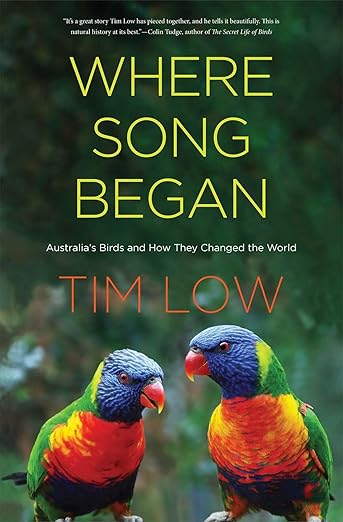
Where Song Began: Australia’s Birds and How They Changed the World by Tim Low: highly entertaining, it will change the way you think about birds.

A Most Remarkable Creature: The Hidden life and Epic Journey of the World’s Smartest Birds of Prey by Jonathan Meiburg: a fascinating account of one of our favorite groups of birds, caracaras.

Far From Land: The Mysterious Lives of Seabirds by Michael Brooke: a wonderful account of birds most of us want to spend more time with—but, sadly, never will.

Hard to Categorize—But Read Anyway

The Ravenmaster: My Life with the Ravens at the Tower of London by Christopher Skaife. The title says it all, but doesn’t come close to reflecting just how entertaining and fascinating this book is!

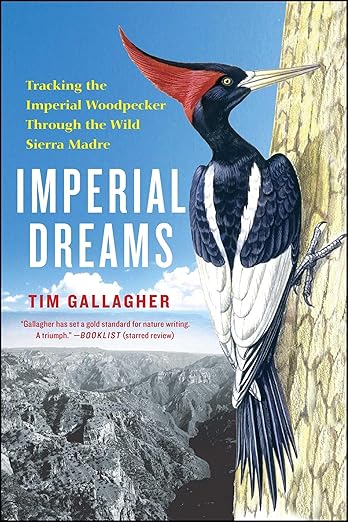
Imperial Dreams: Tracking the Imperial Woodpecker Through the Wild by Tim Gallagher. This book provides a captivating blend of adventure and natural history, following a small group’s dedicated efforts to find a species that now is almost certainly extinct—but just might not be!

The Falcon Thief: A True Tale of Adventure, Treachery and the Hunt for the Perfect Bird by Joshua Hammer. A fascinating look at the world of falcon and egg poaching.

And One More for Montanans

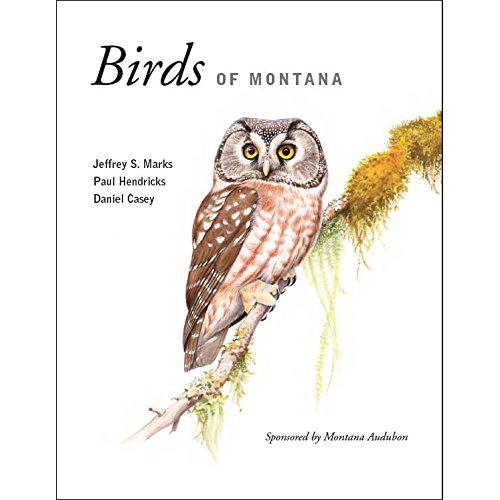
If you really want to buy something special for your Montana birder or birding family, take the plunge on Birds of Montana by Jeffrey S. Marks, Paul Hendricks, and Daniel Casey. This remarkable volume summarizes just about everything that is known about more than 400 Montana resident, migrant, and vagrant bird species. Rarely a week goes by when we don’t dive into this book to learn about a bird we’ve seen or have been thinking about. The book occupies a prominent place on our shelves and is a prized acquisition in our bird book library. Click the image below to order.

A wonderful compendium of information about birds living in, frequenting, or just visiting Montana. As an author, I reference it constantly.

Montana County Sweep: Our Final Eastern Montana Odyssey Post

Just so you don’t get lost in the narrative below, be sure you catch up with our last post—or, better yet, begin with the first post in this series!

We made our way out of the Ekalaka Hills along a different road than the one we came in on—and are so glad that we did! This route paralleled the top of a dramatic rim that dropped hundreds of feet to the plains below. As we drove, we experienced a wealth of warblers, nuthatches, Mountain Bluebirds, wrens, and other songbirds. I wasn’t quite satisfied with our view, though, so I told Braden, “Pull over. I want to walk to the edge.”

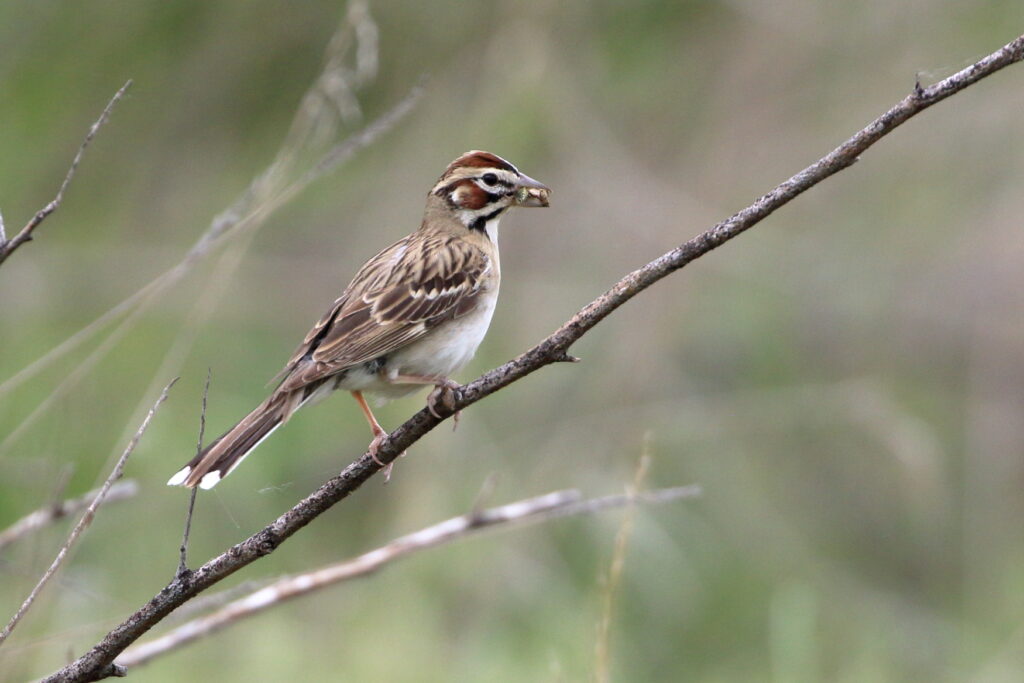
I will never get tired of watching and photographing Lark Sparrows, but this one along the Ekalaka Hills rim was especially cooperative!

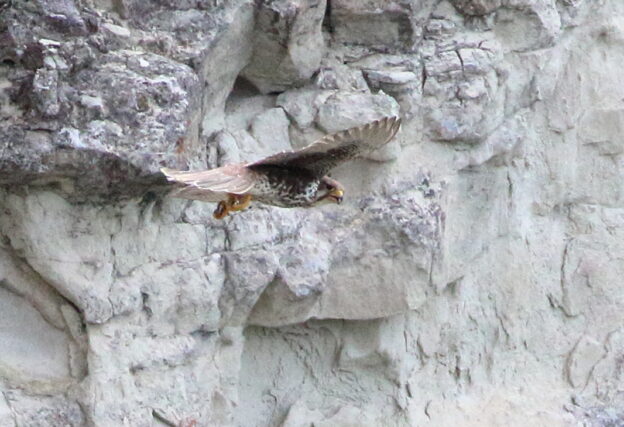
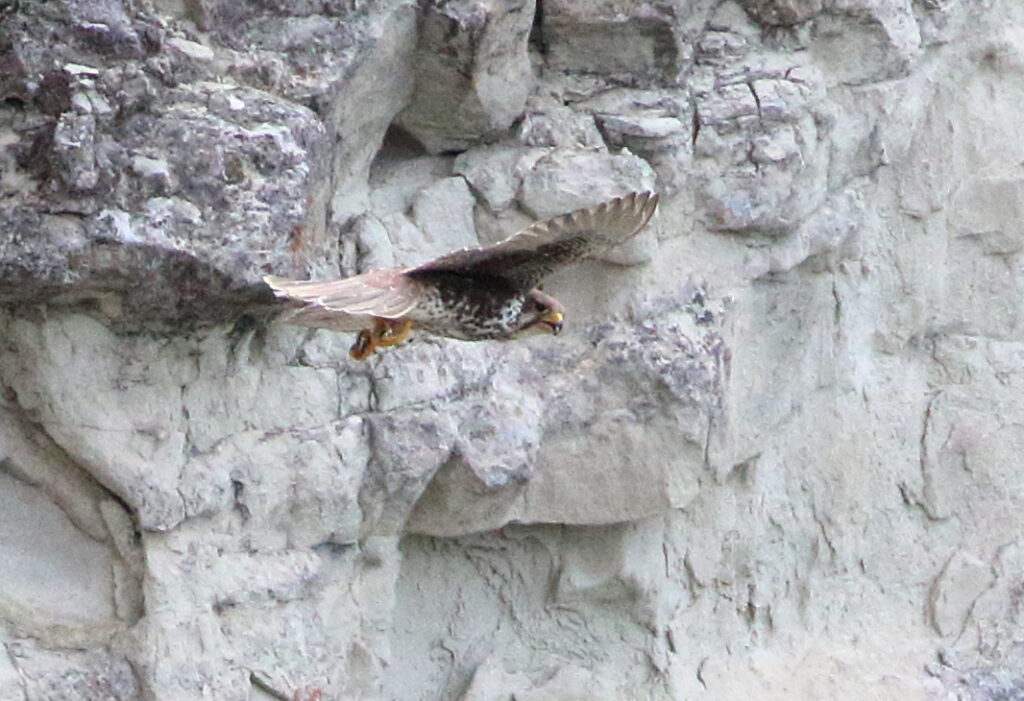
Even as I approached the rim, I could see White-throated Swifts and Violet-green Swallows working the cliffs, and once we got there we experienced breathtaking views, perhaps all the way to South Dakota . Then I saw the bird I especially had been hoping for. “Braden!” I called. “Prairie Falcon!”

The cliffs on the south side of the Ekalaka Hills gave us our best-ever experience watching Prairie Falcons hunting.

This was a bird we had wanted to see the entire trip, but never dreamed of seeing in such dramatic circumstances. Braden hurried over to join me and we watched as this powerful, brown-backed bird deftly cut through the skies in front of us. “Wait. There’s a second one,” I said. “You’re right,” Braden exclaimed.

We spent a full ten or fifteen minutes enjoying the prowess of these magnificent hunters, and it made both of us feel good to know that the pair was undoubtedly nesting in a perfect place for them. Alas, we still had some serious goals ahead of us that day, so we reluctantly said goodbye and continued on our way.

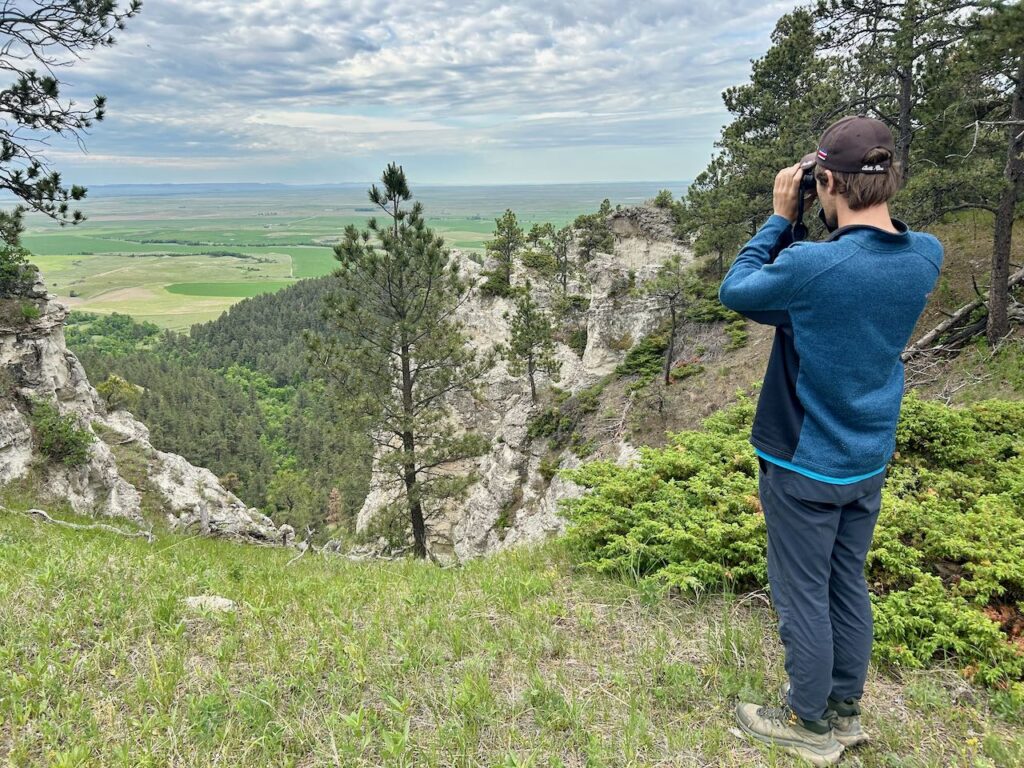
Braden watching the Prairie Falcons performing their acrobatic flights along the Ekalaka Hills rim.

As mentioned in our last few posts, we began our trip needing to bird seven Montana counties to totally fill in our Montana eBird map. In the past week we had knocked off Daniels, Prairie, Wibaux, Fallon, and Carter Counties (see our last post, “Adventures in Ekalaka”). Today we faced the final two: Powder and Treasure Counties. The first proved easy. Driving twenty or so miles south of the Ekalaka Hills, we cut SW along a well-maintained dirt road to Hwy 212 and then turned NW. Eight miles later, we crossed into Powder River County, and immediately began picking up Mourning Doves, Eastern and Western Kingbirds, meadowlarks, and other “roadside attractions.” To meet our ten-species minimum, however, we stopped at a small riverside fishing access in Broadus. There, we collected 13 species including Lark Sparrows, Lazuli Buntings, Yellow Warblers, and yet another Red-headed Woodpecker! Continuing on toward Miles City, we left Powder River County with a total of 21 species. Not bad for just passing through!

By the time we reached Miles City, our trip had taken us almost 2,000 miles, and I guess a collective fatigue had caught up with us. “Do you mind if we just find a coffee shop and chill out for a while?” I asked Braden. He was totally agreeable, so we spent an hour or so relaxing in a City Brew I’d frequented while teaching a writing workshop there several years before. It was just what we both needed. More important, it prepared us for our last lifetime Montana county!

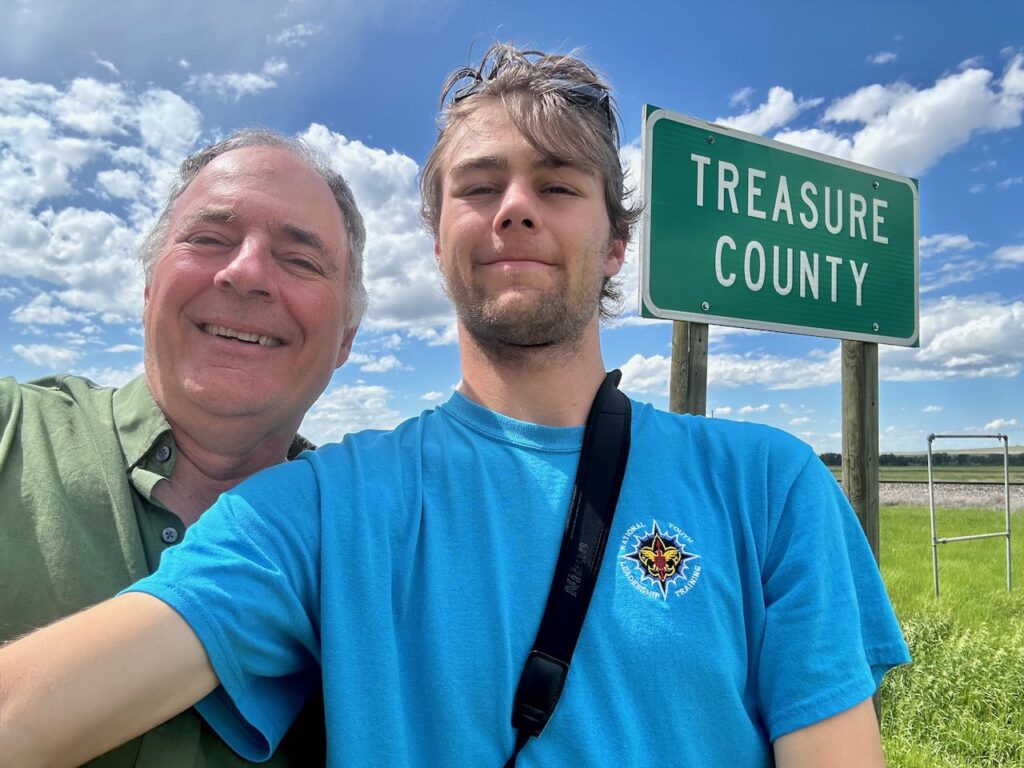
We did it! Our very last county we birded in Montana. And it only took us 11 years!

To reach Treasure County, we tooled down I-94 to the town of Forsyth, and then paralleled the Yellowstone River, driving west. About fifteen minutes later, we reached a sign marking the county line! We, of course, got out to immortalize the moment with our phone cameras, but even posing next to the sign we could hear and see Red-winged Blackbirds, a Western Meadowlark, and four or five other birds. We continued driving until we encountered a likely dirt road leading off to the north. We intended to try to reach the Yellowstone River, but found a promising thicket right before the road crossed some railroad tracks. “Let’s stop here,” I said.

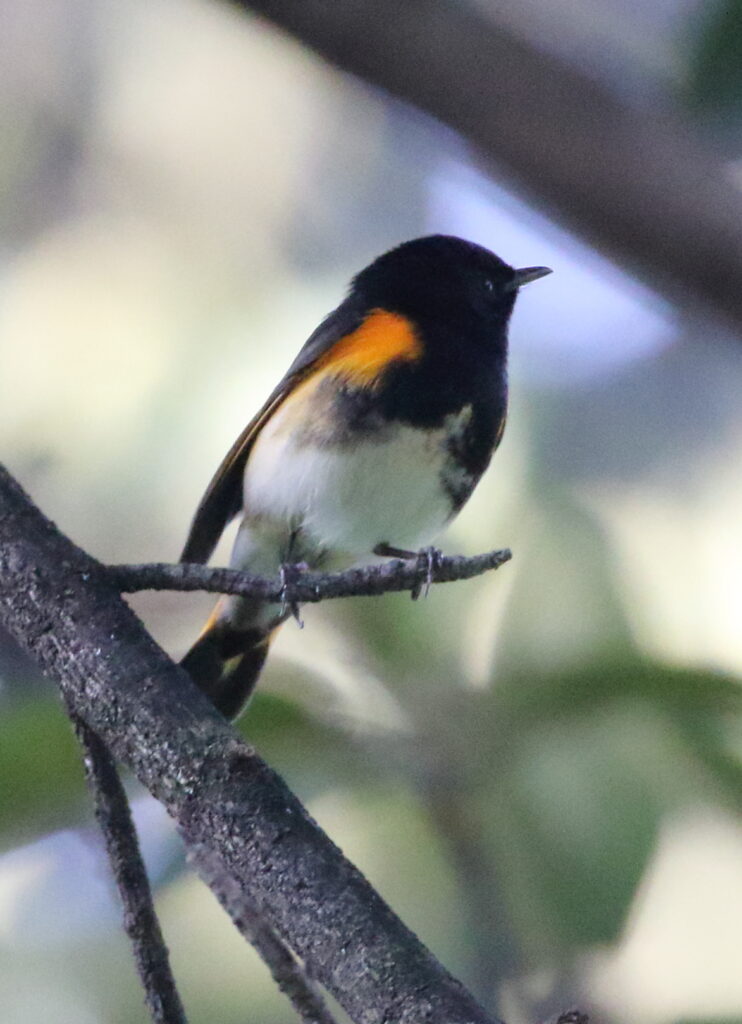
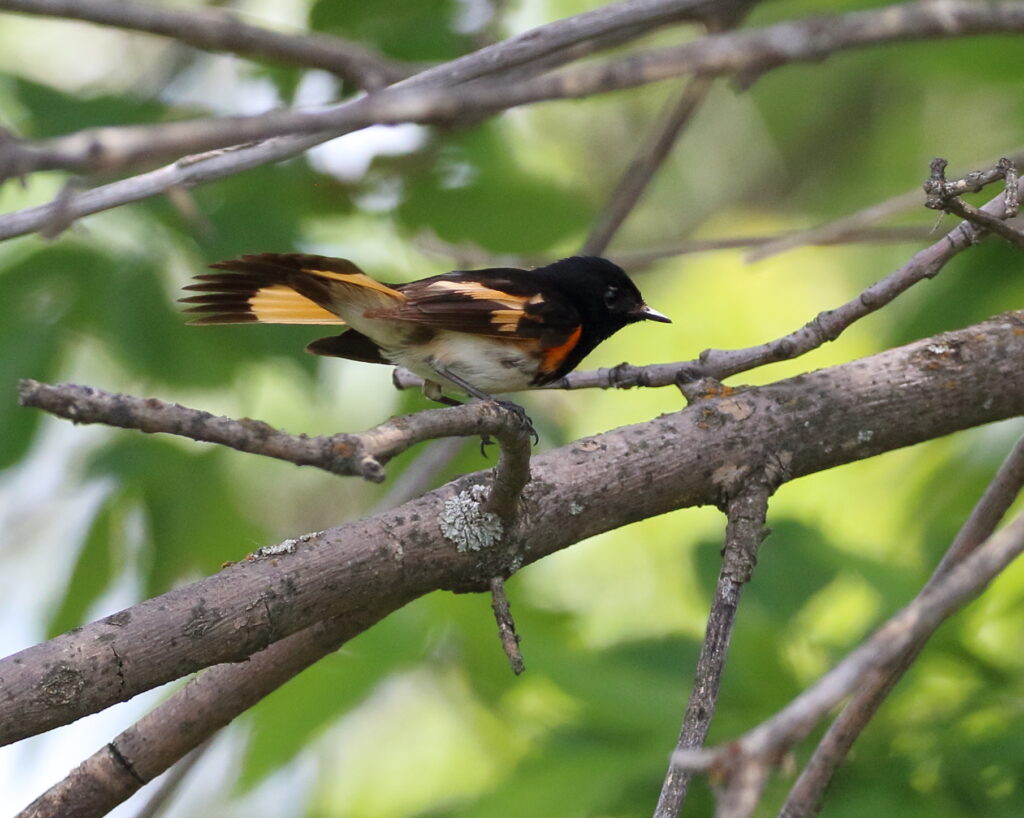
Immediately, we were rewarded with a Lazuli Bunting, American Goldfinch, Yellow Warbler, Yellow-breasted Chat and other birds. The stars? A pair of American Redstarts that landed right in front of us, posing beautifully. Unlike with the Plumbeous Vireo (see our last post), I was prepared this time and took what may be my best American Redstart photos ever! Braden and I delighted in watching these birds for more than a minute before they flitted off into the thicket. But one more Treasure County surprise lay in wait.

One of our best looks ever at American Redstarts, this warbler was our reward for completing our mission to bird every Montana county!

Driving a bit farther, looking for a place to turn around, we headed left down a dirt road. “Uh, this looks like a driveway to that farm over there,” I said, but right then we both saw it—yet another Red-headed Woodpecker! (See our last post.)

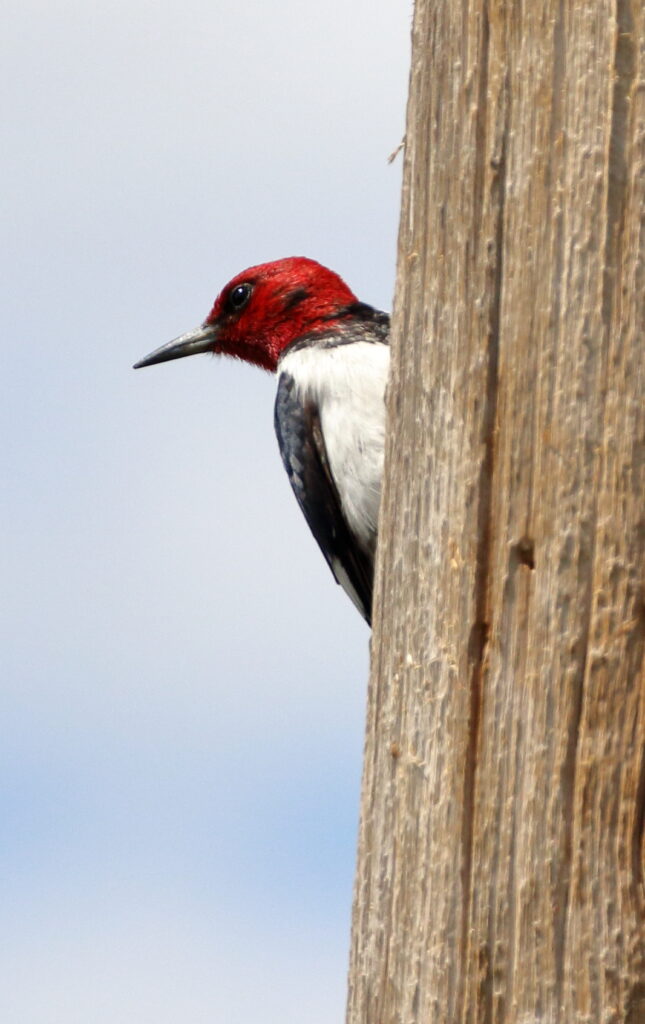
I, of course, climbed out to try to get a decent photo since none of the other RHWOs had cooperated on the trip. This one, fortunately, did—more or less—peaking out behind a telephone pole. It was a great way not only to wrap up our Treasure County list (21 species total), but to punctuate the completion of our goal of birding every county in the vastness of Montana.

This Red-headed Woodpecker both surprised and delighted us when we pulled over to pad our Treasure County list—our last Montana county to fill in our eBird map!

Our Eastern Montana adventure was far from over. It would take us on a wonderful adventure to a private ranch, back to perhaps my favorite Montana place to bird (see our post Bear Canyon—Montana’s “Tropical Birding” Paradise), and above ten thousand feet to witness the enchanting lives of Black Rosy-finches. Rather than blog about these last adventures, though, I’ve decided to write a book, so you’ll just have to be patient. Braden and I hope that you’ve enjoyed these posts, however, and rest assured, we have enjoyed sharing them with you. Please be sure to share, and if you’d like to support FatherSonBirding, consider purchasing new copies of some of Sneed’s books. Speaking of that, his long-awaited new adult book, Birding for Boomers, is now available for pre-order. Don’t be shy. Click on the cover below now!

Trip Stats:

Total Species Observed: 203 (from a goal of 185)

Total eBird checklists: 209

New Montana Life Birds: 5 + 1 (Broad-tailed Hummingbird, Broad-winged Hawk, Least Tern, Eastern Bluebird, Black Rosy-Finch plus—for Braden—Piping Plover)

Miles Driven: 2,482

Our eBird Trip Report: https://ebird.org/tripreport/246744

More than a decade in the making (sort of), my newest adult book, BIRDING FOR BOOMERS, will be available on September 1st—but you can order it now by clicking on the cover above!

Eastern Montana Odyssey 2024: Big Surprise on the way to Plentywood

Welcome to Part 3 of our 2024 Eastern Montana Odyssey! In this installment, we recount our adventures traveling from Fort Peck to Plentywood, including a wonderful grassland birding site and a big raptor surprise as we start trying to knock off our last seven birding counties in Montana. Enjoy, and don’t be shy about sharing!

After breaking camp at Fort Peck (see our last post), Braden and I continued onto the next stage of our epic eastern Montana safari. We had several goals for the day, including birding one of the remaining seven counties we had yet to fill in on our eBird maps. Unfortunately, gusty 20-40 mph winds continued, so we knew we needed to stay flexible. After grabbing breakfast at the French restaurant Le McDaniels in Glasgow, we headed north to our first stop, Kerr Road, south of Opheim, Montana. Last spring, FWP biologist Heather Harris (see my brand new Montana Outdoors article “12 Little Brown Grassland Birds Every Montanan Should (Kinda) Know” in the July/August 2024 issue) took me and my buddy Scott Callow on a delightful visit to Kerr in search of grassland birds, and I was eager to show Braden the area as well.

If this shot of me posing near the beginning of Kerr Road doesn’t get me a modeling contract, I don’t know what will. Can you shout, “ROCKIN’ IT!”?

Thanks to progressive grazing and conservation policies, much of the land alongside the road has been kept in grass, making it great habitat for grassland birds. Despite the wind, we spotted Upland Sandpipers, Willets, and at a spot called Ward’s Dam, Wilson’s Phalaropes. We also saw or heard a full complement of smaller grassland birds including 17 Chestnut-collared Longspurs, Lark Buntings, a Baird’s Sparrow, and what would turn out to be our only Thick-billed Longspurs of the entire trip! All told, we saw forty species, but our total would have undoubtedly been higher without the howling gusts from up north.

Kerr Road offered great looks at what would be our only Thick-billed (formerly McCown’s) Longspurs of the trip. Braden and I just love the interesting colorations on these birds. In Montana they are much less common than the equally impressive Chestnut-collared Longspurs.

Our Kerr Road Checklist.

The grass along Kerr Road offers wonderful habitat for Upland Sandpipers and, sure enough, we saw three of them on our relatively brief excursion.

Our next destination? Daniels County, the first of the final seven counties Braden and I needed to bird to fill in our lifetime Montana county birding map profiles. Humorously, we first stopped to bird in the small town of Richland—only to discover that it sat not in Daniels County, but in Valley County, a county in which we already had a long history of birding! Our blunder turned out to be a good thing, though, because it forced us to stop for a picnic in Roseland Park in Scobey—yielding one of the biggest surprises of the trip. As soon as we parked on the street next to the park, Braden said, “Look over there!” I trained my binoculars on a large raptor sitting in a tree—a raptor that turned out to be a Broad-winged Hawk!

Our second Montana Broad-winged Hawk in three days couldn’t have been more cooperative, perched only yards from where we had chosen to picnic.

A few BWHAs come through Montana every year, but you usually see them hundreds of feet high as they migrate across the state. In fact, Braden and I had collected our first Montana Broad-winged only three days before while birding Camp Creek Campground near Zortman. And yet, here was another, sitting right in front of us! We were both totally astonished and it put us in great moods to eat our turkey-and-cheese sandwiches and do a little birding on nearby streets. We ended up with 14 species for our first Daniels County list, including Swainson’s Thrush, Warbling Vireo, and three Yellow Warblers. Not bad for a (sort of) accidental stop!

Canvasbacks put on a show in several places on our trip, including Ward’s Dam. Can you spot the Blue-winged Teal and American Wigeon flying among them?

From Scobey, we bee-lined for Plentywood, a known hotspot for rare migratory birds that clip Montana’s northeastern corner on their way north. Alas, for various reasons we were missing the peak migration opportunity to find rare eastern warblers, Rose-breasted Grosbeaks, and other songbirds. Not only that, but warm, howling winds continued, squashing our plans to camp that night. Instead, we checked into a local motel and birded two local hotspots, Harry de Silva Park and Bolster Dam Campground.

A tiny roadside marsh along Kerr Road afforded us the trip’s best opportunity to observe a Blue-winged Teal.

Not unexpectedly, results were disappointing. The highlights were spotting several Purple Martins and a nice kettle of Turkey Vultures. To make matters worse, downed power lines had knocked out electricity to most of the town’s restaurants, forcing us to eat at Dairy Queen. It had been several decades since I’d eaten at a DQ, and I have to admit it wasn’t the worst meal in the world. Unfortunately, our food situation was destined to worsen as, the next day, we prepared to head to Montana’s Birding Mecca, Westby.

Make sure you don’t miss the next installment of our epic eastern Montana adventure by subscribing to FSB now. Simply scroll down on the right and fill out the “Subscribe Now” box that you find there!

One-of-a-Kind Birds—and a One-of-a-Kind Book to Go With Them

Thank you for sharing this post :)!

This week’s blog focuses on one-of-a-kind birds—and a book to go along with them. For those of you who have been following FatherSonBirding for the past couple of years, you may remember a February, 2022 post about monotypic animals. These are animals that have no other species in the scientific genus to which they belong. At the time of the post, I had begun researching a new children’s picture book about animals that were not only monotypical to genus, but to the family or order taxonomic level. In other words, these animals are really alone in their taxonomic world. What’s more, they often possess wonderful adaptations and behaviors found nowhere else in the animal kingdom. They include both animals you are undoubtedly familiar with such as the platypus, leatherback sea turtle, whale shark, and pronghorn. They also include lesser-known critters such as India’s purple frog and the South American monito del monte.

Often called an “antelope,” the Pronghorn is actually a unique survivor of our Ice Ages, whose closest living relatives are giraffes and okapis.

The good news is that Like No Other: Earth’s Coolest One-of-a-Kind Creatures is now a reality, exploring 13 of earth’s most remarkable creatures! But since this is (mostly) a birding blogsite, let me focus on the one-of-a-kind birds in the book.

Like No Other’s very first animal is Africa’s Secretarybird. I first learned about this bird 25 years ago when I was researching a book called Birds of Prey: A Look at Daytime Raptors. That book is now out of print, but while researching it, I came upon this bizarre-looking, long-legged raptor that often kicks and stomps its prey to death—when it’s not carrying them up into the air and dropping them from great heights. This grassland- and savanna-dwelling bird originally lived throughout much of Africa, but has declined sharply in much of its range. Culprits include habitat loss and degradation, collisions with fences and powerlines, and poisoning from pesticides. It is a dream of mine to see these birds in the wild before I croak (or hit a powerline myself).

Though a bird of prey, the Secretarybird’s appearance, behavior, and ancestry is unlike any other raptor.

The second bird in Like No Other is a bird I’m not sure I’d even heard of before writing the book: South America’s Oilbird. These squat, kind of chubby-looking birds are reminiscent of nightjars such as the Common Nighthawk or Common Pauraque, but similarities stop there. Oilbirds roost in colonies of up to 10,000 birds in caves of forested areas of northern South America and along the spine of the Andes. Like bats, they use echolocation and an excellent sense of smell to locate fruits of forest trees. Birds of the World lists them as of “Least Concern,” but they contain so much fat that in the past they have been boiled down for oil lamp fuel. No one has any idea how long they live.

Oilbirds live in caves in South America and hunt using echolocation, good night vision, and a great sense of smell.

You know me. I would have packed a lot more birds into Like No Other but felt obligated to include a fair number of other vertebrate groups (those darned vertebrates!). I did manage to wedge one more monotypic bird into the pages, however—New Zealand’s enigmatic Kakapo. For those of you who haven’t heard of it, the Kakapo is the world’s heaviest parrot. Even more amazing, it doesn’t fly! I first learned about the birds 35 years ago when I was on a four-month bicycle trip through New Zealand. At the time, fewer than 50 Kakapo were thought to exist, and as is so often the case on Pacific islands, invasive mammalian predators were largely to blame. Thanks to an intensive conservation program that included captive breeding and eradication of introduced species from offshore islands, however, the Kakapo’s future now looks much rosier. Kakapo are by no means out of the woods, but their population is up to about 250 birds, and they are being closely monitored. It’s another wonderful example of what humans can accomplish when we put our minds to it.

The Kakapo provides an inspirational story of what we can do to save species if we try.

Humans are the very last one-of-a-kind creatures in Like No Other. Nothing like us has ever existed on the planet before, and the jury’s still out whether we can figure out what to do with our big brains and ambitions without destroying ourselves. Stories of protecting the Kakapo and other species in Like No Other, though, give me hope we’ll come up with solutions.

Like No Other is available now from your local independent bookstore, online stores, and other outlets.

Like No Other is available now through your local independent bookstore and other outlets.