Author Archives: admin

Swift-ecta!

In an earlier post, we may have let slip that both Braden and I are on a tear for our 2025 global species lists (see our post In Search of the Green-tailed Towhee). That’s due to a variety of factors. Braden not only drove across the country from Maine to Montana this past spring (see last post), he embarked on intense birding trips to Oaxaca, Mexico (see post Birding in Oaxaca, Mexico) and Costa Rica. As for me, I received delightful last-minute invitations to Colombia (post Antpittas and Tody-Flycatchers), thanks to FSB contributor Roger Kohn, and to Texas, where I spoke about my book Birding for Boomers. The upshot of all this is that Braden has seen almost 800 species of birds this year, while I am within twenty birds of breaking my all-time record of 527.

The thing is, twenty birds in Montana in late July is more challenging than it sounds. Birds common in May or June become increasingly difficult to detect and find, so if you don’t have them by August you may not get them at all. That means you’ll have to rely on migrants—which are notoriously unpredictable—or winter arrivals that you probably got earlier in the year. As a result, I’ve recently been focused on picking up the remaining common birds that I so far haven’t seen. Top on my list? Say’s Phoebe.

Last year, I saw a Say’s Phoebe near the base of Missoula’s Pattee Canyon. Alas, that one eluded me this year, forcing me to search farther afield!

Say’s Phoebes are cool little flycatchers that love to nest on human-made structures such as barns, covered porches, and utility buildings. While not rare, they seem to be pretty picky about their accommodations, and we run into them only infrequently in Montana. As I write this, for example, only four sightings have been reported in Missoula County in the past month. While scouring eBird, though, I did note regular sightings up at Kerr Dam below Flathead Lake. Braden and I had discussed doing a birding day trip, so two Tuesdays ago we set out early, Say’s Phoebes our Number One goal.

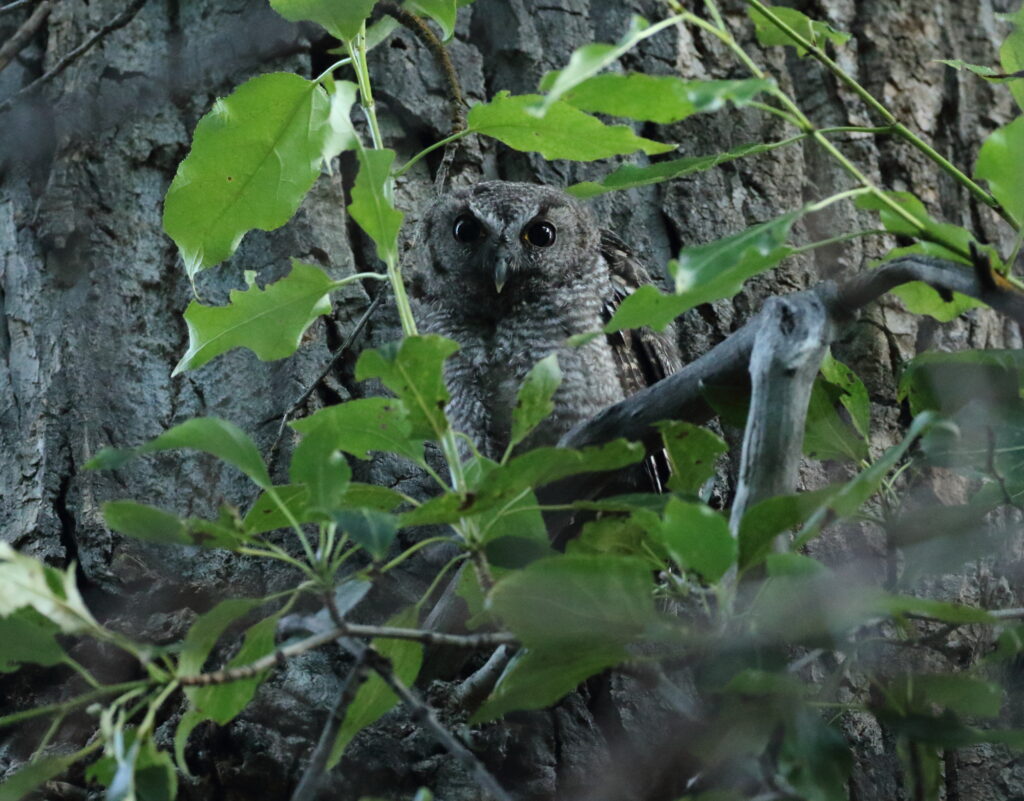
Before leaving Missoula, Braden asked if we could stop at Greenough Park. He had been pursuing a birding challenge with friends back East to see how many species they could find every day for seven days in a row. “I want to pick up Lazuli Bunting and Swainson’s Thrush,” he told me. This search happened to lead to the first delightful surprise of the day. As we were walking up a dirt trail, we approached a cottonwood tree where Braden had found a Western Screech Owl two days before. Today, he suddenly exclaimed, “Oh my god! It’s a baby!” Sure enough, a WSOW baby sat only a yard from its parent about twenty feet up the tree. Here, our day had just begun and already it had been a wonderful outing!

This adorable little guy was the first baby Western Screech-Owl Braden and I had ever seen!

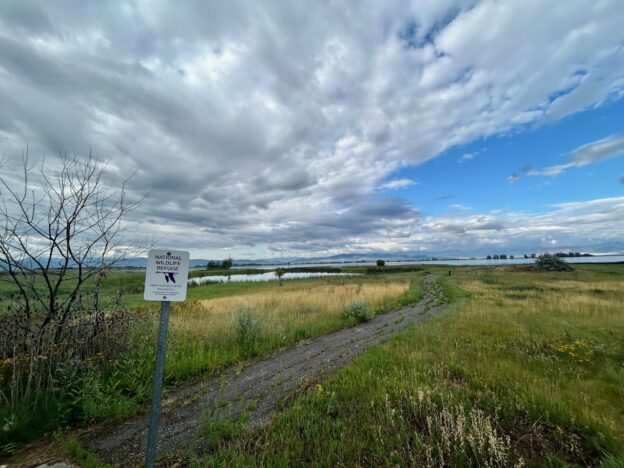
Still, we had a lot of ground to cover. After a fortifying meal at our favorite French restaurant, McDaniels (in honor of Rogére), we headed up to Ninepipe NWR. We didn’t have any major agenda there except perhaps to snag some shorebirds. For July, it was an unusually cool, overcast day and we joked that we might see some Black Swifts. For those unfamiliar with Black Swifts, they are one of the most elusive and rare birds in the US. They nest mainly behind waterfalls and, especially with climate change, are highly vulnerable throughout their range. In Montana, I had never seen one outside of Glacier National Park, and it was pie-in-the-sky logic to even hope we might see one here out in the valley.

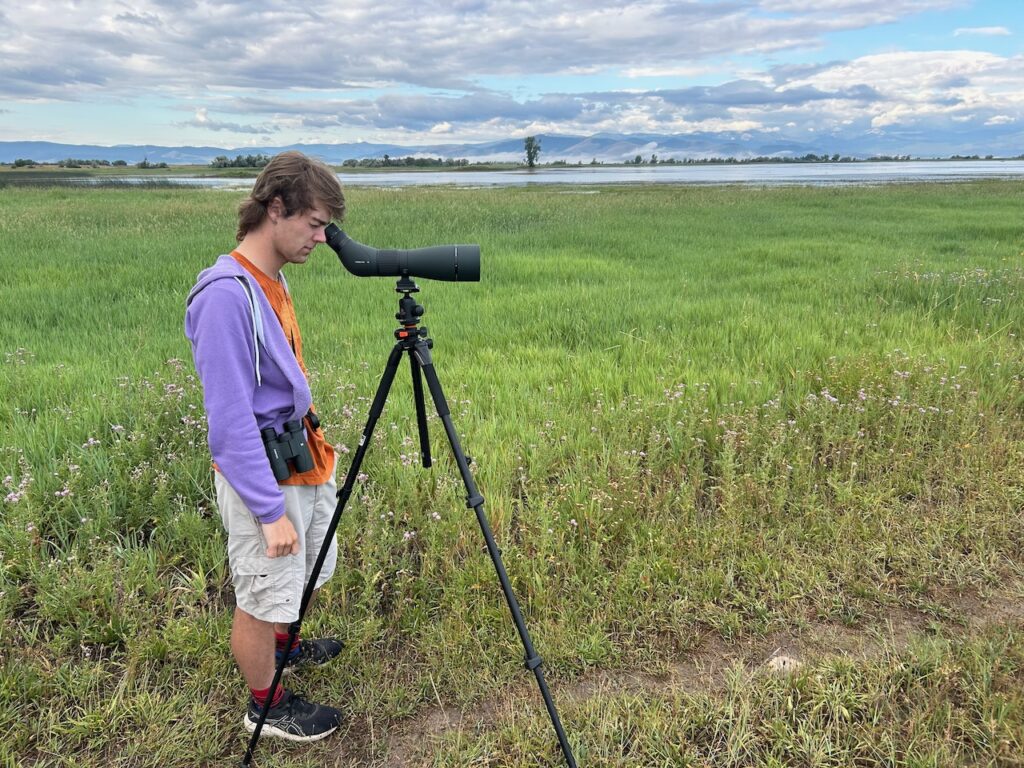
Braden poring through intermolt ducks at Ninepipe.

Anyway, we stopped at one Ninepipe pullout just off Hwy 93. The ducks were in their almost-impossible-to-identify intermolt plumages, but we still saw a nice variety of them plus Trumpeter Swans, American White Pelicans, Double-crested Cormorants, and Great Blue Herons. “Where are the Black Swifts?” I pressed Braden, but he shrugged off my flippant remark.

Though we hadn’t seen any Black Swifts, the low cloud cover at least admitted the possibility that they would venture down into the valleys from their mountain waterfall hideaways.

The phoebes on our minds, we didn’t want to spend too much time at Ninepipe, but decided to stop at one more pullout and, again, found the usual suspects. We both searched the skies for Black Swifts just in case, but didn’t see any. “I have to go to the bathroom,” Braden said, and I kept looking around for various birds. As soon as Braden emerged from the outhouse, however, he shouted, “Black Swifts!” Huh? My eyes darted back toward the low clouds, and there they were—four unmistakable dark shapes scything through the air!

Black Swifts were a stunning find on a day for which we had almost no expectations.

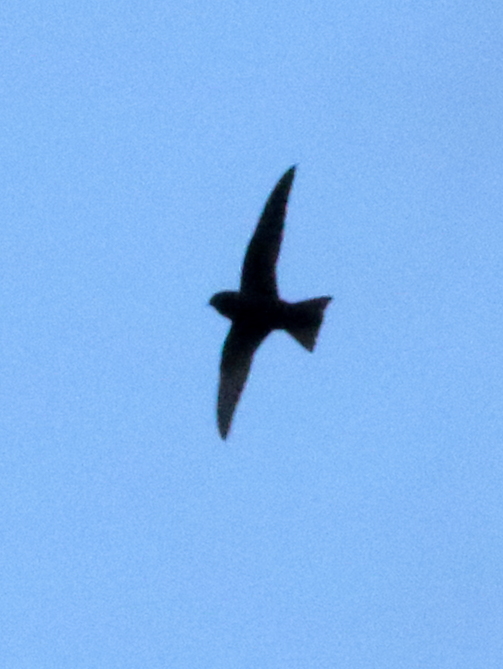
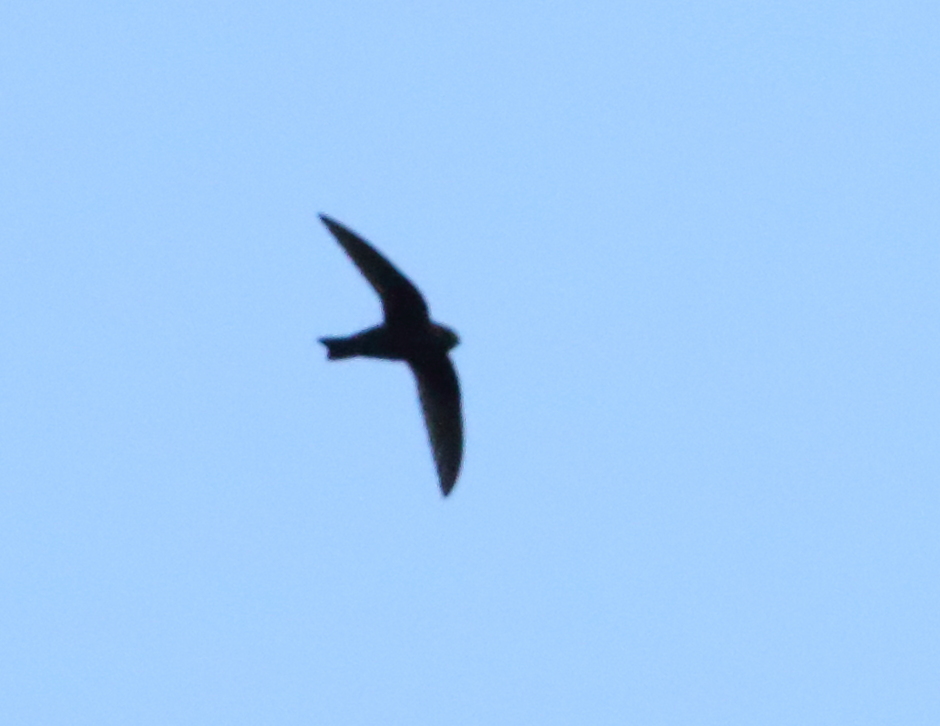
Though I’d seen Black Swifts before, this was my first time really getting to study them, and I noticed both similarities and differences between other swifts. Like other swifts, BLSWs have distinctive almost sickle-like shapes when they fly. With a wingspan of eighteen inches, however, they are significantly larger than Montana’s other swifts, and this shows in their flight. While Vaux’s Swifts zip around with almost mechanically stiff rapid wingbeats, Black Swift wings bend more noticeably. They still look like advanced jet fighters as they zoom through the sky, but with more flexible bodies. Braden also pointed out that Black Swifts show noticeable forks in their tails compared to Vaux’s Swifts, which look like their tails have been chopped off with a cleaver.

Swifts can usually be distinguished from swallows by their stiff-winged, scythe-like silhouette. Note the prominent fork in the tail of this BLSW that distinguishes it from Vaux’s Swifts—though White-throated Swifts can also show a fork.

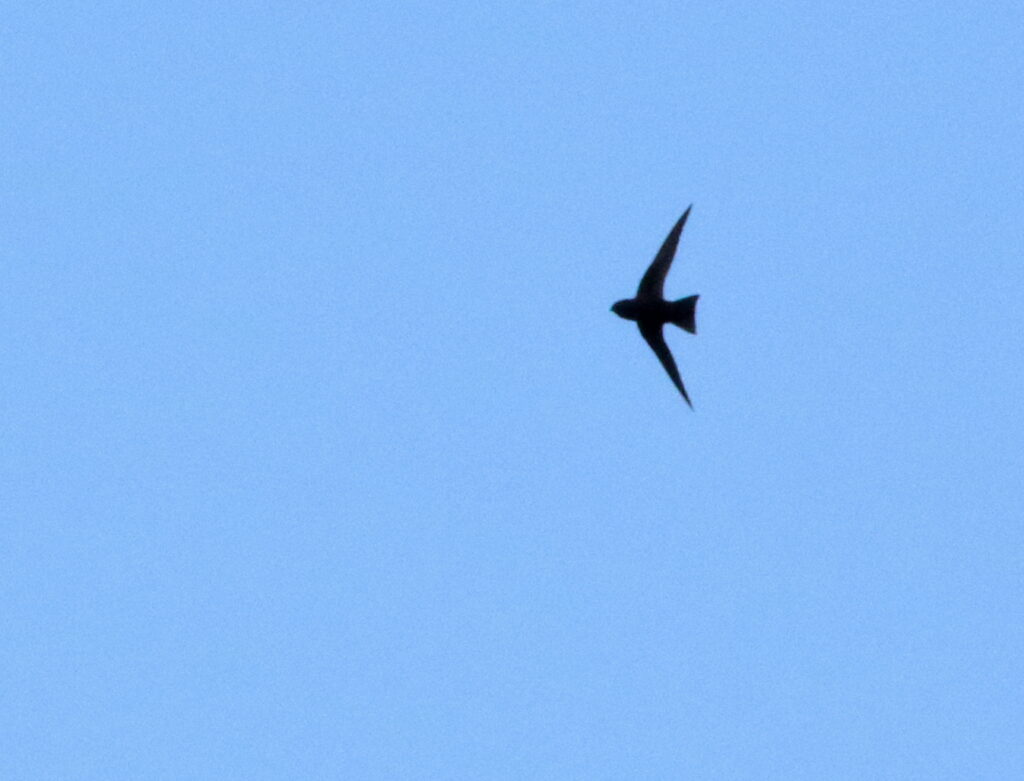
We watched these rare beauties for a full five minutes before they drifted away across the lake and I even managed some cool photos. After they had gone, Braden and I just looked at each other. “Black Swifts,” he said, and we gave each other a hug.

Swifts always remind me of fighter jets—captured here doing an F-35 impersonation.

Remarkably, it was still only 8:30 and we had a ton of birding ahead of us. Our next stop was the roadside rest stop just south of Ronan where we picked up lone Semipalmated, Spotted, and Solitary Sandpipers, along with a pair of Long-billed Dowitchers, all undoubtedly in migration. After that, we headed to Pablo NWR in hopes of some interesting water birds. We struck out on those—but were amazed to see more than 300 Bank Swallows resting on the dirt road. “They must be migrating, too,” Braden marveled, and I agreed. In fact, it has been a very lucky swallow year for both of us with, for example, great looks at large numbers of migrating Tree Swallows and Cliff Swallows. This was the first time we’d ever seen Bank Swallows in such numbers, though. From there, it was on to our primary destination: Kerr Dam.

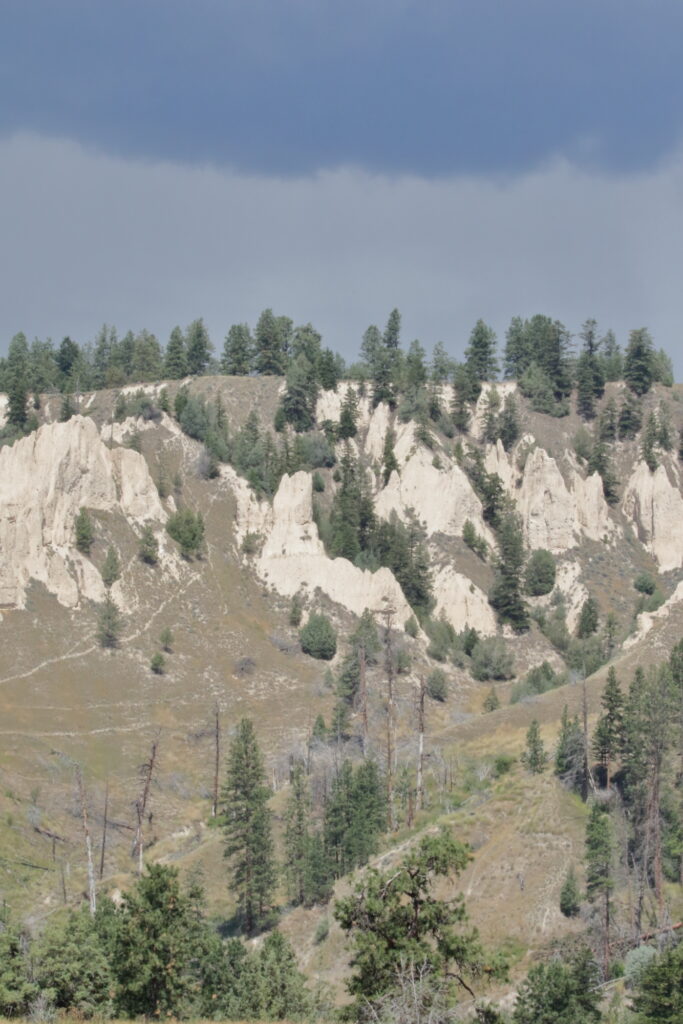
Braden had never been to Kerr Dam before, and I’d just gone to the overlook, but the entire site reminded me of a throwback to gentler, more civic times, when people shared more of a vision for the common good. From the overlook, we looked down on the dam itself with the Flathead River backing up into Flathead Lake beyond. Below the dam, dramatic, highly eroded cliffs framed a dramatic canyon full of promising riparian habitat.

Braden and I both wondered what secrets the dramatic cliffs below Kerr Dam might be hiding!

From the overlook, we watched Ospreys and Braden said, “Look, there are some Violet-green Swallows. White-throated Swifts should be here, too.” Not two minutes later, he spotted a pair flying overhead, their sickle-shaped wings and white breasts clearly visible against the blue sky. “Uh-oh,” I said. “That means that we might have to go for the Swift Trifecta and find some Vaux’s Swifts.” Braden sighed in agreement. Darn those swifts!

But we had not forgotten our main target, Say’s Phoebes. “I’m guessing they are down there at the power station below the dam,” I said. “You up for going down there?”

“Sure.”

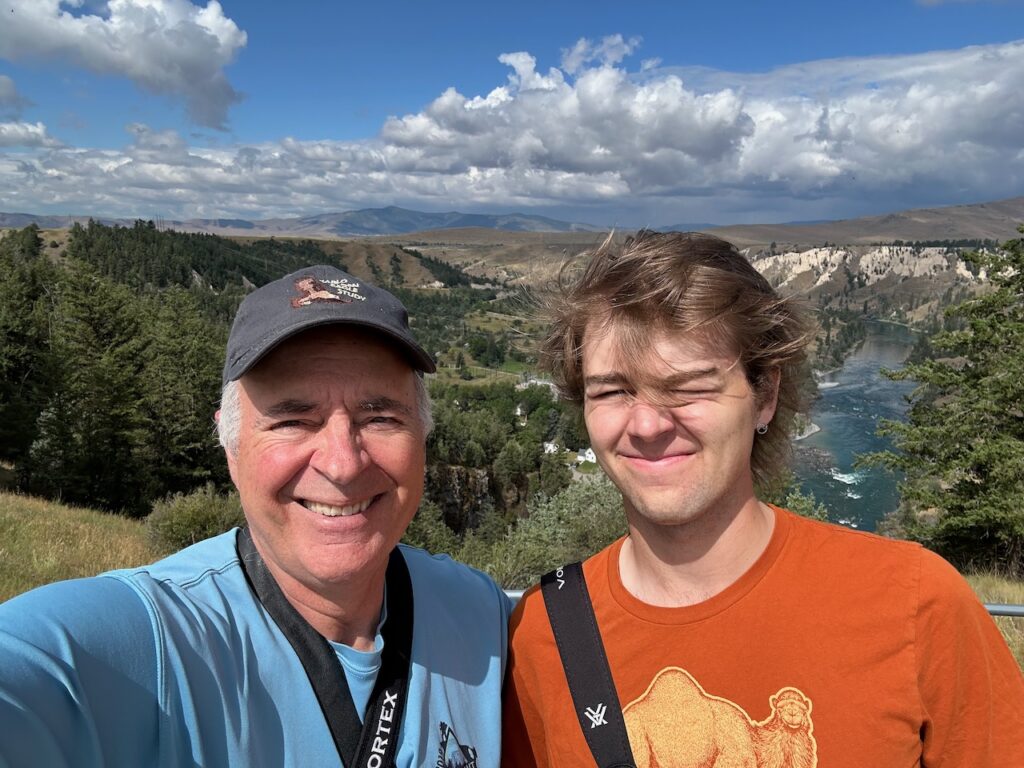
Squinting into the sun at the overlook to Kerr Dam, the Flathead River running south below the dam in the distance.

Winding our way down to the power station, we were greeted by a cluster of neatly-kept houses and a fenced-in area full of transformers and other “power stuff.” All of this was surrounded by an open, pleasant park-like setting that reminded me of my days working on the Pitt River dam network in northern California just after college. We decided to get out and walk around and immediately started seeing and hearing Western Wood-Pewees, American Goldfinches, robins, Eastern Kingbirds, and other songbirds. We hadn’t walked ten minutes when suddenly, some kind of flycatcher darted out in front of us to snag an insect.

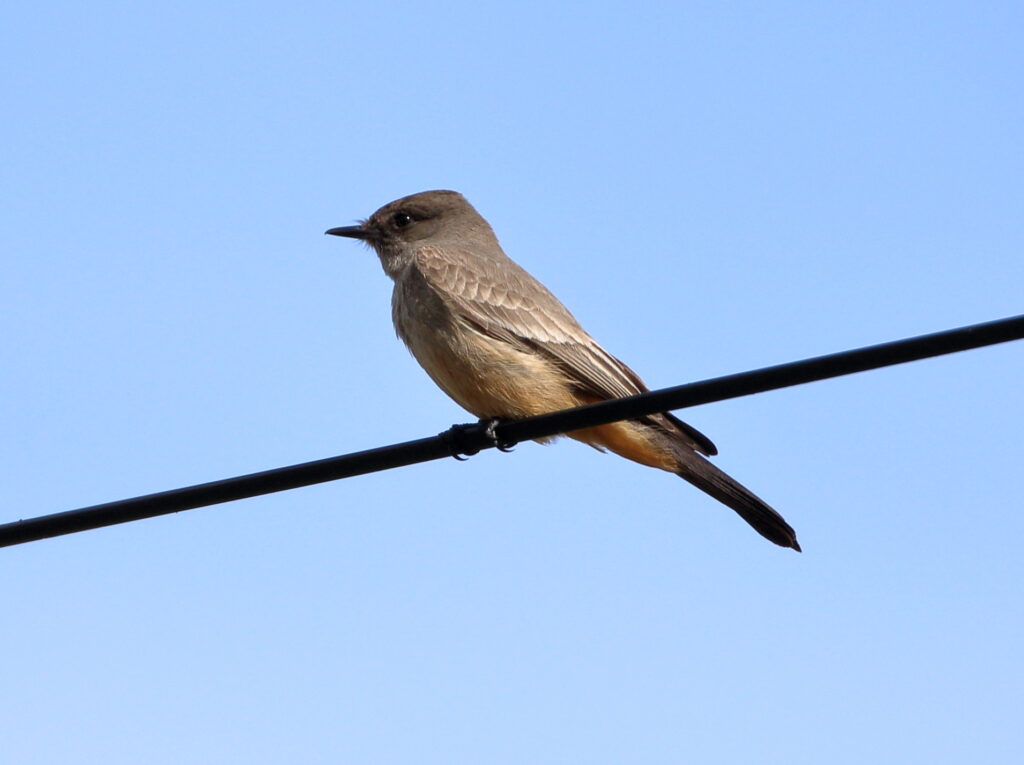
“Say’s Phoebe!” I exulted, and Braden gave me a high five. There weren’t just one, but two, working the area around the fenced-in transformer area. “This is perfect for them,” I said. “Lots of insects and plenty of structures to nest on.” Alas, they didn’t care for our attentions and kept flying away as we approached, but they and the Black Swifts brought my global year total to 509 species—just nineteen shy of breaking my record of 527. Braden already had the phoebe for the year, but the Black Swifts took his global 2025 total to an astonishing 776 species! BUT . . .

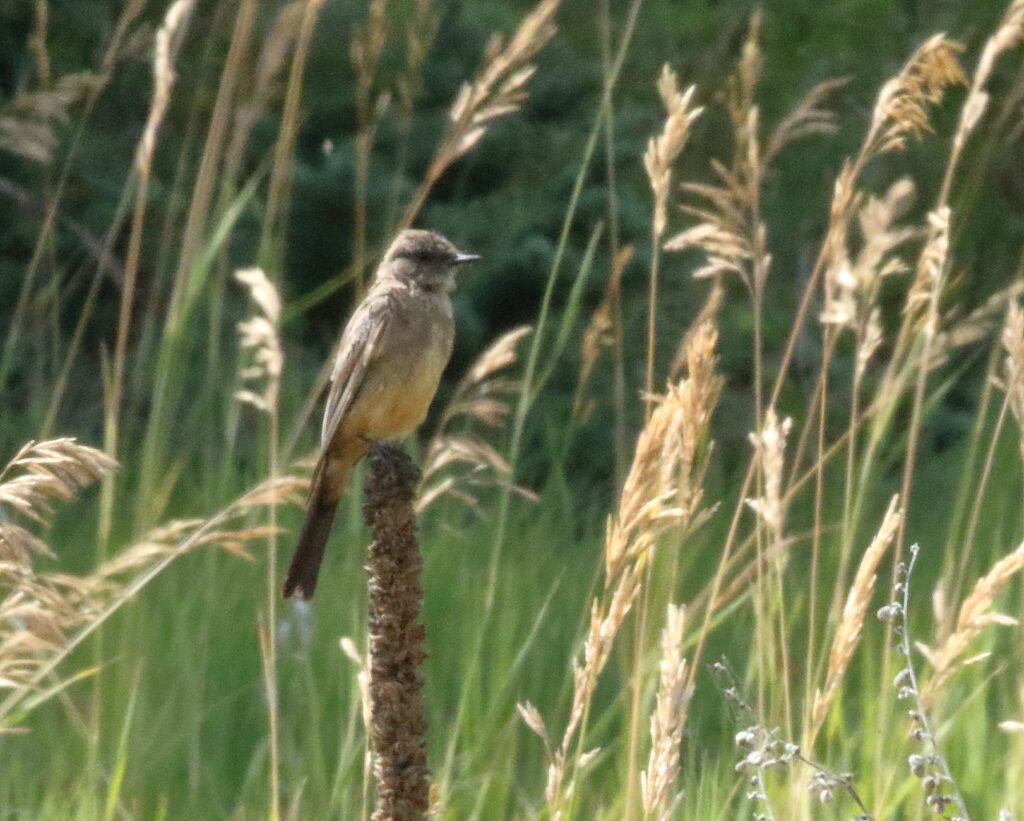
This elusive Say’s Phoebe finally cooperated with me for 2025!

There was still that little matter of a swift trifecta on our minds. After a cultural stop at Richwines Burgerville in Polson, we made our way slowly back to Missoula. Nowhere did we see the third Western Montana swift, Vaux’s Swift. “Let’s go to Caras Park,” Braden suggested as we reached Missoula. “I see them there pretty regularly.”

We parked near the iconic metal salmon sculpture and walked out onto the grass below the Higgin’s Street Bridge. The sun was out by now and things were warming up. Cliff Swallows flew to and from their mud nests on the side of the bridge, but I didn’t expect to see any swifts. “There’s one!” Braden suddenly shouted. Sure enough, several birds with fast, mechanical wingbeats darted back and forth after insects above the Cliff Swallows. It was a final satisfying sighting on a totally surprising, remarkable July day in Montana.

Our Day’s Trip Report: https://ebird.org/tripreport/396651?welcome=true

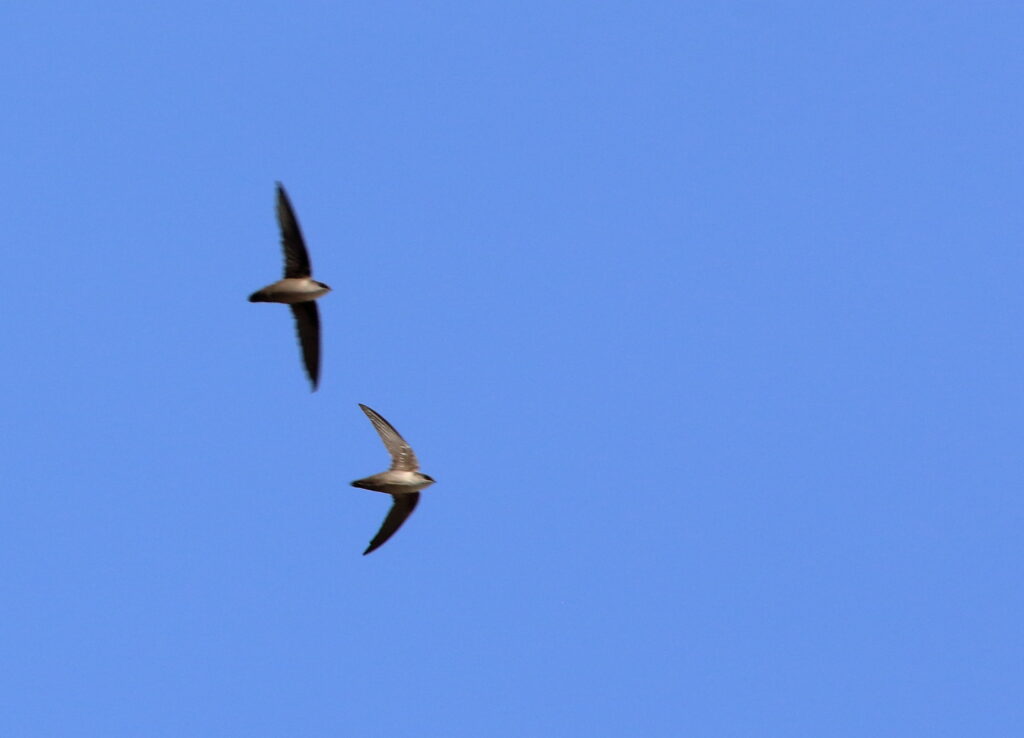
The small size and “chopped off” tails of Vaux’s Swifts are solid ID features to distinguish them from both Black and White-throated Swifts. These wonderful little birds completed our Western Montana “Swift-ecta” and wrapped up one of our best birding days ever.

Campsite #512: Algonquin Provincial Park, Canada (Maine to Montana, Part 4)

Today, we continue Braden’s epic birding trip from Maine to Montana with an astonishing visit to a place few people get to experience: Algonquin Provincial Park. Enjoy this latest installment, and if you’d like to support FatherSonBirding and independent journalism, please consider buying one of Sneed’s books shown to the right. Oh, and please share this post!

Twelve hours west of the Maine border, I spotted the giant sign reading “Welcome to Algonquin Provincial Park.” When many birders think of Canada, they imagine huge tracts of boreal conifer forest filled with the birds of the north: Canada Jays, Yellow-bellied Flycatchers, crossbills and, of course, Black-backed Woodpeckers and Spruce Grouse. Much of my drive from western Maine towards Ontario did not give that impression at all. In fact, the part of Canada that includes Montreal and Ottawa (both cities that I drove through) is lower altitude than western New England, and much of it lies in the St. Lawrence River Valley, a warmer, more humid region filled with deciduous forests, agriculture and suburbs. The area reminded me more of central Pennsylvania or New Jersey than of western New England, despite being at a similar latitude.

But Algonquin Provincial Park was noticeably different from the St. Lawrence River Valley. Three hours west of Ottawa, this large preserve sat at a higher elevation than the valley. The soil was rockier and because of that, far more conifers grew here, especially around the various lakes and bogs scattered through the park. Finally, I felt like I was back in good boreal habitat.

Algonquin Provincial Park represented a significant departure from lower altitude St. Lawrence River Valley only a few hours away.

I wasn’t allowed to camp in the park without paying a hefty fine, so I pitched my tent on a dirt road right outside it, in what appeared to be a site for keeping horses on the shore of a large lake. As dusk fell, I heard the twitter of an American Woodcock displaying high above. I’d seemingly settled in the middle of his territory, and he kept me company all night as I dreamed of what birds I’d see the next day.

My impromptu campsite outside of the park rewarded me with an American Woodcock that serenaded me to sleep.

After a short walk around my campsite at dawn, during which I detected a few Cape May Warblers, I headed into the park. My first location: the Spruce Bog Boardwalk. Spruce bogs, which I’d gotten to know during my time in Maine and the Northeast, are strange, almost other-worldly habitats scattered across the northern United States. Generally consisting of an outer area dominated by spruce trees with a core of peat moss floating atop water, they are home to a variety of unique species including carnivorous plants like pitcher plants and sundews. Because of their unique habitat structures, spruce bogs are also havens for a variety of boreal bird species that are otherwise less common in more southern parts of their range. So, as I set foot on the boardwalk, I found myself once again searching for Spruce Grouse and Black-backed Woodpecker—species I find myself looking for frequently.

Extensive searching brought no luck, although I did find more boreal warblers, including several Cape May Warblers and another great look at a Bay-breasted. I also heard a Lincoln’s Sparrow, my first of the year, singing from the wet back half of the bog. I had much of the day to bird Algonquin Park, so after striking out on my main targets at the boardwalk, I decided to take a short stop at the visitor center. 

I had hoped for both Black-backed Woodpeckers and Spruce Grouse in this spruce bog, but struck out with both species.

Within ten seconds of pulling out onto the road my Toyota RAV4 screeched to a halt. There, ten feet away, staring me down, stood a huge female moose. The animal had to be at least five feet tall, though from my seat in the car it seemed a lot taller! After we shared several seconds of each other’s presence, the moose trotted off into the woods. I didn’t end up seeing any of my bird targets at the visitor center and the center itself was closed, but I was now filled with adrenaline—I’d just scored my most wanted mammal of the trip!

Next, I hit Rock Lake Road. While I hadn’t seen many reports of my target boreal birds here, I figured that this road—a dirt track winding past marshes and through patches of spruce and budding Paper Birch—was as good a spot to try as any! Over the next hour and a half I drove slowly with my head out the window. Again, no woodpecker and no grouse, but I ended up tallying 40 species, 15 of which were warblers! Nashville and Magnolia were the most abundant, along with a smattering of Black-throated Blue, Blackburnian, Canada and others. Near the beginning of the road I also heard several Wood Thrushes singing, a surprise this far north. Along my drive I was also accompanied by the near-constant drumming of Ruffed Grouse, and the loud, piercing whistles of a pair of Broad-winged Hawks.

Though I continued to strike out on BBWOs and SPGRs, Algonquin presented a nice assortment of warblers including Nashvilles, always a favorite!

At this point I admit that I was feeling a bit ungrateful. I’d been birding for three or four hours and had not so much as glimpsed either of my targets—birds that were supposed to be somewhat regular within the park, and had compelled me to drive through Canada in the first place. Sure, I’d seen some great birds and a moose. But if I went the whole day without getting a Black-backed or a Spruce Grouse, I was going to be a bit salty. I jumped on eBird to check on any recent reports of either of them nearby and elected to visit, as my last stop of the morning, Pog Lake Campground. A Black-backed Woodpecker had been seen there only a few days before, and I figured it would be my best chance before continuing my journey west. I parked the car and began walking toward Pog Lake, keeping my ears and eyes peeled for my target species. One of the first birds I heard was a Tennessee Warbler, another boreal species with an electric song, singing loudly from a campsite nearby. I recorded it and continued onwards.

Then, I came across Campsite #512. Surrounded by gorgeous coniferous trees, it at first seemed just like any other campsite in Pog Lake Campground. The first thing that made Campsite #512 stick out, though, was the Ruffed Grouse drumming in the bushes nearby. Now, I’ve heard plenty of Ruffed Grouse drumming in my life—and had heard dozens on this trip already. Seeing one in action was a different story. I’d tried to sneak up on them before, but was always unsuccessful—the birds would flush from under my feet. However, this particular bird sounded incredibly close so I shelved my other goals and went into full stealth mode, sneaking towards the campsite to see if I could watch the grouse in action. After about ten minutes of tiptoeing around, I heard the beating of its wings—and that’s when I spotted it. Through ten feet of dense foliage, there the grouse stood, its wings striking its chest to make the sound that you feel more than hear.

I promptly sat down and spent the next thirty minutes with that grouse. Every five minutes or so, it would stand upright on its mossy log and begin its display. Bom-bom-bom-bom-bom-bom-bom. I watched it drum five or six times—with and without binoculars, and filmed it on my phone’s camera. It was magical. (Click the above image to watch my short clip.)

After twenty minutes, I also heard honking overhead. At first, I couldn’t see any birds above me, but I figured it was just a flyover flock of Canada Geese, though the calls sounded a bit strange. Then, in the gap above Campsite #512, I spotted several flocks of two hundred or so geese—and quickly realized that these were not Canadas. Between a bad view I got through my binoculars and listening to their sounds on Merlin, I realized I’d just seen a massive flock of Brant migrating over me, headed for the Arctic! I’d never seen these birds away from the ocean and never in such numbers! Sure enough, though, Algonquin Park lies right in the middle of Brant’s narrow migration route across Canada, and I’d just happened to be in the right place at the right time.

The Brant disappeared into the distance and the grouse drummed again, and I decided that, even though I hadn’t found my targets, I felt more than satisfied with my experience with Pog Lake Campground. But Campsite #512 hadn’t finished with me. 

As I slowly stood, taking care not to startle the grouse, I heard strange, frantic calls coming from the woods on the other side of the campsite. I quickly recognized them as calls I’d been listening for all morning, and suddenly, a male Black-backed, decked out in sleek black feathers with a yellow cap, flew into the campsite. It landed on a downed log near me, and proceeded to hop along the ground, getting closer and closer to until it stood only five feet away! It either didn’t notice me or didn’t care, poking for insects in the roots of the nearby spruce trees. After a minute or two, the woodpecker flew away, leaving me debating if I should EVER leave Campsite #512.

My best-ever look at a Black-backed Woodpecker will forever embed Campsite 512 in my birding heart.

As you can probably guess, I did continue on my journey, but knew that my visit to Campsite #512 would become one of my most memorable birding mornings ever, one that would be etched in my brain for a long, long time.

Sea of Grass (Book Review)

This week, I’m pleased to announce that I’ve agreed on terms for a new book project with Mountaineers Books, publisher of my books Warblers & Woodpeckers: A Father-Son Big Year of Birding and Birding for Boomers—And Everyone Else Brave Enough to Embrace the World’s Most Rewarding and Frustrating Activity. My new book, scheduled for release in 2028, emerged from the epic birding trip Braden and I took through eastern Montana last summer, and focuses especially on the shortgrass prairie and birds that live there. As is so often the case, I am not the only author to be thinking about this remarkable, highly threatened landscape. Witness the new release, Sea of Grass: The Conquest, Ruin, and Redemption of Nature on the American Prairie (Random House, 2025).

Sea of Grass is required reading for anyone interested in prairie birds and their futures.

In Sea of Grass, authors Dave Hage and Josephine Marcotty have created an impressive work that covers the entire sweep of human understanding and conquest of the American prairie. The authors set the stage by giving us solid background on the richness and diversity of North American grasslands. They recount the geological and climatological conditions that created our great prairies. They give us a glimpse of the remarkable number of species that live both above and below ground, comparing our grasslands favorably to the biodiversity of rainforests and coral reefs. They also explain the incredible amount of carbon that these natural systems sequester.

Grain elevators stand as scenic symbols of the Midwest economy—and of continuing threats to our remaining shortgrass prairie.

What really stands out in the book are the chapters documenting the breathtaking exploitation and destruction of tallgrass prairie, and how technology has managed both to raise agricultural production and create almost unimaginable environmental problems. Even as someone who has followed environmental issues all of my life, I learned an astonishing amount. Have you ever heard of tile drainage? I hadn’t, but it is a drainage system that not only allows farmers to raise abundant crops on otherwise unsuitable land, but mightily contributes to funneling harmful fertilizers and pesticides into rivers, lakes, wells, and other water sources throughout the Midwest. Scientists have established clear links between agricultural practices and the enormous dead zones that occur every year in the Gulf of Mexico. Meanwhile, hundreds of cities such as Des Moines have to spend millions—probably billions—of dollars to try to remove harmful fertilizer residues from drinking water supplies.

The authors explain that while Iowa and other Midwest states have lost virtually all of their original tallgrass prairie to agricultural conversion, the arid nature of the shortgrass prairie traditionally rendered it unsuitable for growing crops. Instead, cattle was king on these lands—including much of the Dakotas, Montana, and Wyoming. Alas, genetic engineering and other technologies have now opened up these fragile, dry lands to farming. I had thought that the great era of prairie conversion had ended, but in the US we are now losing more than one million grassland acres to the plow every year.

The loss of more than a million acres of shortgrass prairie to farming each year not only threatens grassland birds like this Upland Sandpiper, but an ecosystem with a diversity rivaling that of tropical forests and coral reefs.

For anyone who cares about the incredible diversity found in these grasslands—including its remarkable suite of grassland birds—this is horrible news indeed. It also sheds a positive light on the importance of sustainable cattle ranching and “keeping grass in grass,” as one Montana biologist puts it. What makes the situation especially frustrating is that conversion of grasslands to cropland isn’t primarily driven by demand for food, but by billions of dollars of tax breaks, mandates, and other government subsidies for growing corn to produce ethanol. These subsidies arose from efforts to help America achieve energy independence. Instead, they have helped create a system that continues to destroy natural ecosystems while creating immense quantities of a product that we simply don’t need (see, for instance, this report from Wisconsin). Unfortunately, by driving up corn prices, the ethanol boondoggle has made many corn growers extremely wealthy and politically powerful, almost eliminating the possibility of rolling back this pork barrel waste of taxpayer dollars.

99% of Iowa’s tallgrass prairie was lost to agricultural conversion. Today, wasteful government farm subsidies for ethanol help drive the rapid loss of shortgrass prairie in Montana and other states.

Fortunately, the authors don’t leave us with a totally grim outlook for America’s remaining grasslands. Throughout the book, but especially in the final section, the authors detail a number of small-scale efforts to protect and restore grasslands as well as to reduce the incredible environmental costs of modern-day agricultural methods. In Montana, these range from the creation of American Prairie to the practice of rotational cattle grazing to tribal and ranching successes reintroducing bison back onto the landscape. I don’t want to reveal too much, but I’m confident you’ll find these and other efforts as fascinating and hopeful as I have.

Scientist Diane Debinski searching for rare butterflies at Iowa’s Neal Smith National Wildlife Refuge, one of a handful of projects to restore tallgrass prairie habitat. This project was the subject of my 2005 book, The Prairie Builders.

Although it gives fairly brief coverage to grassland birds, if you care about grassland birds—not to mention bison and grassland ecosystems in general—Sea of Grass is absolutely required reading. Especially if you live in or near the Great Plains, it provides vital insights into the huge economic and cultural forces at work in our region. As a bonus, the authors’ clean, entertaining writing style help make this one of the most worthwhile books you are likely to crack open this year.

Summary: A fascinating crash course on the biological, economic, and cultural history of America’s grasslands and the growing efforts to protect what’s left of these remarkable ecosystems.

Saying Goodbye to Lola, Our Birding Dog

Today, our family sadly bids farewell to our beloved dog Lola. Those of you that have been regularly following FSB, or have read my book Warbler’s and Woodpeckers: A Father-Son Big Year of Birding, will be familiar with Lola, but to honor her memory, I’d like to share her remarkable story in more detail.

The beginning of that story will always be shrouded in mystery. We adopted Lola thanks to the always-heroic and compassionate efforts of the Humane Society of Western Montana, and Braden’s sister, Tessa, was the driving force behind adding Lola to our family. For a couple of years, Tessa had gently expressed a desire to have another dog. Amy and Braden were on board, but I hesitated. For one thing, I knew that since I work at home, I would be the main caretaker of any new mammal in the household and I wasn’t sure I felt ready to add that responsibility to my list. Honestly, saying goodbye to our previous dog, our Border collie Mattie, had taken a huge emotional toll on me. Many people don’t hesitate to get a new pet when an old one has passed, but not me. I grieved long and hard for Mattie, and wondered if I were ready to invest so much of myself into a new companion.

We were so heartsick over the loss of our Border collie, Mattie, that it took a few years before we were ready to welcome Lola into our family.

Nonetheless, one afternoon three years after Mattie passed, I asked Tessa, “Hey, do you want to start checking out the Humane Society website?”

Her whole face brightened. “Really? To look for a new dog?”

We both thought that a black Lab would be perfect for our family—affectionate, but active enough to go on adventures—and about once a week, we searched the website for possibilities. Black Labs are so popular that a number of them became available, but each had some quality we thought would make them a poor fit for our family. One day, though, I was looking at the site by myself when Lola popped up on the screen. HSWM estimated she was about two years old and she had been found in Polson, Montana nursing eight puppies!

Over the years, Lola spent almost as much time in my office as I did—including time inviting me to play with her and her Whale.

I immediately called HSWM to find out if Lola was still available and got put through to the director, who actually knew me from some of my past author events. “Well,” she said, “Lola isn’t officially available yet because she and her puppies have been in quarantine for distemper.”

“Oh, is that serious?” I asked. I had heard of this disease but knew nothing about it. “It can be,” the director replied, “but Lola and her puppies have come through just fine. I’ve been keeping them all at my house, but if you’d like to see her you could come out this Saturday.”

One of my favorite Lola photos, with “her girl” Tessa amid spring Arrowleaf Balsamroots.

Immediately, my devious mind began imagining surprising Tessa and Braden with a visit to see Lola, and Amy agreed that it would be a fun idea. The night before, I told the kids, “We’re going on a little outing tomorrow morning.” “Where?” they asked. “Oh, just somewhere fun,” I said.

Hangin’ out in Sneed’s office, waiting for some action.

I’d like to claim that I stayed mum until we actually saw Lola the next morning, but once we climbed in the minivan I weakened and told them where we were going. “We’re going to see a dog?” Tessa asked. I’d rarely seen so much excitement in a kid, and a big smile also spread across Braden’s face. That excitement only increased when we pulled into the director’s long driveway and saw a slender black Lab trotting ahead of the director, returning from a walk.

Amy, Tessa, and Lola at the flourishing reclaimed Milltown dam EPA Superfund site.

“Is that Lola?” Tessa exclaimed.

“I think so,” I said.

We parked near the house and all piled out. The director had warned me that Lola had some issues with men, so I just sat down on the blacktop next to our car and waited for her. Without so much as a growl, she trotted directly to me to receive a vigorous helping of head pets and back scratches. As Amy and the kids approached and also began petting her, none of us had any doubt that this was our dog and that we were her family. With the director’s blessings, we took her home that day.

The day we picked up Lola to take her home! By the time we got there, only one of her puppies, Jagger, remained to be adopted.

I’d like to tell you that from that moment on, Lola’s integration into our lives was pure, smooth sailing, but . . . that’s not quite the case. HSWM believed that Lola had lived totally on her own for most of her two-year existence, and not surprisingly she came with some baggage. Almost from our first walk, we discovered that she viewed most adults with suspicion, and she reserved a special repertoire of warning growls and barks for tall men, skateboarders, bicyclists, and anyone carrying any stick-like object, be it a cane, broom, or baseball bat. It didn’t take a genius to conclude that in the past she had endured some hard treatment at the hands of people. It also meant that we had to be especially careful taking her out.

Lola’s first walk with the Collard Clan.

After a number of tense incidents, we finally booked some sessions with a dog trainer. These made all the difference, and steadily we were able to teach her to become less reactive to most of the kinds of people she found threatening. Steady doses of love and affection from Tessa and the rest of us also helped build up Lola’s trust in humanity.

Meanwhile, Braden and I were doing our first Big Year of birding, trying to pursue our personal goal of finding 350 species of birds for the year. We easily worked Lola into our birding adventures, whether it was up the Mount Jumbo Saddle, out at Fort Missoula, Blue Mountain, or Maclay Flat.

One of our first Lola birding hikes, up onto Mount Jumbo Saddle. Lola loved snow almost as much as she loved water.
Lola took great interest in this sudden appearance of ducks behind the Missoula YMCA. I’m not sure she ever learned to ID them to species.

It was during these adventures that we noticed something surprising. When we were out birding, Lola just naturally switched into “work mode.” She seemed to recognize that birding, like hunting, was a serious activity and part of her job in life. During these sessions, Lola proved amazingly responsive, obeying our commands without complaint. When we stopped, she stopped. When she smelled something, she paused in a classic “point”, one front paw frozen in an up position until we she saw us moving on. In this way, she became not only our newest family member, but Braden’s and my “birding dog.”

A wet morning birding hike with “her boy.”

During the next eight years, Lola accompanied our family on countless adventures—and led us on some that were strictly her own idea. She had a particular passion for chasing invasive squirrels and re-opened some of our local habitat for our native squirrels to move back in. I also brokered a deal between Lola and our neighborhood deer. In this U.N.-sponsored agreement, Lola was at liberty to chase the deer to the edge of our yard, but then had to halt—a deal to which she generally adhered.

Squirrel stare down in front of our house. I could leave Lola for fifteen or twenty minutes like this and she wouldn’t budge.

To be honest, she wasn’t that great at locating birds for Braden and me, but she did find Braden a gorgeous Dusky Grouse once and, last year, rooted out some Gray Partridges from the grass in the hills near our house. She was under strict orders not to try to catch any birds, and I think she was fine with that. Squirrels were much more fun!

Lola at one of our favorite hiking destinations, Mount Jumbo Saddle. Dozens of times in spring, Lola and I woke before dawn to hike up here and check on whether Vesper Sparrows and meadowlarks had returned!

We thought that Lola would be part of our family until she was at least fourteen or fifteen years old. This spring, when we learned that a lump in her mouth was an aggressive oral melanoma, we were at first shocked, and then devastated. Dr. Nicole, our wonderful vet at Pruyn Veterinary in Missoula, removed as much of the tumor as she could, and told us we could elect for radical surgery combined with taking her to Bozeman for radiation treatment—but also said that probably the cancer had already metastasized, limiting chances for success. We did end up doing two more lump “debulkings” to keep the tumor from preventing Lola eating and enjoying life, but mainly vowed just to give her the best remaining time possible.

Until cancer struck, Lola’s most serious injury came from an encounter with a sneaky, sharp tree stump buried in the snow. Despite its gruesome appearance, this wound healed quickly and we thought we would get plenty more years with her.

From then on, we tried to do something special with her every single day, whether it was taking her on one of her favorite hikes, down for a swim at McCormick Park, or to Dairy Queen for a “pup cone.”  It was truly a special time for all of us, but by about three weeks ago—three months after her diagnosis—I could tell that Lola’s energy was waning and that the cancer had probably spread to some of her vital organs. Finally, when our girl was obviously beginning to struggle and her appetite decreased, I made an appointment with Dr. Nicole for a home visit.

During her last couple of months, Tessa and I made sure Lola got to plenty of chances to swim after sticks, an activity that rated as one of her greatest joys in life.
Selfie on one of our last big hikes together.

On our final morning together, we all took Lola for a pup cup at Starbuck’s and then drove out to a local pond. Lola always loved car rides and I could tell she loved this one, especially surrounded by the rest of her pack. What’s more, at the pond, she actually went for a couple of little swims and joyfully chased little splashes we made with rocks while we alternated between laughs and tears. After hanging out at the pond, we took Lola home for lots of cuddles and a nap. As happy as she’d been at the pond, I could tell it had used up her reserves. Overall, we couldn’t have asked for a better last day with our dear sweet dog, and as Dr. Nicole eased Lola out of this life, we had no doubt that she was ready to say goodbye.

Alas, we are not ready, and will be grieving and remembering her as long as our own lives last, always grateful for her joyful, crazy presence in our lives. As a friend of mine once related, we buried Lola not in the ground, but in our hearts.

Lola on her very last outing, surrounded by her pack. We love you, Lola!

We encourage you to donate to the important work of your local Humane Society chapter and/or support both national and local animal welfare groups such as the ASPCA, Feeding Pets of the Homeless, and Dogster’s Spay & Neuter Program.

Redstart Rendezvous at Sears Island, Maine (Maine to Montana, Part 3)

Today, we are pleased to offer the third in Braden’s series about his adventures driving across the country from Maine to Montana. Already, it’s been an incredible birding journey—and he’s not even out of Maine! Sneed is also pleased to announce that two of his books, Birding for Boomers and Like No Other, have been named finalists for the High Plains International Book Awards. We hope some of you Montana residents will join Sneed for the celebration and to crown the winners at the awards ceremony in Billings on October 4th!

I had never seen so many American Redstarts. The birches and maples standing on the northern tip of Sears Island, at times, had more warblers on their branches than leaves. According to Wesley Hutchins, this was the norm for Sears Island during spring, and part of the reason why he’d been wanting to bring me here since we’d become friends four years ago.

I’d met Wes a month or two after arriving at the University of Maine, and thanks to the hours and days we’d spent together exploring the forests and coasts of the state, I now considered him one of my closest friends. Wes and I kept in close contact during the summers when we worked out-of-state (California and Pennsylvania for me, New York for him), keeping each other updated on all of the awesome birds we were seeing around the country. He’d graduated a year before me, but still visited UMaine every week to spend time with me and his other friends there. I had never visited his hometown of Belfast, however, despite it being only an hour away from the campus where I’d gone to college. This week, I was bent on changing that, and now here I was birding the spots that he’d fallen in love with over the last few years.

Selfie of me and Wes at one of his favorite birding spots, Sears Island, Maine.

“It’s really weird seeing you here—in the good way!” Wes admitted, and I nodded. I’m sure I would feel the same way once I finally convinced him to visit me in Montana.

We’d spent the previous evening walking around Belfast Harbor, a pleasant little cove tucked away into the side of Maine’s midcoast region and another one of Wes’s favorite birding spots. This morning, however, he’d taken me to Sears Island, Waldo County’s best birding hotspot and a prime location to see migrating warblers. Upon setting foot on the island, I began to notice warblers—redstarts, a Chestnut-sided, a Northern Waterthrush—but nothing out of the ordinary. I’d been seeing warblers like this all week. We wandered a bit, down into the forested center of the island, but things stayed eerily quiet. After about twenty minutes, Wes turned to me and said, “We should go back to the northern point. That’s usually where all the action is.”

Unlike the other warblers, Sears Island’s Ovenbirds were keeping pretty quiet on the day Wes and I visited.

I felt skeptical. I much prefer walking around to staying in one spot to bird, but Wes had the local knowledge so I followed his lead. We walked back and we immediately began to see birds we hadn’t seen just twenty minutes ago—a Blackburnian Warbler and a couple of Magnolias. Then, I looked up.

In the sky above us floated dozens of warblers, all seeping and chipping as they struggled to combat the winds rushing over the island. Many of the birds faced north, while others zoomed in from the north, landing in the trees directly to our right and left. We stationed ourselves directly in front of a flowering apple tree that seemed to be overflowing the warblers and began calling things out.

“I’ve got two Magnolias on the same branch.”

“Is that a Tenness—no, it’s just a REVI.”

“Here’s our third Wilson’s of the day, a nice male!”

“Six redstarts in this one tree alone. Scratch that, seven.”

One of approximately one hundred American Redstarts we counted at Sears Island.

What we were experiencing was a river of warblers. Every three minutes or so, the birds we’d been staring at would vacate and be replaced by new birds dropping in from above, all slowly making their way toward the causeway that connected Sears Island to the mainland. One in every three warblers was an American Redstart, and there were easily hundreds of warblers. Mixed in with the warblers were small numbers of other species: vireos, flycatchers, a couple Rose-breasted Grosbeaks. It was exactly the experience I’d hoped to have when I’d signed up to go to school on the east coast. The West doesn’t do songbird migration like the East does, especially when it comes to warblers. Montana has fourteen regularly-occurring species of warblers. On Sears Island, we’d seen fourteen species in a matter of minutes.

Rose-breasted Grosbeaks added further spice to an incredible wave of warblers migrating in!

My focus had been warblers the whole week, in fact, with the notable exception of the Acadia Puffin Cruise (see our recent post, Puffin Party). Just a day or two earlier, I’d spent two nights in Portland, Maine, with my good friend Hayden Page. We’d birded hard, visiting many of Maine’s famous birding hotspots like Scarborough Marsh, Laudholm Farm and Portland’s urban Capisic Park. The morning we’d hit Laudholm Farm had been incredible, with 81 species at the preserve including seventeen warbler species and a White-eyed Vireo, a rarity this far north. At an airport in Brunswick, Main, we’d also chased a Blue-winged Warbler—another southerner not supposed to be here. In the coming decades it wasn’t hard to imagine both the vireo and the warbler showing up more and more frequently in Maine thanks to warming temperatures and changes in habitat.

A Blue-winged Warbler—an unusual migrant that may become much more common in Maine as global temperatures warm.

The week had also exposed me to the diversity of Maine’s habitats. Living in Bangor during the colder months, my impressions of the state had mostly been of woods. And it is true that Maine has woods—it’s the most forested state in the country. But southern Maine, especially, holds its fair share of unique ecosystems. Kennebunk Plains Preserve, which I’d visited twice this spring, is a patch of grassland with Vesper and Grasshopper Sparrows and Eastern Meadowlarks. It is regularly burned to keep shrubs and trees from encroaching on it. Grassland used to be far more common in the state, following the intensive logging of the 1800 and 1900s, but now that the forest had grown back Kennebunk Plains was one of the only spots for certain species to be found.

Scarborough Marsh, which my dad and I had visited when we’d come out to Maine in fall of 2021 (see this post), held the largest chunk of salt marsh in the state. This habitat, which looks like a savannah floating on the edge of the sea, is also threatened, both in the state and worldwide, thanks to rising sea levels. The birds that live here include Willets and Saltmarsh Sparrows, the latter of which was the focus of my Honors Thesis Project and is one of North America’s most endangered birds. 

A Willet, one of our most common large shorebirds, at Scarborough Marsh.

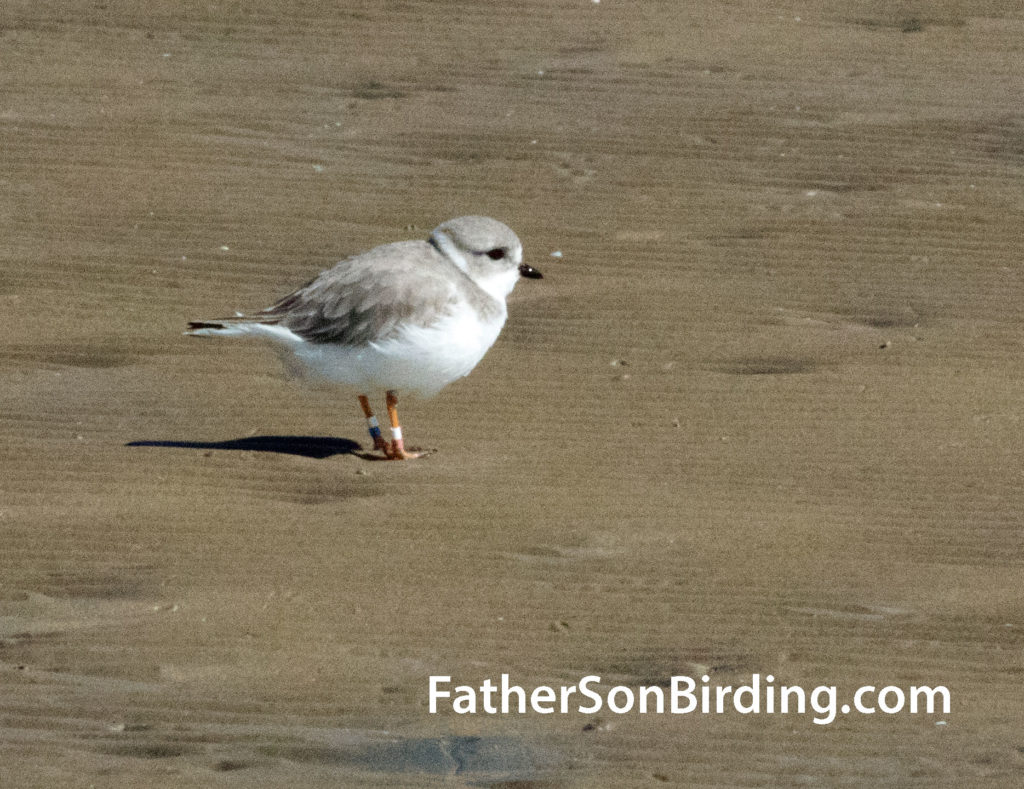
Southern Maine is also a prime location for sandy beaches, and both the birds and the tourists know it. Maine’s coastal towns go from sleepy and affordable in winter to bustling and expensive during the summer, when Americans from all over flock to them to enjoy the summer. This has created problems with the wildlife that depend on sandy beaches as their homes, namely the Piping Plover and Least Tern, two species who spend their days hunting for invertebrates along the coastline and breed in the grassy dunes just upland of the beach. Thankfully, the state of Maine has put in a lot of work to close off these dunes to tourists and their destructive dogs, allowing the birds to nest in a fragile security. At Pine Point, just five minutes from Scarborough Marsh, Hayden and I got to watch a trio of Piping Plovers chasing each other around the beach at close range. It was also at Pine Point that I got to see my lifer Roseate Terns, along with the more common Least and Commons. 

Keeping Piping Plover populations going requires careful monitoring and protection from the swarms of people and dogs crowding East Coast beaches each summer.

Though I’d always joked about the cold weather, lack of mountains, and isolation of Maine, I was certainly going to miss the state I’d spent four years getting to know. The places AND the people. This was especially present in my mind after giving Wes a hug goodbye and driving away from Belfast, from the University, and from some of the best friends I’d ever made. I would make sure to see them again, though it would never quite be the same. Thankfully, I had one more night to spend in Maine before leaving, though it wouldn’t be in the comfort of a friend’s air mattress. No, I was headed for the last county I’d never visited in the state: Franklin County, the land of wind, mountains and moose. 

To learn more about Sears Island and the ongoing fight over developing it, click here: https://friendsofsearsisland.org/wind-port-fact-sheet/ 

Sears Island provided just the kind of warbler experience I’d been hoping for my past four years in Maine. (For those confused by the above photo, it is not Sears Island, but just a fun travel photo from that week in Maine.)