Author Archives: admin

The Road More Pipit (Grassland Birding Part 2)

The burbling call of a Long-billed Curlew echoed across the dry fields as my dad and I stepped out of the minivan to listen. We stood on a dirt road about 20 miles west of Malta, craning our necks as we squinted at the sky, searching for a tiny dot that might be a Sprague’s Pipit. The unnamed road ran smack-dab through the middle of some of Montana’s best pipit habitat, and after missing several other prairie and marsh specialists at Bowdoin that morning (including Baird’s and Nelson’s Sparrows and Sedge Wren), we had come here for one last-ditch effort.

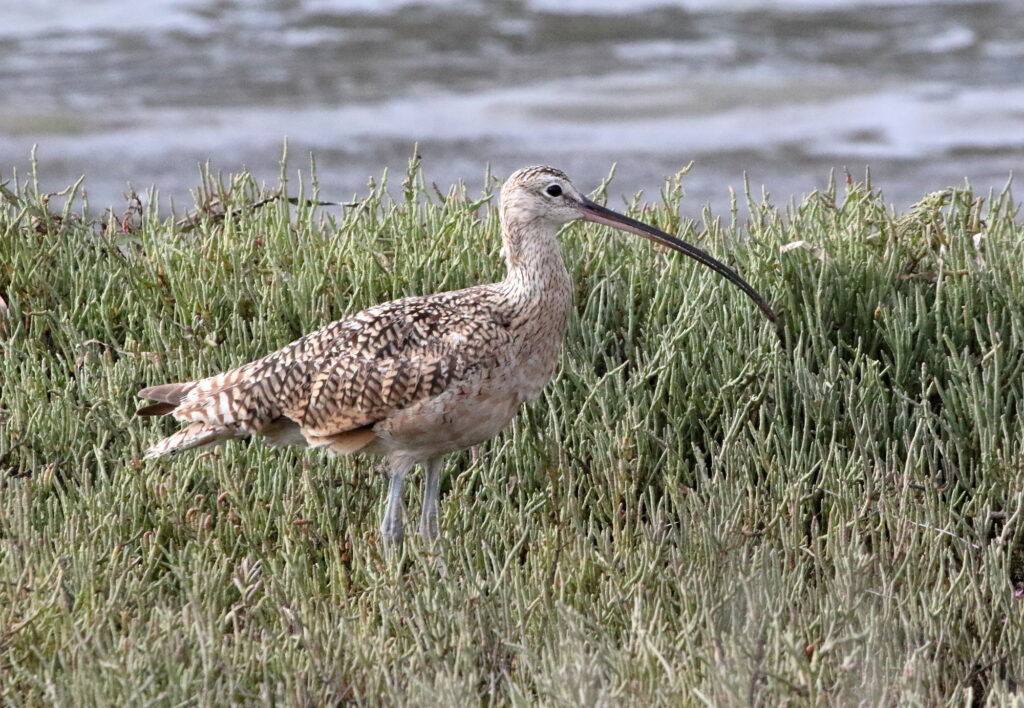
Even for us, it’s hard to get our head around the fact that Long-billed Curlews we’ve seen in, say, Morro Bay, California (above) fly to the grasslands of Montana to breed. We’ll take ’em, though!

Unfortunately, we had limited pipit experience to draw on. We’d only seen one before, in a thunderstorm on a road-turned-to-gumbo last July. Nick Ramsey had spotted that bird as we had frantically knocked mud off our car wheels, so we’d never even found the species by ourselves—making locating one now seem like a long shot. Thankfully, few clouds loomed on the horizon, meaning we probably wouldn’t have to deal with another thunderstorm.

Our search tactic involved conducting five-minute point counts every half mile, getting out of the car and listening for the birds. This was how most pipits had been detected on this road in the first place, and thanks to the science project I’d worked on last summer, I knew roughly how long to stay at each place before designating it “pipitless” and moving on. 

The first couple of points produced good birds, but nothing of exceptional interest. Vesper and Grasshopper Sparrows sang from the tufts of grass along the fence, and a few acrobatic Franklin’s Gulls spun in the sky above us. At places with more dense shrubbery the dry, buzzy trills of Clay-colored Sparrows joined the grassland chorus.

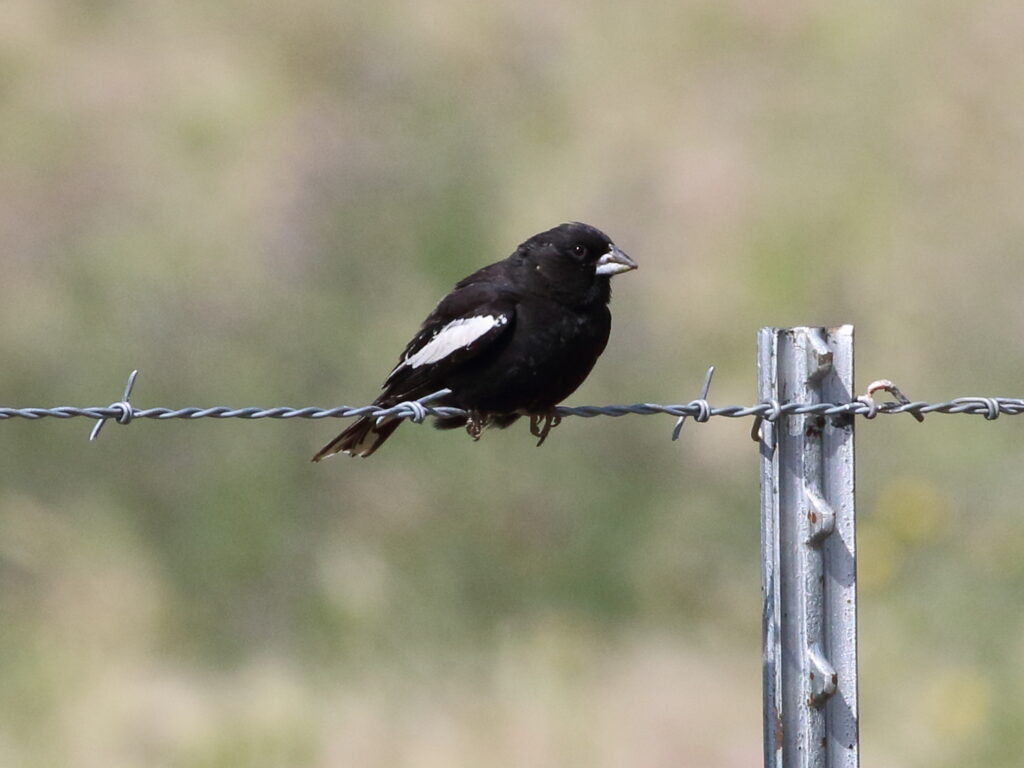
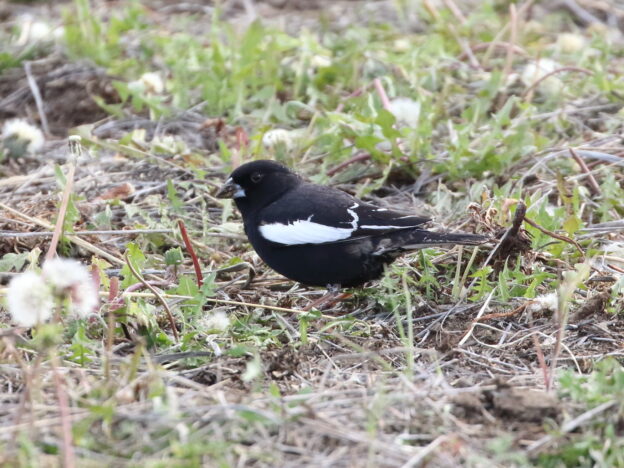
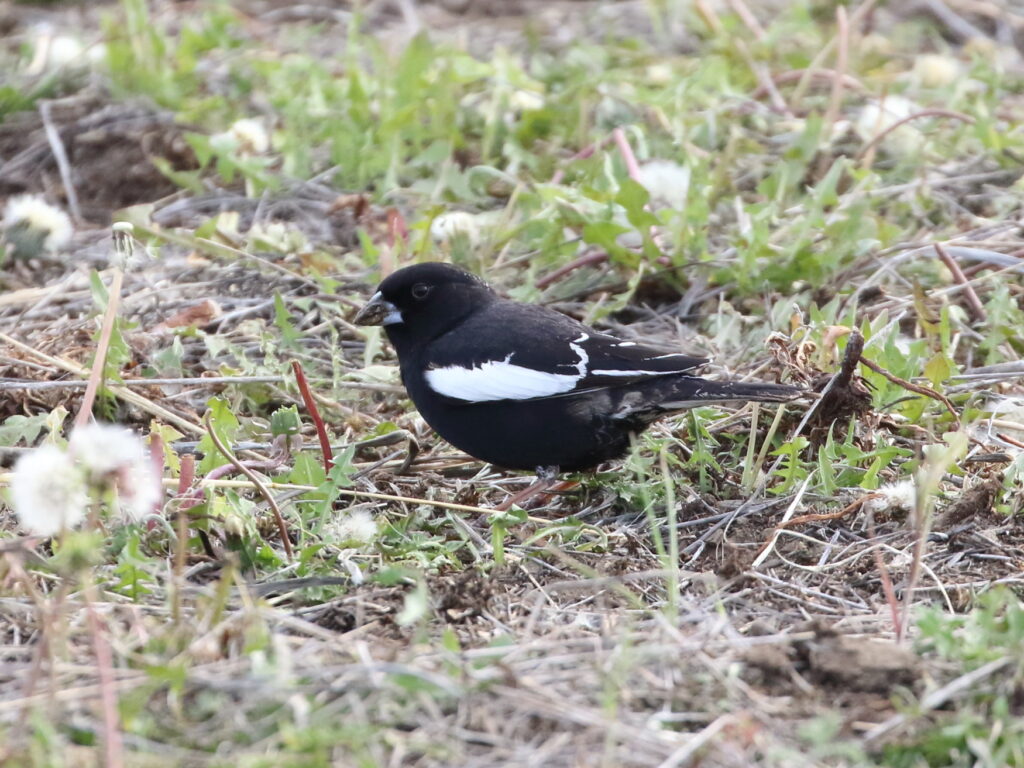
Our “Road More Pipit” also boasted the greatest numbers of Lark Buntings we’ve ever seen!

Then the scenery changed. Rather than parking next to fenced-off rangeland, the habitat on the left side of the road turned into a more natural-looking swath of native shortgrass prairie. As I got out of the car, I swore that I heard what eBird describes as the sound of “a cascading waterfall of tiny pebbles.” I’d been continuously playing the song as we’d driven between points to instill it in my head, so I couldn’t tell if what I’d heard was just my own brain playing back the song of a Sprague’s Pipit or not. Then, I heard it faintly again. As my dad grabbed his camera from the car, I set off into the prairie after the sound, flushing a pair of Ring-necked Pheasant from a bush. I climbed several ridges, watching my footsteps for rattlesnakes, until it sounded like the bird flew right above me. I looked up, and suddenly saw it—a tiny speck hovering in the blue space between the clouds, singing away.

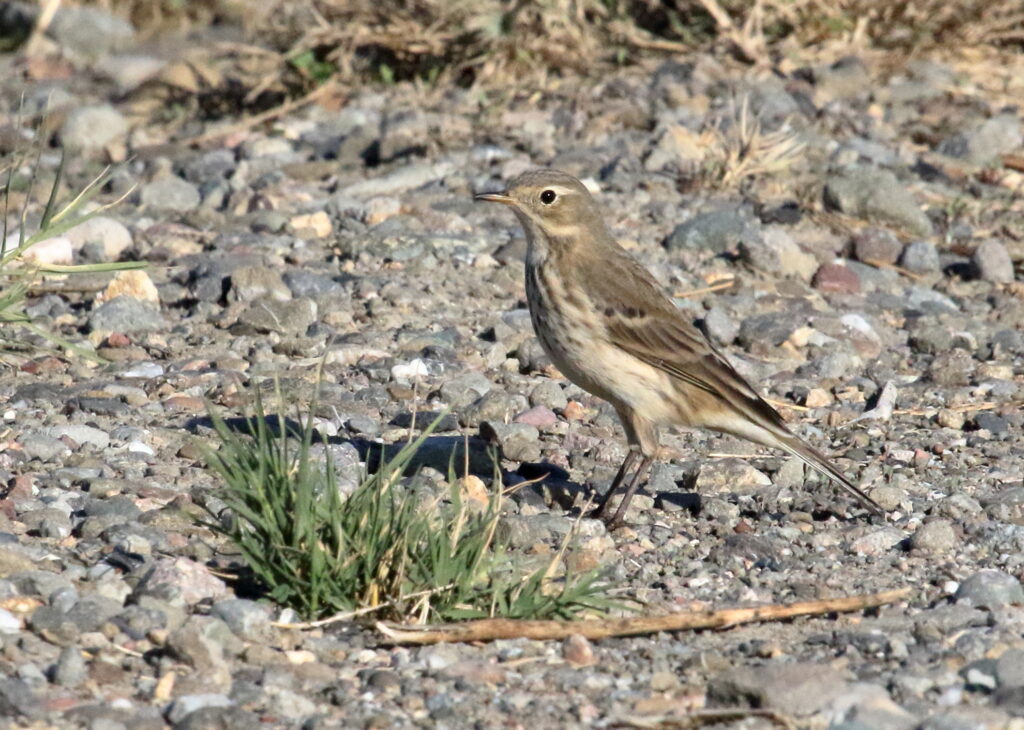
Here’s a Sprague’s Pipit—Not! If we were to show you a photo of one, it would look like a tiny dot in the sky. This American Pipit, though, looks almost identical to its much rarer cousin, so we ask that you pretend.

After showing it to my dad we just stood there watching what would have been the most incredibly boring part of birding for many people—but not for us. The pipit never descended, and instead slowly drifted further and further away until it was out of sight. We’d found a Sprague’s Pipit on our own! Of course, we knew that they were in the area, but locating an individual bird was still no small task!

The pipit was just the beginning of the prairie species we spotted on that road. As we kept driving, we began to pass large numbers of displaying Lark Buntings, which flew up about five feet before floating down, compared to the pipit’s display hundreds of feet above the earth. We passed a cattle grate, flushing a quintuplet of Sharp-tailed Grouse, several of which posed on the side of the road for us. Some of the Lark Buntings flashed white rumps, revealing themselves to be Bobolinks instead, which had a very similar display to the buntings, and in a very short-cut grain field I spotted three Chestnut-collared Longspurs. We’d ticked off most of Montana’s prairie birds on just this one road! Thrilled and relieved by our success, we got back on Highway 2 headed west, ready for the birds of Glacier National Park.

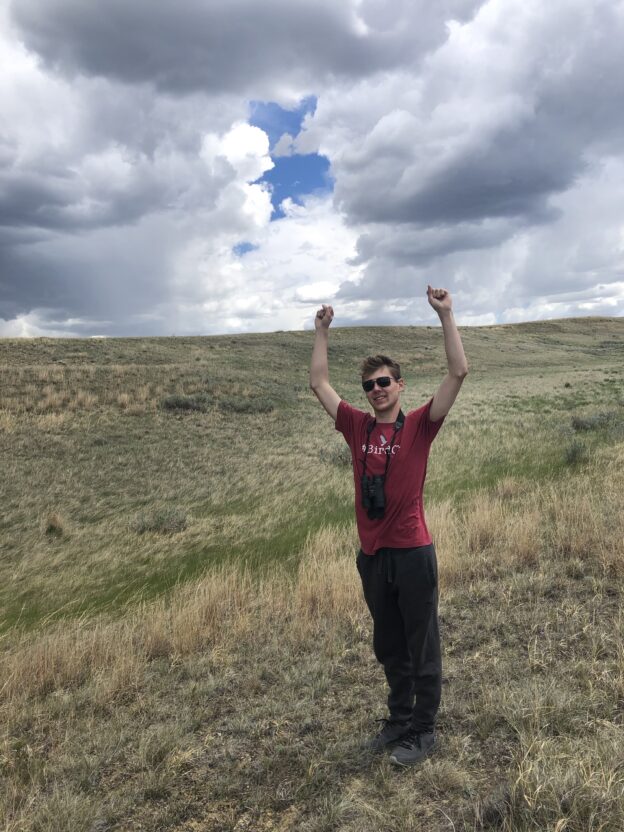
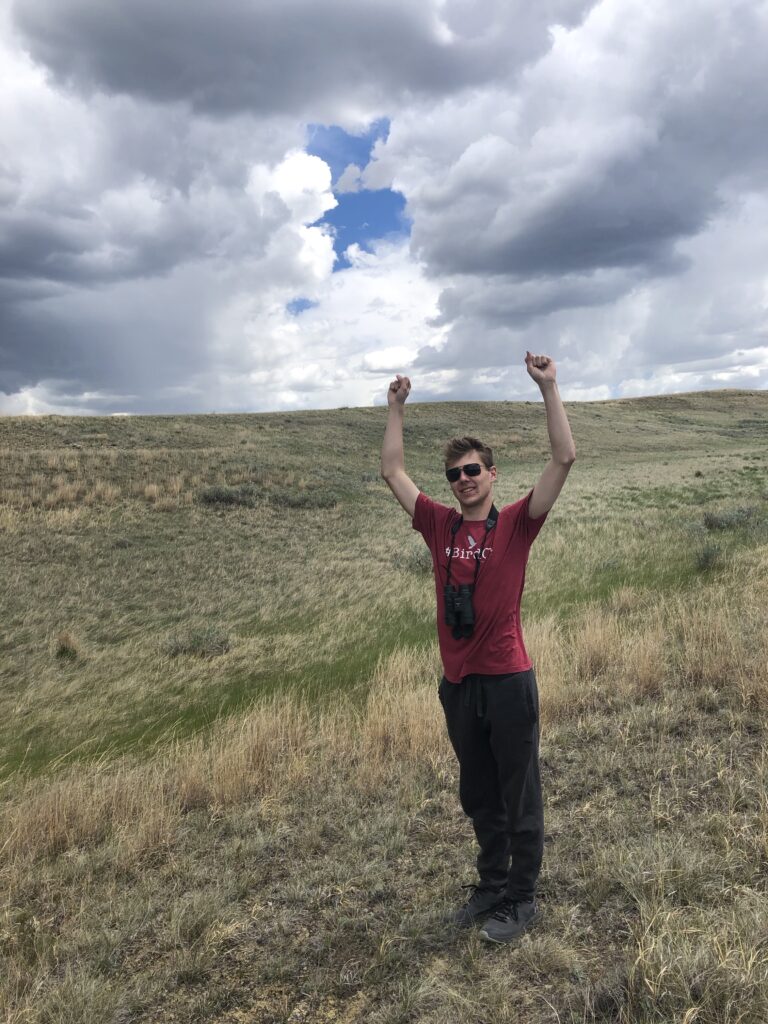
There’s no better reason to celebrate than finding your very own Sprague’s Pipit—though maybe graduating high school comes close!

Great Grassland Birding

Please share this post. Prairie birds will thank you!

After our Montana Big Year last year, Braden and I opted not to simply chase a high species count this year. In 2021 we decided to a) explore new places b) find some new Life Birds and c) revisit favorite birds we’d spent time with before. When we set off on our five-day central Montana trip last week, however, neither of us realized what a rich grasslands experience we would encounter.

It began with an almost mandatory annual pilgrimage to Benton Lake NWR. We both tend to think of Benton as a place full of ducks, grebes, and other waterfowl—including a dependable pair of Black-crowned Night Herons—and we found these birds in abundance. Immediately upon entering the refuge, however, I hit the brakes for an unexpected surprise: a pocket of four Upland Sandpipers! While not rare, these ungainly-looking dinosaur holdovers always delight us, and to see four together constituted a birding bonanza. What’s more, we found three more UPSAs at Benton, along with the other great grasslands shorebirds Long-billed Curlews, Willets, and a lone Marbled Godwit.

Clockwise from above: Upland Sandpiper, Long-billed Curlew, & Willet

Our day had just begun, however, as we decided to try to find Stilt Sandpipers at a fairly isolated lake north of Grass Range. Again, we found the sandpipers, which were hanging out with at least nine Bald Eagles, but it was the grassland birds along the dirt roads that most impressed us. These included four more Upland Sandpipers, Western Meadowlarks, Eastern & Western Kingbirds, Lark Buntings, and at least four other kinds of sparrows. One of these was a drab bird Braden never expected to see on our trip—Brewer’s Sparrow. Though we were well within its range, we’d never found one in this area, which just shows how much you can discover if you get off the beaten birding path!

With their bold “pied” colors, Lark Buntings are one of our favorite grassland species—but spotty in many areas.

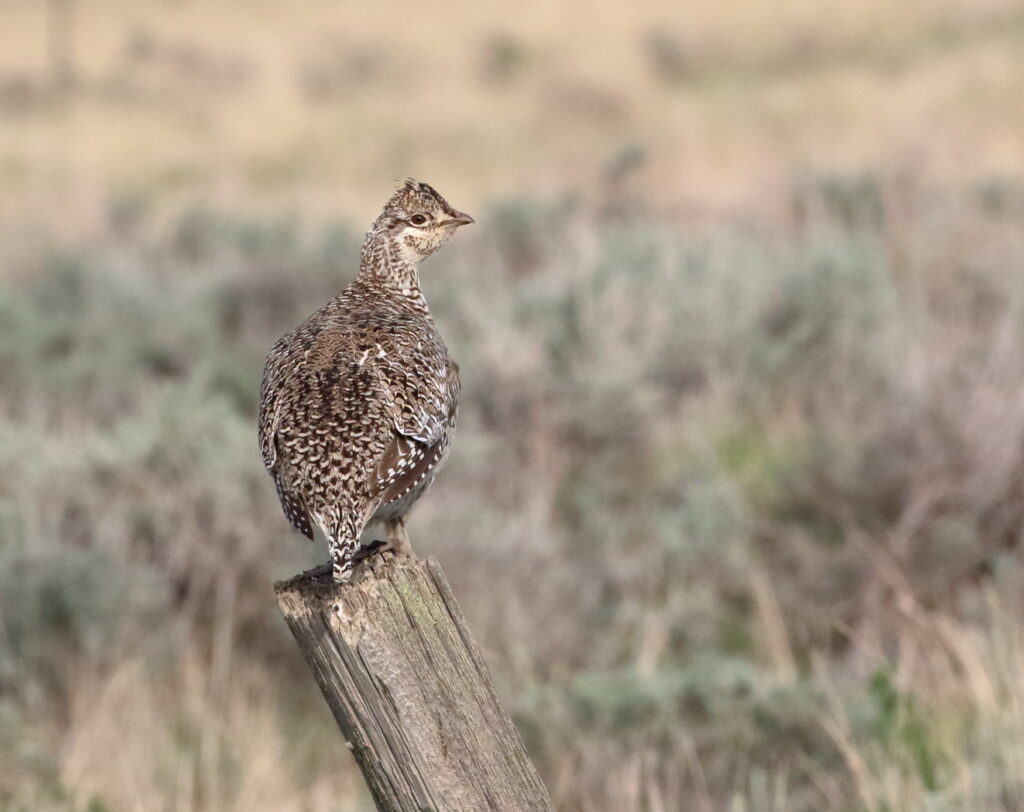
As we were approaching a left turn, I suddenly stopped and whispered “Look ahead.” About twenty yards in front of the car stood a Sharp-tailed Grouse—one of six we found on this particular route. Not only that, it posed beautifully giving us by far our best looks ever at this species. This species helped compensate for our miss on Mountain Plover, an unfortunately uncommon species extirpated from most grasslands by habitat loss or modification, especially the removal of bison and prairie dogs, and the conversion of short-grass prairie to many types of agriculture. Hopefully, we’ll find one next time!

Braden and I never turn down a grouse while birding, and this Sharp-tailed gave us one of our best looks ever.

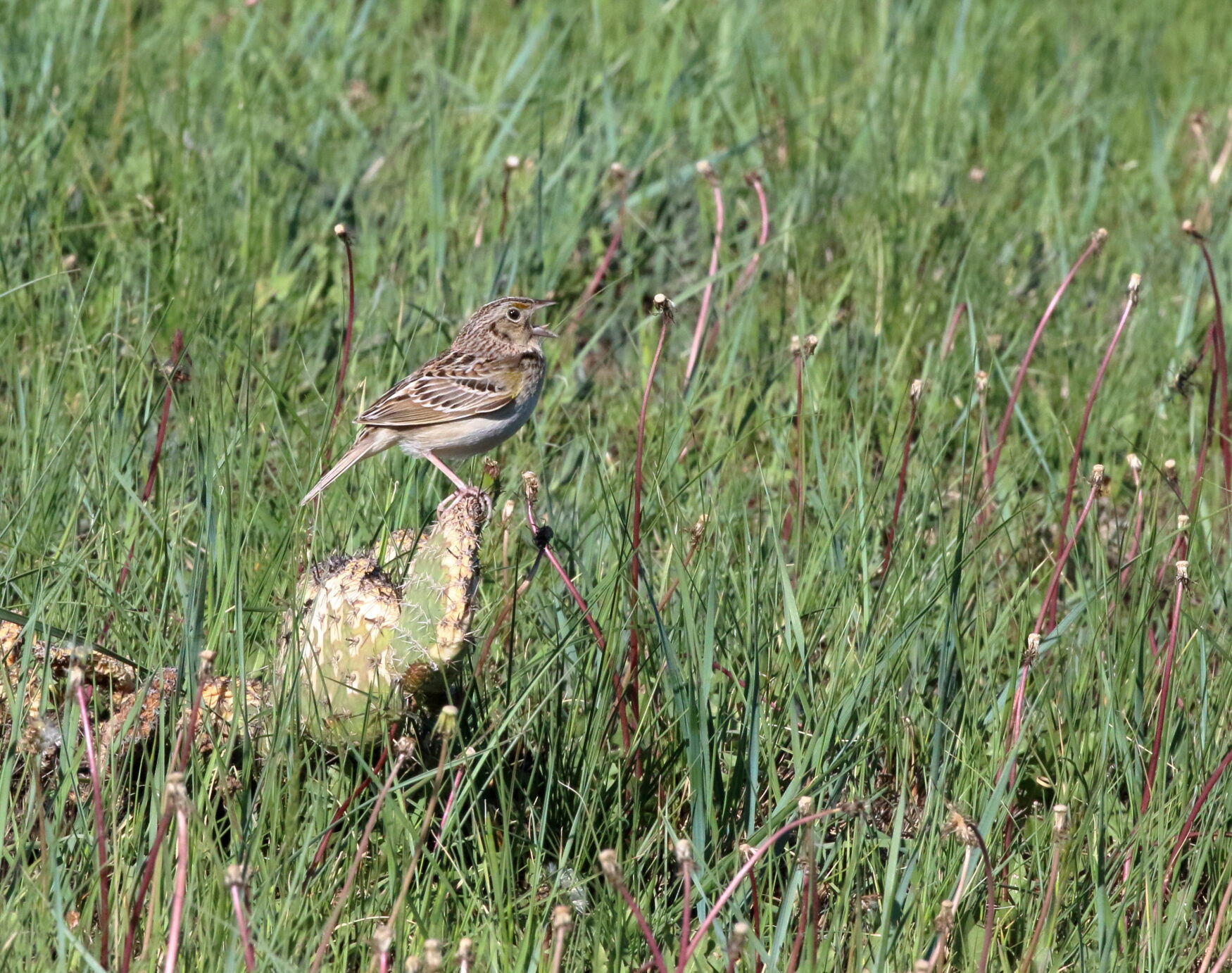
My second favorite grassland bird experience of the trip happened two days later at Bowdoin NWR, when we had a wonderful experience watching a Grasshopper Sparrow singing on top of a stubby cactus. With my crappy ears, I can no longer hear this bird, but this one decided to give me a break by posing in full view where we could watch and photograph it. Which may leave you wondering what our BEST grassland bird experience of the trip might be? I’ll let Braden tell you about that next time!

Beginning birders often dismiss sparrows as LBBs—Little Brown Birds—but close inspection reveals a marvellous diversity of patterns and subtle coloration. Grasshopper Sparrows, for instance, are identified by their yellow faces and single thin brown line extending back from the eye.

10,000 Views—and Time for Reflection

During our Birding Therapy Week posts, FatherSonBirding achieved the milestone of receiving our ten thousandth view! To celebrate, we’d first like to thank all of you who have been following our adventures and other stories about our favorite non-human animals (including our dog, Lola,). We know that everyone has an avalanche of blogs, news, posts—and yes, even books and magazines—competing for reading attention, and we greatly appreciate each and every one of you. It also, though, seems like a good time to reflect and re-evaluate.

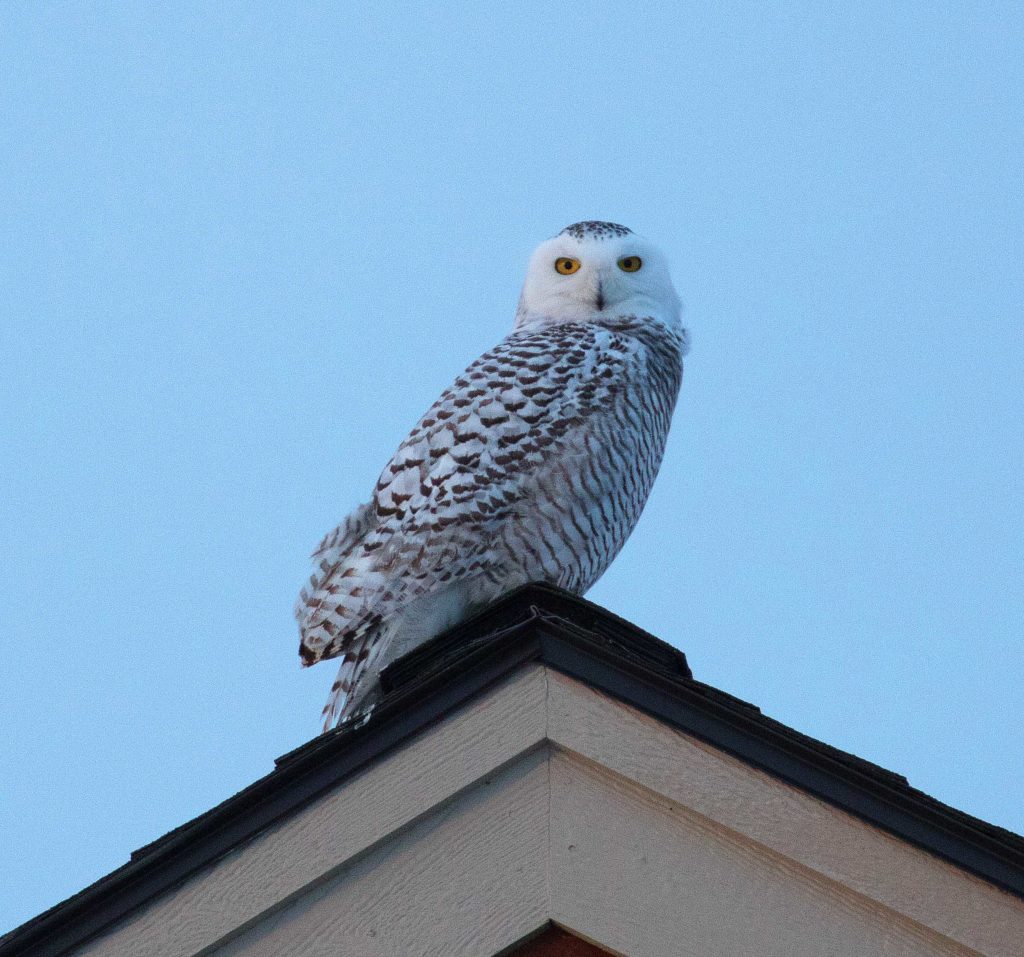
Our Lifer Snowy Owl—from our very first blog post on March 13, 2018

It seems hard to believe, but we launched FatherSonBirding more than three years ago with our post A Quest for Snowy Owls. Since that time, we’ve posted 81 times, and garnered 65 subscribers (there were actually more, but we lost several dozen while getting hacked by suspected Russian provocateurs). On average, about a hundred people read each post. Which is all good, but like a certain ex-president’s approval ratings, our numbers don’t really budge much. On top of that, Braden will be heading off to the University of Maine soon to begin his college career, highlighting the bittersweet fact that we will not have nearly as many birding adventures together as we’ve enjoyed the past few years.

That said, we could shift the focus of the blog from our birding exploits to bird conservation, bird education, or something else. In fact, if you are reading this, we ask that you send us your thoughts on where we might take this forum going forward—including just chugging along as we are, posting occasionally about something that strikes our fancy. Honestly, I (Sneed) have so many mixed feelings about social media that we will probably never do what it takes to build a huge following. I mean, we probably should have launched a blog about watching MineCraft videos or breaking plates over our heads or cooking Julia Childs’ recipes, but we didn’t. Still, we have enjoyed sharing with you and would love it if you’d take time to send us your honest thoughts about what might come next.

As you ponder those, we’d like to leave you with some photos from our best Montana Big Day ever last week, during which we drove 500 miles and found 114 species—the first time we’d ever seen more than 100 different birds in a day in Montana. Ironically, our Bird of the Day was one that we didn’t even see—an American Bittern that we heard calling in the Swan River National Wildlife Refuge! We’d gone looking for AMBIs at least seven or eight times the past two seasons, so it was a real thrill to finally hear one. We hope that you all are having great birding adventures this spring, whether it’s watching your backyard feeder or planning your own Big Day, Big Week, or Big Life!

—Sneed and Braden

Crossbill Sunday: the Final Day of Birding Therapy Week

Thank you for following our Birding Therapy Week posts. Please share and don’t forget to subscribe to receive future posts!

To wrap up Birding Therapy Week, I leaped onto my bike Sunday morning and pedaled to a spot I’d been sorely neglecting this year: the Missoula Cemetery. One thing that got me through the first year of the pandemic was cycling out there on a regular basis just to see what was flitting around. I’d ended 2020 with a total of 50 species, firmly cementing my position of Cemetery King, and seeing many surprising birds as a result. Braden and I had ventured out there once this winter and been rewarded with a flock of Common Redpolls, but I needed to get out there again before the trees fully leafed out, making it difficult to spot passerines.

As usual, I parked near the entrance to put in my hearing aids, grab a drink of water, and stretch out before beginning my tour. As I tried to loosen my hamstrings, however, I was already hearing some interesting sounds. “Hm . . . maybe Pine Siskins?” That’s when I looked up to see a flock of 20+ Red Crossbills! Not only was this a new sight for the cemetery, just that morning we’d seen our first ever crossbills at our backyard feeder. In fact, this was shaping up to be our best crossbill year yet, and I spent a solid 15 minutes enjoying the cemetery flock, which also contained liberal doses of Pine Siskins and a Yellow-rumped Warbler.

The wonky bills of Red Crossbills have evolved to pry open cone scales, allowing the birds’ long tongues to extract the hidden seeds.

Setting off through the tombstones on my bicycle, I wasn’t sure what else I’d find, but encountered other common cemetery birds such as robins, ravens, and flickers, but it was a weird morning, a bit cool and breezy and I began to lose hope that I’d see the unusual passerines I really craved. Turning on to the last access road, however, I stopped to investigate a couple of little birds that turned out to be House Finches. But among them, I spotted a flash of yellow—a Nashville Warbler!  

Alas, I failed to find any sparrows in the spot I’d seen both Song and White-throated Sparrows before, but I did get my Year Brewer’s Blackbird and a new “location bird”—Turkey Vulture—while racking up a total of 17 species. All of which left me satisfied—but not really.

One thing Braden and I have noticed during the past seven years of birding is how much better many of our public open spaces could be for birds, insects, and other wildlife. The Missoula Cemetery is a great example. I mean, it potentially has everything: lots of land, trees, even a fountain, and the dedicated staff obviously works hard to keep it looking nice. Unfortunately, the place is groomed to death—literally. Dead limbs and trees that could provide insect food for birds are meticulously removed. Messy brush—the stuff many songbirds love—is absolutely not tolerated. I could smell some kind of chemical—weed killer, I’m guessing—emanating from the lawns. Even the fountain where birds could drink is blue from some kind of bleach or detergent in it.

American Robins seem to thrive in almost any urban environment, but many more sensitive species need more habitat—and fewer herbicides & pesticides—than many parks and other open spaces provide.

Sadly, this is a situation that repeats itself over and over across America. Our vision of what is nice, neat, and orderly actually represents an extremely unhealthy environment, one that is undoubtedly harmful to wildlife and perhaps humans as well. No one really is to blame. It’s in our nature to want to make things neat and orderly. However as our knowledge has improved, this is something we as citizens can change. As I wrapped up Birding Therapy Week, I promised myself that I would redouble my efforts both to educate others and perhaps change some of our outdated thinking about both our personal and public open spaces.

Quarrying Species: Birding Therapy Day Six

Enjoy these posts? Please share and subscribe using the box down below and on the right.

Saturday, Day 6 of my Birding Therapy Week, I arrived at Fort Missoula at 7:45 a.m. with my daughter for the first of her two soccer games that day. While she warmed up with her team, I took Lola back over to the gravel quarry hoping to catch some magical morning birding. I didn’t have to wait long to kick off a great session. Even before leaving the soccer fields parking lot, my first Barn Swallow of the year flew past me, and once I reached my first stop at the northward quarry pond, I found myself struggling to keep up with all of the species I saw and heard. On the ponds themselves, I ID’ed eight species of ducks, Canada Geese, a Horned Grebe, and a Common Loon—perhaps the same one I’d seen two days before.

I had to play hide-and-seek with this loon even to get this poor shot, but I didn’t mind. Was just thrilled it stopped by the quarry on its way to its breeding grounds.

As I walked along the fence line, a sparrow popped up with a bold face pattern and pale “moustache”—the year’s first Vesper’s Sparrow! Nearby landed a Savannah Sparrow while a Western Meadowlark serenaded us. At the cliff edge above the river, Northern Roughed-Winged and Tree Swallows swarmed while a Red-tailed Hawk, Osprey, and Great Blue Heron sauntered by.

Meadowlarks always make me pause to ooh and ah, especially when they perch and sing in full view!

The hits kept on coming: two Red-naped Sapsuckers, a pair of Wood Ducks flushing from beside the river, a Yellow-rumped Warbler. As before, I made a special effort to find unusual sparrows. In one of our favorite spots, I located a couple of White-crowneds and then I saw something that really got my heart thumping: a bold bird with a peaked crown and distinct gray and brown facial lines. Even more exciting, I thought I detected a bit of yellow on the sides of the breasts—sure signs of a Lincoln’s Sparrow. Unfortunately, the bird was facing away from me and I was just moving in for a better look when two good-natured women walked up behind me and loudly shouted “Good morning!” I turned around and smiled, putting my finger to my lips, but it was too late. The sparrow fled.

Sigh.

Still, it was an amazing morning, with 36 species and delightful experiences. Even better, my daughter’s team won her soccer game. I’ll get you next time, Mr. Lincoln.

Here is my complete checklist: https://ebird.org/checklist/S86803129

I missed the Lincoln’s Sparrow, but was delighted to find my first Vesper’s Sparrow of the year. Braden got his first in a different location the very same day! Note that Vesper’s Sparrows are identified by their bold facial pattern including white eye ring and white “handlebar moustache” curving down and back from its bill. When they fly, look for the white outer tail feathers. Many also show an upside down “heart” on their breasts—though this one is “heartless.” Poor thing.