Category Archives: Migration

Winter Birding in Israel, Part II: Valley of the Cranes

This week, enjoy Braden’s Part II of an Undetermined Series of Posts about our recent birding adventures in Israel and Jordan!

Over the next few days, our host family showed us around Northern Israel. We explored Akko, a seaside town with a great market full of delicious Arab and Jewish food and tall, Crusader-era walls. In Haifa, we took a drive around Mount Carmel and dined on amazing pizza and fantastic pistachio ice cream. My dad and I even spotted a Eurasian Griffon soaring over a residential area, a rare species of vulture that nested in the Carmel range. 
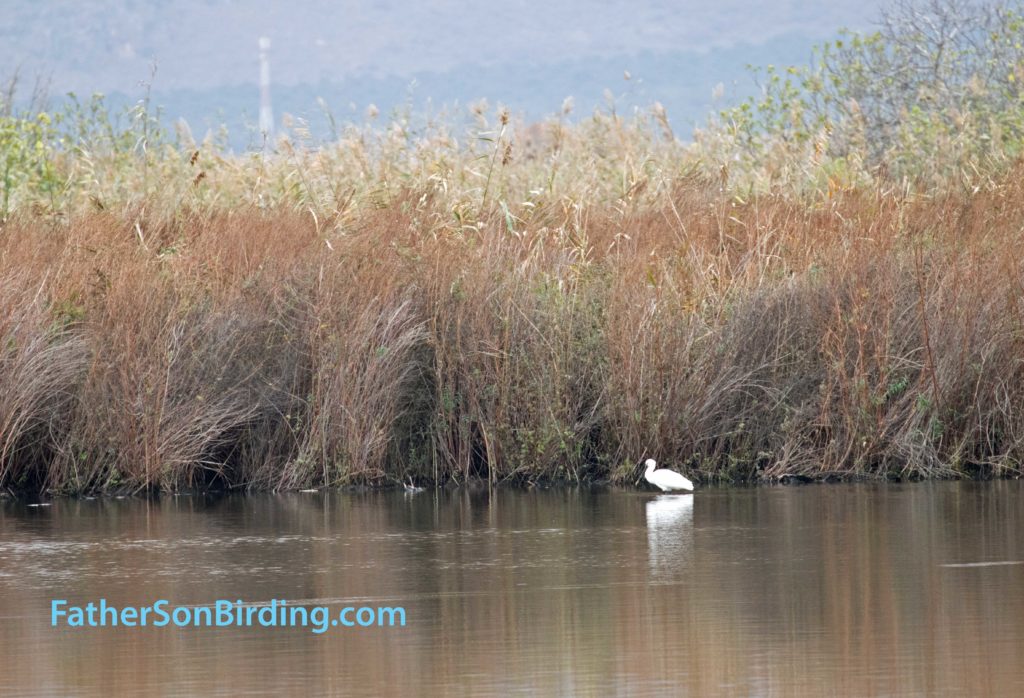
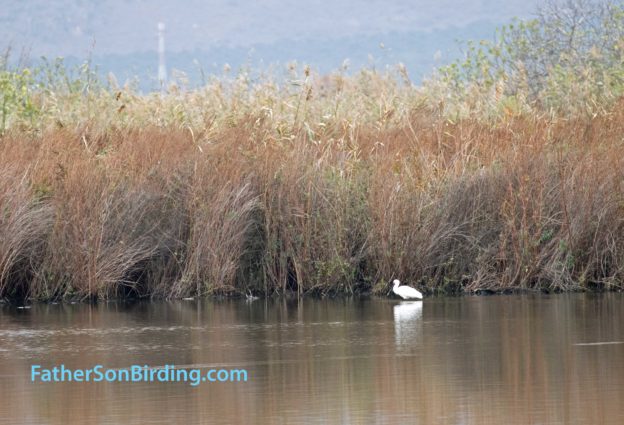
A lone Eurasian Spoonbill enjoys refuge in the Hula Valley Nature Reserve, once part of a vast wetlands that covered much of north-central Israel.

After sightseeing, though, we were ready to do some serious birding. One day, my dad, one of our friends named Noam and I hopped on the train to Haifa (spotting flamingos feeding in salt ponds on the way), where we were picked up by our host’s brother Barak and father Avi. We headed north, stopping only to grab a snack at a roadside falafel & humus stand overlooking the vast Sea of Galilee and its nearby canyons and mosques. Soon, though, we left the mountains, driving past agricultural fields filled with Common Cranes. Eventually we arrived at the Hula Valley Nature Reserve, and were greeted by a large, modern visitor center. The best way to sightsee the refuge was to rent a golf cart, and that we did, setting off around a lake at Formula 1 speeds—about 10 miles per hour. We were soon greeted by hundreds of cranes, as well as various tactics that farmers used to prevent the birds from eating their crops. Every few minutes a gunshot, firework or horn would echo across the landscape (the birds were protected, don’t worry), and we even glimpsed a few people chasing the huge flocks.
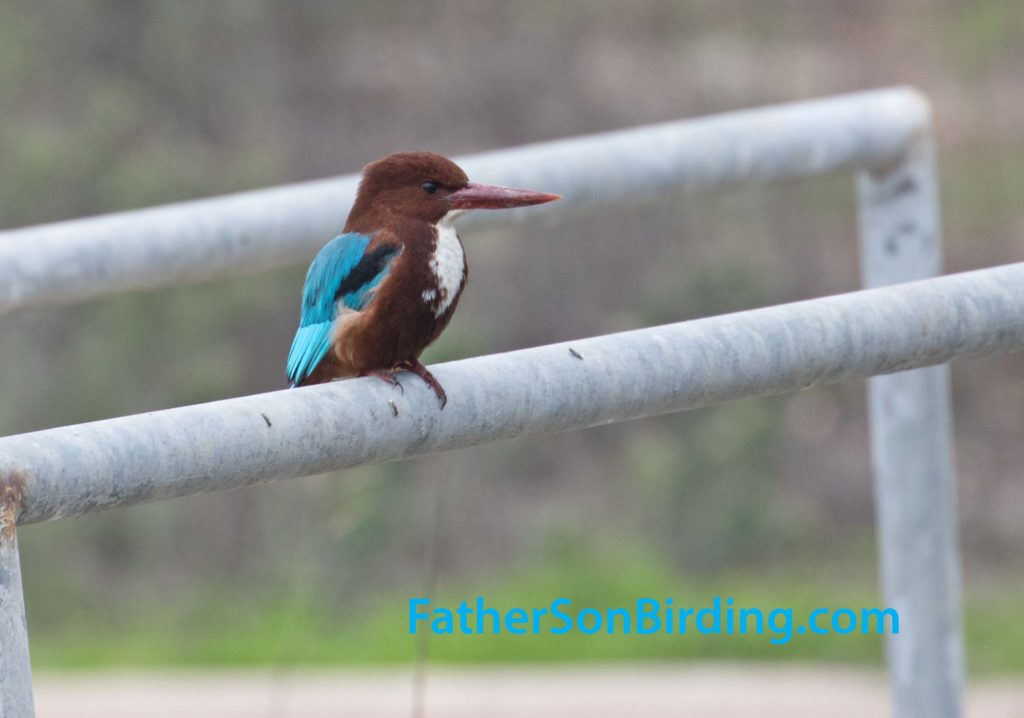
In the Hula, we got our first great look of the trip at what would prove to be one of our Top Five favorite Israeli birds—the White-throated Kingfisher.

Before reaching the main lake, we stopped at a forested spot and were immediately astonished to see not one, but two birds that we’d been hoping to see: a White-throated Kingfisher and a Eurasian Hoopoe! The large kingfisher showed off its azure wings as it scanned the ground for rodents, while the hoopoe foraged quietly like a flicker, probably looking for ants. Spur-winged Lapwings, birds with sharp patterns of black and white on their wings, stood right by the path, unafraid, and almost every bird in the area allowed us to snap sharp, close-up photos. Before leaving we spotted a pair of European Goldfinches, chirping cheerfully despite their “sunburnt” faces.

At the lake itself bird activity increased substantially. Raptors were abundant, including Black and Black-winged Kites, Eurasian Marsh-Harriers, Common Buzzards and Eurasian Kestrels, all flying over the marshes. One kestrel even posed for us on a sign, devouring a mouse right in front of us! The species diversity of ducks was low, but those that were here, primarily shovelers, mallards and teal, foraged in the fields in huge numbers, and Eurasian Coots, Eurasian Moorhens and Little Grebes floated on the water. Shorebirds and waders also were present, and we spotted a few Glossy Ibises, Black-winged Stilts, Ruff and a single Eurasian Spoonbill by the shoreline. Gray Herons, Great, Cattle and Little Egrets and Great and Pygmy Cormorants topped every bare branch and island in the area.

As this Eurasian Kestrel can attest to, there’s nothing like a good stretch after tearing the head off a mouse!

At a lookout a helpful naturalist pointed out several harder-to-see species to us, including Black-tailed Godwits and Northern Lapwings hiding in the distance among the huge numbers of cranes. I snapped photos of several raptors that flew by, later identifying them as eagles! The two we spotted were Booted and Greater Spotted, just a small percentage of the eagle species the Old World supported. Pied Avocets floated on the waves of the pond like ducks.
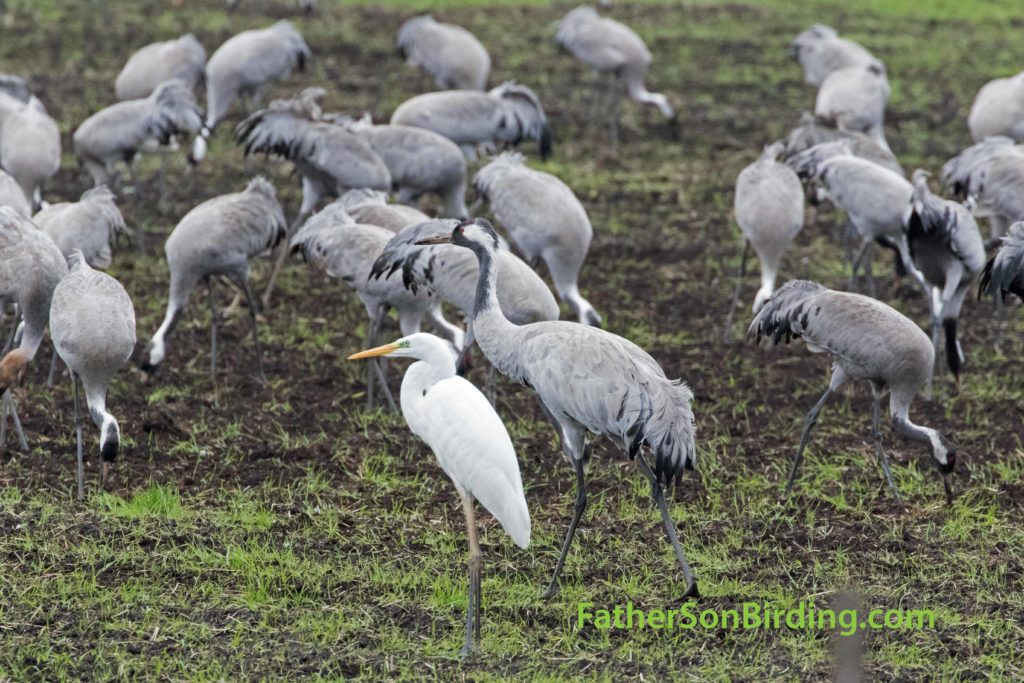
Sing along with us: “One of these things is not like the other. One of these things is not the same. One of these things—” Oh, you get the idea. It’s hard to blend in with 30,000 Common Cranes!

We completed our loop, tracking down cranes for better photos and spotting a Common Kingfisher skulking in the brush back at the visitor center, the only one we’d see for the rest of the trip! This little refuge, surrounded by farmland, was all that remained of the huge wetlands that had once covered much of this area and supported hippos, ostriches and cheetahs. While much of the diversity of the past had disappeared, Hula still provides habitat for thousands of birds during all seasons and efficiently allows the public to experience them. The day had not disappointed. 

All photos and text on FatherSonBirding.com are strictly protected under U.S. copyright law. To request permission to use, contact Sneed at sbcollardiii+2@gmail.com.
Going For Gulls (Part 1)

Do you love birds and birding as much as we do? Do you want to help educate others about the amazing world of birds? Well, please share this site with other birders, wanna-be birders, and educators—AND follow our adventures by subscribing to FatherSonBirding.com using the box on the right below.

Just returned from a fun speaking road trip, where I got to share Braden’s and my birding adventures with fellow birders at Coeur d’Alene Audubon, the Puget Sound Bird Fest, Edmonds Bookshop, and Eagle Harbor Book Co. Thank you for the great turnouts, everyone! I, of course, also hoped to get in some good birding on the trip, but weather—or perhaps bad birding karma—conspired against me. The one bright spot? Gulls!

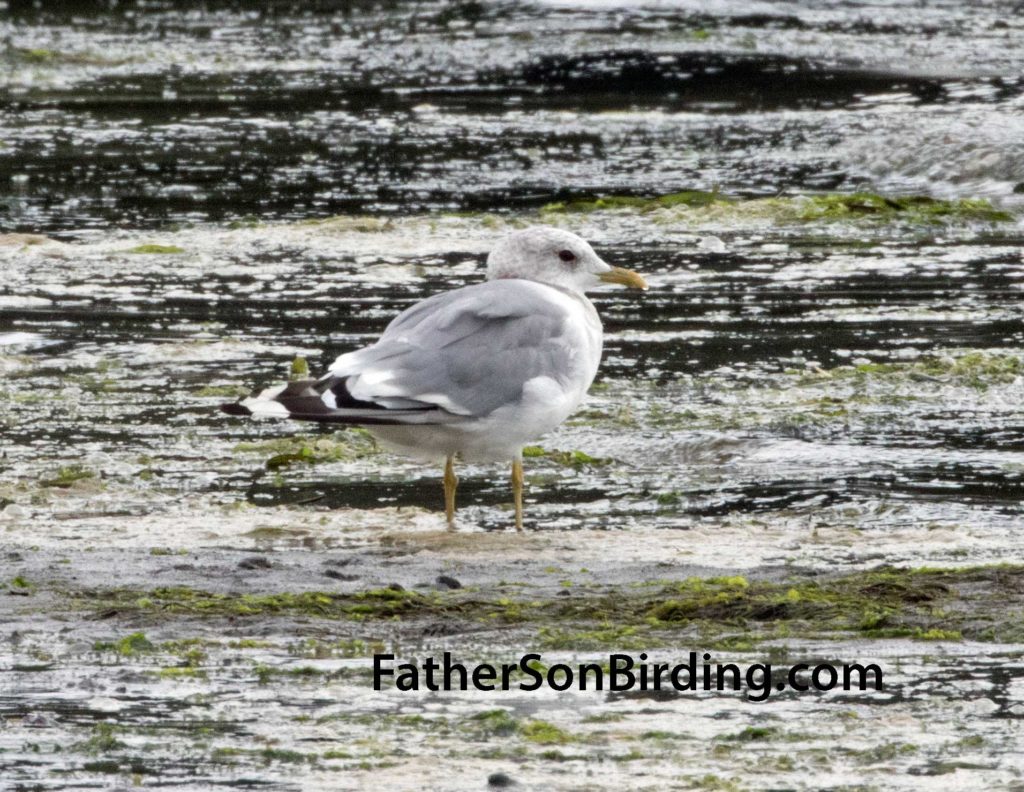
This Mew Gull at The Nature Conservancy’s Foulweather Bluff Preserve was a real surprise—and the first Mew Gull Braden or I had seen on the ground.

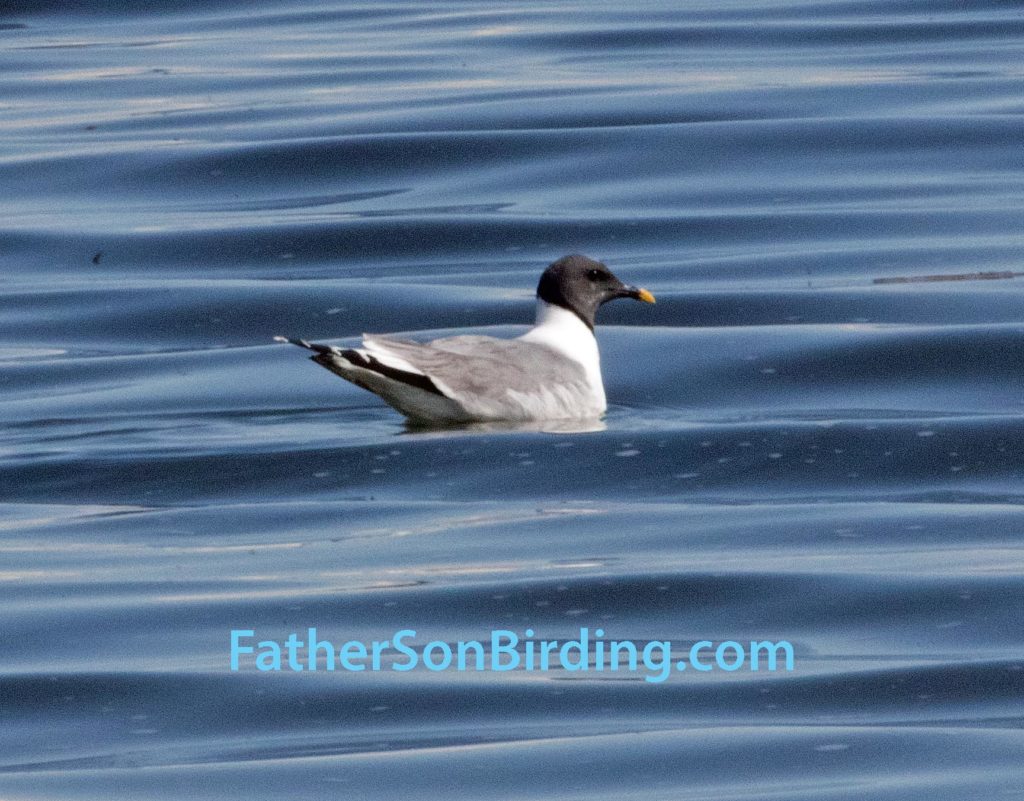
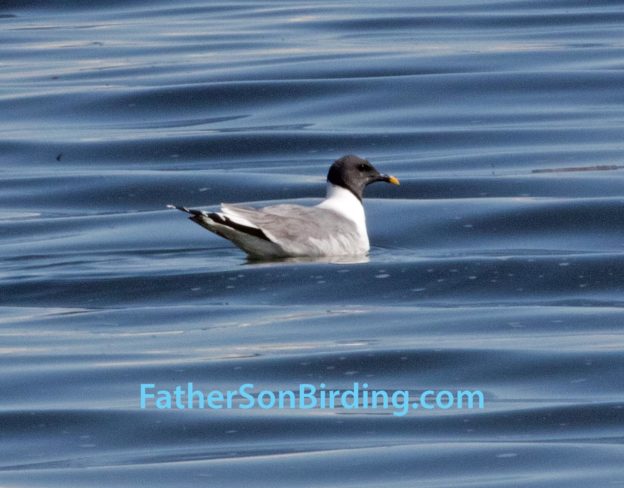
I don’t know about you, but I find gulls vexing. I do not even try to ID immature gulls, but the adults also offer enough variation to render me apoplectic. My first birding stop was Potholes State Park, about thirty miles south of Moses Lake, Washington. I arrived at a crummy time of day, but enjoyed seeing dozens of migrating Yellow-rumped Warblers and few White-crowned Sparrows. Looking out at the reservoir, however, I noticed a black-headed gull in the distance. I tramped toward it, figuring it had to be a Bonaparte’s or Franklin’s Gull. I mean this far inland what else could it be? The problem was the bird’s weird bill, which should have been either red or black. Instead, this bill was black with a yellow tip. “Geez,” I thought. “Maybe it’s turning red.” I called Braden to ask his opinion, but he was stuck in class back in Missoula, so I snapped a few photos and moved on.

What the . . . ? A gull with a black head and half-yellow bill was about the last thing I expected to see in the interior of Washington State. I guessed it was a weird Bonaparte’s Gull—and I was wrong. Read below for the shocking conclusion!

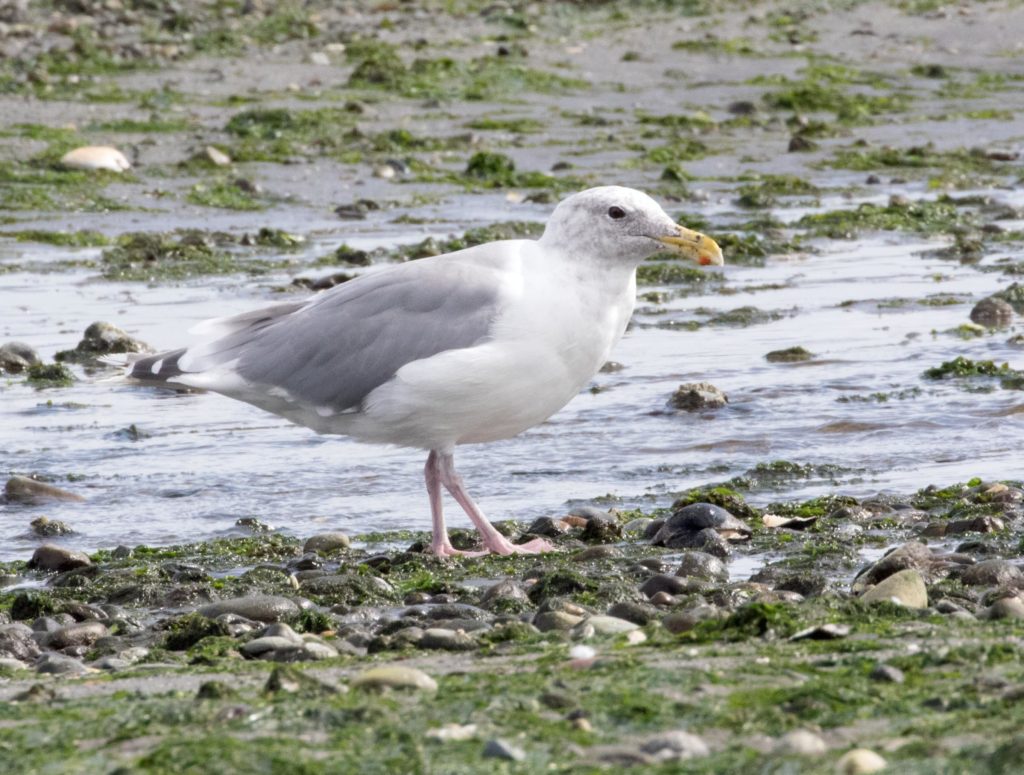
The next day in Seattle, my friends Steve and Carol and I took the ferry to Kingston and drove to Point No Point lighthouse, which had shown a lot of great water bird activity in the past few days. Alas, except for a few Rhinocerous Auklets, very little moved on the beach or offshore so I again turned my attention to gulls. I saw what looked like a Glaucous-winged Gull except that its tail was too dark, so I decided it must be a Herring Gull, as its wings were too light for a Western. Later, however, I ran into a couple of different birders who told me that Puget Sound was awash in hybrid gulls, mostly Glaucous-winged x Herring Gull or Glaucous-winged x Western. I had heard of hybrid gulls before, but didn’t realize they were so abundant and decided the one I had looked at must be a Glaucous-winged x Herring.

“Well-behaved” gulls that follow ID rules are difficult enough to identify. Unfortunately, many gulls make birders’ lives more difficult by hybridizing! Is this a Glaucous-winged x Herring Gull hybrid or a Glaucous-winged x Western Gull hybrid? The lighter wings and tail push me toward the former, but if you disagree, please weigh in!

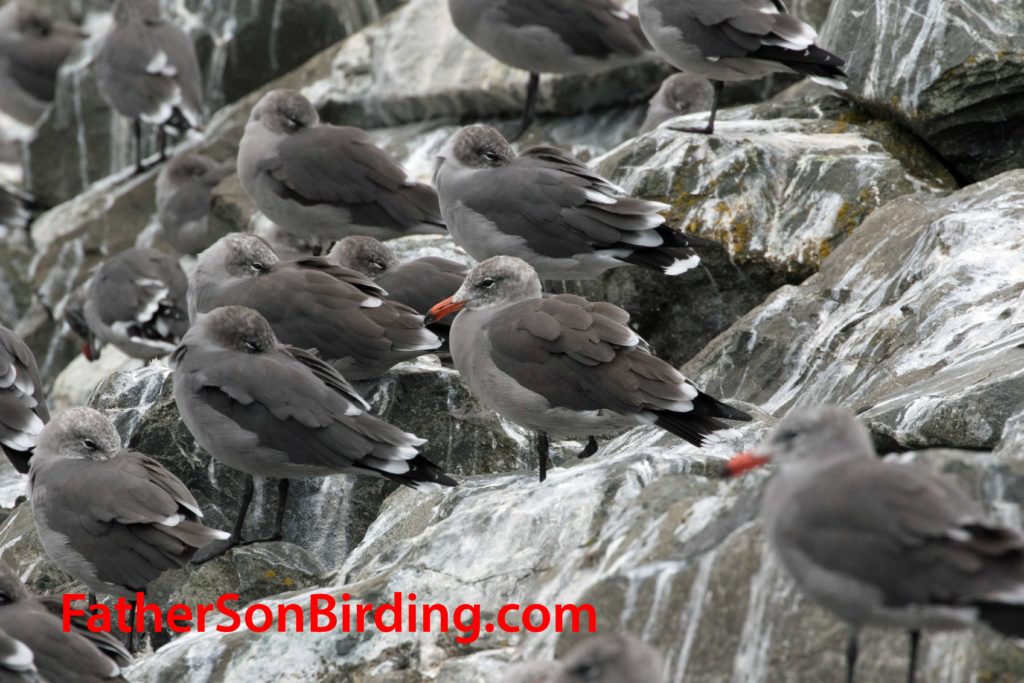
A couple of mornings later, at the Puget Sound Birding Fest in Edmonds, my dismal birding luck continued—except for the gulls! Along the waterfront, I found 400 Heermann’s Gulls—probably Braden’s and my favorite gulls. I also found my first definite California Gull of the trip and settled in to give the hybrids more study. In a later post, I will try to explain the mental flow-chart I use for gulls, but suffice to say, it was a most enjoyable morning spent sharpening my gull skills and knowledge.

Heermann’s Gulls are not only some of the most beautiful gulls, they are among the easiest to identify. Can you tell why Braden and I love them so much?

The best discovery awaited me when I returned to Montana, however, and was showing Braden my gull photos. We found that I had taken a photo of a Mew Gull (which I had assumed was a juvenile of another species). Then, I showed him my “mystery” black-headed gull from Potholes State Park. “You saw that?” he exclaimed. “Well, yeah. Do you know what it is?” “Yeah,” he answered, and pulled up photos of a gull that had never even been on my radar—a Sabine’s Gull! This gull breeds in the Arctic tundra and migrates offshore of the Pacific coast. According to Sibley, “migrants rarely appear on inland ponds, lakes or rivers,” and yet here I’d seen one 200 miles from the coast!

Lesson Number 1: Once again, that birds don’t read the guide books. Lesson #2: That I still have a LOT to learn about gulls—but am making progress!