Category Archives: Bird Conservation

Braden’s Maine to Montana Birdventure, Part 1: A Day in “The County”

Today, FSB kicks off Braden’s accounts of his truly remarkable spring birding trip from Maine to Montana. This adventure would take him to an astonishing variety of habitats most of us never get to experience. Along the way, he would drive 5,000 miles, visit nine states and provinces, and record 264 bird species, seven of them lifers. He begins this series with a visit to Maine’s arguably wildest and most inaccessible county: Aroostook.

Twenty-four hours after walking across the stage of the Cross Insurance Center in Bangor and receiving my college diploma, I was alone in a tent in Northern Maine. I’d gone to school in the state for four years, but never experienced it in the summertime, those three months when Maine is at its best. Now, with an abundance of time, I could leisurely make my way back to Montana instead of the six-day dash I’d done across the country last August. Because of this distant deadline, I’d arranged to spend a week in Maine birding and exploring following my graduation, and there was no better place to start than with one of the two counties I’d never visited: Aroostook County.

A Cedar Bog up in Aroostook County! This one shimmied with Palm and Magnolia Warblers.

Known simply as “The County” to locals, Aroostook is by far the largest and least populated part of Maine. The County contains a large portion of the state’s agriculture, mostly located on its eastern flank, whereas the rest is coniferous forest. Aroostook’s high latitude and cooler climate create a haven for many boreal species of birds that have receded from their more southerly haunts because of warming and excessive logging that promotes regrowth of a different, unsuitable habitat. This northern conifer forest is also a hotspot for the primary topic of my dad’s previous post: warblers.

Warblers, in fact, were a major factor in my decision about where to go to school. I wanted to go to college somewhere where I could see as many warblers as possible, and Maine fit that bill perfectly. With almost thirty species of breeding warblers (nearly triple what Montana, a state twice the size, has) there is no better place to be, and that is especially true of Aroostook County, where most of them could be found. Lying in bed the night of Monday, May 12th, I felt nervous. It was still fairly early as far as migration goes. What if the birds weren’t here yet?

This was my camping spot in Aroostook County, on a backroad in northern Maine!

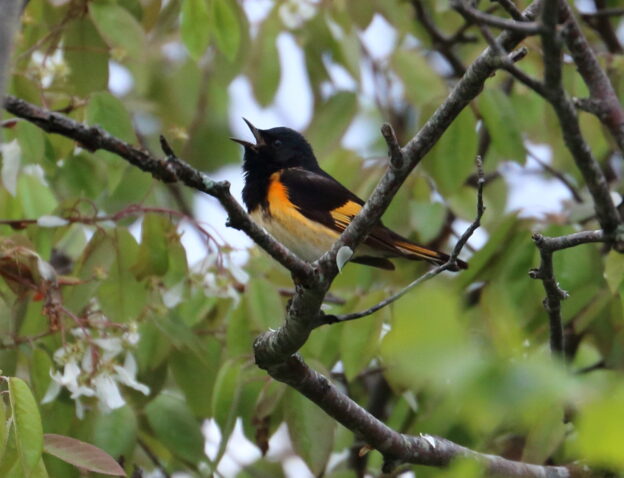
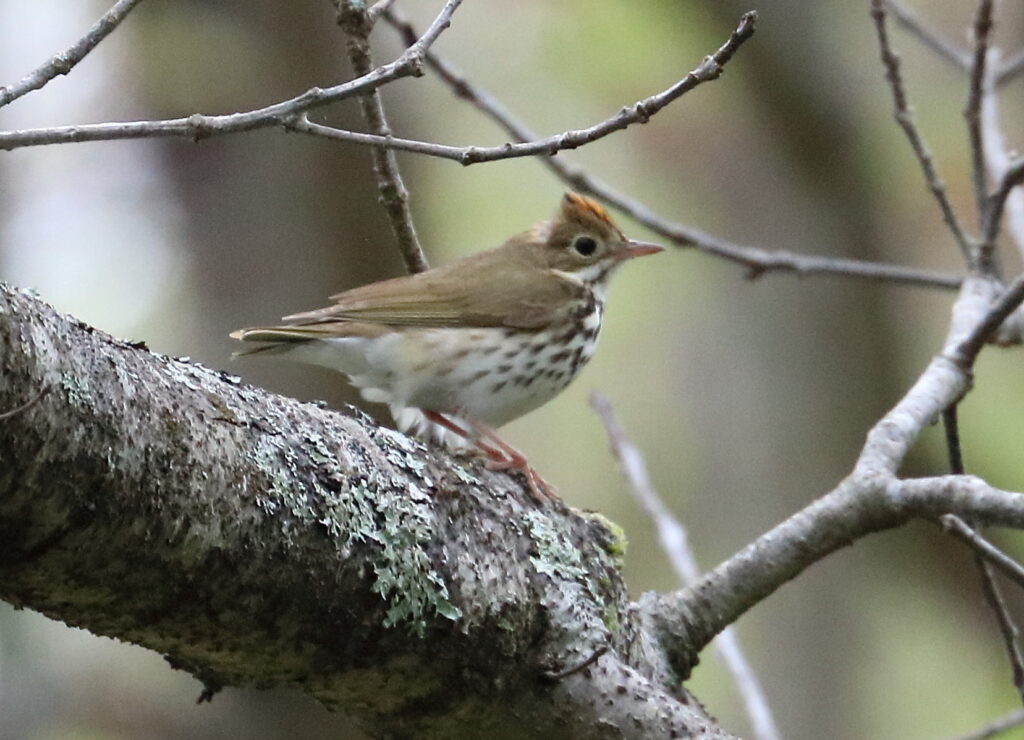
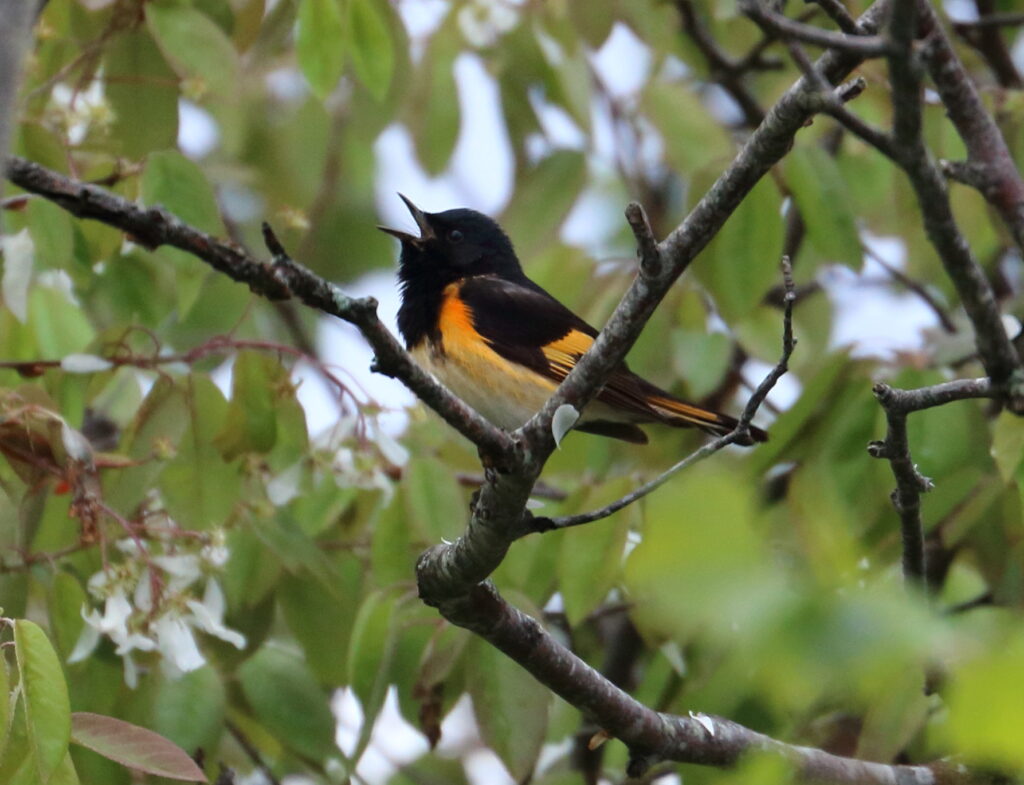
On Tuesday, May 13th, my worries were settled when I woke up to the sound of a Nashville Warbler singing above my tent. I dressed as quickly as I could and set off down the logging road I’d driven in on, my ears receptive to any and all of the birds sounding off in the surrounding woods. Every level of the forest had songsters belting out their tunes: Ovenbirds from the ground, Black-and-white Warblers from spruce trunks, Magnolia Warblers from ten-year-old firs and Yellow-rumped Warblers from high in the canopy. Present in lower numbers were species like Blackburnian Warblers, Black-throated Blue Warblers, and American Redstarts, all likely early representatives of their species, most of which were still farther south, booking it north.

Magnolia Warbler in a spruce tree.

I was especially excited about the two Cape May Warblers. While I’d seen a fair number of Cape Mays before, I’d rarely seen them in their breeding colors and I’d never heard them sing before. This is because of their distributions. While I’d encountered many of the East Coast warblers on their breeding grounds during my time in Pennsylvania, I was hundreds of miles too far south for Cape Mays, which use contiguous spruce-fir forest and are mostly confined to Canada. These warblers (which are named after Cape May, New Jersey, where they neither breed nor spend the winter) are particularly dependent on an insect known as spruce budworm. Budworms are spruce parasites, and their populations are cyclical. During outbreak years the insect infects and ravages thousands of acres of spruce trees before the population crashes. Cape May Warblers, Bay-breasted Warblers, and Evening Grosbeaks, therefore, all have populations that rise and fall with the populations of this insect.

A “Myrtle” Yellow-rumped Warbler, which is the subspecies that lives on the East Coast!

Besides agriculture, the main industry in Aroostook County is logging, and understandably, the logging industry is not the biggest fan of an insect that defoliates thousands of acres of their crop. Unfortunately, the industry’s historical response to spruce budworm outbreaks (which, remember, are ecologically “normal” and important for the birds dependent on them) has been to clear-cut hundreds of hectares of infected forest. Spruce-fir forest is a mature ecosystem that takes centuries to develop, however, and the forest that grows back after these clearcuts is not coniferous but deciduous. This is a major reason why many spruce budworm-specialists, like Cape May Warbler, and many other birds found in boreal forests, like Canada Jays and Black-backed Woodpeckers, have retreated from much of southern Maine in the last hundred or so years. Their habitat has simply disappeared.

I saw evidence of this as I birded The County. Sure, there was a lot of seemingly healthy spruce habitat. There were also massive empty lots, covered in nothing but slash and debris. The forests were filled with birds, while the lots had almost none. It almost seemed apocalyptic. At least the empty lots provided good views of Mt. Katahdin, Maine’s highest peak, rising in the distance.

Again, though, the forests DID have birds, and not just warblers. Many migrants had not yet arrived (namely the flycatchers, of which I saw very few), but I recorded dozens of Ruby- and Golden-crowned Kinglets, Blue-headed Vireos, and Winter Wrens. Ruffed Grouse drummed from wet thickets, Hermit Thrushes foraged in the road, and I even got to see an American Goshawk bomb overhead at a million miles per hour, chasing something or perhaps just trying to give me as least satisfying a look as possible. In the evening, a walk along a side road yielded incredible, up-close views of Canada Jays, or “Whiskeyjacks” as they are known colloquially. These subtle, white-and-gray corvids landed in the trees less than five feet from me, curiously searching for insects while paying me no mind.

A photo of a Canada Jay that I took with my phone!

After a night and a day spent in The County, I headed back south to investigate the other corners of Maine I had yet to explore. Stay tuned!

What the forest looked like in Aroostook!

Birding the Burn 2025

In many ways, my own birding journey began with my book Fire Birds: Valuing Natural Wildfires and Burned Forests. That’s when my birding mentor, UM Professor Dick Hutto, showed me the critical importance of burned forests and the spectacular birds that colonize them. It’s also when Braden and I began birding avidly. Since then, we have explored burned forests many times and they have become some of our favorite places to bird. Last week, we were excited to check out one of our area’s newest burns, last year’s Miller Creek fire area, about an hour from our house. To reach it, we headed all the way out Miller Creek and then wound our way up dirt roads until we reached the burn at Holloman Saddle. On the drive, we passed through terrific riparian and conifer habitat, and Braden could pick out Yellow and Orange-crowned Warblers, Swainson’s Thrushes, and Willow Flycatchers through the car window. At about 6,300 feet elevation, we reached the burn, parked, and began exploring.

Researching and writing Fire Birds: Valuing Natural Wildfires and Burned Forests set me firmly on my birding journey—and propelled Braden and me to start birding burned forests. The multiple award-winning book is a great primer for kids and adults on many little-known aspects of forest ecology. To order a copy, click anywhere on this block!

Thanks to Dick’s tutoring, I had some experience sizing up burns and at first, this one didn’t seem ideal. Three birds essential to “opening up” a burned forest are Black-backed, American Three-toed, and Hairy Woodpeckers. These birds hunt wood-boring beetle grubs in the newly-charred forest and along the way, drill out cavities essential for other cavity-nesting birds. But Dick’s research had shown that Black-backed Woodpeckers need larger-diameter trees to nest in, and the forest that greeted us now mainly seemed full of smaller-diameter trees. I also saw stumps where larger trees had already been removed—another huge problem in human (mis)management of burns.

Braden trying to locate a promising bird call in the Miller Creek Burn.

Through decades of well-intentioned Smokey Bear messaging, we have all been taught that all fires are bad, bad, bad. Even when a natural fire does occur, the forestry Powers That Be have taught us that humans must somehow “save” a burn by salvage logging it. For those unfamiliar with it, salvage logging involves going into a burn and removing trees that retain commercial value. The problem? These trees are exactly the larger-diameter trees that woodpeckers need to drill out their homes and, in the process, provide homes for dozens of other animal species. Salvage logging also often severely compacts forest soils and removes the seed sources (cones of burned trees) needed for the forest to regrow. This means that we now have to pay people to replant the burn site—when the forest was already perfectly equipped to replant itself.

Left to their own devices—i.e. without “salvage logging”—most burned forests recover quickly—and with a much greater variety of plant and animal life than before.

Nonetheless, shortly after Braden and I began walking, we heard the distinctive drumming of either an American Three-toed or Black-backed Woodpecker. These can be distinguished from other woodpeckers because the drumming noticeably slows at the end. To find out which bird was drumming now, we began making our way down a steep hillside toward some larger trees, but the burned ground proved very crunchy and we may have spooked our quarry before we got eyes on it. Disappointed, we climbed back up to the road, and continued walking. Fortunately, the forest around us sang and flitted with bird life.

Almost immediately, we began seeing Mountain Bluebirds, one of Montana’s most spectacular species. MOBLs are well-known “fire birds” and their vivid blue plumage looks especially striking against the blackened trunks of a burned forest. Today, we saw these birds everywhere. During our three-mile walk, Braden recorded seven of them, but we both agreed we probably undercounted.

By popular consensus, Mountain Bluebirds are the most stunning “fire birds” you’ll find in burned forests. However, another common fire bird, Western Tanager, might challenge that opinion. Did you know that bluebirds are thrushes? They are relatives of at least four other popular Montana thrushes: American Robin, Swainson’s Thrush, Varied Thrush, and Townsend’s Solitaire.

Suddenly, a large shape took off from beside the road and spread its wings as it glided down into the woods. “Dusky Grouse!” Braden exclaimed. It was one of the birds he most wanted to see since arriving back in Montana the previous week. Hoping for a better look, we crept down after the bird and, sure enough, espied it sitting quietly in the shadows. We enjoyed it through our binoculars for five minutes and then slipped away, leaving it in peace.

Before heading out, Braden told me, “I really want to see a Dusky Grouse.” This one obliged perfectly—and it was the first we’d ever seen in a burned forest.

Except for the mystery woodpecker that had drummed earlier, we had not heard a trace of other woodpeckers, but what we did hear was astonishing: wood-boring beetle larvae actually munching away inside of the dead tree trunks! I’d been told that one could hear these, but with my crummy hearing, I didn’t believe that I ever would. Sure enough, in several places, we listened to these big juicy grubs take noisy bites out of the wood!

Score! While we watched, this Hairy Woodpecker extracted a juicy beetle grub from a dead tree.

Finally, we also heard tapping on a large tree ahead. Braden got his eyes on it first. “It’s an American Three-toed,” he exulted. We could tell it was a female by the lack of a yellow crown, and we settled in to watch this amazing bird. It was working its way down the trunk, flaking away burned bark, presumably to check for insects hiding underneath. Once in a while, it stopped and really began pounding away after a beetle deeper inside the wood. It sounded like someone driving nails into cement!

Even female American Three-toed Woodpeckers can be distinguished from Black-backed Woodpeckers by having some streaky white on their backs—though not as much as on Hairy Woodpeckers (compare with previous photo).

As we continued our walk, we also saw Hairy Woodpeckers and another three-toed, this one a male. Woodpeckers, though, were just some of the birds making use of the burn. We got great looks at Townsend’s Solitaires, Red Crossbills, American Robins, Dark-eyed Juncos, Yellow-rumped Warblers, and Chipping Sparrows, and heard both Red- and White-breasted Nuthatches. Most of these are classic “burn birds” and we felt exhilarated to see them.

Though we didn’t get eyes on one in the burn, we did hear a White-breasted Nuthatch—and saw this one the day before up nearby Pattee Canyon.

At a couple of places, unburned green scrubby areas abutted the fire boundary, and it was fun to see birds dash from these green protected areas into the burn for quick meals or nesting materials before dashing back to safety. Many birds, in fact, love to “set up shop” at the boundaries of such two contrasting habitats.

We never did find a Black-backed Woodpecker, but that did little to detract from yet another great birding outing. We vowed to return to this spot the next few years, hoping that no one would move in to “save” this precious forest that didn’t need saving. On the drive down, we also stopped at some of the lower riparian areas for great “listens” at MacGillivray’s, Orange-crowned, and Yellow Warblers along with our favorite empid species, Willow Flycatchers. Amid the current chaos of the world, our burn bird outing offered a fun, revitalizing—and yes, inspiring—break. If you’re lucky enough to have a burned forest near you, we hope you’ll check it out.

We can’t prove it, but it seems to be a really good year for Orange-crowned Warblers—not always the easiest birds to see in Montana.

Anahuac Lifer Attack (Texas 2025 Part 2)

After my morning exploring Peveto Woods (see last post), I had intended to visit another favorite coastal Texas location, Sabine Woods (see “Going Cuckoo for Fall Warblers in Texas”). Alas, my long previous travel day caught up with me so I decided to grab a siesta back at my hotel in Winnie. Besides, it didn’t look like the warblers and other migrants were showing up in large numbers, and I reasoned that I wasn’t likely to see much more at Sabine Woods than I’d seen at Peveto that morning. Instead, that afternoon I decided to visit another Texas favorite of Braden’s and mine: Anahuac National Wildlife Refuge.

Braden during our first visit to Anahuac NWR in 2016.

The refuge lies about halfway between Winnie and High Island, and Braden and I had many fond memories of it. During our Big Year in 2016, we’d seen our first Scissor-tailed Flycatcher here, along with our first Common Yellowthroat. I especially liked driving a route called the Shoveler Pond Loop. This afternoon, I didn’t expect any major surprises, but it was a pleasant way to watch Roseate Spoonbills, Common Gallinules, and a variety of other water birds. As I approached the refuge entrance, however, I got my first major surprise: the refuge had a new name! Only in the past few weeks, Anahuac had been renamed the Jocelyn Nungaray NWR. I later looked up how the name change had come about. I like to keep this blog politics-free, but I will just say that the new name resulted from both a tragic story and crass political shenanigans that apparently caught everyone off-guard. Feel free to look it up yourself and draw your own conclusions.

The good news? Shoveler Pond Loop looked better than I’d ever seen it! The loop consists of a 2.5-mile road that circumnavigates a 300-acre wetlands, and the last time I’d visited, in 2021, the latter seemed clogged with vegetation. Not so today. A large area at the loop’s beginning had been cleared out to create wonderful habitat for wading and dabbling birds and as I proceeded, I noticed many other revived sections as well. In preparation to write this post, I called the refuge to make sure that I wasn’t imagining things, and Park Ranger Chris Campbell confirmed that a couple of years ago, they had drained the wetlands and taken steps to remove large areas of cane grass.

Shoveler Pond Loop is definitely one of my Top 5 “car birding” routes in the United States.

The results looked terrific. As I began making my way around the loop, I immediately noticed large numbers of Black-necked Stilts and dowitchers—probably Long-billed, according to Campbell. Both Greater and Lesser Yellowlegs made a good show of it, too, and it wasn’t long before I began obsessing over some smaller shorbs. I eventually IDed two of these as Dunlins, and was especially pleased to find a Least Sandpiper as well. Alligators also seemed to relish the new-and-improved loop, and I watched with amusement as Black-necked Stilts nonchalantly probed the shallows only a few feet from the six- or eight-foot crocodilians.

Uh, Mr. Black-necked Stilt, have you looked over your shoulder lately?

I soon found a great collection of waders including Roseate Spoonbills, Tricolored Herons, Snowy Egrets, and both White and White-faced Ibises. It was when I turned the first corner, however, that the real excitement began.

“Uh, just where do you think you’re landing, Mr. Tricolored Heron? Us Neotropic Cormorants and the herps over there were here first.”

First up? A kind of duck neither Braden nor I had ever seen before: Fulvous Whistling Ducks! “Wow! Lifer!” I exclaimed out loud. For some reason, it never occurred to me that I would see these ducks, but there they were—sitting only fifty feet from their compadres, Black-bellied Whistling Ducks! And the hits were just getting started.

As I rounded the second corner, a narrow canal paralleled the road to my left, and suddenly, a medium-sized, reddish-brown bird flew out from beneath the road to some reeds across the canal. Astonishingly, it was another lifer, one that I recognized immediately: a Least Bittern! One of the smallest members of the heron family, Least Bitterns apparently are not all that rare. Ranger Campbell told me that they are very common year-round at the refuge, but the thing is, they are incredibly shy. I will just tell you that I never really expected to see one, and yet here one was! Not only that, it struck a pleasing pose while I kept my camera shutter clicking.

Seeing my lifer Least Bittern not only justified the entire trip, it captured Bird of the Trip honors!

I had barely started again when I noticed a couple of terns flying around. Generally while I am birding, I ignore terns and gulls until I’ve identified everything else. As one of the terns zoomed by my car, however, I noticed that it had an oddly blunt thick black bill. “No way,” I said, rushing to take some ID photos. My hunch was correct. These were Gull-billed Terns—lifer Gull-billed Terns!

Terns favor the prepared mind. If I hadn’t been birding for more than a decade, the black bill on this guy may never have caught my attention.

Really, I could hardly believe it. I arrived at Anahuac expecting to see birds that I had seen many times before. Now, within the space of ten minutes, I added three new species to my life list! It seemed so preposterous that I laughed out loud. What’s more, this was still only my first day of birding on my Texas trip. One thing was for sure: I never would have had such success if it weren’t for the hard-working government employees we all depend on. It just shows the wisdom of investing in protecting our natural resources for the common good.

Peveto Woods, Louisiana: Spring Migration Hotspot

FatherSonBirding is a labor of love for both Braden and me, and our goal is to entertain and educate, and to promote bird conservation. If you’d like to support our work, please consider buying one or more of Sneed’s books and make a donation to one of the bird-related groups mentioned below. Thank you!

There’s a good reason the blog has been quiet the past couple of weeks. Braden is finishing up his honor’s project before graduating (gasp!) from the University of Maine while I jumped on a chance to head to Texas for the sixth time since Braden and I began birding. The trip arose from an invitation to talk about my book Birding for Boomers at the Mountains and Plains Independent Booksellers Association spring conference in San Antonio. Happily, the event took place during spring migration, so I of course booked three extra nights before and three extra nights after the conference to see some birds!

As soon as I picked up my rental car in San Antonio, I high-tailed it the four hours to Winnie, Texas on the coast just east of Houston. Why Winnie? Because it provides great access to several well-known stopover places for migrating songbirds and offers a chance to soak up a variety of coastal and aquatic species as well. For this trip, though, I was determined to explore some new birding areas, and my first morning I got up before dawn and headed to my first destination, Peveto Woods Sanctuary, just across the border in Louisiana.

A bonus to driving to Peveto Woods is that once you cross the bridge into Louisiana at Sabine Pass, you can find a wonderful little shorebird area, especially if it happens to be low tide. And by the way, I don’t think I’ll ever get tired of posting Black-necked Stilts. So sue me already!
Peveto Woods offers delightful paths through trees, any one of which could be hiding a migrating songbird!

Peveto Woods is owned and operated by the Baton Rouge Audubon Society and like Sabine Woods run by the Texas Ornithological Society and the more famous High Island sanctuaries operated by Houston Audubon, Peveto consists of a patch of forest right along the shore. As soon as I pulled up, I knew I was going to like it. Trails headed off in all directions, crisscrossing forty acres of mostly oak-dominated woodlands. I saw two friendly-looking guys, Scott Delaney and Paul Wallace, who looked like they knew their way around and asked the best way to explore. It turns out, they had been volunteering their time here for many years and suggested I make my way to the east fence line and work my way back. They also explained that the land where the woods sat was called a chenier, a place where wave actions had piled sand and shells up higher than the surrounding area, allowing trees to grow. Hurricanes still occasionally obliterated the place, but the vegetation recovered quickly.

Hey, I’m gettin’ pretty good at these selfies–this one with my new birding friends, Paul (center) and Scott.

Unfortunately, I quickly learned that the main birds I had hoped to see—warblers—had not yet arrived in significant numbers. I was about a week early for many species and, for now, northerly winds had kept others grounded in the Yucatan. Only one hundred yards down the trail, however, I encountered a nice little mixed flock of other species. Sound ID picked up a White-eyed Vireo, and I quickly saw a Warbling Vireo along with at least four Red-eyed Vireos. Joining them were several Orchard Orioles, a couple of Yellow-rumped Warblers, and an Orange-crowned Warbler. Most were flitting about high in the trees, making photography difficult, but my heart warmed at seeing them.

Although the more exotic warblers had yet to reach the Gulf coast, this (Myrtle) Yellow-rumped Warbler tried to hold down the fort till they arrived!

One awesome thing about Peveto is that you can walk right out to the beach and here I saw the trip’s first Black-bellied Plover, along with a couple of Royal Terns and Willets.

For those aware of my love of Black-bellied Plovers, you can imagine how delighted I was to find the first one of the trip on my very first outing.

Returning to the woods, I kept strolling, finding migrating Gray Catbirds and pre-migration White-crowned Sparrows. A couple of Anhingas flew over, and then Sound ID picked up what would be the star of my visit: a Yellow-throated Vireo.

I just fell in love with this Yellow-throated Vireo. In fact, YTVIs are one of my new favorite birds, and I would see or hear them twice more on the trip.

I had seen YTVIs before, but so early in my birding career that they had gotten lost in the steepness of my learning curve. Now, a bird in glorious yellow, white, and gray plumage perched right above me. I shot some quick photos, and then just stood and admired this incredible creature. Like most other vireo species, this one had migrated from Central or South America, completing the eighteen-hour or so flight directly across the Gulf of Mexico.

It seemed like years since I’d seen Indigo Buntings—and then, only females or juveniles. That made it all the more sweet to find these two “Sharp-dressed Men.”

It did make me wonder, though, why the vireos had made it “on time” but most of the warblers had not. “Are vireos stronger fliers?” I wondered. Or had they just timed things better? Either way, I was delighted to see them and get to know them better. And that’s birding for you. Even if the birds don’t always meet your own timetable, they always present a fascinating learning opportunity or two—or, as today, a chance to embrace and enjoy a new group of birds. I rounded off my morning by finding a couple of gorgeous Indigo Buntings on the brushier end of the preserve. I exchanged email addresses with my new friends Scott and Paul, and invited them to look me up when they came to Montana. I suspected, though, that I might make it back to Peveto Woods long before they got to Montana!

My checklist: https://ebird.org/checklist/S223902911

Note: As I post this, the warblers are definitely arriving at Peveto Woods. If you live nearby, what are you waiting for?

Video Post: A Visit to Araucana Lodge (Colombia Birding Part 4)

Roger and I could easily write another ten or twelve posts about our recent birding adventures to Colombia, but I thought it would be fun to pack a lot of our experiences into a video featuring our main destination down there, the Araucana Lodge. The video not only introduces you to the joys of lodge birding, but features some of the famous birds and birding opportunities to be had in the mountains above Cali. Since large files don’t always work well on this blog host, we embed a YouTube link below. Let us know what you think—and enjoy the show!

Click Here to see the first of our Colombian birding post!