Category Archives: Bird Conservation

Birding Glacier National Park in the Hot Dry Fall of 2025

FatherSonBirding is a labor of love and Braden and I keep it advertising-free. If you’d like to support our efforts at independent journalism, please consider sharing our posts with others and purchasing one or more new copies of Sneed’s books by clicking on the book jackets to the right. Thanks for reading and keep working for birds. We will!

Not quite two years ago, I posted “Birding Glacier National Park in the Long Hot Winter of 2024.” The blog resulted from an invitation I received to speak to school kids in Browning, Montana, and I took the opportunity for some rare winter birding at my favorite park. The post has received a lot of views, either because people love Glacier or they are interested in the impacts of climate change or both. A couple of weeks ago, I was fortunate enough to be invited back to Browning. This time, I came a day early and my hosts were gracious enough to provide me with a place to stay for the extra night. My last post narrated my drive up, especially the devastating state of the drought along the Rocky Mountain Front. With my extra day to bird, though, I planned to return to Glacier and I wondered, “Would the park be as hot and dry as before?”

My destination for the day was the road (not THIS one, fortunately) leading past iconic Chief Mountain to the US-Canada border.

I woke in my East Glacier lodging well before dawn and about seven a.m. set off for my first destination, the Chief Mountain road that leads up to Waterton Lakes in Canada. As I drove toward Browning before turning north, a spectacular orange fireball rose on the eastern horizon. I’ve seen lots of sunrises in my life, but nothing matches a sunrise over the northern Great Plains. As a bonus, a red fox and young bull moose greeted me from the side of the road!

My route took me to Saint Mary and up past the one-bar town of Babb before I turned left toward Canada at about 8:30. I sadly didn’t plan to visit our northern neighbor. Today, much as I had on my last visit here, I had a particular quarry in mind: Boreal Chickadees.

As their name implies, Boreal Chickadees live mainly in northern spruce & fir forests and as such, their range barely dips into the US in a few places along our northern border. Lucky for Braden and me, Montana happens to be one of those places. We had found our first BOCHs almost by accident during covid, when Glacier had been closed and we decided to try our luck along the Chief Mountain road. To our delight, we found the little birds. Stunningly cute, their brown heads and other features closely ally them with both the Chestnut-backed and Gray-headed Chickadees, the latter now thought to be extinct in Alaska, their only known home in the US. In any case, on my visit to Browning two years ago, I had relocated BOCHs on the Chief Mountain Road, and it was my aim to do so again today.

For my first try, I stopped at the pull-out right next to the Glacier National Park sign. I walked the road for a few minutes and managed to grab the attention of three Red-breasted Nuthatches while Sound ID picked up the calls of Golden-crowned Kinglets (which due to my ears, I have never been able to hear), but no chickadees.

I repeated this routine five more times along the road between the Glacier NP sign and the Canadian border. I got really excited at one point when I saw a flurry of bird activity from my car. I leaped out, binoculars and camera in hand, and saw robins, more nuthatches, and a Hairy Woodpecker. A foursome of Canada Jays, perhaps the most refined members of the corvid family, swung by to check me out. No chickadees.

As my prospects for finding Boreal Chickadees dimmed, I focused on enjoying another of my favorite birds, Canada Jays—though why Canada gets to claim these gorgeous critters remains a mystery!

As I searched, I especially looked for densely-packed spruce trees along the road, but I realized that lodgepole pine actually dominated many areas. “Hm. Maybe this isn’t a preferred location after all,” I thought. “Maybe we just got lucky the past couple of visits.”

I had started to get that “I guess I’m not going to find them” feeling when I noticed a little area that seemed to have more spruce. There was no pull-out here so I just parked as far off the road as I could and walked back to where a brushy meadow pushed westward into the forest. The meadow was lined with more spruce than anything else, and as if to lure me in, two more Canada Jays landed to be admired. “Might as well give this a try,” I thought.

This meadow intrusion into the woods seemed like my last best chance to find Boreal Chickadees on this unseasonably warm fall day.

I followed what appeared to be an overgrown path through waist-high shrubs. It occured to me that if berries grew nearby this would be an ideal place to get ambushed by a grizzly bear, but I cautiously pressed forward. My hopes shot up when two small birds rose out of the brush and landed in a tree. I got only a brief glimpse and still have no idea what they were, though I’m guessing some kind of sparrow.

I was approaching the end of the meadow when I saw more birds flitting around up ahead. I spotted another Red-breasted Nuthatch and Sound ID picked up White-crowned Sparrows, Golden-crowned Kinglets, and Dark-eyed Juncos. Then, suddenly, I heard chickadees—and they definitely were not Black-cappeds!

Within moments several tiny birds landed in the trees before me. It took a few tries to get eyes on one and to my joy, it was a Boreal! There were four of them altogether and wow, did they have a lot of energy! Not only were they checking me out, they were checking out every other bird, too—including a Ruby-crowned Kinglet keeping company. I managed a couple of good photos. Then, within minutes, all the birds departed—even the White-crowned Sparrows with their loud contact calls. Smiling, I traipsed back to the car. The sun had a special warmth to it and Chief Mountain rising above the forest added magic to the moment. Little did I know, however, that this wouldn’t be my last “moment” of the day.

While most visitors to Glacier focus on seeing grizzlies and mountain goats, nothing says wilderness to me more than Boreal Chickadees.

The glow of seeing Boreal Chickadees still with me, I made my way back to Babb and turned right, up the road to the Many Glacier Valley. A large flashing sign warned that there was no general admission parking there, but I love this drive and decided to go as far as I could. I passed through groves of aspen glowing gold with fall foliage and relished the views of Mt. Wilbur and other familiar peaks ahead.

At the Lake Sherburne dam, I stopped and got out for a look at the reservoir. In keeping with my observations from my last post, it was as low as I’d ever seen it, a giant “bathtub ring” leading from the forest edge down to what water remained. I’d also noticed that Swiftcurrent Creek was incredibly low—mere rivulets flowing between a pavement of exposed rocks.

Lake Sherburne—a reservoir, actually—stood as low as I’d ever seen it, additional evidence of the long-term drought impacting this part of the world.

I still had plenty of time and wanted to do some kind of hike in the park, so I returned to St. Mary and found myself on a little trail for the Beaver Pond Loop. In all my visits to Glacier, I’d never before done any hiking or walking near St. Mary so I set out on this path with some excitement. It wasn’t the most dramatic hike, hugging the south side of St. Mary Lake, but it offered terrific views up the valley and the blue sky and warm (too warm) conditions made for pleasant hiking.

I’d walked maybe a quarter mile when I rounded a bend to see a dark object ahead next to the trail. At first I thought it might be a hare or other mammal. When I raised my binoculars, I realized with astonishment that it was a grouse. Not only that, I felt pretty sure it was a Spruce Grouse!

My accidental Spruce Grouse sighting was evidence that I had put in enough time searching for these guys to break my “grouse curse.” Notably, the grouse brought my year species total to 527 birds—exactly tied with my previous record. Which bird will put me over the top? Stay tuned to FSB to find out!

If you’ve followed FatherSonBirding, you’ll know that I’ve seen SPGR only twice (see posts “Gambling on a Grouse-fecta” and “August: It’s Just Weird”), and had gone to great effort to do so. To have one just show up unexpectedly, well, that pretty much blew my mind. Still, I didn’t feel 100% sure on the ID, so I snapped some quick photos to send to Braden. Then, the grouse started walking toward me. “Whaaaaat?” I wondered.

That’s when I realized that another hiker stood on the other side of the bird and had herded it my way. Finally, the grouse wandered off into the forest, leaving me both astonished and gratified. I guess I had put in enough grouse effort to finally be rewarded by such encounters!

I continued onto a nice rocky beach on St. Mary Lake and found a perfect rock for sitting. Two pairs of Horned Grebes played and fished out on the water—my best look at this species all year—and I relished a few moments in one of earth’s most spectacular places.

Two pairs of Horned Grebes kept me company as I took a few moments to soak up the beauty of Glacier National Park before heading to my week of work in Browning.

Glacier, though, doesn’t exist by accident. It’s here because forward-thinking people planned for the future long ago. As the epically dry conditions of this part of the world attest, we need to keep thinking forward if we want our children and their descendants to have such places to cherish. As I said in my last post, all of us need to fight the disinformation and greed of climate deniers however we can. Whether that’s by making a donation to an environmental or legal group battling the horrible policies of the current administration or making changes to lower your own carbon footprints, every effort matters. Now, more than ever, is the time.

The “Hoax” of Climate Change and Birding the Rocky Mountain Front

It’s remarkable that as the impacts of climate change rapidly accelerate across the planet many of our leaders have doubled-down on the myth that climate change is a hoax being perpetuated by “stupid people.” Here’s the thing: To realize how quickly and dramatically warming temperatures are changing our planet, you don’t have to be a climate scientist. You simply have to look around. 100- or even 1000-year weather events are happening every few years in many places, generating catastrophic winds, storms, flooding, and drought. Even since I moved to Montana thirty years ago, summers are hotter, winters are milder, and snowpack is disappearing more quickly. Especially in eastern Montana, drought conditions seem to be setting in for the long haul. Braden and I have seen dramatic evidence of this all over the state (see, for example, my post “Birding Glacier National Park in the Hot Dry Winter of 2024”). Two weeks ago, I had a chance to again witness severe drought when I birded the Rocky Mountain front from Freezeout Lake up to the east side of Glacier National Park.

The DRY Dock of the Bay: A rapidly receding shore left this dock high and dry at Eureka Reservoir.

I left Missoula Saturday at the modest hour of 7 a.m. Days are shorter by the end of September so there was less urgency to hit the road early. Just as crucially, Highway 200, which would lead me up and over the Continental Divide, can be a notorious kill zone for deer, elk, and moose at dawn and I thought that waiting an extra hour might keep me and my minivan from ending up in a crumpled heap by the side of the road. My later departure paid off. I managed to spot the two potential deer collisions with plenty of time to brake and after a quick stop near Browns Lake, I arrived at my first destination by 9:30.

I had debated whether to visit Benton NWR near Great Falls or head straight to Freezeout, but eBird reports from the latter proved more enticing so I cast my lot there. As they always do, my excitement levels rose as I passed the refuge headquarters and then turned left to scan the southern bodies of water. It had been a while since I’d visited Freezeout this time of year, and I wasn’t sure what to expect since many birds had undoubtedly departed for their southerly wintering grounds. Rumbling along the gravel road, I did scare up a few Horned Larks and a couple of Western Meadowlarks looking faded and shabby. I also saw that the entire area was as dry and crispy as I’d ever seen it. In good years, water can be found in ditches, shallow pans next to the roads, and elsewhere, but now it was confined to the main lakes on my right. Still, I could see birds on the water.

At the very southern end of the refuge, I spotted about thirty-five American White Pelicans along with some coots, barely identifiable American Avocets, and unidentified, distant ducks. I soon backtracked, though, to where I had noted greater potential.

I parked at a pull-out camping area next to a dike/road that led out between two of the large lakes. I couldn’t drive out there, so I shouldered my camera, binoculars, and spotting scope and did what every dedicated birder does: schleps! Am I glad that I did. Almost immediately, I noticed several small birds working some mud off to my right. I ID’ed a couple as Horned Larks, but had a hunch about others so I quickly set up my scope and indeed saw that they were American Pipits! I absolutely love these guys. In Montana, they breed at high altitude, but in spring and fall you can find them migrating through the lowlands. Unfortunately, I had missed them this spring, so that made it doubly sweet to see them now. Even better, it moved me one bird closer to breaking my all-time one-year species count record!

American Pipits working the recently receded shoreline of one of Freezeout’s main lakes.

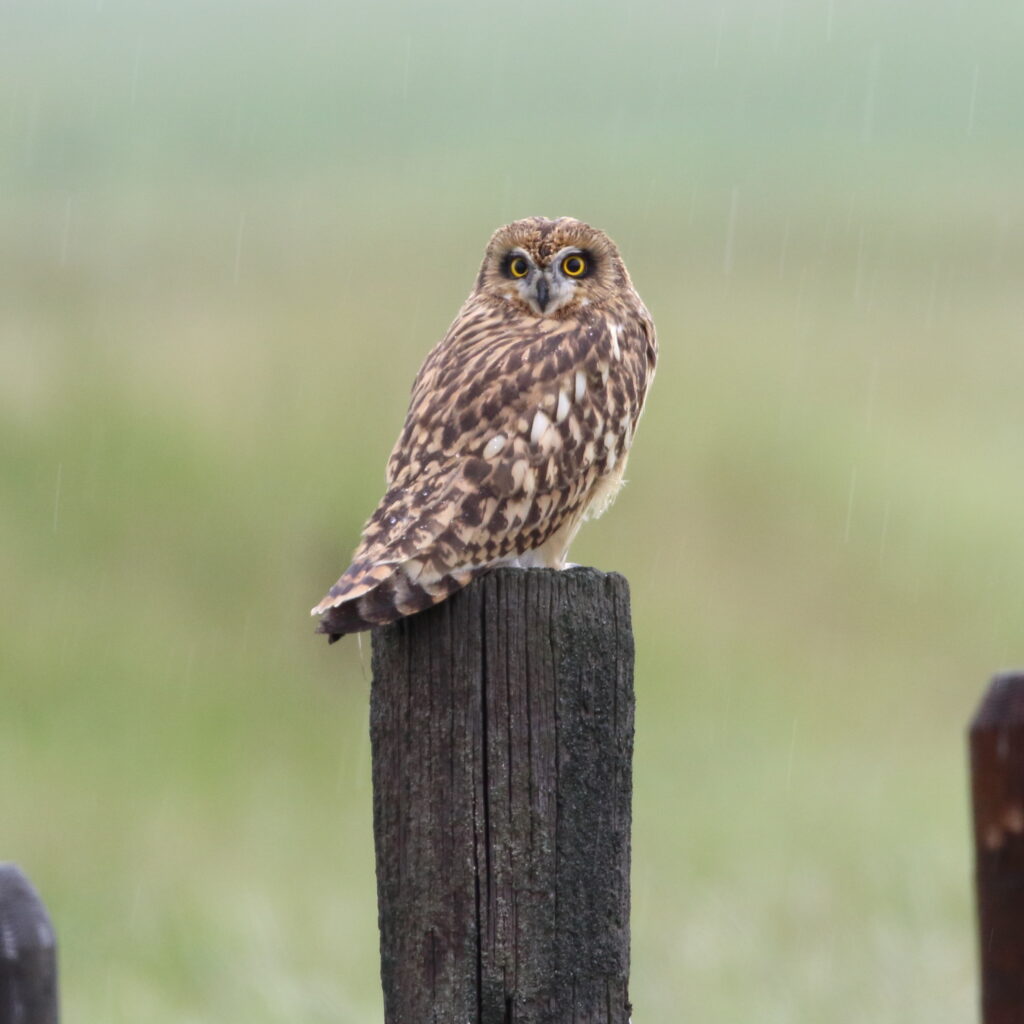
As I resumed walking, I suddenly spotted a large raptor flying low and erratically over fields to my left. My first guess normally would be Northern Harrier, but this was my lucky day. The bird wasn’t a harrier, but a Short-eared Owl! It had been years since I’d seen one here and I couldn’t have been more delighted. These are some of my and Braden’s favorite birds, but we never know when we’ll encounter them. To emphasize the point, the bird was listed as unreported on the eBird filter (presumably just for this time of year), showing how unpredictable the birds can be.

Another in my now-famous series of lousy Short-eared Owl photos! After all, I have a reputation to uphold!

Another couple of hundred yards brought me close enough to set up the scope on the birds I was seeing far out on the water. There were groups of ducks, but those didn’t interest me. What did was a group of about forty or fifty shorebirds. Even with the scope, I wasn’t as close as I would have liked, but their very long bills, pale superciliums (the bands above their eyes) and “oil drilling” probing of the shallows said “Long-billed Dowitchers.” Then, I began to doubt myself. Their bills were so long and from a distance, I could imagine that some of them seemed slightly upturned. “Could they be godwits?” I asked myself, suddenly thrown into confusion. I kept studying them, eventually coming back to dowitchers. What cinched it is that when they took flight I could clearly see the single white stripes running down their backs. Godwits don’t have that. When they again landed, I realized that their numbers had also doubled to about ninety.

Dowitchers always make me happy. I just hope that humans can get our act together in time to make sure they have enough water in the future.

I spent almost an hour studying the water from the dike, and in addition to the Long-billed Dowitchers, I found four sandpipers that I thought were Baird’s Sandpipers but could have been Pectoral Sandpipers—they were just a bit too far away to be sure. I did ID several distant Black-bellied Plovers, too. The rest of Freezeout didn’t offer up much. I saw three Eared Grebes and a Canvasback hidden among scads of Canada Geese and intermolt ducks that were probably mostly Mallards. A stop at Priest’s Lake, however, yielded 2,500—you read that correctly—twenty-five hundred Ruddy Ducks! Ruddies, of course, are one of the BEST ducks, but I’d never seen even close to these numbers before. During fall migration, I guess they like each other’s company!

One of my birding goals lately is to try to bird new areas and on my way up to East Glacier, where I would be spending the night, I made two more stops: Eureka Reservoir north of Choteau and Lake Frances near Valier. Neither yielded anything exceptional, but I did pick up my First-of-the-Year Snow Goose, a single specimen at Lake Frances. What both places strongly reinforced was the critical water situation in this part of the world. Both bodies of water had retreated huge distances from their historic lake shores. It’s difficult to tell what percentage of water they’ve lost, but I’d guess that both were at least three-quarters empty.

Lake Frances offered up the most visible impacts of what drought is doing to the Great Plains. I had to walk across a couple of hundred yards of former lake bottom to reach today’s shore.

As I passed through Browning and turned toward East Glacier, I saw more bad news. Braden and I had driven this route at least a dozen times and every time we saw prairie potholes full of water. On this day, every one of those potholes stood bone dry until I’d almost reached East Glacier. This has dire portents for the future of our wild birds. Sure, rainfall goes up and down year to year, but the trend for the West is to get drier and drier. What happens when migrating birds head south and find no water at all?

This lone Snow Goose at Lake Frances brought me to within three birds of breaking my all-time one-year species count record—but it was small consolation for the dire water conditions I saw everywhere.

Honestly, I don’t want to find out, but it adds an urgency to act—and makes current attacks on clean energy both unconscionable and downright reckless. Why are such attacks happening? Just follow the money to the oil and car companies that continue to make trillions in profits while our planet suffers. These corporations have invested heavily in the current administration and are grinning ear to ear as POTUS rails against solar energy and windmills while he tries to sell our fossil fuels to a world that doesn’t want them. I generally try to keep FatherSonBirding apolitical, but if we want the next generation to have half of the beauty and diversity you and I have enjoyed, we have some urgent decisions to make. None of us has to change the world all by ourselves, but we each have to do something, whether it’s donating to causes working for a better planet or taking the plunge on solar panels, an electric vehicle, or eco-friendly hot water heater. The next generation may not ever thank us “stupid people” for what we’re doing, but we’ll know that the world will be better off for our efforts.

Flight of the Godwit (Book Review)

Bruce M. Beehler’s Flight of the Godwit: Tracking Epic Shorebird Migrations (Smithsonian Books, 2025)

Any birder who has aspired to learn about shorebirds will find a welcome companion in Bruce M. Beehler’s new book, Flight of the Godwit: Tracking Epic Shorebird Migrations. Shorebirds, after all, can be considered somewhat mythical, mysterious beings. Not only do many of them make remarkable annual migrations covering tens of thousands of kilometers, quite a few are notoriously difficult to identify. Certainly, Braden and I realized we had entered a more advanced stage of learning when we started to search out and try to identify shorebirds and, in fact, we both often still struggle with figuring out some of the more difficult shorebird species. Yet the more we encounter and learn about these birds, the more we love them—and that same kind of passion radiates from Beehler’s words as he sets out on his own journeys to observe and learn more about these birds.

In Montana, we are lucky to host three of the “Magnificent Seven” shorebirds as breeders—including Marbled Godwits, one of the focal birds of Beehler’s new book.

In Flight of the Godwit, Beehler recounts a series of recent adventures across the US and Canada to follow and observe shorebirds as they migrate north, stop over at resting and staging sites, settle on breeding grounds, and then head south again for their long non-breeding seasons. Although Beehler discusses all of our North American shorebirds at some point, he clearly targets what he calls the Magnificent Seven: Hudsonian Godwit, Marbled Godwit, Bar-tailed Godwit, Long-billed Curlew, Whimbrel, Bristle-thighed Curlew, and Upland Sandpiper. As he shares his encounters, he sprinkles in liberal amounts of natural history and personal experiences about these birds to make the book much more than a birder’s travelogue.

This Marbled Godwit checked us out as we were scoping shorebirds in Westby last summer.

That said, the travelogue aspects of the book are a big part of what fascinated me about this tale. Even after eleven years of birding, my shorebird experiences have been much more limited than I would like. Although my home in Montana is fortunate to host a number of breeding shorebirds—including three of the Magnificent Seven—for most shorebirds, we get only brief glimpses of them as they pass through in spring and fall. Partly because of this, Braden and I have especially sought out shorebirds on our out-of-state travels to Texas, New England, and the West Coast. Sigh. It is never enough.

It always surprises new birders that some of our largest shorebirds actually breed in grasslands—including Long-billed Curlews.

As I followed Beehler up through the Midwest during spring migration and around Alaska during breeding season, his experiences filled in giant gaps in my own experience with these remarkable birds. I got a better sense of where the birds stop to refuel and rest, and my vague impressions of their nesting territories and habits were sharpened by Beehler’s actual observations and descriptions. Many times, I found myself nodding my head thinking, Yeah, I know what he’s talking about or Oh, so that’s what they’re doing. All of this felt especially satisfying since there’s a good chance I will never experience many of Beehler’s destinations for myself.

As much time as I try to spend with shorebirds, it is never enough. Flight of the Godwit helped fill in many of the experiences I probably will never have for myself.

Those who will appreciate Flight of the Godwit the most probably are birders who have already spent time observing shorebirds and struggling over their identifications. Those with limited shorebird experience may find themselves getting a bit lost as Beehler throws out bird names that may seem a bit abstract without solid brain images to connect them to. Still, there’s a good chance that even beginning “shorbers” will find that Beehler’s tales of adventure excite them to plunge more deeply into this remarkable set of birds. As for intermediate and advanced birders—especially those who may never get to Alaska or follow spring migration through the Midwest—I highly recommend this intriguing book that is not only a valuable educational document, but a labor of love with which many of us can relate.

You can order Flight of the Godwit from almost any outlet that sells books—but why not visit your local independent bookstore and order it there? Another easy way to do this is through the online website Bookshop.org.

The Great Auk (Book Review)

If you are a fan of entertaining tales that blend bird biology, history, and human eccentricity, Tim Birkhead’s new work The Great Auk (Bloomsbury, 2025) will find a welcome place on your night stand. I have to confess that this is the first Birkhead book I have read, but the title suggested a fascinating story about a topic I knew very little about, so right away I requested a review copy from the publisher. My efforts did not disappoint.

The Great Auk by Tim Birkhead (Bloomsbury, 2025)

For me, the first question that needed answering was, “What the heck was a Great Auk?” I had, of course, heard of Great Auks during my twelve years observing, researching, and writing about birds but I hazily lumped them in with the totally unrelated Dodo and elephant birds. Why?  Probably because all of these birds had been large and flightless—and all had gone extinct. Other than that, I knew almost nothing about Great Auks.

Great Auks were the original penguins, conferred the genus name Pinguinus. The origin of the name penguin is uncertain but may refer to the bird’s white head or white eye patch. In any case, the name was later applied to flightless birds of the Southern Hemisphere, even though they bear no close relationship to the Great Auk. (Photo copyright Errol Fuller)

Upon opening Birkhead’s book it was therefore a great relief to learn, “Oh, yeah. Great Auks are actually auks—seabirds!” I mean, duh, right? Members of the Alcid family, their closest living relatives appear to be Razorbills, something I found delightful since Braden showed me my first Razorbills only last Thanksgiving when our family had the chance to visit Cape Cod (see post Birding Race Point). Birkhead is quick to point out, however, that surprisingly little is known about Great Auk biology, much of it speculation from the relatively scant specimen material that has survived.

Seeing one of the Great Auk’s closest relatives, Razorbills, provided a living link to the tragedy of the Great Auk’s extinction.

Which, of course, brings us to the tragic fact that Great Auks were quickly and efficiently wiped out almost as soon as seafaring Europeans on their way to North America figured out where the birds nested. That happened to be remote islands in the North Atlantic, and in historical times, there probably never were more than a handful of breeding sites for the birds. In early chapters, Birkhead especially focuses on what was clearly the most important site, Funk Island. Here, tens—perhaps hundreds—of thousands of Great Auks gathered every year. Couples would each lay their single, exceedingly large egg and work together to feed the resultant, rapidly-growing chicks from the abundant fish schools nearby.

Like Razorbills, puffins, murres, and murrelets, guillemots such as this Black Guillemot are members of the Alcid family, and close relatives of the Great Auk.

When Europeans did discover the auk bounty to be had, the slaughter began. Ships heading to what is now northeast Canada stopped over to feast on the auks and preserve them for food. Later, egg, skin, and feather collectors helped finish them off. Birkhead especially documents the brutal habits of egg collectors. Not wanting to obtain eggs with well-developed embryos inside, the collectors would intentionally crush every egg that they found. Returning a few days later, they could be assured that the embryo inside of any new egg had not yet developed, and its contents could be easily removed through a tiny hole made in the shell. Officially, the last two auks were killed in 1844, though it is likely that a few isolated individuals survived into the following couple of decades.

Birkhead neatly divides The Great Auk into two parts. The first focuses mainly on the history of the bird, its demise, and what can be constructed of its biology from historical accounts, surviving specimens, and extant relatives. Part 2 focuses mainly on some of the more rabid egg and skin collectors, especially Vivian Hewitt, who somehow managed to acquire thirteen Great Auk eggs for his vast collection of approximately half a million bird eggs.

A selection of known surviving Great Auk eggs shows their great variety, which may have helped parents identify them in the crowded breeding colony. This variety also partly explains why they were so attractive to collectors. (Illustration by Henrik Grønvold, 1907)

I have to say that I enjoyed Part 2 just as much as Part 1. Few of us realize this today, but oologist—a term coined for egg collectors that attempted to confer scientific legitimacy upon a practice that we now consider despicable—was all the rage in the early 1900s. It was practiced much as stamp and coin collecting were when I was a kid—and with little thought about the consequences for birds. Collectors routinely not only gathered an egg of a species, but entire clutches of eggs and even hundreds from the same species, searching for variety, fame, and fortune.

As perhaps the wealthiest participant in the field, Hewitt spent a small fortune both obtaining individual eggs and opportunistically snapping up entire collections of other egg collectors when their fortunes turned for the worst. Most prized of Hewitts acquisitions were the eggs and mounted specimens of the Great Auk that he managed to obtain, each of which has a story—and many of which Birkhead traces to fascinating effect. I won’t say more about this fine book, but if you enjoyed Christopher Skaife’s The Ravenmaster and Joshua Hammer’s The Falcon Thief, you are almost guaranteed to love The Great Auk, too. And if you do, why not help prevent the extinction of other bird species by donating to the American Bird Conservancy, the National Audubon Society, or another group working to protect our precious surviving species? Thousands of bird species are in trouble and the need is great.

Author Tim Birkhead. (Photo by K. Nigge)

Protecting Texas’ Globally Important Bolivar Peninsula—We Can Do This Now!

Instead of your regularly-scheduled blog, we today invite FSB readers to join in on an urgent appeal to help protect one of North America’s coolest and most vital bird habitats—the globally important Bolivar Peninsula. Learn more and donate by clicking here—or on the Piping Plover below.

If you’ve followed FatherSonBirding—or read my books Birding for Boomers or Warblers & Woodpeckers: A Father-Son Big Year of Birding—you know that High Island and the Bolivar Peninsula outside of Houston have played pivotal roles in Braden’s and my birding experiences. In these locations, the Houston Audubon Society (HAS) has worked tirelessly to obtain, restore, and protect vital habitat for both migrating and resident birds. On our first visit to High Island and the Bolivar Peninsula in 2016, Braden and I saw an astounding forty-five Life Birds in one day! These included everything from Scarlet Tanagers and Least Terns to Piping, Black-bellied, and Semipalmated Plovers.

Braden and I saw our first-ever Piping Plovers on the Bolivar Peninsula, and I was lucky to see this endangered species again on a subsequent visit.

Even though I live in Montana, I became an annual supporter of HAS shortly after that visit. Even better, I have been fortunate to visit the area three more times. Every trip has been a highlight of my birding career. Each time, I have seen gobs of amazing songbirds, shorebirds, and waders, and learned a ton about birds. Just check out some of my past posts about visiting the region:

Turkey Day Texas Adventures Part 1: Pursuing Plovers

Tangled!

Going Cuckoo for Fall Warblers in Texas

Anahuac Lifer Attack

Unfortunately, during my visits, I also have noticed an inescapable fact: the Bolivar Peninsula is being developed at an astounding rate and the reason is clear: beachfront property. During our first visit there, Braden and I noticed quite a few houses along the 25-mile or so stretch of the peninsula. On each subsequent visit, I was blown away by how many new houses had sprung up since my previous visit! On my most recent trip, this past April, I realized with dismay that the entire peninsula would soon be wall-to-wall housing developments.

One of dozens of major housing developments that have sprung up on the Bolivar Peninsula since Braden and I first visited in 2016.

I can’t even begin to explain how poorly-conceived this kind of rampant development is. Never mind that it has gobbled up some of the best remaining Gulf Coast wildlife habitat, it is virtually guaranteed that hurricanes will totally destroy these developments as they have in the past—and with increasing frequency thanks to climate change (see this Hurricane Ike story and this astonishing storm list). In fact, the ability of the peninsula in its natural state to block tidal surges, prevent erosion, and soak up storm water economically outweighs by far the short-term profits from this get-rich-quick development.

Rampant development in coastal areas not only destroys critical habitat, it greatly diminishes the ability of the coast to withstand hurricanes and other major storms. Though I’d love to enjoy a beachfront house like this myself, economically it is a lose-lose situation, both for homeowners and taxpayers, who often get stuck with paying the bills for disaster cleanup and rebuilding.

Still, the lure of fast profits is just too much here as it is in many other places. And that’s why I’m writing this post. Right now is one of our last best chances to protect what remains of this globally vital birding habitat. How? Currently, HAS owns and manages more than 3,000 acres of Bolivar Peninsula habitat—natural islands in an expanding sea of development. And yet, right at the entrance to their Bolivar Flats Shorebird Sanctuary, a new development recently cropped up. Ironically dubbed the Sanderling Development, it threatened to wipe out critical habitat and destroy a buffer to the core of the Bolivar refuge. The good news? Through heroic efforts, HAS managed to raise $3 million to buy 25 acres of the land this past July. Now, however, they need another $3 million to complete purchase of the remaining 27 acres of the property. This land is so vital that for the first time in decades, HAS has issued a public appeal for funds—And that’s where we come in!

Just one of many Bolivar housing developments, the proposed Sanderling Development directly threatened the ecological integrity of the Bolivar Flats refuge right across the road. However, HAS still needs to raise $3 million to complete the property’s acquisition. Click on this photo to donate!

No matter where we live, securing this last bit of property should be a major priority for birders. Not only does it help provide essential stop-over areas for millions of migrating birds that spread out across the continent, it helps protect critical breeding and wintering habitat. Endangered Piping Plovers, Black Rails, and Red Knots are just three endangered species among hundreds of other species that use this important area.

A fall Long-billed Curlew at Bolivar Flats—perhaps just returned from breeding in Montana?

So how about it? Do you have $25 to chip in? $100? $1000? If you do, I can say with confidence that your money will rarely be better spent. Along with donating, why not plan a spring or fall trip down to the area? If you are fortunate enough to be able to do this, I can almost guarantee it will be one of the highlights of your birding experiences. You also will not have the slightest doubt that your investment in this area is one of the best you will ever make. To donate, CLICK HERE NOW!

And with that, I will sign off so I can make a contribution myself!

Houston Audubon’s Bolivar Peninsula’s sanctuaries are not only vital for Texas birds, but for breeding birds throughout North America.