Tag Archives: Sparrows

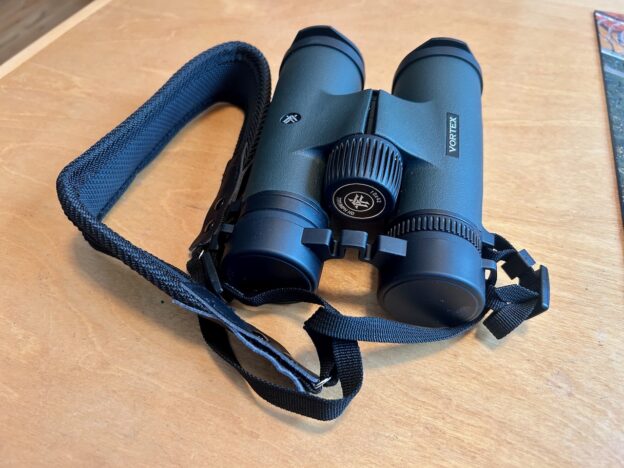
Vortex Triumph 10X42 Binoculars: Entry Level Excellence

Thank you for checking out our reviews! Braden and I write this blog to share our love of birding and provide useful information for our fellow birders. We do not receive any payment for any of our posts, but if you’d like to support our work, please consider buying one or more *new copies* of Sneed’s award-winning books such as Birding for Boomers or Warblers & Woodpeckers: A Father-Son Big Year of Birding. We appreciate your support and hope that you keep enjoying the world’s greatest activity!

We seem to be living in a golden age of birding. Not only have legions of new people discovered the joys of watching, identifying, and protecting birds, the marketplace is awash in incredible equipment to observe, photograph, and record birds. A few weeks ago, we reviewed Nikon’s terrific top-of-the-line Monarch HG binoculars. Today, we shift to an excellent entry-level pair, the Vortex 10X42 Triumph HDs.

Braden and I have both had great experiences with Vortex binoculars and spotting scopes—but have never field-tested their lower-priced equipment. In fact, I generally have shied away from encouraging people to invest in lower-priced binoculars, figuring they would break or wear out, or just wouldn’t deliver an adequate image. To challenge this assumption, I contacted Vortex to see if they would send me both some of their lower-end and mid-level binoculars to try out. I’ll review all of these in coming months, but was first drawn to test the Triumph HDs, which can be purchased for about the cost of a modest meal out for a family of four.

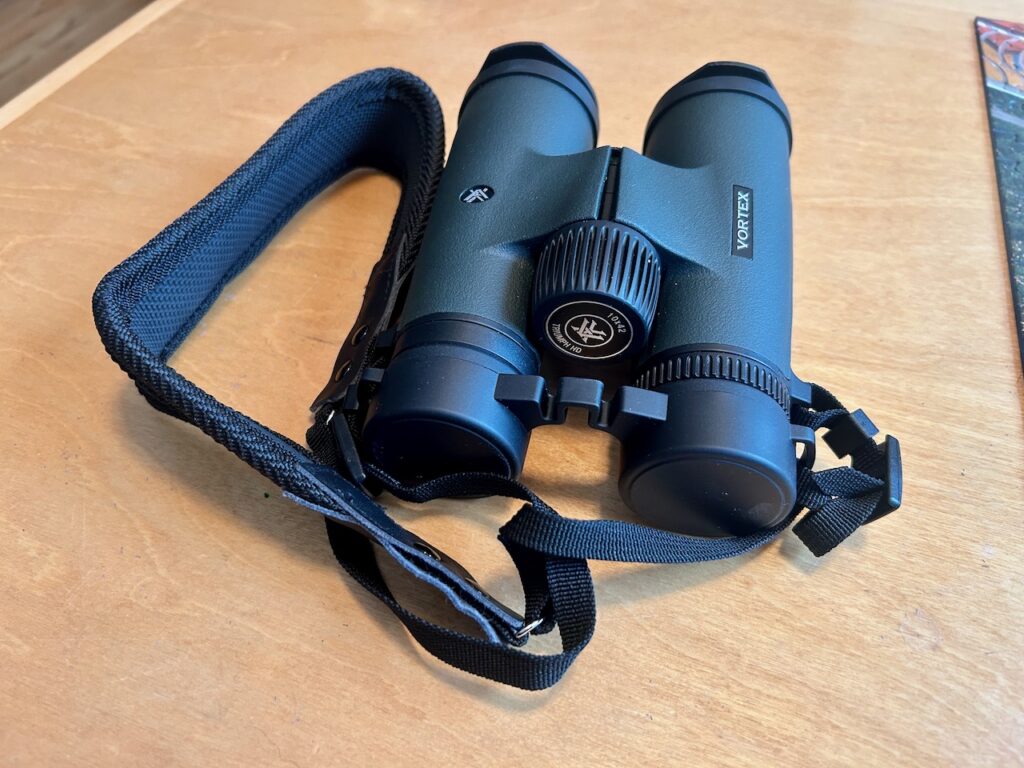
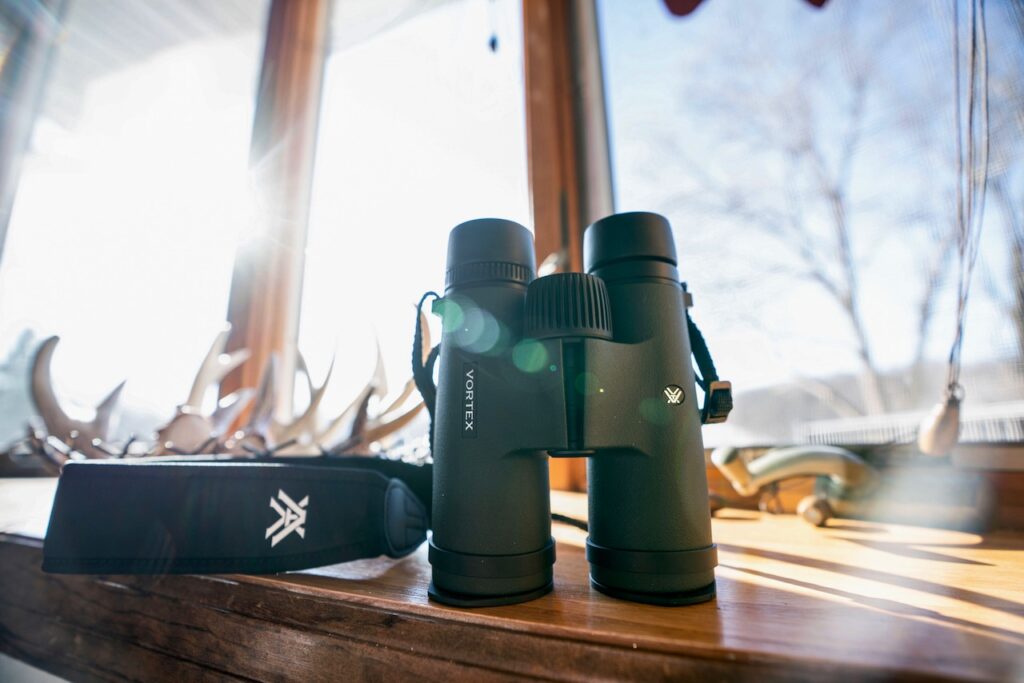
Vortex Triumph HDs offer excellent value for most beginning birders and, like other Vortex products, come with a lifetime no-questions-asked warranty.

It’s true that many binoculars you might buy for under $100 are poorly made. I’ve had several fall apart on me. My first impression out of the box for the Vortex Triumph HDs, though, was “Wow. These seem pretty hefty and sturdy.” Raising them to my eyes, I beheld a clarity and sharpness that seemed totally acceptable for well-lit birding conditions. Their size and slightly rough, slip-resistant rubberized coating felt very comfortable and “friendly” in my hands.

Like many other good pairs of binoculars, the Triumphs have other essential and convenient features for a birder. These include:

* eye relief of 17 mm and solid eye relief tubes (eye cups) that twist out and can click into two different positions

* adjustable diopter ring to allow a different focus for the left and right binocular tubes (essential for people whose vision differs in each eye)

* tripod adapter socket

* o-ring sealed and nitrogen-purged to be water- and fog-resistant

* shock-proof

I have to mention two other things about this and all of Vortex’s other products. One is an amazing lifetime warranty. No matter what happens to your binoculars or how, Vortex will repair or replace them, no questions asked, no receipt required. I don’t even know how they can afford to do this, but it’s an amazing benefit in this day and age when so many things break almost as soon as you breathe on them.

The other thing I just have to compliment them on is that their object lens protector flaps actually stay in when you pop them in place! This might seem trivial to some, but it means that it is a simple task to keep your binoculars protected, even in the worst conditions. Good job, Vortex!

And here’s the best news: although the Triumph HDs list at $149.99, these binoculars are available for around a hundred bucks.

One compromise with the Triumph HDs is a relatively long minimum focal length, which isn’t a problem for most birding situations but could make you “lose” a wren or tapaculo in close conditions. (Image courtesy of Vortex Optics.)

Of course, nothing is perfect and there are a couple of things you should consider before purchasing a pair. Many binoculars focus in as close as 6 or 8 feet, but the minimum focal distance for the Triumph HDs is 16 feet. For hunters and most birders that’s not a problem, but it can come into play when checking out wrens, warblers, tapaculos, and other small, secretive birds. It also pretty much rules out the Triumphs for watching butterflies.

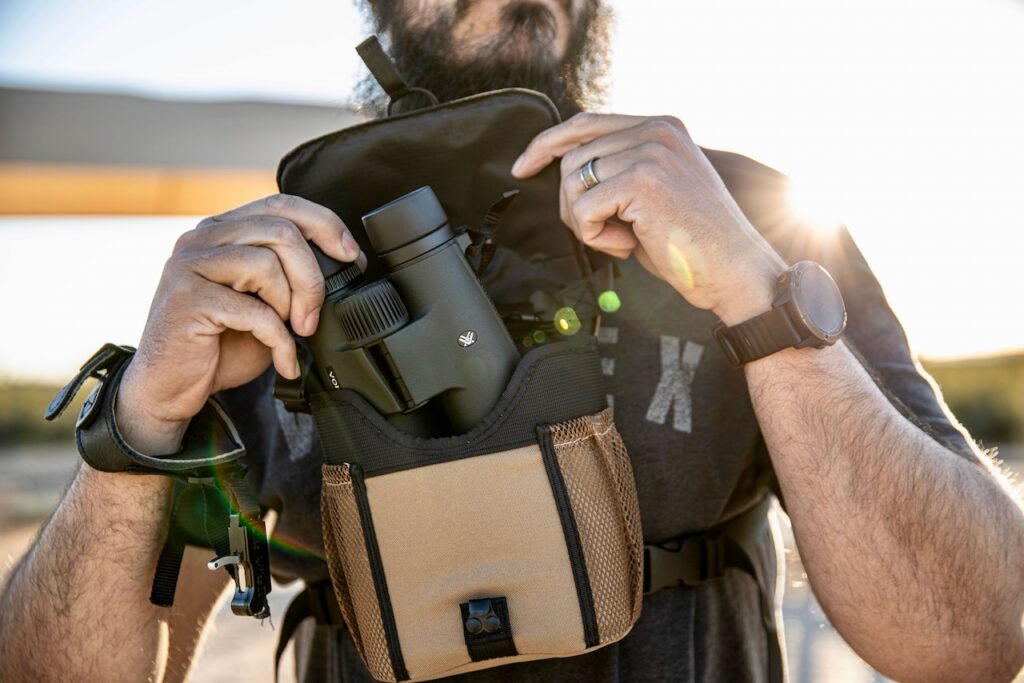
Secondly, while Vortex products are excellent for birders, the company (at least recently) seems to gear its products more toward hunters. The binoculars come with a fairly elaborate combo harness/pouch system called Glasspak™. This is designed for you to carry a pouch on your chest from which you can just pull out the binoculars and quickly slip them back into place. This would work well if you are out birding nonstop all day or hunting elk, but it’s a bit cumbersome for many birders who are whipping their binoculars on and off repeatedly. The binos also come with a traditional strap, so if the Glasspak™ system doesn’t suit you, you may want to use the strap—or order a third-party attachment system that you’ve already used and are happy with.

Unlike many of Vortex’s other models, the Triumph HDs come only in a 10X42 option—which happens to be my favorite size anyway, but may rule them out if you prefer the wider field views of 8X42s. (Image courtesy of Vortex Optics.)

This, of course, inspires some advice to all binocular producers: why not build in larger loops directly onto the binocular bodies? This would allow users to quickly clip on a variety of shoulder straps, neck straps, and harnesses without having to go through a tortured attachment method of threading various straps through this and that. It seems like a no-brainer, and there is great irony that many companies make absolutely beautiful optical products—but don’t go the extra inch to create a fast, simple, convenient set up. This is not an issue specific to Vortex. It seems to be common to a lot of companies, but whichever ones fix it will earn big bonus points!

The Triumph HDs come with a Glasspak™ harness system. While great for hunters and some birders, the system is a bit too complicated for most birding situations. Fortunately, the binoculars also come with a simple strap for those who prefer it.

So let’s get to the nitty gritty: should you buy the Vortex Triumph HDs? I will unreservedly tell you that you won’t regret it if you do. For their price, they are a terrific pair of binoculars for a beginning birder that will last years and years. I have enjoyed using them on several recent outings and also let a friend check them out, and we both agreed they were solid and worked very well.

That said, if you can shell out just a bit more money, you might consider the Vortex Diamondback HD 10X42s. These list at $329.99, but can be bought for much less. At the time of this writing, I saw one place selling them for $124.95! Closer to $200 seems more typical, but either way, they are a deal. If you can stretch for this, you will be rewarded by better lens and prism coatings that are hardier and deliver more light to your eyes, especially in low-light conditions. They also have a cozy 5-foot minimum focal range. According to Vortex, they are the most widely-used binoculars in North America. Either of these models can be purchased from a wide variety of other stores and online outlets. Check the Vortex website to locate a store near you.

So there you have it. We hope you find this and our other product reviews useful. We will keep ‘em coming!

Overall Rating (on a scale of cool birds): Song Sparrow (excellent) 

Products reviewed in this post were provided by Vortex.

Morro Bay Bird Festival report (Guest Post by Scott Callow)

(All photos copyright Steve Rosso or Scott Callow.)

My former work colleague, Steve, and I spent 2 hours deciding which walks and talks we would do at our first winter Morro Bay Bird Festival. It was just over a week since the registration opened. Everything we chose turned out to be full, even with over 263 events, 191 of them field trips.  Lesson learned. (We later learned that the Pelagic Boat Trip filled within an hour.) We were able to sign up for two outings, a Big Day at the inland Santa Margarita Lake and a “Back of the Bay” walk in Los Osos. Steve also made the wise demand to stop at the Pinnacles National Monument on our way down, and convinced me to spend the extra money ($55) on a boating tour of Morro Bay itself. (Readers are encouraged to open up a map of the region.)

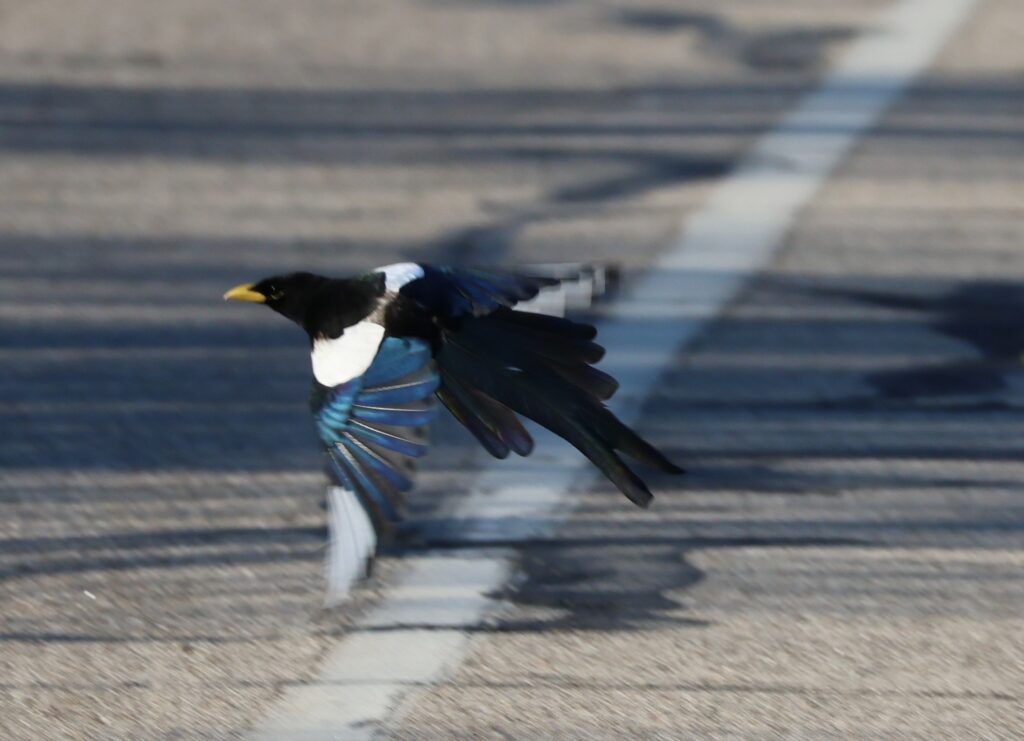
On our trip down, we got good looks at a well-known California endemic, Yellow-billed Magpie (see post “College Search Birding in California”).

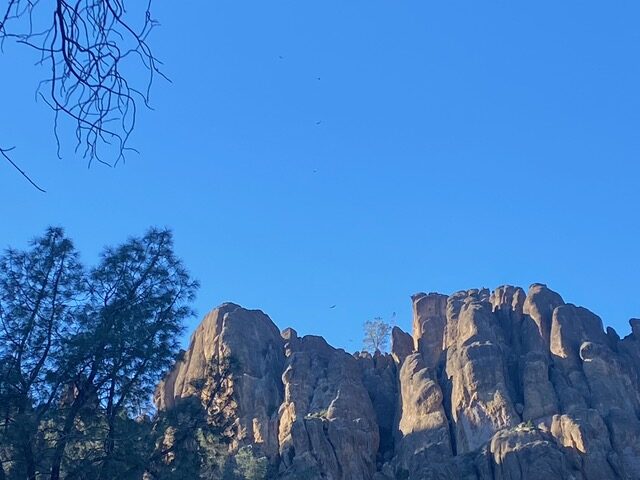
Our first stop was along the lonely Highway 25 between Hollister and Pinnacles’ east entrance. We badly wanted one soaring raptor to be a California Condor but it turned out to be a Golden Eagle. Later (2-3pm), at the observation overlook a mile up the Condor Gulch Trail, more than 15 dark soaring birds suddenly appeared as a group from behind the eroded sandstone Hain’s Peak. I confidently identified four as Condors, one as a Golden Eagle (clearly seeing the difference between each’s white markings on the undersides), and many Turkey Vultures. Steve’s new camera clicked away. At the trailhead, a ranger told us that, years ago, the population was below 10 individuals when reintroduction began and now the local population had swelled to “three digits.”

Pinnacles National Park. And yes, at least some of those black specks are California Condors!

The next morning we embarked on our first festival field trip: a Big Day at Santa Margarita Lake. It was led by Mark Holmgren, retired curator of the natural history museum and collection at UC Santa Barbara (my alma mater and where Sneed got his master’s degree). Highlights included comparing Eared, Horned, Western, Clark’s and Pied-billed Grebes, listening to Fox’s Sparrows, California Thrashers, and Wrentits, and observing raptor behavior. Speaking of, we saw Ospreys and Bald Eagles fishing (one birder theorized the adult eagles were teaching the juvenile), two Peregrine falcons mobbing a raven, and two Peregrines (perhaps the same) apparently fighting over food in mid-air or in courtship display. I got good looks at the yellow lores of a White-throated Sparrow.

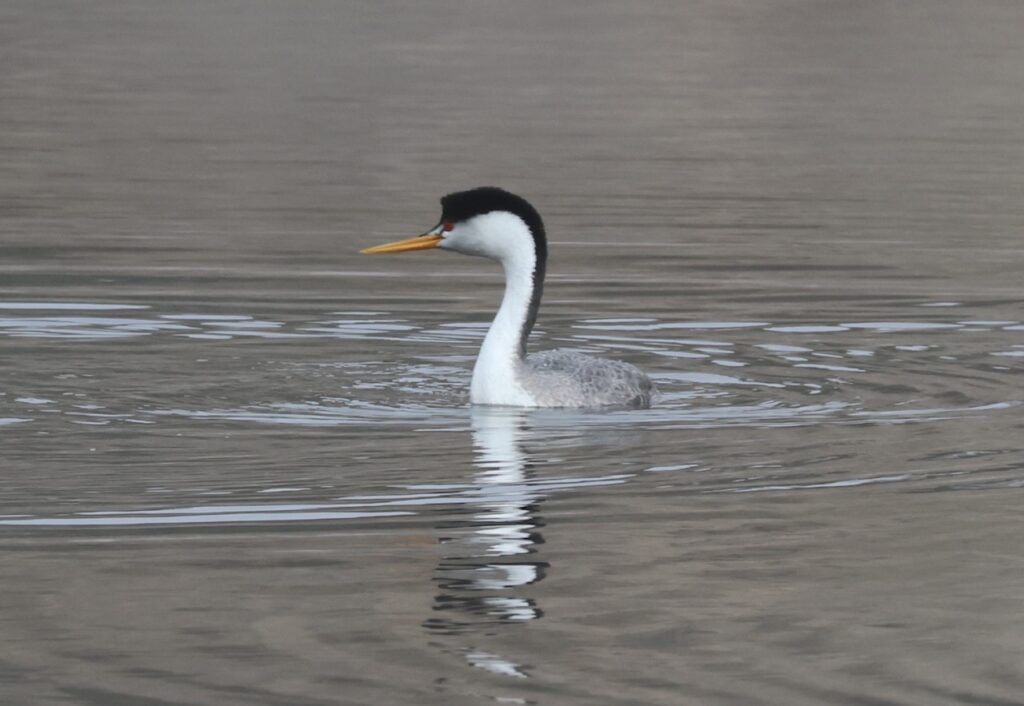
Winter is a nice time to compare Clark’s (shown here) and Western Grebes, which can sometimes be difficult to tell apart. Clark’s Grebes have more orangish bills versus greenish-yellowish on Westerns. The black also rises above the eye on Clark’s, though that’s not as clear-cut on this individual.

Tired from our long day, we drove to the Morro Bay Community Center downtown and attended one of the two  receptions. Included in the cost of registration were free local wines (multiple pours allowed), and extensive noshing trays of cheese, meats, veggies, crackers, and artisan chocolates.  The adjacent bazaar impressed with booths for 3-4 high-end binocular/gear manufacturers, book shops, authors, nature art and nature organizations. The bazaar was well attended and the noise generated rivaled that of a Spring morning chorus.

The bird fest’s exhibit area had a nice variety of vendors and non-profits to occupy us between birding trips, talks, and meals.

Our dinner at Morro Bay’s affordable, healthy and creative Asian fusion cafe, Chowa Bowl is recommended, as is the lunch combo Big Deal of sushi roll and ramen noodles at Baywood-Los Osos’ funky hangout, Kuma. This is important info to a birder even though food and beverages are barely mentioned in The Avian Survival Kit chapter of Birding for Boomers. Good food and libations can elevate a birding trip. (Editor’s Note: We at FSB take exception to this criticism, as we have frequently mentioned fine dining establishments such as McDonald’s, Wendy’s, and Starbucks.)

Next day’s Back of the Bay trip was not only highlighted by lunch, but by Audubon’s Sweet Springs Nature Preserve. It’s a small preserve with a spring-fed creek and excellent views from its wooden observation decks of the bay’s mudflats and its shorebirds, ducks, gulls, and terns—tons of them (which is saying a lot since birds are so light.) With Morro Rock and Morro Dunes in the background, we saw Lesser and Western Sandpipers, too many Brants to count, 30+ Green-winged Teals, 4 Blue-winged Teals, American Wigeon, Northern Shoveler, Bufflehead, Long-billed Curlew, Killdeer, Black-bellied Plover, Great Egret, and Greater Yellowlegs. We learned the Greater has three notes in its call compared to the two notes of the Lesser. Ring-billed Gulls, Belted Kingfishers, and Forster’s Terns were seen flying above the bay.

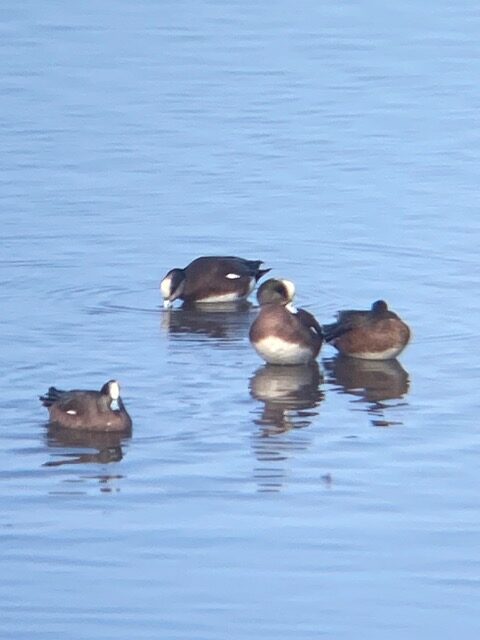
These are the ducks that inspired The Guess Who’s 1970 Number One single “American Wigeon”. Fun Fact: Sneed saw The Guess Who’s lead singer, Burton Cummings, perform this song live in Rapid City, South Dakota in 1977. Sneed was favorably impressed by this performance—until ZZ Top took the stage and basically burned the place down.

In the narrow woodland area between street and bay we saw both Hairy and Nuttall’s Woodpeckers, and Chestnut-backed Chickadee. Then, local guide Dean led our car caravan down the road apiece to his friend’s house which sported about six bird feeders that earned a hot spot ranking on eBird. More chickadees, the ubiquitous House Finch, the most common local warblers—Yellow-rumped, Orange-crowned, Townsend’s—and Lincoln’s, Golden-crowned and White-crowned Sparrows. We also saw our Oak Titmouse, formerly lumped with Plain Titmouse, at the bird feeders. Its range is mostly endemic to California (stretching into parts of Oregon and Mexico) and the bird shares its place with the Acorn Woodpecker as a signature species in California’s oak woodlands.

Dean also shared his mnemonic for our (Pacific Group) White-crowned Sparrow – “Awf man!, I dough-ont wanna see”. It’s a bit of a stretch but “I don’t want to see” sums up many people’s  self-engineered denials of science nowadays, so I decided to add it to my mnemonic checklist.

The rarity highlight of the trip was the sole Blue-winged/Cinnamon Teal hybrid. I “put good eyes on it” but Steve left his camera in the car because he logically thought he’d get better shorebird and bay bird shots on the following day’s boating trip.

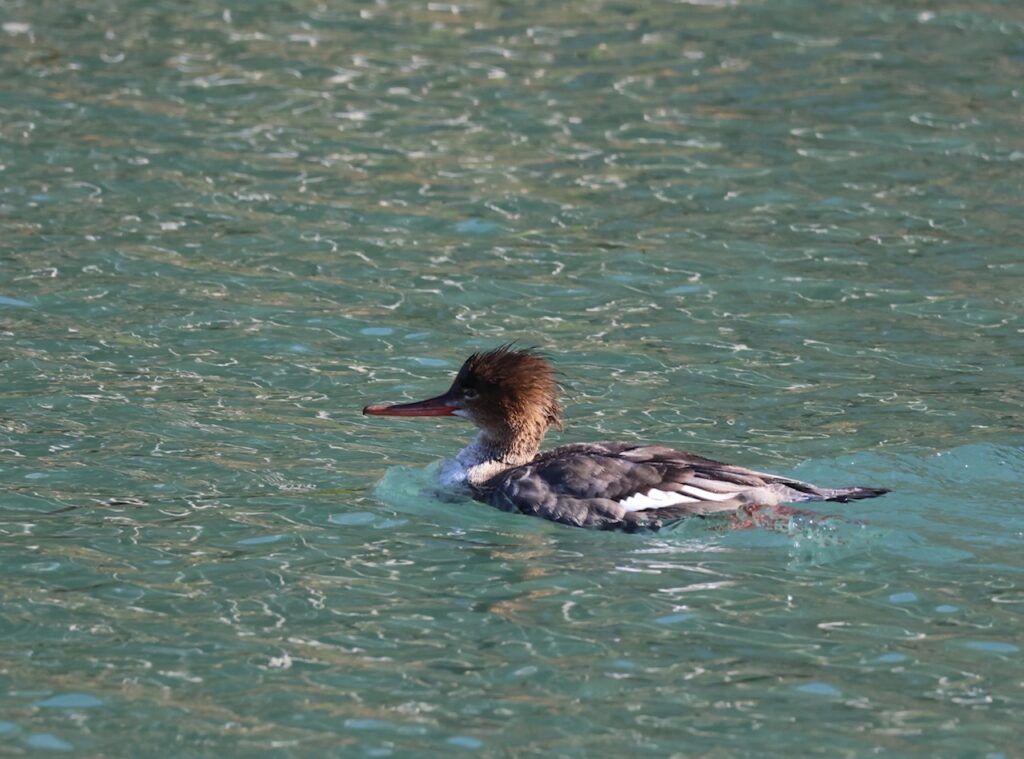
Female, juvenile, and nonbreeding Red-breasted Mergansers (above) can be difficult to distinguish from Common Mergansers, especially in winter, when they can be swimming side by side. We think this is a Red-breasted because of its a) slightly thinner, upturned bill b) indistinct transition between the brown and gray on its neck and c) its crazier “hair-do”.

Our inside-the-bay boat trip the next day also included a fellow (and local) birder, Mike, who led bird trips. Steve and I learned a lot from him. The trip was created as a photography outing and the leader focused on pointing out good shots. The captain, also a birder, put the boat in good lighting and locations for the photographers. We were inspired to overtip him. The trip started in a downtown marina and we made a loop up to Morro Rock, along the rock jetties past the bay’s opening to the ocean, and then back into the bay to the mudflats of the Morro Bay Estuary. As we returned back to the docks, we passed the Morro Bay State Park Boardwalk, the Museum of Natural History, the Morro Bay Water Access, and Heron Rookery Natural Preserve—all excellent spots to bird from the shore, and perfect for photographers from the water due to the sun’s location.

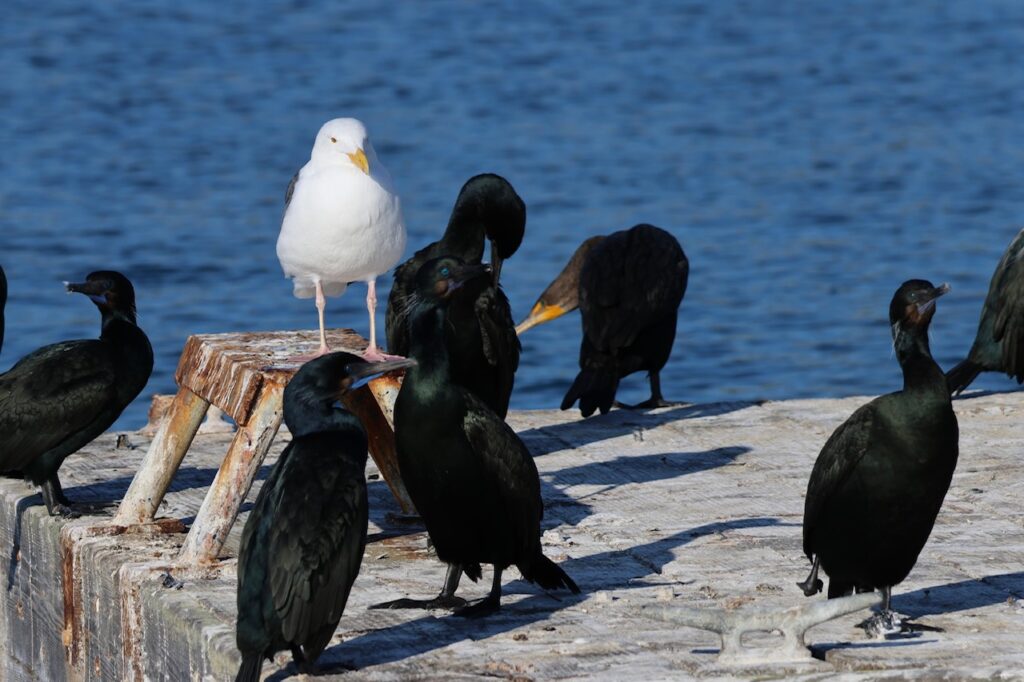
We saw Peregrine Falcons above The Rock, Black Oystercatchers and Black Turnstones on the rocks, Black-crowned Night Herons in the trees, Ospreys on the masts, Common and Red-breasted Mergansers, several Eared Grebes and a Horned for comparison, and a nice collection of Brandt’s, Pelagic, and Double-crested Cormorants floating on a wooden raft. The Brandt’s Cormorants were especially striking with their iridescent coats and bright blue throat pouches. We were surprised to see some of the adults sporting very early breeding plumage marked by brilliant white “whisker” feathers around the ears and shoulders.

Cormorants put on a show under the gaze of their Western Gull overlord. Note the brilliant blue gular pouches on the Brandt’s Cormorants, along with their wispy white breeding feathers on the necks. A Double-crested with yellow markings skulks in the background.

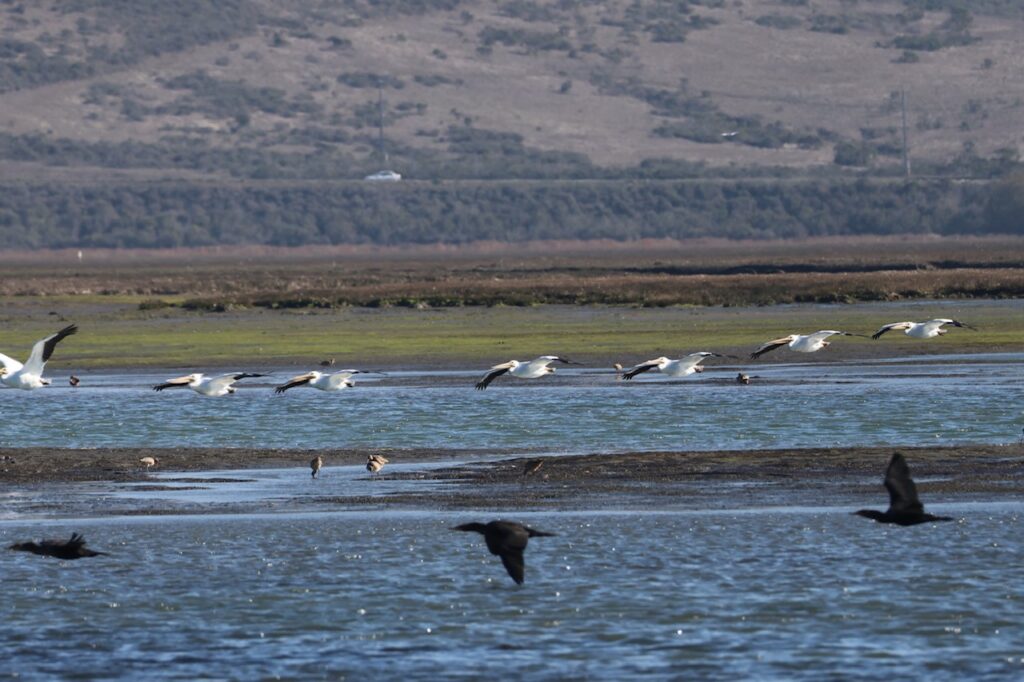
Further inside the bay near the mudflats we saw large numbers, reaching into the hundreds, of Double-crested Cormorants, Marbled Godwits, and other shorebirds too far away to ID, plus good showings of White Pelicans, Ospreys, Ring-billed and Western Gulls, Northern Pintails, Buffleheads and Long-billed Curlews, Willets, and Greater Yellowlegs, as well as other common shorebirds not listed.  Mike told us that the Pelagic Boat Trip ($160) was fantastic. If interested, check the bird list from the trip on the festival’s website.

Our “Inside of the Bay” boat trip featured a great variety of seabirds and shorebirds. Here, American White Pelicans earn extra style points.

The last night’s keynote speaker was Kenn Kaufman, author of Kingbird Highway, multiple nature guides, and his new The Birds that Audubon Missed: Discovery and Desire in the American Wilderness. He extolled birders to persist in their nature explorations, even beyond birds, and to pause the inclination to aggressively list in order to truly observe. He described the Morro Bay region as a “globally important ecological area” and the all-volunteer festival as top-notch and well organized, ranking it among the highest of the many he has attended. 

232 species were identified collectively during the 5-day festival in mid-January. Events included typical bird walks, birding by boat, bicycle and kayak, birding for youth, beginners and advanced birders, birding with wine and olive oil tastings. Sites extended beyond the Morro Bay area including the  Kern National Wildlife Refuge, the Carrizo Plains Ecological Reserve, various ranches, Atascadero, San Luis Obispo, and Pismo Beach. Check out the Long Report of the Festival Events Including Details on the website. More details than you will need to convince you to make next year’s festival are found at morrobaybirdfestival.org.

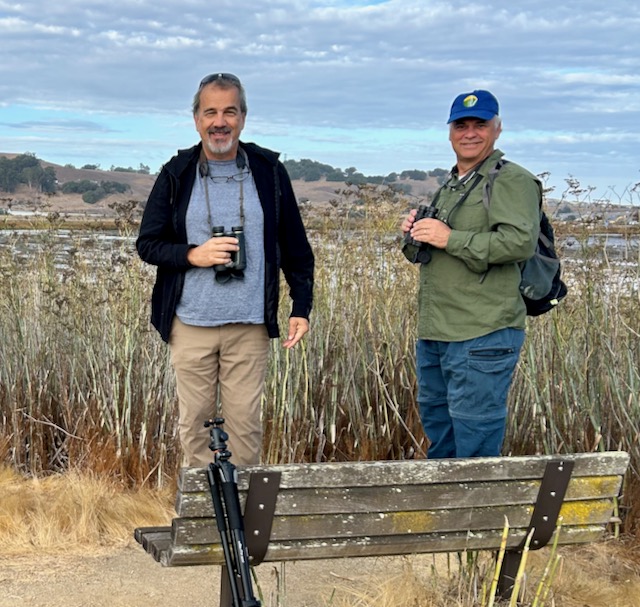
Scott (right) and Steve (left) while birding with Sneed in Marin County last fall. (I don’t know why Scott’s head looks a bit squished. I blame climate change, not my photographic skills.)

Birding Victoria, BC

For my birthday, my wife Amy surprised me with a week-long trip to Vancouver Island, including a three-night stay in Victoria and three more nights at a little cabin overlooking the majestic Pacific Ocean and the Olympic Peninsula across the Salish Sea (or Strait of Juan de Fuca). Amy’s surprising plans delighted me, especially since this was where we honeymooned a couple of decades before, and we’d always wanted to return. I was puzzled, however, when she said, “It’s supposed to be a good place to go birding.” What? Birding? On Vancouver Island? In January? After doing a little research on eBird, however, I concluded that she might just be right. For winter, the area seemed to have a good variety of songbirds, but I got even more excited about the possibility of ocean birds.

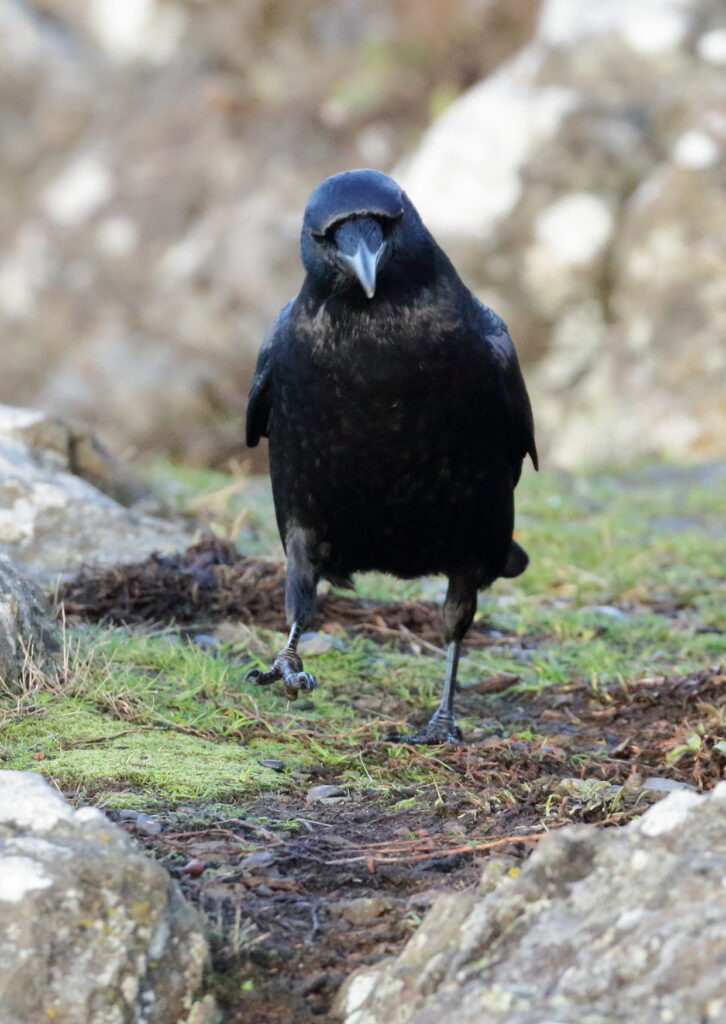
While at McMicking Point, this American Crow kindly kept a close watch on my backpack—I’m sure with purely altruistic motives!

Our first morning there, I awoke before dawn, walked to a nearby convenience store to grab nourishment, and then drove our rental car out to McMicking Point just as light seeped across the sky. I was super excited about this spot because someone had reported sixty species there only days before, including several birds that would be lifers pour moi. I had even dragged my large, awkward spotting scope and tripod out from Montana specifically for such opportunities. Alas, I later learned that the “mega lists” I had found on eBird had been compiled by one of the region’s top birders—a guy who apparently could ID a bird miles away just by the way it flew. My experience would prove far different.

Though the bird action seemed at first a bit slow, McMicking Point offered the most scenic vistas you could imagine.

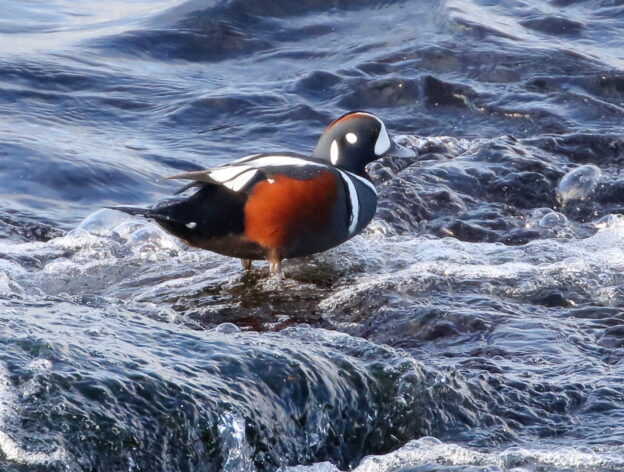
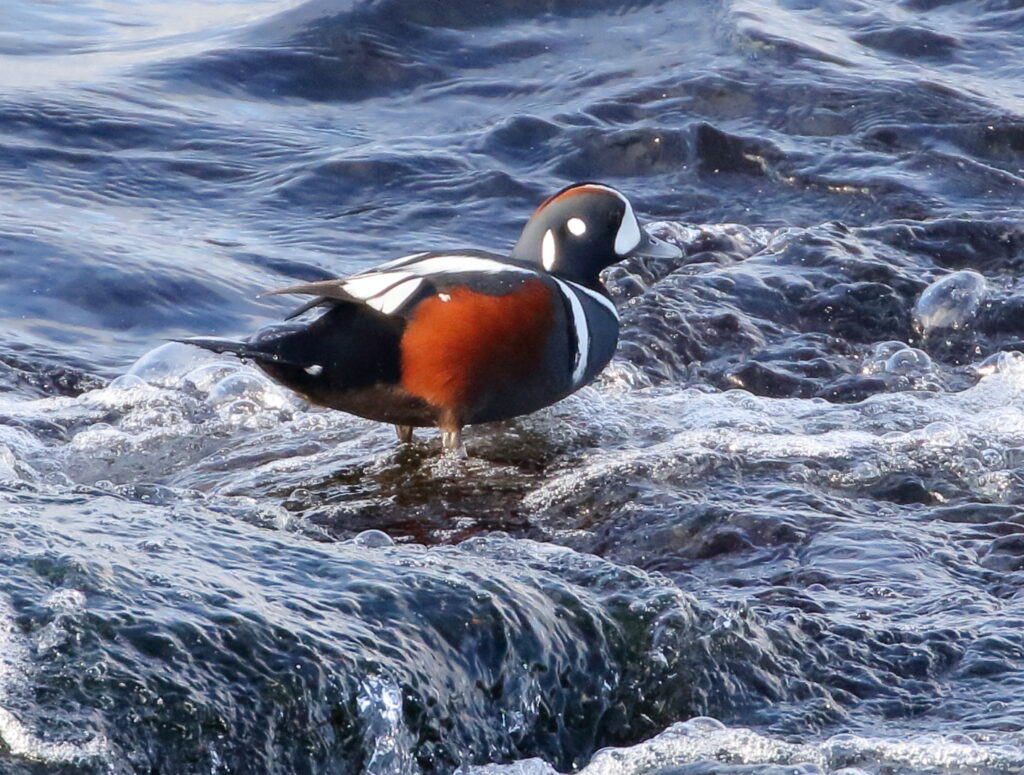
As I set up my scope, my first thought was, “Where are all the birds?” A couple of cormorants—too far away to identify—skimmed the water, along with a few Glaucous-winged Gulls, and I could hear a raven in the neighborhood behind me, but that was it. In such situations, I have learned that it’s important to calm down and be patient—something I am horrible at (just ask Amy), but nonetheless have learned to do. Sure enough, as I trained the scope on some nearby surge channels, I spotted a few Buffleheads and then, to my delight, the trip’s first Harlequin Ducks! In Montana, we have only a narrow window to find HADUs as they breed mainly in a handful of whitewater streams in Glacier and Yellowstone (see our post “In Glacier National Park, When It Rains, It Pours—Animals.”). Because of this, I took extra time to enjoy them.

This trip could be dubbed the “Harlequin Duck Adventure” as I would see far more HADUs this week than in the entire rest of my life!

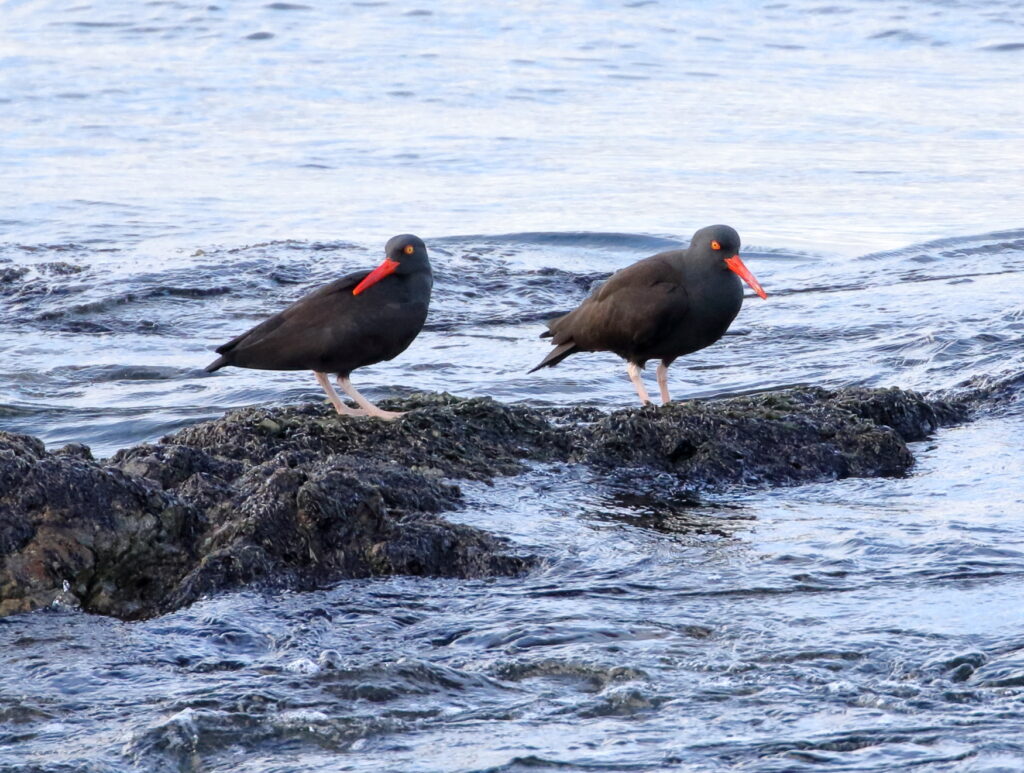
Through my brand new binoculars (more about these in the next post), I also could see interesting action stirring out on the Trial Islands about a quarter mile offshore. I trained my scope out there and immediately picked up Black Turnstones, Black Oystercatchers, and Dunlins working the rocky shore. Then, I got even more excited as I noted several larger, pale, medium-sized shorebirds. Yay! Black-bellied Plovers! This especially reinforced the value of preparing for any birding trip—especially with birds that are far away. The Dunlins, for instance, would have been more difficult for me to pin down if I had not learned that they were the most likely small shorebirds in the area this time of year. I also had noted Black-bellied Plovers on recent eBird lists for the site, and so was primed to recognize them.

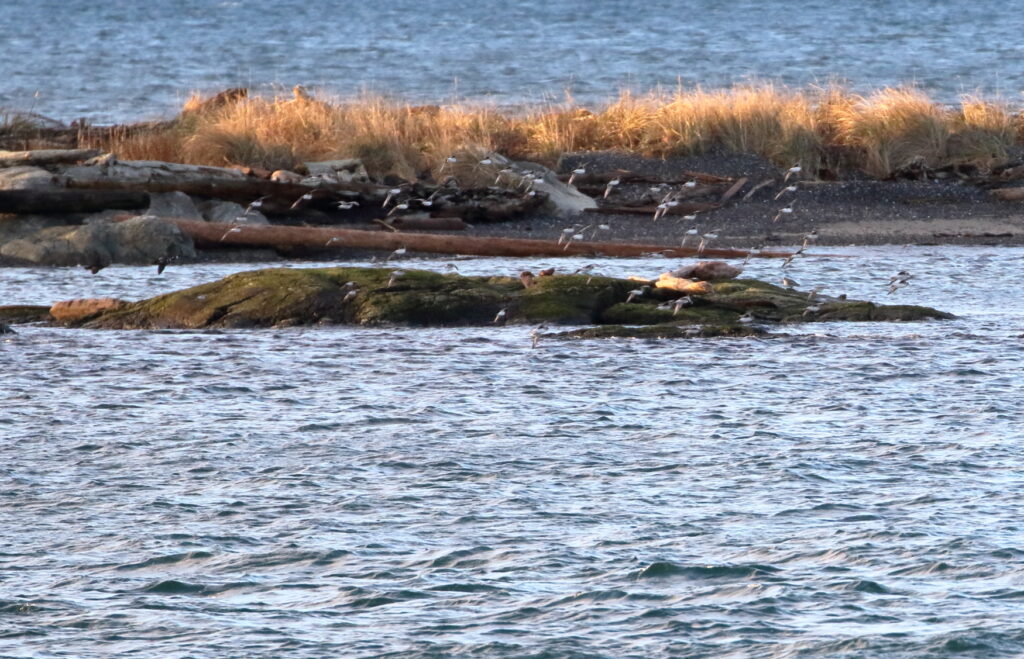
I almost always undercount shorebirds. When I first trained the scope on the Trial Islands, I counted about six Black-bellied Plovers. When they flew, the number exploded to forty! Once again, the black armpits in flight give these away (see our post “Chasing Migrants, Part I: Swifts, Peeps, and Plovers”). For bonus points, can you ID the flying birds on the far left?

After picking up a few more species, I departed McMicking Point with, I should emphasize, a grand total of sixteen species—not the sixty-plus I had been dreaming about. Still, my next stop, Clover Point, would add a few more good ones for the day. Unlike McMicking Point, where I birded alone, Clover Point was well-trodden by walkers, dog owners and, it turns out, a few other birders. Here, I got closer looks at Dunlins, Harlequin Ducks, and oystercatchers, but also picked up both Red-necked and Horned Grebes and Surf Scoters. A friendly birder named John also joined me and pointed out a group of White-winged Scoters in the distance along with what he said was a Red-throated Loon, which Braden and I had seen recently on Cape Cod (see our post “Birding Race Point: Cape Cod’s Pelagic Playground“). I couldn’t convince myself of that ID, but we did spot a Pigeon Guillemot about a quarter mile distant.

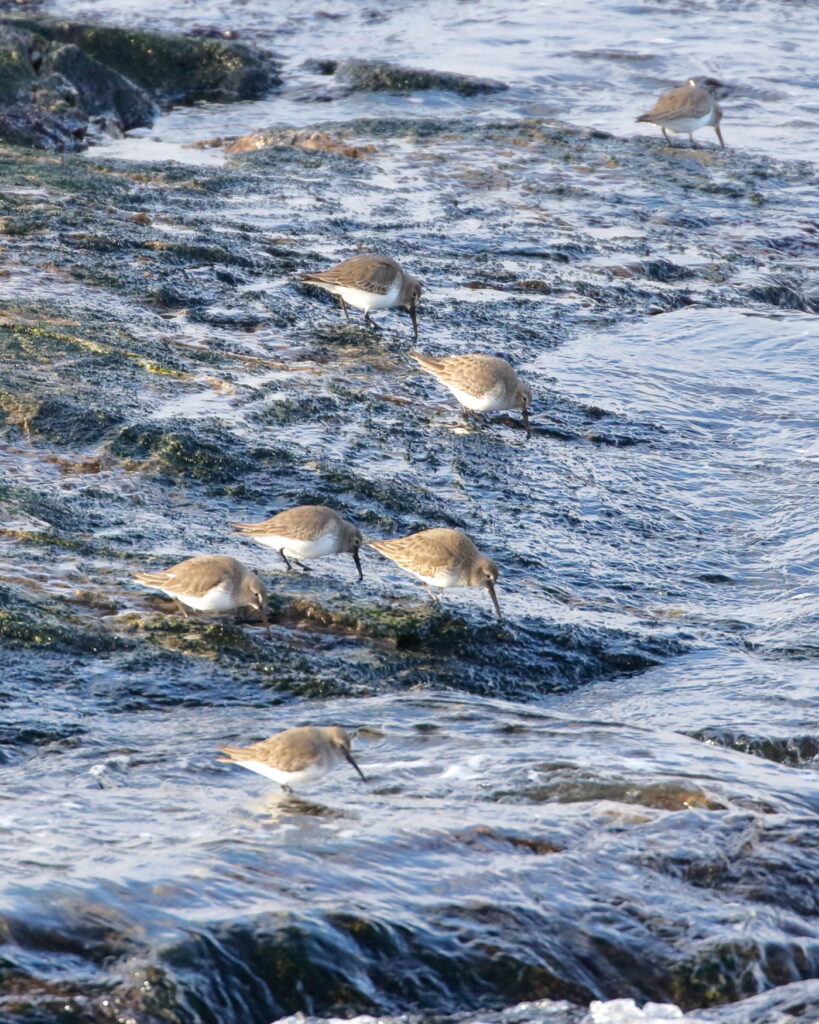
Clover Point offered a great chance to watch Dunlins probe the rocky shore for invertebrate morsels.

“Is there anything special you’re looking for?” John asked me.

“I’d love to find some murrelets,” I told him with a sigh.

“Oh, we should be able to find you more alcids,” he told me, scanning the water with his binoculars. Alas, our efforts proved to no avail, and I admit that I wrapped up the morning feeling a bit of a failure. In fact, I mentioned to John the list with sixty birds on it, and he said, “Oh, that birder is a local legend. You look at his lists and you think he’s just making it up, but I’ve birded with him, and he’s the real deal. He can recognize almost anything.”

Love, love, love Black Oystercatchers. Can’t get enough—even though I got to hang out with a couple of dozen on the trip!

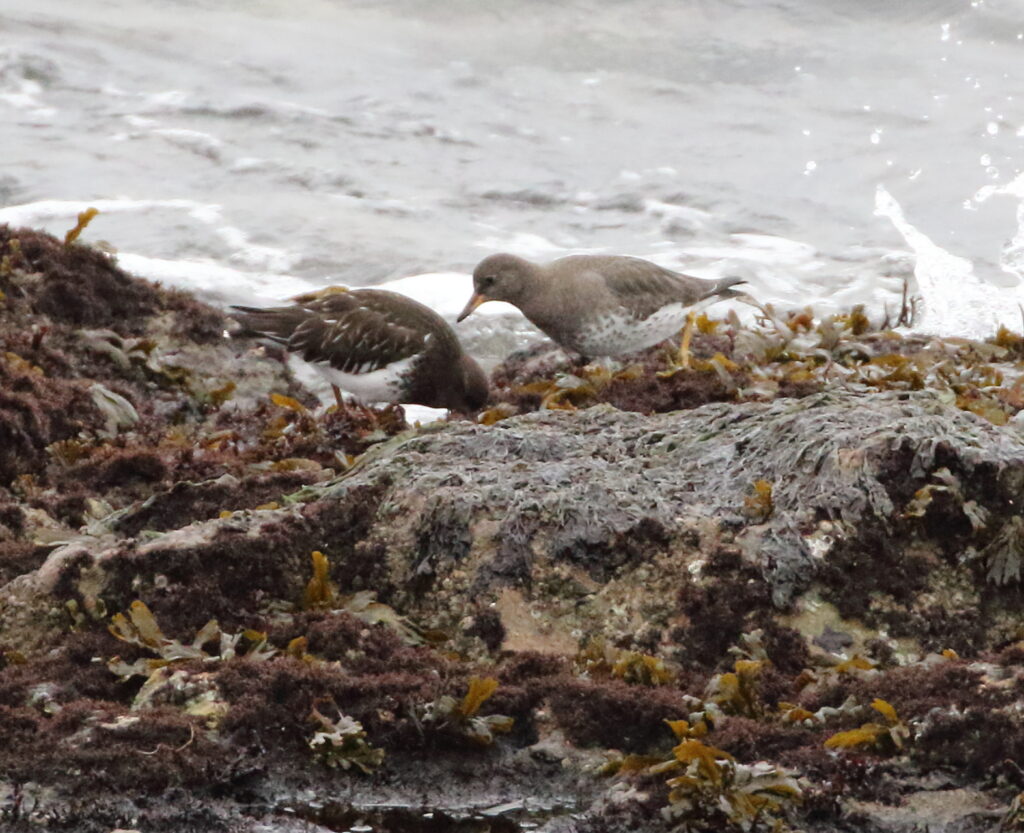
That did make me feel better, but even if I had not learned this, it’s important not to fall into the “failure trap.” After all, you can only see what you can see—and the whole point is to enjoy every bird you are lucky enough to encounter. Also, I reminded myself, my Victoria birding was far from over. I brought Amy back to Clover Point the next day, and while she walked along the cliffs, I enjoyed another nice session, including my only encounter with Surfbirds the entire week. These are some of Braden’s and my favorite rocky shore birds, and it was awesome to watch them foraging along with a larger group of Black Turnstones.

Watching Surfbirds (right) foraging with Black Turnstones (left) was one of the highlights of my second visit to Clover Point.

That afternoon, while Amy rested at the hotel, I decided to make the most of the season’s abbreviated daylight hours and take a stroll through Beacon Hill Park, a large park stretching almost from downtown out toward the sea near Clover Point. I intentionally left my camera in the room so I could just appreciate whatever I happened to see—which turned out to be a lot. On the grass right outside of our hotel, I was astonished to see a dozen Yellow-rumped Warblers—birds that I figured ought to be wintering much farther south (Sibley, though, shows them as all-year-round here after all). Once I reached Beacon Park, I began seeing Pine Siskins, Chestnut-backed Chickadees, Red-breasted Nuthatches, and a bird that, because of my crummy ears, always proves a challenge: Golden-crowned Kinglet.

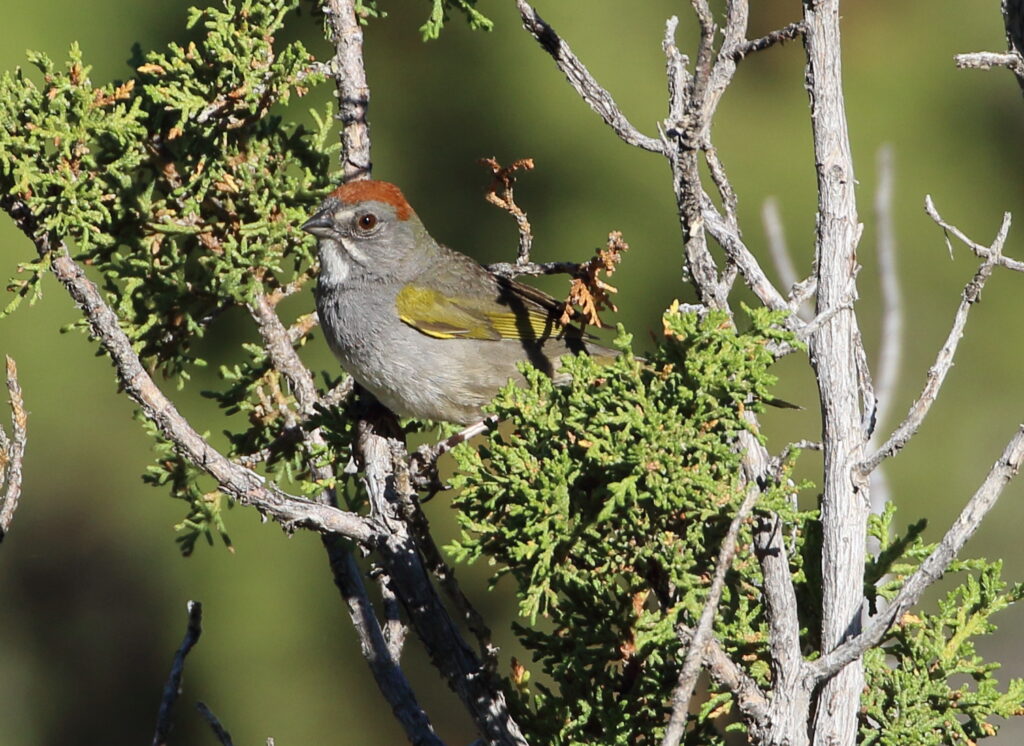
Beacon Hill offered my best experience with land birds of the trip—including a bona fide Victoria vagrant, a Green-tailed Towhee!

After strolling for about half an hour, I stood watching a Ruby-crowned Kinglet flycatching, something I had never seen one do, when another birder approached. In a wonderfully British accent, he asked, “Do you know that within a quarter-mile of here is a great rarity?” I knew immediately what he was talking about. From looking at eBird lists, I had learned that a vagrant Green-tailed Towhee had showed up in Victoria and had set off a frenzy in the local birding community. John at Clover Point had also mentioned it, but I hadn’t realized I had wandered so close.

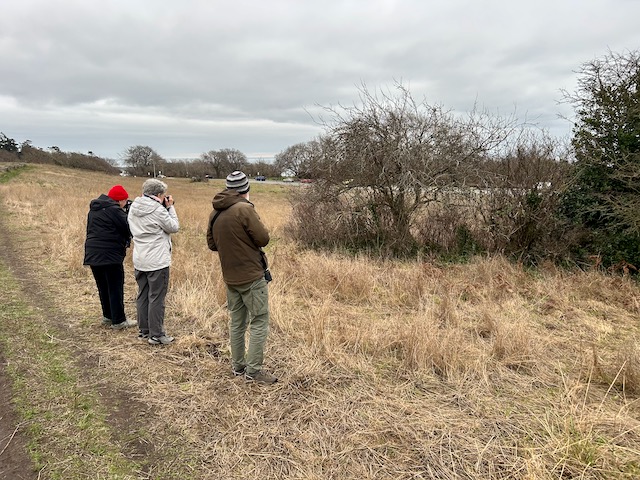
Victoria birders enthralled with a “rare” Green-tailed Towhee!

“I tried to see it,” my newest birding friend confided, “but you know what I heard—‘Oh, you should have been here five minutes ago.’” Nonetheless, he gave me directions in case I wanted to check it out, and with an hour or so of daylight left, I figured I might as well. I crossed the road and followed a little path up and over a hill until I came to a tall flagpole flying the maple leaf. Sure enough, in the field below, a group of four or five birders had gathered around a small thicket. I quietly approached from behind and spotted movement in a darkened space between two bushes. After a few moments, the familiar shape of the Green-tailed Towhee took the stage.

Although fairly common in Montana in summer, the Green-tailed Towhee that showed up in Victoria recently rocked local birders’ worlds! Full-disclosure: this is not THAT bird, but one I photographed in Bear Canyon several years ago.

It was weird seeing a bird that is relatively common in Montana being such a focus of attention here in Canada, but it was cool, too. It helped me appreciate the enthusiasm of birders no matter where you go in this amazing world. What’s funny, though, is that I got much more excited by the Fox Sparrow foraging a few feet away from the towhee. That is always a tough bird for me to find in Montana, so it was great to have one put in an appearance for me here. With that, I made my way back to our hotel so that Amy and I could go find a fun restaurant to dine at. What I didn’t realize is how much good Canadian birding still lay ahead of me.

The lovely mastermind behind our surprise Victoria trip, my wife Amy, enjoying high tea at the Fairmont Empress Hotel.

(For the second part of this story, see “In Search of the Marbled Murrelet”.)

In Montana, Some Real October Surprises

For birders, October is an odd month—especially in Montana. Our resident birds have left. Winter residents are just arriving. Most migrating birds have passed through the state—but not quite all. The month poses a special dilemma for those trying to set any kind of Big Year milestone, because time for new birds is running out. This year, for instance, I have found myself tantalizingly close to making 2024 my second best Montana birding year ever. 2020 was Braden’s and my best year, when we put a ton of effort into it, and I recorded 266 species on my list (see our post “2020 Wraps, 2021 Underway”). Last year, thanks in part to an Eastern Montana trip with my pal Scott, I notched my second best year with 253 species. As October wound down this year, however, I found myself with 247 species—seemingly within striking distance of breaking that 253 mark. Or was it?

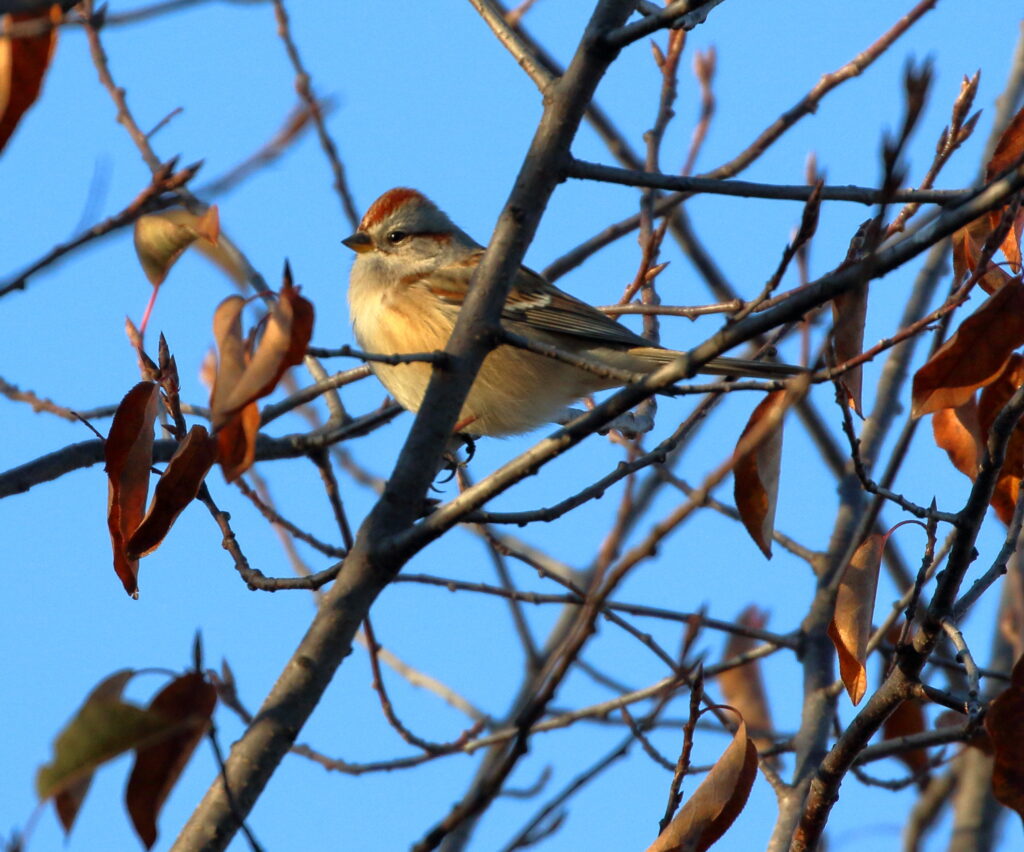
The Fort Missoula gravel quarry delivered our first American Tree Sparrows of the season—a bird that, unbeknownst to me, I had failed to see earlier in the year! This, dear readers, is also where Braden and I got our lifer ATSPs years ago.

A mere seven species might seem like an easy task with three months to go in the year, but that small number is deceiving. As mentioned above, very few new birds arrive this time of year. As for winter arrivals, most birders (myself included) already saw those in January and February. Bottom Line: By October, birders hoping to set a mark need to track down some rarities.

Braden and I have chased plenty of rarities in the past, but I am more reluctant to do so these days. The main reason? Unless I really, really want to see a particular bird, I can’t justify burning up gasoline just to notch another species on my list—especially to break a rather arbitrary record. After all, climate change—powered in large part by burning fossil fuels—is one of the major threats to birds, not to mention to all other species, and my desire to make 2024 my second best year doesn’t rate as a worthy enough goal to place the planet in even greater peril. With Braden gone, chasing rarities also isn’t as much fun.

Still, last week, with the end of the month in sight, I felt like I could use a good birding session to take advantage of our last warm weather and improve my mental health, made particularly jittery by the craziness of the upcoming elections. And then, out of the blue, I got a text from Nick Ramsey: “Hey! Are you in Missoula? And any shot you want to go birding tomorrow?” I didn’t hesitate. “Yes and yes!” I shot back.

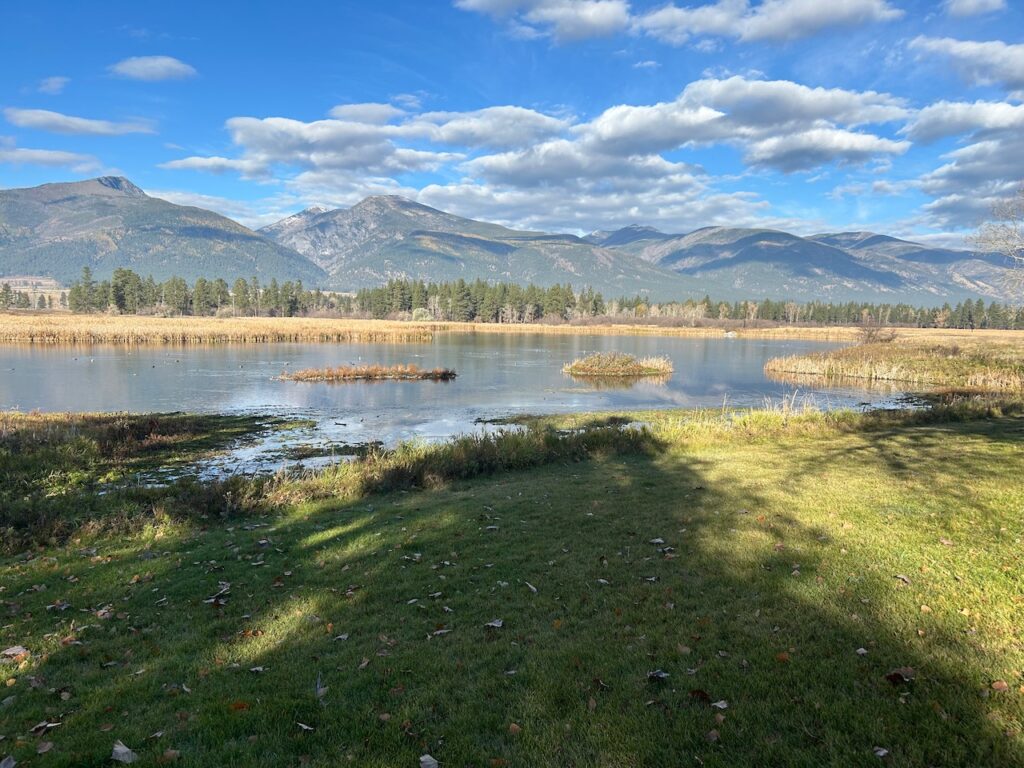
With only hours to spend in Missoula, Nick picked me up for a quick trip to the Fort Missoula gravel quarry and Lee Metcalf NWR, showed above.

Nick, it turns out, had a brief layover in Missoula between a summer field job in Alaska and guiding gigs in Louisiana. Regular readers of FatherSonBirding (or of my new book Birding for Boomers) will recognize Nick both as a member of our extended family, and as our most important mentor when Braden and I first started to bird. We’ve had countless birding adventures together including our first expedition to eastern Montana and Braden’s and Nick’s epic Florida birding trip in 2022. I was thrilled that Nick, who recently graduated from LSU, reached out to me—especially because he had only hours to spare before hitting the road for a 30-hour drive to Louisiana. I asked him what he’d like to do and he suggested visiting the Fort Missoula gravel quarry and Lee Metcalf National Wildlife Refuge. That sounded great to me, and just by coincidence, a Northern Parula had just been sighted at Lee Metcalf.

Decidedly eastern birds, Northern Parulas are almost unheard of in Western Montana. Although chances were low that it would still be there when Nick and I got there the following day, I couldn’t help thinking this could move me closer to tying my “second place” record of 253. For his part, Nick especially wanted to see a Swamp Sparrow, another uncommon bird for Montana. I figured we had almost no hope of finding one of those, but if anyone could, it was Nick.

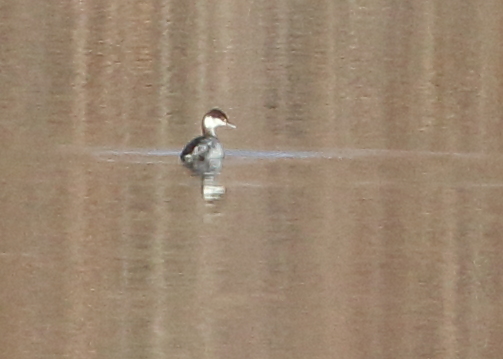
Nick picked me up at eight the next morning, in the company of his adorable diminutive companion, a chihuahua mix named Dixie, who decided that my lap would be her domain for the rest of the day. Our first stop? The gravel quarry. Nick hoped for a Swamp Sparrow here and we both thought it might be a good chance to see scoters, Long-tailed Ducks, or other laggards passing through the area. Unfortunately, a guy flying a drone was most likely scaring off any interesting water birds. Still, we had a nice sparrow session, finding a ton ‘o Song Sparrows, along with White-crowned Sparrows, and the season’s first American Tree Sparrows—which, I didn’t realize I had failed to find earlier in the year! By the time we headed back to the car, the drone flier also had departed, giving us a look at a few Hooded Mergansers. “Hey, there’s also a Horned Grebe!” I told Nick. That was a nice surprise since I’d managed to miss them in Montana the entire year. Click. With the American Tree Sparrows and Horned Grebe, my Montana Year List had leaped from 247 to 249!

I had given up on Horned Grebes for my 2024 Montana list when this one showed itself at the Fort Missoula gravel quarry.

Continuing on to Lee Metcalf, Dixie keeping me warm, Nick and I caught up on the rest of our lives. This, I realized, was the first time Nick and I had ever birded together without Braden along, and though we both missed him, it was a great chance to share our adventures and discuss future birding dreams, plans, and possibilities. In no time, Nick was pulling into the Lee Metcalf visitor’s center parking lot. Several birders had arrived before us, but none seemed aware of the Northern Parula sighting the previous day. The bird had supposedly been seen in the elm trees next to the closest pond, but as we headed over there, what first caught our attention were two shorebirds pumping for food in the mud.

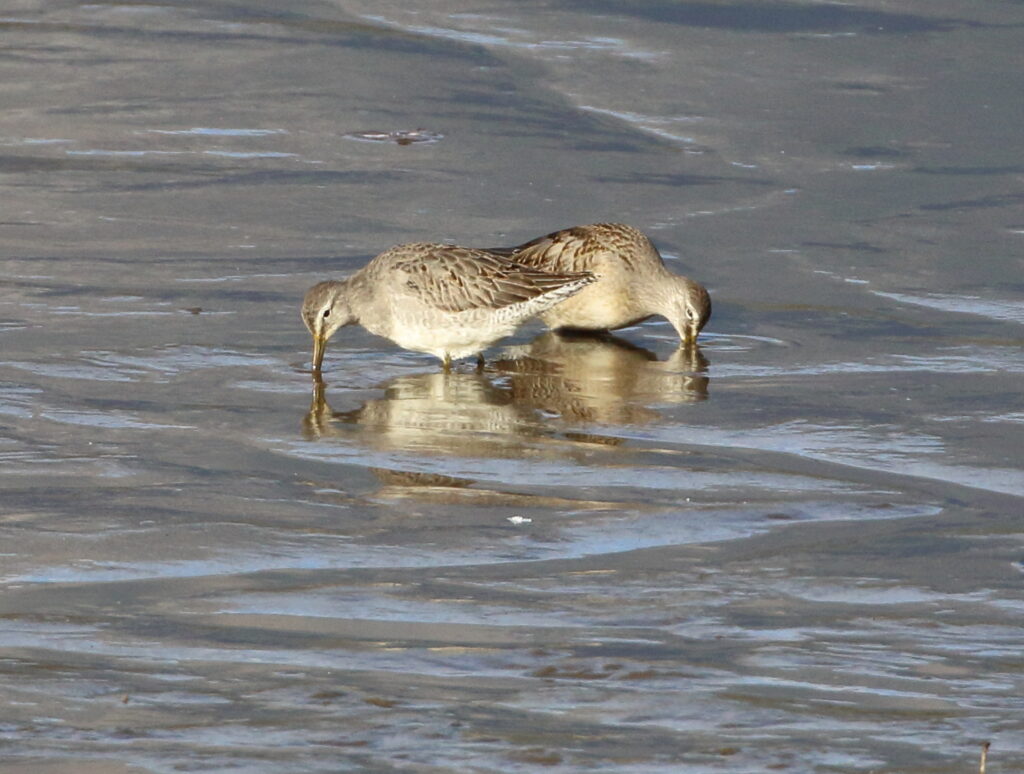
A pair of Long-billed Dowitchers presented our first surprise at Lee Metcalf. More surprises would follow!

“Are those Long-billed Dowitchers?” I asked Nick. “What are they doing here?” So late in the season, they surprised both of us and immediately made our trip down here worthwhile. While we were studying them, however, Nick’s sharp ears caught something else and he began walking over toward the south edge of the pond. I thought he had heard the Northern Parula, but when I caught up, I found him studying the cattails below us. “I thought I might have heard a Swamp Sparrow,” he explained. Then we saw movement. “There!”

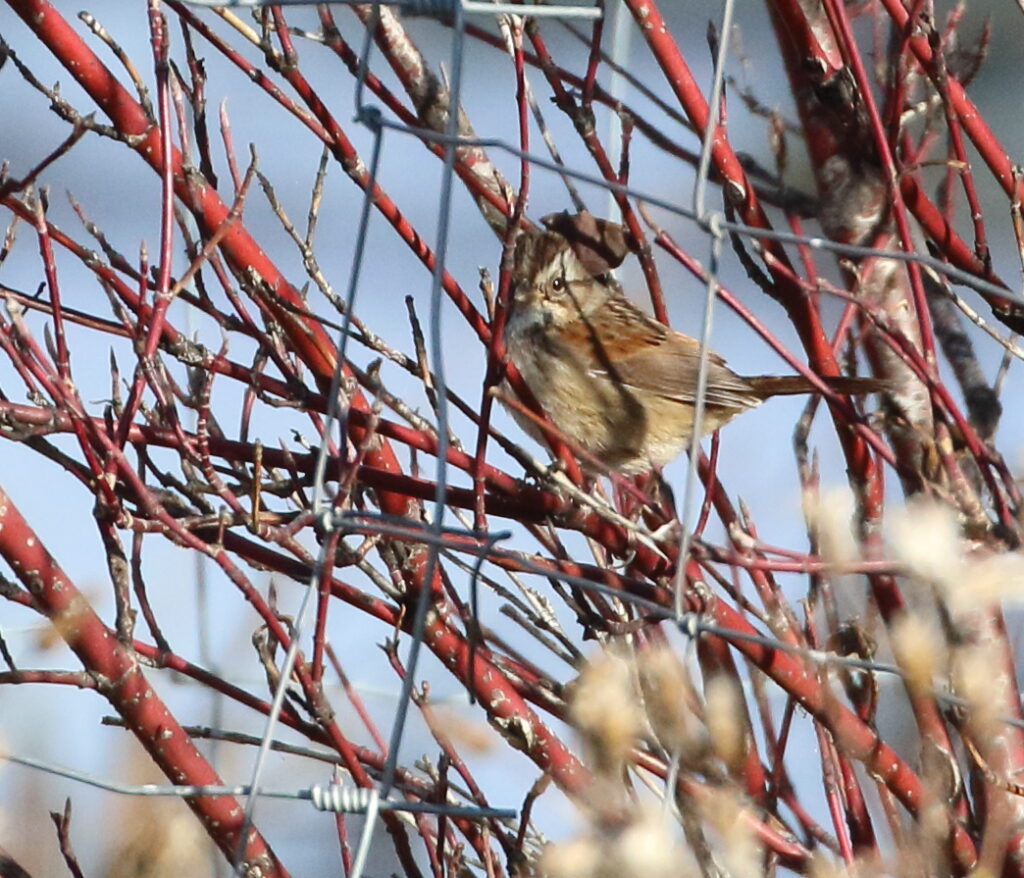
Nick’s Montana lifer Swamp Sparrow was too quick for me to catch in full sunlight, but did pause briefly behind this fence.

Several other birders joined us and it took several minutes for us to get clean looks at the bird. “Furtive” is a good word to describe Swamp Sparrows as they like to stay hidden in reeds along the water’s edge, but finally, the bird gave us full, if brief, views. I was astounded. While only about fifty records exist for Montana, Nick explained that the birds definitely move through the state every year, and Birds of Montana lists several cases where the birds have overwintered. I’d only ever seen one in Montana—in the Shiloh recreation area in Billings—so for me, this was a big deal. Click. 250.

As we moved slowly, following the sparrow to a small brush pile, Nick almost casually said, “The parula’s right behind us.”

What?

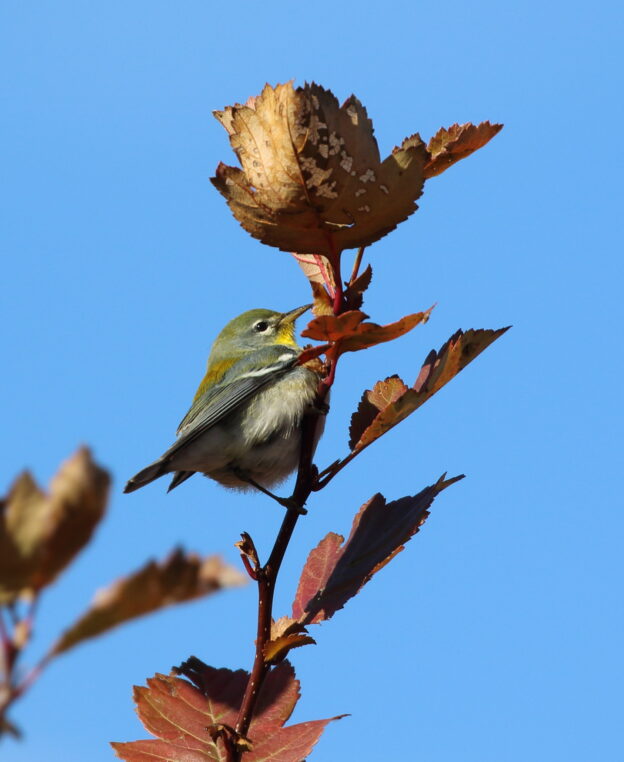
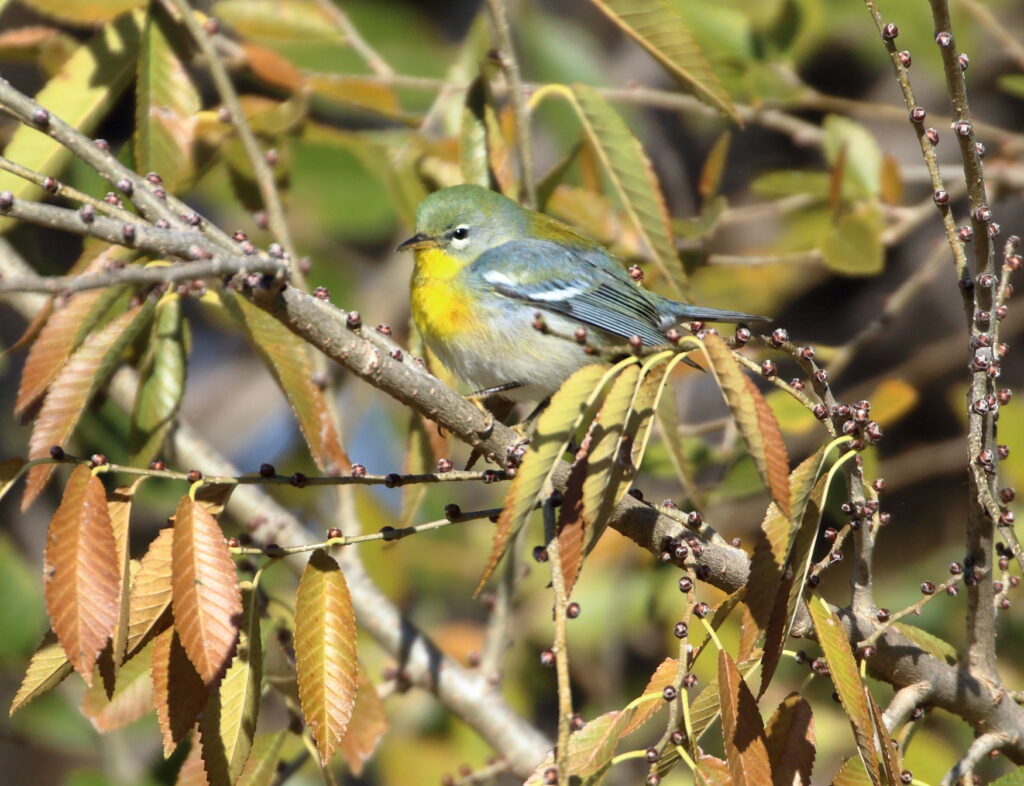
It being fall, I expected that if we saw the Northern Parula, it would be a drab specimen. The gorgeous bird, however, delivered a real October surprise.

I spun around and, sure enough, spotted a spectacular yellow-and-bluish-gray warbler plucking insects from leaves in a deciduous bush not twenty feet from us. Nick called to other nearby birders, and they joined us for one of the most leisurely looks at a rare migrant ever. Much like the Black-throated Blue Warbler that appeared in Lolo last year, this bird seemed little bothered by people. We all hung back about thirty feet, trying to fill up our cameras’ memory cards while the bird fattened up on whatever it could find. Just to mix things up, it flew over to an elm tree for a while, before heading back to the bush. After a hike out to the more distant ponds (still no scoters), Nick and I hit the road back to Missoula, making only a quick nearby stop to get Nick a look at California Quail for the year. In a single outing, and at a most improbably time of year, my year list had advanced to 251 species, making me wonder if I could somehow nab three more species through December. Even better, I had enjoyed a wonderful day of birding and companionship with one of the best rare migrants possible, our friend Nick.

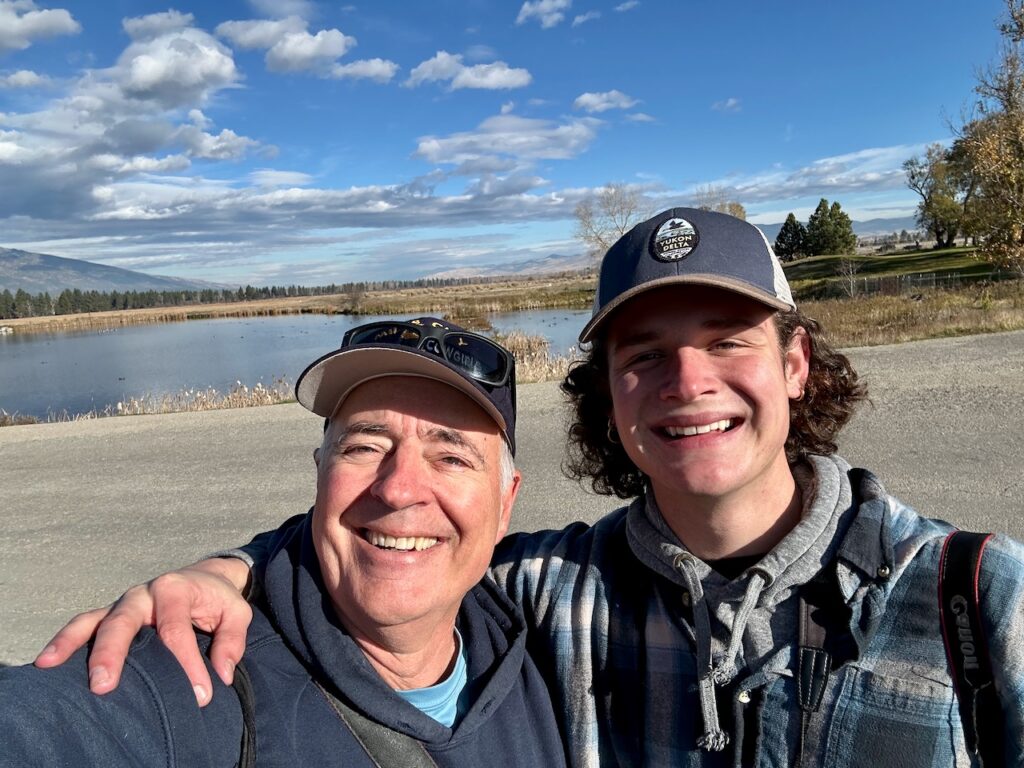
Two happy birders following an improbable day of October rarities.

Least Terns and Black-and-White Warblers: Birding Medicine Lake to Makoshika

Welcome to the fifth installment of Braden’s and my remarkable 2024 Eastern Montana Odyssey. With this episode, and more than 1,000 miles under our belts, we round the halfway mark of our trip, approaching brand-new birding territory for us. Before that, however, we had some truly remarkable birding at past favorite birding sites. If you are enjoying these episodes, please share them with your birding friends and consider supporting our efforts by buying a *NEW* copy or two of one of Sneed’s books on the right.

After two fascinating, fulfilling days in Westby (see our last post), Braden and I were primed to tackle the next stage of our Eastern Montana safari. We’d already had some amazingly packed grassland birding experiences, so I have to admit I wasn’t as excited about Medicine Lake National Wildlife Refuge as I should have been. Part of that may be because last year, my pal Scott and I were turned back from the refuge by thick, slippery mud (aka “gumbo”). In any case, my bad attitude proved to be way off the mark, as Medicine Lake delivered one of our best grassland birding days ever.

At Medicine Lake, Braden counted 67, say it loud, SIXTY-SEVEN Grasshopper Sparrows!

Our visit began promisingly when Braden IDed an Alder Flycatcher by its distinctive “free beer” call right near the (closed) visitor’s center. What unfolded afterward was nothing less than a full-on showcase of grassland birds. Over the next nine miles, Braden recorded approximately 75 Chestnut-collared Longspurs, 67 Grasshopper Sparrows, 9 Clay-colored Sparrows, 6 Baird’s Sparrows and much, much more. He detected many of these by song, of course, but longspurs and sparrows were literally flying up everywhere around our car in some sections. As Braden noted in our eBird list: “Ridiculous.”

One of our better looks at Sharp-tailed Grouse in recent years was one of many delights at Medicine Lake NWR.

Not to be outdone, impressive numbers of waterfowl and game birds, including three Sharp-tailed Grouse, clamored to get on our eBird list. Surprisingly, so did a number of shorebirds. Where the road threaded two ponds, four White-rumped Sandpipers landed, giving us our closest looks of the entire trip. Here, we also saw eleven birds we desperately wanted to find—Red-necked Phalaropes. It’s lucky we did, too, since they would be the only RNPHs of our expedition.

After spending days poring through flocks of Wilson’s Phalaropes, we finally located a group of 11 Red-necked Phalaropes at Medicine Lake. Even better, they were in their uber-handsome breeding plumages.

Our Medicine Lake checklist: https://ebird.org/checklist/S180177051

On our way down to Glendive, we stopped at Culbertson Bridge for a modest 21 species, and then turned right down a dirt road. “What are we doing here?” I asked Braden. “There are supposed to be Least Terns nesting on sandbars in the Missouri River,” he told me. Okay, I admit it, Least Terns were totally off my radar and, honestly, I’m not sure I realized they even nested in Montana. Sure enough, they do. There are five subspecies of Least Terns, and Montana’s belong to the “Interior” group. Unfortunately, this group is federally endangered due to its small population, habitat loss, and disturbance by recreational activities. Only about fifty are thought to live in Montana.

Several miles down the road, I pulled over at a spot overlooking several large sand islands in the river. We scanned them with our binoculars. Zippo. At that point, I was ready to move on, but Braden decided to put in the extra effort of setting up our spotting scope, even though he also thought we were out of luck.

“I see them!” he suddenly shouted.

A distant view of some of Montana’s rarest birds, Least Terns. In the nation’s interior, these birds nest on sand islands in the middle of large rivers.

Indeed, almost impossible to see with the naked eye or through binoculars, two were sitting there blending in perfectly with the sand. As we watched, we saw two more for a total of four—probably the rarest birds we would see on the entire trip! More excitement was yet to come.

We were still squinting when we took this photo—after squinting at the sand island in the background to see four of Montana’s handful of Least Terns. Squint and you might be able to see them, too!

After a great late breakfast-for-lunch at Sunny’s diner in Sidney, we made it to Glendive, where we checked into a motel. After resting up a bit, we embarked on our final bird outing of this already-packed day—to Makoshika State Park.

Scott and I had a great time in Makoshika last year watching Field Sparrows and Rock Wrens, and as we entered the park, Braden and I also picked up both species. We had another agenda, however: finding Black-and-White Warblers. Predominantly an Eastern species, these handsome little birds are known to breed in Montana, but the only other one we’d ever seen was right here in Makoshika on a trip with Nick Ramsey in 2017. Dutifully, Braden and I hiked the same trail to see if we could find another one.

Even without birds, the badlands scenery at Makoshika State Park is some of Montana’s most dramatic.

Nope. Worse, the hike wore me out after our extremely long day. Still, we had one more place to check—a campground way up on top of the hills with spectacular views of the surrounding badlands. We parked, got out, and began looking around. As usual, I was fairly skeptical of finding one, but then Braden’s ears perked up: “I think I hear one.”

We scrambled down a fairly steep slope until Braden stopped and looked up into a tree. “There it is!”

Elated, we both quickly got our binoculars on it, and I even took some crummy photos. After that, we just slowly followed this amazing, improbable little bird as it searched for insects on one tree, then another. By this time, the sun had started to sink low in the West, and standing there watching this bird created a sublime experience—one of those memorable moments that makes birding the best activity on earth.

Finding this Black-and-White Warbler at Makoshika was a powerful testament to perseverance in searching for uncommon birds. Much like nuthatches, these birds often hang upside down or point downward as they rapidly search tree trunks and branches for unsuspecting insects.