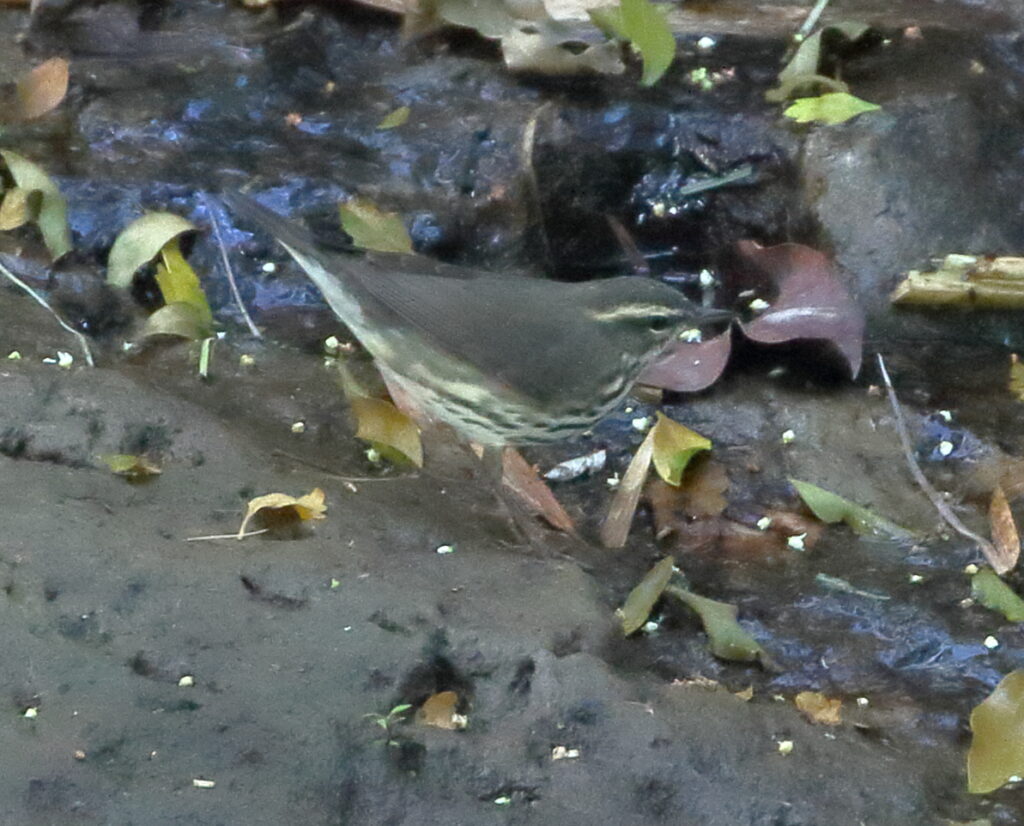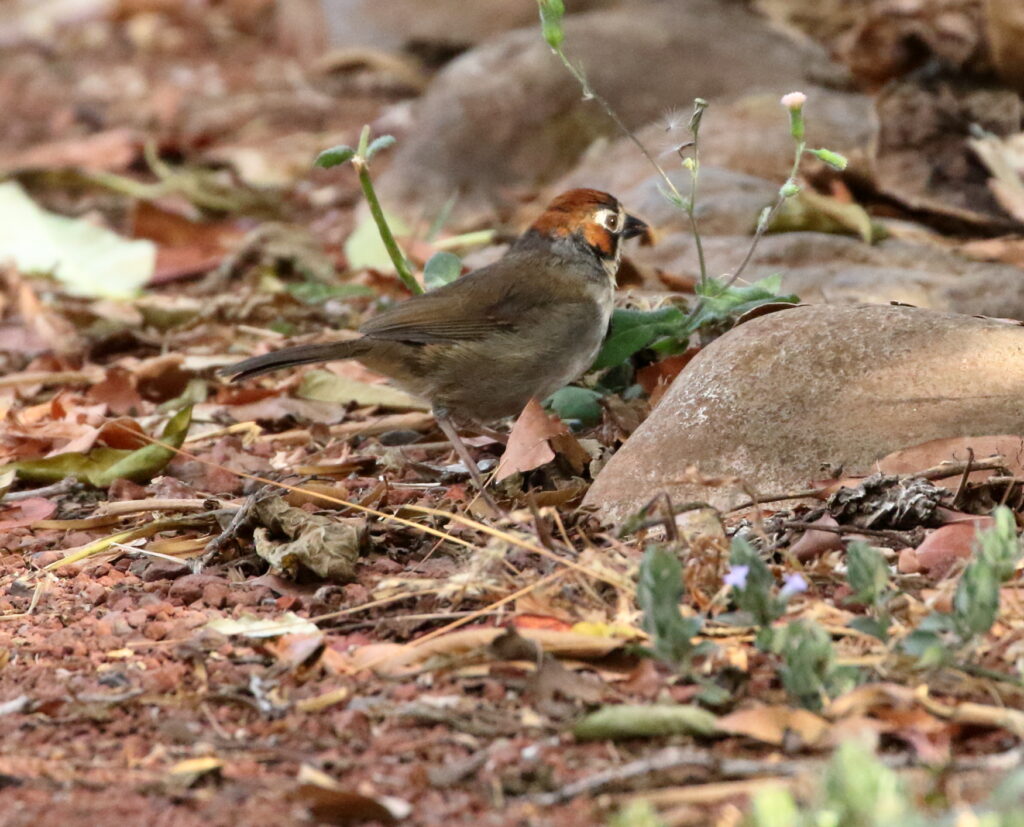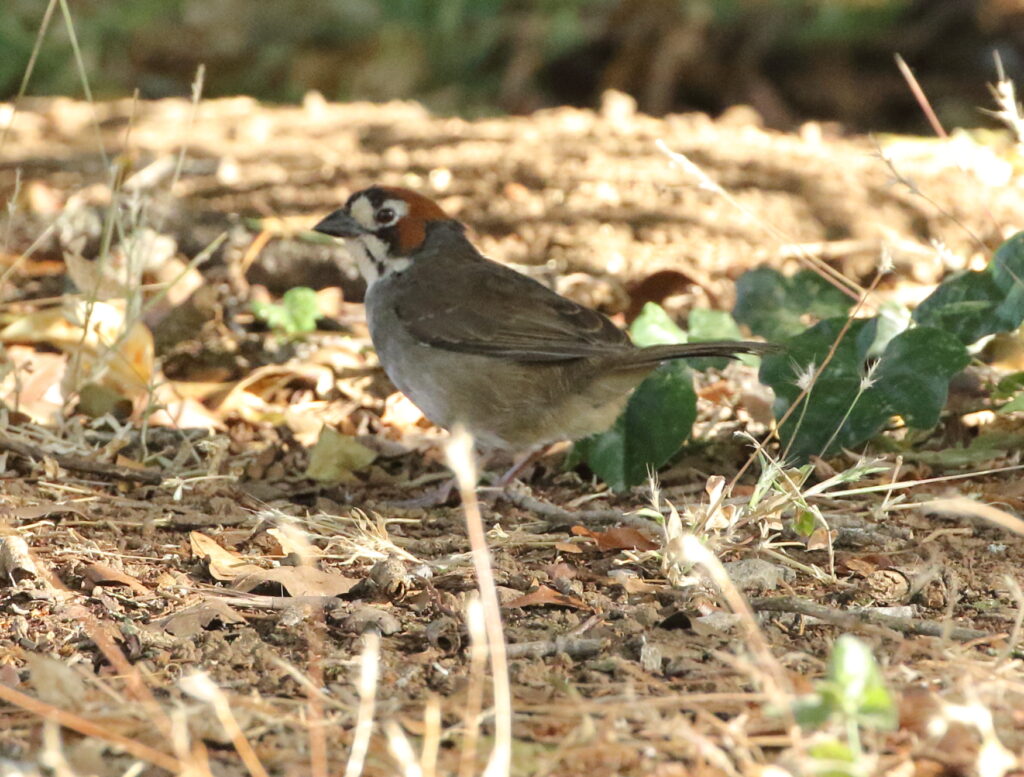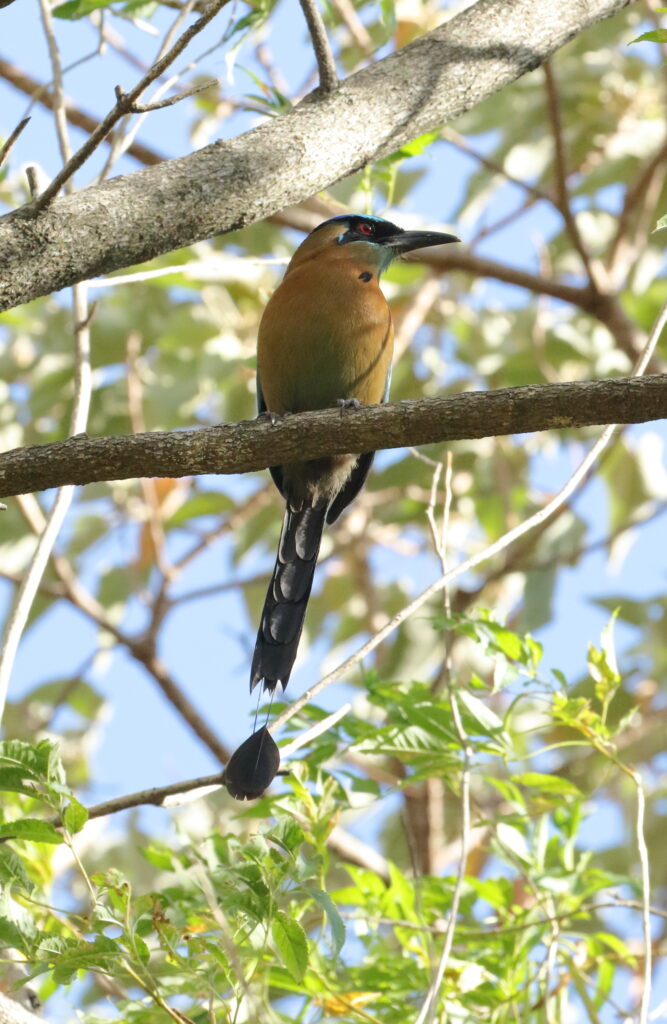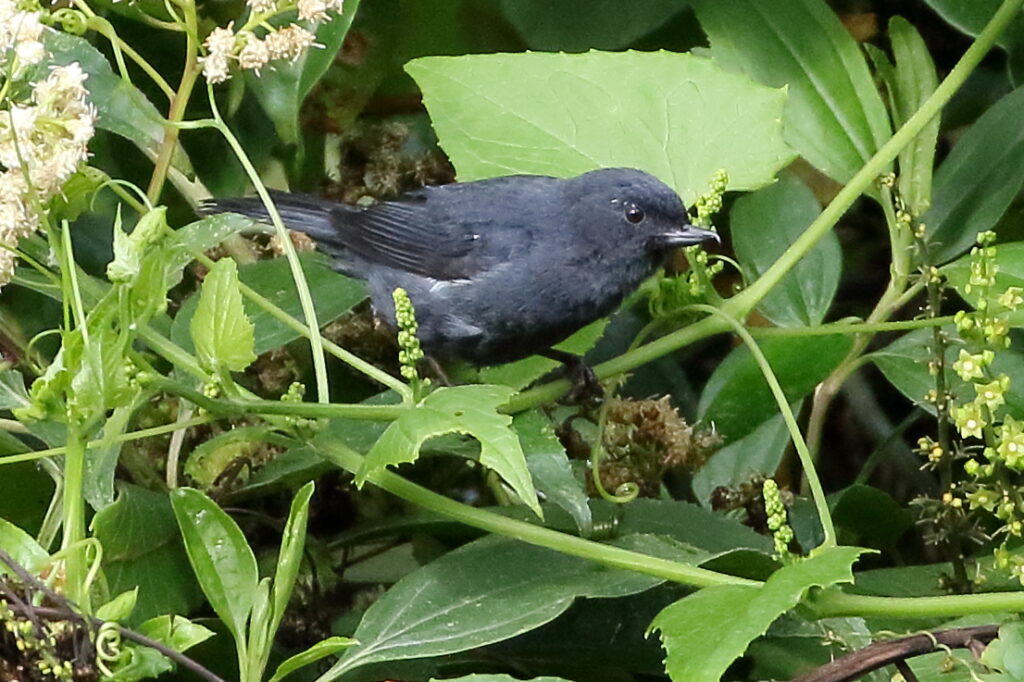
Tag Archives: Sparrows

Gray Flycatcher Science

One of our goals at FatherSonBirding is to encourage support of scientists and nonprofits working to protect our planet’s many imperiled bird species. We hope that you will consider sending a donation to Montana Bird Advocacy, whose work is featured in today’s blog. You can do this by clicking here. It will be money well spent!

Late July often ushers in the birding doldrums. Having finished courtship and breeding, most birds get super quiet. They often disperse from their breeding territories, too, making them more difficult—or at least unpredictable—to find. But this year I was in luck: I had a writing assignment that would guarantee I see at least a few very cool birds.

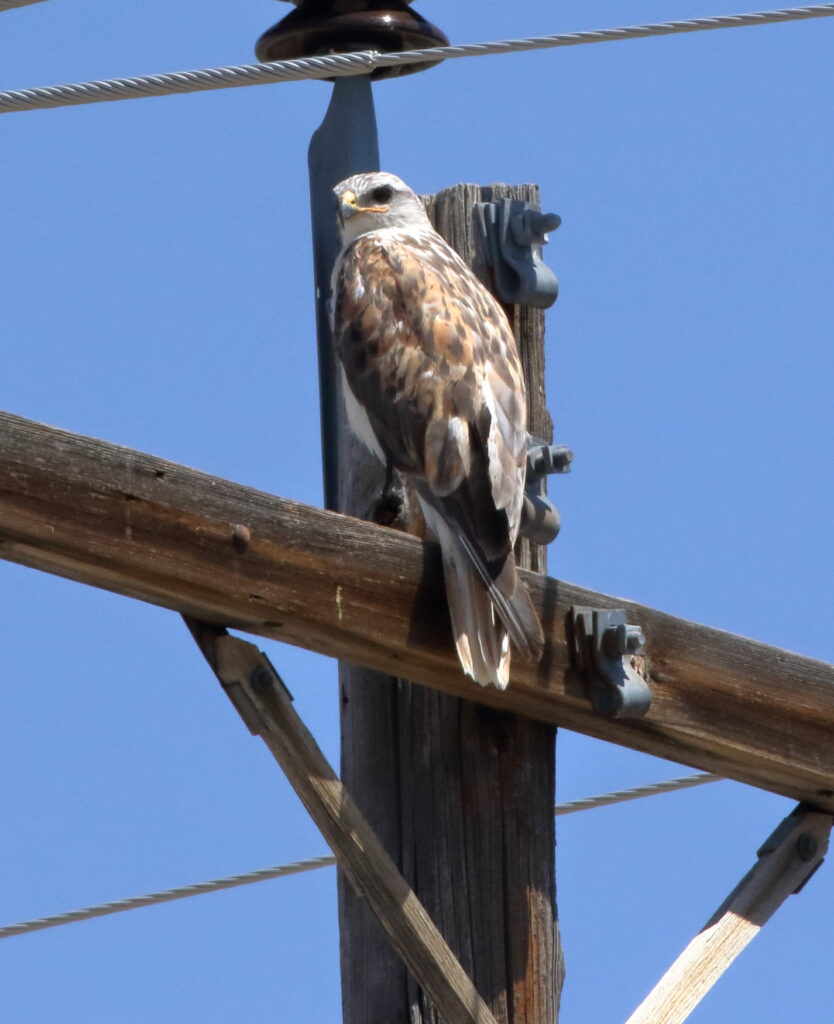
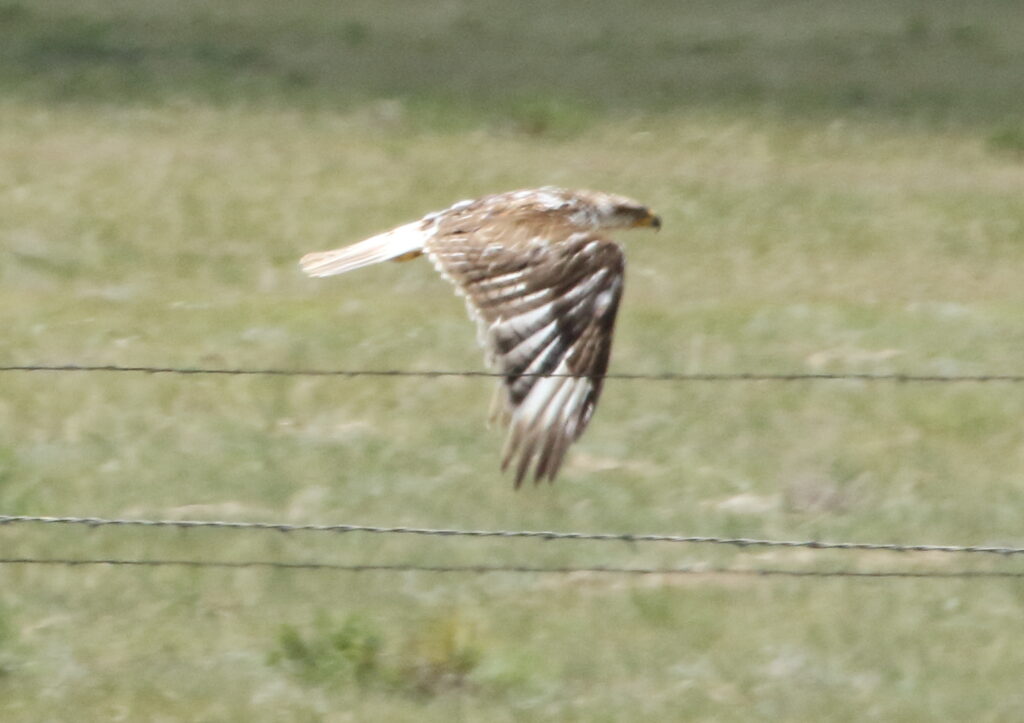
My best look yet at a stunning Ferruginous Hawk proved a delightful bonus to my day near Bannack.

You may recall my unsuccessful June trip down to Beaverhead County (see post In Search of the Green-tailed Towhee) to visit with biologist Jeff Marks, founder of the nonprofit scientific research group Montana Bird Advocacy.  There, Jeff and colleague Paul Hendricks are performing a long-term study on one of Montana’s little-known birds, the Gray Flycatcher. When I visited, Paul wasn’t there, but I also got to meet biologist and research assistant Nate Kohler, who has been playing a pivotal role in the study.

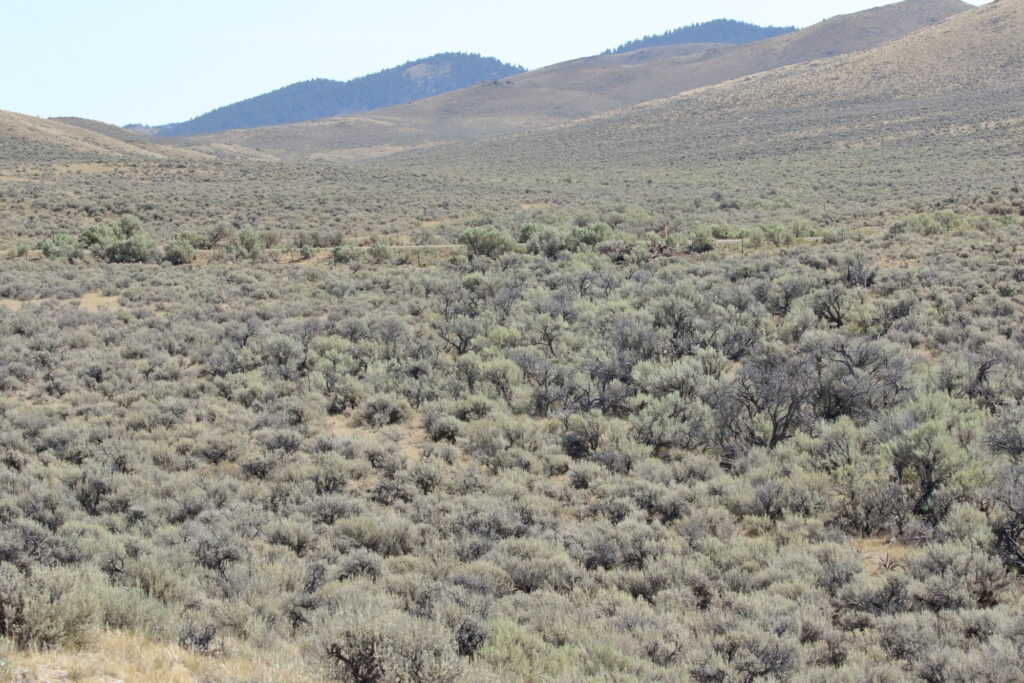
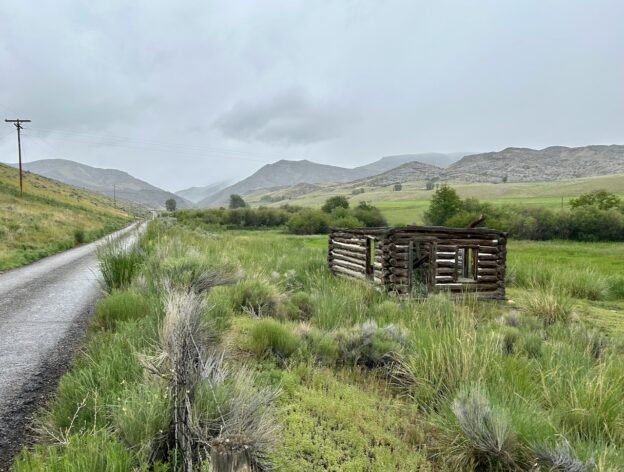
The word “gulch” conjured up a much more verdant image to my mind, but as you can see it takes some pretty special adaptations to survive in this rugged country.

Although my June trip allowed me to see many wonderful birds and interview Jeff and Nate, my intention to see the Gray Flycatchers got squashed by a freak winter storm. Worse, the storm wiped out a whole crop of nestling Gray Flycatchers. The good news? The adults had laid second clutches of eggs, and the babies were getting ready to fledge as I again headed down there the last week of July. This time, the weather would be ideal for seeing them.

Jeff and I headed out at 8:00 a.m. and made our way up Bannack Bench Road, which borders the study area. This was the third season of the study, and its purpose is to figure out some of the basic biology of a bird that scientists know very little about. To do that, Jeff, Paul, and Nate have been banding adult flycatchers with color bands that allow field identification and observation of individual birds.  The birds have been a challenge to catch, but the biologists have managed to band about a dozen each year—and with fascinating results. I won’t reveal too much about those results here since I’m also writing an article for Montana Outdoors magazine that will be out next year. However, I will tell you that seeing where these birds nest and what they are doing was a thrill.

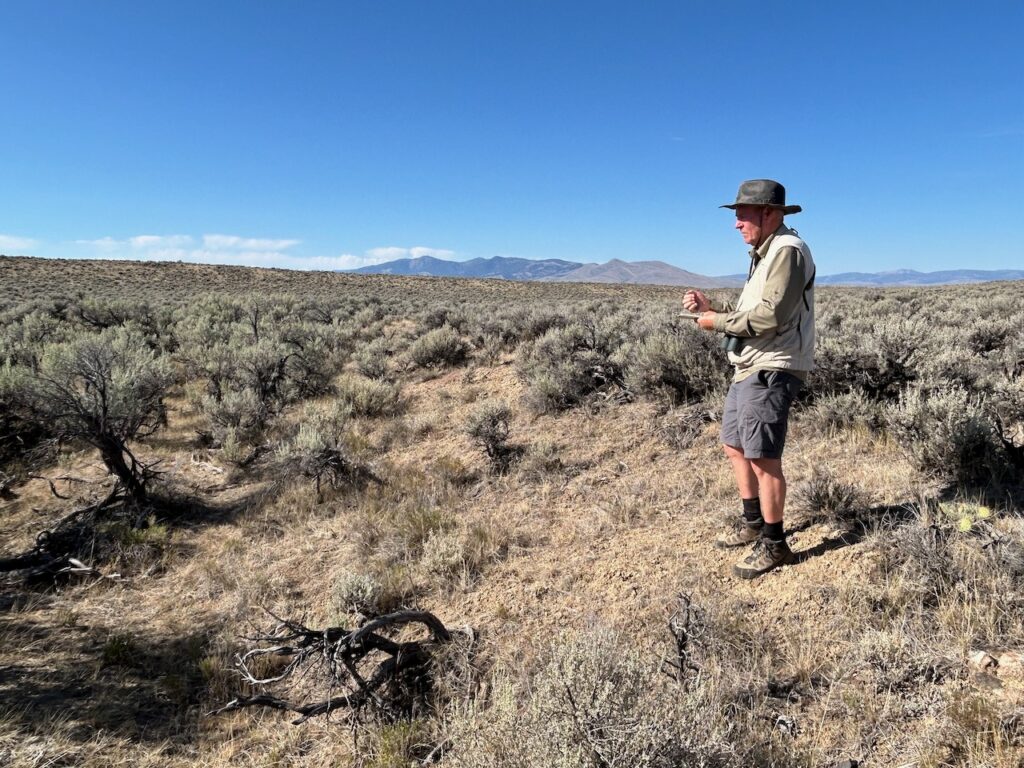
Biologist Jeff Marks takes notes on a Gray Flycatcher nest in his Beaverhead County study area.

When Jeff first told me they were working in a place called Sheep Corral Gulch, I imagined sagebrush plants bordering some kind of verdant riparian zone, perhaps lined with aspens or junipers. Imagine my surprise to see nothing but sagebrush in every direction! Gray Flycatchers breed throughout the Great Basin, but one of the fascinating things about them is that they choose different habitats in different places. In other states, they nest in juniper, pinyon pine, and even ponderosa pine, but in this part of Montana the birds breed almost exclusively in sagebrush plants along dry washes. One thing that these places share in common is that they have open ground for foraging.

Color-banded adults allow Jeff and the Montana Bird Advocacy team to make detailed observations about mating and behavior of these little-known birds.

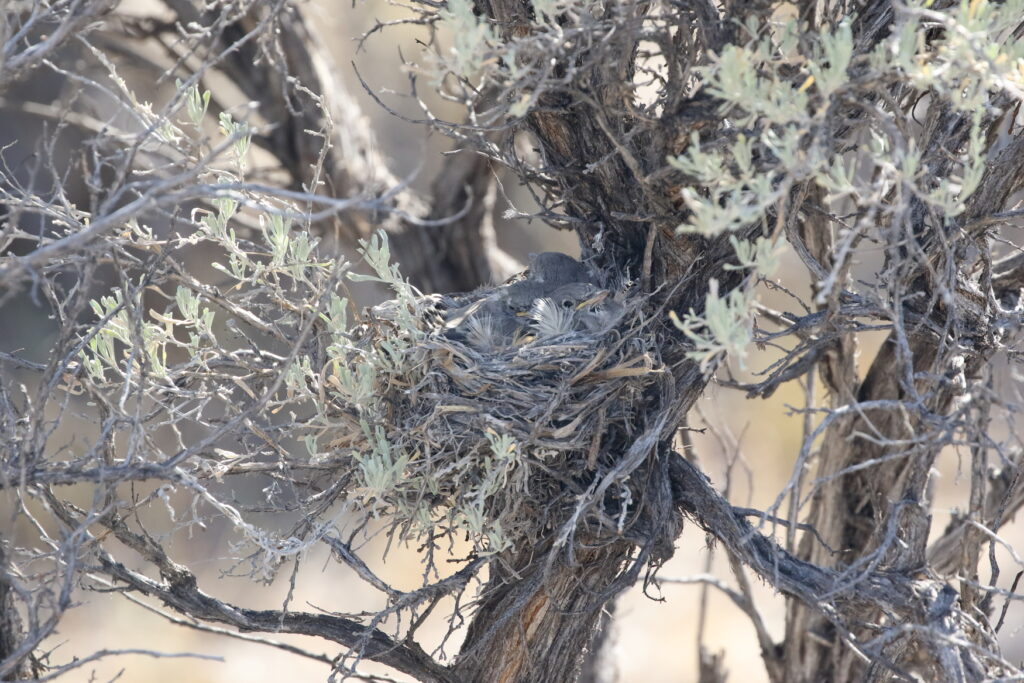
In Beaverhead County, though, not just any sagebrush will do. The birds nest only in taller plants four to eight feet high—plants that can mainly be found growing in the (usually) dry main stream channels of gulches. This year, Jeff and his colleagues located about a dozen nests, one to two hundred meters apart, and as Jeff and I began hiking, it wasn’t long before we spotted an adult bird up ahead. Using GPS coordinates, it took only minutes for Jeff to locate the bird’s nest—a nest with babies!

“They will fledge any day now,” Jeff told me, “and it looks like both parents are feeding them.” Having two involved parents gives the nestlings a huge survival advantage, and as we watched, we saw a parent deliver a juicy grasshopper to its ravenous chicks.

Most of the Gray Flycatcher nests were bursting with babies itching to head out on their own—after a few more meals from Mom and Dad!

For the next three hours, I followed Jeff as we visited one nest after another, and most were jam-packed with two or three babies champing at the bit to head out on their own. We, of course, made sure to stay well back so as not to spook them out of the nests before they were ready.

An unbanded adult Gray Flycatcher keeps watch on us as we move through its territory: “Move on. Nothing to see here, folks.”

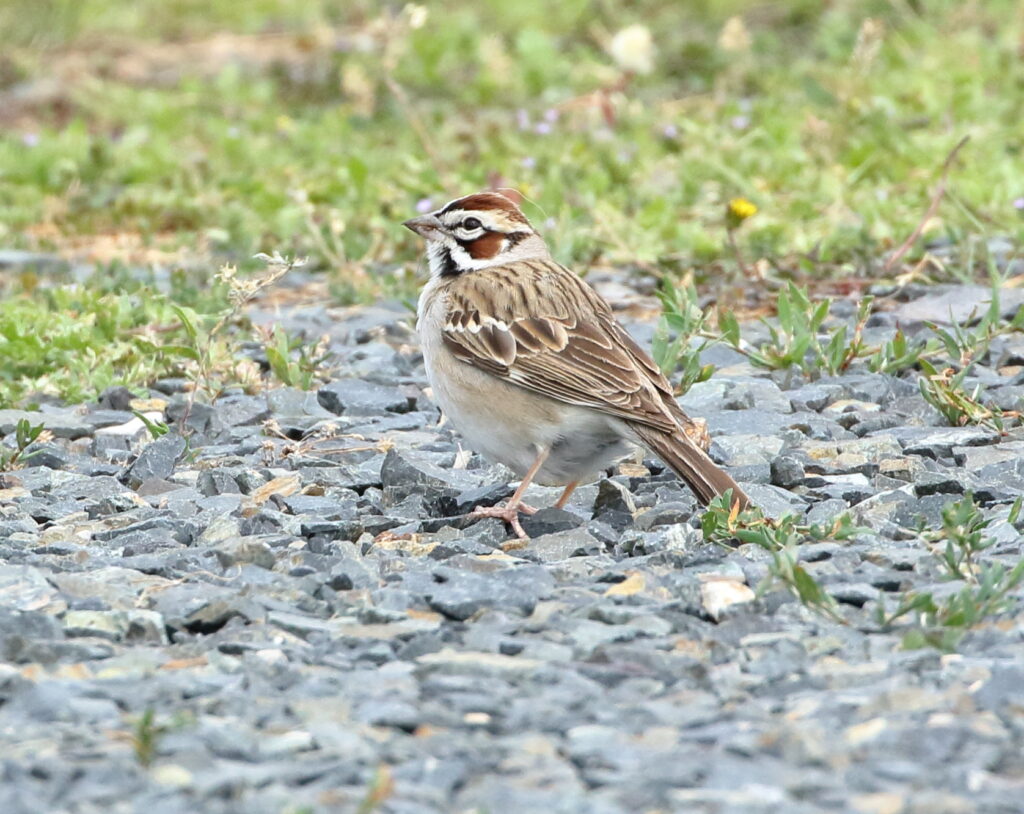
I thought we would see a lot of other birds as we hiked, but especially this time of year, the birds stayed out of sight. We saw a couple of Brewer’s and Vesper sparrows, and a single Sage Thrasher and Northern Harrier. What a contrast from a month earlier when I spotted Sage Thrashers and Brewer’s Sparrows almost everywhere I looked! Nonetheless, I couldn’t have been more thrilled to get these up-close-and-personal looks at one of Montana’s most uncommon species.

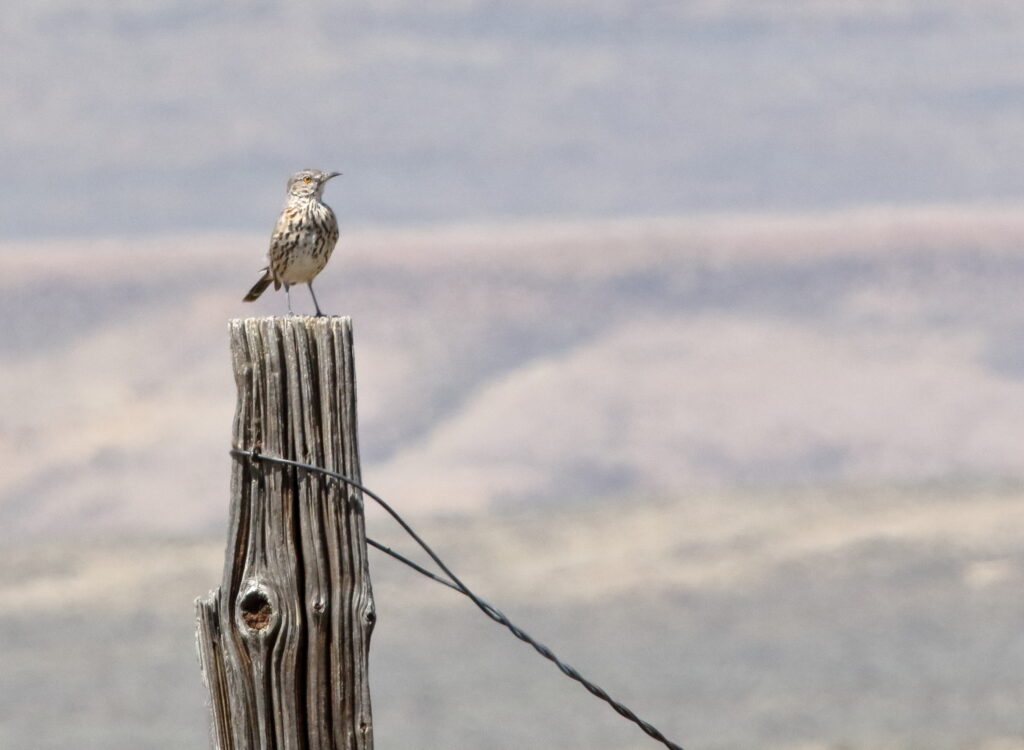
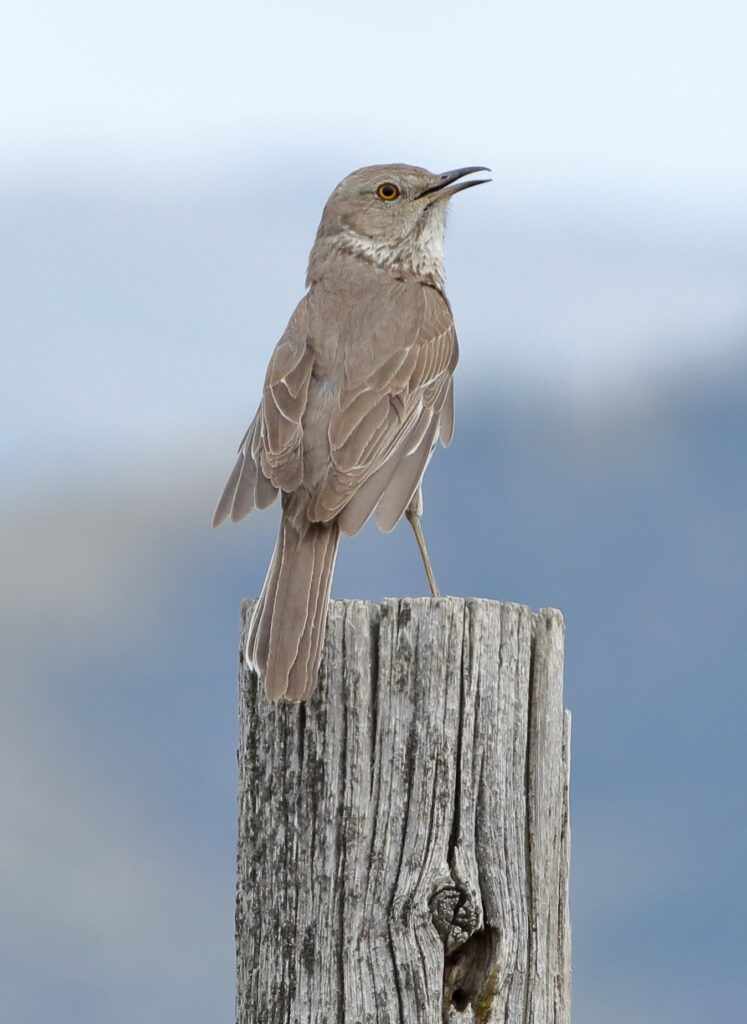
Sage Thrashers were noticeably more elusive than only a month earlier, but this one did pose nicely on a fencepost along Bannack Bench Road.

You may be wondering just where Gray Flycatchers can be found in Montana. That itself is a fascinating story, because they apparently arrived in our state only recently. The first official record occurred in 1999, and Jeff believes that the birds may only have reached the Treasure State as part of an expansion northward from the Great Basin that occurred in the 1970s. Their Montana strongholds are in Beaverhead and Carbon counties (see post Bear Canyon—Montana’s “Tropical Birding” Paradise), but it takes careful observation and listening to distinguish the birds from almost identical-looking Dusky Flycatchers. The fact that the birds are so restricted here in Montana, though, points out how important it is that we protect our fragile sagebrush communities. It also underscores the great value of the work that Montana Bird Advocacy is conducting, because only by understanding the biology of the Gray Flycatcher and other sagebrush species can we know how to protect them.

Please consider supporting the ongoing work of MBA by clicking here and making a donation. The flycatchers will thank you—as will generations of future birders!

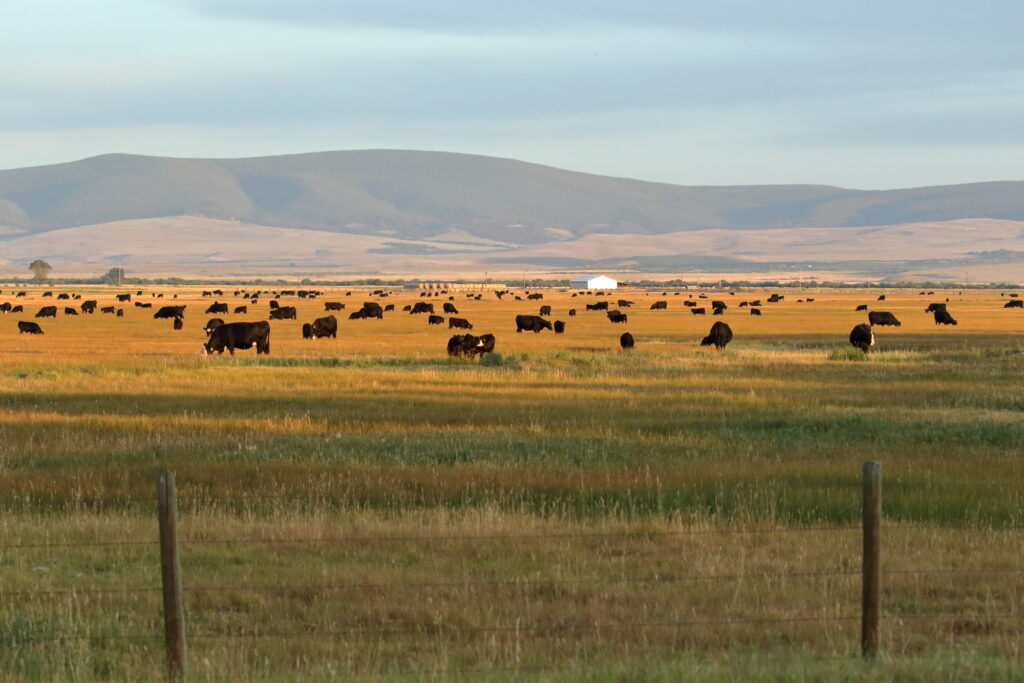
While getting ready for the next day at the study site, MBA’s rental cabin offered an idyllic view of pastureland, complete with deer, coyotes, and gobs of Common Nighthawks. Donate to Montana Bird Advocacy by clicking on this picture.

In Search of the Green-tailed Towhee

Please support our efforts at FatherSonBirding by buying a *New* copy of Birding for Boomers or one of Sneed’s other books shown to the right—and by donating to Montana Bird Advocacy, a wonderful grassroots scientific organization doing novel and unique research on Montana birds.

Confession: Despite the title of this blog, the the main purpose of last weekend was not to find Green-tailed Towhees; it was to learn about a wonderful study of Gray Flycatchers with biologists Jeff Marks and Nate Kohler. However, as I set out Saturday morning, defiant of the grim weather forecast for the next day, I did have a secondary mission in mind—to find and visit with some of the birds in the arid southwest corner of the state. Over the years, these sagebrush areas, from Bear Canyon (see Bear Canyon—Montana’s “Tropical Birding” Paradise) all the way west to Beaverhead County, had become some of my favorite parts of Montana. I credit that partly to my own childhood living in the dry chaparral country of southern California, but I also just love the ecosystems and birds in this part of Montana. I’d have trouble calling myself a real birder if I didn’t get down there at least once each year.

Since you’re pressing me on the issue, I also had a third objective for this trip—to move closer to breaking my all-time one-year species record. The record belonged to 2017, when our family traveled to Ecuador and Peru and I recorded a total of 527 species for the year. This year, thanks to last-minute invitations to Colombia (see THIS POST) and Texas (see THAT POST) I unexpectedly found myself at 498 species—perilously close to setting a new record. That task loomed more difficult than it might appear since once spring migration has passed and breeding season gets underway, it becomes much more difficult to find new species. Still, a trip to the southwest part of Montana promised to nudge me closer to this new goal, and my first target was one of the state’s coolest birds: Green-tailed Towhee.

On Braden’s advice, my first real birding stops of the trip were along the Jefferson River before Lewis & Clark Caverns.

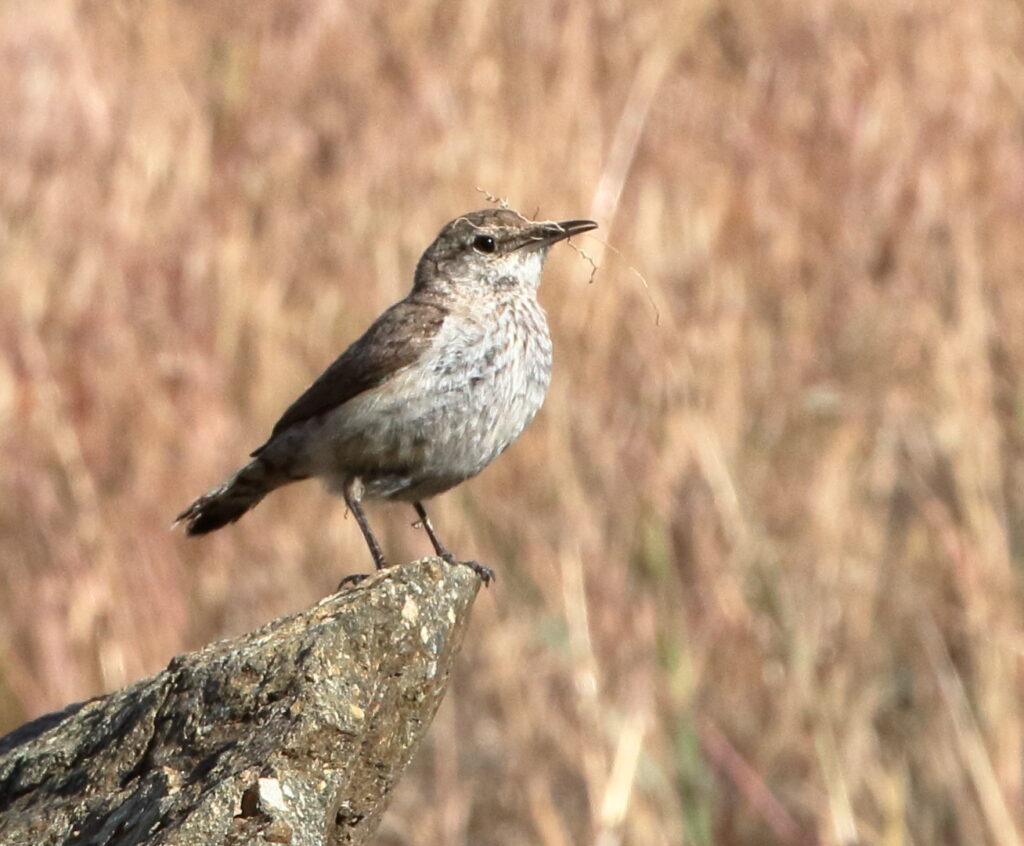
Green-tailed Towhees winter in the American Southwest and Mexico, but generally breed in the the Great Basin region of the West, including southern Montana. Though the birds are not strictly rare, I could count the number of times I had ever seen one, and I felt eager for another GTTO encounter. To find this bizarre, poorly understood beauty, I hit I-90 at dawn and steered toward Lewis and Clark Caverns, two-and-a-half hours to the east. To entertain me along the way, I had checked out an audio version of Eat, Pray, Love, a book that invites all kinds of snarky comments but, I found, actually proved moderately amusing. On Braden’s advice, I pulled over alongside the road leading to the caverns and was rewarded with a wonderful assortment of river and cliff birds including Rock Wren, Lazuli Buntings, and White-throated Swifts. Once inside Lewis and Clark Caverns State Park itself, I focused on finding Green-tailed Towhees.

I struck out. I spent a good hour and a half checking along the road, up around the main parking area, and in the campground. Merlin’s Sound ID picked up a putative GTTO song at one point, but I neither heard nor saw a trace of the bird.

I have to admit that this made me feel like a total failure. I mean, here was my first target bird of the trip, and one that shouldn’t be that hard to find, and I totally “whiffed” on it, as Braden might say. I didn’t plunge into despair exactly, but it definitely put a damper on my mood as I began questioning just what I thought I was doing out here pretending to be a birder! Well, I thought, maybe I’ll have better luck at my next destination.

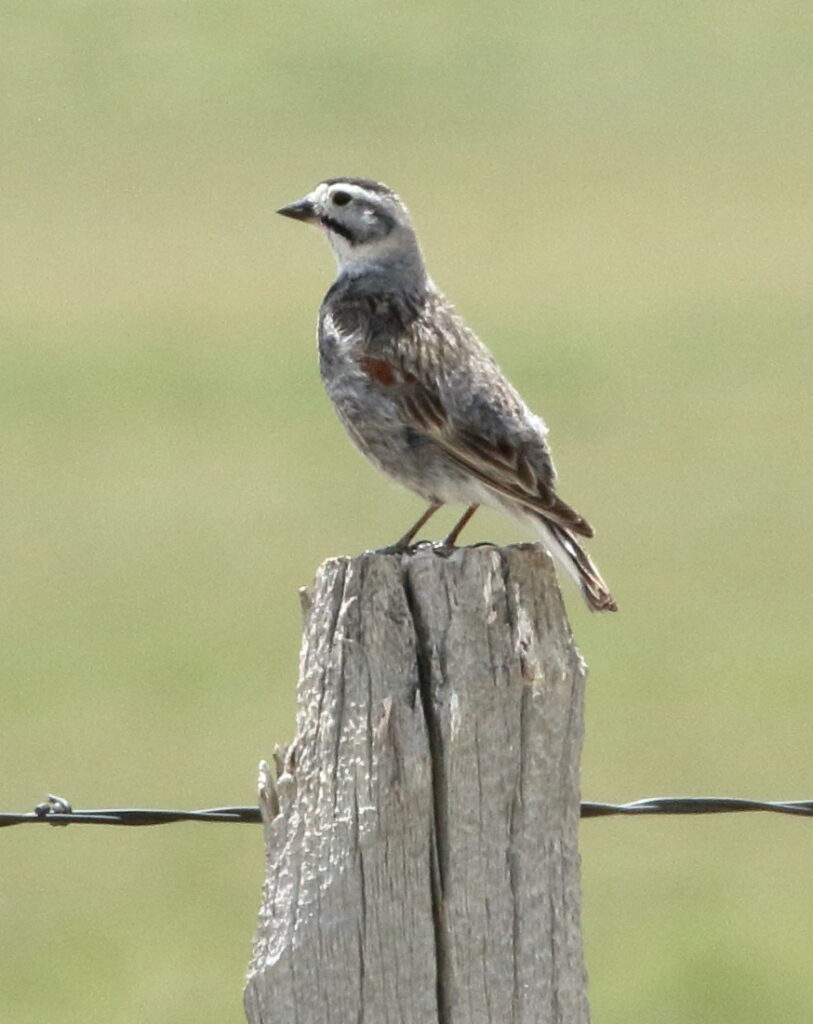
Which happened to be Birch Creek Road north of Dillon in Beaverhead County. Several years before, Braden and I had found our lifer Thick-billed (formerly McCown’s) Longspur on this road, and once again, the road delivered. I’d driven only a mile before I saw a suspicious dark shape on a fence. I actually didn’t think it was a Thick-billed, but my binoculars revealed otherwise. “Yay!” I exclaimed, feeling the weight of my earlier “whiff” lifting slightly. A few minutes later, I was examining another TBLO when I noticed a large shape sitting in a field about one hundred yards away. “Clearly a hawk,” I thought, “but what kind?” The answer: the best kind, at least for my goals for the trip—a ferruginous hawk. This was another bird I needed for the year and one that isn’t always easy to find in the state.

Digging out the peanut butter sandwich I’d made earlier, I tooled down I-15 for my next destination, Clark Canyon Reservoir. Braden and I had only ever birded here once before, and as near as I recall, we hadn’t found much, so I kept my expectations low. I stopped at one overlook and was surprised to see a Common Loon on the water below, along with a Double-crested Cormorant and a couple of Ring-billed Gulls. Violet-green swallows swirled around me and, as always, they brought a smile.

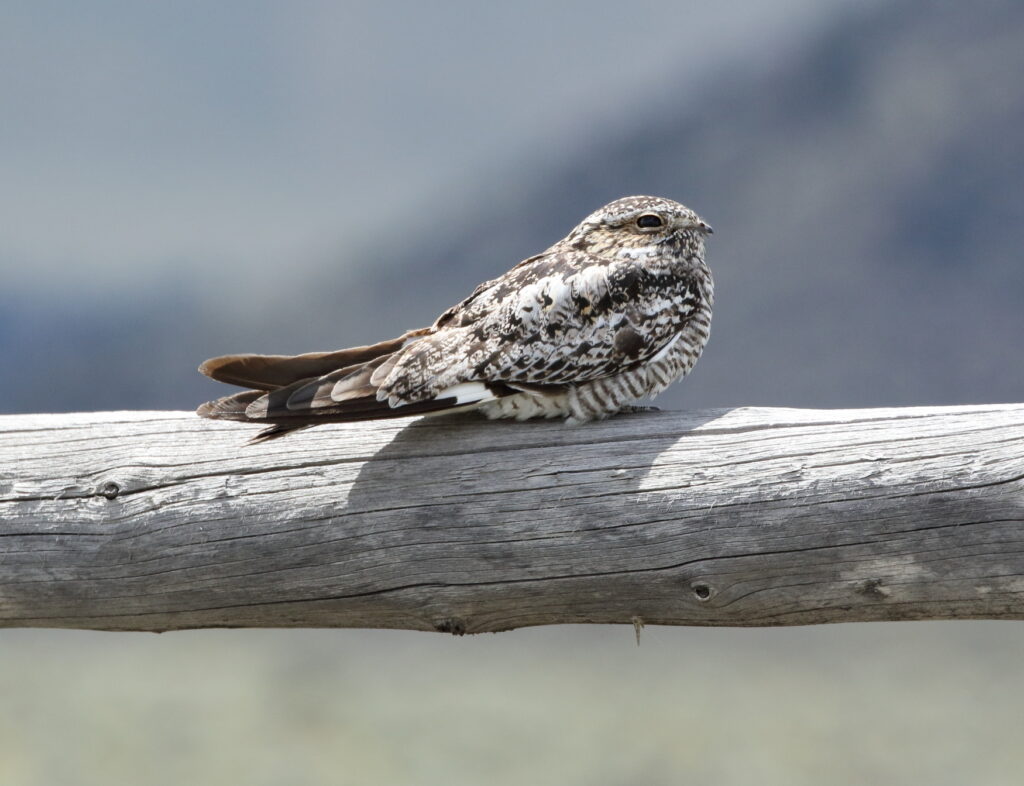
Snaking around the reservoir, I approached a sign for Horse Prairie Campground and spontaneously swerved left onto a dirt access road. The reason? Tall, healthy-looking sagebrush! Hm, this just might have one of my other target birds for the day. Almost immediately, I saw a really cool bird that had not been on my target list—a Common Nighthawk peacefully chillin’ on the split-rail fence. The bird barely blinked as I fired away with my camera through the car window from only thirty feet away.

The first of three Common Nighthawks I spotted chilling on the wooden fence leading down to Horse Prairie Campground.

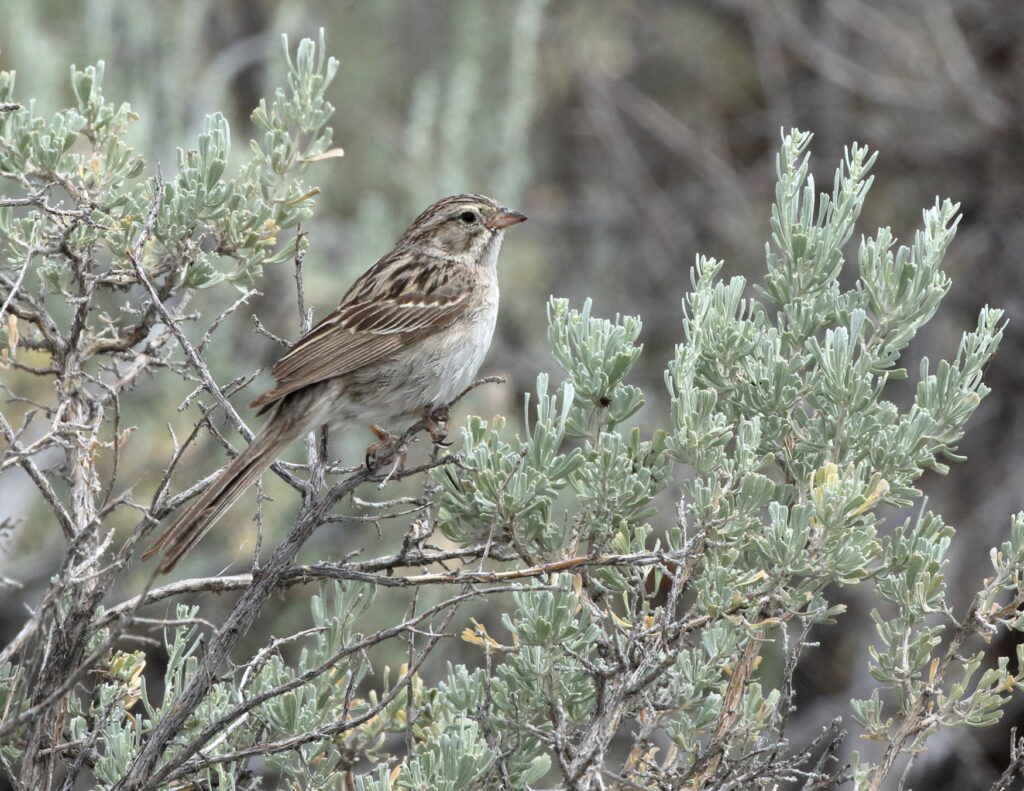
Creeping slowly forward, I heard a song I didn’t recognize—which was no great surprise in itself, but I did have a guess of what it was. Sound ID confirmed it: Brewer’s Sparrow! This bird loves healthy sagebrush and makes up for the world’s dullest plumage with a vigorous song that bewitches any birdwatcher who hears it. A few moments later, one even sat still long enough for a decent photo. Check. Another target bird—but not the one I expected to find here!

One of Montana’s drabbest birds, the Brewer’s Sparrow has an enchanting song.

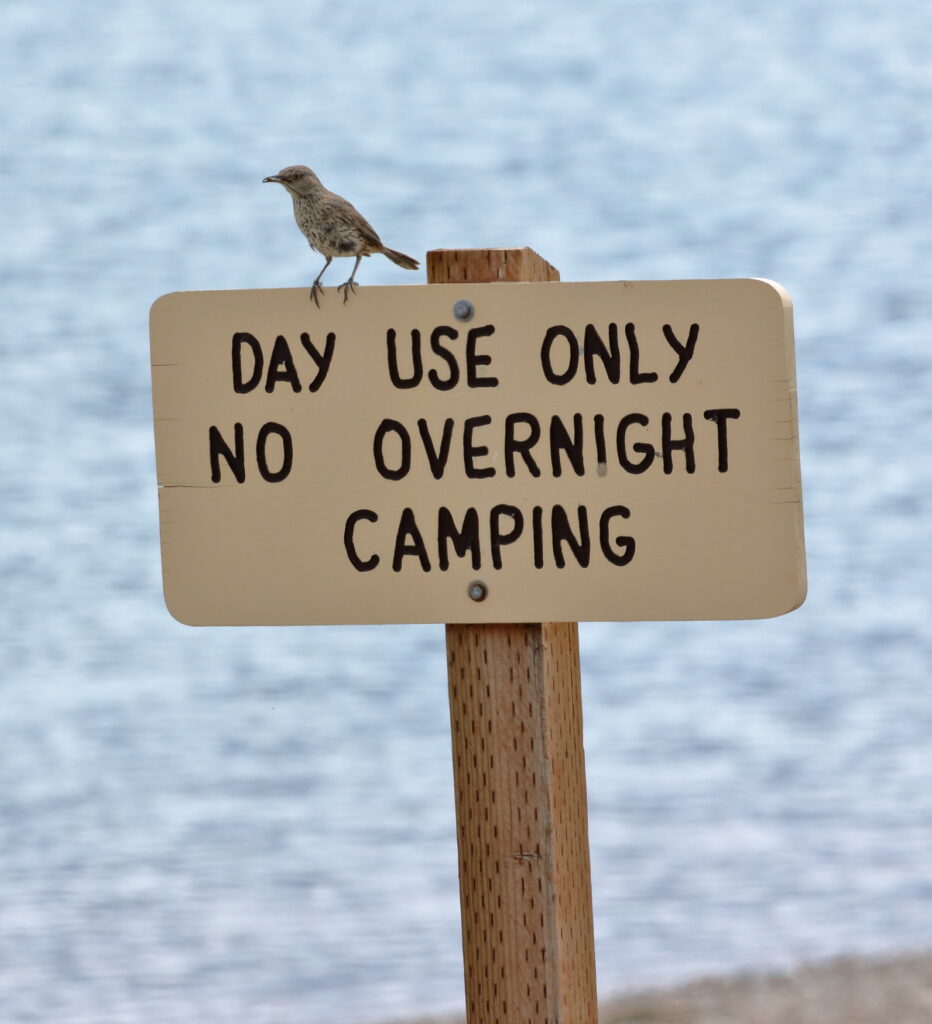
I kept driving slowly toward the campground and spotted a medium-sized, slender bird up ahead. Wishfully, I thought it might be a Say’s Phoebe—another bird I happened to need for my year list—but it flew off before I got close. As I pulled into the campground, though, two brownish birds were chasing each other around. I assumed they were robins, but when one landed on a “Day Use Only” sign, I realized with a start that it was exactly the bird I had hoped to find here—a Sage Thrasher!

Sage Thrashers are so flighty that seeing one on a sign was about the last thing I expected!

Braden and I have never met a thrasher we didn’t like, but Sage Thrashers hold a special place in our birding hearts. For one, they’re the world’s smallest thrashers—which is why I mistook them for robins or phoebes. For another, they are charismatic songsters and often are the most common bird you see in sage country. As I sat in the car, in fact, I counted three more Sage Thrashers around me. Whoo-Hoo!

One of our favorite Montana birds, Sage Thrashers seemed to be everywhere I looked this afternoon.

Later, on the road where I was to meet up with Jeff Marks and Nate Kohler, I encountered seven more Sage Thrashers! It was a veritable thrasher party—by far the best experience I had ever had with these good-looking birds.

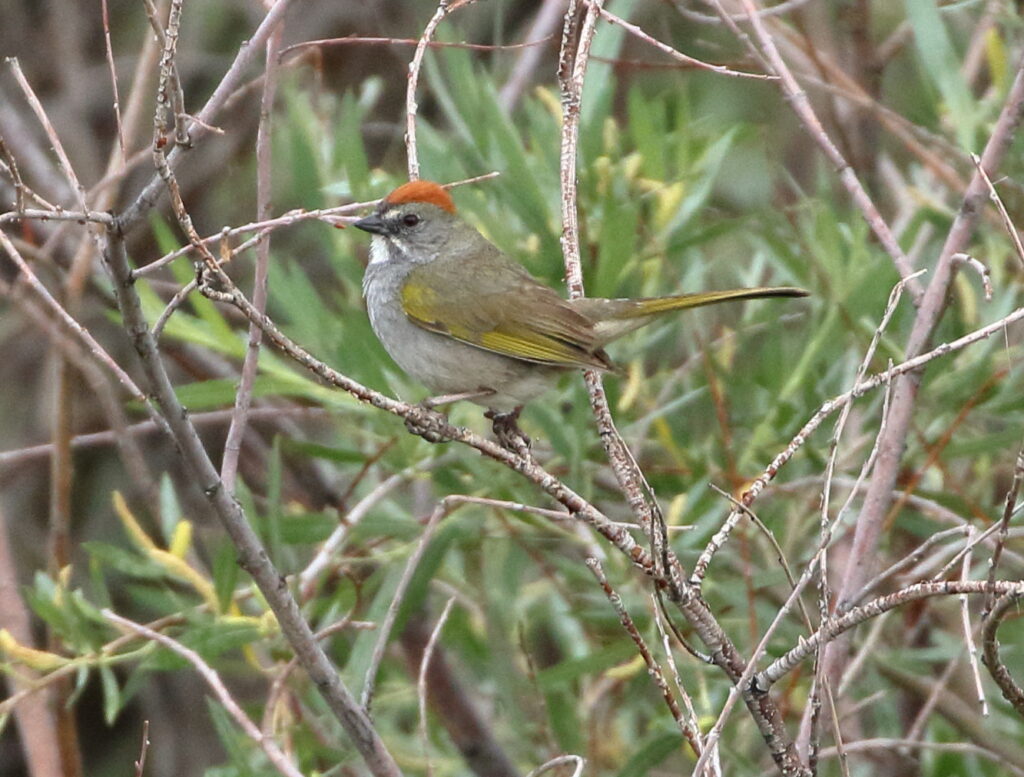
Unfortunately, the next morning, heavy rain and spitting snow kept me from seeing Gray Flycatchers with Jeff and Nate. More on that in another post. Almost as bad, I began the drive home without a Green-tailed Towhee under my belt and no expectations of seeing one. But bless Nate Kohler’s heart. He told me about a canyon I should check out on the way home. It was still raining when I got there, but I drove slowly and stopped frequently, listening and watching. Lazuli Buntings chattered everywhere and I saw a good variety of birds—but no towhee. Finally, I put on my raincoat, got out of the car and played a Green-tailed Towhee song. Almost immediately, a small shape darted up out of the sagebrush—the bird I was looking for! Not only that, it held still long enough for a photo—but the story hadn’t quite finished.

I worked hard for this Green-tailed Towhee—only to find that it wasn’t a year bird after all!

Once I got home and posted all of my checklists for the trip, I was surprised that eBird hadn’t added GTTO to my year list. What’s going on? I thought, and did a quick search to see if I had somehow seen one down in Texas and forgotten about it. Nope. What I did forget was the rare vagrant GTTO I had seen in Victoria, BC during Amy’s and my January trip (see Birding Victoria, BC)! So this one was not a year bird after all, but still a lot of fun to see. Meanwhile, my year list swelled to 503 species thanks to the Thick-billed Longspur, Ferruginous Hawk, Brewer’s Sparrow, Sage Thrasher, and a Prairie Falcon I had spotted the afternoon before. Not exactly the trip I expected, but one I already cherished.

Owl’s Watch Ecolodge (Colombia Birding Part 2)

As light spread across the sky, I slipped on my flip-flops and ventured out onto the porch of our cabin at Owl’s Watch Ecolodge in the department (county) of Caldas, Colombia. Misty clouds clung to the Andean peaks surrounding us. Far below rose the high-rise apartments and businesses of Manizales, a city of almost half a million. Unidentified bird calls rang across the vegetation surrounding us and a couple of flocks of Eared Doves flew by on a morning commute. Suddenly, I saw a shape that stirred familiarity. It landed in a distant tree, but thanks to my amazing new binoculars, I was able to focus in on it. Even though I knew very little about Colombian birds, the way it clung to the side of the tree made me  think, “Woodpecker.” Then, I caught a reddish hue on its nape and back, and my excitement rose. When it turned its head, it revealed a large white face patch that clinched the ID. I couldn’t believe it. In my first moments of serious birding in Colombia, I had found one of the birds I most wanted to see: a Crimson-mantled Woodpecker!

It’s risky to post such a crummy photo of a Crimson-mantled Woodpecker as the post’s very first bird shot, but it highlights how difficult it often is to photograph birds in tropical forests—a topic I’ll discuss in a forthcoming post.

As mentioned in my last post, “Layover Birding in Bogota, Colombia”, I had traveled to South America at the last-minute invitation of my friend and FSB contributor, Roger Kohn. Now, only two weeks later, I felt in awe of the fact that we were actually here, about to launch into our first Colombian day of birding together.

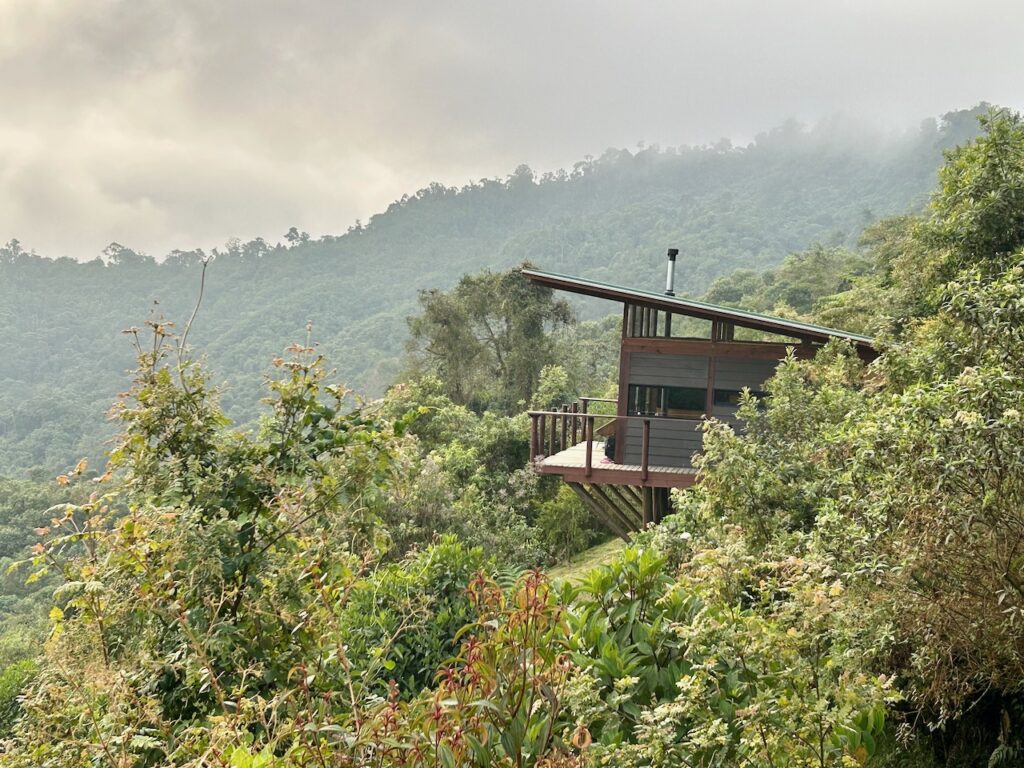
One of the two luxurious cabins at Owl’s Watch, with great views of the surrounding landscape. As popularity of the lodge blossoms, Dennis is considering adding additional cabins.

Roger had planned our entire itinerary, which included booking our first four nights here at Owl’s Watch, a comfortable new lodge with two modern cabins perched at the edge of a large, protected watershed that ensured a dependable water supply for the city of Manizales below. The lodge had been built by American expat Dennis Bailey and his Colombian wife, Adriana. Interested in restoring land that had been cleared for agricultural activities, they had purchased a farm, or finca, that was an inholding of the nearby protected area. As they worked to revegetate the land and allow it to heal itself, they decided to build Owl’s Watch for nature lovers—especially birders.

The following day, we would be heading out with a guide, but today Roger had wisely allocated time for us to bird and explore on our own—a day to get familiar with some of the local birds and rest up from our two-day journeys from the States. I’m more of an early riser than Roger, but to my surprise, he soon joined me on the porch, eager to get started.

One of the amazing things about Owl’s Watch is that you are able to gaze down on Manizales, a city of almost half a million people, while being surrounded by nature.

We decided to begin by climbing the long steep “driveway” that headed up from the lodge to the road above. Almost immediately we saw large turkey-like birds that, from taking eBird quizzes, I recognized as Sickle-winged Guans. Moments later, I glimpsed a furtive shape fly across an opening and dive into a bush—a White-naped Brushfinch.

At the top of the drive, we reached a small parking area bristling with even more activity. In the trees surrounding the area, we quickly identified the orange head of a Blackburnian Warbler, and then got super excited to see a pair of equally small birds with bold, sunburst golden throats and breasts—Golden-fronted Redstarts!

Golden-fronted Redstarts, a New World warbler, were one of our exciting finds from our first day of birding at Owl’s Watch.

As I chased these around, Roger used Sound ID to get onto a bird I never thought we would see, Azara’s Spinetail. Its call sounded like “bis-QUICK! bis-Quick!” and while we never got great looks at it, we were thrilled to get a glimpse of this handsome, skulky species.

From the parking area, we headed down a pleasant trail that would wind its way back to the to the main lodge building, dubbed “the Social.” Soon, a covered viewing platform came into sight and we paused to check out hummingbirds at the feeders and flowering bushes surrounding the spot. Someday, I’ll write about my ambivalence about hummingbirds, but I gotta say, they were spectacular to watch. What got me most excited was seeing a White-sided Flowerpiercer. I’d seen my very first flowerpiercer only the day before in Bogota, and here I was, looking at a second species the very next day!

Though not as colorful as many other tropical birds, I was especially excited to discover this White-sided Flowerpiercer. Notice the hook at the end of the bill? That’s a key to picking out flowerpiercers from other small tropical birds.

We continued hiking down the trail, past the Secret Garden, another great birdwatching spot Dennis had set up. Along the way, I spotted a rather plain brown bird that I quickly recognized as a Swainson’s Thrush. As I indicated in my last post, it’s a special thrill to see a bird from “back home” in its alternative, wintering environment. I also took a photo of a nondescript bird that turned out to be a Mountain Elaenia, a kind of tyrant flycatcher.

Don’t get me wrong. I am NOT an expert at identifying flycatchers, but a guide and the Merlin app helped me figure out this Mountain Elaenia.

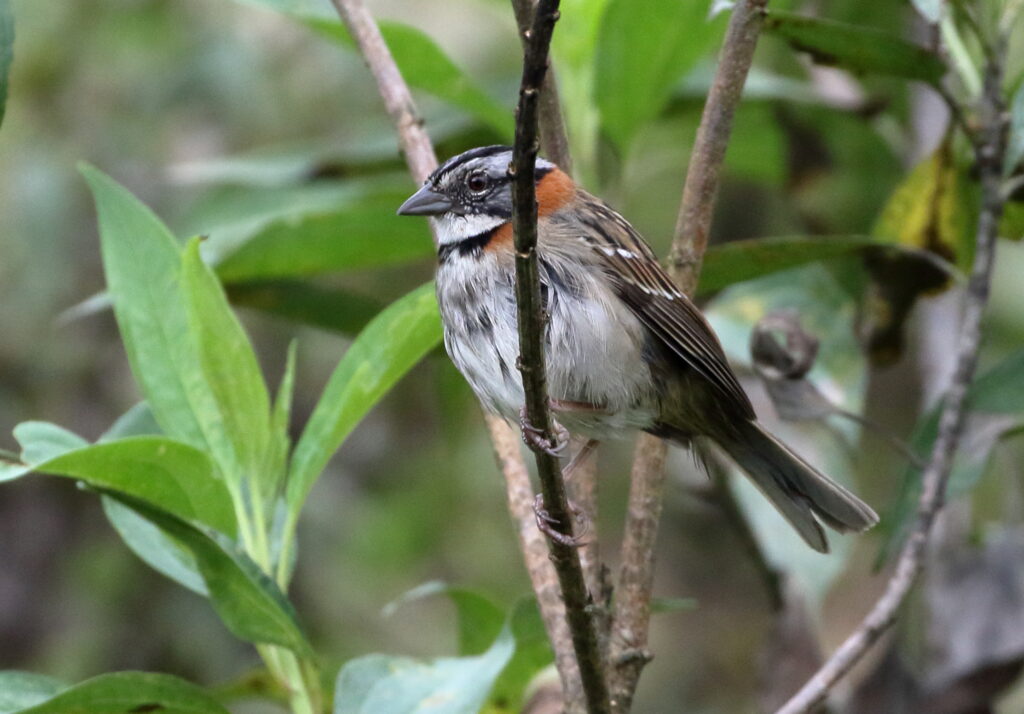
Soon, we found ourselves back at the Social. David, the fabulous Owl’s Watch cook, fixed us a scrumptious breakfast and we dined while enjoying yet more hummingbirds—at least nine species—along with more flowerpiercers, Rufous-collared Sparrows, and Great Thrushes.

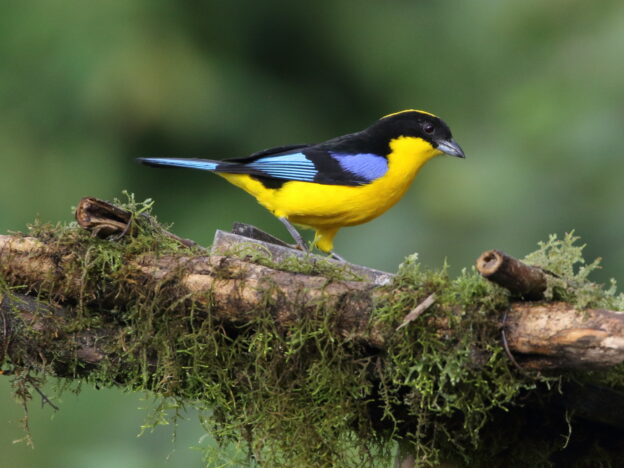
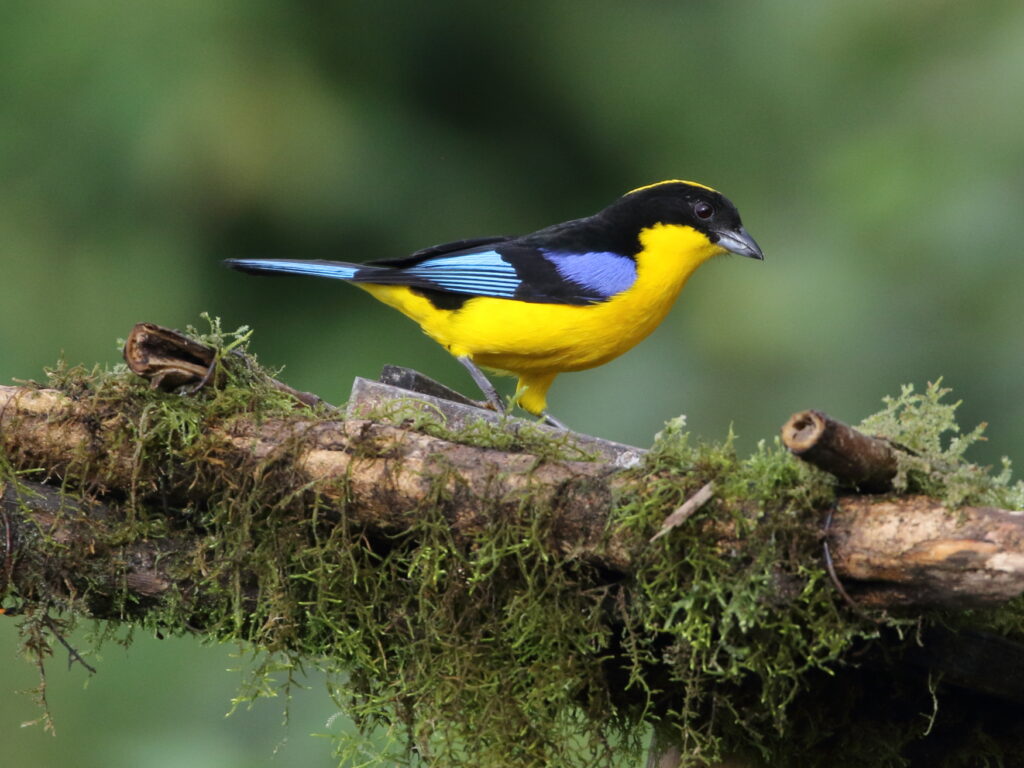
Along with the hummingbird feeders, Dennis’s crew had set up a fruit feeder off to the side, and there we beheld one of the most spectacular of the area’s birds, Blue-winged Mountain Tanagers.

Blue-winged Mountain Tanagers were definitely one of the “best-dressed” birds of our first day birding at Owl’s Watch.

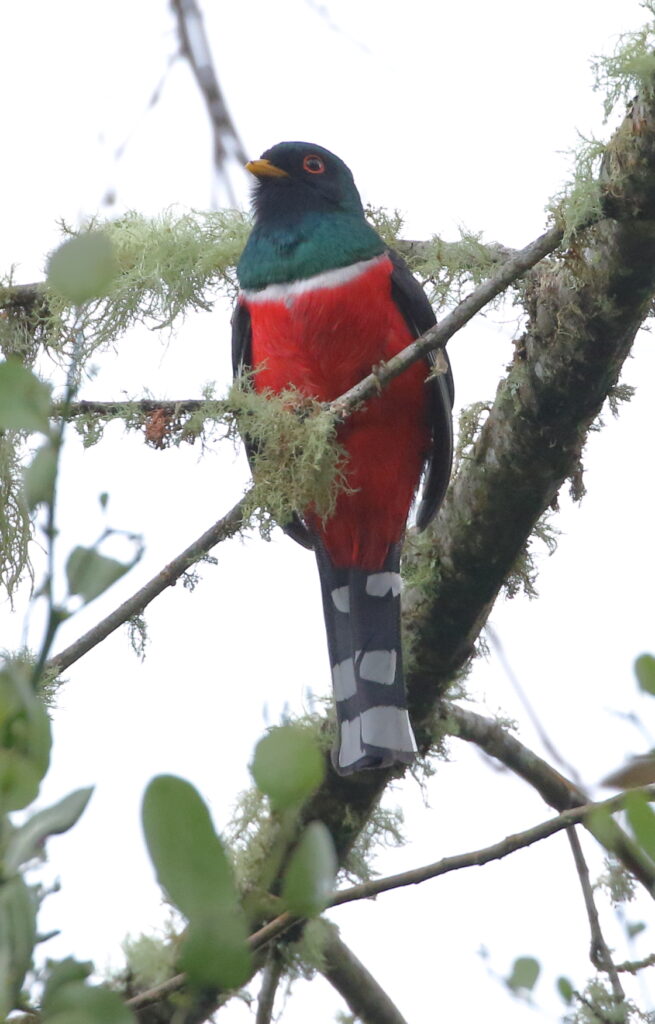
After we got our fill of hummingbirds (if that’s even possible), we took another path that wound around to our cabin. Before our trip, Braden had encouraged me to listen for weird noises, and now I did indeed hear a very bizarre, almost plaintive, series of falling notes. As we rounded a corner, we met the source of these calls—a Masked Trogon! Trogons are some of those birds you always hope to see in the tropics, but when you finally do, you’re left wondering if the bird is really perched there in front of you, or if you’re just imagining it! Fortunately, this was no mirage, and even better, it sat cooperatively while Roger and I did our best to capture decent photos of it against the backlit sky. How did we do? You will have to judge for yourself:

Even this so-so photo reveals what stunning birds Masked Trogons are. While this was our best look at this species of the trip, other trogons would soon follow!

Note: This blog post—and all others on FatherSonBirding—are written by REAL PEOPLE! No compensation or gratuities were provided to us in connection with this post. If you’d like to support FSB, please consider buying one—or ten—of Sneed’s books and contributing to a bird conservation organization of your choice. Thank you!

Birding in Oaxaca, Mexico (report by Braden Collard)

As our final post for February, we feature a glimpse of Braden’s amazing winter break trip to Oaxaca (pronounced “wah-HA-kah”), Mexico with our friend, and now birding guide, Nick Ramsey. If you like tropical birds, we’ve got more treats coming your way—but we won’t spill the bird seed just yet. Meanwhile, if you’d like to support FatherSonBirding, please consider buying some of Sneed’s books—or supporting a bird conservation group of your choice (see our post “Saving Birds. It’s Time.”).

No words can capture the feelings of shock and disbelief that Nick Ramsey, Garrett Rhyne, Eugene Huryn and I felt when an adult male Red Warbler materialized in a bush in front of us. We’d originally pulled over to admire the view of Oaxaca City from several thousand feet up and, no surprise, had begun to notice birds the instant we got out of our rental car. Nick, who had been birding and traveling around northern Central America and Mexico for the last few weeks, pointed out the distinct high-pitched call of a Mexican Violetear, hidden somewhere in the foliage below us. Downslope, a large mixed flock of warblers was passing through, and we started to pick out species as they foraged on the ends of conifer branches—Hermit Warblers, Townsend’s Warblers, Olive Warblers, a Mexican Chickadee—species that birders could find in the western United States. Then the Red Warbler appeared, and we all lost our minds as we scrambled to take pictures of it against its light green backdrop.

One look at a Red Warbler and you know why we lost our minds seeing it!

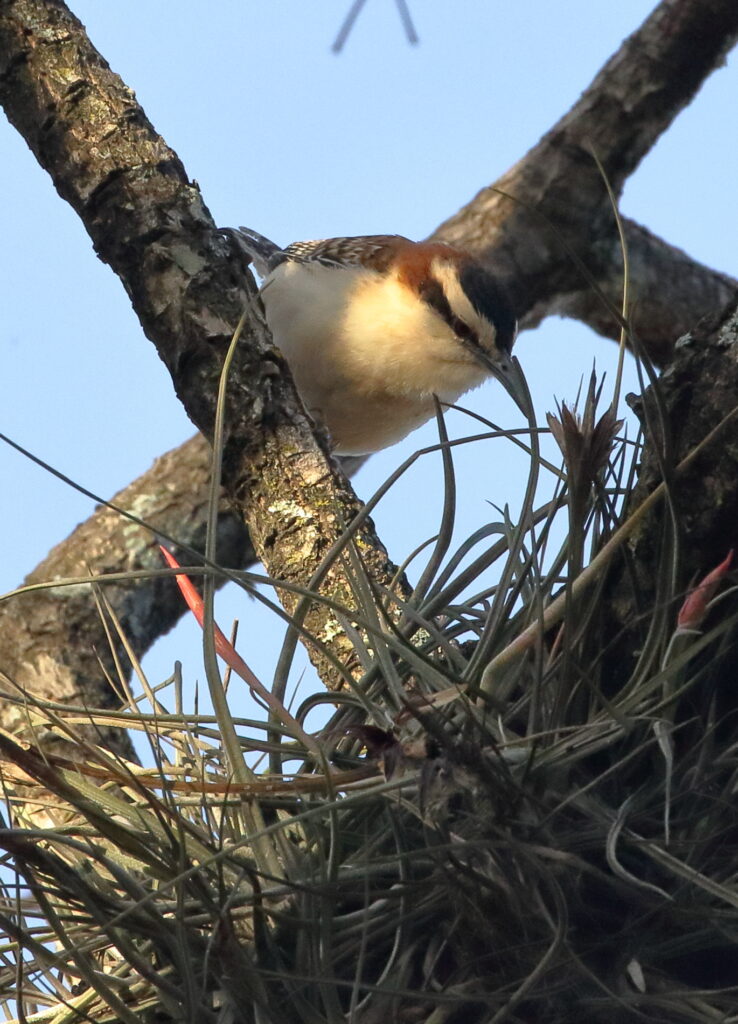
Camino la Cumbre, the road we’d turned onto ten minutes earlier, is one of Oaxaca’s more famous birding locations, and for good reason. As we continued driving up the road, which featured tall pine trees growing alongside ten-foot tall century plants, we stopped any time we heard or saw birds, which was often. Collared Towhees, White-eared Hummingbirds, Brown-backed Solitaires and more species we had on our target lists made appearances alongside the road, in habitat not all that different from what you might see in the middle elevations of California’s Sierra Nevada. Besides the Red Warblers, though, our biggest targets were a pair of species known for traveling together—one of the world’s largest wrens and one of the world’s smallest jays. The Gray-barred Wrens didn’t take long to find, and we bumped into several flocks of them, not skulking close to the ground like many US wrens do, but fifteen feet up in oak trees, picking through epiphytes in search of insects.

One of our biggest first-day targets, Gray-barred Wrens, proved easy to find. One of the world’s largest wrens, they are surprisingly visible at mid-tree level.

As we wound higher and higher up the road, the birds improved—as did the view of Oaxaca City below us. We’d flown in the previous day, and spent that evening and the following morning stalking through the scrubby, lowland habitat in search of other specialty birds, endemic only to dry valleys in south-central Mexico: Dwarf Vireo, Ocellated Thrasher, Bridled Sparrow. We’d been planning the six-day trip, which fell perfectly into my winter break, for several months, but only at the Dallas Fort-Worth Airport had I met Garrett and Eugene for the first time. Nick knew them from his time at LSU, and had brought us all together to see a small portion of the birds Mexico had to offer. And boy, did Mexico have a lot of birds to offer.

Bridled Sparrows remind one of the Five-striped and Black-throated Sparrows many US birders eagerly chase through Arizona.

The Mexican state of Oaxaca is positioned so that it includes both the dry tropical forest of the Pacific and the rainforests of the Caribbean. More importantly, it is home to a variety of mountain ranges and dry valleys, each far enough apart so that different bird species can be found in each area. This diverse array of habitats means that Oaxaca is one of the most diverse areas in Mexico, and we planned to see the full extent of this diversity on our intense six-day itinerary.

We at FatherSonBirding always feel gratified that so many birds are named after us, including this Collard, I mean, Collared Towhee.

Camino la Cumbre was a major target area, and after an hour or so, we rounded a particularly foggy bend in the road, got out of the car, and laid eyes on our other major target: Dwarf Jays. Dwarf Jays are only known from the pine-oak woodland in the mountains north of Oaxaca, and thus the species was quite high on our target list. These tiny blue corvids were in the company of several Gray-barred Wrens as well as a Chestnut-sided Shrike-Vireo, a vireo that has evolved incredibly similar plumage to a Chestnut-sided Warbler, and we watched the mixed flock forage for a while, in awe of these birds we’d only seen in books before. We snagged a few more pine-oak species, including a beautiful male Bumblebee Hummingbird and a pair of particularly skulky Golden-browed Warblers, then continued north to our next birding location. In the following days, we would be driving down and then up the side of another mountain range into the cloud forest, then down into the rainforests of the Caribbean slope.

I unfortunately did not get a photo of a Dwarf Jay, so this Unicolor Jay will have to do!

Almost as exciting as the number of life birds all four of us were getting were the huge quantities of North American birds we saw at every stop! When I’d been in Costa Rica (see Braden’s post on El Copal and his other Costa Rica posts), the common neotropical migrants were eastern birds like Chestnut-sided Warbler and Wood Thrush, species that I’d gotten to know the summer before in Pennsylvania. But in southern and western Oaxaca? Half the birds were Montana species! In several locations we came across triple-digit numbers of Violet-green Swallows, as well as roving mixed flocks of orioles and Western Tanagers.  Our first morning of birding yielded a group of more than a hundred Cassin’s Kingbirds, and we found MacGillivray’s, Wilson’s, and Orange-crowned Warblers foraging low in bushes while Townsend’s and Hermit Warblers hunted higher up, near the tops of pine trees.

A Brown-backed Solitaire.

These species reminded us that Mexico is, after all, a part of North America, even though American birders and citizens seem to forget that frequently. The birds and habitats in parts of Oaxaca mirror what you might encounter on a warm February day in southeastern Arizona. Plus, ABA birders spend hundreds and thousands of dollars driving and flying across the country to see rarities like Slate-throated Redstart or southern Texas specialties like Altamira Oriole . . . and yet, for a similar amount of money, they can fly just a little bit farther to where these birds are not only common but joined by hundreds of other spectacular tropical species. If there’s one thing I was sure of, even on Day One of our Oaxaca trip, it’s that I would be coming back to Mexico.

Our Oaxacan Birding Crew (left to right: Eugene, Garrett, Nick, and Braden) on Camino la Cumbre.

This post is written, photographed, and edited by human beings!

Vortex Triumph 10X42 Binoculars: Entry Level Excellence

Thank you for checking out our reviews! Braden and I write this blog to share our love of birding and provide useful information for our fellow birders. We do not receive any payment for any of our posts, but if you’d like to support our work, please consider buying one or more *new copies* of Sneed’s award-winning books such as Birding for Boomers or Warblers & Woodpeckers: A Father-Son Big Year of Birding. We appreciate your support and hope that you keep enjoying the world’s greatest activity!

We seem to be living in a golden age of birding. Not only have legions of new people discovered the joys of watching, identifying, and protecting birds, the marketplace is awash in incredible equipment to observe, photograph, and record birds. A few weeks ago, we reviewed Nikon’s terrific top-of-the-line Monarch HG binoculars. Today, we shift to an excellent entry-level pair, the Vortex 10X42 Triumph HDs.

Braden and I have both had great experiences with Vortex binoculars and spotting scopes—but have never field-tested their lower-priced equipment. In fact, I generally have shied away from encouraging people to invest in lower-priced binoculars, figuring they would break or wear out, or just wouldn’t deliver an adequate image. To challenge this assumption, I contacted Vortex to see if they would send me both some of their lower-end and mid-level binoculars to try out. I’ll review all of these in coming months, but was first drawn to test the Triumph HDs, which can be purchased for about the cost of a modest meal out for a family of four.

Vortex Triumph HDs offer excellent value for most beginning birders and, like other Vortex products, come with a lifetime no-questions-asked warranty.

It’s true that many binoculars you might buy for under $100 are poorly made. I’ve had several fall apart on me. My first impression out of the box for the Vortex Triumph HDs, though, was “Wow. These seem pretty hefty and sturdy.” Raising them to my eyes, I beheld a clarity and sharpness that seemed totally acceptable for well-lit birding conditions. Their size and slightly rough, slip-resistant rubberized coating felt very comfortable and “friendly” in my hands.

Like many other good pairs of binoculars, the Triumphs have other essential and convenient features for a birder. These include:

* eye relief of 17 mm and solid eye relief tubes (eye cups) that twist out and can click into two different positions

* adjustable diopter ring to allow a different focus for the left and right binocular tubes (essential for people whose vision differs in each eye)

* tripod adapter socket

* o-ring sealed and nitrogen-purged to be water- and fog-resistant

* shock-proof

I have to mention two other things about this and all of Vortex’s other products. One is an amazing lifetime warranty. No matter what happens to your binoculars or how, Vortex will repair or replace them, no questions asked, no receipt required. I don’t even know how they can afford to do this, but it’s an amazing benefit in this day and age when so many things break almost as soon as you breathe on them.

The other thing I just have to compliment them on is that their object lens protector flaps actually stay in when you pop them in place! This might seem trivial to some, but it means that it is a simple task to keep your binoculars protected, even in the worst conditions. Good job, Vortex!

And here’s the best news: although the Triumph HDs list at $149.99, these binoculars are available for around a hundred bucks.

One compromise with the Triumph HDs is a relatively long minimum focal length, which isn’t a problem for most birding situations but could make you “lose” a wren or tapaculo in close conditions. (Image courtesy of Vortex Optics.)

Of course, nothing is perfect and there are a couple of things you should consider before purchasing a pair. Many binoculars focus in as close as 6 or 8 feet, but the minimum focal distance for the Triumph HDs is 16 feet. For hunters and most birders that’s not a problem, but it can come into play when checking out wrens, warblers, tapaculos, and other small, secretive birds. It also pretty much rules out the Triumphs for watching butterflies.

Secondly, while Vortex products are excellent for birders, the company (at least recently) seems to gear its products more toward hunters. The binoculars come with a fairly elaborate combo harness/pouch system called Glasspak™. This is designed for you to carry a pouch on your chest from which you can just pull out the binoculars and quickly slip them back into place. This would work well if you are out birding nonstop all day or hunting elk, but it’s a bit cumbersome for many birders who are whipping their binoculars on and off repeatedly. The binos also come with a traditional strap, so if the Glasspak™ system doesn’t suit you, you may want to use the strap—or order a third-party attachment system that you’ve already used and are happy with.

Unlike many of Vortex’s other models, the Triumph HDs come only in a 10X42 option—which happens to be my favorite size anyway, but may rule them out if you prefer the wider field views of 8X42s. (Image courtesy of Vortex Optics.)

This, of course, inspires some advice to all binocular producers: why not build in larger loops directly onto the binocular bodies? This would allow users to quickly clip on a variety of shoulder straps, neck straps, and harnesses without having to go through a tortured attachment method of threading various straps through this and that. It seems like a no-brainer, and there is great irony that many companies make absolutely beautiful optical products—but don’t go the extra inch to create a fast, simple, convenient set up. This is not an issue specific to Vortex. It seems to be common to a lot of companies, but whichever ones fix it will earn big bonus points!

The Triumph HDs come with a Glasspak™ harness system. While great for hunters and some birders, the system is a bit too complicated for most birding situations. Fortunately, the binoculars also come with a simple strap for those who prefer it.

So let’s get to the nitty gritty: should you buy the Vortex Triumph HDs? I will unreservedly tell you that you won’t regret it if you do. For their price, they are a terrific pair of binoculars for a beginning birder that will last years and years. I have enjoyed using them on several recent outings and also let a friend check them out, and we both agreed they were solid and worked very well.

That said, if you can shell out just a bit more money, you might consider the Vortex Diamondback HD 10X42s. These list at $329.99, but can be bought for much less. At the time of this writing, I saw one place selling them for $124.95! Closer to $200 seems more typical, but either way, they are a deal. If you can stretch for this, you will be rewarded by better lens and prism coatings that are hardier and deliver more light to your eyes, especially in low-light conditions. They also have a cozy 5-foot minimum focal range. According to Vortex, they are the most widely-used binoculars in North America. Either of these models can be purchased from a wide variety of other stores and online outlets. Check the Vortex website to locate a store near you.

So there you have it. We hope you find this and our other product reviews useful. We will keep ‘em coming!

Overall Rating (on a scale of cool birds): Song Sparrow (excellent) 

Products reviewed in this post were provided by Vortex.