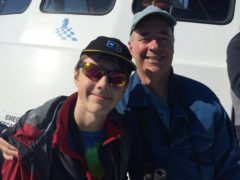
We want to thank all of you for making June our biggest month ever at FatherSonBirding! The number of you viewing our posts absolutely demolished all previous records with more than 1300 visits to our site. We kick off July with the first of a series of posts from Braden. Since early June, he has been working as a field intern for The Institute for Bird Populations. His job? Monitoring Northern Goshawks on the west slope of California’s Sierras. While searching for the elusive accipiters, he and his four-person team are having birding adventures most of us only dream about. Here is his first field report: an encounter with Northern Saw-whet Owls.
Northern Saw-whet Owl
In our first week on the job my team leader, Ivara, decided that we would get the Black Oak PAC over with. A PAC is basically an area of land chosen kind of arbitrarily based on goshawk habitat, territory size and private land boundaries that we survey, and we usually try to complete a PAC every two days. Black Oak was by far the toughest PAC, but we dove right in, bushwhacking through brush in search of any signs of Northern Goshawks. Unfortunately, we couldn’t really focus on scanning the trees above us for nests given the sheer density of the vegetation growing on the slope in front of us. While birds certainly loved all of the brush, with Fox Sparrows and Nashville Warblers singing from exposed perches around me, the foliage did not welcome me as it did them. After about thirty minutes, I found myself wildly off my compass bearing, following the edge of an intimidating thicket in an attempt to get back to my correct line. We considered being five degrees off as “off course”. I was off by thirty!
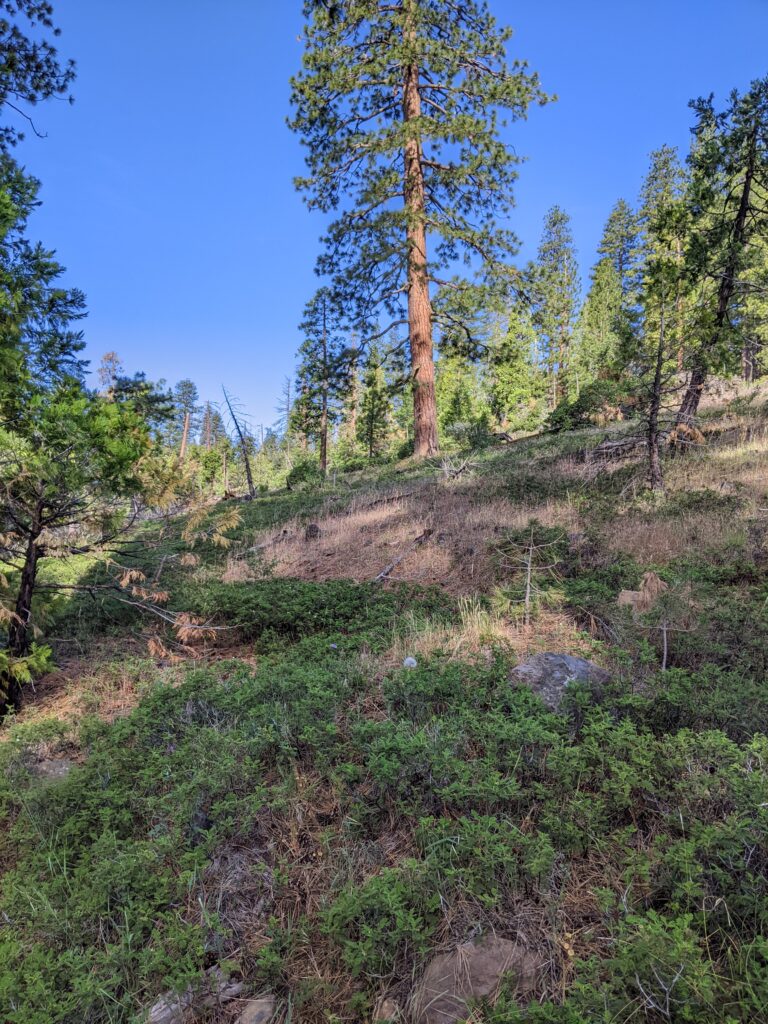
Some of the typical Sierras terrain where we conduct our Northern Goshawk Surveys.
I took a deep breath, plunging into the vegetation in the direction of my coworkers and my correct bearing. I bent to avoid spiderwebs stretching between branches, jumping on top of decaying logs at any chance I got to relieve myself from the sticks that drew blood from my legs. After about fifty meters, the brush somehow worsened. I couldn’t see three feet in front of me, but I pressed on. And suddenly, I flushed a bird.
At first, my mind went to American Robin. It was a medium-sized, brown species, and it darted away from me as if planning to disappear into the impossible maze ahead. Instead, it landed on a nearby tree branch. I lifted my binoculars, peering through a small gap in the leaves, and exhaled in shock. My voice quavered as I spoke into my radio.
“Holy cow. I just found a baby Saw-whet Owl.”
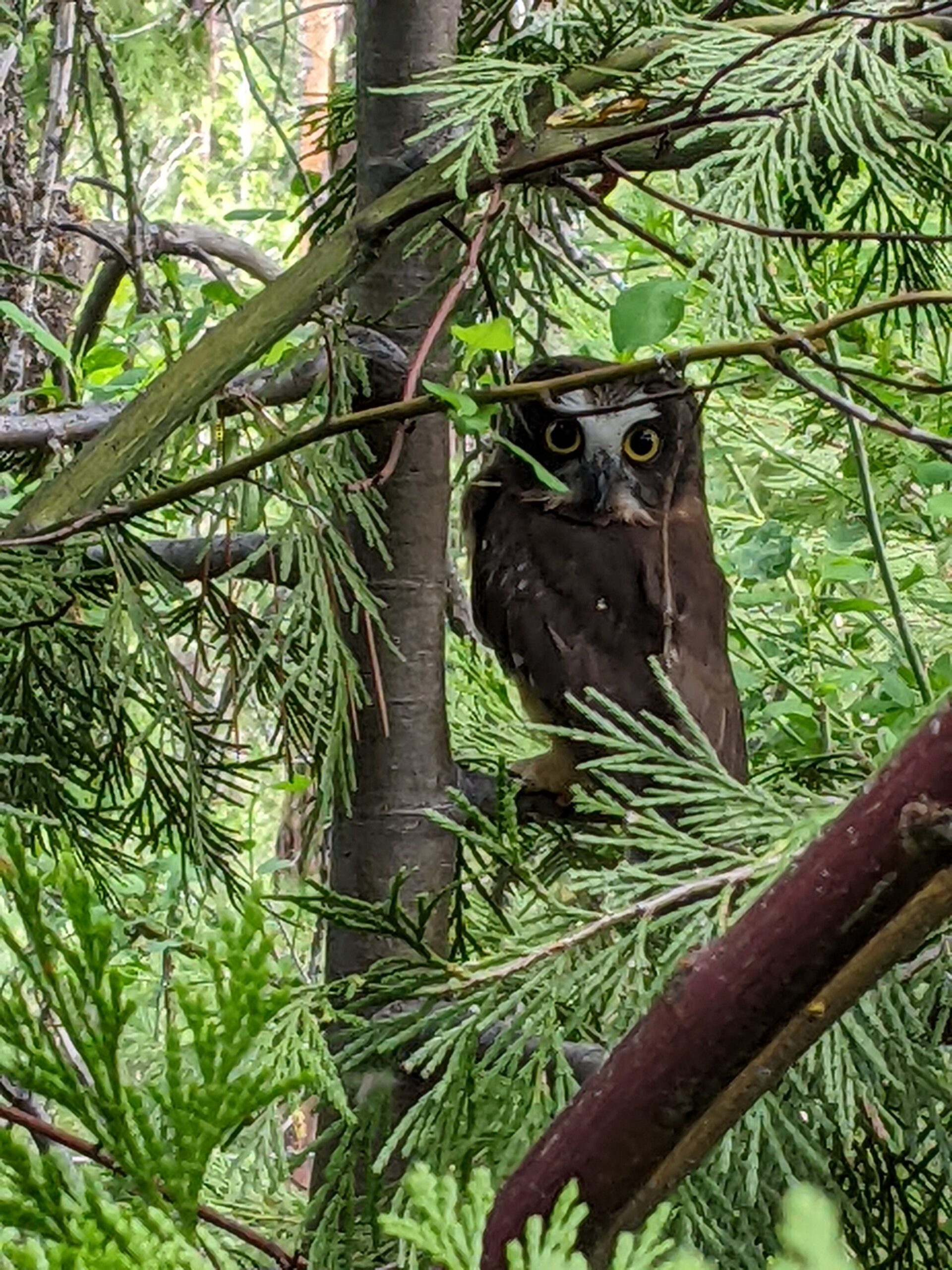
I’d only seen pictures of juvenile Saw-whets once before, on a checklist from Missoula that I’d stared at with jealousy. This bird stared right back at me, its curious, unmoving eyes gazing at the beast that had just disturbed it. The bird’s back was a creamy brown color, adorned with a few spots, and a bushy unibrow accented golden eyes. I could barely see its tiny talons clutching the branch, complemented by buffy feathers that coated its legs.
Unfortunately, I was too lost to direct my coworkers to come see the owls, but I was in no hurry to continue the goshawk search. Our rule: looking for goshawks is important, but so is watching cool wildlife that happens to pop up! On cue, in fact, a second bird flew to a lower branch on the same tree. It was another juvenile owl! My brain registered that it must have just abandoned its day roost mere feet from where I stood. That meant—
My eyes scanned the foliage immediately around me and I saw it: a third baby owl who had not yet flushed in a young pine tree two feet from my face. Staring intensely at me. I didn’t dare move, shifting my gaze between this third, most fearless owl and its siblings in the mature tree behind it. I’d left my camera behind in anticipation of the tough bushwhacking, but slowly snapped a few photos with my phone. I’d never found a roosting owl all on my own before, and here I’d just blundered into three!
This third, and most fearless, of the three baby Saw-whet Owls I discovered will forever be one of my most memorable birding encounters.
After about twenty minutes of staring contests with the cutest birds I’ve ever seen, I slowly backed out the way I had come, taking a left into more brush. Soon, I was on my stomach, army-crawling through somehow-worse vegetation, but I couldn’t be happier. Little did I know that this would mark only the first of many unforgettable wildlife encounters I would experience in the coming weeks . . .
In this post, we continue our account of our return to southern Arizona while on a quest to get Braden to his Big Year goal of 400 bird species. To read the first part of our journey, click here. As always, we appreciate you sharing this post, and if you haven’t already done so, subscribing by filling out the box below and to the right. Enjoy!
After our close encounter with bedbugs, we set off from Safford early the next morning and were pulling into our trip’s first Major Destination by 8:45 a.m. When we had contemplated visiting Portal, Arizona during our 2016 Big Year, we had considered it as “a place to see hummingbirds.” Six years later, we still wanted hummingbirds, but harbored a long list of other targets—including a slew of Lifers and Year Birds that would propel Braden closer to his Big Year goal of 400 species. Driving into town, we blundered into our first. I had pulled over so Braden could get a look at some Phainopeplas (see next post) when I noticed a large-ish bird over in a sage plant. Getting my eyes on it, I saw right away that it was some kind of kingbird—and that it had an extraordinarily large bill! Turns out it was a Thick-billed Kingbird that had been reported around town recently! This Code 2 rarity created great momentum for the day—one that would not diminish until we were snug in our sleeping bags 12 hours later.
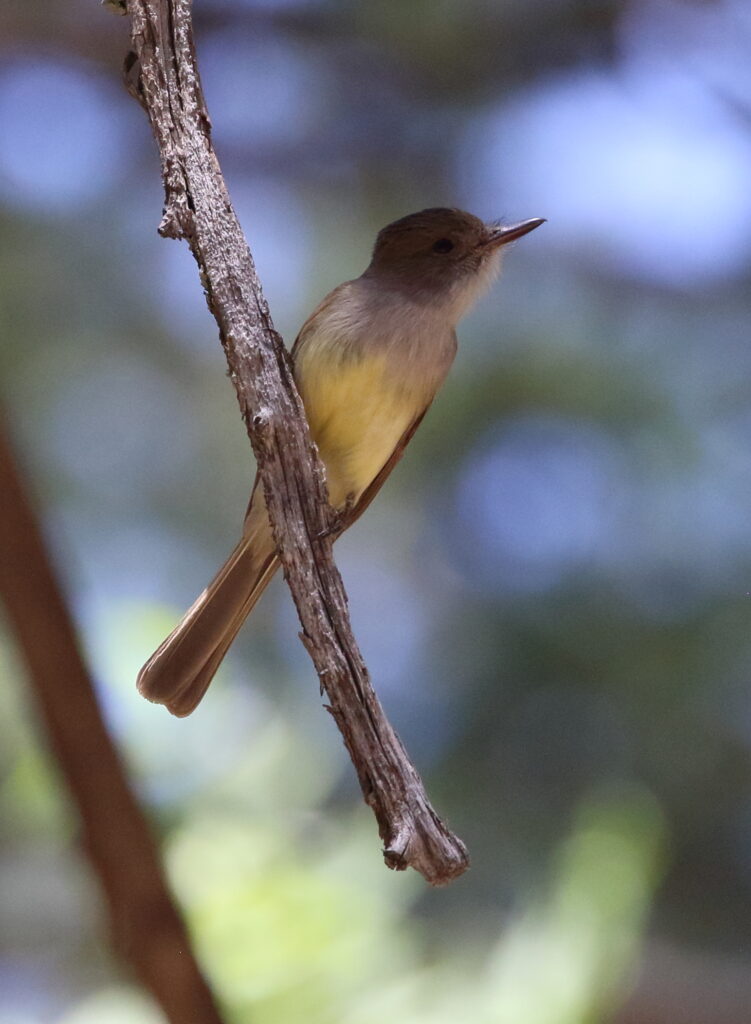
Thanks to Braden’s patient mentoring, I have grown a much greater appreciation for flycatchers, including this Lifer, a Dusky-capped.
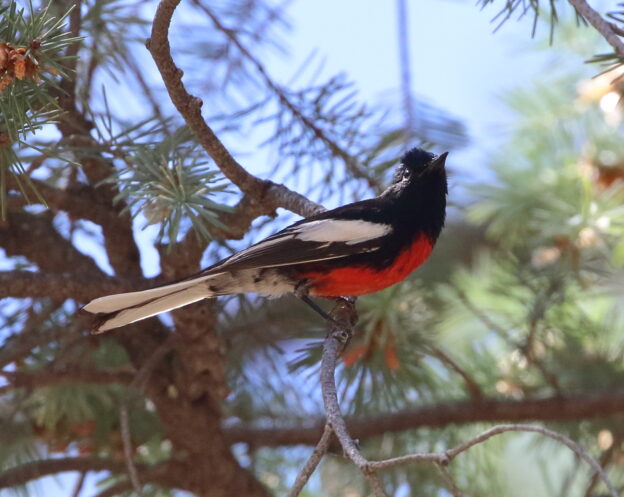
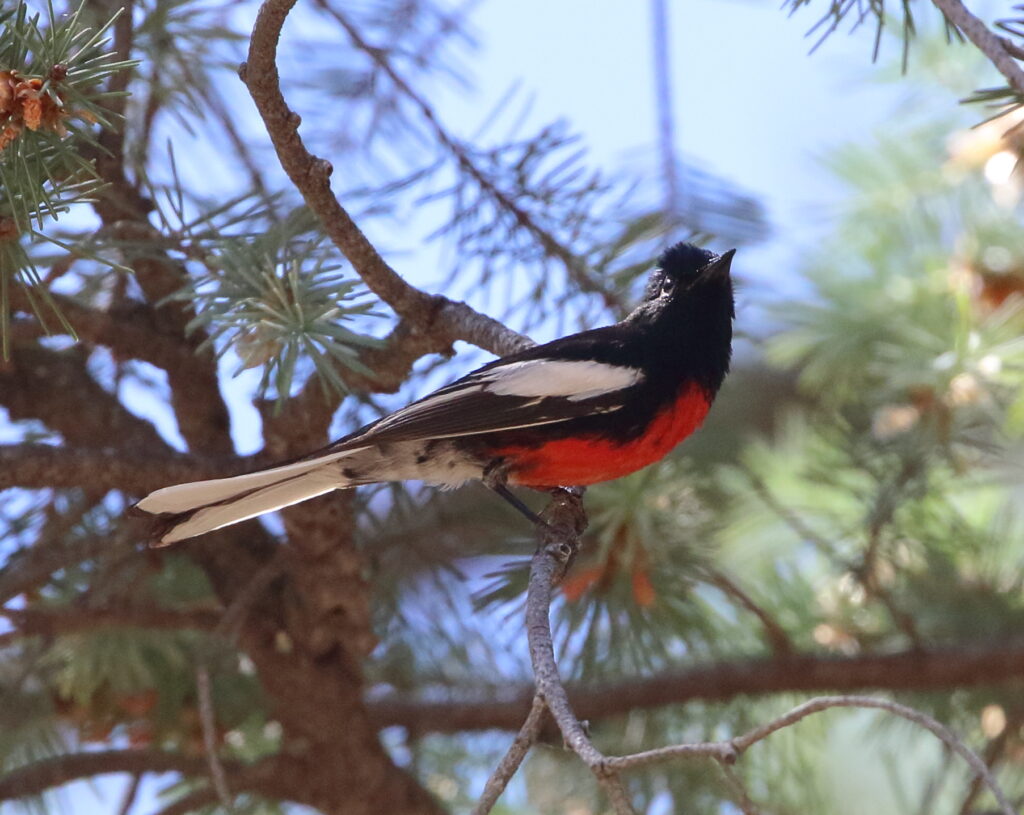
But back to those hummingbirds, it’s true that Portal does have hummingbirds thanks to the many kind people who put up bird feeders, but of equal avian importance is that the town sits at the mouth of a canyon of the Chiricahua Mountains. One of Arizona’s famed “sky island” mountain ranges, the Chiricahuas attract a host of birds from Mexico that are uncommon in the US, from Mexican Chickadees and Yellow-eyed Juncos to Sulphur-bellied Flycatchers and everyone’s Number One target, Elegant Trogons. After grabbing a campsite at Sunny Flat campground, Braden and I set up our tents and, as the day was already warming, decided to drive to high altitudes for our first proper birding session. We had a couple of specific destinations in mind, but as we wound our way slowly up the dirt road, we decided to pull over at a small stream crossing—and are so glad we did! Almost immediately, one of our favorite birds—Painted Redstart—perched over our heads. This was followed by a veritable bird parade that included Hepatic & Western Tanagers, Hutton’s Vireos, Bridled Titmice, Grace’s Warblers, and Dusky-capped and Cordilleran Flycatchers—all birds we had especially wanted to see or hear!
Painted Redstart was our Bird of the Trip during our first visit to Arizona in 2016. Seeing it again, we agreed it had been an excellent choice!
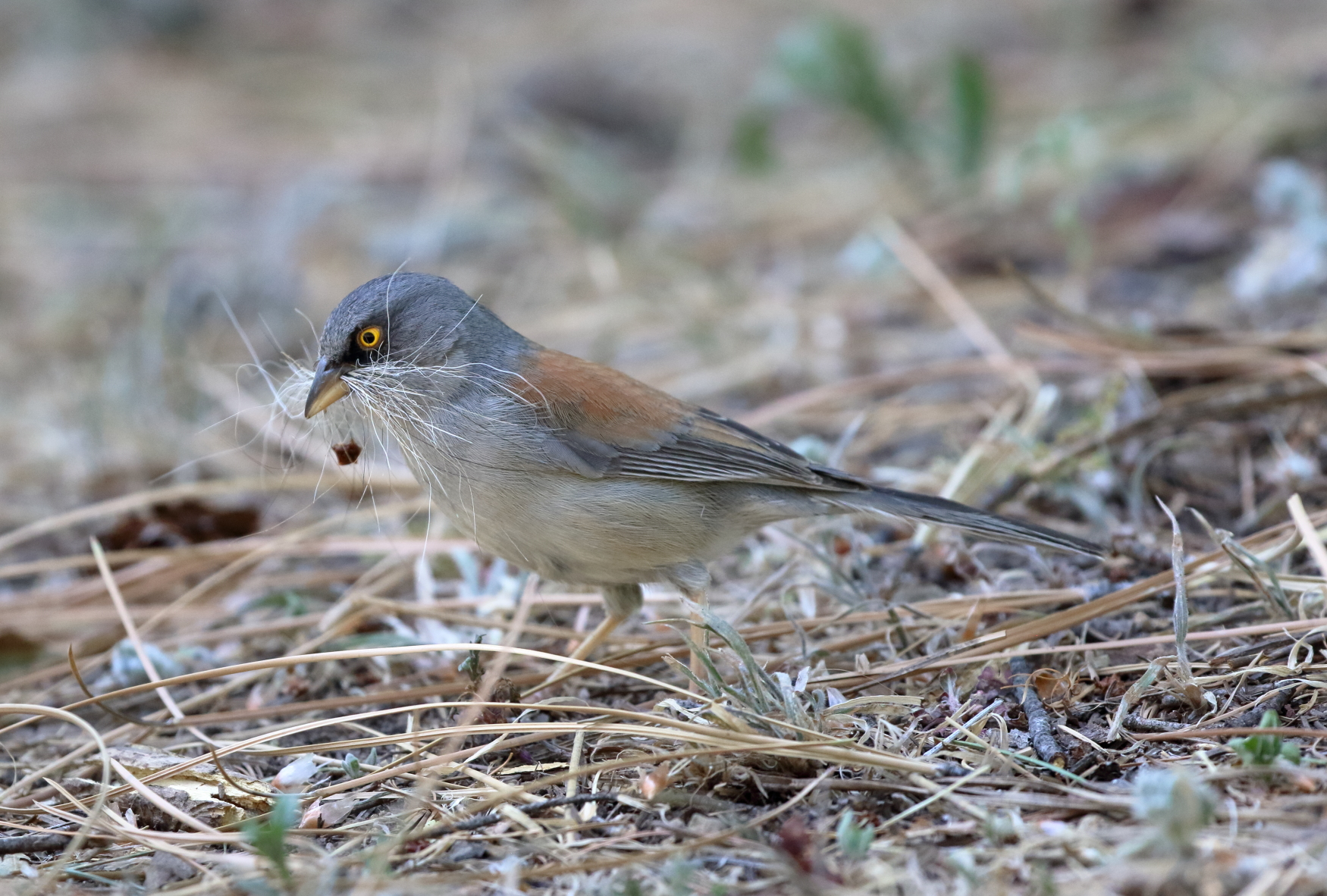
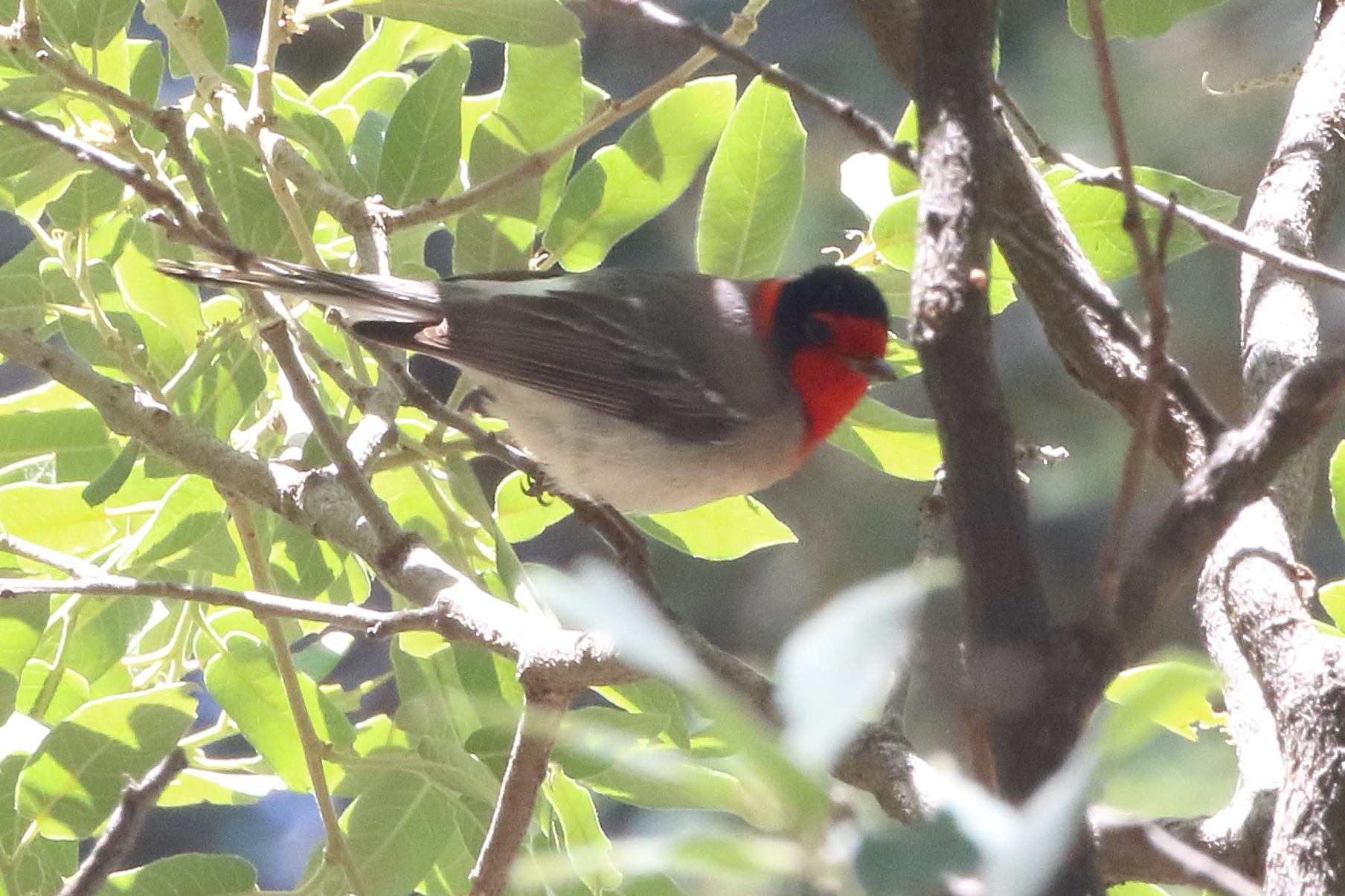
After a few more miles, we reached a loose collection of canyon campsites strung out along the road. The canyon held a wonderful mix of conifers and oaks, and in five minutes, we saw two Life Birds: Yellow-eyed Junco and Red-faced Warbler. The Red-faced Warbler is one of those birds that you learn about, but don’t really believe exists until you see it perched in front of you. Not to be out-done, the junco put on a great show for us, often collecting nesting materials at our feet as we burned gigabytes of camera storage photographing it! One bird we searched for and didn’t find was Mexican variety Spotted Owl. “That’s okay,” I reasoned. “I never really expected to see one of those in my lifetime, anyway.”
Yellow-eyed JuncoRed-faced Warbler
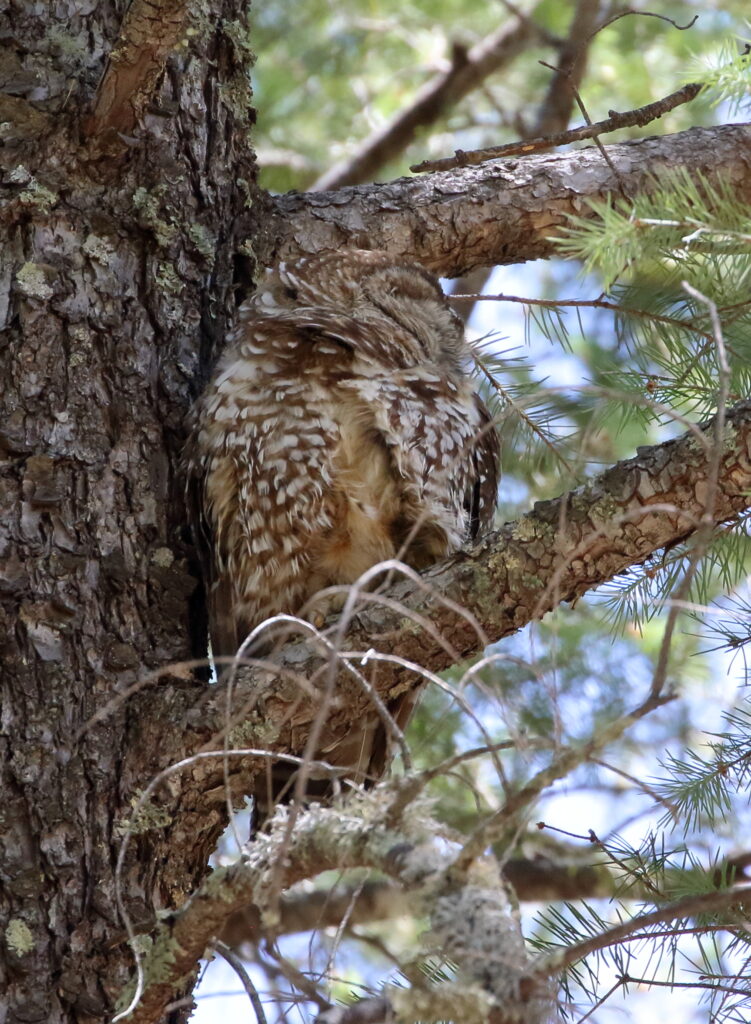
It was such a beautiful spot that we decided to have a picnic lunch there before moving back to higher elevation, but before we did, we took one last look around for an owl. Braden was trying to photograph a couple of Verdin when I turned and glanced up in a tree—only to be greeted by the unmistakable silhouette of an owl. Braden was saying, “I guess we’re not going to find the owl,” when I casually remarked, “Except that I just found it.” He thought I was kidding, but I pointed up into the tree, and we both fell into a silent reverie that lasted a full fifteen minutes.
Like so many birds Braden and I have encountered together, this Spotted Owl is one I thought I’d never see.
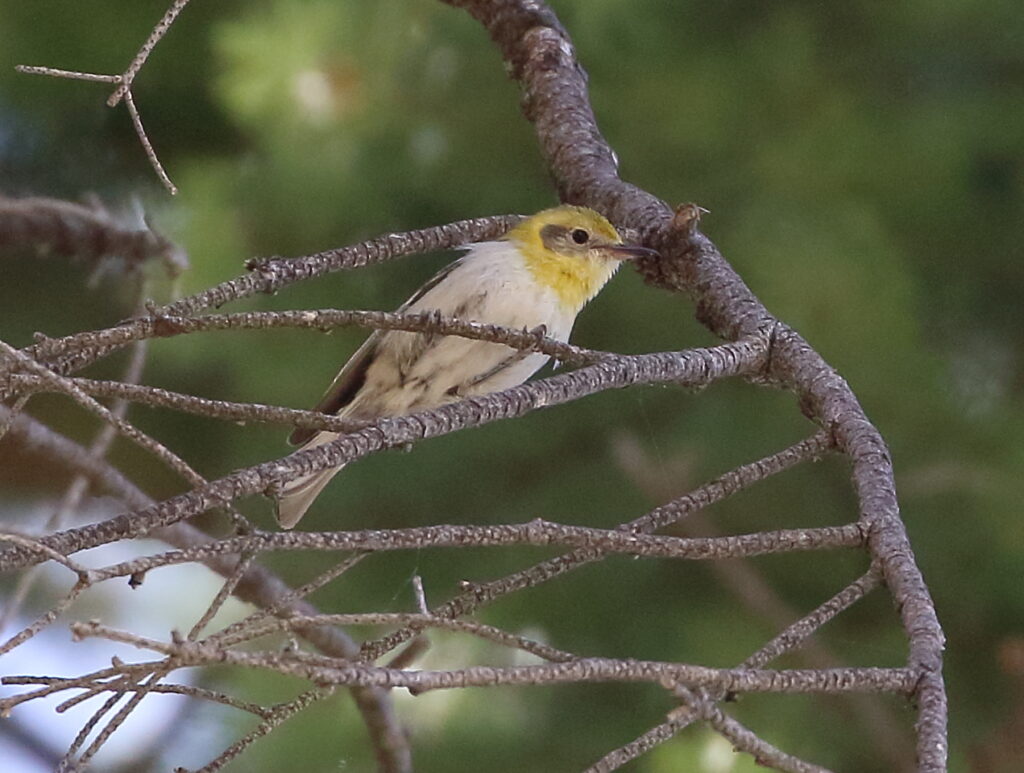
If we’d seen nothing else on the trip, that owl would have made the entire journey worthwhile. Nonetheless, we bid it adieu and headed up to a place called Rustler Park. Here, thanks to Braden’s hard work and determination, we found two more Lifers: Mexican Chickadee and Olive Warbler—the bird that isn’t really a warbler, but inhabits its own strange group of birds. Remarkably, our day still had a long way to run.
If it looks like a warbler, and acts like a warbler . . . well, sometimes it isn’t. This Olive Warbler belongs to its own family of birds, the Peucedramidae.
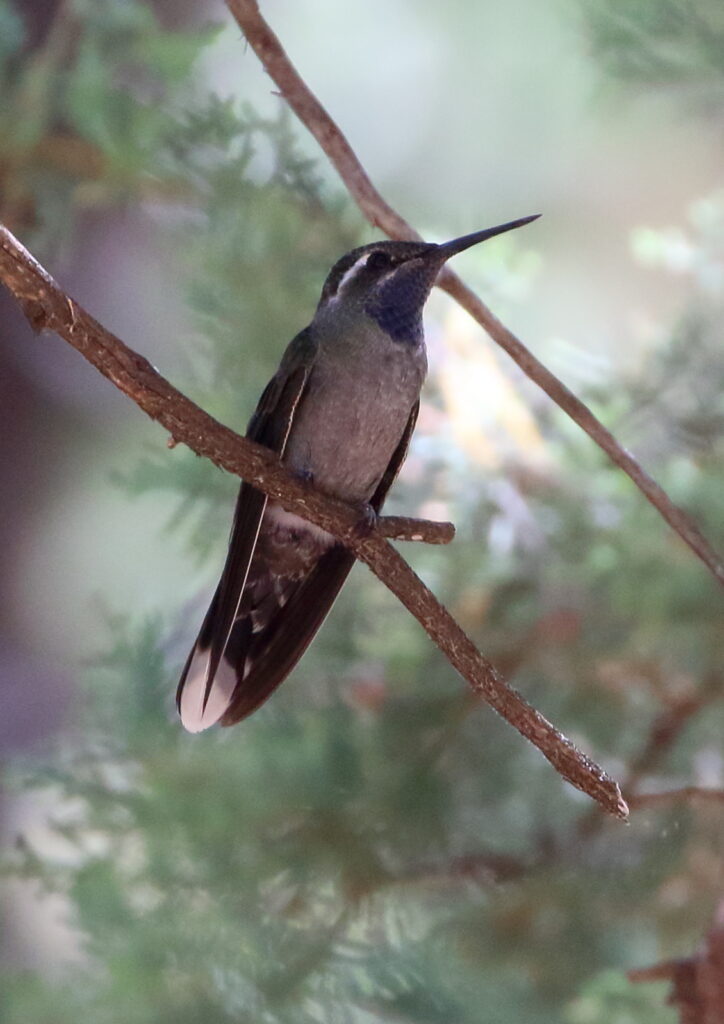
Back in Portal, we scoured the bird feeders, and even hung our own feeder in our campsite, netting yet more Lifers: Scott’s Oriole, a bird at the top of my “to see” list, and Blue-throated Mountain Gem, a gorgeous hummer that came right to our camp feeder! As the shadows deepened over Cave Creek Canyon, however, we had one more very special treat in store for us. Grabbing our flashlights, we set off in darkness down Cave Creek Road, listening intently for a trio of nighttime denizens. We heard the haunting call of the Mexican Whip-poor-will, followed quickly by Whiskered Screech Owl, and finally the “bark” of Elf Owls! Standing together, listening to these magical sounds truly was one of our most memorable birding experiences ever and one that we will both cherish as long as we draw breath. The same can be said for the entire day.
Even better, two full days of Arizona birding remained. Would they include, say, an Elegant Trogon? Stay tuned . . .
I couldn’t write about Portal without including at least one hummer, even though this Blue-throated Mountain Gem declined to give us a full “sun shot”.
Braden and Nick are close to the finish line! This penultimate day of their epic Florida adventure would bring revelation, frustration, traffic jams, and finally, the realization of a key (no pun intended) target species of the trip. They also happened to be nearing their goal of 200 species for their expedition—as well as moving Braden significantly along in his quest to see 400 species during his 2022 Big Year. Read on to find out what happens . . .
Unfortunately, sleep was not in our immediate future after leaving the Keys that night. We pulled back into the Everglades, passing the campsite I’d enjoyed the night before, Chuck-will’s-widow calls sailing through our rolled-down windows. As we drove south in the dark towards Flamingo, the “town” at the bottom of the glades, we scanned the roads looking for our targets: snakes. Soon enough, Nick spotted one, and we pulled off the road, turning on our emergency lights so oncoming cars wouldn’t run us, or the snake, over as we walked down the road towards it. We left Dixie in the car, given that this snake was a Florida Cottonmouth, and probably could have killed Dixie if she got too close. The snake coiled on the warm road, its mouth open, and we showed another group of people that pulled over to see what we were photographing. Our spirits high, we headed back to the car—only to discover that Dixie had peed all over both seats. The smell infiltrated our noses, and we wiped up the mess with various towels and toilet paper that would be going in the next garbage can we came across.
Half an hour later, we rolled into the dark parking lot of a wooded trail near Flamingo. We set off in the dark, using a stick to brush spiderwebs out of the way and looking back frequently to make sure we wouldn’t get lost. Eventually, the trees gave way to a massive field of saltbush, slightly silver in the moonlight. This was the winter home of another incredibly elusive species, the Black Rail. This bird, a member of a group of birds already known to be difficult to find, was the size of a mouse and completely nocturnal. If Mangrove Cuckoo wasn’t the hardest regularly-occurring species to see in North America, it was definitely Black Rail. While hearing them was slightly easier, they didn’t seem to know that as we played for them in the dark, and we walked back to the car, our legs covered in scratches from the saltbushes, after forty fruitless minutes of searching. Nick fell asleep immediately as I took the wheel, just trying to get a little further north before crashing so the driving would not be as terrible during the next few days. I didn’t get far, however, and pulled into another parking lot. Between the smell of urine and the oppressive humidity, I didn’t get very much sleep that night.
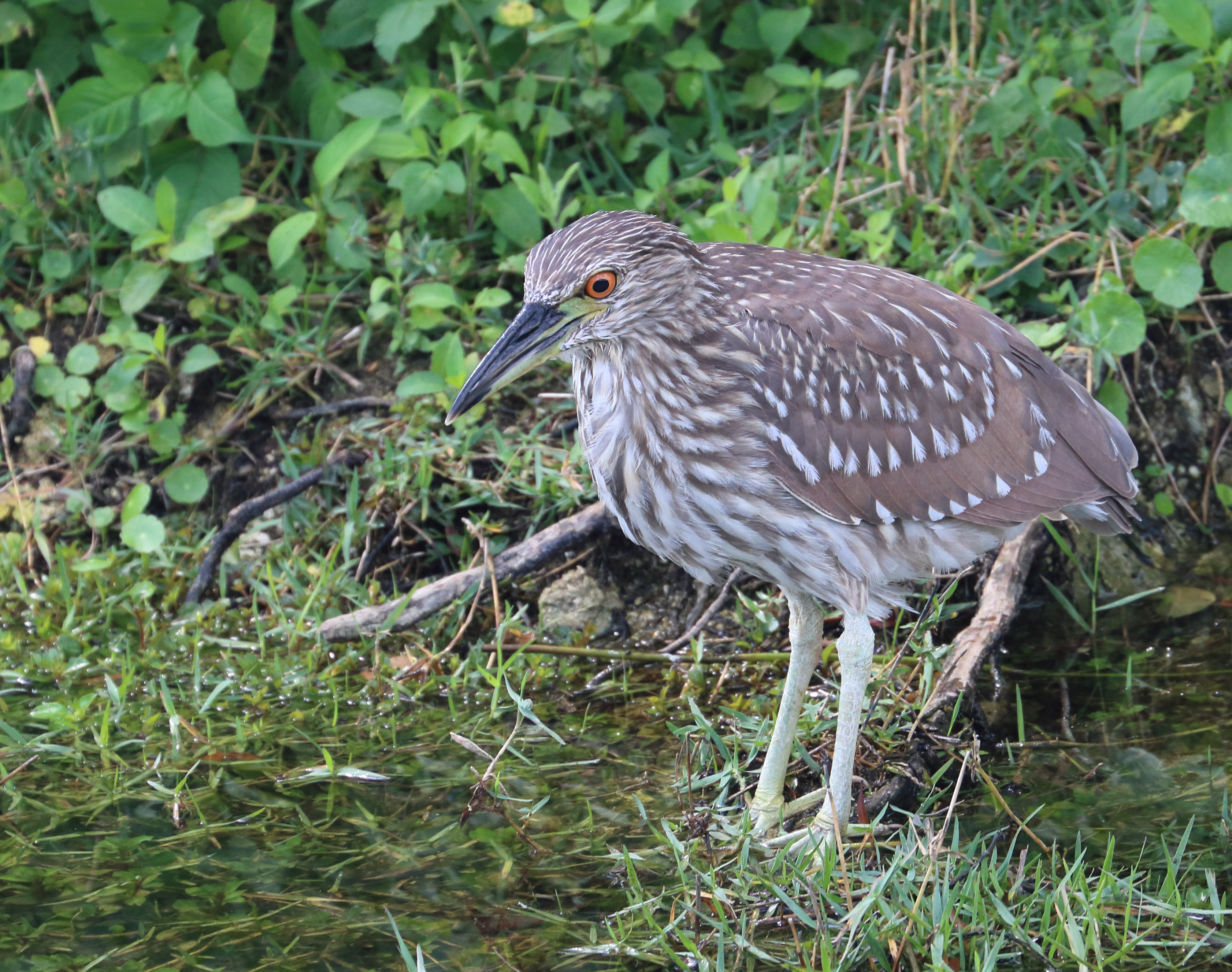
Birds such as this juvenile Black-crowned Night Heron helped compensate for a terrible night’s sleep and Dixie’s, ahem, perfuming of the car seats!
At seven, Nick drove us to our next spot, a place called the L31W Canal, a little northeast of the Everglades. Struggling against my fatigue, I stepped out of the car in the brightening sky, and we began trudging along a straight road bordered by brambles on one side and grassy pine forest on the other. We had several goals here, the primary one being a Smooth-billed Ani that had been hanging out for a while. After doing some digging on eBird, I discovered that the ani was a ways down the dusty road, and I sighed, preparing for a long, hot, uneventful hike. Fortunately, I was quickly proven wrong.
We passed another pair of birders, one of them guiding the other. Nick pointed out the calls of Northern Bobwhites, quail I hadn’t seen since South Texas and had never before heard, and all of a sudden, an orange blur caught my eye. I looked to the right, where a beautiful Barn Owl had just alighted on top of a tall, branchless snag.
This was the best photo I could manage of my first really good look at a Barn Owl.
“Holy cow, look!” I said, pointing as all four of us birders turned towards it and raised our various devices (camera, binoculars, and in the guide’s case, a scope). The bird had dark eyes and a grayish, circular face peering at us in the morning fog. It took off before I was able to secure any good pictures, its flight reminiscent of a bounding rabbit. We watched the Barn Owl, a species I had only seen the butt of before, our eyes transfixed on the vibrant orange of its wings as it floated around for a while and then disappeared. It was almost like the birds had seen my poor mood and responded accordingly, putting the smile back on my face—and they were just getting started. In fact, the best birding of the entire trip unfolded before us.
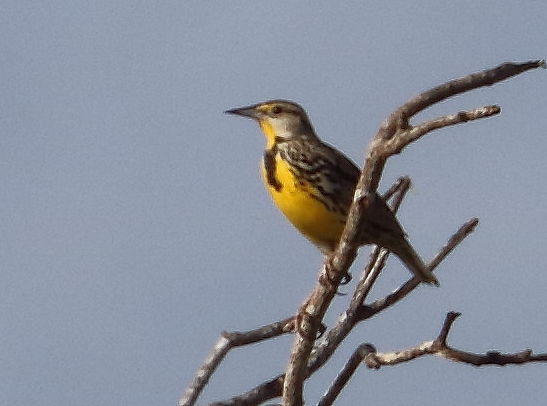
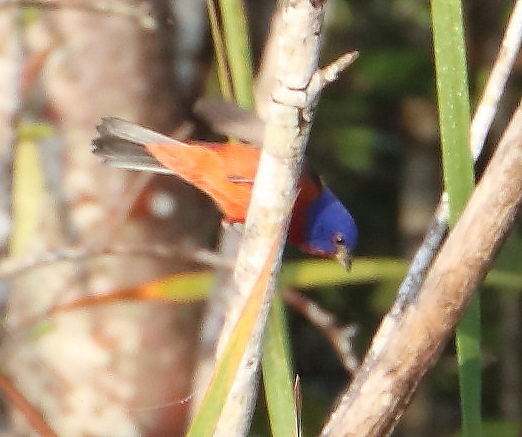
As we scanned the pine savannah to our right, searching for White-tailed Kites, Nick pointed out Eastern Meadowlarks, a bird I somehow hadn’t seen until now. Pishing in agricultural parts of the walk yielded a variety of sparrows, including Savannah and, surprisingly, a Grasshopper Sparrow, a bird I associated with the shortgrass prairie of Eastern Montana rather than the humid scrubland of south Florida. More Swallow-tailed Kites appeared above us, circling above the pineywoods as if cheering us on. At one point, a bright red bird zoomed across my path, briefly perching up in a low bush—a male Painted Bunting! The bird was even more stunning than I’d expected, with its deep blue head, green back and brilliant crimson belly lit up in the sun.
The L31W Canal continued to deliver great birds with my first ever Eastern Meadowlark and a spectacular male Painted Bunting.
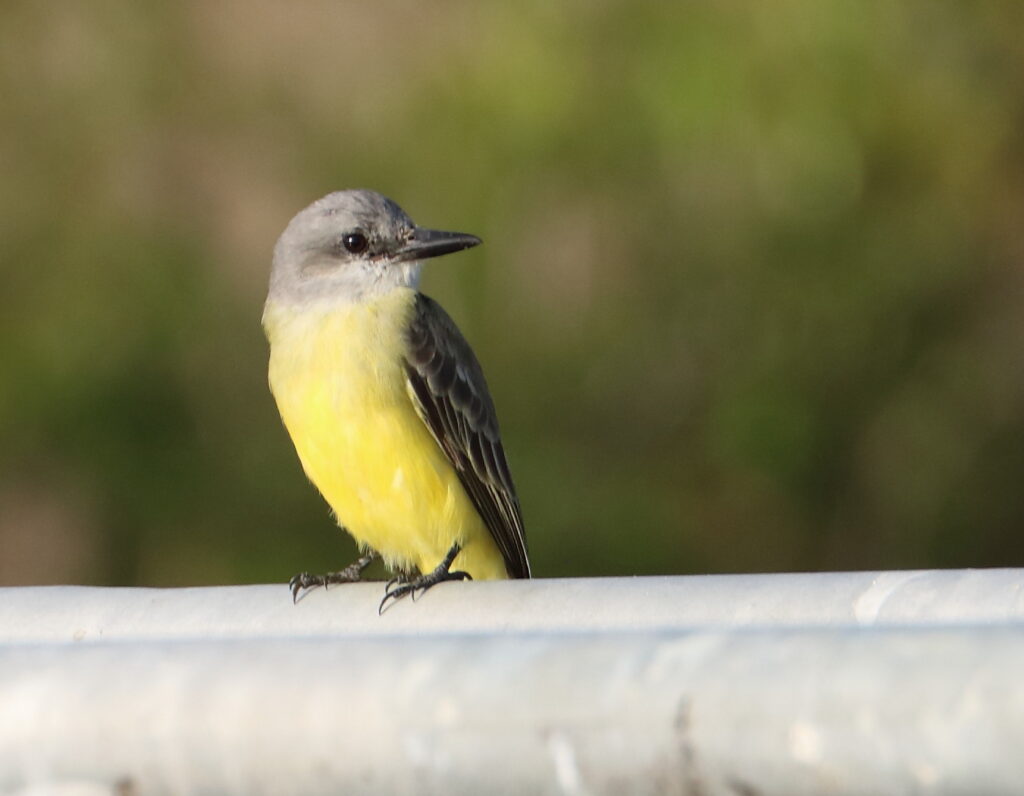
While we didn’t find the ani, the other birders pointed out other rare species to us. This place seemed to be a rarity hotspot, which became apparent with a kingbird flock we found. Western Kingbirds were regular winter residents in this area, but this flock also included both a Cassin’s Kingbird (a Western species) and a Tropical Kingbird (a tropical species), and I learned the difference between the three as we watched them fly around us. As much as Nick and I wanted to stay longer, we had miles to cover and Mangrove Cuckoos to find, so we said goodbye to the other birders and began the drive through the glades towards the Gulf Coast.
This was my first time getting to directly observe the differences between Tropical (shown above), Cassin’s, and Western Kingbirds in the field.
Yet again, we drove through prime Snail Kite habitat, and yet again, we found no Snail Kites. The sawgrass marshes gave way to densely forested glades as we drove along the Tamiami Trail, and we pulled into the visitor center for Big Cypress National Preserve for a quick glance around the center grounds. While we did see a fair number of birds along the drive and at the visitor center, the main attractions were the aquatic creatures. Amazingly, we spotted a pair of porpoises in the canal as well as a Brown Pelican, both an unusually far distance inland. That meant that somehow, this canal must have had some saltwater. What’s more, at the visitor center we found large schools of fish, including mean-looking Florida Gar. In front of our eyes, a Softshell Turtle snagged one of them and was promptly ambushed by several more. However, the most mind-blowing animals were the alligators. Dozens sulked in the canal, and at the visitor center alone I counted thirty or so, all within several feet of the humans peering at them from the safety of the boardwalk.
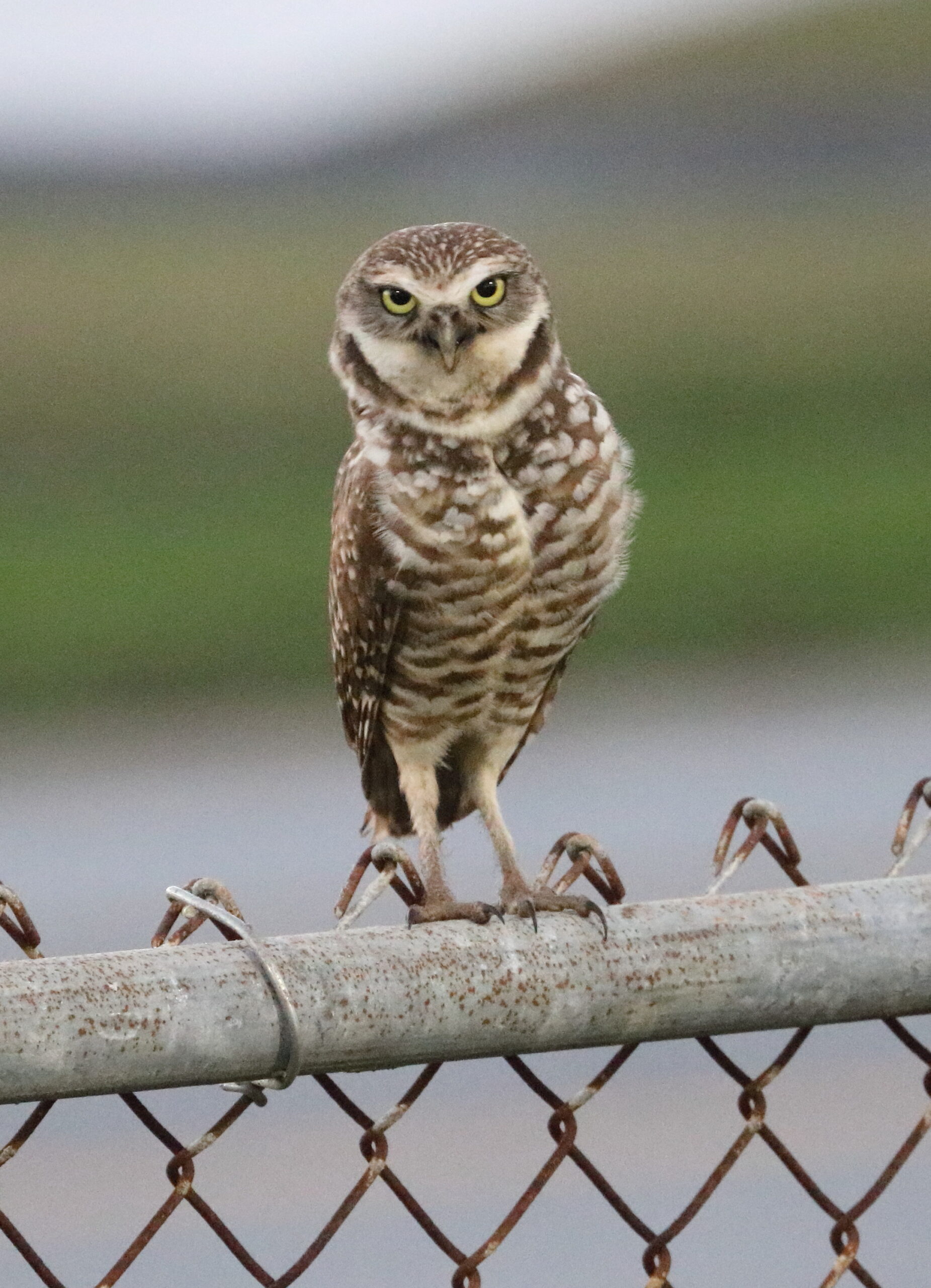
Eventually, the scenery changed as we left Snail Kite habitat and entered the habitat of the snowbirds, people who migrated south from the northern United States to their homes in the warmth of Florida. More specifically, we were in Cape Coral, a hot, concrete-covered town known for its tourists as well as another species that I’d only seen previously in the prairies of Montana: the Burrowing Owl. A threatened, urban owl population existed in this part of Florida, surviving in parks, yards and abandoned lots here only because of the protection the city provided. As we pulled up to the Cape Coral Public Library, we saw the fencing and stakes marking their burrows, although no birds were to be found. The heat of the day seemed to be keeping them down, so we headed west, towards our last chance at Mangrove Cuckoo: Ding Darling National Wildlife Refuge on Sanibel Island.
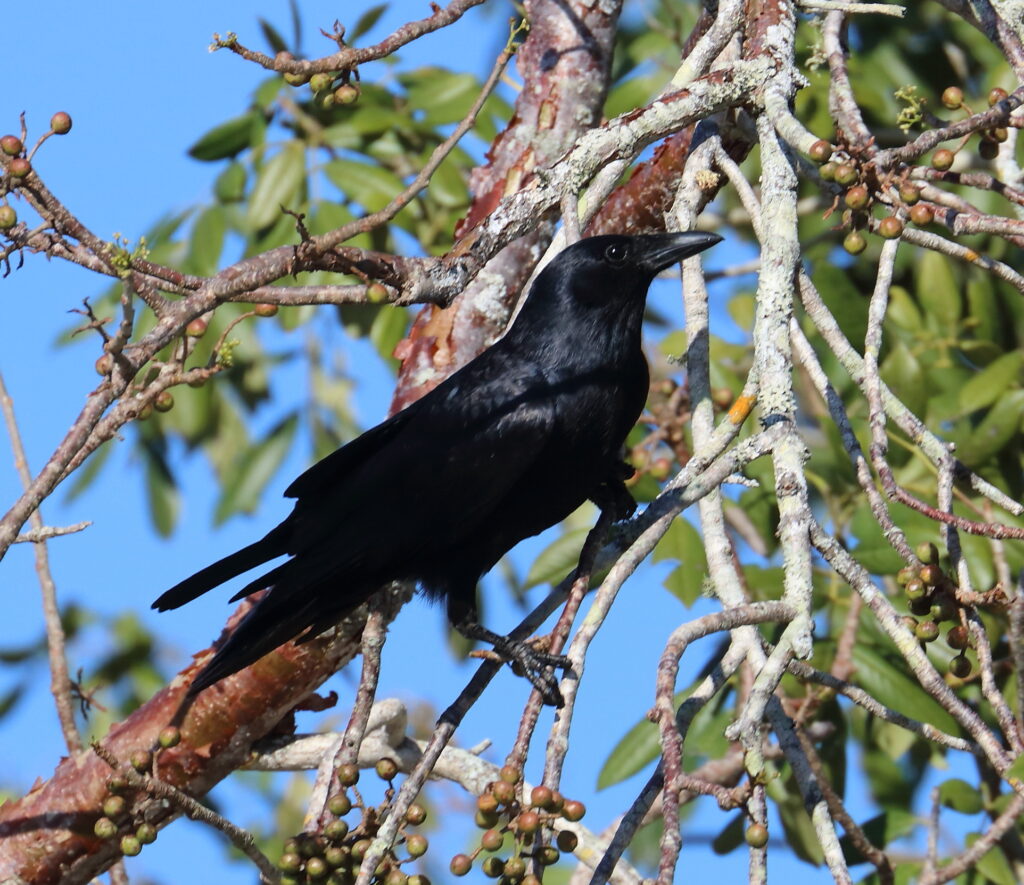
Fish Crows entertained us in many of South Florida’s habitats, including mangroves.
Again, this refuge caught me off guard. I’d expected large marshes and ponds, similar to Montana’s refuges. Instead, we were met with thick, tall, healthy mangroves. The trees were larger and denser than what we’d seen in the Keys, and more accessible too. We drove the main refuge loop, stopping at various trails to play for the cuckoo. One boardwalk in particular displayed the complexity of the Red Mangrove ecosystem, giving us great looks at the trees’ prop roots as they plunged into the shallow, salt-covered mud, and the crabs scampering up their trunks. Fish leapt from the water of the mangrove-encased bays, and we spotted a few shorebirds and waders wherever land showed itself. Here, again, the primary songs we heard were those of Prairie Warblers, singing from all around us in this perfect breeding habitat. And yet again, more Swallow-tailed Kites flew over us, reminding us of the excitement we’d felt when we’d first seen them at Merritt Island.
As we left Ding Darling, cuckoo-less, we discovered what else the area was known for: traffic—the worst traffic I’d ever been in, hood-to-bumper cars stretching for miles as people tried to get off the island. We probably could have gotten off Sanibel faster if we’d been as we covered three or so miles in roughly an hour. Eventually, though, we made our escape, and headed to a nearby baseball field in a last ditch attempt for Burrowing Owls. Again, though, after half an hour of walking around, they evaded us, frustration rising inside us. While the day had been great, we’d missed every single target—no ani, no cuckoo, no kites and no Burrowing Owls, not to mention the uncomfortable night spent looking for nonexistent Black Rails. As the sun began to set, a baseball game started next to us. I stared as the young Little League players hit line drives over each others’ heads. A single ball flew into the outfield, and then I saw it: yellow fencing, located just beyond the baseball diamond. I raised my binoculars, revealing two brown lumps perched on the chain link fence within the yellow caution tape.
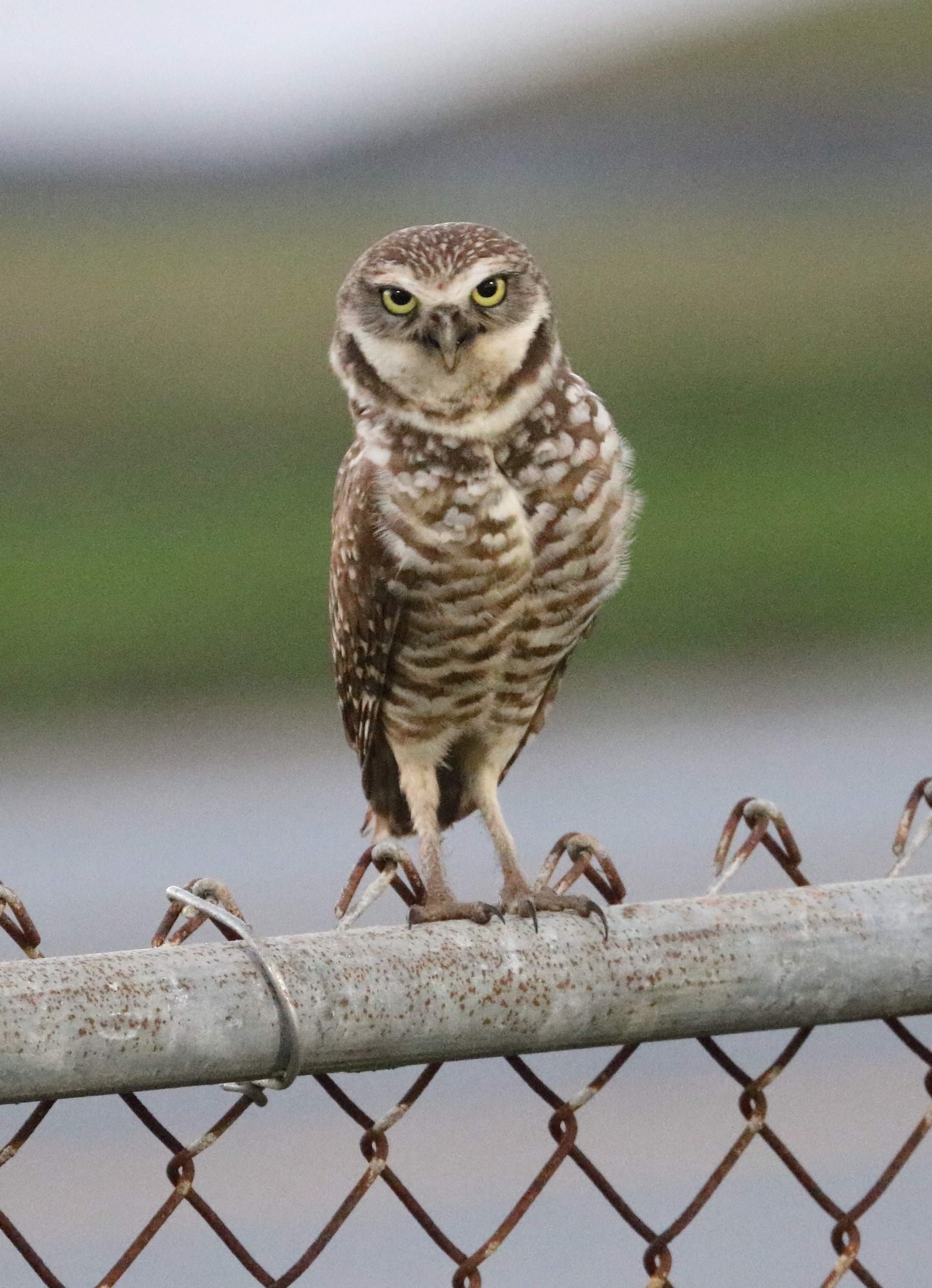
“I’ve got em!” I said, and Nick and I began running, Dixie leading the way. As we got close, we put Dixie on a leash, lying down to photograph what we’d found: two incredibly cooperative Burrowing Owls perched in front of us, one on the lawn and one on the fence above the first. They stared at us, their mottled brown-and-white pattern complementing their intense, unmoving eyes. Nick and I moved a little further to take a selfie. Finally, we’d found something we were looking for!
Finally, after an afternoon-long search complete with horrendous South Florida traffic, we were rewarded with a great look at Burrowing Owls in Cape Coral.
We ended our day at a campsite just south of Gainesville at roughly eleven o’clock, a surprisingly earlier bedtime compared to the rest of the trip. While my goal was sleep, Nick went off in search of Eastern Whip-poor-wills. I lay there, in the back of Nick’s truck, thinking about where we’d been. After spending the day in the glades and the mangroves, we were back in the Pineywoods, hoping for another chance at their birds tomorrow before heading back to New Orleans. While we’d gotten several of my target birds for the trip so far, we’d missed an unfortunate number, and I’d hoped that tomorrow would go better. Would it? Or would we miss everything yet again, to return to Louisiana only with a few of the birds we’d set out to find? Stay tuned to find out!
Still on the fence about subscribing? Kick off the New Year right and go for it. We won’t share your info or use it for any nefarious purposes. We promise! Just fill out the box down and to the right.
You PhD students of FatherSonBirding may recall that our debut post related to our very first Snowy Owl sighting on March 9, 2018, almost four years and 100+ posts ago. Today’s post marks a return to our roots—sort of.
After a successful birding trip to Oregon to close out 2021, Braden and I decided to kick off 2022 with a modest New Year’s Day tour of Ninepipe National Wildlife Refuge in the vain hope that we might see a Short-eared Owl, a species that totally eluded us last year and is one of our favorite birds. As we headed north in our trusty minivan, however, a crooked nail of a thought kept scratching at my brain. Finally, as we approached St. Ignatius I glanced at Braden and said, “You know, people eBirded the Snowy Owl again yesterday, and this might be our last chance to see it together before you head back to college. What do you think?”
“I’m in,” he answered, “but let’s hit Duck Road first.”
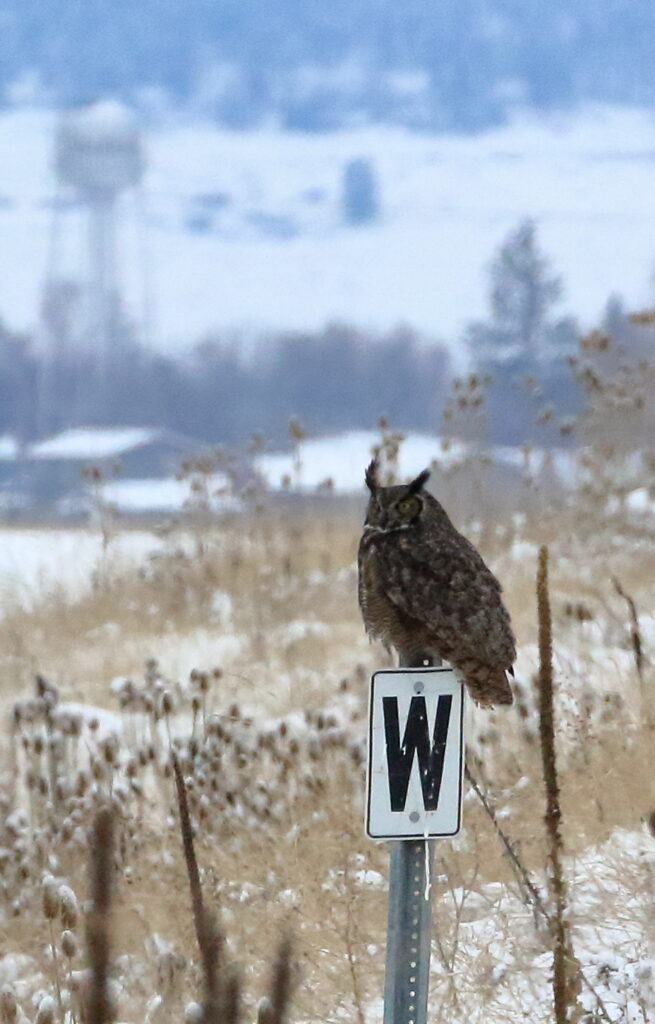
I exhaled, relieved. Even though it would mean an extra two hours of driving, now we were committed. We quickly hit Duck Road at Ninepipe looking for Short-eareds, and of course got skunked, though we did get a great look at a hunting Prairie Falcon and flushed a Great Horned Owl that had taken up residence in a small tree. Then, we high-tailed it toward Kalispell, stopping only for an unsuccessful attempt to find a Lifer Glaucous Gull at Somers Bay.
This Great-horned has apparently taken up residence in a new tree. Don’t be surprised to see it your next time on Duck Road. (Water tower of Charlo in the background—don’t you love telephoto lenses?)
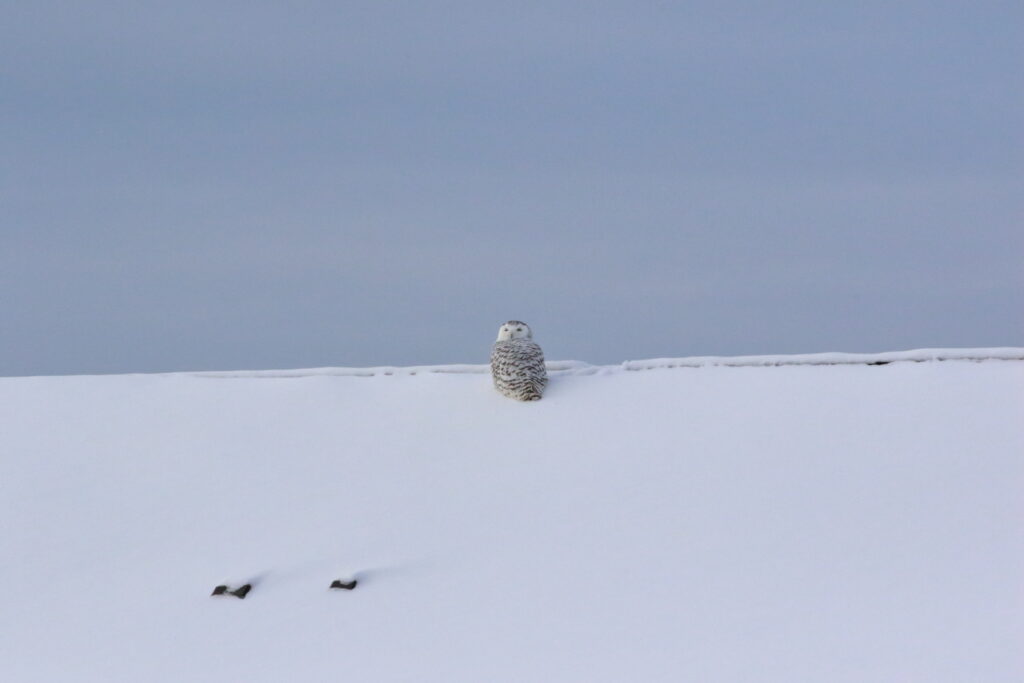
Turning left onto Farm Road in Kalispell—er, Somers to be exact—dark clouds of failure haunted me. After all, we had scoured this neighborhood for four hours in 2021 without so much as a glimpse of a Snowy Owl (see our post “Payin’ Raptor Dues, Reapin’ Raptor Rewards”) and as we crept slowly forward, it felt like history would repeat itself as we passed one owl-less roof and field after another . We turned left on Manning Road and continued driving, stopping a couple of times to scan every house in sight. “I’ve got Collared Doves,” Braden said, just as I focused in on a fuzzy white lump on a roof.
“Got it,” I said. Braden said, “Good,” thinking I was referring to the Collared Doves. “No, I mean the owl,” I clarified. And indeed, only ten minutes after beginning our search, there it was—no more than a quarter mile from where we’d seen our first Snowy in 2018! As beautiful as Snowy Owls are, they don’t usually do a whole lot, but we enjoyed staring at it for ten minutes and taking lousy photos. We thanked the owl and then, with a whole afternoon suddenly freed up, began birding our way back home.
Okay, not the best photo, but give me a break already. The Snowy was far away!
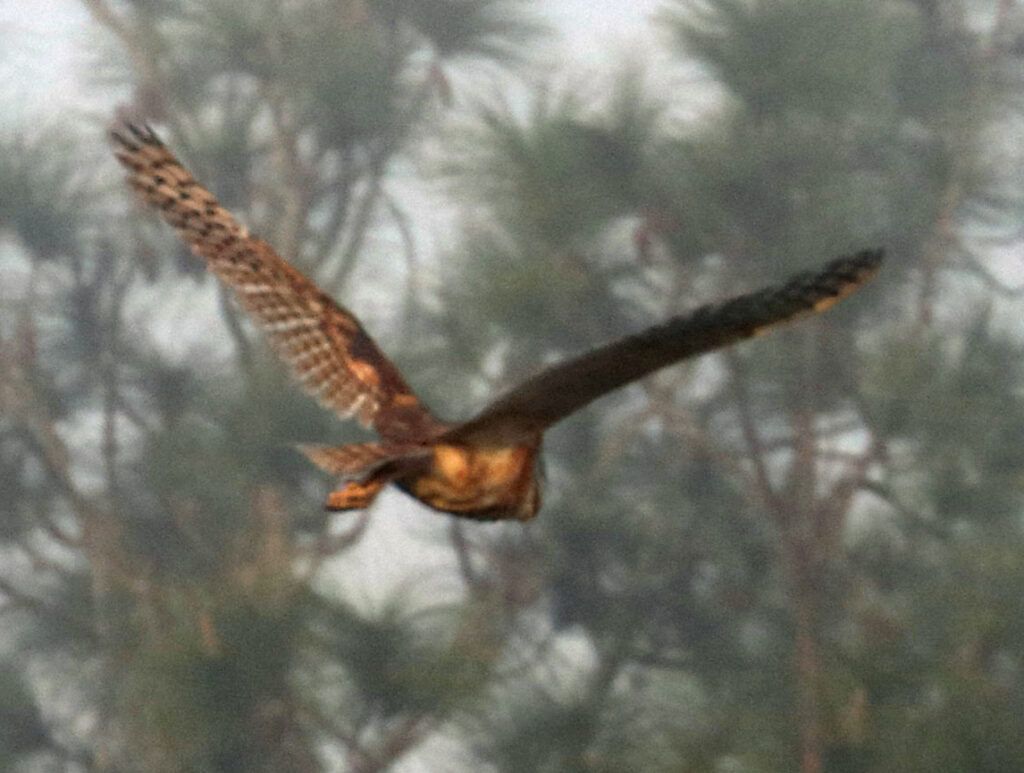
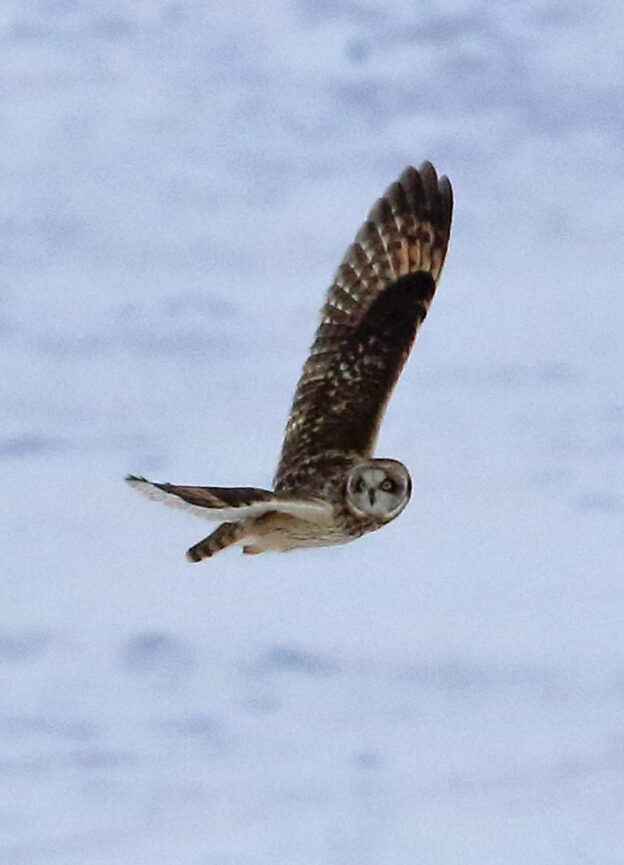
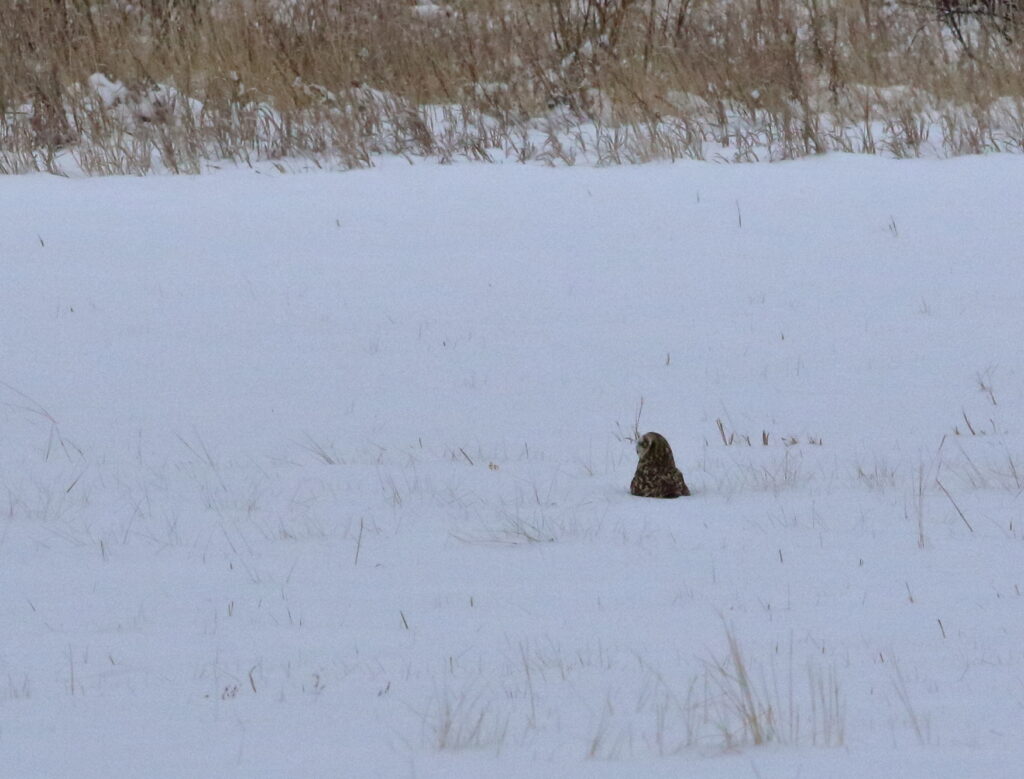
We hit numerous spots on our way south, picking up one Year Bird after another. One of the great things about birding on New Year’s is that it resets the birding calendar, making every new bird a Year Bird! In fact, perhaps because of our low expectations, we saw almost everything we could wish for: Common Redpolls, American Tree Sparrow, half a dozen ducks, and an unlikely Double-crested Cormorant. As we once again approached Ninepipe, we had plenty of daylight for a second go at Short-eared Owls. We again bombed on Duck Road so made our way around the fringes of the refuge, ending up on Ninepipe Lane. Suddenly, a large bird leaped into the air.
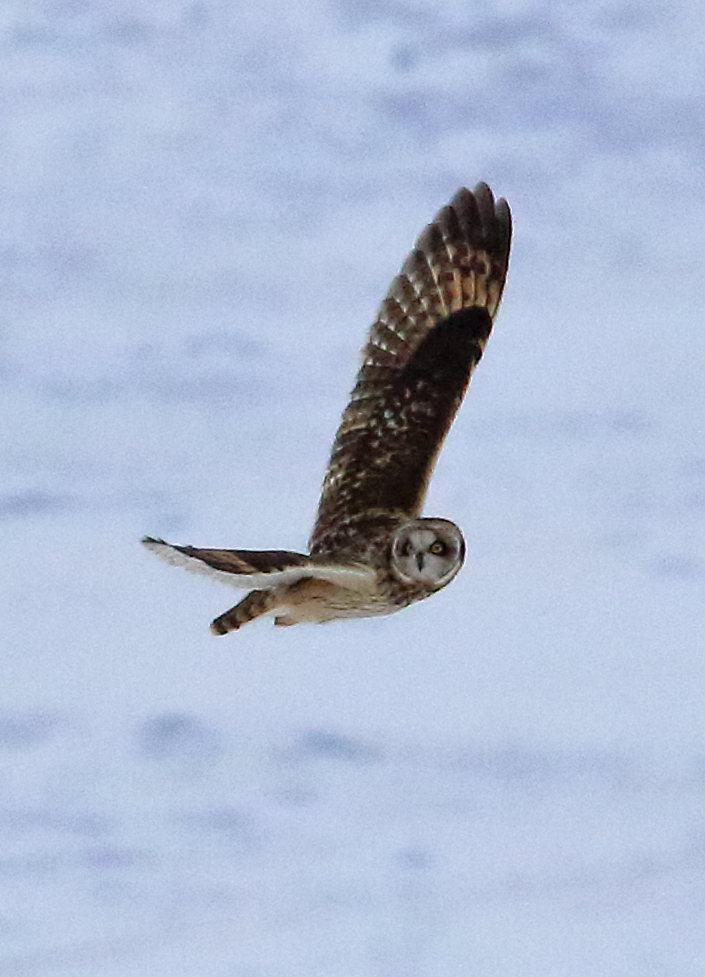
I’ve never been able to take sharp in-flight photos, but I just love this image as this Short-eared Owl looks and listens for prey.
“Short-eared!” Braden shouted. Yes! We got a beautiful look at the amazing creature as it flew a couple of circuits around us and then dove on a hapless mammal in a snowy field. Even more amazing, in the next mile we saw four more Short-eareds! They all perched at a fair distance, but we didn’t mind. In fact, we were glad that we wouldn’t be disturbing them by driving close. Not surprisingly, the SEOWs swooped in for Bird of the Day honors, but we had more birding pleasures in store—including Cedar and Bohemian Waxwings, a Great Blue Heron and kingfisher, a Northern Shrike, and right in our own neighborhood, our last bird of the day, Wild Turkey. It was an awesome way to kick off 2022, and with 46 species under our belts, by far our best Montana New Year’s Day birding experience ever—one we will treasure as Braden prepares to return to college in Maine.
There was no Snowy Owl in the field. Someone had reported the owl from the field this morning, but there was nothing white in sight aside from the post office where we’d parked—not even a plastic bag pretending to be a Snowy Owl! I turned to Miles. “I thought Snowy Owls were supposed to be easy in Maine. What do you wanna do now? There was a Gray Kingbird reported from York County, Maine, yesterday. Although that’s a three hour drive…” I suggested, sure that was out of the question.
To my surprise, Miles looked at me. “Well, we missed the owl. Might as well go big or go home!” We piled into the car and headed south!
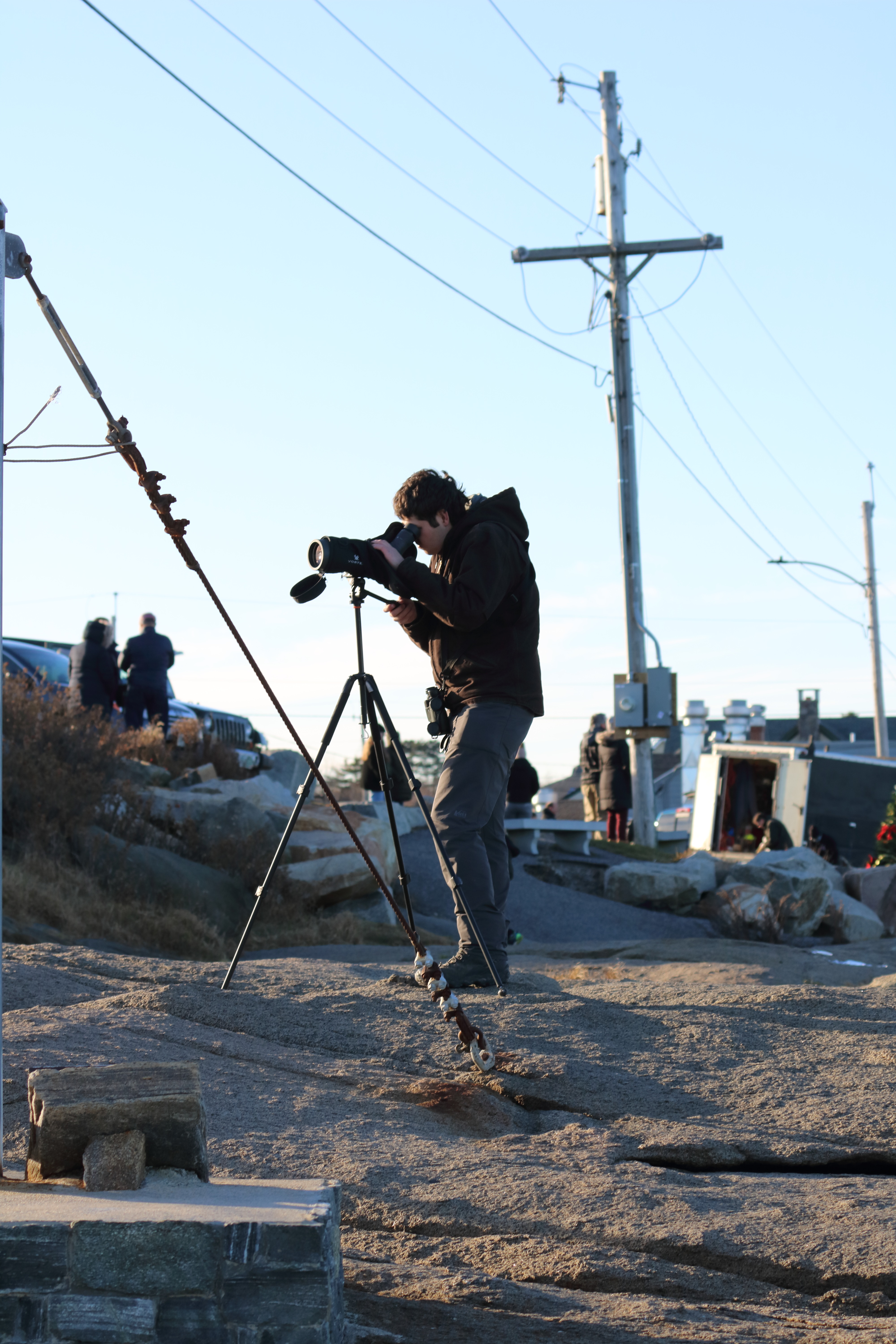
Miles Scheuering had contacted me a few weeks ago about the fact that he would be in Maine as part of a going-on-three-month road trip he’d been on this fall. I’d run into him a few times in Missoula when he’d attended the University of Montana, but never really gotten the chance to talk to him, so I jumped at the chance of birding together! He’d picked me up at my dorm that morning, neither of us with specific birding targets in mind. Now we were driving towards southern Maine on a whim, hoping that the Caribbean bird that had randomly showed up in a coastal neighborhood would still be there when we arrived. Along the drive, we began filling in our lists for the counties we passed through as I learned about how Miles’s road trip had gone. He’d struck out from Portland, Oregon in September, driving through Colorado up to Montana, and then straight down to the Salton Sea in southern California. He then had shot east through the Lower Rio Grande Valley in Texas, around the Gulf of Mexico, and up through New England until arriving in Orono to pick me up.
Having fellow Montana birder Miles Scheuering show up in Maine was a welcome surprise—and led to some BIG BIRDING!Thank you Miles!
And now he found himself again driving south with me in tow to chase what appeared to be only Maine’s fourth ever eBird record of a Gray Kingbird, a Caribbean bird that shouldn’t have been within 1500 miles of Maine but had an unusual habit of straying north in late fall. Ironically, I had been in Florida a few weeks ago for Thanksgiving but had not even dreamed of seeing this bird then.
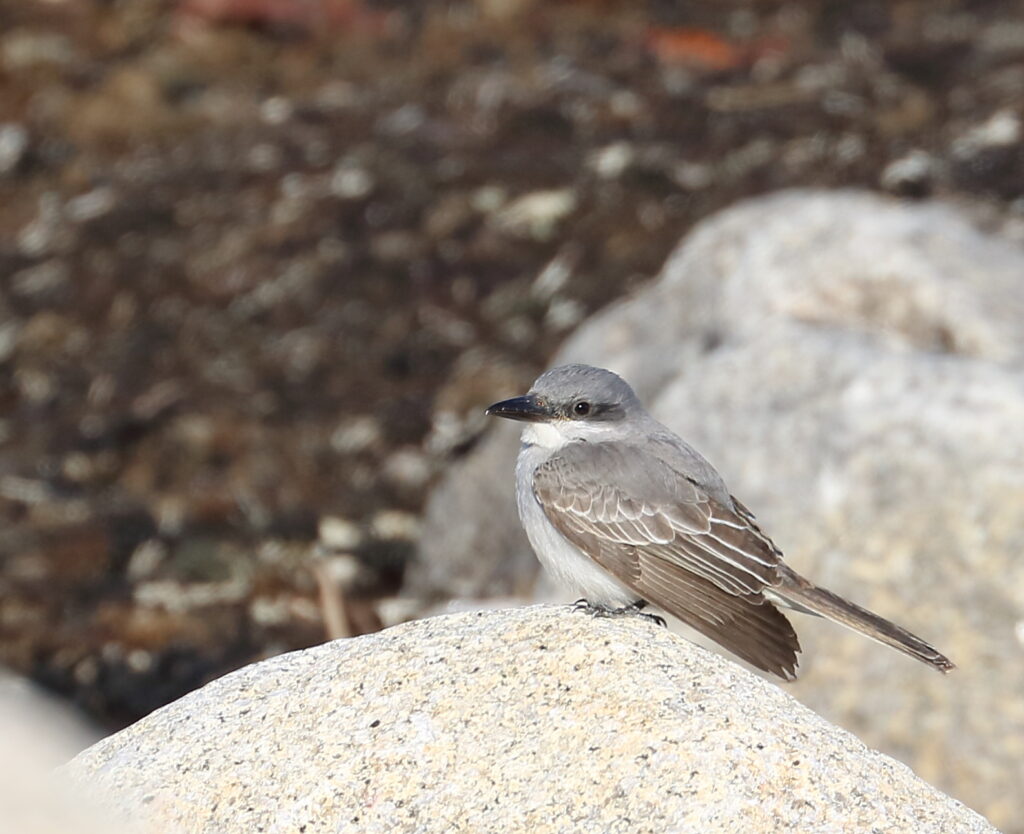
Driving south, we passed small, coastal towns including Biddeford and Kennebunk that had become familiar to me during the last few months, especially because I’d made friends who lived there. A few miles south of Biddeford, we hung a left, and the Atlantic Ocean soon came into view. So, too, did a large number of cars and people wearing binoculars and cameras walking along a single road bordered by a rocky breakwater. We parked, then headed toward the commotion. Almost immediately, someone pointed a small bird out to us several dozen meters away. It was actively flycatching and landing on the rocks, stopping periodically to admire the large crowd that had gathered to watch it. The flycatcher was slate gray, with a dark, raccoon-like mask and a hefty, Eastern Kingbird-esque bill. It was definitely a Gray Kingbird!
Maine is the last place I expected to nab my lifer Gray Kingbird—a bird that shouldn’t have been within 1,500 miles of Maine!
As Miles and I watched the flycatcher sally back and forth across the breakwater, a lady approached us.
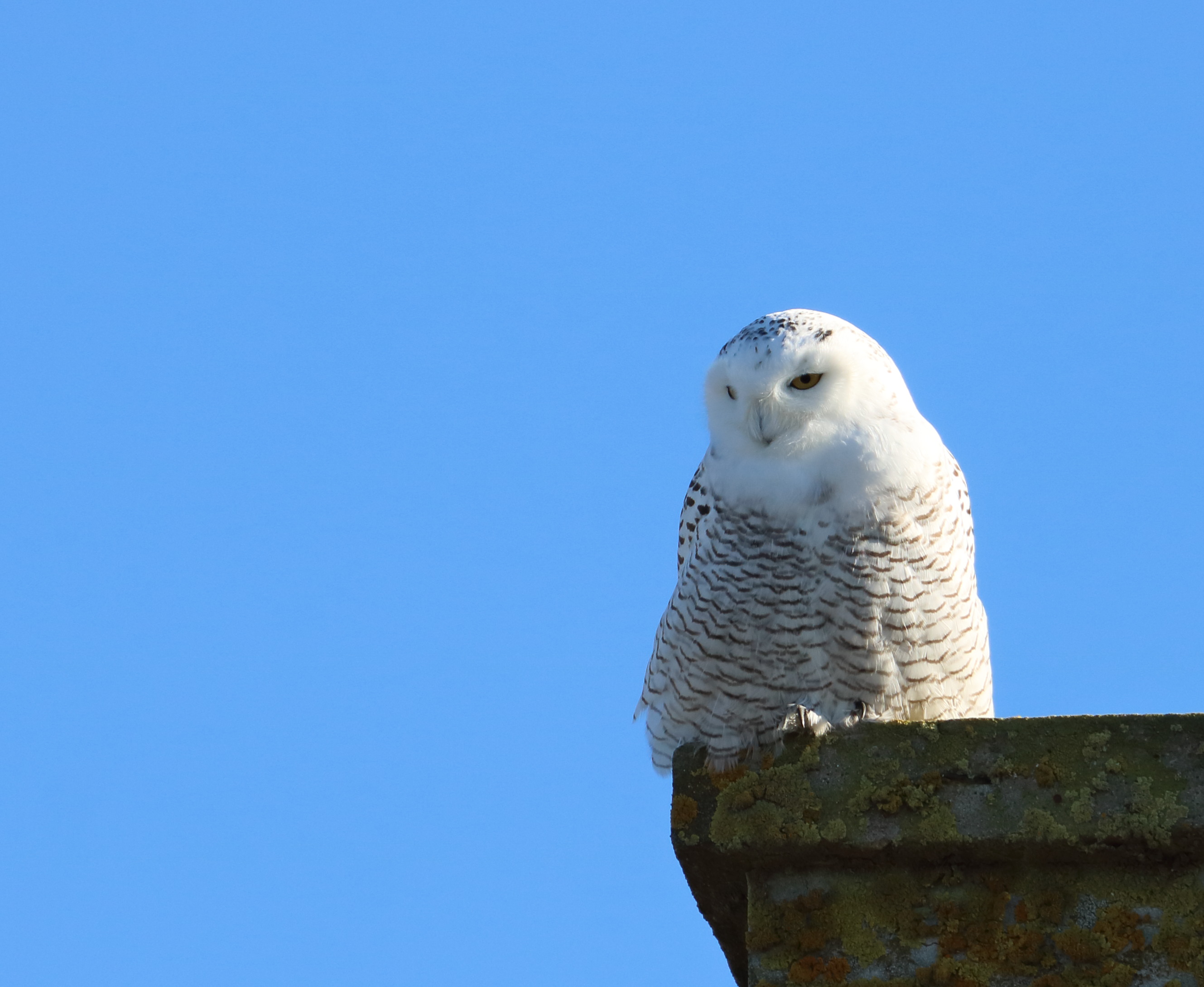
“Hey, I know that it’s not the star of the show, but there’s a Snowy Owl on that roof over there.”
I looked up, and sure enough, spotted a large white ball perched on a chimney several hundred meters behind the Gray Kingbird. “No way! I wonder if anyone has ever had Gray Kingbird and Snowy Owl on the same list before today?” I said to Miles as he began scoping the ocean for sea ducks.
It wasn’t the Snowy Owl we’d set out to find, but we’d take it!
“I doubt it…got some Black Scoters though!”
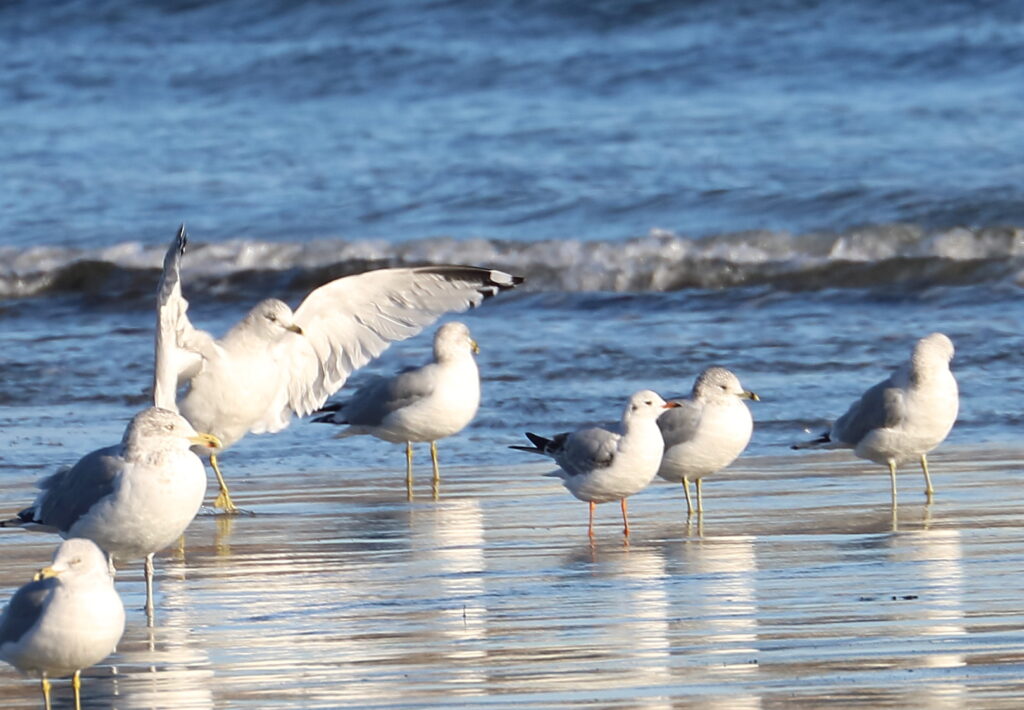
Soon enough we’d picked up all three scoter species (my second time doing that in a day in Maine and my first time doing it in one spot) and Long-tailed Duck. After snapping photos of both the kingbird and the owl, which were both incredibly cooperative, and scanning a large gull flock for anything interesting, we headed out. We probably should have turned around to begin the long drive north again, but instead we continued south to investigate a report of a Black-headed Gull in the town of York, half an hour away. We pulled up at a large sandy beach—a rare sight in Maine—and immediately picked out several flocks of gulls standing beside the rolling tide. Sure enough, I soon observed a dainty gull with bright red legs, a red bill and a dusky ear spot hiding among the larger Ring-billed and Herring Gulls. Black-headed Gull was a lifer for Miles and an ABA lifer for me, and we watched it loiter on the beach as its American counterpart, a Bonaparte’s Gull, dove into the surf behind it.
Can you find the Black-headed Gull here?
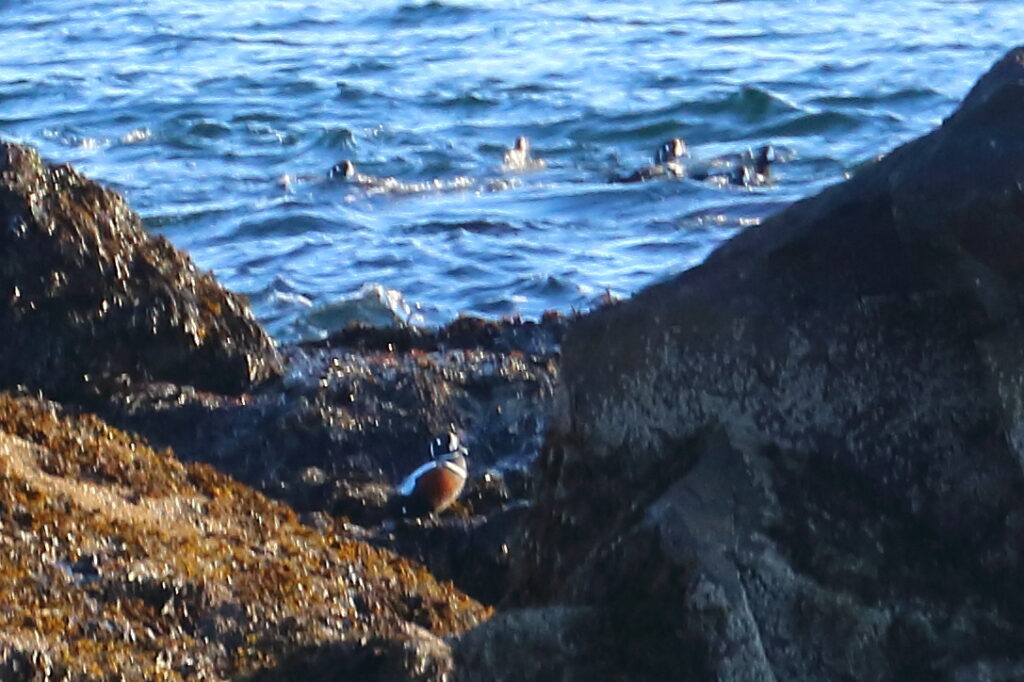
Hungry for more, we drove to a nearby lighthouse to check for Purple Sandpipers and Harlequin Ducks. No sandpipers showed themselves but Miles quickly found two groups of mostly male Harlequins hugging the rocky coastline. It was really cool to see these in their wintering habitat as compared to the fast-flowing streams I’d usually seen them in in Glacier National Park.
Not the best photo, but this was the first time I’d ever seen Harlequin Ducks outside of Montana!
We decided to head back towards Orono, briefly stopping to look for a Clay-colored Sparrow in a cemetery in Portland to no avail. Miles dropped me back at UMaine at around 5 pm, and we made sure to exchange information about birding Maine and Oregon. In fact, Miles will be back in Oregon when my family heads over there for Christmas, so you may see his name pop up on another blog in the near future! It had been an epic, rarity-filled day, and I went to bed dreaming of owls on rooftops and flycatchers by the sea.