Tag Archives: Montana

Another Accidental Big Year: Sneed’s 2022 Recap

FatherSonBirding’s millions of loyal fans will have no doubt noticed a paucity of posts the past few months, and we sincerely apologize, noting the severe nationwide downturn in consumer confidence and the real estate market that this has obviously precipitated. Fortunately, our silence has been a result of good things happening to Braden and me. Braden has been having some exceptional academic experiences during his fall semester at UMaine while I have been kept busy both birding and working on several exciting book projects that have come my way. That said, we’d like to take a couple of posts to wrap up the last few months and, indeed, our entire year of birding. Since Braden is studying for finals, I’ll go first.

Some of you followed my “Accidental Big Year” last year in which I set a new personal best of 352 ABA species during 2021. Believe it or not, I’ve blundered into another accidental Big Year in 2022. How the heck did that happen? I mean, I have definitely underperformed in my home state of Montana this year, notching my lowest total in several years. Fortunately, our trips to New York City and Arizona put me within striking distance. By early October, my count sat at a tantalizing 335 species, only 17 birds short of tying last year’s record, but where would the additional species come from? Some good writing news led to the answer.

This summer, I landed a contract to write about conservation on military bases, with a special focus on Eglin Air Force Base in the Florida panhandle. I chose this base because I spent all of my summers growing up with my father in Pensacola—adjacent to Eglin. Call it nostalgia or a desire to learn more about the area’s species, but I arranged to interview biologists down there to find out what they were doing. First, though, I decided to stop to see my brother in Atlanta, Georgia.

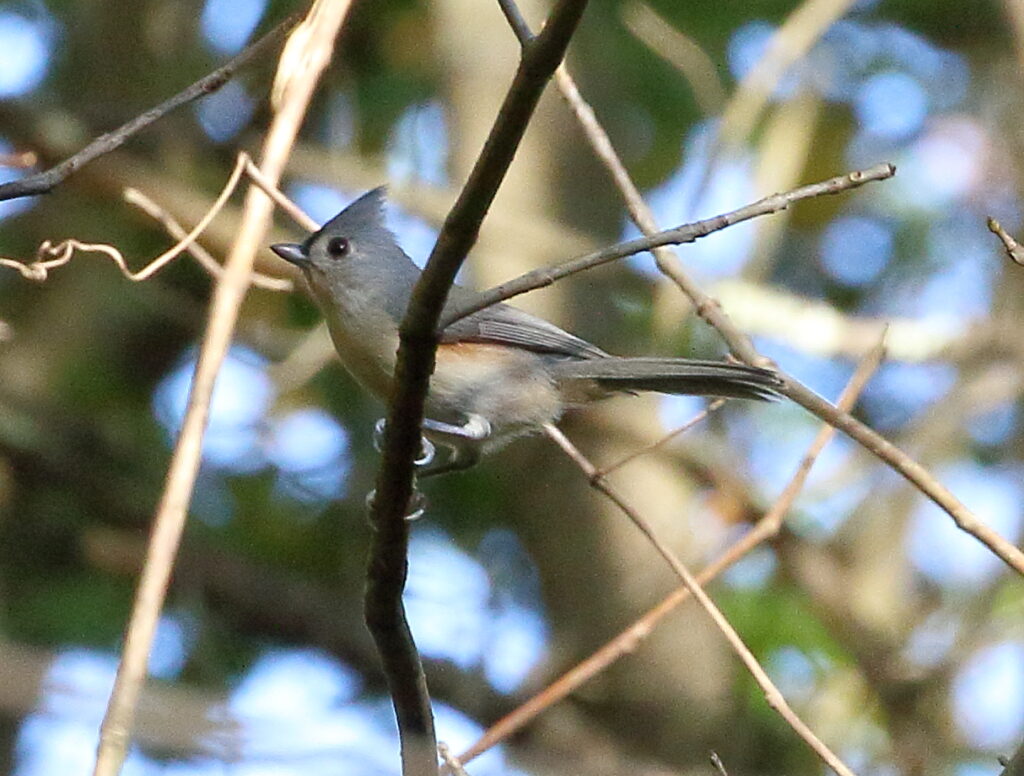
On my recent trip, I didn’t get photos of my best Atlanta birds, but Tufted Titmice are always a blast to see.

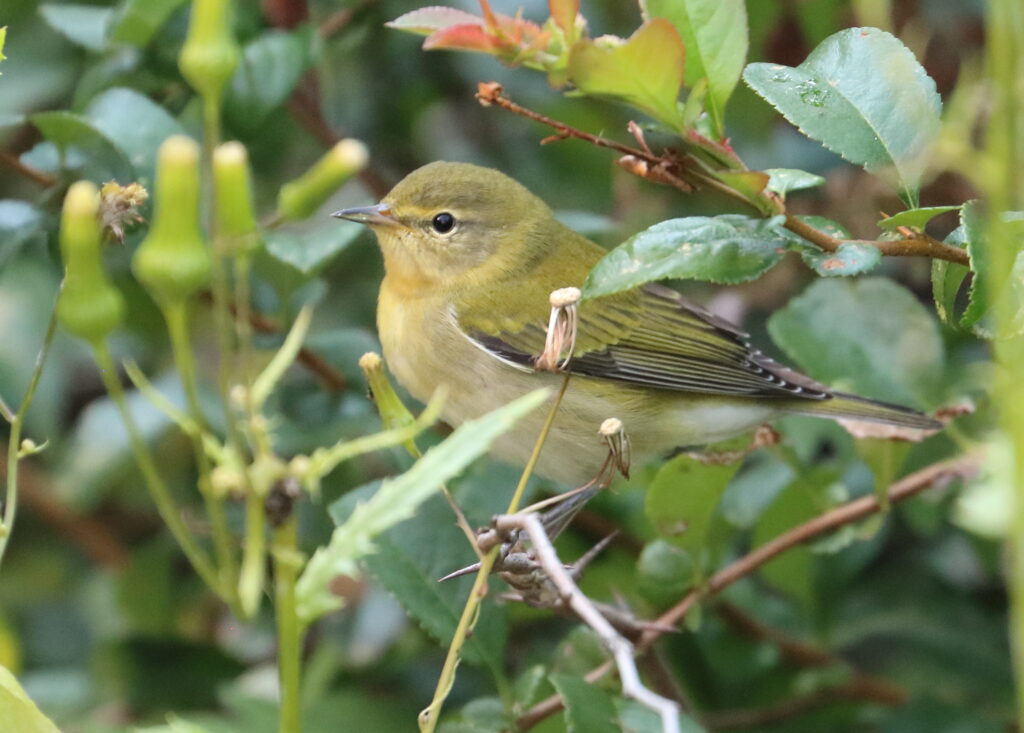
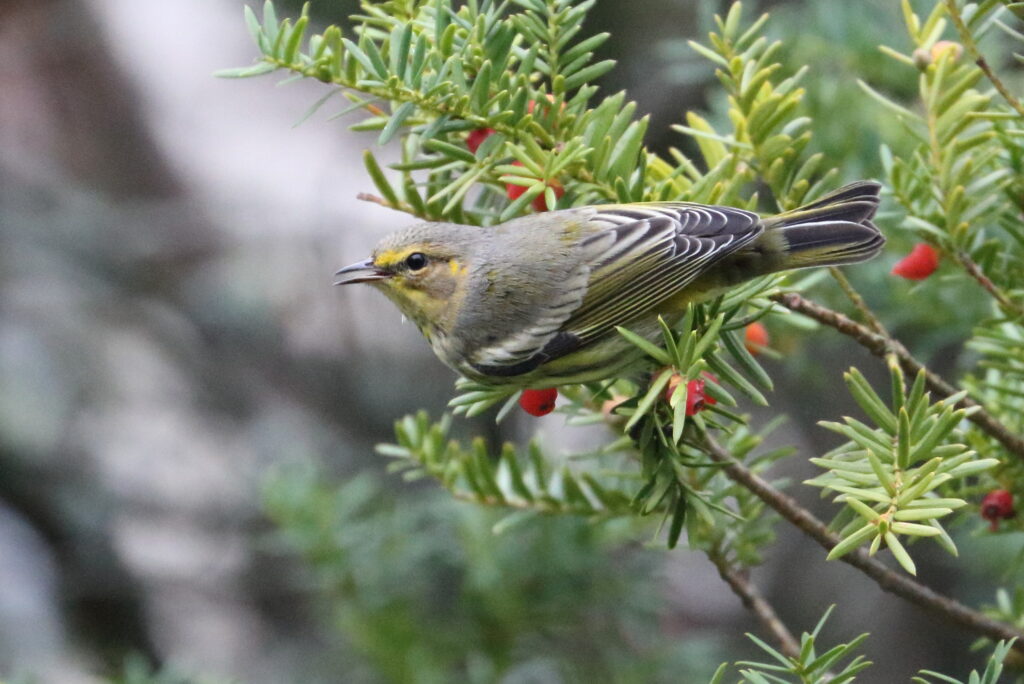
Honestly, I didn’t know how many new birds I’d see in Atlanta. Migration season was waning, and it was possible warblers and other songbirds had already moved through. In general, they had, but thanks to some intensive studying and tutelage by Braden, I was able to score a number of great birds including a trio of wonderful warblers: Blackpoll, Tennessee, and most exciting, Cape May—a Lifer pour moi.

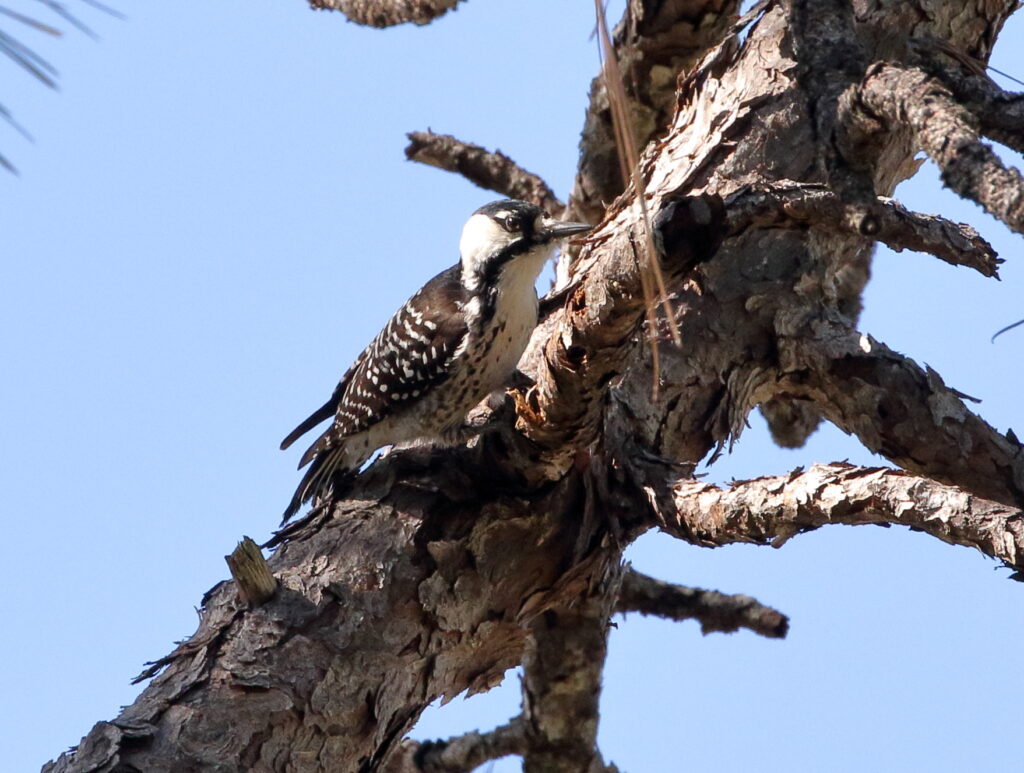
Leaving Georgia to take up a week-long residence with my stepmother Suzanne and her partner Jim in Milton, Florida, I wondered if I was close enough to top 352 for the year? Unfortunately, I arrived in Florida suffering from my first cold in three years—one I am just now getting over six weeks later. Not how I wanted to begin three consecutive long days of work at Eglin! Nonetheless, I persevered and got a bunch of great information from the base biologists. Oh, and I kept adding up Year Birds! In fact, I couldn’t have asked for a better bird to break my record. As biologist Kelly Jones drove me around teaching me about endangered salamanders, we ran into a group of Red-cockaded Woodpeckers, one of America’s coolest and most unusual birds. These birds became endangered due to the catastrophic loss of longleaf pine ecosystems across the Southeast, but many people have been working to restore both the pines and the woodpeckers. Last I heard, Eglin is home to the nation’s fourth-largest population, but this was the only group I ran into while there.

Red-cockaded Woodpeckers are the only North American woodpeckers that carve holes in living trees. Apparently, the sap running down the tree trunk helps deter snakes and other potential predators.

Not wanting to wear out my welcome with Suzanne and Jim, I used the weekend to take a jaunt over to Tallahassee to visit St. Marks National Wildlife Refuge. My dad, a professor at the University of West Florida, led many field trips to St. Marks and always raved about it. More recently, Braden and Nick Ramsey, visited the refuge, seeing among other things a lone flamingo that has lived at the refuge for the past four years. I hoped also to see this bird—dubbed “Pinky”—but kept my expectations low.

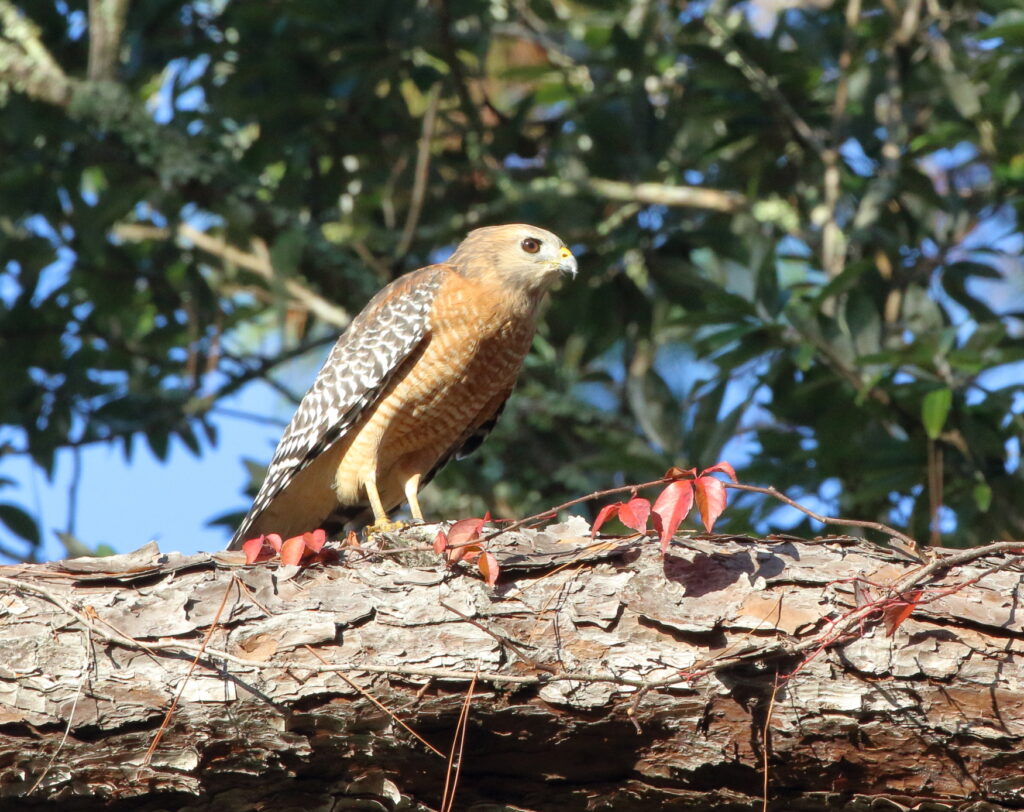
I know they’re common, but I love Red-shouldered Hawks, and this is by far the best photo I’ve ever taken of one.

Upon arriving, I discovered that St. Marks truly is a magical place—a remnant of “Old Florida” with towering oaks and pristine marshes—and my visit got off to a good start with great views of a Red-shouldered Hawk and Yellow-bellied Sapsucker at the visitor’s center. I asked the local naturalist if anyone had seen Pinky the flamingo lately and she said yes, but didn’t know where, so I decided to head down to Lighthouse Pool and work my way back. As I reached the pond, I happened to glance right. There, in the middle of the pond, stood a large orange blob.

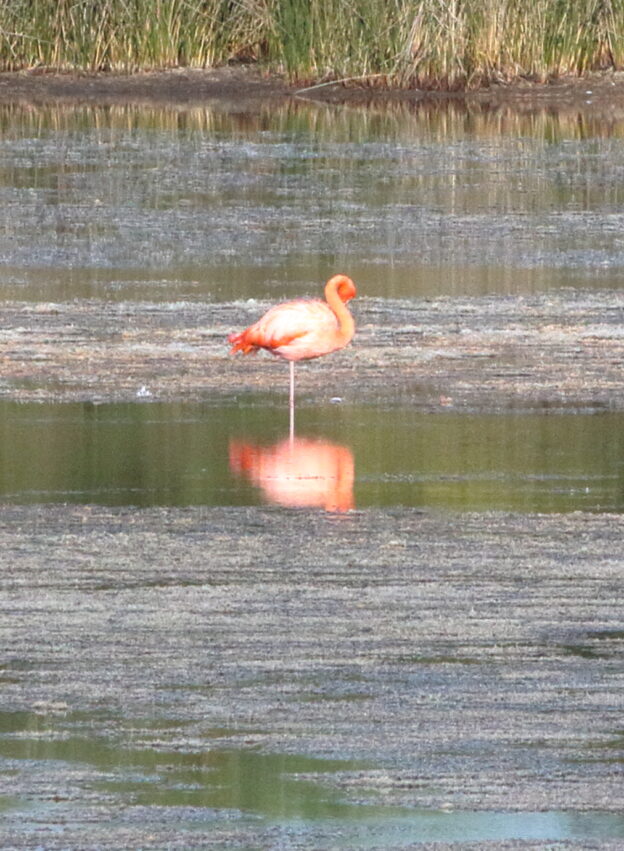
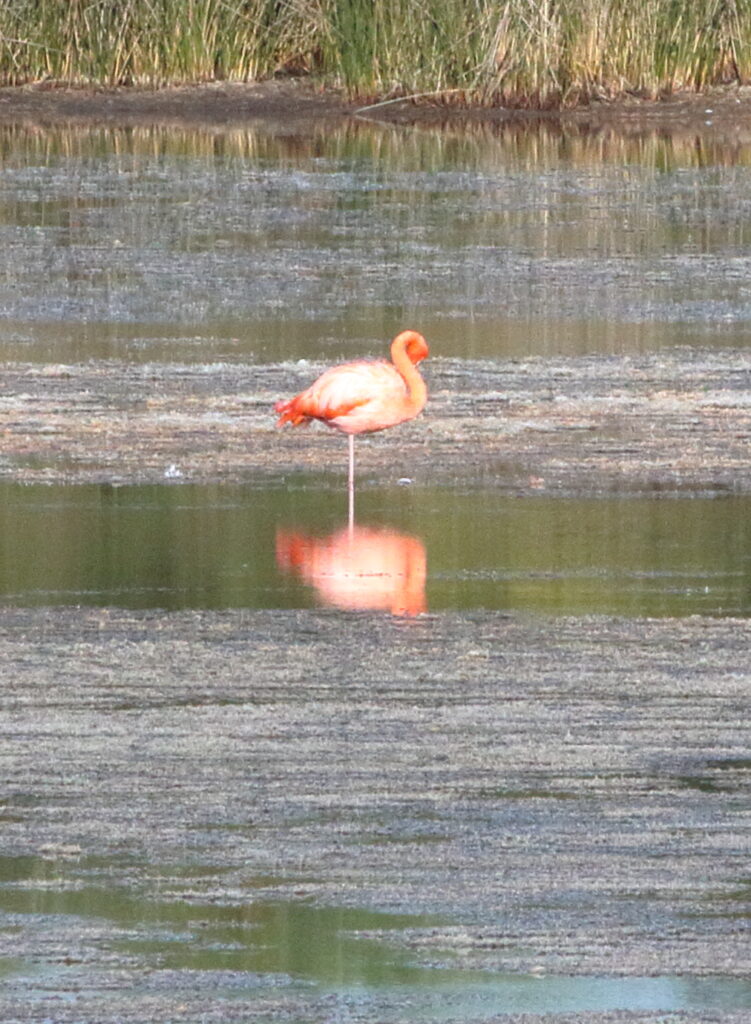
“No way!” I exclaimed, braking to the side of the road as I reached for my binoculars. Sure enough, there stood Pinky—America’s most famous flamingo. Full disclosure: Pinky was not the most exciting bird on the planet, content to just stand there and preen when s/he felt like it. Taking a walk along the southern edge of the pond, however, I picked up lots of other nice Year Birds including Reddish Egret, Tricolored Heron, Short-billed Dowitcher, Semipalmated Plover, and more.

I’m not sure where Pinky got his name, but to me he looked obviously orange. Still, an official Lifer for me, though I did see American Flamingos thirty years ago in Bonaire.

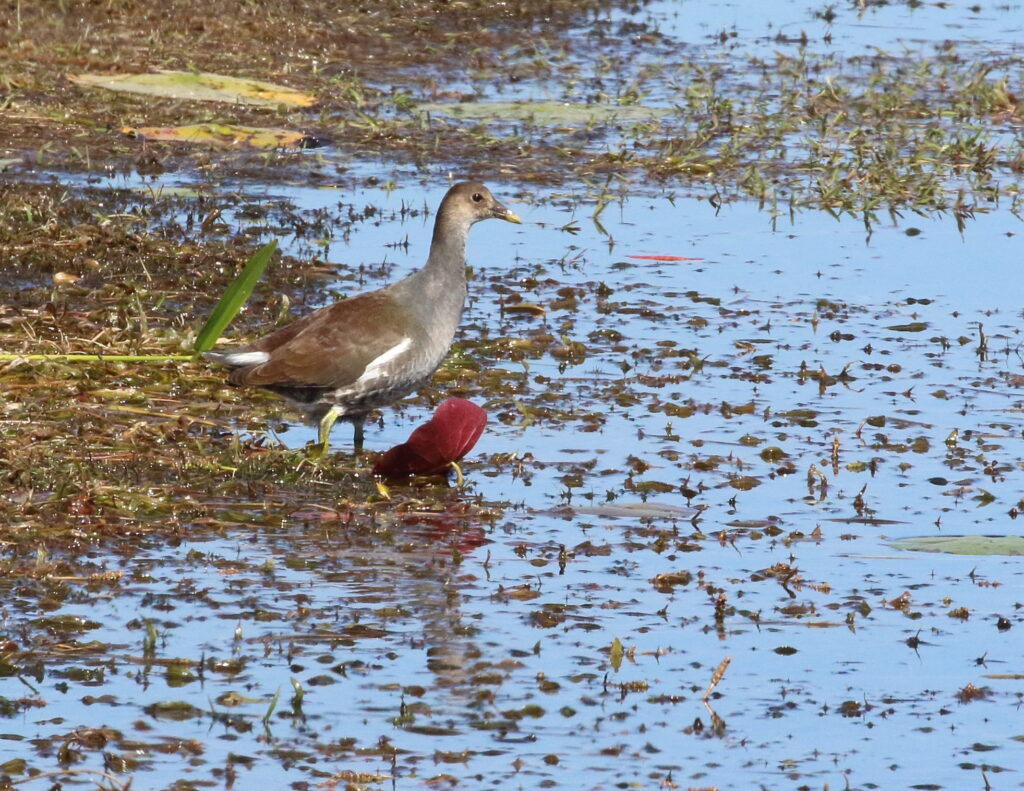
My visit to St. Marks was far from finished. As I drove back up the road, I thought I spotted a rail at the East River Pool location. I didn’t—and this was not the first time I’d mistaken a Common Gallinule for a rail! Training my eyes out on the pond, though, my heart picked up. Why? Because way out there among a large group of wading birds, I spotted another Lifer: Wood Stork! Along with Roseate Spoonbills, another Year Bird. My Lifer-palooza hadn’t ended, either. Following Braden’s directions I drove to another part of the refuge to hear my Lifer Clapper Rails.

This is at least the second time I’ve mistaken a Common Gallinule for a Clapper Rail. I do believe they’re closely related, though, so I hope that you, my dear readers, cut me some slack!

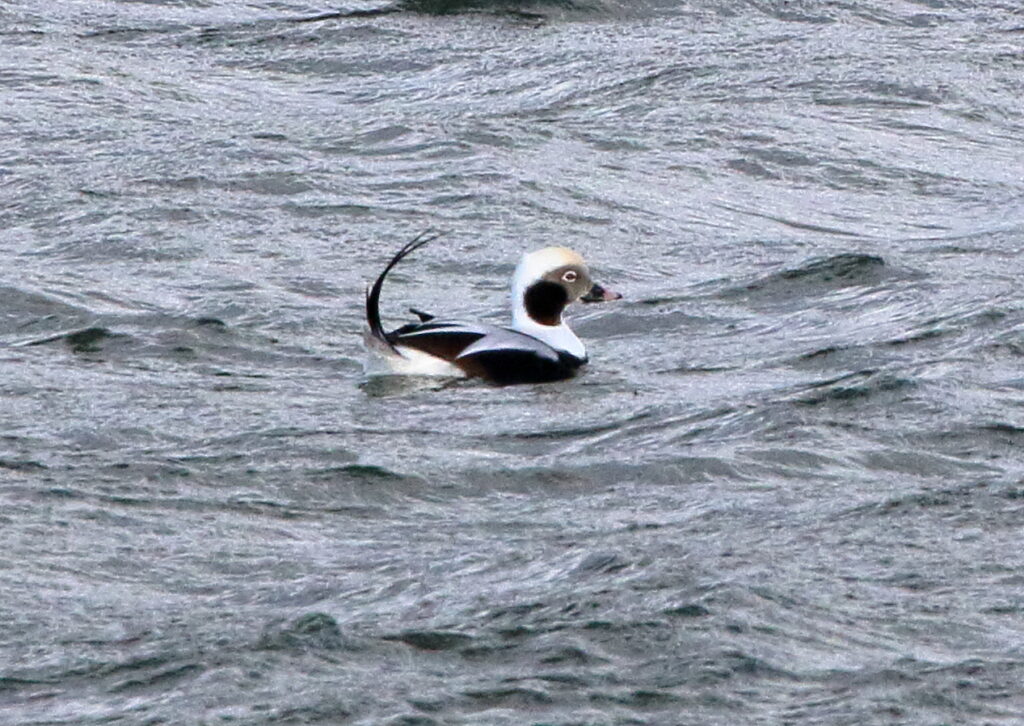
I returned to Montana with a total of 372 Year Birds and have since picked up a few more, thanks to a fortuitous discovery of Montana’s first Long-tailed Duck of the winter, along with the first Bonaparte’s Gulls I’ve ever seen in Missoula County. These and a Horned Grebe now have me sitting at 375, well in excess of my previous ABA Big Year record. My guess is that I’ll pick up one or two more when Braden gets home in a couple of weeks—though what they might be I have no idea. And you know, it really doesn’t matter. While it’s fun to count birds, it’s even more fun to get out and see them and, hopefully, make some new friends along the way. At St. Marks I met several delightful birders to share my adventures with. I hope that as 2022 draws to a close, you all have your own memorable birding adventures combined with heavy doses of peace and friendship.

My Lighthouse Pool checklist.

Perhaps my biggest score of the year was seeing the first Long-tailed Duck recorded this winter in Montana—and my first male ever. If this isn’t a glorious animal, I don’t know what is!

Montana Shorebird Surprise

We’re sharing our most recent birding adventure in reverse order. The day before chasing the wily White-Tailed Ptarmigan, Braden and I had an incredible outing at Benton Lake National Wildlife Refuge (see also The Best Prairie Day Ever). Normally a go-to place for grassland birds and waterfowl, Benton didn’t seem likely for the birds we most wanted to see—shorebirds. Were we in for a surprise! Here’s Braden’s report.

Visiting the Pacific Ocean this summer and having several great days of birding there did nothing but increase my drive to find shorebirds. Between Monterey, the Bay Area and Point Reyes, I had seen species like Red Knot (my lifer), Black and Ruddy Turnstones, Red and Red-necked Phalaropes, Short-billed Dowitchers and more. Now, I was ready to see these and other species during my short stay in Montana before heading back to college in Maine. However, seeing shorebirds along the ocean, where there were miles and miles of great habitat for thousands of birds to choose from, was one thing. In Montana, shorebirds were often hard to find, even during their peak migration in August and September. Two autumns ago, my dad and I had birded hard, visiting the Ninepipe Valley half a dozen times as well as Helena and Three Forks in a quest to find shorebirds. While we had found most of our target species eventually (including finding Baird’s and Pectoral Sandpipers a handful of times and Western Sandpiper once), we found very low numbers across the whole season and missed our main target species, American Golden-Plover. This was fairly normal for Western Montana.

This year, on our way to Glacier National Park for an entirely different bird (see In Search of the Wily White-tailed Ptarmigan), my dad and I decided to seek shorebirds at refuges along the Rocky Mountain Front. I’d seen several reports of large numbers of Stilt Sandpipers at Freezeout Lake in past Augusts, and so we thought maybe we could find some of them there. And so, two days after I arrived home from California, we woke up at four in the morning and headed for Great Falls.

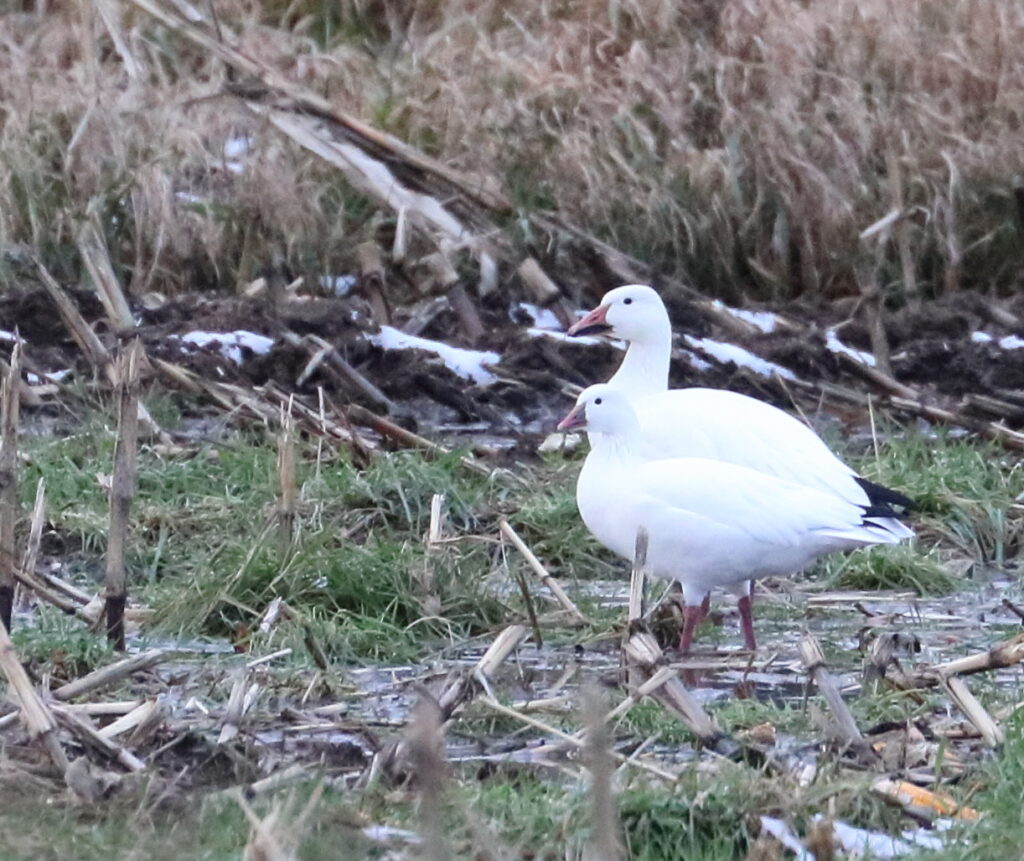
Unfortunately, we didn’t find that much at Freezeout. A few yellowlegs and Solitary Sandpipers picked the mud along the shoreline of the ponds, and we ran into a small flock of Baird’s Sandpipers right at the end of the driving loop. Overall, the refuge—famous for its spring Snow Geese—had been disappointing. However, that didn’t really matter given that we had gone to Benton Lake National Wildlife Refuge first. 

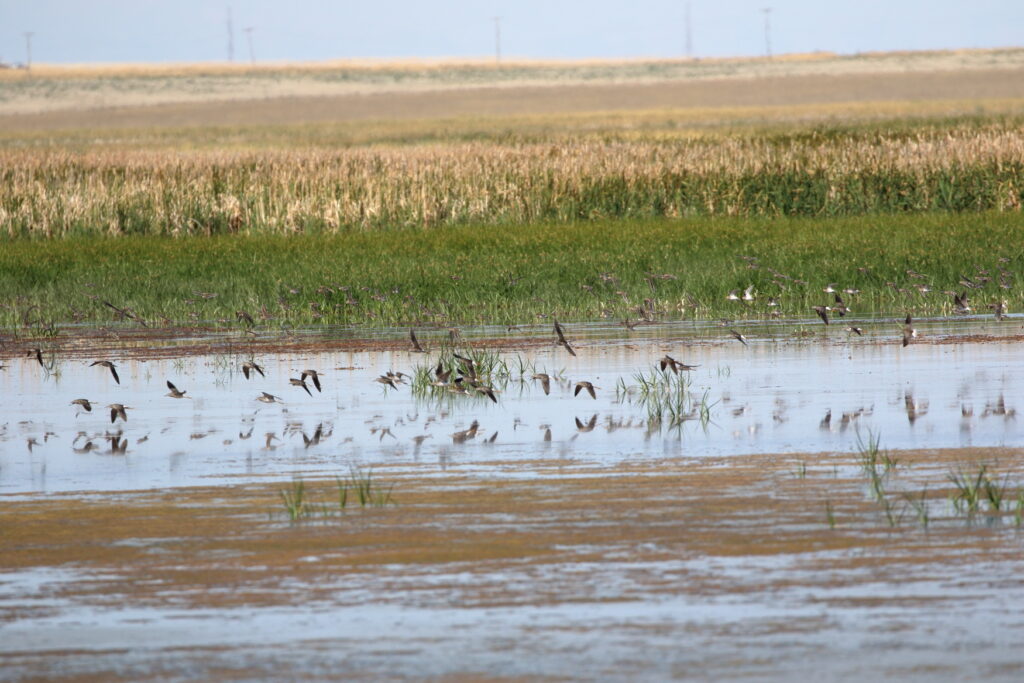
As soon as we arrived at Benton Lake, flocks of Baird’s and (probably Greater) yellowlegs greeted us.

Benton Lake normally did not seem to have good shorebird habitat. Every May, when we would come here to get our Upland Sandpipers and Chestnut-collared Longspurs for the year, we would drive by cattail marshes and open grasslands—not mudflats. The drought in the West this year had been changing everything, though. Bowdoin, one of the best refuges in Montana, had such low water levels that ducks were hard to come by. At Ninepipe National Wildlife Refuge, the ponds on Duck Road had disappeared by May. The upside? Some lakes that previously had been terrible for shorebirds suddenly had extensive mudflats filled with millions of tasty invertebrates for these arctic migrants to feed on. Which is what happened at Benton Lake.

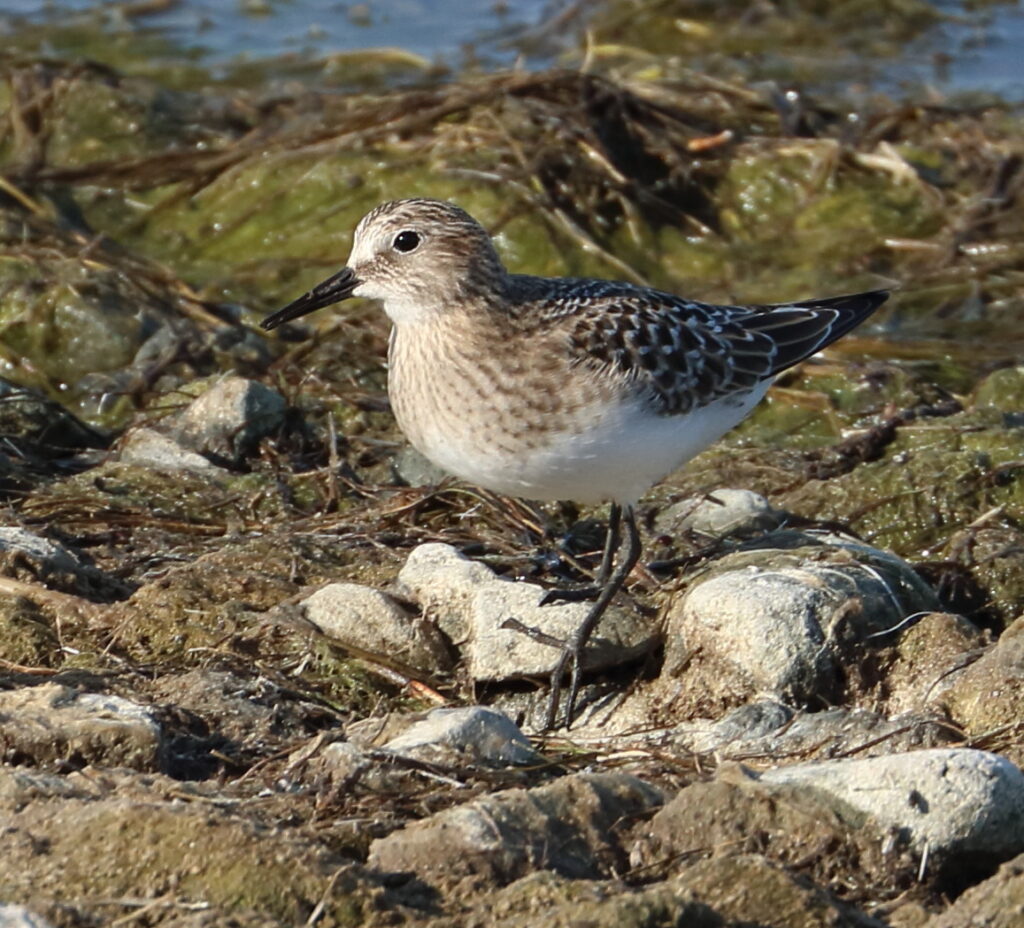
With high numbers and some close approaches, Baird’s Sandpipers proved to be the highlight of our Benton Lake shorebird extravaganza. Baird’s are larger than peeps (though some people group them together), and are identified by their black legs, robust breast markings, medium bill, and wings that extend out over the tail.

In fact, as soon as we arrived at the first pond, a large flock of small shorebirds lifted off from some distant mud, speeding over another flock feeding in the shrinking lake. My dad set up the spotting scope and we quickly determined that both of these flocks were primarily composed of one of Montana’s most common fall shorebirds, Baird’s Sandpipers. As we scanned these favorite sandpipers, we marveled at how much individual variation there was within each group. Though every bird was of the same species, each differed slightly in color, size, shape or bill length, allowing us to learn about what features confirmed a bird as a Baird’s. Soon, I noticed several more Baird’s on the shoreline next to us less than ten feet away, allowing us to get even better views and great photos. However, Baird’s were not the only species out on the mudflats. During my scan of one of the more distant flocks, I spotted a taller sandpiper, with a longer, more curved bill and thick supercilium.

“Stilt Sandpiper!” I yelled, and my dad was able to glimpse the species before the whole flock took off again. That same flock held a few peeps that I struggled to identify, debating whether the bills were long enough for Westerns or if the colors were right for Least or Semipalmated. Despite having some practice with peeps, they always manage to confuse me.

We moved on to the next pond, where more shorebirds waited. More Baird’s flew circles around us, and we spotted a huge group of dowitchers lifting off in the distance, complete with both species of yellowlegs. Solitary Sandpipers foraged on the shore, alongside Killdeer and a few Leasts. Near the end of the final lake, I spotted two Pectoral Sandpipers, another one of our targets, picking invertebrates off the rocks right next to the car alongside our only Wilson’s Snipe of the day! We’d never had better looks or photos of any of these species, and never in these high numbers! At least the drought was creating some good.

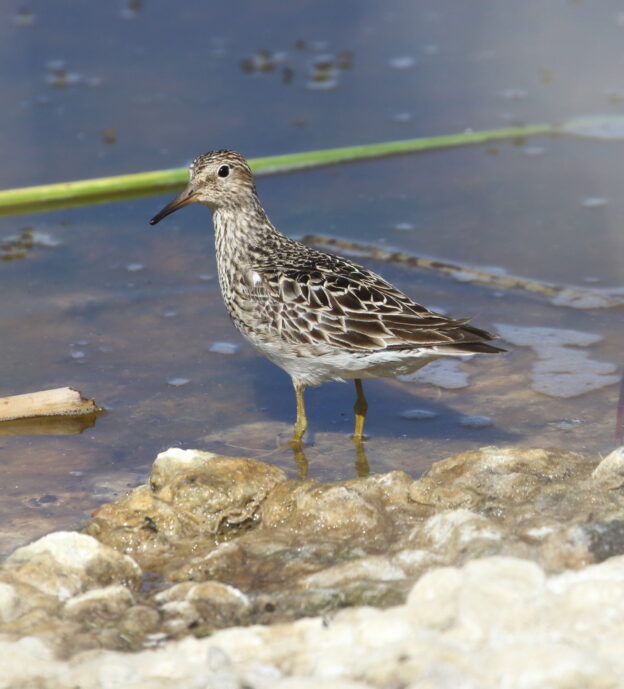
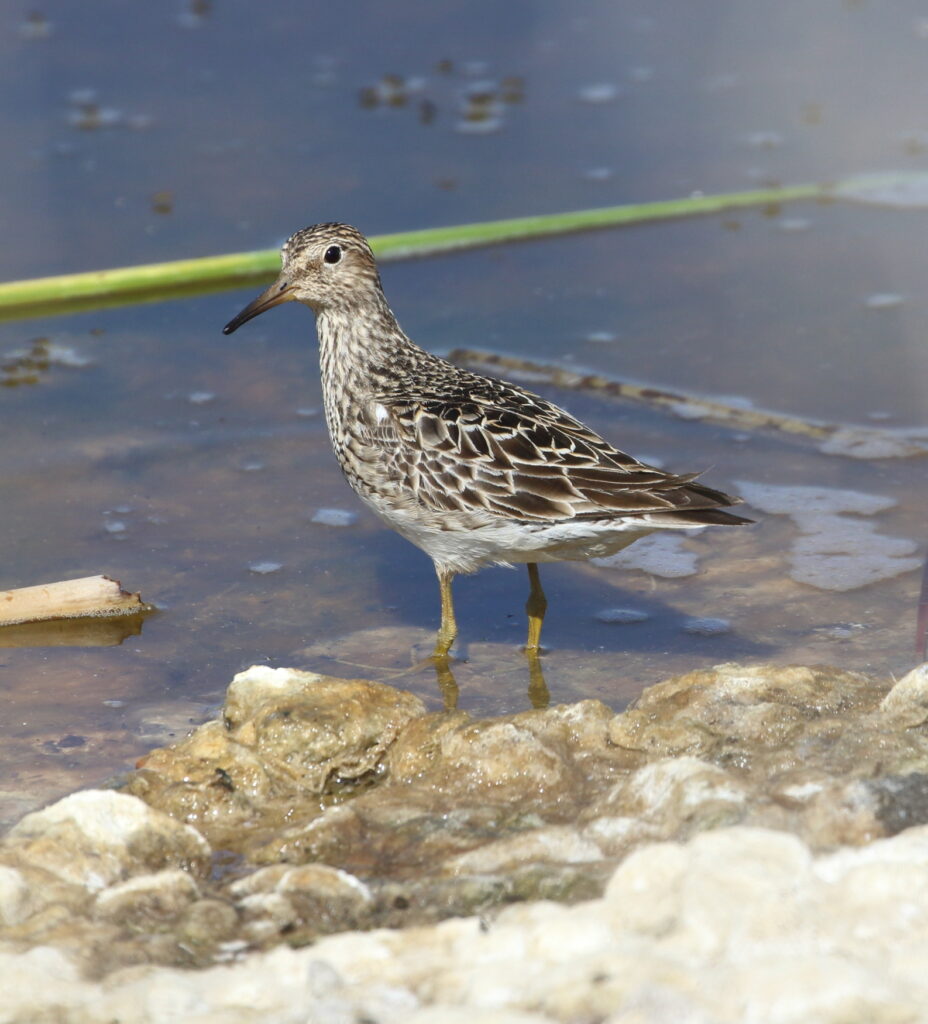
Right along the road, we got our best looks ever at several species including this cooperative Pectoral Sandpiper, distinguished from Baird’s by its yellow legs, larger size, and more extensive and abrupt cutoff of markings on its breast.

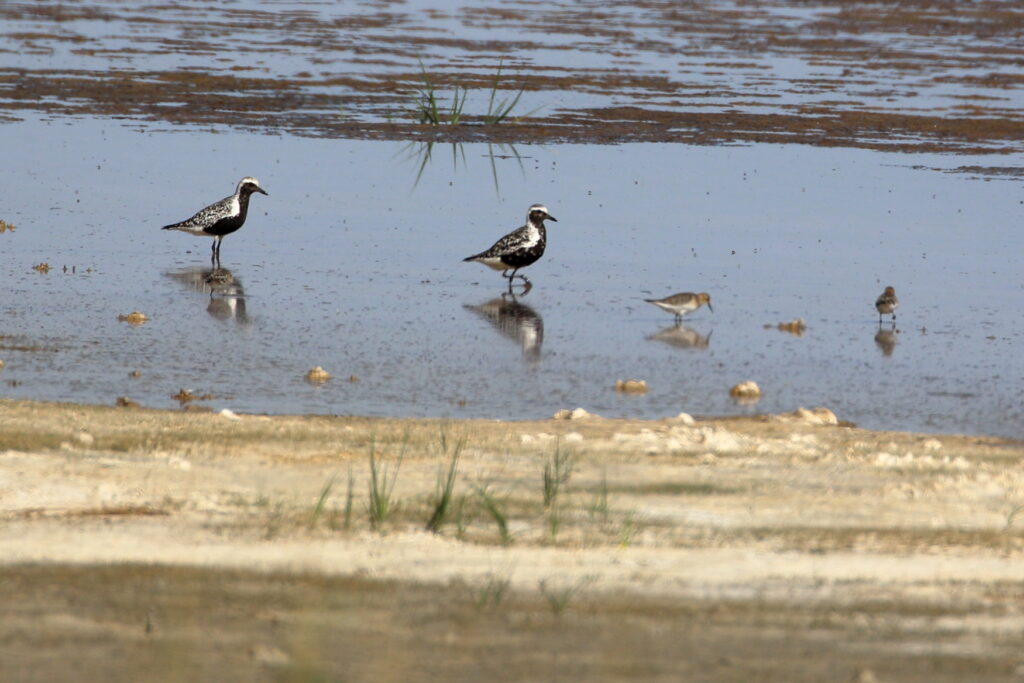
Our most astounding discovery happened as we were picking through another flock of Baird’s Sandpipers, searching for something unusual. As I looked up, I spotted three striking black and white birds flying towards us, and my heart rate jumped. They landed a short distance away, and I stared at them through my binoculars: three Black-bellied Plovers, still completely in breeding plumage! While we’d seen these birds in Montana in previous years, we’d never had such an experience with their breeding colors! They hadn’t been on my radar at all, either, though perhaps they should have been.

Black-bellied Plovers weren’t even on our radar, so imagine our delight seeing three fly in—and in full breeding plumage! (Note the Baird’s Sandpipers next to them.)

My dad and I had finally done it. This was the shorebird experience we’d been hoping to have in Montana for years, and Benton Lake, not any other famous shorebird hotspot, had been the place to provide it for us. The next day we’d leave the prairie behind and head for the mountains of Glacier, though hopefully our year of shorebirds wasn’t quite through!

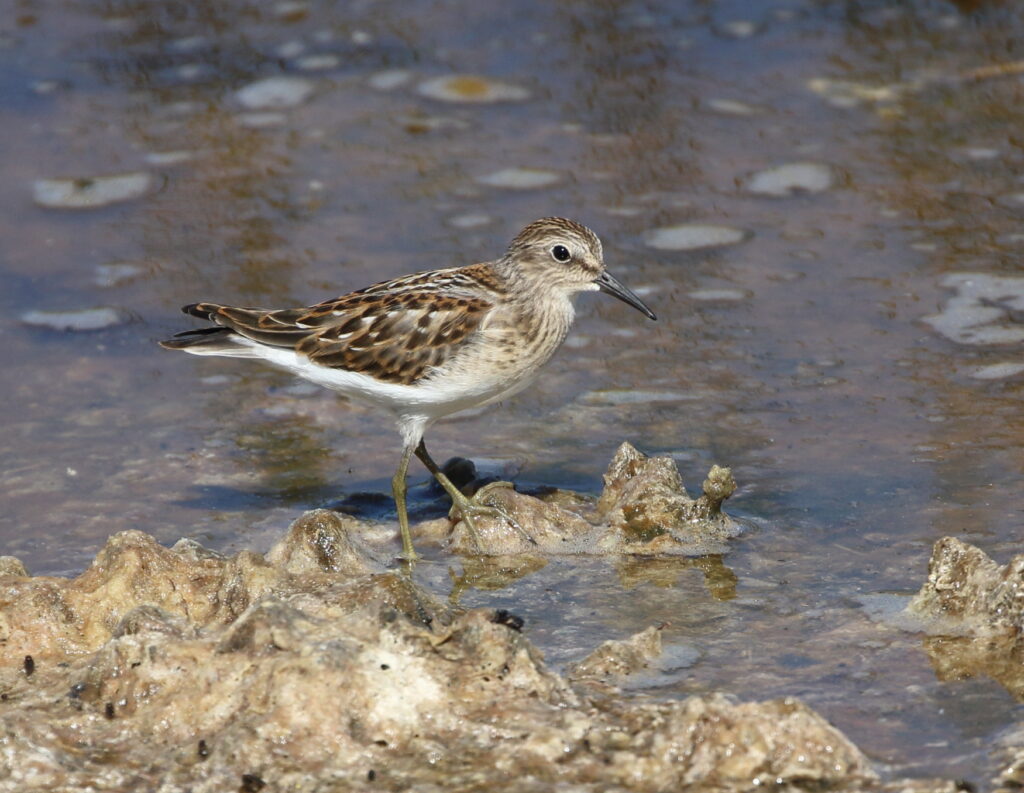
As usual, peeps were hard to pick out, but we did get a great experience with a Least Sandpiper near the end of the driving loop.

In Search of the Wily White-Tailed Ptarmigan, 2022: with VIDEO!

Happy Labor Day Weekend, Everyone! We hope you are not laboring too much and, instead, getting out for some birding. We’ve been “blog quiet” for a few weeks, and that’s no accident. I have been once again driving for Missoula Fire Cache once or twice a week (see Birding by 5-Ton Truck), Braden came home from California & then jetted back to school in Maine, and the birds? Well, they’ve been pretty quiet. During his time at home, though, Braden and I decided on a last-minute two-day intense trip of birding, first to look for shorebirds and then to find a bird I had wanted to see for years. Here is Part 2 of our adventure, Part 1 to come soon. Enjoy!

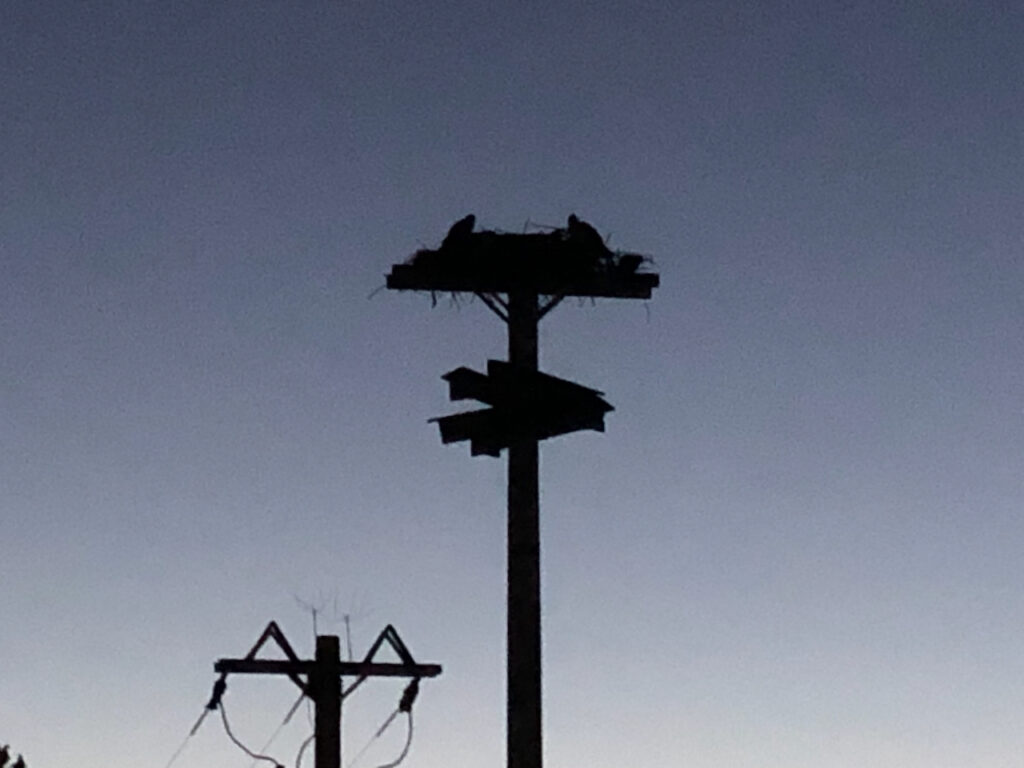
They were the first birds of the day—a pair of roosting Osprey silhouetted against the indigo dawn sky at the Saint Mary’s entrance to Glacier National Park. We had arrived on schedule after rising at 4:00 a.m. and driving from our Super 8 motel in Cut Bank—the only affordable lodging within a 100-mile radius of Glacier. We had had to get here early, too, as the park’s new visitor policy required a reservation for anyone arriving between 6 a.m. and 4 p.m. Chances are we would have risen early anyway since we faced a long hike and, for me, a lifelong ambition: to see a White-tailed Ptarmigan.

First birds of the day: Osprey at the St. Mary’s entrance. I’m pretty sure that Glacier NP pays these birds to sit here and keep visitors entertained while they endure the long lines into the park!

If this goal sounds familiar it’s because just a year ago, Braden had accompanied a storied group of other birders with the same mission and in the very same location (see Ptarmigan Party in Glacier National Park). Unfortunately, I had been forced to skip that outing because of work obligations—and now was my time to make amends. Entering the park with a handful of other early-rising vehicles, we quickly encountered our only charismatic megafauna of the day—a handsome black bear angling across the road. As the dim light gradually revealed the spectacular peaks around us, we drove for twenty more minutes until we reached the tiny parking area for the Piegan Pass trailhead. After getting ourselves sorted, we set out through forest, savoring our solitude, the crisp morning air, and more than anything, the enchanting smells of Glacier National Park.

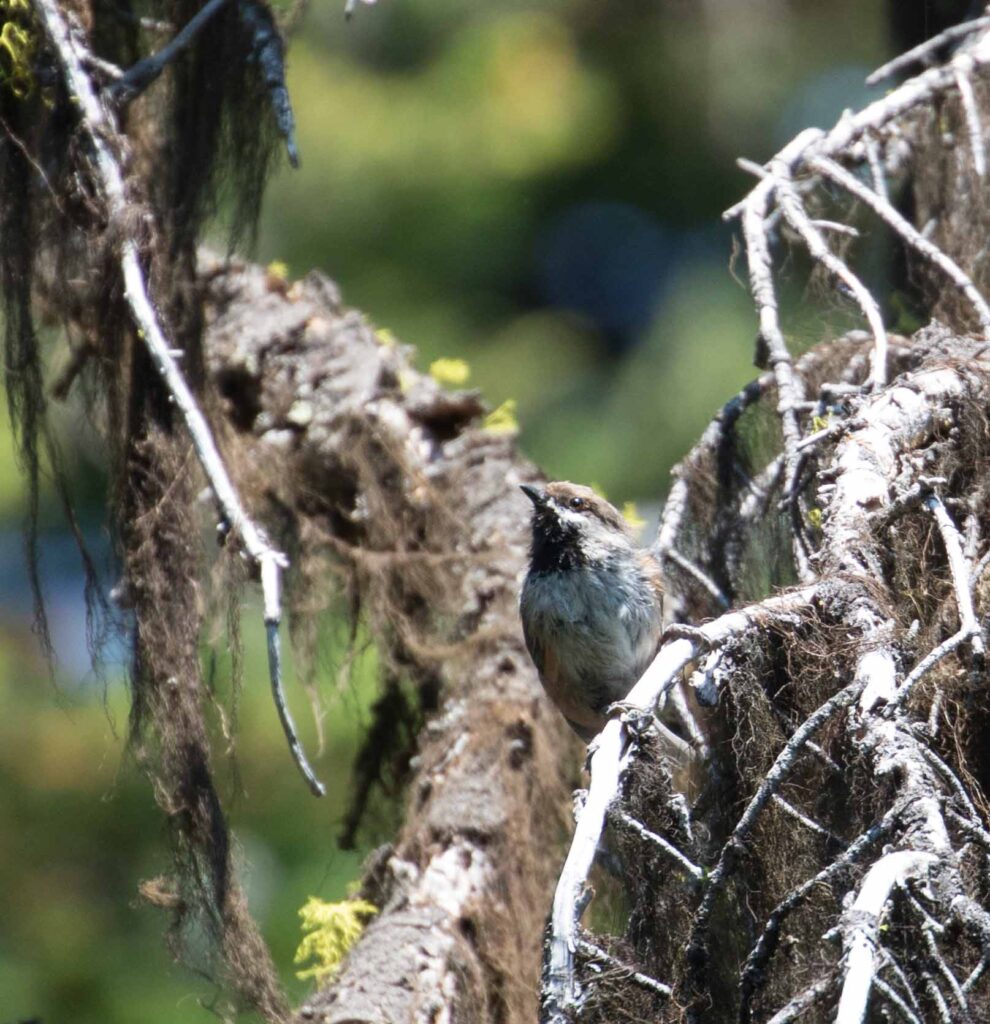
Our hike would take us five miles and more than 2,000 feet up to Piegan Pass, a climb I’d always wanted to make but never had, despite spending an entire summer working as a cook in Glacier in 1979. In addition to our primary goal, we had several other targets, some more likely than others: Boreal Chickadees, Spruce Grouse, Black Swifts, Three-toed Woodpeckers, White-winged Crossbills, and any kind of rosy-finch. As we climbed one mile, then another, however, Braden remarked, “It’s quieter than it was last summer.” Still, I didn’t complain. It just felt wonderful to once again be doing a “real hike” with my son in one of my favorite places on the planet. And slowly, a few birds started showing themselves: Mountain Chickadees, Golden-crowned Kinglets, Chipping Sparrows, and to our delight, a pair of Boreal Chickadees (see Are You Ready for the QUACH?).

A Boreal Chickadee from Braden’s “Ptarmigan Hike” in 2021.

“Well, we got at least one target bird,” I said, and Braden nodded. As we climbed higher and higher, however, I felt anything but confident that the ptarmigan would be waiting for us. The thing about the White-tailed Ptarmigan, though, is that I was pretty sure I’d seen one before. In 1979, while hiking to Grinnell Glacier, I’d encountered a bird with a chick or two sitting right in the middle of the trail. At the time I felt certain it was a ptarmigan, but I hadn’t been a birder, and forty years on, I had reasoned, “Well, it could have been another kind of grouse.” Bottom line: I had never listed it and felt I still had to earn it for my Life List.

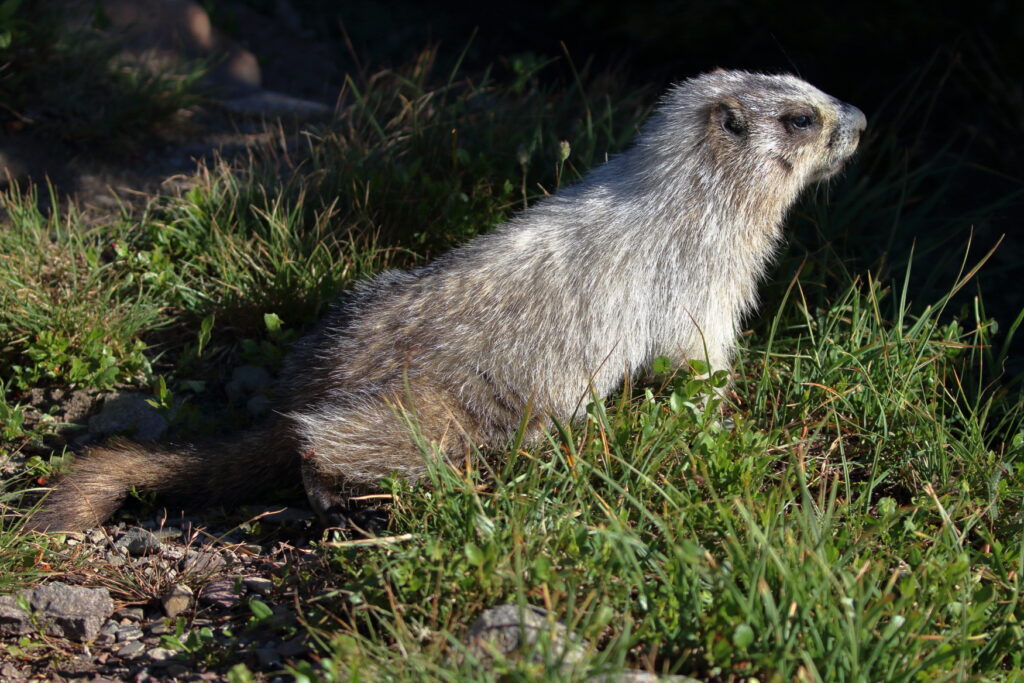
Grizzly Bear? No. Grizzly, or rather, Hoary Marmot 7,000 feet up.

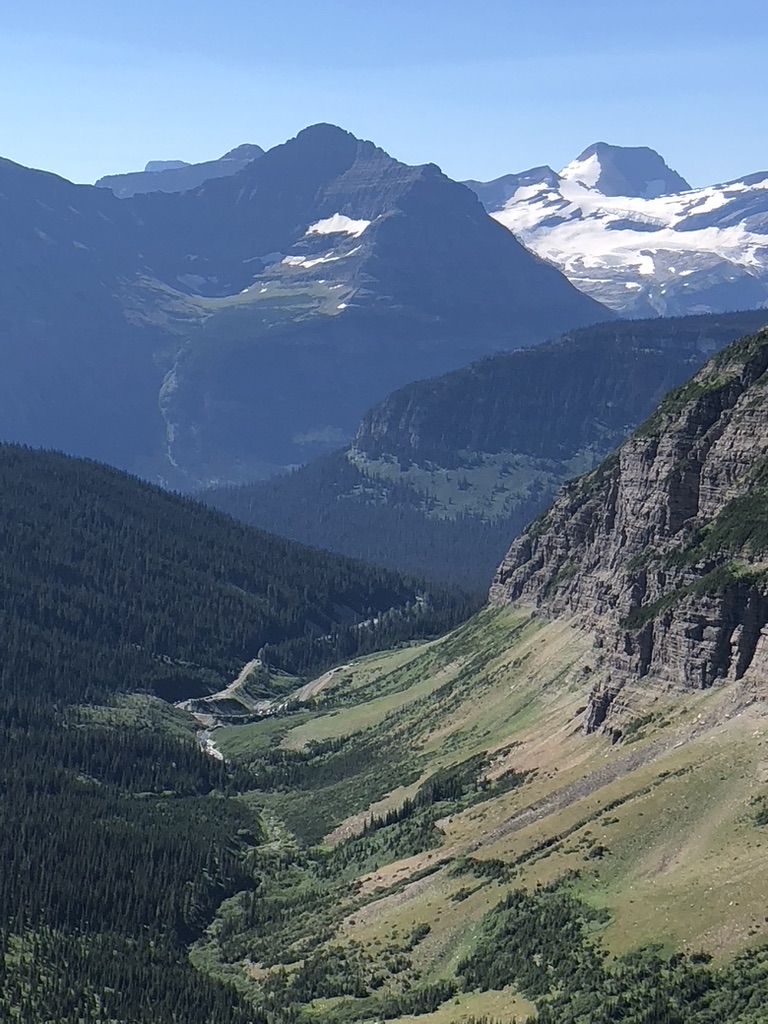
After about four miles, we left the last of the trees and could see the trail cutting across more than a mile of rocky slope up to the pass. My body had started to feel the effort and elevation by now, but that last mile passed remarkably quickly—perhaps because we were trying to keep ahead of this older Belgian woman who threatened to put us to shame. Where do these vigorous geriatric European hikers come from anyway??? In any case, we finally reached the pass and before beginning our ptarmigan search, sat on some rocks to enjoy lunch while staring out at one of the world’s most superlative views down the far canyon to the Many Glacier Valley.

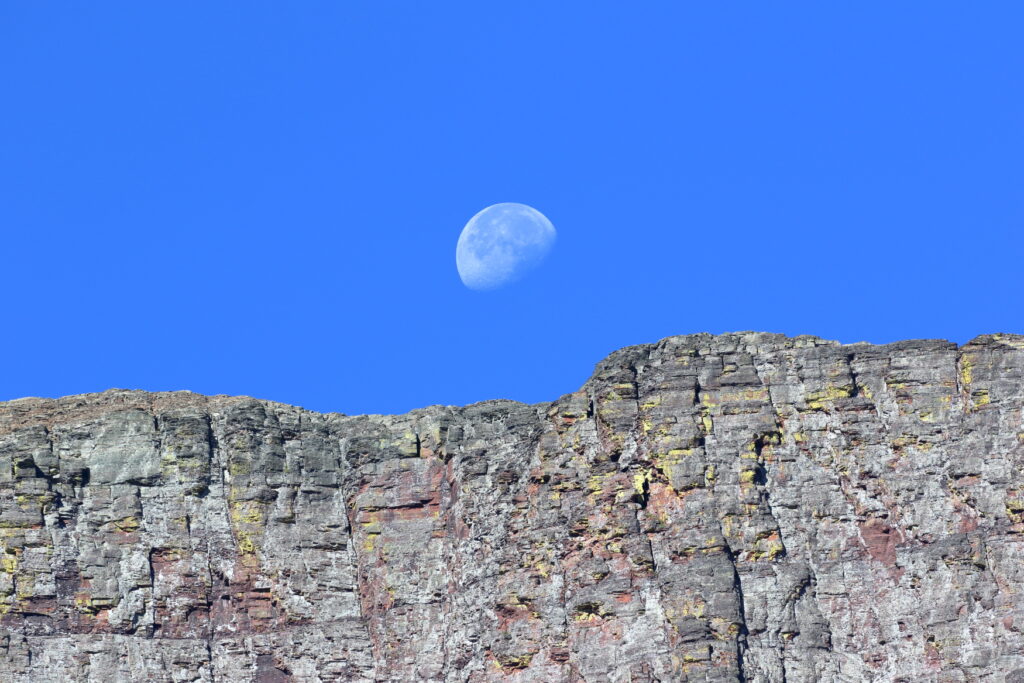
While eating our lunch, we were treated to a glorious gibbous moon “setting” over the rugged cliffs above us.

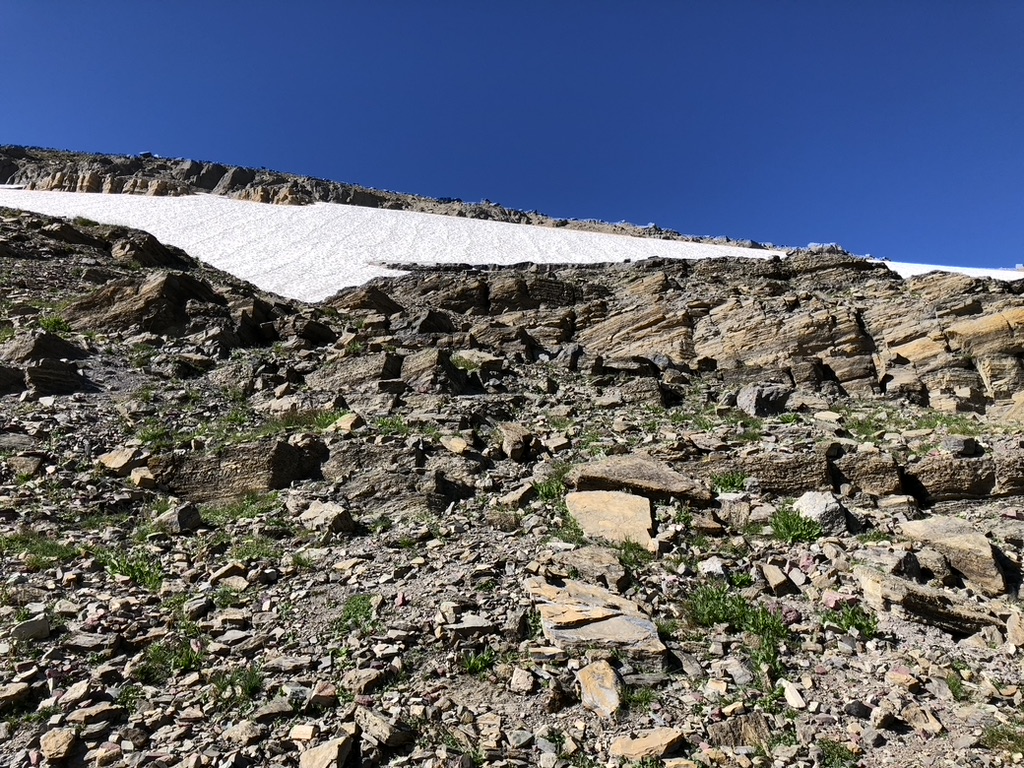
After we stowed our daypacks behind some rocks, Braden showed me where they had found the ptarmigan the year before. “They like to hang out right at the base of snow banks with some cover nearby,” he explained. Despite our ultra-hot summer, some snow persisted at the pass and we began making our way along the bottom of the longest, most promising field. After ten minutes, we had discovered a couple of burly marmots and an adorable pika, but no ptarmigan and I began thinking, I guess we’re not going to see them today. I felt disappointed, but kept my positive attitude, focusing on the near-perfect, glorious day and the unparalleled views of Jackson Glacier several miles away. And, of course, I kept looking.

Even as my hopes for finding a ptarmigan faded, I felt more than consoled by spectacular views of Jackson Glacier several miles away. (Our parking area is visible below.)

Braden had taken a higher route than I and disappeared around a bend. I walked more slowly, scouring every suspicious rock, and wondered if I’d even see a ptarmigan if my eyes happened to land on it. I scrambled down some rough scree to a lower level and started back toward the pass, hopping over rivulets of meltwater trickling over the rocks. I was standing at the edge of a little grotto when I heard a really strange noise coming down from the mountainside above. It was unlike anything I’d heard and I can’t even describe it here, but I wondered, “Could that possibly be a ptarmigan?” I didn’t think so, but hadn’t a clue what else it might be.

While searching, I heard a bizarre noise from the rocky cliffs above me. “Could it be a ptarmigan?” I wondered.

Just then, I saw Braden reappear above me and about fifty meters away. “Did you hear that noise?” I called.

“What?” he answered, too far away to hear me.

“Never mind,” I said—just as I happened to glance at the grotto behind me.

And for a split second, I wondered about the powers of wishful thinking. Why? Because not fifteen feet away, two birds walked slowly across the wet gravel. Two White-tailed Ptarmigans!

And they were real.

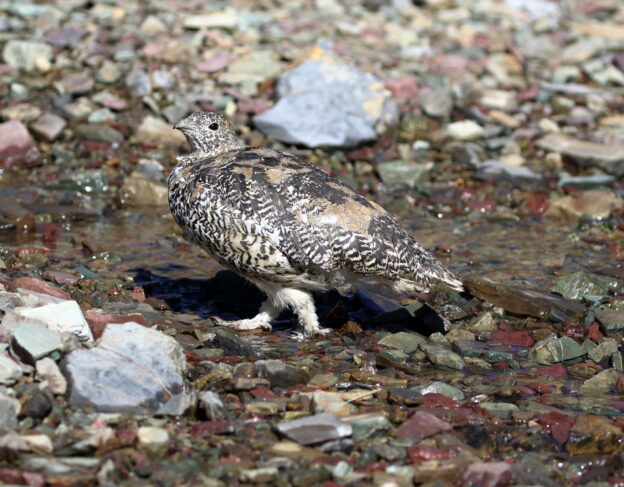
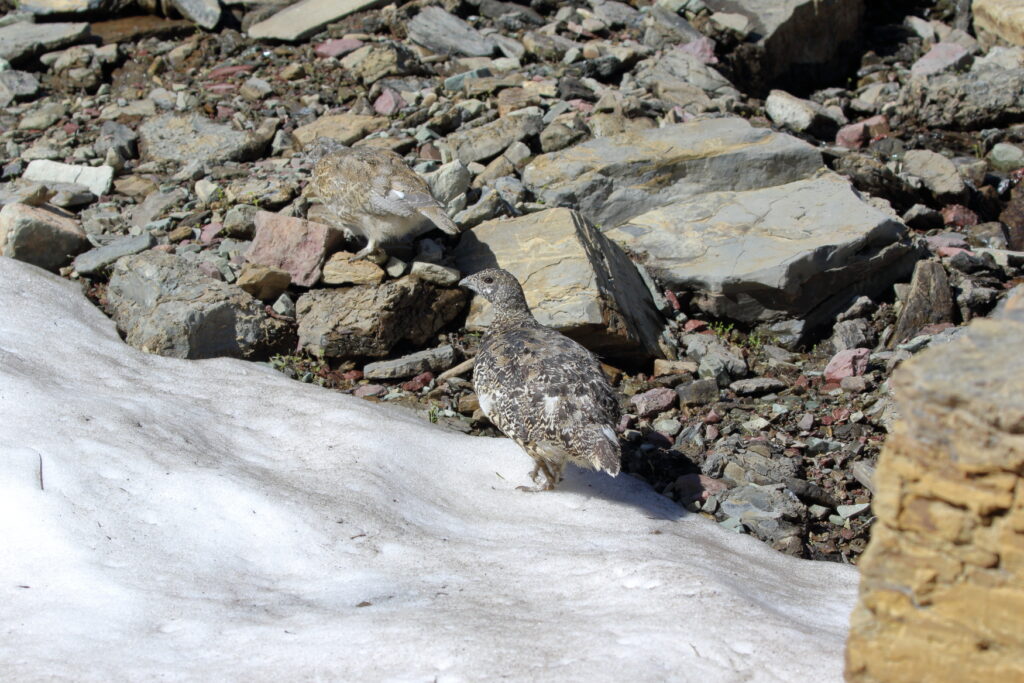
How many ptarmigans are in this photo? I’ll forgive you if you at first see only one. I always do! It shows just how wonderfully adapted these birds are to their environment.

I stared at them for a moment and then whirled to holler, “Braden!”

“Do you have something?” he called back.

I excitedly held up two fingers and pointed behind me. A minute later, we were standing together admiring some of the coolest birds in Montana. The birds—an adult and a juvenile—seemed totally unalarmed by our presence. They gave us the once-over occasionally, but as long as we stayed ten or fifteen feet away, they seemed to have no problem with us. They just walked slowly, picking at the ground for various plant material and invertebrates as we took dozens of photographs and gave each other several hugs. Soon, we spotted a second adult doing its own thing ten yards away. It was a dream fulfilled for me, and perhaps even for Braden since we got to see them together. As we hiked back down the mountain, I felt real satisfaction at having experienced these amazing birds and a sense of peace knowing that they are still up there, high in the mountains doing their thing. I hope that you all get to see one for yourselves one day, but if not, please enjoy this video. It’s the next best thing.  

As the gals from Pitch Perfect might say, our day in Glacier proved “Ptarmi-Pterrific!”

All “Cooped” Up!

Today, we take a break from Braden’s High Sierra adventures to explore how we all bird through the summer doldrums. Here I share a surprising discovery right in my own neighborhood. If you subscribe to FSB, please share your own similar story, and if you don’t subscribe—what are you waiting for? We only sell your information to people who will give us a LOT of money (just kidding; we do not share any of this information). So please fill out the box down to the right—and make sure you receive every “episode”.

How are you spending the summer birding doldrums? When we first started, Braden and I pretty much stopped birding during July and August—until we learned that there are still many birds to be had during the Dog Days! Even though it’s still summer, some shorebirds are already making their way south from their Arctic breeding grounds and can show up almost anywhere. Last summer, Braden and Nick Ramsey joined a bunch of other stellar birders for an epic day at Glacier National Park—and, of course, this summer Braden is birding the heck out of California. As for me, I am simply enjoying the ordinary birds around Missoula, trying to sharpen my skills so I can distinguish the call of a Lazuli Bunting from that of a Yellow Warbler! Experienced birders know, however, that even “ordinary birding” can produce extraordinary results.

Even during the Summer Blahs, an occasional bird will fly out for a photo-op! Thank you, Mr. Lazuli Bunting!

A couple of weeks ago, I decided to take our dog Lola on an early walk around Greenough Park to beat the heat. For those of you familiar with Greenough, Lola and I parked in the lot midway up the east side of the park, and crossed the two pedestrian bridges so that we could begin walking clockwise around the park—and better spot any caffeine-crazed bicyclists barreling down on us. Sure enough, after only a hundred yards on the main path, a large, crazed shape came right at us. But it wasn’t a bicycle. It was a bird—and it zoomed a mere ten feet above my head! On instinct, I spun around and chased after it, hoping for a solid ID before it disappeared. To my surprise, the bird swooped up into a tree only fifty meters away.

Even while not actively hanging with the chicks, at least one Cooper’s Hawk parent never perched far away.

By this time, I had 99% concluded that this was a Cooper’s Hawk—a kind of accipiter especially adapted for catching birds and flying through trees. According to Birds of the World, 47 species of accipiters live on the planet, but here in the U.S. we have only three: the smaller Sharp-shinned Hawk or “Sharpie”; the larger Cooper’s Hawk or “Coop”; and the Northern Goshawk, our largest accipiter and the bird Braden is chasing around the Sierras this summer. Braden and I don’t often get good looks at Coops so I hoped that this one would stay in the tree long enough for me to observe it. It did—and the reason startled me. In a pine next to the busy path, the Cooper’s Hawk couple had built a nest! Even better, the nest had babies!

During my second visit to the Coop nest, the babies generally kept their heads down—save for this guy. Want to bet s/he is first out of the nest?

I, of course, hadn’t brought my camera with me, but in a way that was better because it allowed me to observe the action without worrying about getting a good photo. Speaking of action, I forgot to mention that when the adult flew by me it had been carrying prey—something large and furry, maybe a rabbit. As I watched, the adult started butchering this critter and feeding it to the ravenous chicks. And speaking of chicks, I was amazed to see four of them—and all quite large. Later, I learned that this is not unusual, and a pair will sometimes raise even more, a testament to the hard-working parents. In fact, even though first-year mortality runs fairly high, Cooper’s Hawks seem to have an excellent survival rate as adults and have been known to breed up through twelve years of age.

Incoming! On my third visit, I just loved watching the young Coops testing out their flying abilities—even if they did occasionally land on each other!

Since discovering the nest, I’ve returned two more times, and each time the babies had made marked progress. My last visit, I watched them hopping in and out of the nest, testing their wings for a departure that couldn’t have been more than a couple of weeks away. They also were quickly filling out their juvenile coloration, transforming from white fuzz balls to serious-looking predators before my eyes. At least one parent, though, was never far away.

Ready for launch? Pretty darned close. Observing the Coop nest made me realize that the young have blue eyes! How’s that for a blue-eyed baby?

It all just goes to show that even when we think birding is dead, there’s a lot going on. We just have to keep getting out there and paying attention. Who knows? You may have a Cooper’s nest in your backyard right now! Coops are famously adaptable and found in every region of the Lower 48, often in urban environments and often all year-round. In fact, their numbers have increased dramatically in the past half-century—a nice success story in a time when so many birds are in trouble.

Golf and Birding

Welcome to our new subscribers! We appreciate your interest in our adventures and experiences, and hope you feel free to share this post with others. If you’d like to support FatherSonBirding, feel free to order some of Sneed’s books from online stores or, better yet, by through your local independent bookstore. Thanks, and have a great weekend! Next week: more of Braden’s High Sierra adventures!

Did you ever stop to think that the words “golf” and “bird” both have the same number of letters in them? No? Good. It’s a stupid lead to a blog. Plus, golf is a sensitive subject for me. In my mid-thirties, I began playing with friends and found I quite enjoyed it. Sort of. In between the tears and swearing and bouts of hopelessness and low self-esteem. After my golf swing betrayed me once and for all, in fact, I tossed my clubs into the basement to collect dust for the better part of a decade. Foolishness springs eternal, however, and a few years ago I began a ritual of golfing once a year with a buddy—only to discover an aspect of golf I had never before recognized: Birds.

Many golf courses’ locations adjacent to wetlands and other natural habitats give them a wide range of opportunity for the golfing birder!

When I golfed in earlier years, Braden and I hadn’t yet become birders. Imagine my surprise, then, when I got back onto the links to discover that birds abounded—at least at Linda Vista Golf Course, my favorite course in the area (and one that happens to have a great cafe). I realized, in fact, that this course could actually be one of the best birding spots in Missoula. The problem? It is challenging to golf and record birds at the same time, and I have to thread a fine line so that my buddy doesn’t brain me with a 4-iron while I’m trying to figure out which kinds of swallows are circling around us. This dilemma, however, gave me an idea—one that I finally carried out last week: to get permission to bird the course sans clubs one morning before the golfers showed up.

Even with the distractions of actually playing a round of golf, I had managed to record 25 species of birds a couple of days earlier. These had included surprises such as Cinnamon Teal and Red-naped Sapsucker. I wonder what I’ll find with more time to study my surroundings? I asked myself as I again headed out two days later.

Almost immediately, it became evident that there were greater numbers of birds than I had noticed before. The Yellow Warblers were particularly insane with a new one spouting off every twenty or thirty yards—about the distance of a short pitching wedge. This made sense because part of what made this course such a great birding spot is that it was shoe-horned between river and wetlands on two sides and farm/pasture on another. Along with the Yellow Warblers I noted an abundance of Red-winged Blackbirds and Gray Catbirds—but was also surprised by an absence of Common Yellowthroats and dearth of Song Sparrows. Hm . . . maybe they were just quieting down for the season?

Spotted Sandpipers are always a welcome sight—though I’m not sure the plastic sheeting around this pond made it a great choice for this bird.

Continuing around to the third hole, I came across several open ponds where I was pleased to see at least seven Wood Ducks, Killdeer, a Spotted Sandpiper, and a pair of Ring-necked Ducks, an unlikely find for the time of year. One of the delights of birding a place that doesn’t get much attention is the frequency of red “unreported” dots that appear on the eBird checklist. The Killdeer were unreported and while I was logging species on eBird, another unreported species, Double-crested Cormorant, flew by. I devoted a good ten minutes to figuring out swallows and quickly noted Tree and Northern Rough-winged. As my binoculars pin-balled back and forth, however, I made another great discovery: Bank Swallows! Braden and I love finding these because they always seem to pop up when we least expect it, and this morning they followed tradition!

Double-crested Cormorants were one of several species that earned me a coveted red “Unreported” dot on eBird!

The rest of my birding round yielded nothing that will upend the scientific community, but proved mightily enjoyable nonetheless. While talking to the lone golfer out this early in the day, I spotted a gorgeous male Western Tanager. A Bullock’s Oriole also flew by. Over on the pasture side of the course, Eastern Kingbirds abounded and Cliff Swallows replaced the Bank Swallows zooming around me. I finished the day with 33 species—not dramatically more than I had found while actually golfing, but I had savored every tee, fairway, and green.

One of the fun things about my round of birding was the number of juveniles about—including this young Eastern Kingbird waiting to be fed by a nearby parent.

Speaking of golfing, I did notice an odd phenomenon while doing the round with my buddy two days earlier. I actually played better than I had in recent memory. It may have been that I had forgotten my bad habits, but I think that the birds actually helped. One of my problems with golf is that I overthink everything. Instead of just hitting the ball, I am telling myself Remember to tuck in your hip as you draw back or Keep that left foot planted and your elbow straight. With half of my mind on birds, I didn’t have time to do that—and hit some of my best shots in years. The lesson? There isn’t one. Just get out there and keep birding, wherever you happen to be.

Note: if you would like to bird your local course, be sure to ask permission—and it obviously wouldn’t hurt if you already golf that course yourself. With the manager, discuss the best time to go out and stay polite even if she/he/they says no. After all, golf courses generally are money-making ventures and they have real customers to take care of. But speaking of that, I can’t help wondering if any particularly birdy courses have considered charging a modest fee to people who would like to bird them? Especially for courses that adopt green practices such as using less water, pesticides, and fertilizers, it might be a great way to earn a bit of extra income while promoting sustainability. Just a thought.