Category Archives: Woodpeckers

Campsite #512: Algonquin Provincial Park, Canada (Maine to Montana, Part 4)

Today, we continue Braden’s epic birding trip from Maine to Montana with an astonishing visit to a place few people get to experience: Algonquin Provincial Park. Enjoy this latest installment, and if you’d like to support FatherSonBirding and independent journalism, please consider buying one of Sneed’s books shown to the right. Oh, and please share this post!

Twelve hours west of the Maine border, I spotted the giant sign reading “Welcome to Algonquin Provincial Park.” When many birders think of Canada, they imagine huge tracts of boreal conifer forest filled with the birds of the north: Canada Jays, Yellow-bellied Flycatchers, crossbills and, of course, Black-backed Woodpeckers and Spruce Grouse. Much of my drive from western Maine towards Ontario did not give that impression at all. In fact, the part of Canada that includes Montreal and Ottawa (both cities that I drove through) is lower altitude than western New England, and much of it lies in the St. Lawrence River Valley, a warmer, more humid region filled with deciduous forests, agriculture and suburbs. The area reminded me more of central Pennsylvania or New Jersey than of western New England, despite being at a similar latitude.

But Algonquin Provincial Park was noticeably different from the St. Lawrence River Valley. Three hours west of Ottawa, this large preserve sat at a higher elevation than the valley. The soil was rockier and because of that, far more conifers grew here, especially around the various lakes and bogs scattered through the park. Finally, I felt like I was back in good boreal habitat.

Algonquin Provincial Park represented a significant departure from lower altitude St. Lawrence River Valley only a few hours away.

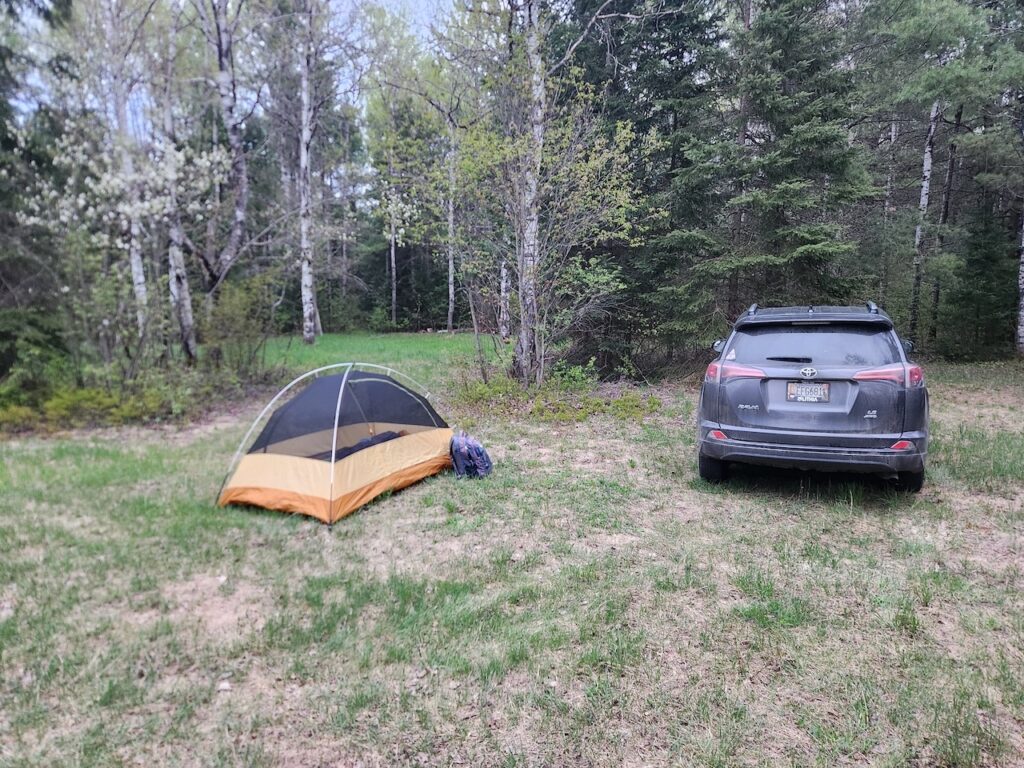
I wasn’t allowed to camp in the park without paying a hefty fine, so I pitched my tent on a dirt road right outside it, in what appeared to be a site for keeping horses on the shore of a large lake. As dusk fell, I heard the twitter of an American Woodcock displaying high above. I’d seemingly settled in the middle of his territory, and he kept me company all night as I dreamed of what birds I’d see the next day.

My impromptu campsite outside of the park rewarded me with an American Woodcock that serenaded me to sleep.

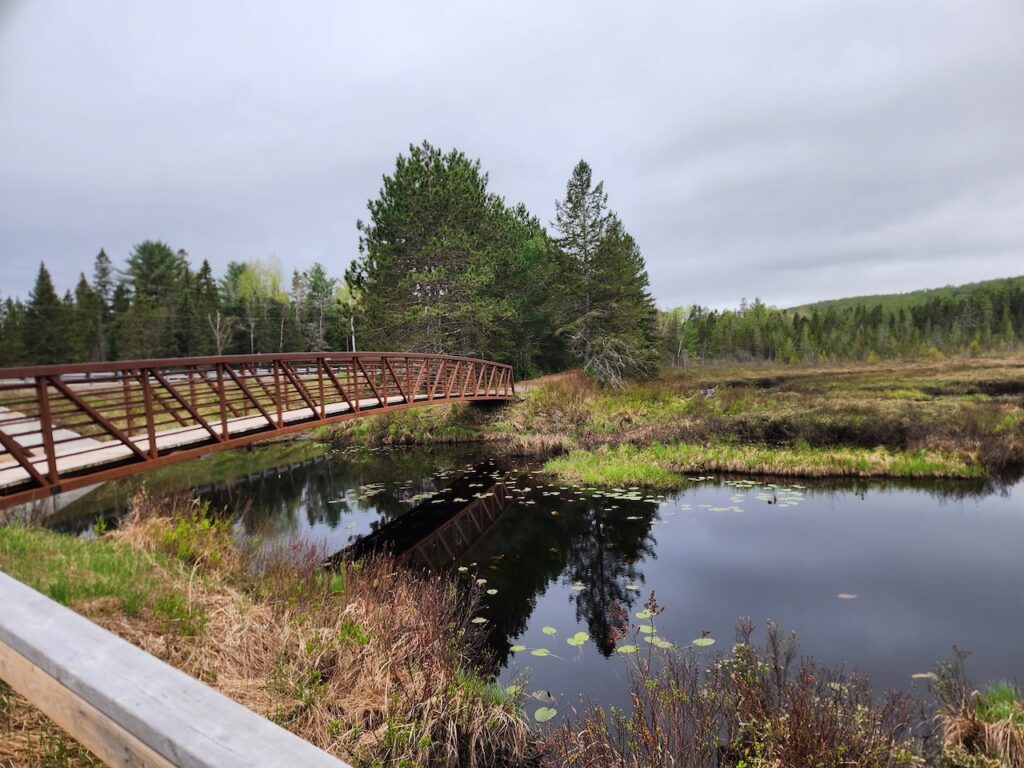
After a short walk around my campsite at dawn, during which I detected a few Cape May Warblers, I headed into the park. My first location: the Spruce Bog Boardwalk. Spruce bogs, which I’d gotten to know during my time in Maine and the Northeast, are strange, almost other-worldly habitats scattered across the northern United States. Generally consisting of an outer area dominated by spruce trees with a core of peat moss floating atop water, they are home to a variety of unique species including carnivorous plants like pitcher plants and sundews. Because of their unique habitat structures, spruce bogs are also havens for a variety of boreal bird species that are otherwise less common in more southern parts of their range. So, as I set foot on the boardwalk, I found myself once again searching for Spruce Grouse and Black-backed Woodpecker—species I find myself looking for frequently.

Extensive searching brought no luck, although I did find more boreal warblers, including several Cape May Warblers and another great look at a Bay-breasted. I also heard a Lincoln’s Sparrow, my first of the year, singing from the wet back half of the bog. I had much of the day to bird Algonquin Park, so after striking out on my main targets at the boardwalk, I decided to take a short stop at the visitor center. 

I had hoped for both Black-backed Woodpeckers and Spruce Grouse in this spruce bog, but struck out with both species.

Within ten seconds of pulling out onto the road my Toyota RAV4 screeched to a halt. There, ten feet away, staring me down, stood a huge female moose. The animal had to be at least five feet tall, though from my seat in the car it seemed a lot taller! After we shared several seconds of each other’s presence, the moose trotted off into the woods. I didn’t end up seeing any of my bird targets at the visitor center and the center itself was closed, but I was now filled with adrenaline—I’d just scored my most wanted mammal of the trip!

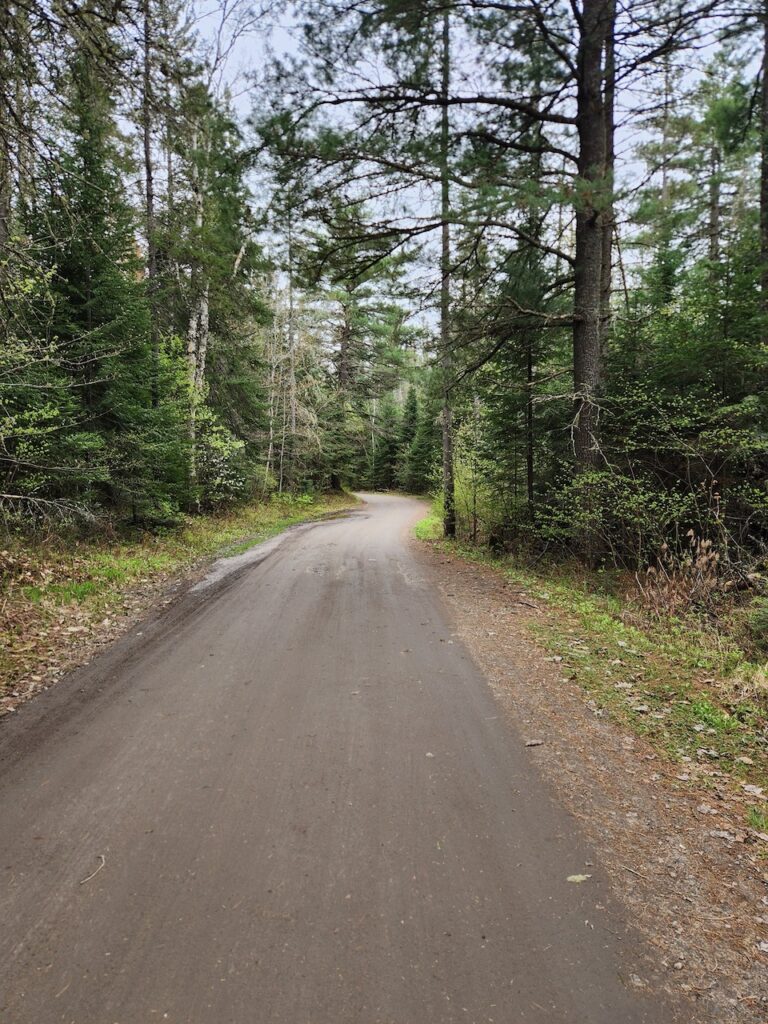
Next, I hit Rock Lake Road. While I hadn’t seen many reports of my target boreal birds here, I figured that this road—a dirt track winding past marshes and through patches of spruce and budding Paper Birch—was as good a spot to try as any! Over the next hour and a half I drove slowly with my head out the window. Again, no woodpecker and no grouse, but I ended up tallying 40 species, 15 of which were warblers! Nashville and Magnolia were the most abundant, along with a smattering of Black-throated Blue, Blackburnian, Canada and others. Near the beginning of the road I also heard several Wood Thrushes singing, a surprise this far north. Along my drive I was also accompanied by the near-constant drumming of Ruffed Grouse, and the loud, piercing whistles of a pair of Broad-winged Hawks.

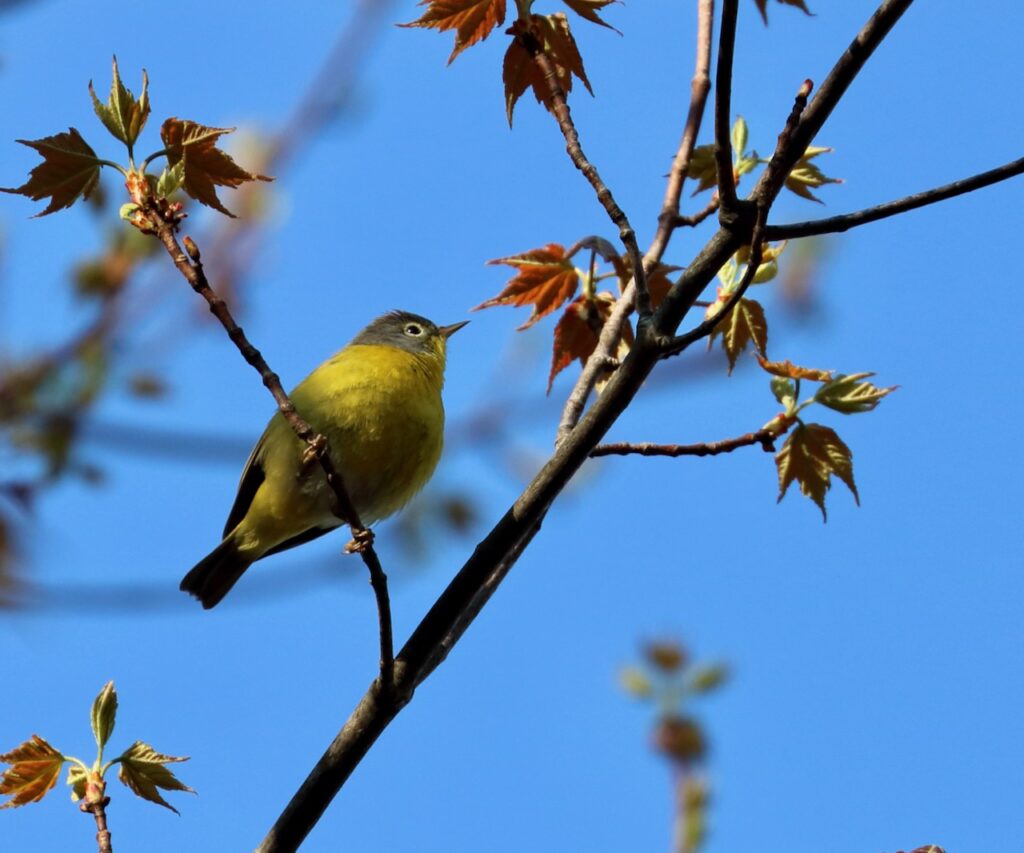
Though I continued to strike out on BBWOs and SPGRs, Algonquin presented a nice assortment of warblers including Nashvilles, always a favorite!

At this point I admit that I was feeling a bit ungrateful. I’d been birding for three or four hours and had not so much as glimpsed either of my targets—birds that were supposed to be somewhat regular within the park, and had compelled me to drive through Canada in the first place. Sure, I’d seen some great birds and a moose. But if I went the whole day without getting a Black-backed or a Spruce Grouse, I was going to be a bit salty. I jumped on eBird to check on any recent reports of either of them nearby and elected to visit, as my last stop of the morning, Pog Lake Campground. A Black-backed Woodpecker had been seen there only a few days before, and I figured it would be my best chance before continuing my journey west. I parked the car and began walking toward Pog Lake, keeping my ears and eyes peeled for my target species. One of the first birds I heard was a Tennessee Warbler, another boreal species with an electric song, singing loudly from a campsite nearby. I recorded it and continued onwards.

Then, I came across Campsite #512. Surrounded by gorgeous coniferous trees, it at first seemed just like any other campsite in Pog Lake Campground. The first thing that made Campsite #512 stick out, though, was the Ruffed Grouse drumming in the bushes nearby. Now, I’ve heard plenty of Ruffed Grouse drumming in my life—and had heard dozens on this trip already. Seeing one in action was a different story. I’d tried to sneak up on them before, but was always unsuccessful—the birds would flush from under my feet. However, this particular bird sounded incredibly close so I shelved my other goals and went into full stealth mode, sneaking towards the campsite to see if I could watch the grouse in action. After about ten minutes of tiptoeing around, I heard the beating of its wings—and that’s when I spotted it. Through ten feet of dense foliage, there the grouse stood, its wings striking its chest to make the sound that you feel more than hear.

I promptly sat down and spent the next thirty minutes with that grouse. Every five minutes or so, it would stand upright on its mossy log and begin its display. Bom-bom-bom-bom-bom-bom-bom. I watched it drum five or six times—with and without binoculars, and filmed it on my phone’s camera. It was magical. (Click the above image to watch my short clip.)

After twenty minutes, I also heard honking overhead. At first, I couldn’t see any birds above me, but I figured it was just a flyover flock of Canada Geese, though the calls sounded a bit strange. Then, in the gap above Campsite #512, I spotted several flocks of two hundred or so geese—and quickly realized that these were not Canadas. Between a bad view I got through my binoculars and listening to their sounds on Merlin, I realized I’d just seen a massive flock of Brant migrating over me, headed for the Arctic! I’d never seen these birds away from the ocean and never in such numbers! Sure enough, though, Algonquin Park lies right in the middle of Brant’s narrow migration route across Canada, and I’d just happened to be in the right place at the right time.

The Brant disappeared into the distance and the grouse drummed again, and I decided that, even though I hadn’t found my targets, I felt more than satisfied with my experience with Pog Lake Campground. But Campsite #512 hadn’t finished with me. 

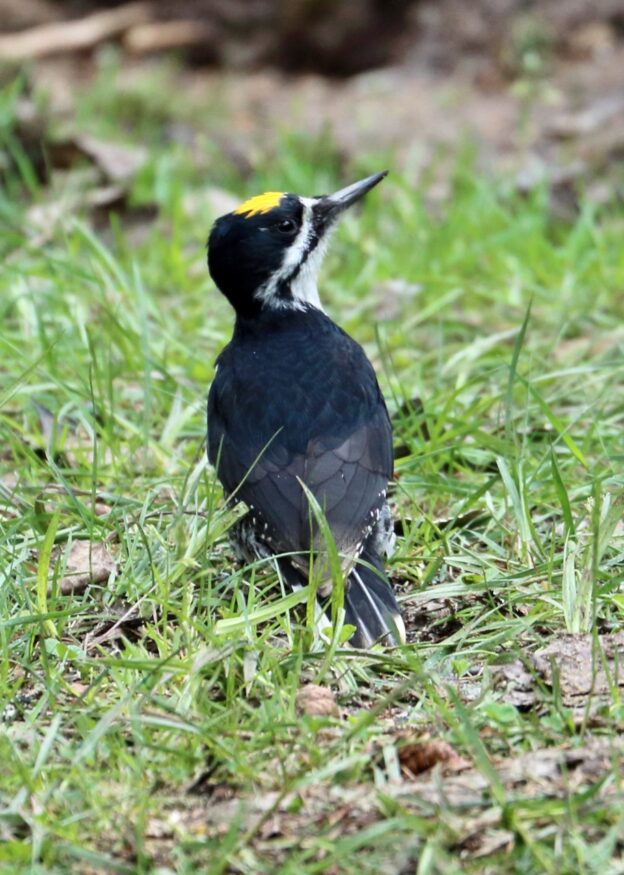
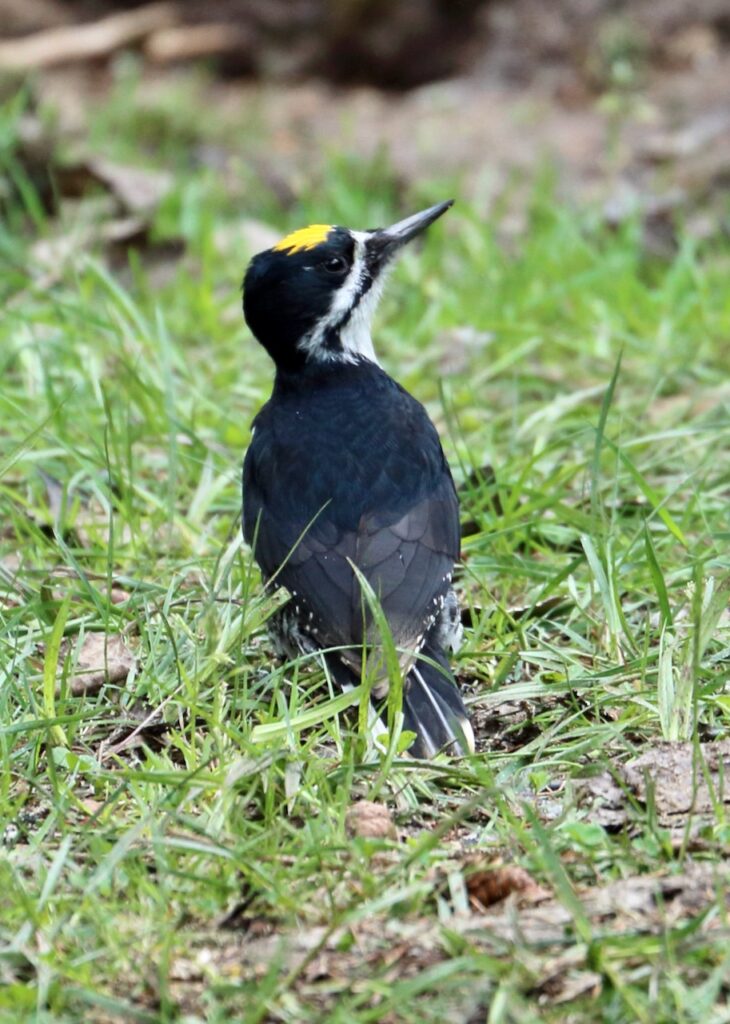
As I slowly stood, taking care not to startle the grouse, I heard strange, frantic calls coming from the woods on the other side of the campsite. I quickly recognized them as calls I’d been listening for all morning, and suddenly, a male Black-backed, decked out in sleek black feathers with a yellow cap, flew into the campsite. It landed on a downed log near me, and proceeded to hop along the ground, getting closer and closer to until it stood only five feet away! It either didn’t notice me or didn’t care, poking for insects in the roots of the nearby spruce trees. After a minute or two, the woodpecker flew away, leaving me debating if I should EVER leave Campsite #512.

My best-ever look at a Black-backed Woodpecker will forever embed Campsite 512 in my birding heart.

As you can probably guess, I did continue on my journey, but knew that my visit to Campsite #512 would become one of my most memorable birding mornings ever, one that would be etched in my brain for a long, long time.

Braden’s Maine to Montana Birdventure, Part 1: A Day in “The County”

Today, FSB kicks off Braden’s accounts of his truly remarkable spring birding trip from Maine to Montana. This adventure would take him to an astonishing variety of habitats most of us never get to experience. Along the way, he would drive 5,000 miles, visit nine states and provinces, and record 264 bird species, seven of them lifers. He begins this series with a visit to Maine’s arguably wildest and most inaccessible county: Aroostook.

Twenty-four hours after walking across the stage of the Cross Insurance Center in Bangor and receiving my college diploma, I was alone in a tent in Northern Maine. I’d gone to school in the state for four years, but never experienced it in the summertime, those three months when Maine is at its best. Now, with an abundance of time, I could leisurely make my way back to Montana instead of the six-day dash I’d done across the country last August. Because of this distant deadline, I’d arranged to spend a week in Maine birding and exploring following my graduation, and there was no better place to start than with one of the two counties I’d never visited: Aroostook County.

A Cedar Bog up in Aroostook County! This one shimmied with Palm and Magnolia Warblers.

Known simply as “The County” to locals, Aroostook is by far the largest and least populated part of Maine. The County contains a large portion of the state’s agriculture, mostly located on its eastern flank, whereas the rest is coniferous forest. Aroostook’s high latitude and cooler climate create a haven for many boreal species of birds that have receded from their more southerly haunts because of warming and excessive logging that promotes regrowth of a different, unsuitable habitat. This northern conifer forest is also a hotspot for the primary topic of my dad’s previous post: warblers.

Warblers, in fact, were a major factor in my decision about where to go to school. I wanted to go to college somewhere where I could see as many warblers as possible, and Maine fit that bill perfectly. With almost thirty species of breeding warblers (nearly triple what Montana, a state twice the size, has) there is no better place to be, and that is especially true of Aroostook County, where most of them could be found. Lying in bed the night of Monday, May 12th, I felt nervous. It was still fairly early as far as migration goes. What if the birds weren’t here yet?

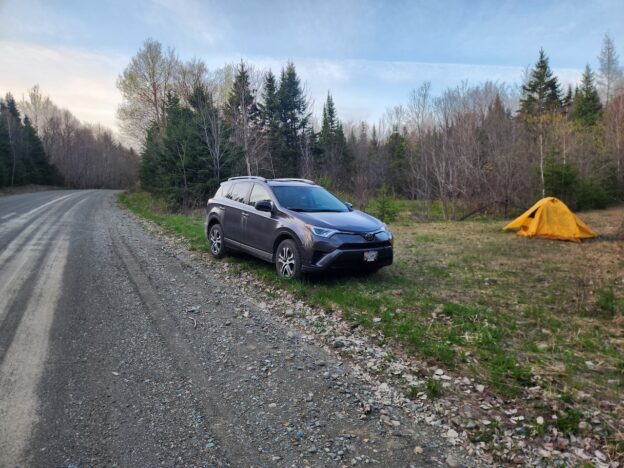
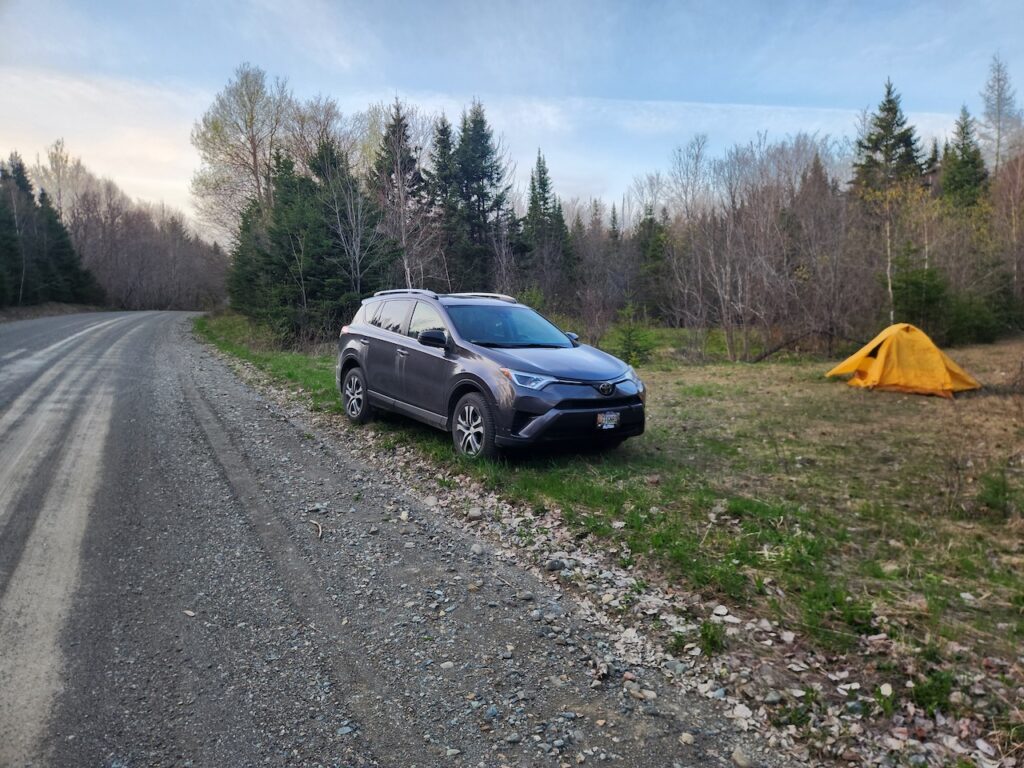
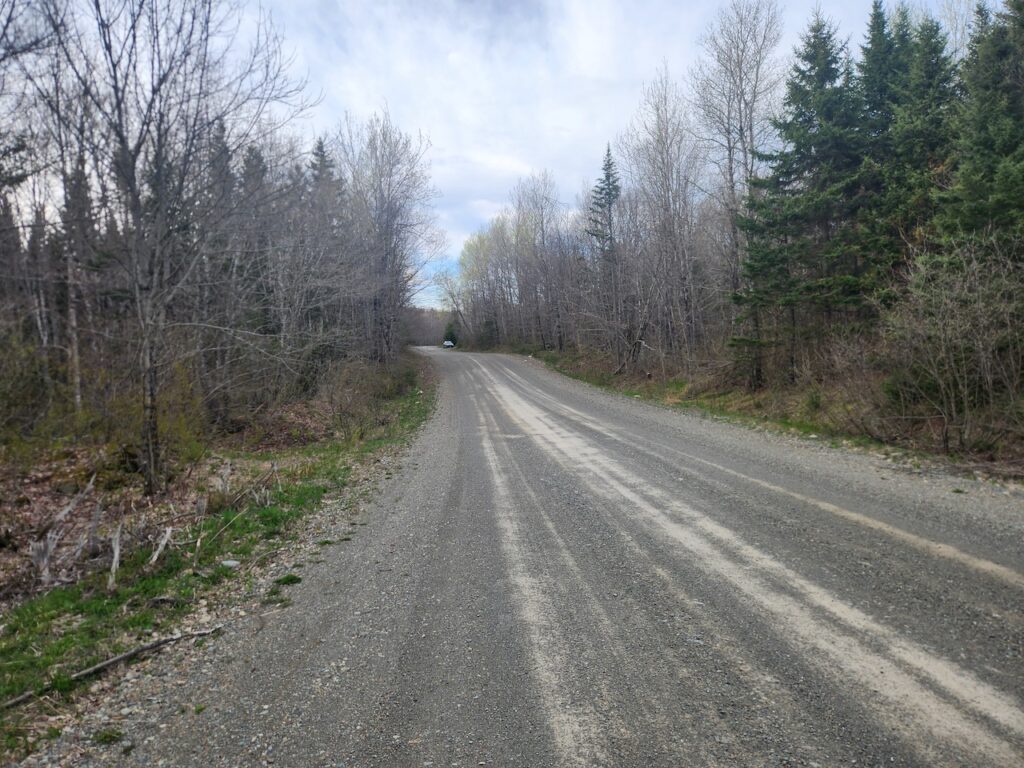
This was my camping spot in Aroostook County, on a backroad in northern Maine!

On Tuesday, May 13th, my worries were settled when I woke up to the sound of a Nashville Warbler singing above my tent. I dressed as quickly as I could and set off down the logging road I’d driven in on, my ears receptive to any and all of the birds sounding off in the surrounding woods. Every level of the forest had songsters belting out their tunes: Ovenbirds from the ground, Black-and-white Warblers from spruce trunks, Magnolia Warblers from ten-year-old firs and Yellow-rumped Warblers from high in the canopy. Present in lower numbers were species like Blackburnian Warblers, Black-throated Blue Warblers, and American Redstarts, all likely early representatives of their species, most of which were still farther south, booking it north.

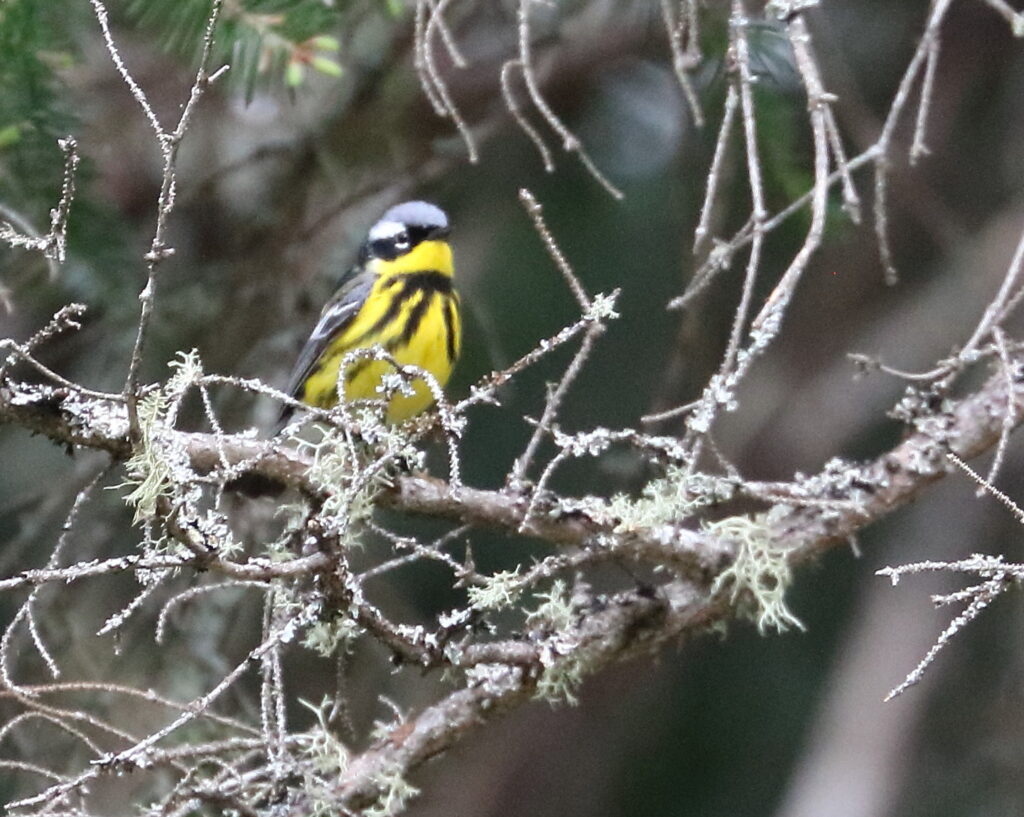
Magnolia Warbler in a spruce tree.

I was especially excited about the two Cape May Warblers. While I’d seen a fair number of Cape Mays before, I’d rarely seen them in their breeding colors and I’d never heard them sing before. This is because of their distributions. While I’d encountered many of the East Coast warblers on their breeding grounds during my time in Pennsylvania, I was hundreds of miles too far south for Cape Mays, which use contiguous spruce-fir forest and are mostly confined to Canada. These warblers (which are named after Cape May, New Jersey, where they neither breed nor spend the winter) are particularly dependent on an insect known as spruce budworm. Budworms are spruce parasites, and their populations are cyclical. During outbreak years the insect infects and ravages thousands of acres of spruce trees before the population crashes. Cape May Warblers, Bay-breasted Warblers, and Evening Grosbeaks, therefore, all have populations that rise and fall with the populations of this insect.

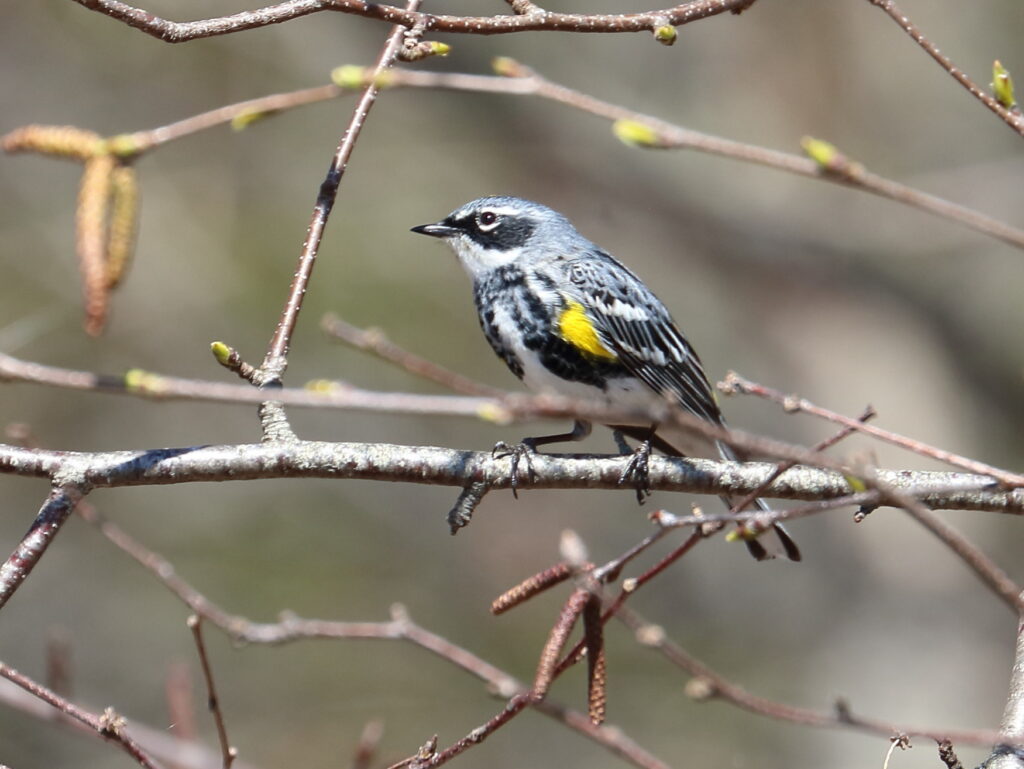
A “Myrtle” Yellow-rumped Warbler, which is the subspecies that lives on the East Coast!

Besides agriculture, the main industry in Aroostook County is logging, and understandably, the logging industry is not the biggest fan of an insect that defoliates thousands of acres of their crop. Unfortunately, the industry’s historical response to spruce budworm outbreaks (which, remember, are ecologically “normal” and important for the birds dependent on them) has been to clear-cut hundreds of hectares of infected forest. Spruce-fir forest is a mature ecosystem that takes centuries to develop, however, and the forest that grows back after these clearcuts is not coniferous but deciduous. This is a major reason why many spruce budworm-specialists, like Cape May Warbler, and many other birds found in boreal forests, like Canada Jays and Black-backed Woodpeckers, have retreated from much of southern Maine in the last hundred or so years. Their habitat has simply disappeared.

I saw evidence of this as I birded The County. Sure, there was a lot of seemingly healthy spruce habitat. There were also massive empty lots, covered in nothing but slash and debris. The forests were filled with birds, while the lots had almost none. It almost seemed apocalyptic. At least the empty lots provided good views of Mt. Katahdin, Maine’s highest peak, rising in the distance.

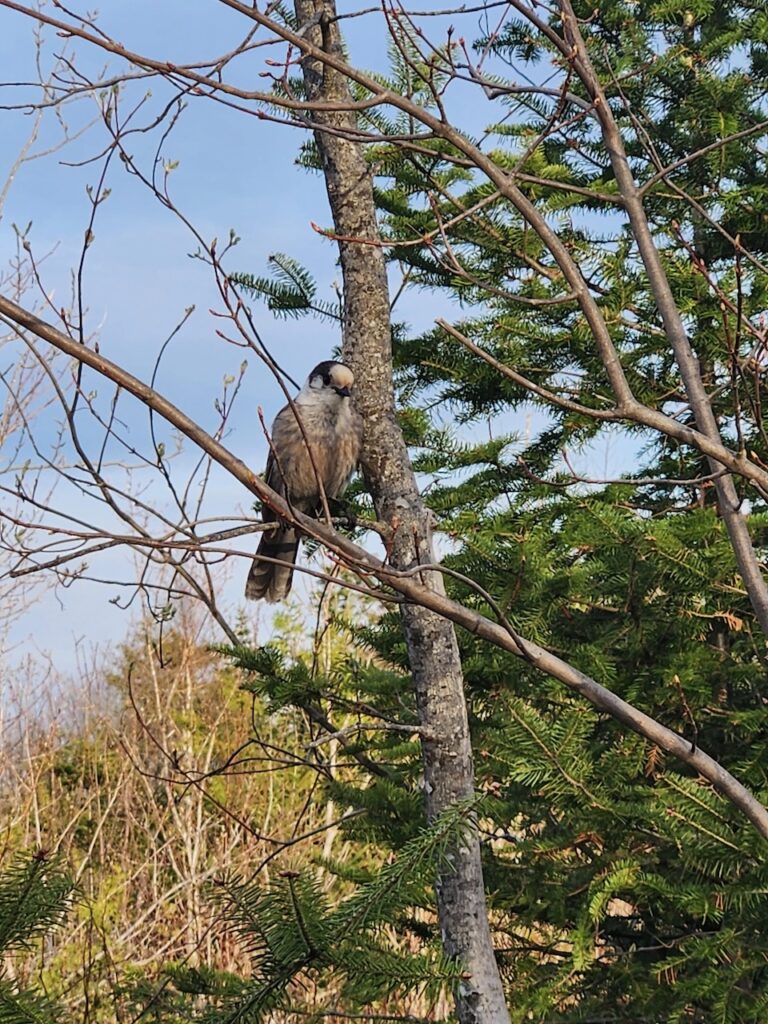
Again, though, the forests DID have birds, and not just warblers. Many migrants had not yet arrived (namely the flycatchers, of which I saw very few), but I recorded dozens of Ruby- and Golden-crowned Kinglets, Blue-headed Vireos, and Winter Wrens. Ruffed Grouse drummed from wet thickets, Hermit Thrushes foraged in the road, and I even got to see an American Goshawk bomb overhead at a million miles per hour, chasing something or perhaps just trying to give me as least satisfying a look as possible. In the evening, a walk along a side road yielded incredible, up-close views of Canada Jays, or “Whiskeyjacks” as they are known colloquially. These subtle, white-and-gray corvids landed in the trees less than five feet from me, curiously searching for insects while paying me no mind.

A photo of a Canada Jay that I took with my phone!

After a night and a day spent in The County, I headed back south to investigate the other corners of Maine I had yet to explore. Stay tuned!

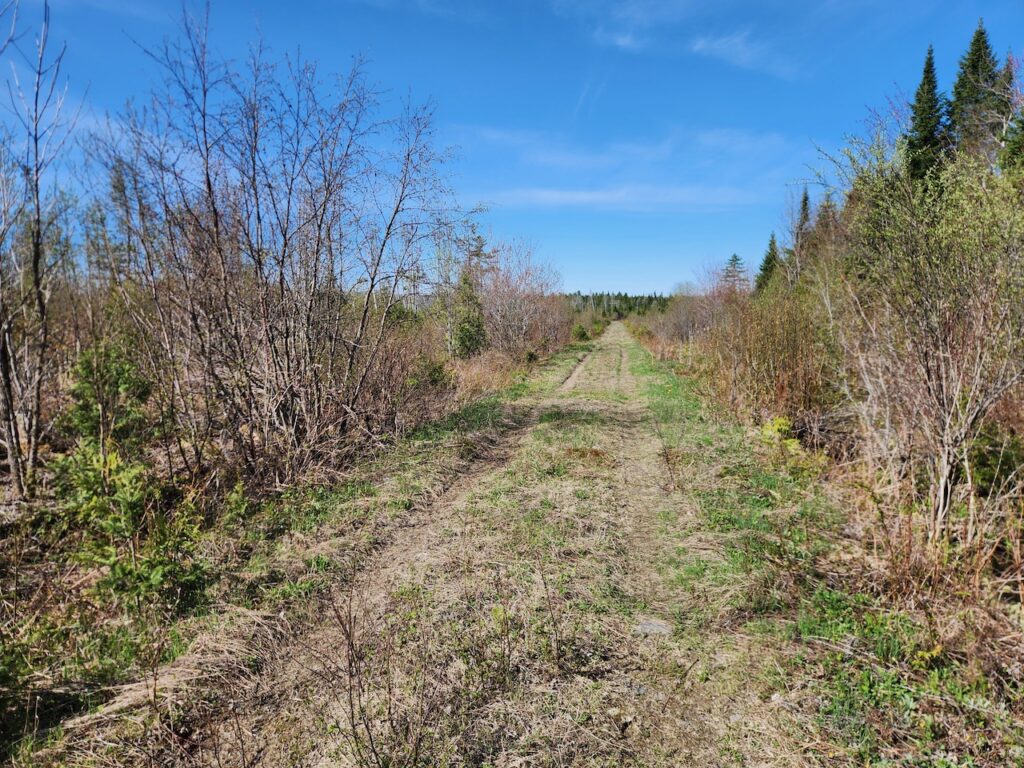
What the forest looked like in Aroostook!

Birding the Burn 2025

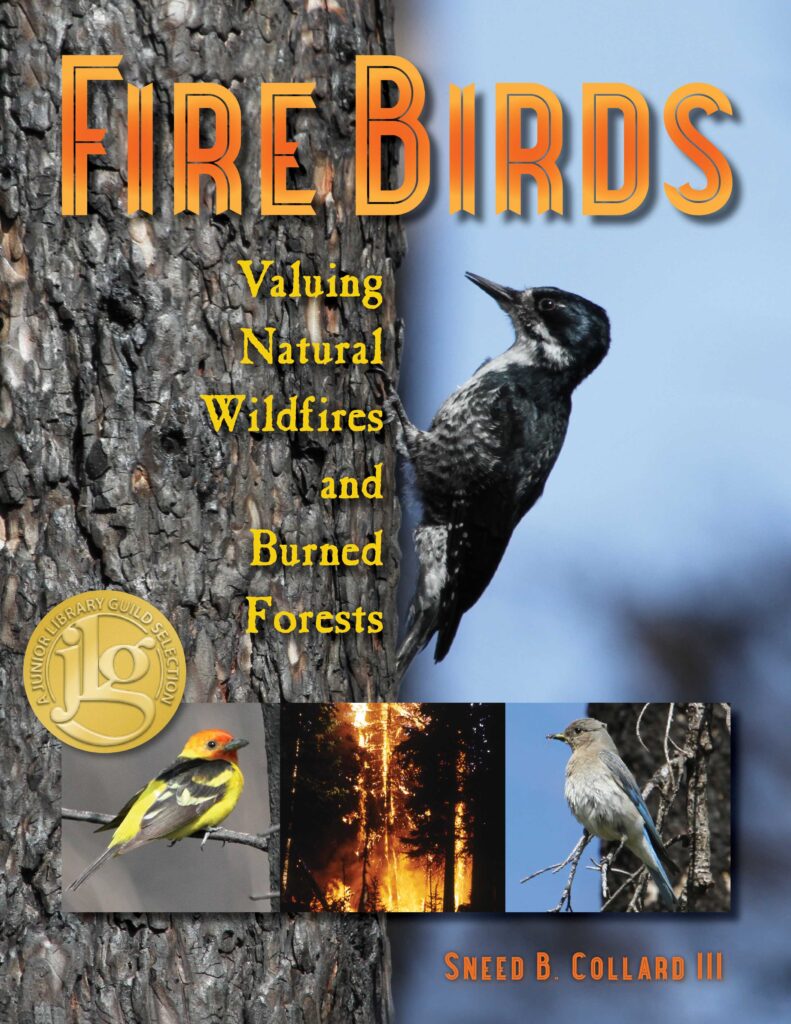
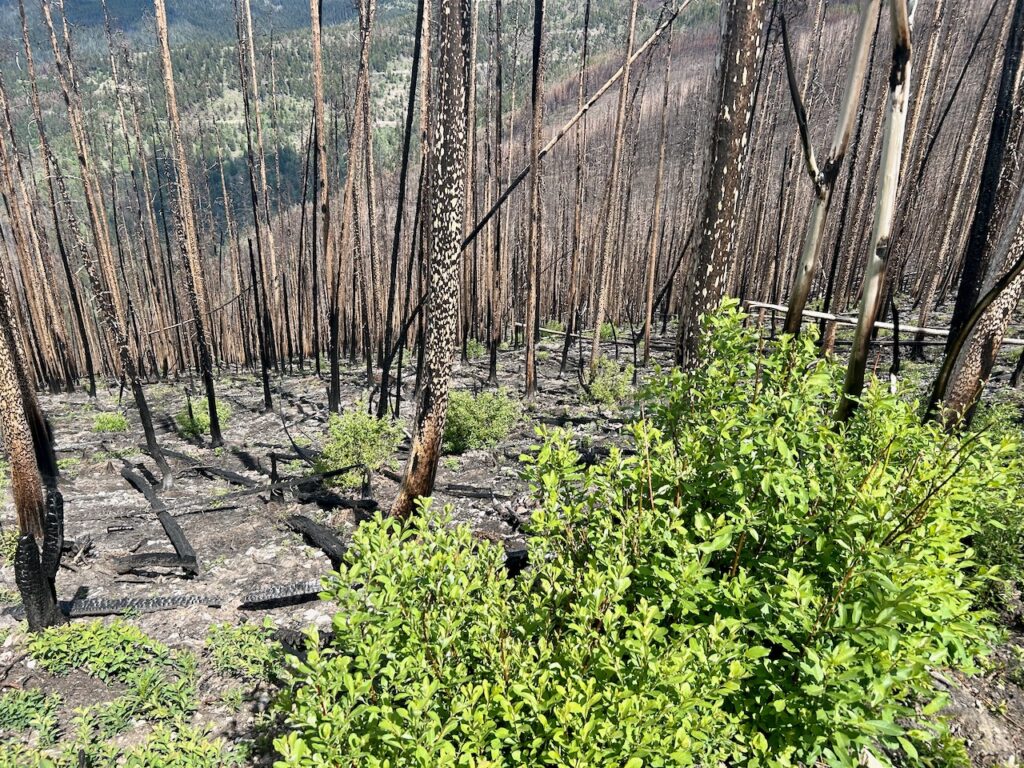
In many ways, my own birding journey began with my book Fire Birds: Valuing Natural Wildfires and Burned Forests. That’s when my birding mentor, UM Professor Dick Hutto, showed me the critical importance of burned forests and the spectacular birds that colonize them. It’s also when Braden and I began birding avidly. Since then, we have explored burned forests many times and they have become some of our favorite places to bird. Last week, we were excited to check out one of our area’s newest burns, last year’s Miller Creek fire area, about an hour from our house. To reach it, we headed all the way out Miller Creek and then wound our way up dirt roads until we reached the burn at Holloman Saddle. On the drive, we passed through terrific riparian and conifer habitat, and Braden could pick out Yellow and Orange-crowned Warblers, Swainson’s Thrushes, and Willow Flycatchers through the car window. At about 6,300 feet elevation, we reached the burn, parked, and began exploring.

Researching and writing Fire Birds: Valuing Natural Wildfires and Burned Forests set me firmly on my birding journey—and propelled Braden and me to start birding burned forests. The multiple award-winning book is a great primer for kids and adults on many little-known aspects of forest ecology. To order a copy, click anywhere on this block!

Thanks to Dick’s tutoring, I had some experience sizing up burns and at first, this one didn’t seem ideal. Three birds essential to “opening up” a burned forest are Black-backed, American Three-toed, and Hairy Woodpeckers. These birds hunt wood-boring beetle grubs in the newly-charred forest and along the way, drill out cavities essential for other cavity-nesting birds. But Dick’s research had shown that Black-backed Woodpeckers need larger-diameter trees to nest in, and the forest that greeted us now mainly seemed full of smaller-diameter trees. I also saw stumps where larger trees had already been removed—another huge problem in human (mis)management of burns.

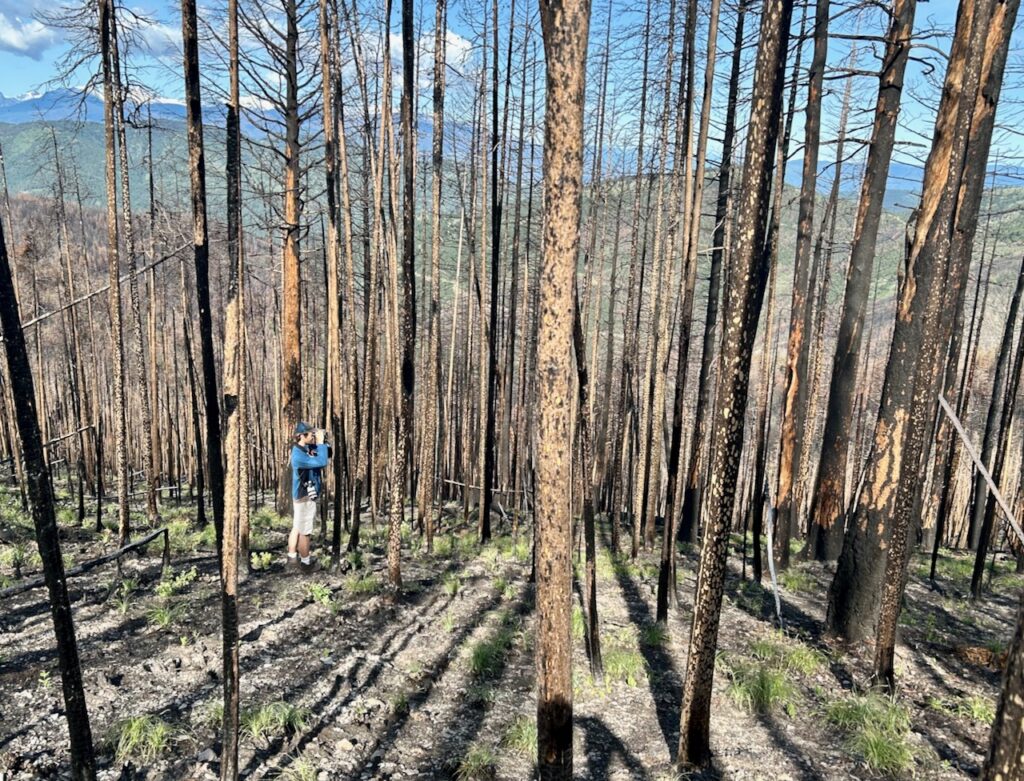
Braden trying to locate a promising bird call in the Miller Creek Burn.

Through decades of well-intentioned Smokey Bear messaging, we have all been taught that all fires are bad, bad, bad. Even when a natural fire does occur, the forestry Powers That Be have taught us that humans must somehow “save” a burn by salvage logging it. For those unfamiliar with it, salvage logging involves going into a burn and removing trees that retain commercial value. The problem? These trees are exactly the larger-diameter trees that woodpeckers need to drill out their homes and, in the process, provide homes for dozens of other animal species. Salvage logging also often severely compacts forest soils and removes the seed sources (cones of burned trees) needed for the forest to regrow. This means that we now have to pay people to replant the burn site—when the forest was already perfectly equipped to replant itself.

Left to their own devices—i.e. without “salvage logging”—most burned forests recover quickly—and with a much greater variety of plant and animal life than before.

Nonetheless, shortly after Braden and I began walking, we heard the distinctive drumming of either an American Three-toed or Black-backed Woodpecker. These can be distinguished from other woodpeckers because the drumming noticeably slows at the end. To find out which bird was drumming now, we began making our way down a steep hillside toward some larger trees, but the burned ground proved very crunchy and we may have spooked our quarry before we got eyes on it. Disappointed, we climbed back up to the road, and continued walking. Fortunately, the forest around us sang and flitted with bird life.

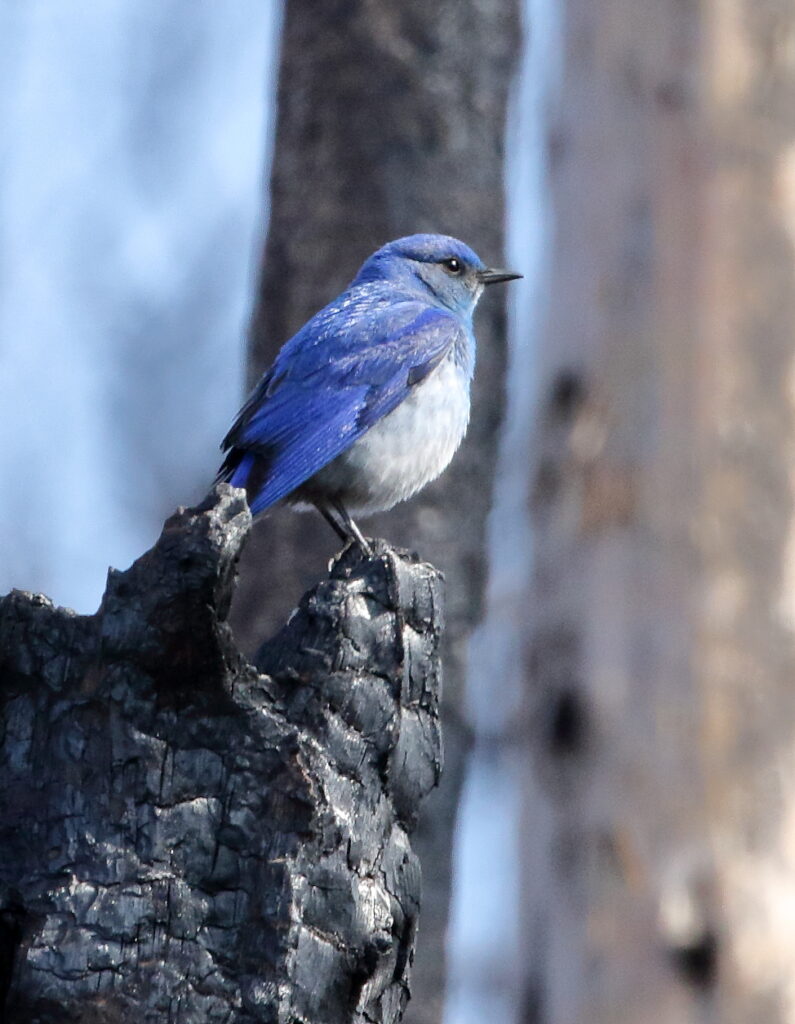
Almost immediately, we began seeing Mountain Bluebirds, one of Montana’s most spectacular species. MOBLs are well-known “fire birds” and their vivid blue plumage looks especially striking against the blackened trunks of a burned forest. Today, we saw these birds everywhere. During our three-mile walk, Braden recorded seven of them, but we both agreed we probably undercounted.

By popular consensus, Mountain Bluebirds are the most stunning “fire birds” you’ll find in burned forests. However, another common fire bird, Western Tanager, might challenge that opinion. Did you know that bluebirds are thrushes? They are relatives of at least four other popular Montana thrushes: American Robin, Swainson’s Thrush, Varied Thrush, and Townsend’s Solitaire.

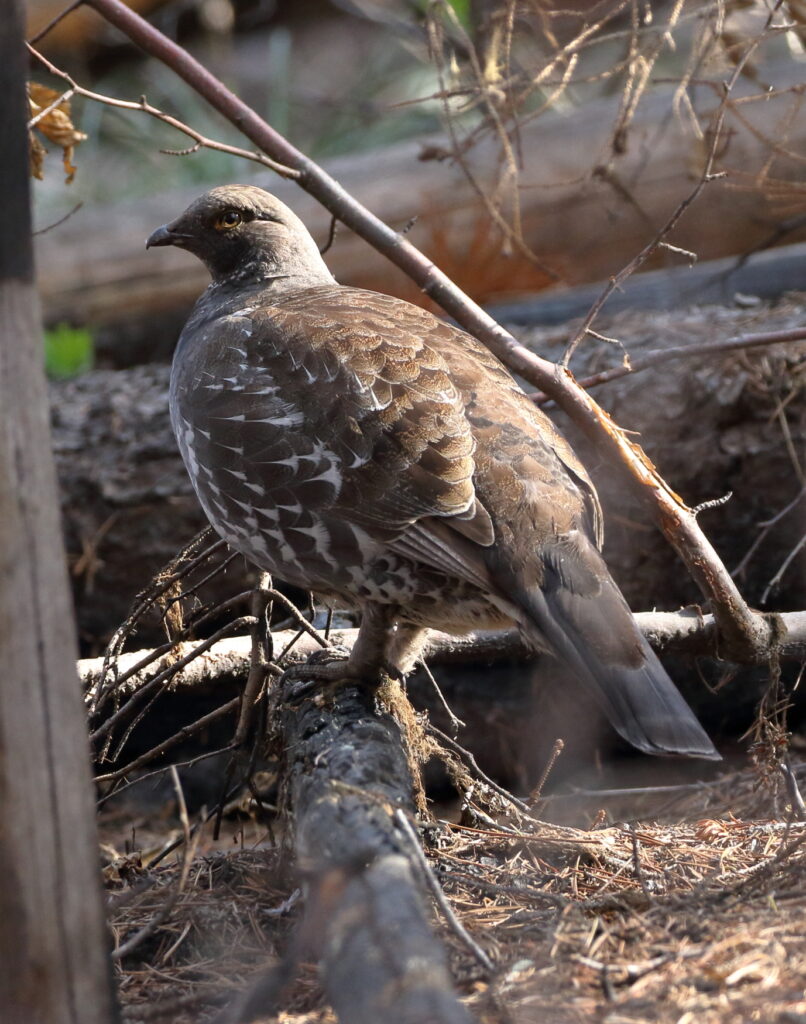
Suddenly, a large shape took off from beside the road and spread its wings as it glided down into the woods. “Dusky Grouse!” Braden exclaimed. It was one of the birds he most wanted to see since arriving back in Montana the previous week. Hoping for a better look, we crept down after the bird and, sure enough, espied it sitting quietly in the shadows. We enjoyed it through our binoculars for five minutes and then slipped away, leaving it in peace.

Before heading out, Braden told me, “I really want to see a Dusky Grouse.” This one obliged perfectly—and it was the first we’d ever seen in a burned forest.

Except for the mystery woodpecker that had drummed earlier, we had not heard a trace of other woodpeckers, but what we did hear was astonishing: wood-boring beetle larvae actually munching away inside of the dead tree trunks! I’d been told that one could hear these, but with my crummy hearing, I didn’t believe that I ever would. Sure enough, in several places, we listened to these big juicy grubs take noisy bites out of the wood!

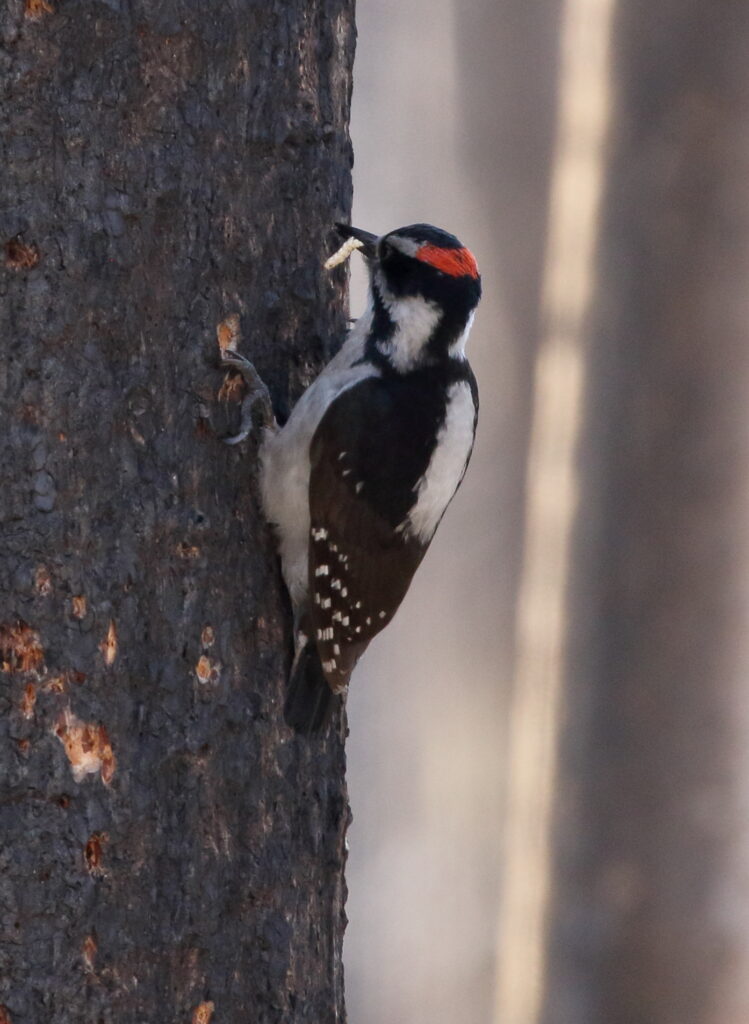
Score! While we watched, this Hairy Woodpecker extracted a juicy beetle grub from a dead tree.

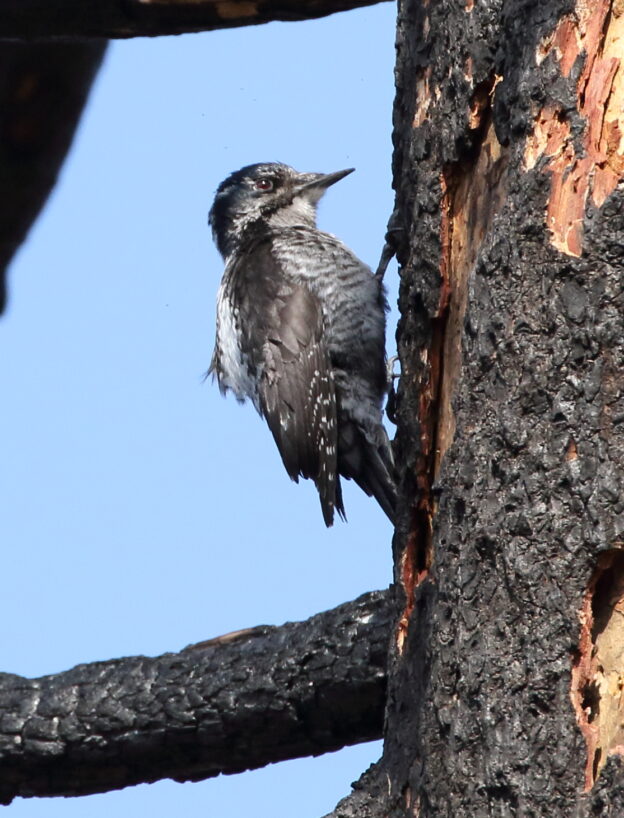
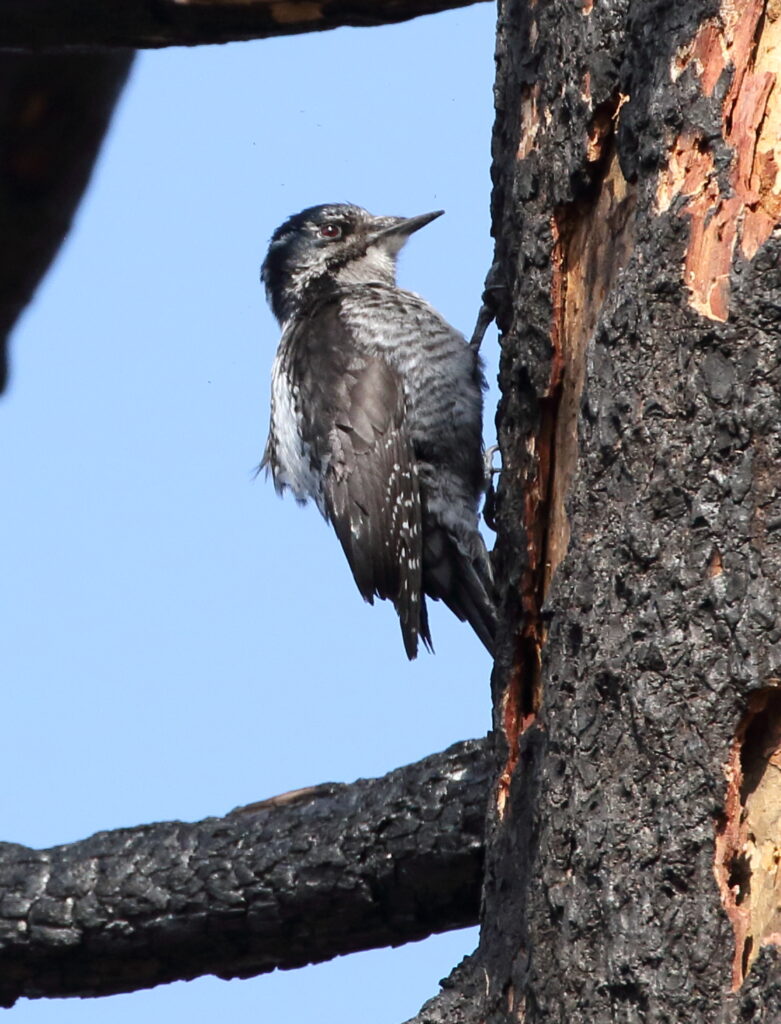
Finally, we also heard tapping on a large tree ahead. Braden got his eyes on it first. “It’s an American Three-toed,” he exulted. We could tell it was a female by the lack of a yellow crown, and we settled in to watch this amazing bird. It was working its way down the trunk, flaking away burned bark, presumably to check for insects hiding underneath. Once in a while, it stopped and really began pounding away after a beetle deeper inside the wood. It sounded like someone driving nails into cement!

Even female American Three-toed Woodpeckers can be distinguished from Black-backed Woodpeckers by having some streaky white on their backs—though not as much as on Hairy Woodpeckers (compare with previous photo).

As we continued our walk, we also saw Hairy Woodpeckers and another three-toed, this one a male. Woodpeckers, though, were just some of the birds making use of the burn. We got great looks at Townsend’s Solitaires, Red Crossbills, American Robins, Dark-eyed Juncos, Yellow-rumped Warblers, and Chipping Sparrows, and heard both Red- and White-breasted Nuthatches. Most of these are classic “burn birds” and we felt exhilarated to see them.

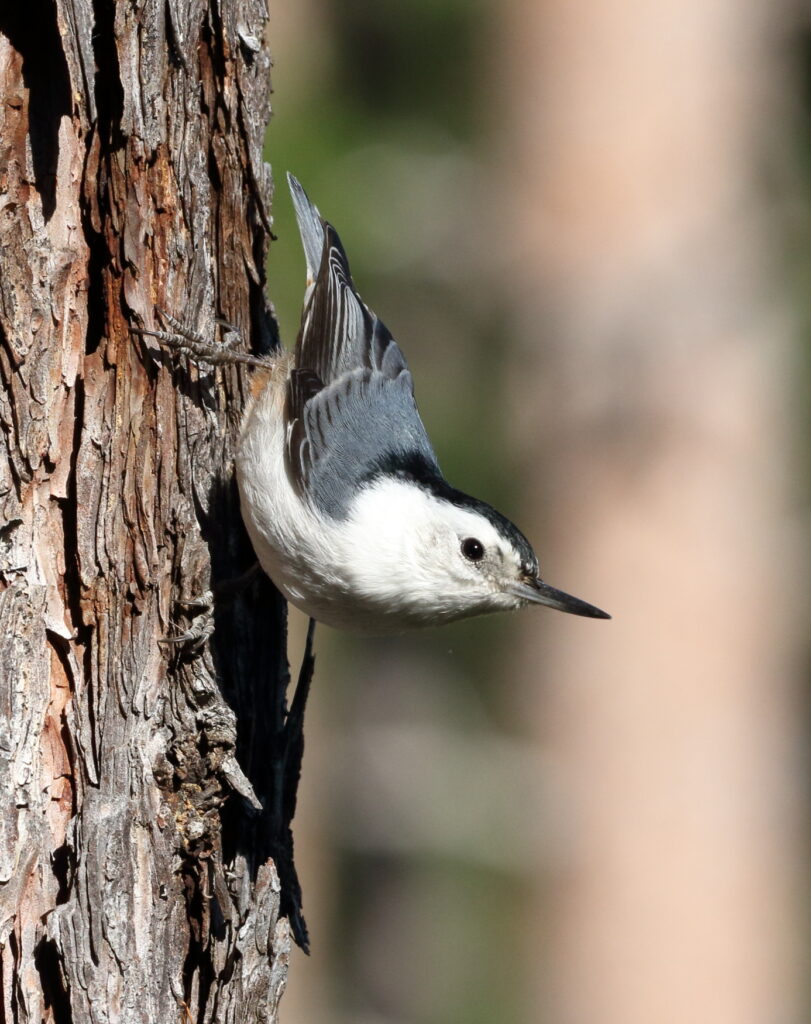
Though we didn’t get eyes on one in the burn, we did hear a White-breasted Nuthatch—and saw this one the day before up nearby Pattee Canyon.

At a couple of places, unburned green scrubby areas abutted the fire boundary, and it was fun to see birds dash from these green protected areas into the burn for quick meals or nesting materials before dashing back to safety. Many birds, in fact, love to “set up shop” at the boundaries of such two contrasting habitats.

We never did find a Black-backed Woodpecker, but that did little to detract from yet another great birding outing. We vowed to return to this spot the next few years, hoping that no one would move in to “save” this precious forest that didn’t need saving. On the drive down, we also stopped at some of the lower riparian areas for great “listens” at MacGillivray’s, Orange-crowned, and Yellow Warblers along with our favorite empid species, Willow Flycatchers. Amid the current chaos of the world, our burn bird outing offered a fun, revitalizing—and yes, inspiring—break. If you’re lucky enough to have a burned forest near you, we hope you’ll check it out.

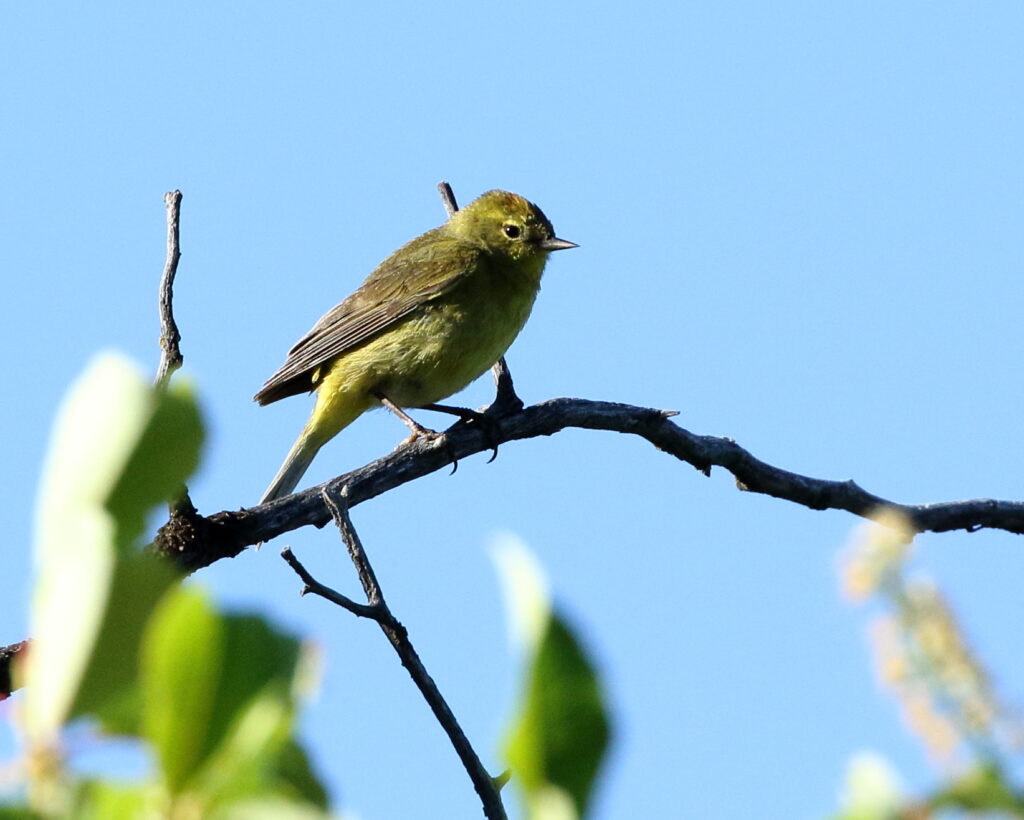
We can’t prove it, but it seems to be a really good year for Orange-crowned Warblers—not always the easiest birds to see in Montana.

Chasing Morelet’s Seedeaters—or Why You Shouldn’t Depend on Map Apps Near the Mexican Border (Texas 2025, Final Installment)

My success finding Black-capped Vireos and Golden-cheeked Warblers (see our last post) left me a welcome gift: an extra day to pursue another bird that keenly interested me. It was a bird Braden and I had unsuccessfully tried for on our 2018 trip to the Lower Rio Grande Valley: Morelet’s Seedeater. Though not rare in its core year-round range of Central America and eastern Mexico, this adorable “finchy” songbird just barely creeps over into the US along the Rio Grande Valley.

Catching sights such as this setting moon is one of the benefits of being an “early birder.”

Sunday morning, I rose at four a.m. and headed south from Uvalde. As they had on the previous morning, both a spectacular sunrise and unforgettable setting full moon rewarded me. As light crept over this flat country, caracaras flew along the road and Scissor-tailed Flycatchers perched on telephone wires. I even got a glimpse of a flock of quail leaping over a fence. Scaled Quail? I could only guess! After ninety minutes, my little highway joined Interstate 35.

And that’s where the trouble began.

I-35 is a main artery for trade between Mexico, the US, and Canada. As I sped south, I kept seeing signs for Mexico, but my map app directions assured me that I should keep going and turn off at an exit called Riverbank Drive. As I kept driving, however, I saw no signs for that—or any other—exit, and I realized that the only other traffic around me consisted of huge 18-wheelers. Finally, a thought occurred to me: Uh-oh.

Soon I found myself at a dead stop, surrounded by big rigs, with no way to turn around. There are moments in life where you know you are in a fix, and there’s not a thing you can do about it. This was one of those. Still, hope springs eternal and I climbed out of the car and walked to a big rig next to me. The kind Mexican driver, undoubtedly flummoxed by what I was doing there, rolled down his window, and we had the following conversation:

Me: Uh, I think I made a mistake. I’m trying to go to Laredo.

Driver: Laredo, Mexico?

Me: Uh, no. Laredo, Texas.

Driver (looking worried for me): You’ll have to turn around.

Me: Where?
Driver (after conferring with his partner): I don’t know.

These Big Rigs kept me company as I contemplated life as a Mexican citizen.

It was then that I began pondering the frightening ramifications of entering Mexico without a passport. I mean, could I have picked a worse time in history for this to happen??? The only good thing was that a Scissor-tailed Flycatcher perched nearby, blissfully unconcerned by my human drama. A few minutes later, the border opened and I eased in front of my new trucker friend. For ten minutes I and the big rigs inched forward until we reached a wide No Man’s Land of pavement and there I spotted an actual border worker. I pulled up next to him and explained my mistake. Looking vaguely amused and overly patient, he said, “See my buddy back there? Turn around and he’ll keep the trucks stopped while you exit at that road on the side.” I proceeded as instructed, gratefully waving to the “buddy.” I could have burst into tears at this point, but instead, I laughed all the way to the next exit—the real exit—which led to my original destination, Father McNaboe Park.

The Rio Grande River, aka the Mexican Border, complete with Border Patrol agents and lots of Carrizo cane, where Morelet’s Seedeaters like to hang out.

By the time I reached the park, I had experienced a week’s worth of drama, but remember, I still had some serious birding on the agenda. In 2018, Braden and I had visited the Lower Rio Grande Valley (LRGV) and even spent a night in Laredo, but had somehow failed to find McNaboe Park. I don’t know how, as the park consisted of a wide, long swath of trails, playing fields, and other amenities right on the Rio Grande River. Today, the park was jammed with people and I felt at ease as I walked toward the river. Before I even got there, I spotted my first great birds of the day—a pair of Hooded Orioles, a species I hadn’t seen since visiting Southern California seven years before. Not long afterward, I saw another oriole, a Bullock’s Oriole—perhaps on its way to Montana?

Over the phone the night before, Braden had told me to look for the Morelet’s Seedeaters in the “cane grass,” a tall invasive species known in Texas as Carrizo cane. Apparently, this plant can be found all along the 1,255-mile reach of the Rio Grande, and it didn’t take me long to find thick stands of it. I began walking along them looking for little black and brown birds. I covered a couple of hundred yards without seeing any and then walked down to a little sandbar right at river level. No seedeaters.

Then, I happened to glance up a side channel at another thick stand of cane. There, perched on one of the stalks was an erect little bird with a finchy bill. I didn’t get my binoculars up in time to get a good look, but I immediately knew: I had found my bird!

I was just about to get a great photo of this Morelet’s Seedeater when a loud car rumbled up next to me. I accidentally managed this flight shot, though, which is kind of fun.

Of course, that didn’t keep me from wanting better looks, and for the next hour or so, I walked various paths and channels. I got to know the bird’s song and it wasn’t long before I was hearing and seeing more of these cute little guys. They were pretty shy, but I managed good looks—and saw some other great birds as well. These included a pair of Black-necked Stilts, a Spotted Sandpiper, a Green Heron, and even a lone Mexican Duck in the middle of the river. Not including the seedeaters, the show stoppers, as usual, were a pair of Vermillion Flycatchers.

Do Vermillion Flycatchers get way more attention than they deserve? Probably. Does anyone ever get tired of looking at them? I doubt it!

After a late breakfast at the French restaurant McDaniels, I decided to hit one more park in Laredo—North Central Park. Remarkably, I had failed to find a Golden-fronted Woodpecker so far on the trip, and though the heat was comin’ on fast, the park had abundant sightings of them. It took only five minutes to hear and then see one of these handsome birds and, walking a couple of miles or so, I also added Great Kiskadees and Bell’s Vireo to my trip list. Then, before I inadvertently wandered toward Mexico again, I turned tail and headed back up I-35 for San Antonio.

Link to my Texas Trip Report: https://ebird.org/tripreport/351263

Total Number of Species for the Trip: 144

My Top 6 Trip Birds:

Least Bittern (see post “Anahuac Lifer Attack”)

Yellow-throated Warbler (see Texas Hill Country post)

Black-capped Vireo (see Texas Hill Country post)

Golden-cheeked Warbler (see Texas Hill Country post)

Morelet’s Seedeater (this post)

Yellow-throated Vireo (see Peveto Woods post)

A pair of Black-necked Stilts flying downstream over the Rio Grande.

Owl’s Watch Ecolodge (Colombia Birding Part 2)

As light spread across the sky, I slipped on my flip-flops and ventured out onto the porch of our cabin at Owl’s Watch Ecolodge in the department (county) of Caldas, Colombia. Misty clouds clung to the Andean peaks surrounding us. Far below rose the high-rise apartments and businesses of Manizales, a city of almost half a million. Unidentified bird calls rang across the vegetation surrounding us and a couple of flocks of Eared Doves flew by on a morning commute. Suddenly, I saw a shape that stirred familiarity. It landed in a distant tree, but thanks to my amazing new binoculars, I was able to focus in on it. Even though I knew very little about Colombian birds, the way it clung to the side of the tree made me  think, “Woodpecker.” Then, I caught a reddish hue on its nape and back, and my excitement rose. When it turned its head, it revealed a large white face patch that clinched the ID. I couldn’t believe it. In my first moments of serious birding in Colombia, I had found one of the birds I most wanted to see: a Crimson-mantled Woodpecker!

It’s risky to post such a crummy photo of a Crimson-mantled Woodpecker as the post’s very first bird shot, but it highlights how difficult it often is to photograph birds in tropical forests—a topic I’ll discuss in a forthcoming post.

As mentioned in my last post, “Layover Birding in Bogota, Colombia”, I had traveled to South America at the last-minute invitation of my friend and FSB contributor, Roger Kohn. Now, only two weeks later, I felt in awe of the fact that we were actually here, about to launch into our first Colombian day of birding together.

One of the two luxurious cabins at Owl’s Watch, with great views of the surrounding landscape. As popularity of the lodge blossoms, Dennis is considering adding additional cabins.

Roger had planned our entire itinerary, which included booking our first four nights here at Owl’s Watch, a comfortable new lodge with two modern cabins perched at the edge of a large, protected watershed that ensured a dependable water supply for the city of Manizales below. The lodge had been built by American expat Dennis Bailey and his Colombian wife, Adriana. Interested in restoring land that had been cleared for agricultural activities, they had purchased a farm, or finca, that was an inholding of the nearby protected area. As they worked to revegetate the land and allow it to heal itself, they decided to build Owl’s Watch for nature lovers—especially birders.

The following day, we would be heading out with a guide, but today Roger had wisely allocated time for us to bird and explore on our own—a day to get familiar with some of the local birds and rest up from our two-day journeys from the States. I’m more of an early riser than Roger, but to my surprise, he soon joined me on the porch, eager to get started.

One of the amazing things about Owl’s Watch is that you are able to gaze down on Manizales, a city of almost half a million people, while being surrounded by nature.

We decided to begin by climbing the long steep “driveway” that headed up from the lodge to the road above. Almost immediately we saw large turkey-like birds that, from taking eBird quizzes, I recognized as Sickle-winged Guans. Moments later, I glimpsed a furtive shape fly across an opening and dive into a bush—a White-naped Brushfinch.

At the top of the drive, we reached a small parking area bristling with even more activity. In the trees surrounding the area, we quickly identified the orange head of a Blackburnian Warbler, and then got super excited to see a pair of equally small birds with bold, sunburst golden throats and breasts—Golden-fronted Redstarts!

Golden-fronted Redstarts, a New World warbler, were one of our exciting finds from our first day of birding at Owl’s Watch.

As I chased these around, Roger used Sound ID to get onto a bird I never thought we would see, Azara’s Spinetail. Its call sounded like “bis-QUICK! bis-Quick!” and while we never got great looks at it, we were thrilled to get a glimpse of this handsome, skulky species.

From the parking area, we headed down a pleasant trail that would wind its way back to the to the main lodge building, dubbed “the Social.” Soon, a covered viewing platform came into sight and we paused to check out hummingbirds at the feeders and flowering bushes surrounding the spot. Someday, I’ll write about my ambivalence about hummingbirds, but I gotta say, they were spectacular to watch. What got me most excited was seeing a White-sided Flowerpiercer. I’d seen my very first flowerpiercer only the day before in Bogota, and here I was, looking at a second species the very next day!

Though not as colorful as many other tropical birds, I was especially excited to discover this White-sided Flowerpiercer. Notice the hook at the end of the bill? That’s a key to picking out flowerpiercers from other small tropical birds.

We continued hiking down the trail, past the Secret Garden, another great birdwatching spot Dennis had set up. Along the way, I spotted a rather plain brown bird that I quickly recognized as a Swainson’s Thrush. As I indicated in my last post, it’s a special thrill to see a bird from “back home” in its alternative, wintering environment. I also took a photo of a nondescript bird that turned out to be a Mountain Elaenia, a kind of tyrant flycatcher.

Don’t get me wrong. I am NOT an expert at identifying flycatchers, but a guide and the Merlin app helped me figure out this Mountain Elaenia.

Soon, we found ourselves back at the Social. David, the fabulous Owl’s Watch cook, fixed us a scrumptious breakfast and we dined while enjoying yet more hummingbirds—at least nine species—along with more flowerpiercers, Rufous-collared Sparrows, and Great Thrushes.

Along with the hummingbird feeders, Dennis’s crew had set up a fruit feeder off to the side, and there we beheld one of the most spectacular of the area’s birds, Blue-winged Mountain Tanagers.

Blue-winged Mountain Tanagers were definitely one of the “best-dressed” birds of our first day birding at Owl’s Watch.

After we got our fill of hummingbirds (if that’s even possible), we took another path that wound around to our cabin. Before our trip, Braden had encouraged me to listen for weird noises, and now I did indeed hear a very bizarre, almost plaintive, series of falling notes. As we rounded a corner, we met the source of these calls—a Masked Trogon! Trogons are some of those birds you always hope to see in the tropics, but when you finally do, you’re left wondering if the bird is really perched there in front of you, or if you’re just imagining it! Fortunately, this was no mirage, and even better, it sat cooperatively while Roger and I did our best to capture decent photos of it against the backlit sky. How did we do? You will have to judge for yourself:

Even this so-so photo reveals what stunning birds Masked Trogons are. While this was our best look at this species of the trip, other trogons would soon follow!

Note: This blog post—and all others on FatherSonBirding—are written by REAL PEOPLE! No compensation or gratuities were provided to us in connection with this post. If you’d like to support FSB, please consider buying one—or ten—of Sneed’s books and contributing to a bird conservation organization of your choice. Thank you!