Category Archives: Humor

Return of the Northern Hawk Owl

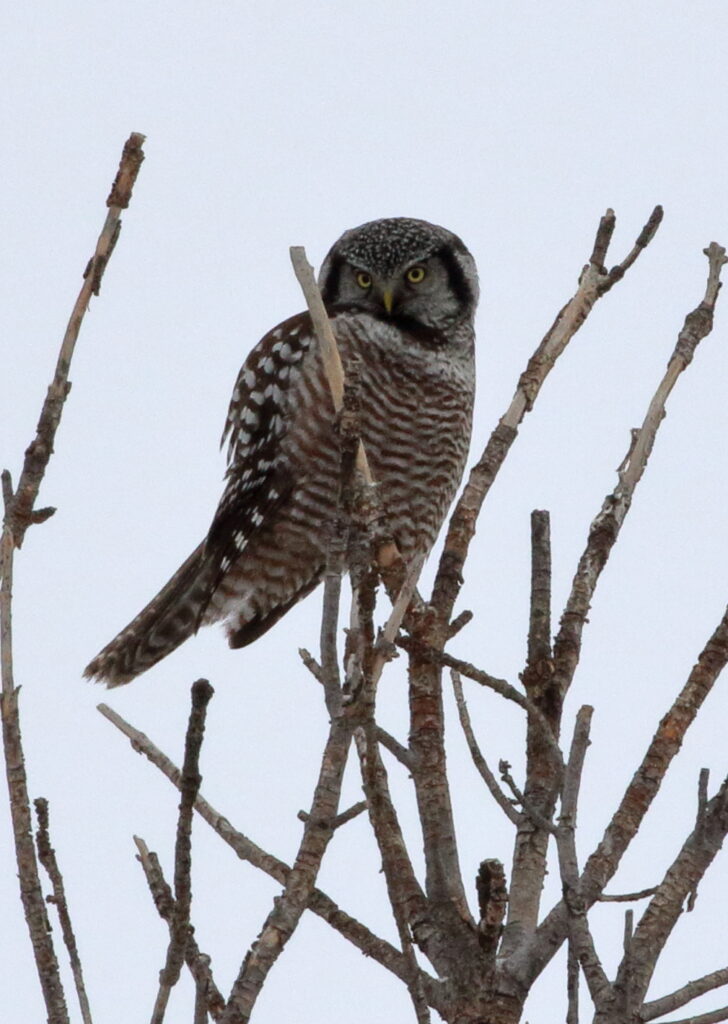
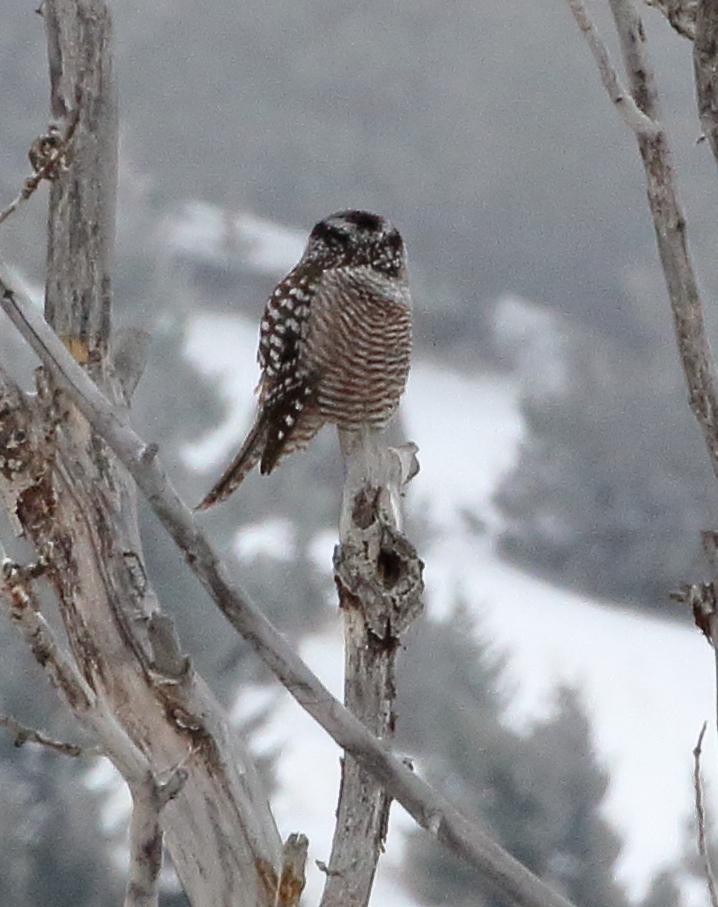
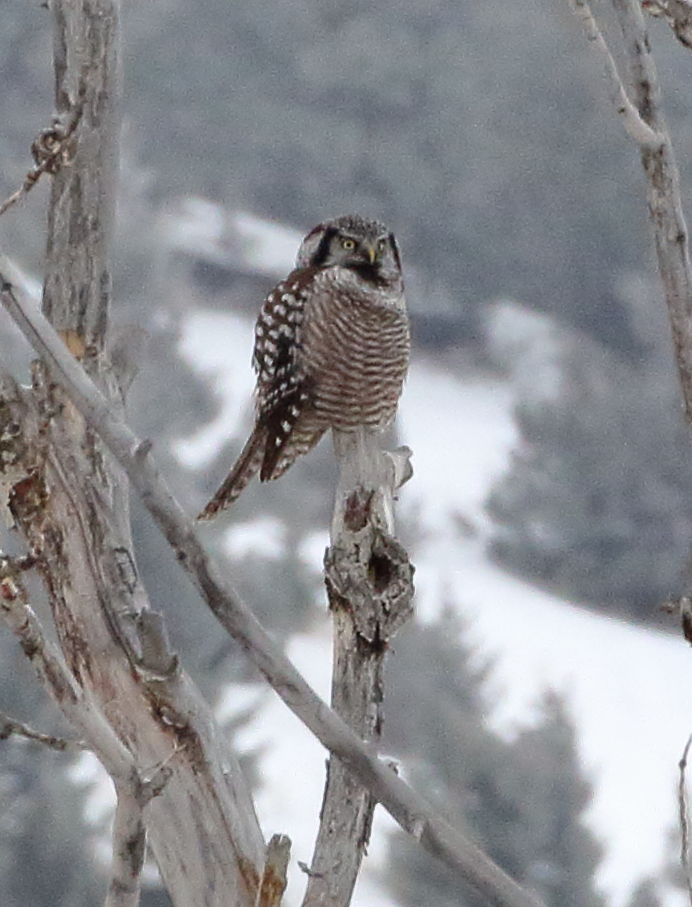
Last week, Wise River resident Rory Macdonald reported a bird that got every Montana birder—and quite a few from other states—giddy with excitement: a Northern Hawk Owl. NHOWs are a decidedly boreal species, but venture south from Canada in a handful of places, mostly in winter. Cornell Lab dubs this owl one of the least studied birds in North America, but we do know that it preys on rodents as well as larger ground birds and hares. Many birders travel to Minnesota’s Sax-Zim Bog to see one, and every once in a while an irruption year brings more of the owls down into the U.S., but even so, NHOWs are considered one of the most difficult birds to see in the Lower 48. Here in Montana, breeding has been documented in Glacier National Park (mostly in burn areas), but breeding there has dried up in recent years and reports elsewhere are few and far between. It’s no surprise, then, that when the NHOW popped up last week, dozens of birders immediately leaped into their cars and headed to Wise River. Braden and I joined the fray.

Our first Northern Hawk Owl, seen on Braden’s birthday in 2020. Read that story here.

Wise River sits about two hours from Missoula, and after I got up early to take my daughter to driver’s ed class and walk our dog Lola, I returned home, grabbed Braden, and pointed our trusty minivan east on I-90 in the pre-dawn darkness. Fortunately, the roads were dry and we made good time, stopping at the Deer Lodge McDonald’s for our customary egg sandwich breakfasts before heading on. We arrived at Wise River just before 9:00 a.m. “Do you know exactly where the owl’s been spotted?” I asked Braden. “In two different places,” he replied. “The first is at the USFS ranger station up here on the left.”

I turned left as instructed. No owl. Braden then directed me to another location maybe a half mile to the west. We crept slowly down a snow-covered side road, carefully studying every fence post, roof, and telephone pole. I started to get the feeling that we wouldn’t find it, and Braden did, too. In our experience, it seemed that whenever we chased something really rare, we either saw it immediately—or missed it altogether.

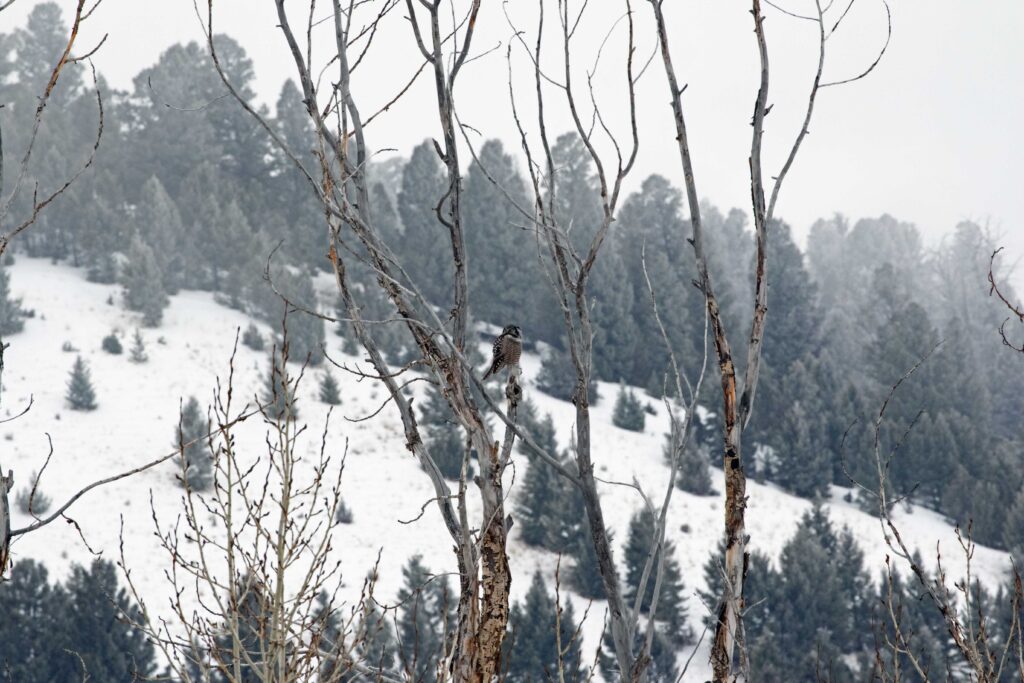
The road turned left and we saw a pickup truck parked where the road made another left at the base of a mountain. “I hope that’s a birder,” Braden said. I did, too, but I also looked at the trees beyond. “There it is!” I exclaimed. “Oh—yes!” Braden said.

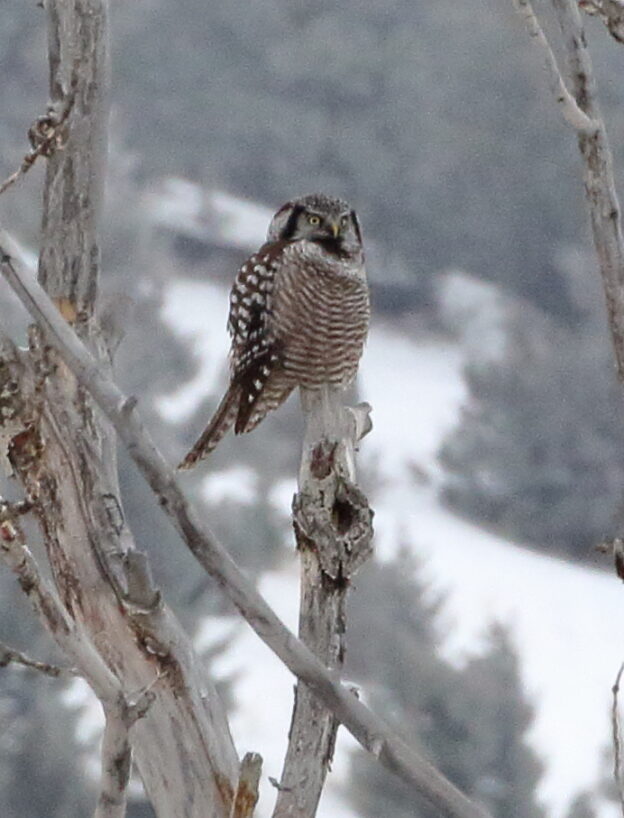
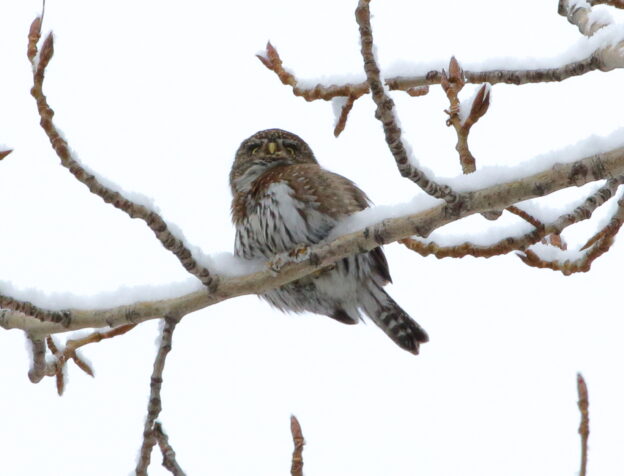
If you’re out hunting or skiing in winter, keep an eye out for something that looks like this. You just may be looking at one of Montana’s rarest residents!

After parking, I quickly set up our spotting scope, and we carefully walked forward. The pickup ahead of us belonged to veteran Montana birder and photographer Dan Ellison, and we enjoyed a nice, fun conversation before focusing in on the owl, which fortunately didn’t appear to be going anywhere. “He doesn’t seem to be spooky at all,” Dan told us, and sure enough, the owl posed beautifully as I took photos and Braden trained the scope on it. As other birders joined us, however, the owl suddenly flew and torpedoed toward something in the sagebrush. Watching the bird fly was a real treat. Though definitely on the chunky side, the owl “handled” more like a falcon; fast and with surprising agility. After grabbing—or missing its prey—it disappeared around a rocky outcrop.

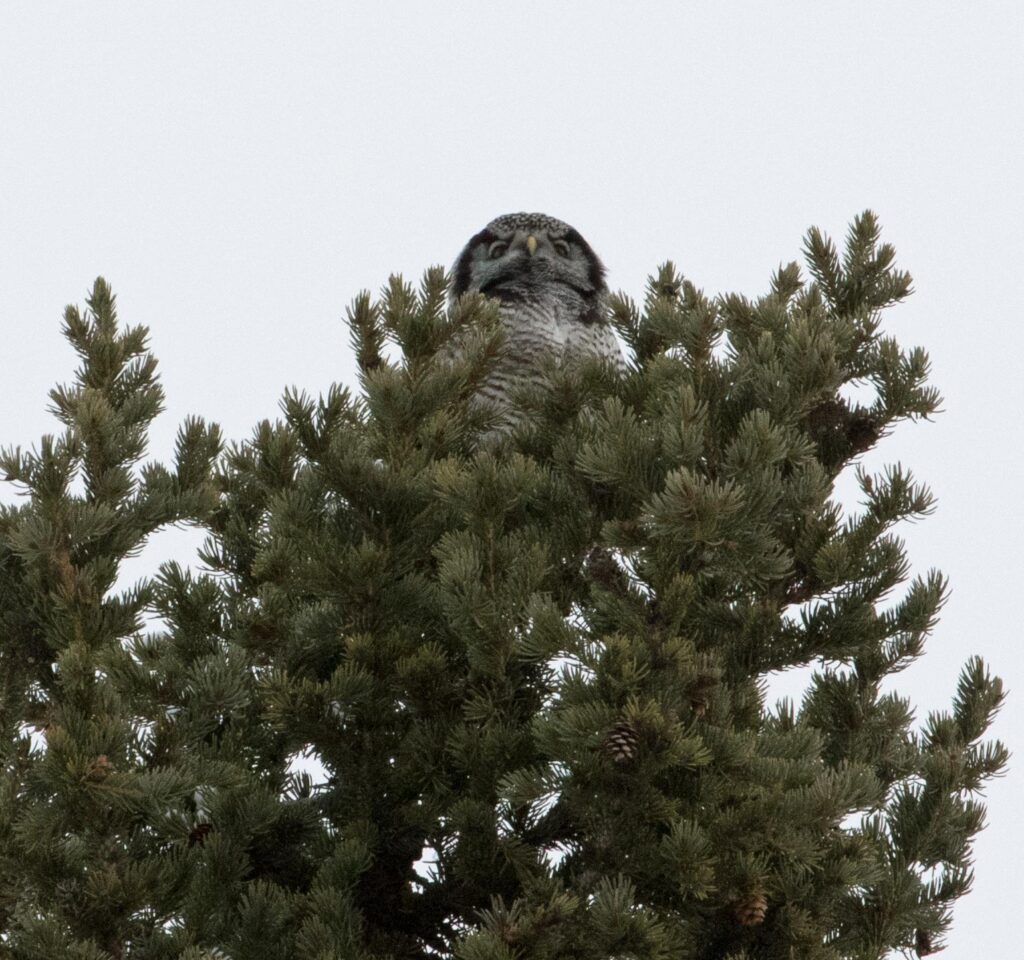
With a stare like that I, for one, am not inclined to get this bird upset.

Fortunately, it soon reappeared in another tree, perhaps hungry for more “Oohs” and “Ahs” from admiring birders. Braden and I find ourselves chasing rarities less often these days, but we were definitely glad we chased this one. This was only the second Northern Hawk Owl we’d ever seen (for the story on the first, see our 2020 post “Incredible Birthday Birding”), and frankly, I never expected to see another. Not only did this one give us great, leisurely views, it was a wonderful ambassador for birds and bird conservation.

After an hour admiring the bird, Braden and I headed back out toward I-90, detouring up to Discovery Ski Area to find a few more winter birds—but maybe we’ll write about that later!

Starting 2023 in the Dumps

If you’ve been following our posts the past five years, you’ve probably learned that Braden and I like to kick off a new year with a big day of birding. Last year on January 1, we enjoyed an exceptional day, chalking up almost 50 species including Snowy, Short-eared, and Great Horned Owls. This year, we didn’t get out until January 3—and following a much colder snap of weather—and weren’t sure what we might find. I predicted we’d see 45 species while Braden opted for a more conservative 40. We both agreed, though, that we might be a bit optimistic.

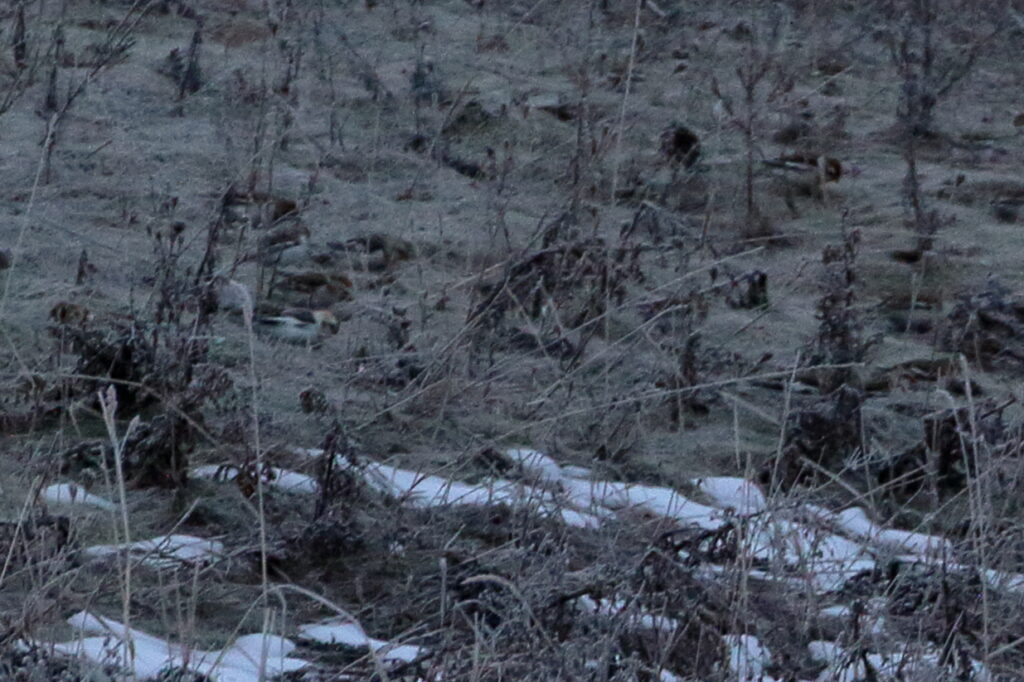
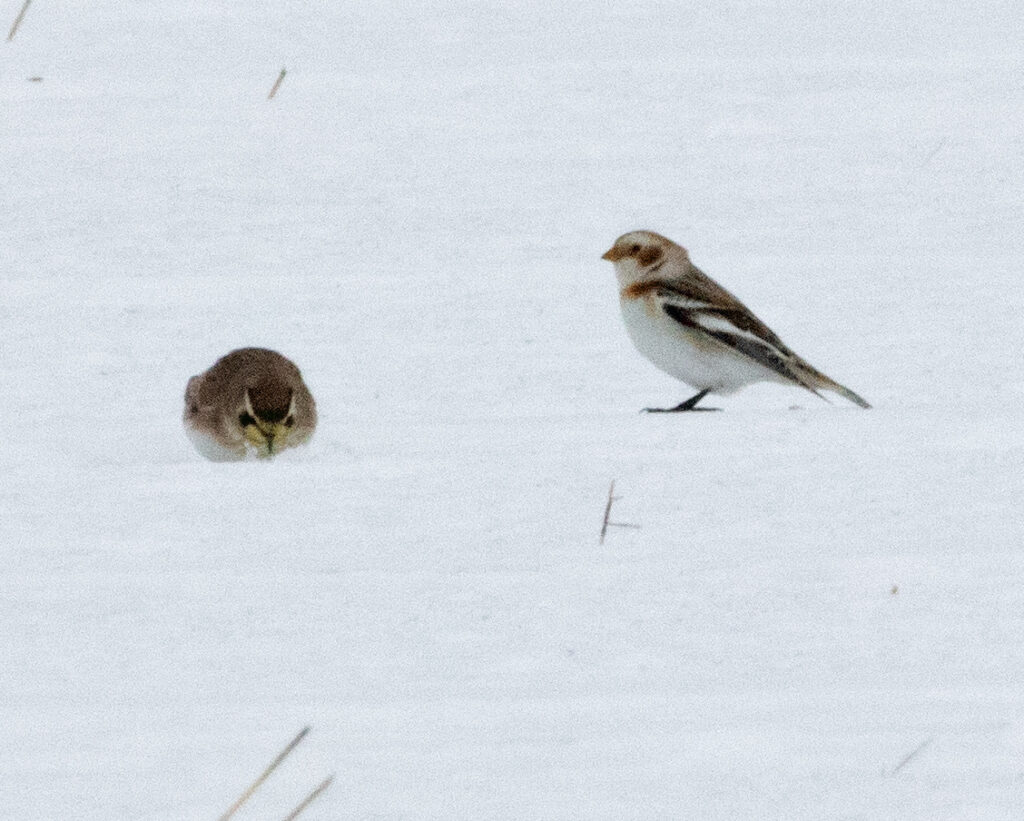
We backed out of our driveway in total darkness and an hour later, as dawn spread over the horizon, were greeted by the sheer majesty of the snow-covered Mission Mountains, surely one of the most stunning mountain ranges in the Lower 48. Our first destination? Duck Road at Ninepipe, perhaps our most reliable spot for Short-eared Owls. Alas, these owls are not to be trusted. They had obviously received advanced intel about our arrival and skedaddled to some other part of the refuge. As we crept along in the early light, though, we spotted a flock of about sixty small birds suddenly rising up from the snow-covered grass. “Waxwings?” I asked as Braden quickly got his binoculars on them. I parked the car as he answered, “No. Guess again.” “Snow Buntings?” I asked excitedly. “Yes!”

We watched the birds whirl around before landing again, and quickly broke out the spotting scope. Often, Snow Buntings travel with Lapland Longspurs, but as we scanned the birds feeding hungrily about a hundred yards away, we saw that this flock was pure buntings. Remarkably, these were the first Snow Buntings we’d ever seen on the west side of the mountains and it kicked off the day in fine fashion.

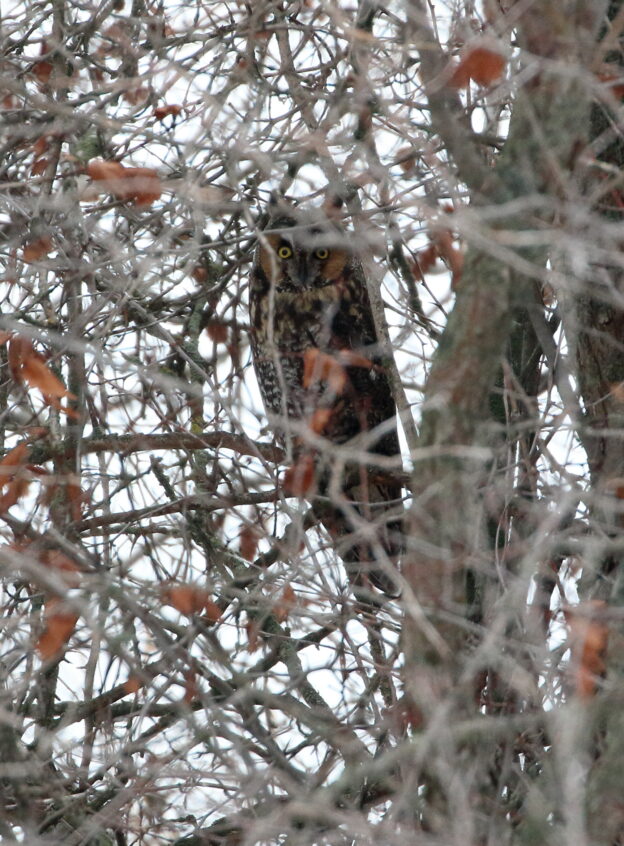
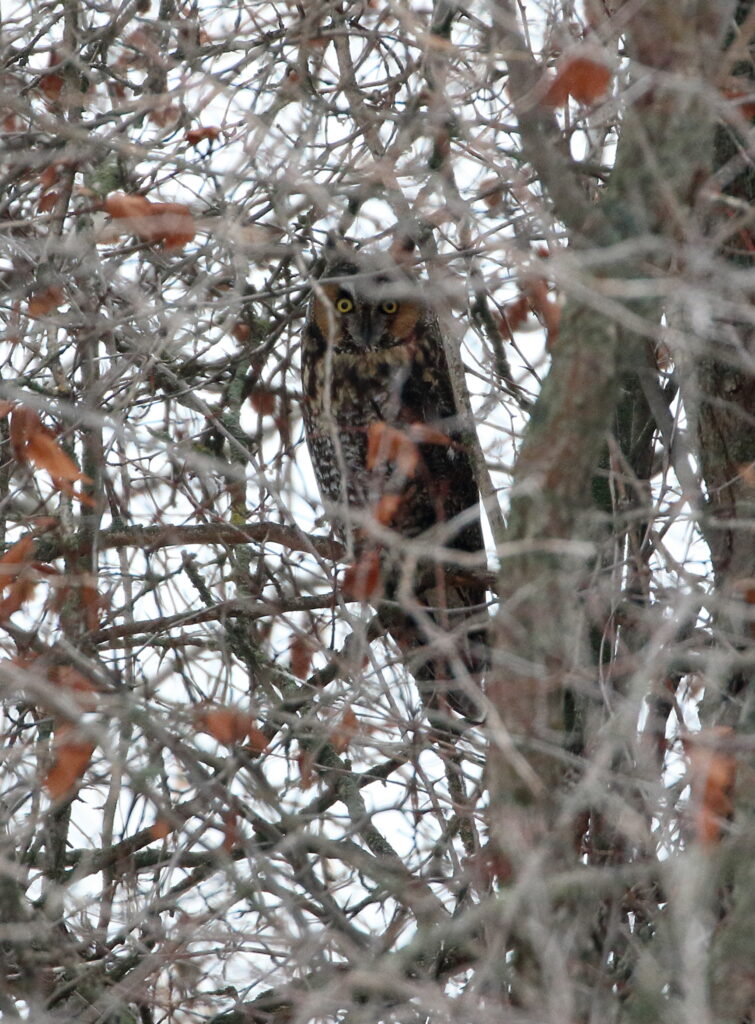
We left Ninepipe with only about ten species, but felt optimistic heading north, and sure enough, found a pair of gorgeous Long-eared Owls at a well-known spot near Polson, Montana. At a nearby bakery, we also happened to snag two donuts and a cinnamon roll for our Year List. Yum!

Bird of the Day: Even concealed in this thicket, this Long-eared Owl and its companion gave us our best-ever look at these animals in the wild.

We weren’t sure what we were going to do next, but decided to retrace last year’s route and continue on to Kalispell in hopes of finding a Snowy Owl. Last year, we had happened into an amazing group of waterfowl at the north end of the lake, but this year we ran into a much smaller group about halfway up the west side of Flathead at Dayton Bay. Here we found Trumpeter Swans and six kinds of ducks, and it was a good thing as we discovered that the north end of the lake was almost completely frozen.

After an unsuccessful search for Snowy Owls, we stopped at Panera’s for lunch and contemplated our next move. “We could go to the Kalispell dump,” Braden suggested. I cringed at the idea since we’d been yelled at a couple of years before when trying to go there to find gulls and Gray-crowned Rosy-finches. The trick was to arrive with some trash to throw away, but we’d forgotten to bring any. As we munched away on our Kitchen Sink cookies, however, we formulated a plan. After leaving Panera’s I drove behind some of the big box stores nearby and, sure enough, found some wasted cardboard sitting there. I tossed it into our trusty minivan and we were all set!

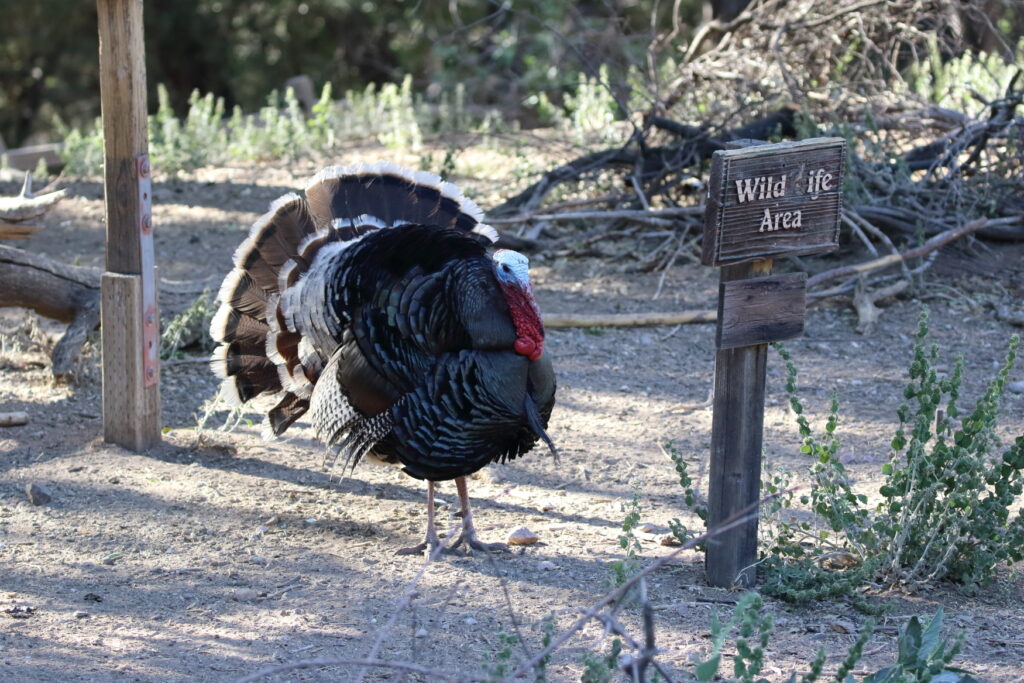
Alas, we found nothing truly extraordinary at the landfill. We did pick up Herring Gulls, which can be a bit tricky to locate in Montana, but the real surprise was a group of about ten turkeys feeding on garbage. Hm. “I didn’t know they could do that,” Braden said, but it made sense. After all, the amount of food Americans throw away could easily feed several other countries. Though we failed to find anything really rare, we had completed our covert mission and headed south again feeling like we’d done our best. Click here for our dump checklist!

Who knew that Wild Turkeys liked to forage in landfills? We didn’t get any photos of this happening since we had to get in and out of the dump quickly, but thought you’d enjoy this “non-landfill” turkey—a different subspecies than the Landfill Turkey.

As the day again drifted toward darkness, we again hit Ninepipe on our way back to Missoula, picking up American Kestrels, a Northern Harrier, and a couple of large groups of pheasants, but no Short-eared Owls. As a consolation prize, though, as soon as we got home, Braden heard Great Horned Owls hooting from our front porch and called me out to listen. We ended the day with 35 species, undershooting even Braden’s smaller target, but felt good about the day. It was still a respectable number to start the new year, and with Braden heading back to college soon, we both cherished another day getting to bird together. How can you do better than that?

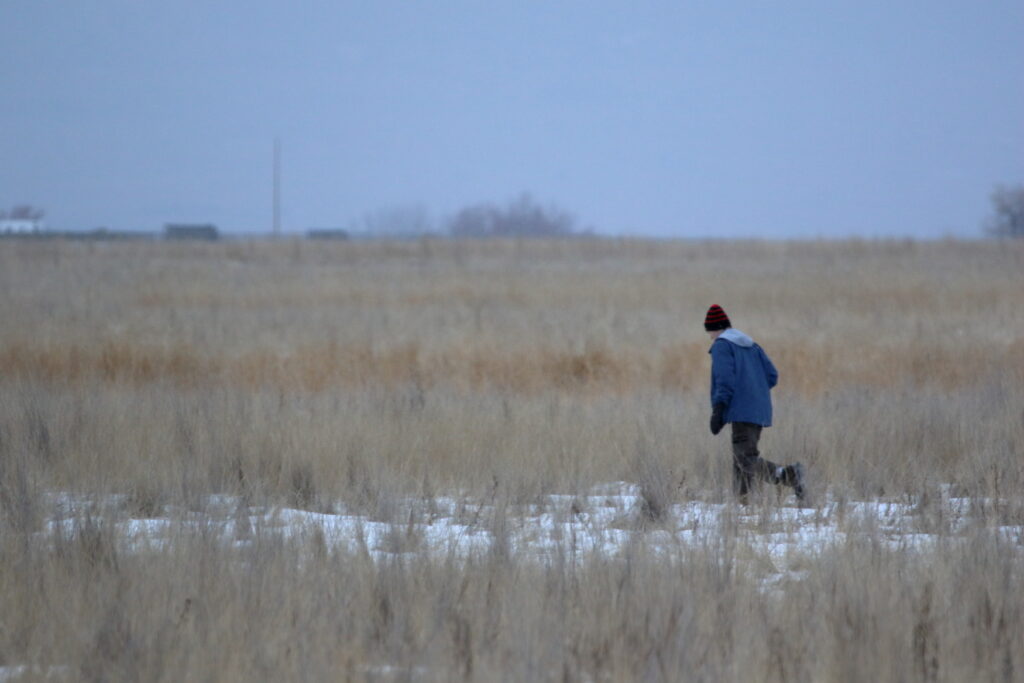
The Good ‘Ole College Try: As our first 2023 day of birding wound down, Braden trudged off across this field to determine if perhaps any Short-eared Owls were just laying low. They weren’t. Still, we felt pleased by our first day of birding, 2023.

Counting Down Braden’s and Sneed’s Top 2022 Birds

A tradition Braden and I have formed over the years is to make top birds lists after any big trip or, as this year, for our entire year of birding. This probably stems from the many hours I listened to Casey Kasem counting down the American Top 40 every weekend as a youth. Our own “Top 40” lists have diverged a bit since Braden is now on the East Coast for most of the year—but this year we still managed to have a lot of birding adventures together, and so have a lot of common birds on our list. It’s funny, though, how some birds we might have been super excited about when we first saw them often drift lower on the list. I suppose it’s like being super excited about Barry Manilow when you first heard him—and then realizing you could be listening to the likes of the Rolling Stones, Neil Young, and John Lee Hooker. Anyway, we thought you might enjoy our Top 10 birds of 2022—and hope you might share some of your own!

# 10

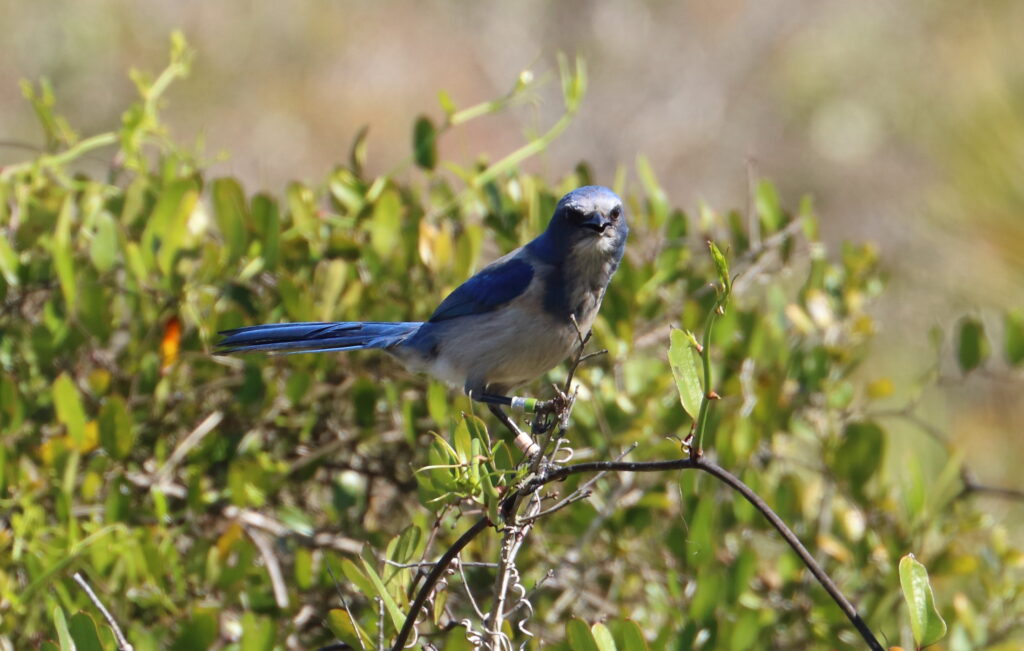
Coming in at Number 10 for Braden was the Florida Scrub-Jay, which is remarkably vulnerable in Florida, but Braden got to see with his birding buddy Nick Ramsey on their epic Spring Break Florida adventure. Read about it here. Sneed’s #10 was an unlikely Cape May Warbler—his Lifer—that he spotted in front of the house of his good friends Mollie and Craig Bloomsmith in Atlanta this fall.

Florida Scrub-Jays are the only bird species entirely restricted to Florida.

#9

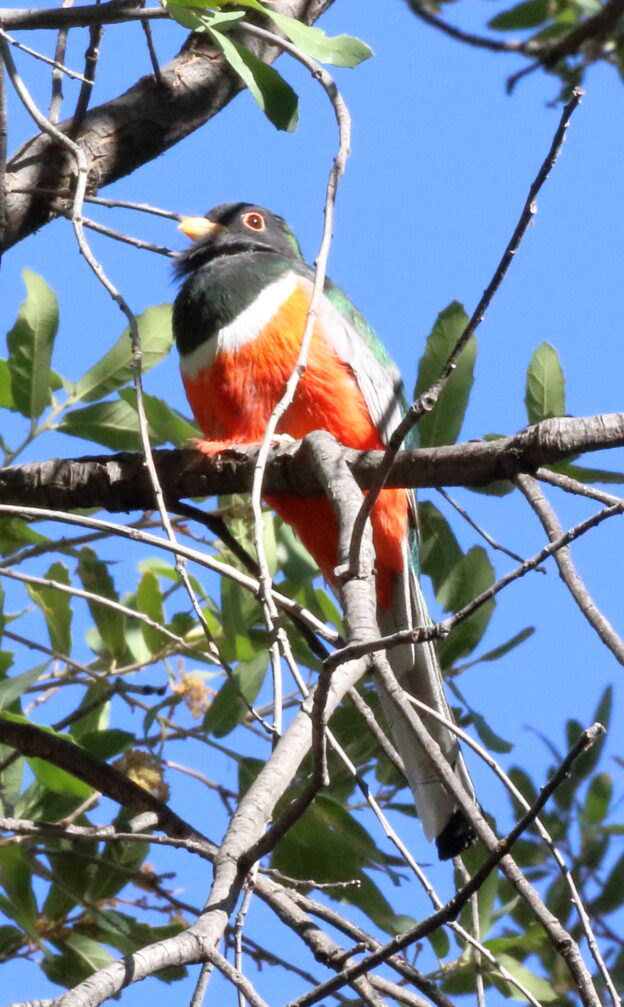
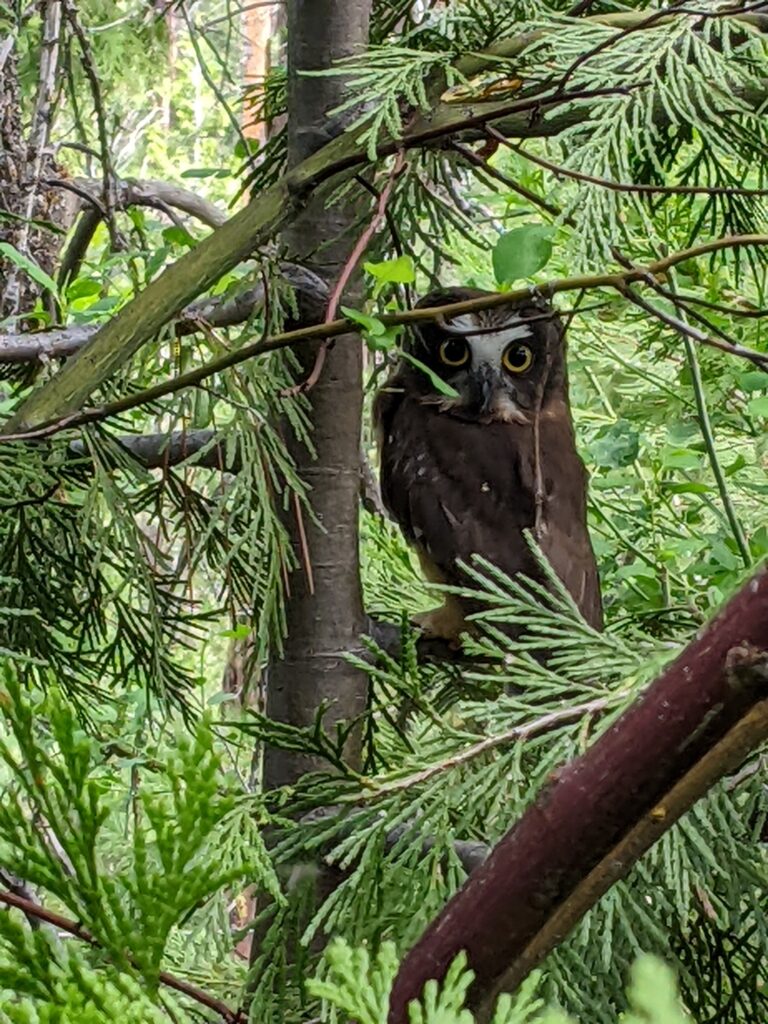
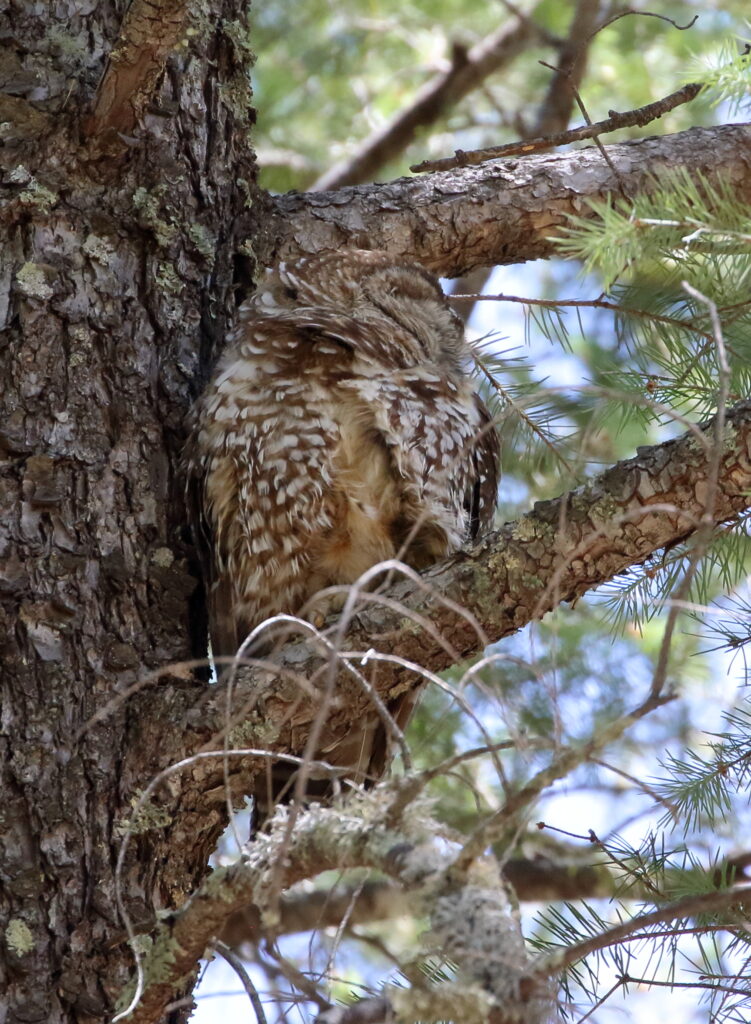
Braden had excellent adventures with Northern Saw-whet Owls while out in California, running into some adorable juveniles while thrashing through the woods during his job with the Institute for Bird Populations. Elegant Trogon finished #9 on Sneed’s list—an exotic bird if there ever was one! And yet, both Braden and Sneed wondered why this bird didn’t finish higher on either of their lists. Probably just too much on the beaten birding path. (Photo at top of the blog.)

Non-stop birding for his job throughout the summer led Braden to a remarkable encounter with these juvenile Northern Saw-whet Owls.

#8

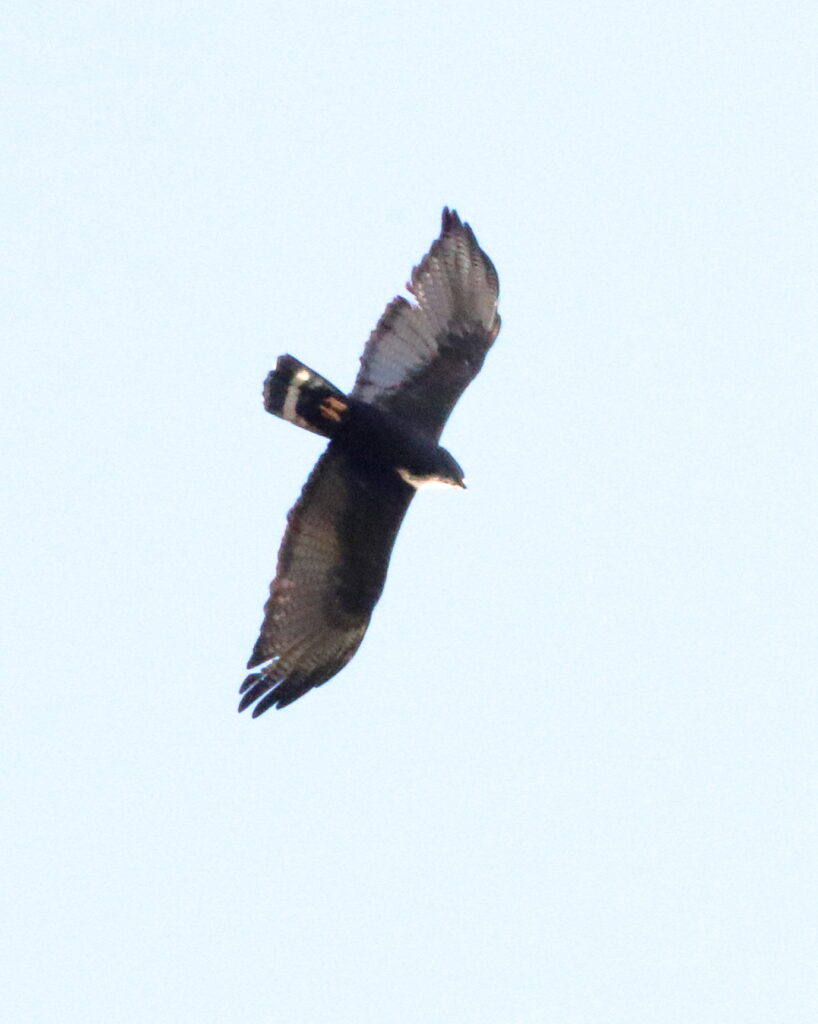
Braden’s night car camping (literally) in the Everglades landed Chuck-will’s-widow on his Top 10 while Zone-tailed Hawk swooped out of a flock of Turkey Vultures at Madera Canyon to nab Sneed’s Number 8.

Zone-tailed Hawks are well-known mimics of Turkey Vultures and often hang out with them—which is where we spotted this one at Madera Canyon, Arizona; only our second ZTHA ever.

#7

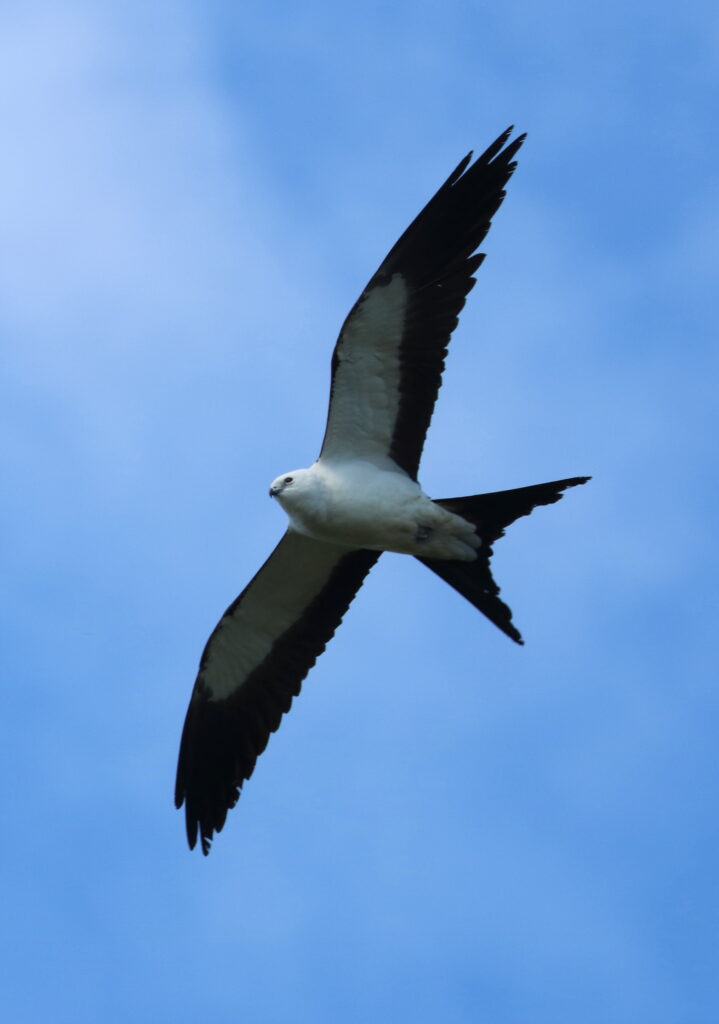
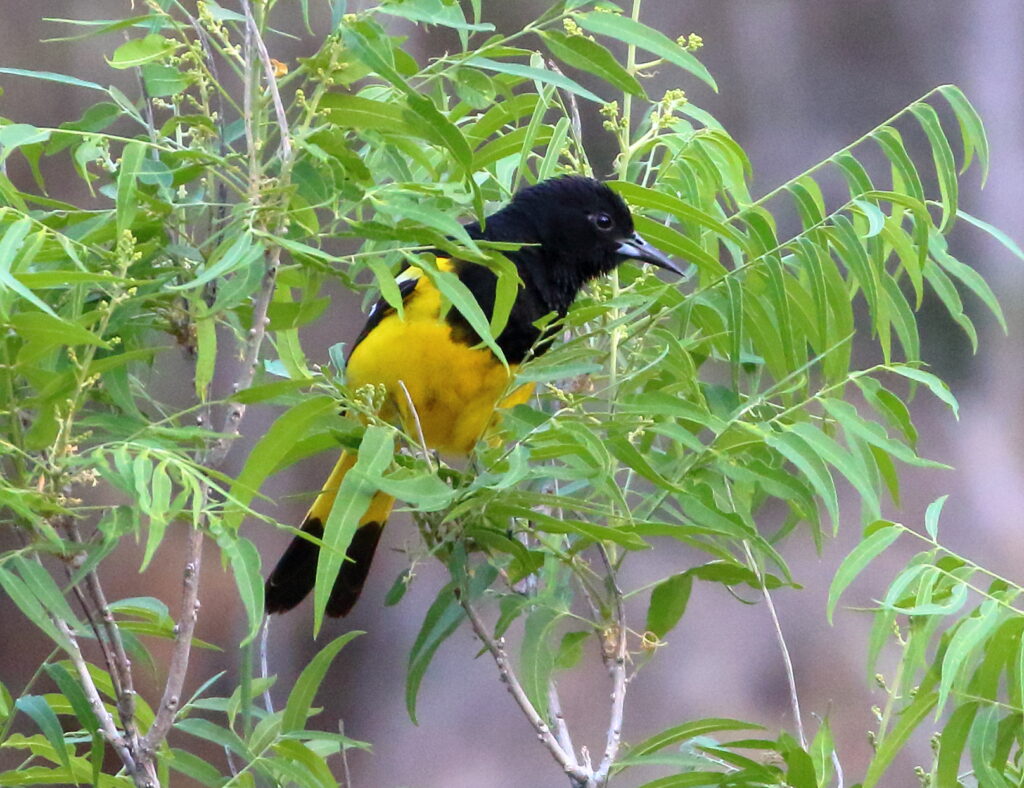
Ah, who doesn’t love a Swallow-tailed Kite—especially one that swoops right over your head? Braden obviously DOES, as yet another bird from his Florida trip snagged a Top Ten spot. Sneed, meanwhile, went with the shockingly beautiful Scott’s Oriole for Lucky Number 7. He and Braden both fell in love with these birds, and were lucky enough to see them several times on their Arizona adventures. In fact . . .

Braden never tired of seeing Swallow-tailed Kites on his and Nick’s epic Florida adventure.

#6

Scott’s Oriole grabbed Braden’s Number 6 while Sneed went with Sulphur-bellied Flycatcher, also in Arizona, in a case that he couldn’t quite explain. “There was just something mysterious and intriguing about that bird,” he was quoted as telling a New York Times reporter.

Though relatively widespread in the Southwest, Scott’s Oriole is a bird Braden and I wondered if we’d ever really get to see—or even if it really existed. It does!

#5

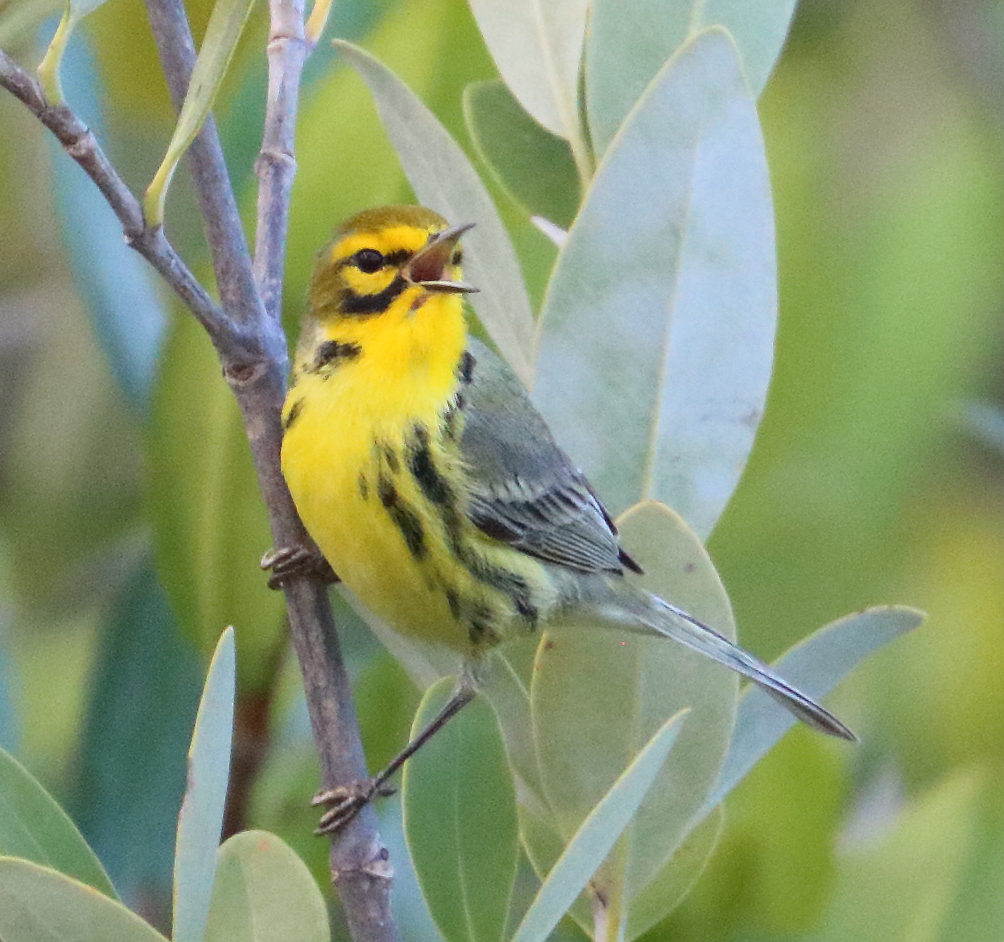
Unfortunately, the same New York Times reporter caught Sneed cheating for Number 5, as he listed THREE birds tied for #5: Mexican Whip-poor-will, Whiskered Screech-Owl, and Elf Owl. “How can you possibly justify this?” demanded the reporter. “Well, I only ever heard these three birds, but we listened to them on a magical night in Portal, walking down a darkened road. It’s just a night that Braden and I won’t ever forget.” Meanwhile Braden went with his many amazing experiences with Prairie Warblers this year for his #5 spot, seeing them throughout Florida, including the Everglades, in Maine, and during the Collard Family’s epic New York City trip in May.

It blew Braden’s mind to learn that Prairie Warblers breed in the mangroves of Florida.

#4

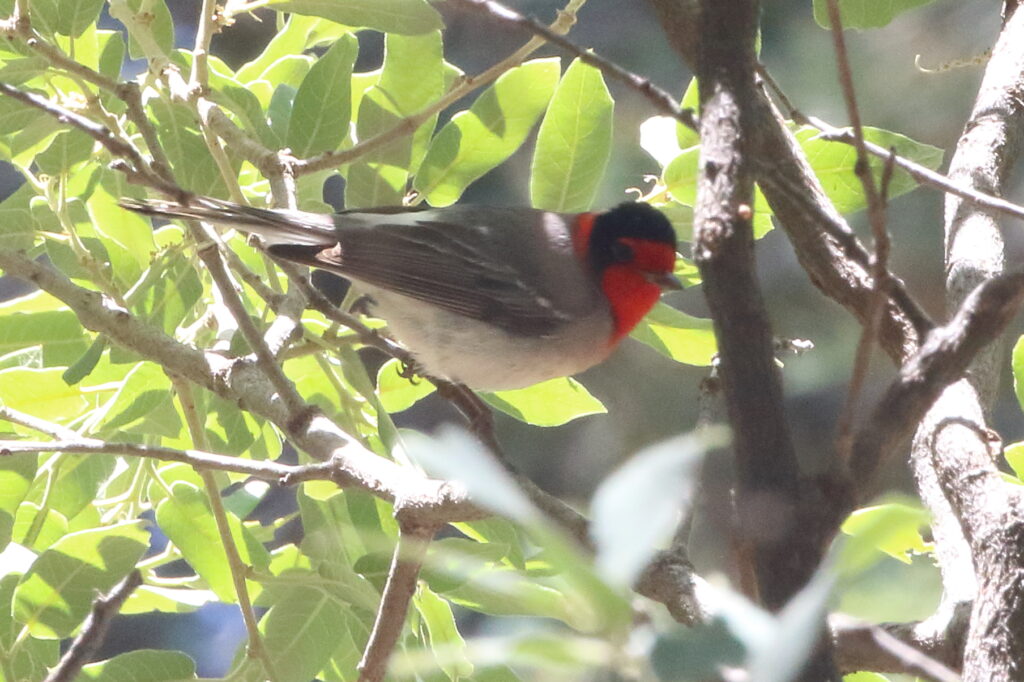
The night walk in Portal also left a big impression on Braden, giving him his Number 4 in the form of Mexican Whip-poor-will. Sneed, meanwhile, went with Red-faced Warbler, spotted just a few miles and a couple thousand feet away—the first, and still only, RFWA the father-son duo has ever seen.

Another fairly common Southwest bird that had eluded us until this trip, the Red-faced Warbler immediately captured our hearts. This is still the only we have ever seen.

#3

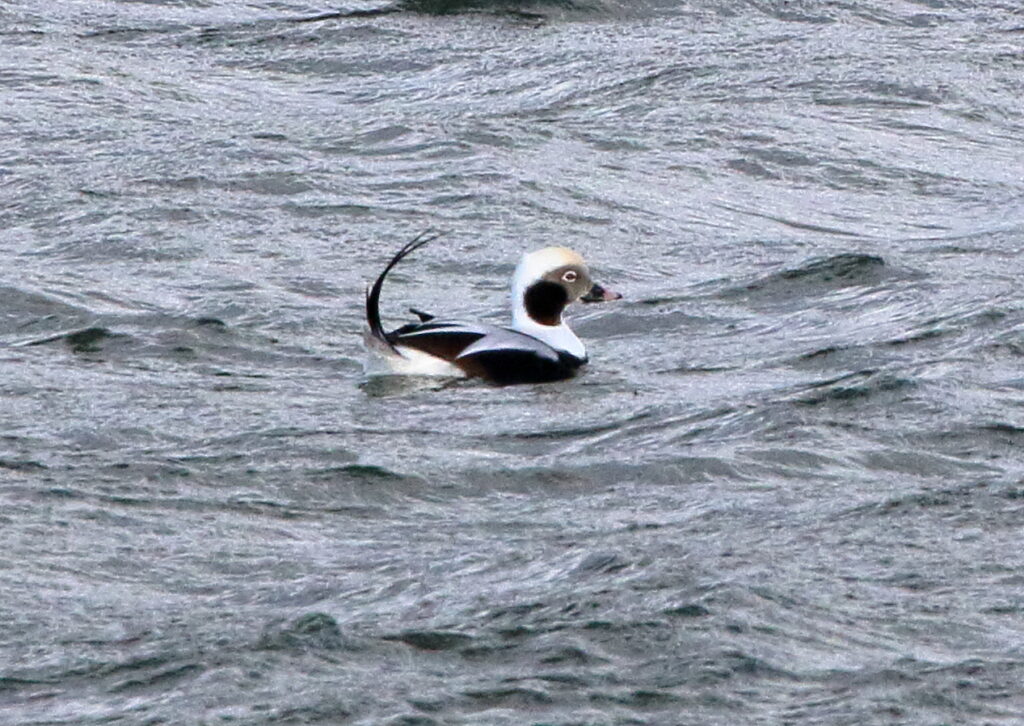
Number 3 is getting into some Serious Birds, and Braden selected Spotted Owl for his. Not only did Sneed and Braden both see them for the first time in the Chiricahuas, Braden got to see the California subspecies several times during his summer job. Sneed went with his recently self-found Long-tailed Duck—the first male he had ever seen—and one he discovered pretty much in his backyard near Missoula.

When you find a bird by yourself, it naturally ranks higher in a Year List. Such was the case with this male Long-tailed Duck Sneed found near Frenchtown last fall.

#2

Braden paid for his Number 2 bird, Long-tailed Jaeger (a second cousin to former lead singer for the Rolling Stones) with repeated upchucking over the side of the boat during his summer pelagic boat trip out of Half Moon Bay. After cavorting with a bunch of Sabine’s Gulls, however, this bird took flight and then passed only ten feet above Braden’s head. He celebrated by once again barfing into the sea. Sneed opted for White-tailed Ptarmigan, just one of the coolest birds on the planet, seen during his and Braden’s stunning hike up to Piegan Pass in Glacier National Park in August.

Blurry photo notwithstanding (or puking as was the case), this Long-tailed Jaeger flew into Braden’s #2 spot for the year.

Drum Roll . . . And their Number 1s are . . .

#1

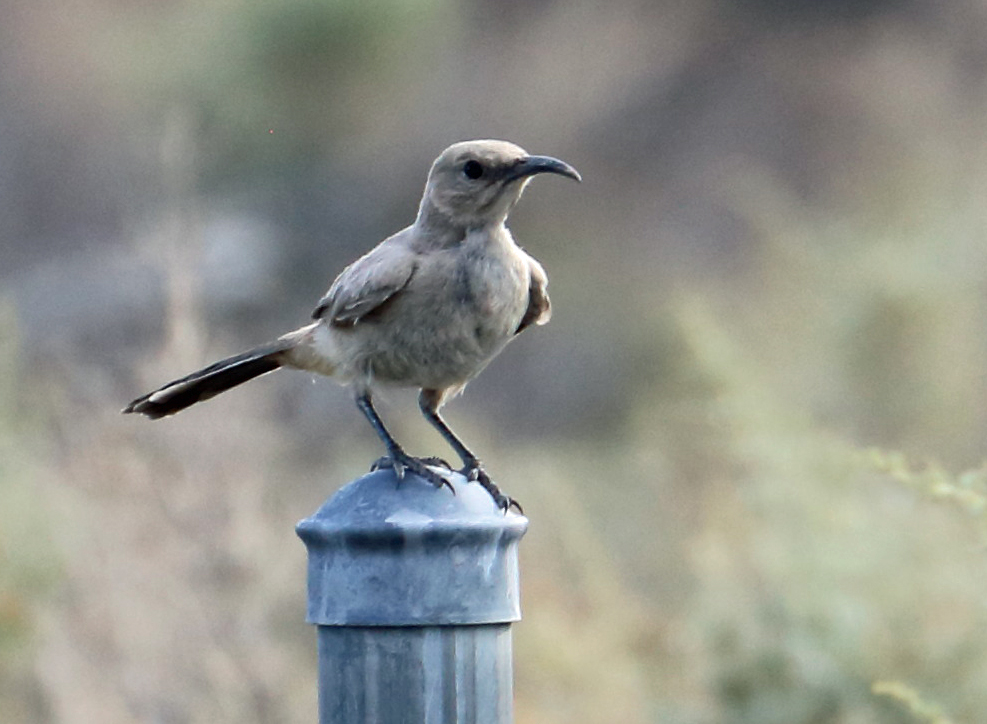
The adventure and thrill of seeking out and finally finding a LeConte’s Thrasher on the east side of the Sierras stayed with Braden strongly enough to make it his Number 1 Bird of 2022! Remarkably, Spotted Owl, which had been only #4 on Sneed’s Arizona Trip list mounted an epic comeback to grab his Number 1 spot!

Thanks for tuning in as we’ve relived our top birds. Be sure to click on the links to get the full accounts, and may 2023 generate a memorable list for you, too!

Another Accidental Big Year: Sneed’s 2022 Recap

FatherSonBirding’s millions of loyal fans will have no doubt noticed a paucity of posts the past few months, and we sincerely apologize, noting the severe nationwide downturn in consumer confidence and the real estate market that this has obviously precipitated. Fortunately, our silence has been a result of good things happening to Braden and me. Braden has been having some exceptional academic experiences during his fall semester at UMaine while I have been kept busy both birding and working on several exciting book projects that have come my way. That said, we’d like to take a couple of posts to wrap up the last few months and, indeed, our entire year of birding. Since Braden is studying for finals, I’ll go first.

Some of you followed my “Accidental Big Year” last year in which I set a new personal best of 352 ABA species during 2021. Believe it or not, I’ve blundered into another accidental Big Year in 2022. How the heck did that happen? I mean, I have definitely underperformed in my home state of Montana this year, notching my lowest total in several years. Fortunately, our trips to New York City and Arizona put me within striking distance. By early October, my count sat at a tantalizing 335 species, only 17 birds short of tying last year’s record, but where would the additional species come from? Some good writing news led to the answer.

This summer, I landed a contract to write about conservation on military bases, with a special focus on Eglin Air Force Base in the Florida panhandle. I chose this base because I spent all of my summers growing up with my father in Pensacola—adjacent to Eglin. Call it nostalgia or a desire to learn more about the area’s species, but I arranged to interview biologists down there to find out what they were doing. First, though, I decided to stop to see my brother in Atlanta, Georgia.

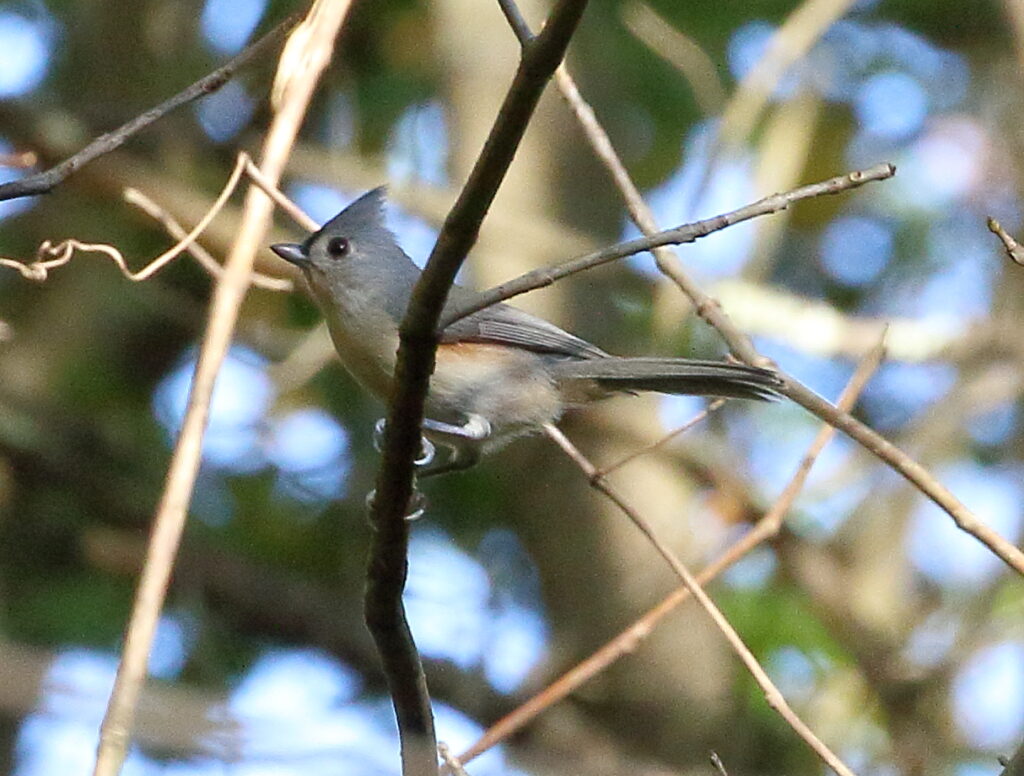
On my recent trip, I didn’t get photos of my best Atlanta birds, but Tufted Titmice are always a blast to see.

Honestly, I didn’t know how many new birds I’d see in Atlanta. Migration season was waning, and it was possible warblers and other songbirds had already moved through. In general, they had, but thanks to some intensive studying and tutelage by Braden, I was able to score a number of great birds including a trio of wonderful warblers: Blackpoll, Tennessee, and most exciting, Cape May—a Lifer pour moi.

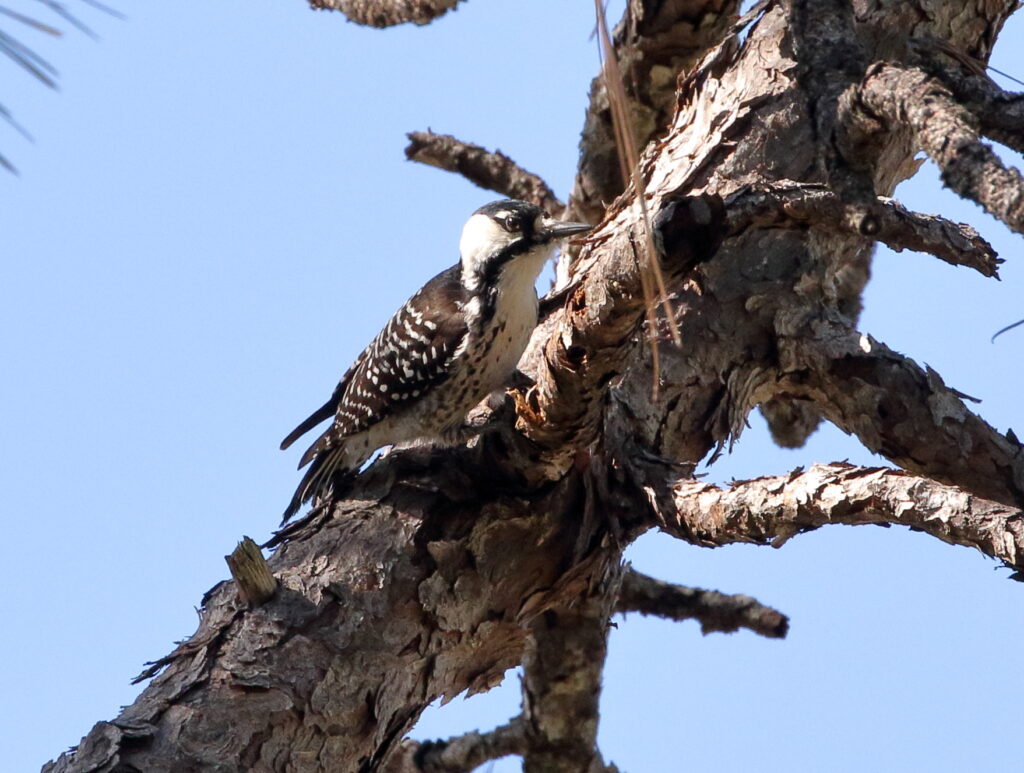
Leaving Georgia to take up a week-long residence with my stepmother Suzanne and her partner Jim in Milton, Florida, I wondered if I was close enough to top 352 for the year? Unfortunately, I arrived in Florida suffering from my first cold in three years—one I am just now getting over six weeks later. Not how I wanted to begin three consecutive long days of work at Eglin! Nonetheless, I persevered and got a bunch of great information from the base biologists. Oh, and I kept adding up Year Birds! In fact, I couldn’t have asked for a better bird to break my record. As biologist Kelly Jones drove me around teaching me about endangered salamanders, we ran into a group of Red-cockaded Woodpeckers, one of America’s coolest and most unusual birds. These birds became endangered due to the catastrophic loss of longleaf pine ecosystems across the Southeast, but many people have been working to restore both the pines and the woodpeckers. Last I heard, Eglin is home to the nation’s fourth-largest population, but this was the only group I ran into while there.

Red-cockaded Woodpeckers are the only North American woodpeckers that carve holes in living trees. Apparently, the sap running down the tree trunk helps deter snakes and other potential predators.

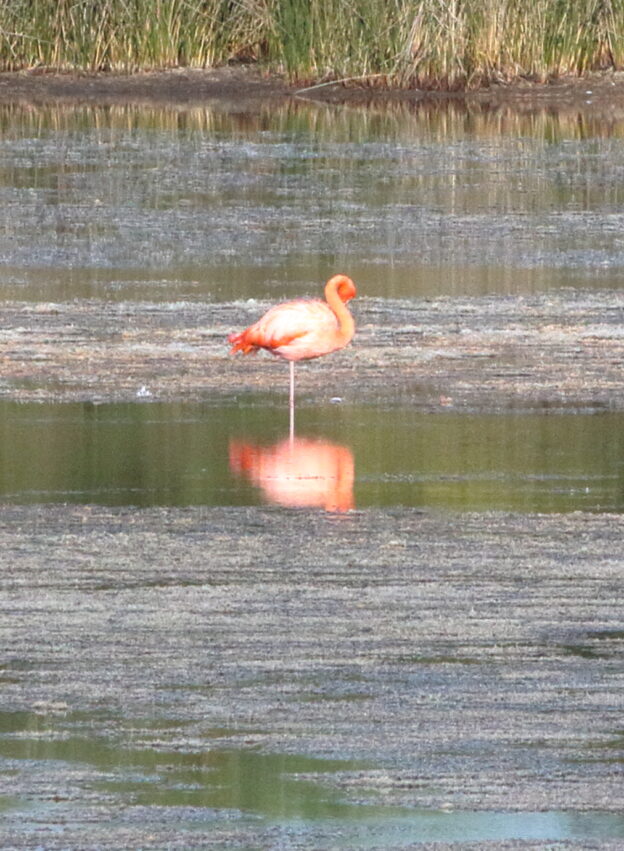
Not wanting to wear out my welcome with Suzanne and Jim, I used the weekend to take a jaunt over to Tallahassee to visit St. Marks National Wildlife Refuge. My dad, a professor at the University of West Florida, led many field trips to St. Marks and always raved about it. More recently, Braden and Nick Ramsey, visited the refuge, seeing among other things a lone flamingo that has lived at the refuge for the past four years. I hoped also to see this bird—dubbed “Pinky”—but kept my expectations low.

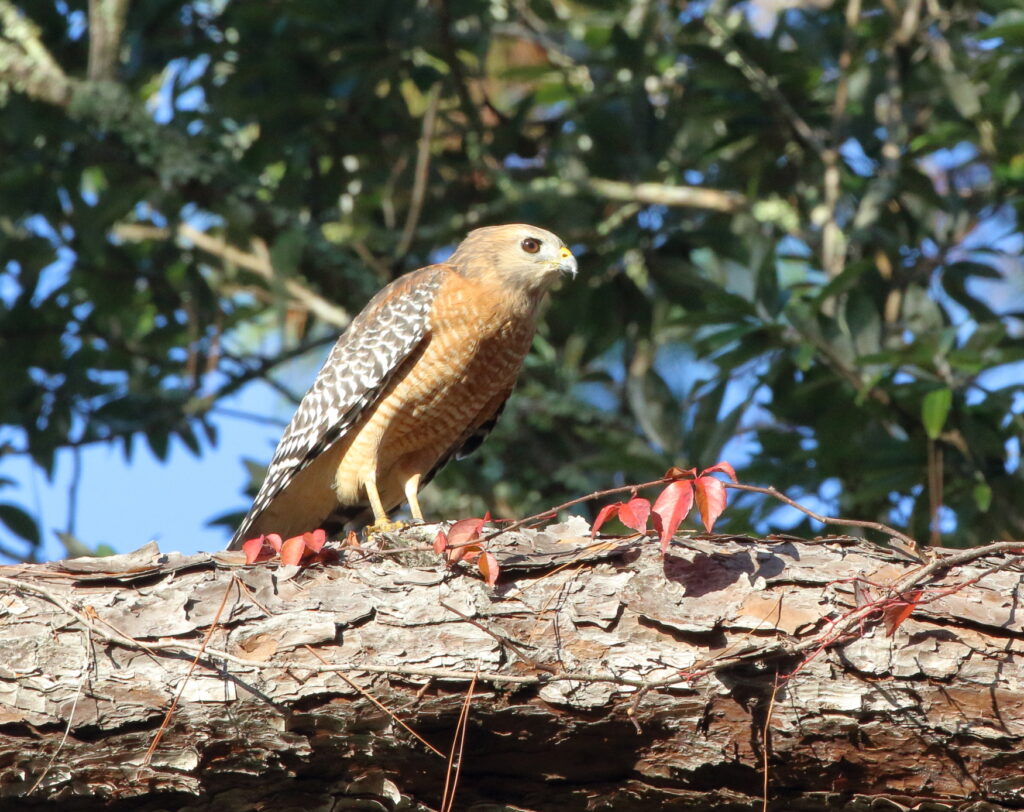
I know they’re common, but I love Red-shouldered Hawks, and this is by far the best photo I’ve ever taken of one.

Upon arriving, I discovered that St. Marks truly is a magical place—a remnant of “Old Florida” with towering oaks and pristine marshes—and my visit got off to a good start with great views of a Red-shouldered Hawk and Yellow-bellied Sapsucker at the visitor’s center. I asked the local naturalist if anyone had seen Pinky the flamingo lately and she said yes, but didn’t know where, so I decided to head down to Lighthouse Pool and work my way back. As I reached the pond, I happened to glance right. There, in the middle of the pond, stood a large orange blob.

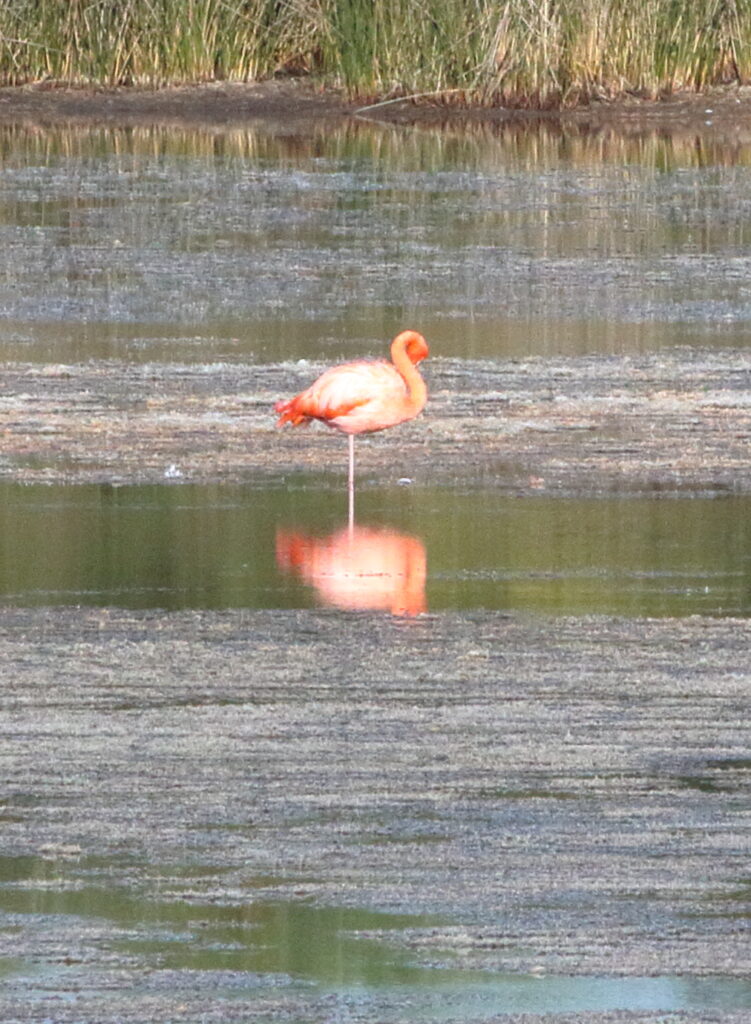
“No way!” I exclaimed, braking to the side of the road as I reached for my binoculars. Sure enough, there stood Pinky—America’s most famous flamingo. Full disclosure: Pinky was not the most exciting bird on the planet, content to just stand there and preen when s/he felt like it. Taking a walk along the southern edge of the pond, however, I picked up lots of other nice Year Birds including Reddish Egret, Tricolored Heron, Short-billed Dowitcher, Semipalmated Plover, and more.

I’m not sure where Pinky got his name, but to me he looked obviously orange. Still, an official Lifer for me, though I did see American Flamingos thirty years ago in Bonaire.

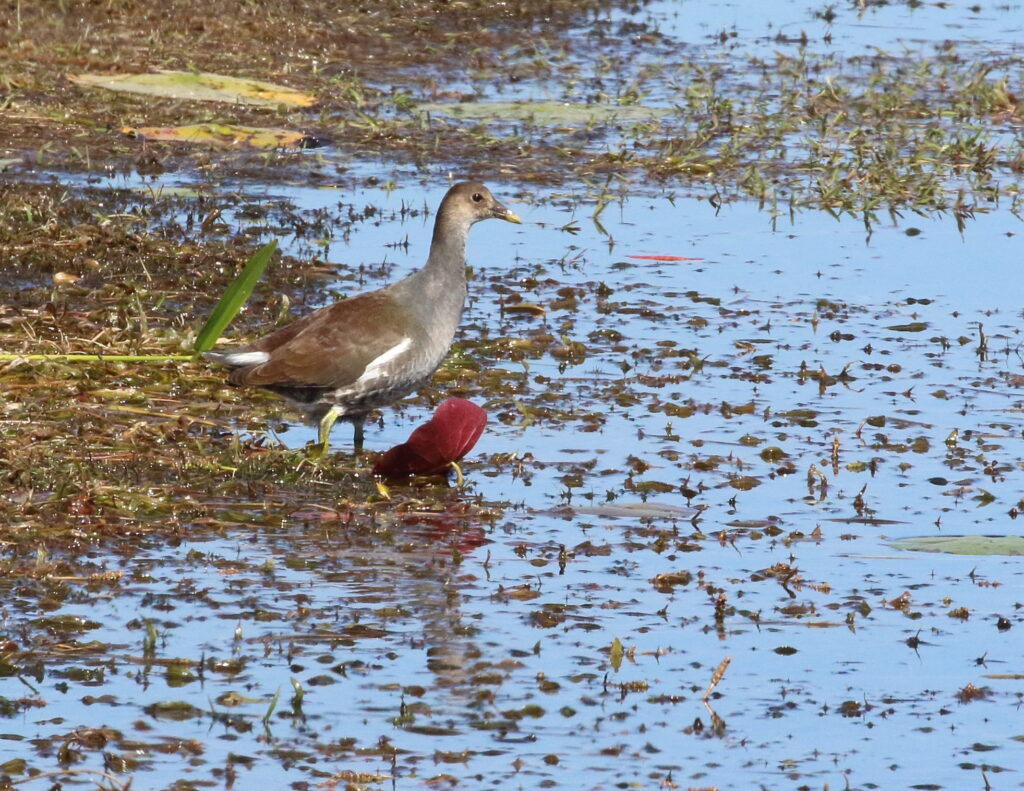
My visit to St. Marks was far from finished. As I drove back up the road, I thought I spotted a rail at the East River Pool location. I didn’t—and this was not the first time I’d mistaken a Common Gallinule for a rail! Training my eyes out on the pond, though, my heart picked up. Why? Because way out there among a large group of wading birds, I spotted another Lifer: Wood Stork! Along with Roseate Spoonbills, another Year Bird. My Lifer-palooza hadn’t ended, either. Following Braden’s directions I drove to another part of the refuge to hear my Lifer Clapper Rails.

This is at least the second time I’ve mistaken a Common Gallinule for a Clapper Rail. I do believe they’re closely related, though, so I hope that you, my dear readers, cut me some slack!

I returned to Montana with a total of 372 Year Birds and have since picked up a few more, thanks to a fortuitous discovery of Montana’s first Long-tailed Duck of the winter, along with the first Bonaparte’s Gulls I’ve ever seen in Missoula County. These and a Horned Grebe now have me sitting at 375, well in excess of my previous ABA Big Year record. My guess is that I’ll pick up one or two more when Braden gets home in a couple of weeks—though what they might be I have no idea. And you know, it really doesn’t matter. While it’s fun to count birds, it’s even more fun to get out and see them and, hopefully, make some new friends along the way. At St. Marks I met several delightful birders to share my adventures with. I hope that as 2022 draws to a close, you all have your own memorable birding adventures combined with heavy doses of peace and friendship.

My Lighthouse Pool checklist.

Perhaps my biggest score of the year was seeing the first Long-tailed Duck recorded this winter in Montana—and my first male ever. If this isn’t a glorious animal, I don’t know what is!

Braden’s Tales from the High Sierras, Episode 4: The Surprising Sierra Spotted Owls

We dedicate this post to our loyal subscriber—and Braden’s grandma—Penny Collard on her 75th Birthday! HAPPY BIRTHDAY, PENNY! We Love You!

In Episode 4 of Braden’s California adventures, he dives into one of the West’s most famous raptors, the Spotted Owl. Thanks to his “sister team” working on this listed species, he shares his first encounter with these charismatic critters and learns about their status in the Sierras. Also see his Big Year update at the end of this post!

Besides my crew’s surveys of Northern Goshawks, the other major species being studied by The Institute for Bird Populations in the Stanislaus National Forest is an even more famous raptor: the Spotted Owl. We’d already met the Spotted Owl team once, and spent a good amount of time with Ramiro Aragon, the lead for the owl crew and the only adult we really had contact with in the field. Ramiro told us that the national forest hosted significantly more owls than goshawks. To wit, it had taken us two weeks to find our own goshawks while the owl crew found owls almost nightly, and continued to monitor them and their nests throughout the season. On the other hand, while our job definitely came with some difficulty, the Spotted Owl workers had it twice as rough. They had nonexistent sleep schedules, and were instructed to chase after any Spotted Owls they detected, regardless of what topography or vegetation stood in the way. Often, the vegetation that stood in the way was Poison Oak.

Fortunately, during our goshawk surveys, we also quickly got a handle on what areas might host Spotted Owls. The owl my dad and I had seen in Southeast Arizona nested in a shady ravine, and that’s exactly what the Sierran owls liked too, despite being a different subspecies. At several PACs we located Spotted Owl feathers, beautiful long feathers with intricate patterns of alternating brown and cream. The day after we found our first goshawks, we were bushwhacking across a hill in a relatively shady area. I had just begun to contemplate crossing a creek flowing in front of me when I heard Ivara through the radio.

“There’s an owl.”

I stopped in my tracks, questions popping up in my brain. What kind? Where?

Both were answered. “It’s a Spotted. Come up towards me, slowly.”

Seeing Spotted Owls and learning that they are probably the most common owls in the Sierras gives me hope for the future of this remarkable species—and the birds that live along with it. You can help protect this and countless other sensitive species by supporting The Institute for Population Studies, The American Bird Conservancy, and other conservation groups.

Soon, the four of us sat on a log in a clearing in the forest, staring at a Spotted Owl perched not more than twenty feet from us in a Douglas-fir. This one, unlike the one my dad and I had seen in Arizona, was fully awake, lazily watching us and our cameras. A pair of juncos hopped around the base of the tree where the owl roosted, and it occasionally turned its head towards them as if the juncos were children playing.

We watched the owl for at least thirty minutes, and everyone seemed to be losing their minds. Sam and Miles especially had never seen one before, despite hearing stories about this near-endangered species for years.

It seems that Spotted Owls are still abundant in the Sierras, thanks to having less strict habitat requirements and no competition or interbreeding with Barred Owls. In fact, we learned that Spotted is probably the most common owl in the higher elevations of the Sierra Nevada.

Meanwhile, coastal Spotted Owls are quite threatened. Instead of requiring shady canyons, they need large tracts of old-growth rainforest, a habitat that has been mostly logged. What’s more, thanks to human disturbance, Barred Owls have spread to the West Coast from eastern North America. These owls, which are cousins of Spotted Owls, are more aggressive and push Spotted Owls out of territories. They also will hybridize with Spotted, muddling the gene pool for this species.  As I stared at the owl, it gave me hope that the populations of this species are still strong in the Sierras. With conservation-minded individuals working tirelessly to protect them, let’s hope that it stays that way.

Braden’s Big Year Update: As many of you know, Braden set out to see 400 North American bird species in 2022—a goal he smashed on our trip to Arizona. Accordingly, he raised his Big Year goal to 500, and thanks to relentless birding in California, he now stands at 440. Even better, he will be heading to Santa Cruz for a pelagic birding trip this weekend and if all goes well, he may add another 15 or 20 species to his list. Still, 500 is a big number and he’s got a lot of work to do. Keep reading FatherSonBirding to follow his progress!