Category Archives: Climate Change

Braden’s Tales from the High Sierras, Episode 7: The Yosemite Bighorn Sheep Survey

As Braden’s sensational Sierran summer begins to wind down, he has continued to have remarkable experiences, both avian and mammalian. In Episode 7, he recounts his hardest hike ever in an attempt to locate some of Yosemite’s most interesting and elusive mammals.

Despite being the nearest gas station, restaurant and convenience store to the eastern entrance of Yosemite National Park, the Mobil station was fairly empty when our red Nissan pulled into the parking lot at seven in the morning. We gathered around a table, breakfast burritos in hand, as we waited for the Bighorn Sheep biologists to arrive from their various lodgings. As we would learn later, sheep biologists sleep in because the sheep sleep in, which differs quite a bit from us bird biologists. At 7:30, we noticed a crowd gathering outside, and donned our identical Institute for Bird Populations baseball caps, heading out to meet them.

Among the scientists we met outside were Dr. Lacey Greene and Dr. John Wehausen, the latter of whom had worked with sheep his entire life and had apparently drafted most of the recovery plan for the Sierra Nevada Bighorn Sheep. As Wehausen joined the group, he struck up a conversation with Greene.

“537 had a lamb yesterday when we went out. 522, didn’t though. I’ve only seen a few lambs so far this year.”

Apparently, every single Bighorn Sheep in Yosemite National Park has a number assigned to it, and as I would learn, a radio collar frequency. The reason these surveys were being conducted in the first place was because the Sierra Nevada subspecies of Bighorn Sheep was not doing well. Due to threats that included diseases spread by domestic sheep, the entire population of Bighorn Sheep in the Sierra had declined to around 100 individuals in the 1990s, spurring the federal government to list them under the Endangered Species Act. Thanks in part to Wehausen’s recovery plan, as well as the hard work of dozens of other sheep scientists, the herd had now increased to roughly 600 sheep, both inside and outside of the park. 

Dr. Greene introduced all of the biologists that would be hiking various parts of eastern Yosemite to look for sheep, and we approached her, asking which biologist we should go with for a medium-level route since we had work tomorrow and did not want to exert ourselves too much. We also requested a route that maximized our chances of seeing White-tailed Ptarmigan, a bird Sam needed for his life list. Interestingly, ptarmigan are not native to the Sierras and were introduced to the area in the 1970s, although we still hoped to run into some in the alpine zone we would be hiking. Dr. Greene pointed towards Seth, a graduate student from the University of Wyoming studying the carrying capacity of the Sierras for sheep, who would be doing a route called “Mt. Gibbs”. 

“Should be a medium route with good chances of ptarmigan,” Dr. Greene said, and we took her word for it. Perhaps we shouldn’t have.

Our “medium route” began pleasantly enough—but we had no idea what awaited us.

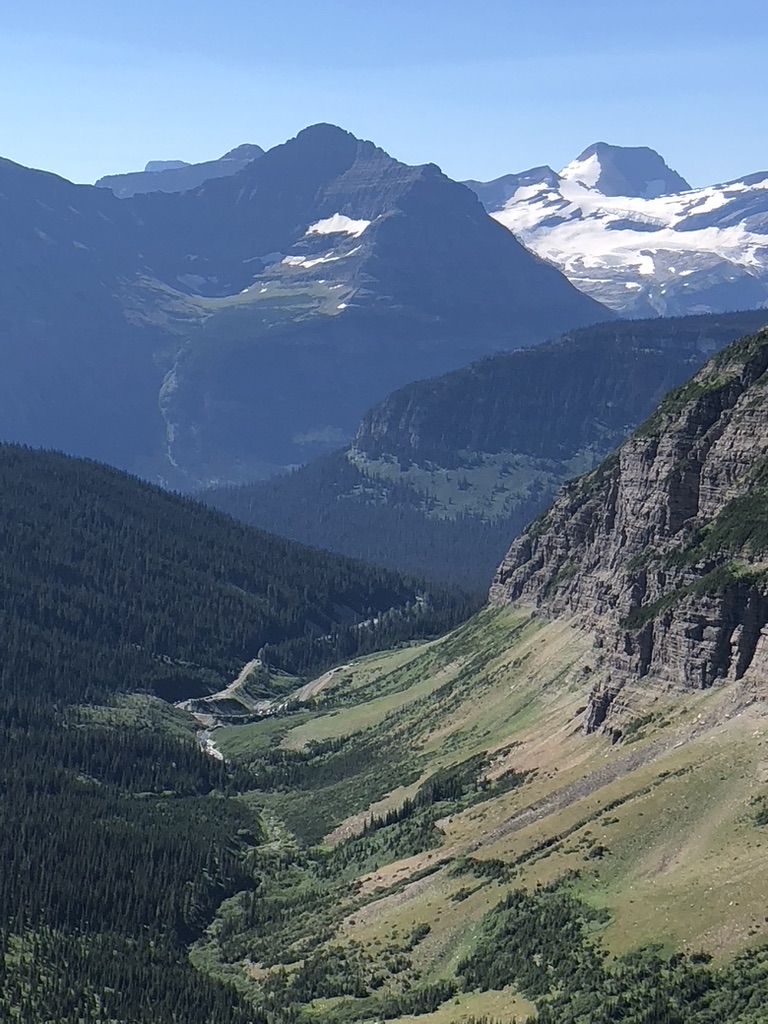
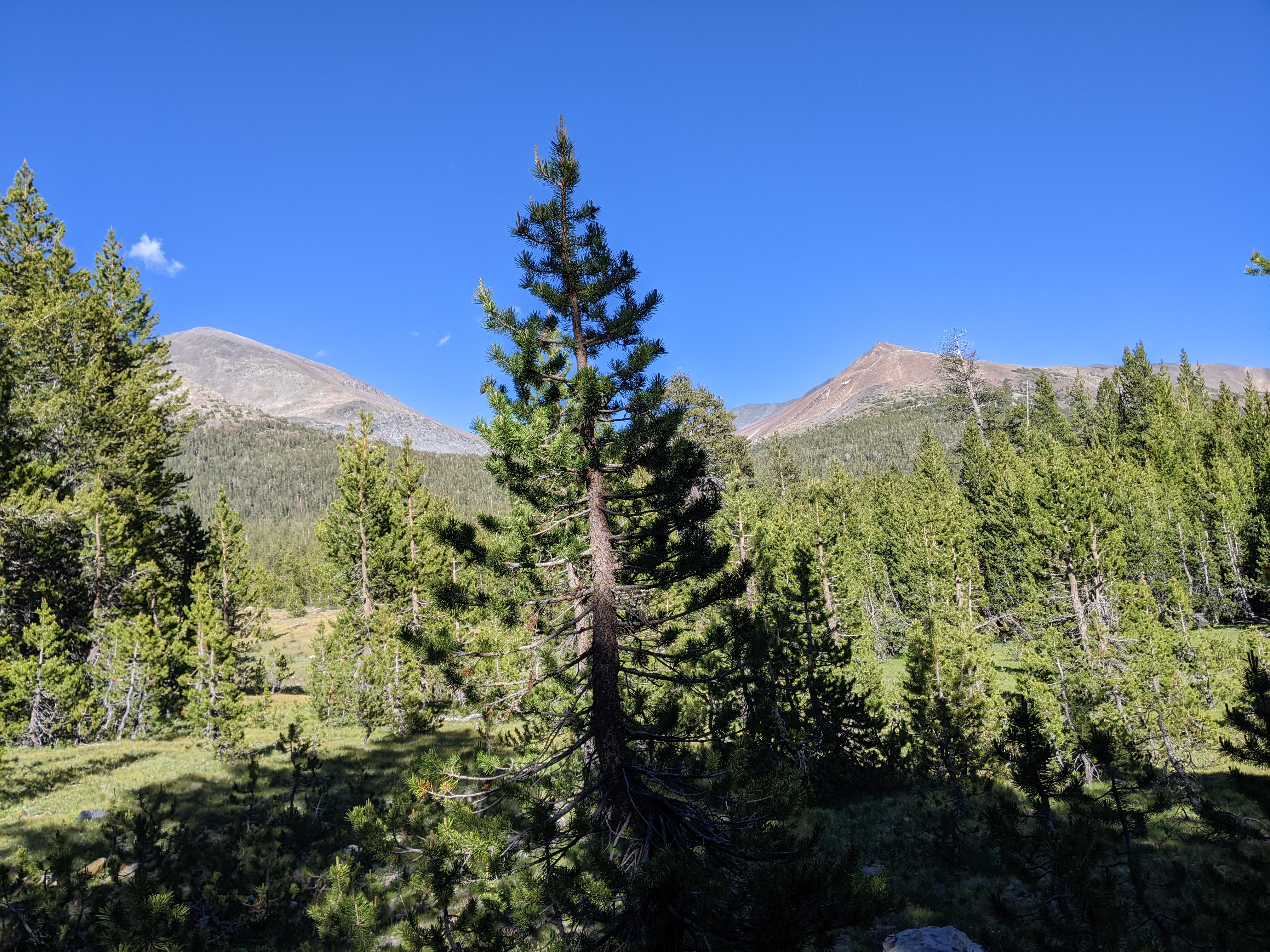
After introducing ourselves to Seth, we all piled into the Nissan (which has adopted the name “the company car”) and joined the caravan of biologists and volunteers headed towards Tioga Pass. I quickly learned from Miles that we likely wouldn’t see many of the National Park’s main attractions, including Yosemite Valley and Half Dome, but soon realized that this did not mean we would be short on scenery. The road soon led us out of the sagebrush and juniper dominating the hills of the eastern Sierra and into subalpine forest. Carved peaks and ridges topped with snow rose around us, and in the distance I marveled at views rivaling Glacier National Park. After entering the park, we soon arrived at the Mono Pass Trailhead and set off through Lodgepole Pine forest with two dozen bighorn sheep biologists.

Several months ago, I’d had no idea what part of California held Yosemite, and now here I was, crossing another one of the United States’ most beautiful places off of my bucket list. The trail crossed wet meadows and creeks, filled with the songs of Lincoln’s and White-crowned Sparrows, and as we gained elevation, Miles pointed out the peaks around us. 

My co-worker, Miles Carlile, tromping through the some of the world’s most spectacular scenery.

“To our left is Mt. Dana, the second-tallest peak in the park at 13,000 feet,” he said excitedly, “And at some point we should be able to see the tallest, Mt. Lyell, to the right along with the Lyell Glacier below it.”

I’d had no idea that any glaciers existed in California, and later learned that the Lyell Glacier was one of only two left in the park. And despite the wilderness-feeling that Yosemite produced as we hiked through it, glaciers weren’t the only thing missing from this once-intact ecosystem. Every time my dad and I visited Glacier, we would try to see the Big Four, what we considered to be the largest (and most obvious) wildlife in the park. Bighorn Sheep were the only one of those species that existed here. Moose and Mountain Goats had never lived in the Sierras, and Grizzly Bears had been extirpated a century ago. So while Yosemite may have rivaled Glacier in terms of scenic vistas, it did not deliver in terms of wildlife.

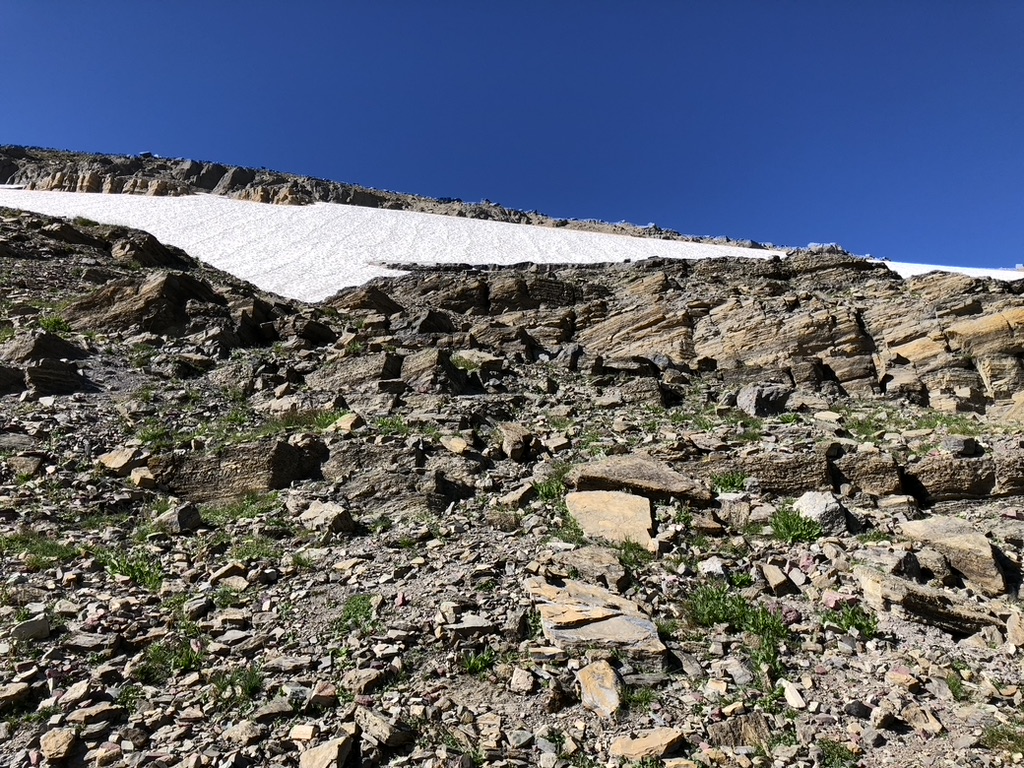
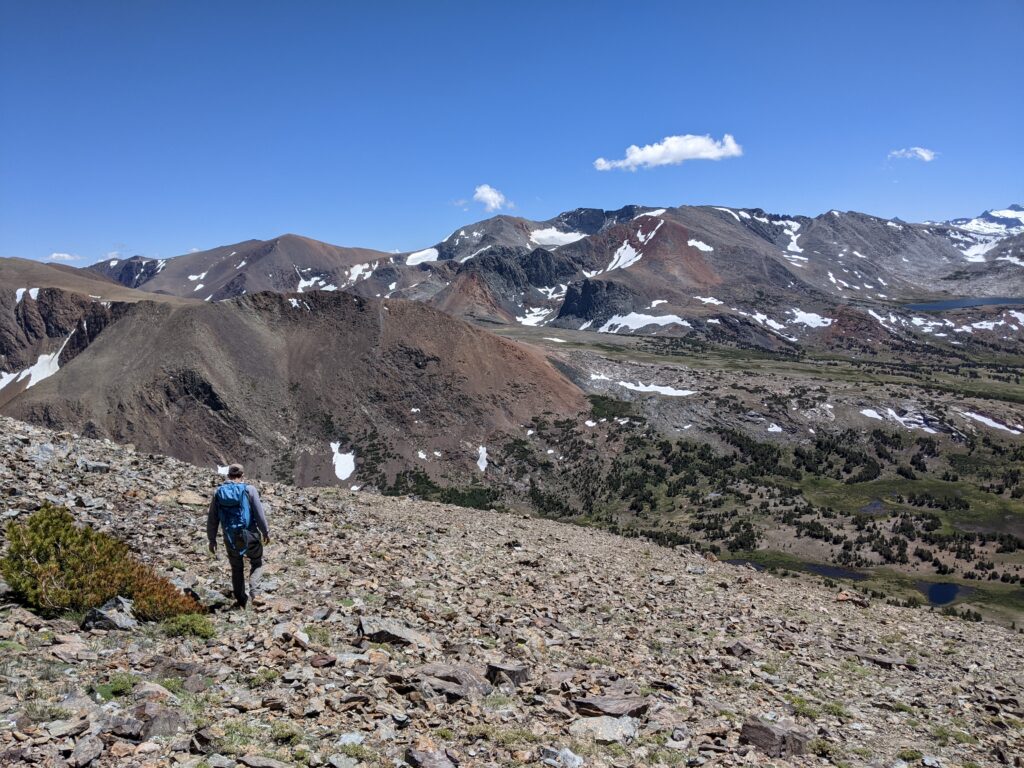
After about a mile, the rest of the group bid us farewell as Seth led us off the trail…directly uphill. We hiked straight up a ridge, through the Lodgepole, for about five minutes before realizing that a sheep biologist’s definition of a “medium hike” differed quite a bit from our own. In fact, it was the hardest hiking I’ve ever done. Following Seth, we left the treeline behind as we realized what we were up against: Mt. Gibbs was only three hundred feet shorter than neighboring Mt. Dana, at 12,700 feet. That was something Yosemite could hold over Glacier—the mountains were taller. Granite Peak, Montana’s tallest, rose only to 12,800 feet. Thankfully, Seth allowed us to take as many breaks as we needed as we scrambled over boulders and scree, heading straight for the summit.

The life in the alpine zone is certainly some of the most magical on earth—and some of the most imperiled by climate change.

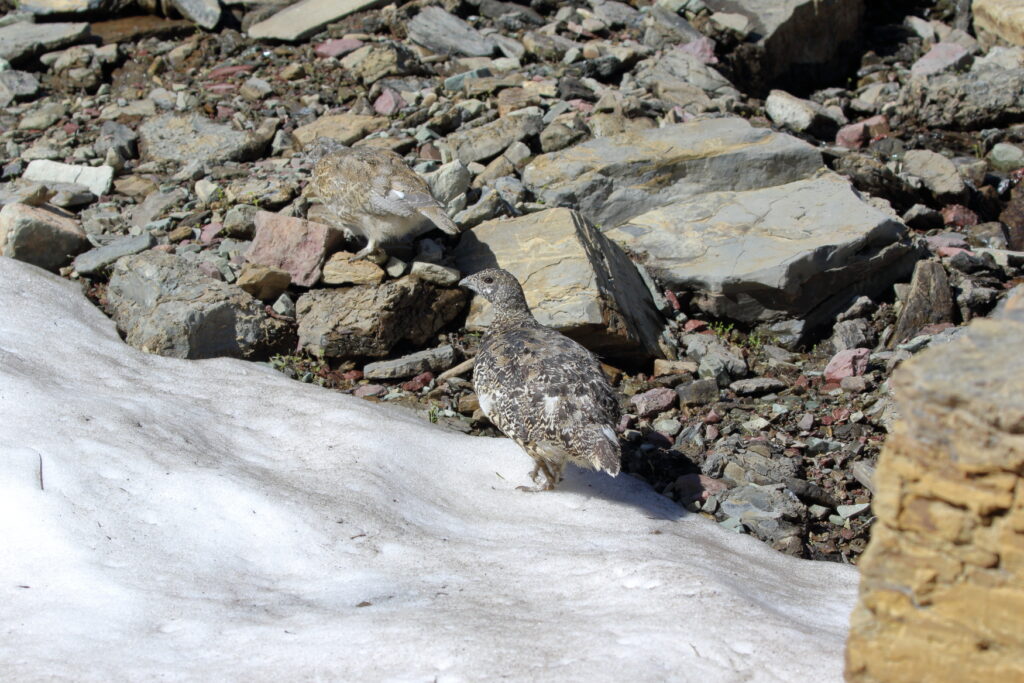
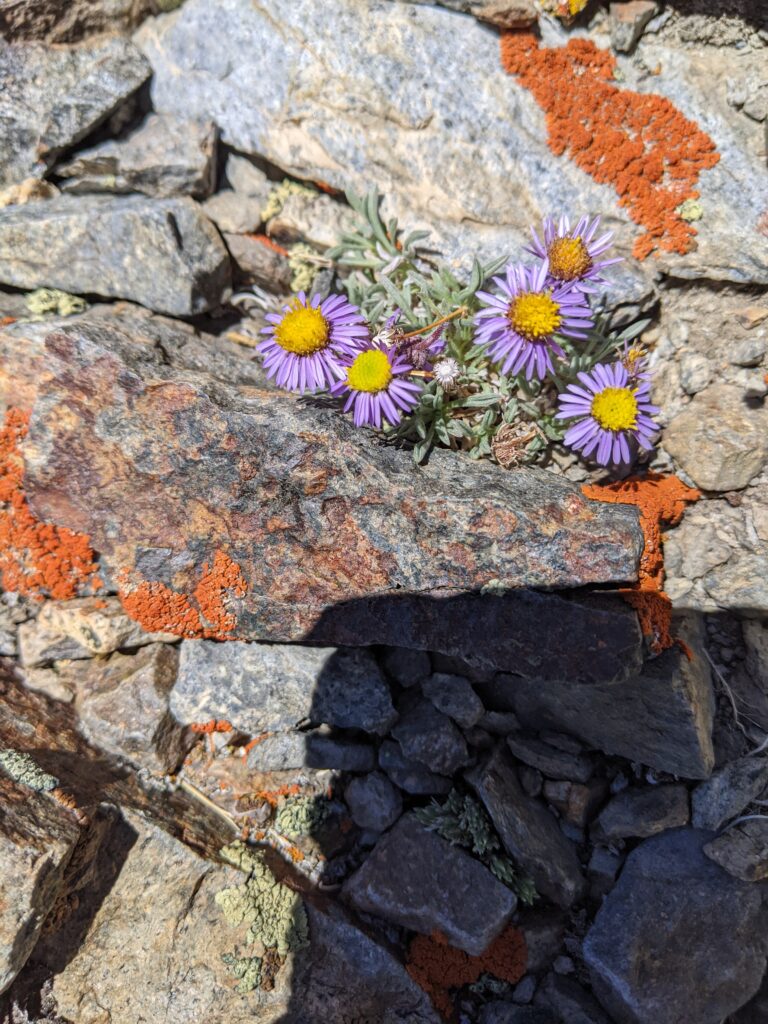
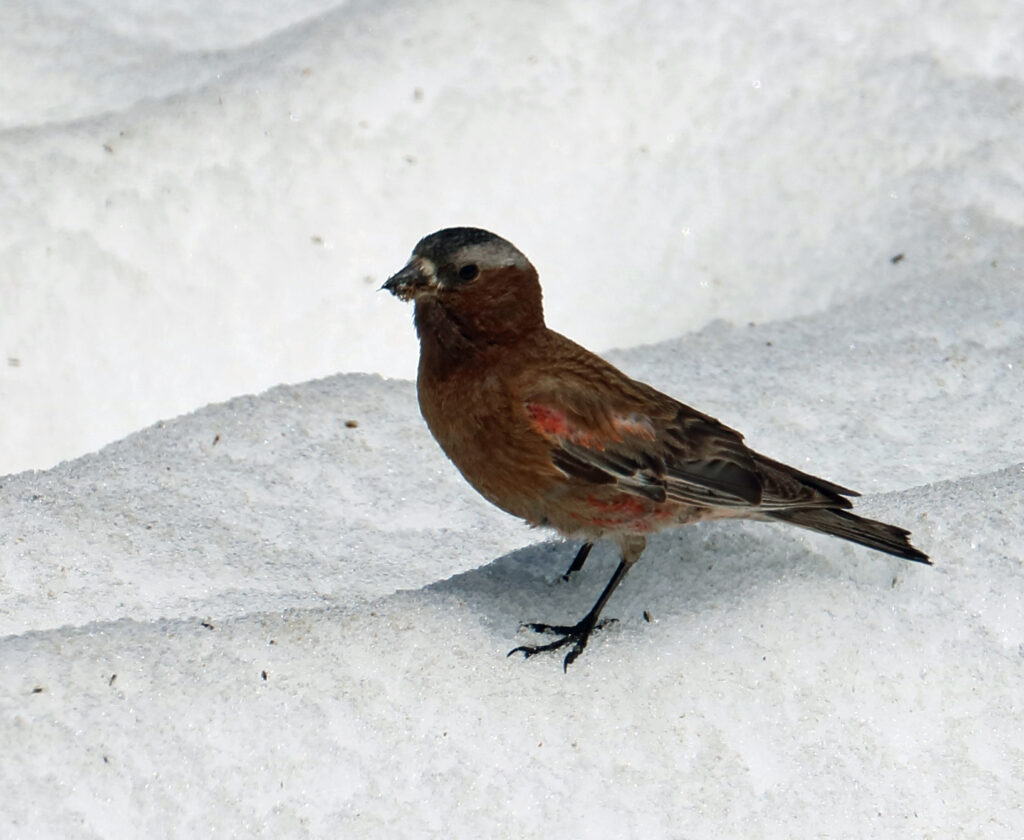
We did not see any ptarmigan. Nor did we spot any of the alpine raptors, like Prairie Falcon or Golden Eagle, that I’d hoped to glimpse. That isn’t to say that the alpine zone of Mt. Gibbs was devoid of life. Tufts of small grass, brilliant purple and white flowers, and splashes of lime green and blood orange lichen led us all the way to the summit. Insects, too, seemed to live here in abundance, and I spotted species of grasshoppers, spiders, ants and butterflies I’d never seen before. One bird seemed to thrive up here: Gray-crowned Rosy-finches, one of the most extreme bird species on the planet. Rosy-finches flitted past us over the scree, and one particularly cooperative flock picked seeds off of a lingering snowpack near the top of the mountain. These birds breed only in these alpine areas, beyond the reach of almost any other bird species and the trees themselves.

Not only did we see one of my favorite birds, Gray-crowned Rosy-Finches, atop Mt. Gibbs, they were some of the most approachable birds I’ve ever encountered.

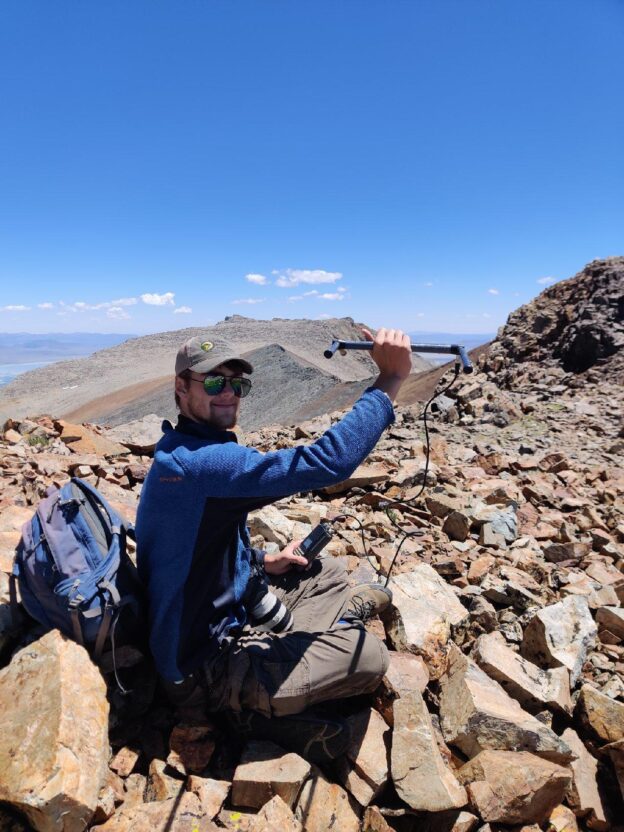
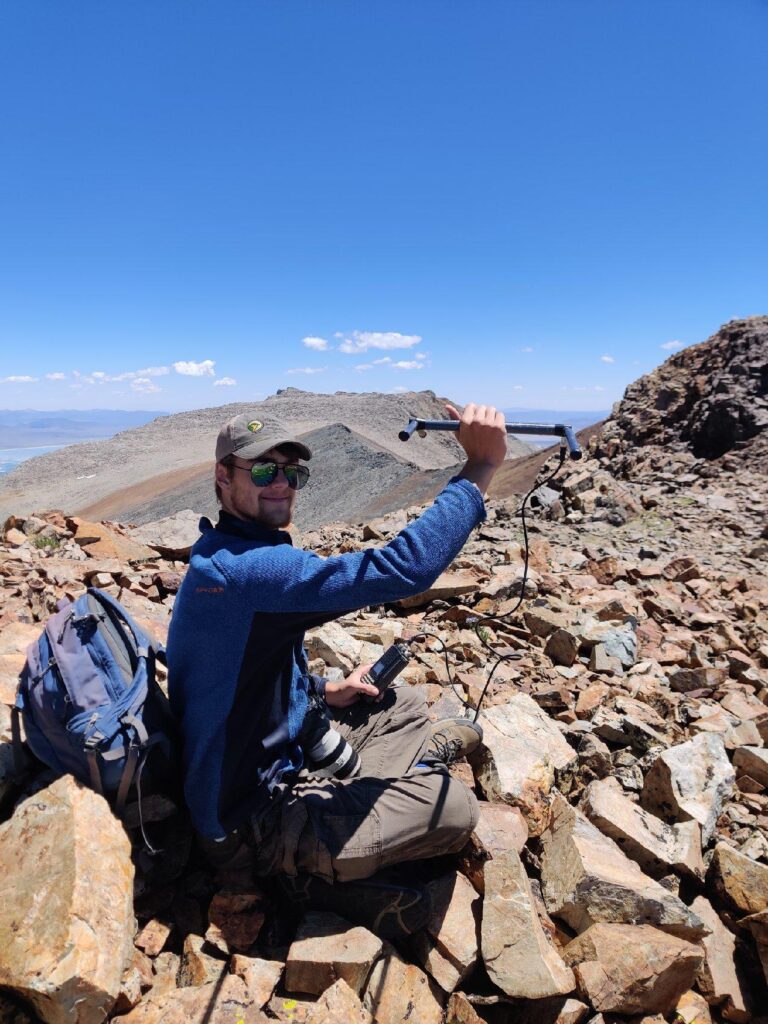
On our ascent, we stopped about every five hundred meters so that Seth could remove a strange device from his backpack. On one end was a sort of radio which displayed primitive numbers and figures, and on the other was an H-shaped receiver. This revealed how the biologists expected to locate the sheep on these seemingly-endless ridges: radio telemetry. The third time we stopped, Seth let me try out the system, and explained to me how it worked. Apparently, every single collared sheep in the Sierras has their own frequency, like the frequency of a radio station. Thus, if you want to locate an individual, you punch its frequency into the radio. Turning a knob increases the volume, and then the H-shaped part of the device comes into play. I held the “H” above me, facing the sky, and slowly rotated it, searching for a signal. Once I began to hear a faint beep, I turned the “H” towards it, trying to locate exactly which direction that beep was coming from. The louder the beep, the more accurate the direction. And in this case, the beep corresponded to a single ram hiding just beyond a ridge in front of us.

A Bearded Big Horn Sheep? No, that’s me sporting my new “field biologist look” while using telemetry for the first time! Note Mono Lake a couple of inches to the left of my head!

Eventually we struggled to the top of Mt. Gibbs, having climbed more than three thousand vertical feet in less than two hours, with no trace of a trail to follow. At the top, we huddled in a small rock shelter someone had constructed, and I signed my name in the “Mountain Registry”, a small notebook housed in a worn, metal box. While I’d like to say that we spent the next hour scanning for sheep, the four of us IBP employees just lounged on the rocks, recovering while Seth did most of the work. Apparently, this was an “easy” day for him—sheep biologists spend most of the summer on five- to ten-day backpacking trips trying to find herds. After recovering a bit and having some snacks, I spent a good amount of time photographing the rosy-finches feeding on the snow around us.

Then it was time to descend. This proved just as difficult as the ascent, as we slowly slid down a scree field for almost an hour before hitting the first trees again. Although we still hadn’t spotted any sheep, we opted to return to the cars. We had work tomorrow and still needed to drive the two and a half hours back to Mi-wuk Village. eBird claimed we had logged nine and a half miles, which meant we had probably hiked closer to twelve, much of that up and down incredibly steep terrain. The survey as a whole, however, was quite productive. The other biologists found at least 32 sheep, including plenty of rams. 

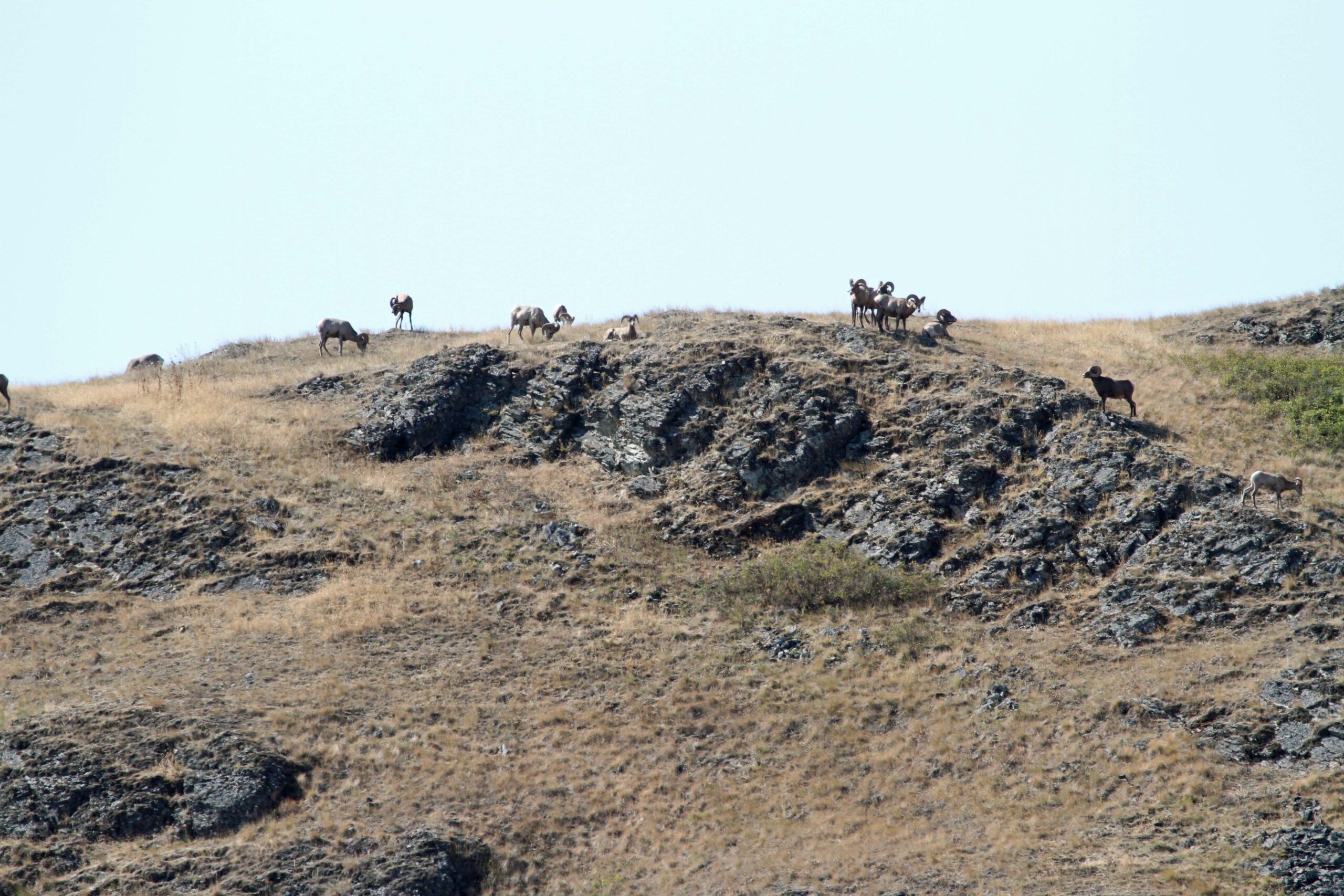
While our crew failed to see any Bighorn Sheep, the other biologists located 32 of these dynamic wild “woolies”. Photo disclosure: these are sheep in Glacier National Park (I think).

Once we got back to the parking lot, legs aching, we thanked Seth for everything and hopped back in the company car. I said goodbye to Yosemite, unsure of when I would return, and after a quick stop at the Mobil station for tacos, we headed home.

Battling the February Birding Blahs

In a recent Redpolling poll, voters overwhelmingly chose February as the worst month for birding (except for a few cheeky Floridians who lorded it over the rest of us). But is February really that bad? In Montana, after all, you can go find some wonderful winter residents such as Rough-legged Hawks, Northern Shrikes, and Snow Buntings. On the other hand, by February you’ve usually seen those already so where does that leave you?

February is a great month to catch up on bird-related reading. For my review on this and other excellent titles, Follow @sneedcollard on Instagram.

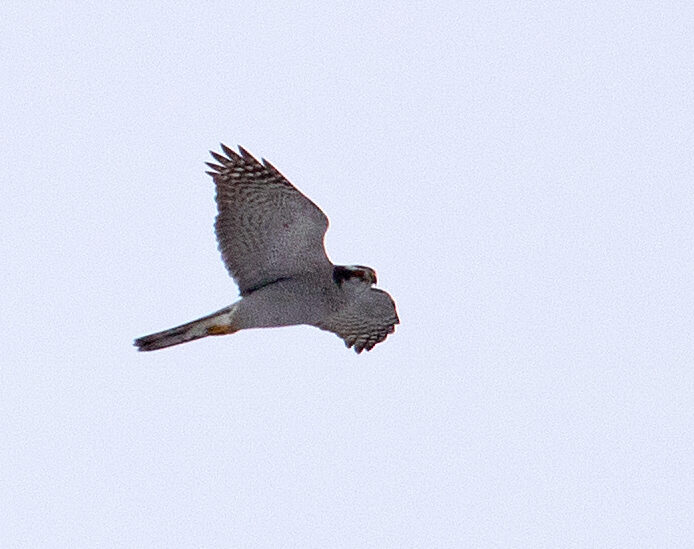
For me personally, February is a time to get a lot of actual WORK done such as writing birding articles, banging out new children’s books, writing letters to the editor and my senators about bird conservation, and reading bird books. That doesn’t mean, however, that I’m not curious about which birds are around—while remaining optimistic that I’ll find some surprises if I go out. On a morning dog walk recently, for example, a Northern Goshawk flew right over me and Lola! This last Sunday morning, Lola and I again headed out wondering if we might see any other surprises.

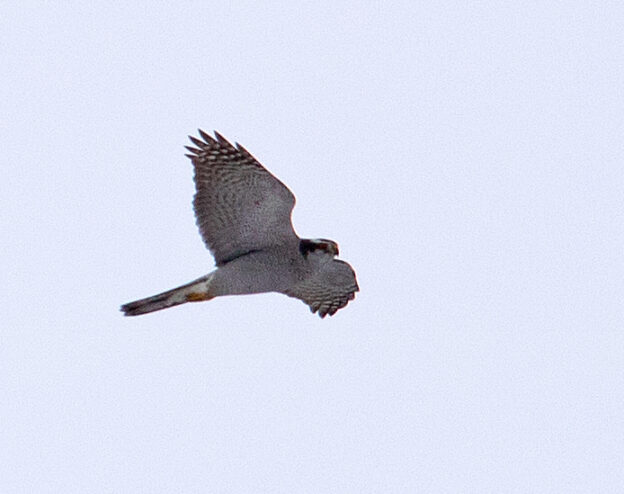
Just to prove that in birding you never know—even in February—a Northern Goshawk flew right over me and my dog Lola only a couple of weeks ago! It was the first I’d ever seen on my own.

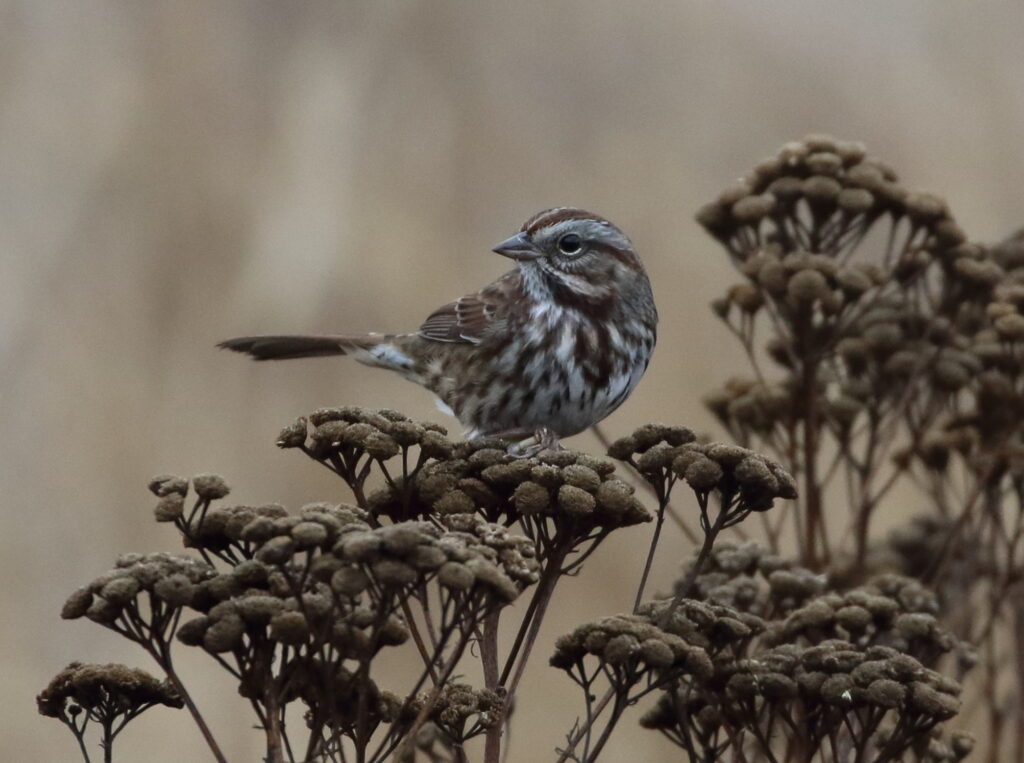
We decided to do a loop I only rarely traverse anymore, through a private neighborhood that COULD be great bird habitat but has instead been landscaped with acres of lawn and over-pruned trees. Still, even before we got to that neighborhood, I noticed that our resident birds have shifted into courtship mode. On Valentine’s Day I heard the first two-note song of a chickadee for the year and also the first throaty warble of an advertising Northern Flicker. This morning, I heard both of those—plus an amazing number of Song Sparrows also advertising. I haven’t kept track of “first spring calls” before, but I wondered if they are on a trend toward “springing out” earlier and earlier every year?

After not hearing a Song Sparrow call for many weeks, I was gratified to hear four of them singing in different locations on our recent Sunday morning walk!

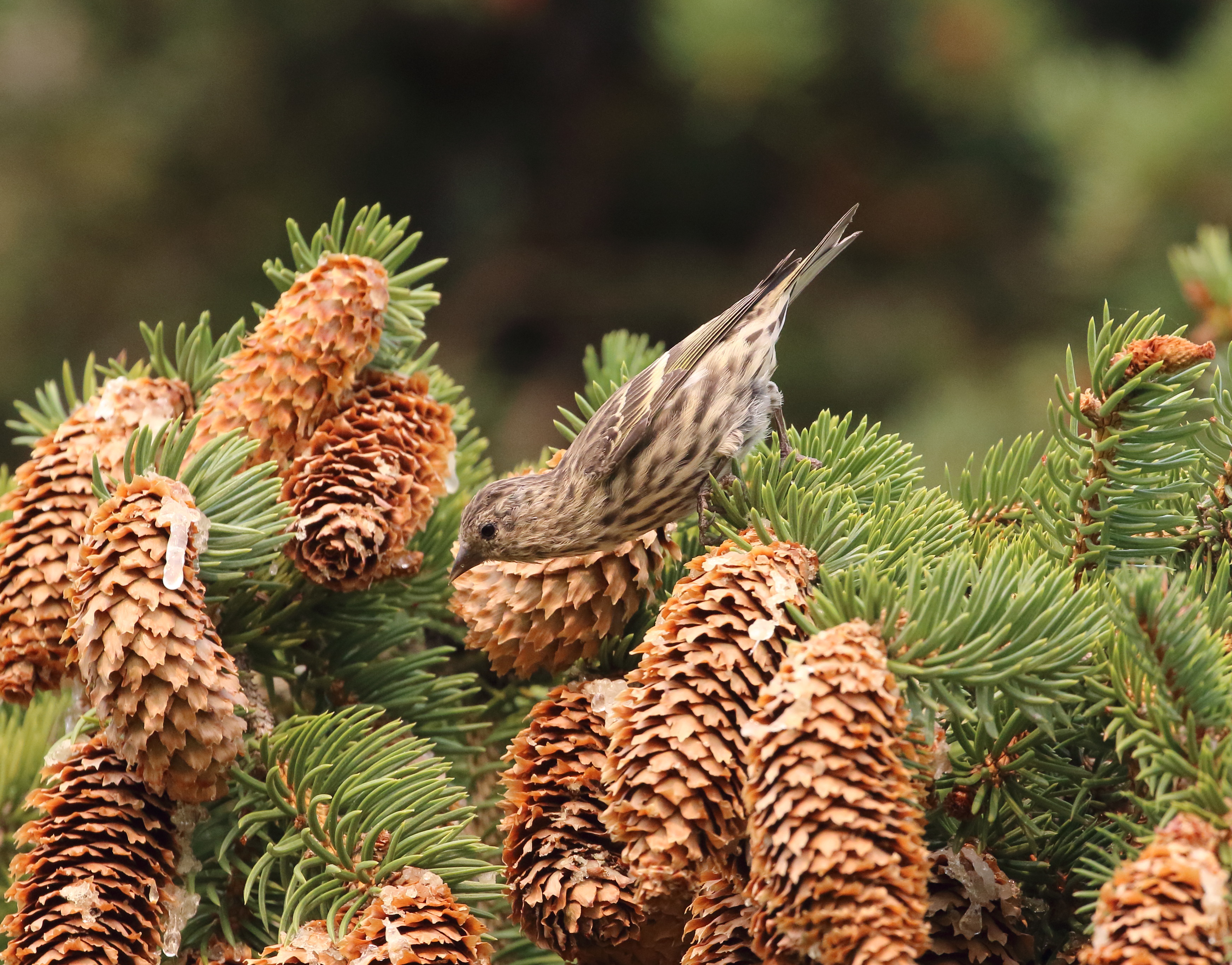
In the private neighborhood itself, we heard some distant wild turkeys, a Red Crossbill, and an unknown high-pitched cacophony. My hearing is so sucky anymore I couldn’t tell who was making this chattering, but whipped out Merlin’s Sound ID, which ID’ed them as Pine Siskins. But where were they? I walked forward a bit, turned around and there they were—more than forty of them in a tree! Okay, so it wasn’t a Northern Pygmy-Owl, but I was still happy. Lola and I had headed out expecting maybe 6 or 8 species and ended up with sixteen! Just goes to show you that, even in the February Blahs, birds are around and ready to teach us new things.

A flock of 40 Pine Siskins proved a delightful highlight of our unlikely February neighborhood walk.

Monotypic Birds—Evolution’s Survivors

In case you missed our last post, Sneed’s new book, Like No Other: Earth’s Coolest One-of-a-Kind Creatures, is now out so that you and your young ‘uns can learn even more about monotypic animals. To order, click on the book jacket in the right column!

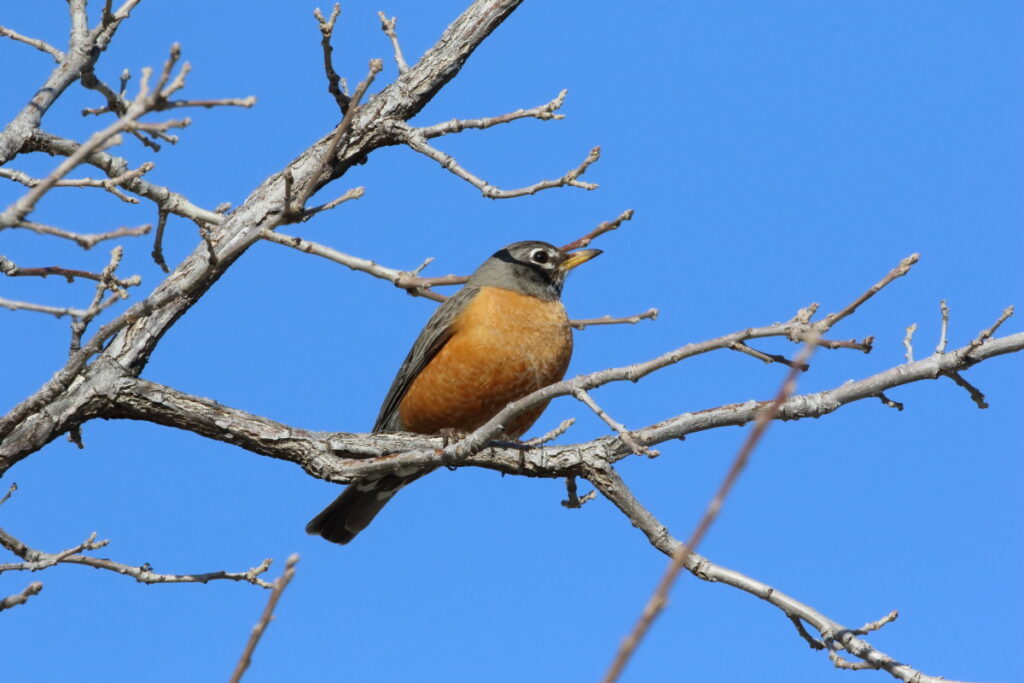
Since Braden returned to college, I haven’t been birding a whole lot. Instead, I’ve been working on a new children’s picture book about monotypic animals—animals without any close relatives. The book won’t be out for a couple of years, but I can’t wait that long to share some discoveries. But first, an explanation of monotypic: in a scientific sense (and what other sense could there be with such a word?), monotypic refers to an animal with no other members in its genus. According to Birds of the World, for example, the genus Turdus contains 83 different species—including the American Robin—but a monotypic species would have no other ‘roommates’ in its genus.

With 83 species in its genus Turdus, the American Robin is a species that is decidedly NOT monotypic!

For my book, though, I have been investigating animals that are monotypic not just to genus, but at least to their scientific family or order. In other words, these species are truly apart, without any even vaguely close relatives. I didn’t know how many of these loners I might find, but guess what? There are a lot more than I expected—including birds! You probably have heard of some of them including the Hammerkop, Shoebill, Egyptian Plover, Rail-babbler, and my favorite, the Secretarybird! All of these are only distantly related to any other kind of bird.

Not that they’ve never had relatives. I suspect most of them have. What happened to their close cousins? We will never know, but they undoubtedly succumbed to a panoply of climatic, geological, and biological catastrophes. Which makes these monotypic survivors all the more impressive, in that they somehow navigated the endless avalanche of disasters that have befallen the world! Learning about these animals, however, also made me ask myself, “In my own relatively brief birding career have I myself actually seen any monotypic-to-family birds?” Astonishingly, the answer is yes—and if you’re reading this, you probably have, too!

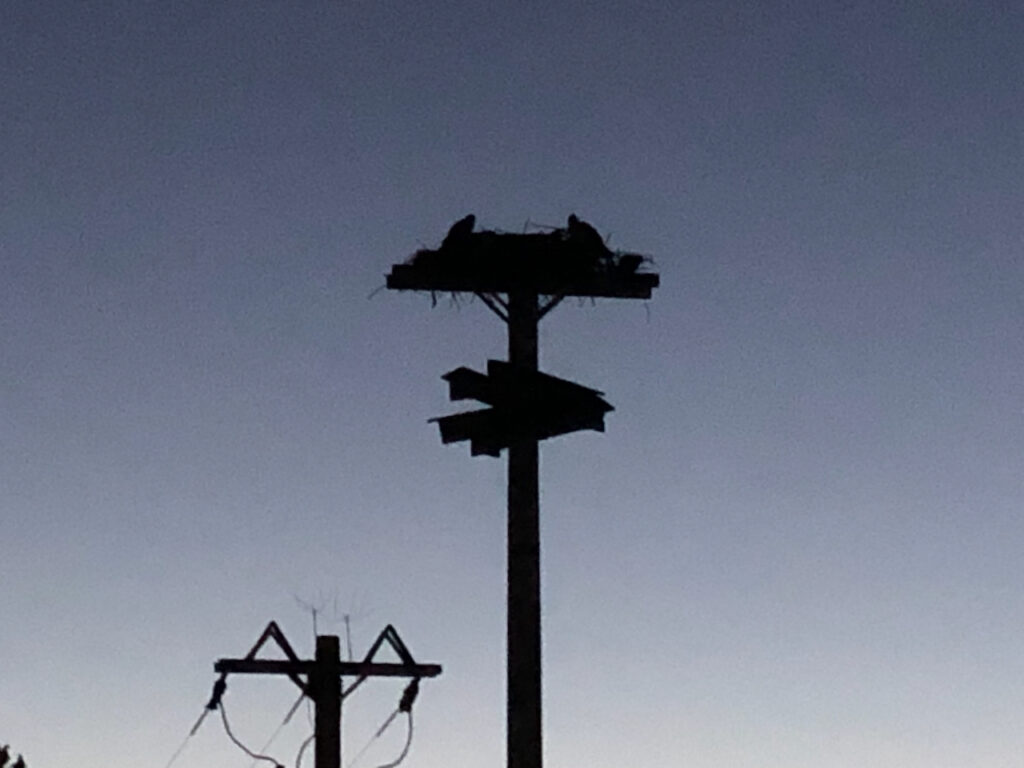
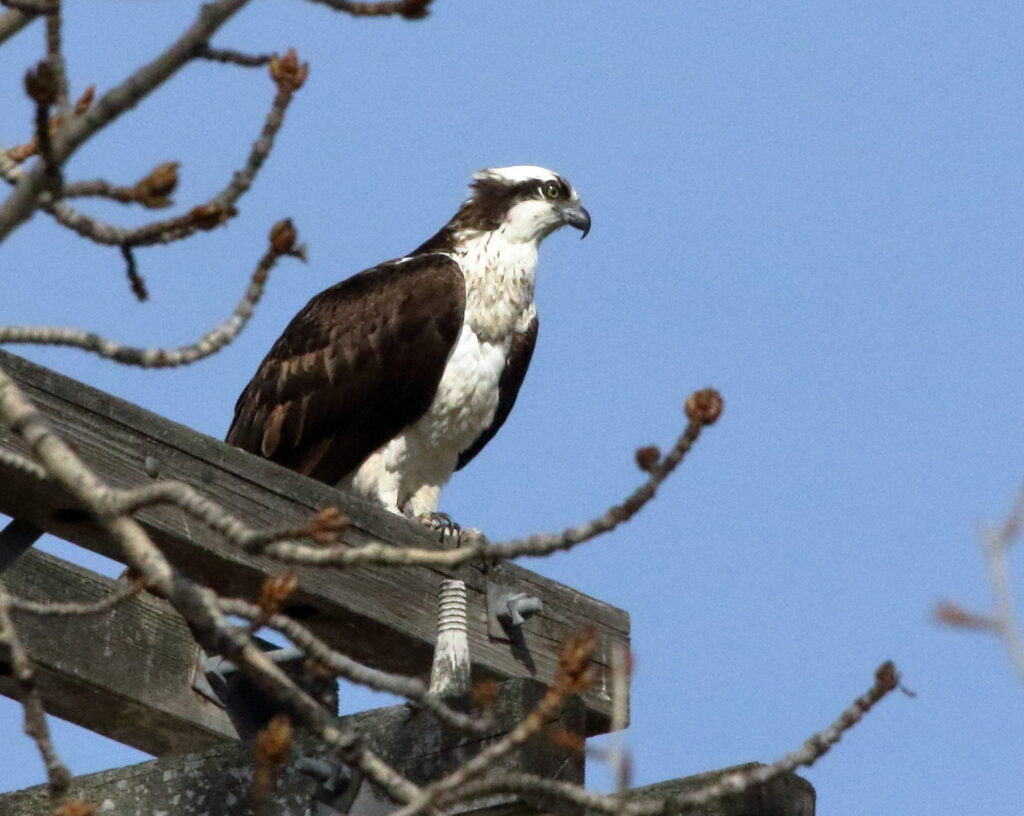
Number 1 on most of our lists has to be the Osprey. If you think about it, that makes sense. I mean, the Osprey is just one weird-looking bird of prey, but even more interesting, it split off from all other raptors very early on in raptor evolution. Can you guess its closest living relative? Yep. Africa’s Secretarybird—another very bizarre bird of prey!

The Osprey may be the most widespread and well-known monotypic-to-family bird on earth!

Many of you also may have seen the Limpkin—the sole species in the bird family Aramidae. Long before I ever became a birder, I enjoyed these gastropod- and bivalve-eaters while visiting Florida’s Wakulla Springs south of Tallahassee. More recently, I heard—but didn’t see—one down in Houston while working on My Accidental Big Year. If you are birding Arizona and New Mexico, you can nab yet another monotypic-to-family bird, the Olive Warbler, of the family Peucedramidae. For other birds that are monotypic to family, however, we must venture outside of U.S. borders—something Braden and I have been fortunate to do.

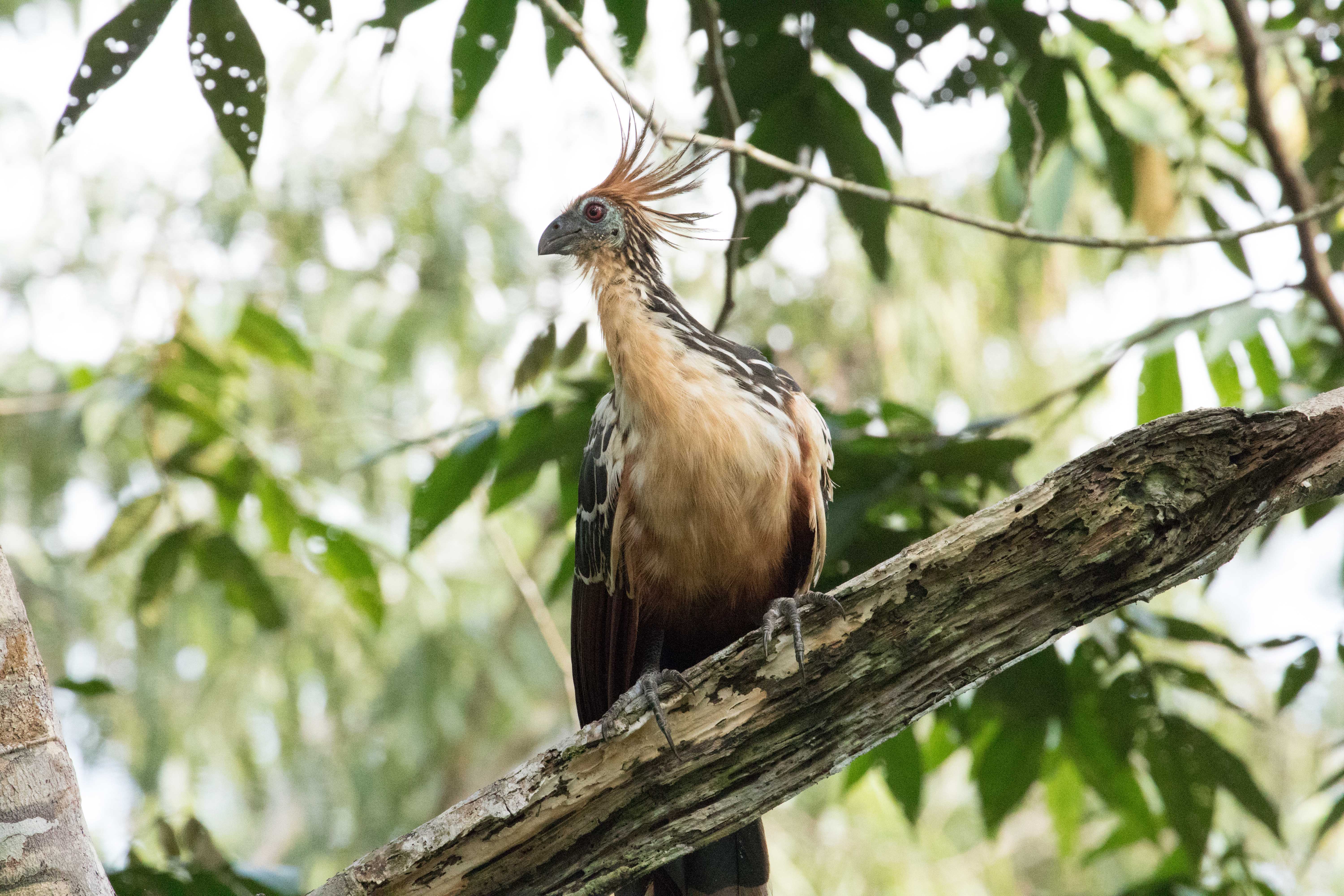
During our visit to the Sani Lodge in the Amazon in 2017, we picked up two monotypic species—in the same location! One was the iconic Hoatzin, a large turkey-like bird that is the sole resident of the family Opisthocomidae. Hoatzins like to show off, and if you watch almost any film or read any book about the Amazon you will undoubtedly see this bird since it often gathers near humans in large numbers. During our stay at Sani, I woke up to dogs barking one night and asked our hosts about it. They looked at me strangely. “We don’t have any dogs here.” We finally figured out that I’d been hearing Hoatzins!

It’s probably no surprise that the Hoatzin is monotypic to family. Looks like these probably don’t inspire a lot of copycats!

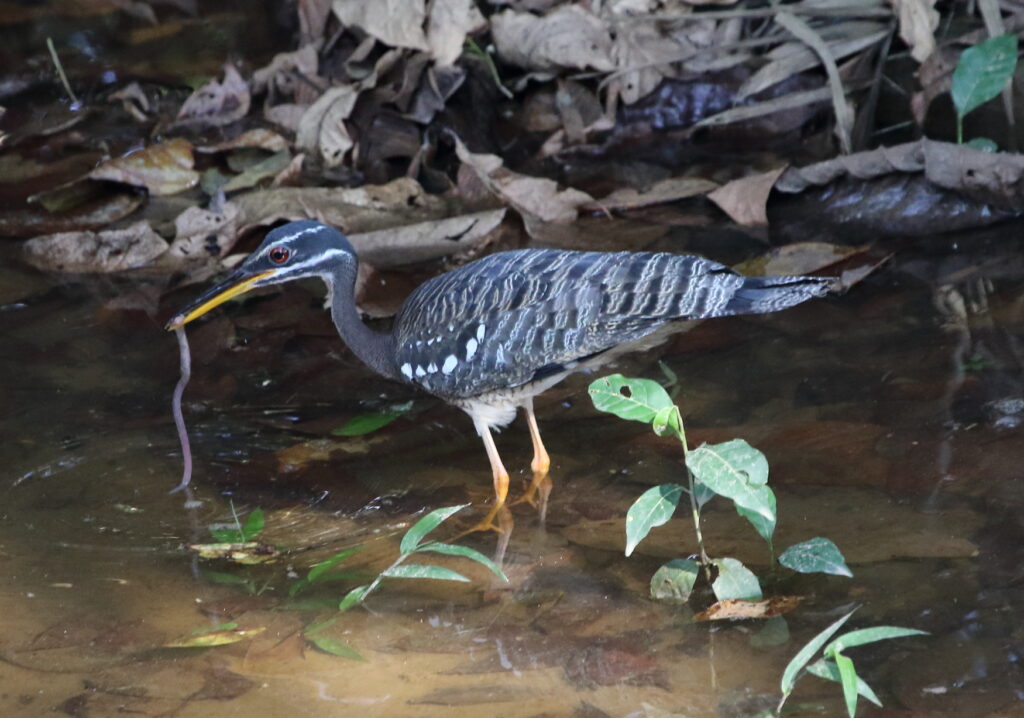
In between outings at Sani, Braden and I were also lucky enough to see a handsome bird silently stalking worms, crayfish, and frogs in shallow waters. What was it? A shy Sunbittern, sole species in the bird family Eurypygidae. These birds are quite cryptic (camouflaged), but apparently when they spread their wings they unleash a burst of spectacular color—something Braden and I unfortunately failed to witness. Still, we didn’t even know Sunbitterns existed before the trip and are happy to now have them firmly dwelling in our brain banks.

The secretive Sunbittern is another South American species that is monotypic to family—one we were lucky enough to encounter.

If you want to learn even more about monotypic-to-family birds, click here for a fun website. Some of the taxonomies have changed, but most are still accurate, and you’re sure to notice some surprises. Meanwhile, I am contemplating a quest to see every monotypic bird family on earth. If you would like to help me and Braden do this please send a nonrefundable check for, say, fifty thousand dollars, and we will begin post-haste! As always, thanks for reading and be sure to share this post with your birding buddies!

Parker River NWR and the 3 Ps of Birding

If it’s one thing we at FatherSonBirding hammer over and over again, it is the 3 Ps: Planning, Persistence, and Preparation.

Okay, actually, we have never talked much about this, but it’s a catchy concept, isn’t it? The 3 Ps, in fact, came very much into play recently when, after our rather disappointing birding in Boston, Braden and I headed up the coast to a place Braden had carefully researched (P Number 1) ahead of time: the Parker River National Wildlife Refuge.

One of the gems of the New England coast, Parker River NWR turned out to be our favorite birding spot of our week-long sojourn.

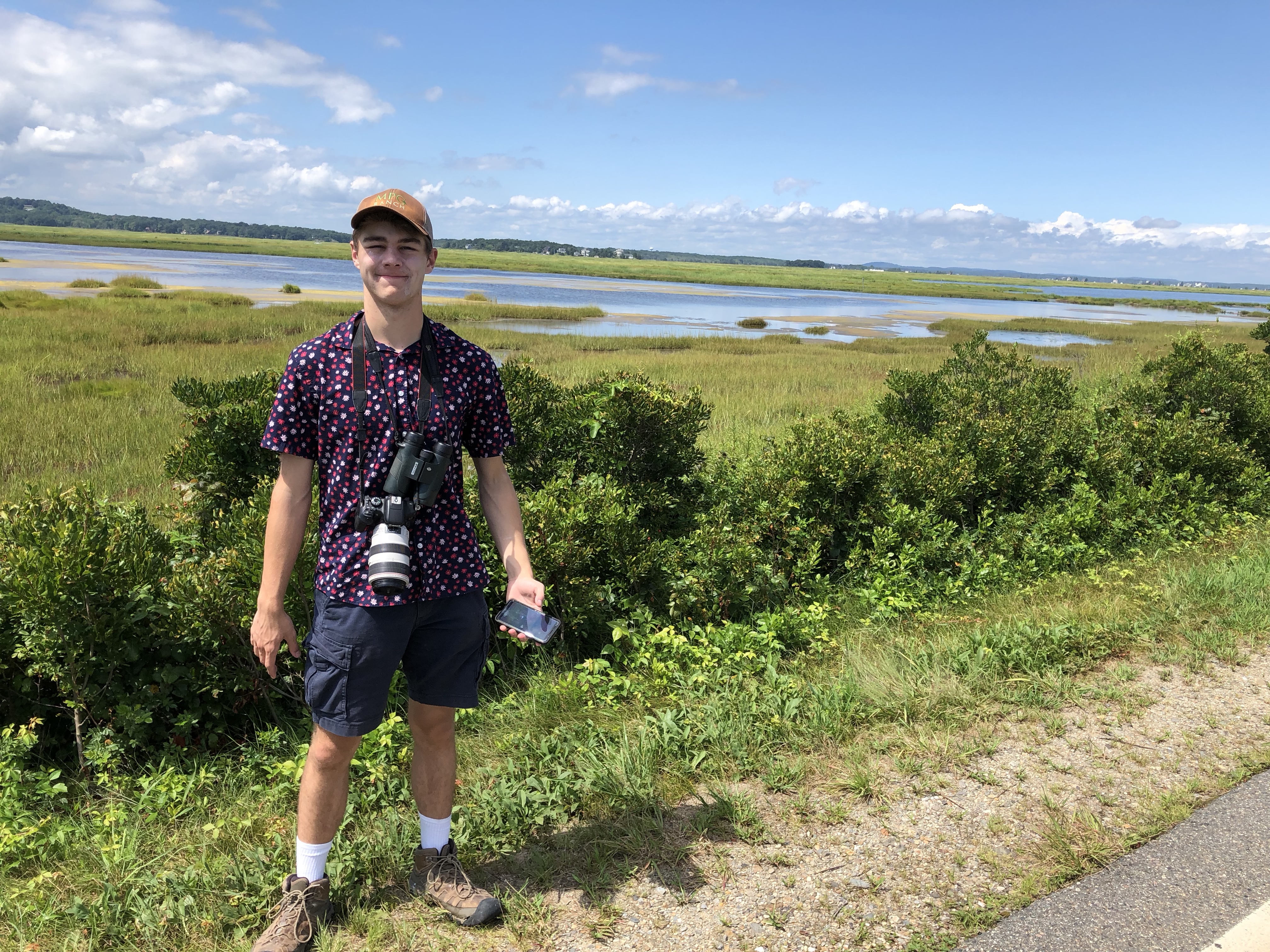
I had actually never heard of Parker River before, but Braden learned about it from some online birding buddies and checked it out to see if it was “visit-worthy”. His verdict? Definitely. Not only might we collect a handful of Life Birds there, the refuge protected one of his top ABA target birds: Saltmarsh Sparrow.

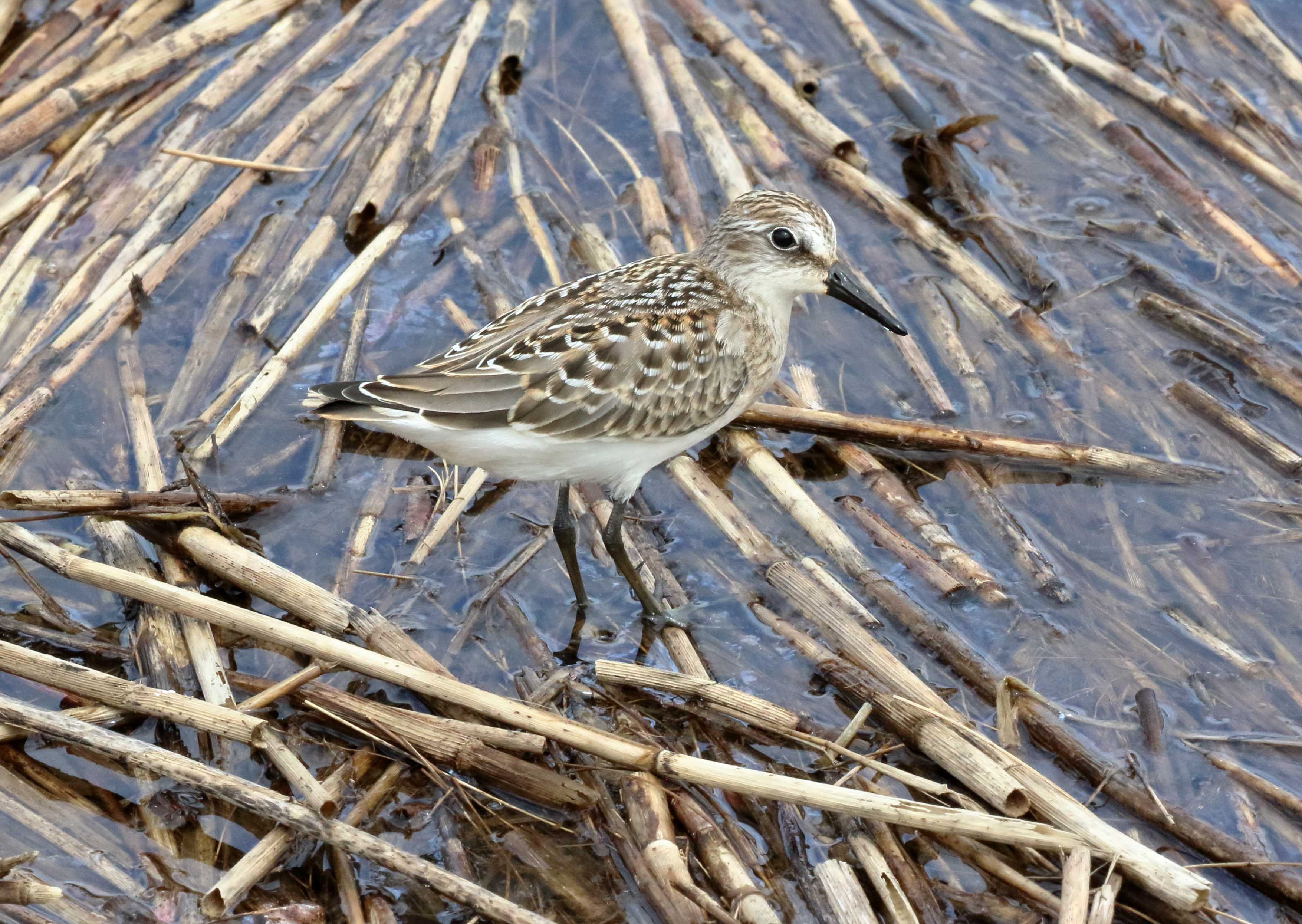
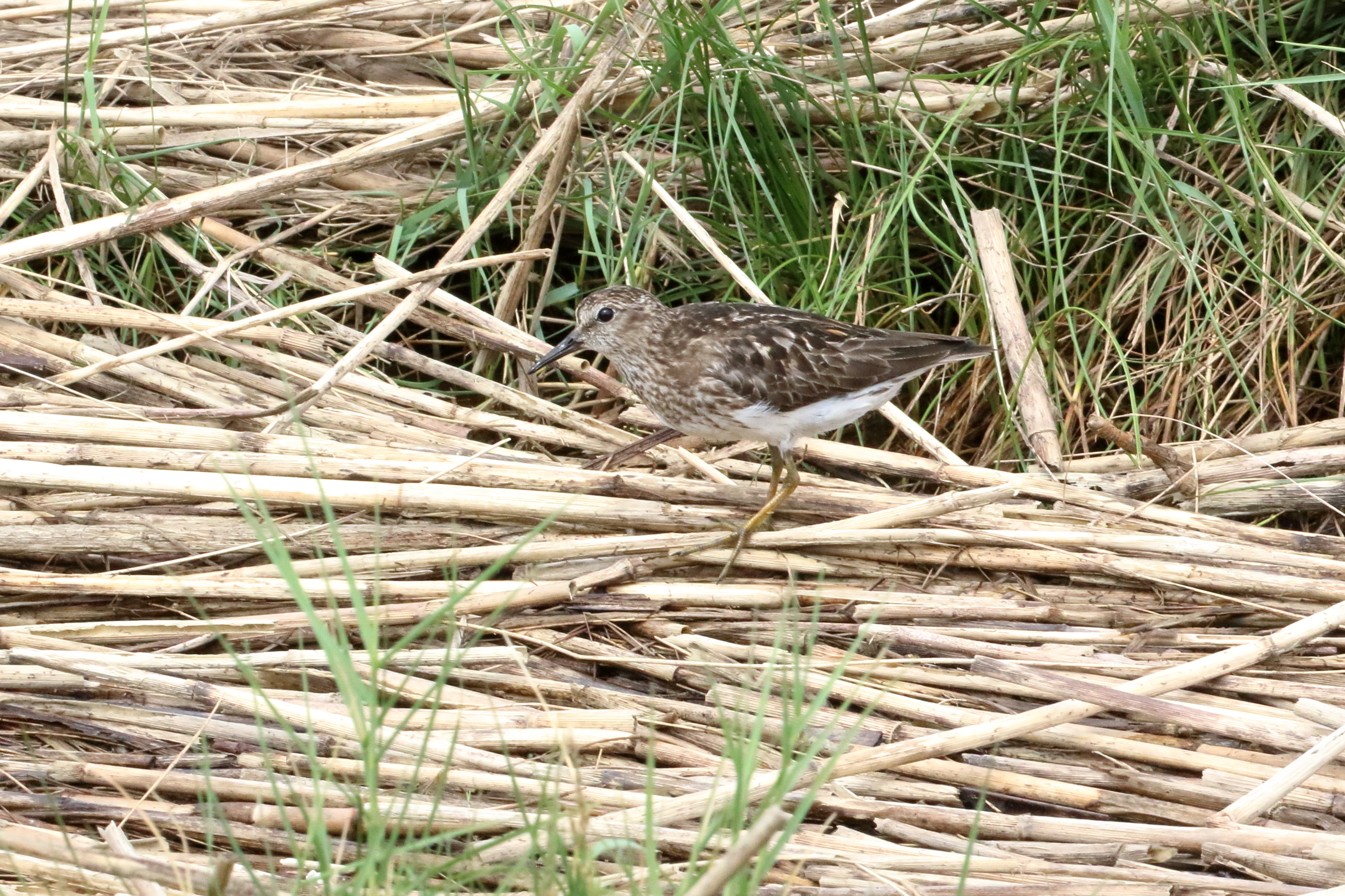
Now, I have to say that when we visit a National Wildlife Refuge, I generally expect a pretty low-key, rarely visited location. Imagine my surprise when we encountered a mini traffic jam waiting to get in. In fact, it became evident that the refuge served not only to protect wildlife, but as a critical outdoor outlet for congested coastal Massachusetts. Our visit started auspiciously with a stop at Lot 1, where we got a quick fly-over of a Baltimore Oriole—the only one we would see on our trip. Crossing the highway, we encountered an even cooler surprise: the closest looks we’d ever had of Semipalmated and Least Sandpipers! This was especially useful after the ID struggles we’d had with birds in eastern Washington only weeks before, and it really helped us examine the unique properties of each.

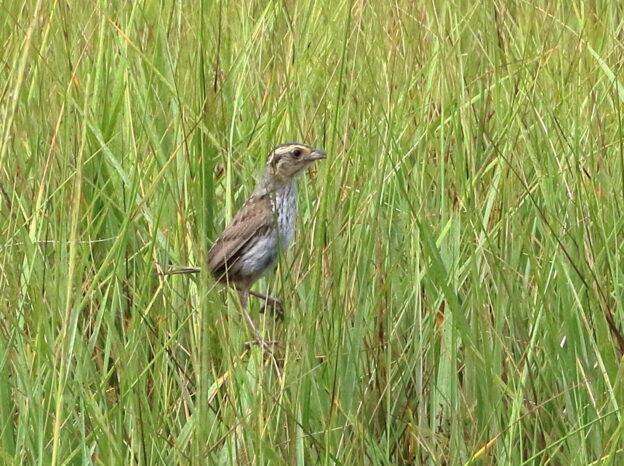
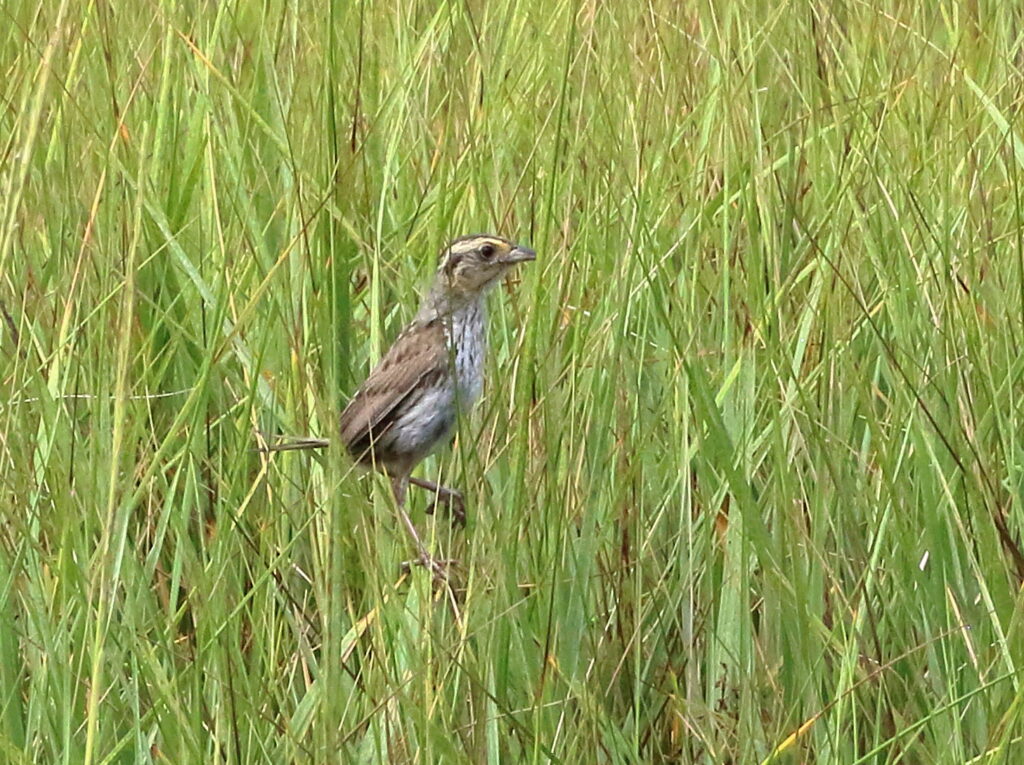
As we moved on, though, Braden felt pessimistic about seeing Saltmarsh Sparrows. He had Planned. He had Prepared himself with knowledge. But Boston had put an “unlucky” vibe in his head. As we made our second stop along the refuge’s main road, however, he suddenly shouted, “I see them!” Indeed, not thirty feet from us, at least four or five fairly nondescript little birds bumbled about in some tall marsh grass, seemingly not knowing what they were doing. “They seem like juveniles,” Braden surmised, and having studied this species quite a bit, he would know.

Saltmarsh Sparrows used to be lumped with Nelson’s Sparrows as one species, the Sharp-tailed Sparrow. As its own species, however, the Saltmarsh Sparrow occupies a narrow range of saltmarsh habitat along the East Coast and, in fact, requires this habitat for nesting. Because of this, it is at extreme risk from higher sea levels caused by climate change, and its population has been steadily declining. This makes protecting places like Parker River NWR even more important—and made us feel especially privileged to have such a close experience with them.

Our amazing experience with Saltmarsh Sparrows proved once again that persistence just may be the most important attribute of a successful birder.

Leaving the Saltmarsh Sparrows, we continued to hit other places in the refuge and were rewarded with a host of Year Birds, and two more Life Birds: Purple Finch and Great Crested Flycatcher—our number one ABA need to that point. Which all demonstrates the third P of birding: Persistence. Sure, luck plays a role, but just getting out there again and again will eventually take luck out of the equation, something we learned for the thousandth time at Parker River.

Click for a link to our largest Parker River checklist. Crazy migrating swallows!

Birding by 5-Ton Truck: a 100-bird Quest

Having missed out on Braden’s epic Glacier birding day because of, you won’t believe this, a job, I have struggled for ways to console myself. Fortunately, birding opportunities are dove-tailing nicely with my new temporary career: delivering fire-fighting equipment by truck to various fire camps around Montana and Idaho. As you’ve probably noticed, it is shaping up to be an unprecedented fire season with record, early heat and little rain in sight. Just another reason that we need to make climate change our number one priority as a species (see Saving Birds. It’s Time.).

On the personal front, however, this radical summer has provided me with an interesting, useful part-time job driving for the Forest Service, and I have to say, I’ve been impressed with their entire operation. As I began my job, though, I asked myself, “How many birds could I see just driving around Montana and Idaho through the fire season?” I decided to set a goal of 100 species for myself—a number that seemed optimistic for this time of year, especially since I would have few opportunities to venture off roads into wildlife refuges and other birding hotspots. Below is my interim report, but first I should lay out the ground rules that I have set for myself, and they are simple: every bird can be counted from the moment I leave for work until I get back. I can’t count birds at my house or on my street, but everything else is game. So how goes the quest?

Who knew I’d be drivin’ truck at my age, but as in most of my life, trying new things has led to new birding—and writing—opportunities!

Well, so far I have driven approximately 3,000 miles and seen 59 species of birds, or about one new species every 51 miles—far more than I expected at this point. Let’s start with raptors. These are birds I expected to do well with because, duh, they are big and easy to see, and they sit on telephone poles. Strangely, I have seen only one Bald Eagle since I began and no Goldens, but have been delighted with Red-tailed Hawks, Swainson’s Hawks, Northern Harriers, Osprey, and a Prairie Falcon. My best raptor? A Ferruginous Hawk that I passed three separate times on my way to Ennis before I could positively ID it at 70 mph!

I had to drive by it three separate days before I could ID a Ferruginous Hawk near Ennis (actual bird not shown), but it was a major score in my “birding by truck” goals to find one of these.

Songbirds promised to be the most difficult category because they are almost impossible to ID at high speed—and often at low speed! Still, I’ve lucked out with birds such as American Redstart and Evening Grosbeak around the ranger station in Seeley Lake, and good looks at Western Tanagers, catbirds, and other species along river roads. While my truck was being emptied down at the Goose Fire south of Ennis, I walked over to “pish” (make a fake bird sound, not doing, well, you know) some bushes and was flabbergasted to see a Lincoln’s Sparrow pop up in front of me—maybe my favorite “truck bird” so far.

Without a doubt my favorite sparrow, Lincoln’s Sparrow made my “birding by truck” list in surprising fashion while I was delivering a load to the Goose Fire crew south of Ennis. (Again, actual bird not shown—it’s hard to get bird photos while working another job!)

On my way back from the Dixie Fire camp in Idaho, I found myself at dusk crossing over Lolo Pass and needed a break, so I pulled into the visitor’s center to see if I could hear a Flammulated Owl. No luck, but White-crowned Sparrows and Swainson’s Thrushes called in the twilight, and suddenly I heard a deep sub-woofer sound. “My god,” I thought. “That’s a Ruffed Grouse!” It wasn’t. Later, after consulting with Braden, I realized I’d heard, appropriately for twilight, a Dusky Grouse. I hadn’t even known they made a similar deep-bass call. It pays to have a well-educated son!

Hearing a Dusky Grouse at, well, dusk at Lolo Pass taught me an important new bird call—and made an unlikely addition to my “truck list.”

The question remains: will I make it to 100? It’s going to take some doing, and I especially need to get into some large groups of waterfowl or migrating shorebirds or songbirds, but I remain hopefully optimistic. Stay tuned for the next installment! And yes, I would sacrifice my goal for a good, soaking rain!