Category Archives: Adventure

Peveto Woods, Louisiana: Spring Migration Hotspot

FatherSonBirding is a labor of love for both Braden and me, and our goal is to entertain and educate, and to promote bird conservation. If you’d like to support our work, please consider buying one or more of Sneed’s books and make a donation to one of the bird-related groups mentioned below. Thank you!

There’s a good reason the blog has been quiet the past couple of weeks. Braden is finishing up his honor’s project before graduating (gasp!) from the University of Maine while I jumped on a chance to head to Texas for the sixth time since Braden and I began birding. The trip arose from an invitation to talk about my book Birding for Boomers at the Mountains and Plains Independent Booksellers Association spring conference in San Antonio. Happily, the event took place during spring migration, so I of course booked three extra nights before and three extra nights after the conference to see some birds!

As soon as I picked up my rental car in San Antonio, I high-tailed it the four hours to Winnie, Texas on the coast just east of Houston. Why Winnie? Because it provides great access to several well-known stopover places for migrating songbirds and offers a chance to soak up a variety of coastal and aquatic species as well. For this trip, though, I was determined to explore some new birding areas, and my first morning I got up before dawn and headed to my first destination, Peveto Woods Sanctuary, just across the border in Louisiana.

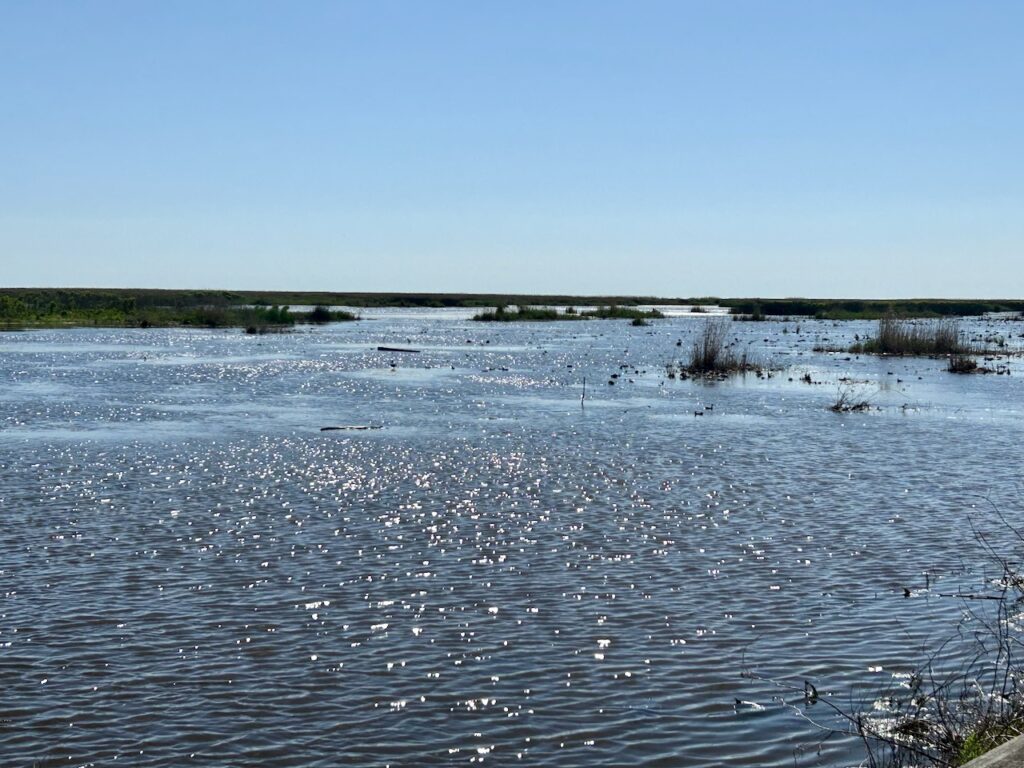
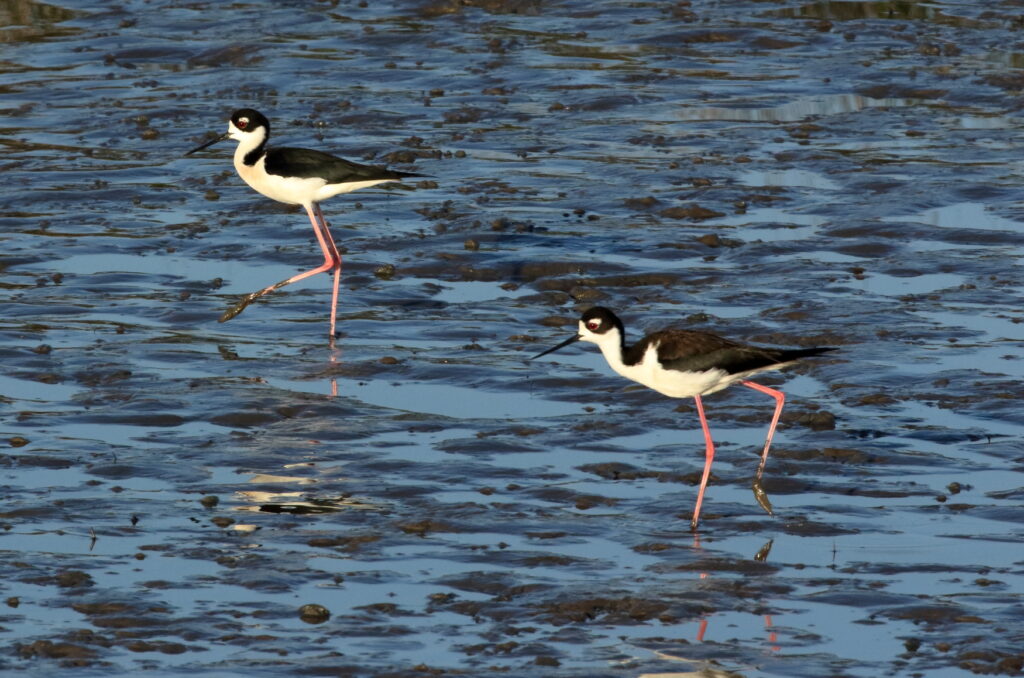
A bonus to driving to Peveto Woods is that once you cross the bridge into Louisiana at Sabine Pass, you can find a wonderful little shorebird area, especially if it happens to be low tide. And by the way, I don’t think I’ll ever get tired of posting Black-necked Stilts. So sue me already!
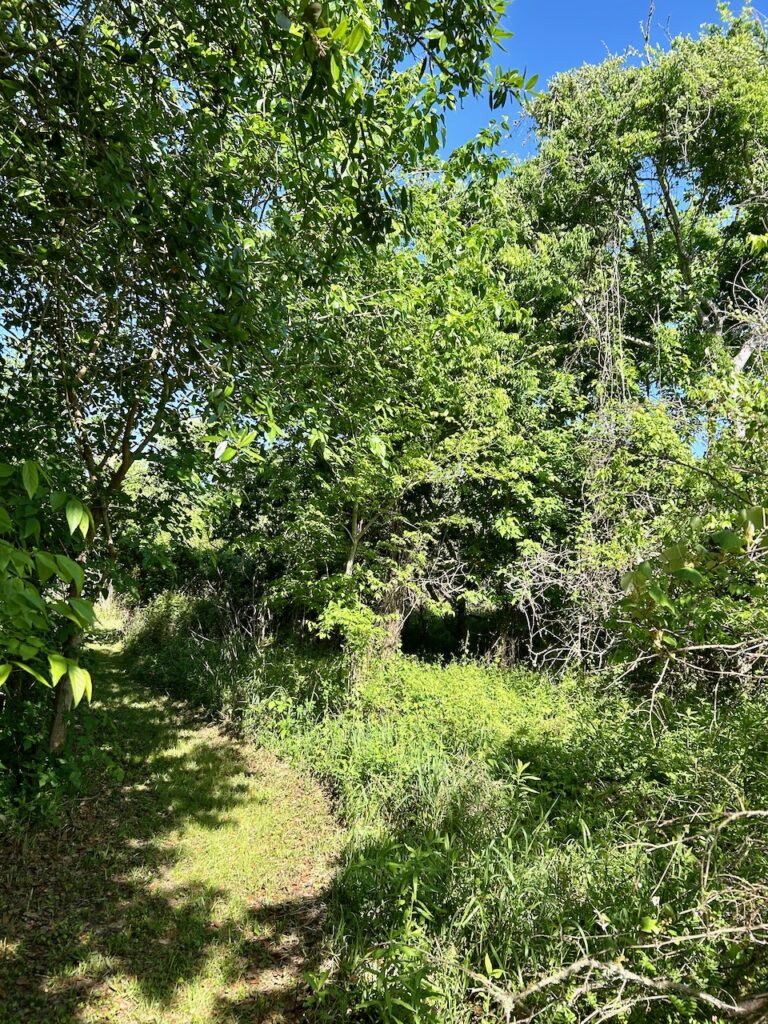
Peveto Woods offers delightful paths through trees, any one of which could be hiding a migrating songbird!

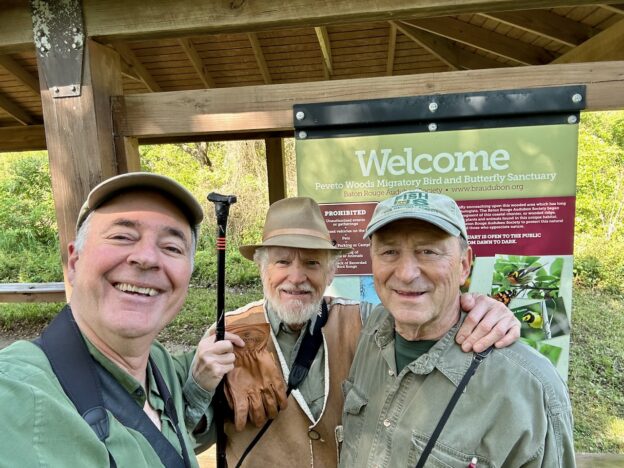
Peveto Woods is owned and operated by the Baton Rouge Audubon Society and like Sabine Woods run by the Texas Ornithological Society and the more famous High Island sanctuaries operated by Houston Audubon, Peveto consists of a patch of forest right along the shore. As soon as I pulled up, I knew I was going to like it. Trails headed off in all directions, crisscrossing forty acres of mostly oak-dominated woodlands. I saw two friendly-looking guys, Scott Delaney and Paul Wallace, who looked like they knew their way around and asked the best way to explore. It turns out, they had been volunteering their time here for many years and suggested I make my way to the east fence line and work my way back. They also explained that the land where the woods sat was called a chenier, a place where wave actions had piled sand and shells up higher than the surrounding area, allowing trees to grow. Hurricanes still occasionally obliterated the place, but the vegetation recovered quickly.

Hey, I’m gettin’ pretty good at these selfies–this one with my new birding friends, Paul (center) and Scott.

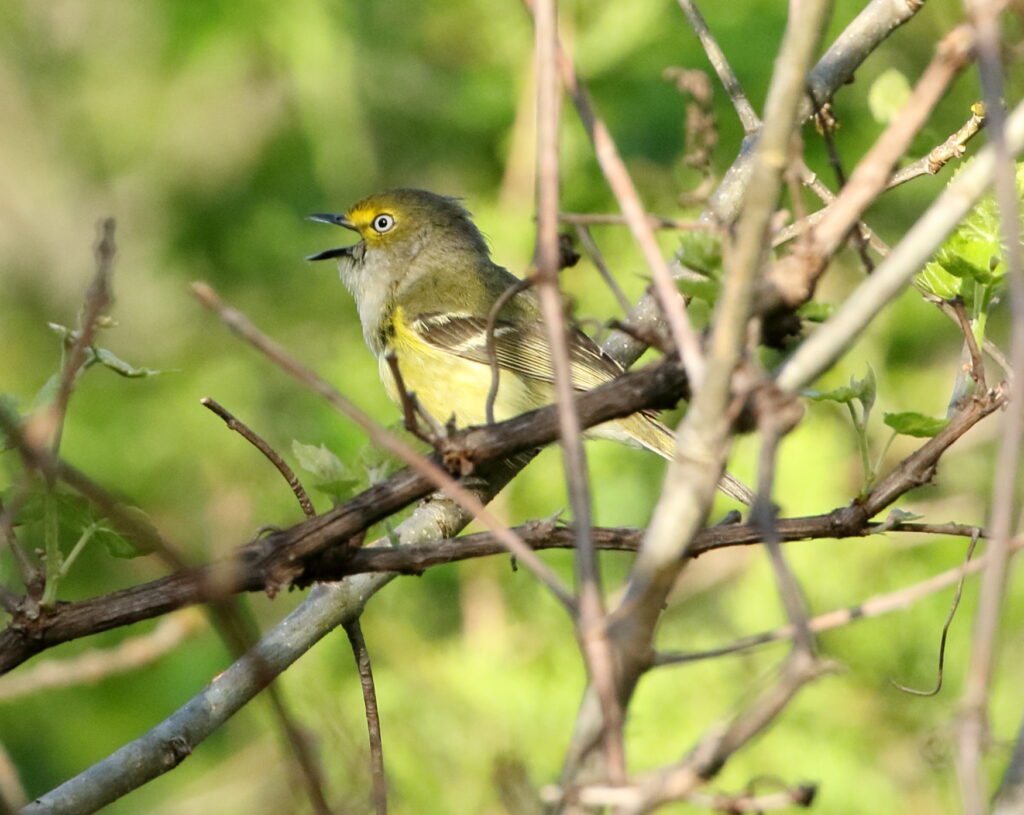
Unfortunately, I quickly learned that the main birds I had hoped to see—warblers—had not yet arrived in significant numbers. I was about a week early for many species and, for now, northerly winds had kept others grounded in the Yucatan. Only one hundred yards down the trail, however, I encountered a nice little mixed flock of other species. Sound ID picked up a White-eyed Vireo, and I quickly saw a Warbling Vireo along with at least four Red-eyed Vireos. Joining them were several Orchard Orioles, a couple of Yellow-rumped Warblers, and an Orange-crowned Warbler. Most were flitting about high in the trees, making photography difficult, but my heart warmed at seeing them.

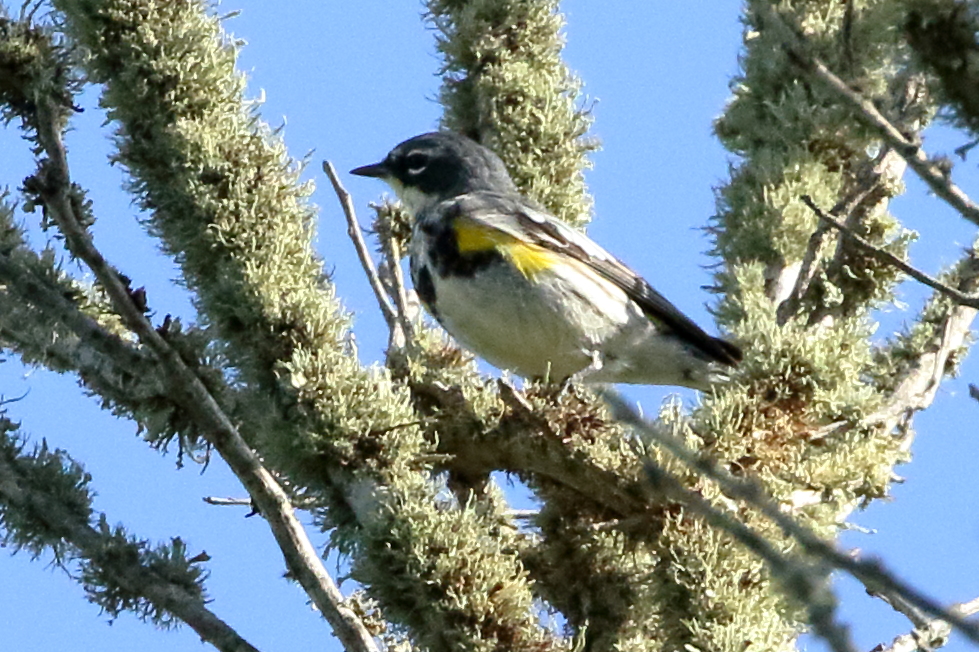
Although the more exotic warblers had yet to reach the Gulf coast, this (Myrtle) Yellow-rumped Warbler tried to hold down the fort till they arrived!

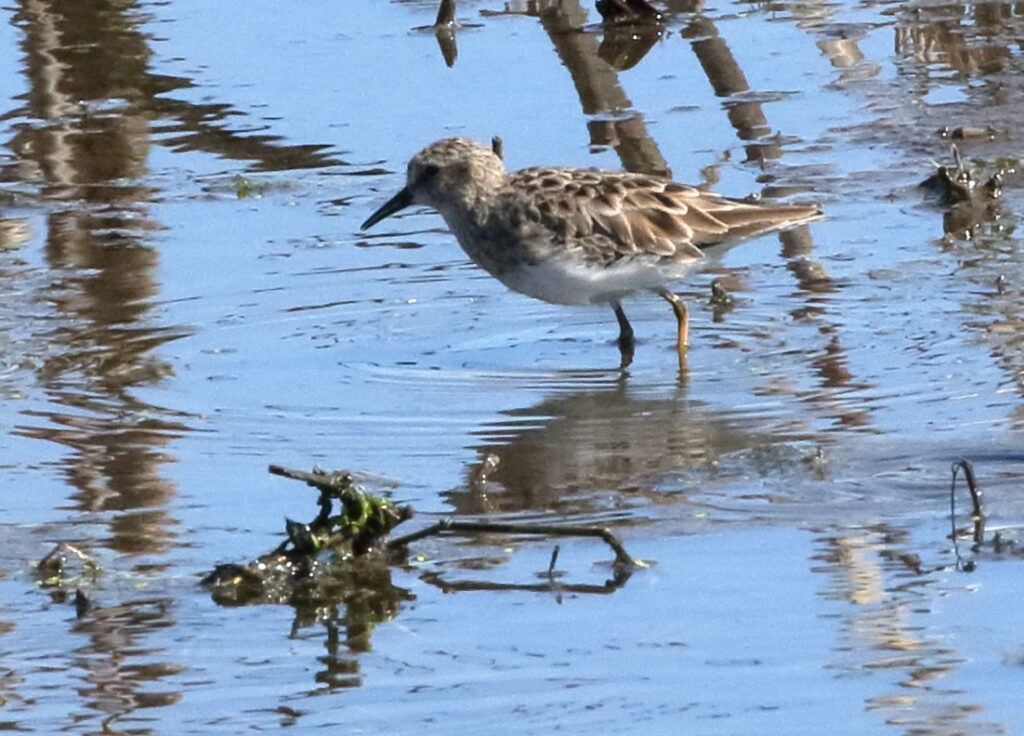
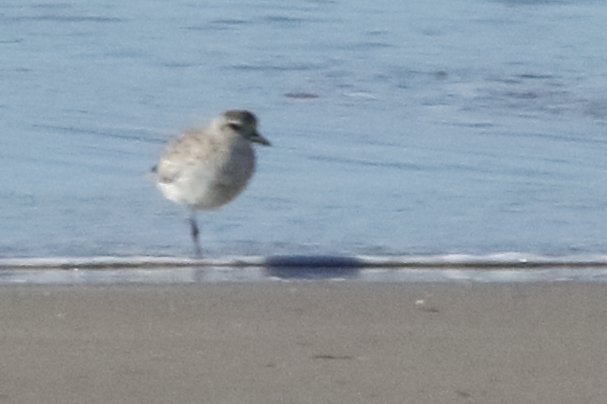
One awesome thing about Peveto is that you can walk right out to the beach and here I saw the trip’s first Black-bellied Plover, along with a couple of Royal Terns and Willets.

For those aware of my love of Black-bellied Plovers, you can imagine how delighted I was to find the first one of the trip on my very first outing.

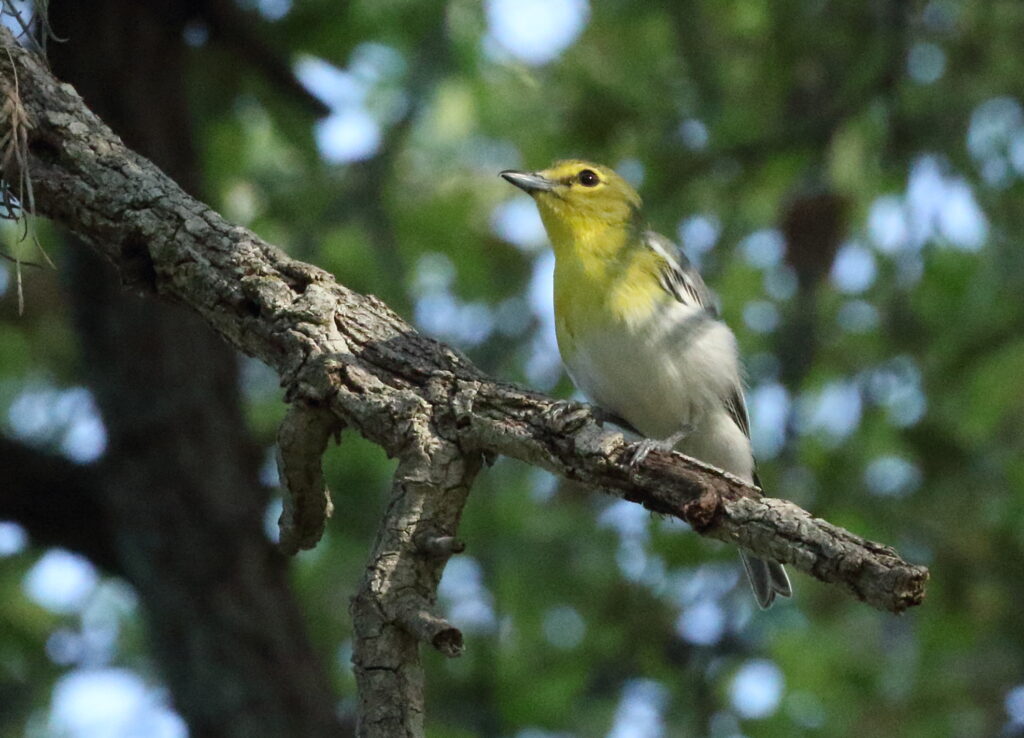
Returning to the woods, I kept strolling, finding migrating Gray Catbirds and pre-migration White-crowned Sparrows. A couple of Anhingas flew over, and then Sound ID picked up what would be the star of my visit: a Yellow-throated Vireo.

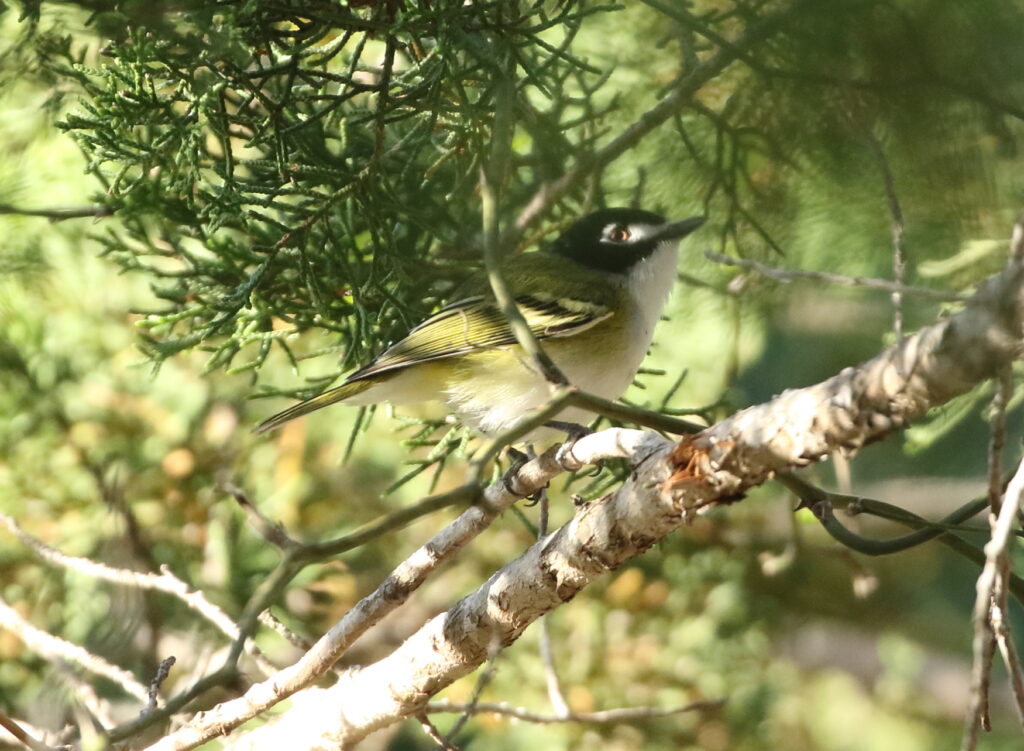
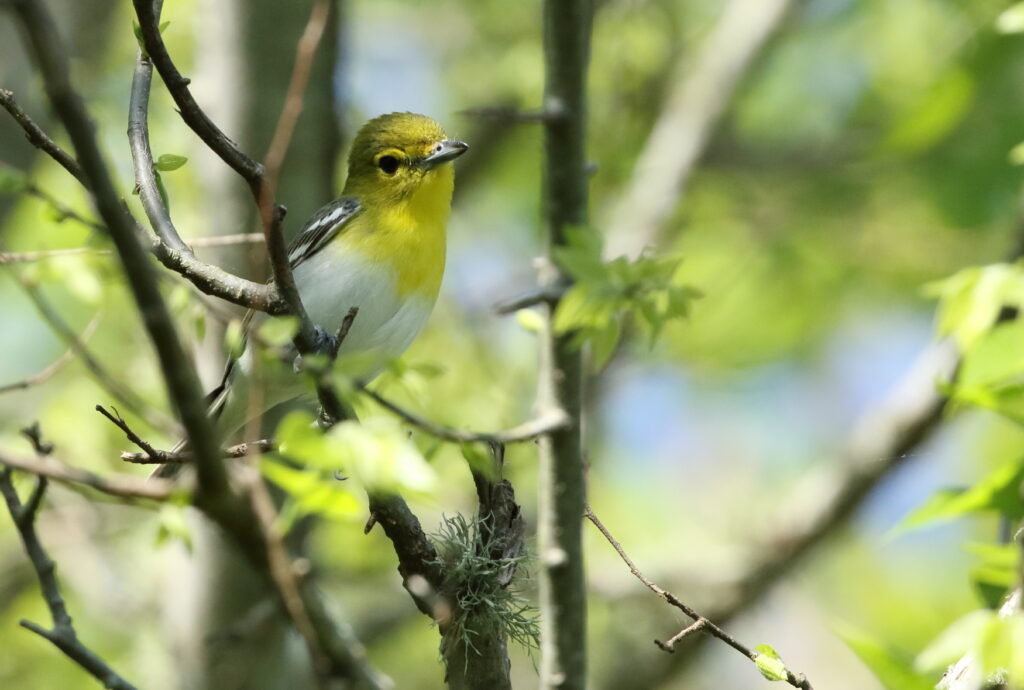
I just fell in love with this Yellow-throated Vireo. In fact, YTVIs are one of my new favorite birds, and I would see or hear them twice more on the trip.

I had seen YTVIs before, but so early in my birding career that they had gotten lost in the steepness of my learning curve. Now, a bird in glorious yellow, white, and gray plumage perched right above me. I shot some quick photos, and then just stood and admired this incredible creature. Like most other vireo species, this one had migrated from Central or South America, completing the eighteen-hour or so flight directly across the Gulf of Mexico.

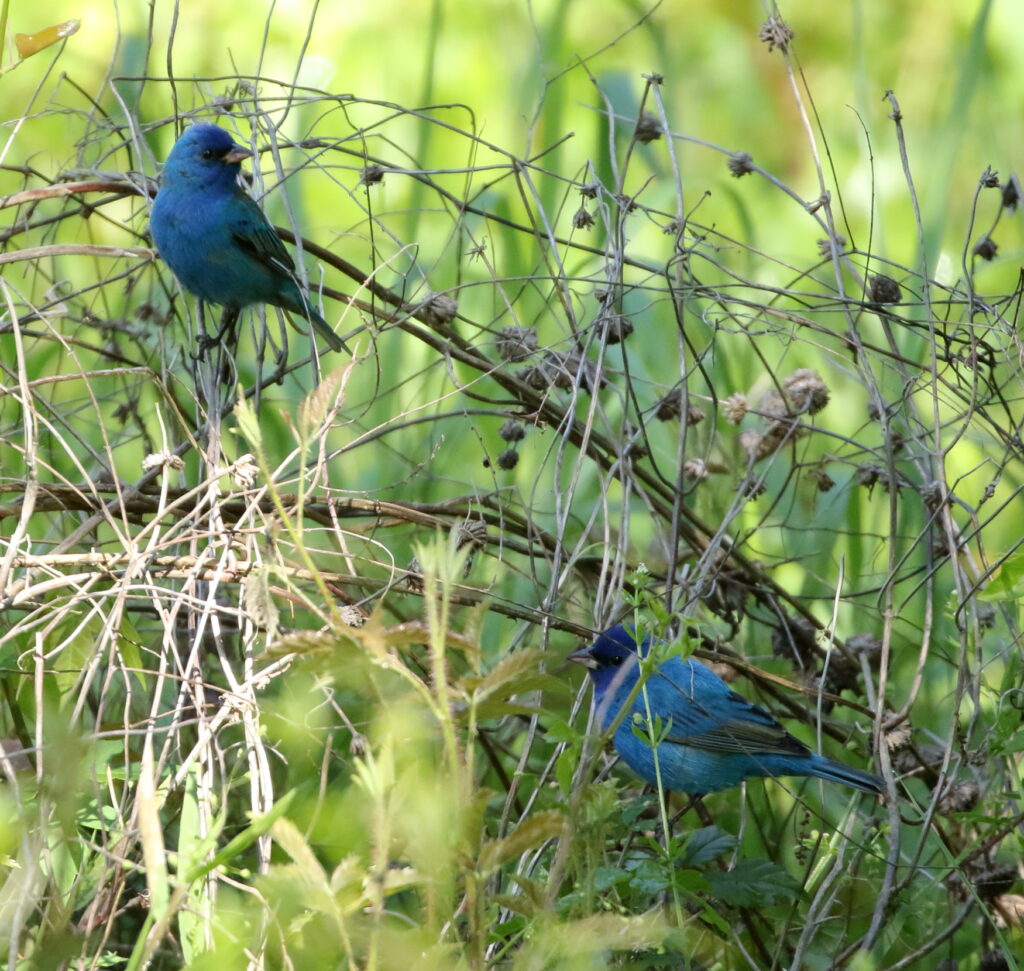
It seemed like years since I’d seen Indigo Buntings—and then, only females or juveniles. That made it all the more sweet to find these two “Sharp-dressed Men.”

It did make me wonder, though, why the vireos had made it “on time” but most of the warblers had not. “Are vireos stronger fliers?” I wondered. Or had they just timed things better? Either way, I was delighted to see them and get to know them better. And that’s birding for you. Even if the birds don’t always meet your own timetable, they always present a fascinating learning opportunity or two—or, as today, a chance to embrace and enjoy a new group of birds. I rounded off my morning by finding a couple of gorgeous Indigo Buntings on the brushier end of the preserve. I exchanged email addresses with my new friends Scott and Paul, and invited them to look me up when they came to Montana. I suspected, though, that I might make it back to Peveto Woods long before they got to Montana!

My checklist: https://ebird.org/checklist/S223902911

Note: As I post this, the warblers are definitely arriving at Peveto Woods. If you live nearby, what are you waiting for?

Habitats of Africa: A Field Guide for Birders, Naturalists, and Ecologists (Book Review)

To Order, Click Here: https://press.princeton.edu/books/paperback/9780691244761/habitats-of-africa

I’m excited to be heading off to Texas in a few days, to promote my book Birding for Boomers, but also to squeeze in a few days of birding. Before I go, I want to share an exciting new book that will interest anyone who has ever dreamed about visiting Africa. Braden loved a previous book, Habitats of the World, by two of the co-authors, and this follow-up is also full of fascinating facts and insights. Oh, and in case you missed it, you’ll want to read last week’s outstanding guest post by Roger Kohn, “Cock-of-the-Rock Extravaganza—with Video!” Enjoy!

When I first opened my review copy of Habitats of Africa, I thought, “How on earth did the authors put together such a comprehensive guide to such a vast and ecologically diverse continent?” I next wondered how, as a reader, I might possibly absorb the immense amount of information packed into this handsome volume. The answer to the first question is that all three authors have worked as professional nature guides, with extensive experience in Africa. As for the second? I could only answer that by diving in.

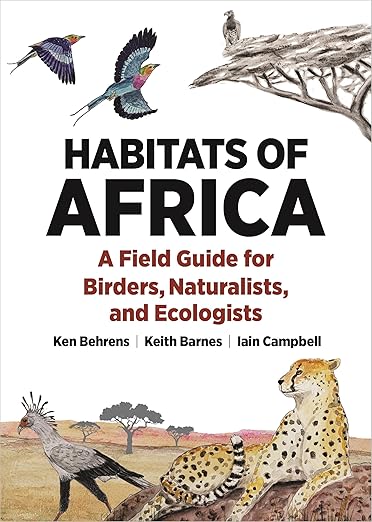
Habitats of Africa: A Field Guide for Birders, Naturalists, and Ecologists by Ken Behrens, Keith, Barnes, and Iain Campbell (Princeton University Press)

The table of contents reveals that Habitats of Africa covers an astonishing seventy-plus different habitats, and honestly, that alone could be overwhelming to the beginning reader. The TOC, though, also provides good clues for how the book is arranged and is therefore worth a few moments of time.

Habitats are organized under a dozen headings, ranging from “Deserts and Arid Lands” and “Warm Humid Broadleaf Forests” to “Savannas” and “Saline Habitats.” The first habitat I read was the Maghreb fir and cedar forest, one of four habitats listed under the “Conifers” heading. I probably started with this one because I don’t usually think about conifer forests growing in Africa. They do, of course, but their ranges are extremely limited, and I wanted to know more about them.

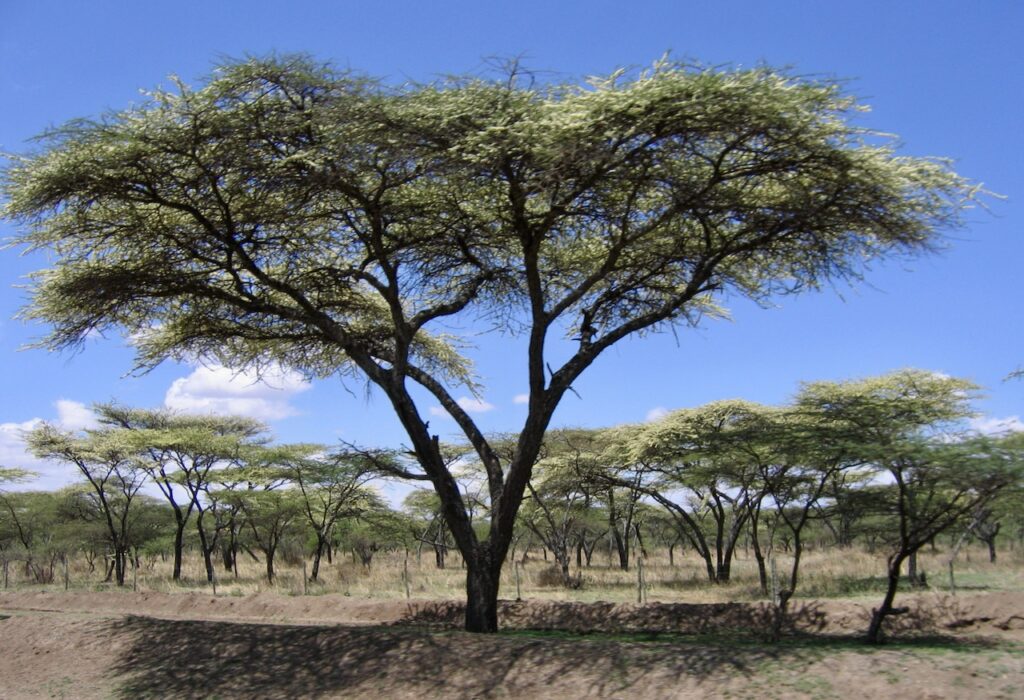
Even those who have never visited Africa easily recognize many of the continent’s distinctive habitats such as this acacia-clad savanna my wife Amy and I observed on our trip to Ethiopia in 2005. This is one of eight distinct kinds of savannas explained in Habitats of Africa.

The listing began with a nice map of where these forests can be found, and then followed with a concise but revealing description of the forest itself. Surprising phrases kept leaping out at me: “Atlas Cedar”, “clusters of oaks”, “winter snowpack”. I mean, where was I, anyway? This sounded more like California than Africa. One of the nice things about the book, however, is that it lists similar forest types found elsewhere in Africa and around the world—including the pinyon-juniper woodland of western North America.

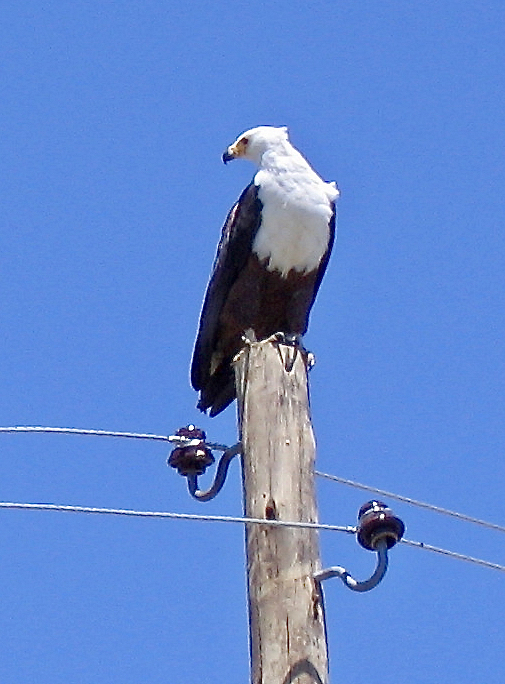
Lamentably, Amy and I visited Africa before I became a birder, but I accidentally managed to take a few bird photos with my point-and-shoot camera, including this magnificent African Fish-Eagle.

After the description, the authors include accounts of a habitat’s conservation status, the particular wildlife that can be found there; and its distribution—including specific places to see it. I found the wildlife sections especially well-done because the authors focused on endemic and other high-interest species while not overloading the reader with information. As a birder, for instance, I discovered that the avifauna of the Maghreb fir and cedar forest shares similarities to what I have observed in the Levant and southern Europe (see posts “Winter Birding in Israel, Part II: Valley of the Cranes” and “Birding Barcelona, Part 1: The Urban Core”)—but that there are also different species such as the Levaillant’s Woodpecker and Atlas Flycatcher.

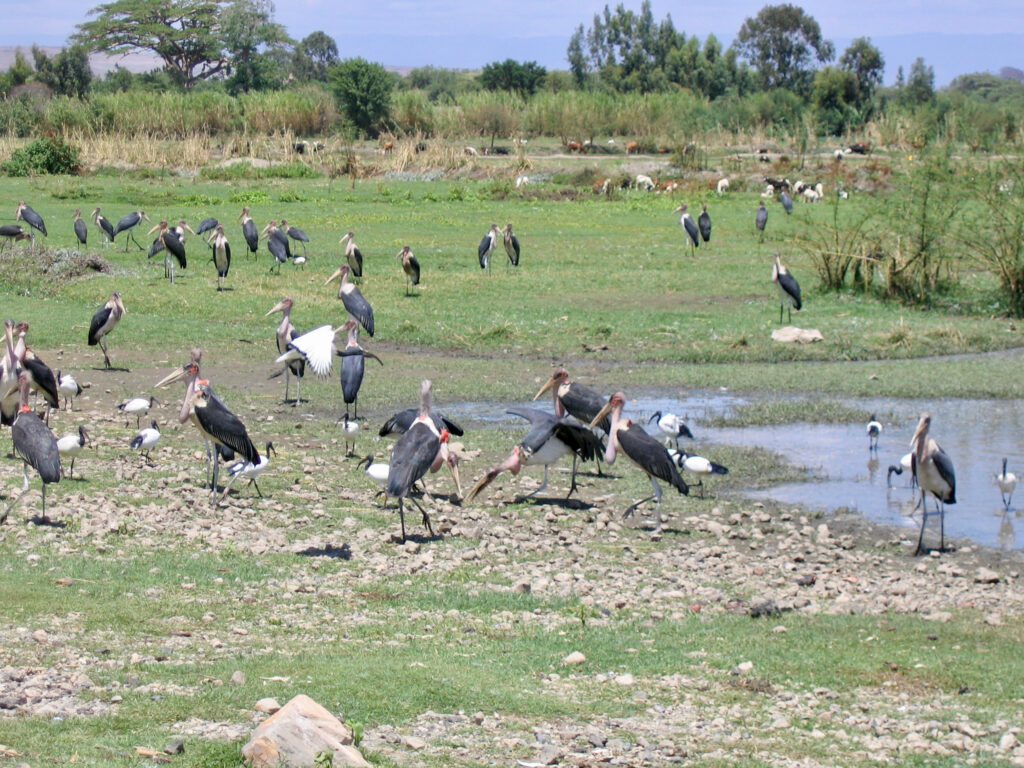
African Sacred Ibis and Marabou Stork attracted to a fish market at a lake south of Addis Ababa, Ethiopia.

There’s no getting around that the conservation status for most of the habitats is alarming. It’s hard to find a habitat in which humans haven’t made a major impact, especially given Africa’s rapidly-growing human population. In fact, the book includes eight habitats under its “Anthropogenic” heading—those with little of their original ecosystems intact. Although depressing on one hand, this conservation information provides a good picture of what is going on in the continent—trends that are distressingly similar to those experienced in many of the world’s other places, including North America. I also found it interesting to read why some habitats appear to be faring better than others. For instance, of southern Africa’s succulent karoo habitat—a habitat I’d never heard of—the authors write, “With limited agricultural potential and not much grass, the land in this biome is not highly sought after for human activity, but there has beeen significant sheep grazing and subsequent erosion.”

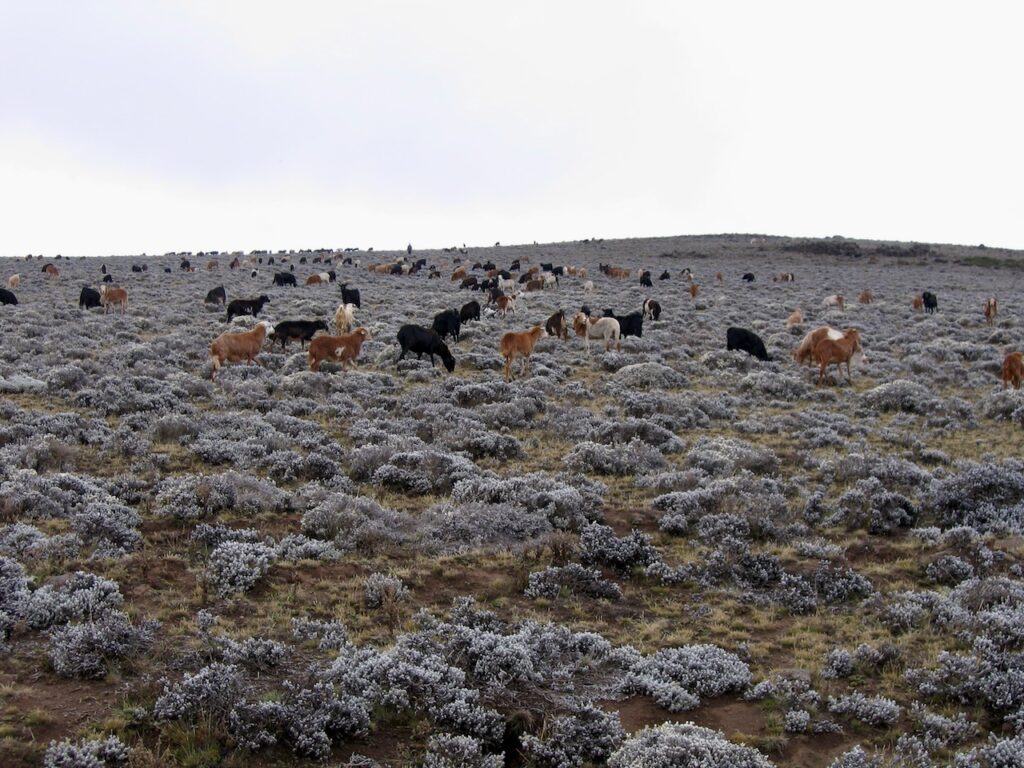
Ethiopia’s burgeoning population and pervasive poverty force livestock owners to illegally graze, even in places such as Bale National Park, one of the last strongholds of the Ethiopian Wolf.

The problem with reading about one habitat, however, is that it immediately made me curious to learn about others. The Maghreb fir and cedar forest discussion, for instance, mentioned that the forest peters out on the southern mountain slopes draining into the Sahara. “But what’s the Sahara really like?” I wondered, so I soon found myself reading up on one of the world’s most inhospitable places, the Saharan reg desert. This is a place that often receives less than one inch of rainfall each year—and where places can go years without seeing a drop. Yet, life persists here. Although much of the large megafauna has been hunted out, fascinating animals such as sand cats and fennec foxes survive, along with an incredible collection of small mammals and reptiles. This is a good place to mention that the book is filled with outstanding photos of the habitats and their various life forms, and in this chapter a photo of Cream-colored Courser caught my eye. Why? Because it looked almost identical to the Mountain Plovers we have in the arid West!

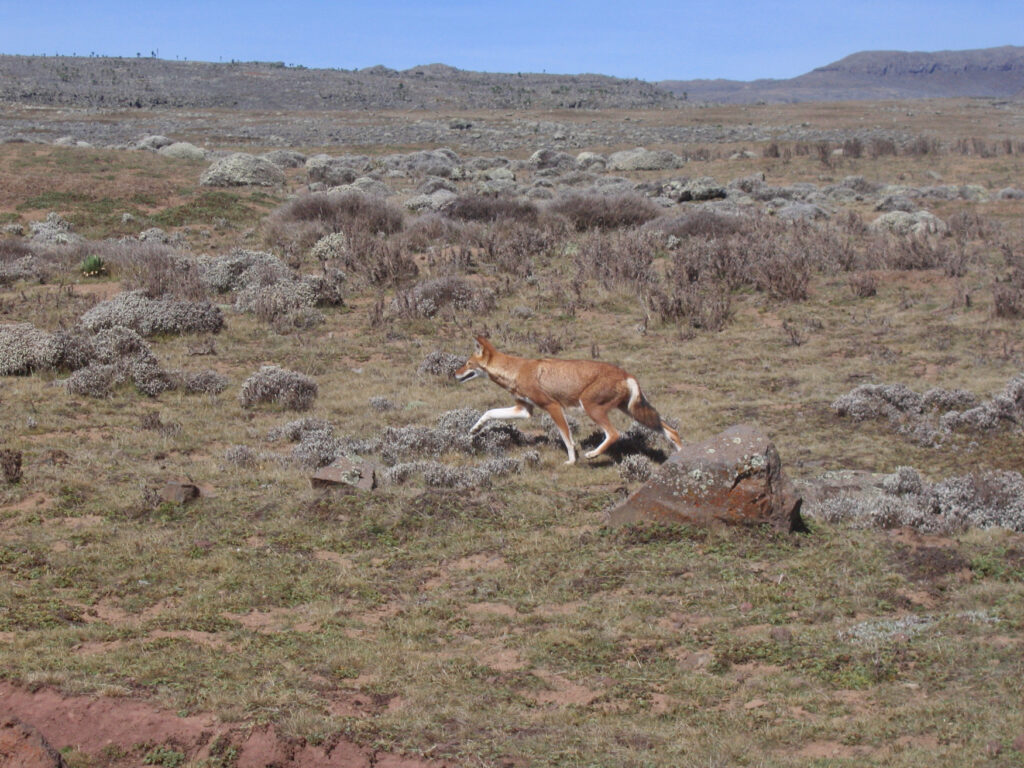
Amy and I were fortunate to see Ethiopian wolves in one of their last strongholds, a high-altitude habitat called afroparamo in Bale National Park. Already by our visit in 2005, grazing in the park (see previous photo) threatened the outlook for the wolves and the giant mole rats that serve as one of their major prey.

That said, one thing the book showed me is that, although similarities can be found between African and other world habitats, many of the ecosystems in Africa are unique—especially if you compare them to North America. And that can have a strange impact on a reader.

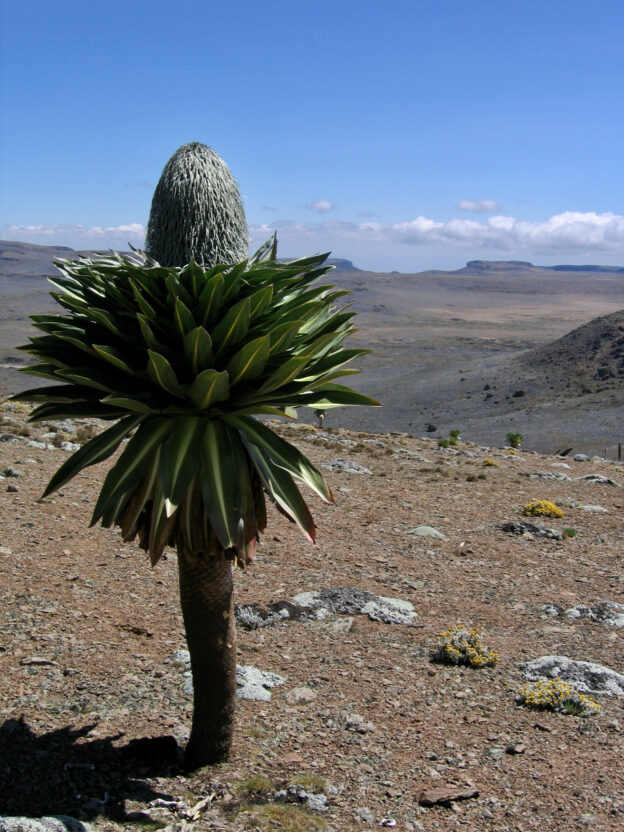
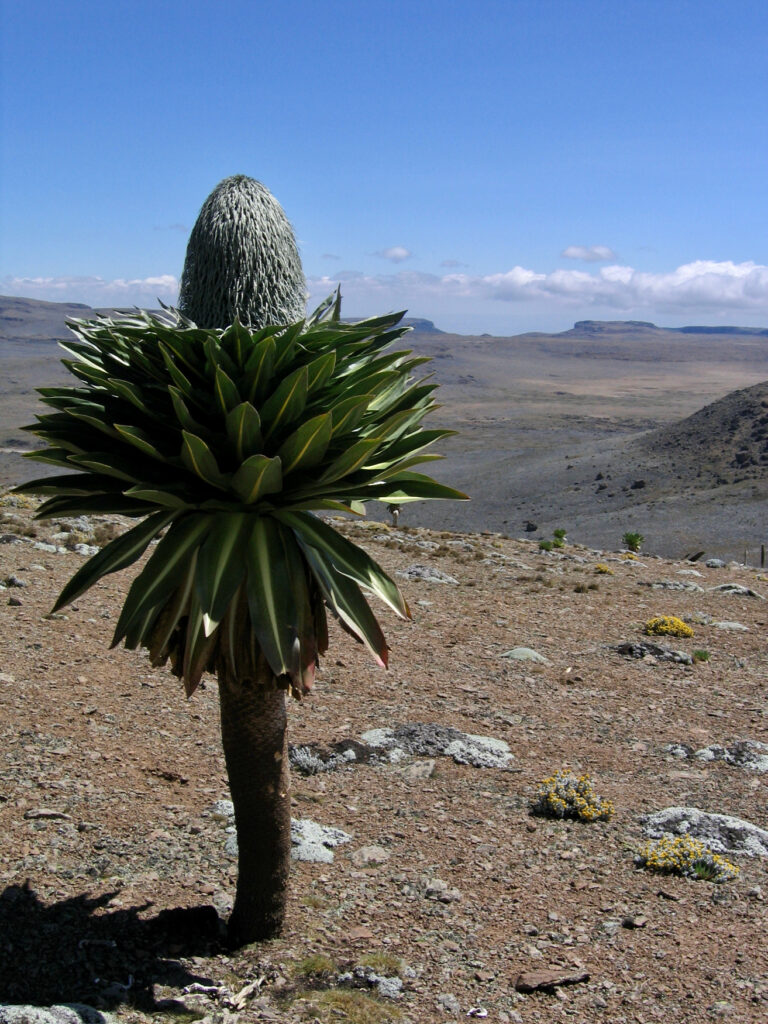
If you have any doubts about the uniqueness of many of Africa’s ecosystems, all you have to do is look at this lobelia tree in Ethiopia’s Bale National Park. The trees reminded me of Joshua trees in the American Southwest, and I can’t help thinking that the two trees might represent a striking case of convergent evolution.

I have only ever been to Africa once, during a school visit to Ethiopia in 2005. What’s more, I thought it unlikely I would ever have a chance to visit again. As I read through Habitats of Africa, however, I kept thinking, “Oh, I want to see that,” and “I want to go there.” It doesn’t mean I will get to, but reading this book may be the next best thing. More than all of the nature documentaries I’ve watched, this volume has given me a plausible idea of the incredible diversity of places and nature that can be seen there. As a birder in particular, it’s also given me a much better idea of the birds that I especially would like to see. It’s a stretch to call the book casual reading, but for anyone interested in nature, or planning their own trip to Africa, it is a well worth your time. If I ever get a chance to return to Africa, you can bet that I’ll be spending even more time with this impressive publication.

Note: Along with the extensive photographs and distribution maps, Habitats of Africa includes a wealth of climate charts, profile sketches, and topical sidebars that enhance the reader’s understanding of each habitat.

One-Sentence Summary: An eye-opening crash course on the nature of perhaps the world’s least understood continent.

Overall Rating (on a scale of cool birds): Rüppell’s Griffon (highest)

You can order Habitats of Africa from your local independent bookstore, or directly from Princeton University Press. Please tell them we sent you!

(Except for the cover image, photos in this post are copyright Sneed B. Collard III. Review copy of Habitats of Africa provided by the publisher.)

Video Post: A Visit to Araucana Lodge (Colombia Birding Part 4)

Roger and I could easily write another ten or twelve posts about our recent birding adventures to Colombia, but I thought it would be fun to pack a lot of our experiences into a video featuring our main destination down there, the Araucana Lodge. The video not only introduces you to the joys of lodge birding, but features some of the famous birds and birding opportunities to be had in the mountains above Cali. Since large files don’t always work well on this blog host, we embed a YouTube link below. Let us know what you think—and enjoy the show!

Click Here to see the first of our Colombian birding post!

Antpittas and Tody-Flycatchers (Colombia Birding Part 3)

Note: This blog post—and all others on FatherSonBirding—are written by REAL PEOPLE! No compensation or gratuities were provided to us in connection with this post. If you’d like to support FSB, please consider buying one—or ten—of Sneed’s books and contributing to a bird conservation organization of your choice. Thank you!

Our second morning at Owl’s Watch ecolodge, Roger and I felt particularly excited. Although we’d had a great day birding on our own the day before (see post Owl’s Watch Ecolodge Colombia Birding Part 2), this would be the first time we went out with an expert guide. We met Owl’s Watch owner, Dennis Bailey, at 6:00 a.m. at the Social, the lodge’s main meeting building, and he served us coffee and a snack. Then, we climbed into his pickup and he drove us up to the Enchanted Forest. This was an area of cloud forest at the top of his property, where he and his team had developed a nice trail system complete with hidden gnomes associated with an information guide about the ecosystem. This is also where we met Daniel Muñoz Buitrago, our Colombian guide for the day.

Our guide Daniel (right) posing with one of the educational gnomes set up along the trail.

Both Roger and I liked Daniel immediately, and he began our tour by walking us along the road above the forest. “This is often where mixed flocks of tanagers can be found,” he explained, and sure enough, it wasn’t long before he started calling out names: Blue-capped Tanager, Saffron-crowned Tanager, Beryl-spangled Tanager, and one I especially hoped to see—Grass Green Tanager. This bird sports a stunning green color with a vividly contrasting red mask across its face.

One of my favorite tanagers of the trip, a Grass Green Tanager, backlit in the top of a tree.

Along with the tanagers, Daniel called out names of warblers, wrens, woodcreepers, and other birds. We glimpsed some of these, but I must pause here to say a word about what it’s like to bird in tropical forests. Many people see fabulous photos of tropical birds and naturally assume that these birds will be dripping from every branch. Unfortunately, tropical forest birding can often be very challenging. Many birds never show themselves at all and are “heard only” species, identifiable only by their songs and calls—and yes, Merlin’s Sound ID still has a long way to go to become accurate in places like Colombia. Many other birds can be seen—but mainly high in the tree tops against gray, backlit conditions. This makes it tough to get good views through binoculars, and darned well impossible to capture good photos. Daniel, though, was about to greatly improve our “photography problem.”

Brushfinches are difficult to see in any conditions, but we did get lucky with this look at a beautiful Gray-browed Brushfinch along the road.

Heading into the Enchanted Forest, he took us down to a set of bird of feeders and began hanging bananas and grapes from various wires and branches. In no time, one of the forest’s most spectacular birds showed up—an Andean Motmot! We had glimpsed this bird on the drive in two nights before, but were delighted to have this additional excellent, intimate look.

Andean Motmot.

After we’d filled our share of camera memory space with the motmot, Daniel motioned us to follow him fifty meters down the trail. Even before we arrived, he started calling “Brownie, where are you? Come out, come out!”—or the equivalent in Spanish. As he did so, he set a few worms on a little fallen log about fifteen feet in front of us. Soon, he said, “Get ready. He’s coming!”

Moments later, a brown, football-shaped bird about ten centimeters (4 inches) high hopped up out of nowhere. “There he is!” Daniel cooed.

The “he” in this story was a Brown-banded Antpitta, one of Colombia’s most difficult-to-photograph species—and about as adorable as you can get. Its appearance was no accident, either. Daniel had trained the bird for months to respond to his calls—and the worms. I, for one, was grateful because I never imagined I’d get to see an antpitta in the wild. Not only are they very secretive, they often have very restricted ranges. In fact, the Brown-banded Antpitta is classified as Vulnerable due to habitat loss, and little is known about its biology and behavior.

“Brownie”, the Brown-banded Antpitta. These birds are extremely difficult to observe, but thanks to patient “trainers” like Daniel, lucky visitors like us occasionally get to see them.

We left Daniel to “clean up” after Brownie and walked back to the feeders. As I was about to step into the clearing, however, I hissed, “Roger, stop!” There, perched on a feeder branch only seven or eight meters away, sat one of the other birds we especially hoped to see—Black-billed Mountain-Toucan! Roger quickly snapped some excellent photos, but I managed only a couple of crummy ones before the bird flew. Still, it was the only BBMT we would see on the trip.

Snooze, you lose. Due to having my camera on incorrect settings, I managed only a poor shot of this Black-billed Mountain-Toucan before it fled with its fruity booty.

Back on the road, we made our way through cloudy conditions down to the trail that left from the parking area above the lodge (see previous post). We returned to the hummingbird viewing platform and immediately saw a species that got Daniel excited: an uncommon hummingbird called a White-throated Daggerbill. Of course, there were also eleven other species of hummingbirds as well (always, always, hummingbirds), but unbeknownst to us, we were about to meet one of the coolest birds that we’d ever seen.

After a few minutes watching the hummingbird action, Daniel motioned us to follow him down to another little spot about thirty meters away. Here he again pulled out his worm bag and began calling, “Gordita! Gordita! Come out!” Gordita, of course, means “little fat one” in Spanish, and both Roger and I chuckled. But who exactly was Gordita?

R2D2? No, meet Gordita—a Chestnut-crowned Antpitta that quickly hopped into our hearts.

After a few moments, out hopped one of the most remarkable birds I’d ever seen. It was another antpitta—this one, a Chestnut-crowned Antpitta! The bird was about twice the size of Brownie the Brown-banded Antpitta and to me it looked just like a little R2 unit from Star Wars. In an instant, it became one of my favorite birds ever, and I’m pretty sure Roger felt the same way.

Daniel’s surprises weren’t over. Continuing on down the trail, he called in another remarkable bird—a Rufous-Crowned Tody-Flycatcher. At least three or four of these would easily fit into your hand, but again, we never would have seen it without Daniel’s knowledge and expertise.

Rufous-capped Tody-Flycatcher.

Which brings up an important point about Colombian birding. While it is possible to bird on your own in Colombia, I highly recommend taking advantage of its growing network of lodges. Although much safer than it used to be, the country does still have its share of problems, ranging from common crime and armed conflict to dangerous road and trail conditions. Taking advantage of the expertise of lodges will help make sure you don’t accidentally wander into a hazardous area. Even better, the lodges we encountered use locally-trained, Colombian guides. Many, like Daniel, speak excellent English, and prices are extremely reasonable. By hiring them, foreign visitors are giving a boost to the local economy—and creating more incentive to protect Colombia’s environment.

After getting our fill of the tody-flycatcher, Daniel led us back down to the Social for a well-deserved (or at least well-received) lunch prepared by the Owl’s Watch cook, David. It had been a splendid day all-around and we so appreciated everything Daniel had shown us. Even better, we were excited to have one more day of birding at Owl’s Watch. That, however, didn’t keep us from eagerly anticipating our next great Colombian lodge destination—which I’ll introduce in the next post!

Roger and our guide, Daniel, birding the road above Owl’s Watch.

Owl’s Watch Ecolodge (Colombia Birding Part 2)

As light spread across the sky, I slipped on my flip-flops and ventured out onto the porch of our cabin at Owl’s Watch Ecolodge in the department (county) of Caldas, Colombia. Misty clouds clung to the Andean peaks surrounding us. Far below rose the high-rise apartments and businesses of Manizales, a city of almost half a million. Unidentified bird calls rang across the vegetation surrounding us and a couple of flocks of Eared Doves flew by on a morning commute. Suddenly, I saw a shape that stirred familiarity. It landed in a distant tree, but thanks to my amazing new binoculars, I was able to focus in on it. Even though I knew very little about Colombian birds, the way it clung to the side of the tree made me  think, “Woodpecker.” Then, I caught a reddish hue on its nape and back, and my excitement rose. When it turned its head, it revealed a large white face patch that clinched the ID. I couldn’t believe it. In my first moments of serious birding in Colombia, I had found one of the birds I most wanted to see: a Crimson-mantled Woodpecker!

It’s risky to post such a crummy photo of a Crimson-mantled Woodpecker as the post’s very first bird shot, but it highlights how difficult it often is to photograph birds in tropical forests—a topic I’ll discuss in a forthcoming post.

As mentioned in my last post, “Layover Birding in Bogota, Colombia”, I had traveled to South America at the last-minute invitation of my friend and FSB contributor, Roger Kohn. Now, only two weeks later, I felt in awe of the fact that we were actually here, about to launch into our first Colombian day of birding together.

One of the two luxurious cabins at Owl’s Watch, with great views of the surrounding landscape. As popularity of the lodge blossoms, Dennis is considering adding additional cabins.

Roger had planned our entire itinerary, which included booking our first four nights here at Owl’s Watch, a comfortable new lodge with two modern cabins perched at the edge of a large, protected watershed that ensured a dependable water supply for the city of Manizales below. The lodge had been built by American expat Dennis Bailey and his Colombian wife, Adriana. Interested in restoring land that had been cleared for agricultural activities, they had purchased a farm, or finca, that was an inholding of the nearby protected area. As they worked to revegetate the land and allow it to heal itself, they decided to build Owl’s Watch for nature lovers—especially birders.

The following day, we would be heading out with a guide, but today Roger had wisely allocated time for us to bird and explore on our own—a day to get familiar with some of the local birds and rest up from our two-day journeys from the States. I’m more of an early riser than Roger, but to my surprise, he soon joined me on the porch, eager to get started.

One of the amazing things about Owl’s Watch is that you are able to gaze down on Manizales, a city of almost half a million people, while being surrounded by nature.

We decided to begin by climbing the long steep “driveway” that headed up from the lodge to the road above. Almost immediately we saw large turkey-like birds that, from taking eBird quizzes, I recognized as Sickle-winged Guans. Moments later, I glimpsed a furtive shape fly across an opening and dive into a bush—a White-naped Brushfinch.

At the top of the drive, we reached a small parking area bristling with even more activity. In the trees surrounding the area, we quickly identified the orange head of a Blackburnian Warbler, and then got super excited to see a pair of equally small birds with bold, sunburst golden throats and breasts—Golden-fronted Redstarts!

Golden-fronted Redstarts, a New World warbler, were one of our exciting finds from our first day of birding at Owl’s Watch.

As I chased these around, Roger used Sound ID to get onto a bird I never thought we would see, Azara’s Spinetail. Its call sounded like “bis-QUICK! bis-Quick!” and while we never got great looks at it, we were thrilled to get a glimpse of this handsome, skulky species.

From the parking area, we headed down a pleasant trail that would wind its way back to the to the main lodge building, dubbed “the Social.” Soon, a covered viewing platform came into sight and we paused to check out hummingbirds at the feeders and flowering bushes surrounding the spot. Someday, I’ll write about my ambivalence about hummingbirds, but I gotta say, they were spectacular to watch. What got me most excited was seeing a White-sided Flowerpiercer. I’d seen my very first flowerpiercer only the day before in Bogota, and here I was, looking at a second species the very next day!

Though not as colorful as many other tropical birds, I was especially excited to discover this White-sided Flowerpiercer. Notice the hook at the end of the bill? That’s a key to picking out flowerpiercers from other small tropical birds.

We continued hiking down the trail, past the Secret Garden, another great birdwatching spot Dennis had set up. Along the way, I spotted a rather plain brown bird that I quickly recognized as a Swainson’s Thrush. As I indicated in my last post, it’s a special thrill to see a bird from “back home” in its alternative, wintering environment. I also took a photo of a nondescript bird that turned out to be a Mountain Elaenia, a kind of tyrant flycatcher.

Don’t get me wrong. I am NOT an expert at identifying flycatchers, but a guide and the Merlin app helped me figure out this Mountain Elaenia.

Soon, we found ourselves back at the Social. David, the fabulous Owl’s Watch cook, fixed us a scrumptious breakfast and we dined while enjoying yet more hummingbirds—at least nine species—along with more flowerpiercers, Rufous-collared Sparrows, and Great Thrushes.

Along with the hummingbird feeders, Dennis’s crew had set up a fruit feeder off to the side, and there we beheld one of the most spectacular of the area’s birds, Blue-winged Mountain Tanagers.

Blue-winged Mountain Tanagers were definitely one of the “best-dressed” birds of our first day birding at Owl’s Watch.

After we got our fill of hummingbirds (if that’s even possible), we took another path that wound around to our cabin. Before our trip, Braden had encouraged me to listen for weird noises, and now I did indeed hear a very bizarre, almost plaintive, series of falling notes. As we rounded a corner, we met the source of these calls—a Masked Trogon! Trogons are some of those birds you always hope to see in the tropics, but when you finally do, you’re left wondering if the bird is really perched there in front of you, or if you’re just imagining it! Fortunately, this was no mirage, and even better, it sat cooperatively while Roger and I did our best to capture decent photos of it against the backlit sky. How did we do? You will have to judge for yourself:

Even this so-so photo reveals what stunning birds Masked Trogons are. While this was our best look at this species of the trip, other trogons would soon follow!

Note: This blog post—and all others on FatherSonBirding—are written by REAL PEOPLE! No compensation or gratuities were provided to us in connection with this post. If you’d like to support FSB, please consider buying one—or ten—of Sneed’s books and contributing to a bird conservation organization of your choice. Thank you!