Tag Archives: woodpeckers

Savoring Sedona: Guest Post by Roger Kohn

We are delighted this week to present only our second ever guest post, by long-time reader of FatherSonBirding, Roger Kohn. Roger and I met at UC Berkeley and roomed together for a time at Cloyne Court Co-op. Since retiring from a distinguished career with the EPA, he and his wife Claudia have settled in Bend and have pursued birding with a passion. Recently, they embarked on their first Arizona birding adventure, kicking it off with a place Braden and I have never birded, Sedona. I asked if he would give FatherSonBirding readers a taste of what it’s like to bird one of the world’s most beautiful places!

Inspired by Sneed and Braden’s adventures in southeastern Arizona last year, and eager to see more bird species and beautiful southwestern landscapes, my wife Claudia and I hopped a flight to Phoenix this past April to start a two-week birding vacation. Our plan was to focus on southeast Arizona. Before heading south, however, we visited Sedona to revel in its awe-inspiring landscapes. Although not known as a birding destination, I was confident we would see some good birds. After all, it was spring in Arizona.

Rising early on our first day, I stepped out onto our deck, which faced a large yard with bird feeders and had more green space beyond. I quickly spotted nine species, including two Lifers: an Inca Dove and a Northern Cardinal (a male, in all its bright red glory), a species I had wanted to see for a long time. Welcome to Arizona! The trip was off to a fine start.

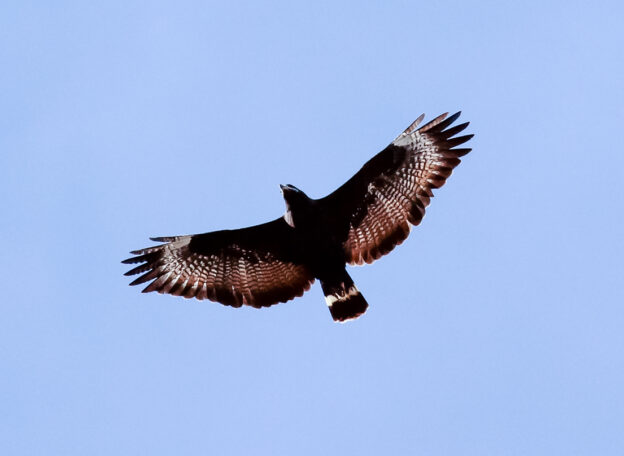
After breakfast we drove a short distance to the location we selected for Day 1 birding: Red Rock State Park, known for its stunning vistas. At the Visitor Center viewing platform, we saw a Turkey Vulture, followed by two dark raptors with white bands on their tails circling above us. “Hawks!,” I exclaimed. I wasn’t sure what species they were, but I knew it was one we hadn’t seen before. The answer came quickly from a park ranger who was standing nearby: Common Black Hawk. Lifer! And who doesn’t love raptors? What a great way to begin our park visit.
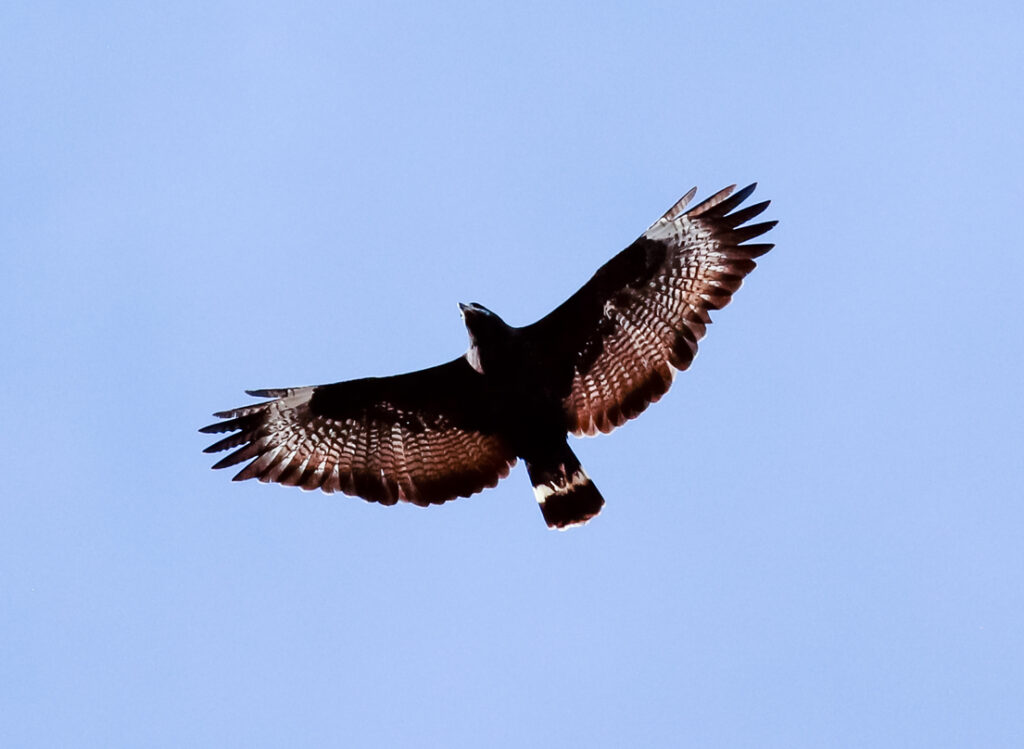
A Lifer Common Black Hawk soars above Red Rock State Park.

After getting looks at another Northern Cardinal, as well as Lesser Goldfinches, House Finches, Red-wing Blackbirds, and White-crowned Sparrows, we followed the Bunkhouse Trail a short distance downhill to Kingfisher Bridge, which spans Oak Creek. The creek was wide and gushed with fast-moving water. This would prove to be a surprising theme of the trip: plenty of water and lush landscapes–not what one thinks of in a state known for its desert landscapes! Tall, bare trees grew right out of the creek, giving a bizarre, otherworldly quality to this striking scene.

We didn’t see any kingfishers at their namesake bridge, but we did see a couple of Black Phoebes (a flycatcher species) perched on branches above the creek between breakfast-gathering forays. Crossing the bridge, we headed west on the Kisva Trail into riparian habitat next to the creek. It was very birdy here, although not always easy to see the birds. Violet-green Swallows zipped back and forth, and a couple even were cooperative enough to perch and allow me to photograph them. We could hear the harsh calls of Gila Woodpeckers reverberating all around us. The Audubon app describes their calls as “a rolling churrr.” To me, the calls had a bizarre, almost electronic, quality. We were not able to see the woodpeckers, but they are very common in Arizona and we would see them many times in a variety of different habitats on the rest of the trip. A little further on, we could see a lot of bird activity in the treetops. Benefitting from Merlin Sound ID, we knew we were looking at Lucy’s Warblers, another Lifer!
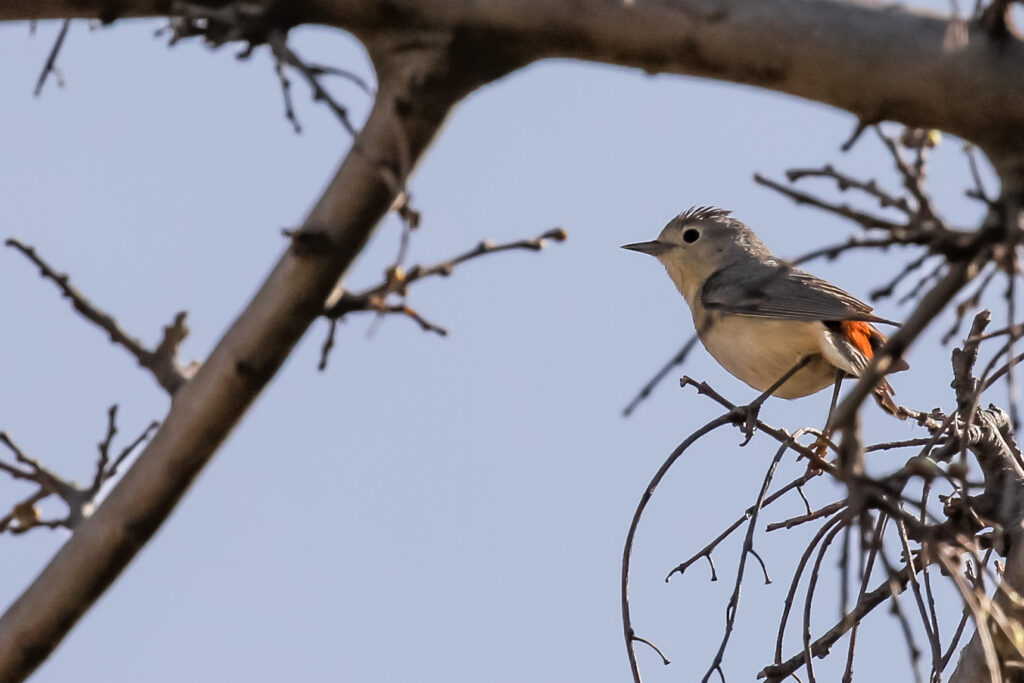
A Lifer Lucy’s Warbler in the treetops along Oak Creek in Red Rock State Park.

The Kisva Trail took us to the Eagle’s Nest Trail, which gradually ascends to a summit with a commanding 180-degree view of the surrounding red-rock country. The scenery in and around Sedona is absolutely jaw-dropping, with layers of colorful rock rising into towering formations that lend an epic, cinematic quality to the landscape. This is why we came to Sedona!

We didn’t see many birds on our way up, or as we descended on a loop trail that took us back to Oak Creek. Walking along the creek, we got good looks at a Townsend’s Solitaire and a House Wren, perched and singing a sweet and enchanting aria for all to enjoy. Later I saw a black and white bird darting back and forth among the trees. I wondered if it could be a species that I was really looking forward to seeing based on my pre-trip bird study. Could it be… yes it was… a Bridled Titmouse! Lifer! With what eBird calls a “crested head with striking black-and-white pattern unlike any other bird,” the Bridled Titmouse makes up for its lack of color with a combination of elegant form and bold contrast that give the species a big WOW factor. We loved these guys and saw them on several other occasions in the next two weeks.
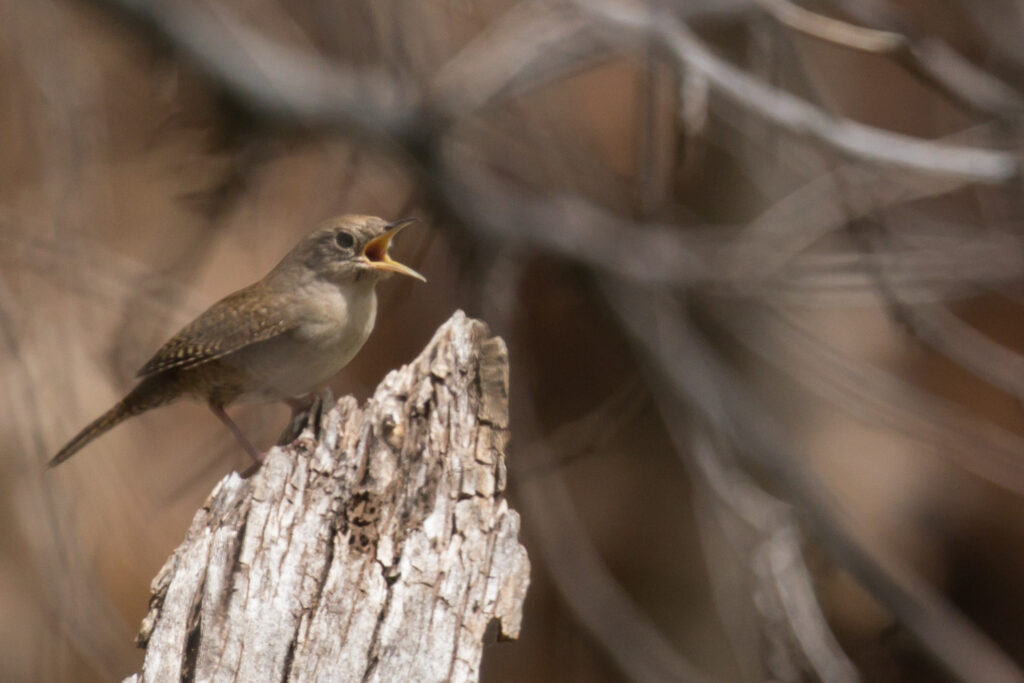
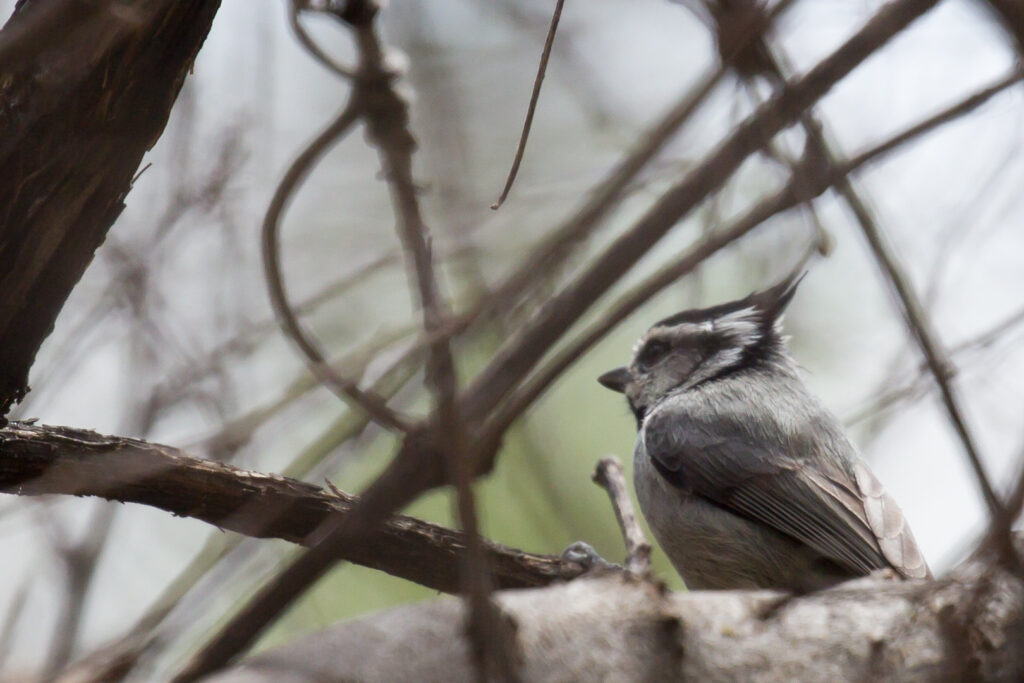
Relaxing back at our rental with a fine locally produced beverage made with barley and hops (and love), we snagged two more Lifers: Woodhouse’s Scrub-Jay and Canyon Towhee. As the sun sunk toward the horizon, we reflected on the excellent first day of our Arizona birding adventure.
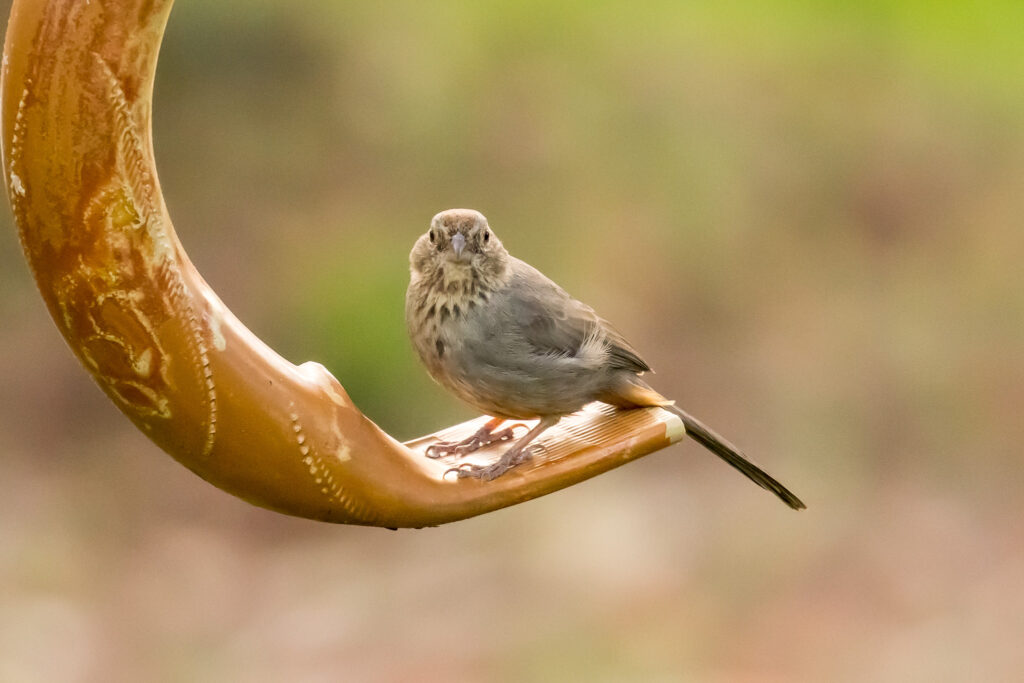
A Lifer Canyon Towhee says hi at our rental.

We awoke to another gorgeous early spring morning on Day 2 of the trip. Our plan was to bird the West Fork Trail, which follows Oak Creek in the Coconino National Forest. After a pretty 30-minute drive through rugged country north of Sedona, we arrived. A pair of bright blue Steller’s Jays and a group of cackling Acorn Woodpeckers greeted us in the parking lot. As we gathered our gear to get ready to walk, a few black and red birds flew over us and landed in the trees above us. This had to be something good. Focusing our binoculars in high branches where the birds landed, we were delighted to discover that they were Painted Redstarts, a Lifer for both of us! We got great looks and absolutely loved this warbler species, with its gorgeous black, red, and white plumage. Although we would get glimpses of this species again later in the trip, this was by far our best sighting.
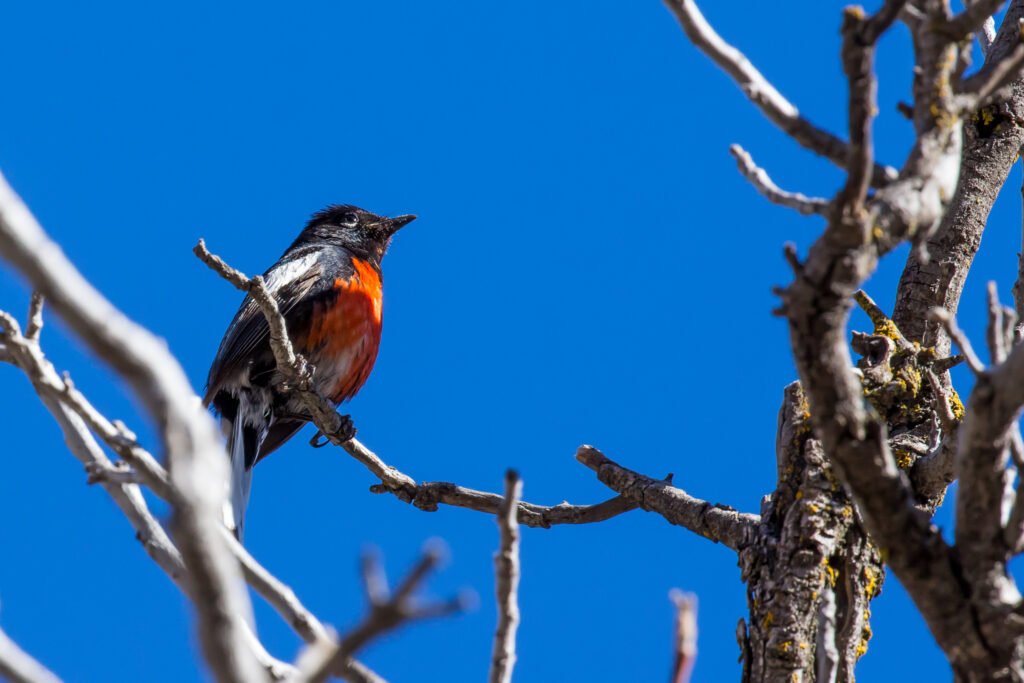
A show-stopping Lifer Painted Redstart in the West Fork Trail parking lot.

Starting our walk, we enjoyed views of three other warbler species near a footbridge that spanned the creek. Lucy’s Warblers were present, although hard to see as they flitted around in the treetops. We got good looks at Yellow-rumped Warblers, and a beautiful Yellow Warbler foraging in the trees.

Continuing, we passed the ruins of an old cabin and were delighted by the beauty of this place, with cliffs in hues of pink, white, and gray rising to dizzying heights above the canyon floor. We saw Ruby-crowned Kinglets, House Wrens, American Robins, and many Acorn Woodpeckers (which live in family groups), with their colorful and clownish face patterns. Soon we reached a waist-high creek crossing that we didn’t want to attempt, so we turned around. On the way back, we enjoyed views of a pair of Common Black Hawks harassing a Peregrine Falcon. The raptors flew gracefully and at high speeds, making sharp turns as the hawks pursued the falcon, all set against a dramatic background of colorful canyon walls.

We loved the beauty of the landscapes in Sedona and would love to return. As our two-day stay wrapped up, we had seen 38 species, including eight Lifers. Now southeast Arizona, which Tucson Audubon calls “one of the most fascinating areas for birding in the United States,” with over 400 bird species seen annually and approximately 500 recorded, beckoned. Early the next morning, we eagerly pointed our car south toward Tucson.

The author in his natural habitat, a brewery in Tucson!

eBird Checklist – 12 Apr 2023 – Red Rock SP – 18 species (+1 other taxa)

eBird Checklist – 12 Apr 2023 – Coconino National Forest, Sedona US-AZ 34.83181, -111.80798 – 4 species

eBird Checklist – 13 Apr 2023 – Oak Creek Canyon–West Fork – 12 species
Birding Japan: Kanazawa

Since we published them, our birding posts about Japan have been read in more than a dozen countries. If you are planning your own trip to Japan, you’re in luck! Sneed’s new book, FIRST-TIME JAPAN: A STEP-BY-STEP GUIDE FOR THE INDEPENDENT TRAVELER, tells you everything you need to know about how to plan your trip to this remarkable, yet sometimes intimidating, country. Order now by clicking here.

Welcome to our Japan birding posts. In this edition, Sneed explores the “less visited” city of Kanazawa, a place that would turn out to be perhaps one of their favorite stops on trip—and with some surprising birds. If you are just tuning in to Japan, be sure to check in on our last post from Kyoto!

Leaving Kyoto, our (non-bullet) train took us through my favorite scenery yet in Japan. Just north of Kyoto, the train hugged the shoreline of Lake Biwa for more than half an hour. Seeing the lake on a map, I envisioned a forested wilderness, marked perhaps by some resorts or getaways, but the entire lakeshore was surprisingly built up with cities, towns, and farmland. Alas, the train was too far away from the lake to identify any birds except Black Kites and crows, though I did see an enticing shorebird flying across a field. Passing through a tunnel, we then entered picturesque mountain areas where I looked in vain for a Brown Dipper in the roaring streams we crossed. No luck. Emerging back onto a large plain, we more or less re-entered civilization until we arrived at our next destination, Kanazawa.

Both Tessa and I were taken with Kanazawa Castle and its grounds from the moment we approached the main entry gate.

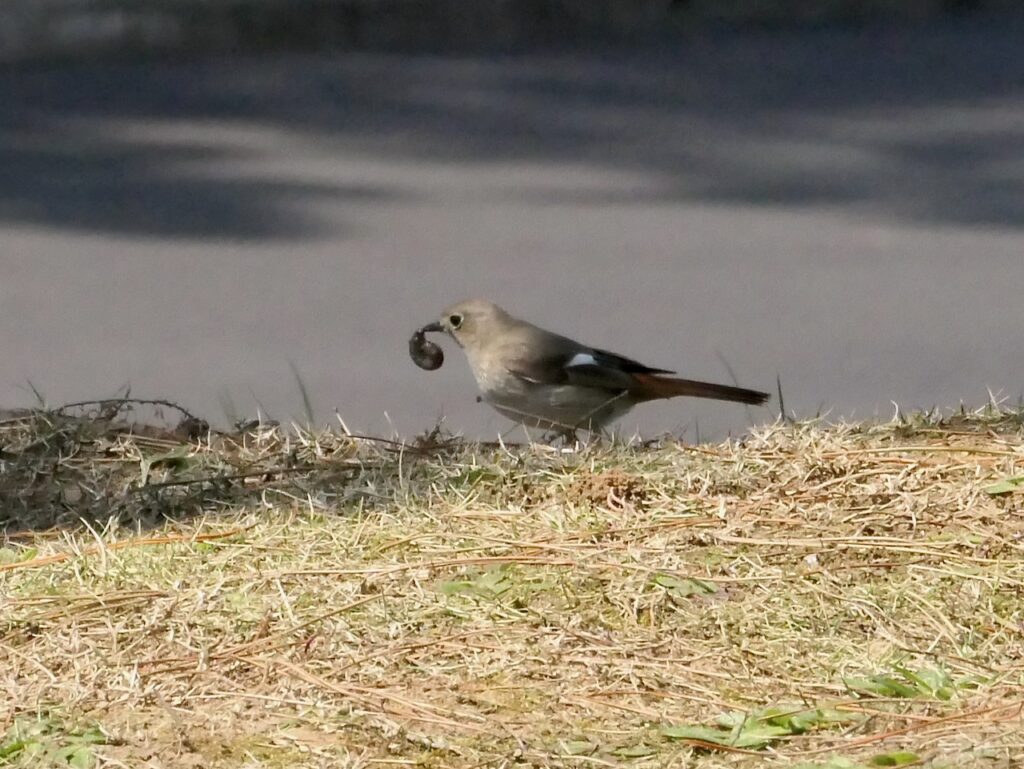
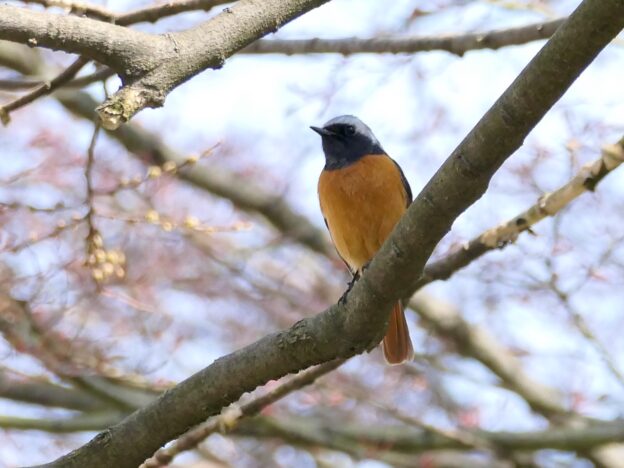
I had booked us a hotel right next to Kanazawa’s major tourist feature, a large castle set in a park-like setting, and as soon as we dropped our bags at the hotel, we grabbed a “set lunch” at a local café and headed straight to the castle. Tessa hadn’t seemed too impressed with other castles on the trip, but this one wowed us both—perhaps because of its dramatic approach and the glorious sakura flowers blooming at the gates. After going inside the castle, we took a wonderful walk on paths above it, where Tessa declared this was her favorite place so far on the trip. The birds also liked it well enough, with the omnipresent bulbuls, crows, and kites surrounding us. Descending back toward the castle, though, I spotted a trio of Oriental Greenfinches, and then a bird that stopped me in my tracks. “Oh my god,” I said out loud, and hurried forward hoping the bird wouldn’t move. It didn’t, and I got my first look at another bird at the top of my “To See” list: Daurian Redstart!

This male Daurian Redstart just made my day—and, of course, my life list. I love the blooming sakura flowers behind it.

As delighted as I was with the redstart, I saved my real birding enthusiasm for the next morning when I left Tessa to hang out and grabbed a cab out to Kenmin Seaside Park, perhaps the only place left on the trip where I might see shorebirds or pelagic species. As soon as I arrived I glimpsed a departing tit of some kind and saw multiple Dusky Thrushes and White-eared Starlings feeding in a field. I hurried past them until I reached my primary destination, the beach. Alas, this was no natural beach. Giant cement breakwaters were piled up offshore and it was clear the area had been heavily worked over by dredging and industry. I saw a few flying birds too distant to identify and a flock of cormorants that took off long before I got close enough to attempt an ID, but that was it. No shorebirds. No waders. Just trash littering an evidently sterile expanse of sand.

Trash has become a scourge on beaches throughout the planet. I was hoping Japan’s dedication to cleanliness might make this Kanazawa beach an exception, but no dice.

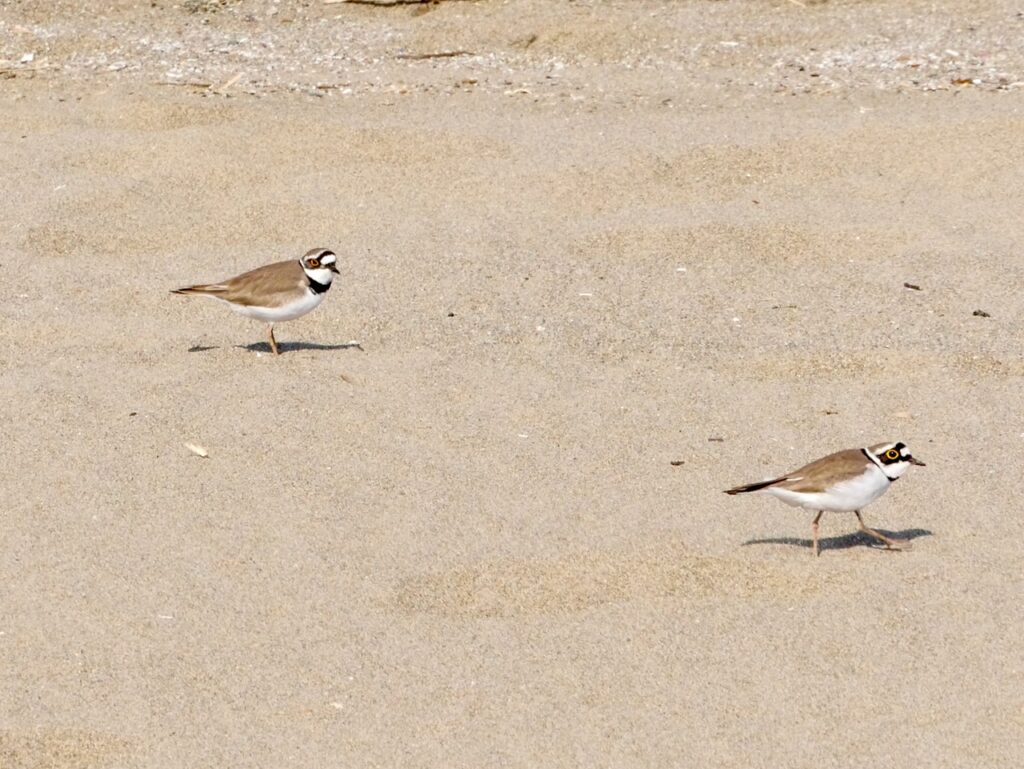
I nonetheless started trudging my way north, planning to round the tip of the small peninsula and make my way back to the park to try some forest birding. Suddenly, my eyes caught movement. There among the trash, I saw one tiny shorebird, then another. I guessed right away they might be plovers and as I moved closer, the yellow rings around their eyes cinched it: Little Ringed Plovers—another life bird and perhaps my most rewarding Japanese species yet. I wish I could tell you that this find unleashed a flood of shorebird sightings, but no. They were it—two hardy survivors on a desolate beach.

Definitely some of my favorite birds of the entire trip, this pair of Little Ringed Plovers were the sole shorebirds on the vast desert of beach next to Kenmin Seaside Park.

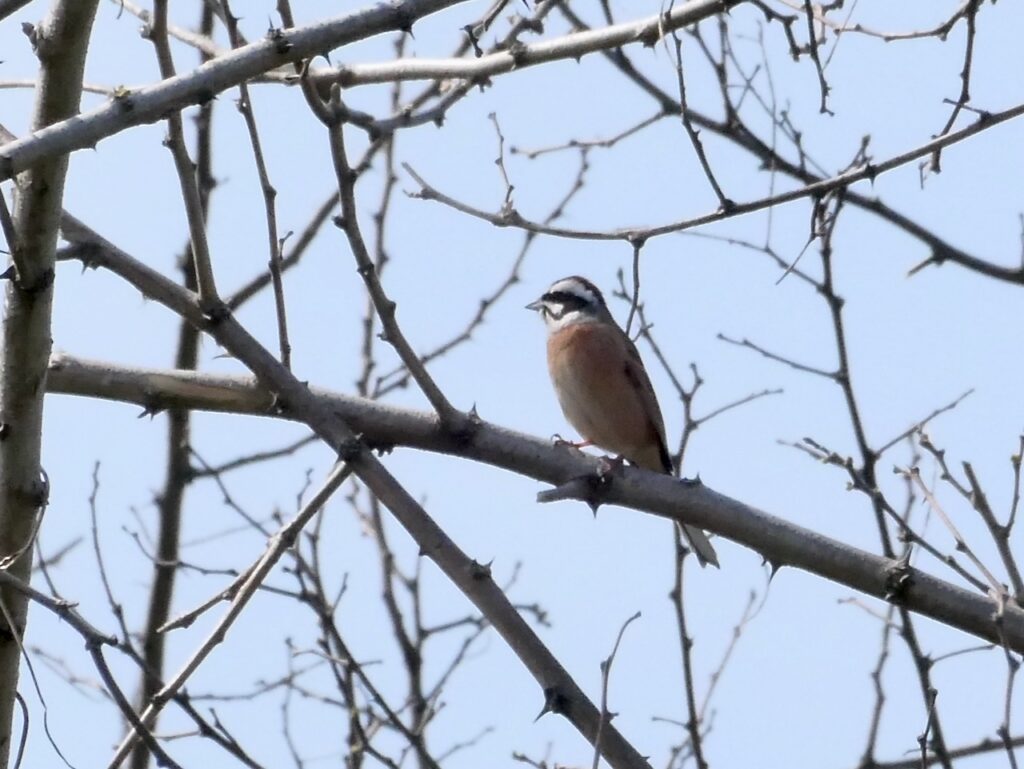
Fortunately, the birding got significantly better as I made my way back toward the main park. I picked up two more lifers in quick succession: Meadow Bunting and Asian House-Martin. Back in the forest, I encountered my best mixed flock of the trip, containing Japanese and Varied Tits, two Japanese Pygmy Woodpeckers, a Warbling White-eye, and a Japanese Bush Warbler.

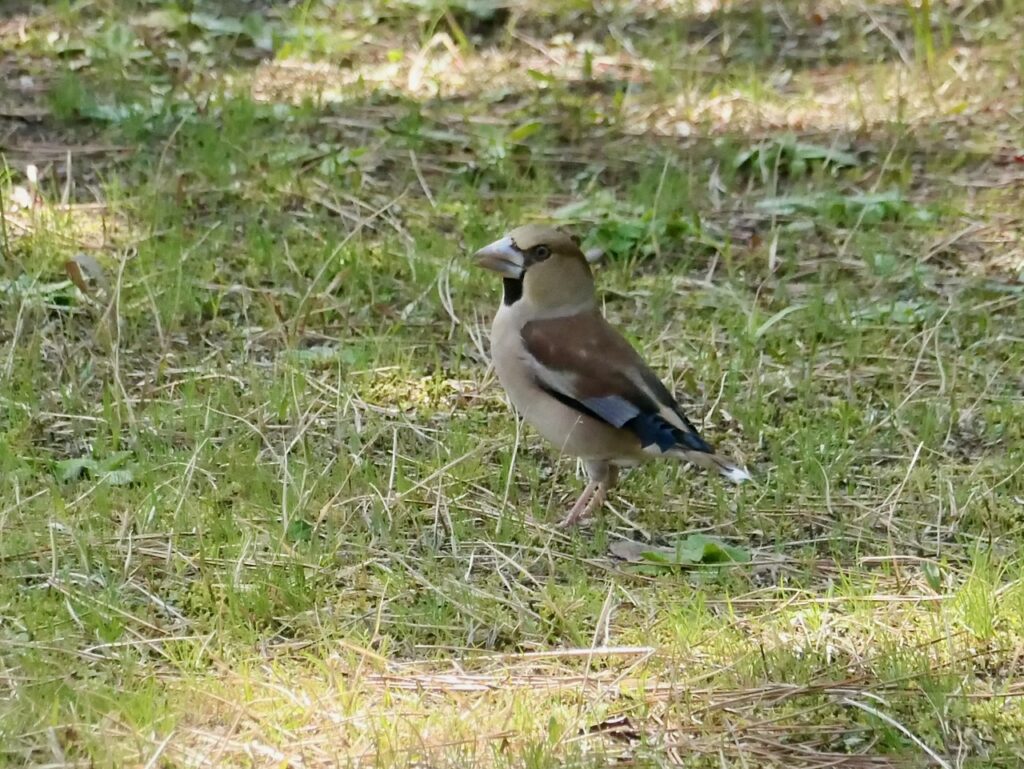
My time to meet my cab was, unfortunately, running out quickly, but as I hurried along a trail, I noticed three birds foraging under some trees. The first was a Dusky Thrush and I automatically assumed that the others were, too. I was wrong. They were Hawfinches! Braden and I had really hoped to see these odd chubby birds in Amsterdam or Israel in 2019, but to no avail. Now, on the other end of the Asian continent, I was staring at two of them cocking their heads at me in between going about their business. It was a great way to end the morning, and fixed Kanazawa as one of my favorite birding spots in Japan.

Sneed’s Kenmin Seaside Park eBird checklist. 

Hawfinch! Need I say more?

Another Accidental Big Year: Sneed’s 2022 Recap

FatherSonBirding’s millions of loyal fans will have no doubt noticed a paucity of posts the past few months, and we sincerely apologize, noting the severe nationwide downturn in consumer confidence and the real estate market that this has obviously precipitated. Fortunately, our silence has been a result of good things happening to Braden and me. Braden has been having some exceptional academic experiences during his fall semester at UMaine while I have been kept busy both birding and working on several exciting book projects that have come my way. That said, we’d like to take a couple of posts to wrap up the last few months and, indeed, our entire year of birding. Since Braden is studying for finals, I’ll go first.

Some of you followed my “Accidental Big Year” last year in which I set a new personal best of 352 ABA species during 2021. Believe it or not, I’ve blundered into another accidental Big Year in 2022. How the heck did that happen? I mean, I have definitely underperformed in my home state of Montana this year, notching my lowest total in several years. Fortunately, our trips to New York City and Arizona put me within striking distance. By early October, my count sat at a tantalizing 335 species, only 17 birds short of tying last year’s record, but where would the additional species come from? Some good writing news led to the answer.

This summer, I landed a contract to write about conservation on military bases, with a special focus on Eglin Air Force Base in the Florida panhandle. I chose this base because I spent all of my summers growing up with my father in Pensacola—adjacent to Eglin. Call it nostalgia or a desire to learn more about the area’s species, but I arranged to interview biologists down there to find out what they were doing. First, though, I decided to stop to see my brother in Atlanta, Georgia.

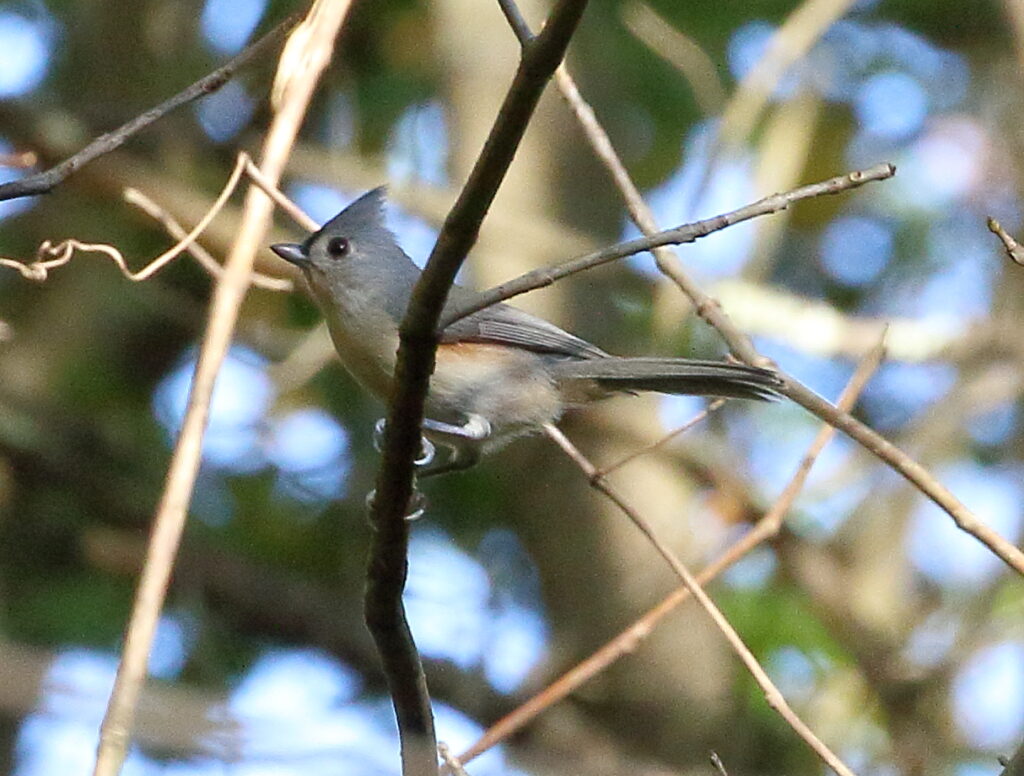
On my recent trip, I didn’t get photos of my best Atlanta birds, but Tufted Titmice are always a blast to see.

Honestly, I didn’t know how many new birds I’d see in Atlanta. Migration season was waning, and it was possible warblers and other songbirds had already moved through. In general, they had, but thanks to some intensive studying and tutelage by Braden, I was able to score a number of great birds including a trio of wonderful warblers: Blackpoll, Tennessee, and most exciting, Cape May—a Lifer pour moi.

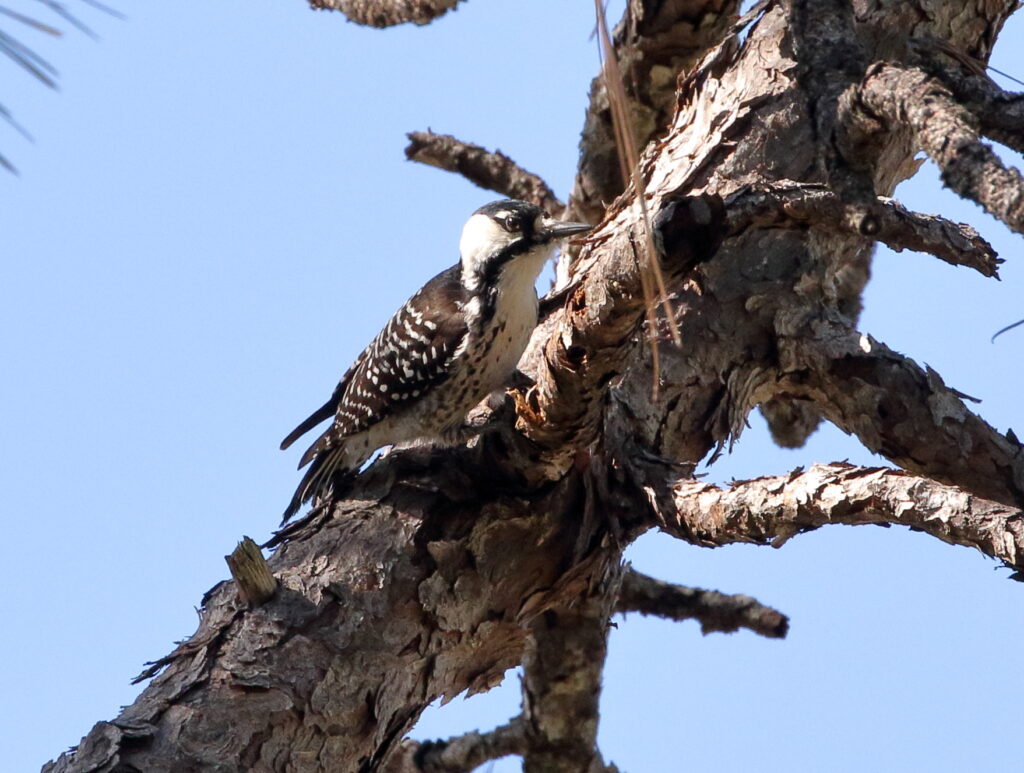
Leaving Georgia to take up a week-long residence with my stepmother Suzanne and her partner Jim in Milton, Florida, I wondered if I was close enough to top 352 for the year? Unfortunately, I arrived in Florida suffering from my first cold in three years—one I am just now getting over six weeks later. Not how I wanted to begin three consecutive long days of work at Eglin! Nonetheless, I persevered and got a bunch of great information from the base biologists. Oh, and I kept adding up Year Birds! In fact, I couldn’t have asked for a better bird to break my record. As biologist Kelly Jones drove me around teaching me about endangered salamanders, we ran into a group of Red-cockaded Woodpeckers, one of America’s coolest and most unusual birds. These birds became endangered due to the catastrophic loss of longleaf pine ecosystems across the Southeast, but many people have been working to restore both the pines and the woodpeckers. Last I heard, Eglin is home to the nation’s fourth-largest population, but this was the only group I ran into while there.

Red-cockaded Woodpeckers are the only North American woodpeckers that carve holes in living trees. Apparently, the sap running down the tree trunk helps deter snakes and other potential predators.

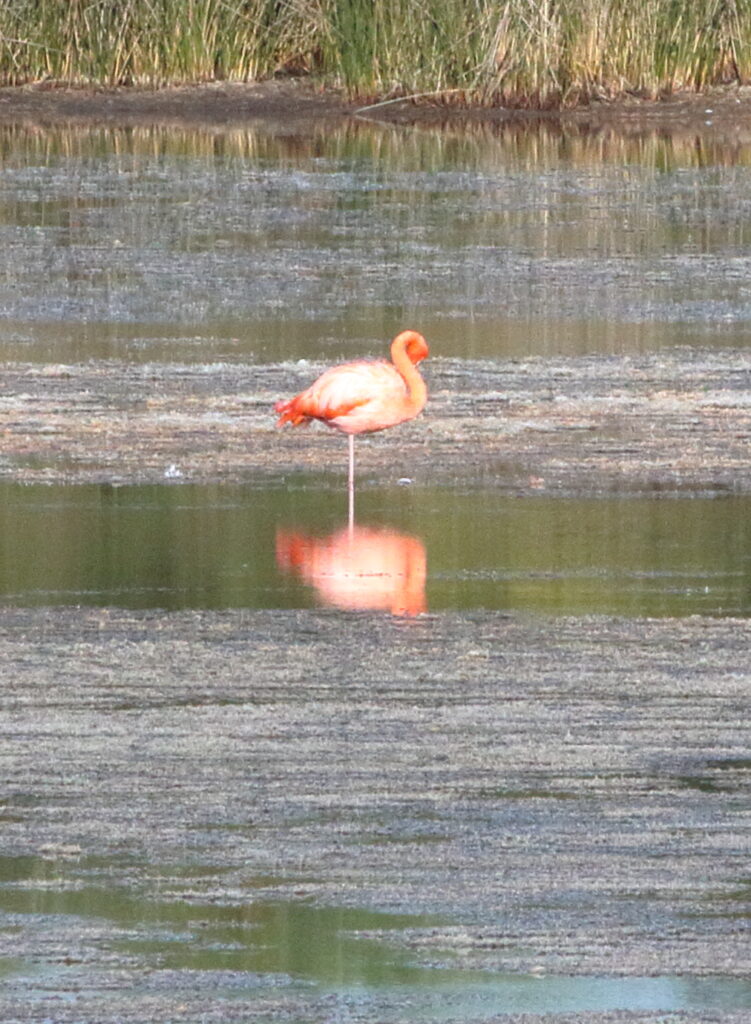
Not wanting to wear out my welcome with Suzanne and Jim, I used the weekend to take a jaunt over to Tallahassee to visit St. Marks National Wildlife Refuge. My dad, a professor at the University of West Florida, led many field trips to St. Marks and always raved about it. More recently, Braden and Nick Ramsey, visited the refuge, seeing among other things a lone flamingo that has lived at the refuge for the past four years. I hoped also to see this bird—dubbed “Pinky”—but kept my expectations low.

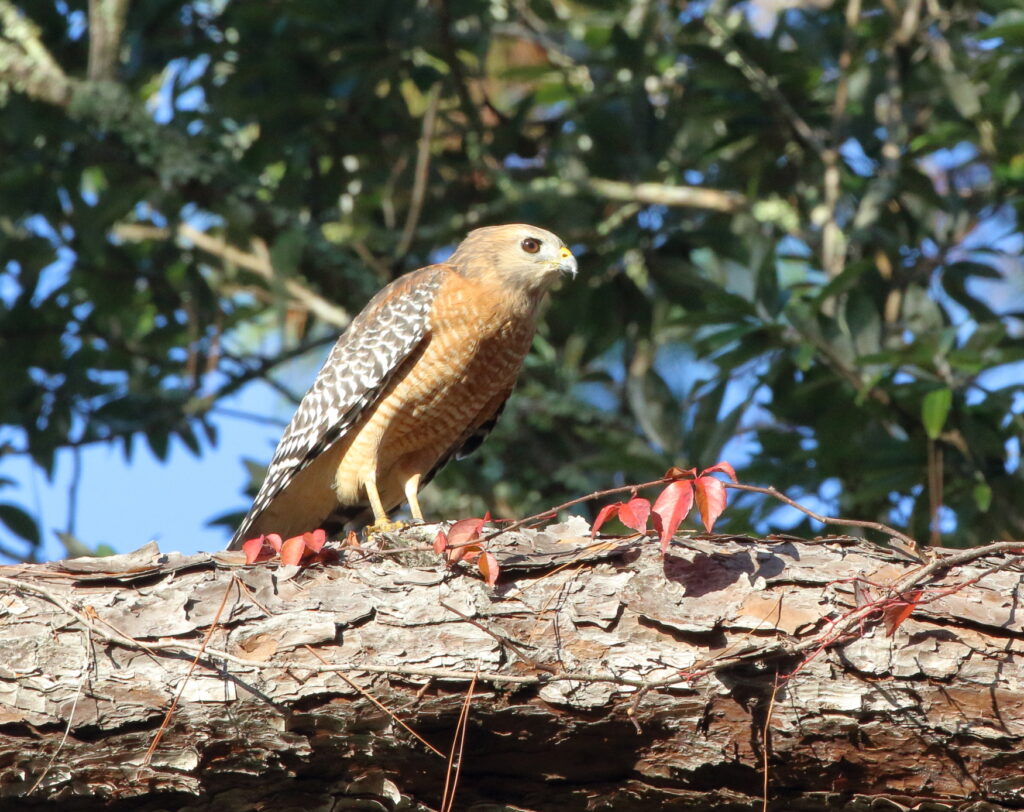
I know they’re common, but I love Red-shouldered Hawks, and this is by far the best photo I’ve ever taken of one.

Upon arriving, I discovered that St. Marks truly is a magical place—a remnant of “Old Florida” with towering oaks and pristine marshes—and my visit got off to a good start with great views of a Red-shouldered Hawk and Yellow-bellied Sapsucker at the visitor’s center. I asked the local naturalist if anyone had seen Pinky the flamingo lately and she said yes, but didn’t know where, so I decided to head down to Lighthouse Pool and work my way back. As I reached the pond, I happened to glance right. There, in the middle of the pond, stood a large orange blob.

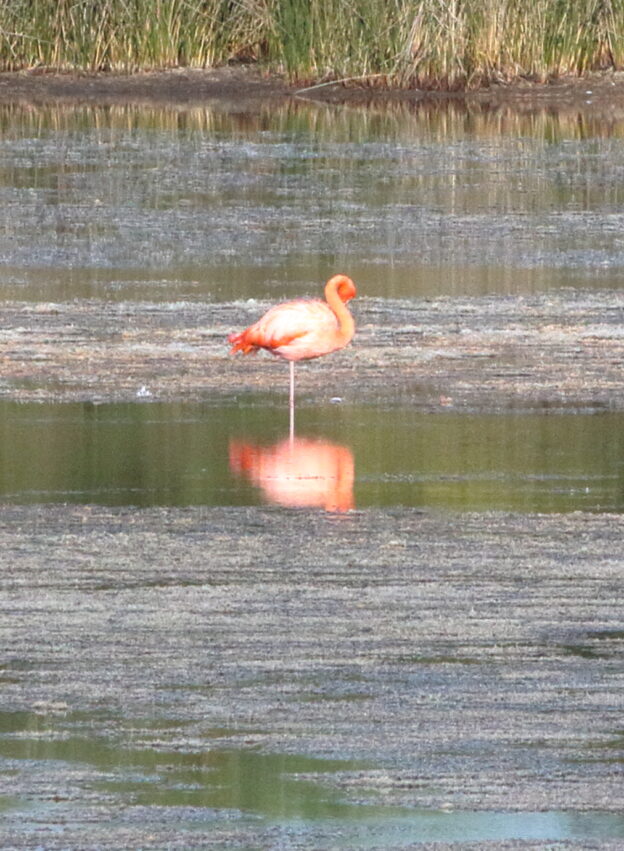
“No way!” I exclaimed, braking to the side of the road as I reached for my binoculars. Sure enough, there stood Pinky—America’s most famous flamingo. Full disclosure: Pinky was not the most exciting bird on the planet, content to just stand there and preen when s/he felt like it. Taking a walk along the southern edge of the pond, however, I picked up lots of other nice Year Birds including Reddish Egret, Tricolored Heron, Short-billed Dowitcher, Semipalmated Plover, and more.

I’m not sure where Pinky got his name, but to me he looked obviously orange. Still, an official Lifer for me, though I did see American Flamingos thirty years ago in Bonaire.

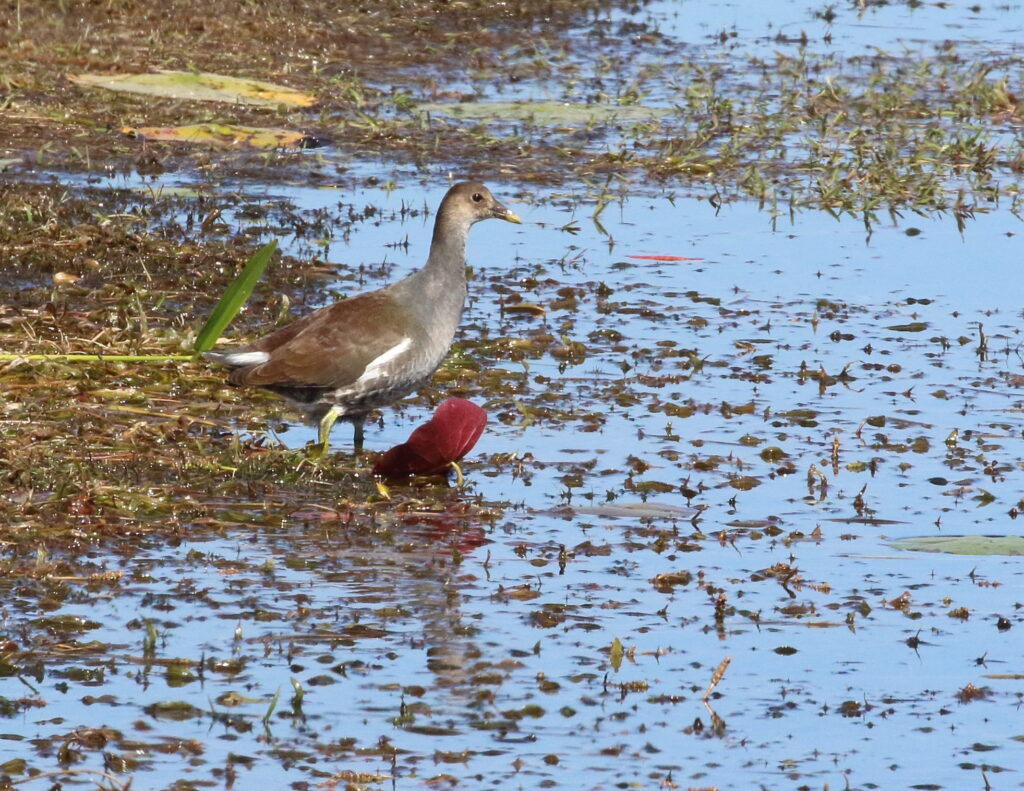
My visit to St. Marks was far from finished. As I drove back up the road, I thought I spotted a rail at the East River Pool location. I didn’t—and this was not the first time I’d mistaken a Common Gallinule for a rail! Training my eyes out on the pond, though, my heart picked up. Why? Because way out there among a large group of wading birds, I spotted another Lifer: Wood Stork! Along with Roseate Spoonbills, another Year Bird. My Lifer-palooza hadn’t ended, either. Following Braden’s directions I drove to another part of the refuge to hear my Lifer Clapper Rails.

This is at least the second time I’ve mistaken a Common Gallinule for a Clapper Rail. I do believe they’re closely related, though, so I hope that you, my dear readers, cut me some slack!

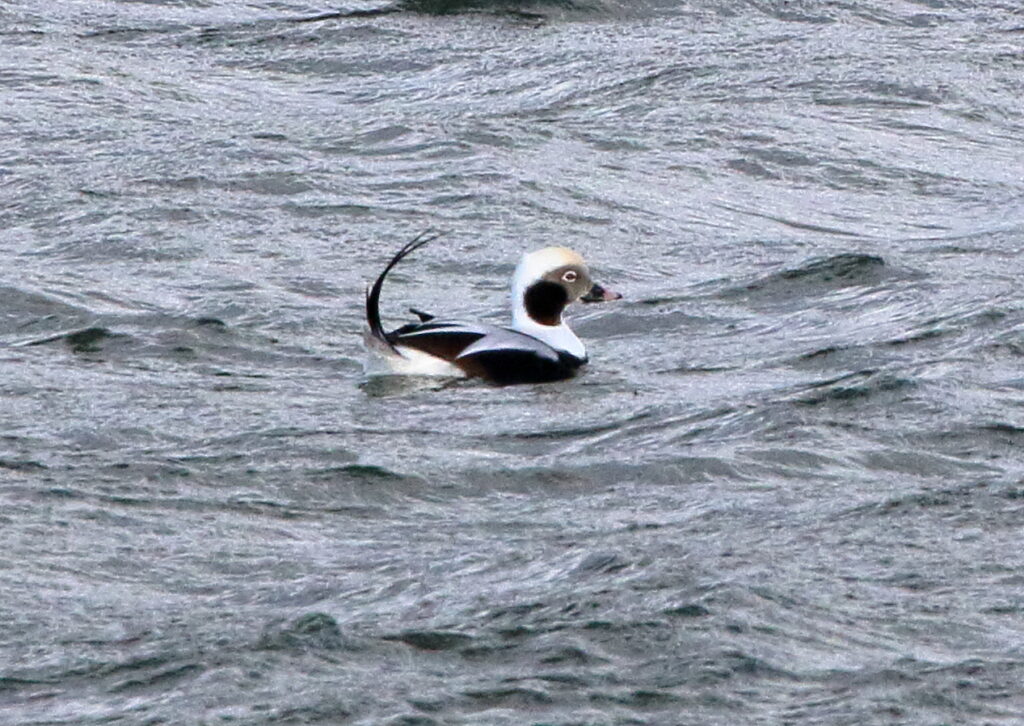
I returned to Montana with a total of 372 Year Birds and have since picked up a few more, thanks to a fortuitous discovery of Montana’s first Long-tailed Duck of the winter, along with the first Bonaparte’s Gulls I’ve ever seen in Missoula County. These and a Horned Grebe now have me sitting at 375, well in excess of my previous ABA Big Year record. My guess is that I’ll pick up one or two more when Braden gets home in a couple of weeks—though what they might be I have no idea. And you know, it really doesn’t matter. While it’s fun to count birds, it’s even more fun to get out and see them and, hopefully, make some new friends along the way. At St. Marks I met several delightful birders to share my adventures with. I hope that as 2022 draws to a close, you all have your own memorable birding adventures combined with heavy doses of peace and friendship.

My Lighthouse Pool checklist.

Perhaps my biggest score of the year was seeing the first Long-tailed Duck recorded this winter in Montana—and my first male ever. If this isn’t a glorious animal, I don’t know what is!

Arizona 2022, Part 1: Braden’s Big Year or Bust

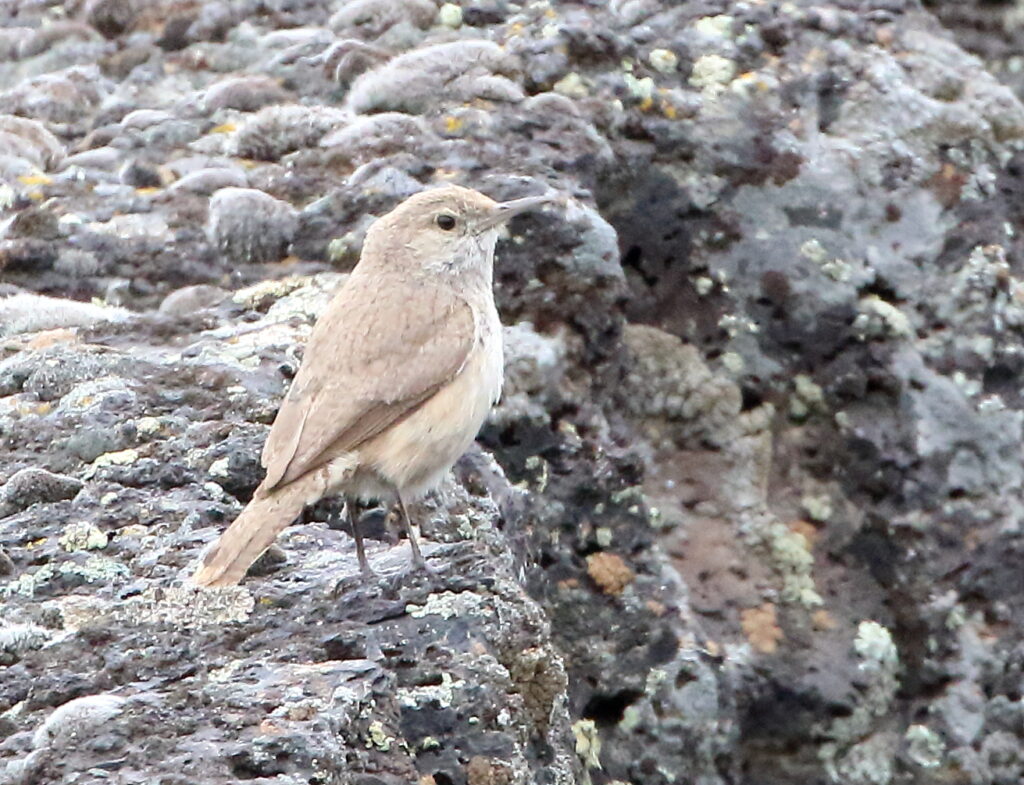
It’s been a while since we posted, and that’s no accident. When Braden landed a field job monitoring Northern Goshawks in California’s Sierras for the summer, I impulsively offered to drive him there—via Arizona and Southern California. We had wanted to return to Arizona since falling in love with the state during our Big Year in 2016. The fact that Braden was out to smash his own Big Year record with a goal of 400 species made the argument even stronger, especially after he and Nick Ramsey had ransacked the state of Florida only weeks before, followed by our amazing time birding New York City. So on May 22, rashly ignoring the price of gasoline, Braden and I made a beeline down Interstate 15, pulling over to pick up Thick-billed Longspurs near Dillon, Sage Thrashers and Rock Wrens in southern Idaho, and Burrowing Owls and phalaropes at Antelope Island near Salt Lake City. After a short, peaceful night in Kanab and a stop to ogle the rapidly disappearing Lake Powell, we rolled into Phoenix for our first major Arizona stop of the trip: Prospector Park, east of Phoenix.

We found Rock Wrens at a delightful I-15 rest area of lava called Hell’s Half Acre in southern Idaho. Don’t pass it up!

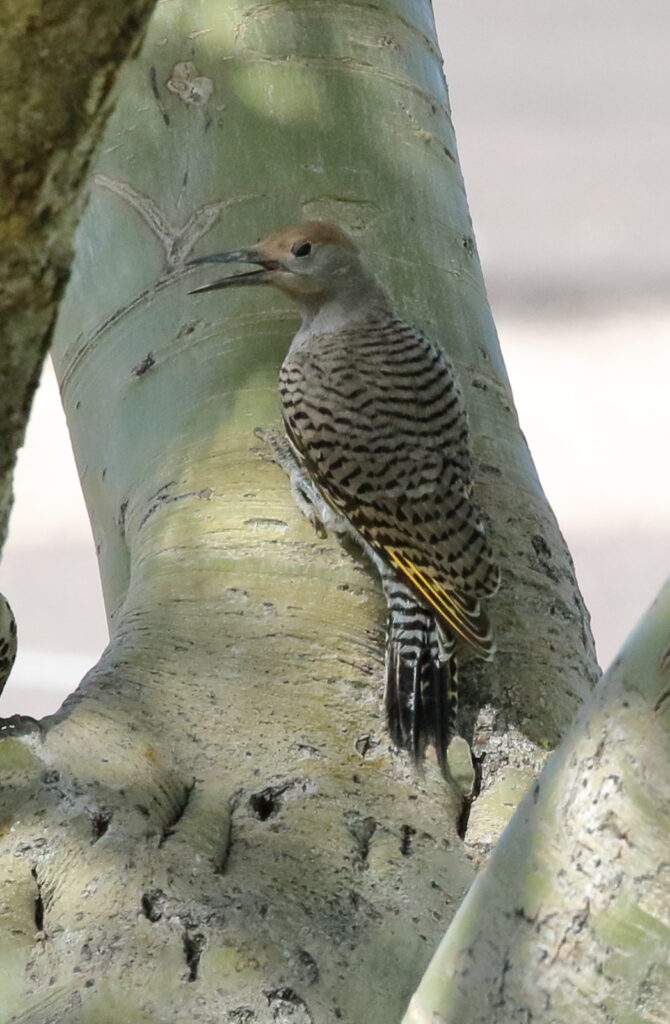
As usual, Braden ferreted out our hotspots for the trip and Prospector Park blew away all expectations. An unlikely-looking suburban park with playing fields and lots of lawn, we tumbled out of the car and began racking up Life Birds before we could utter “Holy Bird, Batman!” As soon as he raised his binoculars to his eyes, Braden called out “Abert’s Towhee!” Five minutes later, “Gilded Flicker”—the last ABA woodpecker I needed for my Life List. This was not to mention the gobs of Year Birds Braden needed to advance toward his magic 400 number. In fact, one of the great things about Arizona is that for Montanans, almost every bird we see is likely to be a Year Bird. Verdin, Ladder-backed and Gila Woodpeckers, Vermillion Flycatcher, Lucy’s Warbler, Gambel’s Quail, Curved-billed Thrasher—and another Lifer, Bendire’s Thrasher. For a birder, Arizona truly is a pot ‘o gold.

Gilded Flicker was a species I had needed for several years to complete my ABA woodpecker list. Okay, I admit it—not the most exciting critter, but we both enjoyed seeing it nonetheless.

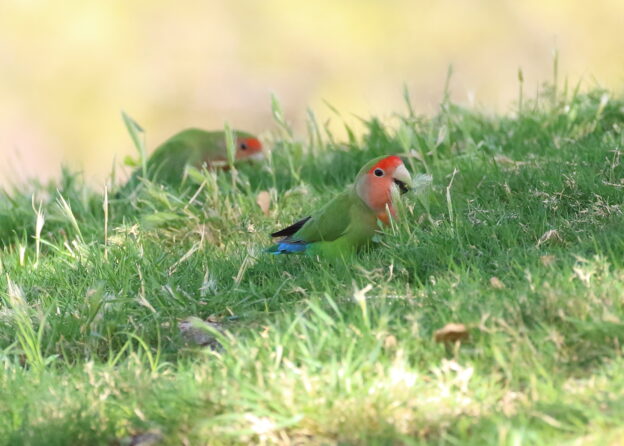
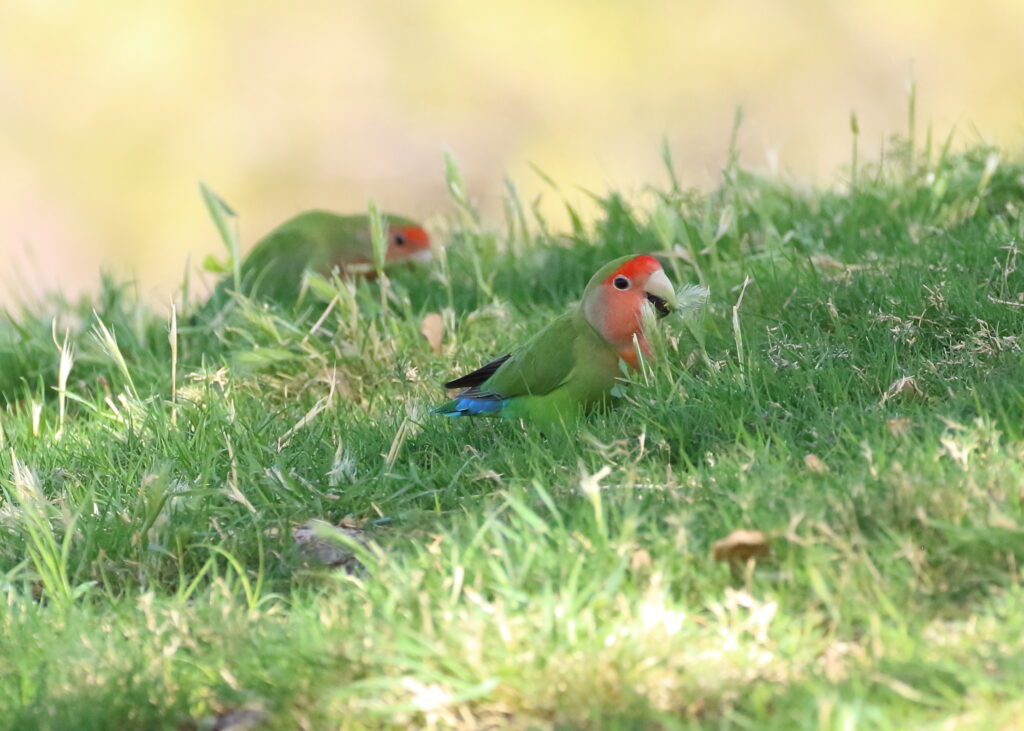
Not for the first time, one of our most fun finds turned out not to be a native species, but an exotic. We were completing our circuit around the park when we noticed a group of (I think) Mennonite birders staring at something in the grass. We couldn’t tell what they were until green shapes flew over to another patch of grass. “Rosy-faced Lovebirds!” Braden called with delight. It was a species he had especially hoped to see—and another Lifer for both of us. We spent a satisfying fifteen minutes just watching these little guys as they gathered grass seed heads—presumably to eat, but perhaps also for nesting material.

Introduced parrots such as these Rosy-faced Lovebirds always stir conflicting emotions in Braden and me. I mean, they definitely don’t belong here, but dang it, why do they have to be so darned cute?

But we had miles to go before we slept, so we reluctantly climbed back in the car for that night’s destination, Safford, where we checked into a cheap motel—only to find bed bugs hiding under the mattress. After quickly getting a refund, we headed to a pricier, bed-bug free place down the street (and yes, we checked the mattresses there, too!) for a welcome, but short night’s sleep. Our two-day, 1270-mile drive had already netted us five Life Birds and raised Braden’s Big Year total from 322 to 345 species—and we hadn’t even reached our first real destination. Would we be able to get Braden to 400? Things were looking good, but in birding as in life, nothing is certain . . .

Our Prospector Park List

Birding Central Park

We continue our spring birding blog blitz by picking up on our New York City trip last week and the nail-biting account of our Central Park birding adventure. If you’re afraid you will get TOO excited while reading this, I suggest you ask someone to hold your hand. And don’t forget to tune in tomorrow for our next post “Birding Brooklyn”!

On Monday, Tessa and I left Amy to continue recovering and rode the Hudson Line up to see our good friends, fellow author Larry Pringle and his delightful wife Susan. After taking a great walk at Nyack Beach State Park and eating a nice lunch, we returned to Manhattan in time to meet Braden at Penn Station after his first year as a college student! Bright and early the next morning, though, he and I jumped on the C train to do something we’d dreamed about since we began birding eight years ago: bird Central Park during spring migration! (Well, after a stop at Liberty Bagels on 35th St., that is.)

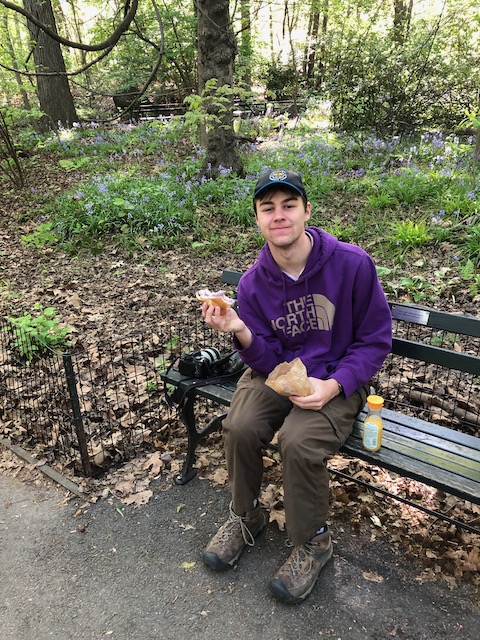
People often ask us the key to successful birding. Our trip to New York provided the definitive answer: bagels.

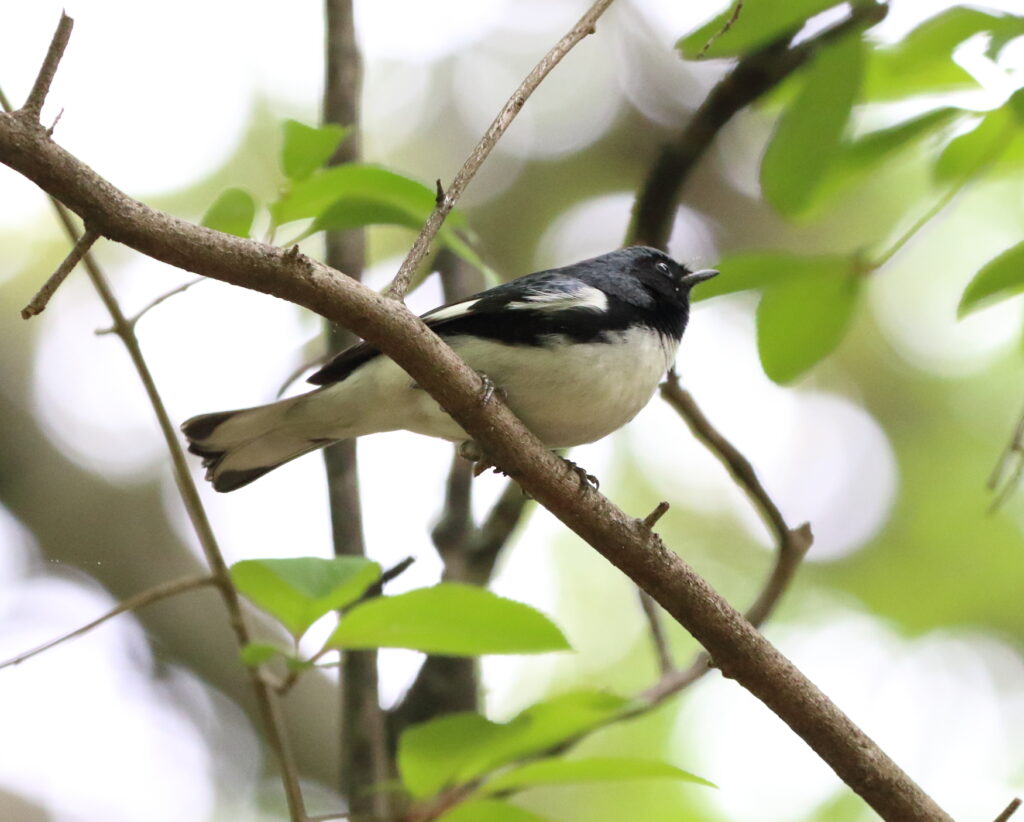
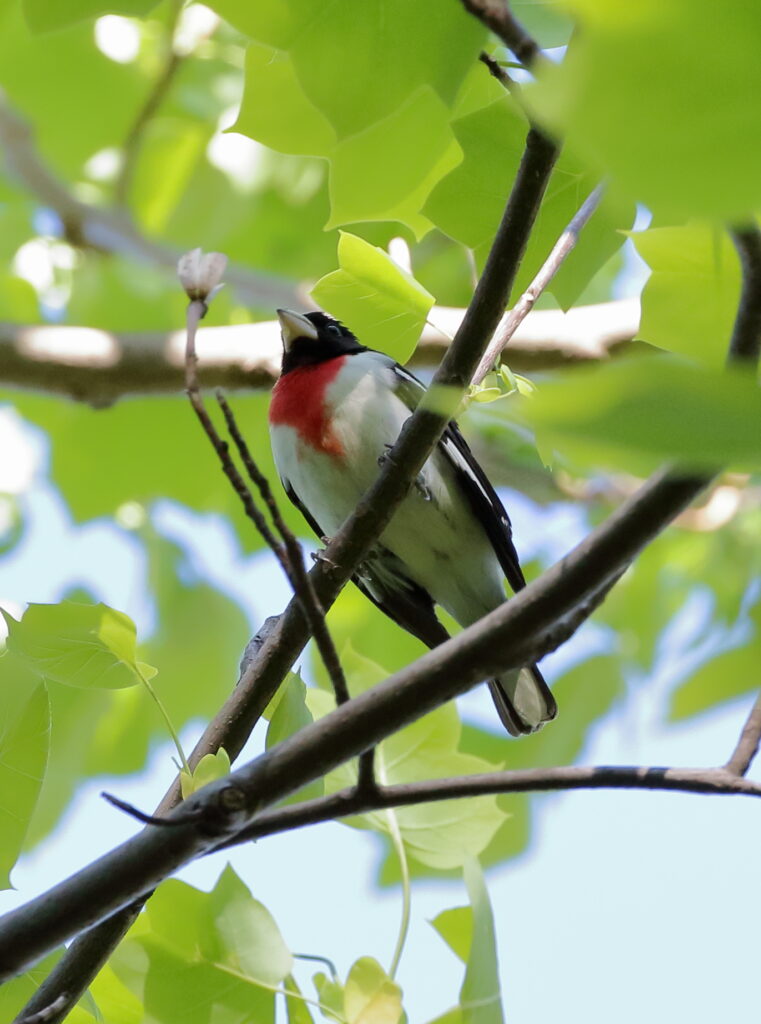
Just as Tessa and I had done two days earlier, we jumped off at 81st St. and immediately crossed over into Central Park, entering a particularly birdy area known as The Ramble. As mentioned in our last post, I worried that the birds might have left NYC already. Most migrating passerines only appear in the park during brief windows ranging from a few days to 2-4 weeks. They also come in waves that one can easily miss. Within a few minutes, however, the birds put my fears to rest when Braden called out a Black-throated Blue Warbler, a Life Bird for me and one of the most stunning of all warblers. Over the next hour and a half, a veritable songbird hit parade followed with sightings of Worm-eating Warbler, Nashville Warblers, Northern Parulas, Northern Waterthrushes, American Redstarts, Swainson’s and Hermit Thrushes, Magnolia Warbler and much more, including a male Rose-breasted Grosbeak high in the trees.

Black-throated Blue Warbler landed at Number 502 on my ABA (American Birding Association) Area Life List—and what an entry it was!
Not the best view, but this was our first male Rose-breasted Grosbeak since we’d hit High Island, Texas during our 2016 Big Year—so we took it!

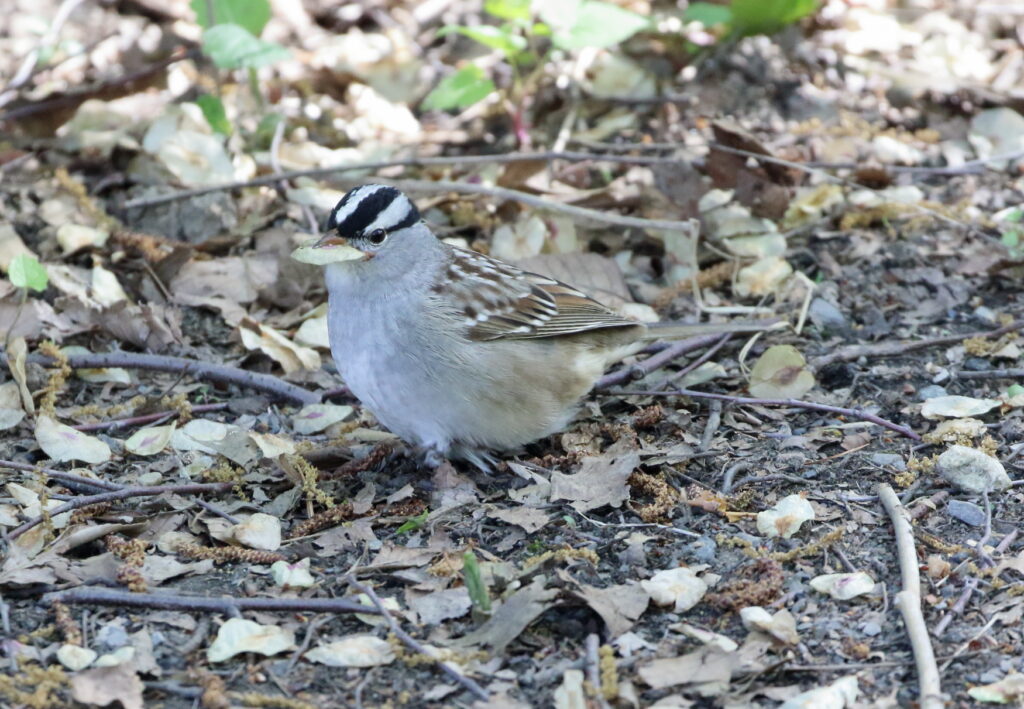
Among birders, it’s a well-known fact that seeing a lot of birds can generate an enormous appetite, so Braden and I were forced to sit down and attack our bagels. Mmmm . . . lox shmear . . . Partly satiated and with cream cheese smearing our faces, we again rose and made our way to our second birdy destination—an area of Central Park called North Woods. Along the way, we passed multiple landmarks familiar to anyone who has ever watched movies or Seinfeld including Belvedere Castle, the Jacqueline Kennedy Onassis Reservoir (where Dustin Hoffman jogged just before getting his teeth ripped out without anesthetic by a sadistic dentist), and the Central Park Tennis Center. We also made more bird discoveries such as a large group of White-crowned Sparrows.

Surprisingly, large numbers of White-crowned Sparrows are rare in Central Park. We were lucky to run across a group of five on our walk up to the North Woods section of the park.

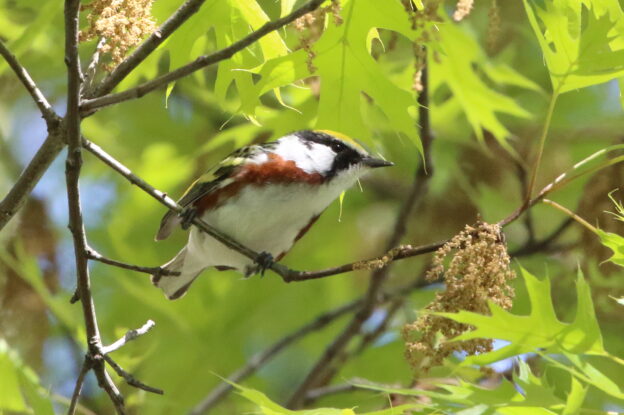
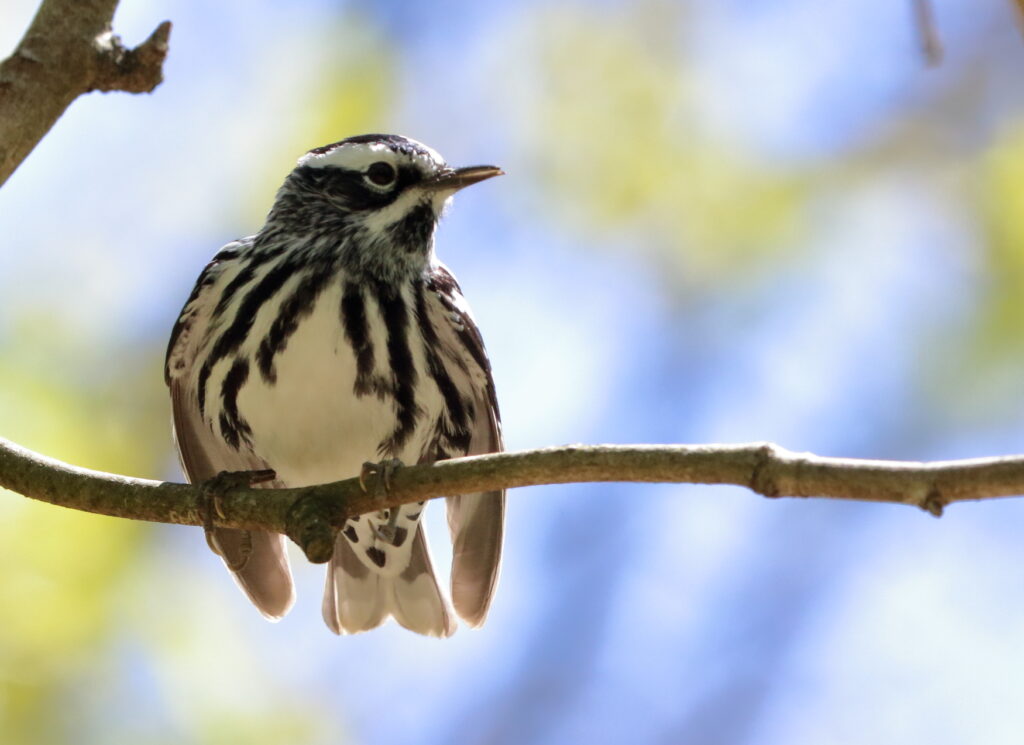
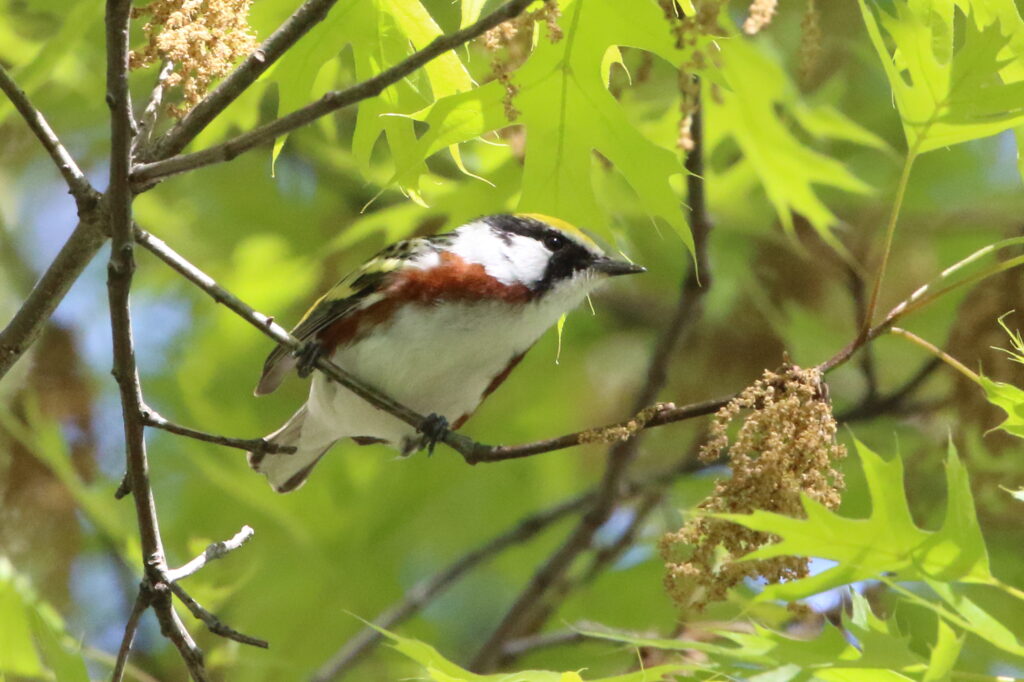
To be honest, however, we didn’t think the North Woods could possibly match The Ramble for birds, but we soon learned that . . . it CAN! Two targets, a Yellow-breasted Chat and a Red-headed Woodpecker had created a buzz in that section of the park, and we (ahem) chatted with several birders about them, but it was the other birds that grabbed our attention. These included incredibly cooperative Black-and-White Warblers, glorious Chestnut-sided Warblers, a Veery and Blue-headed Vireo. We struck out on the chat, but making our way east, we followed the creek through an area called The Loch and continued to rack up amazing sightings. These included a quick glimpse at the now-famous Red-headed Woodpecker, several Red-bellied Woodpeckers, a Yellow-throated Vireo, a Great Egret flying overhead, and a bird I especially wanted to see, Swamp Sparrow.

You wouldn’t think an animal that is just black and white could be so stunning, but Braden and I savor each encounter with Black-and-White Warblers.

By now we had birded for five straight hours and our energy was starting to flag, so we reluctantly dragged ourselves to the 103rd St. subway station and caught a ride back downtown. We learned later that we might have picked up Cape May and Blackburnian Warblers if we had hit a part of the Ramble called the Point, but did we mind? Only a little. In fact, our day had exceeded all of our expectations for birding Central Park. During our long morning, we had logged a remarkable 57 species including an amazing 13 kinds of warblers—as many as we could hope to find during a whole year in Montana!

Our Checklist.

Though I’d seen Chestnut-sided Warblers when taking Braden back to college in Maine last fall, this was my first technicolor, breeding male!

Even better, when we returned to our hotel, Amy was feeling much better and had spent the day with Tessa at Ellis Island and the Statue of Liberty, so we all went out to a nice meal at Kung Fu Kitchen. Can you spell pork soup dumplings???? Then, while Braden and Tessa strolled Times Square, Amy and I set off to see The Book of Mormon, a musical we were supposed to see in Seattle when covid struck. But lest you think Braden’s and my Big Apple birding adventures had concluded, stay tuned for our next post . . .