Tag Archives: Montana

Meditating with Loons: Spontaneous Birding Spectacular, Part II

Braden and I write FatherSonBirding in the hopes of sharing the wonders of birds and birding, and the urgency to protect them. We do not accept advertising or donations, but if you’d like to support our work, please consider buying *NEW* copies of some of Sneed’s books—First-Time Japan: A Step-by-Step Guide for the Independent Traveler, for instance, or the best kids’ woodpecker book ever, Woodpeckers: Drilling Holes & Bagging Bugs. Here, we are pleased to continue last week’s “spontaneous” narrative. For Part I, see our last post. Enjoy!

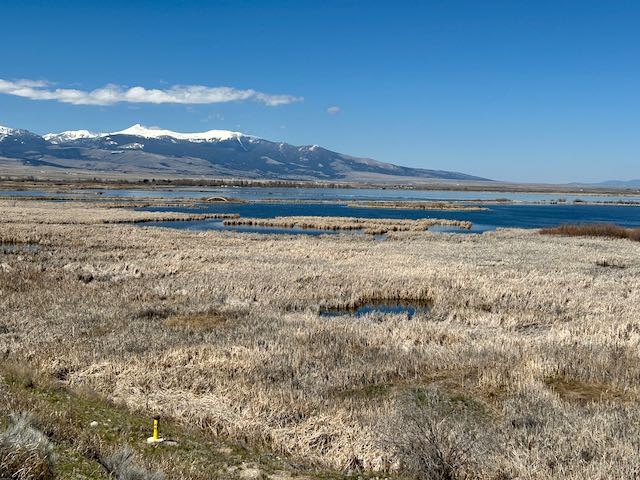
After giving my keynote talk to the Montana Library Association (and yes, it went well, thank you!), I changed out of my good clothes, checked out of my room and hit the road—but not too far. It was early afternoon by now, but before heading home I thought I’d better take advantage of the opportunity to visit Warm Springs Wildlife Management Area, one of Montana’s top birding destinations. It being migration season, the possibilities were almost endless of what I might find, but I kept my expectations low. Why? Primarily because much of Warm Springs is not easily accessible. The refuge consists mainly of several very large reservoirs designed to help clean toxic chemicals from the waters pouring out of the world famous Berkeley Pit copper mine in Butte. The road, however, only gets close to these bodies of water in certain places, so it’s easy to miss rarities that might show up. Nonetheless, I took the “back entrance” into the refuge and soon found myself at the bottom of the large, southernmost reservoir. The scene before me immediately put me in a happy place.

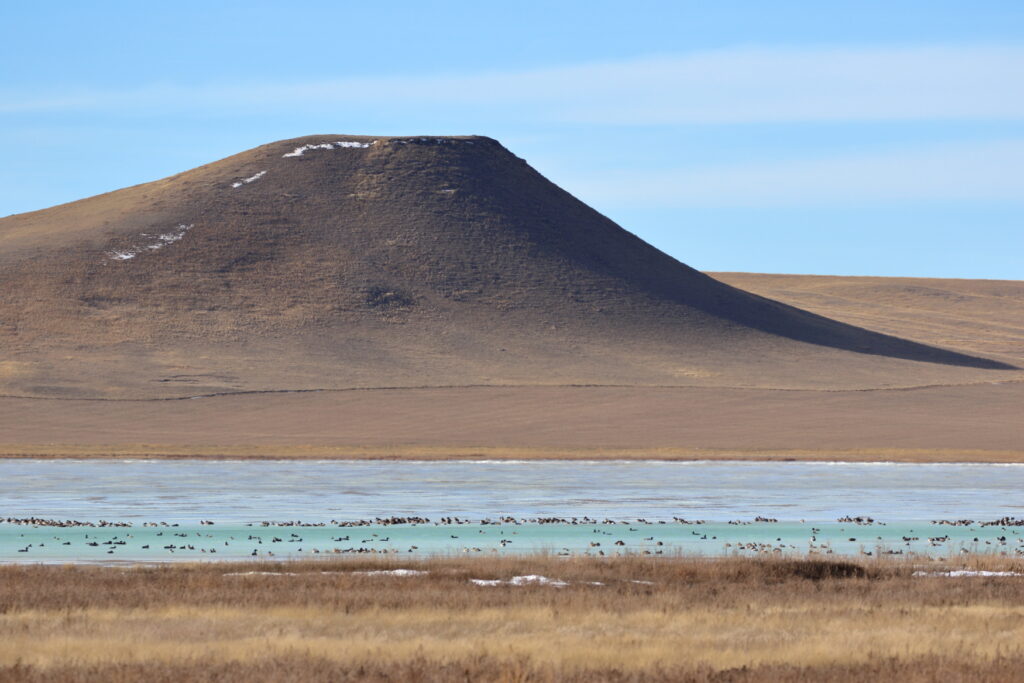
This photo doesn’t capture the size and scope of the Warm Springs ponds—or how amazing they look filled with waterfowl!

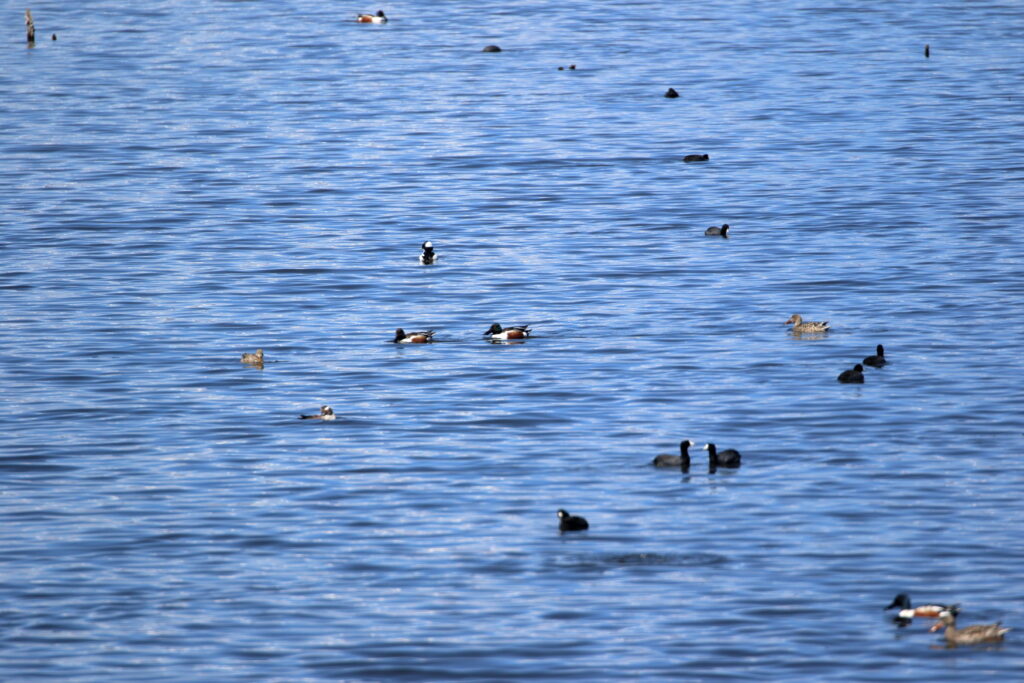
Stretching across the water were hundreds, no, thousands of ducks and other water birds, and I quickly set up my scope for a proper look. I usually try to estimate bird numbers wherever I am, but as I searched across the reservoir with the scope, I quickly abandoned that effort. I recorded 5000 coots, but that could easily be low. I also saw hundreds of Northern Shovelers and Ruddy Ducks, and noted plenty of Buffleheads, Ring-necked Ducks, Lesser Scaups, Gadwalls, American Wigeons, and more. A duck party!

Just a few of the birds stretching out before me at Warm Springs. Pop quiz: can you identify three species?

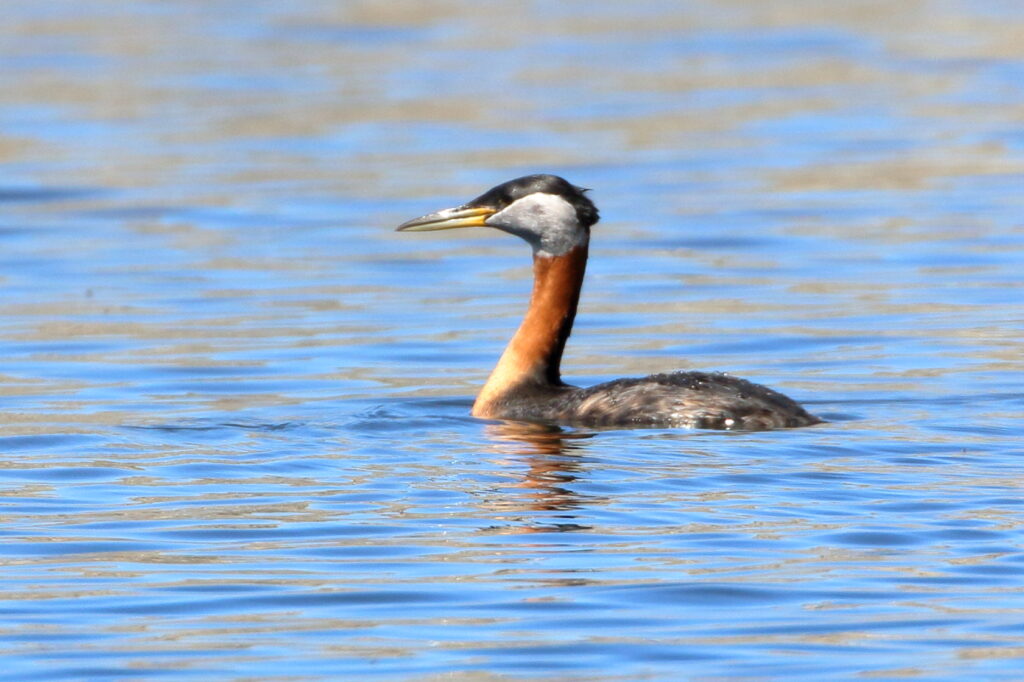
When scoping such a vast array of birds, it’s a natural instinct to look for the unusual or rare species, and after a few minutes, I landed on a pair of Red-necked Grebes—my first of the year. My biggest find, however, was the year’s first Yellow-rumped Warbler (Audubon’s) in the trees next to me! After making an inadequate attempt to eBird what I saw before me, I jumped back in the minivan and continued up the road. I passed a resident pair of Bald Eagles, and then pulled over at a small fishing access next to a long dike that separated this reservoir from the next. I grabbed my binoculars and ventured out onto the dike, and right away saw another Red-necked Grebe. Then, I recognized a bird that made me rush back to the minivan for my camera. I hurried back out onto the dike and trained my lens on it—a Common Loon!

During breeding season, Red-necked Grebes have a circumpolar distribution, but in the US they breed only in a few areas along our northern border. Fortunately, Montana is one of those places—though this guy/gal may well have been heading to Canada or Alaska.

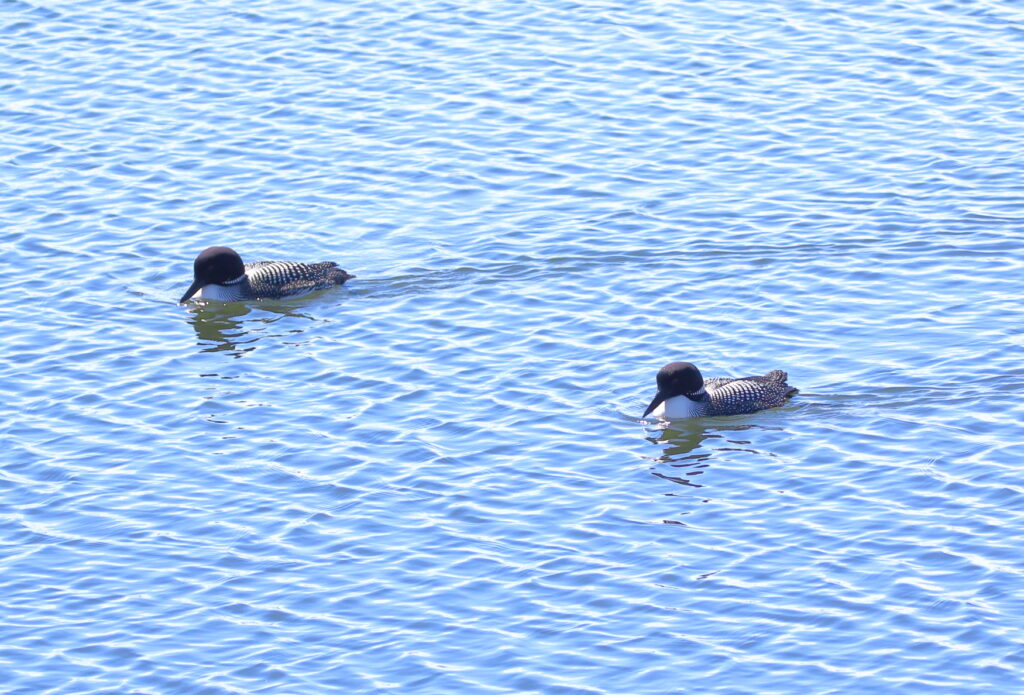
Now, loons are not exactly rare in Montana, but they aren’t gimmes, either (for instance, see post “Rare Bird Hat Trick”). Last year, I saw only one—a quick fly-over at Glacier National Park. If you don’t visit one of the lakes where they breed in summer, you have to catch them during migration. Braden and I have seen a number of COLOs during fall migration, but this was the first I could remember in spring. But wait. As I was trying to get a decent photo of this loon, another one popped up nearby. “No way!” I muttered out loud. But wait, then I spotted a third, and eventually, a fourth! (I think I saw a fifth, but these ‘torpedoes’ can travel so far under water that I can’t be sure.)

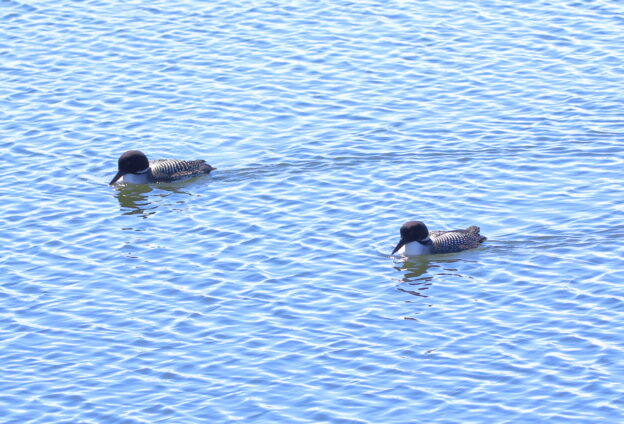
This pair of Common Loons defines the word serenity.

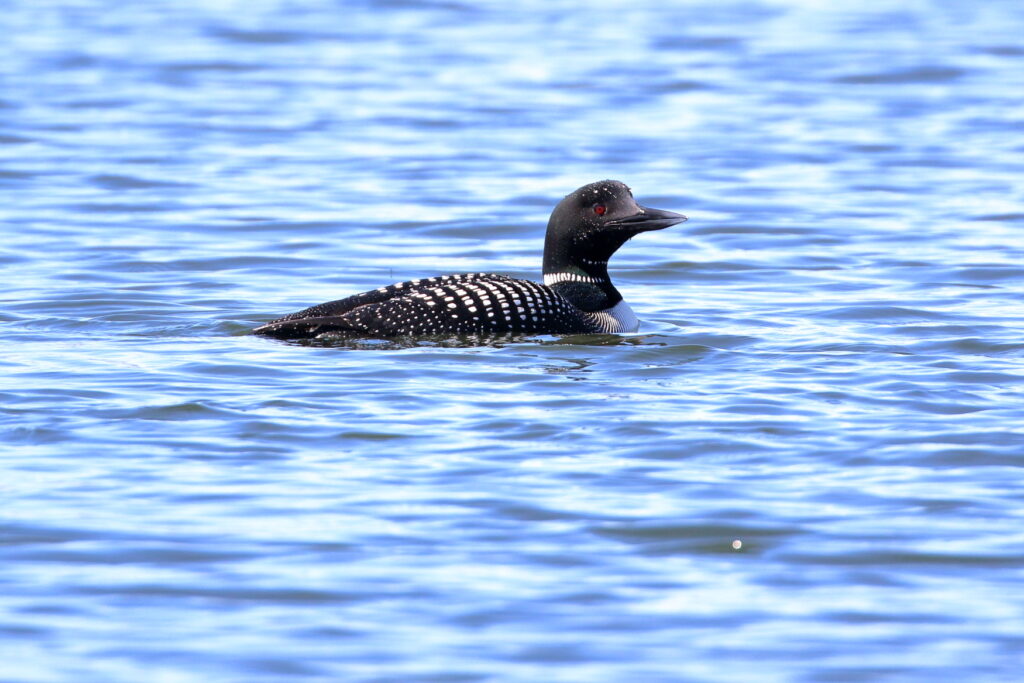
Needless to say, I felt “loonstatic.” My only problem? Every bird was backlit, making a good photo impossible. To try to rectify this, I walked around to the parking area where I could get “up-light” of the birds, hoping they wouldn’t depart before I reached a good spot. They didn’t. I took enough photos that I finally got a really nice one (see below). My other problem, though, is that . . . I needed to relax.

After capturing my best COLO shot ever, it was time to Zen out with some quiet loon time.

More and more, recently, Braden and I have discussed the obsession to rack up species and get good photos without pausing to really appreciate them. Both of us, in fact, have been making an effort just to be still in the moment, and with four stunningly gorgeous loons diving for food in front of me, this seemed like a perfect time. I sat down on a rock and set my camera and binoculars on the ground next to me. I watched the loons for a few moments and then just closed my eyes. I thanked the universe for this special moment and tried to breathe deeply, focusing on the now for a few minutes.

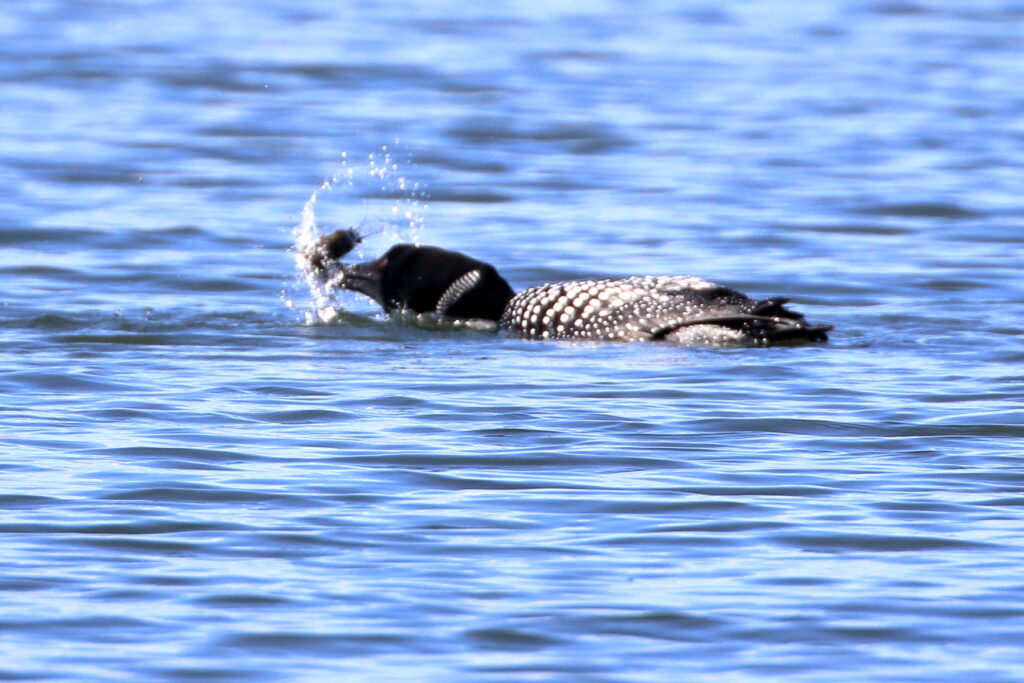
Alas, I did not attain “loon-lightenment,” but when I opened my eyes, the loons were still floating, preening, and diving in front of me. Several times, I watched them surface with crayfish in their bills. I’m not sure if the loons did anything special to them, such as knocking loose their exoskeletons, but down the hatch they went. It was beautiful.

A little “crawfish loon-touffée” for lunch!

My birding had not finished, either. After Warm Springs, I tooled up the road a few miles to another spot that many birders don’t take time to check out—Racetrack Pond. Often, there’s not much to see at Racetrack, but I had occasionally stumbled into some treats. Again, it was migration season, so you just never knew. As I pulled off the interstate and turned right, I immediately saw a couple of hundred gulls out on small islands in the pond. “Hm,” I thought. “Maybe I can pick up some California Gulls there.” As I drove closer, however, I realized that they weren’t gulls. They were Snow Geese!

I pulled over and again set up the spotting scope—and not just to see the Snow Geese. I had an ulterior motive. Almost exactly a year earlier, at Browns Lake, I had stumbled into some migrating Ross’s Geese mixed in with a large Snow Geese flock. “Maybe there are some Ross’s hiding in this one,” I thought with an evil grin. I diligently scanned the flock for several minutes, mainly looking for any geese with stubby pink bills. Ross’s, though, also are a bit smaller than SNGO and tend to have a cleaner, whiter appearance. I thought I was going to strike out when I glimpsed two geese that fit the, ahem, bill. I watched them for at least ten minutes before discarding any doubts. Yay! This was only my third time ever seeing Ross’s Geese, and to get them two years in a row felt like an accomplishment. By the way, ROGOs are also a wonderful conservation success story. Their numbers had dropped to just a few thousand by the 1950s. Today, it is estimated that there are more than two million! Let’s hear it for conservation!

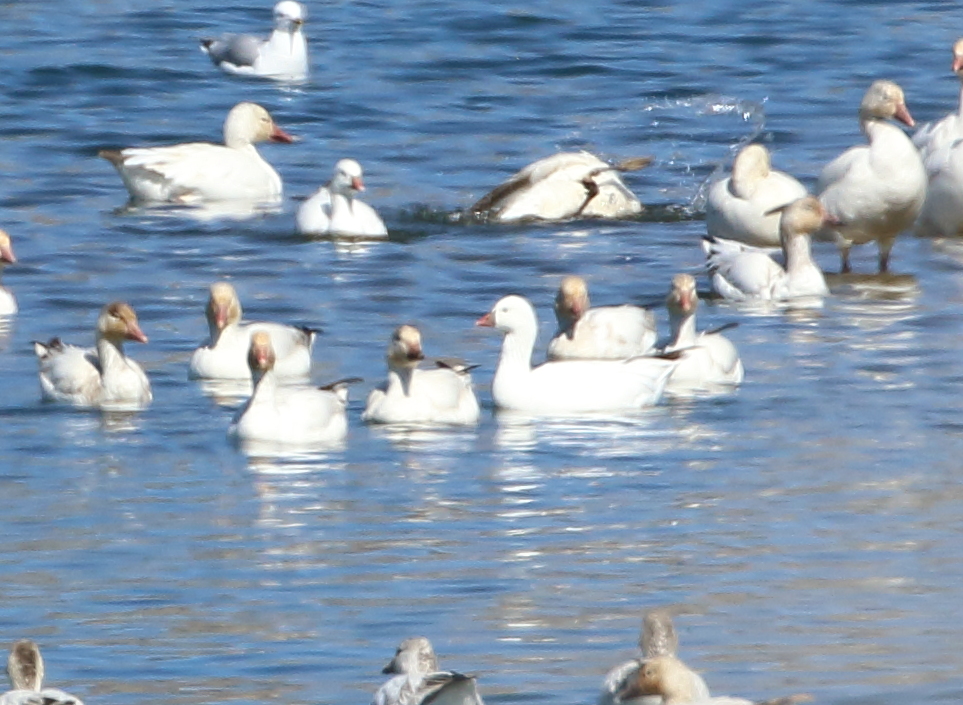
Can you pick out the two Ross’s Geese in this photo? Once you know what you’re looking for, they stand out like, well, um, Ross’s Geese. The prominent, clean white goose just right of center is one of them. The other is swimming toward it from about 10 o’clock.

My discoveries weren’t over. At the north end of the pond, I again pulled out the scope to discover a Greater Yellowlegs, a Killdeer, and two real surprises—an American Avocet and five, count ‘em, FIVE Marbled Godwits. “Perhaps they’re heading to the same place as yesterday’s Willets,” I wondered (see our last post). I later learned that large flocks of avocets had been rampaging through the state, so this one was right on schedule.

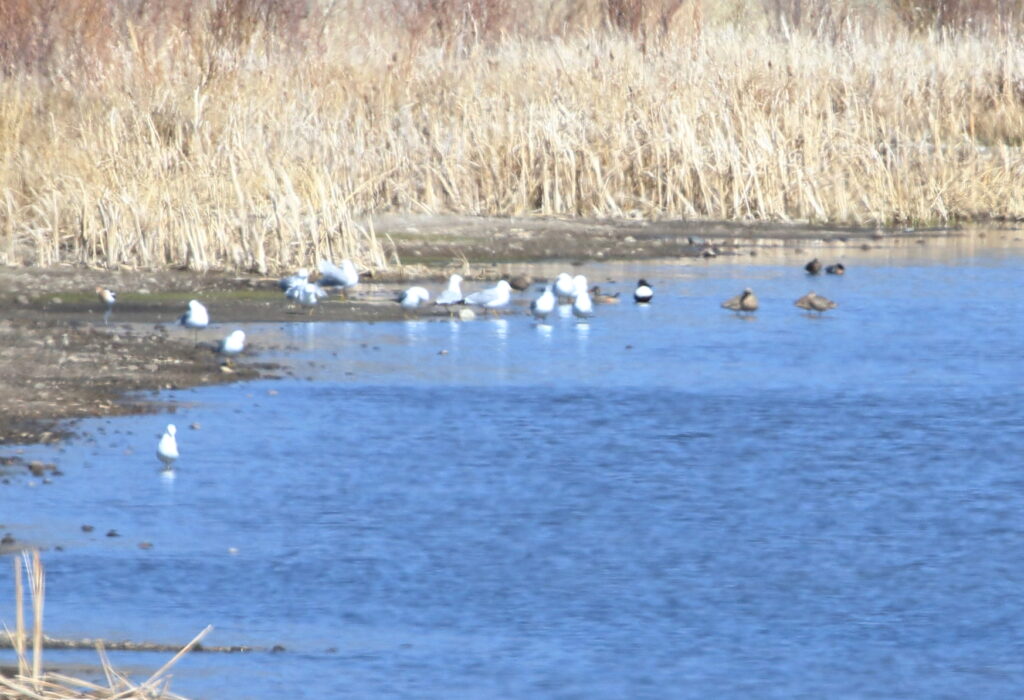
With the help of my spotting scope, I was able to pick out the American Avocet (far left) and Marbled Godwits (far right) along the far shore of Racetrack Pond.

With another wonderful day of birding under my belt, it was time to head home, but really, these days just primed my birding pump. Many adventures lie ahead—especially when Braden returns home from Costa Rica in a couple of weeks. Be prepared for plenty of posts this summer!

Owls, Curlews, Mergansers, and Willets: Spontaneous Birding Spectacular, Part I

Today, Braden and I would like to especially welcome our increasing number of international readers. Our posts are now regularly viewed by birders from more than a dozen different countries, and new countries seem to pop up every week. Thank you for your interest and we invite you to comment and share your own birding interests and experiences! Oh, and check out the quiz in the last photo caption!

I hadn’t intended my visit to central Montana last week to be a birding trip. Rather, I had been invited to Butte to speak at the annual conference of the Montana Library Association, and so had planned a simple, quick overnight. A few days before the conference, however, things got more complicated. Braden has heroically gone without a car during his first three years in college, but as he looked forward to his senior year, we all agreed it was time for his own wheels, and I had been doing a little “car scouting” while he finishes up his semester abroad in Costa Rica. Wouldn’t you know it, I found what looked like the perfect used vehicle in Billings. “Hm,” I thought, “if I got up early, I could drive to Billings on Thursday, look at the car, and make it back to Bozeman (most of the way to Butte) ahead of the conference.”

Long story short: I bought the car, and Friday morning, found myself with an entire morning to bird between Bozeman and Butte.

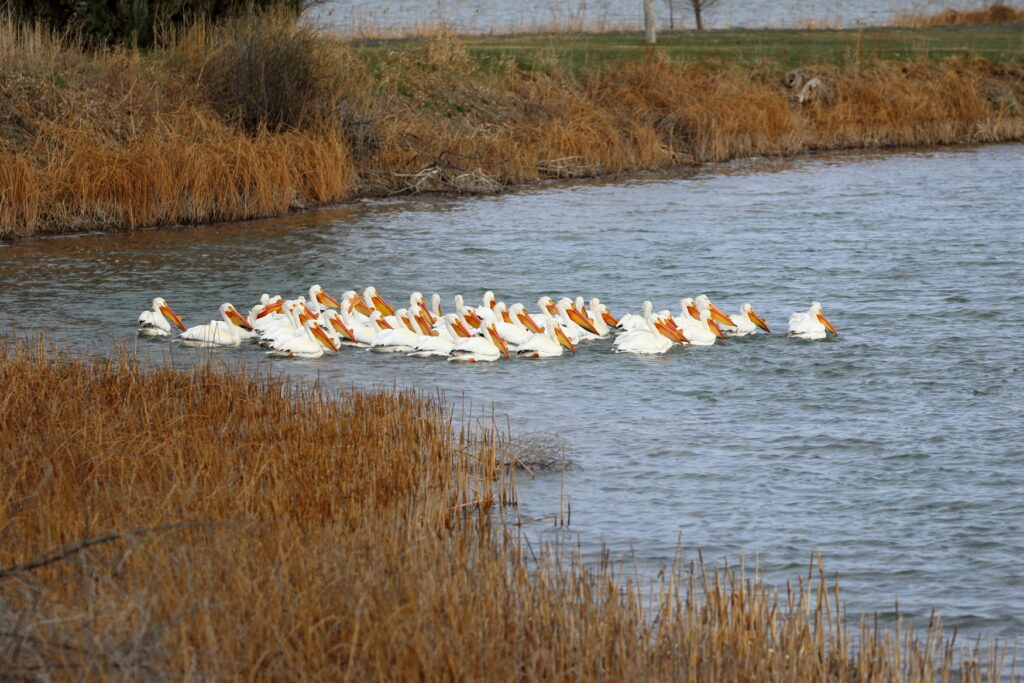
Brown Pelicans are my favorite birds, but American White Pelicans definitely make the top 100. Unlike their brown cousins, AWPEs prefer inland freshwater habitats for breeding. I’m guessing these might be heading to Bowdoin NWR near Malta, but they could be on their way farther north.

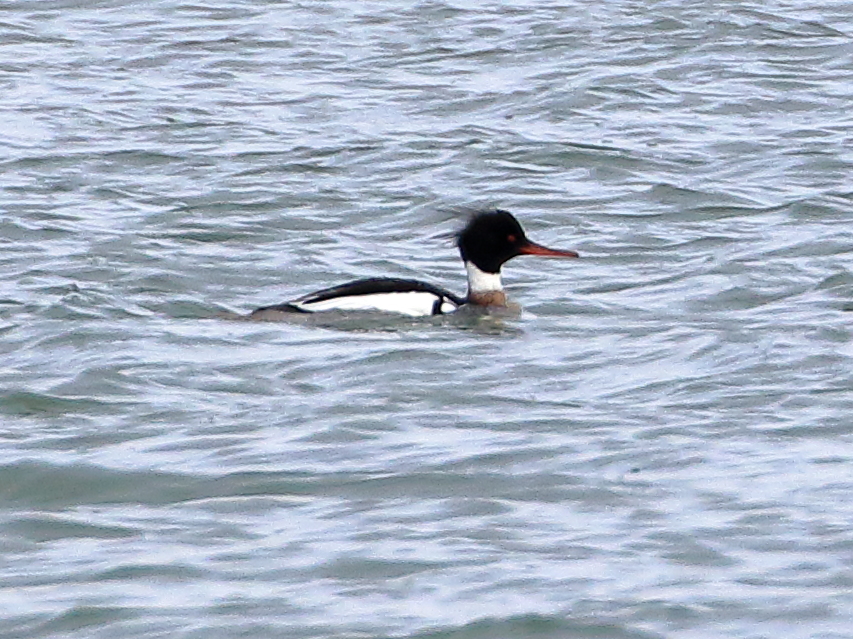
Three Forks ponds can be very hit and miss. I had actually stopped there on my way to Billings, but hadn’t found anything too notable except some American White Pelicans. This morning, though, I decided to try them again before heading up Bench Road. Was I in for a surprise! The first bird I spotted in Three Forks ponds was a bird I had never before discovered on my own: a Red-breasted Merganser! Not only that, I found seven more in the next pond over. These northern breeders pass through Montana only during migration—and not in large numbers—so I felt particularly fortunate to see them. The ponds, though, held other surprises.

Red-breasted Mergansers can be distinguished from Common Mergansers by their spiky “punk” hair-do, gray sides (here, under water), and of course, that reddish band on their breasts.

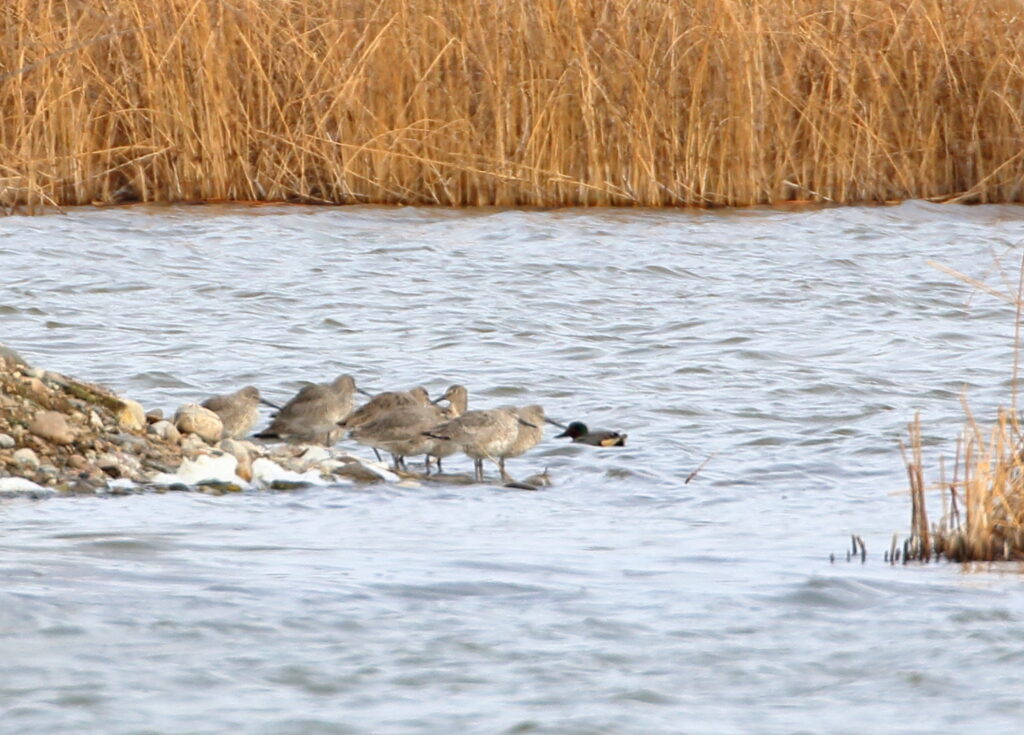
Beyond a much larger group of pelicans, I saw a good assortment of ducks and then spotted birds with bold black-and-white wings fly to an island in the second pond. Shorebirds, I thought excitedly, running back to the minivan for my spotting scope. Other than Killdeer and Spotted Sandpipers, I had never before seen shorebirds at Three Forks, and my pulse picked up as I focused in on a group of eight gray birds at the edge of the island. I quickly ran through all the possibilities in my head, examining their size, color, and bills. My conclusion: Willets! They were obviously migrating, and this was the first time I’d ever seen them moving through this part of Montana. Apparently, I was not alone as the birds’ timing landed them on the Montana Rare Bird alert for the day!

This group of eight migrating Willets surprised me by making the Montana Rare Bird Alert! They also tested my powers of ID elimination.

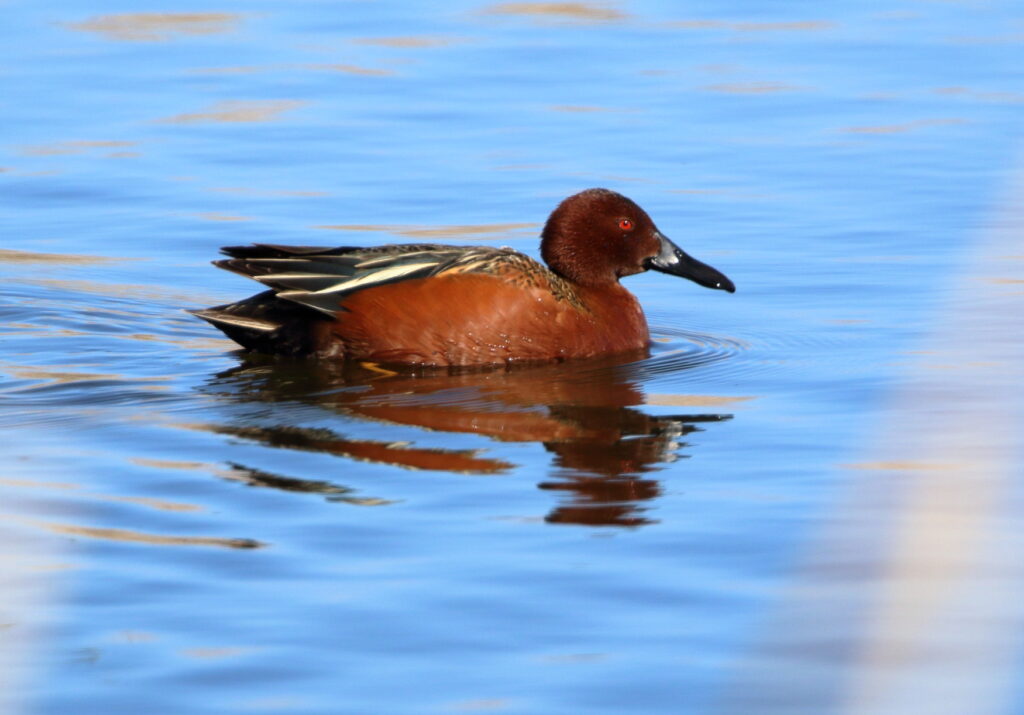
From the ponds, I headed up Bench Road. This was the first place Braden and I ever saw Burrowing Owls, and I hoped to see them again today—but didn’t hold out a lot of hope as I’d missed them my last couple of times here. The road, though, holds a wealth of other birds. In the lower stretch, I pulled over at the marsh to enjoy my first Yellow-headed Blackbirds, Marsh Wrens, and Cinnamon Teals of the year. It was the road’s upper stretch that most excited me, however.

Cinnamon Teal. Most stunning duck ever? Maybe not, but definitely part of the conversation!

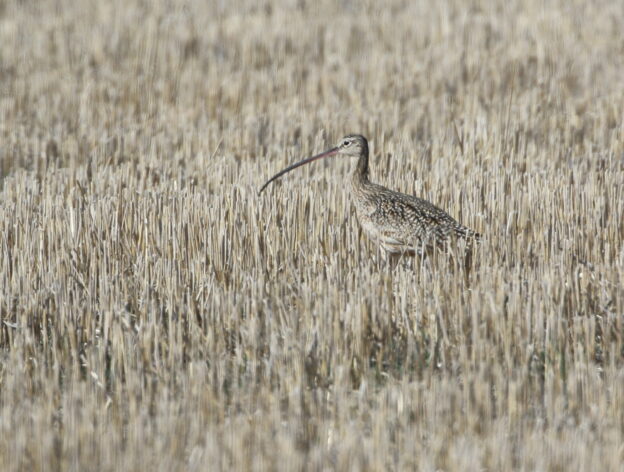
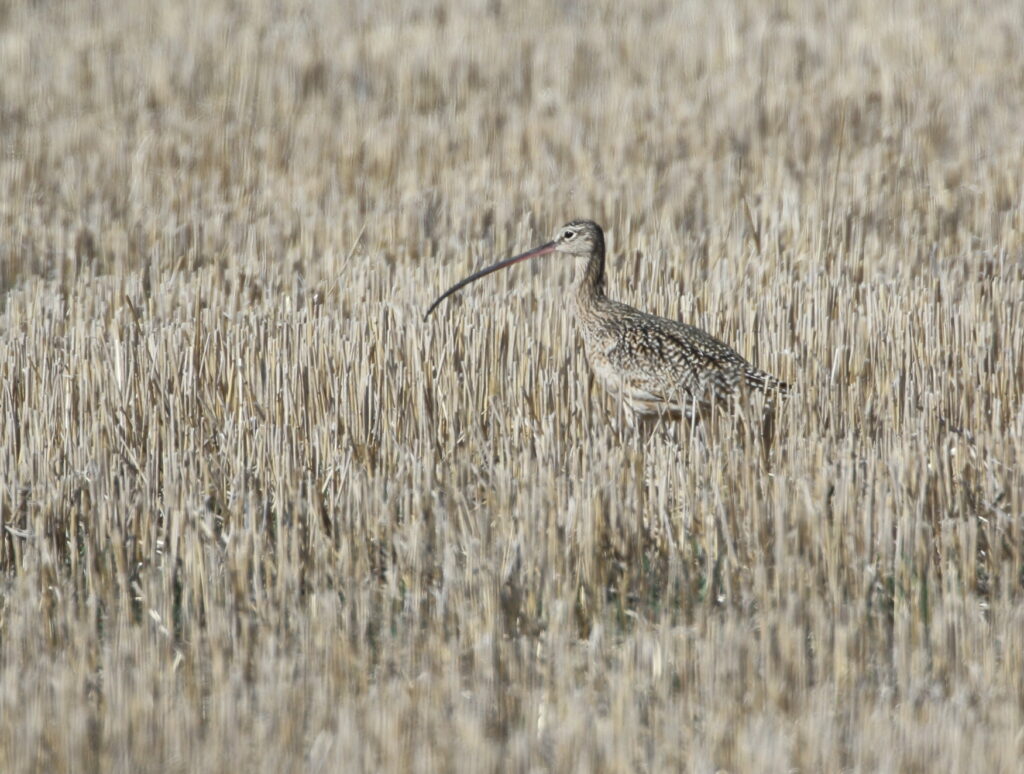
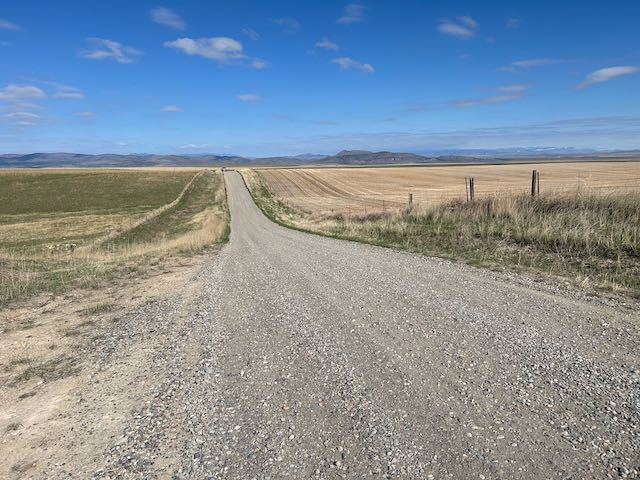
As I climbed up over the first “bench,” I smiled at the many Horned Larks and Western Meadowlarks singing along the road. After a couple of miles, though, I thought I saw a larger bird landing along a side road. Could it be a Burrowing Owl? I turned the minivan down this sketchy, rutted path and after a couple of hundred meters saw a large shape in a field. It wasn’t a Burrowing Owl, but almost as exciting—my first Long-billed Curlew of the year! This greatly interested me because Braden and I had never birded this road so early in spring and I didn’t realize LBCUs would already be here. Turning the van around, though, I spotted four more calling in flight, obviously ready to get busy breeding!

There is something magical about seeing a large, majestic shorebird setting up a breeding territory in our nation’s grassy heartland!

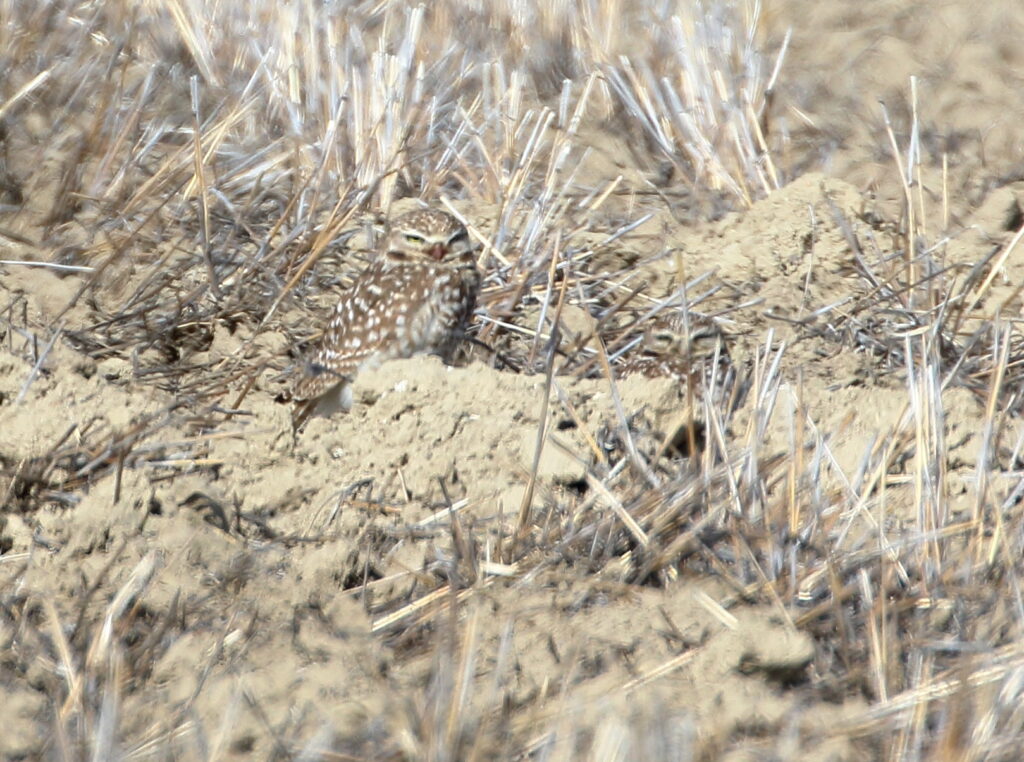
I also encountered the first of three women who were birding as a team in their own cars. She said she had spotted a couple of Burrowing Owls earlier and that one of her friends was up on Baseline Road (which tees off of Bench Road) at a BUOW burrow. I decided to head there, but before I reached it, saw a medium-sized brown shape flying low to the ground across a field. I hit the brakes and raised my binoculars. “Yes!” A Burrowing Owl! Not only that, a second one hunched down next to it. I snapped a poor photo from my car, but didn’t want to disturb them by getting out. BUOWs, though, are incredibly adorable animals and these two had obviously excavated a burrow here at the edge of a field. I hoped the farmer would notice them and not unknowingly evict them!

Come plowing time, I am hoping the owner of this field spots the burrow of this delightful Burrowing Owl couple.

I continued up the road and sure enough found the other burrow that was staked out by the friend of the first woman I had met. The owls didn’t show right away, but soon popped up for a distant view. These appeared to be in much safer habitat than the field of the first pair. After fifteen minutes, I started the minivan back up, wishing the owls luck and hoping Bench Road would be a home for them for years to come. On my way back down the road, I stopped at the marshy area for one last treat—a great, brief glimpse at a Virginia Rail!

Montana birding at its finest, cruising (almost) deserted prairie roads for amazing grassland birds.

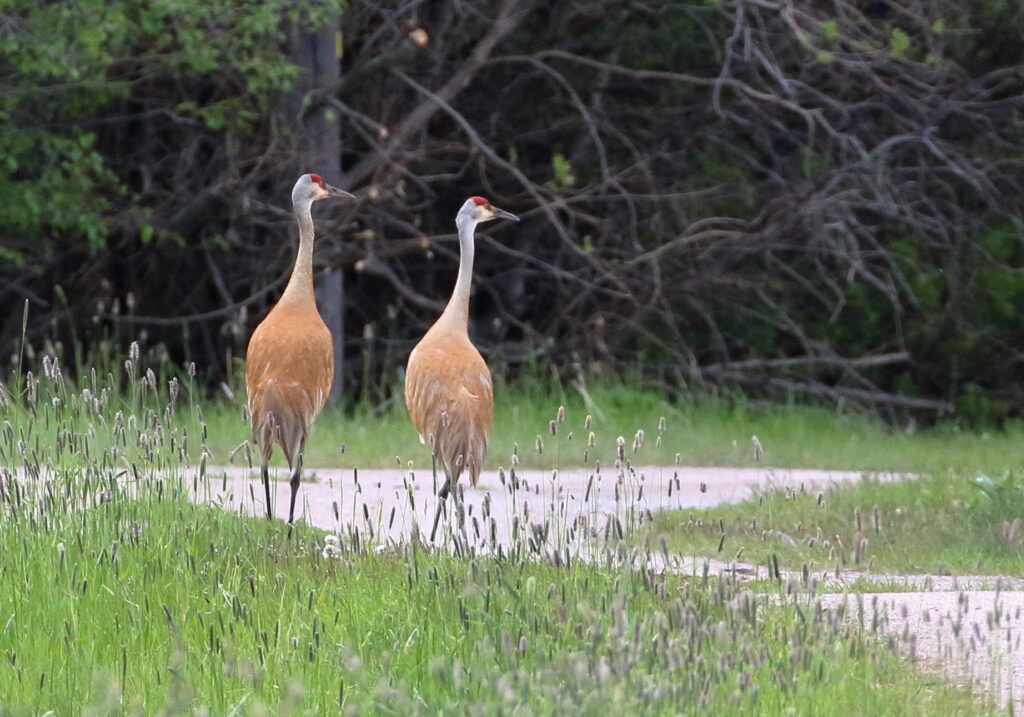
That evening in Butte, after my first talk at the conference, I paid my first visit to Butte’s Lexington Street ponds and wetlands, which were undergoing a major birder-friendly construction project. I set up my scope outside of a chain-link construction fence and saw a great variety of ducks, along with a Western Grebe—a bird that had never before been reported there! As I was packing up, I heard a familiar rattling call and turned to see two gorgeous Sandhill Cranes touching down a couple of hundred meters away. As wonderful as this all was, however, my spontaneous birding weekend had only just begun. Stay tuned for Part 2.

A teaser for our next post: Can you tell which white geese are of special interest and why? If so, send us your answers!

Birding Glacier National Park in “The Hot, Dry Winter” of 2024

Our thoughts go to all of the Californians getting hammered by unprecedented rains right now, and we hope that you are all staying safe—and preferably indoors. While the Southwest is getting one historic climate event, Montana has been getting another: record heat and dryness. Both of these add a heightened sense of urgency to tackling climate change by reducing greenhouse emissions and promoting renewable energy. And, of course, these events are certainly impacting birds. Last week, I had a chance to explore one of our nation’s most pristine areas to see what the birds are doing.

Even before I moved to Montana in 1996, I had visions of visiting the Many Glacier Valley in the depths of winter. In college, I had spent the best summer of my life working as a cook at Swiftcurrent Motor Lodge, and had returned to the valley many times since then—but never in our darkest, coldest season. What would this wonderland be like covered in snow and ice? Last week, almost fifty years after working there, I got a chance to find out. The only thing missing? Winter itself.

I had been invited to spend four days visiting with pre-K through grade 1 students in Browning, Montana, a trip I looked forward to for many reasons, including the chance to learn more about Blackfeet culture and explore the area. As a bonus, I would be working mainly in the afternoons, freeing up the mornings for birding and other activities. As the librarian and I put together the trip, however, I never imagined that I would be visiting during an unprecedentedly warm winter in which temperatures were breaking records daily and the landscape stood almost devoid of snow.

On the drive to Browning, I stopped at the Freezeout Lake wetlands complex near Great Falls and counted several thousand Canada Geese and Mallards. To my surprise, the geese were flagged as rare on eBird for this time of year. Why? Because the lakes are almost always frozen in January and February, but this year large areas of open water shimmered, inviting both geese and ducks.

The disturbing presence of open water at Freezeout Lake is attracting its share of Canada Geese and Mallards this “non-winter.”

Reaching the outskirts of Browning, I turned right for a side trip to Cut Bank. In a normal winter, this entire area would be covered in snow, providing a chance to find Snowy Owls, Snow Buntings, and other typical winter birds. Not today. Driving mud and gravel back roads, I was lucky to find a solitary Rough-legged Hawk on a telephone pole. I did flush one group of 15 smaller birds that I assume were Horned Larks, but nothing else of note. In fact, the main birds I was seeing were the stalwart ravens, magpies, House Sparrows, starlings, and pigeons.

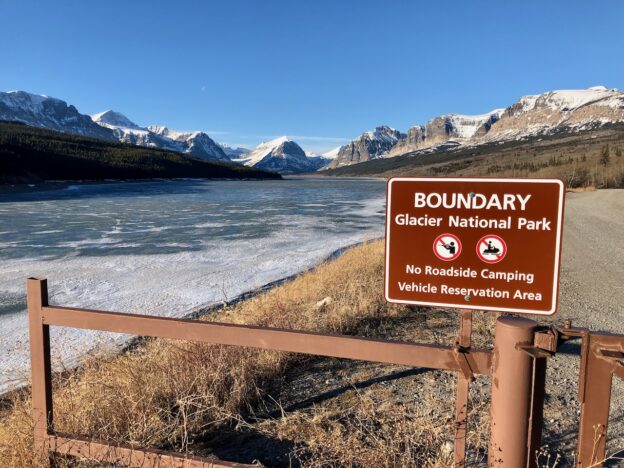
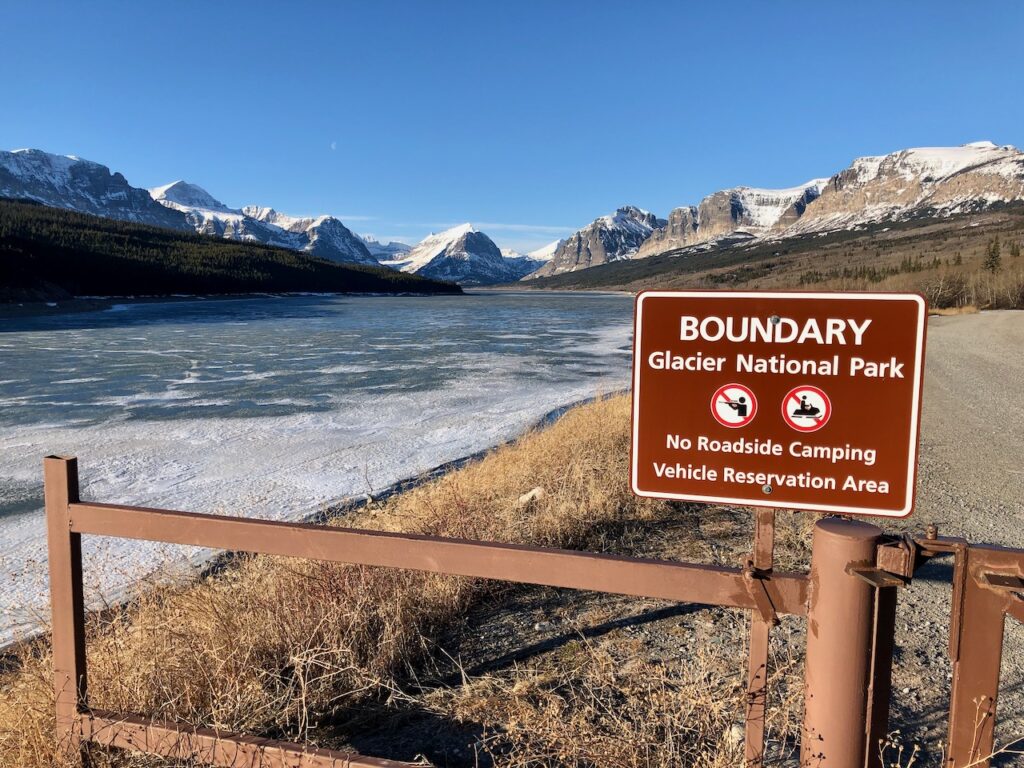
When Thursday rolled around, my birding hopes rose as I got up early and drove toward Babb, the entrance to the Many Glacier Valley on the east side of Glacier National Park. I had no idea how much of the road was open, but made it to the park boundary at Lake (reservoir) Sherburne dam. There, I parked and donned my camera and binoculars.

The Lake Sherburne Reservoir at the Glacier National Park boundary, where I began my jaunt into the Many Glacier Valley.

I couldn’t have asked for a more astonishing day. By 9:00 a.m., temps had reached into the mid-30s and were rising rapidly. Despite an extremely dry winter, a thin layer of snow covered the spectacular peaks of the continental divide and full sunlight created an unparalleled, dazzling landscape. As an extra “cherry,” a waning gibbous moon slowly sank toward 9,300-foot Mount Allen. I paused to take a deep breath and appreciate that I was probably the only person on earth observing this incredible scene. Then, I set out.

A raven greeted me as I stepped into the park, but I wondered if I would see any other animals. Would a grizzly bear be taking a mid-winter stroll on a day this warm? I didn’t know, but spotted no other critter as I walked half a mile along the reservoir. I didn’t have a great deal of time, so I turned around after 20 minutes, and as the day continued to warm, a few birds made an appearance. I heard Black-capped Chickadees and a woodpecker drumming in the distance. Then, a grouse burst out of some stunted aspen trees to my left. I desperately watched it flying away, looking for any ID clues, but alas, I just don’t know grouse well enough to be sure. The bird was gray, however, and the habitat was wrong for Ruffed and Spruce Grouse, rendering a 95% probability of Dusky Grouse, but since I wasn’t sure, I didn’t record it on eBird.

Despite the incredible scenery, I was feeling a bit thwarted bird-wise, and calculated that I had time for another hour of exploration, so I drove back out to Babb, turned left, and then left again on the road leading to the Canadian border and Waterton Lakes National Park. My mission? To find Boreal Chickadees! In fact, I was driving the very road where Braden and I had discovered our lifer BOCHs three years before (see post “Are you ready for . . . the QUACH?”). That had been during early covid days when hardly a soul traveled the road. Would I be able to find any birds today?

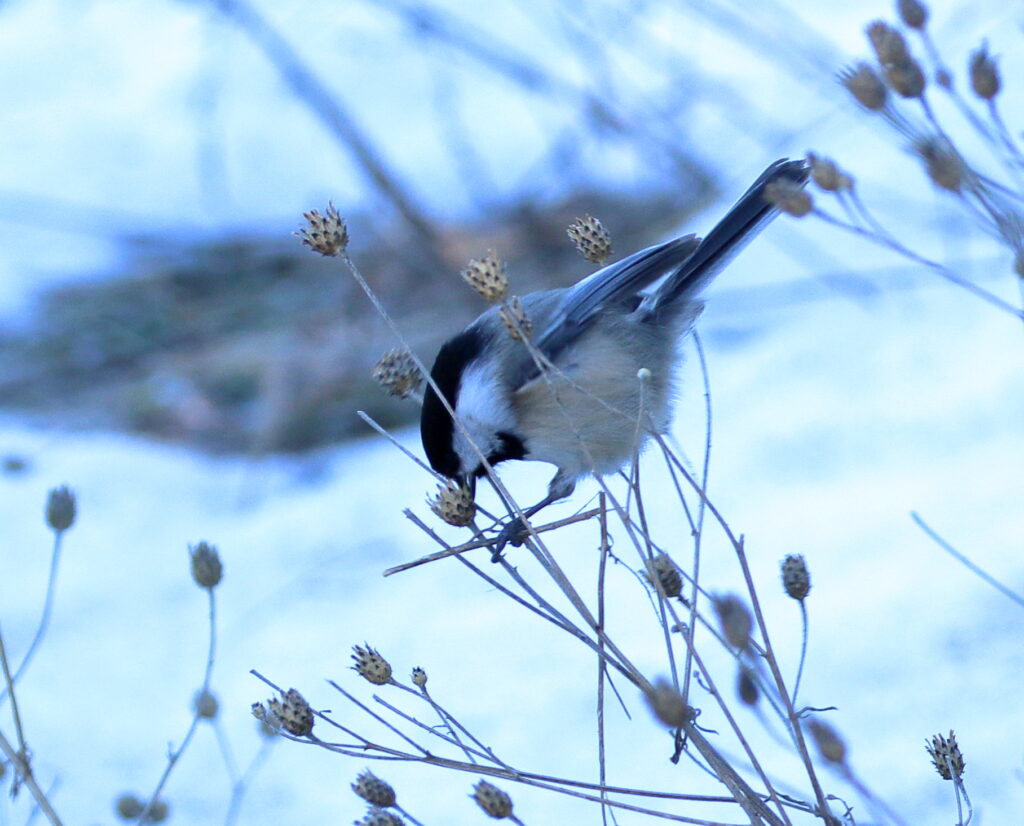
My first chickadee sighting along the road proved to be a mixed flock of Black-capped and Mountain Chickadees feeding on knapweed seed pods—perhaps for insect larvae. Cool, but not the object of my quest.

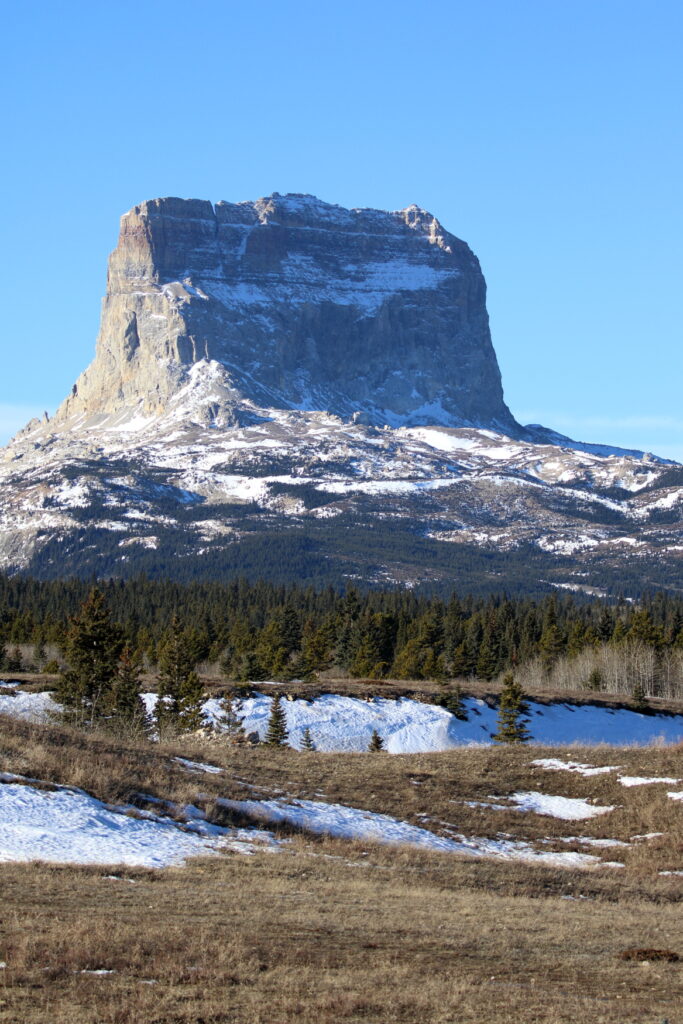
The road wound its way up through scenic pastures and aspen groves, climbing steadily until it reached conifers—all under the magnificent gaze of Chief Mountain. As before, I passed not a car along the way. I pulled over twice and played the calls of Boreal Chickadees, but no bird responded. Then, I actually saw a flock of chickadees up ahead and eagerly braked to a halt.

Not BOCHs. Instead, a mixed flock of Mountain and Black-capped Chickadees, with a Red-breasted Nuthatch joining them.

One of Glacier’s most iconic mountains, Chief Mountain stands watch over the northeastern part of the park, including the road up to Waterton Lakes National Park.

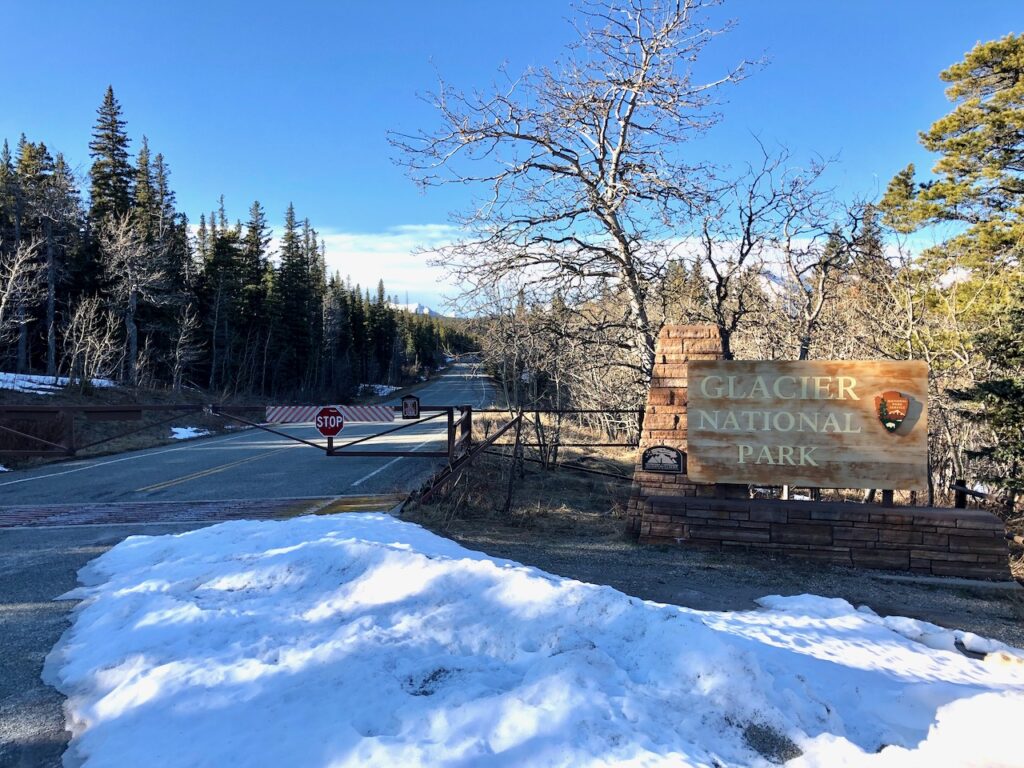
Undeterred, I continued, and soon stopped for another flock of Black-cappeds. I wondered how much exploring I had time for, but passed a Border Patrol truck and soon was forced to stop at the closed boundary of Glacier National Park. Turning around, I again parked to play a BOCH call with no luck. The Border Patrol truck approached and the agent rolled down his window for a chat. I told him what I was looking for and asked him if he saw many birds along this stretch. “Some Stellar’s Jays,” he answered, “but not a lot else.”

I thought the road to Canada’s Waterton Lakes National Park might be open, but alas, no. Fortunately, the chickadees were on my side of the boundary!

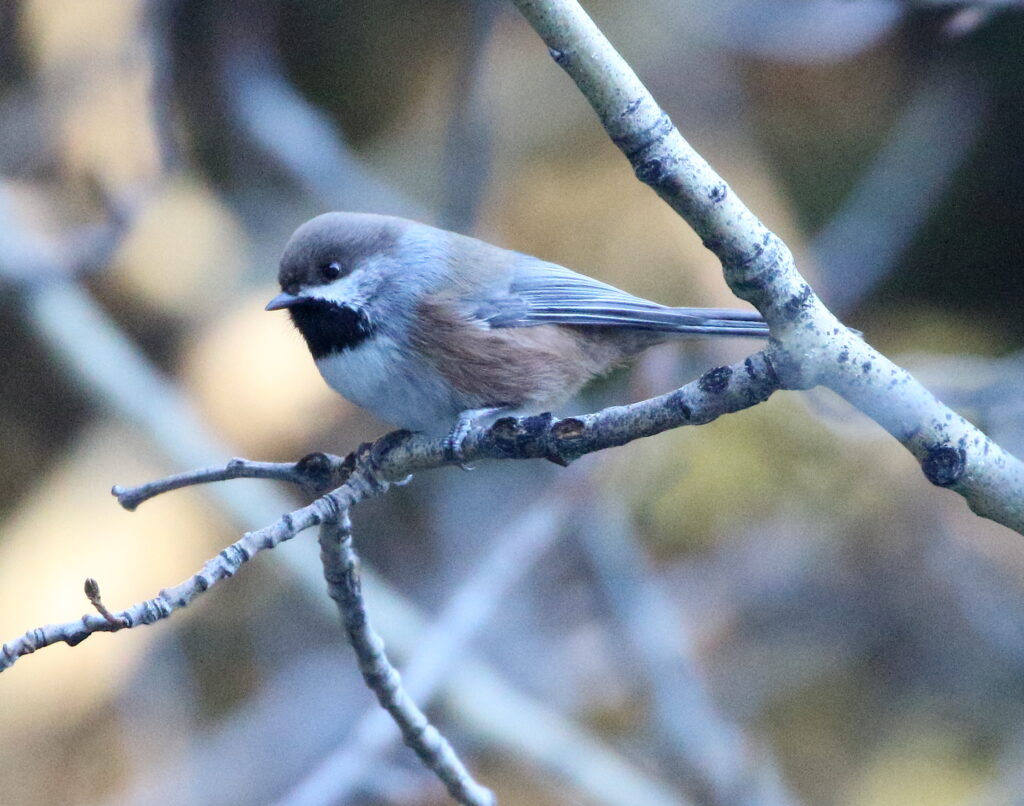
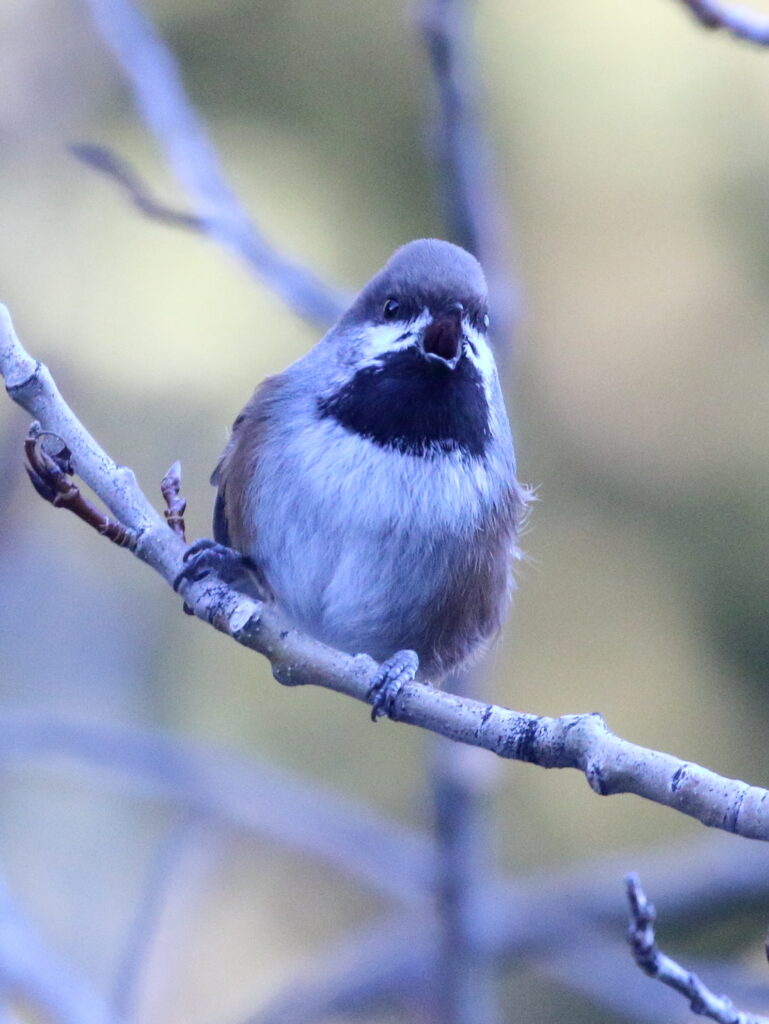
I wished him a good day and continued driving back toward Babb. Before the road began descending again, a large pull-out opened up on the left and I stopped one last time. Not expecting much, I played a BOCH song and made some pishing noises. Within moments, six chickadees surrounded me! Boreal Chickadees!

With their curiosity and handsome features, Boreal Chickadees may just seize the title for Most Delightful Chickadees.

The chickadees were much more curious about me than their congeners (animals in the same scientific genus, i.e. the Black-capped and Mountain Chickadees). The Boreal Chickadees flew back and forth above me and called from nearby branches. I even nabbed some decent photos. I spent ten or fifteen minutes with them, barely believing I was having such a great experience with these elusive, high-altitude and high-latitude songbirds. It once again renewed my appreciation for living and birding in Montana, since this region is one of the few places this species dips into the United States from its main distribution in Canada.

This Boreal Chickadee might have been auditioning for the Chickadee Choir with how much it called to me.

Feeling satisfied and grateful for such a marvellous morning, I headed back to Browning, spotting only a few ravens and Rough-legged Hawks along the way. No matter. The BOCHs and breathtaking views of the Many Glacier Valley had made this a day I would never forget. Now if we can only get some snow.

Our Official 2023 FSB Recap: Bird Names, Bird Clubs, and Lifers

2023 proved to be another wildly surprising year for the FatherSonBirding team. Not only did Braden and I see birds we never dreamed we’d see, but birding opportunities and the enthusiasm of our loyal FSB followers exceeded every expectation. But first, some 2023 stats:

Blogs Posted: 32

FSB Views: 9,361 (easily eclipsing last year’s record of 7,185)

Most Viewed Post: Avian Reveal: Our Five Picks for New Bird Names (598 views)

In addition to the above stats, we surpassed 30,000 lifetime blog views and have now published 174 posts since we began FSB in 2018. Even though this is far short of what is required to annoy you with paid advertisements, it’s still remarkable to us. When we began FSB, Braden and I thought we might keep at it for a year or two at most. Now, almost six years later, FSB has actually generated a body of work that we are immensely proud of. It’s been a way for us to share our adventures, promote birding, and connect with other birders. It’s also been a fun vehicle for educating others about birds and bird conservation. So let’s get to 2023’s highlights for each of us.

This stunning Spruce Grouse featured greatly in Sneed’s 2023 birding highlights!

Sneed’s 2023 Birding Highlights

Japan: Without a doubt, my biggest highlight of the year was taking my daughter, Tessa, to Japan for three weeks. Together, we created a lifetime of memories in a country we loved even more than we thought we would. As you all discovered with my posts about Tokyo, Kyoto, Kanazawa, and other places, I got in plenty of birding, adding 28 species to my Life List and getting to know more than fifty species of common Japanese birds. (Note that Kanazawa is near the epicenter of this morning’s 7.5 earthquake. We are thinking of all of you over there, and hope everyone is safe!)

One of my favorite Japanese birds, a male Daurian Redstart.

Birding Eastern Montana: Thanks to assignments from Montana Outdoors magazine, I had the opportunity to drive out to Westby with my childhood buddy, Scott Callow. We not only hit hotspots such as Bowdoin NWR, Plentywood, Makoshika SP, and Bear Canyon, we had a wonderful visit with FWP biologist Heather Harris who took us on an up-close-and-personal visit to some of Montana’s healthiest short-grass prairie. There, we got my best looks ever at Sprague’s Pipits, Chestnut-collared Longspurs, and other prairie residents.

Heading to Westby with my friend Scott was not only a great way to see great Montana birds, but a rare chance to catch up with a lifelong friendship!

Adding Montana Lifers: While in Westby, Scott and I saw my first Piping Plover in Montana, but during the rest of the year—and with the help of other Montana birders—I also added three species to my all-time worldwide Life List: Sagebrush Sparrow (Bear Canyon), American Golden-plover (Mission Valley), and Spruce Grouse (Mission Mountains).

This Sagebrush Sparrow was probably my favorite new ABA Lifer of 2023–and proves that great things can come in small packages!

In addition to the above highlights, Braden and I got to bird together several times, including a breakneck trip to Glacier NP with our buddy, Nick Ramsey. I also had the pleasure of meeting a lot of other Montana birders at Wings Across the Big Sky and the meeting of Flathead Audubon. At the beginning of 2023, I had entertained visions of breaking my Montana Big Year record with my work trips to eastern Montana—but didn’t. I came close, however, racking up 253 species, including my last two: Short-eared Owl and Northern Shrike on Braden’s and my last big Montana outing. And now . . .

Despite Braden and Nick’s busy lives getting educated and building their birder resumés, we all managed to squeeze in a quick 3-day trip to Freezeout Lake and Glacier National Park last summer.

Braden’s 2023 Birding Highlights

Eastern Songbirds: A long-time goal of mine has been to learn the eastern songbirds, specifically the eastern wood-warblers, by ear. This summer, thanks to my job doing point counts in the woods of northeastern Pennsylvania, I succeeded at that goal, solidifying nearly two dozen warbler songs in my mental repertoire, including those of Magnolia, Canada, Mourning and Golden-winged Warblers. Beyond that, I got to spend all of May and June, and some of July, romping around the forests of the Appalachians, learning about the ecology of all of these species. I fell in love with Golden-winged Warblers, with their specialized habitat needs and endearing personalities, and came to know not only the species of birds in these forests, but also the trees the birds were using. Highlighted by a trip to Cape May and a trip to the Adirondacks, my summer in Pennsylvania may have taught me more about the natural world than any summer I’ve lived through yet!

Getting to know Eastern warblers—including Golden-winged Warblers—fulfilled a long-held ambition of mine.

Western Field Ornithologists Conference: In July, I said goodbye to my co-workers and the woods of Pennsylvania and flew across the country to Denver, Colorado, where I was picked up by one of the members of the board of Western Field Ornithologists (WFO). There started my week-long, high-energy stay in the alpine zone of Colorado, where I proceeded to not only see hordes of birds (including two lifers, Virginia’s Warbler and Brown-capped Rosy-finch) as well as meet a variety of people of all ages, who had converged at the WFO annual conference thanks to their passion for birds. During this conference, I got to hang out with a squadron of young birders from California and meet people like David Tonnessen, a native Coloradan guide, Nathan Pieplow, one of North America’s leading experts on bird sound, Ted Floyd, the editor of Birding magazine, Chris Wood, one of the founders of eBird, and Jesse Barry, one of the lead developers for the Merlin app. It was a whirlwind week, during which I bushwhacked through alpine tundra in search of White-tailed Ptarmigan and Dusky Grouse (only the latter of which we saw), scoped distant prairie potholes for shorebirds, and trekked through spruce-fir forest in the dark of night in an attempt for Boreal Owl. I’ll be sure to attend more of these conferences, whenever I am able to!

Starting the UMaine Birding Club: Last semester, several people told me that if the University of Maine had a Birding Club, they would join. This year, after a few MORE people told me that, I just decided to buckle down and start one. Our first meeting, which took place on September 14th, was a raging success, with more than thirty people filling the classroom I’d reserved to hear me give my elevator pitch for the club. After a ten-minute talk, we headed out across campus in search of fall migrants, which we found in the form of a Ruby-throated Hummingbird and several Cape May Warblers. The rest is history. I put on twelve meetings this year, and led twelve outings as well. I made sure that our meetings were diverse, with some days featuring guest lectures about bird jobs or indoor bird scavenger hunts and others pitting club members against each other in Bird Jeopardy. My personal favorite was a thirty-minute talk I gave on everything wrong with the state birds, and we finished out the year last Thursday with a movie night featuring The Big Year. Our outings, highlighted by one trip to Sebasticook Lake and another to the coast, tallied ninety total species, including Sandhill Cranes and an American Goshawk, which both became “Bird of the Day” on their respective trips. Overall, starting a Birding Club was one of the most meaningful things I’ve ever done and I can’t wait to jump back into it next fall—after I’ve returned from studying abroad in Costa Rica!

Quizzing the UMaine Birding Club on bird vocalizations!

So that’s a wrap, people. Braden and I want to thank you for tuning in and sharing your enthusiasm with us, and we hope that 2024 brings you a rewarding year of seeing, learning about, and protecting the animals we all love.

Avian Reveal: Our Five Picks for New Bird Names

We had planned to publish this post on Thanksgiving, but were in Minnesota and the “auto publish” tool failed—and not for the first time. Still, we hope you enjoy this post-Thanksgiving post, and even more, we hope you all had a lovely long weekend with friends and family. Braden and I have much to be grateful for—including you, our faithful readers—and thank you for your interest and enthusiasm over the years. Now get out there and bird!

Lest you think the birding community is immune from internecine disputes, I present to you two issues that have been roiling birders for the past decade: the woeful situation of horrible state bird choices, and the more recent—and contentious—decision by the American Ornithological Society to begin changing English language common names of all birds named after people. Braden recently addressed the disgraceful situation surrounding our state birds in his post “Getting Serious About State Birds”. Today, I’d like to tackle the AOS’s earth-shaking naming decision.

If you’re a birder, you pretty much have to be living under a rock not to know about this recent shocker. A complete, explanatory news release can be found here, but basically, the American Ornithological Society has long assumed responsibility for the English language common names of all American birds. After years of debate, it has decided to axe all eponymous bird names—those honoring specific individuals. This decision has triggered several immediate results. One is to improve the vocabulary of millions of Americans (myself included) who have had to look up the word “eponymous” in the dictionary. The second is to unleash a foaming volcano of vitriol as birders across America—nay, the world—have vigorously defended and attacked the new policy.

I’ll just come out and say that both Braden and I generally support the AOS decision, but as with most things, the matter is more nuanced than passionate social media posts lead you to believe. There’s no question that certain eponymous names can be deemed offensive, but there are plenty of others that you have to try really hard to be offended by—and it’s a shame we have to chuck the baby out with the (bird) bath water. Unfortunately, failing to do so would ignite endless, often pointless debate about each and every eponymous bird name that exists. All of that time, energy, and money is better spent protecting birds rather than debating their names, and so the AOS wisely decided to wipe the slate clean.

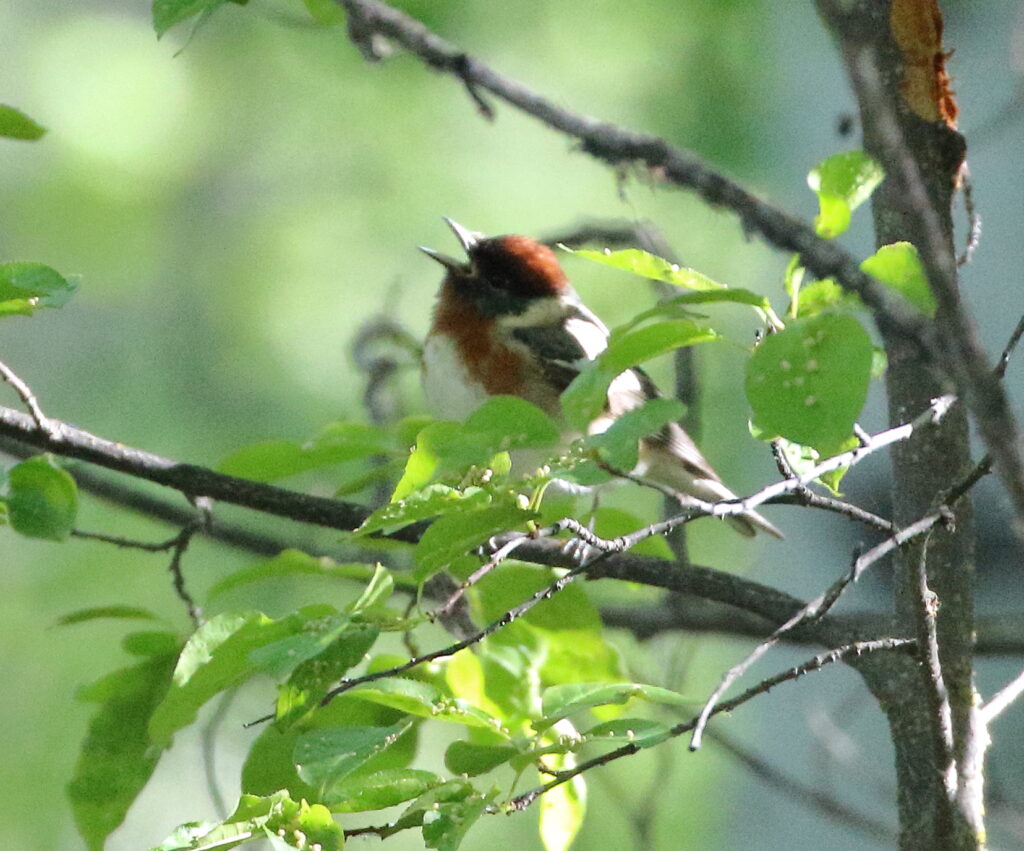
Rather than add to the already burdensome body of opinion flooding the media, Braden and I decided it would be fun simply to pick five of our favorite Rocky Mountains birds that will be impacted by this decision—and try to come up with the perfect new names for each. We hope you will weigh in with your own (non-offensive) thoughts about our choices, as well as your own (non-offensive) alternatives. We will start with perhaps our favorite North American warbler—and perhaps the most difficult to rename.

MACGILLIVRAY’S WARBLER

One of the ironies of MacGillivray’s Warbler is that it was named after an 18th-century Scottish ornithologist who devoted much of his life to, you guessed it, coming up with better names for British birds! Names such as Red-throated Thistlefinch, Quaketail, and Provence Furzeling—none of which survived the test of time. MacGillivray was a controversial figure and apparently offended almost everyone during his lifetime, but that didn’t stop John James Audubon from naming one of our most spectacular American warblers after him. I mean, just look at this bird. He’s not as showy as some others, but his colors are refined, sophisticated. Any lady of quality will recognize it—and if his looks don’t do it, his sweet sophisticated song will clinch the deal. Braden and I always stop when a MGWA pops out of a bush, and we’re not the only ones. But what should the AOS call it?

The bird breeds in shrubby places, often near streams or in recent burn areas, but somehow Shrubby Warbler or Second-growth Warbler don’t seem deserving of this special bird. As far as its looks, Hooded Warbler and Mourning Warbler are already taken—and honestly, aren’t all that great anyway. The partial white eye rings stand out, and are an identification key, so perhaps Crescent-Eyed Warbler? Its hood also gives off a velvet or satiny sheen, so Velvet-hooded Warbler? Quicksilver Warbler? Silver-headed Warbler? After much agonizing, we have landed on Satin Crescent-Eye. Of the five birds included here, this one poses the toughest challenge, so we’d love to hear your suggestions!

CLARK’S NUTCRACKER

When William Clark, of the famous Lewis and Clark Expedition, first saw a Clark’s Nutcracker, he thought it was a woodpecker. However, that didn’t prevent the bird from becoming one of the most iconic species of the West. Clark’s Nutcrackers are especially known for planting high-altitude pine forests—especially those of the White-barked Pine. Each bird caches thousands of pine seeds, far more than it can use, and the overlooked seeds sprout into new forests. The birds and trees are so interconnected that the pines have actually evolved changes in the shapes of their seeds and cones that facilitate dispersal by the nutcracker. Because of this important and fascinating relationship, Braden and I hereby vote to bestow the bird with the name Whitebark Nutcracker. Long live the nutcracker!

LEWIS’S WOODPECKER

Despite the rather embarrassing ID mistake with the Clark’s Nutcracker, the Lewis & Clark Expedition did end up being honored with a woodpecker after all—the Lewis’s Woodpecker. Renaming this bird has engendered spirited debate on Facebook and elsewhere, perhaps because Lewis’s may be America’s most stunning woodpecker. With a green back that often looks black, a subtle gray collar, and an absolutely spectacular watermelon-colored breast and face, the bird has inspired a host of potential names such as Glamorous Woodpecker, Pink-and-Green Woodpecker, and Silver-scarfed Glossy Woodpecker. To us, these kinds of names seem a bit plebian and uninspired. Not only that, the decline of the species is most closely related to the loss of a particular type of tree, so why not bestow a name that involves some education as well? Because of this, we officially propose—nay, insist—that this bird henceforth be called the Cottonwood Woodpecker.

TOWNSEND’S SOLITAIRE

Both Townsend’s Solitaire and Townsend’s Warbler—not to mention at least half a dozen mammals—are named after noted 19th-century naturalist John Kirk Townsend. Townsend came from an ardently anti-slavery Quaker family and accompanied renowned botanist Thomas Nuttall (Nuttall’s Woodpecker) on an 1834 expedition across the Rocky Mountains to the Pacific. During this time, Townsend collected numerous specimens new to Western science—including, coincidentally—MacGillivray’s Warbler! As if all that wasn’t enough to make us love Townsend’s Solitaires, this is a bird that symbolizes the onset of winter, as it descends to our neighborhood after its mountain breeding season. Add to that its lively, musical song and subtle good looks, and the bird has had no trouble flying into our hearts. The AOS decision also gives us a chance to bestow the perfect, slam-dunk name on the bird: Silver Solitaire.

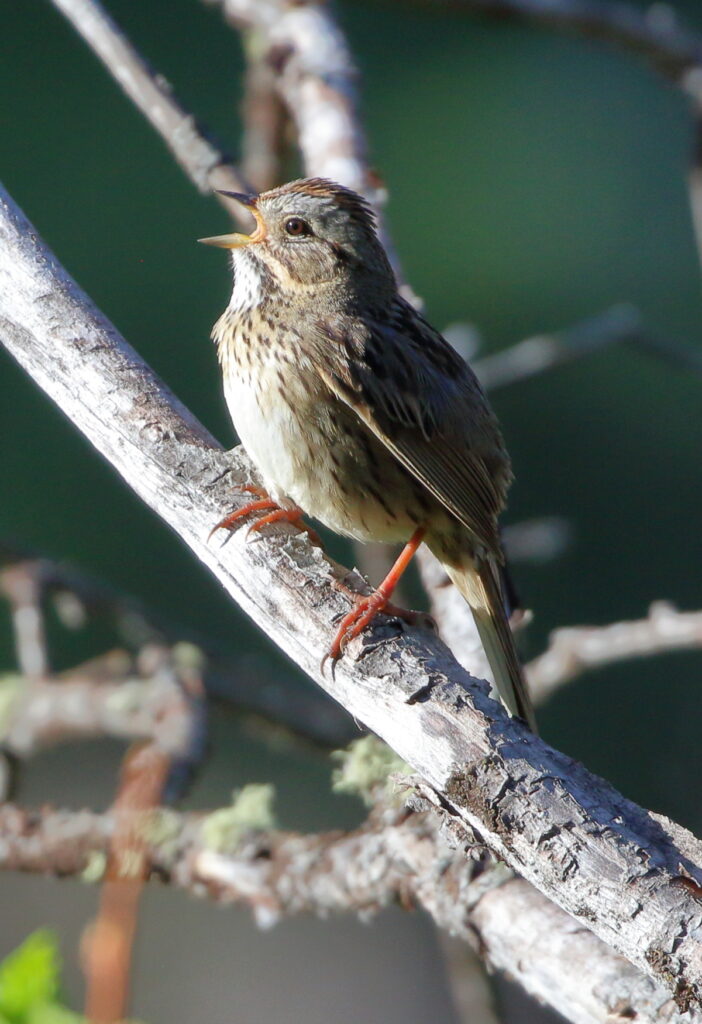
LINCOLN’S SPARROW

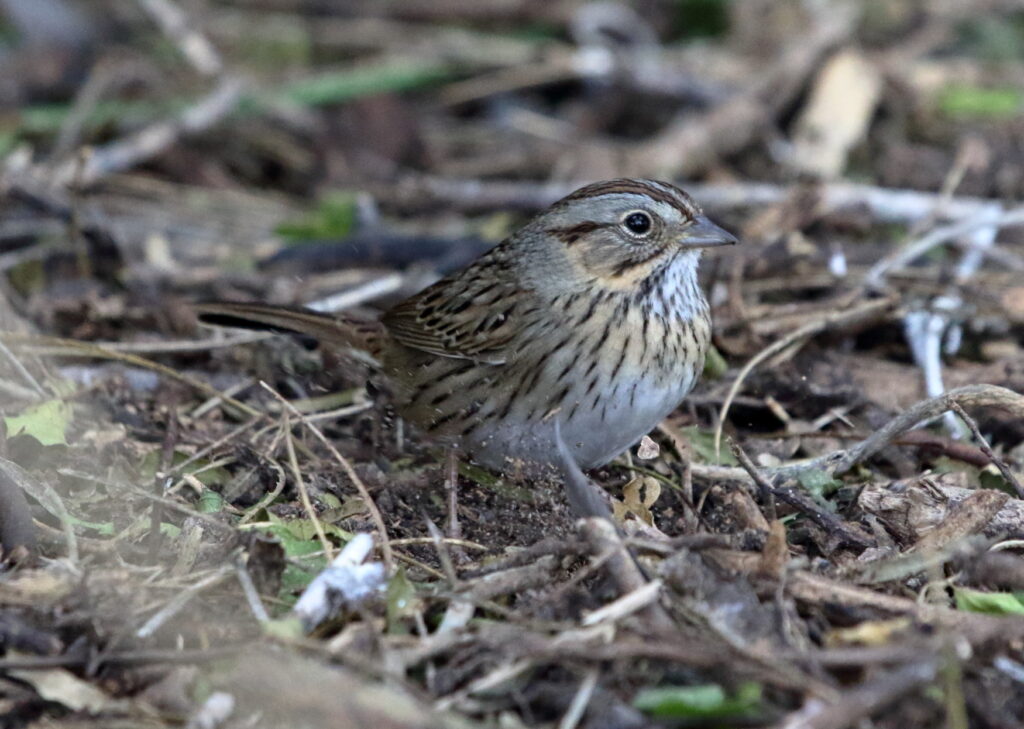
You might think that if ever a bird deserves to keep its eponymous name, it’s got to be Lincoln’s Sparrow, right? I mean who can argue with the president that consistently sits atop the list of greatest presidents in our nation’s history? Alas, the bird isn’t named for that Lincoln. Instead, Audubon named it after the 21-year-old son of a friend, Thomas Lincoln, who accompanied him on an expedition to Labrador, Canada. Audubon had not seen a Lincoln’s Sparrow before, but when one popped up, Thomas Lincoln immediately shot it with a slingshot. Even with that fairly bittersweet story, Lincoln’s Sparrow rules our favorite sparrows list.

This bird exudes charm. It breeds in boggy habitats, usually among willows and often near taller perching trees. It sings a complex, multi-part composition that brightens any landscape, and will often pop out on a branch to give birders excellent viewing experiences. Though subtle, its colors are striking. A yellow wash on its breast and “moustache” contrast most beautifully with its gray and rufous head and white eye ring. The subtlety of its colors, however, and superficial resemblance to other sparrows, makes the bird particularly challenging to rename. Swamp Sparrow, after all, is already taken. Our friend, ornithologist Dick Hutto, suggests Willow Sparrow and that’s not half-bad, but we feel the bird deserves something more inspiring. We therefore dub it . . . Autumn Sparrow! This name not only matches its colors, but coincides with one of the two seasons when many U.S. birders have their best shot at seeing the bird since it can only be found in most states during migration.

So that’s a wrap. We’ve done the heavy listing for the AOS on some of America’s favorite birds. Now, the committee will just have to roll up its sleeves and figure out the other 75 or so species on their immediate list! Braden and I wish them good luck—and if they run into trouble, they know who to call. Our rates are very reasonable.