Tag Archives: flycatchers

Swift-ecta!

In an earlier post, we may have let slip that both Braden and I are on a tear for our 2025 global species lists (see our post In Search of the Green-tailed Towhee). That’s due to a variety of factors. Braden not only drove across the country from Maine to Montana this past spring (see last post), he embarked on intense birding trips to Oaxaca, Mexico (see post Birding in Oaxaca, Mexico) and Costa Rica. As for me, I received delightful last-minute invitations to Colombia (post Antpittas and Tody-Flycatchers), thanks to FSB contributor Roger Kohn, and to Texas, where I spoke about my book Birding for Boomers. The upshot of all this is that Braden has seen almost 800 species of birds this year, while I am within twenty birds of breaking my all-time record of 527.
The thing is, twenty birds in Montana in late July is more challenging than it sounds. Birds common in May or June become increasingly difficult to detect and find, so if you don’t have them by August you may not get them at all. That means you’ll have to rely on migrants—which are notoriously unpredictable—or winter arrivals that you probably got earlier in the year. As a result, I’ve recently been focused on picking up the remaining common birds that I so far haven’t seen. Top on my list? Say’s Phoebe.

Last year, I saw a Say’s Phoebe near the base of Missoula’s Pattee Canyon. Alas, that one eluded me this year, forcing me to search farther afield!

Say’s Phoebes are cool little flycatchers that love to nest on human-made structures such as barns, covered porches, and utility buildings. While not rare, they seem to be pretty picky about their accommodations, and we run into them only infrequently in Montana. As I write this, for example, only four sightings have been reported in Missoula County in the past month. While scouring eBird, though, I did note regular sightings up at Kerr Dam below Flathead Lake. Braden and I had discussed doing a birding day trip, so two Tuesdays ago we set out early, Say’s Phoebes our Number One goal.

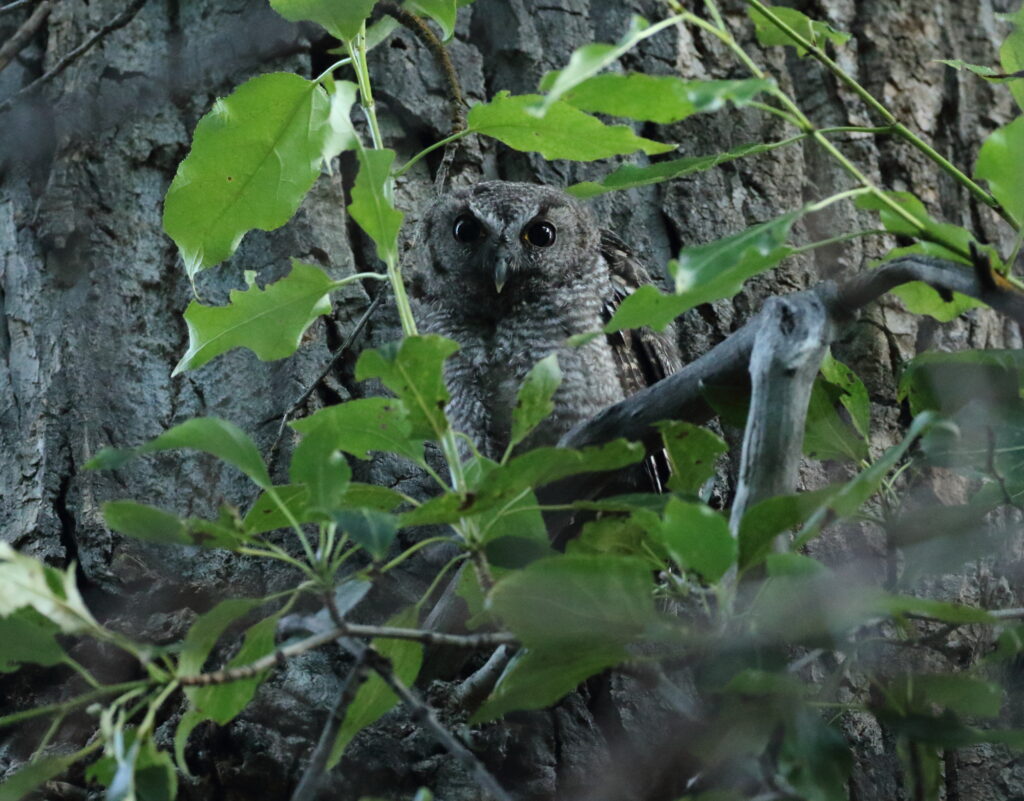
Before leaving Missoula, Braden asked if we could stop at Greenough Park. He had been pursuing a birding challenge with friends back East to see how many species they could find every day for seven days in a row. “I want to pick up Lazuli Bunting and Swainson’s Thrush,” he told me. This search happened to lead to the first delightful surprise of the day. As we were walking up a dirt trail, we approached a cottonwood tree where Braden had found a Western Screech Owl two days before. Today, he suddenly exclaimed, “Oh my god! It’s a baby!” Sure enough, a WSOW baby sat only a yard from its parent about twenty feet up the tree. Here, our day had just begun and already it had been a wonderful outing!

This adorable little guy was the first baby Western Screech-Owl Braden and I had ever seen!

Still, we had a lot of ground to cover. After a fortifying meal at our favorite French restaurant, McDaniels (in honor of Rogére), we headed up to Ninepipe NWR. We didn’t have any major agenda there except perhaps to snag some shorebirds. For July, it was an unusually cool, overcast day and we joked that we might see some Black Swifts. For those unfamiliar with Black Swifts, they are one of the most elusive and rare birds in the US. They nest mainly behind waterfalls and, especially with climate change, are highly vulnerable throughout their range. In Montana, I had never seen one outside of Glacier National Park, and it was pie-in-the-sky logic to even hope we might see one here out in the valley.

Braden poring through intermolt ducks at Ninepipe.

Anyway, we stopped at one Ninepipe pullout just off Hwy 93. The ducks were in their almost-impossible-to-identify intermolt plumages, but we still saw a nice variety of them plus Trumpeter Swans, American White Pelicans, Double-crested Cormorants, and Great Blue Herons. “Where are the Black Swifts?” I pressed Braden, but he shrugged off my flippant remark.

Though we hadn’t seen any Black Swifts, the low cloud cover at least admitted the possibility that they would venture down into the valleys from their mountain waterfall hideaways.

The phoebes on our minds, we didn’t want to spend too much time at Ninepipe, but decided to stop at one more pullout and, again, found the usual suspects. We both searched the skies for Black Swifts just in case, but didn’t see any. “I have to go to the bathroom,” Braden said, and I kept looking around for various birds. As soon as Braden emerged from the outhouse, however, he shouted, “Black Swifts!” Huh? My eyes darted back toward the low clouds, and there they were—four unmistakable dark shapes scything through the air!

Black Swifts were a stunning find on a day for which we had almost no expectations.

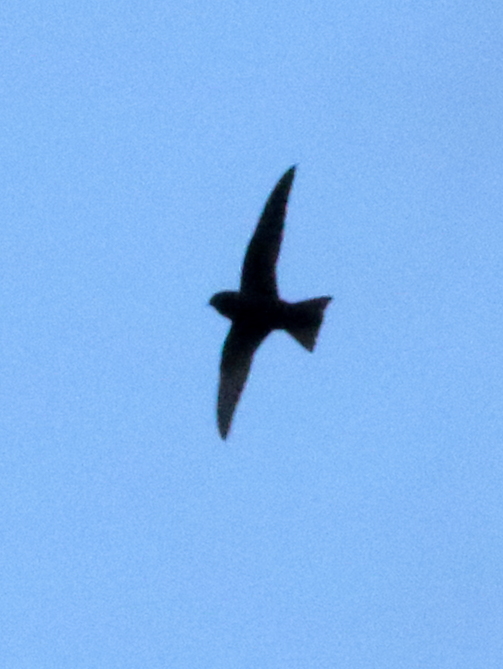
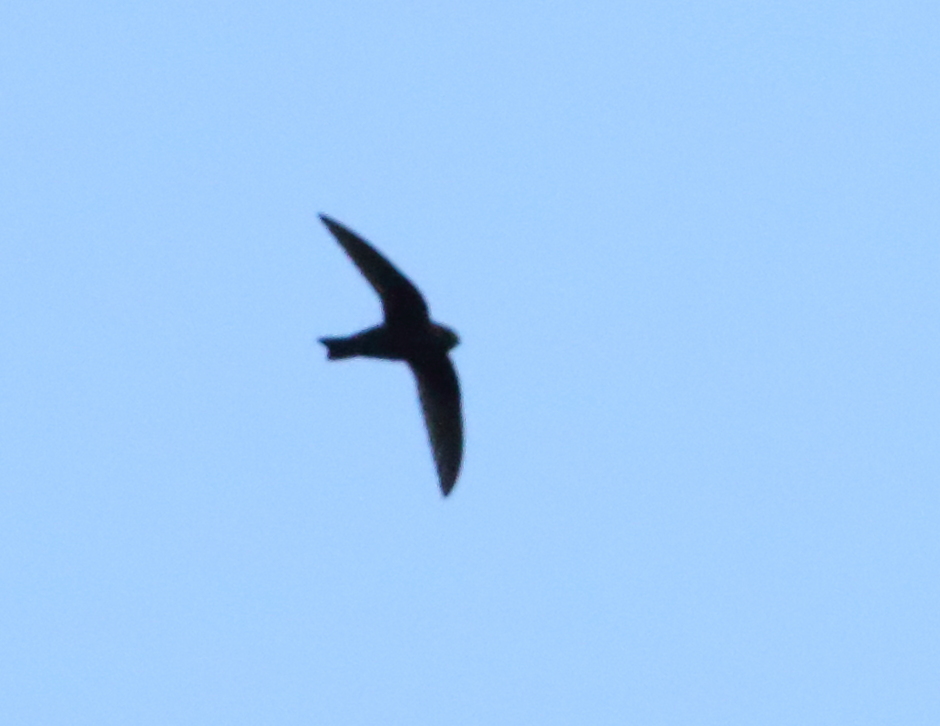
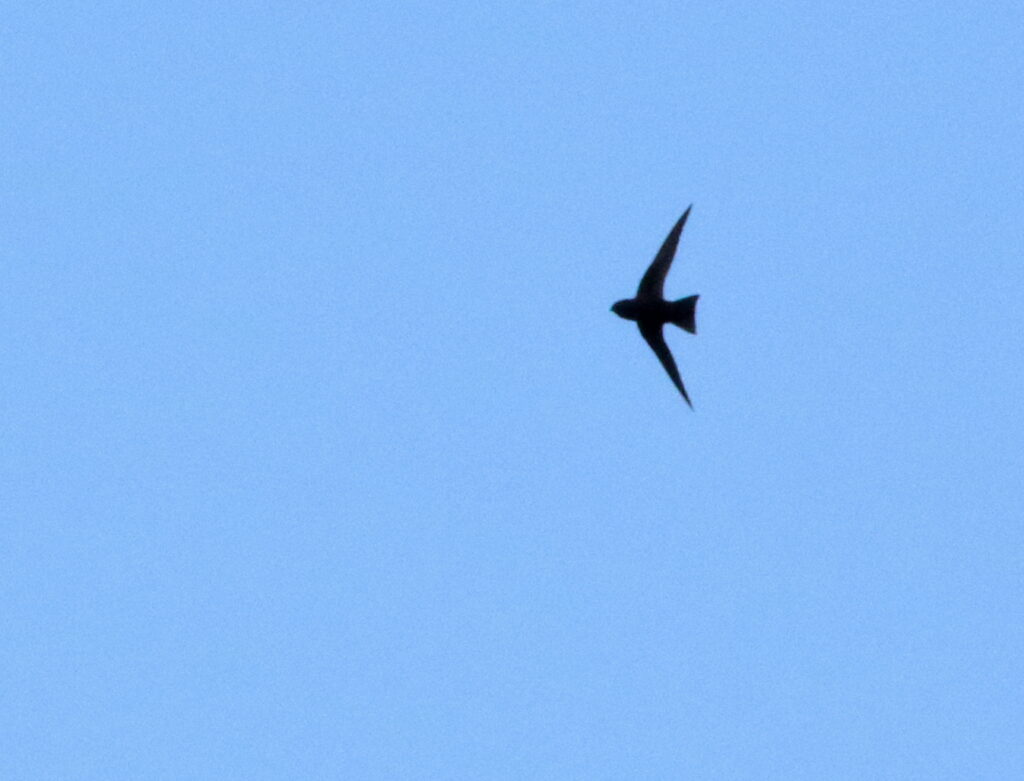
Though I’d seen Black Swifts before, this was my first time really getting to study them, and I noticed both similarities and differences between other swifts. Like other swifts, BLSWs have distinctive almost sickle-like shapes when they fly. With a wingspan of eighteen inches, however, they are significantly larger than Montana’s other swifts, and this shows in their flight. While Vaux’s Swifts zip around with almost mechanically stiff rapid wingbeats, Black Swift wings bend more noticeably. They still look like advanced jet fighters as they zoom through the sky, but with more flexible bodies. Braden also pointed out that Black Swifts show noticeable forks in their tails compared to Vaux’s Swifts, which look like their tails have been chopped off with a cleaver.

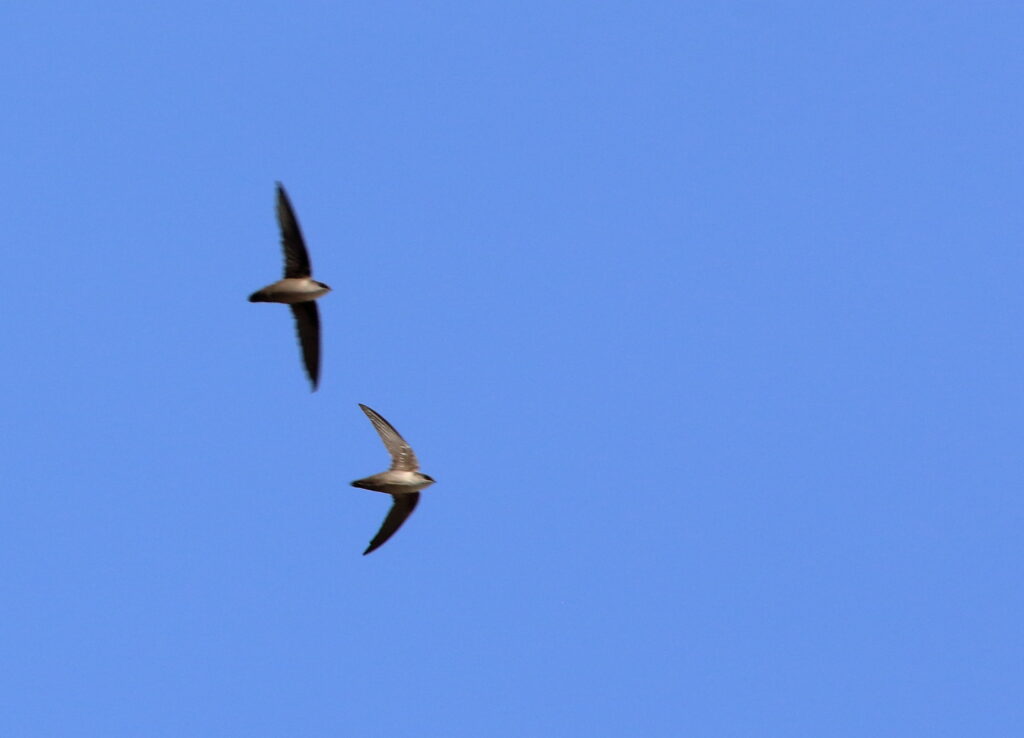
Swifts can usually be distinguished from swallows by their stiff-winged, scythe-like silhouette. Note the prominent fork in the tail of this BLSW that distinguishes it from Vaux’s Swifts—though White-throated Swifts can also show a fork.

We watched these rare beauties for a full five minutes before they drifted away across the lake and I even managed some cool photos. After they had gone, Braden and I just looked at each other. “Black Swifts,” he said, and we gave each other a hug.

Swifts always remind me of fighter jets—captured here doing an F-35 impersonation.

Remarkably, it was still only 8:30 and we had a ton of birding ahead of us. Our next stop was the roadside rest stop just south of Ronan where we picked up lone Semipalmated, Spotted, and Solitary Sandpipers, along with a pair of Long-billed Dowitchers, all undoubtedly in migration. After that, we headed to Pablo NWR in hopes of some interesting water birds. We struck out on those—but were amazed to see more than 300 Bank Swallows resting on the dirt road. “They must be migrating, too,” Braden marveled, and I agreed. In fact, it has been a very lucky swallow year for both of us with, for example, great looks at large numbers of migrating Tree Swallows and Cliff Swallows. This was the first time we’d ever seen Bank Swallows in such numbers, though. From there, it was on to our primary destination: Kerr Dam.

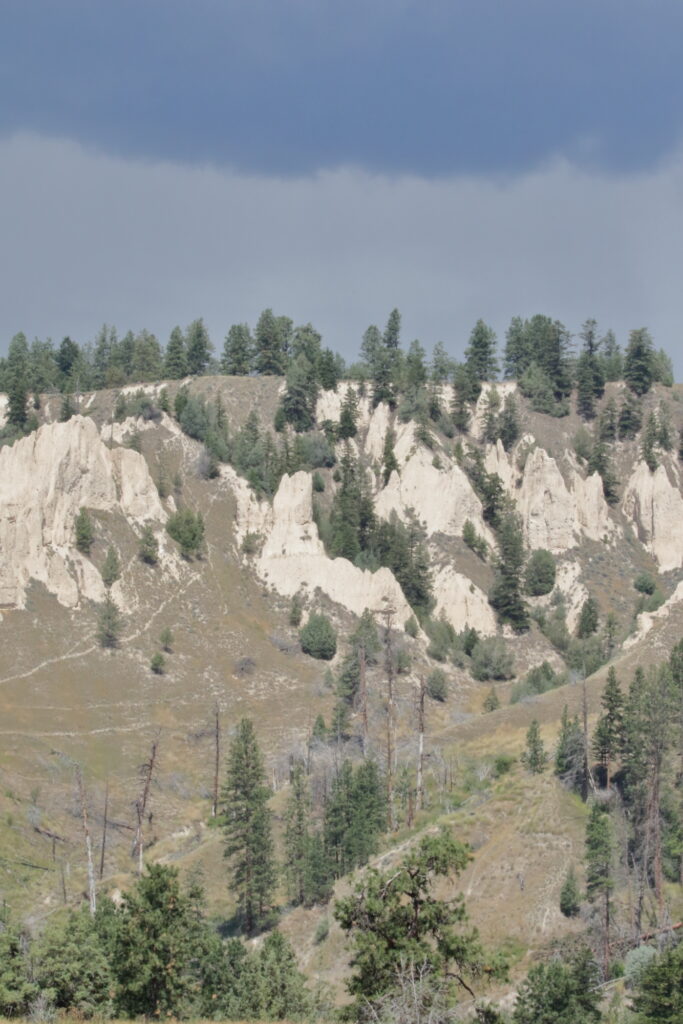
Braden had never been to Kerr Dam before, and I’d just gone to the overlook, but the entire site reminded me of a throwback to gentler, more civic times, when people shared more of a vision for the common good. From the overlook, we looked down on the dam itself with the Flathead River backing up into Flathead Lake beyond. Below the dam, dramatic, highly eroded cliffs framed a dramatic canyon full of promising riparian habitat.

Braden and I both wondered what secrets the dramatic cliffs below Kerr Dam might be hiding!

From the overlook, we watched Ospreys and Braden said, “Look, there are some Violet-green Swallows. White-throated Swifts should be here, too.” Not two minutes later, he spotted a pair flying overhead, their sickle-shaped wings and white breasts clearly visible against the blue sky. “Uh-oh,” I said. “That means that we might have to go for the Swift Trifecta and find some Vaux’s Swifts.” Braden sighed in agreement. Darn those swifts!

But we had not forgotten our main target, Say’s Phoebes. “I’m guessing they are down there at the power station below the dam,” I said. “You up for going down there?”

“Sure.”

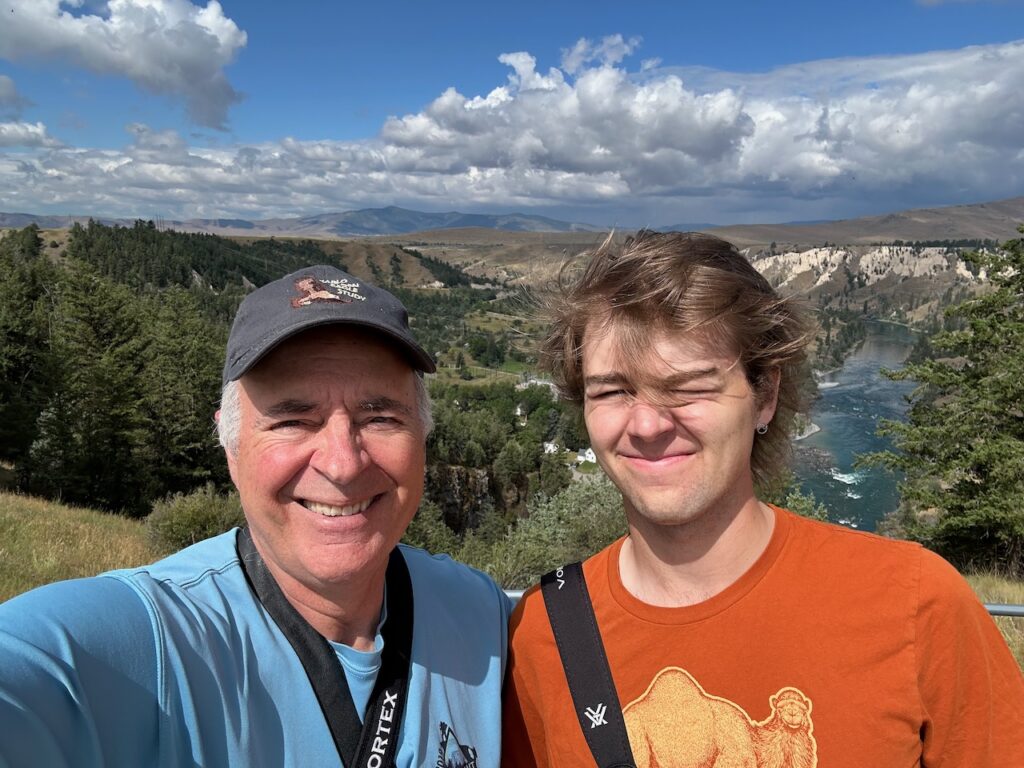
Squinting into the sun at the overlook to Kerr Dam, the Flathead River running south below the dam in the distance.

Winding our way down to the power station, we were greeted by a cluster of neatly-kept houses and a fenced-in area full of transformers and other “power stuff.” All of this was surrounded by an open, pleasant park-like setting that reminded me of my days working on the Pitt River dam network in northern California just after college. We decided to get out and walk around and immediately started seeing and hearing Western Wood-Pewees, American Goldfinches, robins, Eastern Kingbirds, and other songbirds. We hadn’t walked ten minutes when suddenly, some kind of flycatcher darted out in front of us to snag an insect.

“Say’s Phoebe!” I exulted, and Braden gave me a high five. There weren’t just one, but two, working the area around the fenced-in transformer area. “This is perfect for them,” I said. “Lots of insects and plenty of structures to nest on.” Alas, they didn’t care for our attentions and kept flying away as we approached, but they and the Black Swifts brought my global year total to 509 species—just nineteen shy of breaking my record of 527. Braden already had the phoebe for the year, but the Black Swifts took his global 2025 total to an astonishing 776 species! BUT . . .

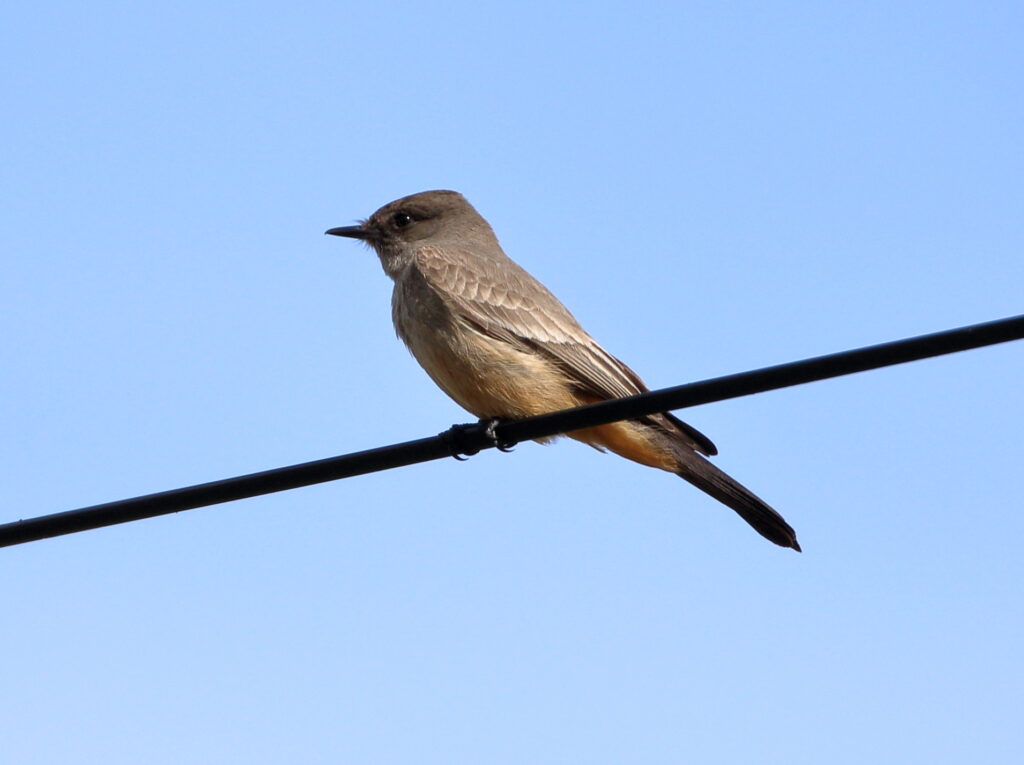
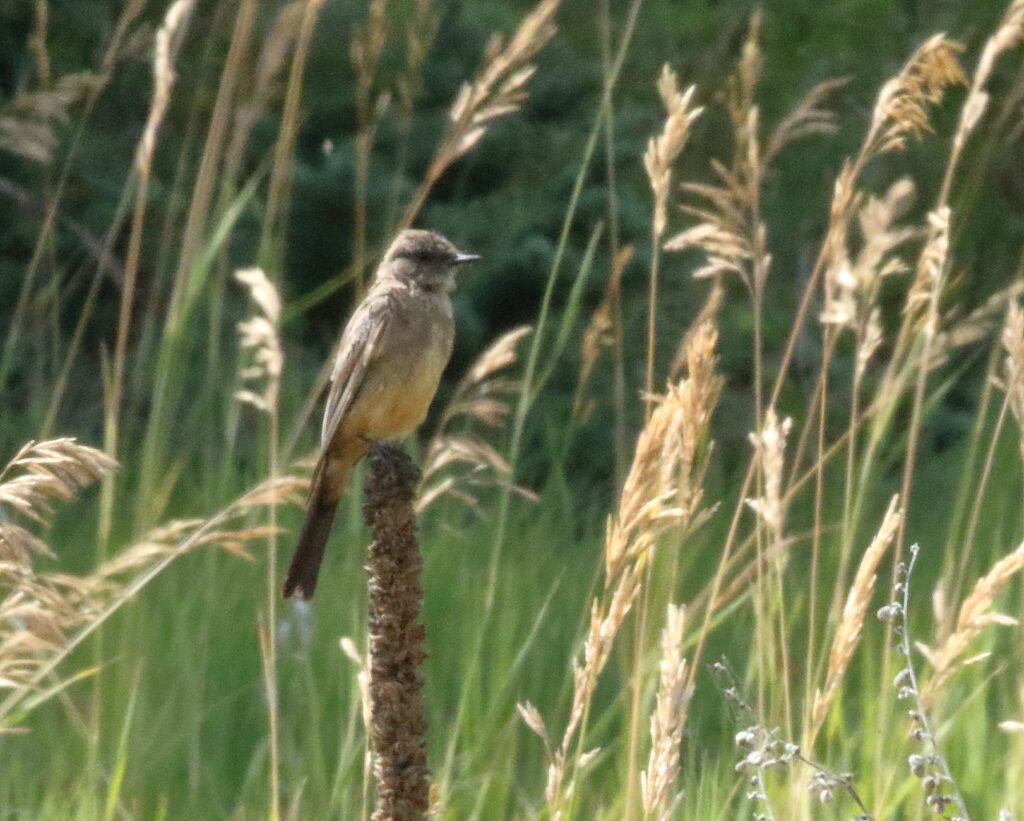
This elusive Say’s Phoebe finally cooperated with me for 2025!

There was still that little matter of a swift trifecta on our minds. After a cultural stop at Richwines Burgerville in Polson, we made our way slowly back to Missoula. Nowhere did we see the third Western Montana swift, Vaux’s Swift. “Let’s go to Caras Park,” Braden suggested as we reached Missoula. “I see them there pretty regularly.”

We parked near the iconic metal salmon sculpture and walked out onto the grass below the Higgin’s Street Bridge. The sun was out by now and things were warming up. Cliff Swallows flew to and from their mud nests on the side of the bridge, but I didn’t expect to see any swifts. “There’s one!” Braden suddenly shouted. Sure enough, several birds with fast, mechanical wingbeats darted back and forth after insects above the Cliff Swallows. It was a final satisfying sighting on a totally surprising, remarkable July day in Montana.

Our Day’s Trip Report: https://ebird.org/tripreport/396651?welcome=true

The small size and “chopped off” tails of Vaux’s Swifts are solid ID features to distinguish them from both Black and White-throated Swifts. These wonderful little birds completed our Western Montana “Swift-ecta” and wrapped up one of our best birding days ever.

Chasing Morelet’s Seedeaters—or Why You Shouldn’t Depend on Map Apps Near the Mexican Border (Texas 2025, Final Installment)

My success finding Black-capped Vireos and Golden-cheeked Warblers (see our last post) left me a welcome gift: an extra day to pursue another bird that keenly interested me. It was a bird Braden and I had unsuccessfully tried for on our 2018 trip to the Lower Rio Grande Valley: Morelet’s Seedeater. Though not rare in its core year-round range of Central America and eastern Mexico, this adorable “finchy” songbird just barely creeps over into the US along the Rio Grande Valley.

Catching sights such as this setting moon is one of the benefits of being an “early birder.”

Sunday morning, I rose at four a.m. and headed south from Uvalde. As they had on the previous morning, both a spectacular sunrise and unforgettable setting full moon rewarded me. As light crept over this flat country, caracaras flew along the road and Scissor-tailed Flycatchers perched on telephone wires. I even got a glimpse of a flock of quail leaping over a fence. Scaled Quail? I could only guess! After ninety minutes, my little highway joined Interstate 35.

And that’s where the trouble began.

I-35 is a main artery for trade between Mexico, the US, and Canada. As I sped south, I kept seeing signs for Mexico, but my map app directions assured me that I should keep going and turn off at an exit called Riverbank Drive. As I kept driving, however, I saw no signs for that—or any other—exit, and I realized that the only other traffic around me consisted of huge 18-wheelers. Finally, a thought occurred to me: Uh-oh.

Soon I found myself at a dead stop, surrounded by big rigs, with no way to turn around. There are moments in life where you know you are in a fix, and there’s not a thing you can do about it. This was one of those. Still, hope springs eternal and I climbed out of the car and walked to a big rig next to me. The kind Mexican driver, undoubtedly flummoxed by what I was doing there, rolled down his window, and we had the following conversation:

Me: Uh, I think I made a mistake. I’m trying to go to Laredo.

Driver: Laredo, Mexico?

Me: Uh, no. Laredo, Texas.

Driver (looking worried for me): You’ll have to turn around.

Me: Where?
Driver (after conferring with his partner): I don’t know.

These Big Rigs kept me company as I contemplated life as a Mexican citizen.

It was then that I began pondering the frightening ramifications of entering Mexico without a passport. I mean, could I have picked a worse time in history for this to happen??? The only good thing was that a Scissor-tailed Flycatcher perched nearby, blissfully unconcerned by my human drama. A few minutes later, the border opened and I eased in front of my new trucker friend. For ten minutes I and the big rigs inched forward until we reached a wide No Man’s Land of pavement and there I spotted an actual border worker. I pulled up next to him and explained my mistake. Looking vaguely amused and overly patient, he said, “See my buddy back there? Turn around and he’ll keep the trucks stopped while you exit at that road on the side.” I proceeded as instructed, gratefully waving to the “buddy.” I could have burst into tears at this point, but instead, I laughed all the way to the next exit—the real exit—which led to my original destination, Father McNaboe Park.

The Rio Grande River, aka the Mexican Border, complete with Border Patrol agents and lots of Carrizo cane, where Morelet’s Seedeaters like to hang out.

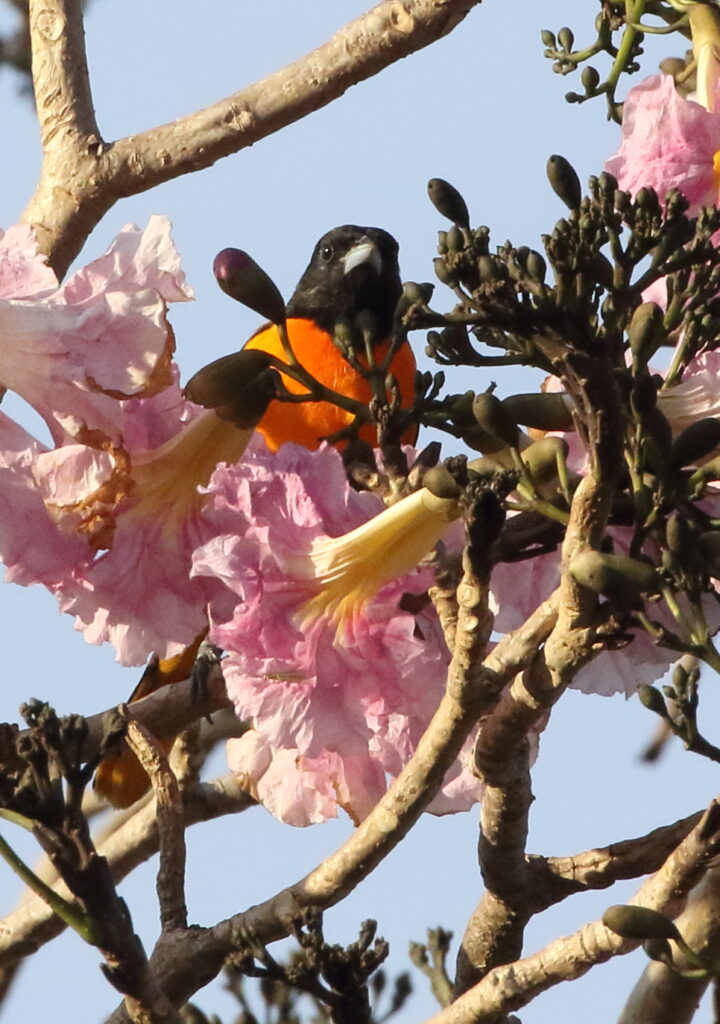
By the time I reached the park, I had experienced a week’s worth of drama, but remember, I still had some serious birding on the agenda. In 2018, Braden and I had visited the Lower Rio Grande Valley (LRGV) and even spent a night in Laredo, but had somehow failed to find McNaboe Park. I don’t know how, as the park consisted of a wide, long swath of trails, playing fields, and other amenities right on the Rio Grande River. Today, the park was jammed with people and I felt at ease as I walked toward the river. Before I even got there, I spotted my first great birds of the day—a pair of Hooded Orioles, a species I hadn’t seen since visiting Southern California seven years before. Not long afterward, I saw another oriole, a Bullock’s Oriole—perhaps on its way to Montana?

Over the phone the night before, Braden had told me to look for the Morelet’s Seedeaters in the “cane grass,” a tall invasive species known in Texas as Carrizo cane. Apparently, this plant can be found all along the 1,255-mile reach of the Rio Grande, and it didn’t take me long to find thick stands of it. I began walking along them looking for little black and brown birds. I covered a couple of hundred yards without seeing any and then walked down to a little sandbar right at river level. No seedeaters.

Then, I happened to glance up a side channel at another thick stand of cane. There, perched on one of the stalks was an erect little bird with a finchy bill. I didn’t get my binoculars up in time to get a good look, but I immediately knew: I had found my bird!

I was just about to get a great photo of this Morelet’s Seedeater when a loud car rumbled up next to me. I accidentally managed this flight shot, though, which is kind of fun.

Of course, that didn’t keep me from wanting better looks, and for the next hour or so, I walked various paths and channels. I got to know the bird’s song and it wasn’t long before I was hearing and seeing more of these cute little guys. They were pretty shy, but I managed good looks—and saw some other great birds as well. These included a pair of Black-necked Stilts, a Spotted Sandpiper, a Green Heron, and even a lone Mexican Duck in the middle of the river. Not including the seedeaters, the show stoppers, as usual, were a pair of Vermillion Flycatchers.

Do Vermillion Flycatchers get way more attention than they deserve? Probably. Does anyone ever get tired of looking at them? I doubt it!

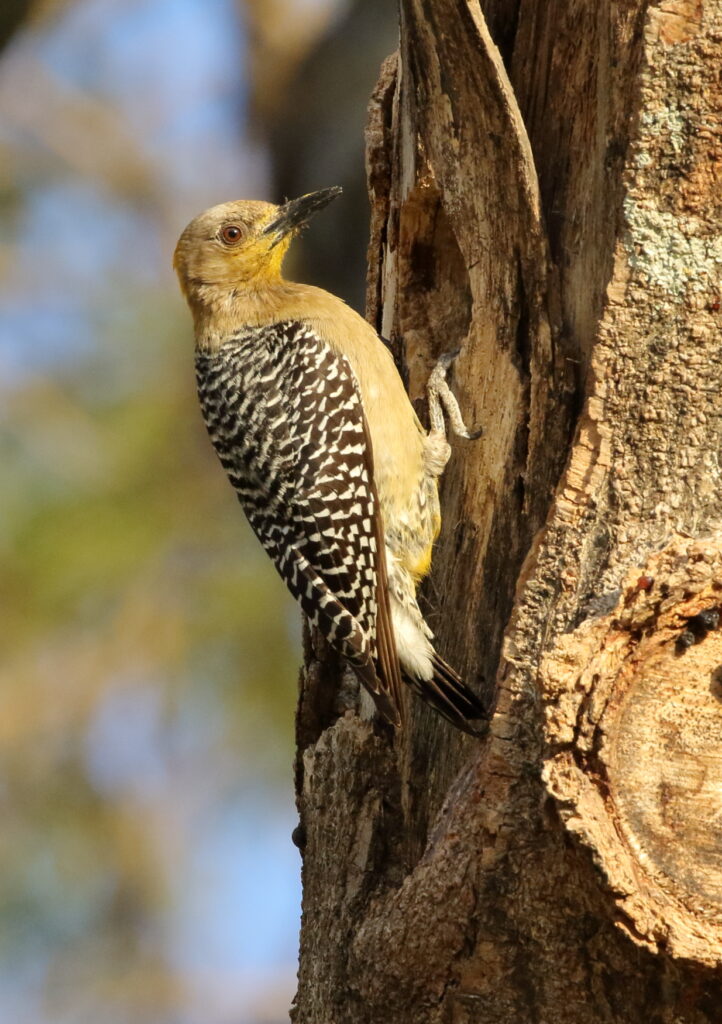
After a late breakfast at the French restaurant McDaniels, I decided to hit one more park in Laredo—North Central Park. Remarkably, I had failed to find a Golden-fronted Woodpecker so far on the trip, and though the heat was comin’ on fast, the park had abundant sightings of them. It took only five minutes to hear and then see one of these handsome birds and, walking a couple of miles or so, I also added Great Kiskadees and Bell’s Vireo to my trip list. Then, before I inadvertently wandered toward Mexico again, I turned tail and headed back up I-35 for San Antonio.

Link to my Texas Trip Report: https://ebird.org/tripreport/351263

Total Number of Species for the Trip: 144

My Top 6 Trip Birds:

Least Bittern (see post “Anahuac Lifer Attack”)

Yellow-throated Warbler (see Texas Hill Country post)

Black-capped Vireo (see Texas Hill Country post)

Golden-cheeked Warbler (see Texas Hill Country post)

Morelet’s Seedeater (this post)

Yellow-throated Vireo (see Peveto Woods post)

A pair of Black-necked Stilts flying downstream over the Rio Grande.

Cock-of-the-Rock Extravaganza—with Video! (Colombia Birding Part 5)

We wrap up our Colombian birding blogs with a terrific post by Roger Kohn, sharing his recent experiences with one of South America’s most famous birds—the Andean Cock-of-the-Rock. If you’ve been reading recent posts, you know that in addition to being a past guest contributor to FSB, Roger was the evil genius behind getting Sneed to Colombia! Alas, an injury kept Sneed from seeing the cock-of-the-rock this time around, but Roger was able to experience these wondrous birds in full glory. He even took an awesome video of a male Andean COTR that’s almost like being there. Our big thanks go out to Roger, and we know you will enjoy this post. Oh, and be sure to watch the Cock-of-the-Rock video below!

Four a.m. My cell phone alarm chirped and the screen lit up and pierced the early morning blackness, rousting me from a sound sleep. If you want to see one of the iconic birds of the Andes, you’d better be dragging yourself out of bed well before dawn!

Our guide Luis with Roger before they went slippin’ and a slidin’ down to see one of South America’s most iconic birds.

Today was one of the most anticipated days of my Colombia birding expedition. Sneed and I would visit “Alto Anchicayá – El Descanso,” commonly referred to as Doña Dora’s place. The owner, Doña Dora, began her business by selling empanadas and coffee to workers on their way to and from a nearby hydro-electric facility. The small restaurant quickly became popular with birders because its location, perched in the cloud forest at about 4,000 feet above sea level in Colombia’s Western Andes, attracts a huge variety of bird species to its feeders and offers some of the best birding in South America. As if that weren’t enough, birders have the opportunity to see the Andean Cock-of-the-Rock, a bizarre-looking bird that inhabits narrow ribbons of cloud forest slicing through the Andes of Bolivia, Peru, Ecuador, Colombia, and Venezuela.

A male Andean Cock-of-the-Rock in its full, bizarro glory!

After Sneed and I downed a quick cup of coffee and a muffin, our guide Luis picked us up at the Araucana Lodge (see “Video Post: A Visit to Araucana Lodge”) at 4:30 a.m. Light rain fell as we drove west for about 50 minutes. Our destination? An Andean Cock-of-the-Rock lek located in steep terrain below Doña Dora’s place.

Leks are assembly areas where males of some bird species, including Greater Sage-Grouse and Greater Prairie-Chickens in North America, perform courtship displays to attract prospective mates. At this time of year, we were pretty much guaranteed of seeing the Andean Cock-of-the-Rock between approximately 6 and 7 a.m.; the only question was whether we would see both sexes or only males.

Arriving at Doña Dora’s, the last raindrops fell as we gathered our walking sticks and prepared for the hike down to the lek. I was a little nervous, having heard that the trail is rough and steep. The recent rain added an additional layer of concern. Turning on our headlamps, Luis, David—a visiting birder from Spain—and I departed in the darkness. Sneed, nursing a sore leg and having already seen the Andean Cock-of-the-rock in Peru, opted to skip the hike and instead get an early start birding at Doña Dora’s.

Tawny-breasted Flycatcher, one of five flycatchers Roger saw on his ACOR trek.

Fortunately, the trail wasn’t as treacherous as I feared. The ground was damp, but the soil and leaves seemed to have absorbed most of the rainfall, so the trail didn’t have much mud and standing water. Steps built into the trail, along with a rubber handrail, made the descent very do-able. Pausing at the moth trap, a great birding area we would visit on the way back up, we turned off our headlamps as the first light of the day penetrated the cloud forest, and made our final push. About 25 minutes after we had departed, we arrived at the lek, an area with lots of open space for the birds to strut their stuff, and a small shelter with benches for birdwatchers.

Buff-rumped Warbler, a New World warbler species that does NOT migrate to the US—or anywhere else for that matter.

Immediately we saw two male Andean Cock-of-the-rocks, then three, and eventually five. These were the strangest-looking birds I’ve ever seen — veritable avian aliens. Bright red on the head and chest, black wings, silver tertiary feathers in the back, large pale staring eyes, a helmet-like round crest on the head with their bills only barely visible at certain angles, and bright orange legs. They perched on branches, and periodically pranced with herky-jerky movements to attract the attention of females. Their periodic calls, which eBird describes as “piglike squeals,” were odd guttural shrieks, comical to the human ear.

Ever wonder what male Andean Cock-of-the-Rocks do at their leks besides drink beer and boast about past conquests? This highly-classified video gives you a behind-the-scenes look! (Copyright Roger Kohn)

We did not see any females, which are brownish and look more like a conventional bird species, but we assumed they lurked nearby. Despite the absence of the females, I felt privileged to witness this display and add this remarkable Andean cloud forest dweller to my Life List. It was a sublime encounter that I will always treasure.

Andean Cock-of-the-Rock female (photo taken at Machu Picchu, Peru, copyright Sneed B. Collard III)

A huffy puffy ascent awaited us—but also a treat about a third of the way back to the top: the moth trap. The trap is a large white canvas sheet suspended vertically, and is a birder’s delight. Moths and other insects land on it, providing a feasting opportunity for resident cloud forest birds, which converge and gorge on bugs they pick off of the canvas. Pausing here, we racked up 15 species in 20 minutes of very fun birding. They included four species you can find in the United States: Summer Tanager, Canada Warbler, Acadian Flycatcher, and Blackburnian Warbler. The rest were species I’ve never encountered before. We saw five flycatcher species, including great looks at a handsome Tawny-breasted Flycatcher. Four warbler species graced us with their presence, including a very cooperative Buff-rumped Warbler. A Yellow-throated Chlorospingus, a yellowish “tanager-like sparrow” (eBird), dined on a big fat moth.

A Yellow-throated Chlorospingus, a member of a bird group Sneed & Roger had never heard of before the trip.

The superstar of the show was a Squirrel Cuckoo, a large dull orange bird with a yellow bill and a long black and white tail. It flew in and perched on a branch out in the open right in front of us, giving us fantastic looks and unbeatable photo opportunities. It would be my only sighting of that species during my 16-day Colombian adventure.

Is this a good-looking bird or what? Squirrel Cuckoos are quite common throughout Latin America, with a range extending from Argentina all the way up into Mexico.

Elated, we climbed up the remainder of the trail, arriving back at Doña Dora’s place, where a pile of scrambled eggs and a full morning of world-class birding awaited us. If you ever have the chance to take a birding trip to the birdiest country on earth, do not miss the opportunity to visit this cloud forest gem.

https://ebird.org/checklist/S215430499

If you enjoyed this post, be sure to check out our previous Colombian birding blogs:

Video Post: A Visit to Araucana Lodge (Colombia Birding Part 4)

Antpittas and Tody-Flycatchers (Colombia Birding Part 3)

Owl’s Watch Ecolodge (Colombia Birding Part 2)

Layover Birding in Bogota, Colombia

Antpittas and Tody-Flycatchers (Colombia Birding Part 3)

Note: This blog post—and all others on FatherSonBirding—are written by REAL PEOPLE! No compensation or gratuities were provided to us in connection with this post. If you’d like to support FSB, please consider buying one—or ten—of Sneed’s books and contributing to a bird conservation organization of your choice. Thank you!

Our second morning at Owl’s Watch ecolodge, Roger and I felt particularly excited. Although we’d had a great day birding on our own the day before (see post Owl’s Watch Ecolodge Colombia Birding Part 2), this would be the first time we went out with an expert guide. We met Owl’s Watch owner, Dennis Bailey, at 6:00 a.m. at the Social, the lodge’s main meeting building, and he served us coffee and a snack. Then, we climbed into his pickup and he drove us up to the Enchanted Forest. This was an area of cloud forest at the top of his property, where he and his team had developed a nice trail system complete with hidden gnomes associated with an information guide about the ecosystem. This is also where we met Daniel Muñoz Buitrago, our Colombian guide for the day.

Our guide Daniel (right) posing with one of the educational gnomes set up along the trail.

Both Roger and I liked Daniel immediately, and he began our tour by walking us along the road above the forest. “This is often where mixed flocks of tanagers can be found,” he explained, and sure enough, it wasn’t long before he started calling out names: Blue-capped Tanager, Saffron-crowned Tanager, Beryl-spangled Tanager, and one I especially hoped to see—Grass Green Tanager. This bird sports a stunning green color with a vividly contrasting red mask across its face.

One of my favorite tanagers of the trip, a Grass Green Tanager, backlit in the top of a tree.

Along with the tanagers, Daniel called out names of warblers, wrens, woodcreepers, and other birds. We glimpsed some of these, but I must pause here to say a word about what it’s like to bird in tropical forests. Many people see fabulous photos of tropical birds and naturally assume that these birds will be dripping from every branch. Unfortunately, tropical forest birding can often be very challenging. Many birds never show themselves at all and are “heard only” species, identifiable only by their songs and calls—and yes, Merlin’s Sound ID still has a long way to go to become accurate in places like Colombia. Many other birds can be seen—but mainly high in the tree tops against gray, backlit conditions. This makes it tough to get good views through binoculars, and darned well impossible to capture good photos. Daniel, though, was about to greatly improve our “photography problem.”

Brushfinches are difficult to see in any conditions, but we did get lucky with this look at a beautiful Gray-browed Brushfinch along the road.

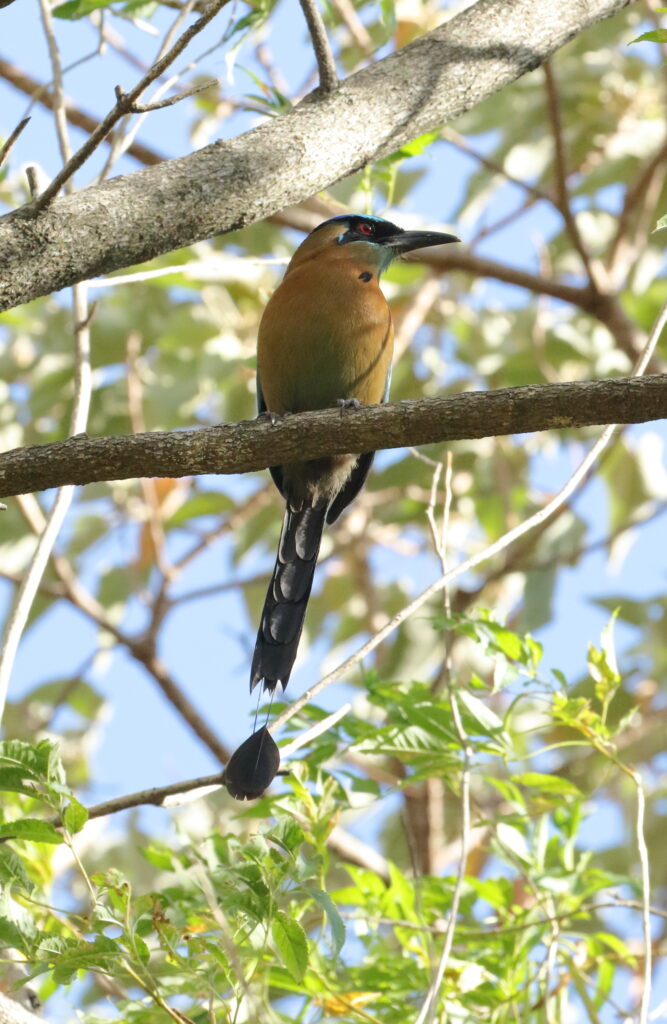
Heading into the Enchanted Forest, he took us down to a set of bird of feeders and began hanging bananas and grapes from various wires and branches. In no time, one of the forest’s most spectacular birds showed up—an Andean Motmot! We had glimpsed this bird on the drive in two nights before, but were delighted to have this additional excellent, intimate look.

Andean Motmot.

After we’d filled our share of camera memory space with the motmot, Daniel motioned us to follow him fifty meters down the trail. Even before we arrived, he started calling “Brownie, where are you? Come out, come out!”—or the equivalent in Spanish. As he did so, he set a few worms on a little fallen log about fifteen feet in front of us. Soon, he said, “Get ready. He’s coming!”

Moments later, a brown, football-shaped bird about ten centimeters (4 inches) high hopped up out of nowhere. “There he is!” Daniel cooed.

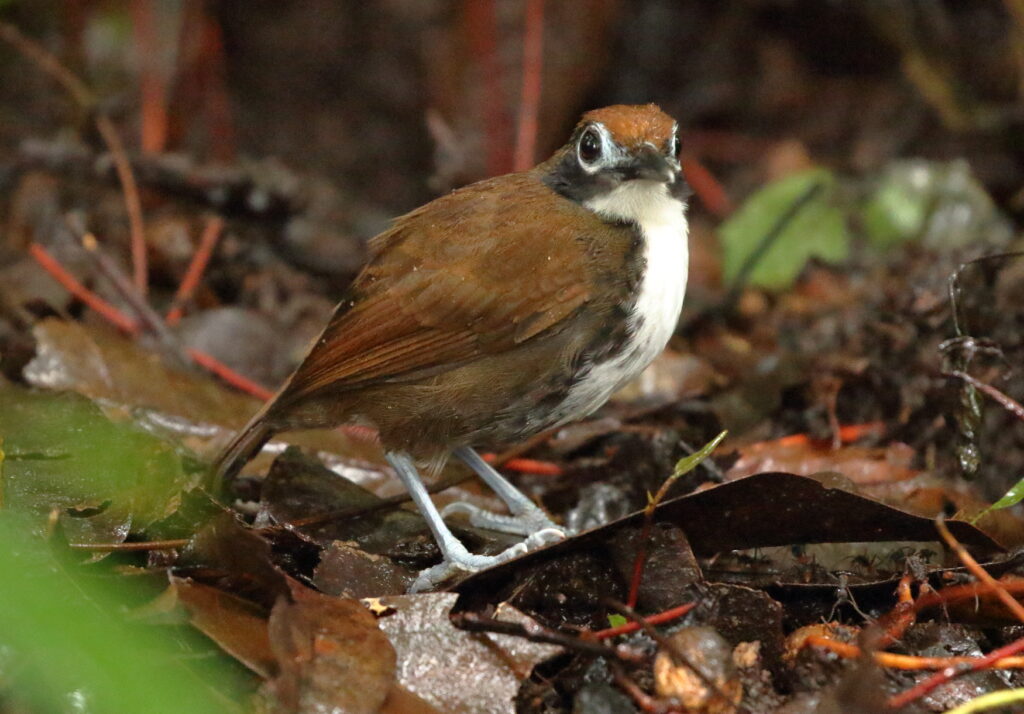
The “he” in this story was a Brown-banded Antpitta, one of Colombia’s most difficult-to-photograph species—and about as adorable as you can get. Its appearance was no accident, either. Daniel had trained the bird for months to respond to his calls—and the worms. I, for one, was grateful because I never imagined I’d get to see an antpitta in the wild. Not only are they very secretive, they often have very restricted ranges. In fact, the Brown-banded Antpitta is classified as Vulnerable due to habitat loss, and little is known about its biology and behavior.

“Brownie”, the Brown-banded Antpitta. These birds are extremely difficult to observe, but thanks to patient “trainers” like Daniel, lucky visitors like us occasionally get to see them.

We left Daniel to “clean up” after Brownie and walked back to the feeders. As I was about to step into the clearing, however, I hissed, “Roger, stop!” There, perched on a feeder branch only seven or eight meters away, sat one of the other birds we especially hoped to see—Black-billed Mountain-Toucan! Roger quickly snapped some excellent photos, but I managed only a couple of crummy ones before the bird flew. Still, it was the only BBMT we would see on the trip.

Snooze, you lose. Due to having my camera on incorrect settings, I managed only a poor shot of this Black-billed Mountain-Toucan before it fled with its fruity booty.

Back on the road, we made our way through cloudy conditions down to the trail that left from the parking area above the lodge (see previous post). We returned to the hummingbird viewing platform and immediately saw a species that got Daniel excited: an uncommon hummingbird called a White-throated Daggerbill. Of course, there were also eleven other species of hummingbirds as well (always, always, hummingbirds), but unbeknownst to us, we were about to meet one of the coolest birds that we’d ever seen.

After a few minutes watching the hummingbird action, Daniel motioned us to follow him down to another little spot about thirty meters away. Here he again pulled out his worm bag and began calling, “Gordita! Gordita! Come out!” Gordita, of course, means “little fat one” in Spanish, and both Roger and I chuckled. But who exactly was Gordita?

R2D2? No, meet Gordita—a Chestnut-crowned Antpitta that quickly hopped into our hearts.

After a few moments, out hopped one of the most remarkable birds I’d ever seen. It was another antpitta—this one, a Chestnut-crowned Antpitta! The bird was about twice the size of Brownie the Brown-banded Antpitta and to me it looked just like a little R2 unit from Star Wars. In an instant, it became one of my favorite birds ever, and I’m pretty sure Roger felt the same way.

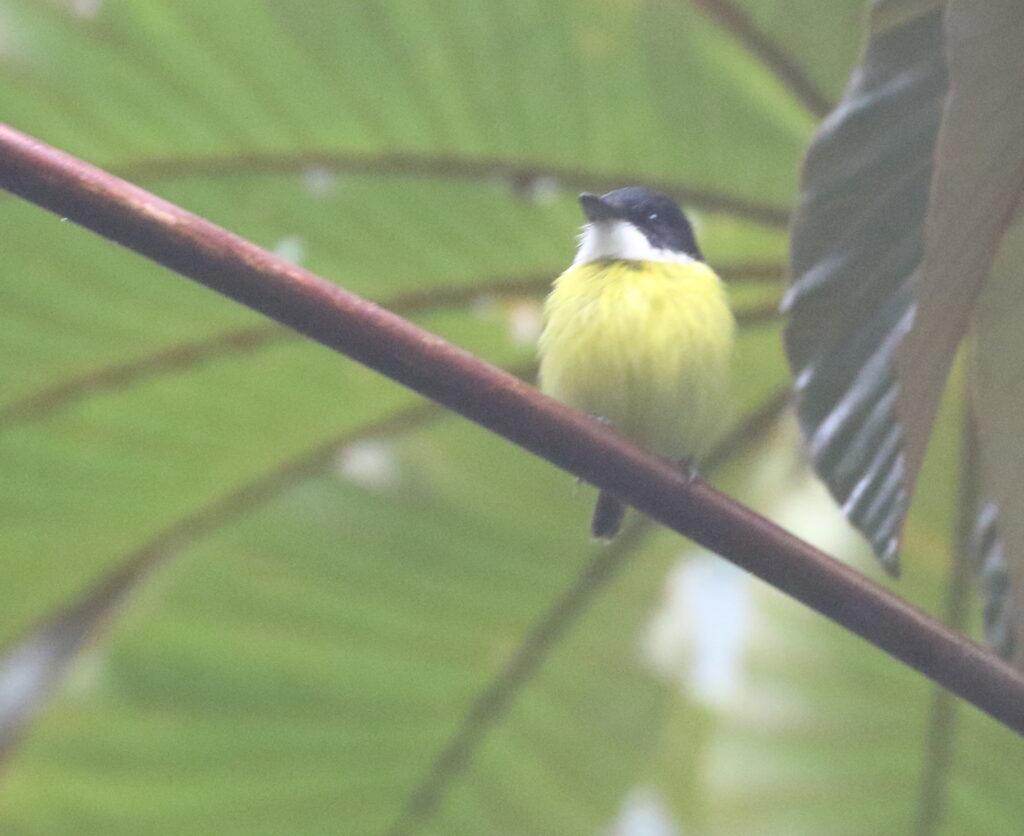
Daniel’s surprises weren’t over. Continuing on down the trail, he called in another remarkable bird—a Rufous-Crowned Tody-Flycatcher. At least three or four of these would easily fit into your hand, but again, we never would have seen it without Daniel’s knowledge and expertise.

Rufous-capped Tody-Flycatcher.

Which brings up an important point about Colombian birding. While it is possible to bird on your own in Colombia, I highly recommend taking advantage of its growing network of lodges. Although much safer than it used to be, the country does still have its share of problems, ranging from common crime and armed conflict to dangerous road and trail conditions. Taking advantage of the expertise of lodges will help make sure you don’t accidentally wander into a hazardous area. Even better, the lodges we encountered use locally-trained, Colombian guides. Many, like Daniel, speak excellent English, and prices are extremely reasonable. By hiring them, foreign visitors are giving a boost to the local economy—and creating more incentive to protect Colombia’s environment.

After getting our fill of the tody-flycatcher, Daniel led us back down to the Social for a well-deserved (or at least well-received) lunch prepared by the Owl’s Watch cook, David. It had been a splendid day all-around and we so appreciated everything Daniel had shown us. Even better, we were excited to have one more day of birding at Owl’s Watch. That, however, didn’t keep us from eagerly anticipating our next great Colombian lodge destination—which I’ll introduce in the next post!

Roger and our guide, Daniel, birding the road above Owl’s Watch.

August: It’s Just Weird

August is a weird month to bird. As we’ve no doubt mentioned before, we used to just write off August. I mean, most birds have stopped singing. No songbirds are migrating. Oh, and in Montana, hot, smoky weather often sucks the motivation from every pore of our bodies. Over time, however, our “bad August attitude” has, like the current presidential race, suffered a total reversal. Now, Braden and I cautiously look forward to August birding. The only problem? We’re never sure what we’re going to find. (See, for instance, last year’s August post “Birding Treasure at Garnet Ghost Town.”)

This August has been no different, but we began the month with some clear objectives. As Braden’s summer in Montana dwindles ahead of his final year of college, he had accomplished most of his summer birding goals save one: finding a Spruce Grouse. I could relate! After all, I saw my lifer spruce grouse only last year (see our post “Gambling on a Grouse-fecta”). As for me, I too coveted another Spruce Grouse on top of other Year Birds that had so far eluded me. The latter included Olive-sided Flycatchers, and Three-toed and Black-backed Woodpeckers. We both wanted to see migrating shorebirds, but realized it might be a tad early for some of them.

Sadly, Braden and I probably had only one day left to bird together before he departed, so any strategy to accomplish our remaining goals would involve compromise. Nonetheless, we set off last Sunday morning for a place we’d never birded together—Skalkaho Pass east of Hamilton. We got on the road before seven and made a brief stop at Lee Metcalf NWR hoping for shorebirds. No luck, probably because water levels were too high, but we did see a lot of the other usual suspects. Most surprising? Vaux’s Swifts, which I myself had probably never seen at Metcalf before, and at least half a dozen Sandhill Cranes—an unusually high number for that location. “Hm,” we thought, “Maybe some birds are already on the move for their fall migrations!”

There was something off about this Sandhill Crane at Lee Metcalf. I just can’t quite figure out what it was!

After a quick stop in Hamilton for breakfast sandwiches, we headed toward Skalkaho, the road transitioning from a two-lane road with a painted yellow line, to a “one track” paved road, and finally to dirt. We encountered an early surprise with a herd of bighorn sheep, and then climbed through a gorgeous forest canyon that gave off moist Pacific Northwest vibes and hosted a huge variety of trees. Here, we heard Pacific Wrens and Golden-crowned Kinglets, but our real destination lay high above us.

A great advantage of birding is that we see a huge variety of mammals during our adventures—including these bighorn sheep.

As the road snaked upward, we entered large burn areas that looked about ten years old. If you’ve been reading this blog (or my book Fire Birds) at all you know that we love to bird in burned forests. Not only do they provide great visibility, standing dead trees attract some of Montana’s most special birds. We pulled over a couple of times to listen for woodpeckers, but didn’t hear anything. Getting out of the car for the third time, however, we were greeted by a loud “Quick! Three Beers!” Braden and I laughed.

Though not a great photo, this is exactly the kind of pose we usually find Olive-sided Flycatchers striking in a burned forest.

“Olive-sided!” he exclaimed. And not just one, either. We would count at least half a dozen in the next couple of hours.

When we passed 7,000 feet we at last felt we had reached proper Spruce Grouse country. I had located a promising dirt road on the map, but before we reached it, we spotted another dirt road leading to the left. “That looks good,” I told Braden. “Let’s take that.”

“Sounds good,” he answered.

The burns near Skalkaho Pass were custom-made for finding cool birds.

It felt like a good day to find a Spruce Grouse. As on my Spruce Grouse excursion with Braydon Luikart last year, the day was overcast and misty, and I kept expecting to see bevies of grouse sitting in the middle of the road. That didn’t happen. In fact, we drove slowly for about twenty minutes, I keeping my eye on the road while Braden searched trees and openings along the road.

“C’mon, grouse,” I urged them, but it seemed like it might end up being a grouse-less day after all.

Then, Braden said, “Stop! Back up a few feet.”

I obeyed. “There, next to that stump,” he told me. “That definitely looks like a grouse.”

Sure enough, it was a gorgeous female emanating a distinctly Spruce Grouse aura. Just to make sure, I called up my Sibley app and compared it to a female Dusky Grouse. The two looked very different. Most diagnostic were this bird’s golden-brown patina and horizontal stripes across its breast and belly. Dusky females are grayer with more vertical barring in front.

We could have easily driven past this female Spruce Grouse as it imitated a tree stump, but Braden’s sharp eyes caught it as we rumbled by.

“We did it!” I affirmed. “We found a Spruce Grouse!” Neither of us could quite believe it. Even better, we spotted two babies popping their heads up and down right behind mom.

We continued up the road for another ten minutes, hoping to glimpse a male, but didn’t see one, so turned around and began bumping back toward the main road. We were not finished with this promising area, though. At another burn area, I pulled over. “Let’s just walk up the slope a bit,” I suggested, grabbing my camera and binoculars. We did, scanning the forest of dead tree trunks for any sign of woodpeckers. Then, we heard drumming to our right and our eyes locked.

“Let’s go over there,” Braden said, and we began picking our way over fallen logs and slash, and through fresh, thriving young trees and shrubs. As we walked, the drumming sound was replaced by tapping, and we grew closer and closer until we felt sure it was coming from a tall tree right in front of us.

“Do you see it?” I asked peering hard at the trunk against a backlit sky. Braden shook his head, so I circled around the tree, trying to spot it from different angles. Finally, I saw movement down low behind a green branch of a living tree. “I got it,” I called to Braden.

It took some time to get a clear look at it, and the first thing I saw was a lot of white showing on its back. This led the pessimistic side of me to conclude it was a Hairy Woodpecker. After all, no yellow showed on its head—the clear sign of a male Three-toed or Black-backed. As Braden also got his eyes on it, though, we began going through its other features. Most prominent? Black barring on its breast.

“Do Hairys have those black markings?” I asked, quickly consulting Sibley. “They don’t!”

This female American Three-toed Woodpecker provided an ideal “study bird” for teasing out the finer details of this species. We were thrilled to find it!

“It’s a Three-toed!” Braden agreed.

Wow. On this one day we had set aside to bird at elevation, we had found almost all of the birds we longed for, missing only a Black-backed Woodpecker.

We weren’t as successful with shorebirds, but that didn’t surprise us. Making our way over to Warm Springs, we found a nice group of Long-billed Dowitchers, and Greater and Lesser Yellowlegs, but not the Baird’s or Pectoral Sandpipers or small “peeps” (Least, Semipalmated, or Western Sandpipers) we were hoping for. Still, we did discover a surprise Black-crowned Night-Heron at the main Warm Springs ponds—something totally off our radar. In fact, I had started the day hoping for maybe one or two Year Birds, and ended up with six! Our success was only dampened by the knowledge that it might be our last big day of birding together this summer. Still, that is the yin and yang of birding—and of life. You just gotta enjoy it all.

Our grouse eBird checklist: https://ebird.org/checklist/S190227269