Category Archives: Tanagers

Layover Birding in Bogota, Colombia

“Call me asap,” Roger’s text read. A few minutes later, I dialed his number. “What’s up?”

The answer: a chance of a lifetime.

As faithful FSB readers know, Roger is a longtime friend of mine from UC Berkeley, and a guest contributor to FatherSonBirding. More than six months ago Roger and his wife, Claudia, began planning a dream birding trip to the world’s epicenter of awesome birding—the country of Colombia. How awesome is Colombia? Well, during the Global Big Day of birding each year, Colombia regularly kicks butt on all challengers. In 2024, its birders recorded an astounding 1558 species in a single 24-hour period—more than twice the number of the US despite submitting only about 15% of the number of checklists. It is widely considered to have the highest biodiversity per square meter of any country on earth.
Sadly, Colombia has a long history of violence that has made it mostly off-limits to birders for decades. That began to change in 2016, when a peace agreement was signed between the government and FARC, the military wing of the Colombian Communist Party. Violence still racks some parts of the country, but that has not prevented a growing number of birders from seizing the chance to visit one of the world’s most spectacular ecological regions. About six months ago, Roger decided to join those growing ranks. He and Claudia mapped out a two-week trip that would include a feast of birding opportunities. However, as the great oracle of our time, Neil Young, sang, “The devil fools with the best-laid plans.” Two weeks before their trip, Claudia was forced to cancel, and Roger asked if I wanted to fill her slot. With a quick nod from Amy and the urging of Tessa, it took me about two minutes to decide.

The plan was to meet up in the Andean city of Pereira to begin our birding adventure (of which I’ll write much more later). Roger planned to fly from his home in Bend, Oregon to Miami and spend the night; then fly to Pereira via Panama City the following day. Being a Delta Airlines loyalist, I left a day earlier, spent the night in Atlanta and then flew to Bogota for a night. This excited me greatly because it would give me a morning to myself before catching a flight to Pereira to meet Roger. Gee, what oh what might I do with that morning?
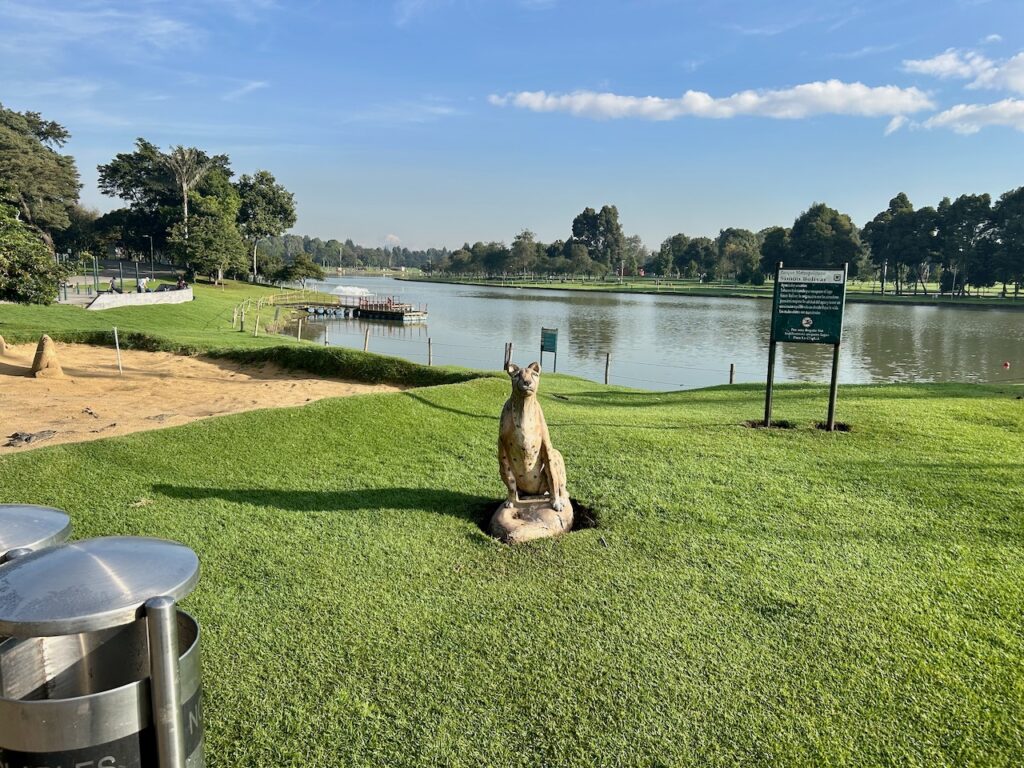
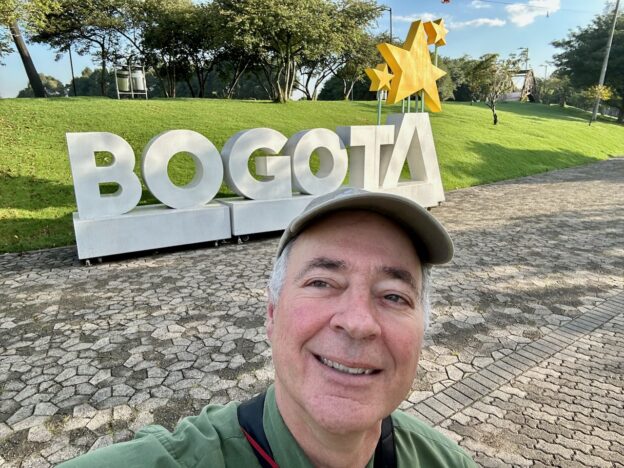
Simon Bolivar Park, Bogota.

Not by accident, I booked a room in the Hotel Capital, strategically located a short taxi ride to two major birding possibilities. Rising early, I wolfed down a granola bar for breakfast and then caught a cab to Parque Metropolitano Simón Bolívar, one of the world’s largest urban parks. In my atrocious Spanish, I told the cab driver of my interest in birds and he dropped me off at the SW corner of the park near a large central lake. I had worried a bit about carrying my camera and binoculars in this unfamiliar city, but my hotel concierge had assured me the park would be safe. Sure enough, I was relieved to see a steady stream of joggers, dog walkers, and cyclists taking advantage of a beautiful sunny morning. But what of the birds?

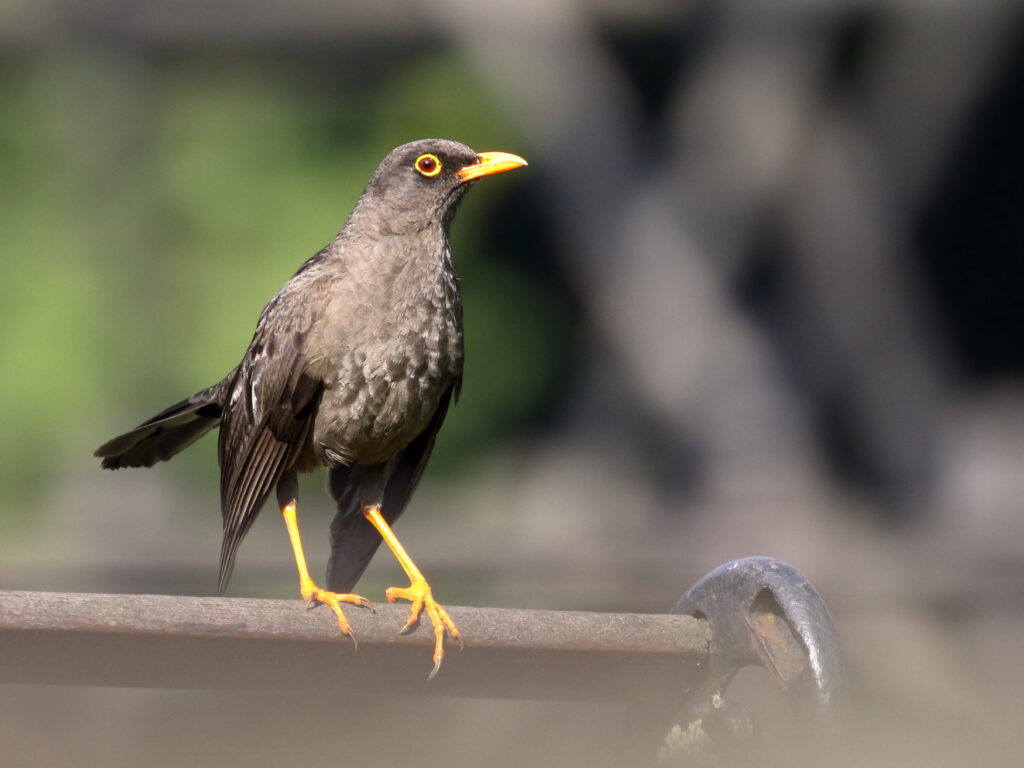
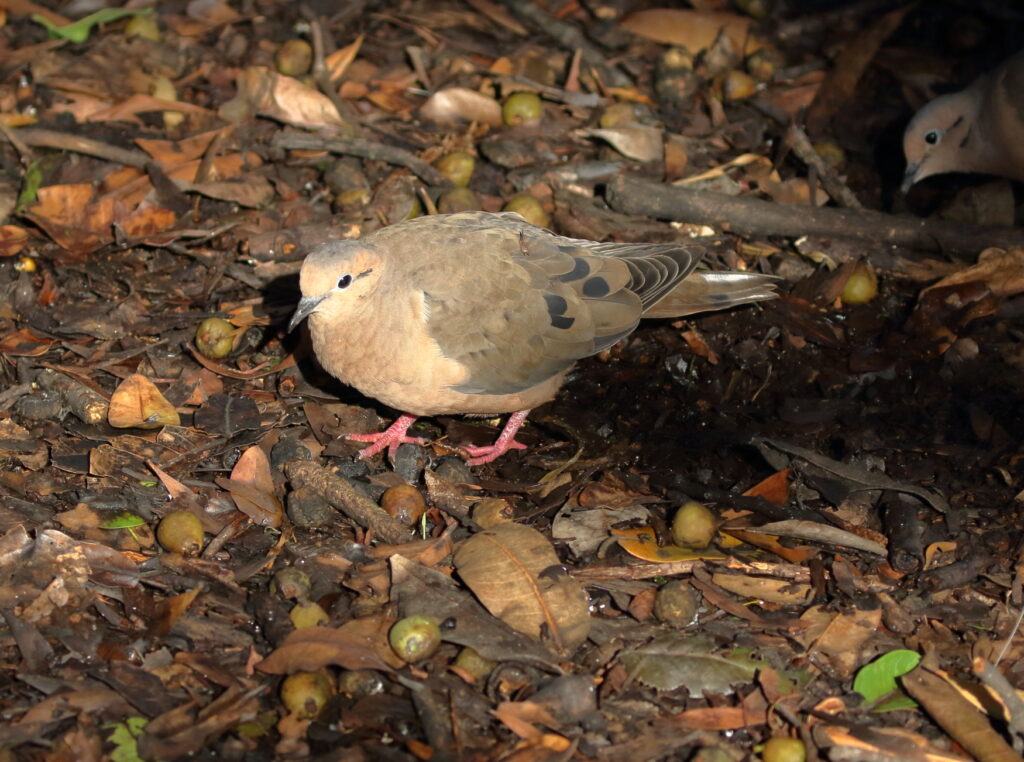
As I walked toward the lake, I saw plenty of Great Thrushes and Eared Doves, and Sound ID picked up the songs of Rufous-collared Sparrows, a bird Braden and I had become friends with on our family trip to Ecuador and Peru in 2017.

Like a birder magnet, however, the lake drew me forward. When approaching a large body of water like this, I always look for legions of water birds to be gracing the water, and in Japan and last year’s trip to Barcelona, that had indeed been the case. Not today. Evidently, ducks just aren’t as big a deal in the tropics as in temperate zones. I did spot what looked like a domestic hybrid duck of some sort, accompanied by a much smaller bird, and I focused in on the latter for the day’s first surprise—a Pied-billed Grebe! “I didn’t know they lived this far south,” I thought. Indeed, I later learned that in the Americas, Pied-billed Grebes have the largest distribution of any grebe, stretching from mid-Canada almost to the tip of South America.
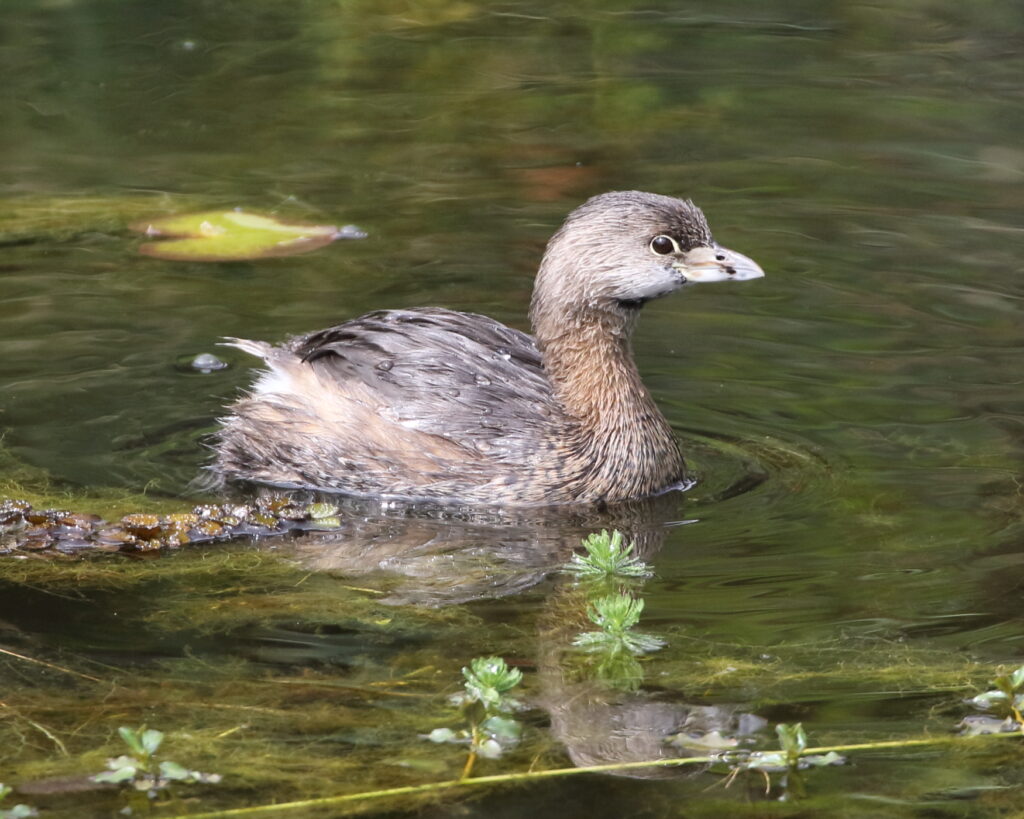
Pied-billed Grebes have the widest distribution of any American grebes.

A hundred meters farther, I caught movement in bushes and discovered one of the real prizes of my outing—a mixed flock of warblers! And not just any warblers, but three species that breed in the eastern US. One revealed a brilliant splash of orange on its face. Can you guess which one it was? That’s right—Blackburnian Warbler! It was accompanied by several Tennessee Warblers and my first look at an actual Rufous-collared Sparrow.
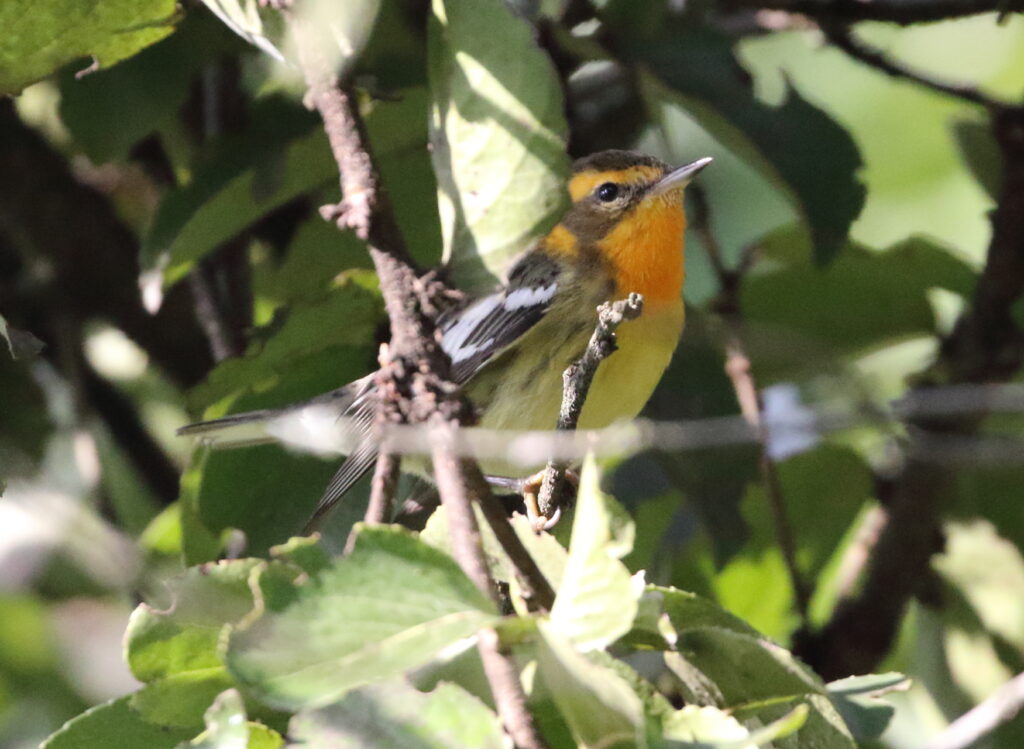
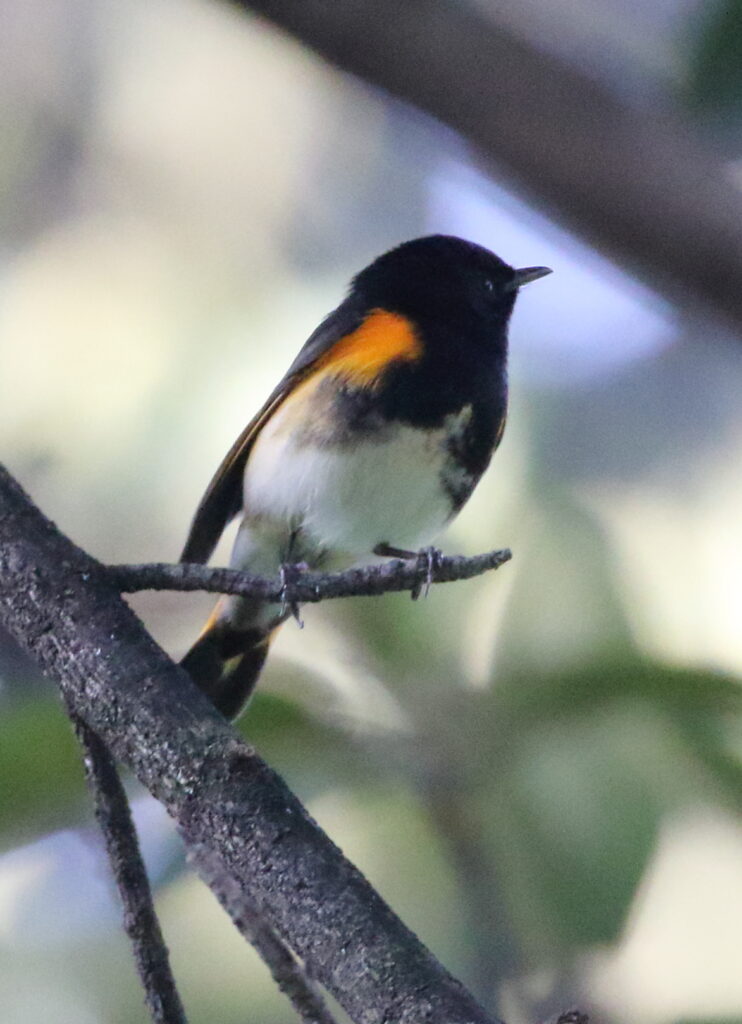
As I followed the flock around, I got an even bigger surprise—a bonafide American Redstart. “Wow!” I said out loud, trying to get a photo of one of everyone’s favorite warblers.

From the main “parky park,” I crossed a pedestrian bridge over jammed up morning traffic and entered a sprawling sports complex.

You’ll be relieved to learn that Colombia has the same kinds of traffic problems as we do!

Soccer players were warming up, track and field athletes ran around a track, and tennis players smacked balls back and forth. Next to the walking path, a pair of familiar-looking black-and-white birds hopped up onto a sign. It didn’t take me long to figure out they were Tropical Mockingbirds—the only ones I would see on the trip! Then, a familiar, largish bird flew noisily by and disappeared over the wall into a stadium. Here, Braden’s and my travels to Israel paid off. Southern Lapwing! my mind immediately shouted. My real destination, though, lay just ahead.
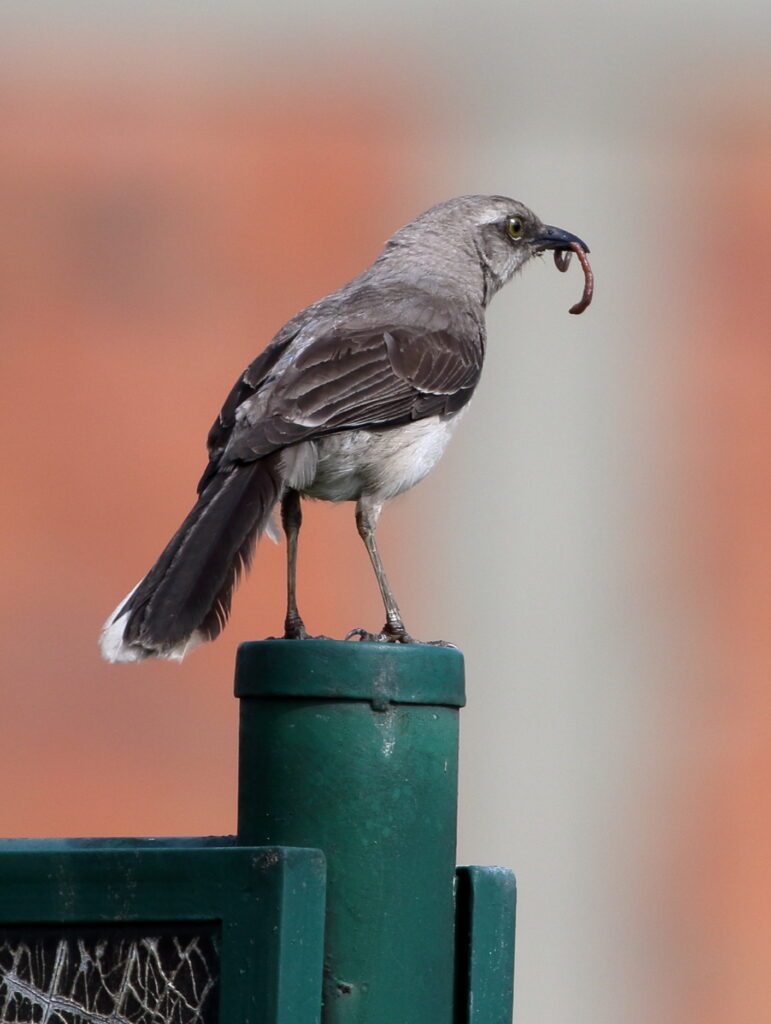
Look familiar? It didn’t take me long to figure out that this handsome fellow was a Tropical Mockingbird.

I paid two bucks to enter the Jardin Botanico de Bogota—which, like the sporting complex, was technically part of the Simón Bolívar Park—and asked a greeter where I might find birds. Then, I set off to explore. My first find? Gorgeous Purple Gallinules. Hummingbirds also flew by, but knowing just how many hummers fill South America, I wasn’t psychologically ready to tackle those just yet.
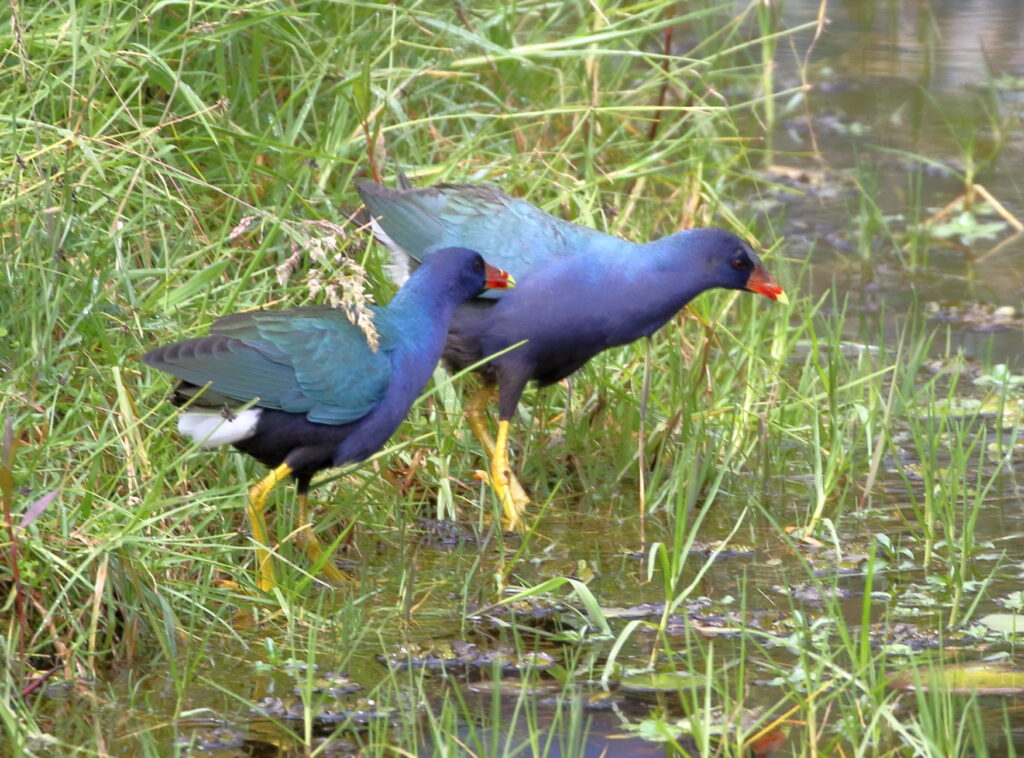
It’s hard not to be impressed with the technicolor plumage of Purple Gallinules.

Continuing on alongside a wooded area, I spotted a bright red shape about twenty feet high on a branch—my first South American Summer Tanager! I saw another traveler staring up into the trees and walked over to introduce myself. “My name is Edwin,” he told me, along with the fact that he was from the Netherlands. “Are you seeing anything?” I asked him. “Yes, but I don’t know what they are,” he confided. I got my eyes on fast-moving, small shapes and recognized another Blackburnian Warbler, along with what I think were more Tennessee Warblers. I told Edwin what I was seeing.

“Hey, did you see the Summer Tanager?” I asked, and his eyes widened. “No!” So I led him back to where I’d spotted it, relieved to finding it still perched, evidently being well-paid by the botanical gardens staff to stay in place.
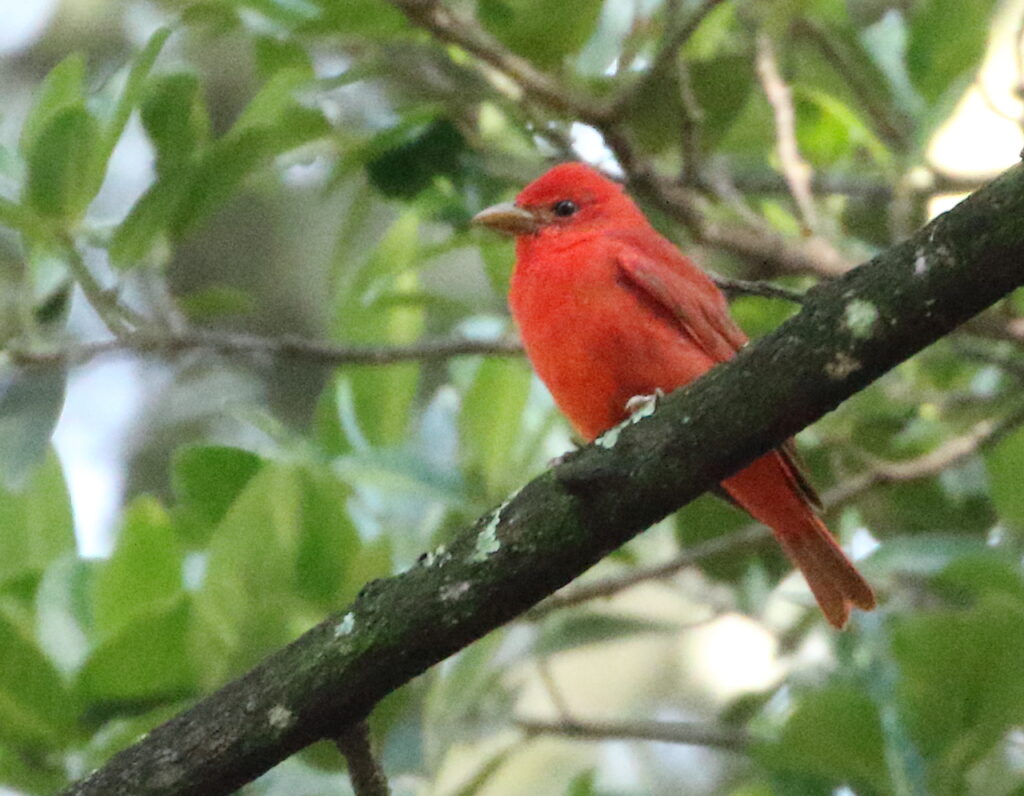
I had hoped to see some of our northern birds in their southern wintering grounds, but didn’t expect to see a Summer Tanager in downtown Bogota!

By this time, I was only up to about twenty species, which seemed like a rather poor showing for a morning in a brand new tropical country, even if I was in a major city. Only one of those species, Shiny Cowbird, was a lifer. Even worse, it was about time for me to flag down a cab and make my way back to the hotel so that I could shower, pack, and get to the airport for my flight to Pereira. Before leaving the gardens, however, I decided to make one last stop where I had seen the gallinules. Suddenly, I detected a small bird flitting among some flowers, and my pulse picked up. I didn’t know what it was, but got some decent ID shots of it. As I zoomed in on one of my photos, a smile spread across my face. It was a flowerpiercer—the first I had ever knowingly seen! Later, I consulted with Braden and we agreed that it was a beautiful little species called a Rusty Flowerpiercer.
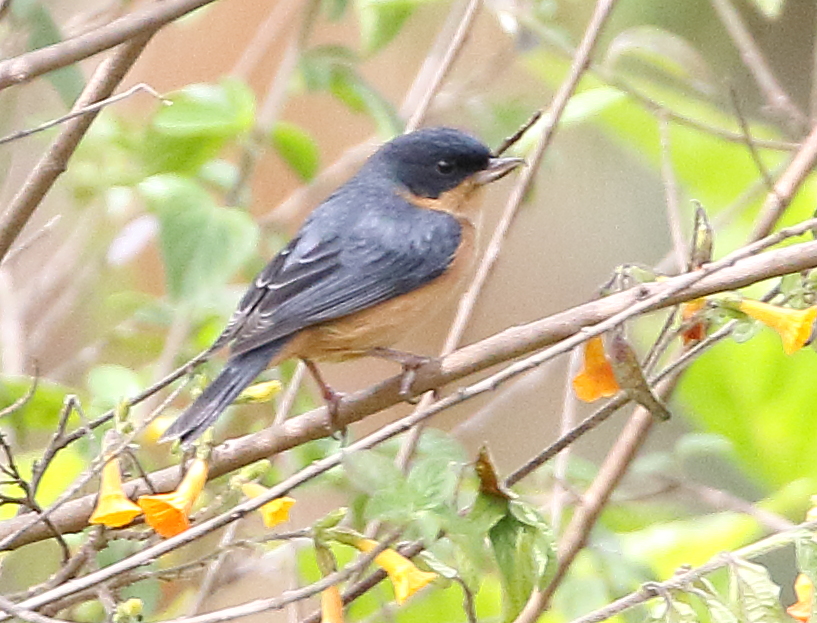
I was thrilled to find this Rusty Flowerpiercer, the first flowerpiercer I’d ever identified on my own.

It was a great way to finish off a fun morning of layover birding in a new country. It also laid the groundwork for what would promise to be an adventurous—sometimes too adventurous—next couple of weeks.
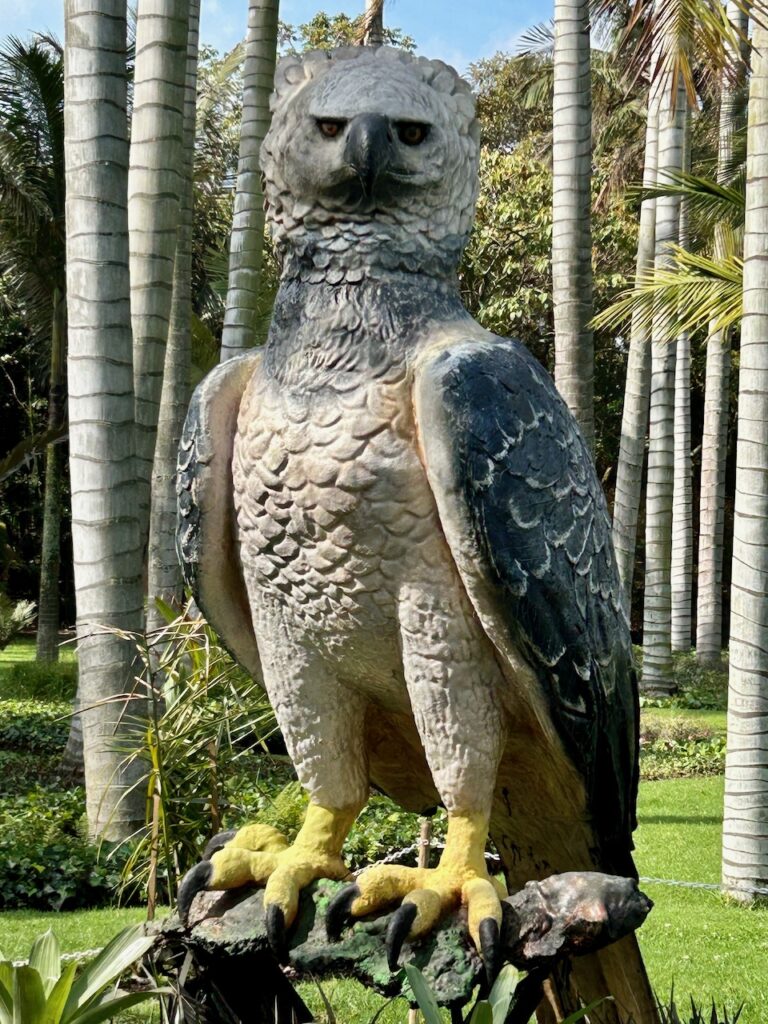
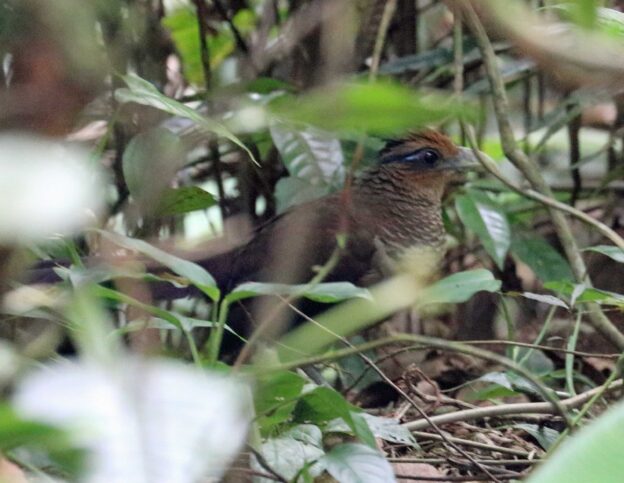
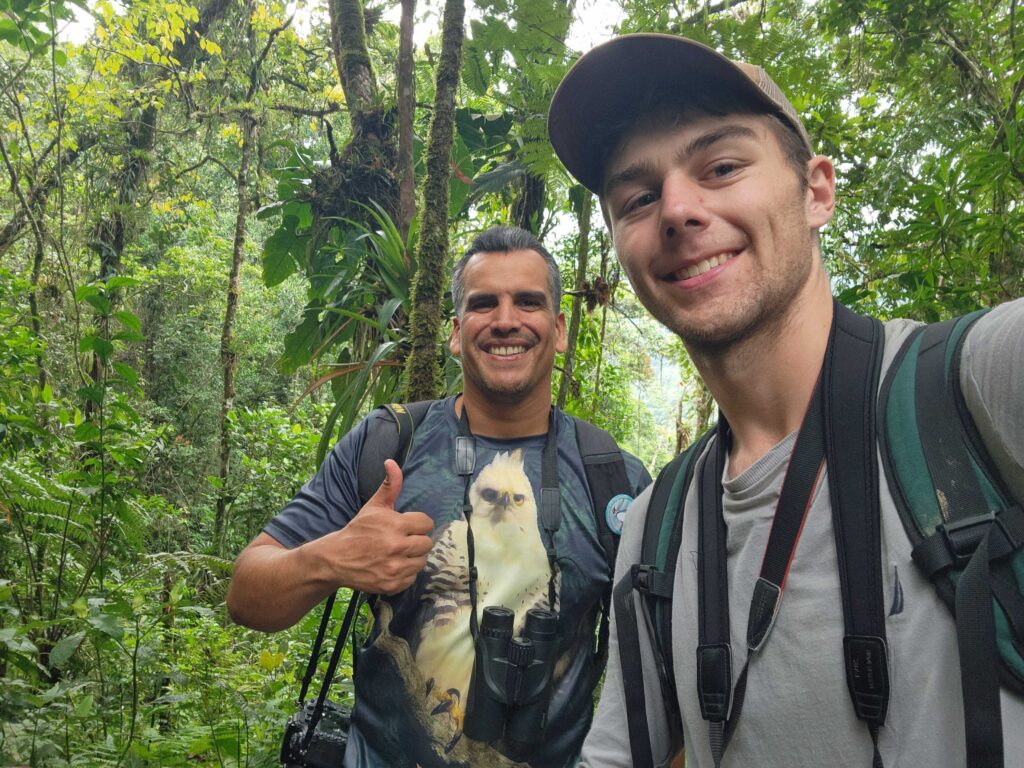
Oh, wait, did I forget to mention the giant Harpy Eagle I saw in Bogota’s Botanical Gardens?

Braden’s Costa Rica Report #5: A Glimpse of a Ghost

Braden and I write FatherSonBirding in the hopes of sharing the wonders of birds and birding, and the urgency to protect them. We do not accept advertising or donations, but if you’d like to support our work, please consider buying *NEW* copies of some of Sneed’s books—First-Time Japan, for instance, or my recent Orbis Pictus Award winner, Border Crossings. We appreciate your interest and hope you will keep reading! Happy Earth Day + 1!

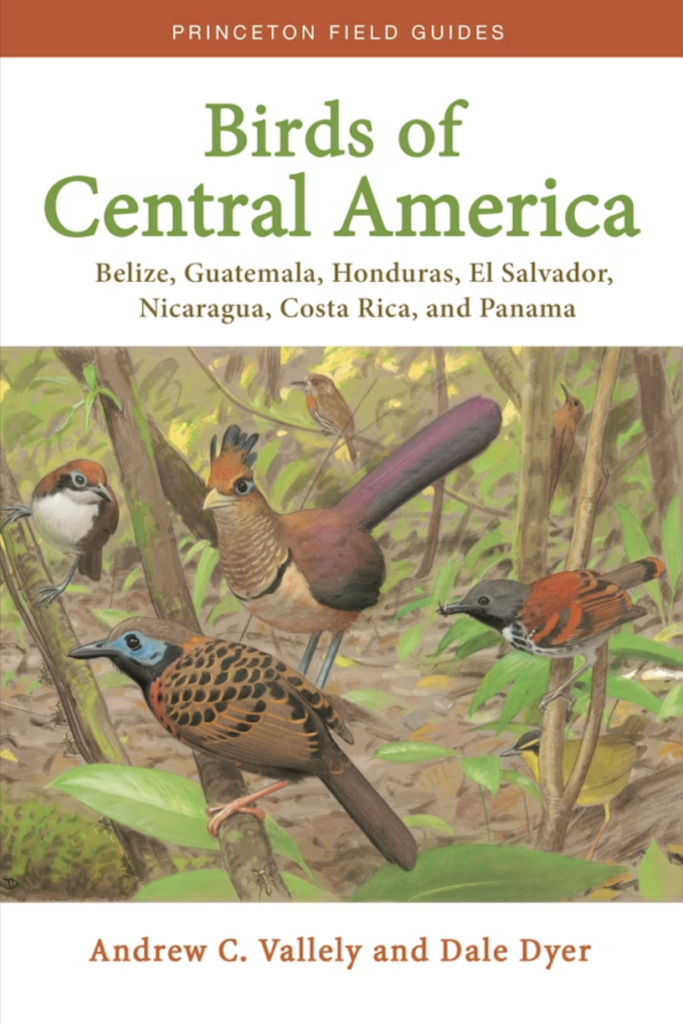
A couple of years ago, I asked my parents for a selection of bird books for Christmas, given that I’d just learned that Princeton University Press was having a sale. Large, detailed bird guides are often quite expensive, but at this time many were being sold for significantly below their usual amounts, and I had my eye on several of them. Fast-forward to December 25th of that year, when I tore the colored wrapping paper off of the boxes with my names on them to reveal the books inside. Two of those books I’ve barely touched—I think one is about waterfowl and the other is about North American rarities. They’ve sat on my bookshelf collecting dust. The other one, however, has gradually replaced the Sibley Guide to Birds as my nighttime reading material. Birds of Central America, by Andrew Vallely and Dale Dyer, is not simply a bird guide. It is an in-depth collection of all of the species in the class Aves that have ever occurred in the seven countries that make up Central America, equipped with some of the prettiest, most detailed drawings of birds I’ve ever seen. The cover, especially, is a work of art, displaying seven species foraging at an ant swarm in the understory of a tropical rainforest. 

That book came with me to Costa Rica, and I’ve opened it every single day I’ve been here. The cover is now creased, and there are wrinkles and smudges all along the spine. I can still see the image on the front perfectly well, however. There’s the White-whiskered Puffbird and Plain-brown Woodcreeper in the back. There’s the Kentucky Warbler, hiding behind the skinny plant stem. In the foreground are three of Costa Rica’s most iconic antbirds: Bicolored, Spotted and Ocellated. I’ve seen the puffbird and woodcreeper, and I’ve seen two of the antbirds. I’m still missing Kentucky Warbler and Ocellated Antbird. This blog is not about those species.

Smack-dab in the middle of the cover, surrounded by the other six birds, is a bird that looks like a dinosaur. It stands sporting a scaly, brown breast; a black neck collar; a deep green feathered crest atop its head; and, of course, that dark purple, iridescent tail sticking out behind it. There are some creatures on Earth that seem made up, animals that are so mythical and enigmatic that few people ever are fortunate enough to lay eyes on them. This bird is like Sasquatch, but even cooler. This bird is like a roadrunner of the jungle. Seeing this bird is akin to seeing a Jaguar. The bird is the Rufous-vented Ground-cuckoo.

I learned about ground-cuckoos in 2020, during a cuckoo-themed bracket-style voting event that took place in a Facebook group I’m a part of, and I remember being absolutely shocked by their existence. A few ground-cuckoos live in the Old World, but those that stuck out the most were those in the genus Neomorphus, of which there are five, all living in the Neotropics. Learning that Rufous-vented live in Costa Rica helped me choose that nation as a study abroad location. And upon arriving, my dreams were all but crushed.

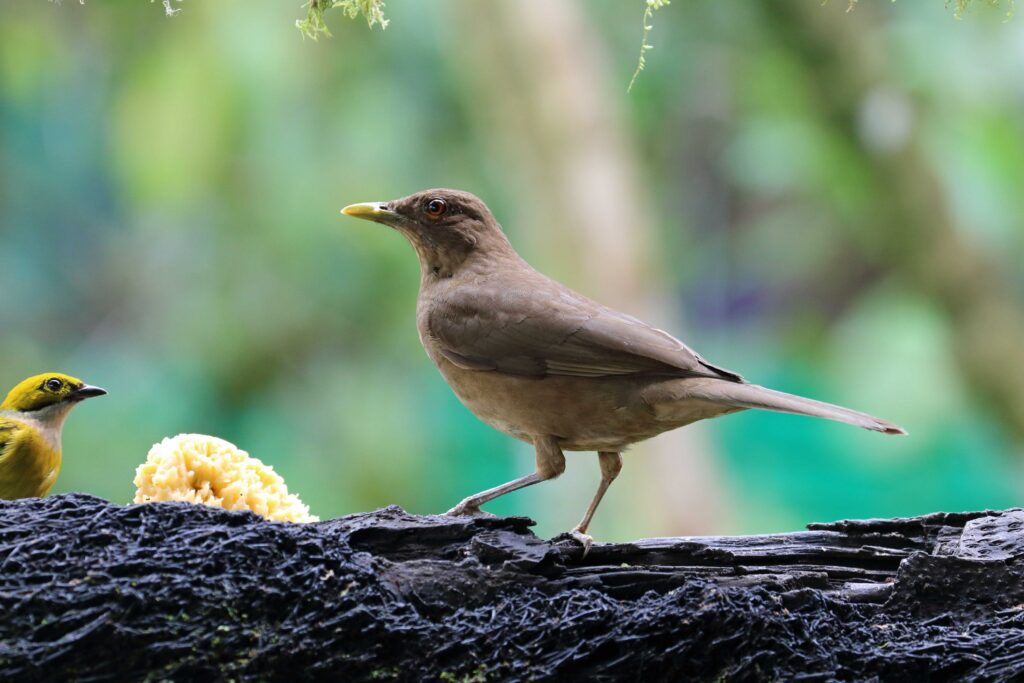
Clay-colored Thrush

Rufous-vented Ground-cuckoos are the most widespread of the five Neomorphus, but even they are unreliable and sporadic at best. For one, in Costa Rica, they only occur on the Caribbean slopes of the big, central volcanoes, places with enough intact forest to support the large ranges they need. For whatever reason, though, they are simply absent from large swaths of the country, including the extensive lowland rainforests in northeastern Costa Rica and the jungles of the Osa Peninsula. In South America, they occur in lowland areas, but here, they do not. 

One of the most reliable spots to see the ground-cuckoo in Costa Rica is a place called Pocosol Biological Station, a remote research center nestled deep in the Children’s Eternal Rainforest. When I say “reliable”, however, I mean that the cuckoo is spotted there a couple times a year at best. Regardless, it was high on my bucket list to visit Pocosol, but I quickly realized that the logistics would be too much, especially since I am only really able to use public transportation while here.

So I gave up on the cuckoo. There were easier birds to see that were almost as cool. Besides, even if I made it to Pocosol, there was a very low chance of actually seeing the bird.

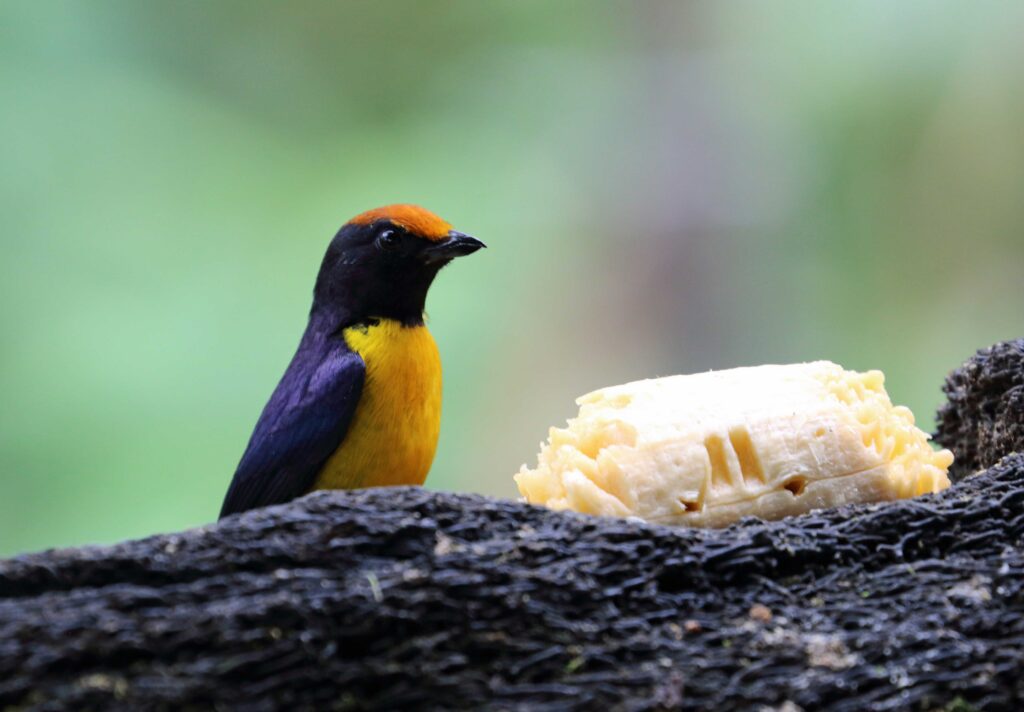
Tawny-capped Euphonia

And then yesterday, on Monday, April 15th, I logged in to eBird. And I just so happened to look at the eBird page for Alajuela, the province I live in here. The top photo was of a Rufous-vented Ground-cuckoo—and the photo had been taken the day before! Not only that, it had been taken at San Luis Canopy, a location only thirty minutes north of my host city, San Ramón. Some quick investigation revealed that not one but SEVERAL Rufous-vented Ground-cuckoos had been spotted at San Luis a few weeks ago, and that they had been fairly reliable since then. Without a second to lose, I went downstairs and asked my host brother if he could call me a taxi. Thirty minutes later, I was on the road north, and just before 11 o’clock I arrived at San Luis.

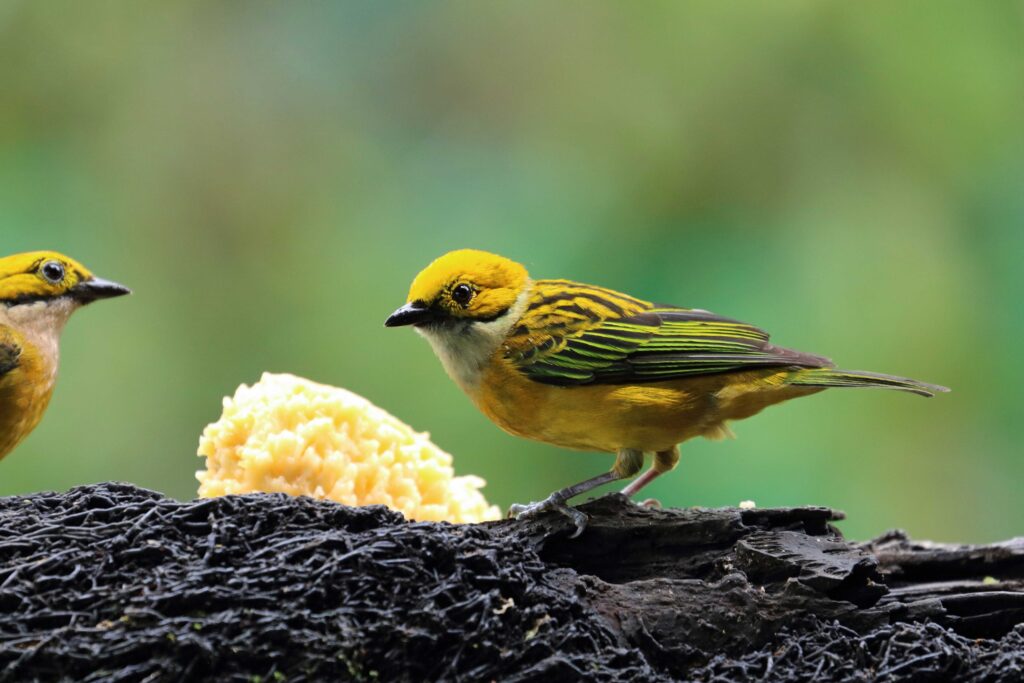
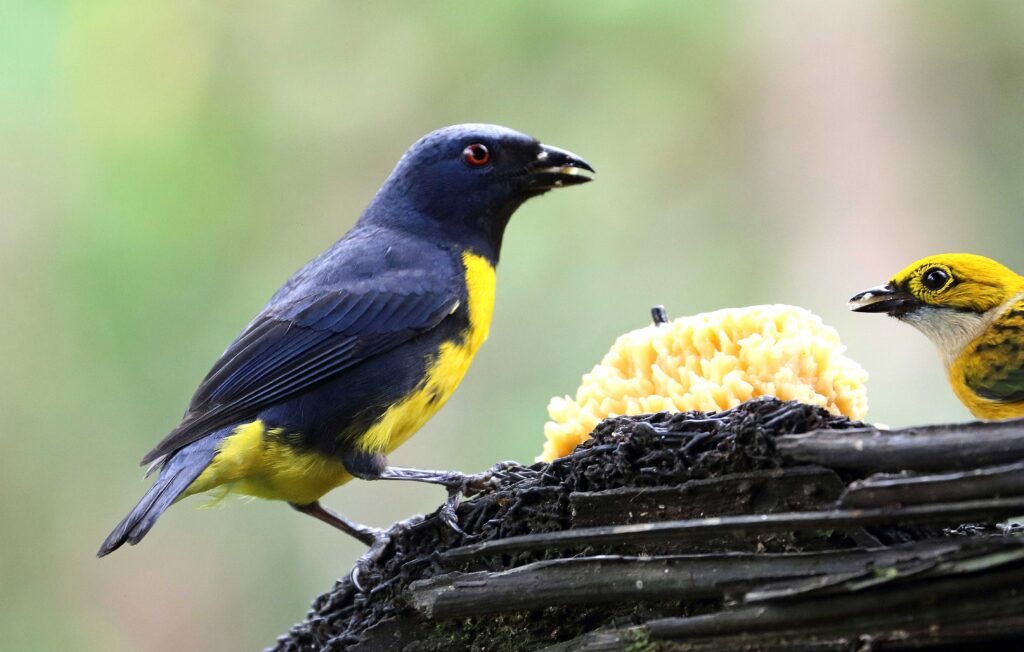
San Luis Canopy is known less for its birds and more for its adventure activities, which include hanging bridges, a zipline course and bungee jumping, and I hoped, when I walked up, that I wouldn’t need a reservation to get in. The woman at the front desk smiled at me and asked me for twenty dollars, the entrance fee, then told me to wait by the bird feeders for her partner to arrive. I rounded the corner to see a log suspended from a roof by chains, currently covered in Silver-throated Tanagers absolutely devouring bananas.

Silver-throated Tanagers

As I watched the tanagers and a curious coati watching the feeding frenzy hungrily from below, I sat down. I felt nervous. This whole morning excursion wasn’t particularly cheap. Plus, I might not even see the bird. But then again, I definitely wouldn’t see it if I had stayed in San Ramón. 

Soon, a man walked onto the patio and beckoned for me to follow. I got in his truck with a local birder by the name of Jimmy, and he drove us down the road for about ten minutes. He then parked, and motioned for us to walk down the trail. Fifty meters into the rainforest, we spotted a large group of birders, all sitting silently by the side of the trail, watching. Most of the birders were locals, but I saw a few Americans, too. So, I sat down, got my camera ready, and waited.

The ants weren’t particularly hard to see. Ground-cuckoos, like antbirds, follow army ants around and feed on the insects the ants scare up. I could only imagine that being three times the size of an antbird means they have to eat that many more insects, which might explain part of why these ground-cuckoos are so rare.

Blue-and-gold Tanager

After fifteen minutes, a couple of birders left—they’d already seen the cuckoo earlier this morning. I frowned. Had I missed my shot at the bird? There weren’t many other species around either. One local pointed out the call of a Golden-browed Chlorophonia as it flew over, but that was about it.

Suddenly, everyone was looking behind me, at the other side of the trail. Several birders had just heard bills clacking, a telltale sign that a ground-cuckoo is nearby. People raised cameras that cost more than I’d spent on my entire study abroad experience, ready to capture the ghosts of the jungle. And then, some people started looking through their binoculars.

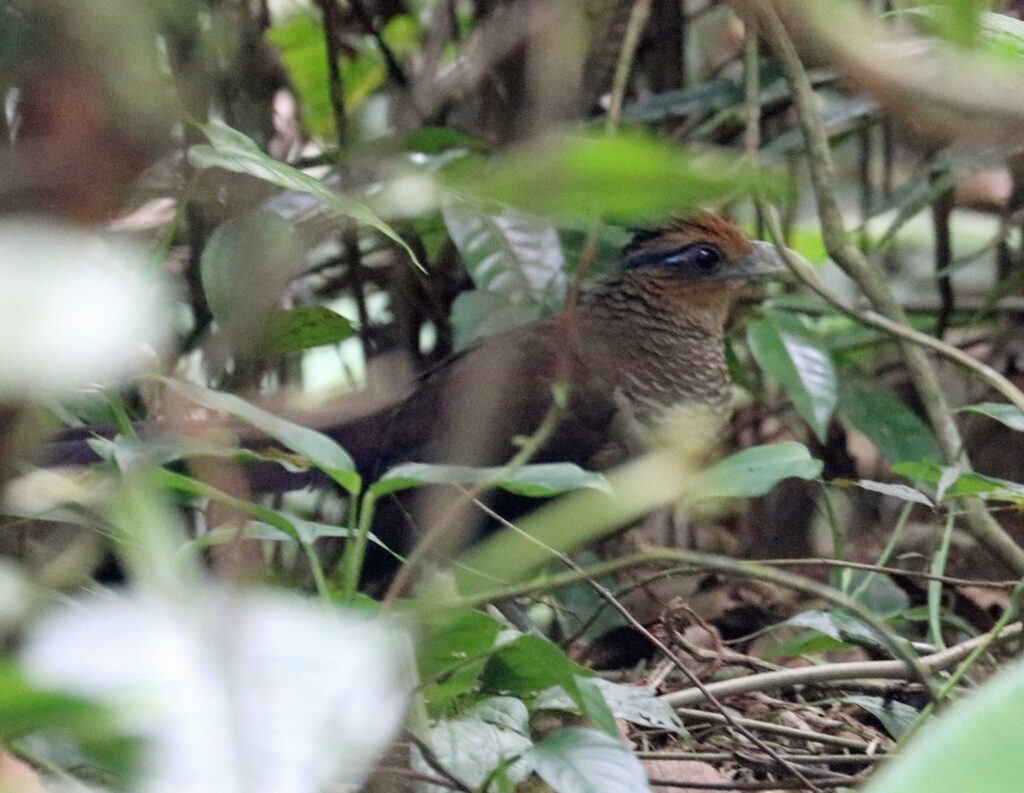
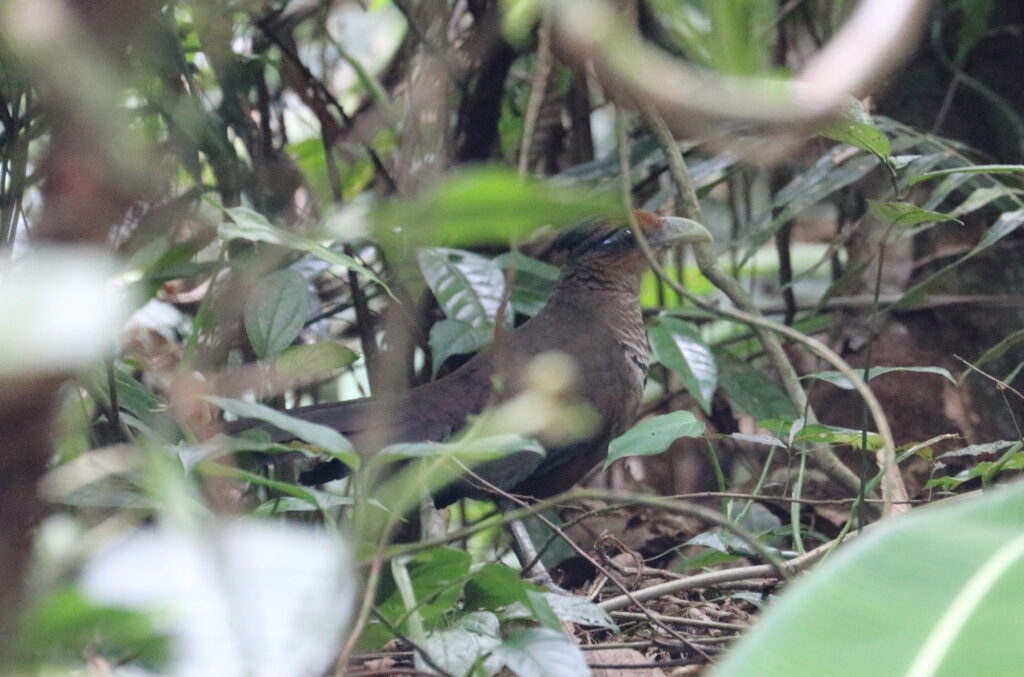
I caught motion out of the corner of my eye, and looked through my binoculars. There, the flash of a dirty brown wing. Two large, scaly feet. A long, dark purple tail. The ground-cuckoo was here. 

Rufous-vented Ground-Cuckoo

“There’s two!” someone whispered.

The ground-cuckoos were here. And then, more movement, and suddenly, a species I’d only dreamed of seeing appeared on a log, seven feet away from me, posing perfectly. I shot some quick photos. Ten or fifteen seconds passed and the second bird appeared. They both gave us humans a quick look before disappearing into the brambles, clacking their bills all the way.

The whole experience lasted maybe thirty seconds, and then they were gone. I’d gotten good photos and good looks, but wanted more. I wanted more time with these elusive birds. But sometimes, thirty seconds is all you get. Still in shock, I lowered my camera. And after twenty more minutes of waiting, I wandered out of the forest.

Rufous-vented Ground-cuckoo—the ghost bird.

How do you tell someone you’ve seen a ghost? What should it feel like? I still don’t know. I still can’t comprehend that I actually saw this legendary bird species.

For the next hour I wandered around San Luis. I got another lifer, Pale-vented Thrush. I also got great views of a variety of birds visiting the banana feeders, including Silver-throated, Emerald, Blue-gray and Blue-and-gold Tanagers (the latter of which is another rarity that people had been coming to San Luis to see), Clay-colored Thrushes, Black-cheeked Woodpeckers and a Tawny-capped Euphonia. And then I caught a taxi home.

I still don’t know what to think. When I saw the Orange-collared Manakins, I was ecstatic. When I saw the Yellow-eared Toucanets, I was in awe. But with this species—it almost doesn’t feel real. If not for the photos, I might think I had dreamed up the whole experience. I feel fulfilled and at the same time inexplicably empty, craving more time with this mythical bird. And yet, it may be the only time I ever see this species for the rest of my life. The cover of Birds of Central America means so much more to me now—but it may take me a while to figure out exactly how.

In the meantime, I’m still in Costa Rica for three more weeks, so stay tuned to see what I get up to next!

P.S. Are you a student? Do you want to study abroad? If so, apply for the Gilman Scholarship! I’ll extol its virtues more on the next blog.

Braden’s Costa Rica Report #3: El Copal

Not many of us have the resources to bird outside of our own regions, and if you are part of that large club, you’re in luck. Braden is spending the spring semester of his junior year studying abroad in Costa Rica. He has 16 full weekends to work with and it’s no surprise that birding is on the agenda for every one of them. Here is his latest report—to a place that is not only a wonderful birding destination, but a model of sustainable agriculture. Enjoy!

I arrived at La Reserva El Copal just as the sun dipped behind the rainforest-covered foothills, my clothes soaked with sweat and every part of my body tired from the four bus rides and two-hour walk it had taken to get to one of Costa Rica’s best birding locations. My weekends in Monteverde and Jaco had been eventful and fun, but I was in need of some solo birding time, and so four days earlier I had made a reservation for this inexpensive, out-of-the-way property sitting on the lower slopes of the Cordillera de Talamanca. Patricia and Beto, the couple that ran the reserve, warmly welcomed me as darkness fell, showing me to my room and then to the dining hall for a dinner by candlelight. As I stared at the photos of rare and colorful hummingbirds on the walls, I realized that I was the only guest staying here for the night. Patricia served my rice and beans and said that she and Beto usually lived in Pejibaye, the town the final bus had dropped me off in, and only came up here when guests arrived, which wasn’t particularly frequently in January and February. This surprised me, given El Copal’s location and the high number of desirable bird species reported from here.

Even a glance of the grounds explains why El Copal is one of Costa Rica’s top birding destinations.

The next morning I arose at dawn, grabbed my binoculars and camera and headed off into the property as the trees began to glow with increasing sunlight. Almost immediately after stepping outside, a small, dark hummingbird buzzed by me, stopping to feed at one of the many flower bushes adorning the property. Despite the fact that it was still dark, I could clearly see the brilliant white cap for which the bird was named—Snowcap, which, in the weeks leading up to my trip to Costa Rica, had quickly risen up the ranks as one of my most-wanted birds. Rare denizens of the Caribbean slope, there were very few places in the country where these birds were reliable. El Copal was one of them, and I ended up seeing at least half a dozen of them during my stay here. The tiny, fairy-like hummingbirds eliminated any doubt I had about making this trip!

El Copal is one of the few places to reliably see Snowcap hummingbirds, and fortunately, they are there in abundance!

El Copal is full of rare birds. Back in the late 90s, the land now holding El Copal had been purchased by several families for agriculture. Instead of developing the rainforest, however, they decided to first establish a form of sustainable agriculture, then open it up for ecotourism, preserving much of the primary forest on the property. Now, some of Costa Rica’s most sought-after birds (and other animals) thrive here, thanks to the decision of those local farmers. This includes the Snowcap and a variety of other hummingbirds, as well as my #1 Target Bird for the whole country: Yellow-eared Toucanet. Of the six toucan species found in the country, this toucanet is the rarest, only found in middle elevation-rainforest on the Caribbean slope. El Copal seemed to be one of the best places to find them in the whole world, and I had my fingers crossed as I headed up the steep trails leading into the reserve.

The morning was…complicated. I heard a whole lot of birdsong, but very few of the singers actually presented themselves for good looks. Merlin (the bird identification app developed by the Cornell Lab of Ornithology) was only so helpful, as there are significantly fewer recordings of Latin American species than North American species. Bird sounds that the app identified for me included Bright-rumped Attila, Broad-billed Motmot, and Northern Schiffornis, the latter of which is an entirely brown bird with one of the most entertaining whistling songs I’ve ever heard. Despite my frustration at not being able to see many of the birds hidden in the foliage, I did get eyes on a few. I spotted both a Collared Aracari and a Keel-billed Toucan, two species of toucans quite common in this type of rainforest. And I did lay eyes on several large, mixed flocks of tanagers, colorful birds that traverse the forest in search of fruit. The species I picked out at the tops of trees included Silver-throated, Emerald, Speckled, Golden-hooded, Hepatic, Summer, Scarlet-rumped, Tawny-crested, Black-and-yellow, and Bay-headed Tanagers. I also got to watch a family group of coatis quietly foraging on the trail ahead of me. They scattered when I stepped on a branch by accident.

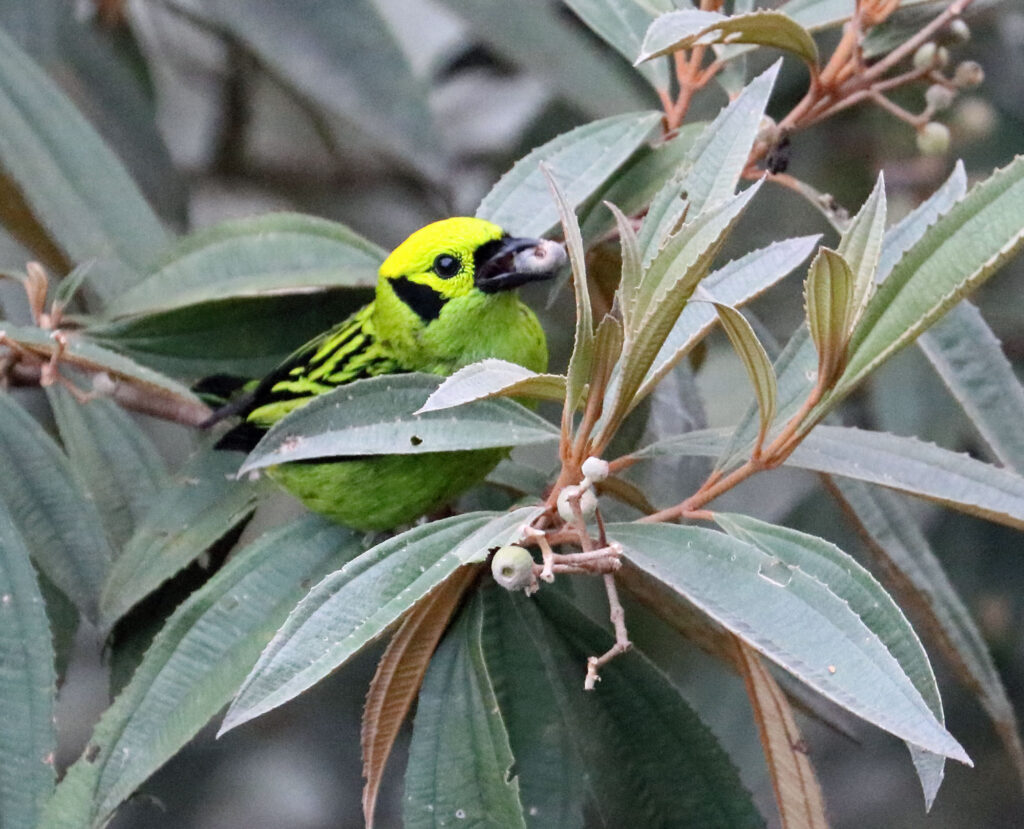
The tanagers put on a real show around the El Copal lodge—including this spectacular Emerald Tanager.

I returned to the main property for breakfast, then headed off on a different trail, this one leading down towards a stream. I found a Buff-rumped Warbler foraging on the rocks in the water, and peered around tree ferns and buttressed trees to try and glimpse the calls I was hearing. This trail also took a left turn and then continued up the mountain, and further up I spotted Scarlet-rumped Caciques and Chestnut-headed Oropendolas, big grackle-like birds making crazy calls. As I rounded a corner, a shiny green bird with a long bill alighted on a branch in front of me. The bird’s beak was longer and thinner than that of a kingfisher, and it had a warm, orange belly complementing its shimmering, green back: a Rufous-tailed Jacamar! Few birds had given me such a good look that morning, and I stood there for several minutes, watching the bird peer down at me curiously. A few minutes later, a large Ornate Hawk-Eagle soared through a gap in the trees, and my attitude began to improve—the birds were showing themselves! On the way down, I heard a rising and falling song, signifying the presence of an antbird. I poked around a little, eventually getting eyes on a Bicolored Antbird overturning leaves! This species, like many other antbirds, are ant-following obligates, meaning that they depend on army ants to find food. As large swarms of army ants rush through the rainforest, they stir up and scare hundreds of other insects, who leap out of the way, straight into the waiting mouths of antbirds, antwrens, woodcreepers and a variety of other birds that just follow the ants around. Ground-cuckoos, one of the most enigmatic groups of birds, also belong to this ant-following group.

While I didn’t actually lay eyes on any army ants, the antbirds signified that there must have been some nearby. The leafcutter ants, meanwhile, were everywhere. Their trails ran alongside and crisscrossed the walking trails, and I always had to keep an eye on the ground so I wouldn’t step on any.

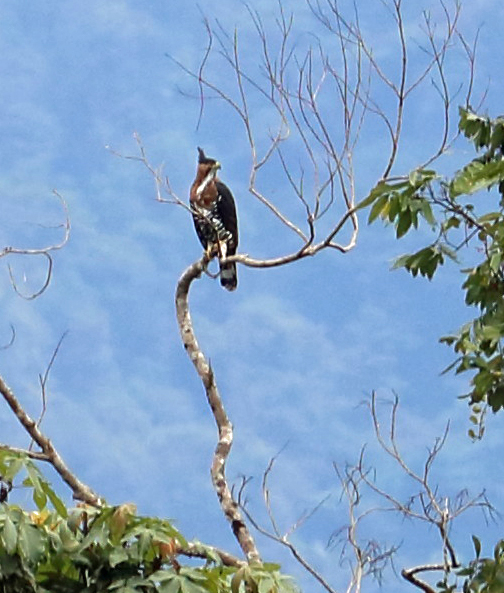
One of the best parts of my visit to El Copal was meeting Carlos, who pointed out this perched Ornate Hawk-Eagle near the lodge.

When I arrived back at the lodge for lunch, another birder who had just arrived pointed out another Ornate Hawk-Eagle, this one perched up on a distant snag. As I peered at the bird through his spotting scope, he introduced himself as Carlos, a local also living in Pejibaye. Carlos is an English teacher and regularly visits El Copal during weekends to search for the hundreds of bird species found here. I told him that I hailed from the University of Maine, and spoke of my hunt for the Yellow-eared Toucanet. He looked at his watch. “I’ve got a few more hours…do you want to hike the trails and look for the toucanet together?” So, after a quick lunch, we headed back up the mountain in search of my target.

Thanks to my chance meeting with Carlos, a teacher and Costa Rican bird expert who can identify most of the birds by sound, I got to see one of my most sought-after Costa Rican species (keep reading).

Carlos’s knowledge of the birds of the area was impressive. For one, he could identify many of the calls I’d felt hopeless about earlier, which included more species of antbirds, Collared Trogon, and several species of wrens. He also knew exactly where all the birds hung out, at one spot pointing down the side of the cliff to a White-crowned Manakin, a tiny black bird with a white cap, sitting in a bush fifty meters away. “He’s always here.”

As we gained altitude, I could begin to see the influence of cloud forest. Slightly different species lived here, and the plant composition looked different, too. One thing in particular made us realize we’d entered a higher-altitude area, however. “Toucanet!” Carlos yelled, pointing to a large, bromeliad-covered tree rising from the slope. I held my binoculars up to see, not my target bird, but an entirely green toucan: a Northern Emerald Toucanet! We tried in vain to photograph the species but neither of our cameras would cooperate, although it will be a long time before I forgot what it felt like to see that bird. This species is much more common at higher altitudes, and it was the first time Carlos had ever seen one on the property! It was, of course, a lifer (a bird I’ve never seen before) for me. As if the Emerald Toucanet wasn’t enough, as we rounded the corner, Carlos stopped me again.

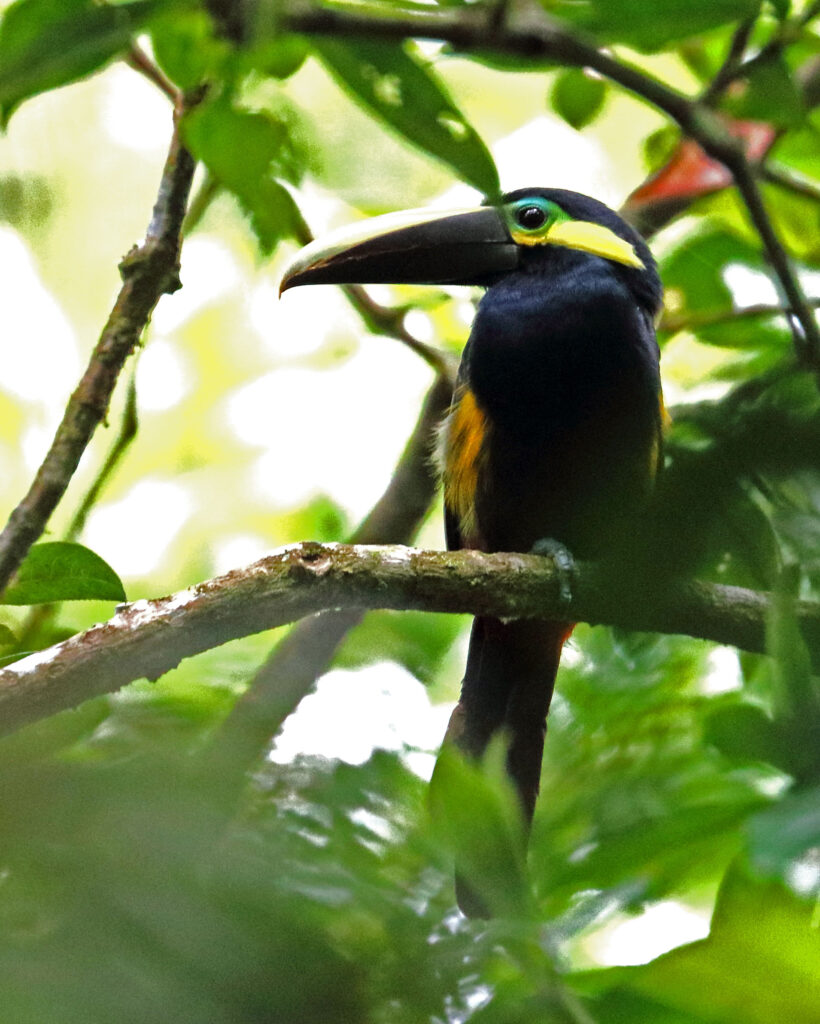
Slowly and quietly, he pointed out a large-ish bird sitting about twenty meters in front of us, up in a tree. The bird was black, with a chestnut cap complementing the blue and green skin around its eye. Its long yellow and black beak, combined with green wings, orange flanks and red rump, identified it as the bird I’d been searching for: a female (hembra in Spanish) Yellow-eared Toucanet. I just about lost my mind, holding my camera up slowly with shaky hands. Never had I actually believed I would lay eyes on one, and yet, here one was, right in front of us. Then, the male appeared, sporting that yellow ear the species was named after. 

Again thanks to Carlos, I had an unforgettable experience with the bird at the top of my “must see” list—a pair of Yellow-eared Toucanets (male shown here).

We enjoyed the birds for about ten minutes, then headed off, as Carlos had to get back home. I thanked him profusely for sharing these amazing birds with me, and we exchanged contact information. Then, I spent the rest of the evening looking at and deleting photos and enjoying the tanagers feeding in the fruiting trees in front of the rooms. Before I went to bed, I spotted several of what I believe to be bioluminescent beetles flying through the rainforest (though they may have been fireflies. I’m not good with bugs.).

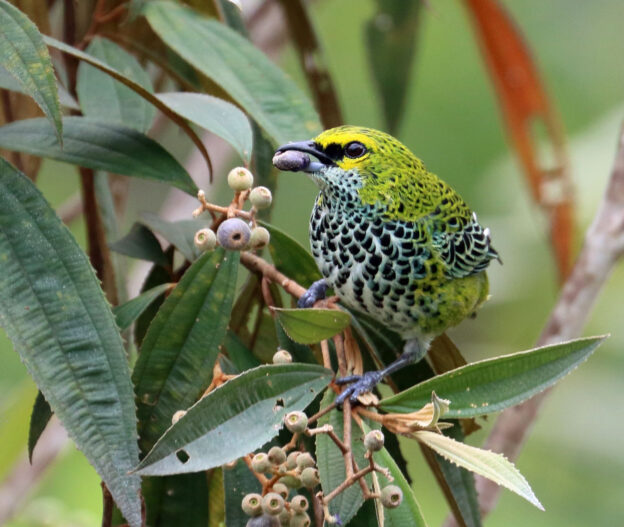
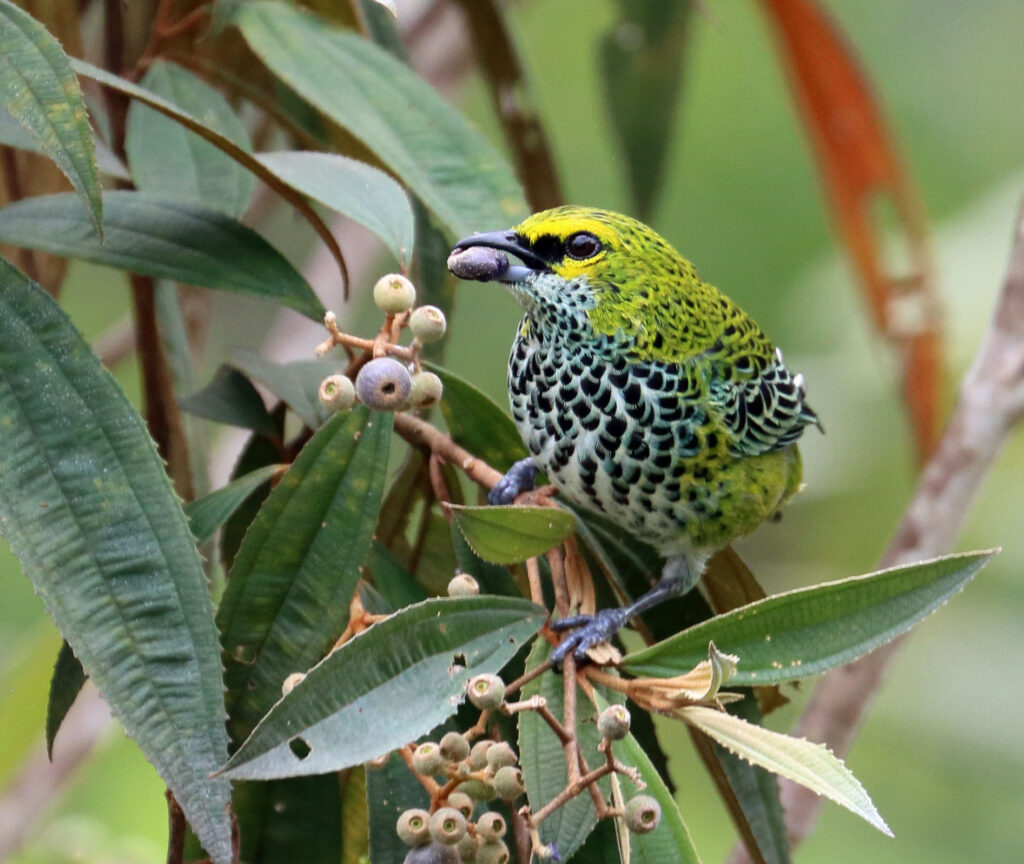
No, this Speckled Tanager was not touched up by artists for my visit!

In total, I spotted 117 species at El Copal over the weekend, including a few the next morning like King Vulture, Gartered Trogon and Green Thorntail. La Reserva El Copal could be described as nothing short of magical. Are there places like this that you’ve always wanted to visit? A mountain range full of endemic plants? A reserve dedicated to protecting endangered amphibians? Perhaps your bucket list is topped with places like the Serengeti, the Great Barrier Reef, the ancient castles of Ireland? If you are, the Gilman Scholarship can help you get to these places! Studying abroad is an experience that every student should have the opportunity to have, and the Gilman helps put this philosophy into practice. The money they awarded me has helped me afford to go on adventures like this, the rain-forested foothills of Costa Rica, and they can help you too! So please, if you’re considering studying abroad (which you should be), apply to the Gilman!

Braden’s First Costa Rica Report: Monteverde

Many annoying things have kept me (Sneed) from birding so far this year. Not so Braden, who is enjoying a semester abroad in the town of San Ramón, Costa Rica. In just his first few days, he tallied almost 100 Life Birds—and he’s just getting started. Here is his first report, from a weekend trip to the cloud forest haven of Monteverde, where I visited to research a book almost thirty years ago.

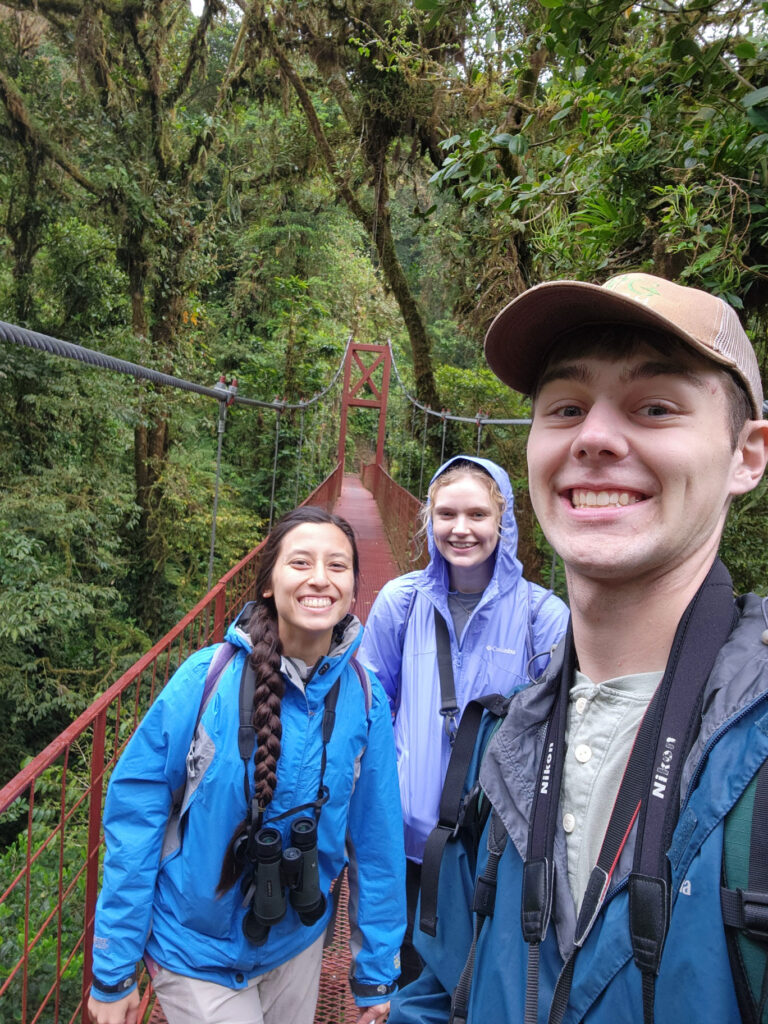
The town of San Ramón and its colorful, ramshackle buildings sits in an ecological crossroads as far as Costa Rica’s ecosystems are concerned, located near Caribbean slope rainforest, Pacific slope dry forest and high-altitude cloud forest. The dry tropical forest, situated in the northwest part of the country, is a habitat characterized by distinct dry and wet seasons. The southwestern part of the country (including the Osa Peninsula) holds tropical rainforest, and these two habitats constitute the “Pacific Slope.” The “Caribbean Slope,” meanwhile, is all rainforest, although its communities differ from those of the Pacific rainforests. Why? Several large mountain ranges run through the middle of the country, reaching heights of 3,800m (about 12,500 feet) in the Talamancas to the south. These mountain ranges not only separate species living on the Pacific Slope from those living on the Caribbean Slope, but also hold another, incredibly important ecosystem: the cloud forest. This ecosystem is the one I’d been most wanting to visit since learning about it a decade ago, and so, on the first of our semester’s sixteen three-day weekends, two fellow UMaine students, Kiley Chen and Leah Hart, and I caught the bus towards Santa Elena for a two-night adventure.

Okay, maybe we do look a little TOO happy in this photo, but can you blame us? We’re in COSTA RICA!!!

The long and winding bus ride did not do good things for our stomachs, but soon enough, we arrived in Santa Elena. The next morning, we caught a taxi up the mountain to the Monteverde Cloud Forest Biological Reserve. Despite the fact that this reserve is a well-known tourist destination, especially during the dry season (December-April), Kiley, Leah and I were the first people to arrive, and proceeded to spend the next seven hours exploring the cloud forest, hiking nearly every trail available to us. It blew our minds.

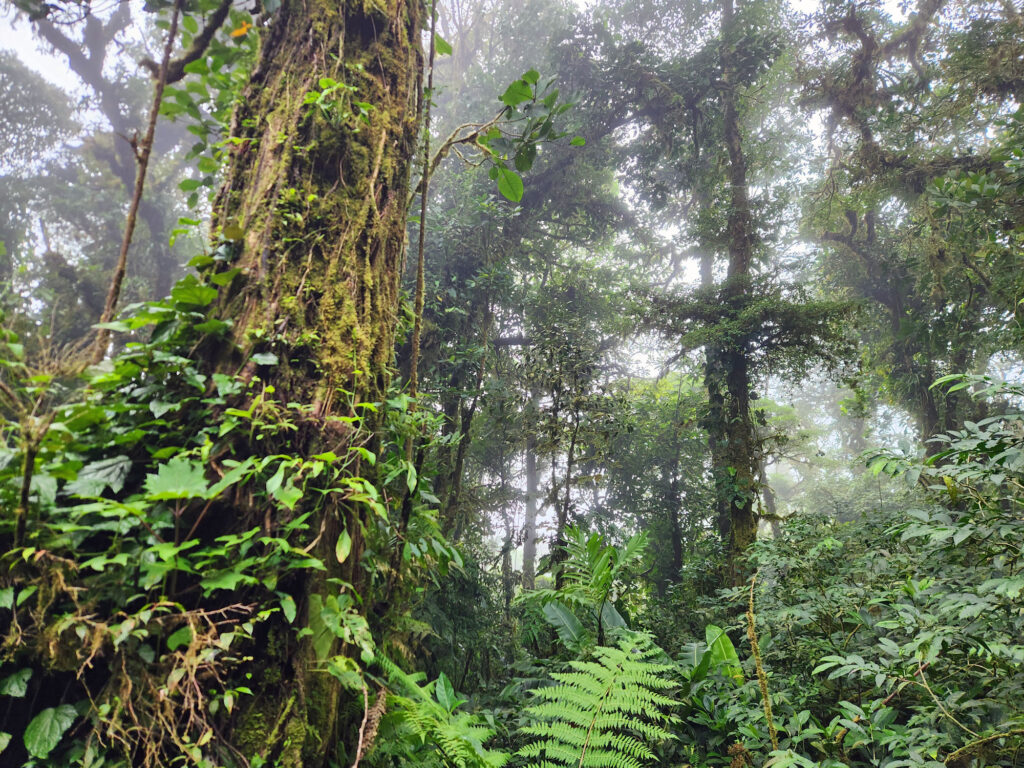
Cloud forests are especially known for their CRAZY abundance and diversity of epiphytes—plants that grow on other plants.

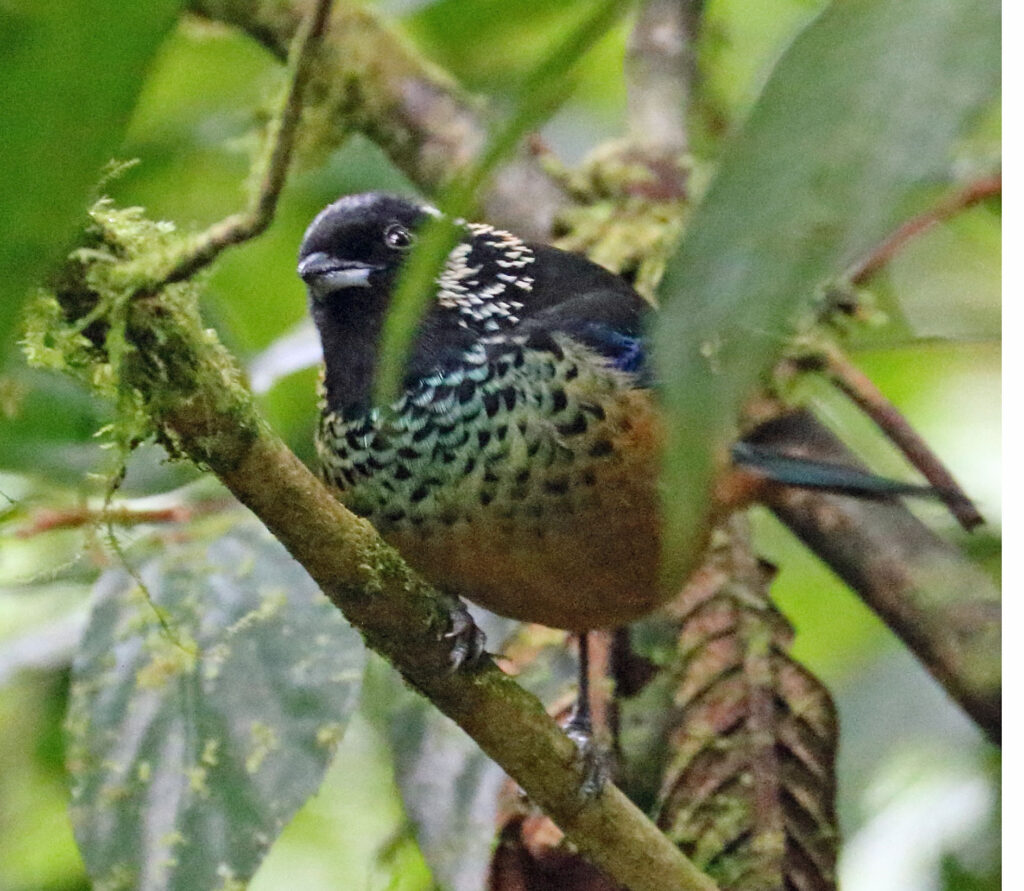
A forest with nearly 100% humidity year-round is a botanist’s dream. Giant bromeliads grew from every branch, and we could hardly see the bark on the trees because of the high densities of moss and lichen. Thick, woody vines (known as lianas) hung down from above, and prehistoric-looking tree ferns, with the trunk of a tree and the leaves of a fern, rose above us. At one point we walked across a red, metal bridge suspended above a gully, and we could see just how the habitat had received its name. Powerful winds carried large fogbanks through the trees, and we could not see more than thirty or so feet out from any viewpoint because of the mist. These constant clouds, caused by winds from the east and high-altitude condensation, lead to the air being constantly saturated with water, allowing a luxuriance of plants to grow here. High concentrations of plants usually mean high concentrations of animals, and the animals we saw did not disappoint. Leah rescued several giant millipedes from the path during our hike, and at one point we saw a group of White-nosed Coatis approach us, completely fearless as they foraged for insects in the damp soil. From the suspended bridge we spotted a large mixed flock of birds, including Ruddy Treerunners, Spotted Barbtails, Spangle-cheeked Tanagers, Prong-billed Barbets and a variety of warblers (including some that spend the summer in Maine!). And, after returning to the entrance to ask directions, we finally found ourselves sitting on a wet bench, staring at an epiphyte-laden tree looking for Resplendent Quetzals.

Spangle-cheeked Tanager.

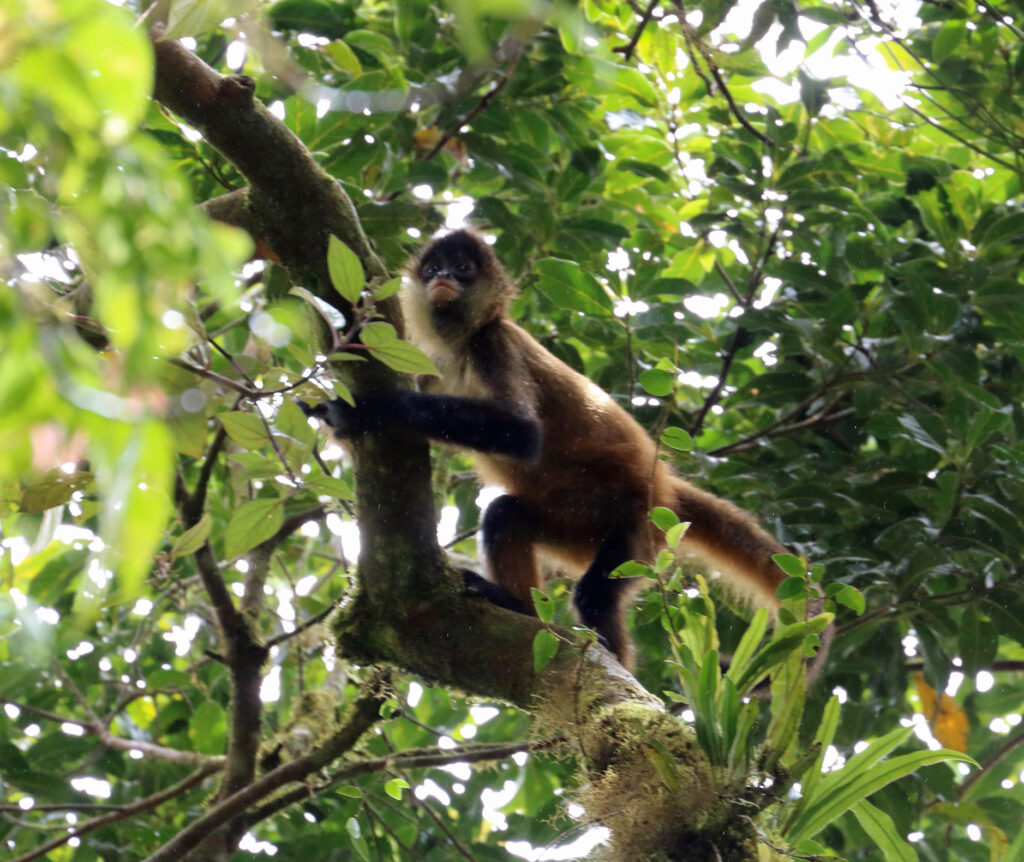
The Resplendent Quetzal is not the national bird of Costa Rica, but with all of the attention it garners, it might as well be. We spotted a female in the tree as we first arrived, admiring its deep, emerald green plumage reflecting light through the mist. The real prize we sought, however, was the male—a bird of emerald and ruby, with green tail streamers up to three feet long. These birds are altitudinal migrants, meaning that they spend the non-breeding season at lower elevations. During the breeding season, they travel upslope to the cloud forest to feed on wild avocados and raise young. They are icons of the cloud forest, a rare animal living in a rare habitat. Eventually, as we sat on that bench, we did spot a male, although the look was incredibly brief and unsatisfying. What was satisfying were the other animals that paid us a visit : Spider Monkeys. After sitting there for about thirty minutes, we suddenly spotted movement in the tree ahead of us. From the leaves emerged a pair of long-limbed, rust-orange monkeys, a mother and baby, and we watched spellbound as they swung effortlessly from branch to branch in front of us. It was awesome.

Spider Monkey.

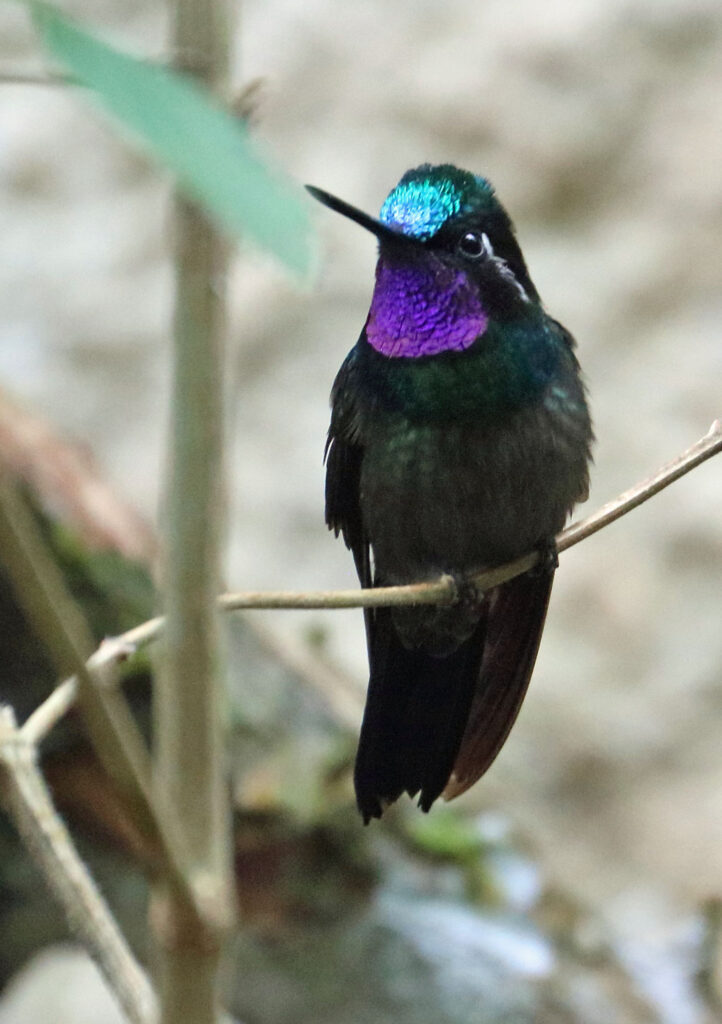
Emerging from the forest, we made a stop at Café Colibri, a restaurant known for and named after the feeders it hangs in the garden outside, and the animals that visit those feeders. At Café Colibri, we spotted seven different species of hummingbirds, almost thirty or so different individuals, each zipping right by our faces in search of sugar water. The hummingbirds had a hierarchy, with the large Violet Sabrewings bullying many of the smaller birds. My favorite of the hummers were the Purple-throated Mountain-gems, the males of which had turquoise foreheads and violet gorgets that shimmered in the sunlight.

Purple-throated Mountain-gem.

We walked back down the road to Santa Elena, admiring the rainbows formed by the mist being blown down the mountain. Following a short rest, we headed out again, this time with a guide to see what animals dwelled in the mountain forests at night. The night walk exceeded our expectations. Our guide, Brandon, pointed out all manner of animals, including Pygmy Rain Frogs, a Robust Climbing Salamander, a Horned Tarantula, an Orange-kneed Tarantula, a Stripe-sided Palm Pitviper loafing in a tree, and two Keel-billed Toucans, fast asleep above us (or they were, until someone pointed a light at them). At one point Brandon wetted a stick with his lips and used it to try to draw a tarantula out of its burrow for us. On our walk back to the entrance to the forest, we spooked a Mottled Owl from its perch in a large banana tree.

Our weekend in Monteverde abounded with sightings of wildlife, and while it may sound like an out-of-reach location for college students, it’s not! The Gilman Scholarship, a scholarship specifically provided to low-income students looking to study abroad and experience new places, is a large part of how I was able to afford going to Costa Rica this semester. If you’re looking to go to Costa Rica, or Ireland, or Japan, or anywhere else, but are worried about the costs, I highly recommend applying for the Gilman. It’s easy to apply, and can support you following your dreams of spending part of your college experience in another country. If you’re enjoying learning about my time abroad and want to have a similar experience of your own, I could not recommend the Gilman more. 

Monteverde was just the first place I’ve visited since I’ve been here in Costa Rica, and I already have more weekend trips planned for the next few weeks, so be sure to check out my next blog to learn about the other cool wildlife and ecosystems I see!

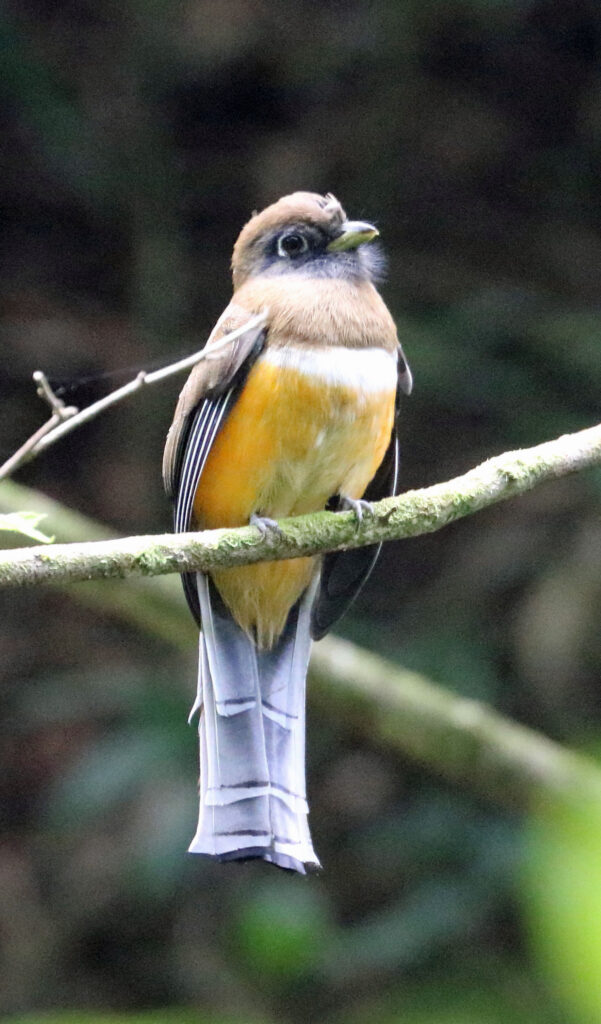
Collared Trogon—named after our family, of course!

Birding Treasure at Garnet Ghost Town

Be sure to catch Sneed at the Montana Festival of the Book on Friday, September 8. He will be on a panel at 11:30, followed by his own session about his recent books Waiting for a Warbler and Border Crossings at 1:15. The following Monday, Flathead Audubon will be hosting Sneed for a presentation. Hope to see you there!

This past Friday, Braden and I set out on a quest for a bird that has steadfastly evaded my life list: Spruce Grouse. In truth, I’ve probably seen one of these birds before—but long before I became a birder—and Braden wanted to help me officially nail it down before he headed back to Maine for his junior year of college. To try to find it we decided to explore a road we’d never before birded—the road up to Garnet Ghost Town, a once thriving mining community about ten miles off of Highway 200. Spoiler alert: we didn’t find a Spruce Grouse. What we did find proved to be a lot more interesting.

As I’ve mentioned before, Braden and I used to pretty much write off August as a good birding month. In recent years, shorebirds especially have shown us that this was an egregious mistake. As far as passerines are concerned, however, we retained our bad August attitude. After all, our typical birding areas around Missoula get eerily quiet in August—almost as if all of the birds have gone on vacation. Turns out they aren’t on vacation. They’re working hard—at a little bit different elevation.

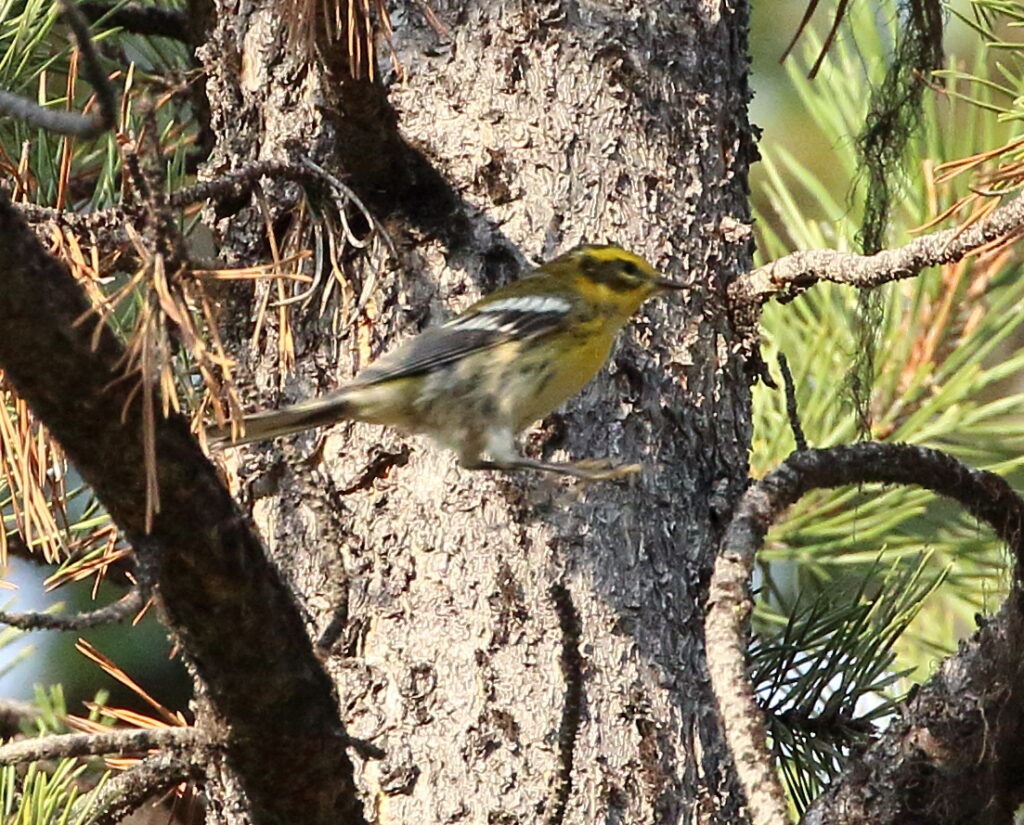
As we turned off of the highway, the road to Garnet began climbing in elevation. We saw a few robins and flickers from our car, but in these kinds of situations, you really don’t know what’s around unless you stop, get out, and listen. After a few miles, we did exactly that—and were amazed by what we found. In what is always a good sign, Mountain Chickadees were sounding off, and as we always hope, a lot of other species accompanied them. We quickly spotted MacGillivray’s, Yellow-rumped, and Orange-crowned Warblers—and a warbler that had stubbornly eluded my crummy ears all year, Townsend’s Warbler!

While I failed to capture a nice photo, I was thrilled to actually see my first Townsend’s Warbler of 2023.

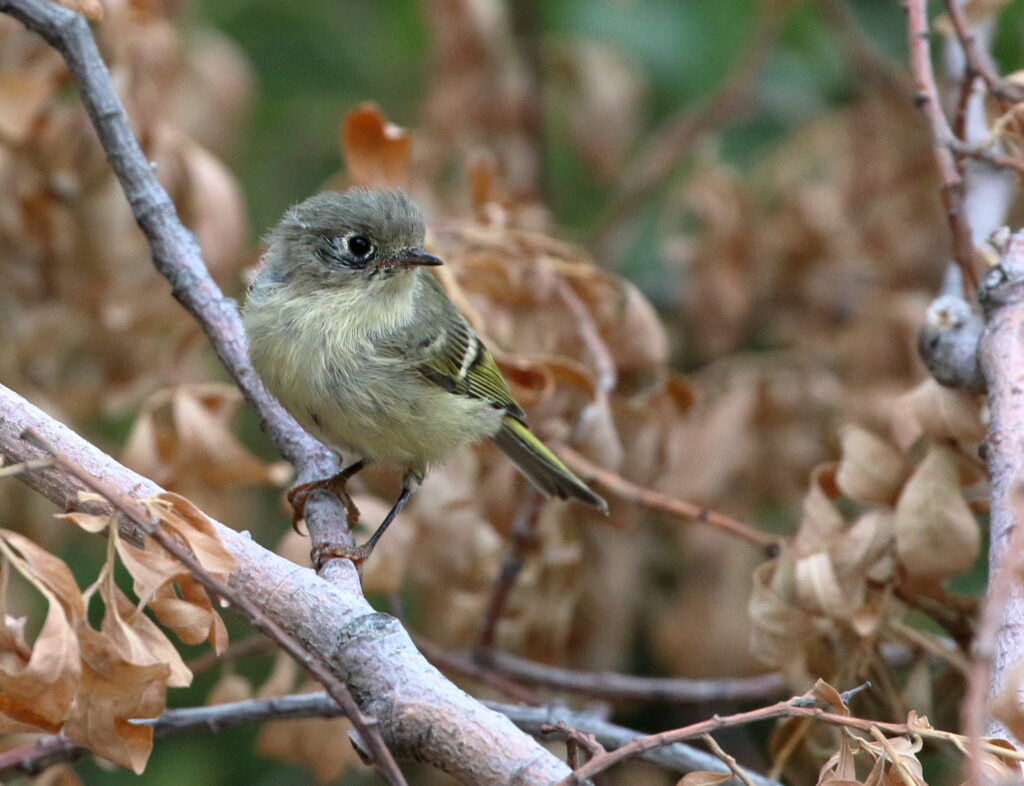
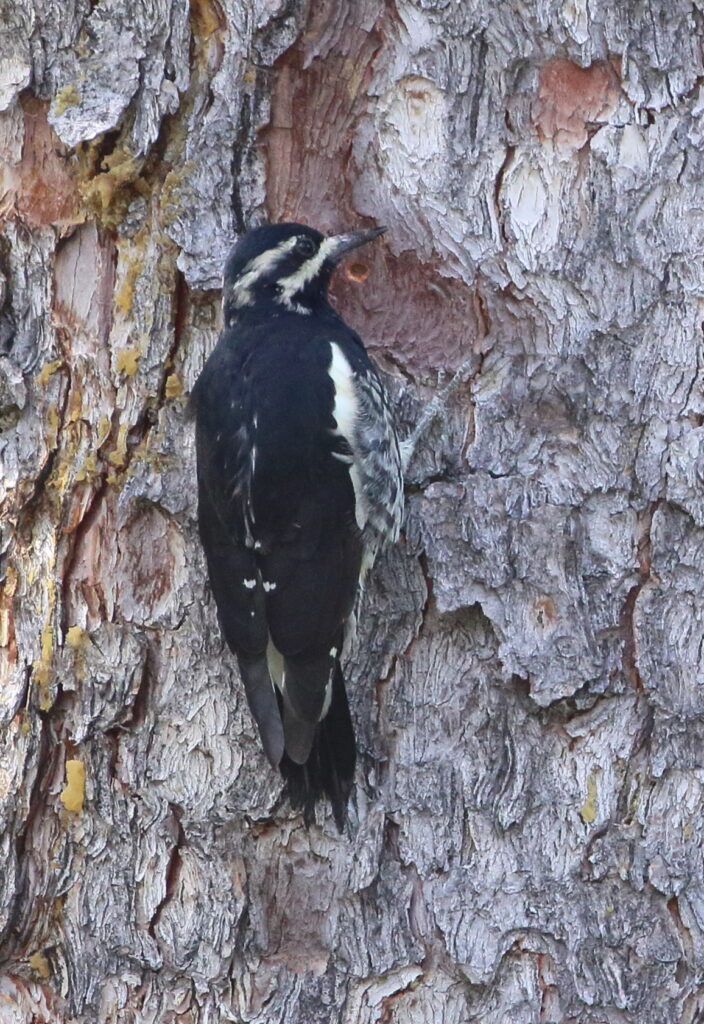
Along with the warblers, Williamson’s Sapsuckers and a Hairy Woodpecker put on a good show, along with Evening Grosbeaks, Canada Jays, Warbling and Cassin’s Vireos, Pine Siskins, and a whole slew of Chipping Sparrows, Western Tanagers, and Ruby-crowned Kinglets. Braden’s excellent ears also detected Golden-crowned Kinglets and a Brown Creeper—the first I’d managed to see all year.

Scads of “Rickies” (Ruby-crowned Kinglets) swarmed the forest edges near Garnet—which explains why they haven’t been in our yard lately!

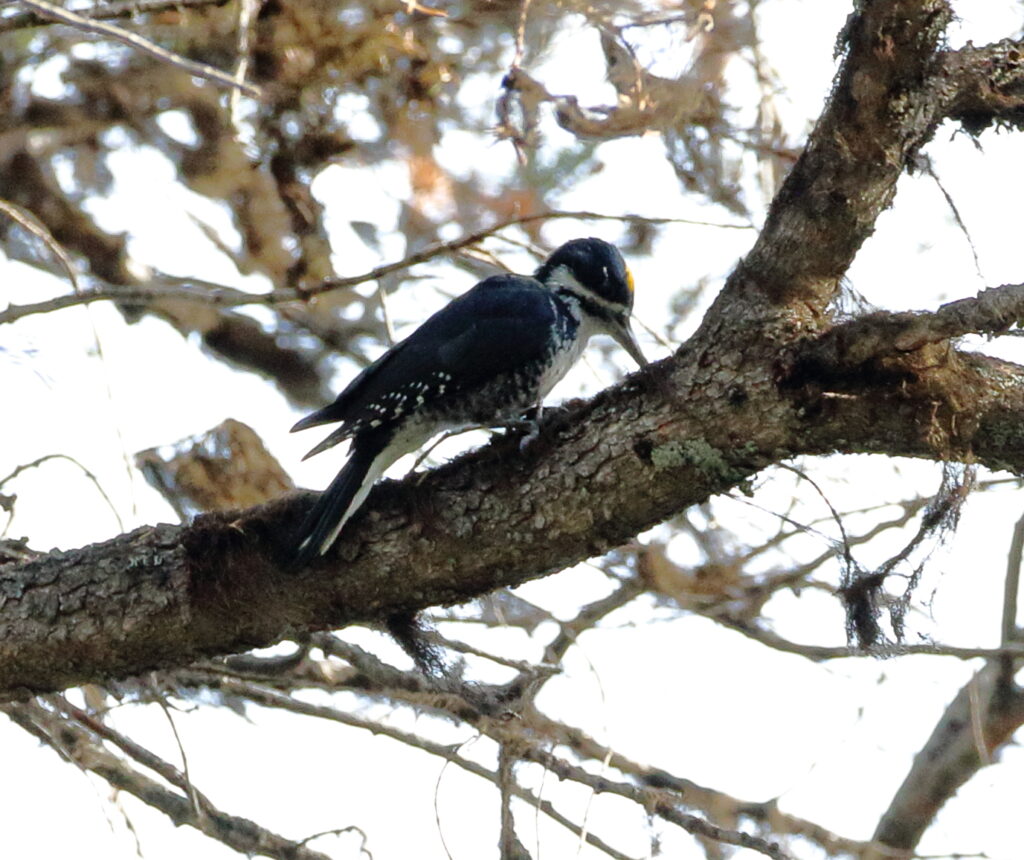
Our next stop a mile or two later gave up an even greater encounter. We saw a bunch of birds heading away from the road so decided to follow them. As a trio of Canada Jays entertained us, we heard a woodpecker methodically pecking away and Braden went to search for it. “Three-toed!” he excitedly called, looking up at a backlit bird high in a tree. Though the yellow head marking was clearly visible, it actually turned out to be an even more surprising bird—a Black-backed Woodpecker, the first I’d ever seen outside a burn area! The habitat made sense, though, as burns weren’t too far away and a lot of dead trees seemed ready to give up beetle grubs.

Our checklist for the Garnet approach road.

This Black-backed Woodpecker both delighted and surprised us with its unexpected location outside of a burn area.

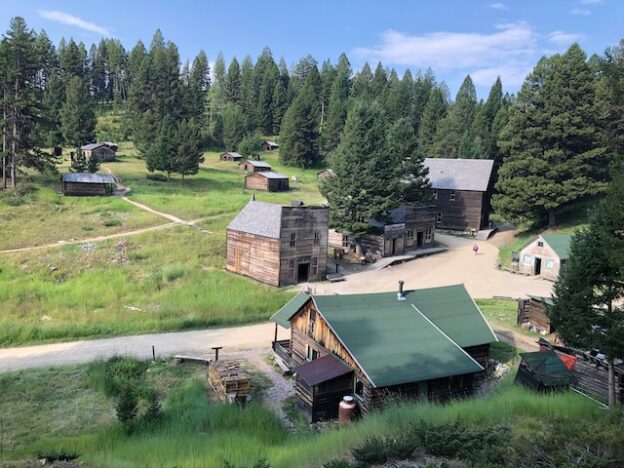
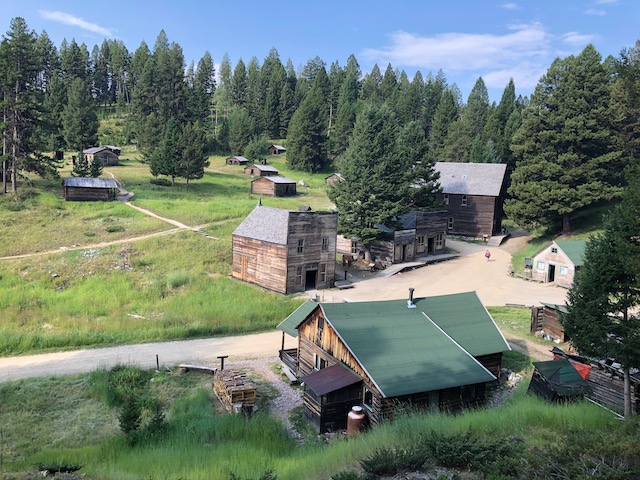
Thrilled with this discovery, we continued onto Garnet Ghost Town. Like most ghost towns, this one has an interesting story. It went from gold boom to bust between approximately 1895 to 1905, and at its peak was home to about a thousand people. By around 1948, the last hangers-on abandoned the town. Thanks to dedicated preservation efforts, however, Garnet today boasts that it is “Montana’s Best-Preserved Ghost Town” and, indeed, the remaining buildings seem in remarkably good shape. Even better, the town sits in a stunning location, surrounded by forests and, even at this time of year, green meadows.

In addition to having a fascinating history, Garnet Ghost Town sits in one of the loveliest spots in Montana.

After exploring the town for a few minutes, Braden and I decided to walk a loop trail in a last effort to find a Spruce Grouse. Again, no grouse. We did walk by plenty of caved-in mine shafts, however, and encountered even more cool birds. These included another Williamson’s Sapsucker, a Vaux’s Swift, and two Olive-sided Flycatchers! Then, a Common Night-hawk called above us and we spotted a second one perched in a tree. Garnet, though, had one more treasure for us.

One of four Williamson’s Sapsuckers we observed near Garnet Ghost Town.

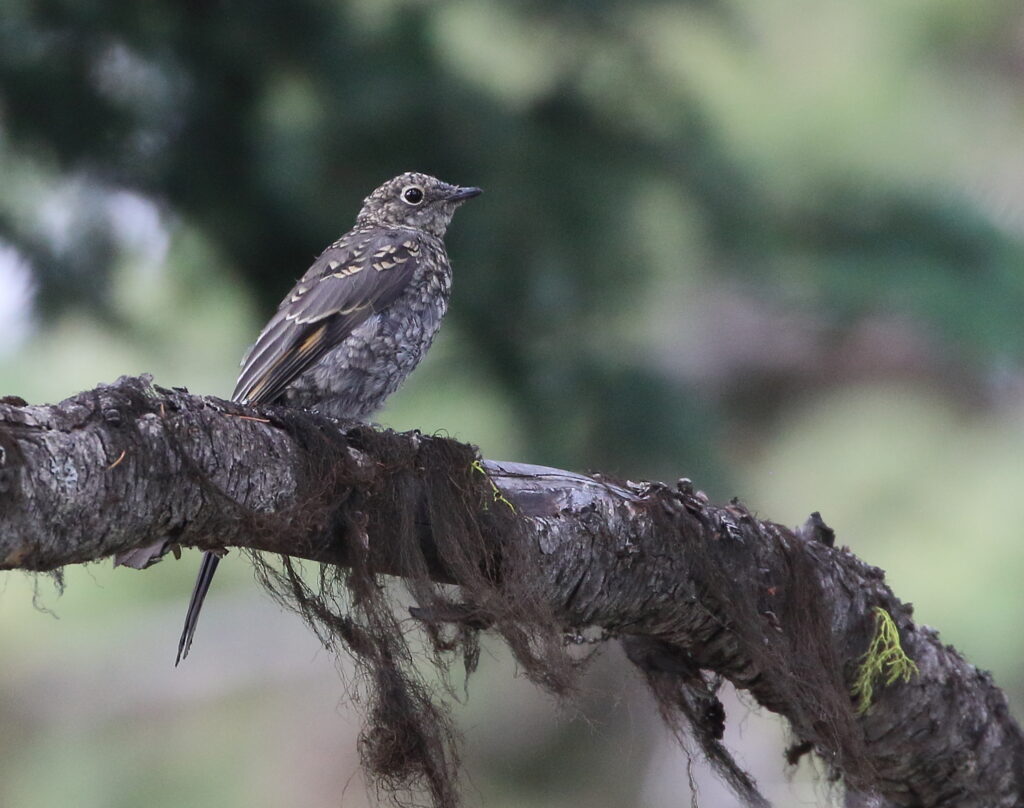
As we neared the end of the loop trail, we saw a bird flitting about on a log. I didn’t at first recognize it, but Braden’s many hours of study paid off. “It’s a Townsend’s Solitaire—and in its ‘pine cone’ plumage!” he exclaimed. I had never heard of the pine cone plumage, but sure enough, this juvenile bird sported a pattern distinctly different from the smoother coloration of the adults. I can best describe it as, well, uh . . . a pine cone!

The “pine cone bird”—our first juvenile Townsend’s Solitaire! What a beauty, huh?

We admired the bird for many minutes and then headed back to our trusty minivan. It had been an outing that far exceeded our expectations, and had proved highly educational. I had heard from Dick Hutto and other biologists that many birds head up to higher elevations to hunt and forage after their babies have fledged, but this was the first time I could remember coming face to face with them—and in such numbers! Though we knew birds continue to face many threats, our experience today made Braden and I both feel better about the state of Montana’s birds, and we excitedly added the Garnet area to our permanent August “must do” birding locations.

Our Garnet Ghost Town checklist.

A father-son selfie in the clearing where we made our surprise Black-backed Woodpecker sighting.