Braden and I head to Costa Rica next week, but before we go I am delighted—yes, delighted—to share the following guest book review by my buddy, Scott Callow. I predict you’ll enjoy his passionate, humorous review as much as the book itself!We challenge you to read it before our next post.And now, heeeeeeeeere’s SCOTT!
Sneed asked me to write a review of The Birds in the Oaks: Secret Voices of the Western Woods by Jack Gedney (HeyDey Press, 2024) before I completed reading it. Consequently, It was impossible for me to finish the last chapter without constant rereading because I became anxious and distracted, wondering how to share all the great things about it. For those of you who only read headlines or first paragraphs of news stories, let me present a few crafted comments that summarize my experiences, being careful not to exaggerate.
Order Jack Gedney’s The Birds in the Oaks by clicking here or on the above image.
* If you live near oak woodlands, you have no claim to being “interested in birds” if you do not read this book.
* The Birds in the Oaks is overflowing with interesting ecological details that will keep me rereading chapters, and I expect I will mark the pages with notes like a seeker underlining sections of the Bible on the journey to become a better person.
* The Birds in the Oaks is a superb example of well-crafted nature writing that mixes extensive and accurate observations with poetic prose, and mixes personal experiences with quotes from historical bird authors.
Last fall, I was fortunate enough to accompany Scott to one of his favorite “oaky birdy” locations, Sugarloaf Ridge State Park in Sonoma County, where we saw a great variety of classic oak woodland species including Oak Titmouse, Golden-crowned Sparrow, and Nuttall’s Woodpecker.(See post World Series Birds in the Golden State.)
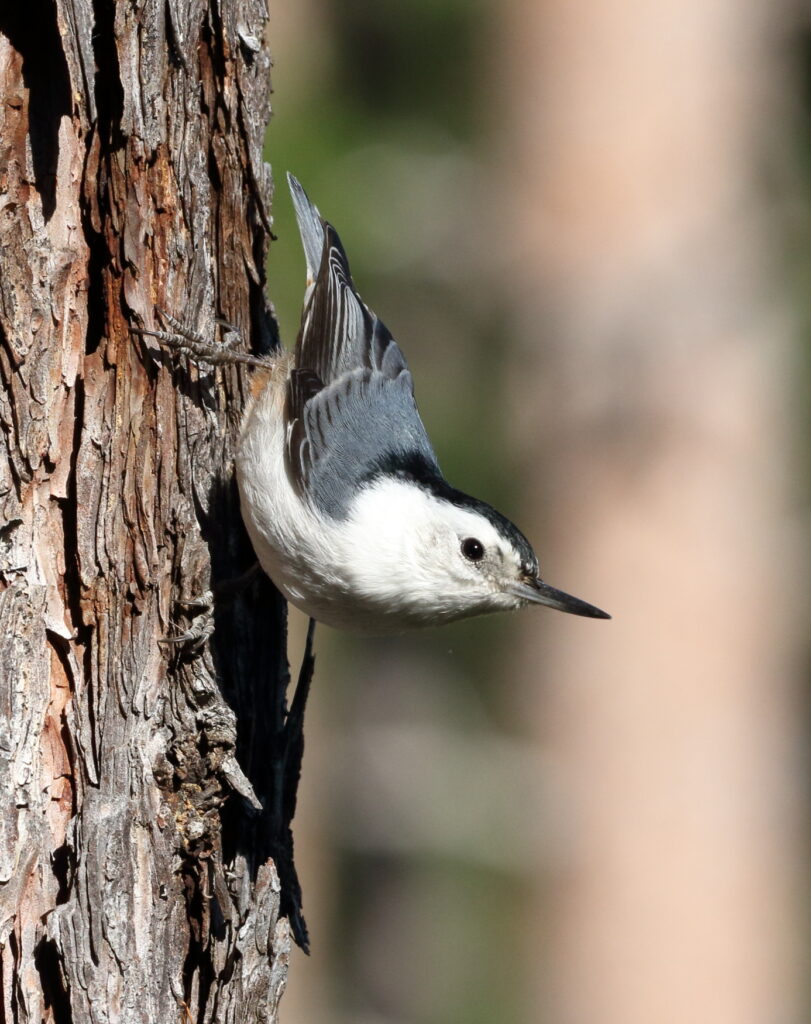
This book, admittedly, is personal for me. I live within walking distance of California oak woodlands. I volunteer at Sugarloaf Ridge State Park which is dominated by oak woodlands and mentioned in the book. The author’s former Wild Birds Unlimited store lies only 24 miles from me. Most importantly, I know these birds. I have learned so much about each of them from Gedney’s book that they have become even more familiar (emphasis in “family”). I will admit only here, amongst birders, that I sometimes say “Hey, buddy!” when I see my first Oak Titmouse of the day, and “Hey-hey-hey” when I see a White-breasted Nuthatch.
Scott apparently has been known to converse with White-breasted Nuthatches. I can’t blame him as I talk to these guys myself!
Each curiously titled chapter is organized around a species. Each begins with key characteristics. Many chapters start with song and call, which I appreciate since I’m late in life to learning bird sounds. (Thank you Merlin.) Example:
“I still hear the bird, steadily whit-whiting away as if mocking my inability to follow.” (A Bird at Our Level – Bewick’s Wren) (“whit-whit bew-wick” – record to memory)
As someone who seeks to be entertained by bird behavior and science, I enjoyed how Gedney explains bird ecology.
“… to learn all the secrets of the woods, one must know … the birds beneath the oaks.” (Discontented Shadows – Spotted Towhee) (Cool we’re on a treasure hunt, I tell myself.)
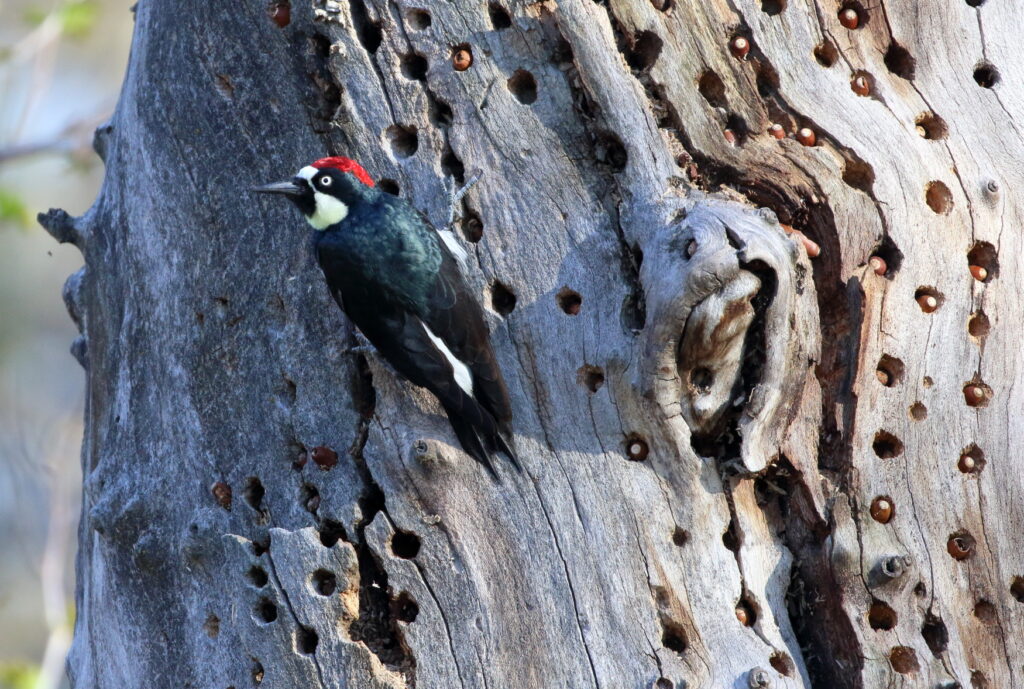
The ecological details too elaborate to be found in a guide have already enriched my birding. Even if you don’t regularly see Acorn Woodpeckers, every birder should learn about their unique extended family groups and their cooperative food hoarding strategies. I also believe every birder should wonder how the Bushtit, weighing as light as a nickel, can engineer such an elaborate sock-shaped nest, insulate it, camouflage it, and then use it for such a short nesting cycle, all on a diet of insects too tiny to see, even with the help of binoculars.
The ultimate oak woodland bird, the Acorn Woodpecker, deservedly attracts abundant attention from birders, both for its stunning good looks and fascinating behavior that features cooperative breeding and storage of thousands of acorns. Isn’t that, ahem, nuts?
But this book is not written by or for the scientist. Gedney is not afraid to add his own appreciation of a bird or personal experiences or poetic descriptions. This at first raised my anthropomorphic alarms since I was trained to reject human sentimentality by my vertebrate bio prof, surprisingly an ornithologist who once said “birds are stupid; their behaviors are mostly determined by genetics; they have small brains.” (These prejudices were spoken decades before contradictory scientific information was shared in The Genius of Birds and several other books on bird intelligence.)
The Birds in the Oaks is very accessible, humanly so. It is so well written that you just might re-imagine your own feelings about birds and get all warm-like inside. You just might be heard saying “Wow” when learning something new about one of the birds. You might just slow down and spend “an inordinate amount of time” observing a bird in one location. Maybe, maybe not. But I will risk one bold prediction: If you get this book, several times you will imagine walking through the woods with the author himself.
No oak trees were harmed in the writing and publishing of this review.
You knew it was coming. You heard the rumours. You’ve waited patiently, and guess what? Today is the day! Right this second, Braden and I are proud to reveal FSB’s Third Annual Short-Eared Owl Lousy Photo Shoot!
Like many birders, Braden and I try to “bird in” the new year with one or more big days of birding somewhere near our home in Missoula. The past couple of years, we’ve headed to Ninepipe National Wildlife Refuge about an hour north of us, mainly because it’s a reliable place for a variety of birds and is especially good for hawks, falcons, and other raptors. This year, our day was shaped by a couple of fun additional circumstances. One is that our long-time friends Susan Snetsinger and her son (Braden’s pal) Eli Frederickson happily agreed to join us for our birding excursion. The other is that a putative sighting of an Arctic Loon on the north end of Flathead Lake sent all of us Montana birders into a tizzy. Why? Because an Arctic Loon has never been reported in the state!
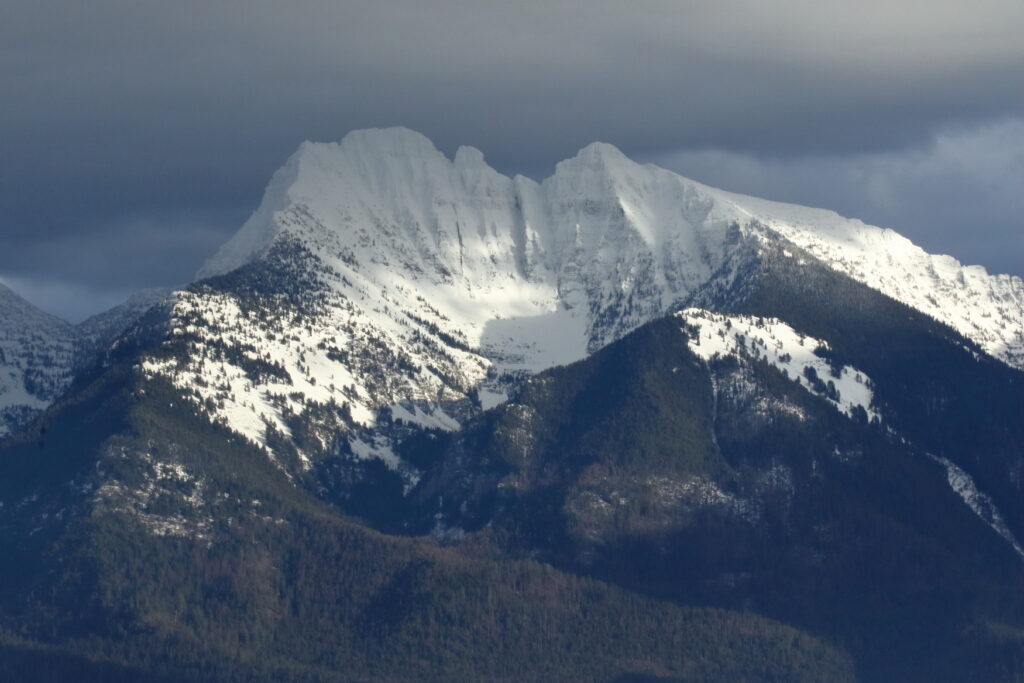
For the third year in a row, we decided to head north through the spectacular Mission Valley for our first major birding expedition of the year.
Unfortunately, on December 30th, yours truly woke up with his first cold in two years and was in no shape to venture out on January 1st. No problem. Everyone agreed to push back our outing to January 3rd and, more important, the Arctic Loon was still being reported! As we set out before dawn, fog and ice covered our route, making driving sketchy, especially with the pre-dawn danger of deer wandering out onto the highway. Braden, though, fearlessly drove us north and as we passed the National Bison Range, a bit of light began seeping in through the fog.
We decided to head to the loon first and that afforded Susan and Eli a once-in-a-lifetime opportunity to join Braden and me at our favorite French breakfast spot, McDaniels, in Ronan. I even convinced the two of them to order my favorite morning birding beverage, a large iced tea, to help power us all through the day.
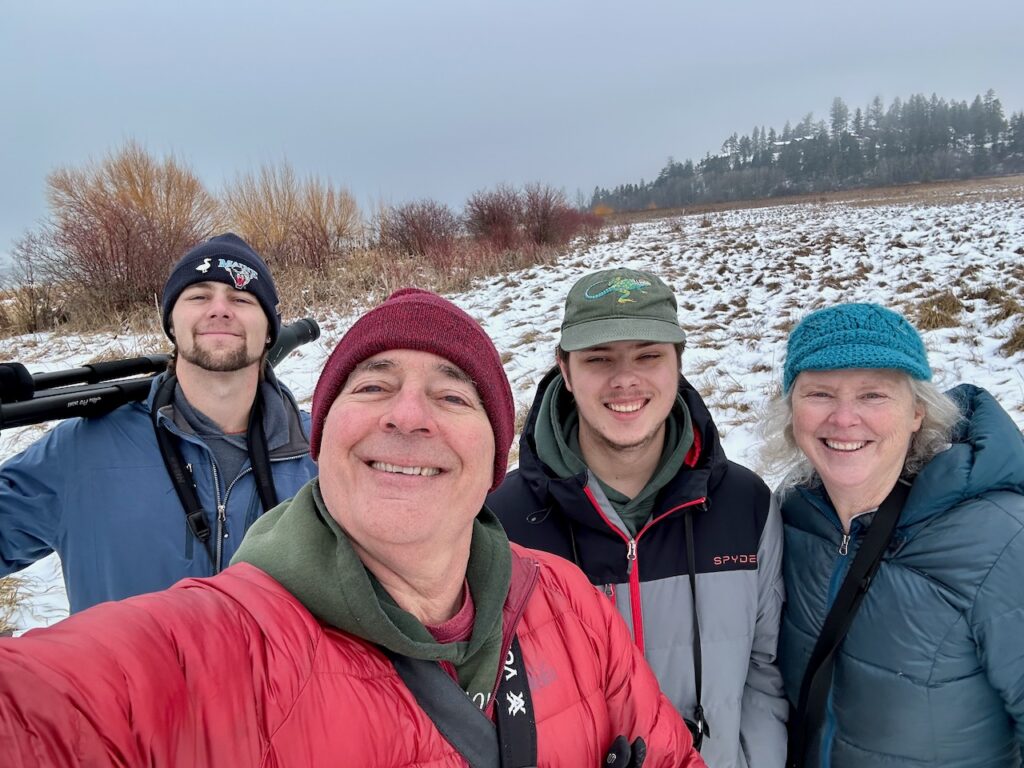
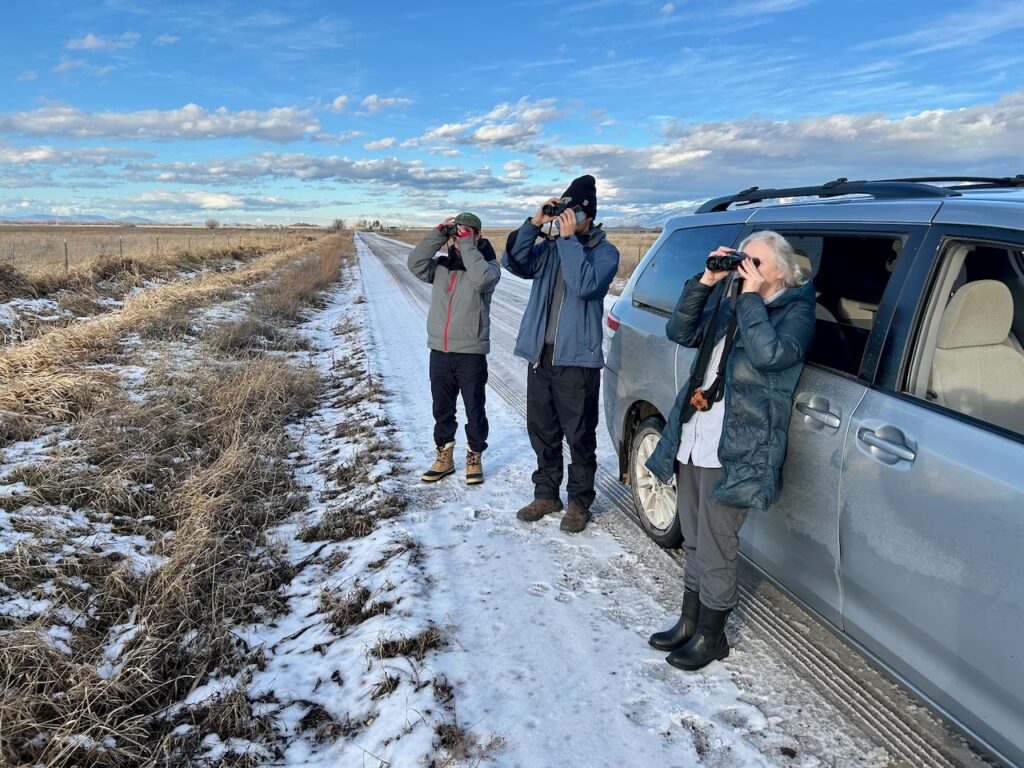
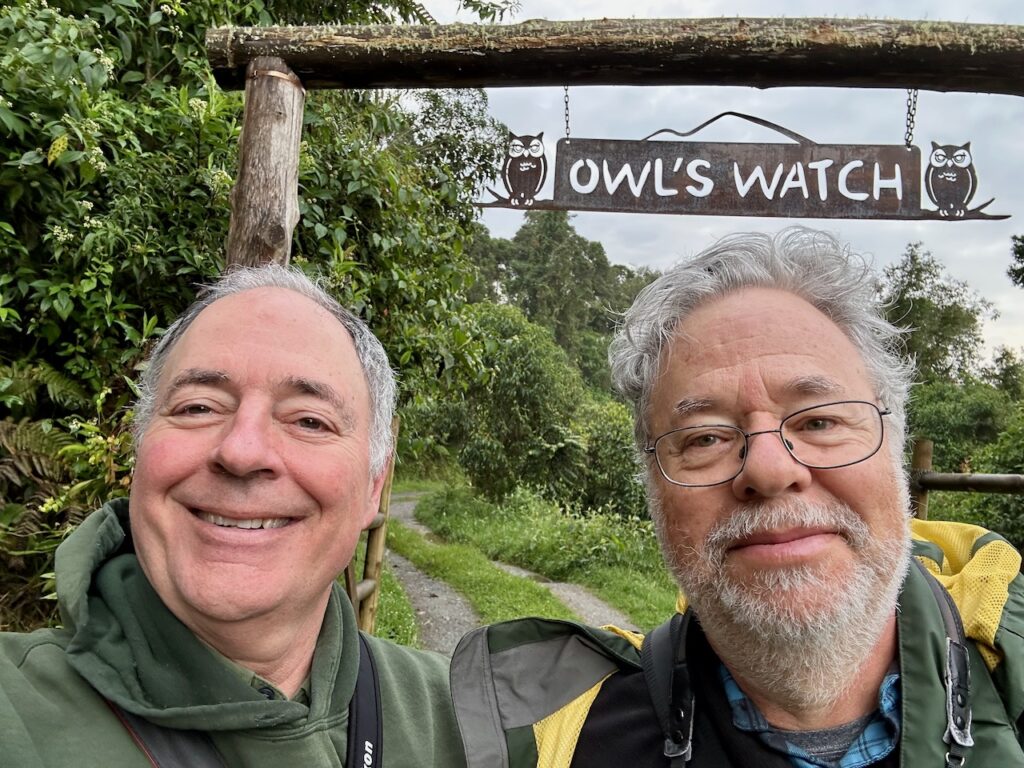
From left to right, Braden, Sneed, Eli, and Susan as we pursued our spirited quest to locate the “Arctic Loon.”
After a fruitless stop to look for Long-eared Owls near Polson, we arrived at our destination of Somers on Flathead Lake just after 11 a.m. Dan Casey, who first reported the Arctic Loon, had kindly noted several viewing possibilities from the lakeshore, and we began visiting these. Right off the bat, we saw some interesting birds. These included Red-necked Grebes, a species we had never found in Montana at this time of year, and a couple of Blue Jays, a species Braden and I totally missed in our home state last year.
We saw no sign of a loon of any kind, so continued to explore the lakeshore. More fun birds popped up, including a variety of ducks, Trumpeter Swans, and one of our favorite winter birds, Northern Shrikes. We also toured the neighborhood where we’d seen our lifer Snowy Owl eight years ago (see our very first post, A Quest for Snowy Owls). None of the owls have been reported this winter, but we thought, “Might as well give it a try.” We eventually left the Kalispell area both owl-less and loon-less, but none of us really minded. We were still seeing birds and even better, enjoying each other’s company.
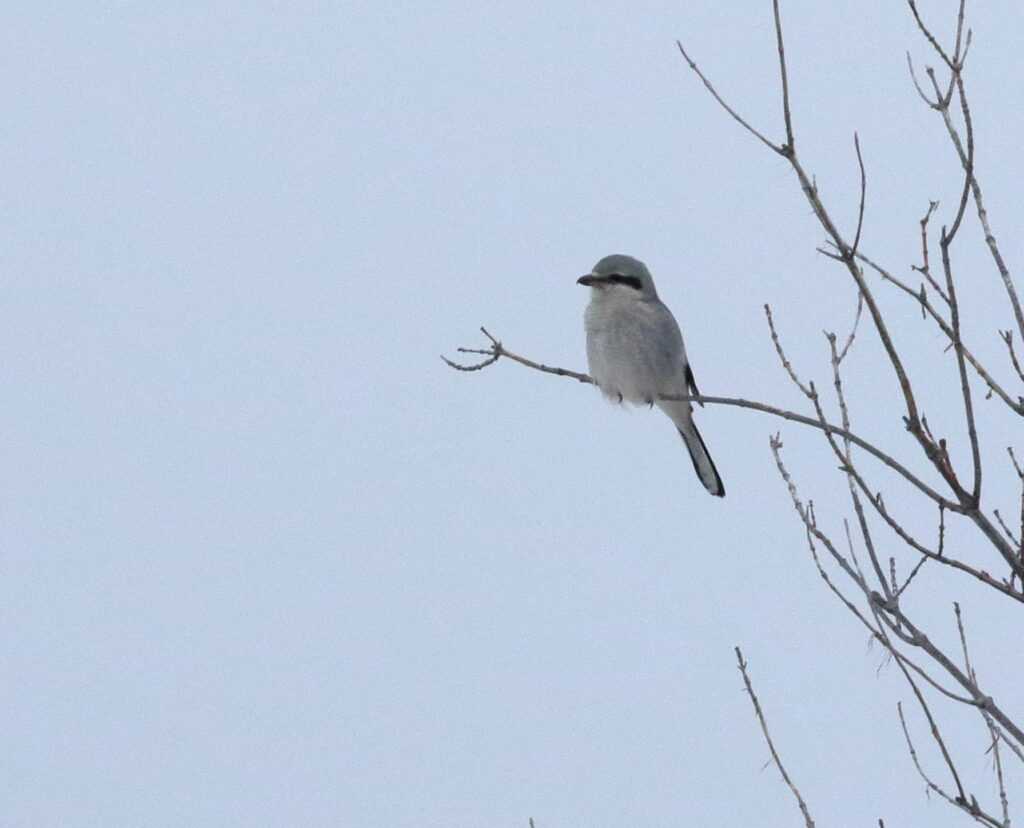
Any day you find a Northern Shrike is a good birding day—and we saw three or four of them during our expedition.
90 minutes later, we were turning down Duck Road at Ninepipe. It was only 3 p.m., but this time of year it felt a lot later. Much of the fog at cleared, but mist still hung off of the spectacular mountains in the distance, giving everything an other-worldly feel. We drove slowly and picked up some expected raptors: Rough-legged and Red-tailed Hawks, Northern Harrier, Bald Eagle, and American Kestrel.
“Should we go drive by the Short-eared Owl place?” I asked Braden.
“Sure,” he answered and began searching for the location on his phone.
We didn’t get that far.
Heading south on Ninepipe Road, he suddenly shouted, “There’s one!”
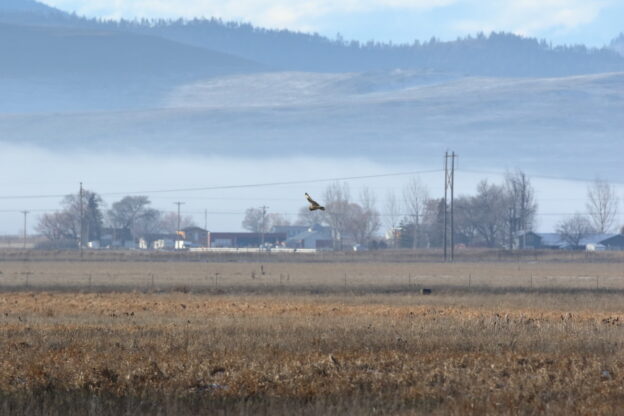
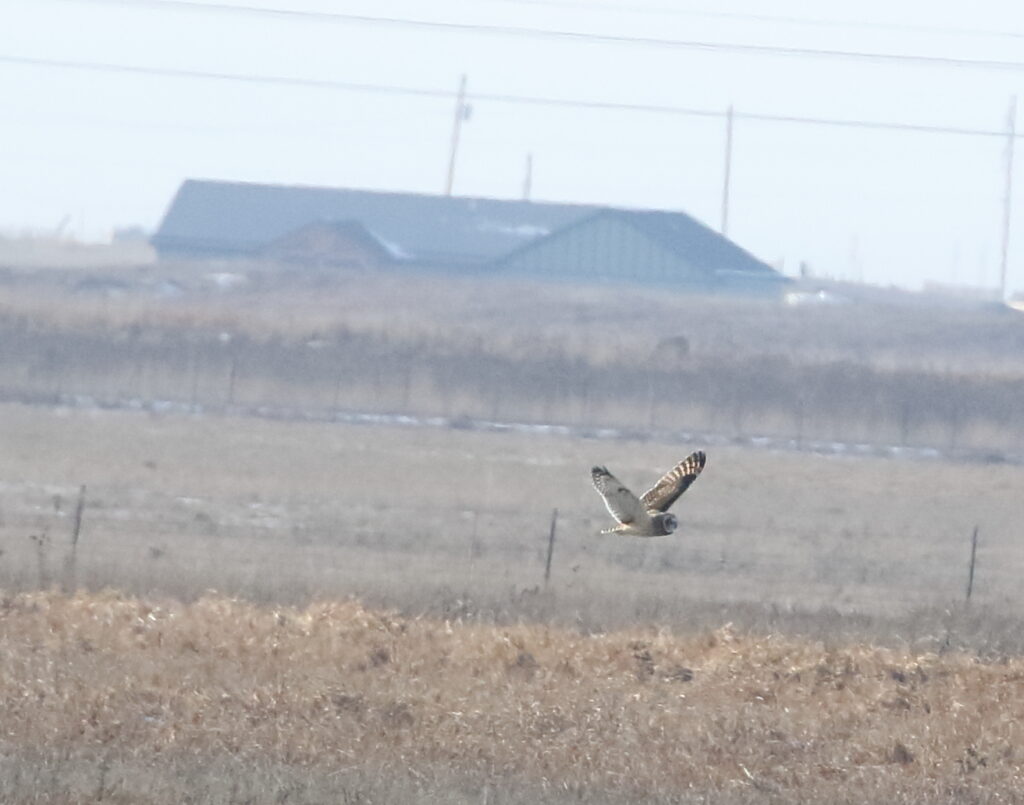
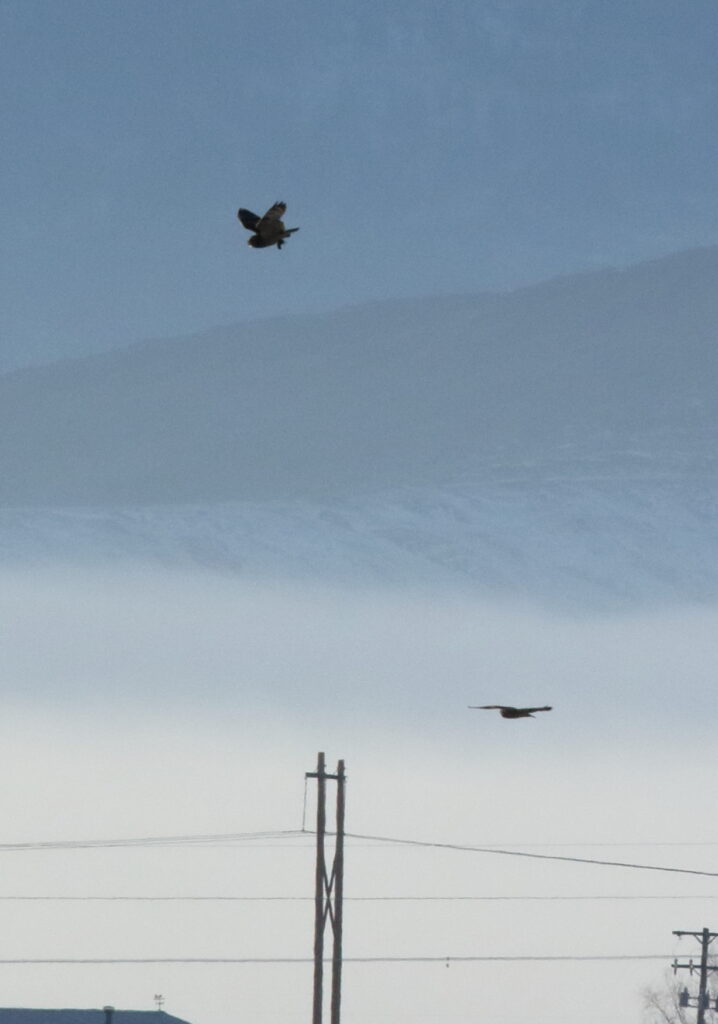
I am especially proud of this lousy Short-eared Owl Shot. See how I tilted the camera to make it appear that the owl is flying downhill? Well, guess what? It wasn’t! I just used my advanced photo skills to make you think that. This is a highly complex and dangerous technique, however, so don’t try it at home!
I immediately pulled over so we could all look and, sure enough, there was one of our favorite creatures flying low over a marsh area in the distance.
We had barely begun to look at it, however, when Eli shouted, “There’s another one!”
“Oh my god,” Braden added, scanning with his binos, “There’s three more way out beyond that!”
If I’d been trying harder, I would have been able to capture up to five SEOWs in one shot–but that might have made the photo TOO good for this blog!
We clambered out of our minivan, and the more we looked, the more Short-eared Owls we saw. These weren’t quick glances, either. Some of the owls appeared to be hunting, dropping quickly into the marsh for a go at a vole. Others looked to be courting, sparring and jousting “good-naturedly” and briefly locking talons before circling around again. A couple of owls spent a few minutes chasing away a Northern Harrier who apparently lacked the firepower to defend her space.
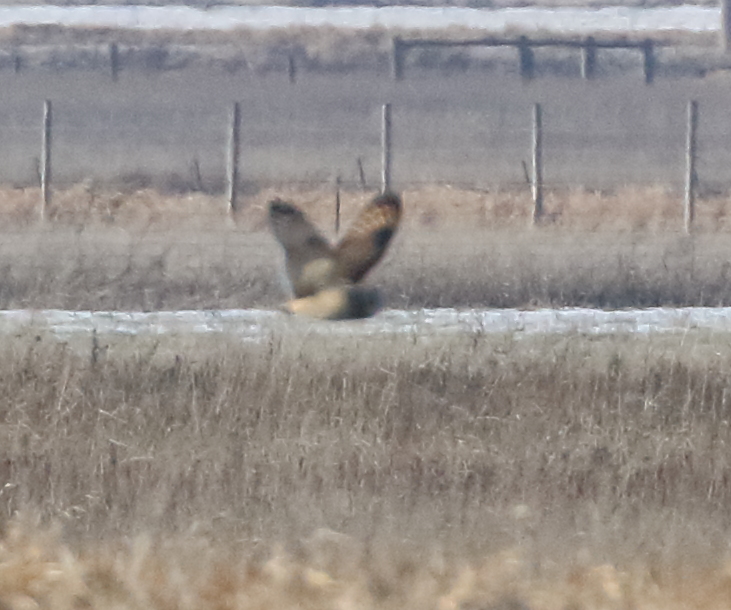
This SEOW did not want its identity revealed, so as you can see I used sophisticated AI processing to blur out its face.
While these weren’t the closest SEOWs we’d ever seen, this was far and away the best Short-eared Owl experience any of us had ever had. Not only were the owls engaging in all kinds of interesting behaviors, we had this winter spectacular all to ourselves.
We encountered nary another birder during our half hour enjoying this “most owl” spectacle!
Oh, and did I mention that I got to take more than a dozen lousy Short-eared Owl photos? That felt particularly gratifying since, after three years, I’ve got a reputation to uphold! We hope you enjoy the gallery and keep tuning in to FatherSonBirding. Even more, we hope you keep having your own magical birding moments.
Happy New Year!
P.S. Oh, it turns out that the Arctic Loon got “downgraded” to a Pacific Loon. C’est la loon!
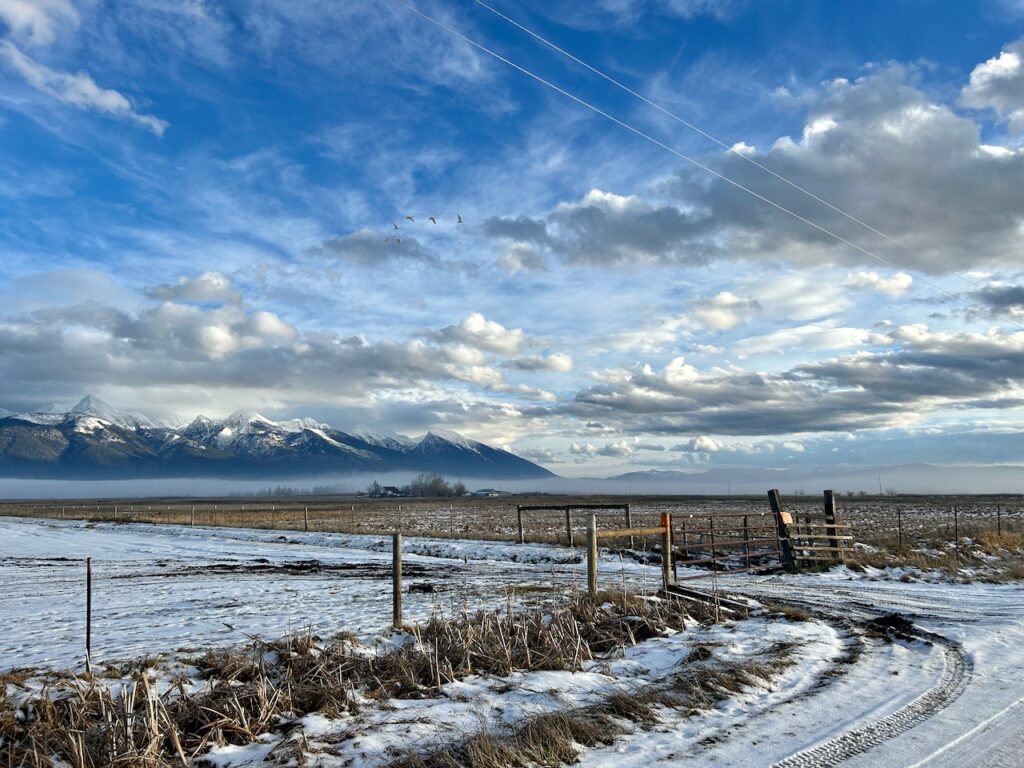
Even without the owls, a winter visit to the Mission Valley is a soulful, satisfying experience. Oh, and can you find Trumpeter Swans in this picture?
As always, we encourage you to share and link to this post. We absolutely do not give permission to use it to train AI models or for other purposes without permission.Happy New Year, Everyone!
As 2025 rapidly winds up, Braden and I want to thank you for your continuing interest in FatherSonBirding and all that you do for birds. We can’t believe that it’s been almost EIGHT YEARS since we published our very first post, A Quest for Snowy Owls! We certainly wouldn’t have kept at it without your interest and support.
We’re thrilled to report that 2025 has been FSB’s biggest year yet. We published a record 49 posts this year, including our 250th post, “Binoculars and Scopes for the Happy Holiday Birder”. Speaking of that, we also launched FSB equipment reviews—articles we do NOT get paid for, but which have attracted a ton of viewer interest.
FSB received a record 20,000 views in 2025, greatly helped by our equipment and travel reviews!
And speaking of viewers, our site attracted 20,000 views this year, shattering last year’s record of 14,000—with the caveat that about a thousand of those views were likely from AI bots stealing our content without permission (Grrrr…). Still, the vast majority of those extra visitors were legitimate—and from an astounding variety of places. More than 15,000 viewers from 104 countries visited our site this year! Huge gracias, arigatos, mercis, and many more thank yous to our international visitors!
By now, we can hear you pleading, “But please, Sneed and Braden, tell us your Top 5 most popular posts!” Astoundingly, four of our five top posts were equipment review posts:
1) Vortex Triumph 10X42 Binoculars: Entry Level Excellence with 1,425 views. (View post here!)
2) Nikon Monarch HG Binoculars: FSB’s First Equipment Review with 950 views (View post here!)
3) Vortex Razor HD 13-39X56 spotting scope with Mountain Pass tripod: A Perfect Travel Combo? With 580 views (View post here!)
4) Birding Barcelona, Part 1: The Urban Core with 510 views (View post here!)
5) Vortex Viper HD Binoculars (Equipment Review, and/or Texas 2025 Part 2-½) with 480 views (View post here!)
Our 2024 blog about birding downtown Barcelona snuck into the Top 5 for 2025—with several of our Japan and Costa Rica posts close behind!
The numbers reveal some clear trends: with rare exceptions, our most popular posts have been our equipment reviews and reports from travel destinations. Our posts from Japan, Spain, Colombia, Mexico, and Costa Rica have been especially popular—as have posts about very birdy domestic locales such as Texas and San Diego. Our book reviews also have done well, but a decline in America’s literacy rate is clearly evident, as our statistics reveal that many more viewers are interested in buying gear than in reading books.
On a personal level, Braden and I are grateful for the many wonderful birding experiences we got to share, both together and separately. Braden was fortunate to visit both Mexico and Costa Rica in 2025 as well as take an epic cross-continent trip from Maine to Montana following his graduation from the University of Maine. He also birded the heck out of Arizona while on his way to his current job in California, where he’s racking up all kinds of new birding experiences.
As for Sneed, I kicked off the year with a trip to Victoria, Canada, thanks to my wife, Amy—and, honestly, the year never seemed to slow down. As soon as we returned, my buddy Roger Kohn invited me on an epic last-minute trip to Colombia. There followed journeys to Texas, Maine, eastern Montana, California (twice!), and most recently, Georgia and Oregon. Most of the latter were not planned as birding trips, but you won’t be surprised to learn that we saw a ton ‘o birds along the way.
Thanks in great part to trips to California with my friend Scott and . . .an epic trip to Colombia with mi amigo Roger, I “accidentally” shattered my world one-year species count record.
You also won’t be surprised to learn that, quite unintentionally, Braden and I shattered most of our own birding records. Braden finished out his birding year with a remarkable 867 species while I smashed my own previous record with 551 species!
One of the low points for the year was having to say goodbye to our wonderful “birding dog” Lola. She left us far too soon and we still miss her terribly. (See this post.)
Besides finding birds, Lola proved adept at finding marine mammals such as this whale. We miss you Lola!
Moving forward, we hope to continue to publish a wide variety of posts for your reading pleasure, including those about everyday birding experiences that are at the heart of a birder’s joy and wonder. Just a few adventures that we have lined up for 2026 include trips to Costa Rica and Germany, along with visits to birding festivals in Colorado, Arizona, and Montana. Meanwhile, it is our sincerest wish that the next year brings you all good things, including many incredible birding experiences and a brighter outlook for birders, birds, and the planet we all share.
For some ideas about how to help birds this coming year, please visit our last post, Giving Back to Birds—with Great Breaking News!As always, if you would like to help support FatherSonBirding, consider buying new copies of some of Sneed’s books by clicking on the book jackets to the right.
A happy by-product of our second child going to school in California is that Amy and I have the perfect excuse to go visit the Golden State. Not that I would everdo any birding during a family trip, but you know, it’s hard not to see some great birds when you just happen to stop at a wildlife refuge or stumble into a local park that happens to be a bright red eBird hotspot!
I was especially excited to head to California a couple of weeks ago because, as previously reported, I was perilously close to breaking my all-time single year species record of 527 birds. In fact, when Amy and I landed in Sacramento and headed up to Chico, I needed only one bird to hit 528 species for the year. What would my “go ahead bird” be? (And yes, that is an homage to the upcoming World Series, which happens to feature a team named after birds!)
Visiting our youngest in California has given me a great opportunity to see friends and get in some bonus birding!
When we arrived, I quickly finagled a couple of birding opportunities, but saw only species I had seen on our last trip to California in August: California Scrub-Jays, Acorn Woodpeckers, Yellow-rumped Warblers and the like. My biggest discovery was a White-winged Dove at the Panera’s near the hotel! It was a rare bird so far north in California’s Central Valley, but not unheard of. Still, I felt proud to have spotted the distinct white stripe across each wing as it flew—undoubtedly hoping to score one of Panera’s kitchen sink cookies!
The next morning, I headed out to the home of a close childhood friend who just happens to live outside of Chico in an agricultural area. I had almost reached her place, when I noticed birds feeding on a coyote carcass on the side of the road. I saw Turkey Vultures and ravens. Then, I saw something that got my heart racing: magpies!
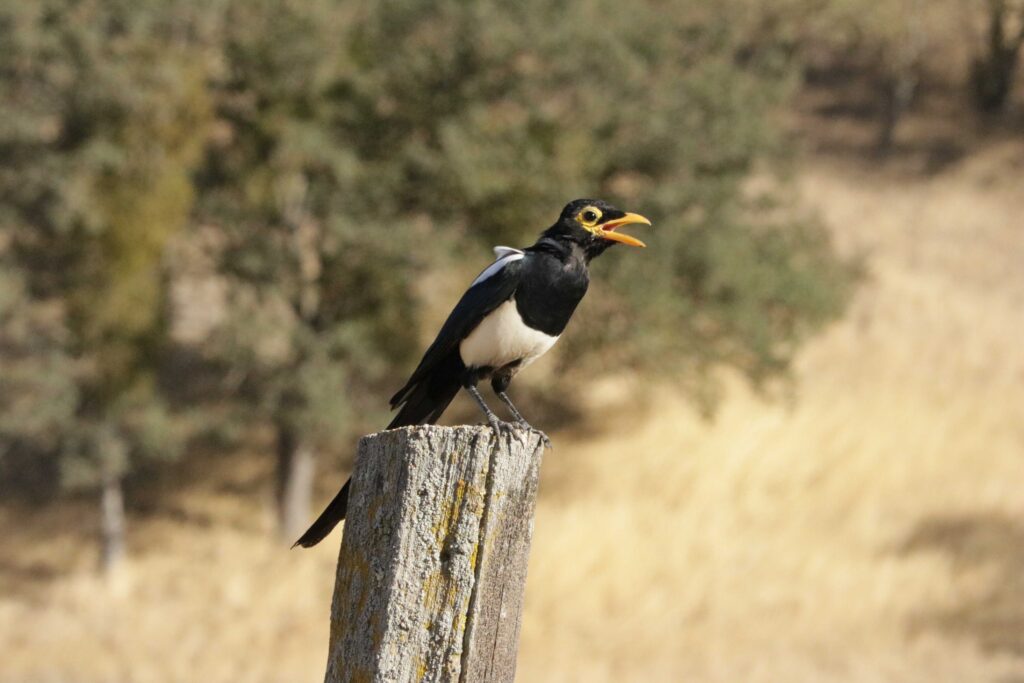
My All-Time Best Year Record Breaker: Yellow-Billed Magpie! Whoo-Hoo!(Photo from earlier trip.)
Not just any magpies. I knew that the Black-billed Magpies we had back home in Montana were unlikely in this part of California. No, these were Yellow-billed Magpies—a bird I had failed to see on our last trip in August! Ka-ching! My record shattered like falling glass! And with a California endemic species no less! Personally, I couldn’t have been happier. YBMAs are some of my favorite birds, and hold an interesting history, too:
“This species was named by John James Audubon in 1837 (as Corvus nutallii, corrected the following year to nuttalli) in honor of the ornithologist Thomas Nuttall, who collected the first specimen near Santa Barbara, California. Nuttall was a prodigious botanical collector and ornithologist who authored a Manual of the Ornithology of the United States and of Canada.” —Birds of the World database by Cornell Lab of Ornithology (accessed Oct. 19, 2025)
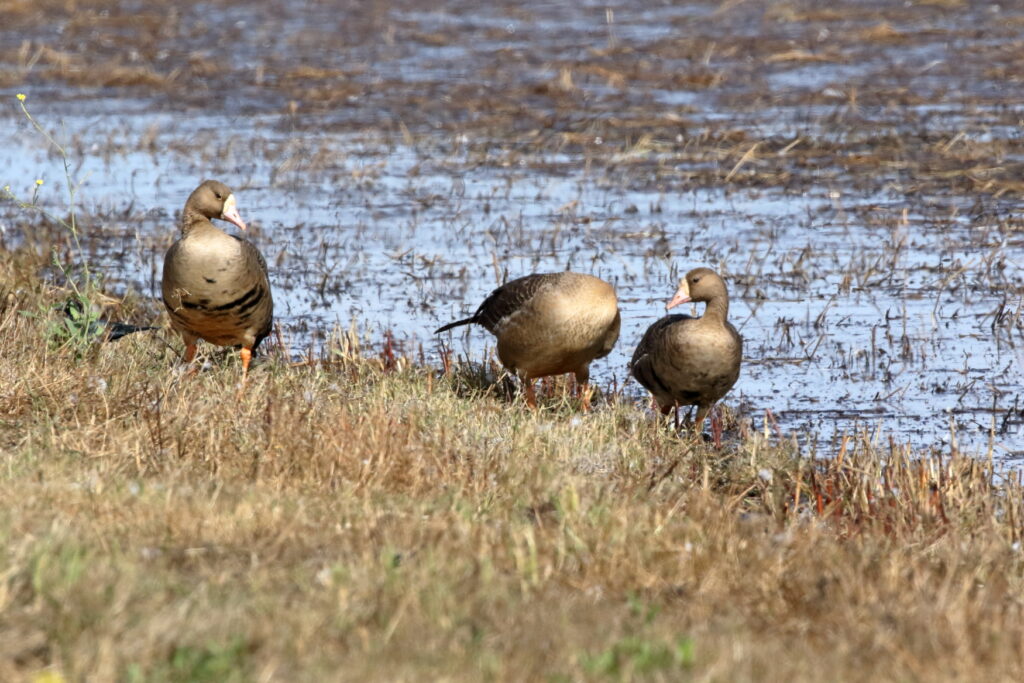
Later that day, I picked up an “insurance bird” at the Llano Seco refuge just southwest of Chico, where Amy and I delighted in Sandhill Cranes, Black-necked Stilts, and my 529th bird of the year, Greater White-fronted Goose.
Greater White-fronted Goose was a great “insurance bird” for my record-breaking year—just in case the Birding Powers That Be decided to lump a couple of species together or I found a mistake in my earlier checklists!
But my fall California birding adventures had just begun!
After a few wonderful days with our child, Amy flew home from Sacramento, and my high school buddy Scott (see Scott’s Guest Post about the Morro Bay Bird Festival), picked me up for an additional four days of exploration. As I’ve mentioned, my emphasis lately has not been so much chasing target species, but exploring places I’ve never before birded, and Scott indulged me to the hilt. After he collected me in Sacramento we explored the Sacramento River delta, hitting Cosumnes River Preserve, where we got a little shorebird action—and a LOT more Sandhill Cranes and Greater White-fronted Geese. On the following days, we hit a huge variety of habitats as we hiked through oak woodlands, explored the large abandoned—and very birdy—grounds of the Sonoma Developmental Center, and scoured rocky shores and intertidal areas in American Canyon, Golden Gate National Recreational Area, Bolinas, and Bodega Bay. I loved every location and, not surprisingly, my “insurance bird” list grew.
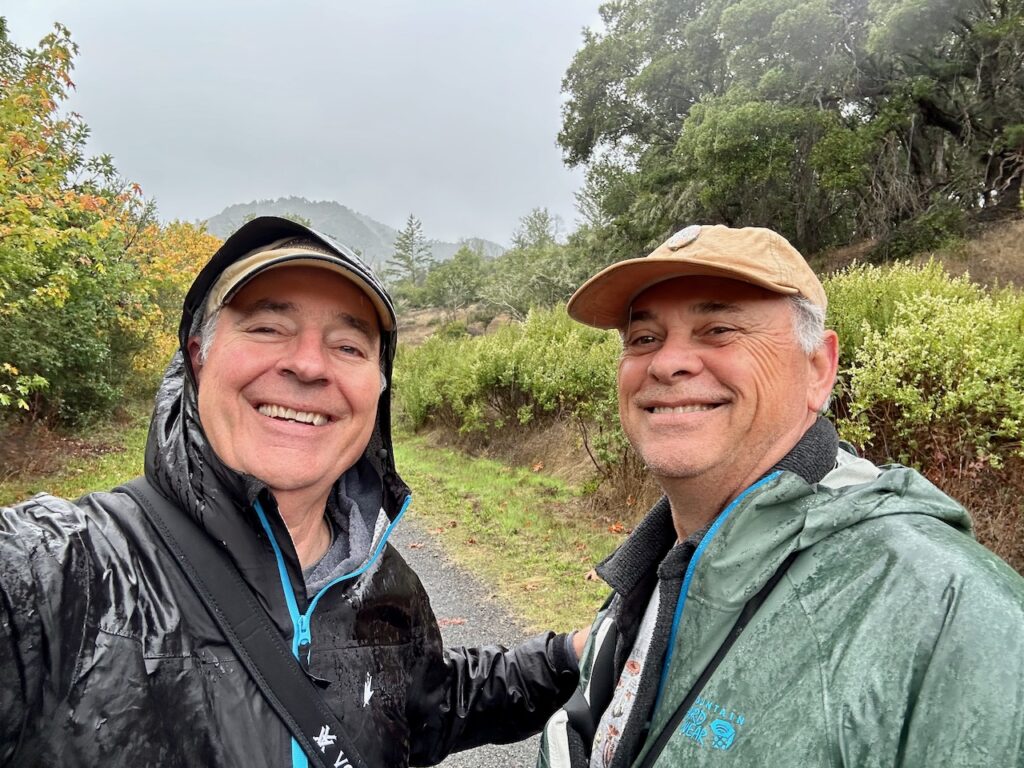
Scott and I enjoyed a wet hike through Sugarloaf Ridge State Park in Sonoma County and fortunately, the rain did not dissuade the birds as we sighted a host of classic oak woodland species including Oak Titmouse, Golden-crowned Sparrow, and Nuttall’s Woodpecker.
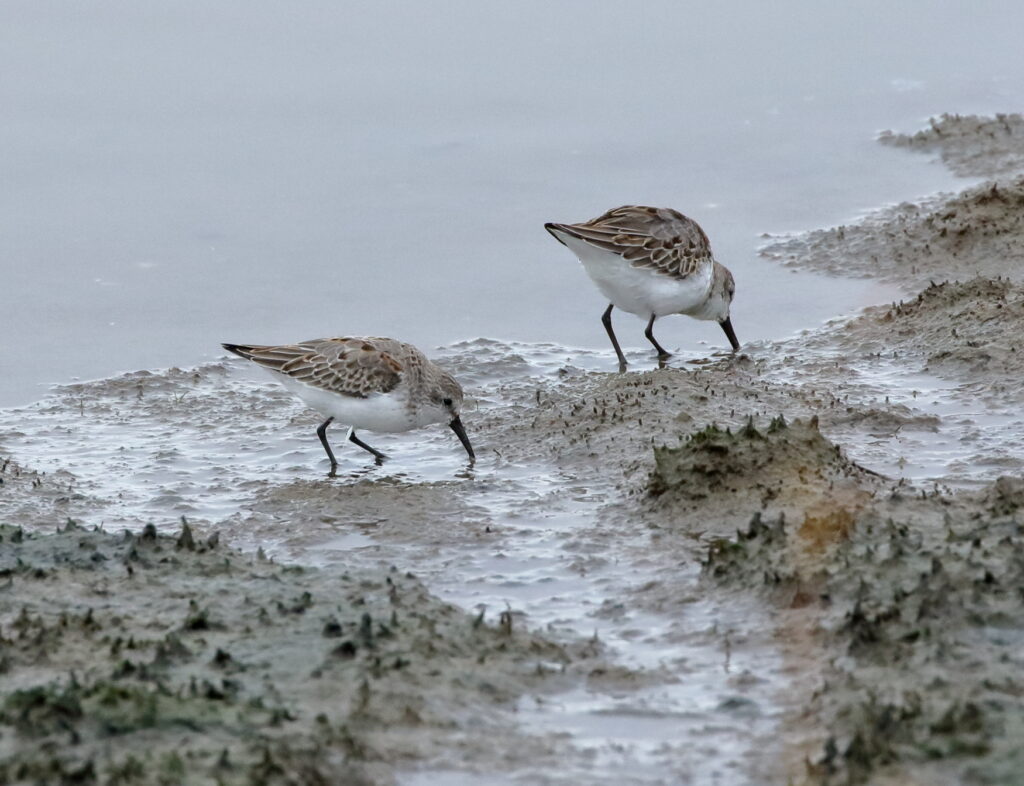
I picked up Mute Swan in American Canyon as Scott and I gleefully observed thousands of shorebirds including Western and Least Sandpipers, Long-billed Dowitchers, Marbled Godwits, and Black-bellied Plovers. That afternoon, we saw my FOY (First Of Year) White-tailed Kites at a place called Buchli Station Road.
Our adventures gave us plenty of time to learn more about peeps as we picked out the subtle details of Least and these Western Sandpipers. Note the rufous shoulder patch (not always present), black legs, and longer, curving bill that distinguishes these Westerns from Least’s.
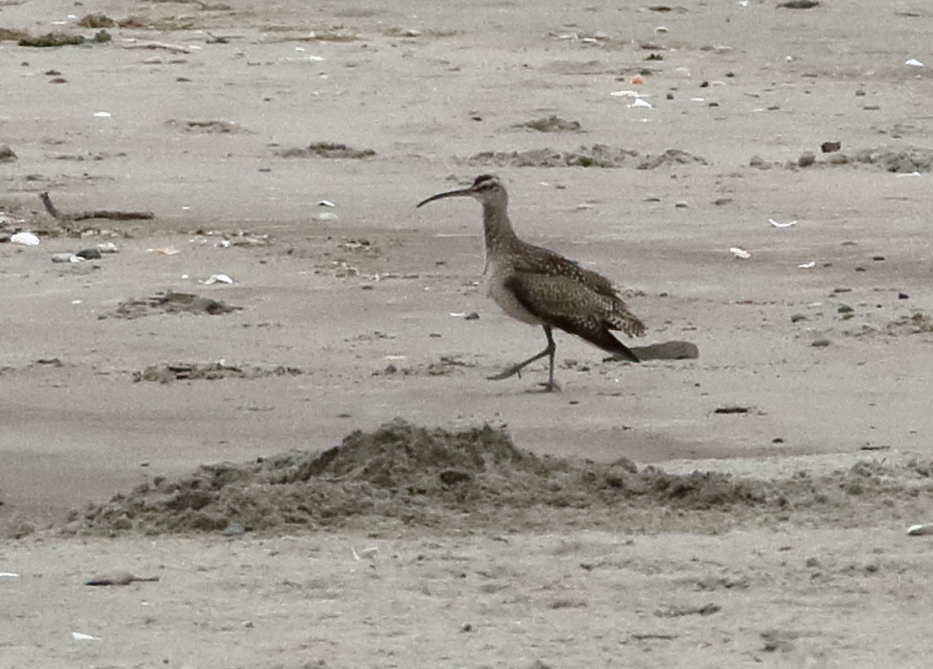
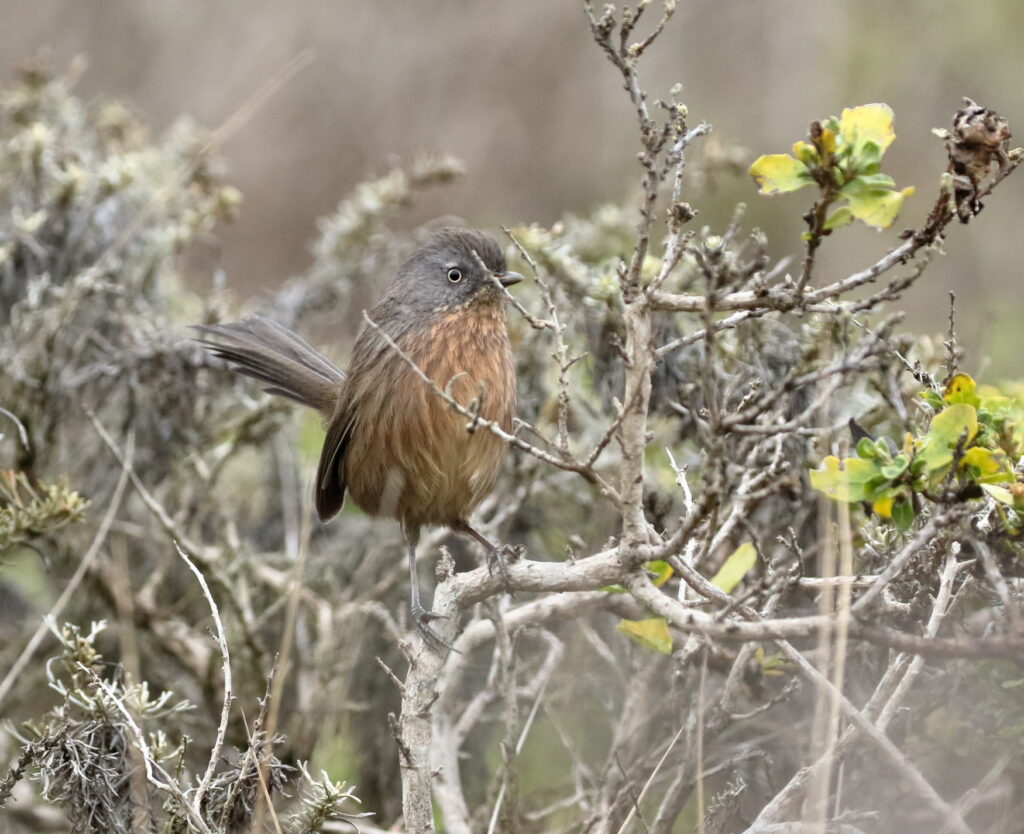
Our favorite—and most productive—day happened October 15th. With a visit to Rodeo Lagoon, we found one of my favorite California birds, Wrentits, along with Western Gulls, which I had somehow managed not to see the entire year! At the nearby Bolinas Lagoon, we also observed hundreds of Elegant Terns and my trip MVB (Most Valuable Bird), a Whimbrel.
This Whimbrel at Bolinas Lagoon nabbed Bird of the Trip honors as it was the first WHIM I’d seen in more than six years.
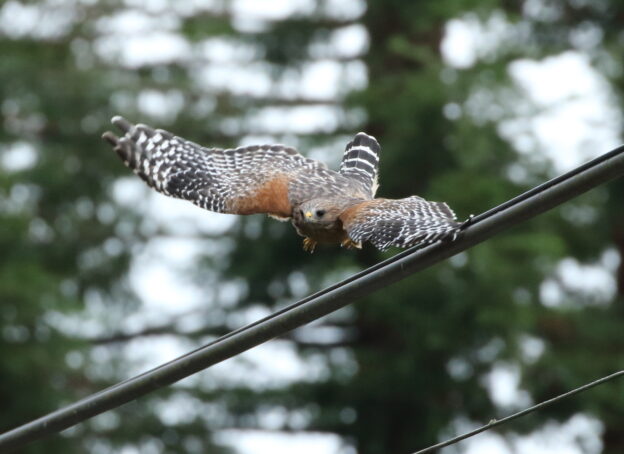
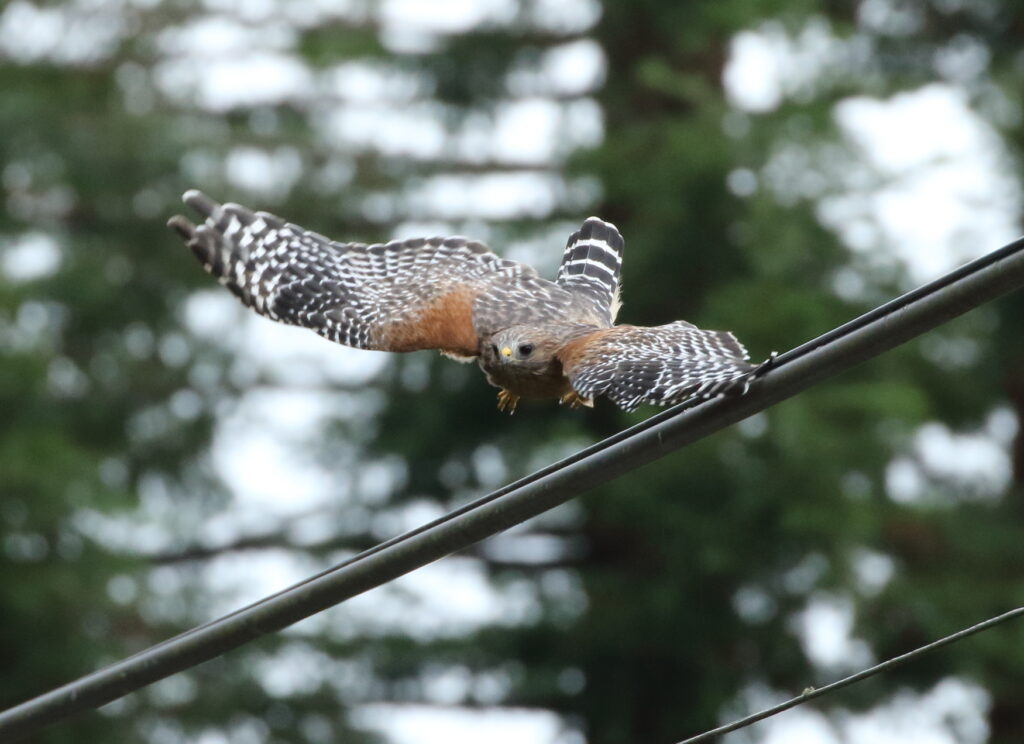
Another bird I had somehow failed to see all year was Red-shouldered Hawk, but as we made our way north toward Point Reyes, Scott suddenly shouted, “Red-shouldered!” We pulled over to look at this handsome creature perched on a power line and even got to see it nab some kind of morsel from roadside weeds. The funny part? We saw four more Red-shouldered Hawks on our drive back to Scott’s house in Glen Ellen! I call that a Grand Slam!
I don’t know that I’ve ever appreciated Red-shouldered Hawks more than I did this one—especially when it launched after some prey!
One thing that made the trip so fun was eating lots of great food and kicking back to watch the MLB playoffs with Scott each evening. I hadn’t seriously watched baseball since Amy and I were still childless more than twenty years before, and it was wonderful to lean back, relax, and watch grown adults try to hit balls with sticks. Goooo Ohtani!
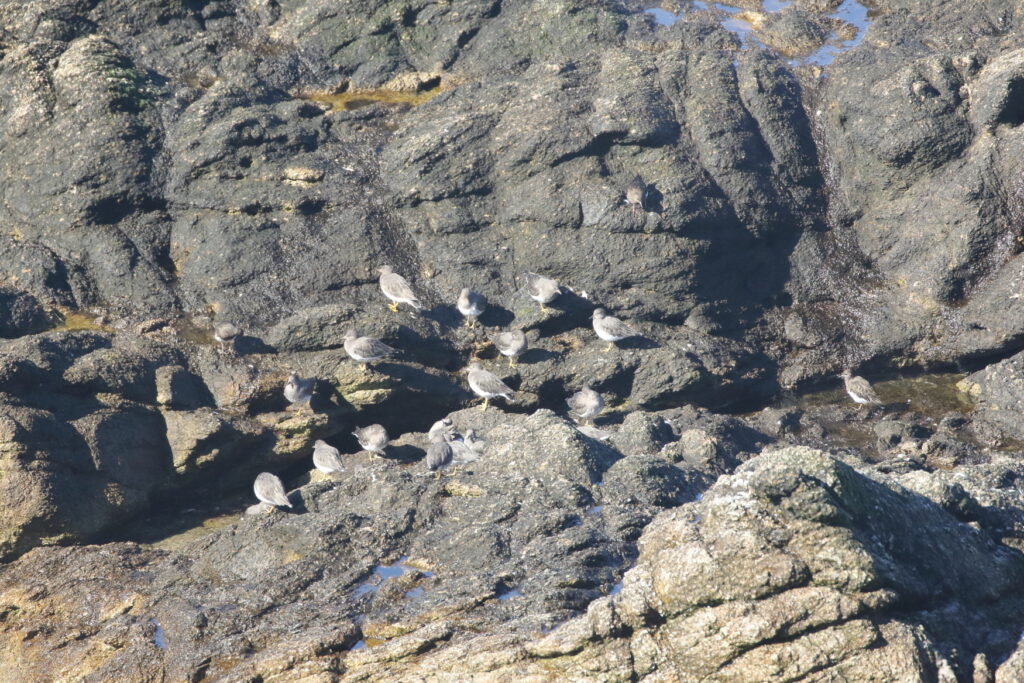
For our final day of birding, Scott drove me to Bodega Bay, one of my favorite places in California. While studying at Cal I had taken an ichthyology course here one summer, and now that I was a birder, the place held even more charm. On the rocks below Bodega Head, Scott and I were astonished to see a group of sixteen Surfbirds—far more than I had ever seen in one place! We also got great looks at both Brandt’s and Pelagic Cormorants, and spotted a Pigeon Guillemot in the far distance.
Since Braden and I saw our first Surfbird from a distance during our first pelagic cruise in Monterey in 2016, these birds have held a special place in our hearts. Never, though, have I seen so many in one place! (Can you also find the lone Black Turnstone in this photo?)
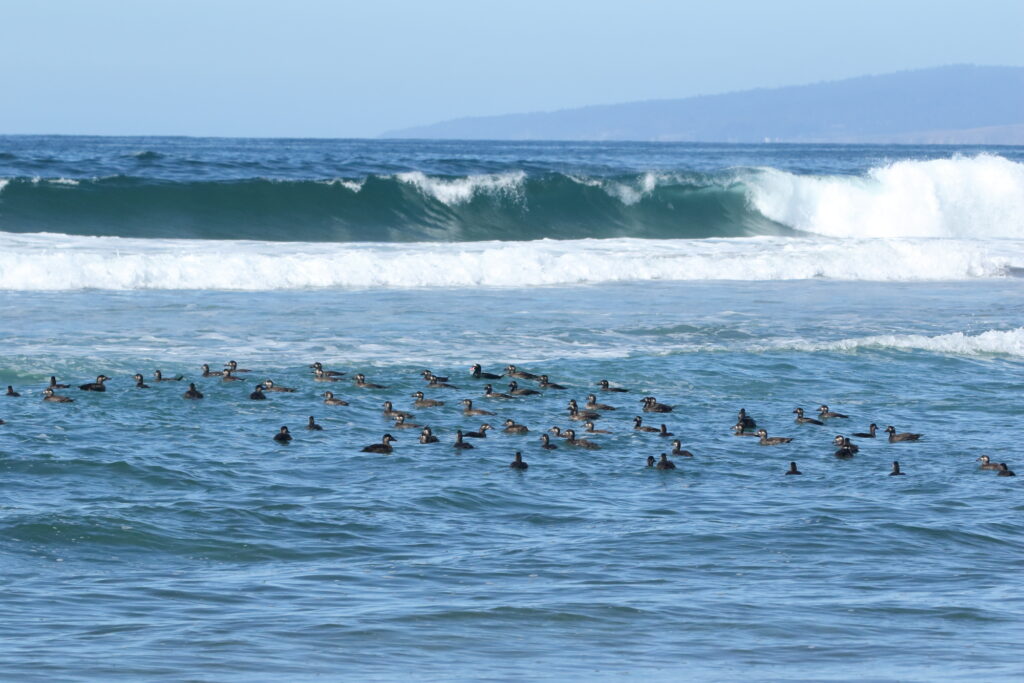
After a lunch of fish tacos, we headed up to the beaches north of Bodega Bay and were treated to a second Whimbrel sighting and more than 120 Surf Scoters casually ducking the breakers offshore. It was a wonderful way to wrap up the trip, and I am grateful to Scott both for being such a great host and for his patience when I was experiencing a blood sugar meltdown at Bodega Head. Of course, you may be wondering where my year list stands now, and I’m happy to report that I am now at 537 species. Will there be any more? I don’t know, but 550 seems awfully tempting, so stay tuned!
Update: Just before posting this, I picked up bird #538 for the year, Lapland Longspur, in some fields northwest of Billings!
Can one ever get tired of Surf Scoters? I don’t THINK so!
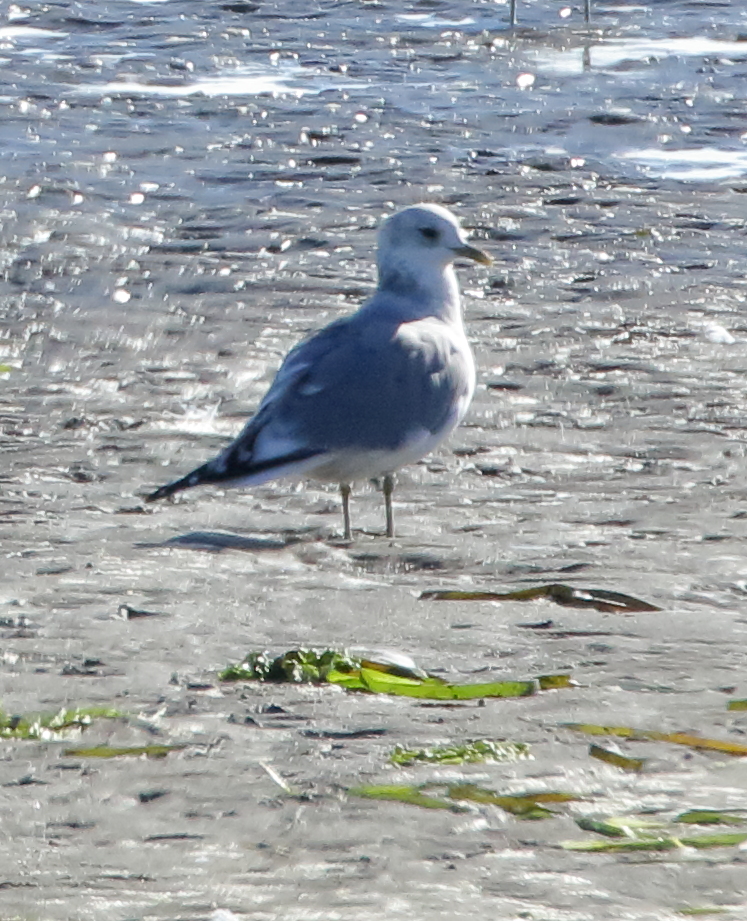
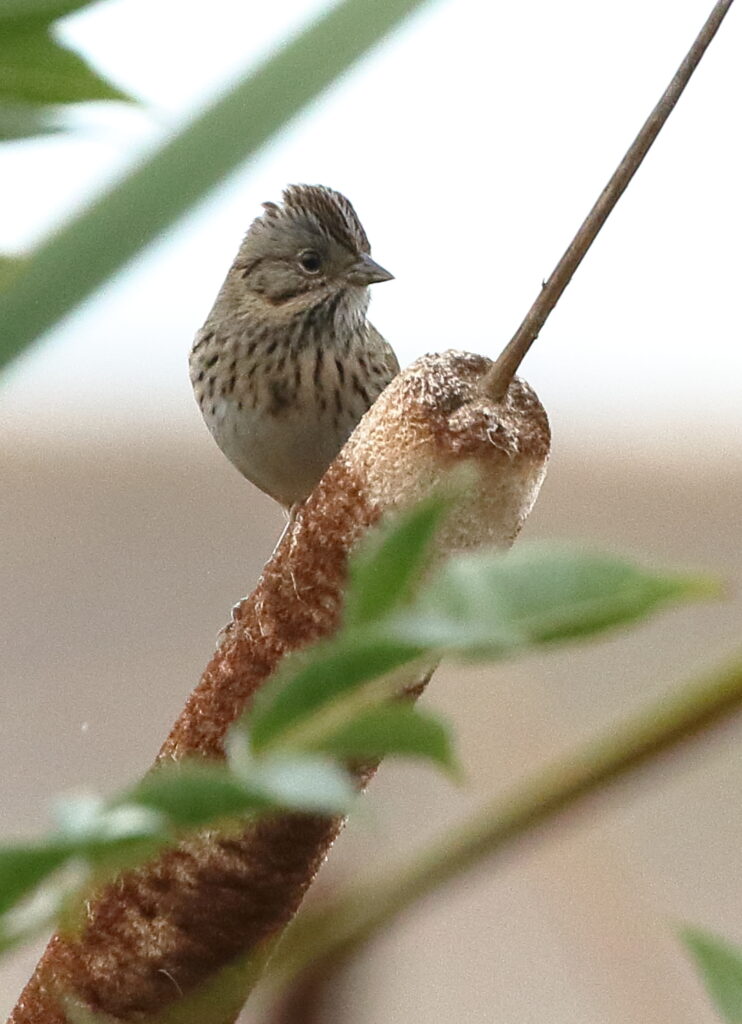
Just for fun, can you name the birds and places above? Answers in the nest—I mean next—post!
Conservation Update: Not long ago, I wrote about an amazing opportunity to protect a key piece of habitat on the famed Bolivar Peninsula in Texas. This property is a critical resting point and staging area for birds migrating across the Gulf of Mexico, and Houston Audubon is leading the effort to raise $3 million to purchase the property. To learn more, please read our recent blog post, and if you have not already done so, consider contributing to this once-in-a-lifetime opportunity to protect birds by clicking here. So far, more than four hundred donors have chipped in, but many more are needed! Thank you and please spread the word!
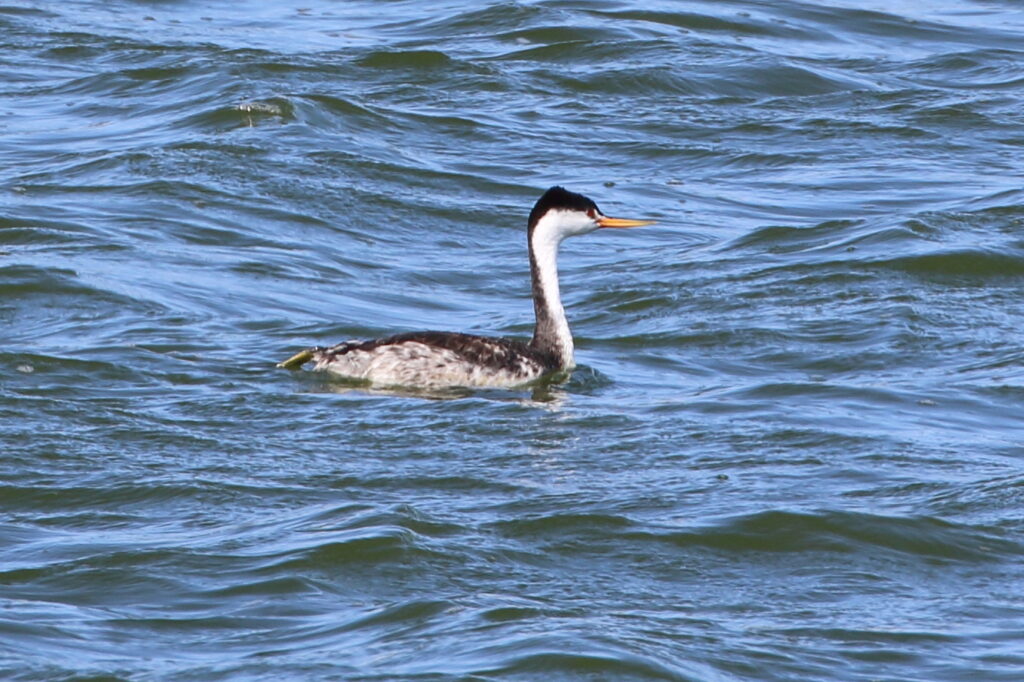
For birders, fall migration is a season like no other. That’s because birds fail to look at the range maps of where they are supposed to be and show up in all kinds of unusual and surprising places! You may recall that recently, I have been moving perilously close to breaking my all-time one-year global species record of 527, but instead of frantically trying chase down species (and burning up a lot of gas in the process), I have decided to see how many species just come to me during the fall. Last week, I picked up a Clark’s Grebe in the local Missoula Gravel Quarry, moving me to within seven species of a new record. That really wasn’t too surprising since a few pairs of Clark’s do breed in Western Montana, and it made sense that one might end up passing through my home town. A couple of days ago, however, when I saw a report of a Red Phalarope, my mind shouted “Whoa!”
A Clark’s Grebe at the Fort Missoula Gravel Quarry helped push my 2025 world species count to 521. (A different CLGR shown here.)
Braden and I have mentioned phalaropes in several past blogs (see, for instance, THIS POST), and they are fascinating birds. Phalaropes are shorebirds in the family Scolopacidae and in the entire world, there are only three species: the Wilson’s, Red-necked, and Red (called the Gray Phalarope in Europe). Montana is fortunate to host Wilson’s Phalaropes each spring and summer, as they are the only phalarope to breed in the interior of the continent. The first time we encountered these beauties was in 2015 at Lee Metcalf National Wildlife Refuge. I had barely heard of phalaropes when we drove past the main pond at Metcalf and Braden—who was and still is better prepared than I—shouted Wilson’s Phalaropes! Since then, I have become increasingly enchanted by these birds and, according to eBird, have seen them 123 times.
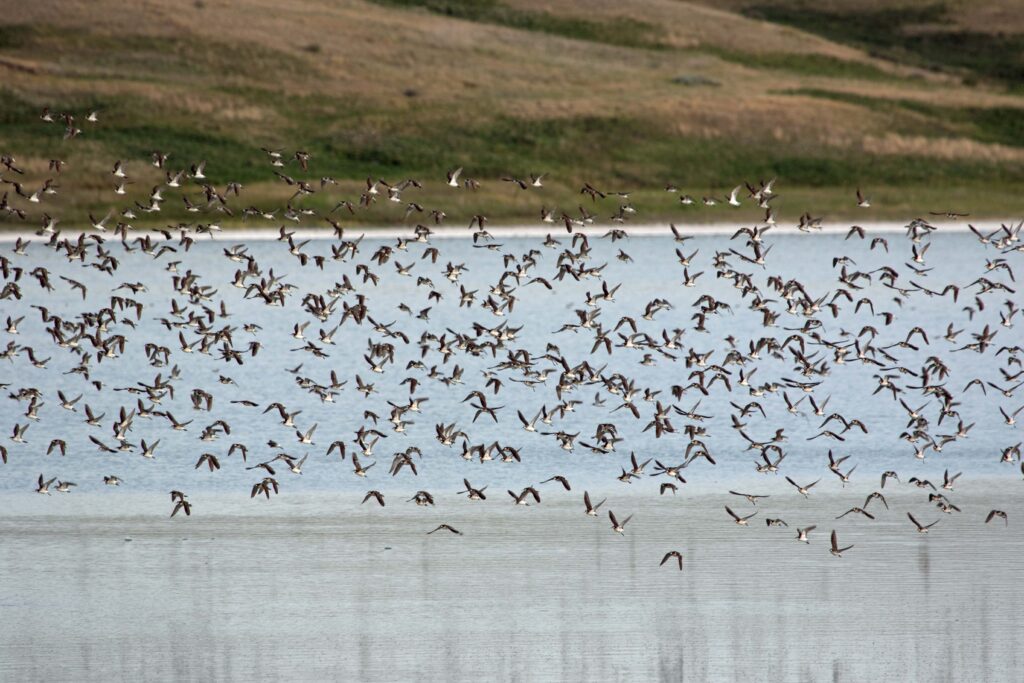
Wilson’s Phalaropes gather in large numbers at some Montana breeding locations—including this flock Braden and I observed near Westby.
Several things make phalaropes stand out from other birds. For one thing, they flip the rule on “males are brighter than females.” With phalaropes, it is the female that is the stunning, brightly-colored sex during breeding, not the male. Females compete for males to mate with and may even “service” several different males, leaving the guys totally in charge of parental care once the eggs are laid. Can I hear legions of human females shouting “Amen”?
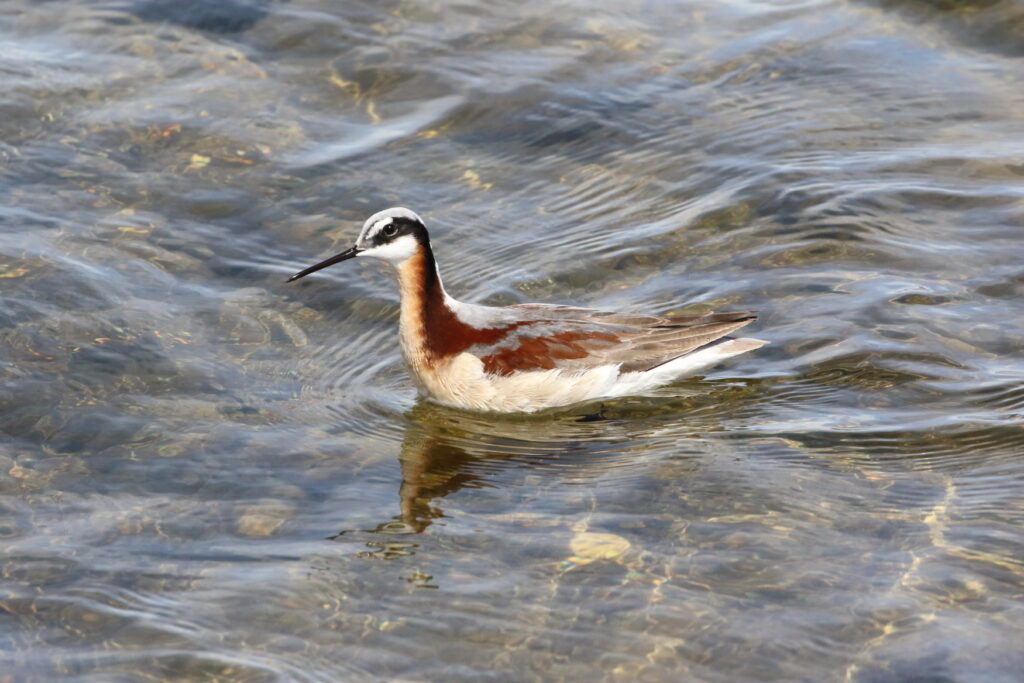
Female phalaropes such as this Wilson’s Phalarope are undoubtedly some of our most beautiful shorebirds. Note the longer, thinner bill compared to the Red Phalarope shown later.
Another thing everyone loves about phalaropes is their method of hunting by spinning rapidly on the surface of the water. This spinning creates a little aqueous “tornado” that sucks up crustaceans and other invertebrate prey from below. The birds also hunt in more traditional shorebird manners by probing shallows and even picking off prey from nearby vegetation.
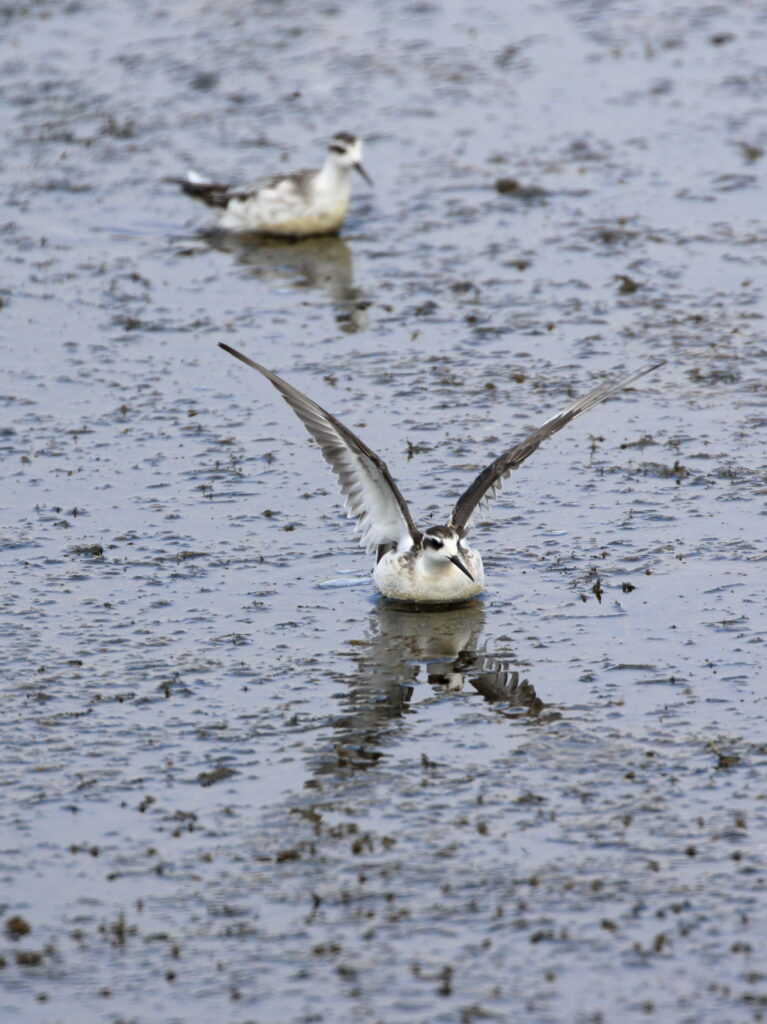
Spinning is not just a yuppie exercise class, but a method for phalaropes to draw up prey from below the surface.(Red Phalarope shown here.)
Whenever Braden and I are lucky enough to visit eastern Montana in spring and summer, we usually see large numbers of Wilson’s Phalaropes feeding and setting up nesting sites (see THIS POST). If our timing is right and we stay persistent, we also usually spot a few Red-necked Phalaropes. With their dramatically contrasting red, white, and dark gray heads, these phalaropes are even more stunning than the Wilson’s. The window to see them is short, however, as they breed high in the Arctic and can only be “caught” while they are resting or staging for their final journeys north. A couple of times we have also spotted them heading back south in August, when they are invariably in their duller gray-and-white plumages.
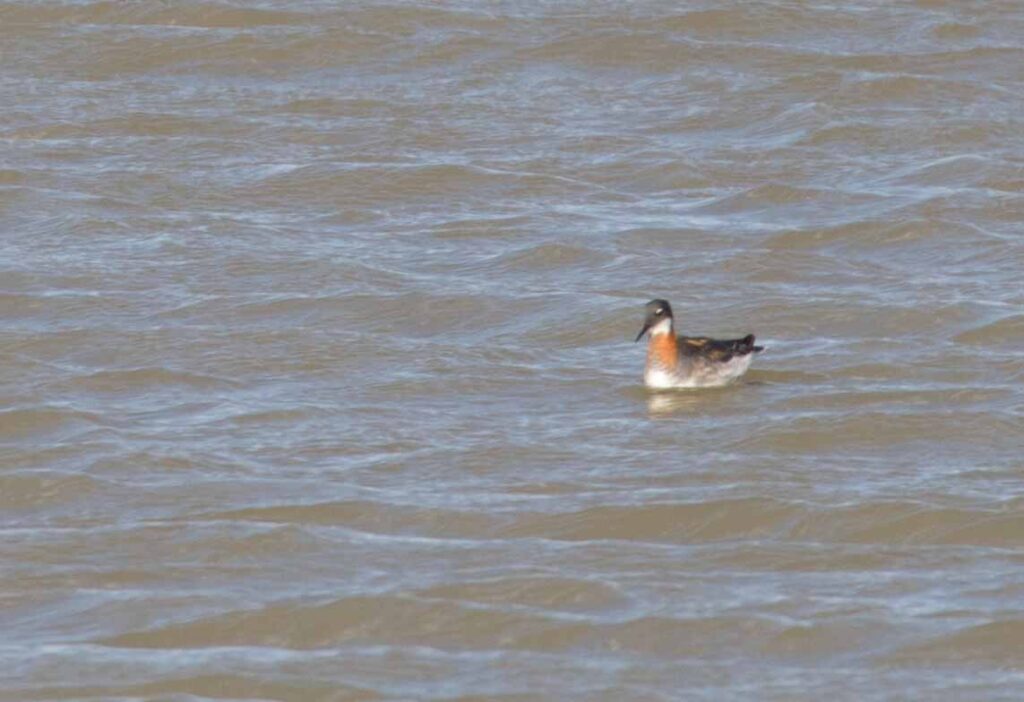
A pair of Red-necked Phalaropes my buddy Scott and I saw at Point Reyes, CA, last winter. Note the thinner, more pointed bill than I observed on the Red Phalarope.We have so far failed to get a good shot of a female Red-necked Phalarope in breeding plumage–but this photo by Braden should give you an idea of how gorgeous they are.
However, one phalarope that we have never seen in Montana in more than a decade of birding is the Red Phalarope. The reason is that, in general, these birds migrate over the ocean—not over the interior of the continent. Red Phalaropes are the most pelagic of the three phalaropes and, except during breeding, spend their lives out at sea. In fact, the only Red Phalaropes that Braden and I ever saw was a single pair off the coast of San Diego during the San Diego Birding Festival several years ago. Only about twenty sightings have ever been reported in Montana.
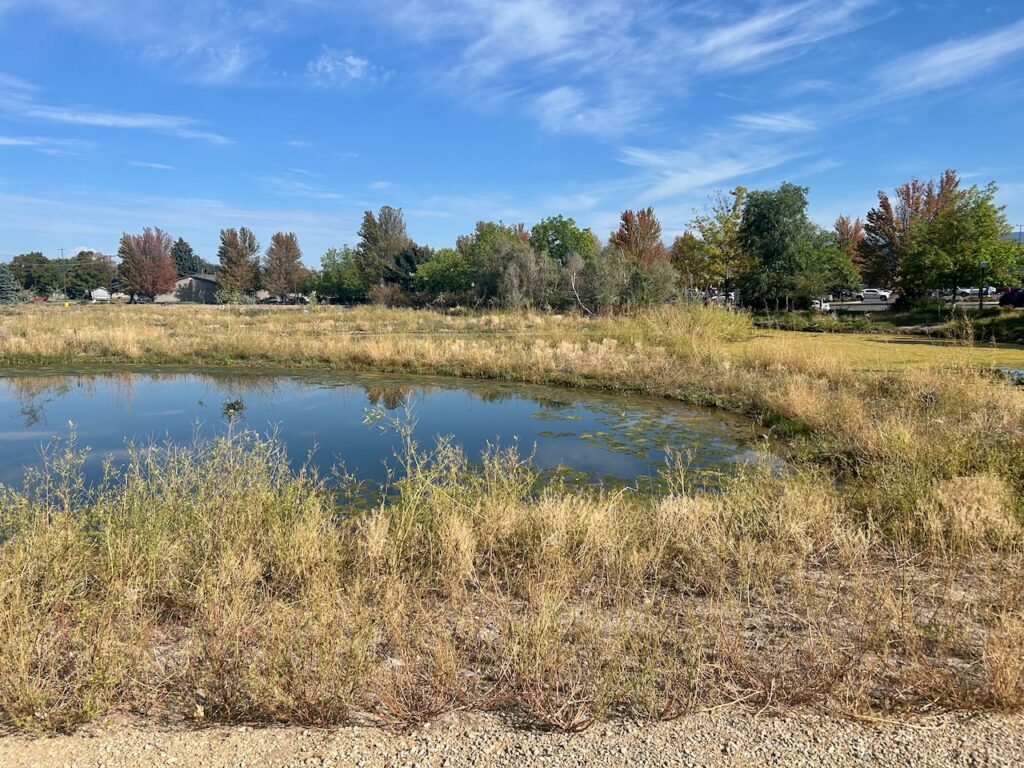
Naturally, when I read the recent report of a Red Phalarope in Missoula, my excitement went into overdrive. The next morning, after Amy and I went to a pickleball class, I convinced her to drive down to a little spot called Cattail Corner where the Red Phalarope had been reported. Mind you, this is not where one would expect to see a rare bird. It’s just a tiny wetland wedged between a shopping center, a gas station, and two busy roads. I used to bird there a lot just to see what I could find, and recently the dense cattails had been cleared out, creating more open water and even a bit of shoreline. Early this spring, Braden and I were surprised to find several Spotted Sandpipers hopefully setting up breeding territories there, but still . . . a Red Phalarope???????
Finding a rare bird such as a Red Phalarope at the tiny, worked-over Cattail Corner seemed unlikely at best.(Bonus: Can you spot a phalarope in this photo?)
As soon as we parked, I grabbed my camera and binoculars and Amy and I began circumnavigating the little wetland. My natural pessimism kept repeating, Oh, I’m sure it’s gone now. After all who would want to hang out in this crummy little wetland? Sure enough, Amy and I spent thirty minutes walking around the ponds without a single sighting of anything resembling a phalarope. Oh, well.
As we were leaving, our friend and fellow birder Susan Snetsinger arrived. We told her we hadn’t seen the phalarope, but if she happened to spot it to please call right away. Then, we got back in the car and began heading home, a bit disappointed but not surprised at failing to find the bird. Besides, Amy had a lot to do and I needed to tackle a number of chores myself.
We were just passing Tremper’s shopping center when the phone rang. I hit the “answer” button on the steering wheel and it was Susan. “Did you see a phalarope at all?” she asked. “No.” “Well, I’m looking at one now, but I’m not sure it’s a Red Phalarope.” “We’ll be right there!” I told her.
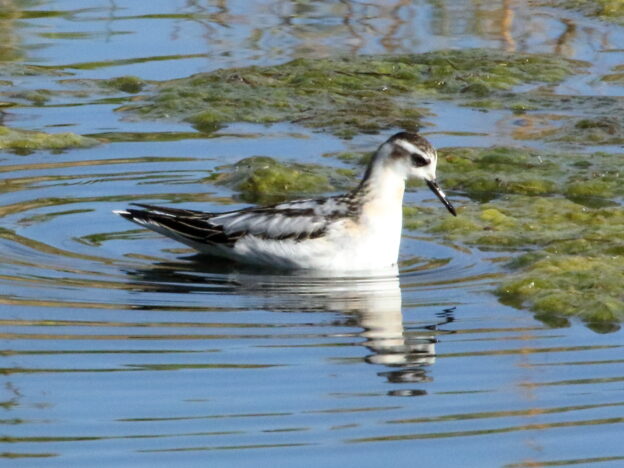
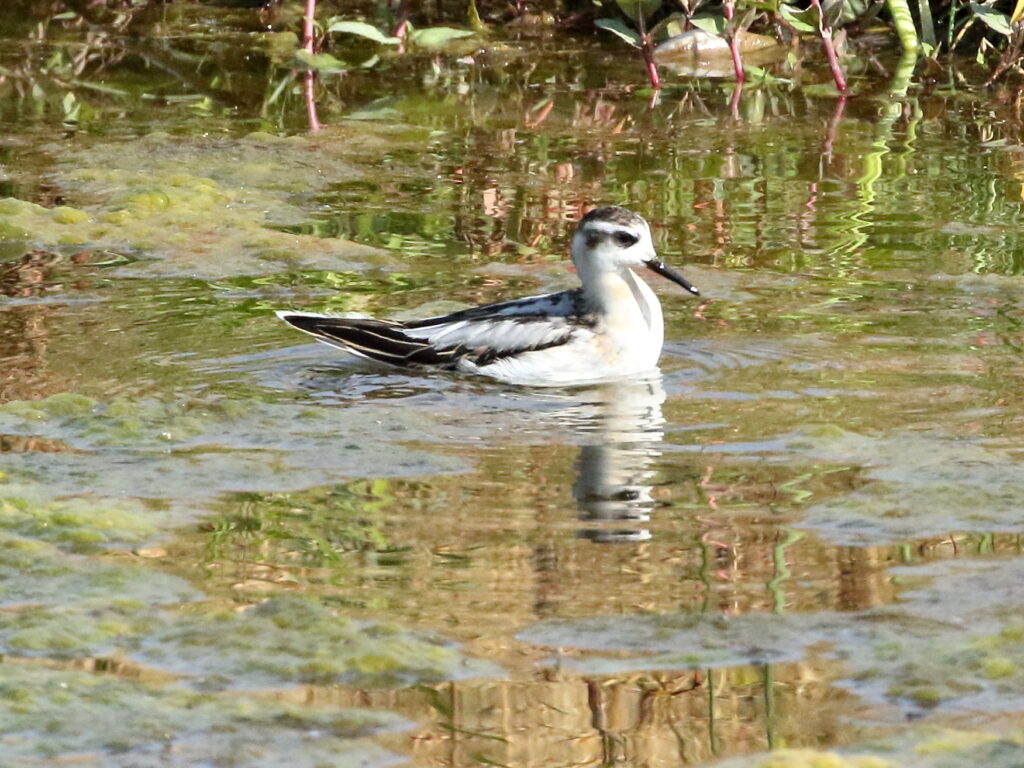
I made a quick U-turn and in five minutes was again parking the minivan. We quickly spotted Susan on the far side of the shore, and even before reaching her, I could see a phalarope on the water. “How on earth did I miss that?” I asked Amy. What’s more, the phalarope seemed blissfully unconcerned as we drew close enough for good viewing and photographs. The problem? This bird was in basic (nonbreeding) plumage and it looked remarkably similar to a Red-necked Phalarope in the same plumage. In the fall, both birds are basically gray and white, with prominent black patches behind the eyes. Red Phalaropes are a bit larger than Red-neckeds, but if they aren’t side-by-side that’s not a useful feature. According to Sibley, Red-neckeds also are streakier on their backs—but this bird before us also looked pretty darned streaky to me.
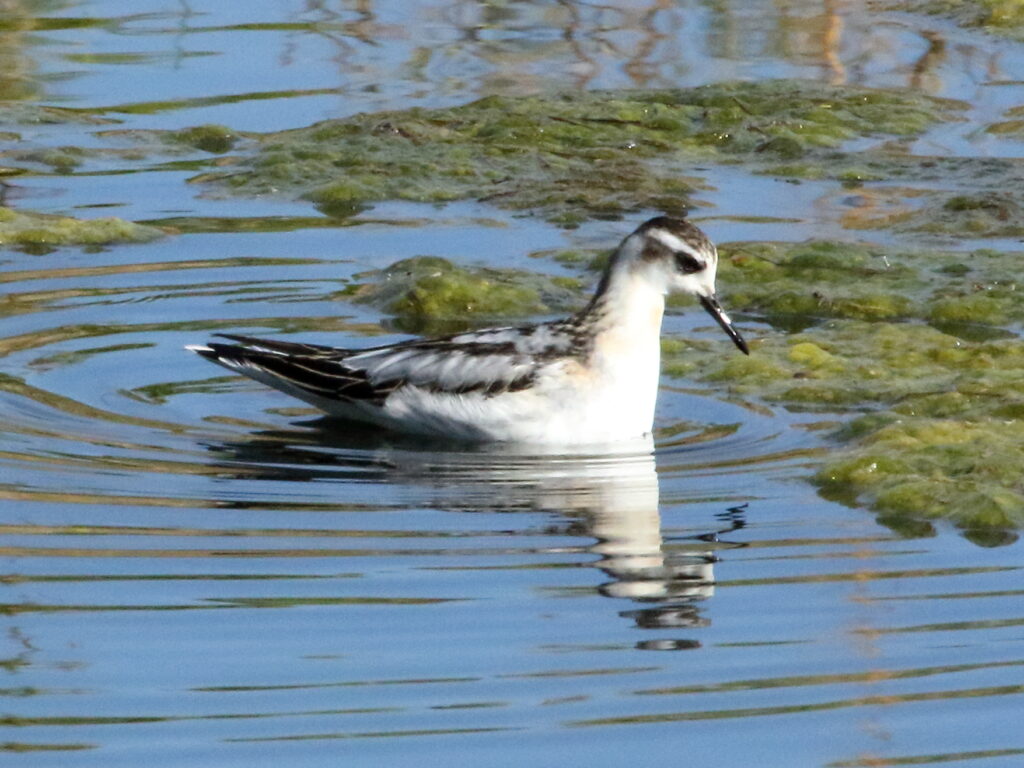
The slightly thicker bill of this Red Phalarope was a key to its identification.
From what I can glean, the key ID feature that distinguishes the two birds is the thickness of their bills. While Red-neckeds have thinner, needle-like bills, those of Reds are thicker, almost pencil-like. The bird in front of us did indeed seem to have a thicker bill, but there is so much variation in these kinds of features that I still felt less than confident—even though this bird had already been confirmed as a Red Phalarope by the eBird Powers That Be. Later Dan Casey, prominent Montana birder and co-author of Birds of Montana, sent me a phalarope comparison guide that helped convince me further. This can be found at:
We watched the phalarope for about ten minutes and then, to my surprise, it climbed ashore and disappeared into the weeds. “Ah, that’s why we didn’t see it earlier,” I told Amy, grateful that the bird had decided to put in an appearance out on the water where we could see it.
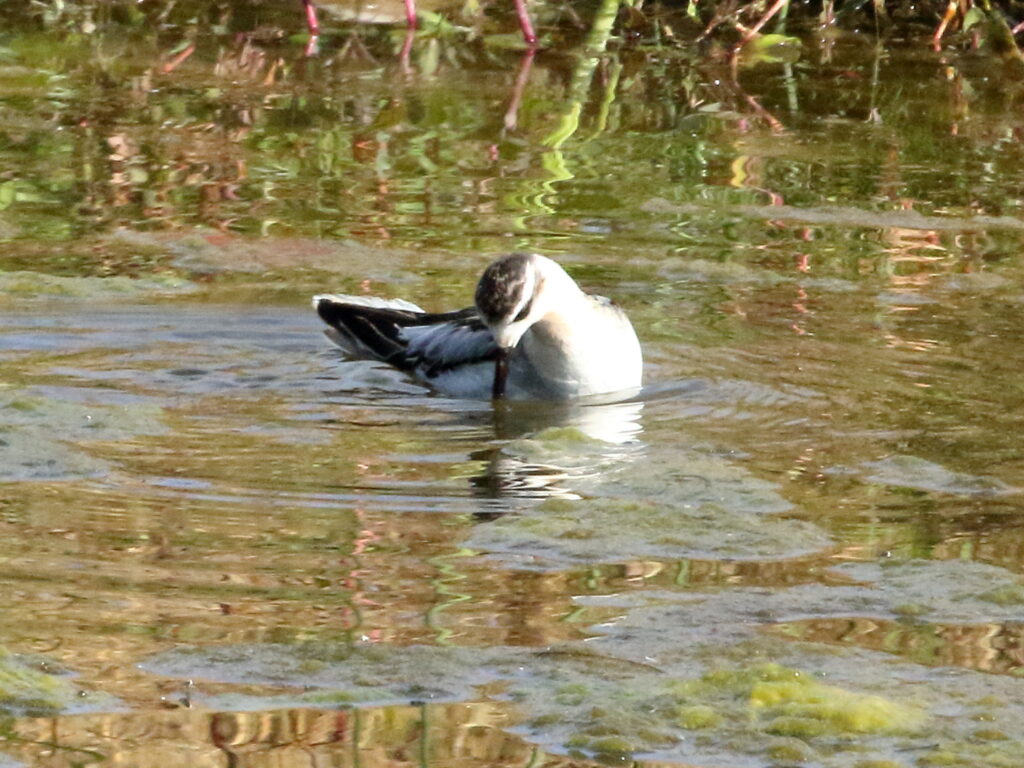
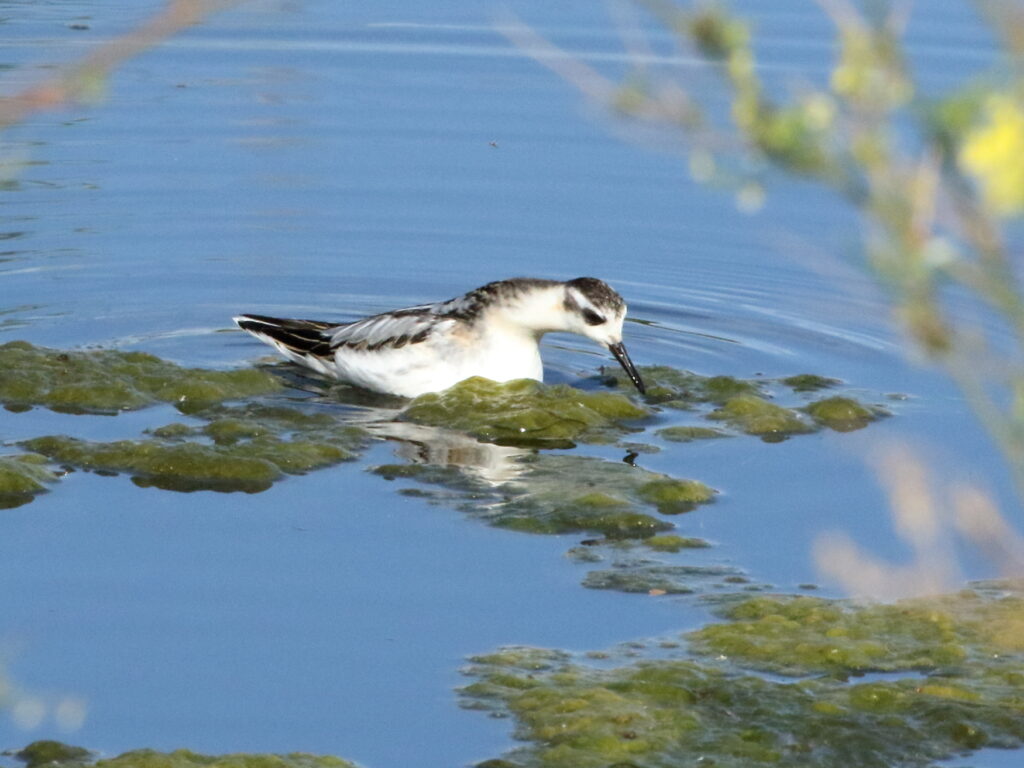
Phalaropes are mainly visual predators, picking off invertebrates wherever they see them.
But the Bottom Line? Red and Red-necked phalaropes are very difficult to tell apart in their basic, nonbreeding plumage, so never assume you’re looking at one or the other. Personally, I hope to get more chances to observe and get to know them in the field in the future.
The other Bottom Line? It was WAY COOL to see a Red Phalarope here in my hometown and it became my Montana Lifer #312. As a bonus, I now need only six more species to break my all-time one-year record. Hm . . . I wonder what will show up next?
To learn more about phalaropes, we recommend the book The Shorebirds of North America, reviewed here.
Sneed’s Bird #522 for 2025. Will I get to 528? It may be up to rare migrants such as this Red Phalarope!