
Bruce M. Beehler’s Flight of the Godwit: Tracking Epic Shorebird Migrations (Smithsonian Books, 2025)
Any birder who has aspired to learn about shorebirds will find a welcome companion in Bruce M. Beehler’s new book, Flight of the Godwit: Tracking Epic Shorebird Migrations. Shorebirds, after all, can be considered somewhat mythical, mysterious beings. Not only do many of them make remarkable annual migrations covering tens of thousands of kilometers, quite a few are notoriously difficult to identify. Certainly, Braden and I realized we had entered a more advanced stage of learning when we started to search out and try to identify shorebirds and, in fact, we both often still struggle with figuring out some of the more difficult shorebird species. Yet the more we encounter and learn about these birds, the more we love them—and that same kind of passion radiates from Beehler’s words as he sets out on his own journeys to observe and learn more about these birds.
In Montana, we are lucky to host three of the “Magnificent Seven” shorebirds as breeders—including Marbled Godwits, one of the focal birds of Beehler’s new book.
In Flight of the Godwit, Beehler recounts a series of recent adventures across the US and Canada to follow and observe shorebirds as they migrate north, stop over at resting and staging sites, settle on breeding grounds, and then head south again for their long non-breeding seasons. Although Beehler discusses all of our North American shorebirds at some point, he clearly targets what he calls the Magnificent Seven: Hudsonian Godwit, Marbled Godwit, Bar-tailed Godwit, Long-billed Curlew, Whimbrel, Bristle-thighed Curlew, and Upland Sandpiper. As he shares his encounters, he sprinkles in liberal amounts of natural history and personal experiences about these birds to make the book much more than a birder’s travelogue.
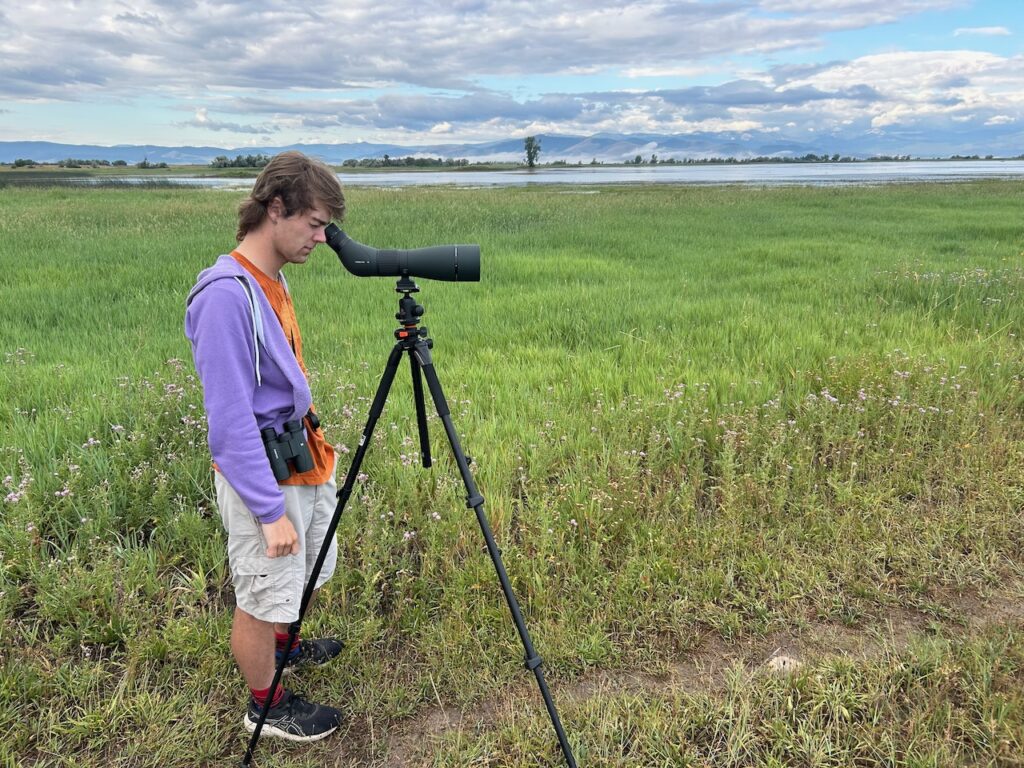
This Marbled Godwit checked us out as we were scoping shorebirds in Westby last summer.
That said, the travelogue aspects of the book are a big part of what fascinated me about this tale. Even after eleven years of birding, my shorebird experiences have been much more limited than I would like. Although my home in Montana is fortunate to host a number of breeding shorebirds—including three of the Magnificent Seven—for most shorebirds, we get only brief glimpses of them as they pass through in spring and fall. Partly because of this, Braden and I have especially sought out shorebirds on our out-of-state travels to Texas, New England, and the West Coast. Sigh. It is never enough.
It always surprises new birders that some of our largest shorebirds actually breed in grasslands—including Long-billed Curlews.
As I followed Beehler up through the Midwest during spring migration and around Alaska during breeding season, his experiences filled in giant gaps in my own experience with these remarkable birds. I got a better sense of where the birds stop to refuel and rest, and my vague impressions of their nesting territories and habits were sharpened by Beehler’s actual observations and descriptions. Many times, I found myself nodding my head thinking, Yeah, I know what he’s talking about or Oh, so that’s what they’re doing. All of this felt especially satisfying since there’s a good chance I will never experience many of Beehler’s destinations for myself.
As much time as I try to spend with shorebirds, it is never enough. Flight of the Godwit helped fill in many of the experiences I probably will never have for myself.
Those who will appreciate Flight of the Godwit the most probably are birders who have already spent time observing shorebirds and struggling over their identifications. Those with limited shorebird experience may find themselves getting a bit lost as Beehler throws out bird names that may seem a bit abstract without solid brain images to connect them to. Still, there’s a good chance that even beginning “shorbers” will find that Beehler’s tales of adventure excite them to plunge more deeply into this remarkable set of birds. As for intermediate and advanced birders—especially those who may never get to Alaska or follow spring migration through the Midwest—I highly recommend this intriguing book that is not only a valuable educational document, but a labor of love with which many of us can relate.
You can order Flight of the Godwit from almost any outlet that sells books—but why not visit your local independent bookstore and order it there? Another easy way to do this is through the online website Bookshop.org.
Need a good book to read? Birding for Boomers recently racked up its fifth award of the year and has been a hit at indie bookstores throughout the West. Why not help support our efforts at FatherSonBirding by picking up a new copy of “Boomers” or one of Sneed’s other books? Just click on one of the images to the right.
After a slow start, August saw the Collard family shift into hyperdrive as Braden drove to Southern California to take a job as a nature guide and camp counselor, and Amy and I saddled up the minivan to drive Tessa to her freshman year of college at Cal State Chico. Braden left a few days early so that he could bird the summer heat of Arizona before arriving at his job. It seemed like a (heat) rash thing to do, but his efforts paid off as he saw 201 species and scored 9, count ‘em, NINE Lifers! These included Montezuma and Scaled Quail, Lucifer Hummingbird, Buff-breasted Flycatcher, Gray Vireo, Cassia Crossbill, and Rufous-winged, Botteri’s, and Cassin’s Sparrow. Just listing the above stats, in fact, makes me hesitant to bring up my own relatively modest birding luck driving to California—but let’s back up a second.
Our drive to California—complete with a stop in Ashland, Oregon—promised to prove crucial to my quest to break my own one-year species record of 527 species. (Sadly, I did not pick up any Year Birds while watching this Shakespeare play!)
As mentioned in previous posts, both of us Collards are having record-breaking years. Braden’s World Species total for 2025 sits at an astonishing 833 species, thanks not only to trips to Mexico and Costa Rica, but his cross-country drives to Montana from Maine and his recent journey to California via Arizona. As for moi, when last I reported (see our post “Swift-ecta!”), I needed twenty birds to break my all-time one-year World Species total of 527. The thing is, twenty species this late in the year was looking a bit dicey. While it might be possible to pick up twenty more species here in Montana, I was counting on the drive to California to put a major dent in that number. Nonetheless, I birded hard before our departure and by the time we hit the road, my year total had crept upward to 512, leaving only sixteen species to break my record.
Normally, I would have thought, “Piece of cake,” especially since I hadn’t visited any West Coast states so far in 2025. But not so fast. Remember that little winter trip Amy planned for us last January (see post “Birding Victoria, BC”)? Well, believe it or not, in Victoria I had already nabbed Bushtits, Anna’s Hummingbirds, and Chestnut-backed Chickadees, removing three potential gimmes from the California trip. Even my Colombia trip with Roger (see post “Antpittas and Tody-Flycatchers”) had allowed me to pick up Acorn Woodpecker and Lesser Goldfinch, removing those bird potentials as well.
The birds of Colombia, including this stunning Toucan Barbet, seen on Roger’s and my trip, are one reason my single year species record has crept tantalizingly to within reach.
Nonetheless, I remained cautiously optimistic as Amy, Tessa, and I hit I-90 for our first stop of the trip, Portland, Oregon. We would spend only two nights there, but I wasted no time, getting up early the first morning to hit Broughton Beach along the Columbia River. My goal was to find cool shorebirds, and I did find both Least and Western Sandpipers—but no Year Birds. While there, though, I met a very nice birder named Ted who told me about another cool spot, Force Lake, and I decided to head over there. I was rewarded by Long-billed Dowitchers and Red-necked Phalaropes—but again, no Year Birds. In fact, the only Year Birds I nabbed in Portland were California Scrub-Jay in the backyard of my in-laws and Black Phoebe at another new spot I visited, Whitaker Ponds Nature Park. As we rolled out of Portland, I hoped that the rest of the trip would prove more productive.
I got turned on to Force Lake by another Portland area birder. It’s a place I’ll return to often, as it offers the best shorebird habitat I’ve found in Portland. Alas, it yielded no Year Birds on our recent trip.
Our next stop was Ashland, Oregon, where Amy had bought us tickets for the Shakespeare play The Merry Wives of Windsor and the musical Into the Woods. Both were excellent productions, but I felt so sleepy I barely made it through them without crashing to floor. Our first morning there, though, I hit another new birding spot, Emigrant Lake (South Shore). Here, I managed to nab three more Year Birds: Oak Titmouse, Bewick’s Wren, and California Towhee. My biggest surprise were a pair of Nashville Warblers. In fact, it’s been a great year for learning about these birds as I saw them migrating through Texas last April and now, making the return migration through California. (Though I must point out that this species has an unusual “bifurcated” distribution so the birds in Texas and California probably came from separate, distinct populations.)
Finding Nashville Warblers along the shore of Emigrant Lake was one of the day’s best surprises.
Chico greeted us with 104-degree temperatures, less than ideal for birding. Our major goal here, of course, was to get Tessa settled into university housing, but you know me. My first morning, I was up at dawn to explore Hooker Oak Park, a great city park I’d discovered when first bringing Tessa to check out Chico (see post “College Search Birding in California”) in 2024. This morning, the park did not disappoint. One of my favorite birds, Acorn Woodpeckers, were flying everywhere and I had a wonderful encounter with Anna’s and Rufous Hummingbirds, who put on a real show for me in a dry riverbed. As far as Year Birds go, however, my only score was a bird that happened to earn Bird of the Trip honors.
I recorded more than two dozen Acorn Woodpeckers in Chico’s Hook Oak Park. Good thing they are one of my favorite birds!
As I was leaving the hummingbirds and walking back down the dry wash, I glanced up at a medium-sized black bird landing high in the top of a pine tree. The bird showed a distinctive, tall peak on its head like it had styled its feathers with pomade, and at first I thought, “Is that a Stellar’s Jay?” Though I knew STJAs were common in the adjacent mountains, it didn’t seem likely that they’d be here on California’s Central Valley floor. However, as I stared at the bird—and three others that joined it—a wave of delight crept over me. I was looking at Phainopeplas!
I love that the orange throat patch of this Rufous Hummingbird looks like an upside-down heart! Several of the birds were aggressively chasing each other—and a few Anna’s that were around.
At first I didn’t believe it. While I knew that Phainopeplas lived in Southern California, I’d only ever seen the birds in Arizona and here in Chico they seemed wonderfully out of place. Quickly calling up Merlin on my phone, however, the range map showed a tiny, seasonal finger stretching up the Central Valley—and stopping almost exactly where I was standing!
With their surprise appearance in Chico, Phainopeplas easily nabbed Bird of the Trip honors for our sojourn to Chico.
These, of course, are the moments a birder lives for—amazing surprises in new places—and the encounter put a bounce in my step as I returned to the hotel for a day of getting Tessa ready for college. Alas, the PHAIs were the last Year Bird I managed to find on the trip. I returned to Montana at 520 species for my Year List. Since then, I’ve managed to add Clark’s Grebe to my list, but that still falls seven short of breaking my record.
Will I make it? Do I have any surprise opportunities up my sleeve to put me over the top? And what of Braden? Could he reach that magical 1,000 number for the year? Well, you know the answer: you’ll just have to keep reading to find out!
A fun visit to Emigrant Lake south of Ashland, Oregon helped nudge me closer to breaking my all-time one-year species count record—but not close enough!
One of our goals at FatherSonBirding is to encourage support of scientists and nonprofits working to protect our planet’s many imperiled bird species. We hope that you will consider sending a donation to Montana Bird Advocacy, whose work is featured in today’s blog. You can do this by clicking here. It will be money well spent!
Late July often ushers in the birding doldrums. Having finished courtship and breeding, most birds get super quiet. They often disperse from their breeding territories, too, making them more difficult—or at least unpredictable—to find. But this year I was in luck: I had a writing assignment that would guarantee I see at least a few very cool birds.
My best look yet at a stunning Ferruginous Hawk proved a delightful bonus to my day near Bannack.
You may recall my unsuccessful June trip down to Beaverhead County (see post In Search of the Green-tailed Towhee) to visit with biologist Jeff Marks, founder of the nonprofit scientific research group Montana Bird Advocacy. There, Jeff and colleague Paul Hendricks are performing a long-term study on one of Montana’s little-known birds, the Gray Flycatcher. When I visited, Paul wasn’t there, but I also got to meet biologist and research assistant Nate Kohler, who has been playing a pivotal role in the study.
The word “gulch” conjured up a much more verdant image to my mind, but as you can see it takes some pretty special adaptations to survive in this rugged country.
Although my June trip allowed me to see many wonderful birds and interview Jeff and Nate, my intention to see the Gray Flycatchers got squashed by a freak winter storm. Worse, the storm wiped out a whole crop of nestling Gray Flycatchers. The good news? The adults had laid second clutches of eggs, and the babies were getting ready to fledge as I again headed down there the last week of July. This time, the weather would be ideal for seeing them.
Jeff and I headed out at 8:00 a.m. and made our way up Bannack Bench Road, which borders the study area. This was the third season of the study, and its purpose is to figure out some of the basic biology of a bird that scientists know very little about. To do that, Jeff, Paul, and Nate have been banding adult flycatchers with color bands that allow field identification and observation of individual birds. The birds have been a challenge to catch, but the biologists have managed to band about a dozen each year—and with fascinating results. I won’t reveal too much about those results here since I’m also writing an article for Montana Outdoors magazine that will be out next year. However, I will tell you that seeing where these birds nest and what they are doing was a thrill.
Biologist Jeff Marks takes notes on a Gray Flycatcher nest in his Beaverhead County study area.
When Jeff first told me they were working in a place called Sheep Corral Gulch, I imagined sagebrush plants bordering some kind of verdant riparian zone, perhaps lined with aspens or junipers. Imagine my surprise to see nothing but sagebrush in every direction! Gray Flycatchers breed throughout the Great Basin, but one of the fascinating things about them is that they choose different habitats in different places. In other states, they nest in juniper, pinyon pine, and even ponderosa pine, but in this part of Montana the birds breed almost exclusively in sagebrush plants along dry washes. One thing that these places share in common is that they have open ground for foraging.
Color-banded adults allow Jeff and the Montana Bird Advocacy team to make detailed observations about mating and behavior of these little-known birds.
In Beaverhead County, though, not just any sagebrush will do. The birds nest only in taller plants four to eight feet high—plants that can mainly be found growing in the (usually) dry main stream channels of gulches. This year, Jeff and his colleagues located about a dozen nests, one to two hundred meters apart, and as Jeff and I began hiking, it wasn’t long before we spotted an adult bird up ahead. Using GPS coordinates, it took only minutes for Jeff to locate the bird’s nest—a nest with babies!
“They will fledge any day now,” Jeff told me, “and it looks like both parents are feeding them.” Having two involved parents gives the nestlings a huge survival advantage, and as we watched, we saw a parent deliver a juicy grasshopper to its ravenous chicks.
Most of the Gray Flycatcher nests were bursting with babies itching to head out on their own—after a few more meals from Mom and Dad!
For the next three hours, I followed Jeff as we visited one nest after another, and most were jam-packed with two or three babies champing at the bit to head out on their own. We, of course, made sure to stay well back so as not to spook them out of the nests before they were ready.
An unbanded adult Gray Flycatcher keeps watch on us as we move through its territory: “Move on. Nothing to see here, folks.”
I thought we would see a lot of other birds as we hiked, but especially this time of year, the birds stayed out of sight. We saw a couple of Brewer’s and Vesper sparrows, and a single Sage Thrasher and Northern Harrier. What a contrast from a month earlier when I spotted Sage Thrashers and Brewer’s Sparrows almost everywhere I looked! Nonetheless, I couldn’t have been more thrilled to get these up-close-and-personal looks at one of Montana’s most uncommon species.
Sage Thrashers were noticeably more elusive than only a month earlier, but this one did pose nicely on a fencepost along Bannack Bench Road.
You may be wondering just where Gray Flycatchers can be found in Montana. That itself is a fascinating story, because they apparently arrived in our state only recently. The first official record occurred in 1999, and Jeff believes that the birds may only have reached the Treasure State as part of an expansion northward from the Great Basin that occurred in the 1970s. Their Montana strongholds are in Beaverhead and Carbon counties (see post Bear Canyon—Montana’s “Tropical Birding” Paradise), but it takes careful observation and listening to distinguish the birds from almost identical-looking Dusky Flycatchers. The fact that the birds are so restricted here in Montana, though, points out how important it is that we protect our fragile sagebrush communities. It also underscores the great value of the work that Montana Bird Advocacy is conducting, because only by understanding the biology of the Gray Flycatcher and other sagebrush species can we know how to protect them.
Please consider supporting the ongoing work of MBA by clicking here and making a donation. The flycatchers will thank you—as will generations of future birders!
While getting ready for the next day at the study site, MBA’s rental cabin offered an idyllic view of pastureland, complete with deer, coyotes, and gobs of Common Nighthawks. Donate to Montana Bird Advocacy by clicking on this picture.
Today, we continue Braden’s epic birding trip from Maine to Montana with an astonishing visit to a place few people get to experience: Algonquin Provincial Park. Enjoy this latest installment, and if you’d like to support FatherSonBirding and independent journalism, please consider buying one of Sneed’s books shown to the right. Oh, and please share this post!
Twelve hours west of the Maine border, I spotted the giant sign reading “Welcome to Algonquin Provincial Park.” When many birders think of Canada, they imagine huge tracts of boreal conifer forest filled with the birds of the north: Canada Jays, Yellow-bellied Flycatchers, crossbills and, of course, Black-backed Woodpeckers and Spruce Grouse. Much of my drive from western Maine towards Ontario did not give that impression at all. In fact, the part of Canada that includes Montreal and Ottawa (both cities that I drove through) is lower altitude than western New England, and much of it lies in the St. Lawrence River Valley, a warmer, more humid region filled with deciduous forests, agriculture and suburbs. The area reminded me more of central Pennsylvania or New Jersey than of western New England, despite being at a similar latitude.
But Algonquin Provincial Park was noticeably different from the St. Lawrence River Valley. Three hours west of Ottawa, this large preserve sat at a higher elevation than the valley. The soil was rockier and because of that, far more conifers grew here, especially around the various lakes and bogs scattered through the park. Finally, I felt like I was back in good boreal habitat.
Algonquin Provincial Park represented a significant departure from lower altitude St. Lawrence River Valley only a few hours away.
I wasn’t allowed to camp in the park without paying a hefty fine, so I pitched my tent on a dirt road right outside it, in what appeared to be a site for keeping horses on the shore of a large lake. As dusk fell, I heard the twitter of an American Woodcock displaying high above. I’d seemingly settled in the middle of his territory, and he kept me company all night as I dreamed of what birds I’d see the next day.
My impromptu campsite outside of the park rewarded me with an American Woodcock that serenaded me to sleep.
After a short walk around my campsite at dawn, during which I detected a few Cape May Warblers, I headed into the park. My first location: the Spruce Bog Boardwalk. Spruce bogs, which I’d gotten to know during my time in Maine and the Northeast, are strange, almost other-worldly habitats scattered across the northern United States. Generally consisting of an outer area dominated by spruce trees with a core of peat moss floating atop water, they are home to a variety of unique species including carnivorous plants like pitcher plants and sundews. Because of their unique habitat structures, spruce bogs are also havens for a variety of boreal bird species that are otherwise less common in more southern parts of their range. So, as I set foot on the boardwalk, I found myself once again searching for Spruce Grouse and Black-backed Woodpecker—species I find myself looking for frequently.
Extensive searching brought no luck, although I did find more boreal warblers, including several Cape May Warblers and another great look at a Bay-breasted. I also heard a Lincoln’s Sparrow, my first of the year, singing from the wet back half of the bog. I had much of the day to bird Algonquin Park, so after striking out on my main targets at the boardwalk, I decided to take a short stop at the visitor center.
I had hoped for both Black-backed Woodpeckers and Spruce Grouse in this spruce bog, but struck out with both species.
Within ten seconds of pulling out onto the road my Toyota RAV4 screeched to a halt. There, ten feet away, staring me down, stood a huge female moose. The animal had to be at least five feet tall, though from my seat in the car it seemed a lot taller! After we shared several seconds of each other’s presence, the moose trotted off into the woods. I didn’t end up seeing any of my bird targets at the visitor center and the center itself was closed, but I was now filled with adrenaline—I’d just scored my most wanted mammal of the trip!
Next, I hit Rock Lake Road. While I hadn’t seen many reports of my target boreal birds here, I figured that this road—a dirt track winding past marshes and through patches of spruce and budding Paper Birch—was as good a spot to try as any! Over the next hour and a half I drove slowly with my head out the window. Again, no woodpecker and no grouse, but I ended up tallying 40 species, 15 of which were warblers! Nashville and Magnolia were the most abundant, along with a smattering of Black-throated Blue, Blackburnian, Canada and others. Near the beginning of the road I also heard several Wood Thrushes singing, a surprise this far north. Along my drive I was also accompanied by the near-constant drumming of Ruffed Grouse, and the loud, piercing whistles of a pair of Broad-winged Hawks.
Though I continued to strike out on BBWOs and SPGRs, Algonquin presented a nice assortment of warblers including Nashvilles, always a favorite!
At this point I admit that I was feeling a bit ungrateful. I’d been birding for three or four hours and had not so much as glimpsed either of my targets—birds that were supposed to be somewhat regular within the park, and had compelled me to drive through Canada in the first place. Sure, I’d seen some great birds and a moose. But if I went the whole day without getting a Black-backed or a Spruce Grouse, I was going to be a bit salty. I jumped on eBird to check on any recent reports of either of them nearby and elected to visit, as my last stop of the morning, Pog Lake Campground. A Black-backed Woodpecker had been seen there only a few days before, and I figured it would be my best chance before continuing my journey west. I parked the car and began walking toward Pog Lake, keeping my ears and eyes peeled for my target species. One of the first birds I heard was a Tennessee Warbler, another boreal species with an electric song, singing loudly from a campsite nearby. I recorded it and continued onwards.
Then, I came across Campsite #512. Surrounded by gorgeous coniferous trees, it at first seemed just like any other campsite in Pog Lake Campground. The first thing that made Campsite #512 stick out, though, was the Ruffed Grouse drumming in the bushes nearby. Now, I’ve heard plenty of Ruffed Grouse drumming in my life—and had heard dozens on this trip already. Seeing one in action was a different story. I’d tried to sneak up on them before, but was always unsuccessful—the birds would flush from under my feet. However, this particular bird sounded incredibly close so I shelved my other goals and went into full stealth mode, sneaking towards the campsite to see if I could watch the grouse in action. After about ten minutes of tiptoeing around, I heard the beating of its wings—and that’s when I spotted it. Through ten feet of dense foliage, there the grouse stood, its wings striking its chest to make the sound that you feel more than hear.
I promptly sat down and spent the next thirty minutes with that grouse. Every five minutes or so, it would stand upright on its mossy log and begin its display. Bom-bom-bom-bom-bom-bom-bom. I watched it drum five or six times—with and without binoculars, and filmed it on my phone’s camera. It was magical. (Click the above image to watch my short clip.)
After twenty minutes, I also heard honking overhead. At first, I couldn’t see any birds above me, but I figured it was just a flyover flock of Canada Geese, though the calls sounded a bit strange. Then, in the gap above Campsite #512, I spotted several flocks of two hundred or so geese—and quickly realized that these were not Canadas. Between a bad view I got through my binoculars and listening to their sounds on Merlin, I realized I’d just seen a massive flock of Brant migrating over me, headed for the Arctic! I’d never seen these birds away from the ocean and never in such numbers! Sure enough, though, Algonquin Park lies right in the middle of Brant’s narrow migration route across Canada, and I’d just happened to be in the right place at the right time.
The Brant disappeared into the distance and the grouse drummed again, and I decided that, even though I hadn’t found my targets, I felt more than satisfied with my experience with Pog Lake Campground. But Campsite #512 hadn’t finished with me.
As I slowly stood, taking care not to startle the grouse, I heard strange, frantic calls coming from the woods on the other side of the campsite. I quickly recognized them as calls I’d been listening for all morning, and suddenly, a male Black-backed, decked out in sleek black feathers with a yellow cap, flew into the campsite. It landed on a downed log near me, and proceeded to hop along the ground, getting closer and closer to until it stood only five feet away! It either didn’t notice me or didn’t care, poking for insects in the roots of the nearby spruce trees. After a minute or two, the woodpecker flew away, leaving me debating if I should EVER leave Campsite #512.
My best-ever look at a Black-backed Woodpecker will forever embed Campsite 512 in my birding heart.
As you can probably guess, I did continue on my journey, but knew that my visit to Campsite #512 would become one of my most memorable birding mornings ever, one that would be etched in my brain for a long, long time.
Today, our family sadly bids farewell to our beloved dog Lola. Those of you that have been regularly following FSB, or have read my book Warbler’s and Woodpeckers: A Father-Son Big Year of Birding, will be familiar with Lola, but to honor her memory, I’d like to share her remarkable story in more detail.
The beginning of that story will always be shrouded in mystery. We adopted Lola thanks to the always-heroic and compassionate efforts of the Humane Society of Western Montana, and Braden’s sister, Tessa, was the driving force behind adding Lola to our family. For a couple of years, Tessa had gently expressed a desire to have another dog. Amy and Braden were on board, but I hesitated. For one thing, I knew that since I work at home, I would be the main caretaker of any new mammal in the household and I wasn’t sure I felt ready to add that responsibility to my list. Honestly, saying goodbye to our previous dog, our Border collie Mattie, had taken a huge emotional toll on me. Many people don’t hesitate to get a new pet when an old one has passed, but not me. I grieved long and hard for Mattie, and wondered if I were ready to invest so much of myself into a new companion.
We were so heartsick over the loss of our Border collie, Mattie, that it took a few years before we were ready to welcome Lola into our family.
Nonetheless, one afternoon three years after Mattie passed, I asked Tessa, “Hey, do you want to start checking out the Humane Society website?”
Her whole face brightened. “Really? To look for a new dog?”
We both thought that a black Lab would be perfect for our family—affectionate, but active enough to go on adventures—and about once a week, we searched the website for possibilities. Black Labs are so popular that a number of them became available, but each had some quality we thought would make them a poor fit for our family. One day, though, I was looking at the site by myself when Lola popped up on the screen. HSWM estimated she was about two years old and she had been found in Polson, Montana nursing eight puppies!
Over the years, Lola spent almost as much time in my office as I did—including time inviting me to play with her and her Whale.
I immediately called HSWM to find out if Lola was still available and got put through to the director, who actually knew me from some of my past author events. “Well,” she said, “Lola isn’t officially available yet because she and her puppies have been in quarantine for distemper.”
“Oh, is that serious?” I asked. I had heard of this disease but knew nothing about it. “It can be,” the director replied, “but Lola and her puppies have come through just fine. I’ve been keeping them all at my house, but if you’d like to see her you could come out this Saturday.”
One of my favorite Lola photos, with “her girl” Tessa amid spring Arrowleaf Balsamroots.
Immediately, my devious mind began imagining surprising Tessa and Braden with a visit to see Lola, and Amy agreed that it would be a fun idea. The night before, I told the kids, “We’re going on a little outing tomorrow morning.” “Where?” they asked. “Oh, just somewhere fun,” I said.
Hangin’ out in Sneed’s office, waiting for some action.
I’d like to claim that I stayed mum until we actually saw Lola the next morning, but once we climbed in the minivan I weakened and told them where we were going. “We’re going to see a dog?” Tessa asked. I’d rarely seen so much excitement in a kid, and a big smile also spread across Braden’s face. That excitement only increased when we pulled into the director’s long driveway and saw a slender black Lab trotting ahead of the director, returning from a walk.
Amy, Tessa, and Lola at the flourishing reclaimed Milltown dam EPA Superfund site.
“Is that Lola?” Tessa exclaimed.
“I think so,” I said.
We parked near the house and all piled out. The director had warned me that Lola had some issues with men, so I just sat down on the blacktop next to our car and waited for her. Without so much as a growl, she trotted directly to me to receive a vigorous helping of head pets and back scratches. As Amy and the kids approached and also began petting her, none of us had any doubt that this was our dog and that we were her family. With the director’s blessings, we took her home that day.
The day we picked up Lola to take her home! By the time we got there, only one of her puppies, Jagger, remained to be adopted.
I’d like to tell you that from that moment on, Lola’s integration into our lives was pure, smooth sailing, but . . . that’s not quite the case. HSWM believed that Lola had lived totally on her own for most of her two-year existence, and not surprisingly she came with some baggage. Almost from our first walk, we discovered that she viewed most adults with suspicion, and she reserved a special repertoire of warning growls and barks for tall men, skateboarders, bicyclists, and anyone carrying any stick-like object, be it a cane, broom, or baseball bat. It didn’t take a genius to conclude that in the past she had endured some hard treatment at the hands of people. It also meant that we had to be especially careful taking her out.
Lola’s first walk with the Collard Clan.
After a number of tense incidents, we finally booked some sessions with a dog trainer. These made all the difference, and steadily we were able to teach her to become less reactive to most of the kinds of people she found threatening. Steady doses of love and affection from Tessa and the rest of us also helped build up Lola’s trust in humanity.
Meanwhile, Braden and I were doing our first Big Year of birding, trying to pursue our personal goal of finding 350 species of birds for the year. We easily worked Lola into our birding adventures, whether it was up the Mount Jumbo Saddle, out at Fort Missoula, Blue Mountain, or Maclay Flat.
One of our first Lola birding hikes, up onto Mount Jumbo Saddle. Lola loved snow almost as much as she loved water.
Lola took great interest in this sudden appearance of ducks behind the Missoula YMCA. I’m not sure she ever learned to ID them to species.
It was during these adventures that we noticed something surprising. When we were out birding, Lola just naturally switched into “work mode.” She seemed to recognize that birding, like hunting, was a serious activity and part of her job in life. During these sessions, Lola proved amazingly responsive, obeying our commands without complaint. When we stopped, she stopped. When she smelled something, she paused in a classic “point”, one front paw frozen in an up position until we she saw us moving on. In this way, she became not only our newest family member, but Braden’s and my “birding dog.”
A wet morning birding hike with “her boy.”
During the next eight years, Lola accompanied our family on countless adventures—and led us on some that were strictly her own idea. She had a particular passion for chasing invasive squirrels and re-opened some of our local habitat for our native squirrels to move back in. I also brokered a deal between Lola and our neighborhood deer. In this U.N.-sponsored agreement, Lola was at liberty to chase the deer to the edge of our yard, but then had to halt—a deal to which she generally adhered.
Squirrel stare down in front of our house. I could leave Lola for fifteen or twenty minutes like this and she wouldn’t budge.
To be honest, she wasn’t that great at locating birds for Braden and me, but she did find Braden a gorgeous Dusky Grouse once and, last year, rooted out some Gray Partridges from the grass in the hills near our house. She was under strict orders not to try to catch any birds, and I think she was fine with that. Squirrels were much more fun!
Lola at one of our favorite hiking destinations, Mount Jumbo Saddle. Dozens of times in spring, Lola and I woke before dawn to hike up here and check on whether Vesper Sparrows and meadowlarks had returned!
We thought that Lola would be part of our family until she was at least fourteen or fifteen years old. This spring, when we learned that a lump in her mouth was an aggressive oral melanoma, we were at first shocked, and then devastated. Dr. Nicole, our wonderful vet at Pruyn Veterinary in Missoula, removed as much of the tumor as she could, and told us we could elect for radical surgery combined with taking her to Bozeman for radiation treatment—but also said that probably the cancer had already metastasized, limiting chances for success. We did end up doing two more lump “debulkings” to keep the tumor from preventing Lola eating and enjoying life, but mainly vowed just to give her the best remaining time possible.
Until cancer struck, Lola’s most serious injury came from an encounter with a sneaky, sharp tree stump buried in the snow. Despite its gruesome appearance, this wound healed quickly and we thought we would get plenty more years with her.
From then on, we tried to do something special with her every single day, whether it was taking her on one of her favorite hikes, down for a swim at McCormick Park, or to Dairy Queen for a “pup cone.” It was truly a special time for all of us, but by about three weeks ago—three months after her diagnosis—I could tell that Lola’s energy was waning and that the cancer had probably spread to some of her vital organs. Finally, when our girl was obviously beginning to struggle and her appetite decreased, I made an appointment with Dr. Nicole for a home visit.
During her last couple of months, Tessa and I made sure Lola got to plenty of chances to swim after sticks, an activity that rated as one of her greatest joys in life.
Selfie on one of our last big hikes together.
On our final morning together, we all took Lola for a pup cup at Starbuck’s and then drove out to a local pond. Lola always loved car rides and I could tell she loved this one, especially surrounded by the rest of her pack. What’s more, at the pond, she actually went for a couple of little swims and joyfully chased little splashes we made with rocks while we alternated between laughs and tears. After hanging out at the pond, we took Lola home for lots of cuddles and a nap. As happy as she’d been at the pond, I could tell it had used up her reserves. Overall, we couldn’t have asked for a better last day with our dear sweet dog, and as Dr. Nicole eased Lola out of this life, we had no doubt that she was ready to say goodbye.
Alas, we are not ready, and will be grieving and remembering her as long as our own lives last, always grateful for her joyful, crazy presence in our lives. As a friend of mine once related, we buried Lola not in the ground, but in our hearts.
Lola on her very last outing, surrounded by her pack. We love you, Lola!